The Third Part
THE GRADUATION TRIP
By Michael Shannon
Family relationships can be so hard to untangle even when you’re part of the family. Being a “Borrowed” child, Nita lived with her maternal aunt and uncle from the time she was eight. She moved up to Arroyo Grande in 1893 to live with Uncle Patrick Moore and his wife Sarah. After seven years there and at the age of fifteen, Nita saw her aunt Sarah die of Stomach Cancer. For much of the early 20th century, stomach cancer was the leading cause of cancer death in the United States, particularly amongst women. Heavily salted and smoked foods and the lack of refrigeration were thought to be the leading causes.
The San Luis Obispo Tribune wrote that, “The sad news reached this city yesterday of the death of Mrs. Patrick Moore, wife of Supervisor Moore, in San Francisco where she went from her home in Arroyo Grande for treatment of cancer of the stomach. She was a good woman and her death will be mourned by many.” *
Nita was just about to enter high school. At fourteen it was a tragedy for her and though Sarah was not her mother she ran a very close second. Nita had come live with the Moores when she was about to turn eight, just at the age where serious long lasting memory begins. Nita knew her mother Jeannie Grey well enough and saw her family regularly, but her daily life marched to Sarah Moore’s heartbeat.
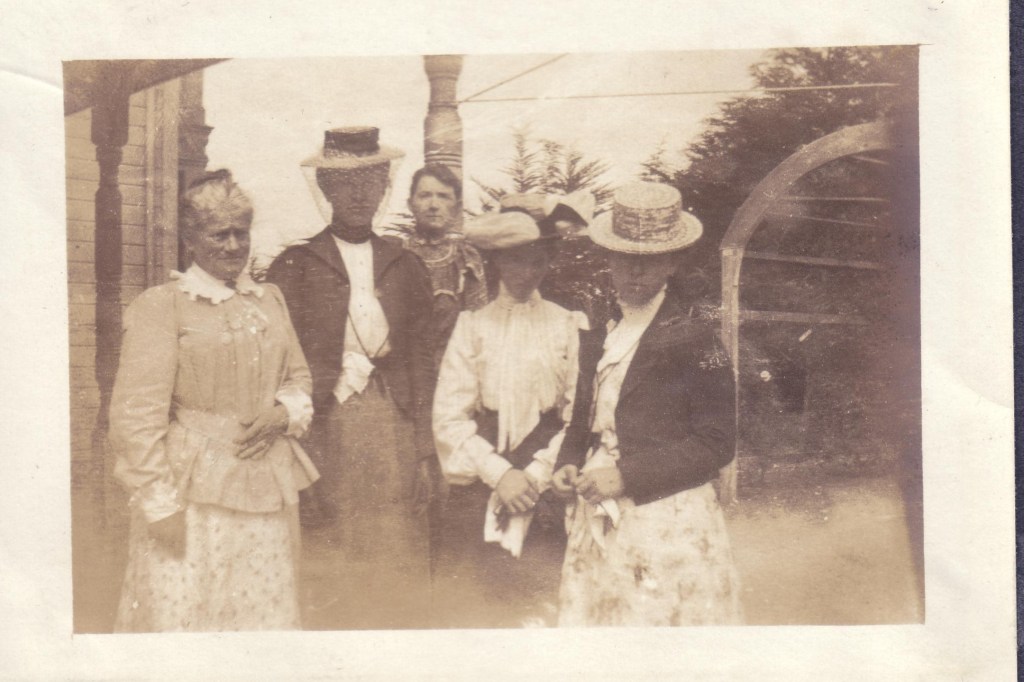
Sarah Moore, left, with Annie “Nita” Grey in the white shirtwaist 1899. Shannon Family Photo
As the big house was always full of her friends and the family servants she stayed with uncle Pat rather than returning home to the ranch in Santa Maria with her parents, brothers and sisters. Part of the families agreement was that Nita be educated and receive a substantial property upon Pat Moore’s passing.
Just two years later Uncle Patrick remarried. He chose a popular local schoolteacher, Miss Mollie O’Conner. The papers made a great joke about this by slyly stating that it was a May December romance and it may have been though in family lore the they were happy together.
The following is from the Salinas Index of July 15, 1903. “It needs no particular explanation to residents of SLO County except that perhaps some would like to know why the genial supervisor did not face the music at home instead of going away to Salinas to get married. “Today at 10 o’clock Judge J H Brown performed a marriage ceremony which united the hearts and lives of Patrick R Moore of Arroyo Grande and Mary “Mollie” O’Conner of Washington. The ceremony was performed in the parlors of the Abbott house and the host and John Lavery and were witnesses to the ceremony.“
“The groom is a prominent resident and supervisor of SLO county and the bride is a schoolteacher. Although well advanced in years at 73, the happy couple boarded yesterday’s southbound train with a happy smile and sprightly step of a couple who might have been just old enough to procure a license. Mollie “O” was all of 42.“
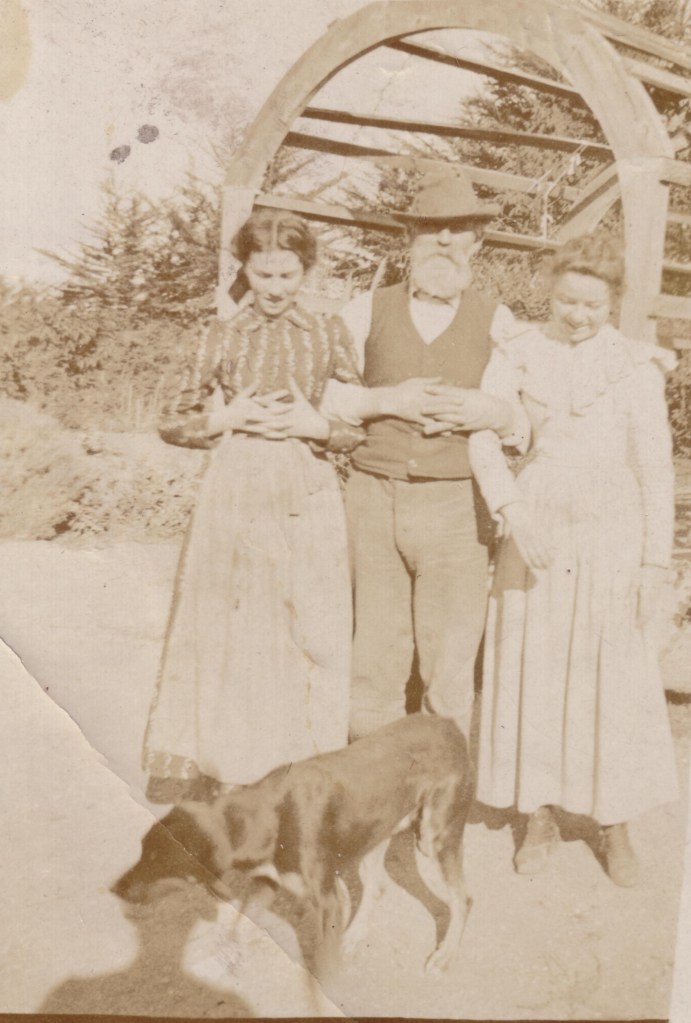
Annie “Nita” Grey, Patrick Moore and Mollie “O” 1904. Shannon Family Photo
Nita had lived her entire life except for the four years in Berkeley and she was very familiar with the beauty of the sand of Pismo Beach. Smooth, satiny; fine as snow drifts turned to gold, carved into wavelets by the wind racing in from the Pacific, polishing each grain to a satiny sheen. The gently rolling hills dusted with yellow mustard and dense clumps of coastal sage, called Chamiso by the Spaniards, covered the north slopes. Dotted on the south and west by groves of ancient Oak trees, this was the land she grew up in. It was the land of Ramona, Zorro, Jacquin Murrieta and was not long ago the pride of the Rancheros; Californios whose Vaqueros rode the slopes and canyons moving the cattle which formed the backbone of their economy. Their heyday just a decade before her birth. She was born on Rancho Guadalupe, she grew up on the old Bolsa de Chamisal Rancho of Francisco Quijada, a large portion of which was then owned by Patrick Moore her maternal uncle in whose home she was raised. She would spent most of her life right there, just a stones throw from the house she grew up in.
In a letter to her childhood friend Mamie, she wrote of her excitement at graduation and the extraordinary gift that Mollie “O” had planned for her. Nita and three of her friends were going to go up to the Yosemite Valley, a place she knew was completely unlike her home in San Luis Obispo county. She was to see the National Park which had just been designated as such by President Teddy Roosevelt four years earlier.
They all went down to the depot and took the Southern Pacific passenger train down to Merced. As early as 1908, the city of Merced, California adopted “Gateway to Yosemite” as its tourism slogan. It was a time when a trip from the coast to the Sierra Nevada took days instead of hours.
It was a nine hour trip because the train was what was known as a local. That meant it stopped at every town on the way. From Oakland, the old phrase “You can’t get there from here” was close to being true. They took the train south to Niles where they changed cars to head east on a spur through Livermore and Tracy to Lathrop and changed again to the local heading down through Turlock, Modesto the Merced where they would detrain again, wait for their luggage to be transferred, and there was a pile of that. Well off women did not travel lightly in 1908. They would need to dress for dinner at the hotels which required fine clothes and all the trimmings which would be unsuitable for adventuring. They packed dresses and sensible low heels. The hiking clothes would have been light canvas or sturdy cotton duck to combat the shrubbery, trees and the ever present dust. The dust, or duff as it’s called is everywhere when the weather was dry. Straw hats, kerchiefs and a vail to keep the insects away. And gloves, certainly, to keep delicate hands free from stickers and nettles.
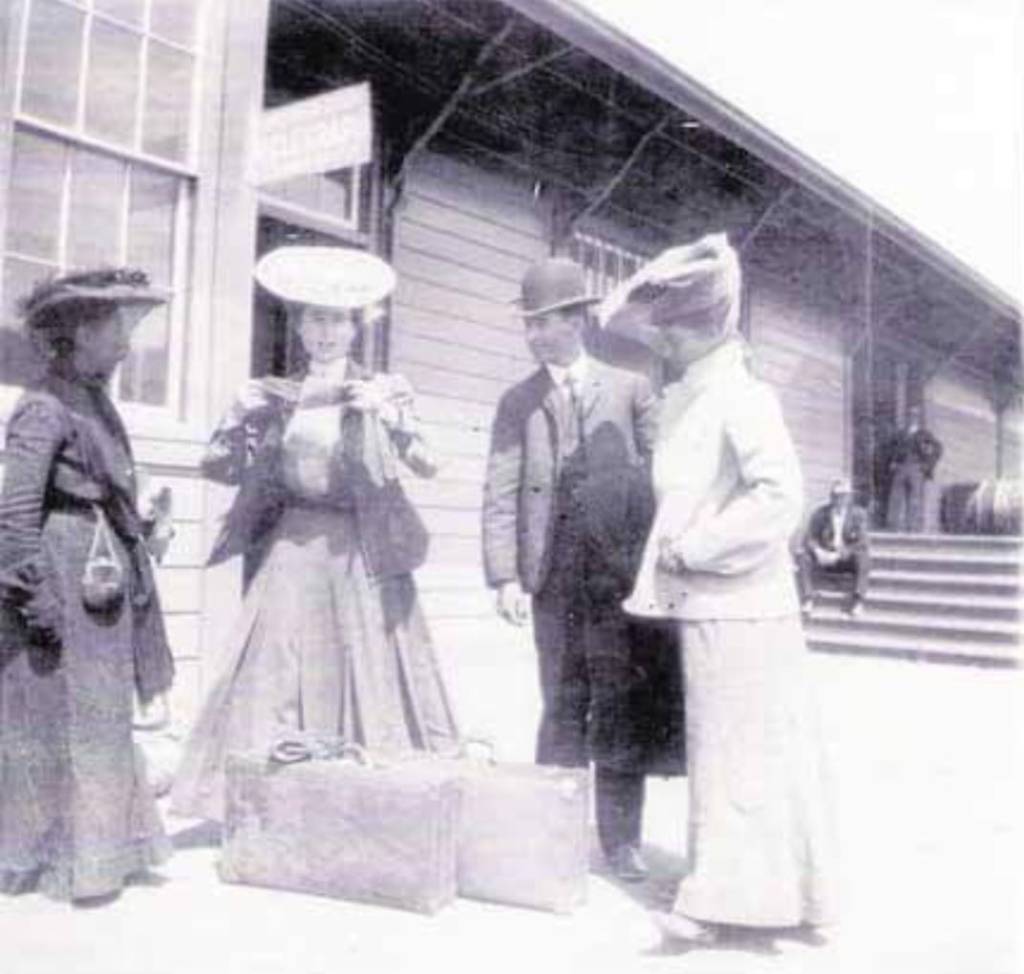
Merced Depot, Nita in the light colored straw hat. Excitement on her face. 1908 Shannon Family Photo.
They stepped down from the cars and had supper at the cafe in the depot while the suitcases and trunks were unloaded and then placed in the baggage car of the short line Yosemite Valley Railroad for the trip up to El Portal where they would spend the night. The little train pulled out of the depot at 2 pm headed up the tracks for the eighty mile trip to tracks end at El Portal. She waddled along at about twenty miles an hour and made fourteen stops along the way arriving at the end of the line around 6 pm.

Del Portal Hotel, El Portal CA. Terminus, Yosemite Valley Railroad at the gateway to Yosemite. NPS Photo
Hotel Del Portal was one of the early first-class hotels established by the Yosemite Valley Railroad to accommodate passengers coming up from Merced to the terminus at El Portal, California, just outside of Yosemite National Park. The hotel set the standard for elegance in the Yosemite area. A trip up to the park was expensive and the formal hotels were built to serve those with the means to come and tour the valley.
The four-story Hotel Del Portal at the eastern terminus attracted celebrities and politicians alike, including William Randolph Hearst of the newspaper game. J.B. Duke head of the American Tobacco Company who introduced “Taylor Made” cigarettes in the 1880’s was one of the wealthiest men in America. Introducing what were originally called pre-rolled cigarettes in the late 1880’s made him. Strangely enough “Taylor Mades” reduced the use of plug or chaw tobacco and the constant spitting it required and is credited with a vast reduction in the transmission of Tuberculosis a disease which is airborne. People could now swap one form of death for another.
Another frequent traveler was John Muir. Muir spent as much time in the park as possible. In 1903, President Theodore Roosevelt visited Yosemite. He was guided by the naturalist. Roosevelt came up to the Wawona Hotel by stage. Rather than checking in to the elegant new hotel he insisted on camping under the “Grizzly Giant” Redwood tree where he slept comfortably on a pile of forty wool blankets. The two men spent three memorable nights camping, first under the outstretched arms of the Grizzly Giant in the Mariposa Grove of Giant Sequoias, then in a snowstorm atop five feet of snow near Sentinel Dome, and finally in a meadow near the base of Bridal Veil Fall. Their conversations and shared joy with the beauty and magnificence of Yosemite led Roosevelt to expand federal protection of Yosemite, and it inspired him to sign into existence five national parks, 18 national monuments, 55 national bird sanctuaries and wildlife refuges, and 150 national forests. Muir’s guided tour for Theodore Roosevelt was the catalysts for the president to declare the valley a National Park in 1906.
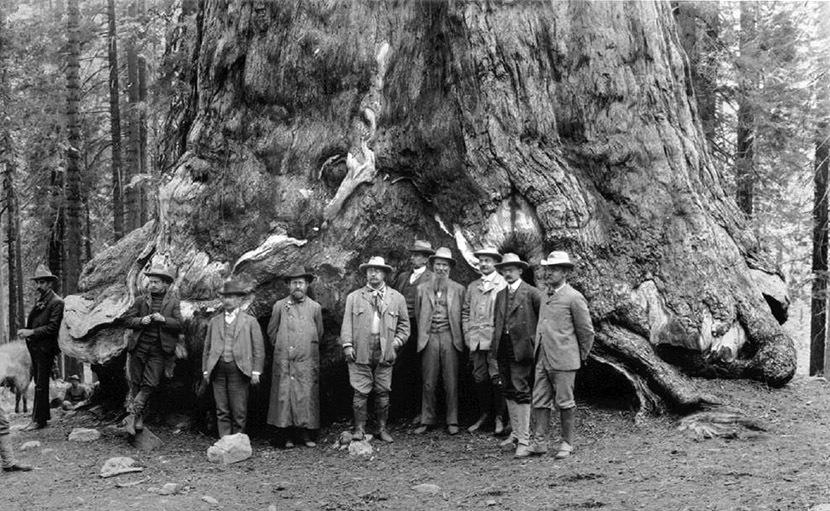
President Teddy Roosevelt and party standing at the base of the Grizzly Giant tree in the Mariposa Grove of Giant Sequoias, Yosemite, 1903. Left to right, two secret service agents; William H. Moody, Secretary of Navy; George Pardee, California Governor; Teddy Roosevelt, U.S. President; Dr. Presley N. Rixey, Surgeon General; John Muir; Nicholas Murray Butler, President Columbia University; William Loeb, Jr., Private Secretary; Benjamin Ide Wheeler, President University of California. Photo Joseph LeConte, Collection of the San Joaquin Library system, Mariposa Library
Muir declared in an article in the Sacramento Record-Union in 1876 “In God’s First Temples: How Shall We Preserve Our Forests?” The articles he wrote began to draw attention to the destruction of California forests. Muir who had worked as a cattle herder in the valley and later the sawmill at the base of Yosemite Falls was a first hand witness to the evolution from wilderness to exploitation at any cost.
Roosevelt himself wrote that, “It is vandalism to wantonly destroy or to permit the destruction of what is beautiful in nature, whether it be a cliff, a forest, or a species of mammal or bird. Here in the United States we turn our rivers and streams into sewers and dumping-grounds, we pollute the air, we destroy forests, and exterminate fishes, birds and mammals — not to speak of vulgarizing charming landscapes with hideous advertisements. But at last it looks as if our people are awakening.” or so he wished. More than one hundred years have passed and if my grandmother was here to read the news she would say that little has changed.
Nita and her California University friends were unwitting witnesses to the almost total destruction of the Oaks that gave Oakland its name. The original Ranchero family, the Peraltas referred to the area as “”El Encinal” for its dense stand of California live oaks which are the dominant tree of the coast live oak woodland habitat.This was translated more loosely as “Oakland” in the subsequent naming of the town, as recounted by Horace Carpentier in his first address as mayor: “The chief ornament and attraction of this city consists, doubtless, in the magnificent grove of evergreen oaks which covers its present site and from which it takes both its former name of ‘Encinal’ and its present one of ‘Oakland.” By Nitas time the forest had been completely logged off, as was the five square mile Redwood grove, once considered as most dense in the state, which had occupied the area which was now the Berkeley campus.
Nita, Mollie “O” and Blanche were part of a constant parade of well known and wealthy people who could arrive at the entrance of the valley by train instead of the twelve to fourteen hour stagecoach ride up from Merced as had been done until the previous year. The coaches were taken out of service in 1907 when the Yosemite ran its first trains to the edge of the park.
The following morning Nita breakfasted at the Del Portal and then saw her luggage loaded aboard the coach which would take her party up through the entrance to the park and the Sentinel Hotel where they would stay. After the turn of the century, The Sentinel was the only operating hotel in the valley. Because it was not winterized it remained closed during the winter season and only operated during summer.. This made little difference since the valleys total attendance was fairly low somewhere between two and five thousand a year before the railroad opened in 1907. The Yosemite RR made the trip up much easier. After the railroad arrived, along with the opening of the Del Portal Hotel, visitor numbers grew significantly . From 1908 to 1909 attendance grew to over 13,000, a leap of 5,000 from the year before. It doubled in attendance in 1915 to over 33,000 . Numbers would rise dramatically when automobiles were first let into the park beginning in 1913. In 1919 at the end of The Great War attendance jumped to over 58,000. Last year, 2022 the number was over 3.5 million.
Nita saw the park in the last days before automobiles, high numbers of people and a proliferation of new hotels, camps, paved roads, restaurants and visitor centers began the clogging the valley floor.
Risng earlyNita and her party took breakfast and then watched the loading of their luggage in the boot of the Mahta Wagon on which they would travel the rest of the way to the valley.
Manufactured in Merced, the Mahta was an 11-passenger stagecoach. Manufactured by Schofield & Alvord, it was a type of coach known as a Mud Wagon. Lighter than a Concord coach which is the coach featured in western movies, the Mud Wagon was the most common stagecoach seen in California. The Mahta was specifically designed for the Yosemite run. With comfortable upholstered seats it made several daily trips between El Portal and the valley. The road along the river was fairly level and the seventeen mile trip could be made in a day.
With picnic lunches supplied by the hotel, Blanche, Molly “O” and Nita settled into their seats excited by the day to come. They had dressed for the trip in sturdy side button shoes and skirts made of duck designed for the outdoors. Bonnets secured by hat pins and veiled against the dust and flies they laughed with anticipation as the coachmen shook the ribbons and clicked his tongue to set the four horse team in motion.
Traditionally coachmen who drove the California stages were called whips, and some, Jehu’s. In the Bible, it is noted of King Jehu that “he drives furiously” (II Kings 9:20). In the 17th century, English speakers began using jehu as a generic term meaning “coachman” or, specifically, “a fast or reckless coachman.” California had its share too. Charley Parkhurst known as “Six Horse” or one eye, for he’d lost his left eye to a horses hoof, drove his stage horses hard and like Hank Monk’s drive with Horace Greeley across the Sierra on the old Overland stage which was chronicled in Mark Twain’s “Roughing It.” For Sam Clemens, that was Twains real name, wrote, “I can tell you a most laughable thing indeed, if you would like to listen to it. Horace Greeley went over this road once. When he was leaving Carson City he told the driver, Hank Monk, that he had an engagement to lecture in Placerville, and was very anxious to go through quick. Hank Monk cracked his whip and started off at an awful pace. The coach bounced up and down in such a terrific way that it jolted the buttons all off of Horace’s coat, and finally shot his head clean through the roof of the stage, and then he yelled at Hank Monk and begged him to go easier–said he warn’t in as much of a hurry as he was awhile ago. But Hank Monk said, ‘Keep your seat, Horace, and I’ll get you there on time!’–and you bet, you bet you he did, too, what was left of him!”
By Nita’s time coaches no longer carried the mail or Wells Fargo strongboxes. The last stage robbers were long gone as were the Jehu’s. Her coach traveled at a sedate pace, bumping and rattling up the road. Any jostling was done by the seat-mates craning their necks to see the increasingly spectacular scenery as the canyon cut by the Merced River, which they were following began to narrow, nearly sheer cliffs rising high above them.
Stepping down from the mud wagon, the party took a quick lunch break sitting on fallen logs with the rivers chuckling in the background. The scent of pines filled the air, so different than the smells and sounds of the city of Oakland. Boarding the coach and settling down they continued towards Arch Rock, the entry to the valley. Two huge granite boulders had tumbled down and formed an arch through which the road traveled. A quick photo stop and then they moved on. The very tall trees closing in on the road created a vibrant green tunnel dappled by sunlight.
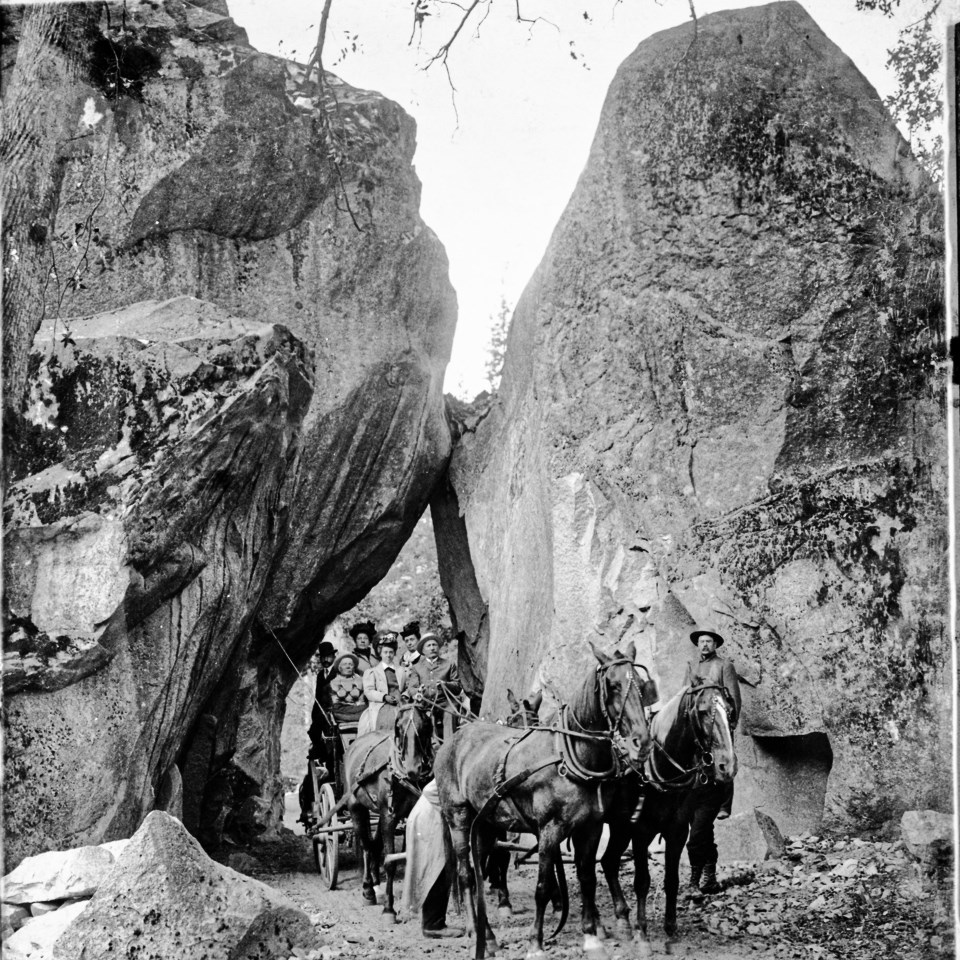
They traveled the road for a couple of miles when suddenly after a slight turn to the right, in an opening directly ahead, Bridal Veil Falls appeared as if by magic. Falling in a graceful sweep and wreathed by sunlight and sprays of water, it took their breath away. The gasps of his passengers caused the driver to smile, he himself felt the same awe each day as he entered the valley.
Soon the valley began to open up and on their left, El Capitan rose nearly a mile and one half straight up, towering over the valley, it sent a shiver of dread through the women. None of them had ever experienced anything like it. Off in the distance, Half Dome, rose more than a thousand feet higher than El Capitan. Nestled in the valley below sat the Sentinel Hotel, their destination.

The Sentinel Hotel and the Merced River. Library of Congress
The stage pulled to a stop in front of the verandah, the driver stepped down and helped the ladies alight. He then opened the boot for the bell boys to begin hauling luggage up the steps and into the hotel. Molly “O” was excited because she had a surprise for the girls, she had reserved the most spectacular room in the hotel for the princely sum of $ 5.00 a night.
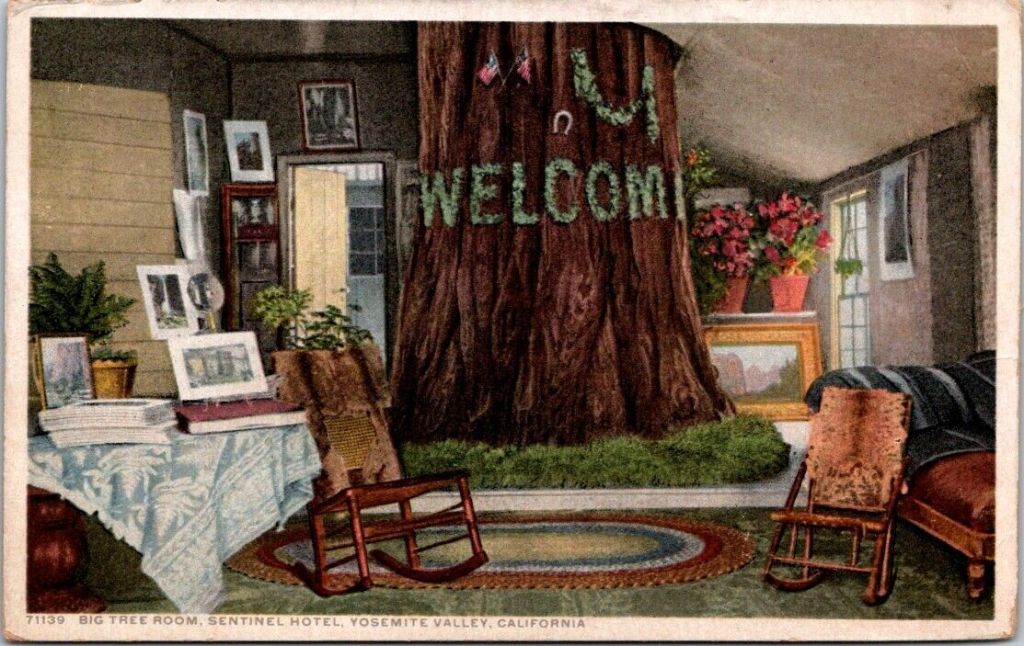
The Big Tree Room, Sentinel Hotel postcard addressed to Mr. and Mrs. Samuel Grey, Nita’s parents. Shannon Family Collection.
The room was built around a 175 foot Incense Cedar tree. Not a piece of a dead tree but a live one. When they settled down after dinner the smell of cedar lulled them off to sleep.
When they came in to breakfast they saw on the wall of the dining room the famous photo of two girls standing on the overhanging rock at Glacier Point. They stopped to take a closer look and were thrilled that they would be going there to see it for themselves.
Miss Kittie Tatsch, a maid and for a time head waitress at the Sentinel hotel in the late 1890s and early 1900s, obviously a young woman with a cool head and; apparently, entirely destitute of nerves went up to Glacier Point and did a high kick on this perilous perch with her friend Katherine Hazelston. Dressed in long wide skirts identifying them clearly as women, they danced and did high kicks at Overhanging Rock, 3,000 feet above the Valley floor at Glacier Point The photo known as the two Kitties was on sale at the hotel when Nita arrived. She could look up from the verandah and see the point high above her. She was eager to go and see it for herself. She wondered, did she want to go out on the Rock? Would she?

The Two Kitties on Glacier Point. Photo: George Fiske, Collection, Library of Congress
The Four Mile Trail, linked Yosemite Valley to McCauley’s Mountain House at Glacier Point. Helen Hunt Jackson, author of “A Century of Dishonor” (1881) which chronicled the injustices perpetrated against American Indians, described the trail as “broad, smooth, and well protected on the outer edge, at all the dangerous places, by large rocks forming a low wall. Although it is the steepest trail out of the Valley, zigzagging back and forth on a sheer granite wall, one rides up it with little alarm or giddiness, and with such a sense of gratitude to the builder that the one dollar toll seems much too small.”

All aboard for Glacier Point. Library of Congress
The coach left the Sentinel, everyone aboard anticipating an adventure. Turning left onto the Glacier Point road the passengers were aware that on one hand the granite cliffs rose almost vertically and dropped off into sheer cliff on the other. Helen Hunt Jackson’s description of the road notwithstanding, The women shared a little alarm and a lot of giddiness. Nita knew they were safe and she shared later that the quakes and fears were simply delicious. Soon enough the coach rolled onto the granite terrace behind the point and came to a stop. Stepping down, the whip pointed out the way to Overhanging Rock and they walked toward it.
As they neared the edge they began craning their necks and had begun to sidle like crabs as the drop off neared. Chins up and weight on the back foot they stopped at the base of the rock trying to see without leaning too far over. It was a long, long way down. Finally by clustering together and screwing up their courage they they began to sidle sideways out onto the rock, not daring to lift their feet, carefully sliding their feet until they finally got as far as they could bear and holding hands for balance, they sat down. They felt so brave. And why not.
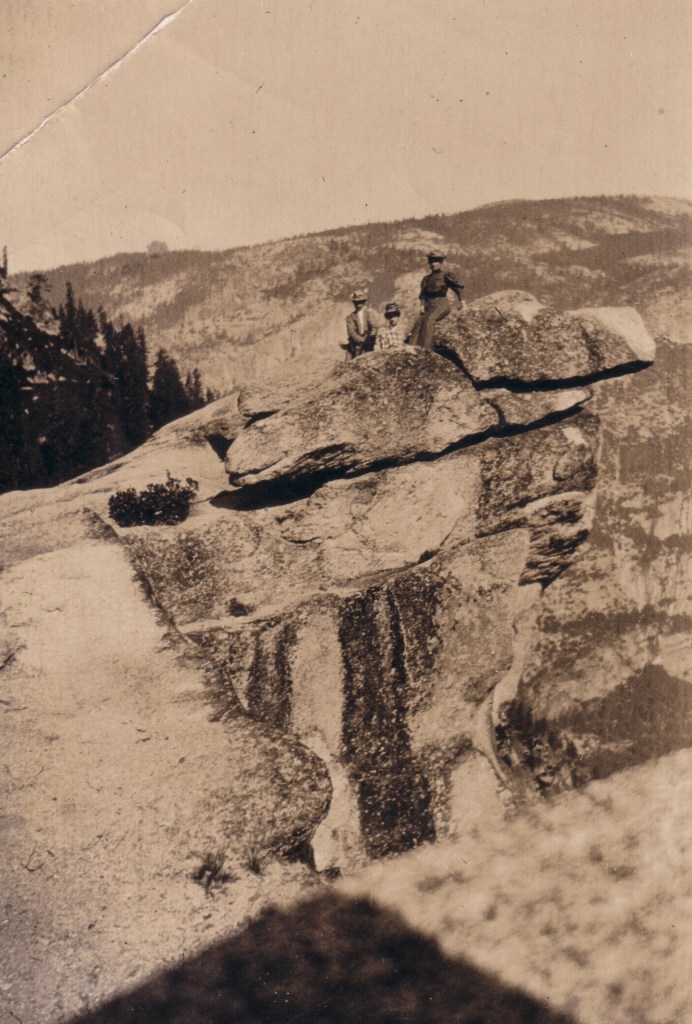
Blanche, Nita and Molly “O” on Overhanging Rock, Glacier Point. June 1908. Shannon Family Photo
The next three days were spent walking about and exploring. Mirror lake was astonishing in the morning light when it lived up to it’s name and reflected both North Dome and Half Dome in its polished surface.
They walked across the Merced River on the old log bridge holding onto the single handrail as the river, still running high in early June speckled their clothes with droplets of water come from the highest ridges of the Sierra where the ice never melted.
Yosemite Falls was magnificent, tons of numbingly cold water pitched from the ledge at the top and falling in waves of lace shimmering in the midday sunlight, rainbows dancing in and about like a kaleidoscope.

Molly “O,” Nita and Blanche, Merced River crossing June 1908. Shannon Family Photo.
When they returned to Berkeley Nita rejoined her husband Jack whom she had married in April, just six weeks before graduation. They moved into their home at 1927 Dwight Way, just off campus. The singular adventure of University life and her trip to Yosemite were the capstone of her single life. As was common, then, she surrendered half her life to her husband and just ten months later to her first born, my uncle Jackie, she gave up the other half. As my father was wont to say, a first class education and the opportunities it brought, limited as they were for a late Victorian girl were set aside and a long life as a housewife began. She put her memories away in a white cardboard box kept in the cupboard for the rest of her life. Nita became Annie Gray Shannon again.
She was born 75 years too soon.

A bemused Annie “Nita” Shannon and her new husband, April 10th, 1908 in the pretend car. Shannon Family Photo
Epilogue:
Yosemite is a place the family has returned too again and again. It has a mystic power that causes the mind to soar. As children we stayed at camp Curry and walked out into the meadow, sat on the grass and saw the Fire Fall. We marveled at mirror lake and inched closer to the edge of Glacier Point just as our grandmother had. I held my mothers hand to peek over the edge. So delicious for a kid. My wife and I honeymooned there in the old Ahwahnee. We’ve been to the old LaConte Lodge which is now a museum and skied the pass in winter. We’ve been to the chapel where the first non-denominational services were held in 1879. We introduced our own children to its wonders. Such a marvelous place.

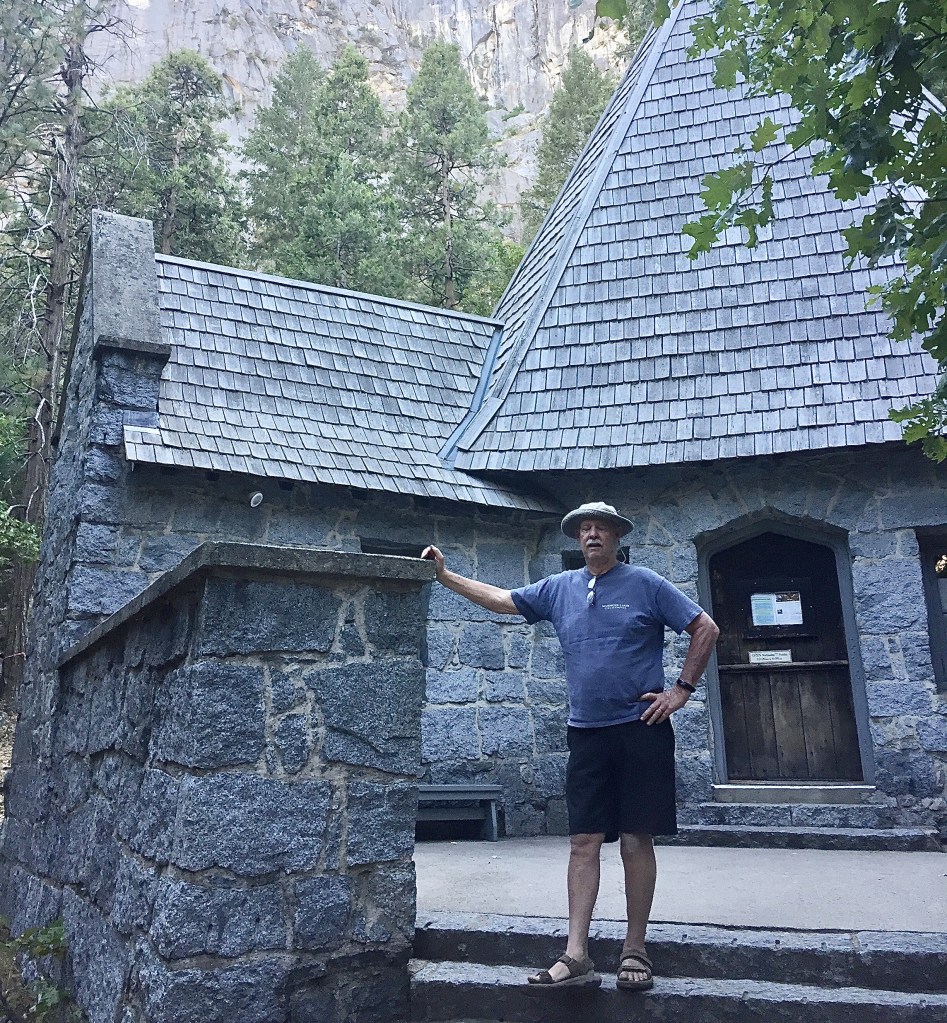
Grandmother and grandson at the Le Conte Lodge, 1908 and 2019
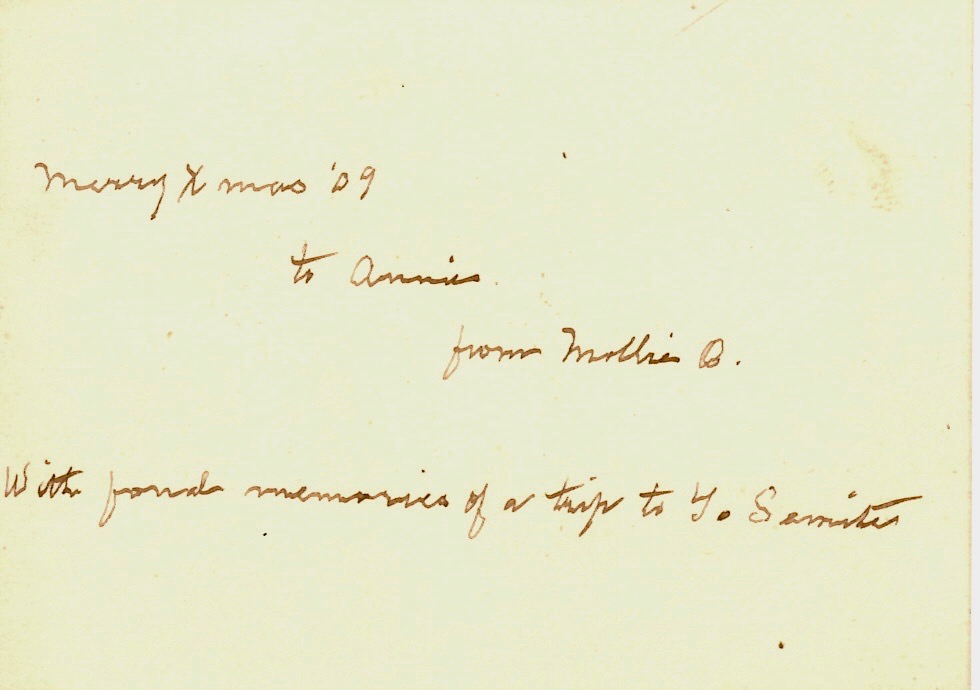
Many, many years later I found this little card in a box of my grandmothers things. The photos and postcards and letters all together tell the story. The fact that she kept these things for her entire life, moving them from home to home gives them a special significance. The are the foundation of this story.
Michael Shannon is a World Citizen, Surfer, Teacher and a writer. He writes so his children will remember the good family they come from.


 atthetable2015