When I was a little guy I would sit at the kitchen table and listen to my parents talk. I wasn’t home schooled, I went to a regular school, a two room one nearly a century old but my real education came as I sat at that grey Formica table and listened to lessons from my parents and their friends. I don’t think they saw themselves as teachers but those little lessons have been rattling around in my head. I’ve been trying to catch up with that time all of my life.
My dad was a big teaser. He loved to tease his mother, my grandmother, who was easily embarrassed and would blush at the drop of a hat. He especially he liked to work on us, his three boys. Almost every thing he said had some little joke woven into it. Some play on words that he knew would confound us. Teach us too. What would you expect from a man who kept a very well thumbed World Almanac right on the kitchen table next to the salt and pepper.
Some of his talk made no sense to me. Such as, who was Leonard Rong and why was he the opposite of Leonard Wright. I heard right and wrong. No one explained this to me. They just tossed out names as they spoke with no explanation added. I’m sure mom and dad never thought twice about explaining who these people were, we were just little kids and didn’t know those men. I had seen Leonard Rong and he looked all right to me, nothing about him seemed wrong. When I asked why he was wrong, dad said, “Why he’s a man out standing in his fields.” What did standing in the field have to do with it. The little mind tried to fill in the gaps.
I mean, did “Dick Dock” have a real name or was the eponymous one just too good not to use. And how about George Arita? George, what Japanese man used the name George? I knew Kaz, Stone, Sab, Haruo and Aki, but George, it didn’t seem correct. There was no explanation for “Jinks” either, or “Ace,” “Bunny” “or “Arza.” Ace was a cool name, Arza seemed weird and what grown up is named Bunny. Seriously, we just though they were making a joke.
My dad sold some of his vegetables to a Mister Get in Los Angeles. I gathered that he was a Chinese man which confused me because I wasn’t sure whether Mister was Chinese or not, and did he go get something, was that his job, getting things. So confusing. Later on I went with my father to Mister Get’s home in Silverlake and had dinner with he and Mrs. Get. It was pressed duck. What! What did they mean pressed duck? Did they mean it was picked up off the highway or was it smashed by a heavy weight. Dad said it was cooked with a brick. How is that even possible. There was no telling.
What about “Coot?” I didn’t think that was real name for a person. I mean the little black ducks with yellow feet that swam in the Oceano lagoon were Coots, but a person. I didn’t think so but when I asked Pop about it he just laughed and said, “Silly Boy.”
My great aunt Anna lived in Santa Ana. Well, OK, but who was she and why was she ever mentioned? Dad said she was a spinster. A What? Was she good at spinning around, did she spin webs? Please explain. I saw her once, she was dumpy, another confusing word, had her hair tightly curled as maiden aunts did in 1955 and turned out to be a seriously vague person, at least to me. She wore a blue dress, pointy spectacles and sturdy shoes. There was no spinning.
We wondered why aunt Mickey was named after Mickey Mouse and my aunt June after the sixth month. Was she born then? Were grownups deliberately trying to confuse their children? Maybe it was a trick my aunt started so that we’d remember her birthday and get her a present.
My dad did not swear, or if he did he sure didn’t do it in front of us. He did have a few choice words he used though. Once he called a man a chiseler. I thought that meant he was a carpenter and built things but at the same time I knew the man sold groceries so how could he be chiseling? It just didn’t make any sense. Dad once called someone and S. B. in my hearing and being about six or seven, I said, “Daddy, whats an S.B.?” He explained that it meant the Silva Brothers, Manuel and Johnny who farmed next to us. When I mentioned it at school, Manny jr. took a swing at me which made it all the more confusing.
My uncle Jackie had some phrases he liked to use. He would say “It’s the Berries.” What in the world were the berries? Did he mean we were going to eat some or pick them, he never explained. How big was a bunch of malarkey? Was it something that needed to be counted or possibly weighed. I once heard him call someone a “Dumb Dora,” to which my dad replied, “She ain’t so dumb.” They both laughed at this. Was it some kind of secret code? We didn’t know. Made me feel like a “Dumb Cluck.”
My mom told dad that my cousin Brucie was a Holy Terror. I thought she meant he tore up hymn books or Bibles in church. Later on I learned from himself that he really was, he smashed my toy truck and hit me with the same stick for telling on him. Mom was right as she so often was.
Gobbledygook, Hodgepodge and flabbergasted were enough to make your head hurt. Parents could talk in a language that was almost foreign or maybe it was and children were not supposed to understand.
My aunt Eva talked to me about her dog Skipper and said that after Thanksgiving dinner she was going to walk him. What in the world did that mean? Every dog I knew could already walk. We never had any dogs that couldn’t. Matter of fact they almost always ran. From here to there and after the pickup, the tractors or they ran in circles around my dad when he was in the fields. Aunt Eva lived on Orange Street in Santa Maria which was the largest city I had ever seen so I assumed that strange goings on happened there which I knew nothing about. The street wasn’t orange either, it was grey colored, so, see what I mean?
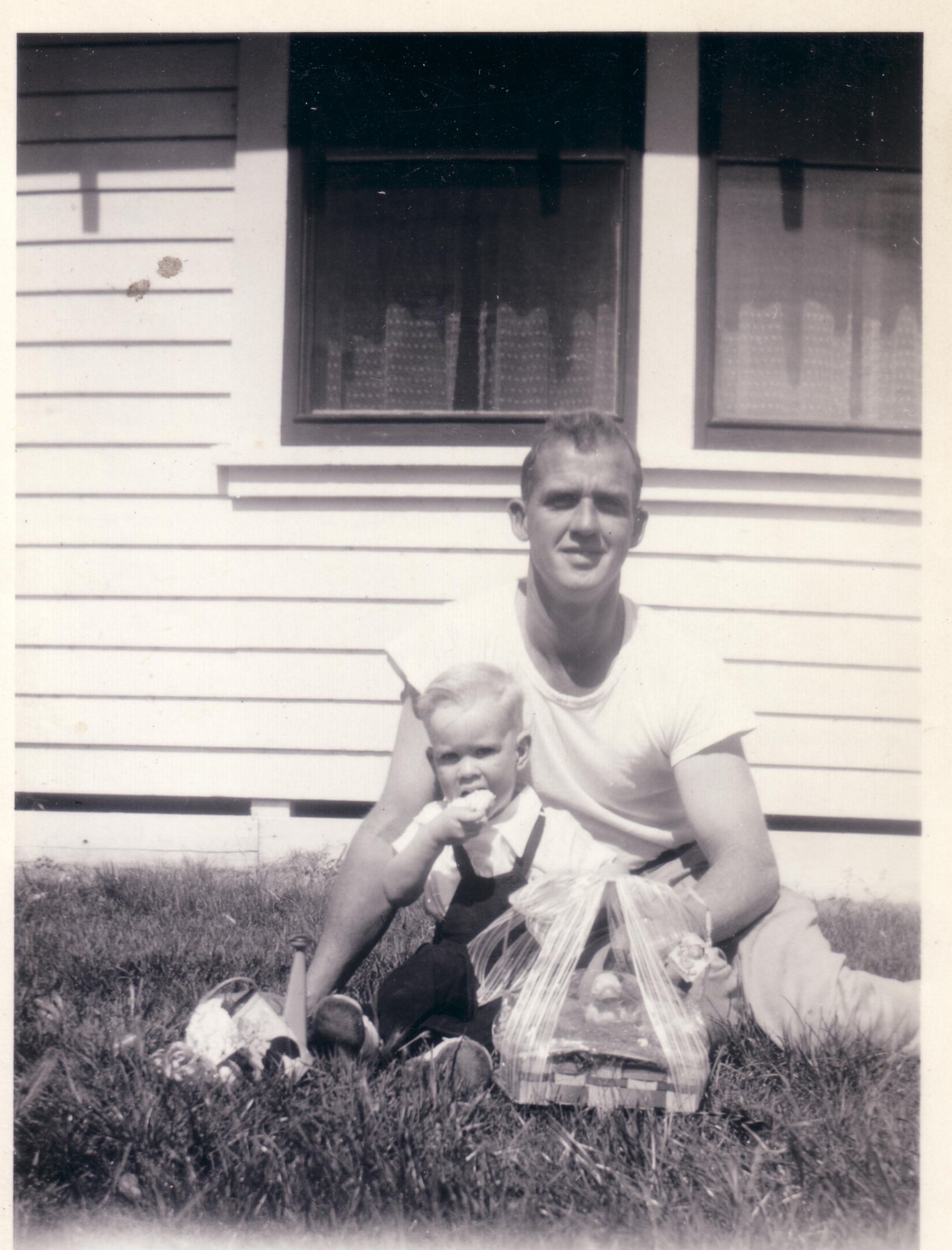
My parents being silly. 1943. Shannon Family Photo
Then there was the cornbread. Cornbread was a staple of our diet in the fifties and I’d say all the kids liked it. My mom didn’t use recipes much, she cooked from scratch, another word that didn’t seem to make any sense but cornbread was easy and in lean years it might be the main course. The kids ate it with butter, my dad did too but my mother put it in a glass of milk, stirred it and ate it with a spoon. That seemed so strange to me, I mean, we were four against one when it came to eating it the right way I think. She said it was because she was from the south but like all confusion she wasn’t from the south, she was from California, born and raised. Her great grandparents were from Mississippi and came through Texas to Anaheim but that wasn’t her. She never traveled there. I just though that parents would naturally be on the same page. Boy was I wrong about that. And what exactly is the same page?
Another one; what’s a Mairzy Doat? It simply could not be explained. Dad said it was a song. Must be in a foreign language because I’d never seen either a Doat or a Mairzy. Maybe like a horse? I don’t know.
When my dad got a little transistor radio he told me that, “It was the greatest thing since sliced bread.” Come on Pop, everybody knows all bread is sliced. It comes in a blue and white checked plastic wrapper and its in pieces, nobody has to slice it. I knew he was pulling my leg then.
He once told me he drove out to the See Ranch and that it was out past Bunny’s on the way to Stony Creek. See the problem?
Was there no end to it? Please explain these things to me Dad. He said “I’ll do it when the cows come home, O K?”
He didn’t though, we lived in a time where children were seen but rarely heard. We would have to figure it all out ourselves. Maybe it would all be clear under the Blue Moon. I don’t know. I could be Rong.
Set the dial for late spring 1898, Arroyo Grande, San Luis Obispo County California. Deep in the center of the old Cow Counties.
We got our news from the local papers, the saloon, the cafe and the poker table. Wheels (Bicycles) are all the rage. It’s a small world in the Bloody Fourth. The fourth supervisors district had a well deserved bad reputation as does the rest of San Luis County. The last armed holdup of a stagecoach occurred on the Cuesta grade in 1888. Arroyo Grande men lynched a fifteen year old boy and his father in 1886. They left them hanging from the Pacific Coast Railroad bridge for all to see, including children on their way to school. The illegal lynchings far outnumbered the legal ones. (Just one legal ) Nearly the entire male population of Arroyo Grand had descended on its little Chinatown and sent the 25 residence running. They burned it to the ground. Saloons, Arroyo had eleven, were frequent scenes of gunplay. The town constable of Arroyo Grande was gunned down in the Capitol Saloon and the shooter got off on self-defense. Soiled Doves thrived in all of our the counties little towns and San Luis Obispo’s was reportedly first class. My great grandfather John Shannon still occasionally carried his Smith and Wesson .41, left over from his days as a Santa Clara County sheriffs deputy. My great, great uncle Patrick Moore, a native of Cavan, Ireland, sits in the fourth’s seat at the Board of Supervisors.
The Arroyo Grande Herald:publishes a report by the U S Navy recognizing the existence of Sea Serpents. We’re glad this vexatious matter is closed.
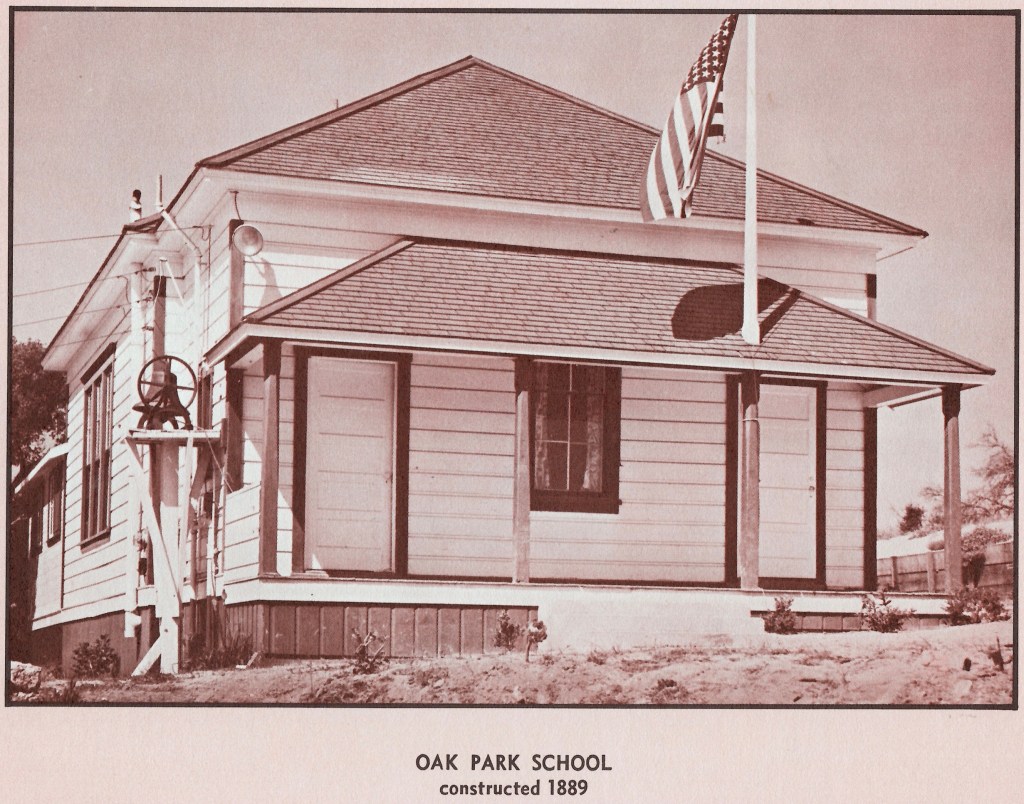
As it is, it has ever been. Styles change, Technology does too, people don’t. In 1900, San Luis Obispo counted over a hundred schools. Names like, Liberty, Banning, Freedom, Cienega, Nipomo, and Branch. There was Allaince and Eagle in Shandon, Edna and Freedom, York Mountain and La Paloma in the upper Los Berros Canyon. Each one served children who lived within short distances. Some had enrollments where almost every child had same the last name. Oak Park school was full of Patchetts, Nipomo sported Dana’s, some were filled with children of almost every ethic or immigrant group you could imagine. Most saw the importance of education for their children. Some citizens saw waste and fraud and were determined to set things “Right.”
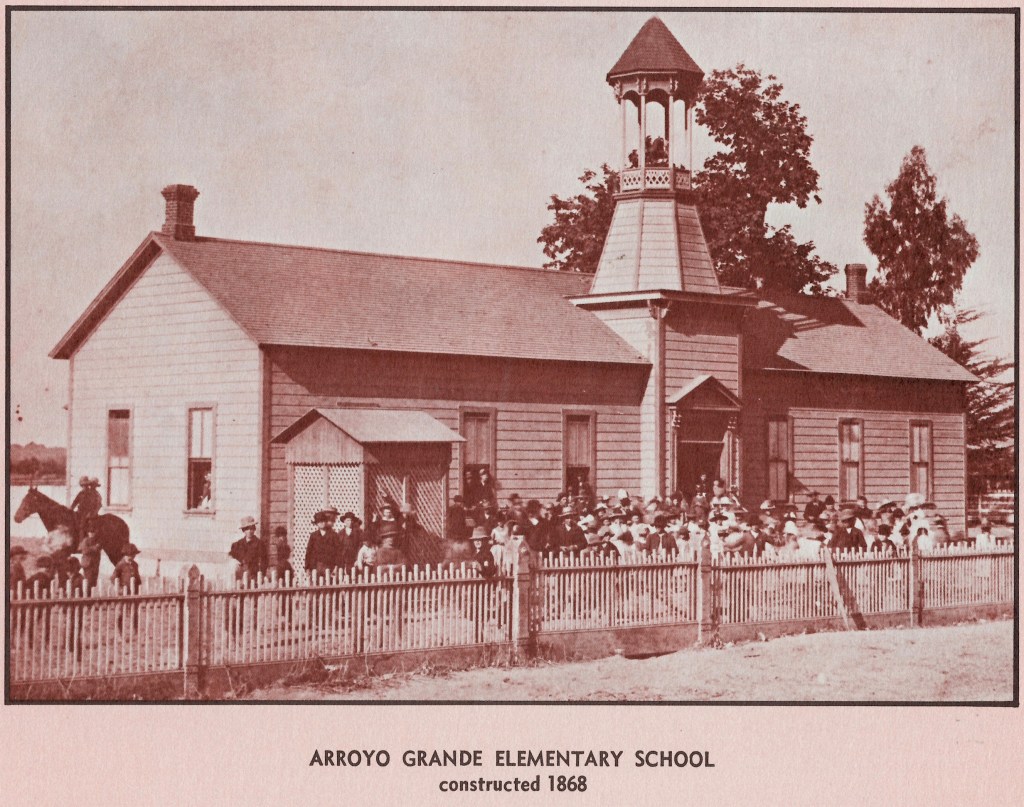
Built at a cost of $ 793.50 by B F Stewart of Arroyo Grande. “26 x 40 feet and of a pretty design.” SLO County Schools photo.
It’s a drought year and warnings of reduced water use are rampant. In those days there were no dams or state water projects to take up the slack. Periodic droughts had devastated the cattle ranches over the previous two decades and led to the economy diversifying. Farming, particularly orchards and dairy had picked up the slack. Dried fruits shipped from Port Harford and dairy from Spooners landing on the Pecho Rancho were thriving business’s. Hopes for the Southern Pacific’s completion of its line between San Francisco and Los Angeles was rampant but “The Gap,” as it was referred to was still in the future. Freight could only travel by wagon north from tracks end at the tiny town of Surf in the Lompoc Valley.
TheEvening Breeze:County supervisors pass an ordinance restricting the harvest of Abalone in the north county.
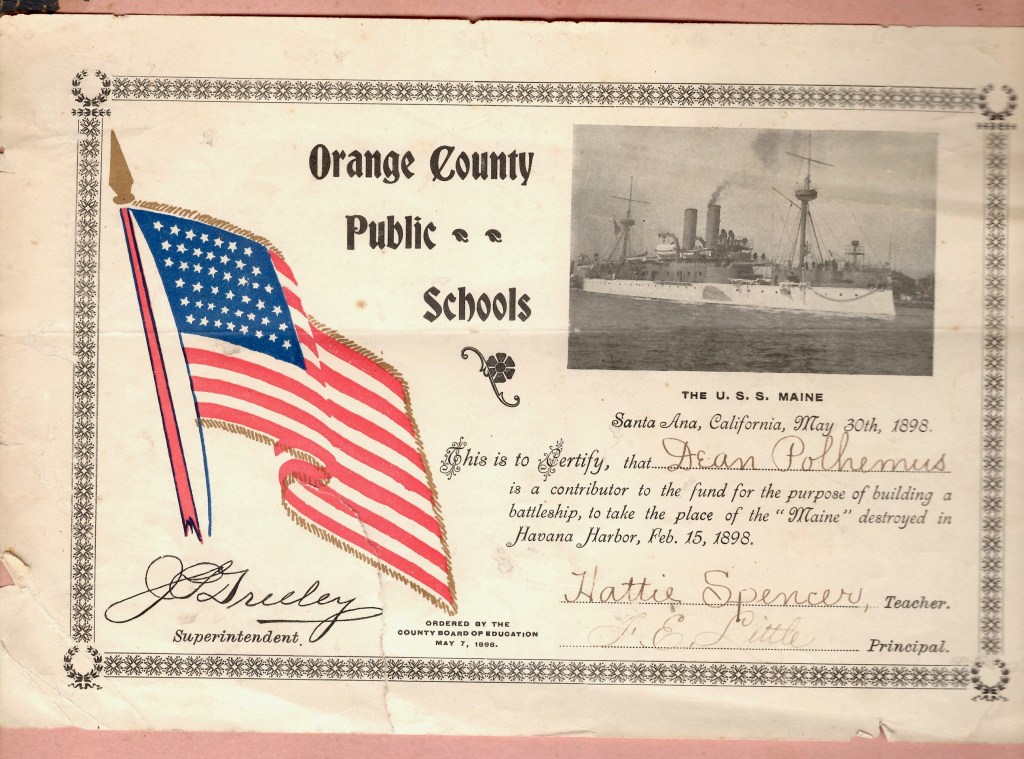
The Spanish American War had begun on April 21st after the American battleship main blew itself up in Havana Cuba. The California National Guards Rangers, Company “G” was actively recruiting in the county. As usual Patriotic Fever was driving young men to sign up in order to go punish the dastardly Spaniards. “How dare they spit on our noble flag.” Thats an actual quote from our own Arroyo Grande Herald newspaper, the Democratic voice of our community. The Republican newspaper, the Recorder published by a local saloonkeeper and brick maker was equally strident. Peter”Pete” Olohan, what bartender was ever called Peter, was a very successful saloon keeper and ran the towns first brick kiln behind his business along Arroyo Grande creek. His bricks made from clay silt deposited on Tallyho creek just below Becketts lake. His bricks transformed the town as merchants quickly replaced many of the old western style buildings with new brick structures.
San Luis ObispoTribune:The news of Arroyo Grande states that a firewood famine is imminent. Most of the dry wood has been shipped to San Francisco and due to the over cutting of Oak trees, little will be available for winter.
Little Dean Polhemus gave five cents to build a new battleship Maine. 1898. His son would die at sea in WWII. Patriotism takes many forms. Shannon Family Photo
Every paper in the county was beating The Long Roll as hard as they could, war fever was everywhere. Flags and red, white and Blue bunting were on sale at Wardens store in San Luis and at Aron and Alexanders in Arroyo Grande.
The Arroyo Grande Recorder:The nefarious Spanish overlords of Cuba have used and infernal Device to blow up the battle ship Maine and school children are sending their pennies to build a new one.
Young men like Joe Bristol, George and Frank Dana, Joe Dominguez who, along with Ed and Burnett Knotts, a cafe owner from Nipomo drove up to the courthouse and took out enlistment papers. Shipping out for Cuba would end Nipomo’s superb local baseball team as the players, in a fever pitch for war made their way north to volunteer.
Arroyo Grande Herald:Mrs J.D. Skidmore grew a tremendous Strawberry more than ten inches in diameter.We think it would take a couple big bites.
A June 1998 notice in the Herald listed the names of the graduates from the Arroyo Grande Elementary School. Annie Grey and John “Jack” Shannon are among the eighth graders. My future grandparents. If you look at their birthdates, his being three years before hers, you might wonder why they are in the same class of graduates at all.
Arroyo Grande Elementary school. Annie Gray in all white, 1st row, . Jack Shannon 2nd from right back row.
If you are counting there are 27 girls and only six boys. Not uncommon for the time, education not being entirely necessary for boys and what did you do with a girl until she married and had children anyway?
My grandfather, like many boys at the time was considered grownup and able to do a mans work. He knew this. His parents did too. They owned an orchard and raced chickens for eggs and meat and 14 year old boys were essentially free labor. There is a family story that illustrates this to a tee. My grandfather once asked my father if he would rather go to church with mommy or stay home and milk cows with his father. He chose cows. He was eight. That was 1920. The idea still persisted that if you were old enough to do work; you did.
Arroyo Grande Recorder:Hunting season has opened and the boys are determined to make the Quail and Ducks less numerous.
My grandfather wasn’t resistant to education, after all my he sent my father to Cal, Class of 1934, it’s just that the times didn’t require that most men be able to do more than read, write and do arithmetic. “The lack of education didn’t hurt me none”.* Jack Shannon didn’t have the patience to read the law or be a professor of anything though he certainly could have. He just couldn’t sit still. Dad once said of him; “When your grandfather cut hay, he cut hay,” meaning he was all in on anything he did.
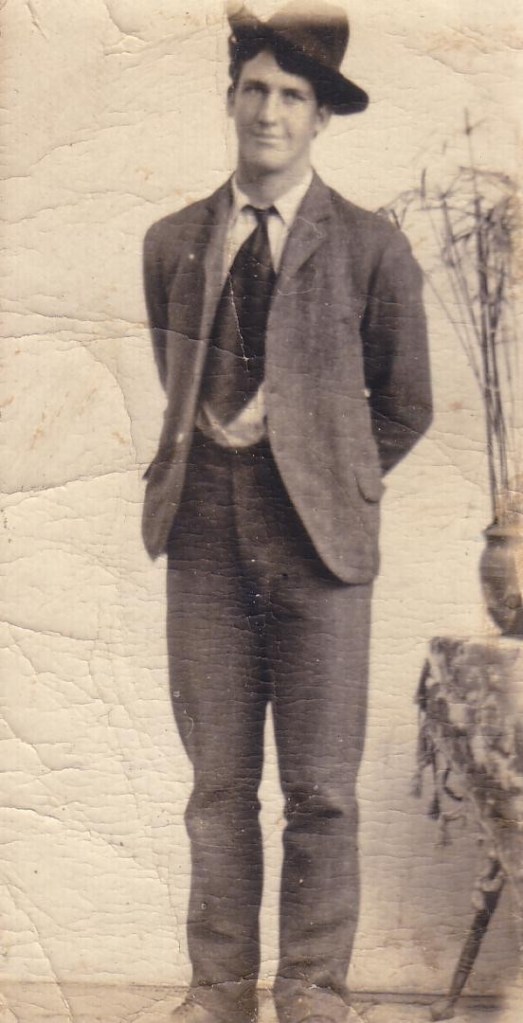
John William “Jack” Shannon about 1897. Shannon Family photo.
It wouldn’t have made any difference to him anyway because that same year the Arroyo Grande High School was savagely disenfranchised and closed and it looked like it was for good. San Luis Obispo High School had just recently barely survived the vote to close it. Education for children past fourteen was under attack.
San Luis Obispo Breeze: The board of Supervisors has voted to allow the purchase of a typewriter for the office of education.
Somehow the past always seems be much more idyllic than the present. Not as messy. A Norman Rockwell dream, a Horatio Alger, poor but noble boy pulling himself up by his bootstraps to run a railroad kind of story. Certainly not the Sinclair Lewis “Hey, lets go work in the Chicago slaughter houses” kind. Think of the plowboys wiping their brows, attached to the nether ends of horses, trudging through the fields for hours and days on end. You don’t need much education for that.
Boys from wealth should be educated because, after all, someone had to run the country. Working class kids were needed for other things. Hard rows needed hoeing.
Arroyo GrandeWeekly Herald:The citizens of Arroyo Grande have subscribed money to buy leg irons to be used on vagrants who refuse to move on. The miscreants will be sentenced to work at hard labor on the roads
The local newspapers tell the story. In the style of the late 19th and early 20th century features and opinion pieces chronicle the story of how all this destruction of education happened. In the snarky, joking writing style of the day in which papers didn’t try to hide their politics behind professed fairness, after all they needed advertising revenue to stay profitable and news was crafted to satisfy the politics of men. To wit; in Arroyo Grande there were two newspapers, The Herald, a Democratically inclined publishing house and The Recorder owned by brick maker and saloon keeper Pete Olohan a staunch Republican. From opposite ends of Branch Street they hurled barbs at each other, a distance of three blocks, the entire length of the little town. Both papers were read and discussed in the saloons and mens fraternal associations like the Odd Fellows and Masons. The talked in the dining houses and with other men leaning on their buggies of a Saturday morning as they waited for the little woman to do the shopping. Chewing on five cent cigars they tossed their opinions about like baseballs, some lobbed, some fired like bullets. If women had any opinions they weren’t listened to for it would still be a decade before they were able to vote. Political power was still out of reach unless it came from the kitchen or bedroom.
San Luis Obispo Tribune:Mrs M. T’ Runels of Nipomo made a hasty trip to north yesterday to attend to the affairs of her son, Harry T Talmadge who was crushed to death by the wheels of a train in the Santa Clara yards while making a hasty escape from the attendants of the St Agnew Insane Asylum.
It is an historical fact that the first state in the union which gave women the right to vote, Wyoming in 1869, believed that suffrage would attract women to move there. Men outnumbered women six to one at the time and it was exceedingly lonely out on the big ranches. That may be so but it should be noted that the wives of the state put their feet down; “Clem if you don’t vote for suffrage, its going to be a long, lean and very cold winter for you out here on the ranch.”
In fact it was the farm and ranch vote that put it over the top. The movers and shakers in the towns didn’t want women meddling in their affairs but they were beaten by ranchers wives. It would be another fifty years after Wyoming that the woman of Arroyo Grande were legally able to vote.
Arroyo Grande Oracle:Two young men named Scott and Foster were arrested yesterday and fined ten dollars each for using rough language to Mrs Donovan who was in her yard as they passed her house in Los Berros.The fine likely hurt less than the horsewhipping administered by the town constable.
So it was money that did the school in. The Cow Counties of Central California were still a farm and ranch economy. The days of the Rancheros was a decade or two in the past but many of the old Ranchos were still operating. New owners in the cattle, dairy or orchard business were being assessed by the school district in order to fund the schools. They didn’t like it. At fifteen dollars per hundred acres it was considered a terrible burden to carry and the whining and screeching was carried on in the papers of the day.
Several years of drought and crop failures had ranchers and farmers on edge. The thought that the county might raise taxes to support schools some though were useless set their teeth on edge. A ground swell to close down the Arroyo high school was growing with prominent men leading the charge. If a man was wealthy enough he could send his children to private high school in San Francisco or closer to home in San Luis Obispo’s Mission school. It wasn’t long before battle lines were clearly drawn.
“The Arroyo. Grande Herald noted in February 1898 that a petition has gone before School Superintendent Meese asking for a special election on the question of disincorporating the Arroyo Grande High School District. The law requires that a petition can only be signed by the heads of families but that many who signed the papers were were not. Many signatures were by men who, no women of course, were in favor of continuing the schools operation. It can be assumed that these men wish the matter brought to a vote and bring this vexing matter before the people of the district and settle the matter once and for all. A few ignorant screechers have been howling against the school for some time and would have succeeded in closing the high school if it wasn’t for the determined fight put up by the Herald last fall, the institution would not now be running. The opponents are proceeding in proper form this time and the Herald gladly accepts the gage of battle and will abide by the will of the people.“
The town of Arroyo Grande was a prosperous community and had a thriving downtown. Three blocks of businesses lined Branch Street where you could purchase almost everything you needed. The Pacific Coast narrow gauge railroad connected it to the harbor at Port Harfod, to San Luis Obispo and points south and east. Oil drilling, quarries and agricultural produce were its main cargo. A person could take a steamer from Port Harford to San Francisco which was California’s largest city. Los Angeles was still a dusty pueblo of no particular note. From the Southern Pacific railroads terminal at San Luis Obispo you could travel north to any place in the country you wished.
Arroyo Grande was a wooden, false fronted frontier town with more saloons than you could shake a stick at. There were small hotels, two hardware stores, a pair of blacksmiths and a bakery. At Aaron and Alexander’s store you could buy just about anything. Today it would be called a department store. The idea that you could do all your shopping in one place was still a novel idea in the little town.
Arroyo Grande Herald:A charge of battery is being held against two toughs for hitting a young Portuguese boy with their whip. There was not the slightest provocation for the offense.
Though the streets were still dirt with a sprinkling of gravel or covered with hay in the winter because the wet adobe soil was a thick as peanut butter and your buggy could sink up to its hubs after a rain storm. A water wagon patrolled the town in the summer sprinkling to keep the dust down. Most houses had running water supplied by the water companies who pumped it from the creek but most were without indoor bathrooms and the tin tub and outhouse were still behind nearly every house.
Martin Fly’s Arroyo Grande Water Wagon on Bridge St. Photographer unknown, about 1900
The highway to the south called the Nipomo Road, which began at Bridge Street was corduroyed with cottonwood logs and covered with gravel from the creek until it passed Supervisor Moore’s home which overlooked the east side of the valley. Not that many years before, most of the valley was an almost impenetrable marsh, dense with Encino and Alamo trees stitched together with wild blackberry. Horse nettle and the long branches of Poison Oak, it’s glossy dark green leaves inviting the unwary to touch. The Penstemon, Coyote Bush and Monkey Flower so thick that it was impassable for a horseman. The thick mass of vegetation was, until the 1860’s patrolled by the Grizzly Bear, Ursus Horribillus. (Horrible Bear) who might find you and your horse a tasty meal.
San Luis Obispo Tribune:John Barenburg jr. returned home last Saturday evening after an absence of over a year, during which time he has visited the Klondike and worked the mines of the frozen north. His friends are glad to see him again.
The valley was alive with a riot of color in the spring, with yellows, purples, red, dusty white and best of all the golden California Poppy. Don Francisco Branch and his 23 year old bride Manuela were stunned when they came over the low hill at the back of our ranch and first saw it in flower in late February of 1837.
The original maps of the three Ranchos on which Arroyo Grande was built were the Bolsa de Chamisal, Corral de Piedra and the Santa Manuela which all listed nearly the entire valley as a Cienega. The Cienega, or marshy bog had to be cleared for farming and at the turn of the century during the school crisis, the clearing was still incomplete. Remnants of this Cienega still remain along the upper Pismo lake preserve which is along North 4th Street today.
Cayucos Vigilent:The Swiss- Italian Hotel has been renamed the Cottage Hotel. It will be repainted and will soon look as pretty as the spring millenary.
When the county board of supervisors was formed and met for the first time on December 13,1852, the very first order of business was to form a county school system. The vote was unanimous with supervisors Francisco Branch, Captain William Dana, Joaquin Estrada and Samuel Adams Pollard all voting aye. The first three were rancheros holding considerable lands and Sam Pollard was married to Captain Dana’s daughter Maria Josefa Antonia Sirila. Though from widely distant places and having little to no formal education themselves they knew the value of schools and they meant to provide for a good education for their families. Initially children were taught in the home because the population was very small and distances between the isolated ranches was so great. The entire county population was just 360 souls though the census forms list only property owners, their families and servants. Rough and ready, the county was thick with bandidos, murderers and other criminals on the run from gold fields and cities and towns farther north. For years after establishing a school system few school houses were actually built. Isolated school houses weren’t safe for children for another decade until the trash had been taken out or hung up; by the neck.
San Luis Obispo Tribune:The Hon: C.H. Johnson has closed a deal with Ah Luis for all the brick owned by the latter at his kiln north of the city.The towns first mayor intends to build a magnificent two story building on Higuera Street at Chorro.
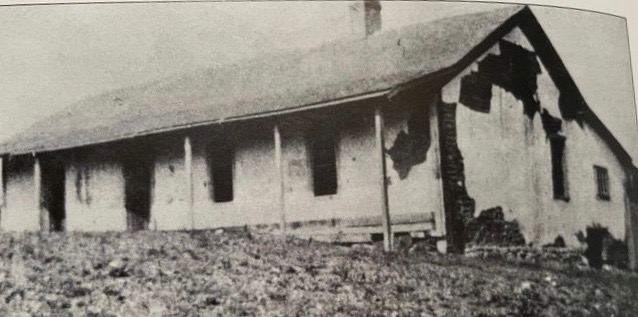
Arroyo Grande’s school district dated back to the famous Oak Tree school, the areas first. In 1860 a young man was hired to teach the children of the Rancheros. Don Francisco Branch who owned David Mallaghs old adobe house, which was on the hillside below Crown Hill, donated the house for the first school building in the valley. The decrepit old building, built in the 1840’s, was swept, rats, bats and owls expelled and resident raccoons and possum beat a hasty retreat down to the creek. Rough made furniture for desks and chairs were donated by the families who wanted their kids to be educated. Somehow a slate board was found and hung from a wall. Hitching posts were built for the children who came on horseback, for many lived more than walking distance away. When school was in session the old adobe was ringed about with horses and a buggy or two, horses chewing on corn from their feedbags or standing hipshot, dozing while they patiently waited for the kids.
The David Mallagh Adobe, 1880’s San Luis Historical Society photo
Thirty years later the town of Arroyo Grande had been established and was now ringed with one and two roomed grade schools. A one room school in upper Verde Canyon, A two room in the Oak Park district, Santa Manuela at the entrance to Lopez Canyon, a school in the upper Lopez, Branch school near the old Francisco Branch adobe; up the Huasna, a one room in Los Berros Canyon and La Cienega along the lower Arroyo Grande creek. Pismo and Oso Flaco schools rounded out the district. If there were enough children living within an eight or so mile diameter there was a school. Most residents saw a necessity in educating their children.
Arroyo Grande Herald:Aron and Alexander announce the Grand Midsummer Display in cotton dress goods. See the new Ebilenes, Eolines, Gaze de Soie, and Figured Lawns, Roidered Waist Patterns, Ladies and Children’s tan shoes and lace hosiery to match.Ask for prices.
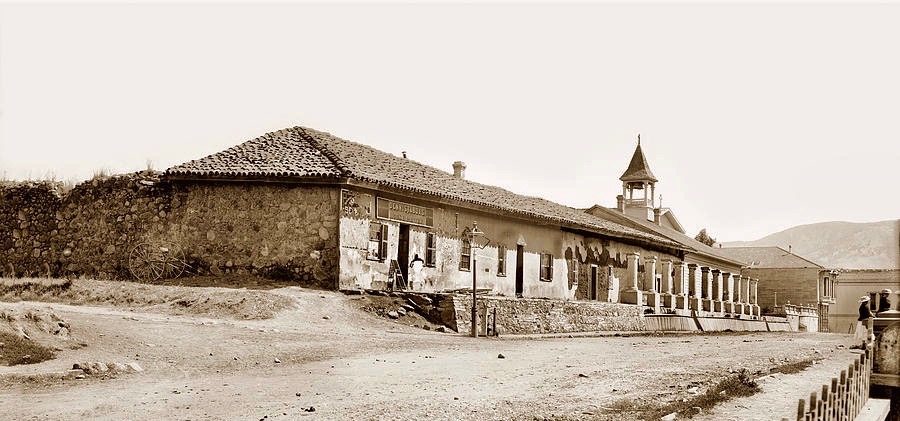
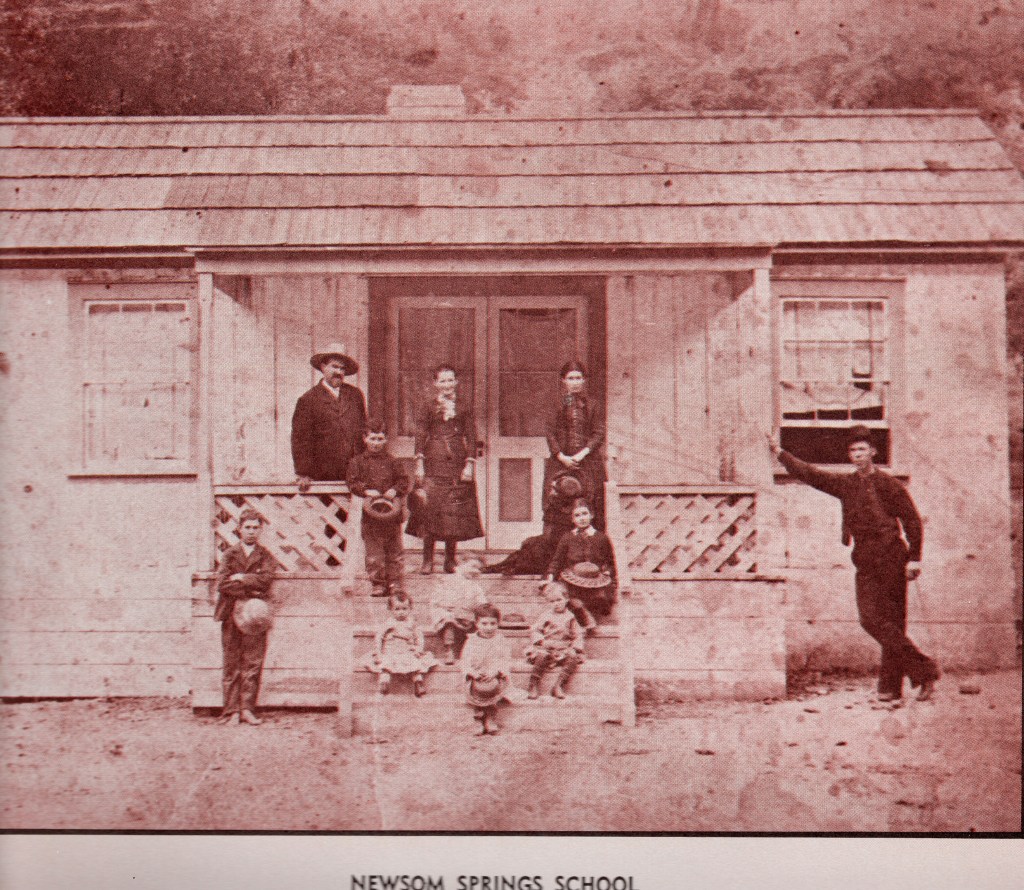
Frank Newsom opened the first official school in district one and taught classes at the old mission. In a dusty room, children sat with chalk and slate on wooden benches made by the Indian neophytes for the padres, decades old. Newsom taught in Spanish with a little English thrown in because almost all the children were descendants of marriages between the Ranchero’s and their Californio wives. The occasional Indian child was almost always a Spanish speaker. There was no such thing as a textbook and reading material were limited to a few donated books. Any kind of book would have had to come by ship from the east coast so there weren’t many.
Old San Luis Obispo Mission in 1865. Photo: Calisphere
Born in Petersburg, Virginia, Newsom was all of 18 years old. He arrived in old San Luis Obispo and being a literate man and nearly penniless he gladly took the teaching job. Three years later he was teaching school at the Branch family’s Mallagh adobe just downhill from todays Paulding Middle School. In 1863 he married Francisco Branch’s daughter Anna and by 1870 was running a farming operation on the lands that had been deeded to his wife by her father. He established a small school there for his own children which eventually numbered eleven; poor Anna. He also taught the children of his neighbors. They were still taught in Spanish. In the 1880 census he listed himself as a hotel keeper because with the discovery of the hot sulphur springs in the upper Guayal canyon he had built a small hotel where people could come and “Take the waters.” No longer a poor man his politics had changed concerning schools, especially High Schools.
Newsom Springs school, Frank Newsom in the big hat. 1870’s. Historical Society Photo.
Newspapers began reporting in 1898 dissatisfaction with the high school. Bernardo Miossi, a farmer and rancher and owner of the Sycamore Springs ranch near Pismo Beach and a member of the board of control, school board in todays terms, who represented the Pismo Area, Frank Newsom, former pioneer teacher, Dan Donovan of the Los Berros district and Willis B Buck who farmed in the Oak Park section of south county were all vocally opposed to the continuation of the Arroyo Grande high school. “A waste of time and money,” Dan Donovan said, quoted in the Herald.
They were out to get rid of it, By hook or by crook. Very quickly, the gloves were off.
Arroyo Grande Herald:The board of Supervisors today granted 84 liquor licenses countywide. They expect to continue the review tomorrow as there are many more applications. At this place, License for Frank Babcock, Frank Cochran, Knotts brothers. E. Knotts, Bernardino Souza, and Peter Olohan. (2)**
Coming, Chapter two.
Arroyo Grande Herald: September 16, 1898.There are a number of citizens who are anxious on one ground or another that the educational facilities of the Arroyo Grande region should be continued….
(*Paul Simon, “Kodachrome”)
(**Arroyo Grande Valley Districts population, 1900 was 3,399. At the time it boasted over a dozen places to get a drink.)
Michael Shannon is a world citizen, teacher, and surfer. He attended a two room Grammar school himself. He write so his children will know where they came from.





 atthetable2015