By Michael Shannon
Chapter Four
Clara

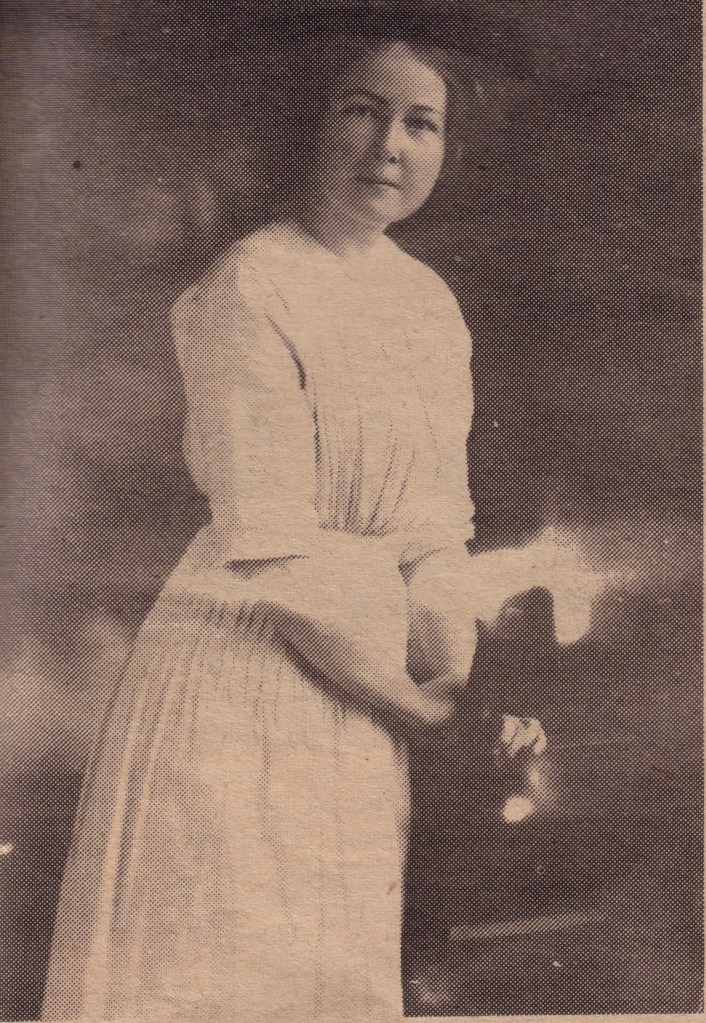
Clara, Mrs E.L. Paulding, nee Edwards. Arroyo Grande Valley Historical Society photo.
Lets call her Clara for surely a woman of character deserves the use of the familiar. What she did she did without help from anyone other than herself.
She was born in the little town of Bath, Stueben County, New York in 1855. Bath is in the western part of New York state. It lies at the base of the Allegheny mountains and was about a half century old when she was born. Her father John Edwards was named for his distant relative Jonathan Edwards. A leading figure of the American Enlightenment. Edwards is widely regarded as one of America’s most important and original philosophical theologians. Perhaps this drove his decision to become a pastor and missionary in his own right.
Little Clara spent her early life on the move as missionaries were ordered to a new parishes as the church needed. In 1857 her father was ordered to take over the administration of the Wheelock Indian Academy in what was then Arkansas’ western territory, now Oklahoma. Wheelock was one of many schools formed by church organizations in an attempt to educate the native American peoples into subjugation and to make them “White Men.”
Wheelock served the Choctaw Nation. The Choctaw (in the Choctaw language, Chahta) are a Native American people originally based in the Southeastern Woodlands, in what is now Alabama and Mississippi. As part of Indian Removal Act of, despite not having waged war against the United States, the majority of Choctaw were forcibly relocated to Indian Territory from 1831 to 1833. President Andrew Jackson was primarily responsible for the removal and defied the Supreme Court who had ruled against the act to do anything about it. David Crockett, the legendary frontiersman and Tennessee congressman, opposed the Indian Removal Act, declaring that his decision would “not make me ashamed on the Day of Judgment.” The congressmen resigned his seat in protest and went to Texas. It didn’t do him any good but it no doubt did not shame him before Saint Peter when he arrived at The Gates on March 6th, 1836.
The Edwards family traveled to the Arkansas territory by taking ship in New York and sailing down to New Orleans where they went up the Mississippi by steamboat to Fort Smith. They then bought a Studebaker wagon painted dark green with red wheels and bumped and banged their way southwest to the Wheelock Mission..

Indian children at the Carlisle Indian School. National Archives Photo.
Western Arkansas was a wild place when the Edwards family arrived.
Thought he Civil War wouldn’t officially begin until April 1860, Pro and anti-slavery armed bands roamed the Arkansas, Missouri and Kansas territories preying on each other and the citizens who lived there. Political butchery was in full swing with the likes of Senator James Lane’s Jayhawkers whose bands of men were willing to fight, kill, and rob for a variety of motives that included defense against pro-slavery “Border Ruffians”, who favored abolition. The Jayhawkers were intent on driving pro-slavery settlers from their claims of land. John Brown and his sons plied there murderous trade under the banner of God himself. Brown’s weapon of choice was a sword which he used to numerous hack pro-slavery men to bits. In the name of God, he said.
From the state of Missouri, pro-slavery Bushwhackers and Border Ruffians tried to force slavery on Kansas by resorting to the same methods. Bands led by William Quantrill, Bloody Bill Anderson and Dave Pool raided into Kansas from Missouri and the Arkansas territory. They then retreated to the lawless territories to avoid capture. Political murder was in full swing.
Regardless of anyones personal politics it was a very dangerous place to live. A missionary and his family were not be immune from the violence.

Bushwackers Archie Clements 1, Dave Pool 2, and Bill Hendricks 3. about 1858. Kansas State Historical Society Photo.*
The Wheelock school was right in the middle of the burgeoning conflict that would become the civil war. At the outset of the war, the Union Army abandoned all of its forts in the Indian Territories and withdrew its troops to Kansas and Missouri, knowing that they would be needed to fight the Confederate Army. All civil government essentially collapsed, and irregular guerrillas ran unchecked throughout the Arkansas territory. All other non-Choctaw personnel also left including the five year old Clara and her parents. The school closed for the duration of the war.
Though not as visible as the war in the east the conflict in the borderlands was extremely vicious. Those bands of quasi-soldiers took no prisoners and devolved into nothing more than thieves and bandits, killing, robbing and defying what little law there was. The were a breeding ground for the scourge of outlaws that would plague the west for decades to come.
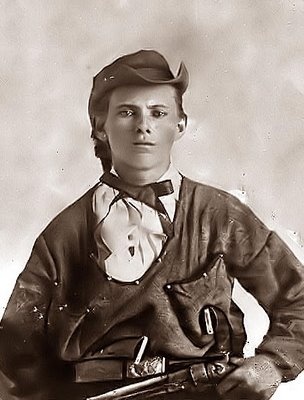
16 year old Jesse James, already a killer. He is wearing a Bushwacker shirt made by his mother. They were made with oversize pockets for ammunition and carrying three Colt six shooters. 1863. Kansas State Historical Society Photo.*
Five year old Clara’s father, Pastor John Edwards was wont to tell the “Ruffians” that his oath forbade him to take up arms for either side. He just wanted to be left alone. That was not to be.
A few weeks later a neighbor lady came running to the school and between gasps for air informed Mrs Edwards that a gang of armed Texans had vowed to hang all northern sympathizers and the Pastor Edwards, the dirty Yankee, was to be the first. Mrs Dukes told Clara’s mother Rose that they were already on the way. The Edwards had no doubt about Mrs. Duke’s news. Her husband ran to the barn to saddle a horse while Clara’s mother gathered some spare clothes and food to take. The Pastor shook his wife’s hand, it was 1860 after all when public affection between even married people was rare, hugged Clara, told her brother George he had to be the man of the house and to take care of his mother and sister, George was eight. He jumped into the saddle and headed north towards the Little River. Mrs Dukes had run several miles to warm the family and was exhauste so she was invited to supper before returning home. During the meal the sound of galloping horses was heard in the yard and the Texas Ruffians arrived in a cloud of dust demanding to know where the H**l was Yankee Edwards. Being an honest women she pointed north. The didn’t believe her, surely a woman would lie to save her husband, they figured he wouldn’t be able to ford the Red river to the south and head into Texas without drowning or being killed. After talking it over they figured she was lying about going north which presented them with a conundrum about which way to hunt Pastor Edwards. Surmising that he would be forced to return they decided to stay until he did. Dismounting they pushed came up on the porch, pushed past Mrs Edwards and into the house where they turned over every piece of furniture and looked anywhere a man could hide, but found nothing. Still certain that the Pastor would soon return, they surrounded the house and spent the night waiting. The murmur of their voices and the glow of their pipes terrified the women and children in the house. All the next day they waited but by evening it was certain the Pastor would not be returning. Grumbling and muttering amongst themselves they mounted up and rode away south telling Mrs Edwards that they better not find her husband or he would be done for.
Arroyo Grande Herald: Dear Mr. Clevenger, when up Lopez creek yesterday and I met Mr. Eubanks and George Balaam. They were very comfortably camped and they invited me to a Coyote dinner. Talk about hard times when Coyote is the best meat we have. John Mahan
Families and friends helped Mrs Edwards pull the wagon from the barn and up to the house. She loaded it with what goods she thought she could keep. Rose arranged to give 35 head of cattle and six acres of land to the local storekeeper for two horses which the husband of her neighbor told her weren’t fit to pull a loaded wagon and if she tried she’d be stranded on the plains with no help anywhere. He said he would trade her the horses for two mules instead. Poor Rose had to kick in $ 35.00 dollars to boot.This was not an act of generosity and left her nearly destitute. She sold most of her furniture, kitchen utensils and any other thing she could lay her hands on because she would need money when she arrived at Fort Smith to meet John. The mules were far superior for the job than the horses would have been. The little Edwards family headed north, with Mr Libby, John’s helper driving the old Studebaker wagon, Rose Edwards on the drivers seat with Mr Libby and Clara and her brother George sitting atop the heap of bedding and furniture. In 1861 the Arkansas territory was wild and deserted. It was the beginning of the Great Plains which swept west to the Rockies, seemingly flat but cut by gullies and washes which made travel difficult, especially for a 35 year old mother of two. She had only Libby to help her. After a long days travel they unhitched the mules at night, saw to their feed, set up camp and fed themselves and the children. Mr Libby slept under the stars and Rose and the children inside the wagon. A woman traveling with her children, completely alone, was far too risky and as Mr Libby was a slave owner that they would likely be left alone by any Bushwackers they might meet. The remnants of the Edwards family drove by day and camped without a fire at night and slowly found their way northeast. Still early in the war and US troops still in the territory she thought that the Choctaw and Osage would leave them be. The outlaws and Bushwackers would likely leave Mr. Libby alone if they were stopped. They’d assume, because he owned slaves he was a southern sympathizer. Somehow they crossed the Little River, mules wagon and all and got to Lennox where they met John and continued on to Fort Smith where they had to give an oath of parole never to serve the north and were finally able to get a steamboat up river. They would never return to Wheelock.
Mister Libby did return and he and his family sat out the war without any harm coming to them. The Indian children were simply left to find their way home if they could.
In 1862, Clara was to make the trip to California with her parents. At seven, like most children of her age she was a walking talking bundle of energy and about to head off on another of her great adventures. The trip, by sailing ship from New York to San Francisco began in December of 1861, just nine months after the Secessionist fired on Fort Sumpter. It would take them down the east coast, around Florida and to New Orleans. The risk of winter storms and Confederate Raiders was high, but other than a shifting cargo which put the ship over on her beam ends for a time, a very dangerous thing which could have resulted in the ship capsizing and sinking but which the children on board made into a game by climbing to the high side and sliding down the decks for fun.
The little Edwards family took ship from New Orleans to Aspinall Panama to board the cross isthmus rail road. The Panama Railway was the first transcontinental railroad in the Americas and was built to provide a shorter and more secure path between the United States’ East and West Coasts. When completed in 1855, the line was designated as an “inter-oceanic” railroad crossing as it connected ports on the Atlantic and Pacific Oceans. The tropical rain forest terrain and outbreak of malaria and cholera, rendered its five-year construction, at a cost of $8,000,000, a considerable engineering challenge, and required more than seven thousand active workers drawn from “every quarter of the globe including from the United States, Europe, Colombia, China, the Caribbean islands, and also included hundreds of African slaves rented out by their owners. Many of these workers had come to Panama to seek their fortune and had arrived with little or no identification. Many died with no known next of kin, nor permanent address, nor even a known surname. The death toll ran upwards to as much as ten thousand men and women. Malaria, Yellow Fever, Typhus, the Black Vomit and Cholera scythed through the workers. Few records were kept of the dead because the laborers were considered disposable.

Aspinall, Panama. East to west, ocean to ocean on the Panama Railroad. 1860.
Arroyo Grande Herald: Charley Rice’s team was left in front of his City Meat Market shop while the driver went inside to collect some turkeys. There was a big fat hog in the wagon and he decided that he would give a big grunt, which he did. The horses thought they heard “Bear” and they made a wild leap and bolted. Geo. Thatcher tried to stop them and was rewarded with a kick to his leg which will likely cause him to limp for some time. George’s attempt caused the team to run up on the sidewalk where they were captured in front of Richards store. They haven’t stopped looking for that bear yet.
The Missionary Foundation paid the passage for the family as Pastor Edwards was being sent to his new posting in San Francisco. A ticket on the road was $ 25.00 dollars a considerable coast to travel just the 47 miles from Caribbean to Pacific. It was the most expensive railroad in the world.
It was said at the time that each tie on the road had cost a human life. It nearly cost seven year old Clara hers, as she quickly fell ill with Malaria. Once aboard the San Francisco bound ship in Panama City she took to her bunk and suffered bone breaking pains in her limbs and a raging fever. Her mother expected she would die and be buried at sea, but somehow she lived.
Clara was an adventurous from the get-go. She fell out of trees, slammed window sills on her hands, nearly drowned and was frequently sick. Malaria in Panama, Pneumonia in cold and wet San Francisco and when the family moved to Visalia she promptly contracted Valley Fever. In the 1870’s only three in five children lived past five years. Scarlet Fever, Cholera, Typhoid, Measles, Smallpox, Pneumonia, and Influenza along with the dangers of day to day living which brought rabid animals, blood poisoning, kicking horses and shooting accidents which nearly every family was familiar with. There was not much John and Rose could do to protect her, something common to all parents in the still wild west of the 1870’s. Visalia was still frontier, dusty, dirty, abundant saloons with rough characters everywhere and frequently heeled. With her friends, Clara ran free with little adult supervision. She was forming the character which was to lead her to Arroyo Grande where she was to lead the effort to save a school.

The Right Reverend John Edwards and his daughter Clara. Calisphere Photo. About 1868
Clara started school at ten in Visalia and proved to be a precocious student. With John Edwards connections to the University of California and Mills College he arranged for Clara to start her college education in 1871. Clara was off to Mills College at just fifteen. She, like most of her contemporaries was to study to be a teacher. Teaching was one of the few serious careers open to women at the time. Western movies would lead you to believe that any young woman could just walk into a school and teach but then as now it required a rigorous education at a Normal School or teachers school such as Mills. Three years of higher education led to strict testing system in order to earn a certificate. Curriculum was predicated on the fact that most students would not attend school past the eighth grade. Compared to today, classwork was more rigorous than than it is now. Most schools only went up to 8th grade. By necessity their education was much more difficult than even high schools today. Very few people went to college. In 1900 only around 4 percent of children even attended a high school. Less than one precent of those would attend college and just seventeen of a hundred actually graduated. Just over half of all children would attend any school whatsoever. They would be starting their adult lives much sooner. In order to graduate from 8th grade, students had to pass a final exam. Below is a snippet of a typical 8th grade test from 1899:
Orthography 1 1/2 hours
1.)What is meant by the following: Alphabet, Phonetic, Orthography, Etymology, Syllabication.
2.)What are elementary sounds? How classified?
3.)What are the following, and give examples of each: Trigraph, Subvocals, Diphthong, Cognate, Linguals?
4.)Give two uses of silent letters in spelling. Illustrate each.
5.)Define the following prefixes and use in connection with a word: Bi, Dis, Mis, Pre, Semi, Post, Non, Inter, Mono, Super
6.)Mark diacritically and divided into syllables the following, and name the sign that indicates the sound: Card, ball, mercy, sir, odd, cell, rise, blood, fare, last.
7.)Use the following correctly in sentences: Cite, site, sight, fane, fain, feign, vane, vein, raze, raise, rays.
8.)Write 10words frequently mispronounced and indicate pronunciation by use of diacritical marks and by syllabication
In 1883 Clara returned to California from Hawaii where she had been the private teacher and governess to the seven daughters of Alfred S. Hartwell the presiding justice of the kingdom of Hawai’i’s Supreme Court. She had traveled and worked independently without the supervision of an adult male which, for the time was quite unusual. Teachers of the female persuasion were forbidden to enter pool halls, saloons under any circumstances and were required to be escorted by an approved male when eating out or attending concerts or entertainments. They were typically enjoined to attend church each week and only certain churches were likely to be approved. They were to be in bed by ten o’clock and to exhibit the strictest morals as set down by the community. No smoking, sex, drinking, reading of “Racy” novels or unchaperoned courting were allowed. Marriage meant instant dismissal in most cases.
Arroyo Grande Oracle: Four slick and greasy tramps crawled out from under the PCRR depot this morning and proceeded to work Branch Street for grub. Constable Tom Whitely urged them to move on or become aquainted with the ball and chain…
In Hawai’i Clara showed an independent spirit to say the least. She rode horseback astride, She camped with other young people in Haleakala crater on Maui, completely unsupervised and she went where she wanted without asking anyones permission. She had an independent streak a mile wide. Returning to the mainland and needing a job, she went to see the California Superintendant of Schools who told her there was only one school available and that was in the little town of Arroyo Grande and if she took it she must start Monday next. In a split second she made the fateful decision to go. She said “yes.”
She made it on time. She sailed from the San Francisco Bay to Port Harford (Port San Luis/Avila Beach) and bought a ticket for one dollar on the Pacific Coast Railroad, one of the oldest in California. The rattler huffed and puffed it’s way to San Luis Obispo then over the hills south to Arroyo Grande. It clanked along at bare walking speed for it was no streamliner. It was built to haul goods, with passengers and their comfort simply an afterthought.

Clara Edwards Paulding on the wheel she rode from her home in Arroyo Grande to and from Branch Elementary School where she was teaching in 1898. She taught about sixty students grades 1 thru 8. She is 42 yo. Photographer unknown. CA.SP Photo.
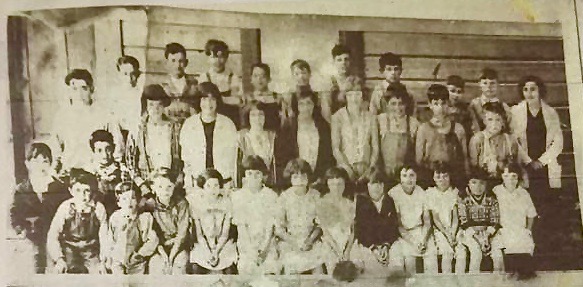
Clara taught all over San Luis Obispo County. She listed the Court School in San Luis, Cholame and Shandon in north county, Santa Manuela and Branch in the upper valley and the old Arroyo Grande Grammar school on Nevada Street. When two Hostlers at the Ryan stables across the way perforated the school with their handguns, parents prompted the school to move down to Bridge Street. While at Branch, she heard a commotion outside during recess and stepped out the back door to see the kids surrounding a rattlesnake. One of the older boys said, “miss, you’d better shoot it,” and reached into his possibles sack and handed her an old Civil War revolver. She did too, shot the rattlesnake’s head clean off. If she wasn’t already respected, she certainly was now. Just another day at school. In 1898 it didn’t occur to anyone to question why a boy would take a revolver to school. It came in handy this day.
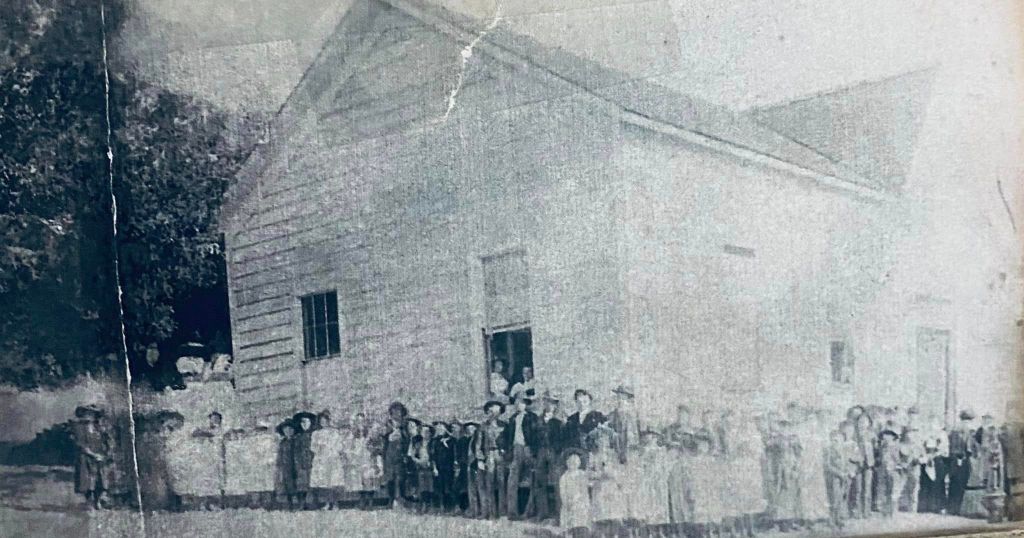
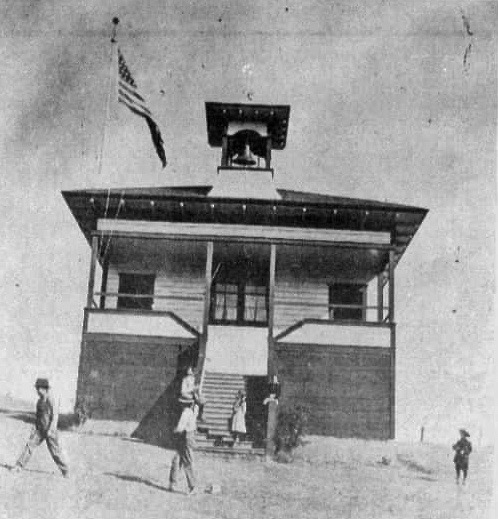
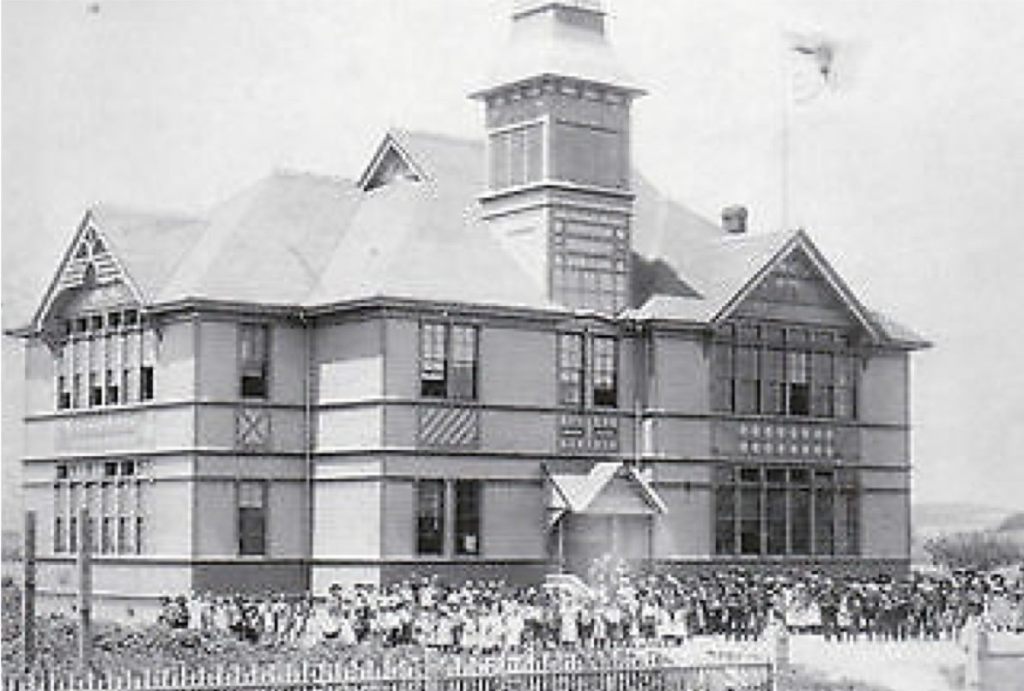
Branch Elementery School in 1886 when Clara taught there. It looks about the same today. San Luis Historical Society photo
She started the first town library and was a member of the WCTU which fought the saloonkeepers tooth and nail for years finally causing Arroyo Grande to “go dry” though none of the drinkers seemed to notice. She was a leading advocate for the high school which finally came to fruition in 1895. The “Wreckers” of Billy Buck and his cohorts had came up against Mrs Clara Dudley Edwards Paulding and they would be sorry.
*In the movie, Ride “With the Devil,” Pitt Mackeson played to great effect by Jonathan Rhys-Myers is modeled on Archie Clements a psychopathic killer responsible for numbers of cold blooded murders. Though the movie is fiction, it is a harrowing depiction of the border wars as they were known.
*James Woodson James did nothing in his short life that was of any value to humanity. He stole, he robbed, and was a casual murderer. The movies and books have made him something he was not. He was a killer of the first order.
Chapter Five
The Wreckers Get Their Comeuppance, coming next.
Michael Shannon is writer and a Branch Grammar School graduate. He writes so his children will know where they came from.
Link to Chapter one: https://wordpress.com/post/atthetable2015.com/11202
Link to Chapter two: https://wordpress.com/post/atthetable2015.com/11890
Link to Chapter three: https://wordpress.com/post/atthetable2015.com/11815











 atthetable2015