
By Michael Shannon
Chapter Five
Superintendent Messer says he will not call an election to disincorporate the AGHS district unless the courts compel him too. It is probable the opposition will resort to the courts to force his hand. Frank Newsom and Willis Buck were in town working up the matter yesterday at Olohan’s saloon. The state legislature has ruled that county supervisors cannot tax land owners to support schools which leaves our high schools, in particular, nearly penniless. County school offices do not have nearly enough money to fund all the high schools in the county and ” Little Bald Billy Buck” and his “Wreckers” know that. The legislature is stuffed with rich landowners and the law was no surprise to anyone.
Landowners in San Luis Obispo County are not all paying their school tax. Board of Control members “Lobbied” taxpayers, newspaper publishers and businesses aggressively. They argued that high school curriculum was full of “Fads and Frills.” “Any foreign language classes were ridiculous in an English speaking country and drama, music and art were a waste of time and taxpayers money,” they said. The idea that preparing “Working mens children” for higher education was preposterous. Summer school was a complete and unnecessary luxury .Those students who couldn’t keep up were only good for laboring and teaching them was a waste of money.
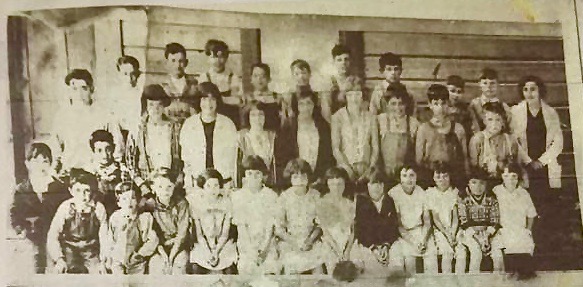
Figures from the 1890’s show that the vast majority of children, mostly boys, dropped out of school at 12 to 14 years and went directly to work as my grandfather did. Rural schools in San Luis County had large numbers of students who were immigrants or children of recent immigrants and spoke little or no English. Waves of Portuguese, Japanese, German and Swiss Italian came to California in the 1880’s and ’90’s. They came because of wars and famine in their home countries, a lack of education, grinding poverty and no opportunity to improve their lives. They understood that schools were the key. The Branch School photo shown below lists five Perry kids, one Fink and one Nagagawa. Every one of the 24 remaining kids bears a Portuguese name.
The “Wreckers” didn’t care about these kids. They were only good for labor. Bald Billy Buck, himself a law student at Hastings Law School at the University of California, and who had his tuition partially paid for by Judge Venable, was quoted as saying, “Education is no help to these people. It shouldn’t be put on the shoulders of the successful to pay for it.”
Buck was reducing the uneducated as unworthy. He was referencing the theory of the Helot. Helot was a term used by the Spartans to describe a class of people who were in a sense wage slaves, bound to the soil and assigned to individual property owners to till their holdings; their masters could neither free them nor sell them. The helots had a very limited rights, after paying to their masters a fixed proportion of the produce of the land they worked. In America we refer them to as “Share Croppers,” a state in which the person is only a hair above chattel slavery. After the Civil War ended, Share Cropping was introduced as a way to keep former slaves bound to the land and the plantation owner in business. By the 1890’s Share Cropping had become an institution in America and Willis Buck would have known very well the import of his words.
An article printed in the Oracle quoted Columbia University professor Nicholas Murray Butler as saying, “We need to replace teachers and local school boards opinions on curriculum with education policies set by “College-Educated Bureaucrats.” These administrative “Progressives” forged an alliance with business leaders who liked the idea of top down, expert management of schools. They deplored the idea of local control and wished to lower their taxes by cutting away classes they deemed “Useless and Wasteful.”*
The “Wreckers were certainly aware of a reform movement that advocated replacing women teachers with men. “Feminization” of teachers was a major misstep according to William Rainey Harper, president of the university of Chicago. When Chicago teachers complained, that their wages had been frozen for twenty years and they deserved a living wage, Harper replied that women in the teaching profession should be glad they made as much money as his maid, who worked harder than they did and deserved her money, inferring, of course, that female teachers did not.
Under the guise of “Reform,” business leaders stated that non-university-schooled teachers were not qualified to make autonomous decisions, write lesson plans or discipline children within their own classrooms.* Reform leaders thought that “Normal Schools” gave only the most rudimentary education to women teachers and that graduates were not, thus, fully qualified to manage their classrooms.
Local people may have had just a simple education but they could read. The back and forth agreements were a staple of the local papers. Other county papers watched and commented on the Board of Control’s doings too. Though big city papers didn’t write about local news, they were readily available. Daily papers from San Francisco were brought down by train from the city by the Southern Pacific railroad which had a depot in San Luis Obispo. You could read a paper from Chicago or New York just a day or two old. Newspapers were the only mass outlet for news and were thoroughly read. Readers would not have been unaware of educational doings in other cities. Thinking that people in 1899 were completely unaware of world events would be a mistake. Disincorporation of the high school was a community wide concern and it was clear that the moneyed interests, the big landowners and their crony’s meant to kill the school.
Supporters of the high school were counting on a recent law passed in Sacramento which gave women who were eligible the right to vote in school elections. Governor Gage promptly vetoed it. He apparently stands with the Republican school Wreckers here. Surely women voters, mothers and fathers of children, would have tipped the balance for the school in an honest election. The last one was not honest. People knew that the ballot boxes had been manipulated. The head of the election commission had a vested interest in seeing the school fail as he controlled a very large ranch in rural Arroyo Grande.As Stephen Clevenger said in the Herald, we know because everyone knows that the government can’t keep a secret for five seconds, something that holds true today
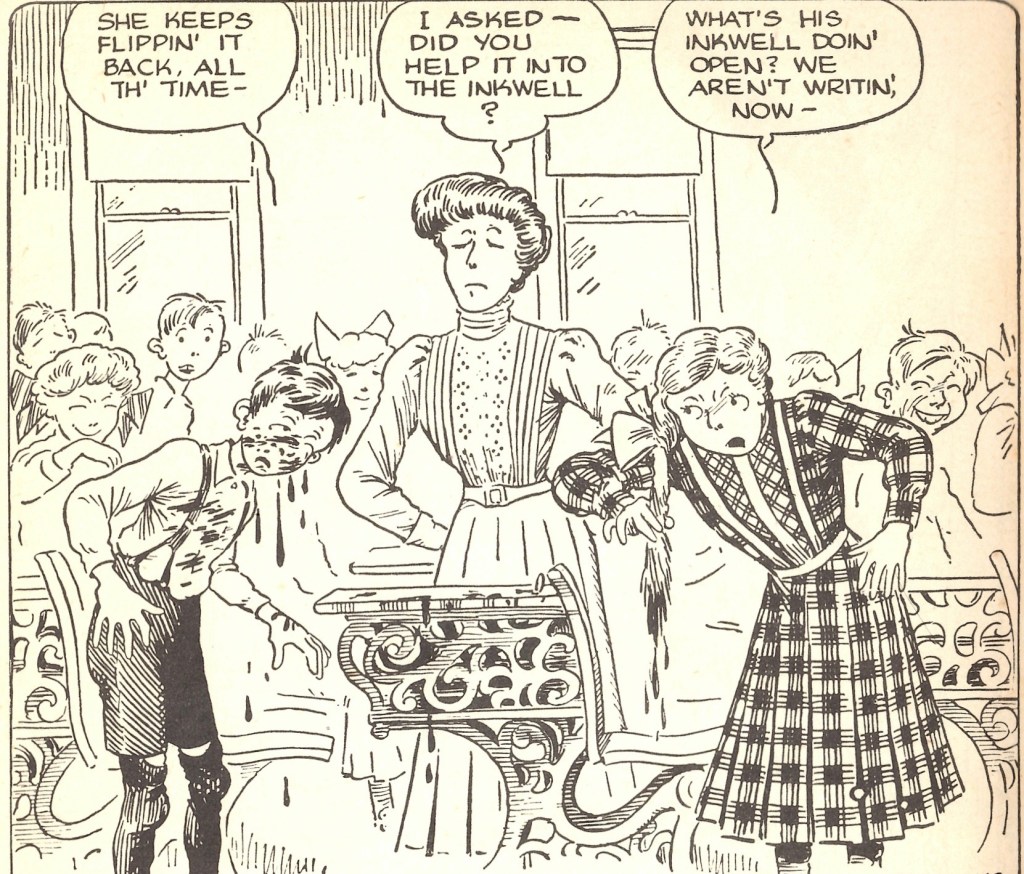
Born 100 Years too Soon. Illustration: J R Williams.
Arroyo Grande Herald: Miss Maud Grieb arrived in this place yesterday where she will spend the summer before retuning to Stanford.
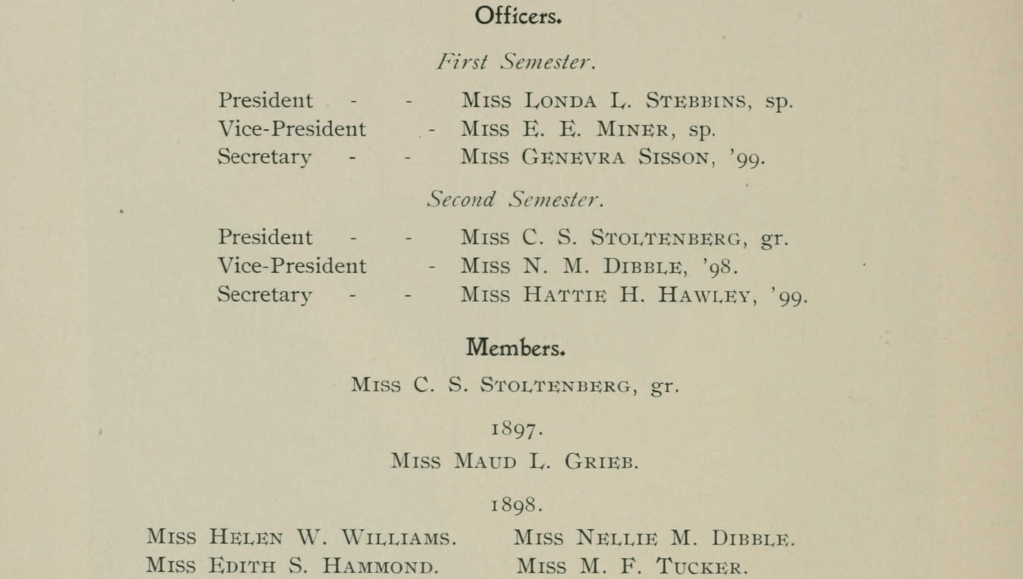
Maud Grieb. Saturday Night Club. Stanford University Yearbook..
The immediate need was for donations to make up the nearly one thousand dollar shortfall in the budget in order to keep the school open until spring 1901. The Wreckers who had a majority of one on the board of control had lowered Professor Parsons salary to $65.00 a year hoping he would resign. He didn’t, so they lowered it to $40.00 and he did. So did the two teachers. They next hired a notorious local drunk and ne’er-do-well named Stringfellow to be the principal and not one new teacher. The students began to skip school. Clara Paulding saw Cliffie Carpenter and Helen Grieb walking arm in arm past Miller’s Stable and blacksmiths shop and asked them why they weren’t in school. Cliffie replied, “He doesn’t teach us anything and the boys like Tom Meherin, Louis Phillips and Charley Phoenix* jump out of the windows and go smoke down by the creek. There is nothing for us to do.” Clara shook her finger at the girls and said, “If you don’t stay in school there will be no school. Take your knitting or a book to read but please stay in school and I will tell the boys’ fathers, who will strip a piece from their backside if they are caught again.” She was as good as her word. All three fathers were supporters of the school. Meherin and Phoenix were both large landowners and had already made substantial donations to the school fund as had the Phillips Brothers.
San Luis Obispo Tribune: About 9 o’clock last evening Marshall Cook arrested one of the denizens of Chinatown who operates a house of ill-fame. She was released on bond of $50.00 by Judge Egan.($1,500.00 today)
The fund to support the school was quickly raised and the class of 1901 was assured of graduation. What kind of education they got was up for debate as the new principal did not change his stripes one bit. Nevertheless the class would graduate in the spring.
Arroyo Grande Herald: 1898: Mister John Corbit a well-known citizen of this district is being mentioned in connection as a candidate for county Sheriff. He will make the strongest possible candidate that the party could put up.
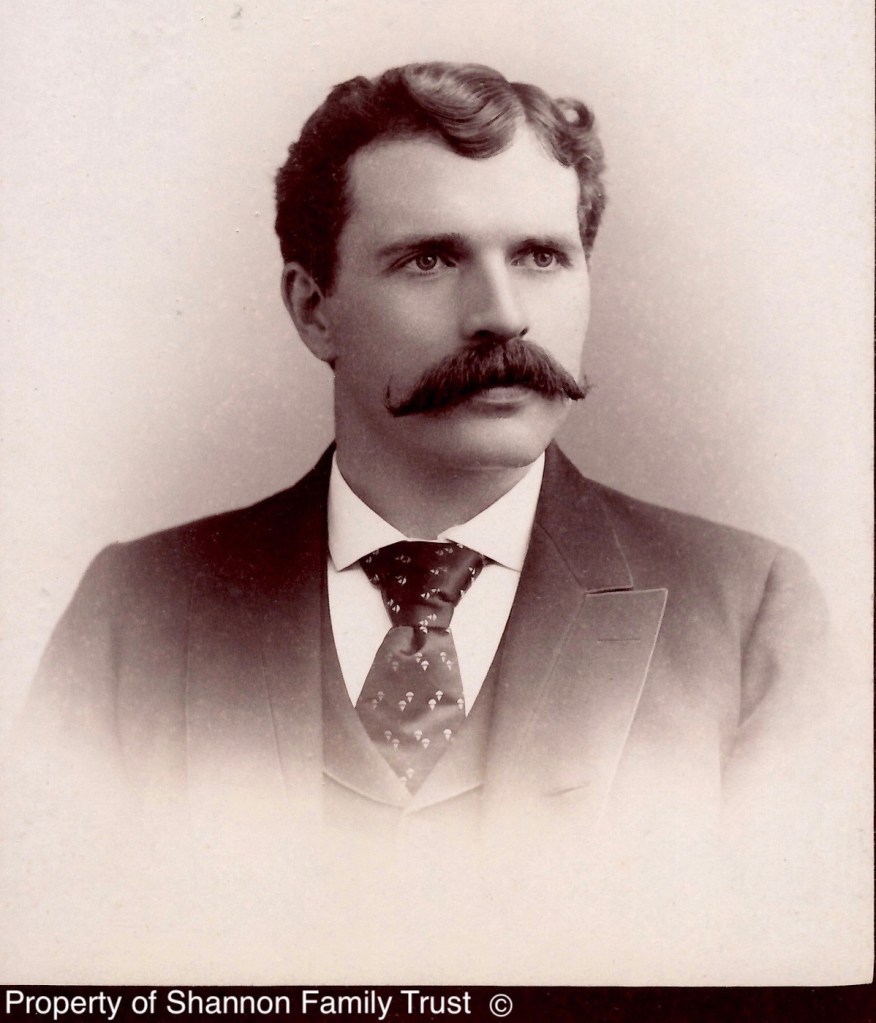
The Honorable John Corbit From County Cork Ireland. B. 1832, D. 1912. Photo from Pat Moores photo album. Shannon Family.
Arroyo Grande Herald: 24th June, 1899: At Oak Park, Mr and Mrs Willis Buck, born, a son.
Arroyo Grande Herald: 25th June, 1899: At Oak Park, Mr and Mrs Willis Buck, a son. Died.
The members of the save the school committee tasked with exploring the legal issues surrounding the closing of the school went to work. Three local businessmen, Thomas Hodges, Amos Henry and the publisher of the Herald, Stephen Clevenger began looking into any legal issues they thought might give them an opening into reversing the decisions of the Board of Control.
Amos Henry was a young father with a 5 year old son, Daniel. At 31 he was successful farmer and lived and farmed on what would become Mason Street. He and his wife Aurelia were both community mended. Amos went on to become county assessor and was active in many organizations such as the IOOF. He was cerainly concerned for the future education of his little boy.
Thomas Hodges was also a farmer and grew fruit trees on the Arroyo Grande road southwest of town off todays Halcyon Road. His farm was where the mobile home parks are today. He and his wife Sarah had six children. All educated in Arroyo Grande schools. Thomas’s daughter Rose taught at Los Berros school in the 1890’s. Well known was their son Virgil who Chronicled life around the turn of the century with his camera. Virgil who always listed himself as an artist, left us an incomparable record of photographs of our town and the people who lived here. Virgil was a 1897 graduate of the high school.

Virgil Hodges, left and friend on the Pismo Road. After the turn of the century. Virgil Hodges Photo.
Arroyo Grande Herald: It is high time the responsible citizens of the Arroyo Grande district arise and stamp into dust this whole hissing nest of vipers trying to dismantle education and bring anarchy to our school system.
After the citizens meeting at the Good Samaritan Hall, Mrs Paulding began going door to door, buttonholing anyone would would listen to her about the value of higher education. Carefully skipping around the manure dotting the dirt streets, pinching her flounce and lifting it to keep her hem out of the muck as she knocked on door after door. Some remained closed to her but most opened up and listened to what she had to say.
The flyer she carried was headed with the phrase, “The Plain Facts.” It went on to say that it had been requested that the flyer be circulated by the friends of the high school. In it they encouraged readers to take a look at the statements being made by the board of control; to wit:
1.That it is not possible to continue the high school because of the dissatisfaction of the people.
2. The majority of the board of control are opposed to the continuance of said school. (Six to five.)
3. As the high school district is so large as to make it impossible for students to travel to and from the school, property owners should not be taxed to pay for the school as no students would be wiling to travel that far to attend.
Mrs Paulding pointed out that there was no dissatisfaction by the public except on the part of the board of control whose six majority office holders were in fact large property owners who represented considerably less than a third of the district’s students but more than 60% of its land.
She also pointed out that 80% of all students who attended the school lived within four and a half miles of the school, a distance easily traveled by horse or wagon. The Patchett family farmed and ranched on land adjacent to Willis Buck. She stated they had no problem getting their children to school. In fact, the Fink children were students who traveled more than eight miles to school. She mentioned the Phoenix children and the Harloes who lived fifteen miles away on their ranches but who also maintained houses in town. Both families had homes off Bridge street which were within easy walking distance of the school. Ex-supervisor Moore and his wife Sarah also provided rooms for children during the week.
Clara said it was clear that there was a great deal of support for the school as evidenced by the funds the committee had raised to support it.
Mrs Paulding was quick to point out that the school had twenty-four students currently attending the school that came from these outlying district and that there were an equal number who would graduate from the eighth grade in May ready to enter the high school in the fall.*
She also said that without a high school diploma no student would be able to enter the state’s universities. There was already talk from the State Board of Education that the Arroyo Grande high school would lose its accreditation over the propose disenfranchisement fight.*
The opposition had also been saying that the grammar schools curriculum had been corrupted and that the Normal Schools had indicated that no graduate would be qualified to enter there. Clara was quite clear that this story being put about by the Wreckers was an outright lie and could easily be disproved.
Arroyo Grande: Died, Oliver Taylor, age 70
The three men working up a legal case against the board of control were ready to go to court. They had been working with the county District Attorney to draw up a bill of particulars stating the various crimes and misdemeanors of the Wreckers. A hearing would be held in the San Luis Obispo courthouse.
The Herald also posited that since nearly all of the grammar schools in the district had with withdrawn from the union high school, their seats on the board of control should be vacated as they no longer represented the school.
Arroyo Grande Oracle: An automobile passed through town yesterday on its way to Solano. It runs by steam.
Everything came to a head in September of 1899. The “Wreckers, by a single vote of the board of supervisors reduced the budget for Arroyo Grande’s high school to the point where it simply could no longer operate.
The Citizens Committee to Save the School quickly raised enough money through subscriptions to make up the budget shortfall and thus ensured that the school would remain open until June of 1900.
Up at the county courthouse Oliver Pence, the attorney representing the “Friends” was meeting with County District Attorney Arch Campbell who had won election the year before, defeating Fred Dorn who was no friend of the school. The Tribune wondered what kind of strategy they were cooking up behind closed doors. Willis Buck, who happened to be in San Luis was quoted as saying, “I will not show the white feather,* no threats from the committee will stop us from closing the high school. It is a burden to all taxpayers and must go.” Buck, Miossi, and Donovan are having a lively time of it said the Tribune.
Buck was soon to find out what they were up to. On Sept. 14 the district attorney issued a citation ordering W. B. Buck, et al, to appear in court on Wednesday the 20th to show cause why they should not be removed from office and judgement of $ 500.00* entered against each of the board members who had voted to reduce the budget and close the school.
Both parties appeared before Judge Unangst in superior court at 10 am. The “Wreckers’ immediately requested a continuance citing too little time to prepare their case. Judge Unangst granted the request and set a new hearing for the 22nd. That too was postponed for the same reason though Judge Unangst was not pleased with the continued delays by the “Obstructionists.” The opening of the trial was now set for Wednesday the 28th.
Outside the courthouse, Bernard Miossi, who represents the Pismo school district on the board of control of the high school said that the board would hold a meeting to formally close the school on Saturday. Daniel Donovan who is a member of the board from the two Los Berros schools agreed with Miossi that the school should not continue. They both said, “This will be an exciting meeting; the school, will, be closed however They can’t stop us, we have the majority.”
Except that it wasn’t. The citizens committee showed up at the Columbia Hall in force. They far outnumbered tose who wanted to close. It was a standing room turnout. Many fine speeches were given opposing the closing of the school. Mrs E. L. Paulding took the board to task stating that what they were doing was illegal and if they went ahead she would see them in jail for breaking their oath of office. At the end of the night the majority, the “Wreckers” voted to table the motion to close until after the superior court made its ruling. That trial was due to begin on Thursday the 28th and the majority said they were ready and would prevail.
Reported Expressly for the Tribune by P. A. H. Ararta in superior court the Hon. Edward P. Unangst, Judge, September 28th, 1899.
Plaintiff R. B, Musick* vs. Willis B. Buck et al. The defendants request for a trial by jury denied by Judge Unangst. The judge stating that he had had enough delays. The defendants then demanded that they be tried by separately. Denied again. Judge Unangst was visibly angry and threatened the defendants with contempt for their attempt to delay the proceedings. The defendants then asked for a continuance of five days on account of the absence of a material witness, viz: Mrs. A. C. S. Woods. Motion again denied. The following witnesses testified for the plaintiffs. D. Newsom, Albert Fowler, Mrs Clara Dudley Edwards Paulding, A. Slack, Geo. Balaam, Frank Swigert, Robert English, and A F Parsons.
David Newsom, was the son of Frank Newsom who built the first school at Newsom Springs but who was opposed to the high school. There must have been some interesting conversations around the kitchen table up in Newsom’s canyon.
Others testifying for the plaintiffs were Albert Fowler, the father of three young children was a farmer, Albert Slack an accountant, George Balaam, a Gensler (Goose breeder), Frank Swigart, a farmer, Robert English,* Arroyo Grande’s undertaker and A F Parsons, the county surveyor. They were all parents of children in school.
The missing witness, Adelaide Woods was the San Luis county superintendant of schools. She was the first woman elected to that position. She was a graduate of the state normal school in San Jose, the future San Jose State University and had taught a year at the Alma school, San Jose and two years in Eureka, Humboldt county. She taught at the Court school in San Luis before being elected to the job as superintendant. In fact, she was the first lady elected to any office in the history of the county. She was just 35 years old and had been elected in 1898 . She had been instrumental in collecting furnishings, books and other supplies for the Arroyo Grande Grammar school after it was destroyed by fire. It would be interesting to know what the “Wreckers” had in mind when they asked her to testify. It isn’t likely she would have been in favor of closing the high school. She had been elected and began serving the previous year and its easy to imagine her thought process. She had to uphold her office, an elected office to boot, and her primary job was supporting education. It’s difficult to imagine what the “Obstructionists” were thinking. It was extremely unlikely she would have anything to say to support the actual closing of a school. She made herself scarce.
When testimony was concluded, judge Unangst continued the trial to the next day, Friday the 29th for closing arguments. He said he was curious what the “Wreckers” might say in closing as they had produced no witnesses for their own defense.
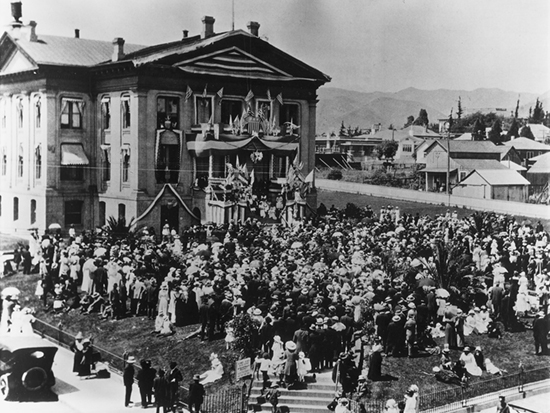
San Luis Obispo Superior Courthouse, Fourth of July, 1898.
Late on Friday morning Judge Unangst ordered that the case of Musick vs. W. B. Buck be called. The attorney for the plaintiffs, Oliver Pence rose and informed the judge that the parties had reached an agreement and moved that the action be dismissed without prejudice* , and without costs to either party. Judge Unangst took a long moment then asked the attorney for the “Wreckers” if they agreed. With the answer in the affirmative he dismissed the case.
Overnight a deal had been reached. When the remainder of the case was presented to Buck, he realized he was done. State law required that an elected board could not dissolve itself. Elected officials, sworn to duty could not, as part of that duty, vote to disband themselves. In effect, closing the school was a crime under state law as they were duty bound to continue education at the high school level. The schemers would be liable for fines and possible incarceration if found guilty. Willis B. Buck was forced to show the White Feather. The high school was saved.
San Luis Obispo Tribune: Popular school teacher Miss Mollie O’Conner and several of her friends were up from Arroyo Grande yesterday.
In Arroyo Grande an election was immediately held in which new trustees were elected. The three remaining grammar schools and the high school board voted that Frank Parsons be rehired as principle and Amos Henry was then voted in as president of the school board. The withdrawal of eight of the grammar schools in the south county now meant that the individual school would no longer use their budgets to help support the high school. They would also no longer receive revenues from the high school which would reduce their operating costs. The new high school board, according to Amos Slack, the district accountant, needed to establish a fee for out of district students to attend the school. On the recommendation of Mr. Slack a charge of $2.50* a month for each student was so ordered.
The withdrawn grammar schools almost immediately began to hear complaints from parents that wanted their children to attend high school. What once cost them nothing suddenly became a burden on their pocketbooks and they let the trustees of their schools know it. To use an old phrase used at the time, they had “Shot themselves in the foot” or, as the case may be, their collective feet.
Those that followed the lead of the “Wreckers” now suffered with them. Over the next few years all the grammar schools that had jumped ship came crawling back and rejoined the Union High School District.
The High School Citizens Committee: The citizens committee in defense of the high school feels it must commend Mr. Clevenger for his unstinting support of the school these last nine years. His defense in preserving the school and defeating the opposition cannot go unnoticed. The committee takes great pleasure in saying a word in behalf of his generous and unstinting work. There is nothing that lends general prosperity to the common welfare of a community like an active local paper, one that is in harmony with the town and its beneficent institutions. Without Mr Clevenger, the high school would have been closed some time past.

The Herald Recorder Building erected by Stephen Clevenger in 1897. Arroyo Grande Herald photo. 1963
Arroyo Grande Herald: The Herald says that the class of 1901 of the Arroyo Grande High School will hold its commencement exercises at the Columbia Hall next Friday evening, May 31st. Doctor Thos. Hoyer will be pleased to give the commencement address The members of the class consider themselves very fortunate in having a school from which to graduate. The four* young ladies of the class are Mary v. Keown, Lou F. Parsons, A Gelka Barcella and Lorena B. HaskinsThey will be tendered a reception by the other three classes at the Union Hall this evening at 7:00 O’clock.
The program is as follows:
Song, “The Bugler”, John “Jack” Shannon*
Recitation: The Hen with One Chicken by Miss Stella Sims.
Coon Song; Six Girls*
“The Kitchen Clock,” Duet, Hazel Miller, May Clevenger
Selection, Orchestra.
Recitation: The Little Runaway, Florence Lynam.
Song: The Boot Black*, Eight Boys.
The Class Colors are Green and Pink.
Master of ceremonies is Miss Belle Bowden. Assistant Principal
So the “Wreckers” slunk back into their caves like the snakes that they were and nothing more was heard from them. Willing to destroy an educational opportunity for the children of the Arroyo Grande Valley they received their comeuppance from a dedicated citizens group led an educated woman whose life had taught her that you must take no prisoners when it came to matters of principle.
Herald Recorder: The high school will be constructed on new lines. This ought not to be such a hard job with such workers as Mr. Newsom, Mr. Fowler and Mrs. Paulding at the helm. The high school district and the people will fall right in and carry them out. We must have no more “Dog in the manger practice.”

Arroyo Grande High School, built 1904
Arroyo Grande High School today numbers more than 2,000 students. It is a California Distinguished school and boasts a 96% graduation rate. All of this grown from a tiny school with no building of its own founded in 1895. Today, one of the districts middle schools is named for Clara Edwards Paulding’s daughter, Ruth who taught for over thirty years in the district. Ruth Paulding taught both my father and my uncle. My children both attended Paulding middle school. The Paulding family home is now a state park museum and is open to the public.
On a final note. History like all of life is a very flexible thing. The issues written about here are still with us today in perhaps a slightly different form but nonetheless they are still bones of contention. Educational issues are never truly finally fixed. This has been an extremely interesting story to write about. All I can say is that, be like Clara, do your homework, work hard at educating yourself about educational issues and don’t be afraid. History tends to treat women as subtext, but be assured that, just as today, they were a serious factor in 1901 Arroyo Grande.
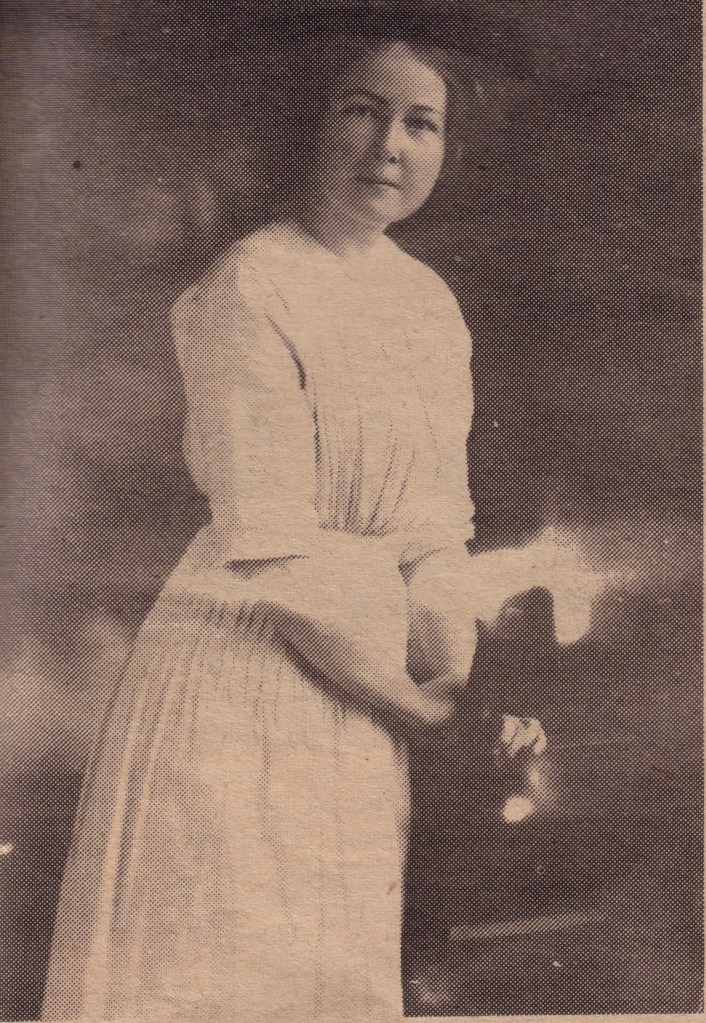
Miss Ruth Paulding.
Notes:
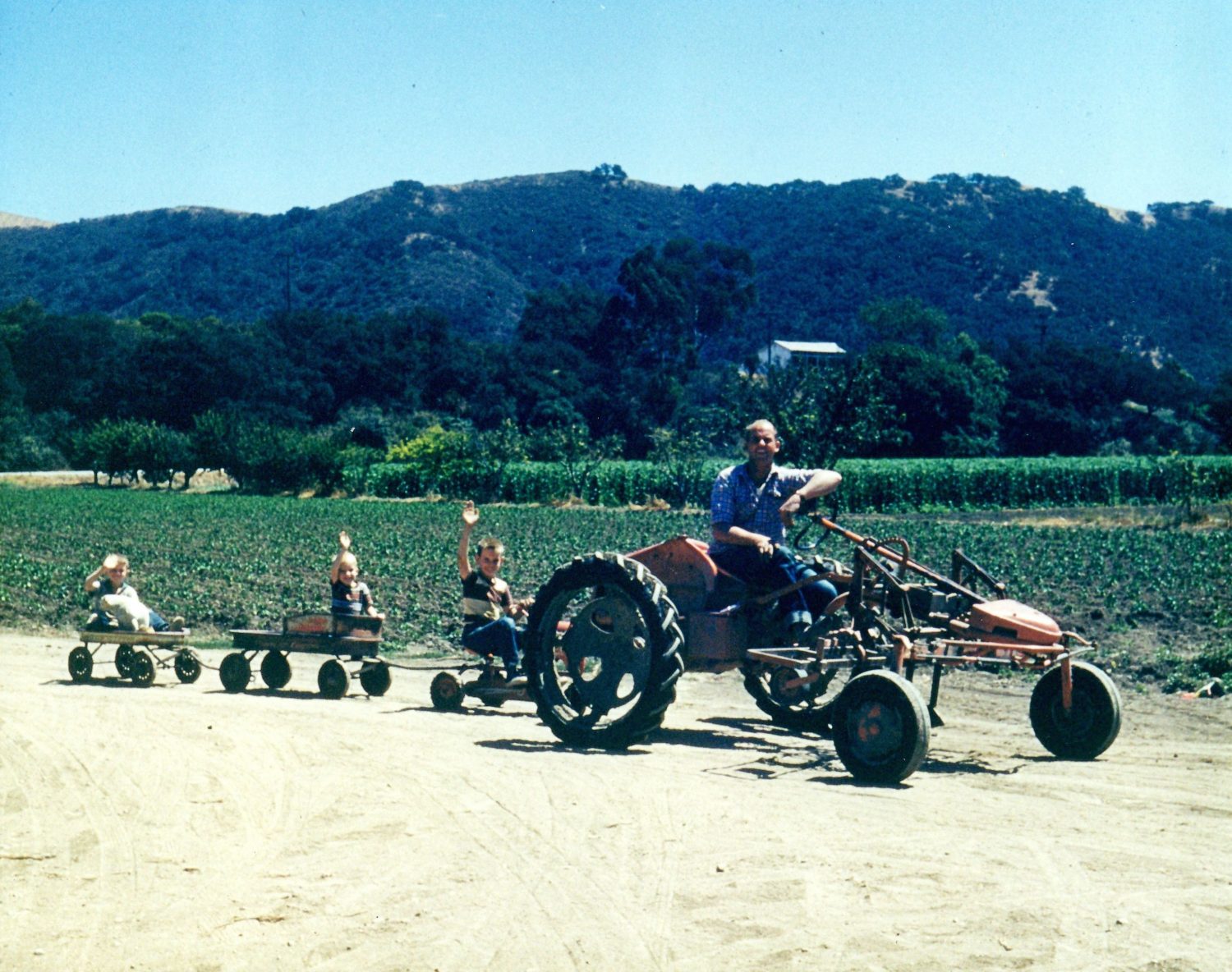
*The cover photo is of the new grammar school that replaced the one destroyed by fire. It was razed in 1931.
*Professor Nicholas Murray Butlers opinion that schools should be run by “College Educated Bureaucrats” is now the norm.
*Administrative bureaucrats posited that discipline should only be meted out by “Qualified Professionals.”
*Neither Tom Meherin, Charley Phoenix or Louis Phillips graduated with their class in 1901 though they were all from prominent and well off families and their fathers were supporters of the high school.
*The High School did lose its accreditation. My grandmother, Annie Gray graduated from the eighth grade in the spring of 1901 from Arroyo Grande grammar and would begin as a freshman that fall. Because she intended to enter the University of California she was forced to travel down to Santa Maria for high school where she graduated in 1904. She was a graduate of Cal, class of 1908.
*$500.00 in 1900 money is the equivalent of more than $18,000.00 today. It would have been a devastating fine.
*The white feather is a widely recognized symbol. It has, among other things, represented cowardice or conscientious pacifism; as in A. E. W. Mason’s 1902 book “The Four Feathers”. In Britain during the First World War, it was often given to males out of uniform by women to shame them publicly into signing up for the slaughterhouse in France. The true origins of the term are lost to history but Billy Buck certainly knew it was meant to show cowardice.
*R. Musick was a rancher in the upper Arroyo Grande and was the father of well known author and historian Madge Musick Ditmas who wrote a column on local history for the Herald for over thirty years . He is credited with being one of the county’s first grape growers.
*Robert English the town undertaker displayed my great-grandfather John Edward Shannon in his coffin behind the window of his parlor on Branch Street in 1924. I went to school with his grandson Jack, who is my life long friend.
*Communications marked as ‘without prejudice’ cannot be used by the other party as evidence in court. This means that parties can speak openly about the matters in dispute without the risk of the other party using that information against them later.
*The $2.50 a month is roughly equal to $90. 00 today. A serious levy for 1900.
*The four young ladies that graduated in 1901 were the remains of a freshman class of 18, including 6 boys.
*Coon song or “Turkey in the Straw” is a folk tune that been around in the United States for almost 200 years. With lyrics clearly intended to parody the speech of African-Americans in the rural South, it became a staple of minstrel shows and blackface acts into the twentieth century. It was a popular black-faced minstrel show song and one of the most popular sheet music covers for the song is dominated by an image of a caricatured black man. In sum, it appears that most credible sources date “Old Zip Coon” as the earlier song. “Turkey in the Straw” is adapted from it. The song illustrates the systemic and casual racism of the time. The civil war was part of the experience for many Arroyo Grandeans, many having fought in or migrated west from the border states. A large number of citizens had come out of Missouri after the war and brought prejudices with them.
*The Boot Black is another racially centered song. History shows that though it seems that no real changes have been made in our country’s conversation with race the opposite is true. The kind of overt racism presented in this music would not be tolerated today, at least in public.
*Prejudice against the Chinese was also extreme at the time. The Chinese Exclusion Act was approved on May 6, 1882. It was the first significant law restricting immigration into the United States. In the spring of 1882, the Chinese Exclusion Act was passed by Congress and signed by President Chester A. Arthur.Jan 17, 1882. Following the passing of the Chinese Exclusion Act, a period known as the “Driving Out” era was born. In this period, anti-Chinese Americans physically forced Chinese communities to flee to other areas.
*You will note that my grandfather Jack Shannon sang at the 1901 graduation ceremony though he never attended a single day of high school. He also played on the high school baseball team. Such was life in small town America at the turn of the twentieth century.
*And finally, Little Bald Willis Buck never went to law school. He lost and the judge never paid up. He died in Avila Beach, CA in 1933. In the ultimate irony, all of his three children went to high school.
*Patrick Moore ran for supervisor against Gilliam in 1902 and reclaimed his seat by a large margin.
*On a final note, the author went to school with the descendants of nearly all the families written about in this article. Patchett, Fink, Harloe, Phoenix, Donovan, Newsom, Fowler, Miossi, Jatta, Moore, Gray, English, Swigert and the others who still reside in our county.
Michael Shannon lives in Arroyo Grande and is a graduate of Arroyo Grande high school as were his father and uncle, 1928 and 1930. Both of his sons are AGHS grads also. He, his wife and his brother and sister-in-law all taught in the school district.
Link to Chapter one: https://wordpress.com/post/atthetable2015.com/11202
Link to chapter two: https://wordpress.com/post/atthetable2015.com/11890
Link to Chapter three: https://wordpress.com/post/atthetable2015.com/11815
Link to Chapter four: https://wordpress.com/view/atthetable2015.com
 atthetable2015