Michael Shannon
The Immigrant
He slept in the old rattling, wheezy school bus as it found it’s arthritic way. Most did. They hoped for just five more minutes, one more minute, please. The bus turned off the two lane road, bumped through the borrow ditch and rattled down the dirt road to the fields. The road baked as hard as steel, rutted, criss-crossed with the stampings of tractor wheels shook the old yellow bus with the fading tracery of San Luis County Schoolson its side. With a lurch the bus pulled up, the doors wheezed open and the driver said, “Get off.”
Down the aisle he shuffled with the others. The stale smell of yesterdays sweat hung about with evil odor of whiskey farts, bad breath and musty, not washed enough work clothes. He stepped down, he stretched cramped muscles, a thankless gift from the day before. Holding his pail with the tortillas, beans and rice rolled in tinfoil. he walked heavily to the wire bound basket in the pickup bed holding the hoes and flat files which were the tools of his trade.
Taking a deep breath of the sparkling air flavored with the last vestiges of the nights foggy dew, he headed down the row which seemed to stretch to infinity the ends still shrouded in the ground fog of early morning. He arrived at the spot where he’d quit the day before. Taking his water bottle off, a glass gallon jug with a length of binder twine tied around the neck in order to make it easier to carry, he stood tall, arching his back as he made a last futile attempt to disappear yesterdays pain. With an audible sigh he bent to the work.
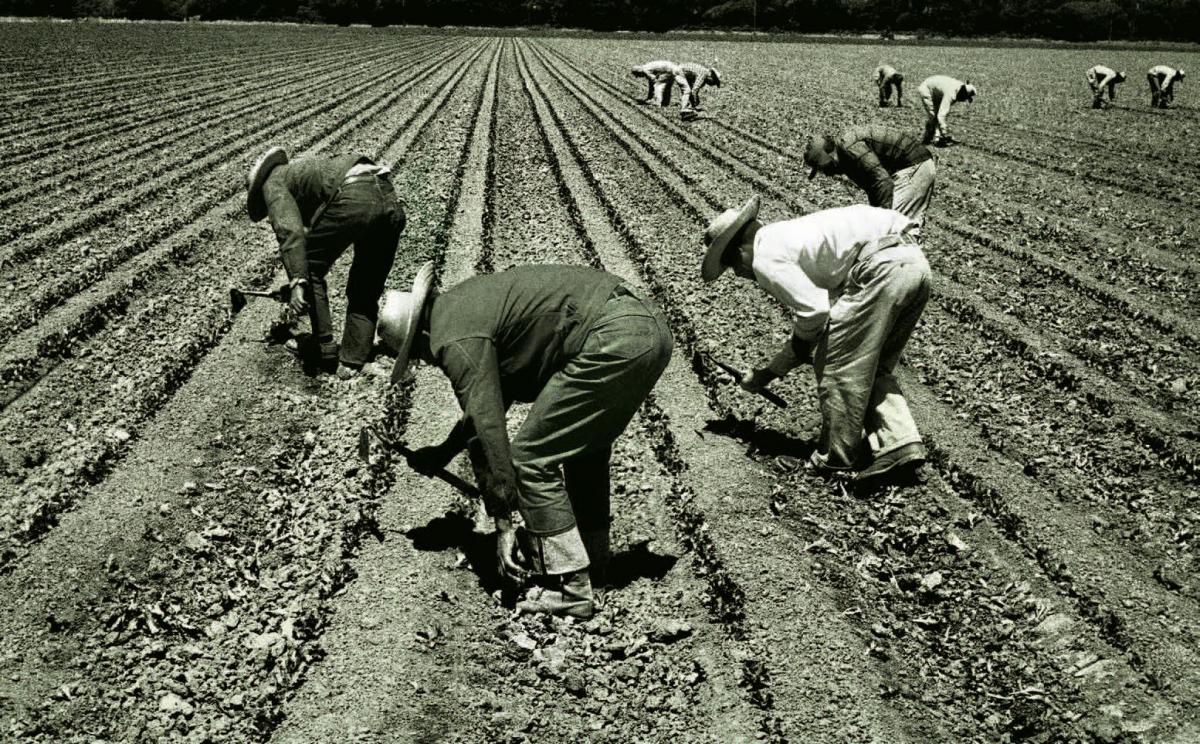
Scattered like the seeds they tend, across the fields as if flung there, their backs humped up, faces the color of the dirt. they are bent close to the ground as if part of it.
Hoeing, weeding and thinning the delicate tomato seedlings already exuding the distinctive faint odor of their kind. The width of the short hoe with its 16 inch handle determined the spacing of the plants which would be allowed grow to maturity. All others sacrificed, Tomatoes, Malva, thistle, purslane and mustard, tiny as a fingernail, chopped by the rhythmic rise and fall of the hoe. Mass murder.
Held halfway down the handle for balance the hoe slipped between the plants removing all unwanted growth. The Tomato seedling with its two jagged leaves was left alone. Again. Again. Again. Tens of thousands sacrificed to the scuffling blade.
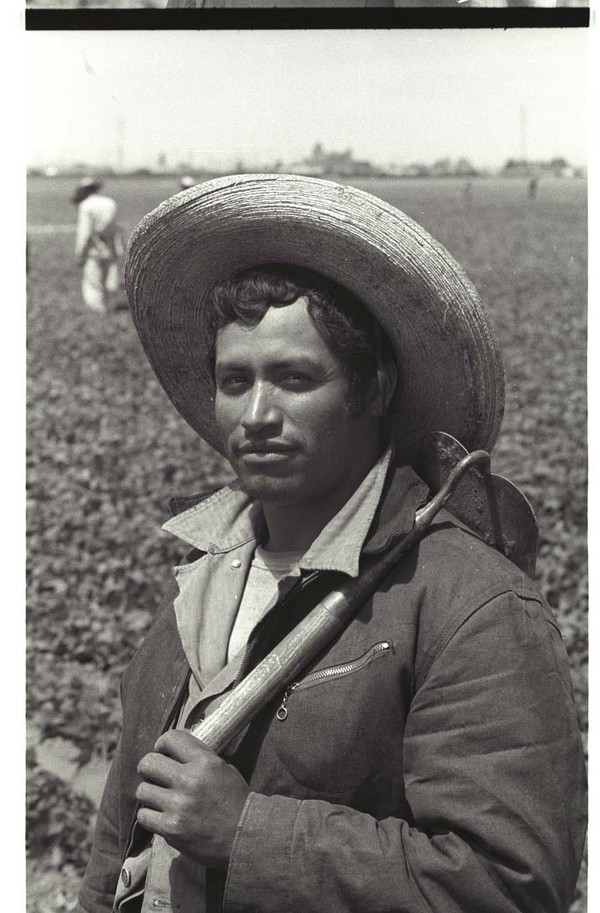
Photo ; Leonard Nagel, National Museum of Natural History 1956
Bent double at the waist, feet crossing again and again in the narrow furrow, he moved on. Already his back hurting. The pain began at the waist, spread down the backs of his thighs, the tendons behind the knees and up his spine to the shoulders and the back of the neck. Stay stooped, don’t straighten up it hurts less and the boss will see you if you do stand. There is a family to feed.
The heat rising, the sun seemingly stationary, the row endless and if you ever get to the end you must turn and face it again. Ten hours. All around the rhythmic pace of men, no talking, waste no energy. Can’t stop to smoke. When no one’s looking, a quick sip of tepid water. Sweat dripping from brow into the eyes. He straightened slowly, careful to ease the muscles lest he be crippled. He bent back over the row, trying to ease the pain of the hoe in his palm, turned red from the constant movement of the wood against skin. Back to it and all the while the ache, the ache; never ending.

Almuerzo en el Campo. Photo Shannon 1950’s
Noon, an unbelievable half hour crouched in the shade of the bus. Almost asleep while eating. Eyes closed until wakened by the shuffle of other men, cursing, groaning, headed back. Bloated with lunch, gut heavy, aching, he bent over the row. Shuffling sideways, his legs crossing and uncrossing, the Cortito rising and falling, he labored on like a condemned man, he administered his own torture; held it in his own hand.
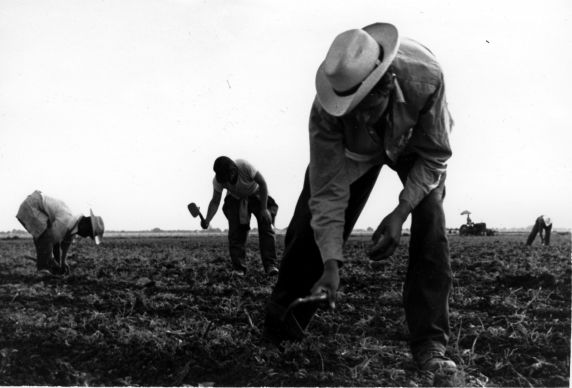
Usando el “Cortito,” ( El Azada) San Luis County, California. Family Photo
His vision narrowed until the only thing visible was the hoe and the tiny green plants. The mind going down a dark hole, focused only on the intolerable ache and the rhythm. Slide step, drop and pull, crossover step, drop and pull. He followed the bent men.
The sun slid achingly down the sky, the men moved on across the brown earth. He hardly thought, focused only on the pain and the chopping. Quitting time did not exist now, only an endless wilderness of sameness. Up and back, up and back.
At first he was hardly aware of a new movement, men jumping across rows and trotting to the bus. IHe realized with a start that it was quitting time. Slowly straighten, stretch the bunched up muscles in his back, finally standing upright he followed the others into the bus. Stepping over men prone, unable to take another moment of back bending, he found a seat.
He walked to the barracks leaning oddly backwards still trying to stretch the twisted, corded muscles in his back. Propped on his cot, feeling the new lumps of muscle in his aching spine he said to himself, “I will never go back.” But the pay was one dollar an hour and his family, in Chihuahua needed the money. An hour of work bought a meal, two, a day of food.
He was a long way from home, unable to see a return, he had no choice.
Epilogue
The Chumash, The Mestizos, the Chinese come to Gold Mountain, the Irish Navies cast loose by the southern rebellion, the Japanese, Filipinos, Azoreans, Germans, Italians, Norwegians and Swedes. The Russian Jews and the those fleeing Eastern Europes despots. Vietnamese fleeing Ho Chi Minh. Now, Haiti, South and Central America, Mexicans, Hondurans, the disposed of Oaxaca, Chiapas and the raging Cartel wars. Day laborers from Mississippi, Motel maids from Chicago, tractored out sharecroppers from Missouri, Arkansas and Oklahoma, they all come for the same reason.
America and California are built on expectations. You can start all over here. That’s why people come–to start all over and become somethng new. They put up with tenements, sweatshops and grinding stoop labor, not in resignation to tragedy but in the name of a future. Something better for my kids.
Don’t mistake the illegal Mexican immigrant who is, today, working the lettuce fields around Santa Maria, Salinas, Arroyo Grande and Oxnard with an intensity that you might mistake as resignation. It’s the reverse.
In one way or another every immigrant since the Ice Bridge has lived this same story. We are a country of Immigrants and should be proud of it. There is no other country on earth that has the same collective experience. Immigrants are truly the Glory of our Country. We need to be reminded of that often, especially now.
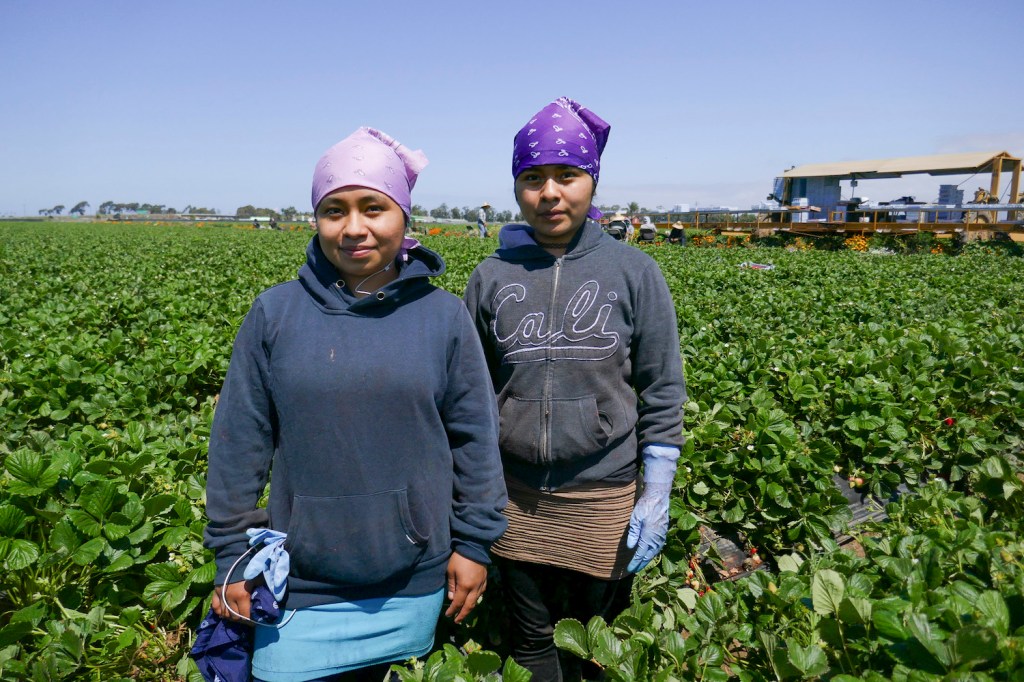
Maria y Jennifer San Salvador, 15 y 17 anos. Students at Oxnard HS. 2020. Oxnard California. Photo: Elizabeth Aguilera for CalMatters, 2020
Si Se Puede.
The hoe, ”El Cortito,” The Short one. One bracero called the hoe an “instrument of horror . . . designed by the devil.” Many growers believed short-handled hoes made workers more careful and kept crops from being damaged. The bosses also liked the short-handled hoe because they could tell at a glance whether the farm laborers were working or resting. After numerous and very contentious lawsuits the hoe was outlawed in California in 1972. The crops, workers and farmers are just fine without it.
Michael Shannon is a writer and died in he wool farm boy. He has an intimate acquaintance with the short hoe. He lives in California.
 atthetable2015