Dear Dona

Written by Michael Shannon

Page Four

Unlike the American military where mail was censored and journals and diaries forbidden the Japanese Imperial Army thought the differences in language would make ordinary Japanese as indecipherable as any code to an American reader. The head instructors at the MILS schoolalso knew that Japanese soldiers were brutalized by their superiors and would likely be resistant to the treatment the British were using on captured Afrika Corps German troops where violence and intimidation were routinely used to coerce confession and information. As many of the instructors had lived in Japan for extended periods of time they knew the Japanese were generally very kind and the spirit of co-operation was instilled in them from birth. The culture of Japan was bound to duty to the Emperor and higher authority, but they also believed that force would not be enough to get prisoners to break down. Instead the language program not only include reading a writing and the general makeup of the Japanese soldiers battlefield strategy and tactics but a heavy emphasis was put on Japanese society, geography and religious beliefs. The idea was to draw a picture of the individual soldier in an attempt to establish rapport with him. They planners knew that they would resist brutality because that was a soldiers daily life in the Imperial Army. Instead a cautionary approach was adopted where kindness and not only assurances of kind treatment but whenever possible knowing about the persons home. Differences in prefecture, religion, the social mores of a particular part of Japan helped build trust between the interrogator and the prisoner.

American government sponsored propaganda was designed to present the enemy as a monolithic structure, all Japanese being of the same mind. Depictions of the Japanese were as vile and hateful as the propagandists could make them. It was impressed upon the American public that they needed to be eradicated. This conveniently swept under the rug the fact that, just like the US they were a diverse people with many different beliefs. Led by a military dictatorship whose war aims were no less than domination of the entirety of east and Southeast Asia.

The two largest religions were Shintoism, the official state religion and Bhuddism which originally came from China and was characterized as a forign religion. Various western religions were also represented particularly the Methodists. In 1940, Christians in Japan united in a declaration of church unity after the Religious Organizations Law required all Protestant churches to merge into one.

Japan had religious freedom during World War II and there was separation of church and state. It was not a theocracy. It is correct to say that most religious people were pro-war at the time.

During the pre-1945 period, Japan moved into political totalitarianism, ultranationalism, and fascism culminating in Japan’s invasion of Chinese Manchuria in 1931. This was part of an overall global period of social upheavals and conflicts.

Regardless of the political reality the instructors knew that the average Imperial Japanese soldier would have far less interest in politics and much more allegiance to his family, friends and the local village life. All of these observations dictated a much more friendly and kind approach than the Germans were getting from the British. Establishing a connection between the Nisei interpreter and the prisoner was an important part of the curriculum at Camp Savage.

The very first class which started on June 1, 1942 was made up of 200 enlisted men, 193 Nisei and 7 Caucasians. The entire class, which had been moved from the Presidio was made up of soldiers who had already enlisted before the war and were considered regular army. Their studies had begun in San Francisco and it wasn’t until after order 9066 was signed in February of ’42 that they moved east.

There were three types of student classification. There were Caucasians who had studied abroad or attended universities where they studied Japanese The majority were Nisei, American born citizens who had varying degrees of language experience. Some had attended locally run Japanese schools which they attended after regular public school classes and came from homes where the Japanese was spoken. The third classification were the Kibei, A subset of Nisei who spent a significant part of their youth in Japan, usually for education, and then returned to the U.S. They ranged from students who had gone to elementary school, many from Japanese high schools and some University students. The Kibei were terrific asset to the MIS because of their familiarity with Japanese culture at all levels.

The terms the Japanese used to describe what generation they were from were introduced to Western American cultural language in the late thirties. Hilo’s immigrant parents were referred to as Issei or First Generation. The 2nd generation like Hilo and his brother were Nisei or 2nd generation. Sansei were their children, the ones I went through school with.

Families wealthy enough to send children to Japan were relatively uncommon. Kibei (帰米, literally “go home to America”) was a term often used in the 1930’s and 40s to describe Japanese Americans born in the United States who were studying in or had studied in Japan. Many Kibei got trapped in Japan when war broke out between Japan and the U.S. In a sense, they became stateless because they were Americans living in Japan, labeled as the “enemy” in both.

The Kibei were the foundation blocks of the school at Camp Savage. Because the service would need soldiers to read fluently, translate to careful english, have some background in Japanese cultural, both civilian and military classes were on educating each student in a curriculum that matched both his background, Nisei or Kibei, and the specialty he was being trained for. Graduates would operate in teams where each member had one of the key components they studied at Savage.

Savage was an apt description for both the curriculum and the school. Foremost in their minds must have been the consequences they likely faced if they failed. The military is essentially faceless. You have a serial number because thats how you are identified. Transfers aren’t exactly blind but primarily rely on number that are needed here or there. For the Nisei soldiers at camp Savage, that meant that failure meant transfer back to your original unit. In Summer of 1943, nearly all Nisei in the various units of the army were transferred to the 100th Infantry Regiment, a mostly Hawaiian unit made up from the Hawaii National Guard. Trained in Mississippi and Wisconsin they shipped out to Italy in September of 1943 and were immediately thrown into the battle for Salerno in southern Italy near Naples. They spent the next eight months in nearly constant combat in some of the most vicious fighting of WWII. Every Nisei at Savage knew of this and what the price of failure would be, immediate transfer to the 100th as a replacement. They weren’t cowards, far from it, but they also understood the reality.

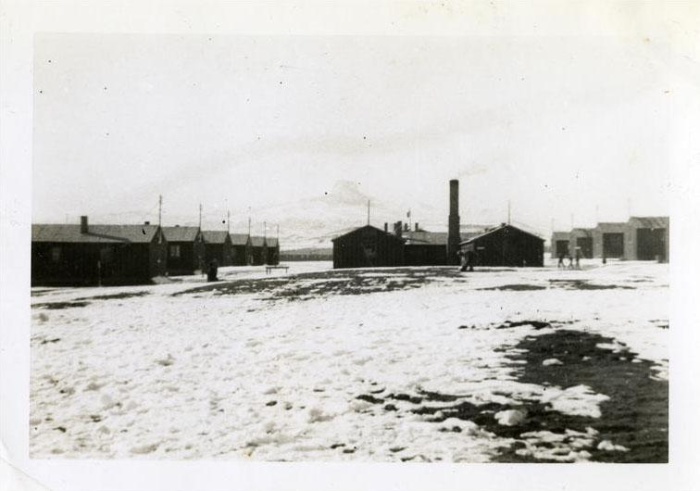
Your father lived in one of those tarpaper shacks for six months. I’m sure he had his turn rolling out of his cot at 4:30 am and priming the stove. He may have been lucky in the placement of his bunk, next to the little coal stove would have been as good as it got. Having a bunk on the end of the row would not be the best place to be in Minnesotas winter. Tarred paper is not among the greatest insulators. In fact it dwells pretty near the bottom. You can poke a pencil through it with no effort. Those shacks were drafty and pretty close to sleeping out of doors. In the morning they must have smelled. A confection of bad breath, farts, nearly dead hunks of coal giving off a noxious vapor and the clinging smell of cigarettes and uniforms they were not able to keep clean. Hanging just below the rafters a white cloud of condensed vapor from the mens breathing which would melt a drip as the room and the day heated. Soldiers had to do their own laundry, in tubs and basins outdoors with rough alkaline soap. Avoiding that chore would have been paramount.
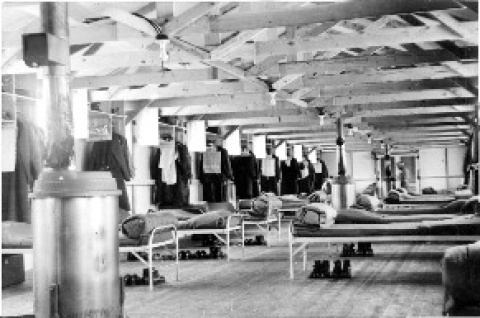
Barracks at Camp Savage with stoves. US Army photo. 1943

Being young and soldiers they would have laughed at their predicament and blamed the army in no uncertain terms. Grousing soldiers have alway found the military to be the villain. SNAFU* was the word in WWII.

The classrooms were a better place to be. Semi-permanent buildings, well heated and clean would have been a relief. Luckily student were relieved of all the most basic duties that a soldier normally carried out. There was no drilling or inspections, no standing post in the middle of the night, all the little annoying things that the regular private has to put up with. The Army was desperate to prepare them for their combat jobs and made sure they had no more distractions than absolutely necessary.

After six months in the classroom, class C-10 at Camp Savage walked out of the classroom for the last time and stood in front of one of the remaining log buildings and stood for a class picture. Everyone smiling and glad to be through the grinding curriculum.
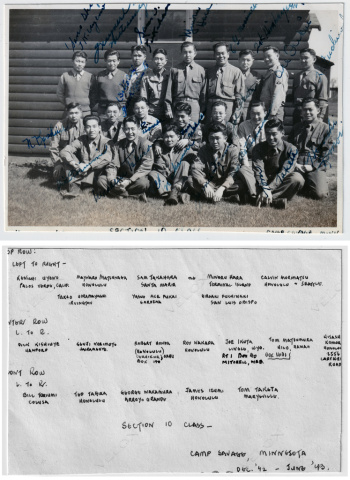
1942 1943 Camp Savage MIS Niseis. Your fathers class.

Hilo received a promotion to Tech five, an enlisted rank slightly below Corporal.** Like the others, he walked back to his hutment to open his official orders. He would have opened the manila envelope with the printed label, Official, Department of the Army and like all soldiers held his breath while he slid the paperwork out. Along with his service record was a single page warning him that he was now a holder of a Top Secret Clearance and was liable under the Uniform Code of Military Justice and the Official Secrets Act not to share or divulge any information as to his assignment or duty station under penalty of law.

Every MIS soldier carried a Secret designation. Information on the school and its graduates, their purpose was to be a closely held secret. This designation was to be enforced for a period of fifty years after WWII. The Military was concerned about the fact that they had interpreters in the Pacific theater whose importance could not be overstated.

Hilo’s parents who were housed at the Gila River, Arizona concentration camp had been visited by the FBI. Every MIS graduate had been thoroughly vetted before they were ordered overseas. This must have been very confusing to Hirokuni and Ito who would have been interrogated by two agents who gave them no information at all about the reason. Hilo wasn’t even mentioned during the questioning. The were and would remain completely ignorant of the reason until the war was over.

The second sheet of paper stated his destination; future duty station and was clipped to a set of official orders and travel vouchers. He was to report to Army headquarters in Oakland where he would travel by available transport to the Southwest Pacific Theater of Operations immediately. There would be no leave as Nisei soldiers were not yet allowed to enter the restricted zone to see family.*** Censorship rules meant that he could not tell them his destination just that he was being ordered overseas.
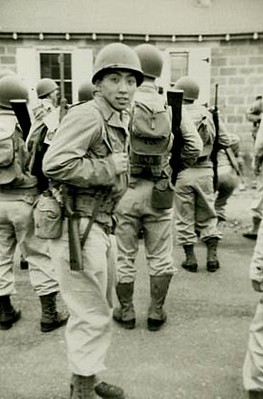
MIS interpreter PFC Geo Hara leaving for the Pacific, 1943. Densho Archive photo

Hilo himself wouldn’t have known his actual destination. He wouldn’t find out until his ship passed Hawaii so sensitive was military command. Some of the instructors at Savage were returnees and would have shared general information but not too much. He could have likely guessed that it would have been the Western Theater of Operations under General MacArthur but where? He was left to wonder.

Page Five coming Saturday November 23rd.

Destination, Southwest Pacific theater of operations and the real war.

Notes on text:

*SNAFU, Situation Normal, All f****d Up.

**The Army forbid the Nisei commissioned rank until late in the war. All MIS personnel were enlisted or noncommissioned rank.

*** Restrictions on visitation were lifted for servicemen in late 1943.

Links to other chapters in the series.

Page one: https://wordpress.com/post/atthetable2015.com/12268

Page two: https://wordpress.com/post/atthetable2015.com/12861

Page three: https://wordpress.com/post/atthetable2015.com/12872

Michael Shannon is a writer living in the Central Coast of California. He went to school with many children, whose parents were survivors of the camps in his little farming community of Arroyo Grande, California..
Standard

Dear Dona

Page Three

Written by Michael Shannon

A Hobson’s choice is a free choice in which only one thing is actually offered. The term is often used to describe an illusion that choices are available. That’s the military to a “T”

December 3rd, 1942.

At morning roll call, the Lieutenant called your father’s name. He was told to report to headquarters right after morning chow. Like any good soldier he asked what was up and like any good officer the Lieutenant wouldn’t tell him. So after breakfast he hustled over to the headquarters building and reported to the Top Kick, the first sergeant. Hilo would have entered the office, stood on the yellow footprints painted on the floor and announced himself. The sergeant merely looked up then rummaged on his desk until he found what he wanted, then said simply, “Your Orders.” “Where to Sarge?” “Camp Savage, you’d better pack your winter uniforms,” and he laughed.

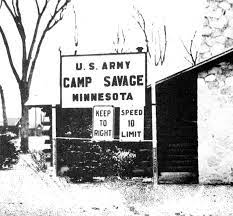
Camp Savage, Minnesota home of the Military Intelligence Service Language School. Camp Savage was a World War II Japanese language school located in Savage, Minnesota, and was the training ground for many Japanese Americans who served in the U.S. military. The buildings were originally built during the Great Depression to house Civilian Conservation Corps (CCC) workers. In the rush to build up American forces the CCC tarpaper huts were put into service for the Nisei students. Part of Fort Snelling near Minneapolis, Savage was the new home of the language school. Originally located at the Presidio in San Francisco it was moved to the center of the country for the “safety” of the Nisei students. Californias attorney general Earl Warren a supporter of Executive Order 9066 signed by President Roosevelt on February 19, 1942: this order authorized the forced removal of all persons deemed a threat to national security from the West Coast to “relocation centers” further inland – resulting in the incarceration of Japanese Americans. You will note that the order only mentions “persons,” and not Japanese Americans, though the only removals just happened to be in the west. Germans and Italians weren’t moved anywhere.

Fort Snelling/Savage had a long history controversial acts by the US Government. Snelling is a former military fortification on the bluffs overlooking the confluence of the Minnesota and Mississippi Rivers. The military site was initially named Fort Saint Anthony, but it was renamed Fort Snelling once its construction was completed in 1825.

Before the American Civil War, the U.S. Army supported slavery at the fort by allowing its soldiers to bring their personal slaves. These included African Americans Dred Scott and Harriet Robinson Scott, who lived at the fort in the 1830s. In the 1840s, the Scotts sued for their freedom, arguing that having lived in “free territory” made them free, leading to the landmark United States Supreme Court case Dred Scott v. Sandford. In this ruling, the U.S. Supreme Court ruled that enslaved people were not citizens of the United States and, therefore, could not expect any protection from the federal government or the courts. The opinion also stated that Congress had no authority to ban slavery from a Federal territory. United States Supreme Court Chief Justice Roger B. Taney ruled that African Americans were not and could not be citizens. Taney wrote that the Founders’ words in the Declaration of Independence, “all men were created equal,” were never intended to apply to enslaved blacks, they not being “Men” under the laws of the United States.The decision of Scott v. Sandford is considered by many legal scholars to be the worst ever rendered by the Supreme Court. The ruling was overturned by the 13th and 14th amendments to the Constitution, which abolished slavery and declared all persons born in the United States to be citizens of the United States.

The fort served as the primary center for U.S. government forces during the Dakota War of 1862. It also was the site of the concentration camp where eastern Dakota and Ojibway tribes awaited riverboat transport in their forced removal from Minnesota to the Missouri River and then to Crow Creek by the Great Sioux Reservation.

Hilo went down to the transportation office to find out how he would get up to Minnesota, it was nearly 1,400 miles away and when he checked the newspaper in the PX he found out that the high temperature that day was 21 degrees and the low was -1. Not the temperate central California weather where he was from nor even Fort Bliss where it was 68. He reckoned the crack about winter uniforms was good advice. Of course, being the army they weren’t going to issue him any either. He figured he would have to wait until Minnesota.

In ’42, getting from Texas to Minnesota wasn’t easy. The Army would waste no effort in flying a lowly private anywhere, going by car was impossible for those who had them and even if they could get rationed gasoline, that was impossible for an enlisted man. The Army sent soldiers by bus here and there but getting a chit to travel that way was forbidden to the Nisei. With the war in the Pacific the military considered it too dangerous for Japanese Americans travel alone or by private transport. He went by passenger train. Switching railroads and constantly being sidetracked by military trains which had priority, the 1,400 mile trip took six days. He had to sleep on the train car’s benches and jump off at the stations where the train stopped to buy something to eat. Even for a 23 year old in the prime of life it was an exhausting trip although considering what was to come, it was a walk in the park.

He and the other boys kept up on the war news by reading newspapers to pass the time. While they were enroute, the US Navy lost the heavy cruiser USS Northhampton in the Battle of Tassafaronga in the Solomon Islands, sunk by Japanese Imperial Naval torpedos. They read that the Afrika Corps was being pushed into a corner in Tunisia by the Allied armies and their surrender was expected, though that wouldn’t be soon. While traveling to Camp Shelby they read that the US Marines had turned over the mission in Guadalcanal to the US Army which immediately was involved in very heavy fighting in the interior of the island. American and Australian troops finally pushed the Japanese out of Buna, New Guinea. New Guinea was a place Hilo would soon enough become familiar with. Unbeknownst to the travelers, below the bleachers of Stagg Field at the University of Chicago, a team led by Enrico Fermi initiates the first nuclear chain reaction. A coded message, “The Italian navigator has landed in the new world” is sent to President Roosevelt. The result would, in the end, save the lives many Mils soldiers, but that would come much later, too late for many.

Following Japan’s attack on Pearl Harbor, anti-Japanese sentiment and political expediency pushed President Franklin D. Roosevelt to order the army to set up Japanese internment camps in seven western states, that included Japanese Americans who volunteered at the U.S. Military Intelligence Service Language School in San Francisco. The school and volunteers had to move from the so-called “exclusion zone.”

All the western states but Colorado and Minnesota refused to host the school except Minnesota Gov. Harold Stassen who offered 132 acres of land in Savage to host the school. In 1942, Camp Savage was established. An old CCC camp and host to the Boy Scouts, it was run down and primitive. What buildings were still standing were augmented with the building of the cheapest of the military’s building, the loathed and ubiquitous tarpaper shack, the miserable hutment.

Hilo stepped down from the camp bus which had picked up the volunteers at the railroad station. He tossed his barracks bag up onto his shoulder and followed a Corporal who had been sent to get the. When they got to the headquarters building he turned, looked them up and down and over a big grin said, “you’ll be sorry,” followed by a laughter. Names Kobayashi,” he said, “Larry.” “Get checked in and I’ll take you to your quarters.”

Most of the men experienced for the first time the bitterly cold winter of Minnesota. Nearly all the students were from the temperate zones of the west. Some of the men suffered frostbites and persistent colds. The only source of warmth was the pot-bellied coal burning stove found in the classrooms and in the barracks. The stoves in the classrooms were kept burning by the school staff but the ones in the barracks were the responsibility of the students. If you had been designated barracks leader you usually had to wake up early at 4:30 am. to stoke up the stoves so that the rest of the men could rise and shine in a warmish barracks.

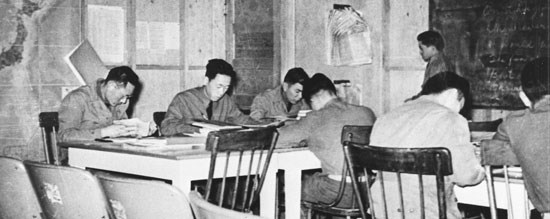
Classmates at Camp Savage. The Military Intelligence Service Language School, 1943. Densho Archive

The purpose of the school was for the volunteers to teach the Japanese language to military personnel. This skill could then be used to interrogate prisoners of war, translate captured documents and aid in the American war effort. A total of 6,000 students graduated from the school before it was moved to Fort Snelling in 1944.

The ancient Chines General Sun Tzu and philospher revered as one of the greatest military strategists, advised in his treatise that intelligence, procured from the enemy is the way to victory. George Washington set up an extensive intelligence system and it really hit it’s stride in the Civil War. Of the two types of intelligence strategic or long term planning and Tactical which concerns the enemy’s strength and location and is used to make immediate decisions on the actual battlefield.

The short but extremely intensive course was designed to meet the demands for linguists from field commanders in the Pacific. The studies included the study or review of the Japanese language, order of battle of the Japanese military forces, prisoner of war interrogation, radio intercept and many other subjects that could be of value in the field. Just to illustrate how intense our course was the kanji (ideographs) instructor would make us memorize seventy five characters a day just to make sure we remembered fifty for the next day’s test. Many of us studied using flashlights under our blankets after lights out at 2200 hours. Saturday mornings were devoted to examinations. Many woke up early, about 0400 hours, went to the latrine, sat on the commodes and studied for the tests under the meager lighting. The competition was so keen in class that the class grade average was in the mid-nineties.

The study week, Mondays through Fridays, consisted of classes from 8 to 12, a brief lunch break, classes from 1 to 5, a break for supper and compulsory supervised study from 7 to 9. Examinations were conducted on Saturday mornings. The soldiers were free from Saturday afternoon until Monday morning. The majority would hurry to the Twin Cities for Chinese food and movies. On Sundays most attended church services in St. Paul, where many students were befriended by a Mrs. Florence Glessner, who graciously invited the Nisei kids to luncheons and parties. Mrs. Glessner was a Red Cross volunteer and after graduation and assignment to the Infantry Divisions on Bougainville, the MIS soldiers made a collection from the members of the language detachments and sent the donation to the Red Cross through Mrs. Glessner. She later sent us a clipping from a Minneapolis newspaper about the donation “from her boys”.

Minnesotans rarely saw any Japanese-Americans and for the most part had little or no racial bias. Unlike the west coast where business and individuals were stripping evacuees of their property, houses, fishing boats and anything they could get their hands on the people of Minneapolis were giving dances and dinners to the kids at school. Showing an appreciation for the Nisei soldiers who were serving their country. Many students at the MISLS were astounded by this. Captain Kai Rasmussen, the camp’s first commanding officer was quoted as saying, “Minnesota was the perfect place because not only did the state have room for the school, but Minnesotans had room in their hearts for the boys.”

Your dad arrived at Savage after your grandparents had already arrived at Poston. It was very hard for them to communicate by mail. Nisei soldiers could not safely write in Japanese and in many cases the parents could not write in English. Letter were very carefully written, in your dads case probably by your aunts, He must have been worried sick about them and they him. They may not have even known where he was. If he got leave at the end of his class he would not even have been able to visit because in 1942, no Nisei soldier would have been allowed in the exclusion zone. When the restriction was lifted in 1944, he had already left for the Pacific war zone.

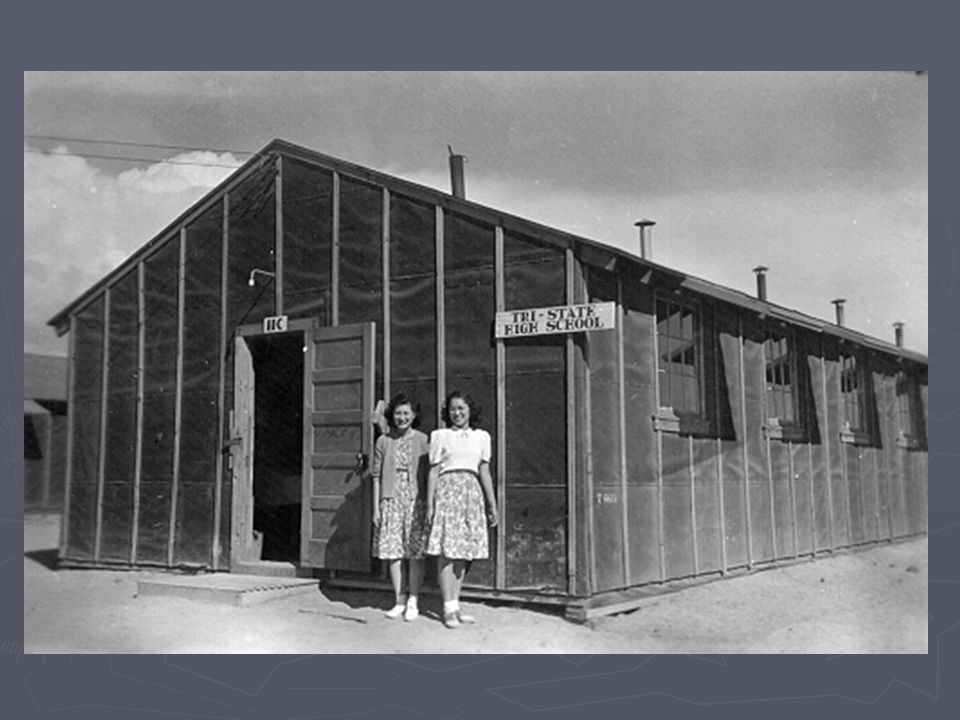
Tri-State High School, Poston Camp. 1943. Densho Archive.

The photo above is a sad commentary, but the two young ladies are a lesson in the girls resilient nature. Though held against their will behind razor wire they still managed to dress in the current fashion of young women. They wear saddle shoes, bobby sox, full knee length skirts, peter pan collars and sweaters, they would not be out of place in any high school in the nation. My mother dressed just like this. She was the same age

It was a rough go for them because almost al the students were from the exclusion zone and many had no idea where their families were. Lieutenant Paul Rusch, one of the senior instructors had spent decades in Japan as a Methodist missionary and knew the culture better than any other instructor. He lent a sympathetic ear. Students said they ween’t angry with the Army but that they were, “Just against everything that was happening with their families. We’re being treated as second class citizens and we hate it.” Imagine what it be like to be forced from your schools and home and cast adrift in a forbidding and alien place where only the most rudimentary life is possible. It was like life on another planet.

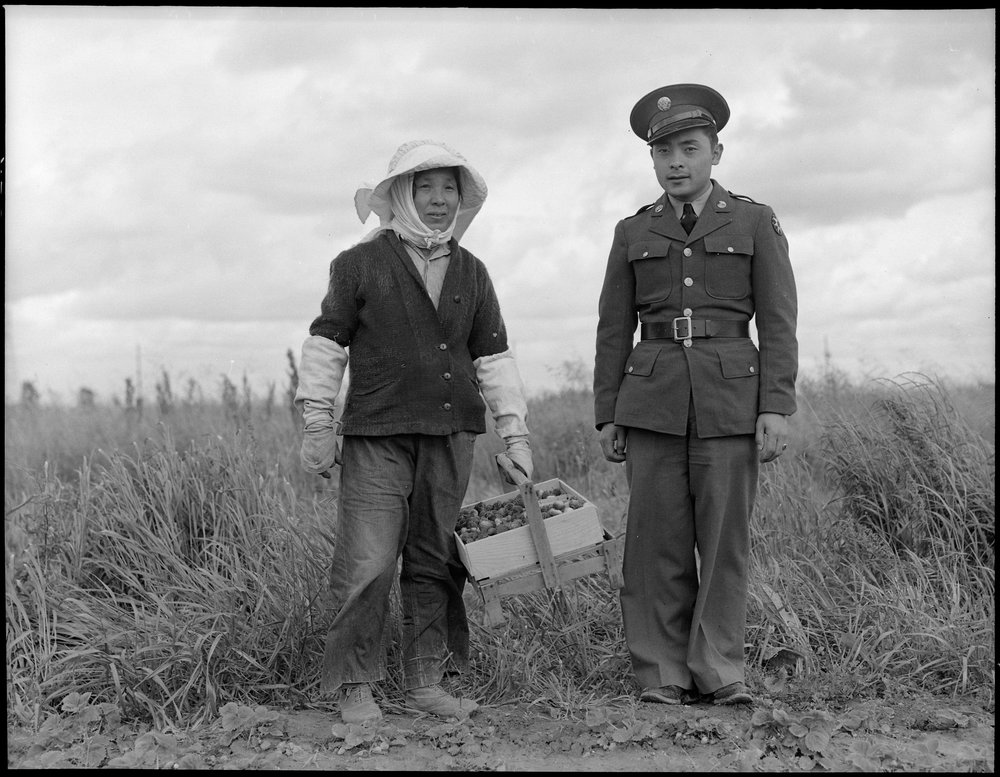
A widowed mother with six children in a strawberry field near Fresno. Two of her sons served in Italy and France with the 442nd Regimental Combat Team. She spent the war with her other four children in the Manzanar concentration camp in the Owens Valley of California.

Dear Dona page four

Coming November 8th, 2024

Unlike the American military where mail was censored and journals and diaries forbidden the Japanese Imperial Army thought the differences in language would make ordinary Japanese as indecipherable as any code to an American reader. The head instructors also knew that Japanese soldiers were brutalized by their superiors and would likely be resistant to the treatment the British were using on captured Afrika Corps German troops where violence and intimidation were routinely used. As many of the instructors had lived in Japan for extended periods of time they knew the Japanese were generally very kind and the spirit of co-operation was instilled in them from birth. The culture of Japan was bound to duty to the Emperor and higher authority. They believed that force would not be enough to get prisoners to break down……

Links to other chapters in the series.

Page one: https://wordpress.com/post/atthetable2015.com/12268

Page two: https://wordpress.com/post/atthetable2015.com/12861

Michael Shannon is a writer living in the Central Coast of California. He went to school with many survivors of the camps in his little farming community.

Standard