Page 8
Doing Work, Staying Sane.
From Michael Shannon
Every soldier comes from somewhere. Sometimes to remain sane they need something, an object, a letter, a family photo, or one of his wife, children or sweetheart to remind him of home. In old stories knights, Jannisaries and legionnaires would carry a talisman to ward of evil or to remind the Gods to take care of them. Talismans have changed but the idea remains the same.
Historians have found letters from Roman soldiers to their friends and families that, if translated from the Latin to English sound remarkably like a letter written today. Alexander’s Macedonian Hoplites wrote home, so did the Persian boys who served under Xerxes and Darius of Persia. Letters form the backbone of history.*
Your dad must have done the same. Carried in his backpack or his ditty bag even in a breast pocket was a photo. Perhaps it was your grandparents or one of the family. Many soldiers carried pocket Bibles. Most likely, or so I would like to believe, he carried a photo that girl, Iso Kobara. Hopes and dreams reside there.
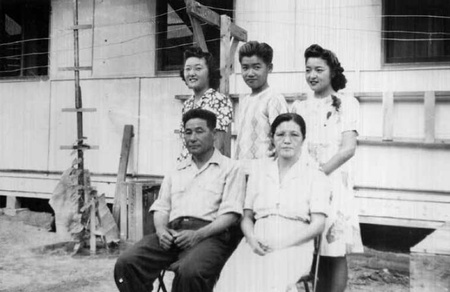
Shigechika and Kimi Kobara at Gila River with their children (left to right): Iso, Towru and Namiko. Photo courtesy of the Cal Poly Re/Collecting Project and the Fuchiwaki and Sanbonmatsu families.
With wartime restrictions, censorship in place no American serviceman could name the place he was nor where he might be going. Journals and diaries were forbidden and letters from home came from the family who knew there were certain things they could not say.
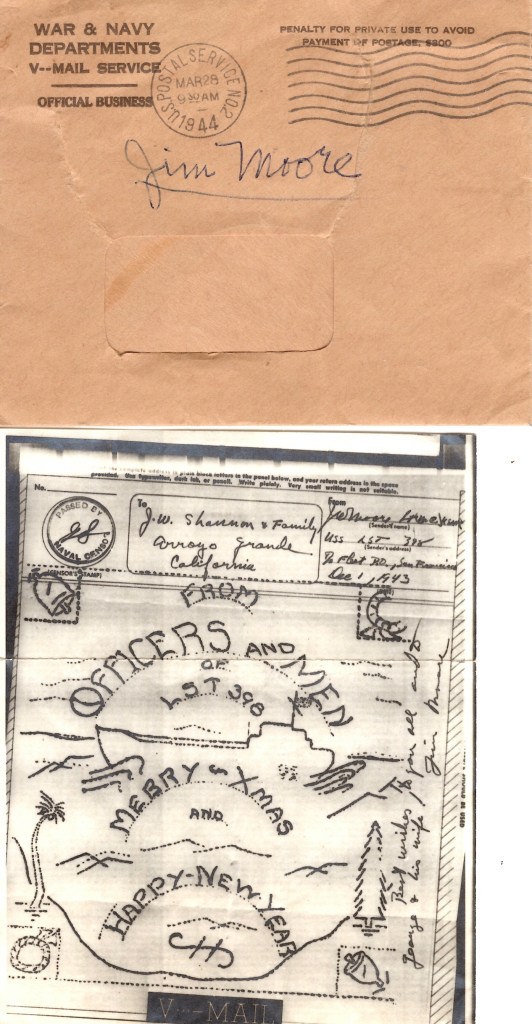
Jim Moore was my fathers friend and the son of Judge Webb Moore and his wife Edith, nee Fesler. They lived at the site of the McDonalds at Grand Ave and todays El Camino Real. The text on the side, “Best wishes to you all and to George and his (New) wife.” My mother was the new wife, the only wife actually. Other than the address Landing Ship Tank or LST there is little to tell you where he was when he wrote it. The only real clue is the palm tree which indicates somewhere in the Pacific. My family saved a number of these because they had friends serving all over the world. Over half the draft age young men from our town were in the service somewhere. My mother and grandmother were relentless in writing to them. Letters from home were a great prize.
Today we know that when this V-mail was written, his ship set sail from Kukum, Guadalcanal to resupply forces in Torokina, Bougainville. The convoy was under constant air attack and raised a barrage balloon to 2,000 ft. While unloading supplies, equipment and mail on a Bougainville beach. Japanese artillery hit the ship on the same day this photo was taken, killing an officer and five crew members.

Lt. Jim Moore’s 398. The workhorse of the fleet, hard used and constantly on the move. Jim served on her for three years without coming home. He took the train to Oakland on December 8th, 1941 with my father to enlist in the navy. After the war Jim became a surgeon in Ventura.
Your mother’s address would have been Gila River, Pima/Sacaton Arizona, Relocation camp, building 19-5 B, a hut they shared with two other families. His family would address mail to the APO, Army Post office San Francisco with just his name rank and serial number. Strict limits were put in place for obvious reasons. Old photos of the captured and dead invariably show them with pockets turned out and scattered papers and other objects lying nearby.
I took a while for the army to get over the suspicion that somehow the Nisei translators couldn’t be trusted, but by the time your dad got to New Guinea enough intelligence gathered by the MIS showed the great value they brought to the battlefield. Not only had battles been won but carful analysis of the information gathered gave the allies an almost complete picture of the Japanese Imperial armies disposition, tactical and strategic goals. They had gotten so good that the names of individual soldiers, not just officers, but the town and prefecture they lived in back home in Japan, their family members and their civilian occupations. Never in military history had planners had such a complete picture of their enemies.**

Captured diary of a Japanese soldier. National Archives. The map shows Malaysia, Burma, (Myanmar) both British controlled colonies. Thailand, Cambodia, and Vietnam were under the control of the French and called French Indochina. The Phillipines were and American Colony and the Dutch controlled Indonesia. All rich in resources such as rubber and oil they were the focus of the allies war effort in the Southwest Pacific area. Little mention of this area in textbooks but the effort to restore these countries to their European masters was very hard fought.
The following are entries from the personal diary of Hideki Oura.
June 29, 1943 : I wonder if they will come today. Last night it drizzled and there was a breeze, making me feel rather uncomfortable. When I awoke at 4 this morning, rain clouds filled the sky but there was still a breeze. The swell of the sea was higher than usual. However, the clouds seem to be breaking.
I have become used to combat, and I have no fear. In yesterday’s raid our air force suffered no losses, while nine enemy planes were confirmed as having been shot down and three others doubtful. Battle gains are positively in favor of our victory, and our belief in our invincibility is at last high.
Some doughnuts were brought to the officers’ room from the Field Defense HQ… They were awfully small ones, but I think each one of us had 20 or so. Whether they were actually tasty or not didn’t make much difference because of our craving for sweets. Each one was a treasure in itself. While eating the doughnuts, I lay down in the sand, and I pulled out the handbook my father had bought for me and which was now all in pieces from a bomb fragment. As I looked at the map of my homeland, which was dear to me, I thought I would like to go to a hot spring with my parents when I get home…
July 23: …Where have our air forces and battleships gone? Are we to lose? Why don’t they start operations? We are positively fighting to win, but we have no weapons. We stand with rifles and bayonets to meet the enemy’s aircraft, battleships, and medium artillery. To be told we must win is absolutely beyond reason… In the rear, they think that it is all for the benefit of our country. In short, as present conditions are, it is a defeat. However, a Japanese officer will always believe, until the very last, that there will be movements of our air and naval forces. There are signs that I am contracting malaria again.
This was Oura’s last entry. His fate is unknown, but it is unlikely he survived.
A diary with an illustration of the destruction after the fire bombing of Tokio
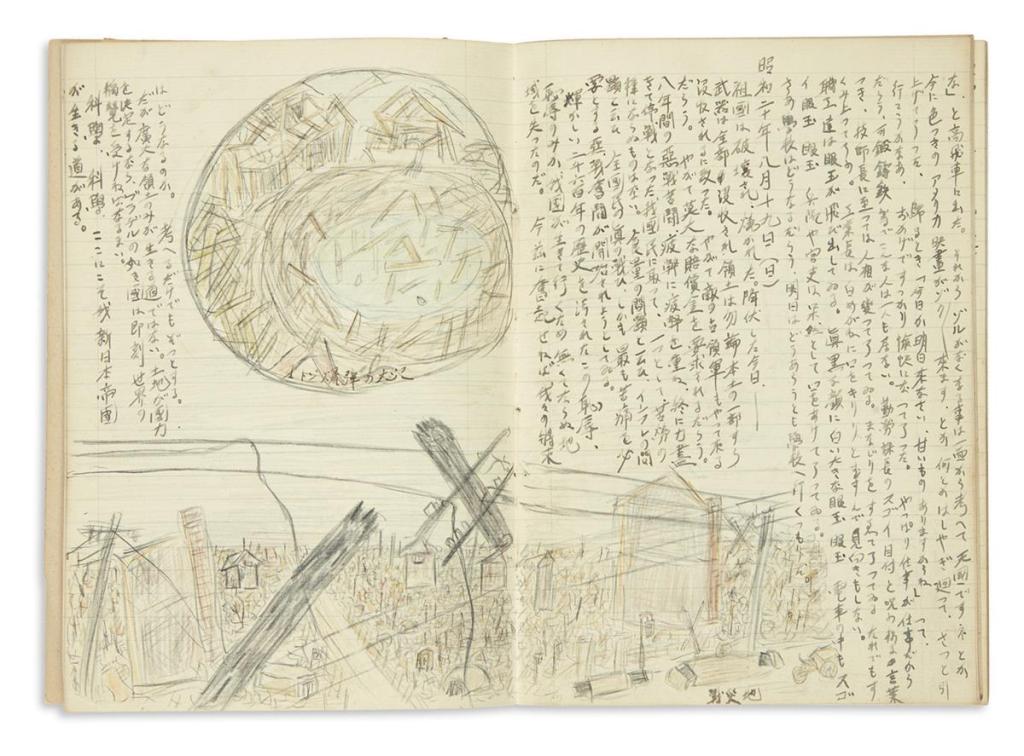
The first fire bombing of Tokyo on the 9th and 10th of March 1945 incinerated over 100,000 and made nearly a million people homeless. Every major city in Japan was to suffer the same fate. It didn’t sway the Emperors government at all.
Working in Port Moresby your dad would have handled letters and diaries daily. A vast amount of information had to be read, categorized and organized quickly because battlefield conditions are constantly in flux. Added to information coming down the Solomon and Marshall Islands, the Australian, Dutch, British, and from the US Army, there came intelligence from the coast watchers to which was now added labor needed to handle the documents coming from the Marines on Guadalcanal in the Solomons. The Navy and Marines would not enlist any Japanese. The remained segregated throughout the war but had seen the value the MIS boys brought to the fight and wanted to take full advantage of it. Because of this the MIS boys would soon be on the move.
At the ATIS clearance center in Brisbane, 400 hundred Nisei worked around the clock. Information from there was sifted thoroughly, categorized and quickly forwarded to Pacific headquarters at Pearl Harbor.
As well as the collected paperwork, your dad would have seen a steady stream of Papua New Guinea islanders, the famous Fuzzy Wuzzys. He would have had to really stretch his language skill because, though English was the language of the administrative population and the larger towns, in the bush it was Pidgin. Tok Pisin was the second language for the indigenous population. Pisin, or Tok Pisin is often referred to by English speakers as New Guinea Pidgin or simply Pidgin. It’s an English creole language spoken throughout Papua New Guinea and today is recognized as the official language of the country.
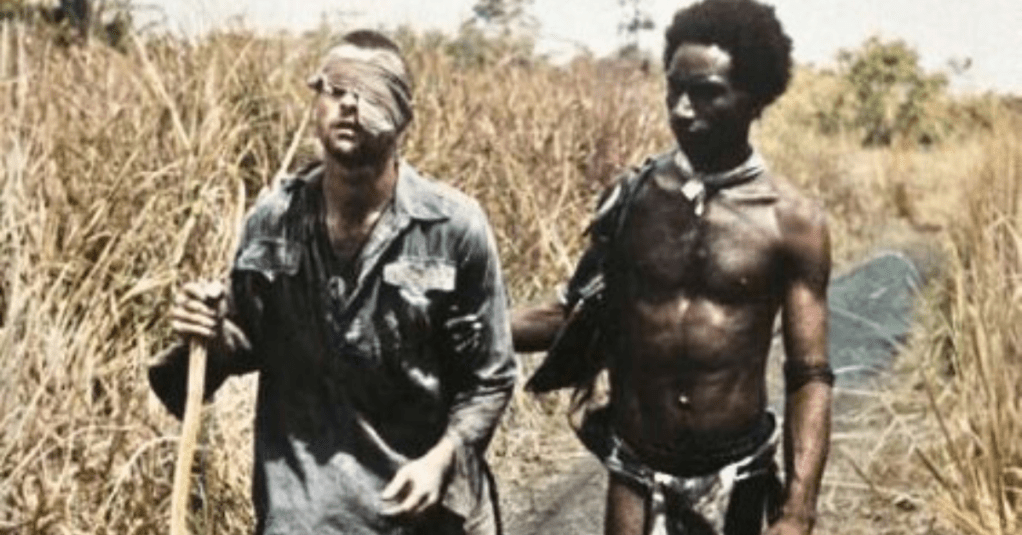
An Angel escorts a wound Australian of the 26th Regiment to the rear. Australian War Museum photo.
For example; if a Pidgin speaker came into the translators tent with some information on Japanese movements he might greet your dad with the greeting, “Gutpela long bungim yu.” or “Yu stap gut?” Wanam nem bilong yu? If Pisn wasn’t enough how about the Aussies? Australian and New Zealand slang is highly complex and something as simple as asking where the latrine is, “Wheres the Dunny mate?” can be laughingly confusing.
People today are likely to forget that much of the material the MIS handled was intensely personal. Japanese children grew up in those decades keeping journals in which they recorded their personal thoughts and feelings. Letters to Japan were mostly concerned with matters of family. American troops were much the same except that they were censored by their officers to root out any forbidden information which might help and enemy. The Japanese had no such system. A letter home by a Japanese soldier would have a return address, whereas US troops could not ever mention where they were.
Your grandparents hadn’t seen their son since he shipped out to Minnesota to attend school in October, 1942. He had not seen his family for almost two years. Letters were the only form of communication and it must have been agonizing to listen at mail call for his name to be called. Mail was irregular, frequently lost or arrived weeks and months late. The canvas bags of mail came by ship, were transferred to trucks or LST’s to be moved between stations and could come torn, opened by censors if they were from the concentration camps; even in some cases were and moldy after the long sea voyage. For the MIS especially terrible, literally every one your father knew, his entire family, neighbors, kids he went to High School with were locked behind barbed wire. Doing ones duty to his country came with a staggering personal cost.
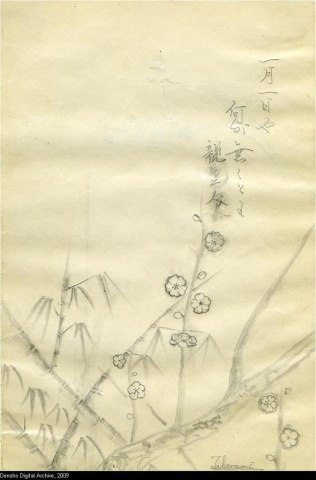
Japanese soldier’s diary page.
I must mention too that the documents that came in to the MIS where stripped from the dead for the most part. Soldiers were ordered to capture Japanese soldiers when they could but since that meant a risk to your own life, it was rarely done. A journal might be splattered with the blood of the soldier it belonged too. It may have been moldering at the bottom of a wet, fetid backpack for a week and stunk to high heaven. There is little doubt that the Japanese American boys felt something very personal about this. They read names just like their own. The Kibei especially, who had studied in Japan before the war and who knew the country well. Customs mentioned in the letters, places they had lived, schools they had attended and for a few as the war went on, the names of people they knew and in some rare cases Japanese soldiers from before the war and in at least one case a brother who was unable to get out of Japan, drafted and met his MIS brother on Okinawa.

As time has moved on and the old soldiers neared then end of their lives, secrets they never told anyone began to take on a new meaning. Sons and daughters who had asked the age old question, “What did you do in the war daddy?“ just might receive an answer. Many children only learned about their fathers military service when they opened that old green trunk in the attic or a small box at the bottom of the sock drawer with a handful of old unidentified medals and insignia or perhaps at the top your mothers closet, a small white cardboard box tied with a faded blue ribbon full of saved V-Mail letters from the far side of the world.
When my uncle Jackie was in his nineties, I asked that questions just like the others did and his answer? He thought about it a while before he answered, “Oh, you don’t want to know about that.” and that was that.
*Clint Eastwoods twin films “Flags of Our Fathers” and “Letters from Iwo Jima” received critical acclaim but “Letters” by far was the most watched because it opened a door into a shared experience to which the generations who have lived since WWII were unaware of. It had the effect of humanizing those Japanese boys on Iwo through their the personal experience written in letters home. Letters from Iwo Jima is not the most exciting or intense war film but it does something that I’ve never seen before in that it humanizes the Japanese. Yes, there are still quite strong cultural differences that the movie talks about but it also shows them as everyday people with their own worries and hopes.
**In researching for this letter I found numerous official photos taken by combat photographers of captured or surrendered Japanese Imperial soldiers being questioned, most without any mention of the MIS Nisei, such was the secrecy surrounding the program. The photos I’ve used in this story of Nisei are almost without exception non-official and taken by unofficial photographers. The only exception is the one with Colonel Merrill of the Marauders in Burma.
Dear Dona 9
Coming Jan 18th 2025: “Up the line to Morotai Island. Big changes for the MIS.”
Michael Shannon lives in Arroyo Grande, California. He writes so his children will know what kind of people they come from.
 atthetable2015