Moving Up
Michael Shannon
Your fathers original group of four hundred translators that worked in Brisbane in 1943 had been broken up into small units and was now spread all over the Southwest Pacific. Many of them now shared the privations and dangers of combat and had taken to carrying rifles. They operated just behind and into the lines and were subject to enemy gunfire, artillery and bombs. War zones are dangerous places and even those that see no actual combat are subject to the whims of the monster.
After Morotai headquarters moved up to the island of Leyte and promptly discovered something entirely new. The translators as with all staff, headquarters and support troops rarely knew what was going on in the wider war. As they advanced in the Phillipines the war began to widen out. The days of jungle fighting were nearly over. Leyte with a population of just 900,00 most supporters of the Americans was divided by a mountain range with the southern portion of the island very lightly populated The flanking coastal plains allowed the use of tanks and other mobile units for the first time. Fighting was heavy but the Japanese were pushed up the island in a series of very sharp battles. The campaigns success allowed the planning for the invasion of the main island of Luzon to go forward in a hurry.
Since MacArthur had been ordered out, Corregidor had been surrendered, the Bataan death march had taken place and most combatant Americans had been locked up in concentration camps. MacArthurs Filipino Scouts had also surrendered but not all. Army Navy personnel and the Filipinos had disappeared into the hills of the Phillipines and for three years had been roving the country formed into Guerrilla groups. (1) Filipino ex-soldiers, American service members, Naval officers and Australian and Dutch soldiers had formed lethal bands of Guerrillas who preyed on Japanese troop movements and supply convoys. The Dutch and Australian stole or cobbled together radio sets with which they sent messages to Army headquarters in Australia. They reported on Japanese ship movements and disposition of army units.
MacArthurs command arranged to deliver better radios, generators to provide electricity to the Coast Watchers were constantly on the move. A message sent in the clear or in code could be tracked by Japanese rangefinders so they picked up and got out of Dodge immediately after sending. It was highly dangerous work but invaluable to the allies. Radio message were synced with MIS translations and throughout the three years before the return the command had a clear picture of almost everything the Japanese were up to.
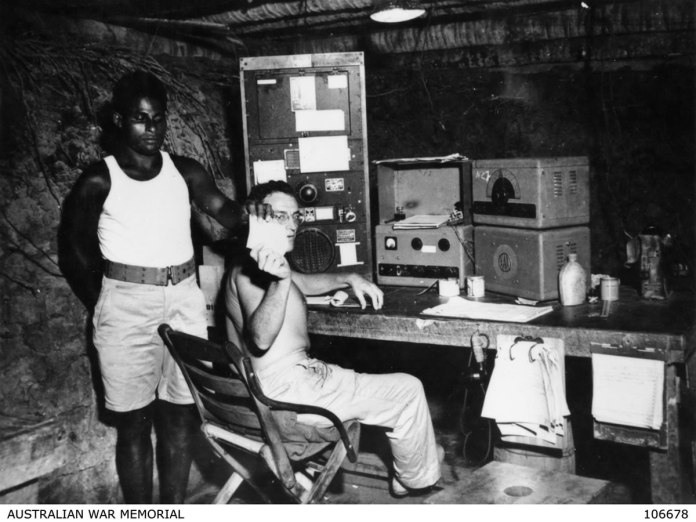
The base radio station dugout of the Coastwatchers Ken network in the Solomon Islands. Photo: Australian War Memorial.
During August and September 1942, 17 military coast watchers (Seven Post and Telegraph Department radio operators and 10 soldiers) and five civilians were captured as Japanese forces overran the Gilbert Islands. Imprisoned on Tarawa atoll, they were all beheaded following an American air raid on that island. The coast watchers and their teams, mainly native islanders were constantly on the move. They faced starvation, boredom and feared for their lives but none attempted to escape. Though mostly resident civilians who had worked for the rubber plantations and the petroleum companies they received nothing for their work. It wasn’t until late 1944 that that the Anzacs bestowed military officer rank on them so if killed their families would receive a pension.
Coastwatchers were also involved in organizing supplies for the Guerrilla bands. They received supplies and arms from American subs, Dumbos (2) and the famous Black Cat Catalina flying boats. They also rescued downed flyers and other military personnel who were downed or sunk along the island chains. These included the future US President, US Navy Lieutenant John F. Kennedy, whose PT 109 Patrol Torpedo boat was carved in two and destroyed by a Japanese warship in the Solomon Islands. After the sinking, Kennedy and his crew reached Kolombangara Island where they were found by Coastwatcher Sub-Lieutenant Reg Evans who organized their rescue.
In the Philippines they were to witness the roots of the local Resistance which represented the cultural and socio-economic diversity of the Philippine Islands. From socialist peasant farmers the Huks, middle school teachers, ROTC youths, to Moro (Philippine Muslim), the range of the men and women who participated in the struggle against the Japanese Imperial Army was seemingly inexhaustible.
Officers at headquarter were initially astounded when groups began showing up. slipping out of the jungles like wraiths, armed and dangerous.
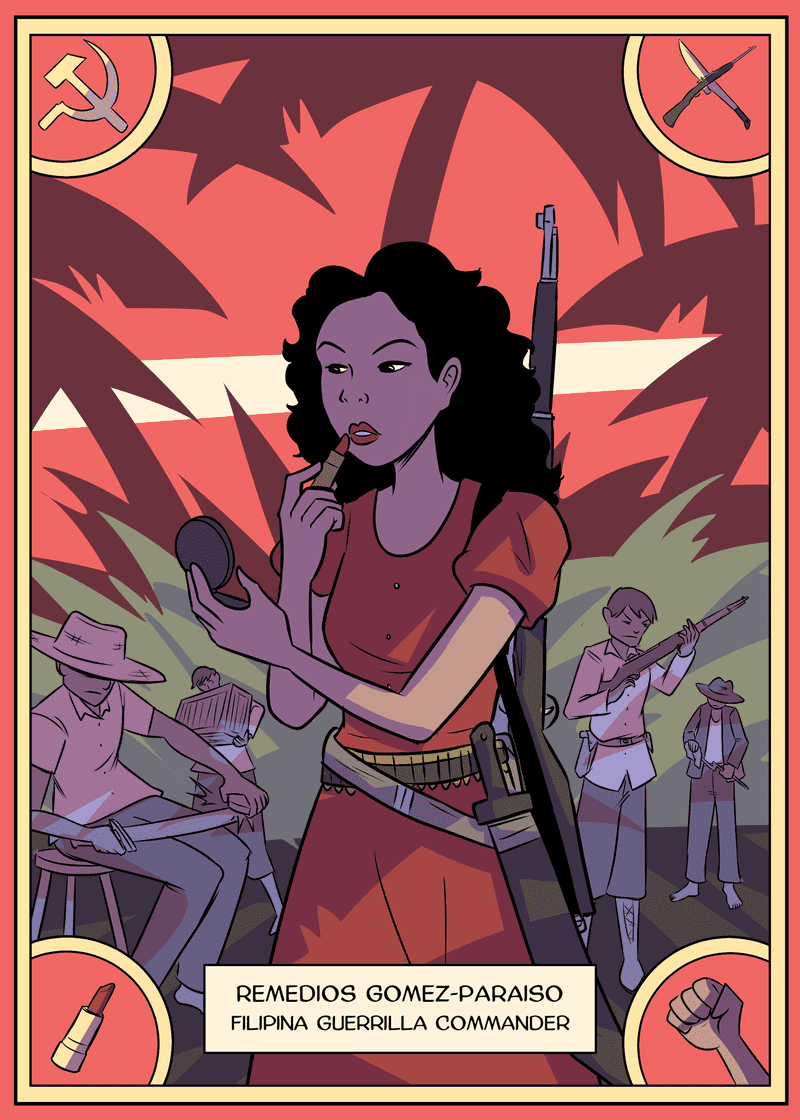
At least 260,000 strong, the guerrilla forces were ill-equipped and poorly armed. They depended on local civilians for food, shelter, and intelligence. Several units recruited women guerrillas. Some took up arms and served side by side with men, including journalist Yay Panlilio and Huk commander Remedios Gomez-Paraiso also know as “Kumander Liwayway.”

Remedios Gomez-Paraiso, Kumander Liwayway. Photographer unknown. 1945
Remedios Gomez-Paraiso was an officer in the Hukbalahap, a communist guerrilla army known for their daring attacks on Japanese forces. Born in Pampanga, Gomez-Paraiso joined the guerrillas after her father was killed by Japanese forces. Known for going into battle wearing her signature red lipstick, Gomez-Paraiso quickly rose in the ranks to become a commander of a squadron. At one point, she had two hundred men under her command. Perhaps best known for the “Battle of Kamansi” in which, despite being outnumbered, Gomez-Paraiso’s squadron forced Japanese forces to retreat. After the war, her Hukbalahap Guerrillas continued their revolution against the democratic Philippine government until 1948, when her husband was killed, and she was captured. She was released and went on to become a vocal advocate for the recognition of Filipina Guerrillas.
In a marriage of convenience the guerrillas, some who had been fighting the Americans invaders since 1898 when President McKinley annexed the islands against their wishes. In the southern Phillipines, the Muslin Moro had resisted the Spanish conquest since the since the end of the 15th century. This religious war only ended with the annexation by the US in 1898. The Muslim Moros then fought the United States and finally the Japanese. Resistance was baked into their DNA. Because they hated the Japanese more they saw the alliance as temporary but expedient. Filipino Guerrilla groups fought right up until the end of the war. (3)

A guerrila group on Leyte, Phillipines, 1944. National Archives photo.
On January 25th 1945 your dad and his MIS team walked aboard LST 922. They were bound from Leyte to the island of Luzon. Just nine days before 175,00 American troops supported by over 800 ships had gone ashore at Lingayen Gulf, ironically the same beaches employed by General Homma’s Japanese forces in December, 1941.
General MacArthur himself went ashore on S-Day. There were no histrionics this time. Luzon which he had abandoned in 1941 was not only his personal goal, but erasing the embarrassment which was compounded by secretly fleeing during the Phillipines during the dark of the night in a little PT boat, PT-32 commanded by LTJG John Bulkeley (4)
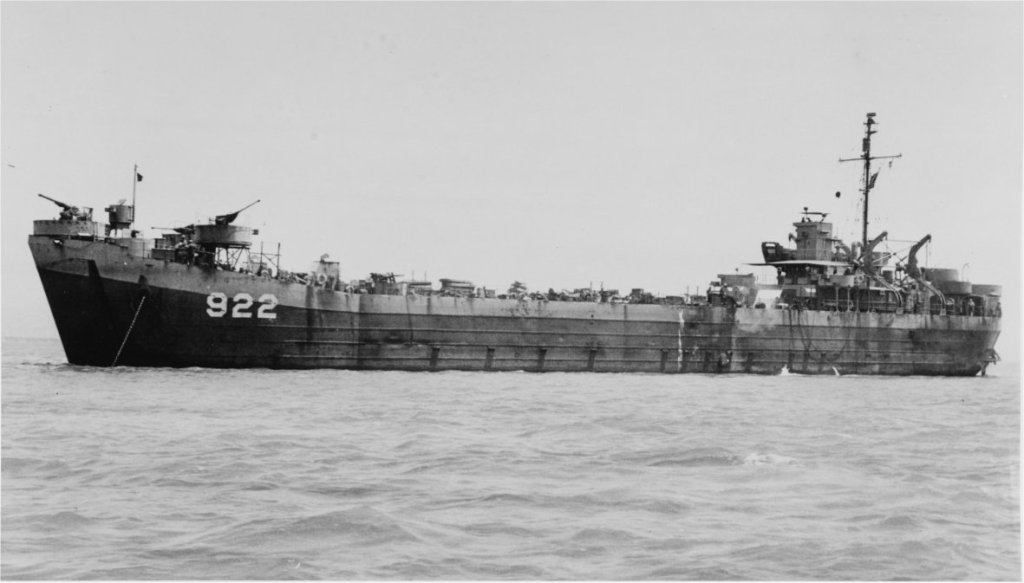
LST 922 at Morotai Island, Dutch East Indies, December 1944. USN Photo
Your dad’s MIS team hefted their barracks bags and walked up the ramp for yet another trip by an LST. Commanded by Lieutenant, Junior Grade Ronnie A Stallings who was a regular Navy officer. A special but not uncommon type in the WWII Navy, he was a Mustang. Mustangs as opposed the thoroughbred Naval Academy officers were generally outstanding enlisted men promoted up from the ranks. Born in Brooklyn New York in 1924, Stallings enlisted in April 1941 and went to sea as a 17 year old later that year. He was an ordinary seaman. Assigned to a Landing Craft Infantry 487 or LCI. LCI 487 was typical of this type of LCI. It was newly built and the crew was young and inexperienced. The skipper, Lt. Stewart F. Lovell was the “Old Man” on board. Born in Manchester, N. H. on May 26, 1907, he was 36 years old when he set sail on the 487. However, most of his crew was seventeen, eighteen and nineteen year olds. His young crew gave their Skipper the nick name “Baggy Pants” because he did not acquire a proper fitting uniform after losing a lot of weight while onboard. LCI’S were 158 feet long, just over half a football field and only 23 feet in the beam. With the bridge being high and the hold being empty she rolled like a “Drunken Sailor” to use a Navy term. There are other terms for unseaworthy ships but most are unprintable. A very strong stomach would be required and perhaps the skipper didn’t have one. The Executive Officer – Ensign James T. Clinton was nicknamed “Boy Scout” because he was pale, clean cut and did not drink or smoke. Ronnie Stallings was present during the landing in North Africa in 1942 and at D-Day, June 1944 where his little ship, derisively known as “Waterbugs” by disdainful Admirals disgorged over two hundred GI’s of K Company, 18th Regimental Combat Team of the 1st Infantry Divion onto Utah Beach. Unable to back off the beach, 487 was pounded by German artillery and temporarily abandoned. Stallings was taken back to a survivors camp in England located at Greenway House the estate of Agatha Christie. With only the clothes on his back he was given an overcoat and a bag with a broken tooth brush and a razor with no blades.
His next ship was the fleet oiler USS Salomonie. He caught up with her in Panama in July as she passed through the canal on the way to Milne Bay, New Guinea. By this time a Quartermaster or QM, he would stand watch as assistant to officers of the deck and the navigator; serve as helmsman and perform ship control, navigation and bridge watch duties. QMs procure, correct, use and stow navigational and oceanographic publications and oceanographic charts. Thats the official description. Navy slang is “Wheels” because the begin by steering ships which is no mean feat. (5)
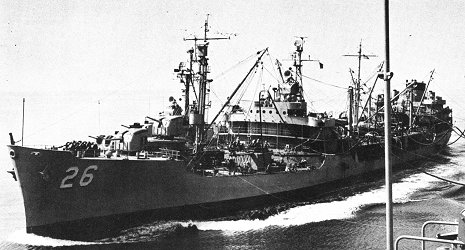

USS Salamonie Ao 26 and an LCI unloading at Utah red Beach Normandy, France June 5th, 1944.
Salamonie sailed for the Pacific Ocean via the Panama Canal on 8 July 1944 and reported for duty to Commander Service Force, US 7th Fleet, at Milne Bay, New Guinea, on 23 August. Salamonie joined the Leyte invasion force in Hollandia on 8 October 1944 and later supported both the Morotai and Mindoro strike forces. She spent the final months of the war supporting Allied operations in the Philippines after Ronnie Stallings transfer to the LST.
By the time Stallings arrived at Milne Bay he was a Chief, a rank achieved in just three years, a feat that could only be achieved in wartime. In peacetime it could take 20 years of duty, and he was just 22 years old. A 22 year old former enlisted swab made it to Chief Quartermaster. At Milne Bay he received a commission as a Lieutenant Junior Grade, and his own ship. No stateside classes, no practice, only his three years at sea as his training ground. As a newly commissioned officer he walked up the gangplank as the senior officer and Captain of his own ship Landing Ship Tank-922. He could never have imagined as a seventeen enlisted recruit that he would end up here.
Trailing their gear the team came aboard 922. Led by your father, the leader with the rank of TEC 4. Trudging into the ship were his crew, Jim Tanaka, Michael Miyatake, Henry Morisako, and Tabshi Uchigaki. Masai Uyeda, and Tsukasa Uyeda followed. Seven men, all headed for Eleventh Corps headquarters at Lingayen. General Eichelberger commanding. By this time they undoubtedly knew that the end was coming for the empire of Japan.
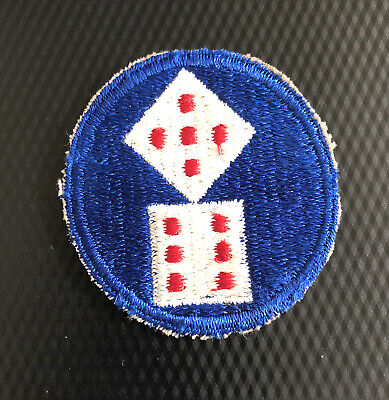
Eleventh Corps Badge, WWII
Dear Dona,
12th page next week Feb. 15th.
Closing the Ring*
1) Guerrilla from the Spanish Guerra. Guerrilla literally translates to “little war”. It’s a diminutive of the Spanish word guerra, which means “war”
(2) Dumbo refers to large aircraft such as the B-17 or B-24 heavy bombers which were modified to carry a large lifeboat that could be dropped to survivors at sea. They were largely replaced by the more versatile PBY Catalina which had a longer range and could land on water. The Catalina has been Largely ignored by most historians but was a major factor in air-sea rescue, insertion and extraction of personnel from Japanese held islands. The Catalinas also delivered supplies to Coastwatchers and guerrilla groups. The term Black Cats or Nightmare is the name given to the Naval and Army squadrons who flew these missions by night.
(3) The Moro people in the southern Phillipines have fought invaders from the fifteen hundreds right up to the present conflict with independent Philippine government. Nearly five hundred years of almost constant conflict has made them a formidable force.
(4) LTJG John Bulkeley is portrayed by Robert Montgomery in the 1945 film “They Were Expendable.” Directed by John Ford and co-starring John Wayne and the inestimable Donna Reed. In my opinion one of Ford’s best films. It impresses with its portrayal of the utter hopelessness of those last days before the surrender of the Phillipines to the Japanese. The dinner scene with the officers and the nurse, Donna Reed is utterly in tune with the times. By todays standards it is mawkish but it wasn’t made for now but during the war when people felt differently than they do today.
(5) The author served in the Merchant Marine. Steering a ship as long as two football fields and weighing nearly 30,000 tons is not for the faint of heart.
(6) Technician fourth grade (abbreviated T/4 or Tec 4) was a rank of the United States Army from 1942 to 1948. The rank was created to recognize enlisted soldiers with special technical skills, but who were not trained as combat leaders. Technician fourth grade. The T/4 insignia of a letter “T” below three chevrons.
*Apologies to Sir Winston Churchill.
Michael Shannon is a writer from California. He knew Mister Fuchiwaki personally.
 atthetable2015