Chapter Twelve
Texas Shenanigans and the Whipstock
By Michael Shannon
Texas oil sprouted big personalities. Theodore Newton Barnsdall whose daddy started in the Pennsylvania fields, drilled the second well ever and built the first refinery taught him the business the way a butcher sharpens a knife. “Tede” as he liked to be called started out working for his father as a pumper annd when his dad died he inherited the company. Ambitious, a hale fellow well met, he also had the three things an oilman must have. He was fearless, supremely lucky and had a nose for oil. Not in barrels, oh no, a nose for oil underground. He was doing ok in Pennsylvania but thought he should go west and his case that was Indian Territory. The home of the Choctaw and Osage. With his gift of gab he made a friend of Chief James Bigheart of the Osage. Bigheart was instrumental in Barnsdall buying a stake in the Osage oil company, ILIO in 1903 which covered all of the Osage reservation, some 1,470,938 acres of what is now Osage county Oklahoma.*
Barnsdall became wealthy by bringing in well after well. Immensely rich he sold his company in 1912 and took stock from the new company, Cities Service. Though Theodore Barnsdall died in 1916 his company survived.
The oil business is and always has been a labyrinth of connections, co-ownerships, subsidiaries, wholly owned or leased. Oil companies owned and were owned by railroads, refiners, conglomerates and even companies who had no connection to production at all. Production was sold to refiners, refiners to banks and then bought back by the producers. Companies were deliberately bankrupted in order to not only clear debt but sometimes to assume debt by the buyer of the defunct company. Sometimes defunct companies were not actually defunct. Names lived on.
Though “Tede” was long buried away., his company lived on but now owned by Cities Services a refiner and major lender to the business, Cities kept the name and the Barnsdall Company continued to operate. It partnered with the Philllip’s company, now Conoco-Phillips and Socony, Standard Oil of New York and in 1927 decided to move some operations to California under the name Barnsdall-Rio Grande**
How does this effect the man who laborers on the rig. No need to ask him because he likely has no idea. It’s affect on my grandparents though, easy to understand.
Grandpa Hall in the course of following the work ended up in Summerland and Santa Barbara by 1927. They rented a little house on Mission street and Bruce began working as a Farm Boss down in Summerland. Today it is a hip little town but in 1927 it was very small cluster of small houses just north of the section of beach which would become famous for the oil rigs there.
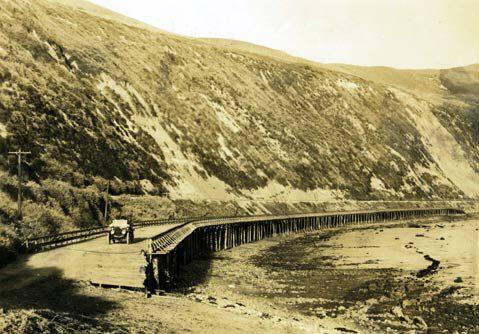
The road south from Summerland at the Rincon. SB Historical Society Collection. 1920’s
A former Treasury agent, Henry Lafayette Williams, initially intended to raise pigs there when he bought this land in 1885. But when the Southern Pacific Railroad announced it was laying tracks north from Los Angeles that would cross his pig ranch, he decided to sell off lots and build a town next to the rails.
What made this act of entrepreneurship unusual was that Williams and his wife were Spiritualists. A popular religion at the time its practitioners believed that mediums connected the living to the dead. Williams and his wife persuaded fellow Spiritualists to move to their town. Lots of 60 feet by 25 feet sold for $25 each. In 1889, the early settlers named the town Summerland which was the name of the Spiritualists’ heaven.
Town lore has it that many of the homes that the Spiritualists built had hidden rooms from which the spirit of a dead relative would enter during seances. People from neighboring towns nicknamed Summerland “Spookville” because of all the strange happenings they thought were going on.
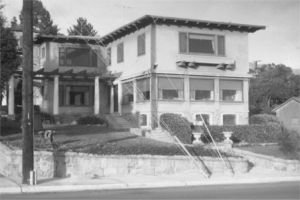
The Williams home, The Big Yellow House.
The Williams’ own home, rumored to still have ghosts today is the Big Yellow House Restaurant, a Summerland landmark.
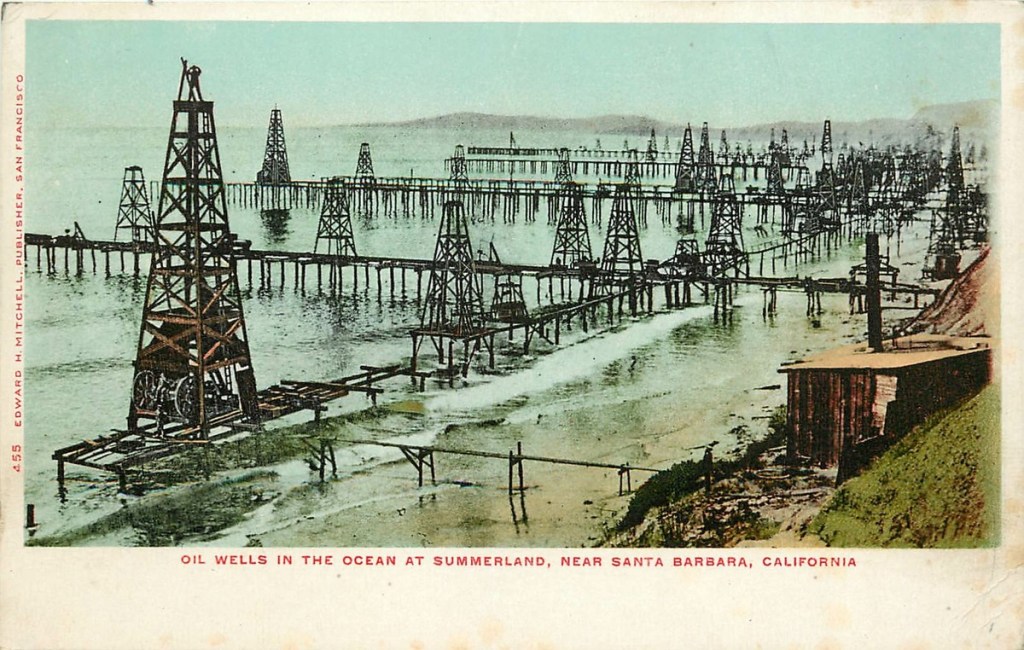
In 1894 the accidental discovery by a man drilling for water who struck oil instead. Oil fever and the boom was on. The bluffs along the coast came right down to the waters edge. As the field expanded piers were built into the ocean, derricks erected and Summerland had what is considered the first offshore oil field in the Western Hemisphere.
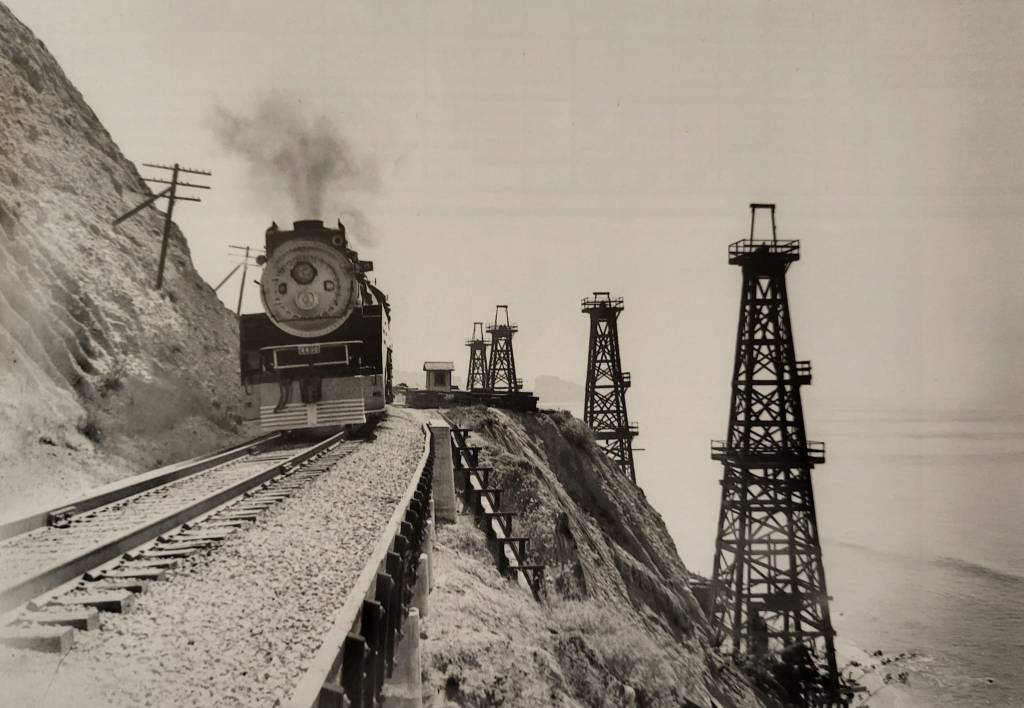
The Ortega curve, Southern Pacific RR above the Summerland field. SP Photo.
Both things played to Bruce’s skills. The wells were very shallow, some at only 400 feet which favored cable tool rigs. Shallow wells and sandstone formations were made for cable rigs. The other thing he knew was the whipstock and how to use it.
Grandpa Bruce did not whip my grandmother. He wouldn’t have dared. She was a farm girl and raised by a fierce independant woman. She would have been a handful. No, the whipstock was a tool used to direct the path of a drill bit. it seems a bit need only go straight down but there might be a reason why you wouldn’t want it too.
Here is where we might want to return to “Tede” Barnsdall and his like. You see, experimental oil drilling, as was practiced in the early days required a man who was a gambler and a risk taker like ‘Tede. “Perhaps a little “Shifty” a man who mght just bend the rules.
Oilfield history is rife with legendary fields and the Wildcatters who risked everything on an all chips in the pot hand, high card wins the gamble.***
Spindletop, Wink and Burkburnett in Texas, Sunset on the Midway in the West Kern, Old Maude in the Casmalia field, Alamitos no.1 on Signal Hill, Doheny’s first well at La Brea, each field drilled by one of those elite gamblers with which the old boys begin their tales of adventure.
When old time oilmen circle their Eldorados for the night and hunker down around the campfire at the Petroleum Club to talk about the good old days, sooner or later one name always pops up.
Mister Glenn McCarthy. Not sure about the mister though, he never seemed like the kind of guy who needed a mister.
The loner. The poor boy who made good. The rich boy who made bad. The Wildcatter. The model for Jett Rink in the movie Giant.
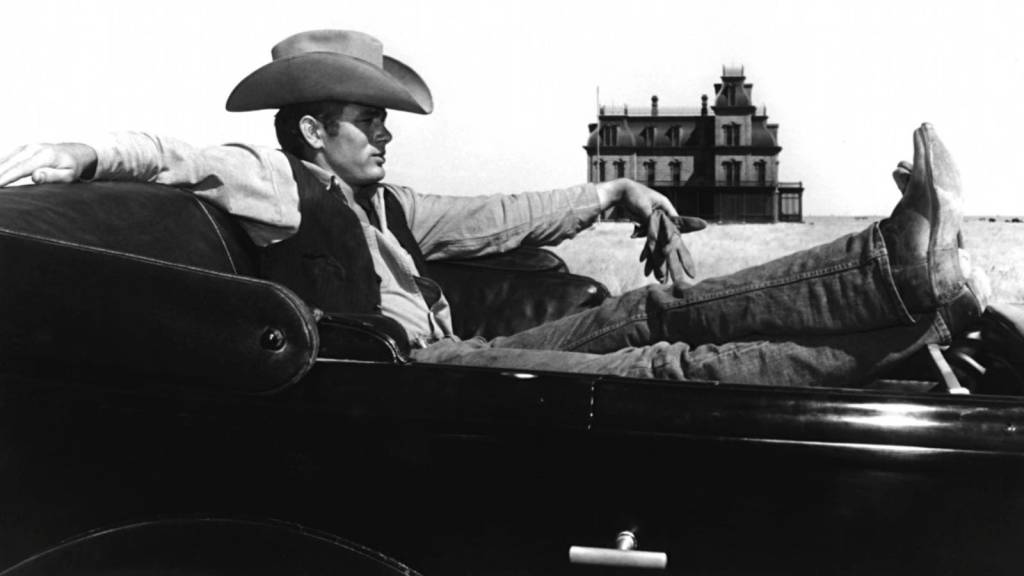
Jett Rink, Wildcatter. Warner Brother, 1956.
Remember the time Glenn made a half-million from a field that all the oil companies said was dry? That’s nothing, once he was a million and a half in debt, so he built a $700,000 house just for the hell of it.
He said the banks would think he was rich. “Buy a new Cadillac and let them see you drivin’ it. Put ’em off the scent. And the time the Houston Country Club wrote him a letter saying that, all in all, they’d rather not have him around the place?
Yeah, those were the days, when—at least to the outside world—he was the personification of Houston, Texas, USA. Feast and famine, gusher and duster, whenever two people got together to fight or wheel or deal or all of the above, one of them was a smiling Irishman with curly brown hair and a dark mustache—Glenn Herbert McCarthy, the Wildcatter.
He came from Beaumont originally, the son of an itinerant oilfield worker, William McCarthy, who was a driller at Spindletop. Young Glenn was eight then, and carried a water bucket from the pump to the sweating workers. When he was 23, McCarthy wooed and wed Faustine Lee, the 16-year-old daughter of T. P. Lee, a rich Texas oilman. Lee was upset, since Faustine had run away from high school to marry, but by then, Glenn could hold his own. After all, he was an oilman too and soon he proved it. It’s been up and down, cold Brut Champagne and hot Bud. Time had him on its cover, the King of the Wildcatters. One of many.
“So what if some oilmen were flamboyant and boisterous and loud? They were the men who worked their tails off, rain or shine, winter or summer.” They risked everything and sometimes they won.
It took a man with an idea. A man like my grandfather who could solve a problem. Drilling wasn’t as straight forward as you might think. Bits did no always go straight down, they could wander all over the place. Drilling in sand or punching through rock can bend the drill string every which-a- away.
Since the business of punching holes in the ground was made up on the fly and there were very few engineers on the drill floor things had to be figured out by the dirty, sweaty roughnecks and Toolies. And by God they did.
The first slant well was successfully drilled in 1929 in Texon, Texas. Sidetracking a well can solve some unexpected problems such as bypassing damaged sections of the well or going around broken tools at the bottom that can’t be retrieved by fishing. Lateral deflection of the well bore has been achieved by placing a wedge or whipstock in the well. The whipstock is, essentially, a wedge that crowds the bit to the side of the hole, causing it to drill at an angle off the vertical. The angle of the hole was measured, in the days before high technology by the simple expedient of lowering a glass jar half filled with Sulphuric acid down the casing until it hit bottom. Left there for a time the acid would etch the inside of the jar and when pulled up a line indicating the angle would be clearly visible. The difference between this line and top of the jar indicated the angle of the bore. Very simple. Workman who solve problems rarely have any time to figure out something sophisticated like an engineer does.
When Bruce was working on the West side, as the fields around Maricopa, Reward and the Elk Hills were called, the depth of the wells was such that Rotaries were needed to make hole. A rotary rig with a Hughes Tool bit was able to drill nearly 9,000 feet**** No Cable tool rig could go much over 1200 feet. The Cable Tool method which he had nearly ten years of experience with were in the minority. Learning the rotary bit system wasn’t difficult and he soon became an excellent Tool Pusher for both types.
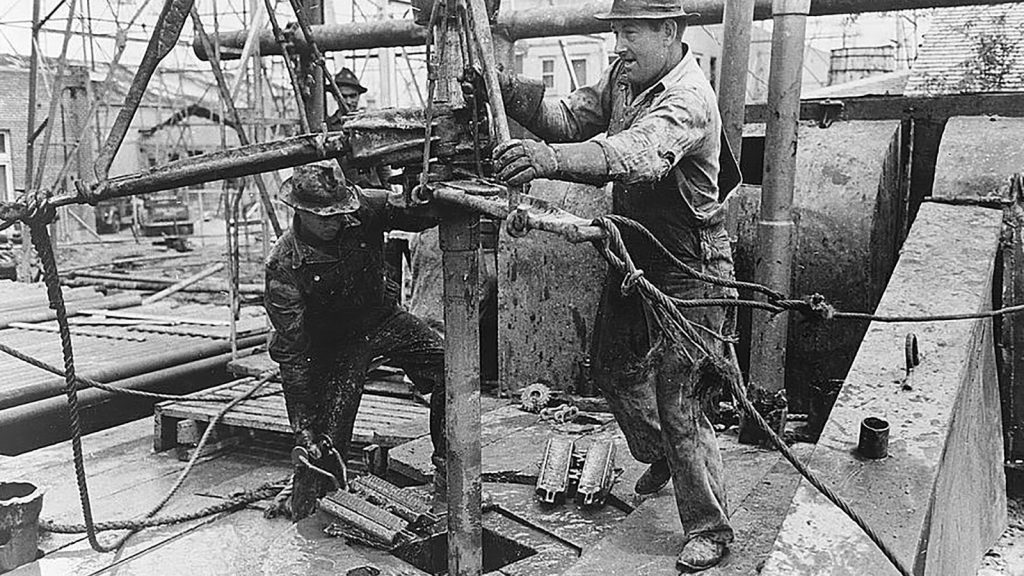
Tripping pipe on a rotary rig, Elk Hills. Near Taft Ca.
In Summerland it took just a few years to drill along the foreshore. The wells crowded together so close you could literally spit on your neighbor. The oil sands were shallow and the old walking beams of the cable rigs were everywhere. When they ran out of room the drillers simply built piers out into the ocean and kept on going. At about 1,200 feet the Rotary Rigs were set up on the piers and they moved farther out. When it got too deep for piers they brought in the whipstock and began slant drilling.
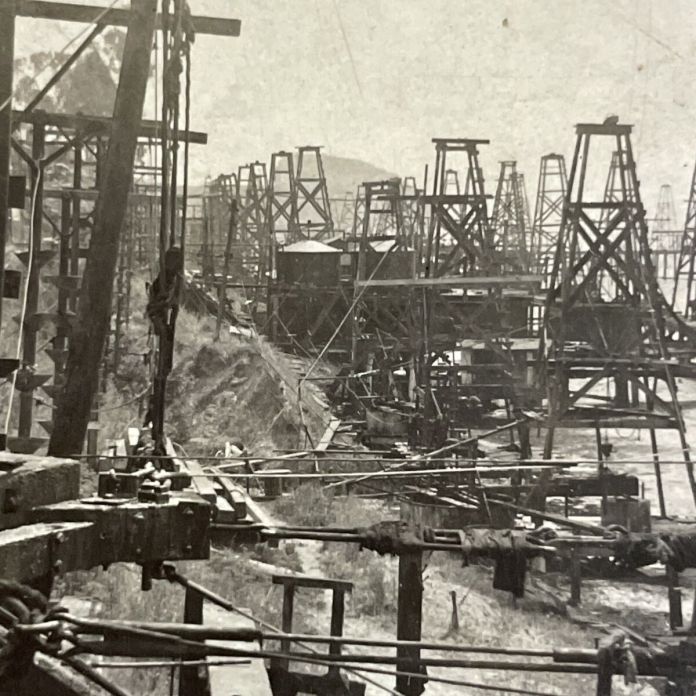
Summerland. 1928. Not a square foot wasted. and insanely dangerous. SB Historical
What they did was to take a large chunk of wood and shape it into a wedge, thinner at the top and thick and heavy at the bottom. Then all the pipe in the well casing was tripped out, the wedge lowered to the bottom of the hole. The drill string was then tripped back in and when the bit hit the whipstock it followed the angle of the wedge and began drilling at an angle.
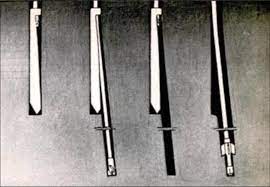
Whipstocking. Baker-Hughes company illustration.
Now a driller could go around cave ins, or difficult strata reorienting the bit in the right direction. They quickly figured out that they could now drill more than one hole off the same rig. And of course, in the still wild and wooly oil business it took about two seconds for some sharp operator to figure out that he could drill under someone else’s lease and steal their oil. Bruce knew the technology and working for Seaside Oil they soon had a literal bowl of spaghetti of pipe with holes going every which-away. It was near impossible in those early days to figure out where any one’s string actually went. In a day when roustabouts still carried revolvers you had to be careful about what you said and to whom. A man had a family to feed after all and it was common custom to pay a man in shares of production once the well came in. Instead of cash, which was paid at the end of the job, a percentage of the payout on a barrel of oil was your wage. Contractors made their own rules and the big Companies looked the other way. Why they practically encouraged it by ignoring it. You couldn’t find a Toolie who knew anything about it. It was a mystery. It was highway robbery best kept quiet.
*The Osage county seat is in the small town of Pawhuska which you may be familiar with from watching Ree Drummond, the Pioneer Woman’s cooking show. Her husband Ladd Drummond owns the family ranch which covers 433,000 acres in Osage County. Oil rights obtained from the Osage has immensely increased the family’s wealth. The Drummonds were actively complicit in the Osage oil scandal of the 1920’s buying up “headrights” and foreclosed or bankrupt ranches from members of the Osage tribe. Not illegal exactly but certainly the result of “Sharp.” practice. Since Ladd’s cousin is the states attorney general, they are covered.
**The genealogical timeline for Barnsdall goes as such. Bigheart Oil Company-Barnsdall-Cities Services-Phillips-Rio Grande Oil-Standard Oil of New York, (Socony)-Richfield-Atlantic Richfield, (Arco)-Sinclair-Continental- Marathon oil and in 1999 British Petroleum, (BP Amoco)
***Boomtown 1940. A film starring Clark Gable, who actually worked for Barnsdall oil in Oklahoma when he still had big ears and bad teeth. Old timers will tell you its the best film ever made about boom and bust wildcatters and is largely true to life. From Kilgore Texas to the Kettleman Hills in California.
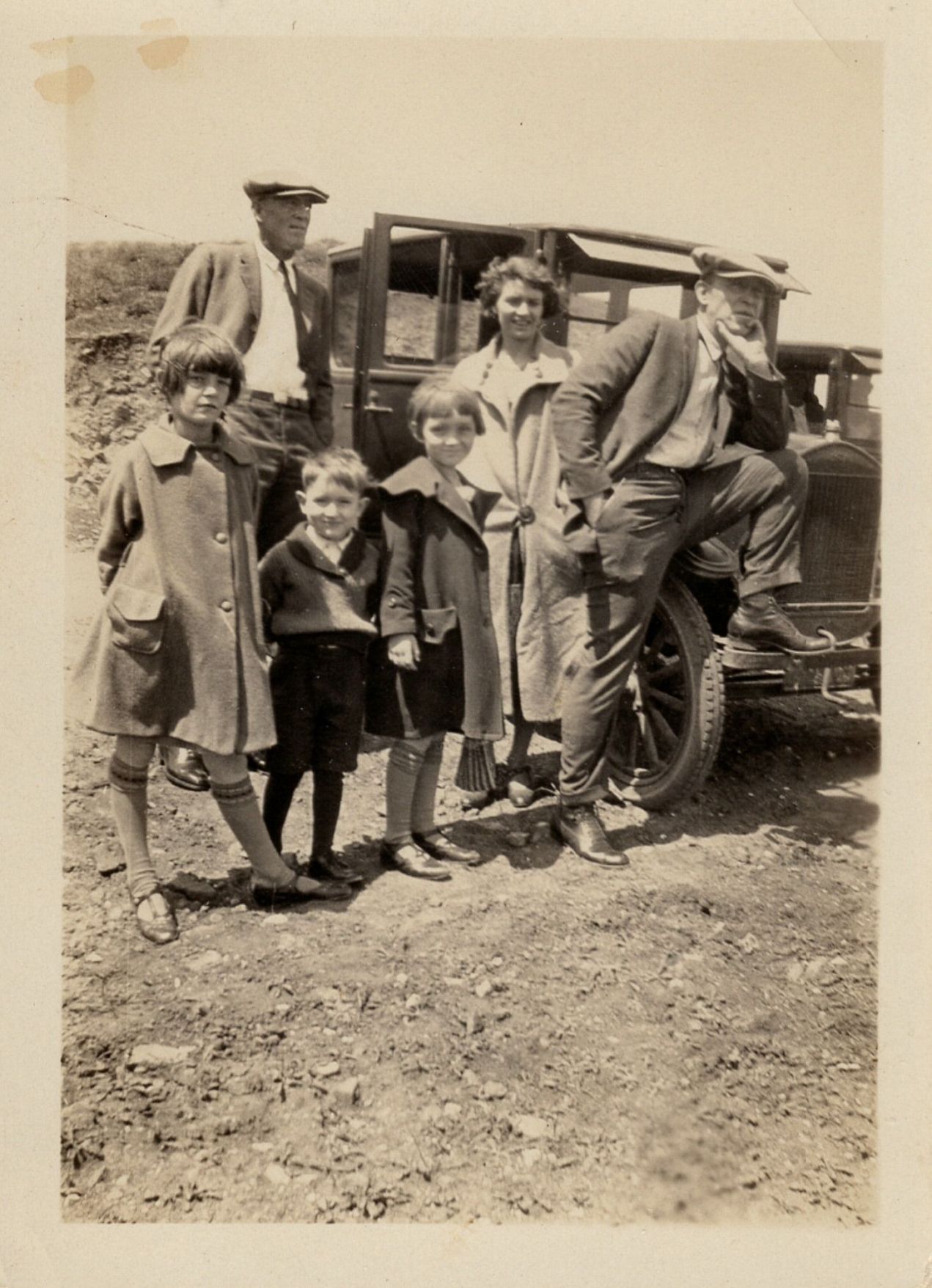
Cover Photo: The Hall Family Mariel, Bob, Barbara, my mother, Eileen and Bruce. Uncle Marion in the rear. 1928.
Michael Shannon’s mother was on the ride with his grandparents. Her memories form a great part of this story.
 atthetable2015