Chapter 14
Oct 24th 1929
In ’29 Bruce was transferred to the new field up at Elwood. Barnsdall-Rio Grande gave him a raise and he became a field supervisor. The Mesa and Ellwood fields needed men who could whipstock as the wells were being pushed out into deeper water. Bruce was good at that.
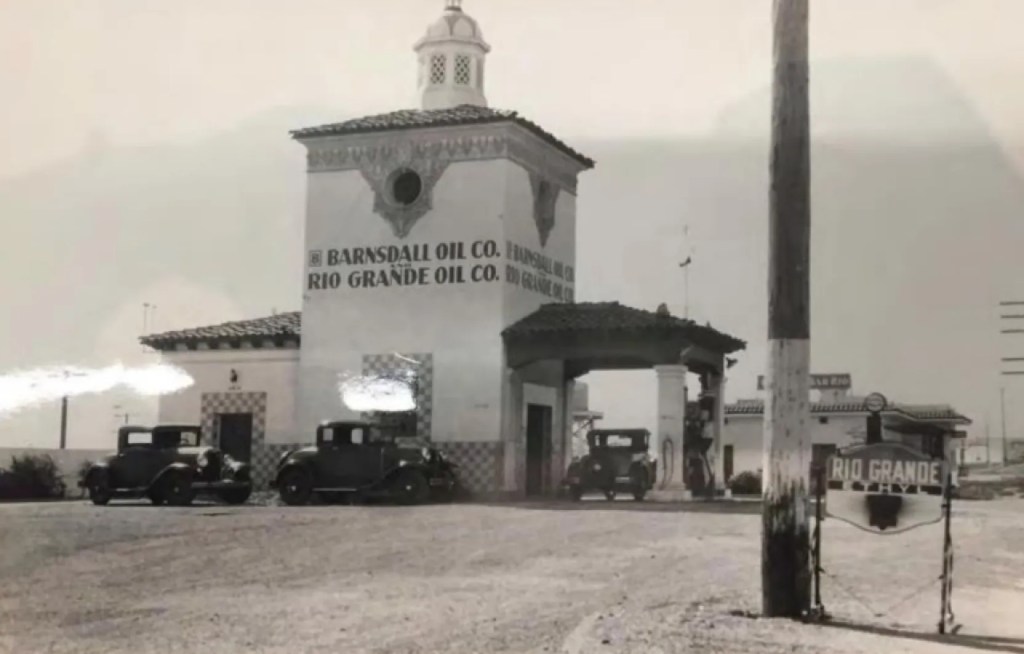
Elwood. Goleta Historical Society photo.
Bruce and Eileen moved up to a little wide spot in the road called Goleta. Sometime after the De Anza expeditions, a sailing ship (“goleta”) was wrecked at the mouth of the lagoon, and remained visible for many years, giving the area its current name. After Mexico became independent of Spain in 1821, most of the former mission ranch lands were divided up into large grants. Nicholas Den was granted this 16,500 acre rancho in 1842. The Rancho was named Dos Pueblos for the two Barbarino Chumash rancherias which were on the bluffs above the beaches. Below that was what would become one of the largest oil producing fields in California.
Barnsdall-Rio Grande added the Elwood field to Bruces territory. His skill with whipstock was doubly important because at Elwood there were no actual wells onshore. Every well was turned out into the oil sand under the Santa Barbara Channel.
Goleta wan’t much of a town in the late 20’s but they decided to move closer to the wells because exploration in Summerland was nearly done and his chief job there was to monitor production.
Bruce’s half-brother Marion who originally got him in the job in Casmalia was giving the oilfields another go. Marion and his wife Grace with their son Bill moved in with Bruce and Eileen. The kids were attending Goleta Elementary school. Mariel the oldest was just thirteen, my mother, a year younger and uncle Bob was nine. In the old photos you can see that they are better dressed surely as the result of Bruce’s promotions.
That same year Bruce and Eillen gave my mother a piano. It is, we still have it by the way an upright Gulbranson, it cost the princely sum of $300.00, and I do mean princely. The equivalent sum today would be over five grand. The original receipt calls for ten monthly payments of $30.00 each. As a Tool Pusher or Farm Boss Bruce would have been making as much as ten dollars a day. That was a very high wage for men employed in the oil fields and good pay for any man who worked with his hands.

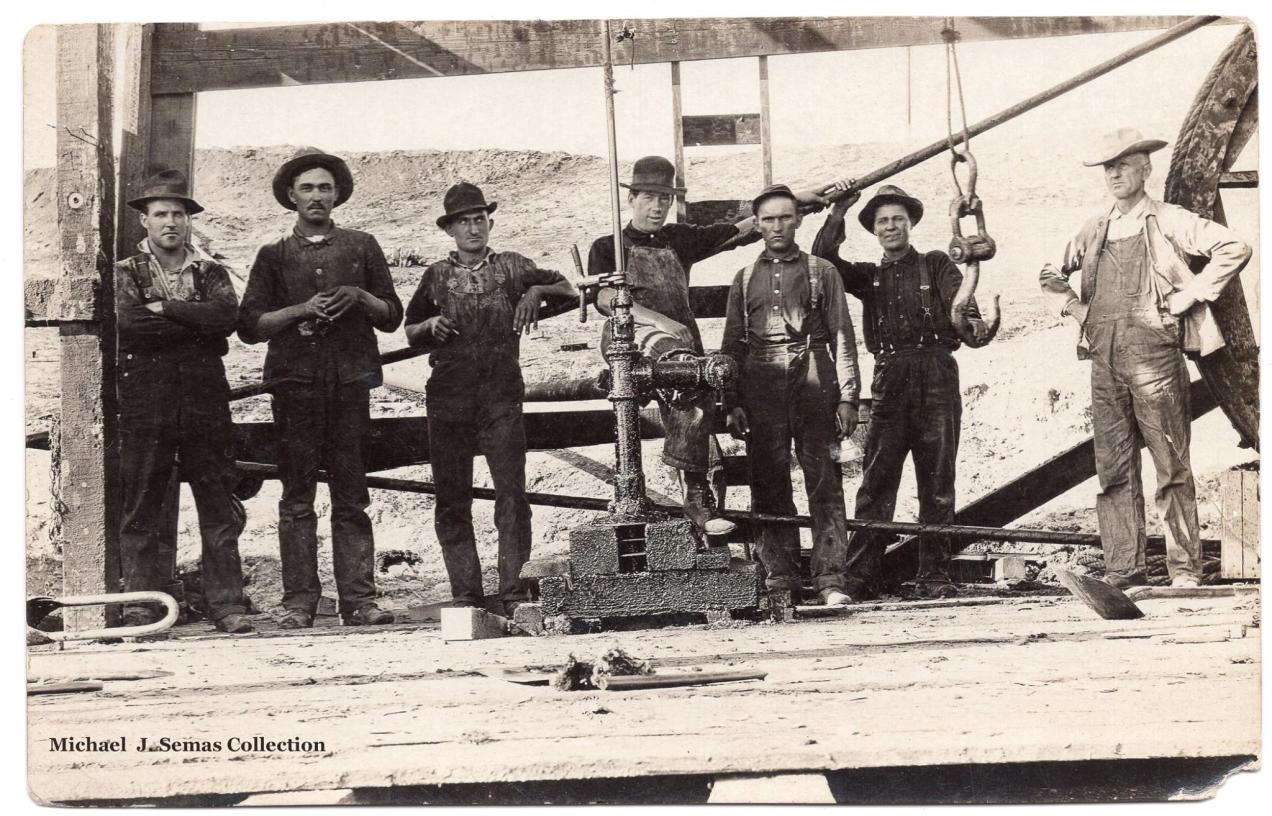
Derrick and wells, Tecolote Canyon, 1930.
Below the horizon though a financial wave was slowly gathering and like the music played in the movie Jaws, it was building quietly but would soon turn their entire world upside down.
In November the entire house of cards came crashing down. Out of control oil companies who pumped more oil than the public could use. Banks which loaned far more money than they actually had, 650 failed in 1929 and over thirteen hundred by then end of the next year. There was no FDIC to protect your money. Millions of people lost their life savings. Wall street’s frenzy of buying and selling on margin,* the residual cancellations of industrial war equipment and the end of farm price supports put the economy in the tank where it would stay for nearly ten long years. Money that vanishes is not easily replaced. Within a year, 25% of the population was unemployed and completely adrift. Men were desperate for work and just the rumor of a job put them on the road. Children too, they were forced out of families or left on their own because feeding them was a burden to their parents.**
In 1930 Bruce reported to work at Elwood where he was abruptly fired along with his entire crew. Barnsdahll-Rio Grande had pulled in their horns, declared bankruptcy in order to escape their creditors, the banks and private investors. Then they simply walked away from California. It’s leases in Summerland and Santa Barbara were sold, it equipment simply abandoned. Oil companies, finally accepting their fate fell like dominoes. Thousands and thousands of roustabouts, worms, toolies and farm boss jobs evaporated almost over night. Your hard won skills were useless. This pull back on labor was across the board, factories, big farms, the shipping industries all pulled back.
After ten years of continuous employment Bruce’s career was simply yanked out from under him. He called in favors, got on the phone, calling everywhere, every company he had ever worked for, Associated, Standard Oil, Union and every operator from Huntington Beach, Los Alamitos and Signal Hill to the coastal companies and east to the San Joaquin valley, drillers in Oildale, Kern River and the West side and the Elk Hills; Maricopa, McKittrick, Reward and Fellows. There was nothing moving. Drilling for new oil was dead, only maintenance and pumpers had any hope of a job.
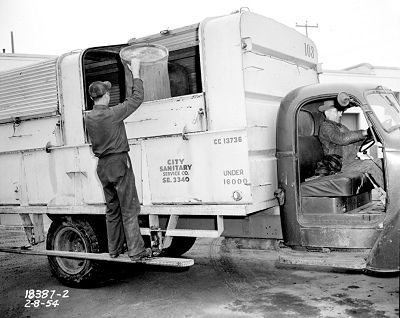
Thirty four years old, wife and three children and desperate. He was lucky to land a job with Santa Barbara Garbage Company, slinging ash cans. He rode the trucks standing on the foot plate, jumping off at every stop and hefting the loaded bins onto his shoulder and tossing them up on to the back of the truck as it idled up and down the streets of Santa Barbara and Montecito, two of the richest towns in California. A self-made man humping the garbage of the rich. It must have been galling. His brother Henry said Bruce worked like a mad man. Twelve hours a day, six days a week, sun up to sun down for $16.00 dollars a week, roughly .22 cents an hour. The cut in pay by more than three quarters put them on a collision course with poverty. It came pretty soon.
Eileen finally took the desperate measure and I mean desperate measure of going to the government office in downtown Santa Barbara and applying for relief. Under President Roosevelt’s series of assistance programs, established by the New Deal, provided federal funds to state and local governments for direct relief to the unemployed, including cash payments and food assistance. These programs aimed to provide immediate assistance to those who were unemployed, impoverished, or facing economic hardship. Like any good idea it was soon run by petty bureaucrats who wielded absolute authority over people who were guilty of nothing except being poor. They didn’t want to be poor and were shamed by the very thought of asking for help.
Just as today, those better off considered thee programs as a “Giveaway.” Relief had strict guidelines for eligibility. To meet qualifications the applicant had to fill out a questionnaire and be evaluated as to need. The Halls had the need alright. Three kids, a wife and a husband with a very low paying job which he could lose at any time. There were thousands of others who would gladly take it if they could. They stood on the steps of the company office every day, smoking, nervously, hoping for the smallest break. Mostly they would get none.
For a proud family, which we still are it was agonizing for my grandma to sit in the chair and “Beg” for help. Beg, a word that was loathed by my grandparents. Grandpa Bruce had pulled himself up by his bootstraps and was rightfully a prideful man. There is no adjective strong enough to describe how it must have felt to sit in that straight back, hard bottom chair, in front of the desk where the woman who would decide your family’s fate sat.
The conversation was short. “You qualify for food and rent assistance with just one stipulation,” she said. “Your husband will have to sell the car.” My grandmother couldn’t believe her ears. “But he needs the car to go to work,” she said. The woman looked up from her paperwork and said, “Thems the rules. He has to sell the car.”
When grandma Hall told that story it cinched a hatred for the government that still exists in our family. It’s not that it can’t help people in need but the way they do it.
My mother remembers them talking in quiet tones at the kitchen table that night. They’d sent the kids out of the room for they lived in a time when children were seen but not heard. Mom was scared because she didn’t understand what was happening. Her parents were as kind as they had always been but she said the kids knew something scary was happening. Bruce and Eileen were tense and very quiet. After ten years on the road with oil this was brand new territory. Grandpa had the assurance of a man who labors at his trade but the thought of losing all of that, though never said out loud had changed the dynamic of the family. Grandma and grandpa never had a harsh word for one another but to see her mother with tears was something she never forgot.
The only thing they thought possible was to join the family in Madera on grandpa Sam Hall’s ranch where they could at least eat and live under a dry roof.
So, they packed up what they could fit in and on the car, arranged for a friend to haul the piano and simply left the rest, furniture, dishes and all and pulled out for Madera.
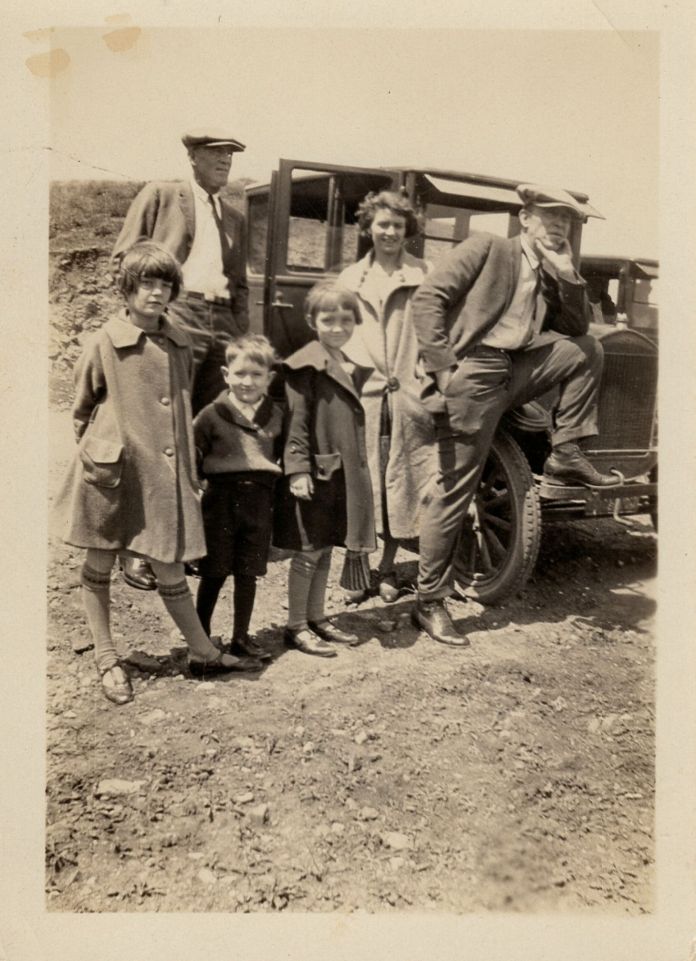
The Halls on the road to Madera. From left to right, Mariel, Robert, Barbara, Eileen, and Bruce. In the rear uncle Marion. 1930 Photo Grace Williams. These old photo make people look older than they were. Bruce and Eileen are both thirty four. Grandpa has his foot on the bumper to relieve his back, a problem he had all his working life.
*In the 1920s, buying on margin meant investors could purchase stocks by paying only a small portion of the stock price with their own money, and borrowing the rest from a broker. This allowed them to control a larger investment than they could otherwise afford, potentially magnifying profits. However, it also significantly increased the risk, as losses could exceed the initial investment if the stock price declined. When the broker called the margin the buyer had to make up the difference between the money spent and the difference owed the broker. It was a dangerous investment strategy if the buyer was unable to make up the difference. In 1929 it was a financial disaster.
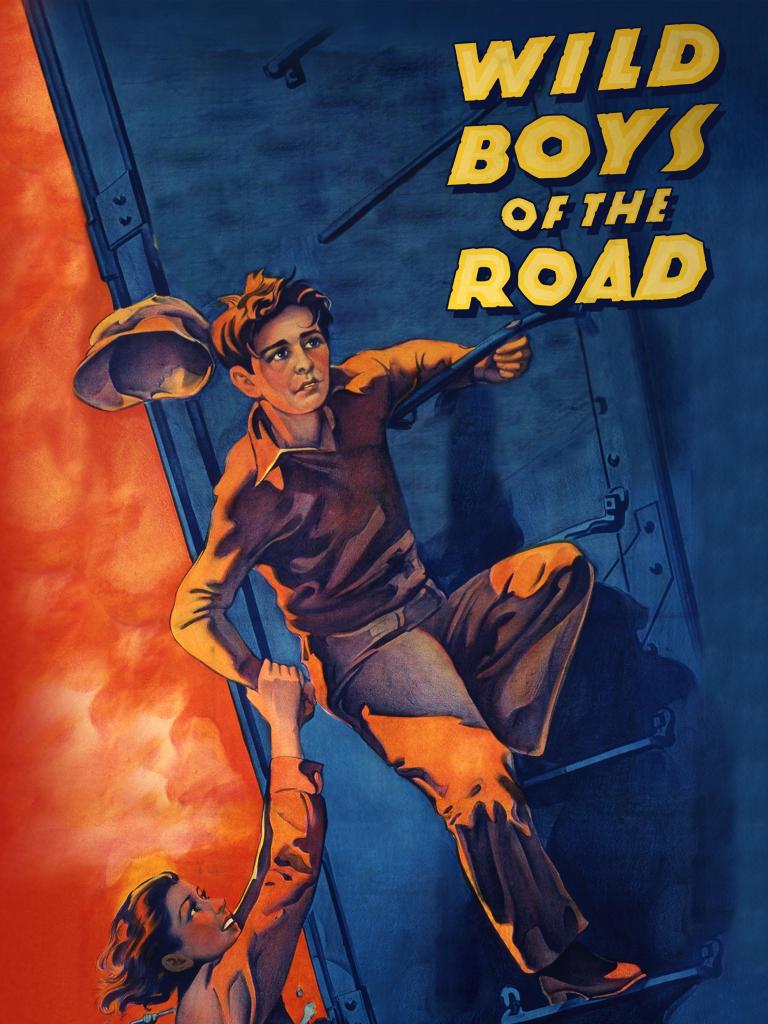
**Wild Boys of the Road is a 1933 pre-Code Depression-era American drama film directed by William Wellman and starring Frankie Darro, Rochelle Hudson, and Grant Mitchell. It tells the story of several teens forced into becoming hobos. The screenplay by Earl Baldwin is based on the story Desperate Youth by Daniel Ahern. In 2013, the film was selected for preservation in the United States National Film Registry by the Library of Congress as being “culturally, historically, or aesthetically. Available on Apple TV.
Michael Shannon is a writer and former teacher. He writes so his children will know their history.
 atthetable2015