Chapter 14
Michael Shannon
Bruce listened intently. With his left hand braced against the wall, head down and the receiver jammed aginst his right ear. He softly repeated, “Yes sir” several times. After a few minutes he said “Thank you Sam, I’ll be there as soon as I can.”
He hung up the phone, turned, took off his hat and held it as he put his hands on his hips and arched his back as he exhaled.
He looked at Eileen then Marion and said “That was Sam Mosher, I’m going back to work. I have to be in Long Beach as soon as I can. I’ll leave tonight I gotta go gas up the Ford. Eileen can you pack me a bag and something to eat?”
Bruce rattled down the Cahuenga pass into Los Angeles. He’d been on the road for a day and a half, slept in the back of the Ford last night and woke this morning sliding into the drivers set, setting the Magneto and advancing the spark, he kicked the starter button and turned her over. He figured with a quick stop for breakfast he’d roll down Alameda Street and into Long Beach just after sunup.
Rolling through Huntington Park then South Gate he drove into the fields and scattered houses of Compton and he could smell it. Drifting east on the morning breeze, the unmistakeable heady mixture of crude oil perfume. A strong, pungent, and a little bit sweet, the odor can be reminiscent of a mix of gasoline and tar, with a distinct earthy or petroleum scent. Some people find the smell unpleasant, but to an oilman It smelled like home.
Exhausted by the drive the odor washed over Bruce and caused his energy to start flowing. With his hopes soaring he drove down Alameda until he entered Long Beach. The City of Long Beach had a population pushing 150,000 and had doubled since the census of 1920. Once it was primarily a Beach resort for the retired and wealthy but the discovery of Alameda no.1 up on Signal Hill had changed the city drastically. Midwesterners flocked to the Hill to get rich. Leasemen, Drillers, Salesman, factories that built steam boilers and rolled pipe quickly surrounded Long Beach. Houses went up as fast as they could be built. The Navy was moving part of the fleet to the new Navy Yard on Terminal Island. During the booming twenties Long Beach became the home of sailors, oil field workers, workers in auto assembly plants, soap makers, a vast fishing fleet made up of Japanese immigrants and people coming to the edge of America looking for the main chance.
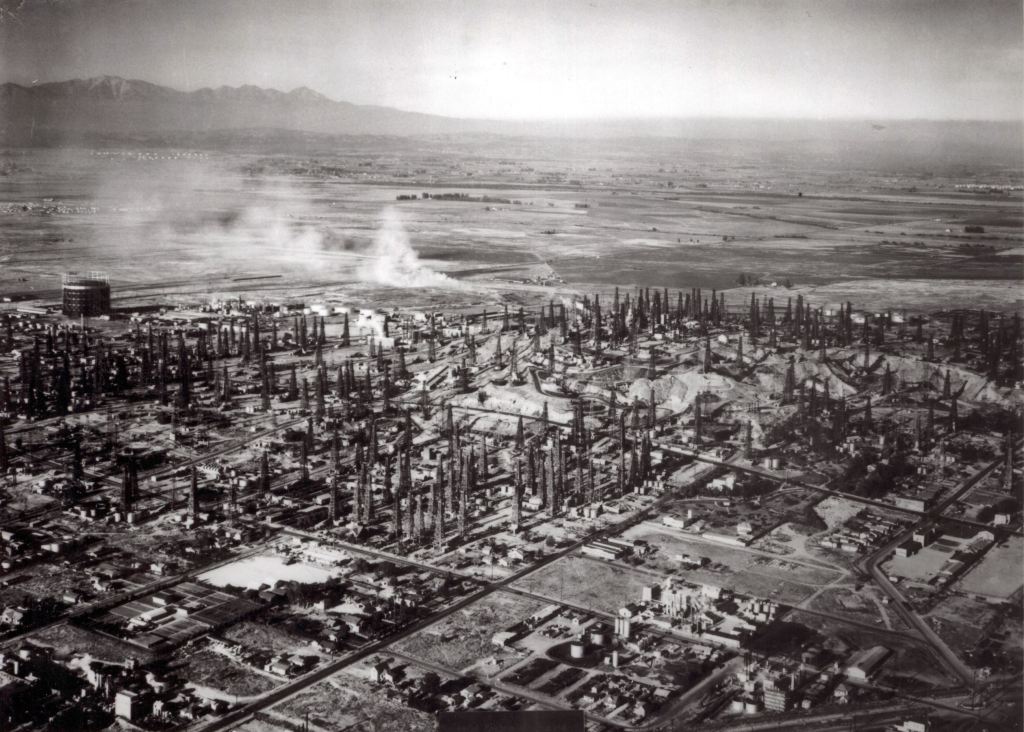
Signal Hill with The San Gabriel Mountains to the north. 1931 Calisphere photo.
Long Beach city was part of the Mexican land grant Ranchos Los Cerritos, the Little Hills and Rancho Los Alamitos. the Little Cottonwoods. It had been for two centuries dedicated to cattle raising. The small villages of the area were distinctly rural and grew slowly over time. Wildcat drillers began poking around in the 1890’s and when Edward Doheny brought in the first well in 1the Los Angeles field* in 1892 it was “Katie, bar the door.” The Los Angeles Oil Field made Edward Doheny one of the richest men on earth. “Richer than Rockefeller” as the song “Sunny Side of the Street” says from the old Fats Waller tune and it was true. Richer than Rockefeller.
Beginning in the late 15th century, Spanish explorers arrived in the New World and worked their way to the California coast by 1542. The colonization process included “civilizing” the native populations in California by establishing various missions. Soon afterward, a tiny pueblo called El Pueblo de Nuestra Señora la Reina de los Ángeles de Porciúncula would be founded and prosper with the aid of subjects from New Spain and Native American slave labor.
One Mestizo Spanish soldier, José Manuel Nieto, was granted a large plot of land by the Spanish King Carlos III, which he named Rancho Los Nietos. (The Grandchildren) It covered 300,000 acres of what are today the cities of Cerritos, Long Beach, Lakewood, Downey, Norwalk, Santa Fe Springs, part of Whittier, Huntington Beach, Buena Park and Garden Grove. It was the largest Spanish or Mexican land grant issued being nearly ten times the size if Catalina Island.
Soon prospectors started putting down hole everywhere. They found Oil in Santa Fe Springs and in a couple of decades were pumping in Beverly Hills, Torrance, Southgate Dominguez Hills and Seal Beach.
But Alamitos #1 was the biggie. She came in with a roar heard in downtown 24 miles away. Drilled on the at the northeast corner of Temple Avenue and Hill Street in Signal Hill. Spudded in on March 23, 1921, it flowed 590 barrels of oil a day when it was completed June 25, 1921, at a depth of 3,114 feet. The discovery well led to the development of one of the most productive oil fields in the world and helped to establish California as a major oil producing state.

Alamitos no. 1. Discovery Well, June 25th 1921. Signal Hill, Long Beach
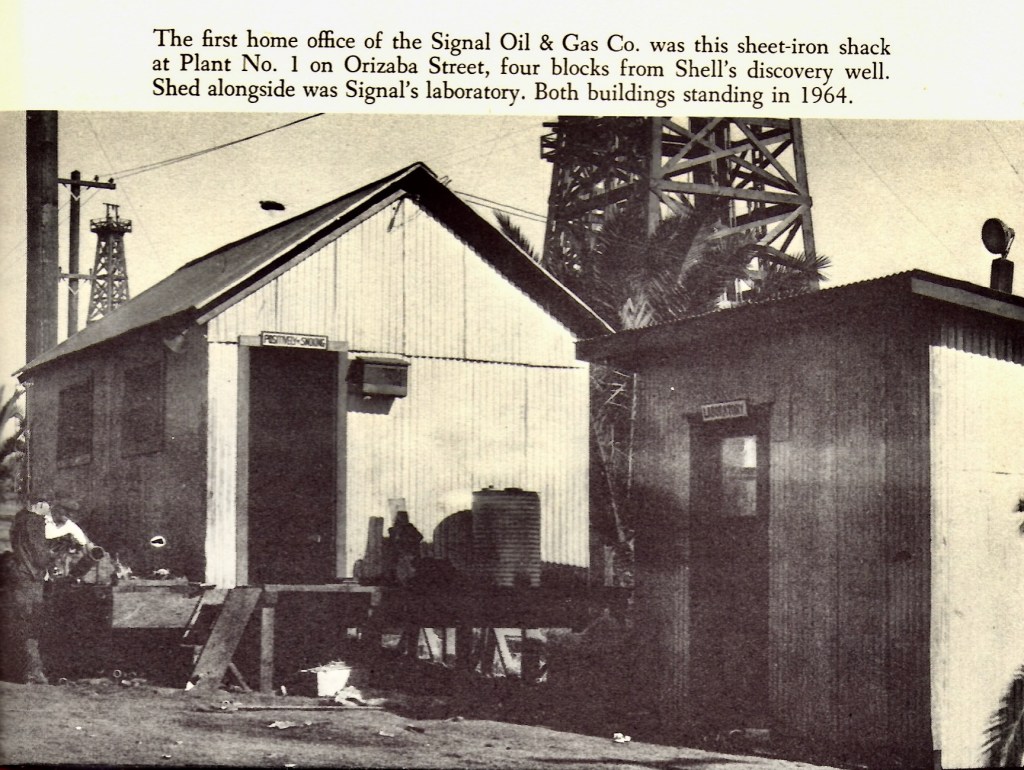
Ten years later Bruce made the turn from Alameda onto Willow, passing the Sunnyyside* Cemetery and headed east towards the Signal Oil and Gas headquarters building. Building isn’t exactly the right word though. Years later Signal would move into a modern building on Beach Boulevard and later still build its’ own headquarters building on Wilshire and 7th in downtown Los Angeles. This headquarters was was no more than a tin shack in the middle of the field itself. It may be a slight exaggeration to call it that but Signal was just eight years old and had begun life as a refiner of natural gas and owned no wells of its own in the beginning.
In the run up to the great depression Sam Mosher’s nascent company was struggling mightily to raise money to stay in business. Consequently they were using bond sales, private money, partnering with large oil companies like Standard Oil of California and banks trying to stay afloat. Independent companies were failing on nearly a daily basis as the price of oil tumbled. The big companies were cancelling contracts to the independents in order to protect their own. Breaking bonafide contracts was illegal but they had the money and lawyers so the attitude was independents be damned. Crocker Bank pulled its loans and a loan agreement with Giannini’s Bank of America kept them afloat.
The company under Mosher’s leadership invested in oil leases in Texas, the Westside of the San Joaquin, Summerland and a few abandoned leases in Elwood near Goleta. The idea was to diversify their holdings into drilling in order to provide product for their little refinery.
As the Ford toiled up Signal Hill the couldn’t help but wonder what the job would be. It didn’t matter that much, whatever it was he needed it.
Bruce and the Ford were both tired, it had been and long lonely drive He wanted to show Mosher that he had extraordinary drive hence the immediate drive down to Long Beach. It was very important to demonstrate that he was always ready to go. He had met the man a few times but had mainly dealt with his drillers and superintendents when he was working the Goleta and Summerland fields.
He pulled into the yard which was filled with trucks, automobiles parked any whichaway. Climbing down from the car he stretched than walked quickly toward the headquarters building. He could see, hear and see welders pipefitters, draymen, ditch diggers, bricklayers concrete masons, electricians, carpenters and plumbers at work everywhere. They were coming and going, these skilled laborers moving between rigs, some working for just one company but most were day laborers or were moonlighting, paid cash money they represented the itinerant workers seen all over any oil fields. Bruce stepped over some drill pipe and paused turning to take in the hustle and bustle and chatter of the men around. The sound of boiler valves popping off extra pressure, steam whistles, the chug chug of diesel engines pulling the linked chains that spun the drill string, sucker rods in an endless rise and fall lifting the crude from near a mile underground. When the wind blew the massive wooden derricks bent to it, creaking and groaning with a dismal sound. An ordinary man would be cautious and afraid his ears ringing, eyes stung by the constant blend of exhausts, the sewer gas coming from the drill pipes with its semi-putrid odor all of it wafting about lighting on and tainting every surface. Grandpa once said you didn’t need any hair oil in the patch, it was provided for free. Always buy a black car and never wear a white shirt.
Headed for the steps he hopped over every kind of detritus, crushed cans, butts, random paper blowing about, there were gobs of crude oil everywhere and the wooden surfaces of the buildings and derricks were soaked with it. It was no place for a fastidious man. A very careful man but not one overly finicky.
Bruce climbed the steps stepped to the door and knocked on the door trim, there was no door, someone found a better use for it he guessed.
Inside at an old desk scarred by hard use, its edges burned by cigarette butts left too long, sat a man. Dressed in stained Khakis and hard used work boots. He wore a green long sleeved work shirt, cuffs buttoned against the dirt and grime, no man exposed any more of his body than was necessary on the job. Pants held up by braces, no man working in 1931 wore belts, too restrictive. He rose from behind the desk sliding back the bent wood chair that served as a seat with a rasping screech, he reached up with his right hand and pushed back his typically stained and dirty Fedora. The smile above his jowls flashed as he held out his hand and said “Hello Bruce, damned good to see you.” Grandpa smiled back and took the hand, “Good to see you too Bob.”
It was Robert M. Pyles, Signals drilling superintendant for Huntington Beach. He said, “Sit down Bruce.” Bruce pulled up the only other chair and sat. Bob pushed up his black heavy rimmed glasses, used his forearm to sweep the piles of paper on the desk to the side, reached down opened a drawer and pulled out a binder and laid it on the desk. “These are our reports for Elwood, I want you to take a look at them and tell me what you think.” Bruce slipped his reading glasses out of their case, put them on and slid his chair closer to the desk.
He pulled a crushed pack of Chesterfields from his left front pocket and offered one to Bob who declined. Picking a match from a box on the desk he scratched it with his thumb held it to the smoke. Fired up he leaned back blew the match out and closed his eyes for a moment to let the smoke from the phosphorus match head clear and then bent to the binder and began to read.
After an hour or so and some discussion the two men sat back in their chairs. Bob pulled open a desk drawer and snagged a fifth he kept there, blew the dust from two coffee cups and poured a couple fingers in each one. He took one and slid the other one to Bruce and said “So you’ll take the job?” Bruce grinned, nodded. They reached out and clinked the cups and threw it back. They stood up reached across the desk and shook again. Bob said, “You’d better call Eileen and tell her to pack up and get down to Santa Barbara.”
That is how the employment contract was signed. The old way.
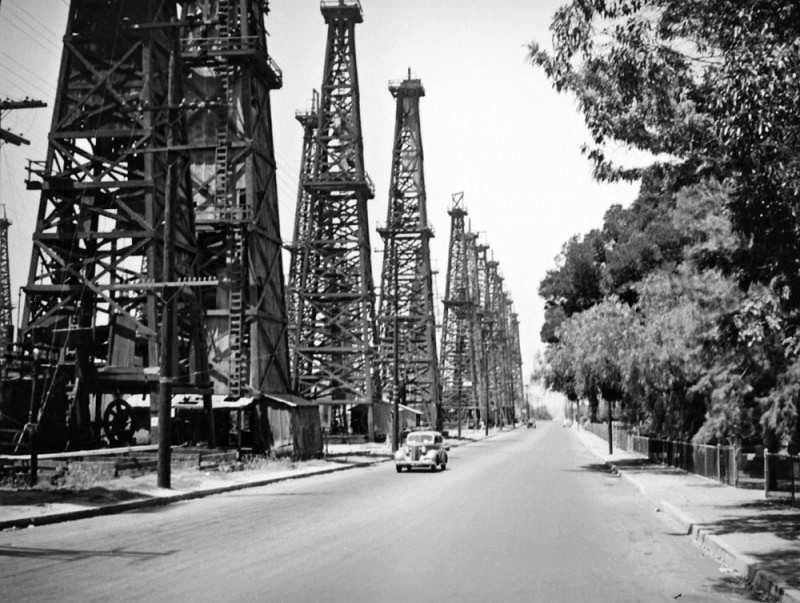
Cover Photo: Willow Street and Sunnyside Cemetery in Long Beach 1930. Long Beach History photo
*The Los Angeles field is is still pumping. It runs from the east near Dodger Stadium into downtown at Alvarado Street.
**The Sunnyside Cemetery would not lease its ground for oil drilling for obvious reasons. It was completely surrounded by forests of wells. More on that later.
Michael Shannon is the spawn of drillers and ranchers. He write so his children know who they are.
 atthetable2015