Chapter 13
The End And A New Beginning.
By Michael Shannon
Easter Sunday, April 1st, 1945, and where were you? I was resting in my mother’s arms in Sisters Hospital Santa Maria California. Staffed with sisters from the Poor Clares, a Irish enclosed order of the Holy Roman Catholic church. The sisters carried me to my mother from the nursery wrapped in a blue blanket and a small green ribbon tied in a bow in my sprig of blond hair, the only child born on that day. It’s been my luck.
Half a world away on the same date the tenth United States army made up of three Marine divisions and four army divisions started going ashore on the Japanese island of Okinawa. Supported by the Navy’s Fifth fleet made up of three separate task force units and the British, Australian Royal Canadians and New Zealanders. The combined forces numbered nearly 541,000 troops, 184,000 thousand of them combat infantry. The invasion was supported by a fleet consisting of 18 battleships, 27 cruisers, 177 destroyers/destroyer escorts, 39 aircraft carriers (11 fleet carriers, 6 light carriers and 22 escort carriers) and various support and troop transport ships.
One of the great euphonius names of WWII commanded at Okinawa. Lt. General Simon Boliver Buckner jr. Named for his father he commanded the entire 10th Army. A graduate of Virginia Military Institute and the US Military Academy at West Point he had served in WWI and The Philippine Insurrection which I’m sure the Filipinos considered a war. His father Buckner sr. served in the Mexican war, the Civil war, was a Confederate General and Governor of Kentucky. General Buckner had iron clad credentials. Considered a soldiers General he was on the front lines with the 2nd Marine Division when he was warned by marines to remove his helmet with it’s three gold stars because they could see them a half mile away. He did. Moments later a small artillery shell hit near him and he was wounded by coral shards and died less than an hour later while being operated on in an aid station located in a shell hole.. He was one of four US Generals killed in WWII.
General Buckner was just one of the 200,000 deaths, including both military personnel and civilians. It was an orgy of killing and the newspapers back home listed casualties of such high numbers that the public which had become inured to the death toll was shocked into a stunned numbness. Marine casualties exceeded the total number of a single fully manned division. It was as if one of the three Marine divisions, the 1st, 2nd and 6th has been completely wiped off the face of the earth. The army suffered equally with over 19,000 dead and wounded. The Navy lost thirteen destroyers sunk by Kamikazes. Nearly sunk, the Essex class carrier USS Franklin, CV-13, the “Big Ben” lost 1,294 with 807 killed in the greatest single ships loss since the USS Arizona. Lest any one should think that support personnel were relatively safe 35,000 cooks, seabees, truck drivers, labor detachments, hospital corpsman and doctors were killed and wounded. The dead included two war correspondents.*
When the “Butchers Bill” was presented to the population of the United States and its government they were aghast. What was it going to cost to invade the Japanese homeland? You could scarcely drive down a street in the countries small towns without seeing small banners with gold and blue stars hanging in windows.
The Battle of Okinawa was a victory for the US but resulted in massive casualties on both sides. Japanese forces fought with the same fanaticism the Americans had witnessed in battles such as Iwo Jima and Peleliu. Rather than be taken prisoner, defenders often chose suicide. Okinawa was so close to home, most Japanese soldiers refused to surrender and fought to the death. Their fanaticism contributed to a dreadful toll. Some 110,000 Japanese and conscripted Okinawan defenders were killed in action. The battle created a humanitarian disaster for civilians as well. It is believed that the number of civilians casualties was greater than all battle casualties combined. Combatants on both sides, after three years of war were completely numb, bereft of any kind of humanity. Robert Leckie and Eugene Sledge both wrote books about their experiences and told the same story. Marines and soldiers automatically shot Imperial Japanese soldiers who were wounded, they also shot the dead to be sure they stayed that way. They told of the absolute necessity in a cold, pragmatic way, emotionless. No combat rifleman wanted an enemy soldier playing dead to suddenly come back to life and jump into their foxhole at night.
Later in Vietnam, a marine sergeant told Lieutenant Phillip Caputo. “Sir, before you leave here you’re going to learn that one of the most brutal things in the world is your average nineteen-year-old American boy. Phillip Caputo was Marine officer who served as a platoon leader in Vietnam. He was right. It is a quote that describes soldiers as far back in antiquity as you choose to go. It could have been said by a Hoplite in Alexander the Greats Macedonian/Greek army two and a half thousand years ago.
For the last time the Nisei boys boarded assault ships and sailed for the islands of the Ryukyu Group of which Okinawa was the largest island, 66 miles long and seven miles wide on average it was to be the last major battle of the Pacific war though no one knew it yet. It was also going to be the deadliest.

MIS camp, Okinawa, 1945. Signal Corps photo
The Japanese Imperial Army wasn’t nearly on it’s last legs. The Military leaders in Tokyo had determined that they would not engage in offensive battle but rather set up defense in depth and attempt to bleed the Americans dry. They well knew that after three years of increasingly brutal fighting the American public was losing heart. Printed in the nations newspapers casualty lists were enormous. Though newsmen tried to put a positive spin on war news, the Battle of the Bulge had just ended and cost the American army 81,000 casualties. People were war weary. We were running out of children to sacrifice. The High School class of 1944 was just finishing training and was headed for the front.
Mom’s cousin Don Polhemus, lost on the USS Spence during typhoon Cobra, her brother headed for the western Pacific on a destroyer. My dad’s best friend Sgt. Harry Chapek, killed in France, and his cousin Bill Marriott had just left New Guinea and was headed for Okinawa . Jim Moore, son of the judge and my grandparent’s closest friends LST was bombed in the Pacific.The war was everywhere in our little county. There were military posts in literally every town and all along the coast. People don’t think about it much anymore but there were P-38’s at Santa Maria, flying cadets at Hancock field, Coast artillery units above Pismo Beach, a Rec. Center in Grover City where my mother volunteered. There was a Coast Guard bases in Morro Bay and Avila beach. Amphibious landing were practiced along the Atascadero Beach. Camp San Luis Obispo was the largest infantry training base in the country turning out ten thousand soldiers with every cycle. Camp Roberts in north county on the Hearst ranch and just to the south Camp Cooke where Patton’s tank Divisions had trained on the dunes above Lompoc before North Africa.. Mom said military convoys clogged the old highway and would go through Arroyo Grande, rumbling people awake at all hours. The list carried in the old Arroyo Grande Herald Recorder titled “Our Boys in the Service” was filled with nearly four hundred names in August of 1943. They were the last names of kids I would go to school with. The bus drivers, librarians and teachers in our schools, the postman, truck drivers, housewives, doctors and pharmacists, all listed. Those that would never come home marked with a small black star. There were more than a few. All from a town with a population of less than five thousand people.
The troops were weary too. The American leadership put no real censorship on the news and the people at home and their families wrote of neighbor boys who were dead, wounded and captured. Every day, every thought grounded in the agony of a war that seemed to have no end.
Hilo and his team must have worked frantically to translate all the information coming in from the Army and Marines. The temptation is to think that all this emphasis on information was at this point useless. We al know the end of the story. Thats the problem with history. Though we can study events for their meaning there is one thing we cannot do and that is see the future. Hilo and his team hadn’t the least inkling of where it would end. The man at the center of the hurricane has no idea where the way out is. Even the big brass in the Phillipines, Pearl Harbor and Washington DC had no crystal ball. The only thing they could do was to press ahead.
Planning for the invasion of the Japanese islands was well under way. The war in Europe would soon be over, there was no doubt of that. Germany was finished. The only question was how much longer would the insane self destruction continue. Even the Dogface trudging along German roads, still dying daily knew it was over. They all wanted to live, Japan was waiting. They knew that is was different fighting the Japanese than the Germans. No one wanted to go. But they did. The first Army Air Corps units had already arrived from England. The Generals had no doubt that when the time came they would go. Bill Matousek, some day to be my family doctor, as a fresh replacement tank driver who arrived on the line just days before the battle of the Bulge knew it. My sister in laws father had fought all the way from Sicily to Anzio to southern France, he knew it too. Del Holloway, Orville Shultz, John Loomis*** Arch and Leo Harloe, your father too, they all knew what the next step was going to be. It’s all they talked about. It seemed to them that it would last for years. “Golden Gate in ’48” they said.
They knew nothing of the Manhattan Project and the bomb. During the fight for Okinawa, FDR died .On April 12th the day of his death the first order of business for the new President, Harry Truman was to be told about the bomb. It would be up to him to decide.
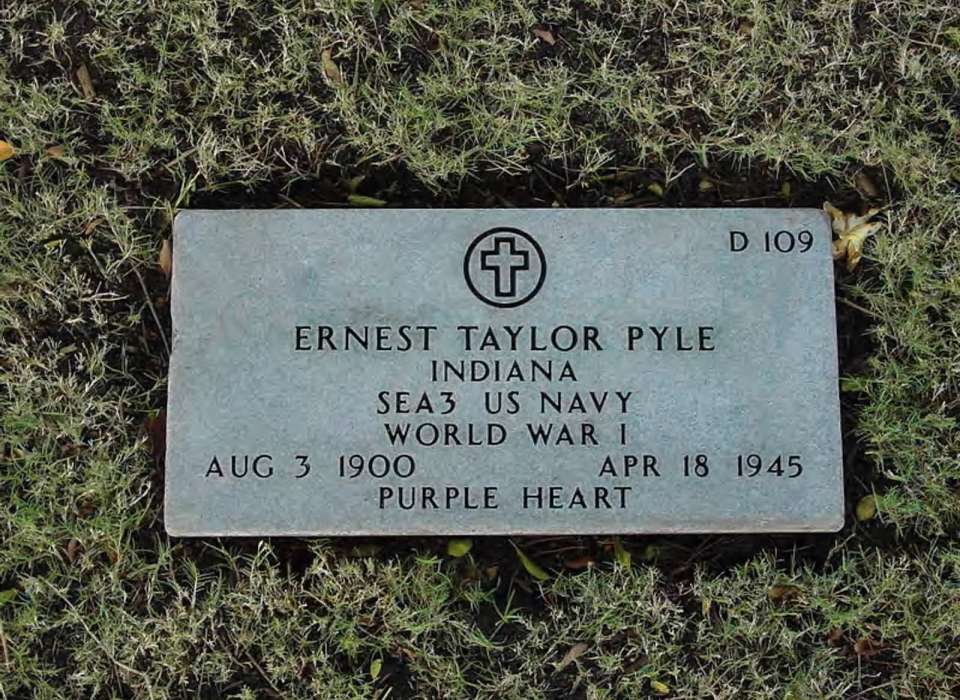
Ernest “Ernie” Pyle, the soldiers friend killed on Okinawa April 18, 1945 RIP National Cemetery of he Pacific, “Punchbowl” 2177 Puowaina Dr. Honolulu, Oahu, Hawai’i
They lie supine in their regimented rows where once they stood. They are the waste. The war dead. Those who know nothing pass them by on the road. Only as long as the markers, the holy grail of the left living, be visited by those who remember will they signify the personal cost. On memorial days and anniversaries families may gather at the stones to remember their children who all too often were in their teens or early twenties when they died. But during the rest of the year they are noticed only by the caretakers who mow between the stones.
The consequences, the blind, the amputees, the depressed, the suicidal, these insane, these jobless, these homeless, the side effects and delayed effects whose very existence keeps memories of the war alive when most citizens can’t wait to forget, or, remember in a circumscribed vision for the burial of the dead is a burial of memory. The National Cemeteries fulfill a desire to set it all aside. No one can say that they are not moving places but the arranged beauty does not evoke any memory of terrible battles.
Perfectly aligned marble does not resemble the memory of the men who lived them, but rather masks the heaps of the dead and wounded, They lay in piles, in fragments, limbs broken and contorted, Burned, muddy clothes shredded or ripped from bodies by the sheer velocity of the man made forces that took their lives. This, the veteran of combat knows and of which he will not speak. The impossible knowledge cannot be conveyed to the living, the wives and children and grandchildren. Thats the secret, the wilderness of slaughter and death, put away as if in a box to be gradually forgotten. It speaks to the resiliency of memory, the ability by some to bury the scars so deep they can never be found.**
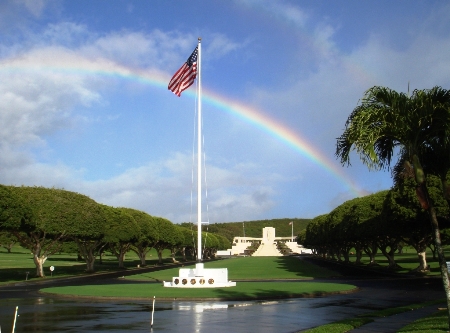
Punchbowl
Next, Chapter 14. Home, it’s all changed.
*During the Battle of Okinawa in World War II, Ernie Pyle, a renowned American war correspondent, was killed by enemy fire. He was covering the battle for American newspapers and was known for his deeply humanizing accounts of soldiers’ experiences. Pyle won the Pulitzer Prize in 1944 for his newspaper accounts of the “dogface” infantry soldiers from a first-person perspective. He was killed by enemy fire on Ie jima (then known as Ie Shima) during the Battle of Okinawa. Another journalist, John Cashman, was killed in an aircraft crash on Okinawa on July 31, 1945,
**As far as I know I am the only living member of my family who recalls Corporal Edgar Green of the 2nd Australian Infantry whose grave is in the Baghdad North Gate military cemetery in Iraq. When I am gone so is Edgar, his incredible and brutal goes story with me. Markers are not for the dead but for the living.
***https://www.newspapers.com/article/the-arroyo-grande-valley-herald-recorder/179529347/ Follow this link to a letter home from a local Marine on Okinawa.
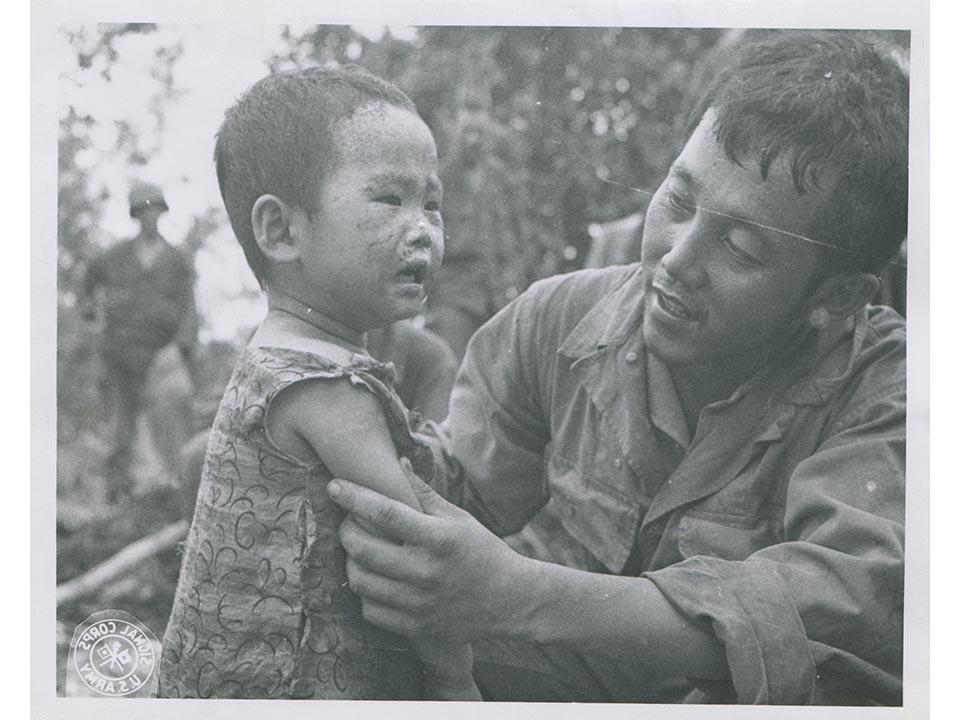
Cover Photo: Private Bob Hoichi Kubo United States Army MIS
Below is the link to “letters to Dona” page one.
https://wordpress.com/post/atthetable2015.com/1226
Michael Shannon writes so his children will know where they come from. He lives in Arroyo Grande California
 atthetable2015