Michael Shannon
She was only ever referred to as the hired girl. She worked for my Great Uncle Patrick Moore and his wife Sarah. She wasn’t a live in for her parents had a home just down the hill from the Big House called Grand View, that huge confection of a house built in the 1889 by My grandmother’s maternal uncle, the very successful Irish immigrant who had risen from a sheep farmer in Guadalupe to become one of the richest and most influential men in what were still known as the “Cow Counties.”
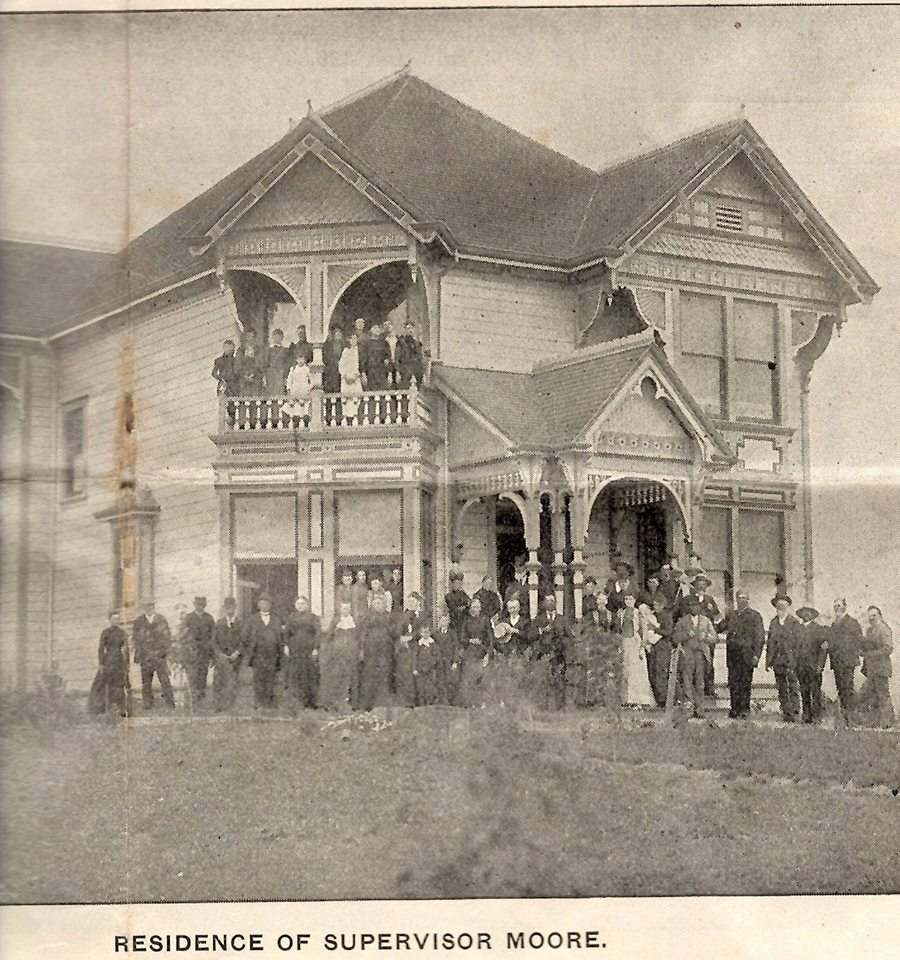
Grandview 1896. Annie Gray Shannon is the little girl in white up on the balcony.
The Moores could never have imagined how their life would turn out. They immigrated to the United States in 1847 from Cavan town in county Cavan where Patrick’s family raised pigs. Moderately prosperous they lived in what is known as the Irish Lakes District because it contains 365 named lakes. County Cavan is also the source of the river Shannon. According to legend, the Shannon is named after Sionnan, who was the granddaughter of Manannán mac Lir, the god of the sea. She came to this spot to eat the forbidden fruit of the Tree of Knowledge, which was planted by the druids. As she began to eat it, the waters of the pool sprang up and overwhelmed her. She was drawn down into the pool and its water began to flow over the land, forming the River Shannon.
Patrick himself had no desire to spend his life slopping pigs in that good Irish mud so he prevailed upon his father Michael to buy him a ticket on an immigrant steamer. He arrived at Castle Gardens New York in April 1847 aboard the SS John Ravenal out of Liverpool, he was 15 and he intended to stay. Like most immigrants he already knew someone who could show him the ropes so to speak. Chain immigration has always been the way. Over the next decade he would return the favor and bring his father Michael and his three sisters, Mary, Bessie and Catherine to this country.
They moved across the country. He lived Sandusky Ohio and in 1860, moved to the Sacramento area of California. Somewhere along the way he learned to read and write and became a citizen.

Patrick Moore. Family photo
He and Sarah were married in 1871 but old census reports indicate they were living in the same house for a few years before that. Perhaps you can imagine the rest, or not. Everyones life has been self censored.
In 1877 they were living near Salinas during the great drought of the 1870’s. He ran horses, cattle and herds of sheep and his stock was in great distress because of little feed and almost no water. He wrote to his old friend Patrick Donovan who was an Arroyo Grande pioneer asking if he had feed to sell. Pat Donovan told him that he had leased lands in the Oso Flaco area and that Moore should drive his herds south. When Pat Moore asked what would be the cost Donovan said it would be nothing as they were friends and Patrick Moore was a friend in need. Pat Moore never forgot this act of kindness. “Every cent I now have ” he would often say, “I owe to the friendly act of my friend, Pat Donovan. He never took a cent in pay for the feed he gave my starving livestock.” Pat Moore spent the rest of his life paying that kindness forward.
The entire family relocated to Guadalupe in 1877 where he farmed and ranched. Like many Irish immigrants he began buying land, Something no Irishman could do in the home country. For some like Pat Moore it was an obsession.
By 1891 he owned vast tracts of land. Much of the old Santa Manuela Rancho, Parts of the Bolsa de Chamisal, bottom land in the Arroyo Grande valley, three stone quarries and had become an informal banker, lending money to others. Some of his land in the hills of Santa Barbara county and in the flats east of Santa Maria produced the first oil in the area.
Fortunate had graced his efforts and in 1890 he began building the great house known as Grandview. It overlooked the little town of Arroyo Grande and the valley for which it was named. Pat was active in politics and in 1892 was elected supervisor of the fifth district of San Luis Obispo county, the so-called “Bloody Fifth.” It’s reputation was well earned. Saloon brawls, the little town had many more than a dozen saloons and there were land disputes which occasioned cold blooded murder and a non-judicial lynching. The regular clearing out of undesirables such as vagrants and the pesky Celestials who lived in the Oceano area. People then were no better than we are now.
In 1893 a singular event in their lives changed their lives. My eight year old grandmother came to live with the Moores in the big house. From a prominent Santa Maria family, her mother was a niece of Sarah Moore. Annie Gray left her family to be raised by the Moores who were childless. They promised to provide her with a first class university education and deed her a ranch when the Moores passed on. It was another selfless act of kindness by two Irish immigrant families. My great-grandparents to loan a child and another family to cherish her.
The Moores had also taken in a pair of sisters who had been orphaned. The inscription on Elizabeth Tyler’s headstone reads: “Remember friends as you pass by. As you are now, once was I. As I am now so you must be. Prepare yourselves to follow me.” Mrs. Tyler and her husband died of Smallpox in 1875. She is said to have been the first person to be laid to rest in the burial grounds of the old Guadalupe Catholic cemetery. Her two girls, Mame and Hattie would grow up with my grandmother in the Moore house. Just down the hill in the little area of small farms owned by some of the most prominent citizens raised boys and girls of the same age. The big ranching families all had houses in town because they were so far from schools and shopping that they sometimes lived in their townhouses away from the ranches.
Up at the house in the days long before radio, television and the like, entertainment for kids was provided by parties and family get togethers which were a constant occurence. My grandmothers little autograph book which her guests signed contains the names of kids from families like the Phoenix kids, the Harloes, Dixons, Lierely, Jack Shannon, my future grandfather, the Rice girls, the Griebs, Conrows and many others. Children were more than welcome at Grandview anytime and for any reason.
The gift of an education was not reserved for just my grandmother but was settled on several young women who spent time in that house. Girls attended the San Jose Normal school, Santa Barbara College and Cal, all paid for by Pat Moore.
So, a big house full of kids and adults, hence the hired girl. Her name was Clara.*
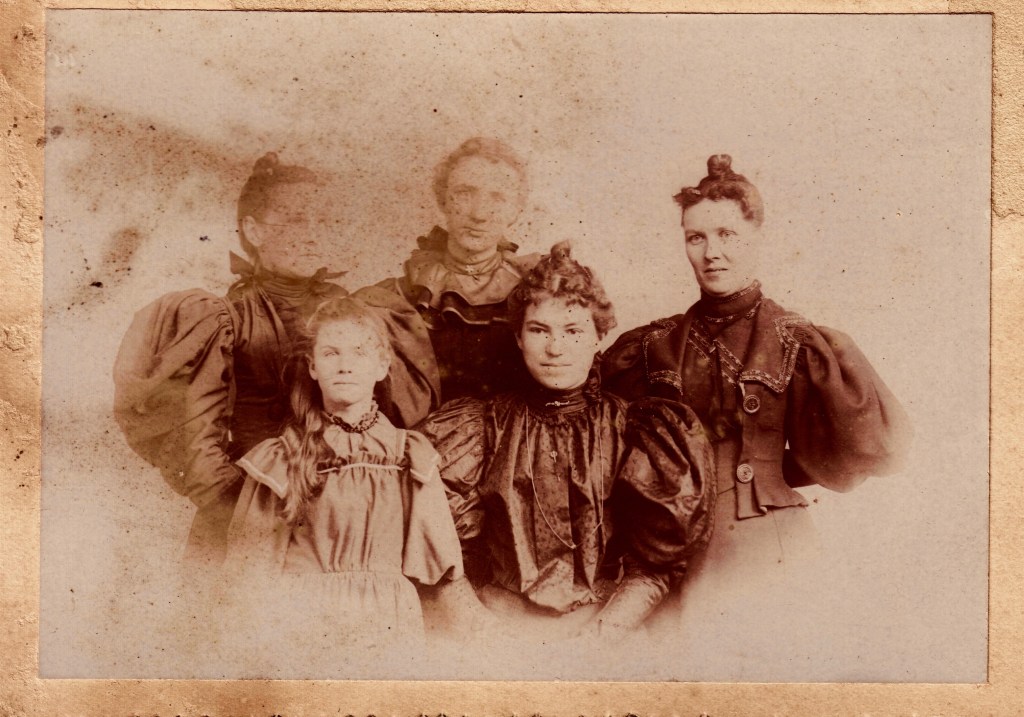
Annie Gray, my grandmother and the hired girl Clara. Rear. Mary Maguire and the Tyler sisters. 1893. family photo
Clara was a lively redheaded Irish girl six years older than my grandmother when she came to live with the Moore’s. Her parents had come from Ireland in 1879 and settled in Arroyo Grande. They lived just down the hill from Grandview. Her father farmed a small tract of land in the lower valley. He had come south working for the Southern Pacific railroad.
Clara began working for the Moore’s when she was fourteen. A house nearly ten thousand square feet took some work to keep up. The house had hardwood floors covered with rugs and you can bet that guests and families did not remove their high button shoes to come inside. The streets of the town were still years from being paved and the road out to the house was corduroy which was just basically logs covered with dirt. The Moores might have had a big house and dressed well but they still had horses in the barn, pigs in the sty and dogs in the yard.
Visitors from out of town like San Luis Obispo or Guadalupe came by train which ran twice a day. Come for dinner you had to spend the night. Pat and Sarah loved guests in their home and weekends especially the house would be full.
Clara must have spent many hours pushing that brand new invention, the carpet sweeper** and scrubbing floors.Thankfully for her most of the laundry was sent out to the Chinese laundry in Oceano so at least she was relieved of that chore. Outside duties were delegated to the hired man Clarence Seamen who lived upstairs in the horse barn. The house was set on an entire section of ranch land and was a busy place.
My grandmother grew up in that big house, leaving for university at Berkeley in 1904. She married my grandfather Jack Shannon in 1908 and had two boys. The family ran their dairy on the promised ranch, and retired in 1954. My grandfather passed away in November of 1976 and my grandmother Annie in April 1977.
Readers of stories about my family will know that she was a right proper lady. She was a turn of the century girl raised by two wealthy families. She was a churchgoer of the first order and anything improper was neither said nor done…or ever mentioned.
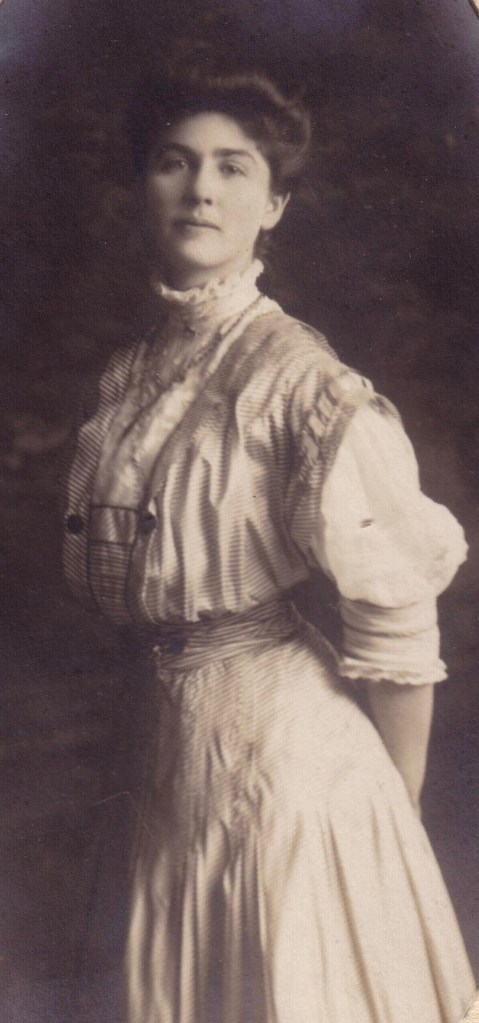
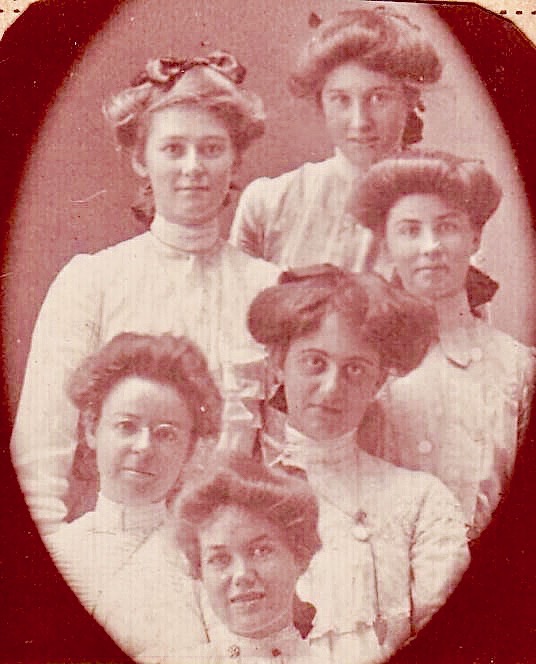
Annie Gray 1906. University of California Berkeley. Yearbook photo.***
On a visit home in 1977 I went out to the ranch house where she still lived and found her, always a small women, much diminished in stature sitting on her pink rose patterned couch where she spent her last days. She was lost to me. She dwelt in some foggy place where I could never go and barely recognized who I was. Cold and wrapped in a house coat and a blanket across her knees she sat in a ray of sunlight and took my hand when I sat down with her. The little hand I had touched all my life, the hand that had stroked the blonde curls of her first grandchild that I was. Any conversation was mostly mine offering questions that were things long past that she might recall. She offered snippets of stories, of the family.
I found a small autograph book in a box stored on the shelf below the folded towels in the guest bathroom along with stacks of old photos. The cover, a polished wooden piece of lovely mahogany with the crest of Queen Liliokulani**** of the kingdom of Hawai’i and filled with a decade of sentiments by kids who attended birthday parties, graduations or just any occasion to get together in the big house. Many names familiar to me for we lived in a small town where for decades families never left. I went to school with children whose grandparents had signed her book.
She didn’t have much to say. “She played bridge with that girl, or that was her best friend, that was my sister Sadie, he was a nice boy,” things like that. In a beautiful copperplate script there was a note that said “Think of me long, think of me ever? Think of the fun we’ve had together.” Your Friend Clara J. Arroyo Grande February 3rd, 1899. It was my grandmothers thirteenth birthday.
When I asked who Clara was because I had never heard it before she replied, “Oh that was the hired girl, she got knocked up by the hired man.”
Well now! Here was a voice from long ago that sent the family stories tumbling. Neither my father nor uncle ever heard of Clara. My grandmother even mentioning the word sin out loud was a surprise. Not exactly a peccadillo, but something very serious. She said “Knocked Up.” Did people in 1900 even use vulgar phrases like that? Yes they did, in fact you might be surprised that people were not much different then, than now.
One sentence is all, just one. This is what I had. A mention by a very old woman, a single inscription in an autograph book and Clara’s name written on the back of an old, old photograph. “Knocked Up” she had to be sent away. She married a Mexican it was said, not entirely a full throated congratulation for the poor girl. Clara was just six years older than my grandmother and a friend, judging from the inscriptions she left in Annies autograph books. She got herself “Knocked Up” as the old saying goes and had to be sent away. “At least she had enough sense not to marry the hired hand who made the baby.” My grandmother whispered, “But she did marry a Mexican.” The hired hand? He was sent packing. When she talked of these things eighty long years had passed yet to her they were as real as yesterday. Isn’t that time travel? And indeed Clara never had another child which would lead one to believe the outcome of the pregnancy was not good. Perhaps at twenty she should have known better, but she was a “lively” girl.
I thought, sent away which I think implies not just home but away somewhere else. San Luis Obispo and Santa Maria had lively Red Light districts where there would likely have been midwives employed for that very reason. Or was she sent by train to San Francisco and how did the Moore’s know where to send her. Abortion? Miscarriage, no one alive today knows just that she never had children. Of course the verdict of the time wold have been that she was “Ruined.”
She did marry a “Mexican” though in California that didn’t really mean all that much since it was once a Mexican province and like it or not many Californians are descendants of Mexican people and proud of it as they should be.
Clara married just two years later and stayed married for 61 years to the same man. Her family stayed in the San Luis county area and her sister even has a local valley street named after her.
Clara seems to have had a good life and her secret has remained one for well over a century but it’s a story that delights the discoverer and covers much of the history of what we might call real people don’t you think?
A secret buried for 76 years and never to be revealed as if somehow my grandmother was shamed by it. We have learned that the human does not change. Words yes, the world around us yes, but us, not so much.
*Though Clara had no living children, her husbands family has descendants living nearby so family and married name shall remain private.
**Invented in 1876, the carpet sweeper reduced the workload on housekeepers. Rugs had to be taken out and beaten at regular intervals. It was the latest mechanical marvel and a boon the housekeepers everywhere.
***We still have that skirt packed away in a cedar lined trunk.
****Hawaii was still a kingdom at the time and how or why she came into possession of the little book is a mystery.
Michael Shannon is a writer and found his own family to be very fertile ground. He writes so his own children might know something of that family.
 atthetable2015