Chapter 16
Michael Shannon
The Twelve Hour Tour was over. As the old saying goes don’t buy a Pig in a Poke sack. Except of course you’ll end up doing it anyway.
Bruce accepted the job as a superintendant of drilling and went to work on the Signal piers at Hydrocarbon Gulch. After they had cleared a platform to build a small and shaky derrick on the edge of the Pacific ocean the cable tool bit was dropped a few times which qualified as spudding in a well and the terms of the one year contract were fulfilled. They made it by the skin of their teeth.
Because Bruce was a whipstock expert he was busy at the Gulch. No derrick could be erected on the beach because of the tidal shifts so a pier was begun immediately in order to begin drilling out in the Santa Barbara channel. The oil pool was offshore and in order to reach it they would need to slant drill.


A pile driver building the piers for the validation well. The validation well, Appleford No. 1, October 1929.
Bruce’s new position came with a raise and lots more responsibility. After nearly twelve years the twelve hour tour was a thing of the past. The twelve hour was now 24 hour and then some. Supervising more than one well could take a great deal of time. If his crews were lucky they had a shack or small shed where they could wrap themselves around boxes and equipment and sleep the sleep of exhaustion between tripping pipe. Pulling all the pipe in the casing, “Making a round trip” or simply “Making a trip” is the physical act of pulling the drill string out of the well-bore and then running it back in. This is done by physically breaking out or disconnecting the drill string when pulling out of the hole every other 2 or 3 joints of drill pipe at a time. The pipe pulled, called a stand is then racked vertically in the derrick. Up on a small platform near the top of the derrick called a “Monkey Board” is the The Derrick-man. the derrick-man walks the board to guide, stack, and secure drill pipe as it is lowered into or pulled from the bore hole.
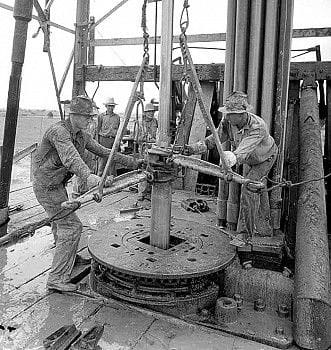
Tripping pipe in the early 1930’s. The stack is behind the man on the right. Calisphere
A typical reason for tripping pipe is to replace a worn-out drill bit. Another common reason for tripping is to replace damaged drill pipe. It is important to get the pipe out of the well-bore quickly and safely before it can snap. My grandfather could place his gloved hand on the rotating pipe and tell you what was going on deep underground. In the thirties there was little in the way of scientific measurement. No electronics were yet available for measuring hole. The drillers still relied on taste, feel and smell to understand what was happening deep underground.
The drilling floor was a dangerous place to work, slippery with drilling mud, oil and water. Ninety feet above the floor hung all kinds of equipment that could fall and kill a man. Hands were crushed by heavy machinery, steam boilers could rupture and cook a man. Heavy chains could snap and take your legs off. No one wore a hard hat. They were not in common use yet. No self-respecting work man would were one anyway out of pure cussedness. Men were careful enough, within reason, but idiots were not tolerated and would be quickly run off lucky to just get a beating on the way. Avoiding death caused by an idiot is in itself likely to make a crew furious. It was every man for himself.
When Bruce left for work Eileen never knew when she would see him again. It could could be days. Raising the girls was mostly her job. House wifing was a different job in the thirties. There were no labor saving devices in the home. Few had a washing machines, only 8% of American homes had a refrigerator in 1930. If your house was electrified, about 90% were in urban areas, you had an opportunity to buy home appliances if you could afford it but if you lived out of town, if you lived on a farm or out in the country that dropped to roughly 10%. A woman lived little different than her grandmother had before the civil war. Things were still done by hand. Itinerant oil workers, because they moved so much weren’t likely to be moving with heavy appliances. It was by this time jusy normal life for grandma Hall. My mom talked about taking the rugs out to beat the dust out of them. She said she could really wrangle the floor sweeper around. She remembered that she was twelve when her mom retired the old Sad Iron. Mom also was the carwash, something she did until she married. Grandpa had a car which he liked to keep clean. Muddy roads meant a lot of washing. The car meant you could get to work and back and was an important as any other tool.
School was within walking distance. The old Benjamin Franklin grammar school had just been rebuilt and served the central section of Santa Barbara. Opened in 1899 it added to the legacy of education in Santa Barbara begun by the holding of formal classes in the home of Don Domingo Carrillo who had used local Chumash Indians labor to build his home in 1807. He built the house for his wife Concepción Pico Carrillo who established the school.*
Mom said she loved Santa Barbara and like every time they moved she hoped they would stay. Her reality was they were oil nomads. Grandpa went where the work was because he loved the work I guess. Thats thing not uncommon amongst those that work with their hands. Trapped by experience and the need to provide you’d better make the most of it. The rest of the family is along for the ride.
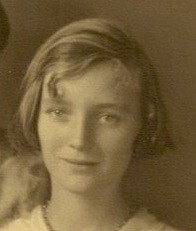
Barbara Hall. She carried that winsome look her entire life. Santa Barbara California 1931
Both my parents told me that when the were in the depression they didn’t really know it. No one called it that, It was just hard times and most people got by as best they could. They said ordinary people, which they were, took care of their money. Savings banks were a pretty new concept and most people didn’t use them anyway even if they had cash to spare. Because my dad was a farmer and dairyman they grew and made things people needed and saw as necessities. They were lucky in that way.
In the rest of the country one in four people were out of a job, over five thousand banks across the country closed forever taking peoples life saving with them, suicides increased by 30% and there were more than two million people homeless. Thirteen billion dollars of the American economy had absolutely evaporated in 1929 with the stock market crash. No one knew that the recovery would take a decade and with help from Adolf Hitler and the fascists governments of Europe.
Mom knew how to run a sewing machine and read patterns so she made her own clothes. So did her sister. Bob, her brother couldn’t sew but more than adequately filled the role of general all around pest which they both said he was pretty good at. They owned a car, which was a little bit of luxury but was necessary for Bruce to get to work. Mostly the kids walked to school, downtown or to shop. The Santa Barbara street railway had closed in 1929 killed off by car ownership but it wasn’t a large town, just 33 thousand in 1930 and especially for kids Shanks Mare got them around just fine. The most luxurious thing they owned was a radio. Radios were a new phenomenon that “Do you own a radio?” was a question on the 1930 census. The Hall’s said they did.
In addition to the music, news, and sports programming that present-day listeners are familiar with, radio during this period included scripted dramas, action-adventure series such as The Lone Ranger, science fiction shows such as Flash Gordon, soap operas, comedies, and live reads of movie scripts. Major film stars including Orson Welles got their start in radio Welles became a household name in the wake of the infamous panic sparked by his 1938 broadcast of The War of the Worlds. Both my parents said he didn’t really fool anybody.
Music filled many hours of programming, singers of all kinds, radio orchestras played popular music and symphonies. Popular 1930s radio shows included dramas and comedies like The Shadow, Little Orphan Annie, and Fibber McGee and Molly, variety and music shows like The Chase and Sanborn Hour and Kraft Music Hall, and children’s programs such as The Adventures of Superman. Radio was a booming entertainment medium during the decade.
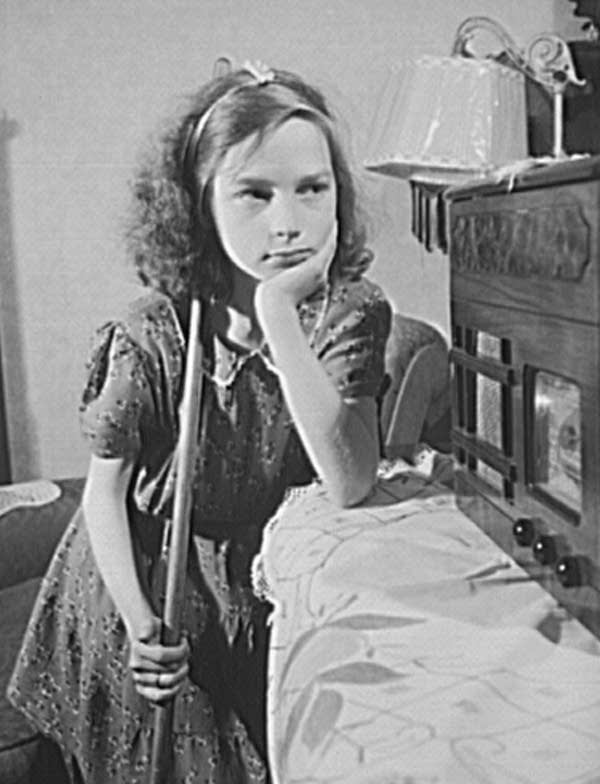
Taking a break to listen.
The future of the Hall family wasn’t all that rosy though. Grandpa had a good job near the top of the earnings curve but life in oil was still tenuous. Crude oil price were through the floor. Some independant companies were dumping oil on the ground. It cost more to pump it than it was worth. New exploratory wells were at a standstill. If there is no hope of profit, don’t invest.
Signal had made up it’s mind that the only hope for the company now that their sales of gasoline to the big producers had been cut off was to plow ahead with the Elwood field hoping to strike enough crude to at least break even so that a hoped for upturn would still find the company afloat.
Like pirates fleeing the law, they pressed on, mortgaging what they owned, makeing frantic rounds of private investors and sending a steady stream of executives to what banks were still in business hoping to find at least a dribble of cash. They began selling their crude at a loss. It was an enormous bet on the company and Sam Mosher’s “Varsity Team” of engineers, superintendents and drillers to innovate, cut the fat and and walk the knife edge of safety to survive another day.
As fast as the piles for the piers at Hydrocarbon gulch were driven, derricks were thrown up, spudded in and the turntables began to whirl. Sometimes the drillers worked over parts of the pier that had almost no planking such was the rush. They wasted no time on guardrails. If you fell, it was in the water if you were lucky and you would simply be fished out. “Joining the Birds” was how they put it.”
From the small field in Maricopa, Chief Engineer R W Heath organized the teardown and loading of the refinery and processing plant which was moved by truck to Tecolote canyon where it was reassembled in just eighteen days. Eighteen, think of that, all moved by truck. There was no Hwy 166 in those days, it all came by 41 and down the Cuesta Grade in tired oil field trucks whose brakes were always suspect. That kind of job that could not be done today. Everyone who worked on the crew did whatever job was required. There was no specialization, if you could turn a wrench, you did. If sweat and grit could move tanks and towers it was done. In it’s early days Signal was like a team working to a common goal. A Varsity Team Sam Mosher liked to call it. Grandpa was one.
Signal had one toe over the line into bankruptcy. If they didn’t find a well which produced marketable quantities of crude they would be unable to meet their contracts and would be forced into receivership. Working overtime to keep the comany in business was the source of heart attacks. If the company failed no one had anywhere to turn. No jobs were available anywhere in oil. Mosher had nowhere to go except to work every day and trying to dream up a way out while sleeping.
Appleford number two did not bring in a heavy enough flow to be profitable. The head field engineer Walt Greenfield was sure that there was plenty of oil just a little farther offshore and said if he was able to whipstock a well he knew he could find it. Whipstocking used a heavy iron device shaped like a shoehorn that when lowered into the drill casing at about a hundred feet could guide the drill bit and its pipe in a lateral direction. They would be able to send the drill spinning out below the sea bed ahead of the pier into deeper water offshore. The problem for the front office is that the cost was thought prohibitive, as much as $35,000 instead of a typical $25,000 for a vertical hole. Management slammed the hammer down and said no, too expensive.
Bruce was a master of the Whipstock and drill bits were moving in all directions underground just like worms in the compost. Signal engineers believed that there was an ever larger pool just a little bit farther from shore. They believed that if they could just go a little bit farther out there was a fortune there for sure. They just had to find it.

The pile driver at work, Mahoney’s pier, 1930.
The family was pretty settled in those two years, Grandpa had steady work. The kids who were about to be teenagers and were happy in school, one of the few times where they stayed long enough make friends. Santa Barbara city was at it’s finest. Because of the generational wealth which was mostly depression proof stores stayed open, the streets were clean and safe. What was euphemistically called Riff Raff was quickly showed the way out of town.
Any minorities persevered in the face of direct and indirect discrimination. People who served in wealthy homes or worked the many fashionable hotels were allowed north to work but not to live.
The descendants of the original Spanish/Mexican and Barbareno Chumash were pushed down into the lower eastside south of Cabrillo street and east of State. Over the middle part of the twentieth century discrimination concentrated the non-white population into the area of temporary shacks, cheap houses** and a service area that held the laundries, shoe repair shops, blacksmiths and auto repair garages. In the depression there was a literal line at Cabrillo Street where people who dwelled in the lower east where most definitely not encouraged to cross.The Eastside neighborhood, was for the marginalized racial and ethnic minorities.
In an interesting twist the school my mother attended was fully integrated though it was outside those neighborhoods entirely.
Born at the end of the 19th century my grandparent’s had that sort of mild racist mindset common at the time. On a simple scale they felt that somehow they were better than the marginalized. In her old age, my grandmother occasionally referred to African Americans as “Coons” which set my teeth on edge. The thing about it was that she had no evil intent. She might have been just referring to the fact that African Americans were undereducated and had less opportunity or lived in poorer neighborhoods. It seemed to be just as if she was describing any object of note. It certainly goes to the complexity of experience. It would be decades before African Americans or Hispanics started showing up in the oilfields. In their married life that had lived in more than one “Sundowner” town.***
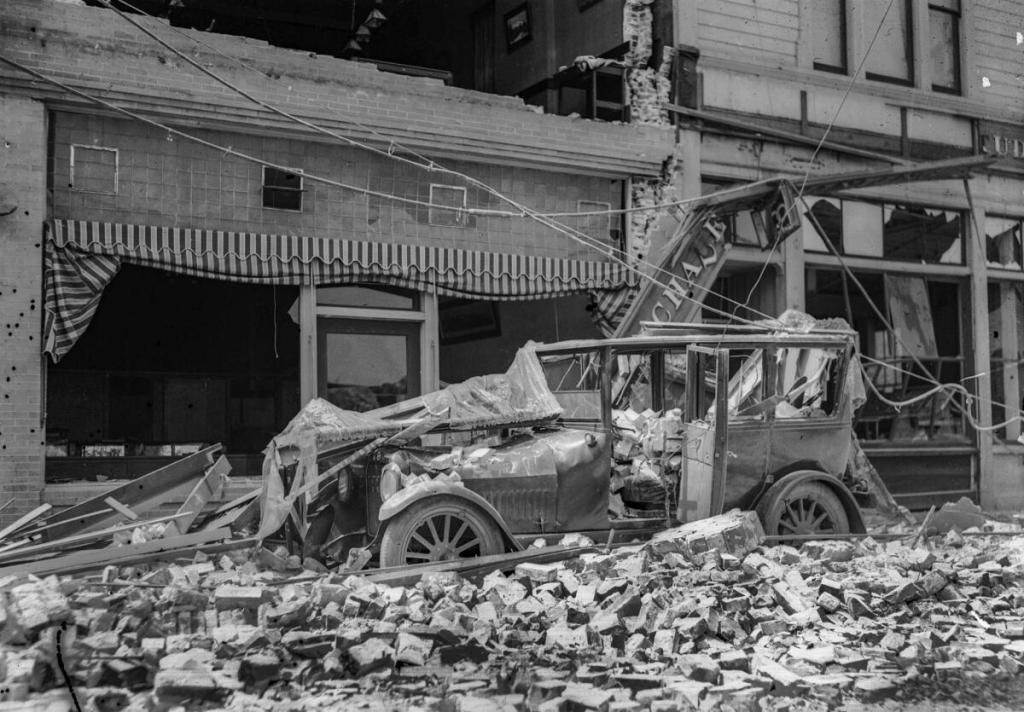
State street, Santa Barbara, California June 29th, 1925. Calisphere
In a fortunate piece of timing after the devastating earthquake of 1925 it was decided to rebuild the city in a quasi-California Mission Style. Helen Hunt Jackson’s novel Ramona written in the late nineteenth century had kindled and polished a romantic version of old California. Though the novel became popular and did, for some, shine a light on injustices toward Indigenous peoples, the fact remains that the novel, rather than initiating a movement of change, romanticized a tragic story where the ones who lost the most were those of Indigenous descent. The largest impact the novel had was in tourism—creating a road map of California that the characters traveled, thus making these locations popular and lucrative. The Rancho life has endured until today as a visible symbol of old California which never truly existed. The fantasy, the connection between the novel Ramona and Lummis’s Sunset Magazine is through tourism: the book became so popular it inspired a wave of travel in Southern California, which Sunset Magazine later helped promote and document. Focusing on the region’s “Old California” romantic image led to design requirements for rebuilding the downtown. Santa Barbara remade itself into a popular vision and because the country was postwar prosperous it became the best example of a Hollywood style fantasy of any California city.
Construction of the nearly destroyed Mission had been completed just two years before my mothers family moved there. The harbor was completed in 1929 and was family inaugurated the following year when my Aunt Mariel pushed my mother off the breakwater onto the boulders below and knocked out her front teeth. Never found they are still there as a sort of family talisman.
As a child I was fascinated that she could detach her bridge, take out her teeth which she scrubbed in the kitchen sink. I knew of no other mother who could do such a marvelous thing. Such are the connections that make a life I suppose.
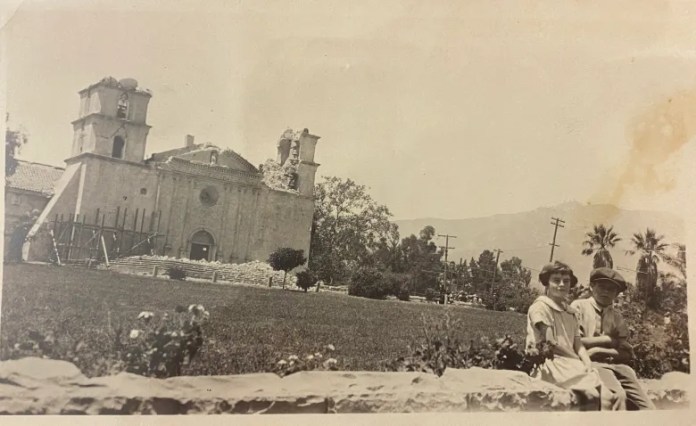
Mission Santa Barbara 1925 after the quake.
The company could at least make payroll and service all it’s notes. Sam was busy looking around for more possibilities. He found some on Signal Hill.
The driller’s had no choice but to wait until things became absolutely desperate. Holding on by the skin of his teeth, Mosher operated a grand total of eighteen wells in the Los Angeles basin, the Midway-Sunset in the southern San Jaoquin and the Elwood field Mosher decided to slow exploration in Ellwood and buy more leases in and around Long Beach. So in late 1931 the Halls rolled up the carpets and trekked south.
Chapter 17 Next:. A year of ups and downs with a major surprise
NOTES
*Leopoldo Antonio Carrillo August 6, 1880 – September 10, 1961) was an American actor, vaudevillian, political cartoonist, and conservationist. He was notable for playing Pancho in the television series The Cisco Kid (1950–1956) and in several films. His signature line was “Cisco, lets went.” His character has since been memorialized and the catch phrase Lets Went” taken its place as a bit of California iconography. We will meet him again later in the story.

**My oldest son rented a studio apartment in an old house which had been divided into apartments in the old eastside neighborhood. This was when he was working in management at a beachside hotel in the early 2000s. Rent was nine hundred a months which was a very substantial sum for a bedroom that had a toilet in it. The house should have been condemned long ago but ghettos are not torn down in one night.
***A sundown town was an all-white community that intentionally excluded people of color, typically African Americans, using discriminatory laws, harassment, threats, or violence. The term comes from signs posted at town borders that warned non-white people to leave before sundown or face consequences. Many California oilfield towns had active KKK chapters until after WWII and later. My grandparents would have been familiar with the term and life in them.
Michael Shannon writes and lives in Arroyo Grande California. He tells these stories so his children will know where they came from.
 atthetable2015