NAQT CHAPTER SIX

CHAPTER SIX

Headed southwest from Hawaii the crewman of the Spence began arranging storage for the supplies and gear they had brought aboard at Pearl. During the Naval build up in the Pacific the initial push was for warships at the expense of the ships which supplied logistics. Tankers, repair and supply ships were being added to the fleet as fast as they could be built, but in 1943 there weren’t sufficient numbers available yet. The war in Europe took precedence over the Pacific. Fighting in North Africa had just concluded in May and the buildup for the invasion of Sicily, which was to begin in July and then followed immediately by the invasion of Italy in September. Meanwhile planning for Normandy which was to be in June of 1944 went ahead. All these operations required an enormous quantity of shipping which wouldn’t be available to the Pacific fleet for some time yet.

Cutting corners, scrimping on supply were to be the watchwords on the Spence. Each department went about checking and rechecking what they had aboard. The greatest difficulties faced by the Navy in the Pacific and the least understood at home were the distances involved. You could drop nearly three Atlantic Oceans into the Pacific. Distances were vast. Shipping between continental Nova Scotia and Ireland was less than 2,000 miles. San Francisco to Honolulu alone was over 2,300 and if you continued eastward more than 10,000 miles to Shanghai, China. Escorting the convoy, Spence expected to travel for over three weeks to get to the Solomon Islands. Destroyers are amongst the fastest ships in the Navy but in a convoy they must travel with the slowest ships. There would be plenty of time to make sure everything was just right.

It was a terrific problem for logistics to keep the fleet supplied with the thousand and one things over and beyond food, fuel and ammunition. “Want of a nail,” Ben Franklin’s Old Saw is an absolute law for a fleet at sea. The Spence needed everything you find in your home, everything you need at the office and everything you need at work. She had watchmakers, Blacksmiths, boilermakers and laundrymen, and tailors, cooks and bakers. She carried machine-tool operators, draftsmen and dentists, men who could repair a typewriter and other men who could rebuild a steam turbine and metal-smiths and a master diver. She had gunners, torpedo men, yeoman, radiomen, signalmen and quartermasters. She carried a master machinist and firemen. All the seamen needed to operate the ship were also aboard. And each man carried the tools of his trade. The signalman needs needles and thread and a sewing machine to repair signal flags soon to be whipped to pieces by the wind. The machinist has to have every possible wrench, gasket, bolt, screw and spare parts for the main engines, pumps, fans and all the auxiliary machinery. There is no handy store just around the corner.

The boatswain mates, John Esler, Samuel “Sonny” Rosen and John Saxon ran a school for seamen. Sailors on the deck crew were divided into three watches and it was the responsibility of the Bosuns to school them up in order to maintain the ship. The new kids that had come aboard at Pearl were from all over the country and if one had any experience working a ship it would have been a surprise. A fisherman’s kid would have been “encouraged” to unlearn everything he knew about seamanship. There was the Navy way and none other.

There are no sit down classes on shipboard. It’s all learned on the fly and under pressure. A good bosun owns the ship and you had better figure that out right away. A 376 foot long machine at sea takes a great deal of punishment. Salt water corrosion, the constant working of the hull in a seaway mean that there is never enough time to do all the task necessary to keep everything in good order.

Chipping paint every day, decks, bulkheads, and every part of the superstructure that needs maintenance. If a man is a slacker, well he can crawl between the lowest deck and the ships frame and chip in the ‘tween spaces, laying on his back and scraping rust in the near darkness. Is he claustrophobic, no one cares, he has no choice. Perhaps he will change his tune after that. At Pearl Harbor and the first sea battles of the war they discovered that layers and layers of accumulated paint caused catastrophic fires so now ships were constantly stripped and repainted to reduce that possibility. All the porthole curtains, officers rugs and upholstered chairs were left at Pearl or thrown over the side. Absolutely everything that could burn and could be spared was gotten rid off. If your ship is burning you have nowhere to go but over the side. Every sailor in the Navy goes to firefighting school and practices constantly.

The kid from the midwest is likely to know what a rope is. The problem; there is no rope on a ship. There are lines, cables, hawsers. stays, breast lines, spring lines but no ropes and woe betide the swab that calls them that. You have to know the difference between a hitch and a bend or how to backsplice. Know where the bitter end is and how to find the Pelican Hook.

Better learn in a hurry too. Bosun’s are supposed to be tough. They don’t stand for any nonsense. John Saxon was one of eight children born to parents who had immigrated from Slovakia in 1913. His father was a laborer and spoke Slovak and just a smattering of english. His mother stayed at home and raised kids. His brother John was in the Navy and his younger brother worked in the Merchant Marine as an Able Seaman. At five eight, 170 pounds, when his grey eyes narrowed, you’d better set to with a will.

Those assigned to guns learned how to dismantle, clean, oil and reassemble their charges. Gunners Mate Frank Baeder came from central Pennsylvania, the descendants of German immigrants who arrived in America just before the revolution. As a Gunners Mate his primary purpose was to see that his men could fix any part of the guns they were assigned. They must be able to operate them at lightening speed. As they headed west the gunners practiced everyday, firing at sleds towed by other ships or sleeves towed by the catapult planes from cruisers and battleships.

Muriel Owens, was born just a year before Don Polhemus. He came west from Lawrence, Missouri with his parents Arlye and Golden “Goldie” Owens during the dust bowl years. His parents were fruit pickers but managed to get all four of their kids through high school in Anaheim. His brother Royce had been lost when the Jacob Jones DD-130 was torpedoed off the coast of New Jersey in 1942. Only 12 sailors survived. Muriels brother-in-law, John Ladd was also aboard Spence. His little brother Holly was stationed on the USS Kaskaskia AO-27, a fleet oiler and would have occasion to fuel the Spence during combat operations in 1944. The Owens family displayed four stars in their front window, one Gold and three Blue.
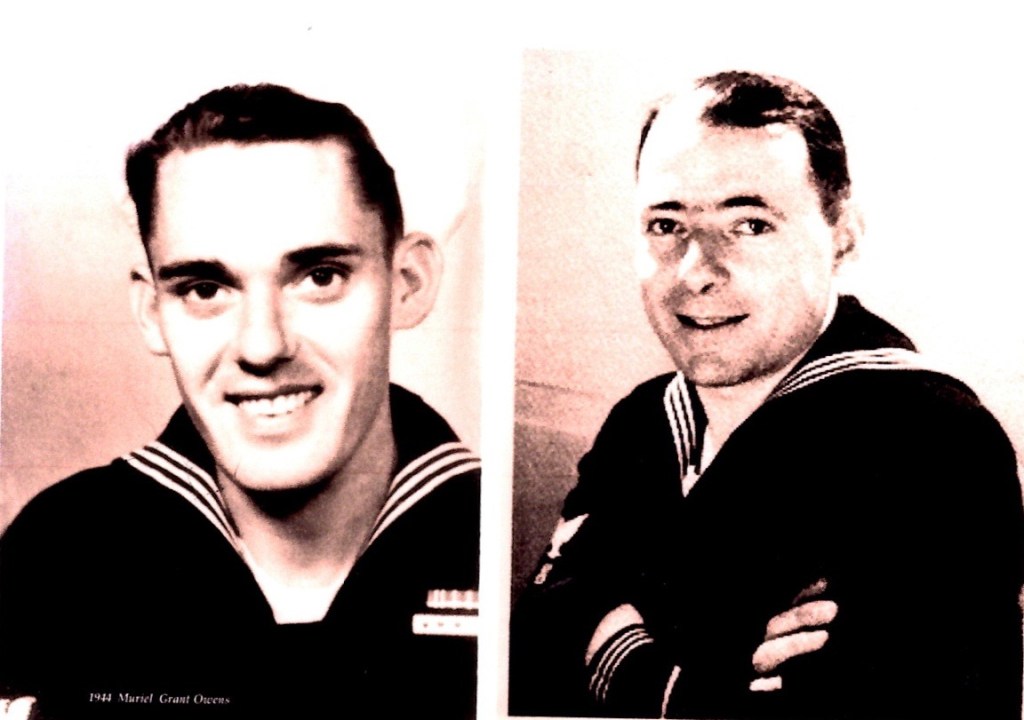
Muriel Gordon Owens SM-2C and Samuel “Sonny” Rosen BM-1C

Whether his mother taught him to sew or not, Muriel could make a sewing machine hum now. He was an expert at morse code, could read signal flags, send wig wag and operate the blinker lights with lightning speed. In enemy waters, radio communications were kept to an absolute minimum as the enemy was likely listening. Visual replaced TBS, “Talk Between Ships” with few exceptions.

With the loss of the Philippines, the Dutch East Indies and Singapore there was now not a single large scale naval base between Pearl Harbor and Colombo, Sri Lanka or Bombay, India. This created a task of gigantic magnitude for the Service Force of the Pacific Fleet. The Service Force had to supply the needles, thread, bolts, typewriters and paper for the fighting units. All the imponderable paraphernalia of sea warfare was carried across the vast Pacific by navy and merchant freighters, tankers and repair ships.
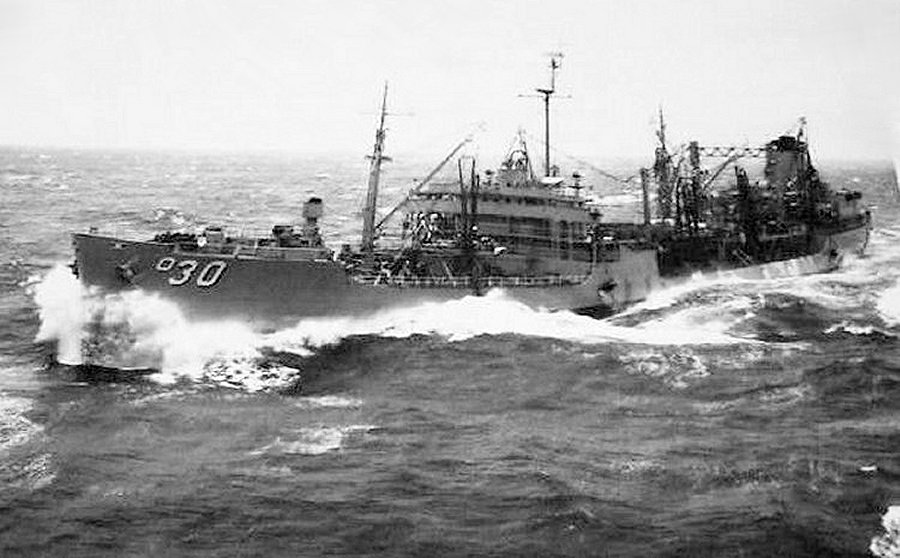
USS Kaskaskia US Navy Archives Photo

As she cut westward through the waters of the Pacific, each turn of her screws shortened the time before she would have to nestle up to the big ships and take on fuel. Replenishments or Reps are a friendly affair. Talk between ships in good weather can be done without a megaphone and on deck crew can talk to their counterparts aboard the bigger vessel. The bigger ships sends over little luxuries like fresh bread, ice cream, magazines, books and soft drinks as the smaller destroyer bounces and tosses alongside. Occasionally the ship’s band would serenade the Small Boys churning nearby.
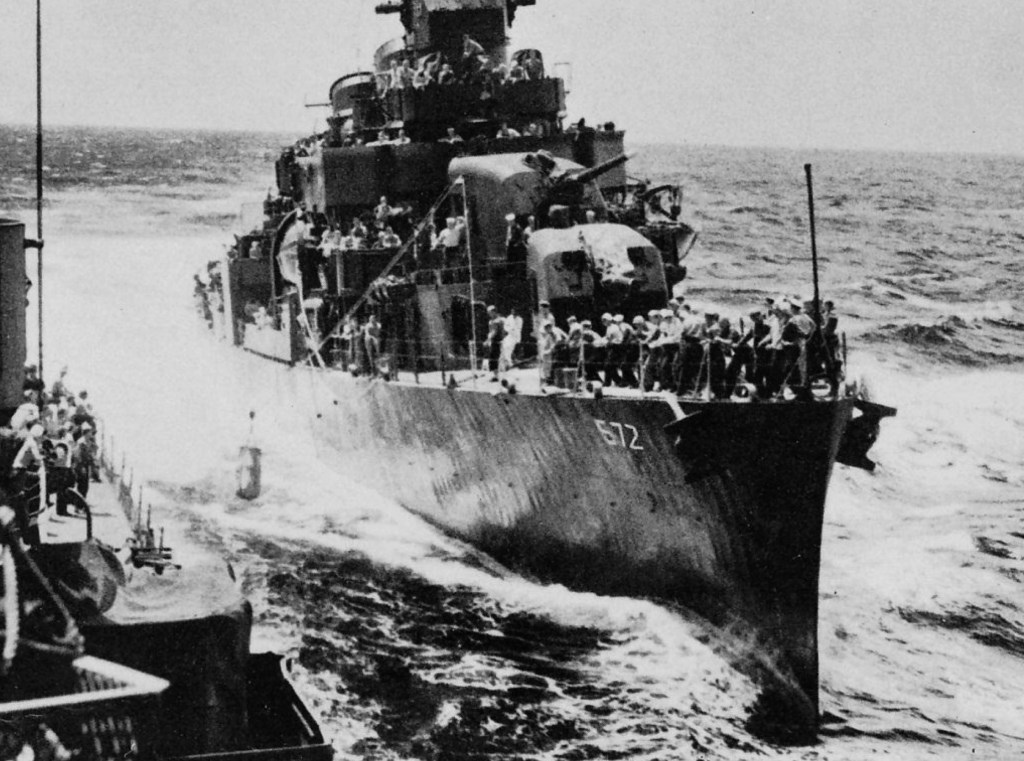
Destroyer USS Dyson DD-572 High-Lining

Captain Henry Jacques Armstrong, Naval Academy 1927 was from Salt Lake City. He had served in a variety of ships in the years before taking command of the Spence in 1942. An experienced ship handler he loved his little ship and liked to handle her like a hot rod. When approaching a carrier or tanker to fuel, he would run up to the larger ship at 30 knots, nearly top speed and then “Crash Back” by reversing the screws, the same as slamming on the brakes, slowing the ship to the same speed as the larger ship at the last moment. His crew loved it. The dashing little ships gave fits to the the larger ship’s captains, sometimes causing a little consternation on their bridges. Captain shouting through the megaphones to “Get that damn ship away from the side.” Perhaps a little jealousy too, from the officers on the plodding giants.

Three hundred twenty nine men on the Spence may seem excessive but the needs of a wartime ship are legion. Like any other organization destroyers are divided into departments. Each department is responsible for certain duties applied to the running of the ship. Most visible, of course, is the first division which is responsible for the upkeep and operation of all things topside. Chipping and painting, tying up and letting go when entering or living an anchorage, fueling both at anchor and while underway and the general physical plant above deck. Deck division sailors are also used by the other ships departments as needed. First Division provided the majority of the bridge watch standers and the gun crews. The Gunnery Officer – Or “Gun Boss” was responsible for operation and maintenance of all of the ship’s armament plus all matters relating to deck seamanship.
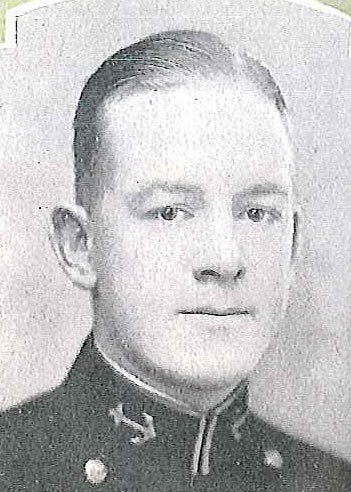
Captain Armstrong US Navy Archives photo

The Boatswain’s Mates (BM) was generally considered to be the senior enlisted rating in the navy, a tradition probably handed down from the days of sail. The Chief Boatswain’s Mate (BMC) was expected to be the most capable seaman on board. Often he was assigned additional duties as Chief Master at Arms (The ship’s head policeman). The other rated BMs were generally assigned individual sections of the ship to maintain. This was a very prestigious assignment and these Petty Officers generally lorded it over the junior non-rated sailors in the division. Sometimes lovingly referred to as “Boats,” the Chief Bosun was a real sailor man. Boats was also involved, under the purview of the Chief Executive Officer, Frank Van Dyke Andrews out of Coronado, California, in the planning, scheduling and assigning of work to the deck crew on ship. In wartime the Navy takes almost anybody who can stand up and the deck crew would have had it’s share of undereducated scoundrels. Though there is a formal process for issuing discipline the Boatswain’s mates had to be handy with their fists. Minor infractions could and were handled with a rough sort of discipline that would have been recognized in Admiral Nelson’s Navy. Regardless, the deck crew was proud of their standing in the navy and took great pride in it. Referred to as “Deck Apes” by other sailors they took a perverse pride in their toughness and the name. Boatswain Mates were superb at “Make Do,” they could find it, fix it or make it when they had to.

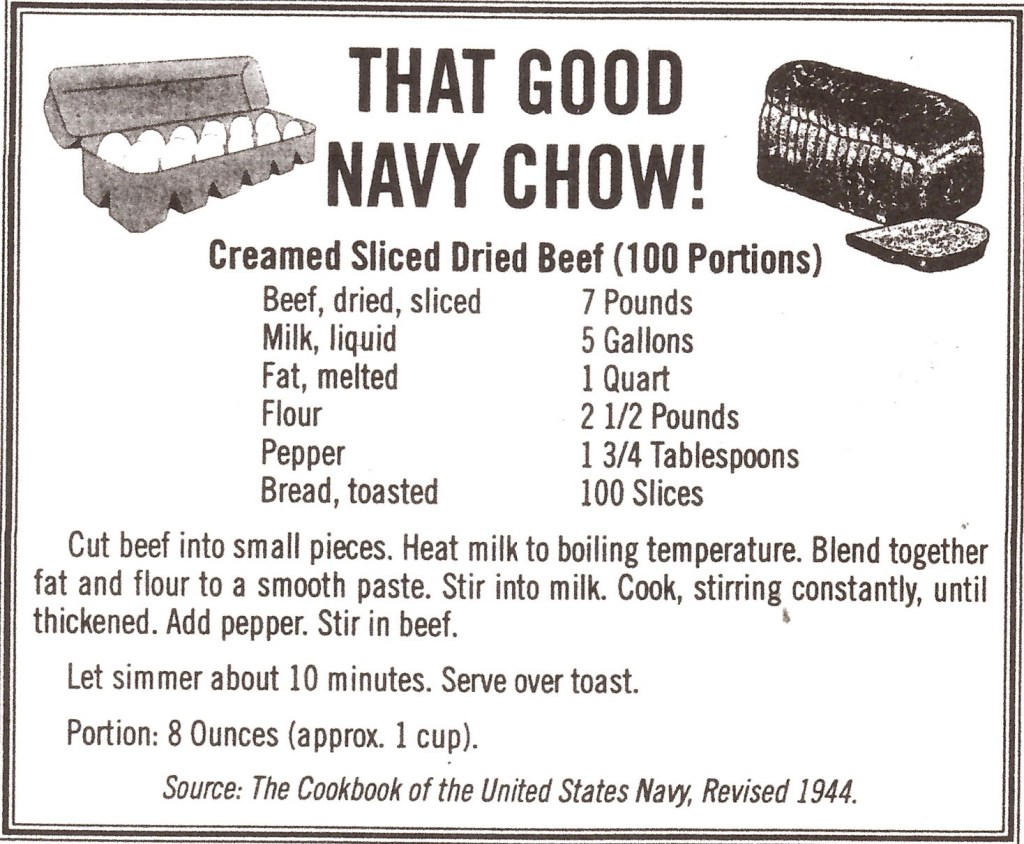
Don Polhemus’s department was Supply. His officer was Lieutenant (JG) Alphonso S “Al” Krauchunas, twenty four, from Kalamazoo, Michigan. He was born in a  Wisconsin farmhouse to Lithuanian immigrant parents and like most of Spence’s crew never saw the ocean before coming aboard in April 1944. A supply and disbursement officer, he was in charge of “S Division” which was the pride and joy of her crew because of the excellent meals provided them daily by a dedicated group of cooks and bakers. Lest you imagine a gleaming commodious galley, think again. So small and cramped that the cooks literally climbed over each other and hotter than the shades of Hades, working 24 hour a day in three watches, they provided meals for 329 men three times a day plus plate of sandwiches for watchstanders in the long hours of the night. Each meal took in excess of 2 hours to serve with sailors standing in long lines outside the galley. Hot blistering sun, boondockers burning the soles of your feet and Dixie Cup turned inside out to protect the ears it better be chow worth waiting for. Not every ship was as lucky as Spence. It took a supply department who worked hard, used a great deal of ingenuity in procuring food supplies and perhaps some sly Cumshaw on the side.
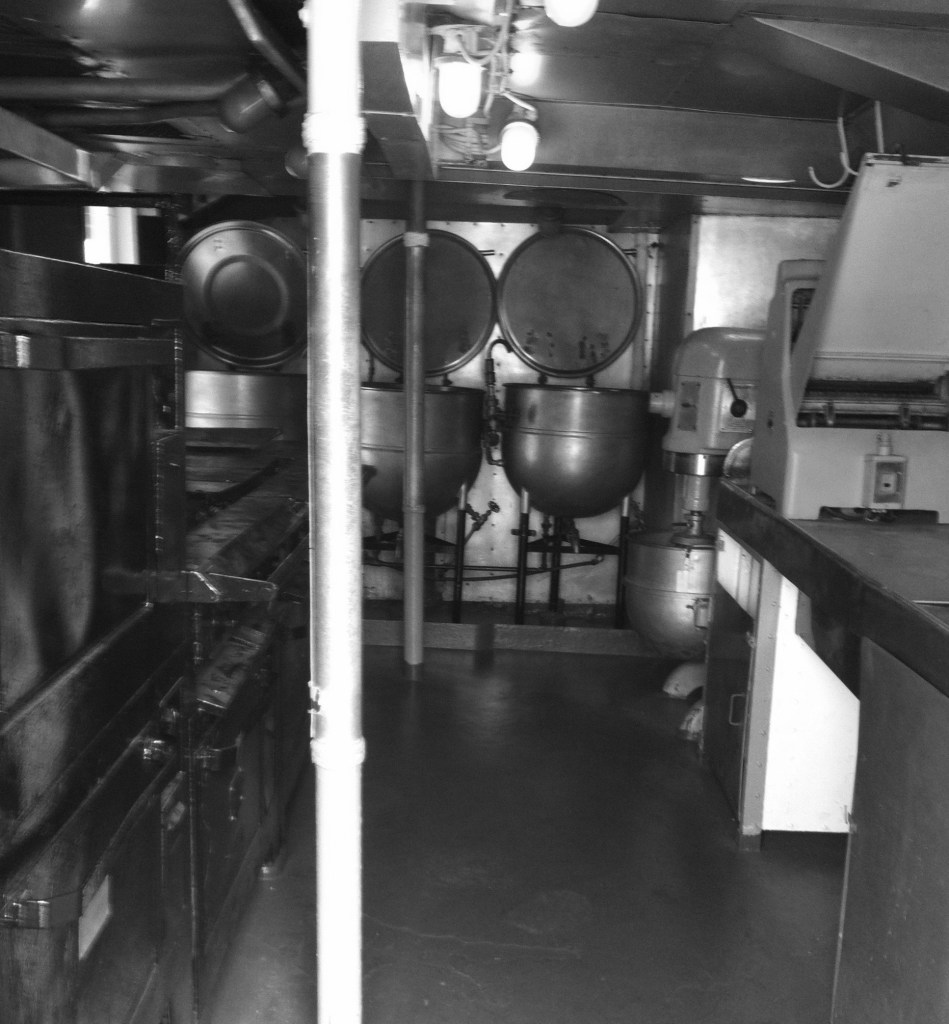
The ships galley with Hobart ovens and Wolf ranges, three large kettles, mixer and bread slicer. USS Kidd museum photo

The Lieutenant was also the paymaster. These duties made him a popular man with the crew and he was known as Lieutenant “Pay” when he was out of earshot. All hands learned that the husky young officer at five foot ten and 200 pounds was a stalwart shipmate, ever ready to lend a hand when needed.

Alfonso Krauchunas was a graduate of Western Michigan College where he starred as a hard hitting, slick fielding shortstop. He was signed by the Chicago White Sox and was playing in the minors when the war broke out. He enlisted in the Navy as an enlisted man before being commissioned as an ensign in the supply corps. He was a physical education major in college and was a strong swimmer. This skill was important for he dove overboard twice in the Marianas campaign and swam 80 to 100 years to save downed pilots who were floundering and about to drown. The second time, riflemen commanded by Chief Bosun John Esler fired on and fought off several sharks headed for the swimmers.

The officers had a tiny pantry adjoining the wardroom and a section of the main galley is assigned for their use. The cooking, serving and quarters cleaning is done by the stewards department who have no other duties except at general quarters where every man in the crew has a battle station. The mess men on the Spence were all black. The Filipino stewards of earlier days were no longer enlisted in the Navy in 1943 and the other traditional stewards, the Chamorro’s of Guam were unable to serve because Guam was now held by the Japanese. Their battle stations on the Spence were in the lower handling rooms and magazines. They worked at sending powder and shell up the hoists to the 5inch/38 gun turrets. They passed the ammunition just as efficiently as they did the potatoes in the wardroom.

Rosevelt Copeland was one of those stewards. Rosevelt was from Mansfield, Louisiana. His mother Fannie had to sign for him in order to join the service, being too young to volunteer on his own. He had just turned sixteen so they lied about his age. Rosevelt was from one of the poorest parishes in Louisiana, De Soto. Rosevelt’s father had been as a cook in WWI and had served in France. While Rosevelt was a little kid he cooked for the local hospital. The hospital was a converted plantation house of two story and an imposing building when Rosevelt was growing up. In the tiny town with unpaved streets, he lived Jim Crow south every day. Sugar Cane was the business and antebellum south was visible all around. There were homes still standing from pre civil war days  such as the famous Shadows on the Teche, a plantation dating to 1834. Wakefield, Belle Grove and the Lady of the Lake plantations still dominated working life . Each one a constant reminder of his place. By 1940 his father Edgar was gone to Bossier City, no longer around. It’s hard to imagine what his mother thought about signing those papers. His older brother was married when the war started and had only completed the third grade and of his two sisters, Maggie was nearly illiterate and Mattie had died before her first birthday. With a population over 80% black the Navy must have to seem to the young man a sort of salvation. Perhaps the only way out. At seventeen he was the youngest member of the crew.

Fred Cooper was the ranking Steward, wearing a 3rd class crow.*. He had signed up in Shreveport Louisiana in November of 1942 with Rosevelt Copeland and both had come aboard Spence when she was commissioned. Fred had lived with his widowed mother Gurtha in a section called Calumet heights south of downtown. Known as South Chicago, the area had been the destination for Blacks migrating from the mid-south all during the depression,. They were fleeing the grinding poverty and lack of any opportunity to live a better life. Fred’s mother brought him up from Arkansas in 1932 and by 1940 was living in a rented house, taking in lodgers to help make ends meet. Her principle lodger in those days was Judge Wilkinson, a railroad porter. He worked the Chicago and Northwestern RR. A Porter was considered to be one of the best jobs a Black man could have. In 1940 he worked all 52 weeks and earned a yearly salary of 1,000 dollars which was comparable to a skilled white tradesman. Gurtha earned 300 dollars working as a presser in the retail trade which meant that Fred would have had a fairly comfortable life. Fred had a high school education which was becoming common in the late forties for Black kids. The lodger, Judge was born in Mississippi to a sharecropper family, Andrew Jackson Wilkinson and his wife Alice. Judge had come north in 1932 to work on the Railroads. He and Gurtha both listed themselves as single but were likely living as common law married as she gave her name as Wilkinson on the 1940 census form.

The officers pay for their own food which they buy on shore or from the ship’s general mess. To plan the menus, collect mess bills and keep accounts an officer is elected as the Mess Caterer. He is usually very junior and often a lowly ensign serving his first tour. He sits at the lower end of the mess table at the opposite end from the President of the Mess, the Captain. His term of office is entirely dependent on his own ability and interest. His only job is to see to the state of abdominal contentment of his messmates. Some mess caterers stay in the job for long periods, others are voted out at the end of the month, if the mess bills have taken a sudden and unexplainable rise, if the quality of the food has drooped out of sight , or if the unfortunate caterer has sought to swing the mess toward his own particularly affectations. If a junior officer complains constantly about the food being served he is sure to be voted in next month on the “Lets see what you can do” basis. There was a story going about the Navy about an island boy from Guam whose command of the language was at best imperfect. The first time he was examined for promotion he was asked the first question which is to define the difference between a command and an order. The Navy Training Manual explains it as, in effect, that an order allows for some initiative in how the order is carried out; a command is arbitrary and inclusive. The steward from Guam had his own ideas. “An order,” he said, “is ham and eggs. A command is bring ’em in.” He got his promotion.

On a destroyer the bakeshop is a four by four space. The Bakers can turn out light crusty bread, delicious pies and cake. Unfortunately a design flaw led the baking ovens exhaust up near the bridge. On baking nights, the mid- watch, from midnight to 4 am was as hazardous as the Japanese were to the watch standers on the bridge who had to smell the odors wafting from the ovens exhaust. Many a seaman was laid low by the aroma of baking apple pie. For this savage duty, they were usually allowed into the galley first for breakfast and, just perhaps received a slice of pie with chow. Every ship in the Navy held mid-watch snacks as sacred.

Baker first class Charley Craver cut his teeth working at the Romeo and Juliet Bakery in Miami before going into the navy. The Spence was lucky to have a man of his talents. He was backed up by Bkr 2nd Shelby Ryals from Lowndes, Alabama and Johnny Kaufman, Bkr 3rd. Shelby Ryals had worked for the American Bakery Company in Montgomery, Alabama and likely knew what his rate would be the day he put his employer’s name down on his enlistment papers. Sailors and officers stepped lightly around these men, they knew which side their bread was buttered on.

Two of the ranking petty officers in Krauchuna’s department were Don “Poley” Polhemus and Charley Reed Bean from Moorefield, Hardy County, West Virginia. Charley had a fit name, Bean, for he was one, 6′ 2″ and only 160 pounds he was a string bean. He had the blue eyes and ruddy complexion of his forebears. Moorefield was very small town folded into the corduroy mountains of the Appalachian Plateau west of the Alleghenies. They were almost due west of Washington DC. Only about 100 miles west, Hardy county was not just a world away when he was born but almost a galaxy distant. Situated on the south fork of the Potomac, Moorefield was just a speck, a far, far distant place. Charley was born from pioneer stock who had lived in the same small county for over two hundred years. His parents, Orvan and Essie where good solid Irish stock, the kind of people who persevered. They had little schooling and ran a small bee keeping operation while he worked in the lumber mill. He originally hailed from Snyder Knob and she from Capon Springs, both in Hardy county. Charley, born in 1923, the middle child of three. With the advent of family radios he must have dreamed of a world outside the mountains he was raised in. His was the first generation raised on radio which brought in the world outside the small world of Moorefield.  He finished high school school in 1941 and went to Hagerstown, Maryland to work in the Fairchild Aircraft factory. Fairchild was feverishly building PT-19 trainers for the Navy and Army Air Corps. It was a good job. Training as a machinist, the same as “Poley,” both would have received essential industry deferments but neither wanted to miss out. Charley joined on up, the Navy was for him. Perhaps to see the world or maybe as a way to avoid ground combat or falling out of the sky. Who’s to know, they just did what young men have always done, they got in the fight. War is a very young mans game.

The engineering department was just what it sounds like. The Chief Engineer bears responsibility for operation of the ship’s engineering plant, electrical generation and distribution, auxiliary machinery, and interior communications. A warship is festooned with pipes, cables, ducts and many other systems that allow for the operation of all of it’s systems, any of which could cripple a ship in combat or sea conditions if allowed to fail. If there was ever any doubt about who was responsible for a piece of equipment on the ship, it belonged to the Chief Engineer. He was also responsible for coordination of shipyard overhauls or periods (availabilities) alongside a tender. The operation of the Two separate engine rooms were his direct responsibility. Why two? A Destroyers main defense isn’t necessarily it guns, it’s speed. It takes superb gunnery to hit a ship several miles away when its able to travel 44 miles per hour. Serious damage to a ships engine room, either fore or aft allows the vessel to continue maneuvering. Loss of both engine rooms and the ship becomes a sitting duck. The engine rooms are the spaces where the Snipes work. Engineers were always referred to as “Snipes.” This term originated in the British Navy when a visiting Admiral said that the engine room on a battleship resembled a “snipe marsh”. Jobs in the engine room many. There are throttle men who take the engine room telegraph signals from the bridge and open and close steam valves to slow or speed up the turns the screws make, there are Wipers who do exactly what the name implies, Firemen the jacks of all trades, Boiler Tenders who see to water levels in the boilers, and Machinist Mates who maintain all the machinery in the engine spaces and above decks. If you picture a clean and healthy environment this is not it. It’s extremely noisy and a thin film of oil floats in the air, especially hard on the engine room crew because bathing is only a remote possibility. Above all, it is hellishly hot. In the tropics temperatures routinely exceed 130 degrees even at night.
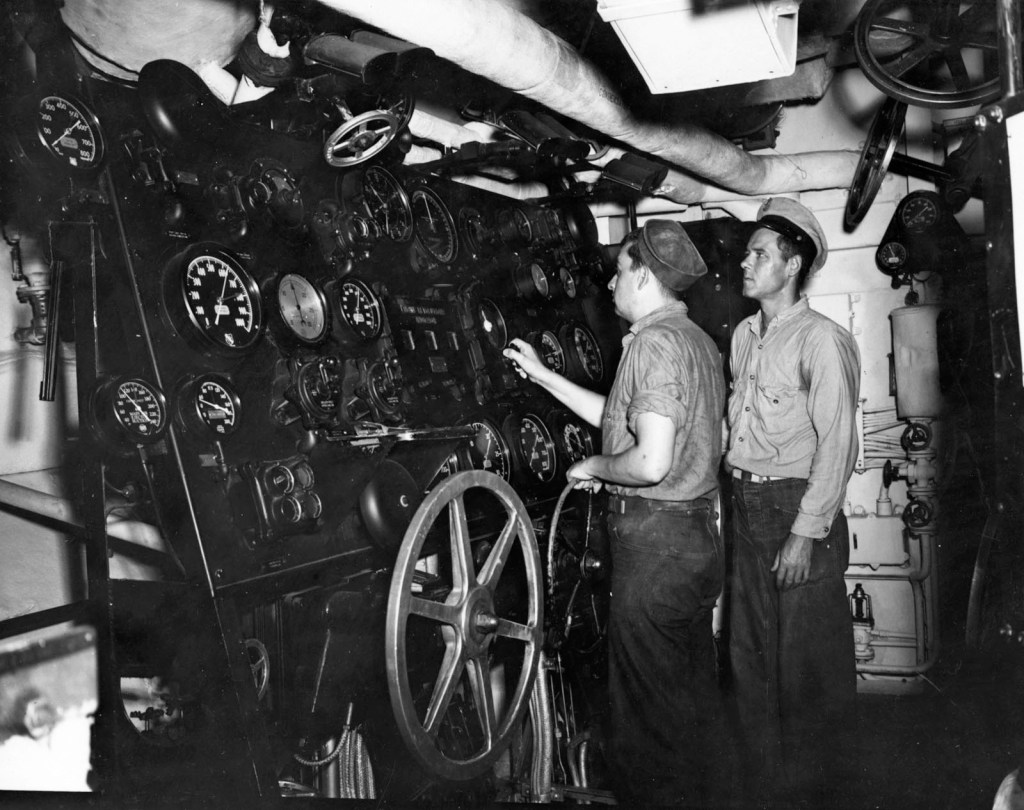
Forward Engineroom Control Panel. US Navy photo

One of the most important men in the engineering department, usually a First Class BT (Boiler Tender) and was  designated as the “Oil King”. He was responsible for all fuel transfer operations plus chemical testing and treatment of the ship’s boiler water. Normally he was a non-watch stander and he was usually provided with at least one full time assistant. All records of boiler water treatment and fuel usage were kept in an office referred to as the “Oil Shack”. The BT rating was considered to have the hottest and dirtiest jobs in the navy. Contrary to what you might think, fuel oil and water are held in numerous tanks throughout a ship and particularly in small narrow ships the contents of thee tanks and the amount they contain have a great deal of importance in keeping the ship in trim. According to the condition of the sea, calm or stormy, the speed at which the ship is traveling and whether or not it is running before a swell, breasting one or sailing parallel to the waves the “Oil King” is primarily responsible for arranging the contents of these tanks in order to maintain stability. The Spence would have held roughly 61 tons of fuel fully loaded or about 188,000 gallons. Steaming up through the slot at 25+ knots she burned about 55,000 gallons every twenty four hours. The “Oil King” needed to balance his load constantly as fuel was burned and be aware that he needed to refuel every 3 or four days depending on conditions. BT-1C Frank Horkey was from Pasadena, Maryland, one of the three children of John and Ada. John Horkey was the son of immigrants from Bohemia and had worked as a stevedore and a carpenter in the shipyards at Maryland Shipbuilding and Drydocks. Young Frank had to quit school after the sixth grade and ended up working at the massive Sparrows Point Bethlehem Steel plant in nearby Dundalk. His brother William worked for the Frank Shenuit Rubber company. Frank was from a solid working class family typical of those that sent their boys to the fleet.

The Oil King had to be very careful in his work. A ship 367 feet long and only 39 wide and top heavy with guns and the superstructure is a very tender ship. She feels every change in wind direction and sea state. A Fletcher in a high speed turn will actually roll her fantail under water and that is in a calm sea. Forty degree rolls are common in almost any sea condition and in heavy weather a top heavy destroyer with insufficient ballast in its fuel oil tanks or seawater pumped into those empty tanks can suffer 70+ degree rolls and even capsize. The constant shifting and ballasting of the ship is an absolute neccesity.

In the tropics where the Pacific Navy fought, daytime temperatures average 80 plus degrees in the summer and cool off to 80 plus degrees in winter. Squalls and rain are an almost daily occurrence, and clear days average only about 6 per month. Rainfall in some areas is as high as 138 inches per year. The few islands with mountains such as Guadalcanal and Kolobangara in the Solomons to which the Spence was bound are relatively dry, averaging around 80 inches. The ocean temperature stays in the low 80’s and 90’s year round.  Now apply these conditions to a steel ship in the days before air conditioning where the only cooling devices were the blowers that attempted to push air around the ship. With few openings topside and full height bulkheads dividing the hull into sections not only was cooling almost nonexistent but just moving around inside the ship was a chore. The only relief was after sunset when the air cooled slightly. If the ship was moving at speed the breeze helped, particularly if there was enough surface chop or a large enough swell that spray came over the bow and wet the deck. Sailors slept on deck whenever they could and it was common to step around sleeping swabs, fully clothed and using life jackets for pillows. These conditions were  the norm when underway or anchored. Just doing your job was difficult under these conditions but the war in combat conditions put many extra and severe demands on crewman. 

NAQT CHAPTER SEVEN

Steaming down towards the southwest, caracoling around the transports and carriers the Spence crossed the line for the first time. In the time honored tradition of seamen everywhere, King Neptune Rex ruler of the Raging Main swung himself over the side bringing with him his Royal Court to initiate all the “Pollywogs” aboard into the mystery’s of the Noble Order of the “Shellback.”

To Be Continued May 27th

* Crow is the naval term for the Eagle pictured on the rank badge that is worn on the upper sleeve of a petty officer. They appear on the badges of third class petty officers all the way up to Chief Petty officer. For example, Boatswain’s Mates, Gunner’s Mates, Torpedoman’s Mates, Signalmen, Quartermasters and the like were ‘right-arm’ rates, and their rating badges were worn on that arm.  Conversely, Radiomen, Yeomen (office personnel), Ship’s Cooks, engine-room personnel . . . and that sort, were ‘left-arm’ rates, and the crows were worn on the left arm. This is no longer the practice. In 1948 all badges of rank were moved to the left shoulder. Deep water sailors hated that. In recent years the specialty insignia has been done away with, so a person can no longer tell which rating a sailor might be. The Navy is about tradition and sailors hate this kind of thing. Ratings are proud of their jobs but decisions come down from the Secretary of the Navy who is a civilian appointee and doesn’t give a damn what the sailors think.

Second Class Corpsman, HM-2nd class

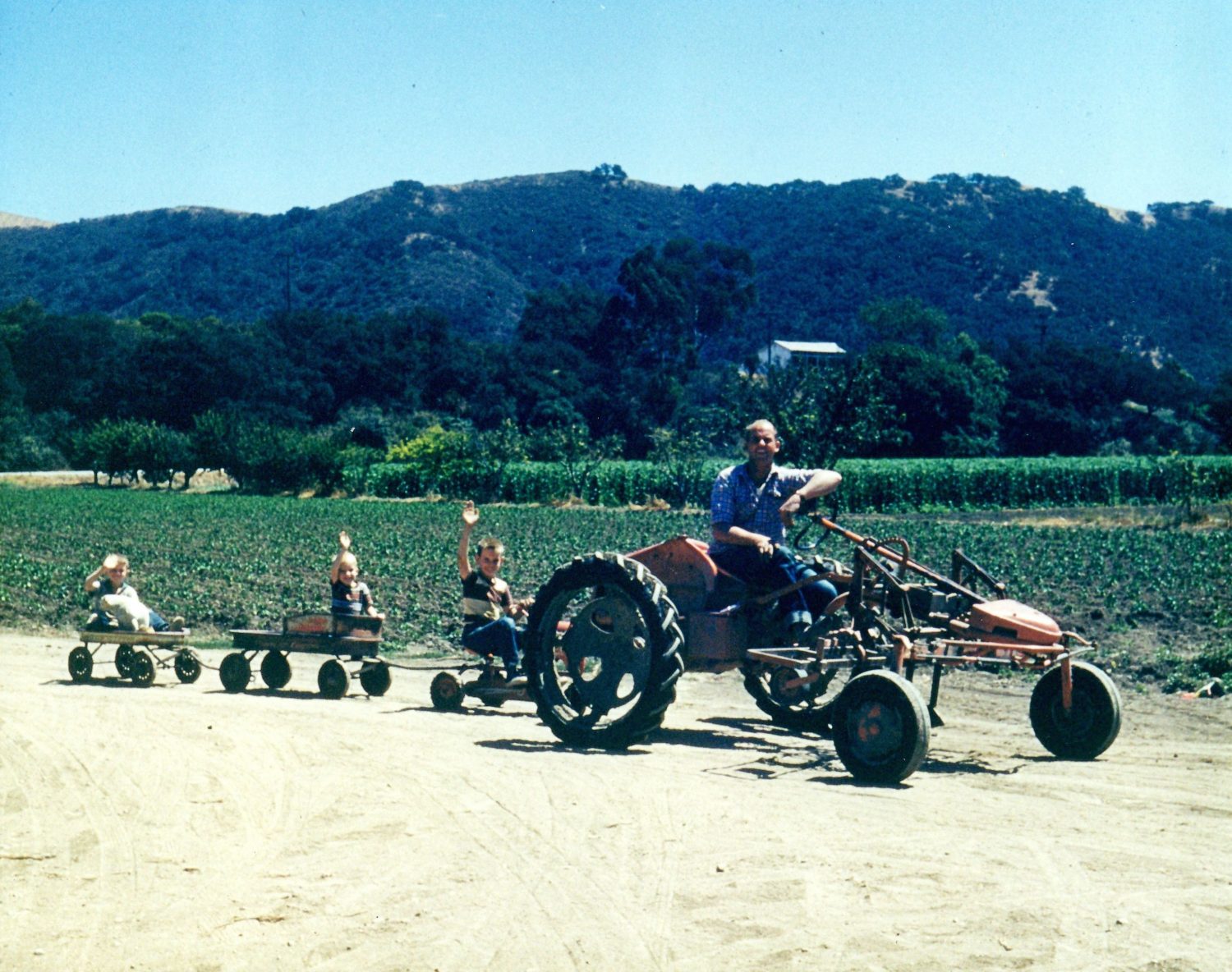
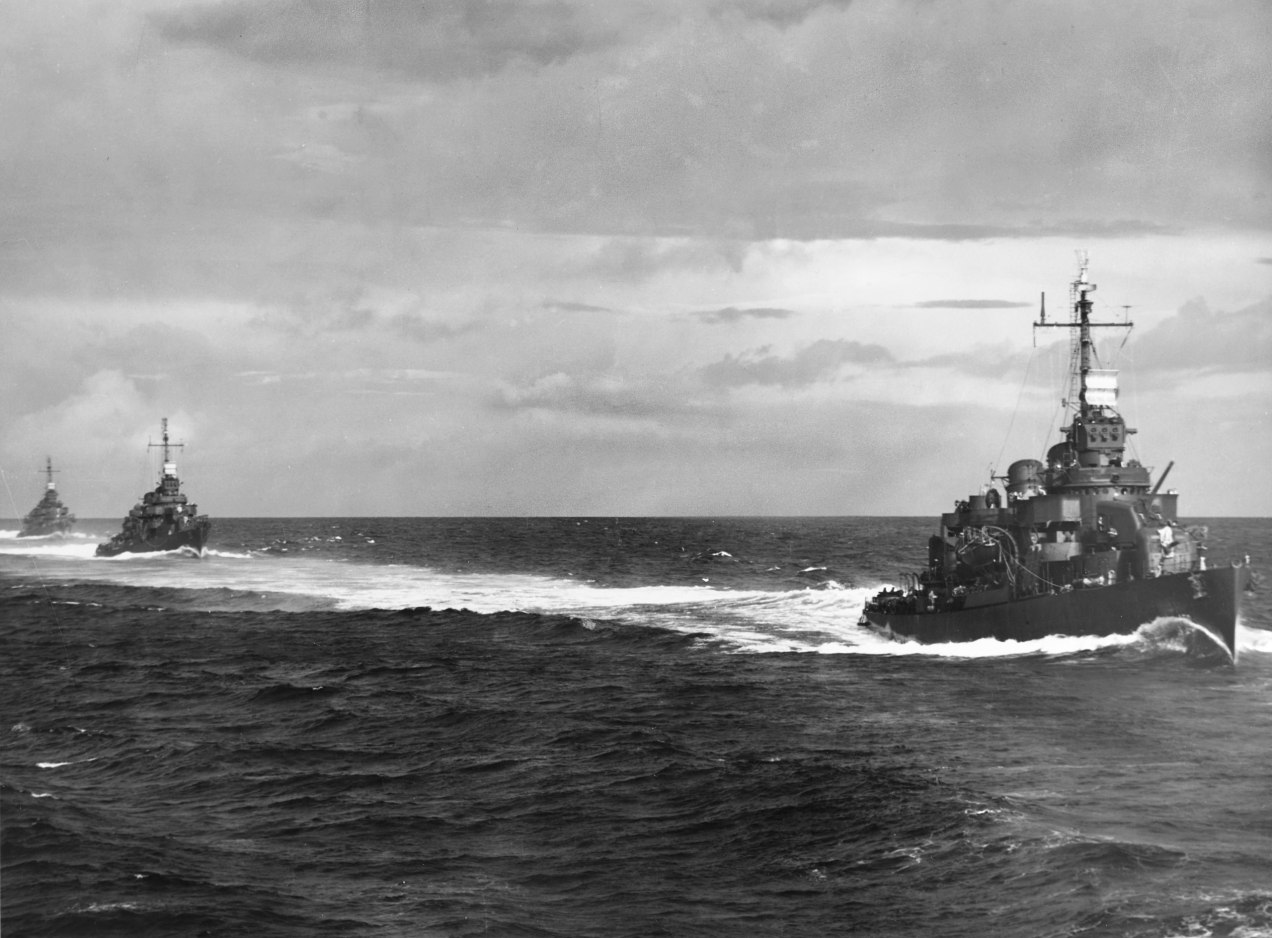
Front-piece: DESRON 23 steaming in WestPac, 1944.

Michael Shannon is a World Citizen, Surfer, Sailor, Teacher, Builder and Story Teller. He lives in Arroyo Grande, California, USA. He writes for his children.
Standard

NAQT CHAPTER FIVE

CHAPTER FIVE

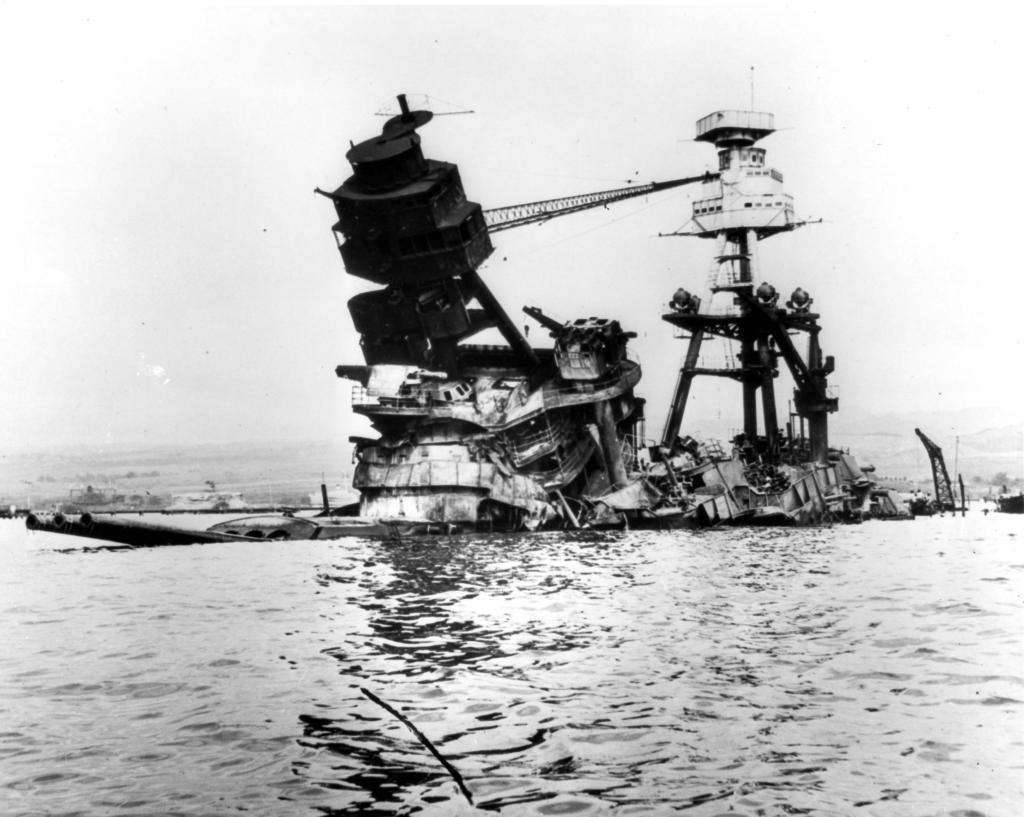
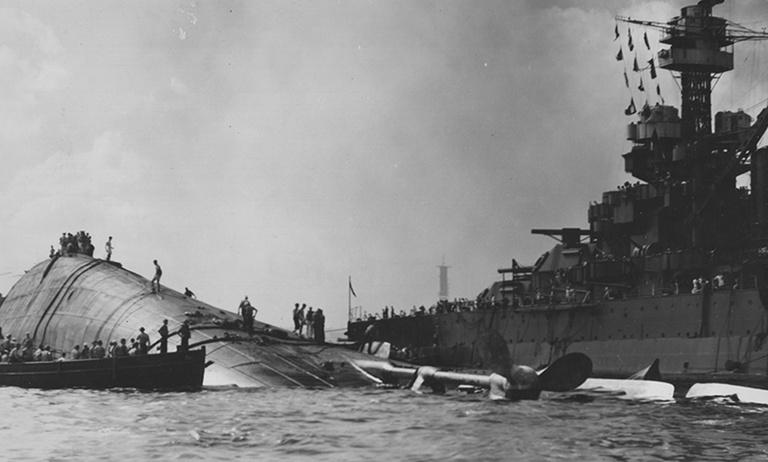
Rounding Oahu, slipping through the Molokai Channel and turning Northwest, she passed Diamond head, Honolulu and came to the entrance of Pearl Harbor. She lay off the entrance until the harbor pilot came aboard and steered them through the minefields, torpedo nets and in towards the Destroyer anchorage in the Middle Loch. As they slid past Ford island the destroyed Arizona, BB-39 stood as mute testimony to the savage attack of December 7th just two years before. Just forward, the massive salvage operation to raise the capsized Oklahoma BB-37 was still underway.* Rounding Ford Island to their designated anchorage they pass the old target ship Utah, BB-31 rolled over and rusting away. Some of it’s crew still entombed inside, forever.

Oklahoma US Navy archives

In 1940, the City and county of Honolulu had a population of just under 180,000. Pearl Harbor and Honolulu were, during the war absolutely jammed packed with servicemen. The Royal Hawaiian hotel on Waikiki Beach was leased by the Navy for the duration of the war for sailors and officers recreation. Sailors had other diversions too, drinking at Bill Lederer’s bar on South Hotel Street in Chinatown or strolling River Street which ran along Nu’uanu Stream, Peering into or entering  the cafes, gambling parlors and houses of prostitution which accounted for every single business between the King Street bridge and Beretania Street. These “houses of ill repute,” the local name for them was “boogie houses,” a euphemism used when suggesting a visit to one was “let’s go climb the stairs,” because almost all were in upstairs locations. There were literally dozens  crammed into the very few streets and square blocks of Chinatown, bounded by Beretania, River, Kukui, and Nu’uanu streets, and as the war advanced they grew like mushrooms along the north end. Although illegal, their existence was accepted as necessary. During the war they were very strictly controlled by the military. The Honolulu Police Department having the chore of keeping them in line. The “girls” were medically examined weekly. They were required to live in the houses. They were not allowed to do any streetwalking, and when they went out, they were not allowed to be accompanied by anyone but another girl. Curfew was 10:30 P.M. They could visit only certain beach areas during weekdays. No drugs or alcohol were allowed. The madams had keep the house in a clean, neat, and sanitary condition. No drinking or drugs were allowed in the houses though this became harder to police after the war started.

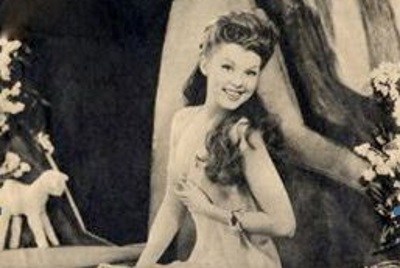
The girls from The New Senator Hotel featured in an advertisement in the Honolulu Star newspaper, 1940. Photographer Unknown

The New Senator hotel was next door to the famous Wo Fat Chinese Restaurant at number 2 North Hotel Street. Advertised as such, it was most certainly not. The lofty minded dowagers of the oldest Haole families living up in Pacific and Saint Louis Heights and in Kohala district around Diamond Head must have sniffed at such doings. Their husbands who owned the buildings simply remained silent and pocketed the proceeds.

Prostitution was a very lucrative business both before and during the war. Betty Jean O’Hara was one of those girls. She was from Chicago. Her father was a doctor there and she had the benefit of a first rate education. Though her parents were strict Catholics they did allow her to attend parties and movies with other kids her own age. At about 16 she met another girl at a party who was “dressed to the nines,” dripping jewels and smothered in mink. She wore rolled silk hose and a short skirt, the picture of the Flapper. Falling in with the girl she discovered where the money for the fine clothes came from and decided she was going to have that too. She signed up for the “Oldest Profession” and soon after ran away from home and went to San Francisco.

Jean was a very pretty girl and grew into a handsome woman. She was what was known in those days as “Black Irish,” meaning she had raven black hair, very fair skin and very dark blue eyes. She was petite and even slender by the standards of the day. Her good looks and obvious upper class bearing would serve her well. She worked for about five years in a high class “House” in San Francisco and resisted every attempt by her parents to frighten her and bring her home. She was definitely a headstrong girl. Although she always claimed she loathed the life, she loved the money even more.

Elizabeth “Betty” Jean O’hara photographer unknown

She arrived in Honolulu in 1938. She had been recruited by a procurer working the houses on the west coast. The pay for bringing the girls over ranged from 500 to 1,000 dollars. Jean was met at the dock when the Lurline docked by a city of Honolulu detective and escorted to the Blaisdale hotel on Fort Street. There they were explained the rules they would have to live by and that any violations would be cause for expulsion from the Territory. They were given a Territorial Tax Book to keep their accounts and issued a license stating that they were “Entertainers.” They were required to pay one dollar for the license plus 30 dollars a month for each girl to the Honolulu Vice Squad. Each “Entertainer” paid both State and Federal income taxes which was collected by the madam who actually filed the returns. Though prostitution was illegal, the madams operated their houses with permission from the local police.

Open from 1:00 pm to 5:00 pm before the war and from 8:00 am to 1:00 pm during the war, the girls could make as much as $4,000.00 a month when the average skilled working man might make $100.00. During the war they were expected to see a hundred men a day. It seems improbable but it’s true.

Jean explained that the girls could not have a bank account, own a car nor drive one. They had to walk in pairs when out, could not date nor be seen in the company of men and were restricted from the “Better” parts of town. If a house broke any of these rules the police and the military would shut them down for a period of time. Money changed hands.

The madam, perhaps the well known Mrs Kipfer that James Jones wrote about in “From Here to Eternity,” held their cash. She took one dollar from the three the men were charged and the girls paid for their lodging and laundry with the remaining two. The wages of sin was what was left. It was plenty though and Jean O’Hara bought a house in the Pacific Heights area of Honolulu when she retired. She lived out her days there amongst the elite of Honolulu. She married a local boy and had a second home in Old Waikiki.

She stated that it was a rough life and she had several run-ins with police for breaking the rules including being beaten and having her ribs broken. The first time she bought a house they caught her and forced her to give it up and go back the brothel. She always said there was no glamour in it, just money.

The Pearl Harbor naval base was not far away, and when a numbers of ships docked after long trips at sea, the sailors flocked to these places and formed long lines outside the doors to wait their turn, blocking entrances to the many adjacent restaurants and shops of all kinds. The restaurant goers and local shoppers, mostly housewives, would thread their way through the lines, unconcerned, in order to get to their destinations.

Lined up 1944. Honolulu Advertiser photo

The Japanese women dressed in their colorful and beautiful kimono and obi, wearing ornate zori (Japanese slippers); Hawaiian women with their holoku gowns and wearing lei around their necks and haku lei on their heads, some of the younger ones with a flower on one ear or the other; Korean women in their voluminous costumes reminiscent of nuns’ habits, only white in color; and Chinese women in colorfully embroidered silk blouses and black silk slacks, some hobbling because their feet had been bound when they were infants. There were Filipino laborers from the pineapple fields, Chinese shopkeepers and Haole boys running errands for the big merchants downtown.

For most of the Spences’s sailors on leave, Honolulu was a new and exotic place. In those days it even smelled good. The sweet odor of the Frangipani blossom pervaded the air in the city. The diverse population of the Territory of Hawa’ii would have been a surprise, especially to west coast sailors like Don who would have been familiar with the race baiting common in the western states.

The night of December 7, 1941 was a panicked one in Hawaii. In the wake of Japan’s surprise attack , Hawaiian civilians struggled to understand what had just happened—and to make sense of the announcement that their island was now under martial law. 

As military and FBI agents rounded up suspected spies and “suspicious persons,” the army imposed a strict curfew. Habeas corpus was suspended, the military took control of labor, and trial by jury was temporarily abolished. More than 2,000 people were arrested in the first 48 hours alone. Hawaii would remain under military rule for almost three years.

“The Army’s readiness to take over every detail of government in Hawaii only hours after the Pearl Harbor attack was in startling contrast to its lack of military preparedness for that attack. Though it was generally believed that there would be war with Japan, few military leaders believed that it would begin at Pearl. The US government and its allies had steadily pushed the Japanese into an economic corner, denying the Empire oil, steel and other imports in an attempt to force them out of Manchuria and northern China. The thinking at the highest levels of the Japanese military was that crushing American, British, Australian and Dutch military bases in the Pacific would cause them surrender or so slow the response that the Japanese would be able to consolidate their gains and be able to resist any counterattacks from the allies. Most Japanese leaders considered Americans weak, the thinking was that the United States would not have the will to fight a cross Pacific war. It would prove to be a mistake, though the issue was still very much in doubt in the summer of 1943.

Military rule meant big changes for Hawaiians. Every person on the island, with the exception of children, was fingerprinted and issued identification papers they had to produce on demand. Civilians were forbidden to photograph any coastal location, which in Hawaii is everywhere. Hawaii’s Japanese Americans, who had long been under surveillance by federal and military intelligence agencies that feared they would side with Japan during wartime, were treated particularly harshly.

Hawaii was a territory, not a state. The laws that established a territorial government in 1900 covered Hawaiians with the protections of the United States’ constitution. Thirty-seven percent of residents were of Japanese descent, including about 37,000 Issei, Japanese-born people who were not eligible for citizenship under the exclusion laws in effect at the time and 121,000 Japanese first and second generation American citizens, referred to as the Nisei. 

Hawaii’s proximity to Japan made it of prime strategic importance, and put the islands at unique risk. Military officials doubted the loyalties of the island’s many Japanese Americans. As the United States sent people of Japanese descent to concentration camps on the mainland, it hesitated on to how to deal with Japanese Americans in Hawaii itself. 

The federal government couldn’t afford to intern one-third of the population of Hawaii: The war effort needed labor and feared such a move might stoke pro-Japanese sentiment. Besides, the logistics of imprisoning nearly 160,000 people in a territory that was small to begin with seemed insurmountable. And so, they turned the Hawaiian Islands into its own type of internment facility instead.

“I wasn’t supposed to speak Japanese anymore,” said Amy Hirase who was a young girl in Honolulu during the Pearl Harbor attack, in an interview. “It was almost like a sin.” 

“The community was fearful of…being taken away,” said Tomoko Ikeda. She was 17 when Pearl Harbor was bombed. Her father, a Buddhist priest and Japanese language school teacher, was swept up in an FBI raid soon after the attacks. Though she had enjoyed a thriving Japanese community in the years before the war, under martial law she was shunned by her former friends. “We were totally isolated.”

Many of the period’s rules focused specifically on non-citizens who had been born in Japan. Japanese-born people couldn’t own shortwave radios, gather in groups of more than ten people, or move without requesting official permission. They were labeled “enemy aliens.” 

Other facets of military rule applied to all Hawaiian civilians. “Everybody was under martial law and treated equally unfairly because the military couldn’t target just the Japanese who were so important to the economy.” The Chinese, Filipinos, Hawaiians and Whites were all initially suspect.

During martial law, the media was censored, and press outlets were only allowed to use English. So were people placing long-distance calls. The Japanese language ban affected schools, which were forced to close. Hawaii’s Japanese population had long been subjected to English-only campaigns, but they had never been successful. Now, pressure to speak only English came from both the military and Japanese groups desperate to prove their loyalty to the United States. “Speak American,” they were encouraged.

Though it was not military policy to intern people of Japanese descent in Hawaii, dual citizens, community leaders and suspected spies were rounded up and detained. They underwent military hearings during which they were not told of the nature of their accusations. About 10,000 people were arrested and 2,000 incarcerated, one third of them American citizens.

People could be arrested and interrogated at random, and hasty, biased hearings were common. This policy of “selective detention” had a chilling effect on Hawaiian civilians, who restricted their movements and lived in fear of arrest and harassment. 

“My father lived in constant fear of being sent to a concentration camp, as my Uncle Toru Nishikawa had been. Uncle Toru, born in Hawai‘i, was deemed a threat to national security because he was a reporter for a Japanese language newspaper in Honolulu. He was locked up on Sand Island and later moved to Honouliuli Internment Camp on O’ahu. His bank account was frozen and his wife’s sewing school forced to close.” said Jean Hiyashi would later become the first lady of Hawai’i, marrying George Ariyoshi another Hawaiian Nisei and veteran of the Army intelligence Corps.

Despite being subjected to such harsh restrictions, it turned out that people of Japanese descent did not betray the United States as feared. “With the exception of Otto Kuehn, a German immigrant who was convicted of espionage, not a single one of the internees or detainees was found guilty of overt acts against U.S. laws, no one was investigated for sabotage, and only a few were ever suspected of espionage,”

As time dragged on, so did martial law. Even after the Battle of Midway in June 1942, which was widely thought to have ended the possibility of a Japanese invasion, military control continued. In early 1943, Hawaii’s new civilian governor and a group of influential civilians petitioned the Roosevelt Administration for an end to military rule. The military strenuously objected, and only agreed to turn over some control if it was allowed to continue its regulation and control of labor. 

Hawaii finally got some of its civilian government back in March 1943. But only in October 1944 did martial law end. Even then, though, full control of Hawaii was not returned to civilians. Those designated “enemy aliens” were still ruled by the same restrictions, and the U.S. Army still controlled Hawaiian labor.

Most Japanese boys in the Territory of Hawai’i were not placed in concentration camps as they were on the mainland. When the army asked for 2,900 volunteers, more than ten thousand stepped forward, they joined the military in droves, serving in one of the most fabled Army units in American history, the 442nd Regimental Combat Team which saw the heaviest fighting in the Italian campaign including  the Rapido River and Monte Cassino. They suffered enormous casualties, they had something to prove and their white senior officers were only too happy to oblige them.  In 1944 the 141st infantry regiment of the Texas 36th Division was cut off and surrounded by the Germans. The final rescue attempt of three was made by the 442nd Regimental Combat Team, the segregated unit composed of Nisei, or second-generation Japanese boys. The 442nd had been given a period of rest after heavy fighting to liberate Bruyeres and Biffontaine, France, but the commanding General, John E. Dahlquist called them back early to relieve the beleaguered 2nd and 3rd Battalions of the 36th. In five days of battle, from 26 to 30 October 1944, the 442nd broke through German defenses and rescued 211 men. The 442nd suffered over 800 casualties. “I” Company went in with 185 men; 8 came out unhurt. “K” Company engaged the enemy with 186 men; 169 were wounded or killed. Additionally, the commander sent a patrol of 50–55 men to find a way to attack a German road block by the rear and try to liberate the remainder of the trapped men. Only five returned to the “Lost Battalion” perimeter. The 442nd is the most decorated unit in U.S. military history for its size and length of service. Their motto, a pidgin english phrase, “Go For Broke,” epitomized the dedication to the country they fought and died for. Lest you think that the mix of Texans and Nisei boys from Hawa’ii caused problems you would be mistaken. Combat veterans know no race other than their collective experience; and, in fact, in 1962, Texas Governor John Connally made the veterans of the 442nd “honorary Texans” for their role in the rescue of the Lost Battalion.

Lieutenant Daniel Inouye, 442nd Regimental Combat Team. Congressional Medal of Honor. US Senator from Hawai’i.** Honolulu Advertiser photo

This was the Hawai’i the crew of the Spence took their liberty in. Much of the finer establishments were off limits for sailors like Don and his friends. There were the bars and brothels on River and Hotel Streets, Bill lederer’s bar, the oldest saloon in Honolulu was doing a land office business. You could get your Blues tailored or a tattoo, or just walk around and see the sights. The YMCA and the USO were always packed. If you were lucky you might get a room at the Royal Hawaiian Hotel for .25 cents. For a dollar, you could have your picture taken with a hula girl. Send it home to your mother if you dared. The beach at Waikiki was great for swimming if you didn’t mind the coils of barbed wire and the armed patrols.

Harry Owens and his Royal Hawaiian’s played the ballroom at the “Pink Lady.” He was fronted by the World Famous Hilo Hattie. who would do her comedy routine and sing the song that made her famous, “The cockeyed mayor of Kaunakakai.” She was so beloved that when she died in 1979 she was buried in the National Memorial Cemetery of the Pacific, Punchbowl, with her Soldiers, Marines and Sailors.

Clarissa Hai’ili, “Hilo Hattie”

The Spence meanwhile, would continue to exercise off Oahu, refining her combat readiness. She ran anti-submarine drills, practiced antiaircraft gunnery and maneuvering in concert with other ships while preparing for operations in the western theater.  The Spence and two other destroyers were to escort the Light Carriers Belleau Wood CVL-24 and Princeton CVL-23 out of Pearl, sailing toward the sunset on the the 21st.  Finally to the regret of the young men in the crew, they slipped their mooring in Pearl Harbor’s Middle Loch, sailing toward Waipi’o channel, they slid past Ford Island, the water slick with the still leaking bunker fuel from sunken ships where the capsized USS Utah, BB-31 and the shattered ruins of the USS Arizona still lay, her crew interned inside the hull never to be recovered. This a stark reminder of where they were headed and why. The Starboard rail of the Spence was lined with the crew in dress white uniforms, all at rigid attention, some with tears streaming down their cheeks at the horror of it all. Passing Iroquois Point and leaving Mamala Bay, crossing over the exact spot where the old “Four Piper” destroyer Ward DD-139 fired the first shot of the war in the Pacific, they silently ghosted away west.

The Pacific Ocean west of Hawaii represented the front porch of the Japanese Empire in 1943. Though the sea war had moved west 3552 miles to the southwest Pacific, IJN submarines still patrolled vast areas and escorts were required to protect cargo and troop ships. Danger was now absolutely real.

CHAPTER SIX

Headed southwest from Hawaii the crewman of the Spence began arranging storage for the supplies and gear they had brought aboard at Pearl. During the Naval build up in the Pacific the initial push was for warships at the expense of the ships which supplied logistics. Tankers, repair and supply  ships were being added to the fleet as fast as they could be built, but in 1943 there weren’t sufficient numbers available yet. The war in Europe took precedence over the Pacific. Fighting in North Africa had just concluded in May and the buildup for the invasion of Sicily, which was to begin in July and then followed immediately by the invasion of Italy in September was ongoing. Meanwhile planning for Normandy which was to be in June of 1944 went ahead. All these operations required an enormous quantity of shipping which wouldn’t be available to the Pacific fleet for some time yet.

To Be Continued Friday May 26th

*One of my high school classmates father was trapped below decks on the Oklahoma for four days until salvage crews managed to cut through the bottom of the ship and get him out. Try and imagine what that must have been like.

** Note that Dan Inouye has the scars from a German grenade including the loss of his right arm which was removed in an aid station without anesthetics.

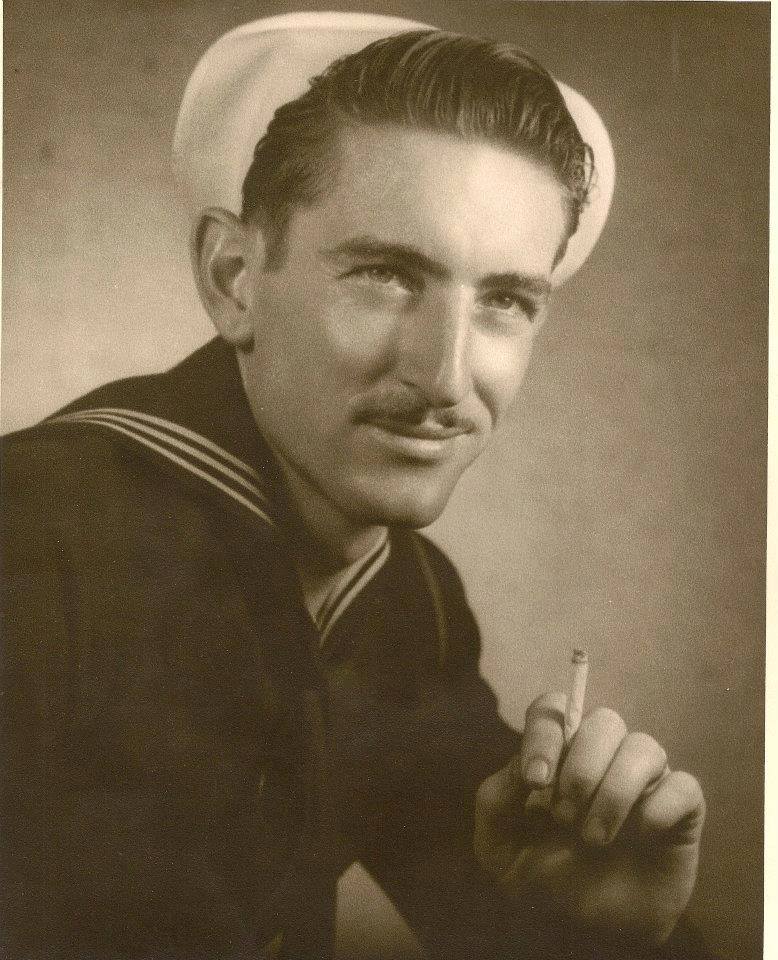
Front-piece: My uncle Robert “Bob” Hall who served on a destroyer in the western Pacific during WWII.

Michael Shannon is a World Citizen, Surfer, Sailor, Teacher, Builder and Story Teller. He lives in Arroyo Grande, California, USA. He writes for his children.

E-Mail: Michaelshannonstable@Gmail.com

Standard

NAQT CHAPTER FOUR

By Michael Shannon

CHAPTER FOUR

The small size of the Spence and all other destroyers and destroyer escorts served to foster a certain informality in naval custom. When planning for the Spence, the bureau of personnel or BuPers, allowed just about 11 square feet per man or roughly three feet by three feet nine inches in which to sleep, store uniforms and personal items.  In peacetime this allowed minimal but ample room for the crew but in wartime the complement went from roughly 226 men to 329 which strained accommodations to the limit. The crew “hot bunked,” sharing racks with sailors on duty while another slept. Very tight quarters. For their size, these warships carried very large numbers of crew. This was necessary in order to operate the ship at a high level of readiness when in a war zone. If you couldn’t bear to be bumped or jostled about by others you were in the wrong kind of ship. It took about two hours waiting in line for chow which you had to eat in fifteen minutes, crewmen did this three times a day. Tiny shipboard spaces coupled with very large crews wasn’t conductive to spit and polish. Oil, grease, tarred ropes and hawsers made it impossible to keep the summer uniform of whites clean on these small ships. The common uniform of the day was dungarees, a light blue chambray shirt, denim bell bottom dungarees and naval working shoes fondly referred to as“Boon-dockers.” Heavy duty work shoes, suitable for any job which never wore out, or as some sailors say, never broke in either. Dungarees were stored between the thin mattress ticking and the wire racks in crew quarters, giving them the appearance of laundry that was never, ever ironed. Scruffy in looks, comfortable to wear and eminently serviceable, sailors took a great deal of pride in their appearance and spoke of their belonging to “The Dungaree Navy.” “Tin Can” sailors were intensely proud to be a part of it and looked down on the swabs that rode around on immense flattops and mighty battleships with legions of “four striper” captains and Admirals looking down on them from sky bridges, ever critical and more powerful than the God himself. Is it any wonder then that Tin Cans had the highest casualty rate of any class of ship in the navy. They went to the sound of battle, always.  The Small Boys were the one ship that led the way, sacrificed for the safety of the glamorous carriers and battleships. Everyone in the Dungaree Navy knew what was expected of their ships and crews and they did it.

Sailors have long considered the Fletchers a very sexy ship with her raked stacks and aggressive profile it is easy to see why. With all of her boilers on line she could top out at 38 knots or roughly 44 miles and hour. The captain could ring up flank speed, the engineers would tie down the pop off valves to increase boiler pressure, the air intakes or blowers as sailors called them would begin to howl like hurricanes as they forced massive amounts of air to the burners in the boilers and the ship would begin slicing through the sea like a knife, shaking like a dog trying to pass a peach pit as the old saying goes, clouds of spray coming back over the bow hard enough to sting the face.  The ship would grab a bone in its teeth, settle at the stern as the twin screws pushed so much water out from under the keel that it partially sank. Swabbies loved them. Perhaps more after the fact than during, but still they were special ships manned by prideful young men.

USS Spence off Guadalcanal 1943 with a bone in her teeth.

Bigger warships called them “Small boys.” A term that was both envious and derisive. There is a story told that in the Fall of 1944,  a destroyer escort, smaller by nearly 80 feet than Don’s Spence, limped into Pearl to have extensive battle damage repaired, she received a semaphore signal from a massive battleship moored to Ford Island. The battleship division Admiral’s query? “What type of ship is that?” No doubt this accompanied by the admiral’s staffs little snickers as they peered down from the flag bridge high above the little DE as it passed. The Captain of the USS Tabberer, (DE-481) a Butler Class Destroyer Escort, Lcdr Henry lee Plage commanding, a ninety day wonder Naval Reservist, cheekily signaled back, “What type of ship are you?” to howls of delighted laughter from the sailors on the little Tabby’s bridge. The little “Tabby” just a fraction the size of the BB had won a Navy Unit Commendation, 4 battle stars and her captain, the Navy’s Legion of Merit awarded by Admiral Halsey himself who passed on Admiral Nimitz’s congratulations for tweaking the nose of the high and mighty battleship Admiral.

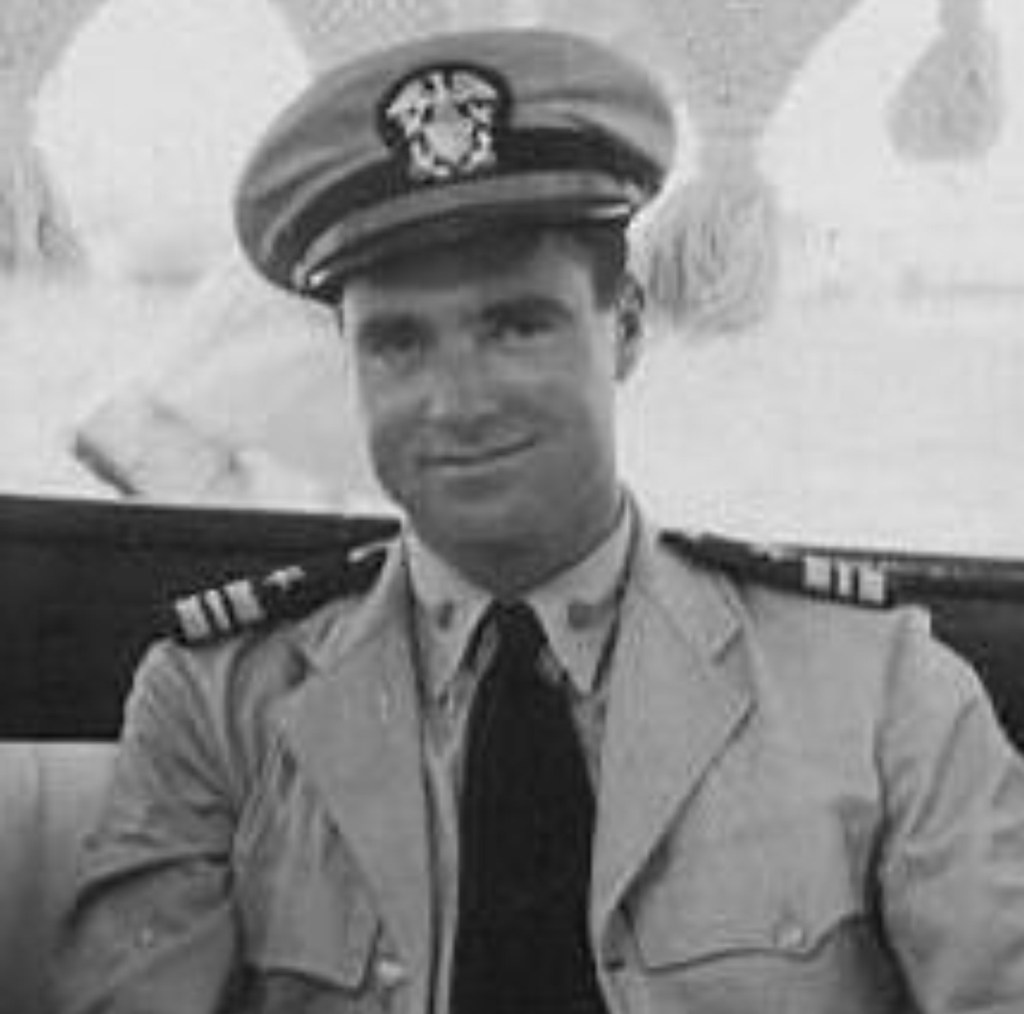
Typical of the officers that made the Navy great in WWII, Henry Lee Plage started his military career as a member of ROTC at Georgia Tech. He joined the Navy in 1937 after his graduation. Like many college grads during the depression his options were limited and a Naval officers career was appealing because the pay was steady and there were some options, though advancement was very slow. Following the attack on Pearl Harbor, Lt. Commander Plage immediately requested sea duty. As a reservist officer his chances of an important command were slim but by May of 1944 when he took command of the Tabberer, the naval service had discovered that these essentially amateur officers often outfought and out thought the Naval Academy boys who were often driven by career objectives and internal politics. The great strength of America lay with it’s amateurs.

LCDR Henry Lee Plage

The crews called them “Tin Cans,” for they were so lightly built with less than a half inch of steel plate that hard service would dish the hull between frames so the sides would look like waffles. They were the thoroughbreds of the fleet. They suffered more casualties than any type of ship during the war. Early in the war, the Navy took horrific casualties in the battle for Guadalcanal. Heavy cruisers were decimated by the Imperial Japanese navy and the roles they would normally have played were filled by the little ships which were forced by high command to take on not only IJN destroyers, but cruisers and battleships.

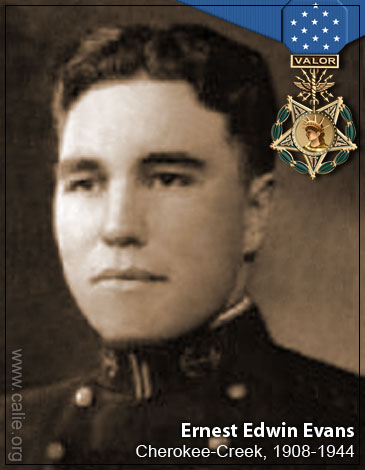
The sailors who rode these ships were men like Henry Plage and Ernest E Evans. Ernest Edwin Evans, a half-Cherokee Indian and one-quarter-Creek Indian, was born on 13 August 1908 in Pawnee, Oklahoma. He graduated from Central High School in Muskegee, Oklahoma and May 1926 and enlisted in the US Navy. After a year’s service as an enlisted man, he was appointed to the US Naval Academy, Annapolis, Maryland, from the Navy at large. Enlisted personnel take a written exam and present evidence to the examiners as to their fitness. Evans entered as a Midshipman on 29 June 1927. The Academy yearbook, “The Lucky Bag,” described him thus:

As a plebe, Chief thought his military life was just “one bust after another”, but coming through that year with a philosophy of “life is what one makes it”, he established himself in the heart of every Middie. 

Endowed with an exceptionally brilliant mind, he advocates and practices a minimum of study and a maximum of reading and pleasure. This policy has enabled him to develop a shining personality and pleasant nature, together with a knowledge of psychology, religion, philosophy, love, or most any subject about which one desires to converse. 

As a wife he is reliable, big-hearted, and consistent, full of good jokes, “lend me two bits, pal, so I can call Baltimore,” laughs and sorrows, never gripes, always ambitious.

The Big Chief graduated with the degree of Bachelor of Science and commissioned Ensign in the US Navy in June 1931,

During the commissioning ceremony of the Destroyer Johnston, DD-557 in September 1943, Commander Evans a made his mission clear to the Sailors assigned to his ship: “This is going to be a fighting ship. I intend to go in harm’s way, and anyone who doesn’t want to go along had better get off right now.” No one did.  They did go too. In the battle off Samar, Philippines, Lcdr .Evans, without waiting for orders flung his little ship against a Japanese fleet of 8 cruisers, 20 destroyers and 4 battleships including the two largest and most powerful ever built, the IJN Musashi and the IJN Yamato. The Imperial Navy’s Yamato weighed more than all the ships of the American task force, more than two hundred forty time than the Johnston alone. The Yamato fired a projectile that weighed over a ton. The Johnston fired one that weighed 55 pounds. The little ships from Taffy 3 that attached the IJN fleet had to run for over seven miles under fire before they were close enough to shoot. The men of the Johnston, the Hoel and the Samuel B Roberts fought their ships until they were destroyed. In a battle lasting over  two and a half hours the Johnston and the other destroyers of his group, Taffy 3 savaged the Japanese fleet. At the end, Evan’s and the Johnston were beaten to a pulp, nearly dead in the water, topsides blasted into a smoking ruin. As Capt. Bob Copeland, the commanding officer of Samuel B. Roberts, describes the moment, he watched Johnston limp slowly by, with Captain Evans standing on her fantail, calling orders down the hatch where her sailors were trying to turn her rudder by hand. Captain Evans was stripped to the waist and covered in blood. His left hand, missing two fingers and wrapped in a strip of his shirt. When he saw Copeland, he grinned and waved.  At the end, the Johnston rolled over and sank taking 186 men down with her including Capt. Evans. Not long after, the Sammie B. was also gone, blown to pieces by shells from the battleships weighing almost 1,500 lbs each. LCDR Evans was awarded the Congressional Medal of Honor.  Lest we think Evan’s action was a rarity, Bob Copeland who waved back at Ernie Evans wrote in the after action report of the USS Samuel B. Roberts, “The crew were informed over the loud speaker system at the beginning of the action, of the Commanding Officer’s estimate of the situation, that is, a fight against overwhelming odds from which survival could not be expected, during which time we would do what damage we could.  In the face of this knowledge the men zealously manned their stations wherever they might be, and fought and worked with such calmness, courage and efficiency that Captain Copeland felt that no higher honor could be conceived than to command such a group of men.**

Medal of Honor, the Bronze Star Medal, Purple Heart Medal and Presidential Unit Citation Ribbon, *

This is the Navy Donald Polhemus entered, the Tin Can Navy. His ship was to go in harm’s way too. More than once.

Spence had just returned from convoy escort duties to Casablanca, Morocco with a brief stop in New York for a brief refit.. Leaving Newport News, she headed for the Naval Training Area located between the Outer banks of the Carolinas and Bermuda. At a distance of over 700 miles across, this area was chosen because it gave sailors, particularly new ones an opportunity to get their sea legs. You see, the gulf stream traveling north off the east coast of the US bounces off Cuba and Florida, accelerating around the curve of the coast at Cape Lookout, North Carolina and is compressed between the Cape and Bermuda. This makes it a place where rough water is sure to be found. Running gunnery, overboard, anti-sub drills in these water is meant to test crews limits under some pretty harsh conditions. With perhaps two thirds of the crew staggering seasick, training forces men to perform under very rigorous conditions. Not the least of which is showing them the importance of getting along and helping each other. They learn they must operate the ship no matter how many bumps and bruises or buckets of vomit they toss over the side. Running at flank speed of 38 knots a Fletcher class destroyer in a tight, hard over turn can roll up to 60 degrees, surely a terrifying experience to young farm boys or city kids who have never been to sea. A turn like that puts the lee rail underwater and causes anything on board not tied down to careen across the deck. Crockery in the galley is sacrificed, open lockers spill their contents, unsecured depth charges spill out of their racks, crashing against bulkheads, altogether a frightening experience for the new crew but eminently satisfying to the veteran seamen aboard who know how to move around with one hand for the ship and one hand for themselves. They have practiced walking down a corridor with one foot on the deck and one on the bulkhead, a trick demonstrated by Fred Astaire in his movie “Royal Wedding where he dances on the wall and the ceiling. The cuts, bumps and bruises will eventually seem like nothing to these boys getting their initiation to sea life. It’s a highly instructive object lesson for the crew on the value of securing anything not in use. A good master can forge a tight knit crew only by forcing them to be proud of the hardships they must endure. They learn the old seaman’s adage about seasickness, “First you think you’re going to die, then you hope you’ll die soon.” 

Steel ships are not built with comfort in mind. Everything below decks seems to be designed to poke, scrape and cut the unwary. There are no cushions or bumpers on anything. Passageways are festooned with thousands of electrical wires left exposed for ease of maintenance. A ship built in Bath, Maine will have had all it’s welds ground smooth which is not the case with vessels from other yards. The Boiler room is hotter than Hell on a summers day. Live steam leaks from pipe fittings, the deck is slippery and there is a cloudy haze floating in the air. The engine rooms are nearly as hot and the sheer number of fittings, gauges and control wheels boggles the mind. There is a constant oily haze in the air and the engine room crew is liberally coated with it. The noise is deafening, the big turbines produce a high pitched whine, the reduction gears grind and the sound of the forced draft from the blowers sounds like a hurricane when the ship is traveling at a high rate of speed. Blowers are a constant. Ships did not have air conditioning in WWII and the constant sound of the blowers trying, without much success to cool the air is deafening. An off duty sailor in his rack can hear the water gurgling and hissing as it flows over the hull.

Worst of all, for the new kid it all happens at once. The rolling gait of an old seamen is hard earned. Of course there is a method to this madness, taking a ship into the roiling Gulf Stream. There is no time for coddling. Junior officers, Chiefs and veteran rating push, shove, shout and lay the hard word on confused young sailors until they finally begin to resemble a functional crew. Almost nothing they learned in boot camp applies to their new jobs.

Chief Quartermaster Harlan Carrigan, a black haired Irishman from Maine man was in charge of teaching the seamen who actually steered the ship. Peter Paul Manghisi from New York was a seaman who was “Striking” for Quartermaster, at just five foot three and 120 pounds Peter must have been quite a contrast to Chief Carrigan who stood six two and weighted in a 200 plus pounds. Nevertheless Harlan Carrigan saw something in the diminutive Manghisi worth cultivating.

Striking is a naval term for a sailor who has qualified through study and experience for a rate, but has not yet become a petty officer. The Chief himself, might not be the best steersman. Qualifying as a Quartermaster takes much more than just mastering the nuts and bolts of the skill. The man who steers a ship must develop a sense that anticipates the movements of a vessel. Its an intuitive skill which involves all the senses. Seeing the sea state, reading the instruments before you and feeling the movements off the deck under you are what makes a good helmsman.

A Fletcher class destroyers primary wheel is located on a console mounted to the deck on the bridge. The console also has two compasses, a gyroscopic which indicates true north and a magnetic which indicates magnetic north. The north pole, magnetic north tends to drift with the movement of the universe and can be unreliable. It’s never used unless there is some failure of the gyroscope. There is always a rudder repeater which tells the man steering two things. One is the angle of the rudder caused by turning the wheel and the other is the true angle of the rudder. There is a time lag between turning the wheel and the rudder responding and there is a much longer time before the ship begins to turn. This is where intuition comes in. A helmsman must be able to anticipate what the ship is going to do in any sea state. A Fletcher is 376 feet long and only 39 feet wide. Its like a floating pencil. Being long and thin the expectation would be that they want to move in a straight line but that was not the case. Sometimes it simply defied reason to determine why she wandered of course.To be a good helmsman required very sensitive physical senses and a keen mind. It was necessary to predict what she is about to do in the next several seconds and take corrective action before it happens. Once the ship slides off course the rudder cannot be moved quickly enough to avoid wandering. A good helmsman has to be able to second guess constantly. The worst sea state is when the swells are abaft (Behind) the beam. As the swell begins to lift the stern the bow buries itself and the stern begins to slide off to one side or other. In a very heavy swell the ship can broach, or turn sideways to the swell and possibly capsize. As the ship slides sideways the helmsman must correct. If he overcorrects the ship will roll as well as pitch. All over the ship you will hear, “Who the Hell is on the wheel?” Peter Maghisi began his instruction in calm seas for obvious reasons.

Spence in heavy weather

Soon after completing at sea training, the Spence was assigned to the Pacific Fleet and sortied through the Panama canal and up the west coast to Mare Island Navy Yard Annex at Hunters Point, San Francisco, for a three week overhaul. Don was able to take the train down to Anaheim to visit his parents and get the family news. His brother Henry and his brother in-law CB Cotton, who had married his older sister Evelyn in 1933 were both Naval officers and in the Pacific. Evelyn was living with her parents while her husband was at sea and it must have been frightening to have two family men in the war zone and the youngest, Don, soon to be on his way.

Anaheim like most towns in mid 1943 would have exhibited a curious quiet. There were very few school friends about, most were in the service. Not just the boys either. Married men, men with children and those that failed physicals in ’41 were now considered healthy enough to serve were being caught up in the draft. Women entered the Waves, WACs and the Women’s Marines. There was almost no unemployment on the west coast. The industries that produced war material operated 24 hours a day sven days a week. When Don left his parents house to walk around town it would have seemed almost like a ghost town.

It is so hard to imagine today what it was like for mothers to have one eye out the window all the time looking to spot the boy delivering telegrams on his bicycle, coming up your street, praying that the sadness he was bringing was for some other poor mother and not you. There is a magnificently poignant scene in Saving Private Ryan, where the Ryan’s mother sees the sedan coming up the drive and seems to float out to the porch waiting for what news it brings. When the family’s minister opens the door, she slowly collapses, floating to the floorboards to slump heavily as if weighed down by impending grief. It’s heartbreaking to see. It happened 1,089,918 times in WWII. Read it again, one million, eighty nine thousand, nine hundred eighteen telegrams for the dead and the wounded and the missing. All those parents, brothers and sisters, wives, children, grandparents and friends, they were casualties too. 

 Spence left San Francisco and Hunter’s Point for Pearl and the western Pacific theater on 25 July and steamed into Pearl Harbor on August 3rd, 1943. She was slated for further training. In fact the training never stopped, she was headed into harms way and she could never be prepared enough. 

Spence leaving San Francisco 25 July 1943

chapter five

Rounding Oahu, slipping through the Molokai Channel and turning Northwest, she passed Diamond head, Honolulu and came to the entrance of Pearl Harbor. She lay off the entrance until the harbor pilot came aboard and steered them through the minefields, torpedo nets and in towards the Destroyer anchorage in the Middle Loch. As they slid past Ford island the destroyed Arizona, BB-39 stood as mute testimony to the savage attack of December 7th just two years before. Just forward, the massive salvage operation to raise the capsized Oklahoma BB-37 was still underway.* Rounding Ford Island to their designated anchorage they pass the old Utah, BB-31 rolled over and rusting away. Some of it’s crew still entombed inside.

The crew, dressed in crisp whites stood at attention and saluted. Tears flowed unashamedly from both sailors and their officers. Prewar servicemen almost certainly knew some of those lost men.

To Be Continued Thursday May 25th.

*One of my high school classmates father was trapped below decks on the Oklahoma for four days until salvage crews managed to cut through the bottom of the ship and get him out.

**On 30 October 2019, the research vessel (RV) Petrel, belonging to Vulcan Inc., discovered the remains of what was believed to be Johnston at the bottom of the Philippine Trench. The remains consisted of a deck gun, a propeller shaft, and some miscellaneous debris that could not be used to identify the wreck, but additional debris was observed lying deeper than the RV could go. On 31 March 2021, a research vessel surveyed and photographed the deeper wreck and definitively identified it as Johnston. She sits upright and is well preserved at a depth of 21,180 ft, or 4.01 miles (6,460 m). Until Samuel B. Roberts was discovered on 22 June 2022, Johnston was the deepest discovered shipwreck in the world.

Front-piece: My cousin Bobby Hall U S Navy in his dungarees.

Michael Shannon is a World Citizen, Surfer, Sailor, Teacher, Builder and Story Teller. He lives in Arroyo Grande, California, USA. He writes for his children.
E-Mail: Michaelshannonstable@Gmail.com

Standard

NAQT

By Michael Shannon

CHAPTER THREE

Exhausted from the 120 hour ride in old passenger cars just taken out of the boneyards of railroad storage and so crowded that soldiers and sailors had to sit on the floors, or sit together in threes and fours on old seats made for two, Don like the other passengers stood in shifts or tried to get some shut eye by crawling under the seats and stretching out on the floor. The aisles were stacked with seabags and their other gear was stuffed in every nook and cranny the could find. For Naval recruits straight out of Boot Camp, it must have seemed crowded beyond belief. They were about to find out to their sorrow that their discomfort was just beginning. 

The going was slow. Military trains were often sidelined because war materials took priority over troops. Brief whistle stops gave the boys an opportunity to get off, stretch their legs and maybe get a quick bite to eat at the train stations set up along the way. If they were fortunate perhaps they might find long tables set up by the Red Cross where coffee and donuts were served by volunteer girls. Often all they had were sandwiches and maybe an apple passed through the windows when the train stopped to water or coal. It was still a long hard trip even for young men in the physical prime of their lives.

North Platte Nebraska Canteen officers pose for a publicity photo, including (left to right) Helen Christ, Mayme Wyman, Jessie Hutchens, Edna Neid, and Opal Smith. Used by permission.

Don’s train arrived in Newport News, Virginia on the 19th of May, 1943, where the sailors joining their ships were processed. The entire group spent the night in a temporary barracks built for WWI. The receiving center was jammed with sailors waiting for ships or transportation to other parts of the country. Boot camps were turning out roughly five thousand new sailors each and every week and still couldn’t keep up with demand. New construction was outpacing crew. The Navy was using it’s prewar sailors to polish up the Boots when they came aboard  but there weren’t nearly enough to keep up. The learning curve for the new kids was going to be very steep.

 Trying to catch whatever sleep he could and anxious about what tomorrow might bring Don slung his seabag on an available bunk and headed for the galley with other sailors he’d met him on the train. Most of the new crew were not assigned to specific ships and were at the mercy of clerks or yeoman as they are rated in the Navy. The would have had stacks of chits from ships at Newport listing requests for Able Seamen, Cooks, Gunners Mates and a myriad of other ratings. The navy was madly scrambling to man as many ships as it could and many crews in 1943 were made up primarily of boots. Experienced seamen, petty officers and commissioned officers were being shuttled from place to place in order to provide some level of experience but for the most part the navy was being manned by amateurs. 

Hours standing in line, following the lines painted on the deck and dragging his seabag with him Don finally got to the Yeoman’s desk. Taking Don’s personnel file he noted his rating, storekeeper, shuffled some mimeographed chits around until he found a ship requesting a storekeeper. He filled in the chit banging away on his typewriter handed Don his file and a new set of orders, and said, “Portsmouth Yard, Spence,” He said, “next in line.” He never looked up, just held out his hand to the next man and said,”Orders?”

When the United States started preparing to send troops overseas in World War II, no other place in the nation could match Hampton Roads Virginia’s record as a military port. The city had multiple rail connections and it had an excellent deep-water, ice-free port. It also had several WWI camps that could be reactivated very quickly and reused.

In addition to the deep water off Newport News Point, there were excellent anchorages just up the James River, around Old Point Comfort on the York River and inside Cape Henry at Lynnhaven Roads, giving the port commander ample room to assemble vessels and organize hundreds of ships. You could bring ships into this harbor  and they would all be protected by the mine fields at the mouth of the bay and the Hampton Roads channel, the coastal artillery at the capes and at Fort Monroe. The air cover at Langley Field and Naval Air Station Norfolk made Newport News impregnable.

Beginning Dec. 2, 1942, and continuing through the war, nearly 1.5 million people would pass through the gates of the giant complex on their way to or returning from war.

Getting off the bus, Don stood a moment looking up at the ship that would be his home. It was a uniform gray with its number picked out in white on it’s bow, 512 which identified it as the Spence. It was nested with three other, the Edison DD-439, Schroeder DD-501 and the Foote, DD-511.* Towering over the pier they were sleek and deadly looking vessels. He walked down the pier to the gangway, shouldered his seabag, stepped onto the Foote, threw a salute at the Ensign on the fantail, saluted the Officer of the Deck and requested permission to come aboard. “Reporting aboard Spence sir.” The Foote’s OD replied,”Permission granted, come aboard.” Don then crossed the Foote’s deck and onto Spence’s. The Spences O.D. returned his salute and directed a seaman to take him to the personnel office for assignment. Every sailor who ever served knows this routine. The Navy is like an old maiden lady set in her ways and things must be done just so. Don was carrying his orders in the tan colored envelope that followed him everywhere and had a life of its own. Without his service file, he literally didn’t exist. He would be an orphan until it was found or a new one was cobbled together. He followed the sailor through a maze of passageways before arriving at personnel to be checked in. Don was fortunate to have a specialty. Without one he was liable to be attached to whichever division needed the most bodies. He might have gone to the engine room or deck division. As a recent boot he would have been at the mercy of the four winds as most new sailors were.  

Don’s ship, Destroyer, DD-512, Spence, was a Fletcher Class and just a little less than a year old. Built in Bath Maine, she was laid down on 18 May, 1942 and slid down the ways into the sea, wetting her hull for the first time on the 25th of January, 1943. At 376.5 feet stem to stern she was built for speed. With a beam of just 39.5 feet, she was most definitely not built for comfort. Crammed into her interior were all the machinery that made her go, boilers, turbines, reduction gear, fuel tanks, ammunition store stores, crew space, in short, so full of necessary things that there was barely any room for the 329 souls that made up her crew.   That number was necessary to allow around the clock manning of gun mounts, repair parties, and other watch stations. By necessity most crewman held down more than one job. Being a storekeeper, Don had what you might call a day job, keeping records, disbursing various supplies needed to run the ship and working directly with his the supply officer. The supply officer, a Lieutenant nearly as young as the sailors he commanded was in charge of S division. The Supply Officer also had department head status. Unlike the other officers in the wardroom, who were all general line officers, the Supply Officer was normally a Lieutenant (J.G.) or Ensign in the Supply Corps. Supply officers were all referred to as “Pork Chops” because of the shape of their insignia. This officer stood no underway watches. But he had a good deal of responsibility. Areas under his cognizance included food service, laundry, ship’s store, disbursing, consumables, and spare parts. He was directly accountable for all expenditures of government funds.

Supply Department ratings, the navy word for those trained in a specialty included Storekeepers which were responsible for ensuring that the required quantities  of spare parts and consumables were on board and maintaining the required records. This was Don’s rating. In wartime rating’s often rise in rank very quickly. From the time Don reported aboard until he achieved the rank of Storekeeper First Class was just over a year. This meant that he rose five full ranks in that short time, a testament to his hard work, intelligence and the fact that the Navy was expanding very rapidly and the need for qualified personnel was extreme. 

The Supply Officer was in charge of more than just the Storekeeper clerks. He also supervised the Commissary men or CS ratings who were the ship’s cooks. Obviously they were the people who were most likely to take heat from the other crew members for their efforts, or lack thereof. Good cooks and bakers were so valuable that senior officers from other ships would forcibly transfer superior sailing cooks to their own vessels. This led to the occasional serving of lousy dishes to visiting dignitaries. Amongst the cooks was the Baker whose only job was providing fresh bread daily and that wonder of wonders, cinnamon rolls.

Charles Robert Craver, Baker Third Class was already aboard. He had reported to Spence when it was first fitted out. This made him one of the few “Plank Owners” on the ship. Plank Owners were members of the very first crew to go aboard a brand new ship. Sailors took great pride in this honor as you might imagine. Some ships presented these men with small plaques  with a strip of wooden deck and engraved with their name and date that they reported aboard.

BK3 Bob Craver was from Miami, Florida where he had been working as a baker at the Romeo and Juliet Bakery. Perhaps looking ahead, he left work on December 5th, a Friday, 1941 and marched himself down to the local Navy recruiter and signed up. After recruit training in “Great Mistakes,” Naval Training Center in Chicago he was ordered to his first ship. The USS Bowditch AGS-30 was a Naval Survey ship. She was first launched in 1929 as the Santa Inez. She was later purchased by the Navy in 1940 and was outfitted as a surveying vessel by the Portsmouth Navy yard in Norfolk Virginia. A type unknown to most, survey ships accompanied the fleet into every war zone. Their purpose was to chart ocean areas to improve navigation. He must have joked that the Spence was a far cry from the Bowditch, which was a spacious former passenger liner. 

THE FAMOUS SOS, DOD photo

The SH rating were the ships servicemen. They were the laundresses and operated the ship’s store and barber shop. They washed and ironed uniforms for over 300 men and they did it in a tiny room with only a single tumbler washer, dryer and a steam mangle iron. Sailors were to be clean at all times and the laundry did a land office business. They could never keep up with demand and sailors learned to hand wash uniforms in buckets while on deck. They made do, which was the watchword in the naval service, particularly in small ships.

SHIPS LAUNDRY

The Disbursing Clerk Assisted the Supply Officer in performing his paymaster functions. This was a job held by Don “Poley” Polhemus. Crewmen treated the pay clerks with a great deal of respect. The Lieutenant who ran supply was nicknamed “Pay,” though he wasn’t called that to his face. Pay disbursements were made in cash, typically the old two-dollar bill. Sailors rarely drew actual pay beyond what they could spend on gedunk or gambling. The tiny ships store bar was usually open for longer hours than the Galley. They were stocked with a wide variety of consumables such as snacks, soft drinks and fresh coffee. Sailors refer to the snacks themselves as “gedunk”. The money raised went to the ships enlisted fund and was used for recreation and other things that benefited the crew. 

The Stewards ran the Wardroom, the officers mess and provided valet service for the officers exclusively. In Don’s Navy they were nearly all Filipinos or Black. The Navy being far from integrated in WWII. They were the only enlisted men allowed in what was known as officer country. Though crowded into a very small ship, officers and enlisted men maintained very careful distances from one another. The stewards also served as crew for the ships guns but were typically segregated in their own compartments.

Don Polhemus was quickly promoted to 3rd class petty officer. In the rush to fill crews promotion for enlisted personnel was very fast. The Chief Petty Officer, SKC, was the senior enlisted man who ran the day to day operations of the supply department. The Chief being in charge of all the departments in S division. The supply officer, Lieutenant Alfonso Stephen Krauchunas was Don Pohlemus’s department head. Operating from cramped compartments below the after 5 inch 38 caliber gun mounts, they were responsible for the ordering, storing and disbursement of all ships stores. This included gunnery, engineering, deck division and officers mess funds. Basically their job was to run a warehouse, a very small but extremely busy one. One of the prime considerations for any sailor is to learn to get along with almost no space in which to live and work. The supply office was the size of a average walk in closet. All of the work needed to maintain and operate a ship the length of a football field with a crew of over three hundred men was done there by an officer and his men, often working literally shoulder to shoulder. A the officers mess the supply officer customarily sat at the foot of the table where he was in full view. The looks and comments he received were in direct proportion to the quality of the job he was doing.

STOREKEEPERS OFFICE. DOD photo

There is an interesting custom in the Navy. Through the supply department, the service that provides the nuts, bolts, clothing, food, cleaning supplies and all of the other necessaries to keep the ship operating at an efficient level. What it doesn’t do is provide the critical luxuries that keeps crew happy. There is a somewhat different process for this. “Cumshaw,” a word owned by the underground Naval service. Underground, meaning it’s practice of and operation of is frowned upon, but enthusiastically practiced by the lowliest seaman to the Admiral of the fleet. The only basic consideration is; don’t get caught. It was probably British Navy personnel who first picked up cumshaw in Chinese ports, during the First Opium War of 1839. Cumshaw is from a word that means “grateful thanks” in the dialect of Xiamen, a port in southeast China. Apparently, sailors heard it from the beggars who hung around the ports, and mistook it as the word for a handout. Since then, U.S. sailors have given cumshaw its own unique application, for something obtained through unofficial means (whether deviously or simply ingeniously). Sailors are known to bend the rules a just a little, to outright bribery. Don wouldn’t learn this in Storekeeper school, but he would certainly be introduced to it by the senior ratings and chiefs of long naval experience. Whenever the Spence was in the yard or tied up to a destroyer tender or other supply ship, things of value tended to migrate from one ship to another. Things of value might be “Cumshawed” in the dark of night only to be replaced by an item of equal value from the ship alongside. Quid Pro Quo you might say. Don and the other ratings in supply made sure that naval records were squared away and ready for inspection at all times. Perhaps certain surplus items from the Spence might, just might, fall over the side and have to written off as lost or destroyed. This practice allowed for a basic and somewhat bare bones ship to be customized.

You might think a bare bones ship would have nothing to trade. That would be far from the real story. The Navy went to great pains to see that their ships were well supplied, particularly with food. Don and his mates, under LT. Krauchunas would typically put aboard and store a quarter ton of bread, 300 or more dozen eggs, 30 gallons of milk, 100 pounds of butter, 50 pounds of raisins, 150 pounds of tomatoes, 75 pounds of melons, and 200 pounds of bacon. They also loaded many cases of Life Savers and Spearmint gum. Furthermore, they loaded one of the most valuable of trading items, cigarettes. A typical load would be in the neighborhood of 5 cases each of Lucky Strikes, Camels and Chesterfields and 3 cases of chesterfields. This amounted to 180,000 smokes for a crew of 329 men.

Encouraged by cigarette manufacturers, the military made sure that soldiers and sailor were well supplied. To begin with, most men smoked to begin with. Pipes and cigarettes would have been considered a necessity by most of the crew. But beyond that it was known that smoking climbed nerves and suppressed appetite both seen a positive outcomes particularly in combat zones. In the Navy smoking was limited to specific locations on shipboard and further, limited to situation. On deck smoking after dark was prohibited, smoking while working was also forbidden. This led to the idea that being allowed to smoke was a treat, which in a way it was. The idea that it was a special thing was beneficial in a cramped, stressful and very hard life that. It became something to look forward to in a situation that offered little outright pleasure. If some boys didn’t smoke when they joined the Navy they likely took it up before long.

Chapter Four

The small size of the Spence and all other destroyers and destroyer escorts served to foster a certain informality in naval custom. When planning for the Spence, the bureau of personnel or BuPers, allowed just about 11 square feet per man or roughly three feet by three feet nine inches in which to sleep, store uniforms and personal items.  In peacetime this allowed minimal but ample room for the crew but in wartime the complement went from roughly 226 men to 329 which strained accommodations to the limit….

To Be Continued Wednesday May 24th.

* The photograph of the four destroyers was taken at the Portsmouth Naval Yard, Newport News, Virginia on the actual day Donald Pohlemus reported aboard, May 23rd 1943. Dept. of Defense Photo

Michael Shannon is a World Citizen, Surfer, Sailor, Teacher, Builder and Story Teller. He lives in Arroyo Grande, California, USA. He writes for his children.

E-Mail: Michaelshannonstable@Gmail.com

Standard

NAQT

By Michael Shannon

CHAPTER TWO

Home with his family, after a long six day week at Douglas, Don was sitting around with his dad, Dean. Flopped in a chair, Don was lounging in the way only teenage boys do, draped all over the big Morris chair, half listening to the big Philco radio in the corner. Just another .Sunday afternoon. Nothing much else to do, they had just finished reading the Sunday LA Times. A nationwide welders strike was slated for Monday, San Quentin prison was being accused of being a hotbed of red plots. Members of the state assembly were protesting the parole of three former **Seamen’s Union of the Pacific organizers who had been imprisoned for communist activities, stating that, “These Commie thugs are a danger to the citizens of California and ought to be kept in prison instead of going free.” The Russian Army was desperately trying to stop the German armies advance just outside Moscow, feeding untrained conscripts into the meat grinder that was the eastern front. The new Russian ambassador, Maxim Litvinov, just arrived in San Francisco vowed that the Soviet Union was unwavering in its struggles against the Axis. In Washington the State Department had just announced the takeover of all Finnish Merchant ships docked in American harbors. Taken into protective custody, the crews will be interned while negotiations with the Finnish government are underway. The headline at the top of the page; “Roosevelt Sends Note to Mikado, final peace move seen, Chief Executive Believed to Have Expressed Dissatisfaction with Japan’s Premiers Reply to Protest Against Continental Aggression.” On the same page a statement from the Japanese press, detailing Japan’s dissatisfaction with Roosevelt’s insincerity in pursuing the peace process and stating that “All of East Asia will arm in case of American Aggression.” Japan’s Ambassador to the United States, Kichisaburo Nomura was, that Sunday morning on his way to the White House to deliver a note to the President replying to Roosevelt’s demand for a non-aggression pact in China and southeast Asia. He would be too late.

In Anaheim, Don’s mother Christine was in the kitchen preparing Sunday supper. The radio was tuned to the Mutual Radio Network. Everyone in the house was listening to “One Man’s Family,” the longest-running uninterrupted serial in American radio history. It told the story of the Barbour family of San Francisco and its 15 minute radio show came on every day. On this day,  the  announcer had declared, “One Man’s Family, brought to you by Fleischmann’s Yeast,” and “dedicated to the mothers and fathers of the younger generation and their bewildering offspring,” The father, Henry doles out wise advice, Fanny plays the supportive and submissive wife, and the children do their best to make their parents proud.

Suddenly, there was a crackle of static and then a scratchy voice coming from the radio cabinets speaker,

We interrupt this Mutual Radio broadcast for the following important announcement. One, two, three, four test, test. Hello, Hello, NBC. Hello, NBC. This is KGU radio in Honolulu, Hawaii. I am speaking from the roof of the Advertiser Publishing Company building. We have witnessed this morning a distant view of a brief full battle of Pearl Harbor and a severe bombing of Pearl Harbor by enemy planes, undoubtedly Japanese. The city of Honolulu has also been attacked, and considerable damage done. This battle has been going on for nearly three hours. One of the bombs dropped within 50 feet of KGU tower. It is no joke. It is a real war.The public of Honolulu has been advised to keep in their homes and await results from the Army and Navy. There has been fierce fighting going on in the air and on the sea. The heavy shooting seems to be — one, two, three, four. Just a moment. We’ll interrupt here. We cannot estimate yet how much damage has been done, but it has been a very severe attack. And the Navy and Army appear now to have the air and the sea under control.”

And just like that, in that instant life for the Polhemus family and all Americans changed forever.

war

For citizens at war, particularly those kept at home by rationing and blackouts and the impossibility of travel, radio became a window on events, sometimes as they transpired. They war was to come into the Pohlemus home on a daily basis. Edward R Murrow had broadcast from London live. From atop various rooftops he described the nightly german bombing of London, opening with “This is London calling” and closing with”Good night and good luck,” a phrase used by the citizens of London, never knowing if they would live to see each other again. The family was fully involved. Donald’s older sister was married to a naval officer who was to serve in the Pacific and Korea. His brother Dean, left the bank of America to enlist in the navy. As a graduate of Fullerton JC and later, the University of Southern California he enlisted in officer training in early November 1941. Their father Dean Sr missed WWI but we have a certificate he received for giving fifty cents to the “Remember the Maine” fund while at Orange County Schools in 1898. His father served with the 23rd New Jersey Regiment of Volunteers during the Civil War. Like many Americans they were fully invested in defending their country.

In the lead up to WWII not everyone in the country was in favor of supporting the allies in Europe. The America First Committee (AFC), which was founded in 1940, opposed any U.S. involvement in World War II, and was harshly critical of the Roosevelt administration, which it accused of pressing the U.S. toward war. At its peak, it had 800,000 members across the country, included socialists, conservatives, and some of the most prominent Americans. There were leaders from some of the nations most prominent families, finance, banking and Industrial leaders including Newspaper publishers. There was future President Ford; Sargent Shriver, who’d go on to lead the Peace Corps; and Potter Stewart, the future U.S. Supreme Court justice. It was funded by the families who owned Sears-Roebuck and the Chicago Tribunes, owned by “Colonel” Robert M McCormick a leading conservative and WWI veteran who hated the president. Also counted among its ranks were prominent anti-Semites of the day including Henry Ford and Avery Brundage, the former chairman of the U.S. Olympic Committee who had prevented two Jewish runners from the American track team in Berlin in 1936 from running in the finals of the 4×100 relay.” Charles Lindbergh, a leading American firster gave a speech in September 1941 in which he expressed sympathy for the persecution Jews faced in Germany, but suggested Jews were advocating the U.S. to enter a war that was not in the national interest. “Instead of agitating for war, the Jewish groups in this country should be opposing it in every possible way for they will be among the first to feel its consequences.” 

Three months after Lindbergh’s speech, on December 7, the Japanese attacked Pearl Harbor, prompting the U.S. to enter World War II. Three days later, the AFC disbanded. When war started, the War Department rejected Lindbergh’s offer to serve. He spent the war as a civilian contractor testing airplanes.

Henry Fords German and Vichy French plants continued under company control until August 1942, eight months after the US entered the war. Germany continued to build Ford trucks and cars throughout the war. After surrender, Ford Motor Company sued for damages to its properties in Germany and France. The court awarded them only 1.1 million dollars, noting the hypocritical stance taken by Ford in asking for compensation for damage to facilities bombed by Ford built bombers producing Ford trucks for the Nazi’s.

In April 1942 Don left work at Douglas and went down to the Naval Recruiting station in Long Beach. After talking to his brother  and brother in law he had decided to jump the gun while he still had the chance and enlist. The draft would give him little or no choice where he would end up, Army or Marines likely. He had been a good student and that would perhaps give him an opportunity to attend an advanced school after boot camp. Both his family members were Naval officers in the supply corps and perhaps with a little good advice thats where he ended up. The Navy in 1942 was still gearing up for total war and having two officers in the family certainly didn’t hurt his chances to stay out of the engine room or deck crew, the “Swabs.”

Seaman Recruit John Donald Polhemus, Service Number, 563 03 59, United States Naval Reserve, reported to the induction center downtown Los Angeles and was bussed to the brand new Naval Training Center, San Diego, then as now, Boot Camp. Leave taking would have been typical for families sending children off to war. His father Dean, Stoic and proud, his mother Christine waving, holding back tears as she sends her baby off, Don looking forward perhaps with some apprehension but also with a great deal of excitement. This was to be the great adventure of his life.

The term “Boot” first appeared during the Spanish-American War of 1898. Leggings were worn at the time by all military specialties including the Marines and the Navy. Sailors’ leggings were known as boots and that term was transferred to recruits. Military style Leggings are designed to give extra ankle support and help protect the legs below the knees from sharp objects. They also keep sand, dirt, and mud out of shoes. They were worn by infantry troops in both WW1 and WW2. Perhaps the Navy continued to wear them as they do help support the calves and ankles which helps those who march constantly as Boots do.

The poor recruit is literally overwhelmed by the demands made upon him in the first days of camp. He is pounded with the demands that he must learn in drill, military dress and particularly in the Navy; nomenclature. The ceiling is now the “Overhead”, walls are “Bulkheads,” doors, both in bulkheads or decks are “Hatches” and fastened not by knobs but “Dogs.” Floors are Decks and to make it even more confusing, supports in the overhead are called “Floors.” The bathroom is the “Head” so named from the days when ordinary sailors simply hung their fannies over the bows of a sailing man-o-war to do their business. The front is the bow, the back, the stern, left is Port and right is Starboard. The Kitchen is the “Galley,” food is “Chow,” a Chief is your direct superior and officers are next to God.

The first few days are a whirlwind of furious activity and then; waiting. Waiting in line for uniforms, for chow, or just waiting for no apparent reason. Batteries of aptitude tests are taken. Spatial awareness, mathematics, reading comprehension and physical fitness. There are hours waiting in line for physical examinations. Poking, prodding and looking in places your mother wouldn’t consider. Told to follow the blue line on the deck or the green one, perhaps the yellow one, always carrying your personnel file. Stick out your tongue and say Ahh, read the bottom line on the chart, bend over, grab your ankles and cough. No need to be indignant, you’re all in the same boat. If you don’t like it, well, you sure as hell can’t go home. It’s the first lesson in endurance.

Shots, shots and more shots. The corpsmen almost certainly recruited from death row in some God awful prison. Expressionless, they jab and poke the left arm then the right their assistants reloading syringes at a furious pace. The big guy ahead of you in line takes one look at the needle and promptly faints only to be dragged aside, his file stuffed down his pants and left to recover on his own. The line keeps moving. When a recruit company finishes the line they immediately go to PT and begin waving their arms in jumping jacks, relieves the pain, so says the Chief.

To the recruit it is incomprehensible but the Navy has its ways. Classes are held in seamanship, navigation, and ship handling. Essentials of the UCMJ, Uniform Code Military Justice are studied in which Boots learn about their duties and rights. There are few of the latter. The Captain of a Ship is next to God in authority. Military history is learned, the idea is to make the sailor proud of his service. Admiral Farragut, Admiral Porter, John Paul Jones, Admiral Dewey at Manila Bay, Old Ironsides, and the fate of the Arizona. Every little bit slowly forges pride in service and overall loyalty to those with whom you serve.

With roughly 60 other boys Don’s company worked its way through training. For the most part, was the first exposure to kids from different parts of the country. There were unreconstructed rebels from the deep south, sons of lobstermen from Maine, oil workers from Oklahoma and Texas, cowboys from Montana, some were college boys, some were barely literate. Learning about your buddies was one of the most important things you had to learn. You compared girlfriends or lied if you didn’t have one. You spoke about your jobs and families. You had to share and understand each others languages. The flat nasal drawl of a Maine man, the slow measured drawl of that boy from Alabama, the staccato machine gun delivery of Brooklyn boys and the soft patois of the sons of Mississippi. French Acadians who ended every sentence with a question. Don would have had to learn about “Cooters,” what “Pop” was and the difference between cocks and pussies. See, they mean different things in different parts of the country and woe betide the boy who didn’t quickly learn the difference.

Service on a ship requires two very important things, cleanliness and neatness. A recruit has to learn both. Each article of uniform has a very precise way of being folded and stored. Socks are rolled and each pair fits in a particular place and oriented with the elastic to Starboard, your right. Each article is inspected daily through boot camp, until the entire company can perform the exercise correctly. Shaving, showers, brushed teeth and doing your own laundry were real surprises to many. You had to learn to wake shipmate for watches. You didn’t shake or push a sleeping man, you might get punched. No, you learned to gently hold his nose shut until he woke. Quiet and humane, for you at least. Most homes had no showers in 1942. For some families, bathing was a once a week affair. There were always those who refused to cooperate in the communal ablutions. A quiet word from the Chief to the company recruit leaders would lead to GI showers. Dragged into the showers and held down, the offending recruit would be scrubbed raw with scrub brushes and hard Navy soap until he got the message. Few resisted. The primary lessons of boot camp were not jargon or how to wear a uniform but how to act as a unit and take pride in it.

After graduating boot camp in San Diego, Don was ordered to the storekeeper school training facility.  This where he would have learned Naval procedures for operating procurement and disbursement. He learned typing, filing and all the type of paperwork required to provision a ship at sea. It has been said the Navy doesn’t float on water but on paper. After eight weeks and completion of his advanced trading course he received orders to join the crew of a destroyer stationed on the East Coast.   He was given two weeks at his home in Anaheim. After leave he was to meet the ship in Newport News Virginia.

With two family members already in the service  his mother in particular must have been torn between anxiety and pride. Very little good news was coming over the radio. Newspapers knew little about what was happening in the fleet. With her two boys and son in law gone, Christine must have worried herself sick. Three men of the family serving in the Pacific war would have been almost unbearable to think about when the Los Angeles Times published serious war news. Names of ships were almost always classified as were locations of battles, the news sometimes coming long after actions had been completed. The news she did get, left too much to the imagination. The long lists of the dead and missing published each day must have been agonizing to read. It wasn’t just family but friends and neighbors too. Nearly every family in the country was involved in some way in the fighting. When she hung the three blue stars in her front window, her neighbors must have sensed the Polhemus pride in their boys. To Christine they were a constant reminder of what she had at stake.

Swabs on liberty

CHAPTER THREE

Exhausted from the 120 hour ride in old passenger cars just taken out of the boneyards of railroad storage, so crowded that soldiers and sailors had to sit on the floors, or sit together in threes and fours on old seats made for two. They stood in shifts or tried to get some shut eye by crawling under the seats and stretching out on the floor. The aisles were stacked with seabags and gear was stuffed in every nook and cranny. For Naval recruits straight out of Boot Camp, it must have seemed crowded beyond belief. They were about to find out to their sorrow that their discomfort was just beginning. The going was slow. Military trains were often sidelined because war materials took priority over troops. Brief whistle stops gave the boys an opportunity to get off, stretch their legs and maybe get a quick bite to eat from the Red Cross stations set up along the way, flirt with the girls if they had time, but it was a long hard trip even for young men in the physical prime of their lives….

TO BE CONTINUED TUESDAY MAY 23RD, 2023

  • Note: My Uncle Marion Williams was working at the Elwood refinery when it was shelled. It Scared him witless.
  • Note: I was a member of the Seaman’s Union of the Pacific, no communists there.

Michael Shannon is a World Citizen, Surfer, Sailor, Teacher, Builder and Story Teller. He lives in Arroyo Grande, California, USA. He writes for his children.
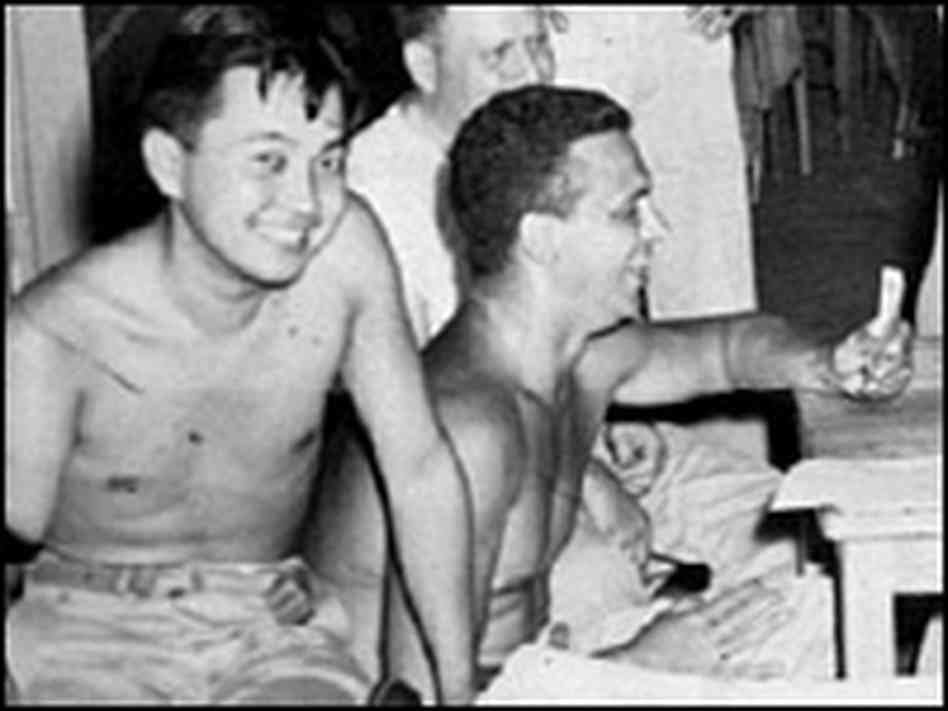
E-Mail: Michaelshannonstable@Gmail.com

Standard

NAQT

By Michael Shannon

NAQT is the designated Naval signal flag hoist for the USS Spence, Destroyer DD-512.

USS_Spence_(DD-512)_in_San_Francisco _Bay,_California_(USA),_on_9_October_1944_

Department of Defense Photo. Leaving San Francisco October 9, 1944

November,  Alpha,   Quebec,   Tango

naqt spence

“Any man, when asked what he did to make his life worthwhile, can respond with a good deal of pride and satisfaction, “I served in the United States Navy.”

 Captain, Patrol Torpedo Boat-109, John Fitzgerald Kennedy, addressing the graduating class of the US Naval Academy, August 1st, 1961

CHAPTER ONE

Today is Memorial day in the United States. It is a federal holiday dedicated to honoring and mourning the military personnel who have died while serving in the United States Armed Forces. The history of Memorial Day in the United States is complex. The practice of decorating soldiers’ graves with flowers is an ancient custom. Soldiers’ graves were decorated in the U.S. before and during the American Civil War. In April 1865, following the assassination of President Abraham Lincoln, commemorations were widespread. The more than 600,000 soldiers of both sides who died in the Civil War meant that burial and memorialization took on new cultural significance. On May 5, 1868, General John Logan issued a proclamation calling for “Decoration Day” to be observed annually and nationwide; he was commander-in-chief of the Grand Army of the Republic (GAR), an organization of and for Union Civil War veterans.  With his proclamation, Logan adopted the Memorial Day practice that had begun in the Southern states three years earlier. The northern states quickly adopted the holiday. In a sense the north appropriated a southern holiday and made it national.

That’s the history of the holiday. This is what it really means. Someone’s life was taken in a battle, a family was devastated. A young man or woman, in the literal flower of their youth was plucked and now is but a memory.  Many euphemisms are used to somehow help the people left behind deal with that terrible loss. “He gave his life,” and “He died a hero,” or; “He was taken from us.” Pleasing things to say but hardly a description of the act of taking that life.

Each of those who are gone has a story. Most we will never really know. Apocryphal story’s passed from generation to generation must suffice. Few events are witnessed by anyone but the participants. Occasionally a person floats to the surface of consciousness and we know. Here is one.

Cousin Donald Polhemus was born in 1922 in Anaheim, Orange county California. His father and mother lived there all their lives and for many years in a little house on Placentia St. was their home. Donald grew up there in the days when Anaheim was just a rural farming community. In the 20’s and 30’s orange groves spread across the Santa Ana river valley and, with a population of just ten thousand, must have been a nearly ideal place to grow up. His father only attended the eighth grade, which was fairly normal for a man born in 1890. When a boy was 13 or 14 he was old enough to work and that he did. His mother kept house and raised a family of two boys, Donald and Henry and a girl, Martha.

Don attended Anaheim Union High school and graduated with the class of 1941. An impending war made it a risky time to be a healthy young man of 18. The handsome, serious boy in the center of the photo below had much to look forward to. With a war likely coming, the promise of adventure would have certainly been on his mind. Seventeen year olds are long on imagination and short on experience. 

anaheim union hs class 1940

Don Polhemus, center, 2nd row. He is flanked by girls, which always a good thing when you are a young man. Like high school kids in all ages they are happy, looking forward to life after school. This is, after all their senior year and they will graduate in June 1941.

The girl to Don’s left is Delfina Pinedo. Her parents were from Morelos, Zacatecas, Mexico and had come to the United States through Arizona to Anaheim in 1919. Her native language was Spanish and along with her brother, sister and parents she worked picking oranges. She would be the first person in her family to graduate from high school. She would live to be 94.

The boy in front of Donald is Clayton Schultz. He is wearing his letterman’ s sweater which has two stripes indicating two years as a basketball player and a star indicating he was captain of his team. He was a Bee basketball and football player. Bee varsity sports were for boys to small for the “Real” varsity team. When he was drafted in 1942, he was working as a tool and die maker at Douglas Aircraft. He may have worked with Don, who also worked at Douglas. Clay did what many young men did then, he considered the odds and promptly joined the Army Air Corps where he was a aircraft mechanic in the 8th Air Force.

The girl on Don’s left is Elizabeth “Betty” Potvin and as you can see by the expression on here face must have been an outgoing and extroverted young woman. We can see that in the fact that she was in many HS clubs, particularly the Drama Club. She is the girl in the photo below. She had the lead in the Junior play “Anybody’s Game”

betty potvin

One of the striking things about the class of 1941 is the number of clubs they had. Some might be considered odd by todays school administrators but were pretty common in the forties. There was a stamp club. My father in law who graduated from Santa Monica HS in 1950 was in the stamp club and left a large collection of stamps. They had a radio club for short wave and Ham radio enthusiasts. Radio being the only way to listen to communications before television and by the 1940’s there was an entire generation of boys and girls who could build and operate home radios. Witness the radios which transmitted from German prison camps during the war. Made of random scraps found around the Stalags they kept POWs in touch with the outside world and provided information for Allied intelligence operators back in Britain.

There were the Girls Athletic Associations, though the girls didn’t participate in anything close to the level they do today. They were restricted to intramural sports only. Girls also had the Domecon Club whose purpose was to prepare them for the joys of domestic life. Another club which has gone by the wayside. There was a Mozart Club, Honor Society, Toastmasters and the first Newman Club in a Southern California High School whose purpose was to foster the Social, intellectual, and spiritual interests of Catholic youth. Speakers that year were Judge White of the Los Angeles Justice Court who lectured on character building, Dr Kersten of Anaheim who spoke on foreign relations and Santa Ana Sheriff Elliot who gave a very impressive talk on Juvenile Delinquency. If there was any problem white JD’s in Anaheim, Hirohito and Hitler would soon take care of that.

There was no problem in finding a job in the summer and fall of 1940 for Don or any other young man who wanted work. The draft, enacted September 16, of that year, was the first peacetime conscription act in United States history. This Selective Service Act required that men who had reached their 21st birthday but had not yet reached their 36th birthday, register with their local draft boards. The country was very divided about the war in Europe and large numbers of citizens were adamantly against any US intervention in the war raging in Europe. Just a month before Don and his classmates graduated, the German army invaded Belgium and France in the first week of May. The French and Belgians were overrun in just 56 days, the British army retreated from Dunkerque, France in an evacuation by the Royal Navy and a citizen flotilla of small craft. The War Office made the decision to evacuate British forces on 25 May, just 15 days after the German invasion has started.

In those nine days from 27 May to 4 June, 338,226 men escaped, including 139,997 French, Polish, and Belgian troops, together with a small number of Dutch soldiers, aboard 861 vessels, of which 243 were sunk during the operation. It is now characterized as the “Miracle of Dunkirk,” but was, in fact a catastrophe of the first order. People in America had been glued to their radios for weeks and for Don and the about to be graduates of high schools and colleges the message must have been very clear.

At 18, all those boys in Anaheim High School knew that by 21 they would all have to register and become subject to conscription. What to do? That was the question asked by young men in every US conflict in which the draft was ever enacted. Go to college, get a job or just wait. For Don, college was likely not an option with the war coming. Although from a working class family, his older brother was studying at USC and was in the Naval ROTC and would be an officer if war came, but with the future so unsettled, work was really the only answer for the time being.  Factories were rapidly tooling up in case of war and jobs were readily available. Don went to work at Douglas Aircraft’s new factory in Long Beach. Just 13 miles from his home, it was an easy hop each morning getting there via the Red Cars. Lunch pail in hand, Douglas ID pinned to his cap, he joined tens of thousands of men and women from all over Los Angeles county building planes. Douglas Aircraft had constructed, in the summer of 1940, an 11-building facility encompassing about 1.42 million square feet of windowless covered work space for the wartime production of military aircraft. from bombers to cargo planes. Initially the plant stepped up production of the famous transport plane the DC-3, but soon added the B-17 flying Fortress to the line  At its peak, Douglas’s wartime employment was 160,000 workers. Don was one.

CHAPTER TWO

Home with his family, Don was sitting around with his dad Henry, his brother, mother, the family listening to the radio on Sunday afternoon. His mother Christine was in the kitchen preparing Sunday supper. The show? “One Man’s Family,” the longest-running uninterrupted serial in American radio history. It told the story of the Barbour family of San Francisco and its 15 minute radio show came on every day. On this day,  the  announcer had declared, “One Man’s Family, brought to you by Fleischmann’s Yeast,” and “dedicated to the mothers and fathers of the younger generation and their bewildering offspring,” The father, Henry doles out wise advice, Fanny plays the supportive and submissive wife, and the children do their best to make their parents proud.

…To be continued Monday May 21, 2023

Michael Shannon is a World Citizen, Surfer, Sailor, Teacher, Builder and Story Teller. He is a member of a sixth generation California family. He lives in Arroyo Grande, California, USA. He writes for his children.

E-Mail: Michaelshannonstable@Gmail.com

Standard

BEISBOL

By Michael Shannon

We drove down to Carpinteria High School for a statewide Odyssey of the Mind competition in 1992. My son Will was a sixth grader and his team was in the competition for the second year in a row. Held at the high school, it drew teams from all over the southern part of the state. If you’ve never been there, Carpinteria is one of the hidden gems of California. With rugged mountains to the east and the Pacific Ocean to the west, it is situated in a way that it can’t grow and so has remained a small town. Tucked in this pocket, the town built it’s school on a large grassy plain at the foot of the Santa Ynez Mountains.

Like all high schools, a large open space on campus is dedicated to athletics. East of the main campus is a large grassy space containing practice football fields and two baseball fields. One being the official field on which league games are played and closer to the school buildings, a practice field. It had a battered backstop, old green painted wood and sagging chickenwire above that. As with most HS fields it had a pitchers mound, and base paths worn in the dry crinkling  grass but no actual bases, just round dusty areas where they might be on a practice day.

There was a Junior Varsity game on the real diamond but the old field was about to demonstrate where the real heart of baseball is.

At around one o’clock on that Saturday men began to arrive, walking in from the parking lot they carried an odd assortment of baseball gear. There was an old cotton catchers chest protector, torn here and there, the stuffing poking out in tufts. It had only  one old leather strap to hold it on, the other being a piece of cotton rope. Maybe a piece of old clothsline. There were a few old and beaten gloves in evidence but no batting helmets. Two old wooden bats, one obviously held together by nails and duct tape and that was it. The nails bent over in the ame style as they were on the bats we used in my elementary school.

By their looks, the players had just come from the strawberry fields in the surrounding area. Half a day Saturday and a little baseball after. They were universally dirty, scuffed workboots, every variety of trousers, worn at the knees, occasional holes. Everyone wore long sleeves, there are no short sleeves in the fields, sun and prickly leaves are hard on the skin. These were men not boys. Men who labor. You could see the states of Mexico reflected in there stature. Chapparitos from Oaxaca, the occasional Chilango from DF, swarthy skinned round men from the mountains of the Sonora and Chihuahua. Happy men, days work done. Time to do a little ribbing, a tease or two and play some beisbol.

Just as little boys do, the bat was tossed, grabbed by a horny palm and hand over hand to the knob to decide home team and first pick.  One by one names were called and stepped to this side or that until all were chosen. Each team had 8 players. They decided that the ninth player on each team would be the last to bat on the opposite team.

Ready to go, the defensive players took their positions. The umpire, one of the players wives stood behind the catcher. She didn’t crouch for she had no gear, so she stood, the better to jump out of the way of a wild pitch or foul tip, her only protection a rather battered old Boogie board. The lanky kid who was to pitch toed the imaginary rubber on that dusty little mound, the catcher wearing the old chest protector, one shin guard, a pair of work boots partially unlaced and a tin hard hat with a well used and ancient catchers mask got ready.

Now I just naturally assumed that this would be the kind of friendly game in which nobody worked too hard or took it too seriously but I was completely wrong. The Lanky pitcher wound up and presented the batter with a sidearm throw that came across the plate at better than eighty miles an hour. If you’ve never seen what a good sidearmer can do with a baseball you’ve missing something. They can make the ball hop or dip, wriggling like a worm on a hook. Lest you think the batter was surprised, think again. These guys had obviously played  before. The hitter tapped the second pitch over the shortstops head and beat it on down the line, his greatest fan, the umpire, screaming at the top of her lungs, “Apurate, apurate mijo,” as the batter hustled down to first. These guys played for reals.

The game went on for a good two hours. Changing sides, the gloves were exchanged and the catchers gear shared. The other hurler was a stocky dark skinned middle aged man who was a junk ball pitcher. He had a whole bag of tricks. Knucklers, sliders, drops, a rudimentary fastball that he never threw over the plate, not even once. On purpose of course.

The game was an absolute pleasure to watch. There were a couple home runs, one that rolled under the bleachers on the soccer field where the center fielder had to crawl underneath in order to fetch it. There was much laughter and good natured back and forth, the fans, including me had a wonderful time.

Given a good field, proper gear and uniforms, these guys could have beaten a decent high school team. After nine innings of play they packed it up, pulled some cervezas from their coolers and arm in arm walked off the field. They left me knowing that I had just seen real baseball, played just for fun and nothing else. It is still a cherished and serendipitous memory because it was such a surprise and I had it almost to myself. The kind of thing where you sit, hug your knees and smile. Like a fool.

This may seem like a “story” but its not. It really happened. I played and coached baseball for over 20 years and its the only time i’ve seen anything like it. I wish I could see it again. If you’re down in old Mexico you can see these games in every dusty little town. Mexico is a serious baseball country. So if you’re traveling somewhere on a Saturday afternoon keep your eyes open, it might happen to you. If you’re lucky.


Michael Shannon is a writer, traveler and was once a pretty good man with a glove. He lives in Arroyo Grande California.


Standard

THE DEAD RIDE HARD

A SHIRLEY SHANNON MYSTERY

ONE

It was a hot night in the city of angels. The Santa Ana was comin’ in from the San Gabriels like an express train loaded with coals from the devils furnace. I was upstairs in my office in the old John Marshall Building. The fan in the corner doing no more good than if it was off, might as well throw it out the window.

I reached down into the desk drawer and hauled out the bottle of bourbon I kept there for inspiration. I found in right next to my 1911 Colt auto, yeah the one I brought back from the ass kickin’ we give the Krauts. Shoulda paid the government for it but I’m not that kinda guy.

Being a private dick has its compensations, one of which is plenty of time to put yer feet up and contemplate the gams of my secretary Vivian. She’s painting her nails and paying no more attention to me than she would the brick I use to prop the door open when I’m trying to get a little breeze into this oven. 

The phone rings with a jangle that punches me right in last nights hangover. Viv picks it up and opens her carmine red lips, takes out her unfiltered camel that smells like it came from one, and says with a purr, “Shirley Shannon, private eye, watcha want?“ God, she’s great. Keeps the lightweights away, that voice gives ‘em the willies.

“It’s fer you,” she says, “It’s that dick Red Baker down at Robbery Homicide, says you better hop on down there, toots sweet. Says it’s important. Thats a laugh. He wouldn’t know important if it walked up and kissed ‘im on the mouth.” She puts the phone back on the hook like a construction worker humpin’ a jackhammer. Thats Viv, all soft and sweet; charmin.’

As usual the elevator in headquarters ain’t workin’ and I had to hump up the stairs to the third floor. The door to the homicide office ain’t so clearly marked. Half the letters is gone, it says Homi now, ya know like the spics say up in Boyle Heights when their talking to each other. Sorta fits though, the LA Dicks do a lotta business up on the East side.

I strolled down the row of battered old desks, most of ‘em empty, but a few heads looked up and ignored me. I ignored them back. Mutual disrespect. Cops don’t much care for guys who are private, ‘specially one who used to work outta this same office. Yeah, I use ta be a cop. Least ’til the bottle and a dame queered the deal. Chief was happy to see my ass go out the door, but like a nightmare I’m still in his head.

“Jeez Shirley, you look like someone just dug you up, maybe I outta check with the Angelus Rosedale, see if they have an empty hole with no one in it.” Red reached up with a right hand, looked like a catchers mitt and took the cheap cigar out of his mouth, “Boy do I got a doozy here.”

I pulled up a chair a flopped down in it like a sack of barley, tired, barley in the distilled form being the reason why. I took off my battered Fedora, wiped my forehead with the backa my hand and said, by way of nothin’, “Hot enuff for ya Red.” He tilted his head back and a grunt which I took to be a laugh bubbled up from his throat. He cocked his head and spat something brown into the wastebasket next to the desk and said, “Kiss my ass, Shannon, I got enough ta worry about without you bein’ such a wise ass.” He shoved a battered file folder across his desk. “Look at this will ya, I wanna know what ya think.” I opened it up and looked at the top sheet. Picture of a cheap hood, greasy hair slicked back, mouth, couldn’t tell if it was a smirk or a sneer. Those bastards must practice in front of the mirror. Always wonder what they think, is it gonna stop a slug? Might shoot ‘em just for doin it, if ya know what I mean. “Name of this piece a garbage, one Steve Campodonica jr. Shirley,” Red went on, “ found him face down on that old has been actress Laura Howards’s carpet, she says she stuck him with a kitchen knife, got ‘im in the gizzard. Bad end for Mickey the bosse’s chief enforcer aint’ it? Killed by a woman. He figured he was real tough, course that actor Sean Conners damn near broke Campodonica’s wrist when he stuck his rod in Conner’s face last year cause he though Conner’s was shtuppin’ the old bag. Steve was a Marine in the Pacific too, musta been handin’ out tea towels though. Not so tough.” Red leaned back in his chair, creaking under his weight, pointed at the file and said, “I need ya to do me a favor for old times sake…..

I loafed down the stairs, thinkin.’ Was I gonna get myself into another mess? Peepin’ Johns about to get divorce papers or servin’ writs was the usual stock in trade for private dicks, boring , but it brought in the shekels that kept Viv in silk stockings and lipstick. Paid for the dump I called an office too. Not to much stress either, maybe the occasional schlub needed to be knocked around, but hey, a guy’s gotta have a little fun in this world before he checks out. Know what I mean?

I was crossin’ the lobby, headed for the door, tryin’ to get outta there to clear the cop stink off me when I heard, “Hey girly, still got that name,” followed by laughter that sound like a file rubbin’ across some sheet metal. I knew I shouldna turned, but I did. I clocked  a  big lump leanin’ on the receptionist’s desk. It looked like it was an even fight, would the desk hold him  up or not. He had his fedora pushed back on his head, showin’ his thinnin’ hair, his tie pulled down, some kinda peacock printed on it, wearin’ a brown suit musta been made out of a surplus army tent by the looks of it. He had the butt of a cop’s 38 special stickin’ outta of his pocket, the only thing he had in front coulda’ passed for the business end if you know what I mean. “Stuff it Pigmeat,” I said, “Rolled any drunks lately?” I strolled over towards him, sayin, “Jerry, how come they ain’t booted you outta here yet, must be some silk lined pocket you’re in.” His little pig eyes, the pupils the size of BB’s narrowed, “Take a hike Shirley, you ain’t wanted around here. Get it, dirty cops get thrown out with yesterdays garbage. Go back to that dump of a office with that trashy dame you got and don’t come around here no more if you know whats good for you.”  I shoulda’ give him one right in the beak right there, woulda saved a lotta trouble. Instead I said, “I’ll pass along you compliments to the trash dame, see if she wants to return it.” The receptionist snickered. Jerry snapped his head around and gave the girl a rancid look, “Cut the gas Baby, take the word from the bird and mind your business and you might last a week here.” She lowered her eyes to her work but not before giving me a sly little wink. She knew the score. 

I decided to hoof it back to the office, give me some time to think about what I’d just seen. Figured I’d head down Spring to 4th and back to the dump we politely called the office. Once I hit the concrete, I could hear the squeak of brakes behind me.I turned and saw a beat up hack tryin’ to slow down, the binders soundin’ like someone wringin’ the neck of a cat. Could only be one car in the whole town sound like that. 

“Oi Shirley, need a lift?”  The gal behind the wheel was the only skirt drivin’ a cab in LA. Tillie Picadilly we called her. She was just a slip of a gal, 100 pounds wringing’ wet, Cats Eye cheaters always slipped down on her nose, talked funny ’cause she’s from London’s east end. She hooked a doggie in ’45 to get inta  the country and then dumped him when he wasn’t useful no more.

“Wotchor, Shoil?” she questioned. “Hop in and I’ll roll you down to that trash heap closet you call an office, could’n swing a cat in there could ya? Can’t do no better?” What could I say, I fisted open the front and crawled into her heap.

“Hope ya feel special, sitin’ in front, ain’t to many gets to,” She said. She took her foot off the brake and we rolled down the street back to my place.

“Flip me an oily rag, Shoil, I know ya got plenty Bees and Honey in the Rattle and Clank.”

“When you gonna’ learn to speak english Til’? “Whats the hell does that mean anyway?”

“A fag, Shoil, you damn Yanks stole plenty ah things from us British, but hit ain’t English.” She replied. “Giv’ us a smoke Shoil.”

I shook out a Chesterfield from my pack and she stuck it in her face. I scraped a match with my thumbnail and she looked over and lit up, not watching the road, which she didn’t often do anyway judging by the condition of the fenders on her heap.

She pulled up to my building, judging her distance by bouncing her front tire off the curb.

“Gates of Rome, Shoil,” Tilly said, “Oi, “Give us a Butcher’s at your paper mate.”

I’d forgotten I was still carrying the times and I flipped it to her. She clocked the front page a moment and then, “Humph, think that old slag did for the hood?”

“Couldn’t say Til.” I turned and headed for the stairs.

“Oi, Shoil, Ya forgot the bread and honey, float me a tenner and I’ll buy you a drink at the boozer later.” She was laughing now.

“Sure thing Til,” I said, handing her the double sawbuck. I turned and tripped up the apples and pears to the office, thinking about how, whenever I was around her I learned more about whatever the Brit’s called English. Apples and pears, stairs, there’s one for ya.


Standard

Rick and Louis

casablanca

That old film Casablanca was on last night. If ever a film was made at the right time this was it. Set in Casablanca Morocco in 1940 it is primarily a love story. When you watch it today, few, I think, have the background knowledge that even the most casual person would have had when the film premiered in November 1942. It was still dark days in America. Millions of families had sons and daughters in the armed services. Already the telegrams were arriving at front doors all over the country.

The Nazi’s had overrun France and Belgium in the summer of 1940. The continent of Europe, Eastern Europe and Much of Asia was in the hands of the Axis. The Wermacht was driving across north Africa towards Egypt. Pearl Harbor, Wake Island, The Philippines were gone. Shanghai, Hong Kong, the Dutch East Indies were in Japanese hands and they were driving South through the Solomon Islands toward Australia. Britain was stoically enduring the Blitz. Hope was in very short supply. Unlike today, no one knew the future.

This story of an American that risked his citizenship and his life to fight for the Republicans in the Spanish Civil war. A refugee in Paris right before the Nazi’s rolled. A woman whose husband had been imprisoned in the Theresienstadt concentration camp in Bohemia and was thought to be dead. Add a menagerie of expatriates, Sascha, the Russian bartender infatuated with Yvonne, a French refugee who had left Nazi-occupied Europe. Señor Ferrari the unctuous, unscrupulous man of all that is duplicitous. Captain Louis Renault the Prefect of police always looking out for the main chance though with a wink and a nod. Major Heinrich Strasser the SS commander, thoroughly Nazi, evil, cold and thoroughly deadly. 

In the final scene as Rick and Louis stroll off into the foggy darkness, the frenchman with his impish grin and gallic swagger, Rick, with his side to side stroll trailing the smoke from his ever present Gauloise, the credits role and you are left with the thought, where did they go?

Maybe This…..  

fff

The Jeep with the Free French cross of Lorraine on the hood rolled slowly up the Rue Buffon and gradually came to a stop.

“Don’t touch the brakes Sam, They screech like a cat with his tail in the door,” the officer in the passenger seat quietly spoke, “Don’t want to draw any attention from the Krauts.”

” Yessir Mister Rick, I hear you,” said the driver in his unique deep south accent, “I ain’t fixin’ to get shot just yet.”

The slim Captain in the uniform wearing the French blue and yellow shoulder patch of General Leclerc’s 2nd Division slid out of his seat and walked back to the armored personnel carrier. As he passed the second jeep in line he said to the soldier manning the .50 caliber machine gun mounted in the back seat, 

“Keep an eye on the Jardin de Plantes there,” the captain said as he pointed left. “Who knows what might be in there.”

 “Oui, mon Captain.”

“And corporal, remember there are two of our boys in there. don’t be too quick on the trigger” 

“Certainement.” The Caporal said, taking a long pull on his Sweet Caporal and then pinching it out and putting the butt in his pocket,

“Alors, I will not shoot the americain Shirlee, Ma raison d’être, n’est-ce pas?”

Captain Blaine smiled, “Je suis d’accord.”

The Captain approached the personnel carrier, stepping up on the running board to speak to the Major in the front.

“Louis, lets wait here, Sergeant Shannon and Corporal Fluerot are pushing through the gardens to try and snoop out any activity along the river. We should  be careful here, we might be the first unit to reach the Seine.”

I agree Ricky, “It’d be unfortunate to be shot now, we’ve come such a long way from Casablanca and Brazzaville, eh?” The trim little Major replied.

He slipped down from his seat, turning back to grab his carbine, he said,

“Lets walk up to the jardin de plantes vivaces, Shannon should be back soon.” He snapped of the safety on his M-1 and started for the gate.

The two officers walked along the side of the Galerie de Botanique towards the Allee de Justieu, turning left into the trees. Waiting for the Sargent, Major Renault reached into his blouse and offered a crushed pack of Gaulois to Captain Blaine.

“Thanks Louis,” he said, slipping the cigarette into the corner of his mouth and leaning down to the proffered match. Captain Blaine leaned back against a tree blowing smoke upward, he slumped slightly, plainly weary.

“You know Louis, we’re a long way from June 1940. Morocco, Algeria, Libya and the desert, chasing the krauts all the way. It makes those nights in Casablanca seem like a dream, doesn’t it?”

The little Major looked down, fingered his smoke, rolled it between his fingers and replied,

“D’accord Ricky, it does, I think of those nights often. Ils etaient de bons moments. Perhaps again some day.”

A slight rustling along the alee caused the men to slip behind the trees and bring their weapons up.  Sergeant Shirley Shannon appeared like a wraith from the nearby trees, the officers sighed with relief and stepped out to take his report.

“We saw nothing in the jardin or across the river Sir, Doesn’t mean they’re not there though. Caporal Fluerot is still back there keeping an eye out. What would you like to do?”

“What do you think Louis?”

“Lets roll up to the Boulevard de I’Hopital, from there we can see the Pont d’Austerlitz and get a good look across the Seine. We haven’t seen any Krauts yet and that worries me.” “

Shirley, he said, “Go collect the Caporal and meet us at Place Valhubert. Be careful and stay back in the trees, Eh? Watch for any movement in the windows across the river, could be snipers.”

“Yessir Major.”

Sergeant Shannon and  Corporal Fluerot disappeared into the trees, silent as wraiths the way experienced combat soldiers move. Sliding quietly on the balls of their feet as if feeling for danger under the earth. Shirley Shannon had grown up in the sweet little valley of Arroyo Grande, a farm boy, he was descended from the hollers of West Virginia, learning to hunt almost before he could talk. He could read the ground and all around it as if it were a classic book. Fourteen generations of backwoodsmen had cured the man like a good ham, lean and crusty, sweet too if you ever saw the inside. So tough on the outside, phlegmatic, almost wordless, he led his men by example, his only goal, to get them through to the end. Like many soldiers, war was the thing that brought out his selflessness and nobility.  Perhaps not apparent until you saw him tending to his flock on the field.  He was that rare thing, a veteran soldier, a killer, who taught his charges how to stay alive.

Move slowly, be quiet, don’t walk in front of doorways, shut up, Don’t smoke on patrol, take care of your weapons, watch the veterans, keep your eyes open and your head on a swivel, quiet does not mean the enemy is not there, always be prepared for a fight, the first shot is the most effective, kill the Krauts and get the hell home.

They all, those that had survived the two years, remembered how it was in Tunisia. Inexperienced but brave to a fault they learned their lessons the hard way. The German Africa Corps kicked the crap out of them. Vastly more experienced, the Wermacht taught them lessons that could only be learned on the ground. The cost in men was terrible, but slowly, but surely they learned how to pay off the debt those young men left in graves in Tunisia, Sicily and the Italian mountains had left them. Morals, ethics and pity had to be put away until some other time. 

Rick watched the trees, focused on nothing, wondering how it was that two young guys, one from Steubenville, Ohio and one from Arroyo Grande, California had managed to survive seven years of almost constant combat and still be standing.

“You know Louis, Shirley Shannon has been with me since we met on that cattle boat in 1938. Hit it off on the way to Spain to join the Republicans and fight Franco. Every day seems like some kind of miracle. Wonder how much luck is left in that tank, Eh?”

Louis took a deep drag on his Gaulois, “C’est La Guerre Ricky, C’est La Guerre.” he said through a cloud of smoke.

Returning to their vehicles Rick and Louis shook hands,

“Almost there, eh Ricky?

“Right Louis, lets move.”

Jumping into his seat, Captain Blaine said, “Low gear Sam, lets creep up to the end of the street and see if anybody notices.”

“Yessir boss,” The driver said.

Dropping the jeep into low gear and letting out the clutch, he slid the little truck up the Rue followed by the column spread out about thirty yards apart. Stopping just short of the tree line both officers climbed down, motioning the rest of their troops to get out of their vehicles.

“Lets move up,” the captain signaled.

He moved his arm  behind his back to let his soldiers know what he wanted. Then putting a finger to his lips for silence he slowly and carefully began moving forward. Spreading out, the column moved toward the Boulevard. The Port D’Austerlitz slowly came into sight. The advancing French patrol, though you could hardly call it French, there being few Frenchmen in it, was made up of Spanish civil war veterans who had fled Franco’s army in 1939, at the end of the Spanish Civil war. There was also a  sprinkling of American and British soldiers of fortune. Many of the  soldiers were from the western desert of Arabic Africa. They called themselves Maghrebis and were descendants of a mix of Roman Africans, Carthaginians, Berbers and the Moors who had once ruled all of Northern Africa and Spain. Some of them had been at war literally their entire lives. Captain Blaine and Major Renault knew this. Leading fighters such as these is why they had the most dangerous job of poking what they thought would be a German hornets nest. Sergeant Shannon said the Krauts were like chewing on hornets.

goumiers

Mahgrebi soldiers, WWII

It was no secret that General Dietrich von Choltitz had personal orders from Hitler to defend Paris to the last and then destroy the city. The Allied didn’t know that he commanded only about 20,000 troops and that most of these were poorly trained and  conscripted from territories overrun by the Wermacht early in the war. There were Poles, Romanians Serbs and Russian in the German army. They might not be fighting for the Fuehrer or Duetchland but they would fight to stay alive. As Captain Blaine will tell you, a bullet fired has no friends and you can be killed by the most unskilled and unmotivated of soldiers.

Following Sergeant Shannon, the Captain crept up to the corner of the building that housed the Museum d’histoire naturelle and lying prone behind some shrubs, slipped his  binoculars out of their case and slowly began to glass the buildings on the opposite side of the Seine. All the troops following spread out and went to ground, waiting. The Captain motioned the Major forward. Lying very still they spent 20 minutes carefully observing everything up and down the Quai Henri IV. The Major, Captain and Sergeant Shannon talked quietly among themselves, mapping out the order for crossing the Pont d’Austerlitz. Major Renault then retreated and called his other Sergeants and squad leaders forward and began to explain what they were to do.

“Sergeant Berthaud, send a runner back and tell the tank commanders to slowly bring up two of the M-4’s and stop when I signal, “comprenez vous?

Oui Majuer.”

The runner turned and sprinted back along the line of vehicles until he come to the first two Shermans. He slipped around its rear and pulled out the telephone and called the tank commander who was buttoned up in the turret. The tanks soon moved out with the characteristic squeaking rasp of the bogie wheels on the tread dogs.  It moved up toward the head of the line. The Doggies inched out of her way. A Sherman was practically blind and smashed a soldier beyond recognition if he was in the way. Major Renault waved them on as they passed, noting the names painted on the sides, “Asesino” and “Guadalajara.” The dark eyed Spanish tank commanders saluted as they rumbled past. Major Renault noted the emblem of the Free French painted on the hull of each tank and the division patch for the 2nd armored, “Hell on Wheels” stitched on each commanders shoulder. He wondered if, in his lifetime he would ever again know men such as these. Some had been with him since he had driven into Brazzaville in 1940, he and the former saloon keeper Rick Blaine driving a stolen German staff car. He, the Vichy French Prefect of Police in Casablanca at the wheel. Both men fleeing murder charges after the killing of SS Hauptman Heinrich Strasser. A good killing he thought, no regrets there and after four years of killing, barely a footnote to anyone but himself and Ricky.

sherman

The tanks took up position on either side of the Rue Buffon, swiveling their 75mm main guns to cover the approaches to the Pont. Captain Blaine quickly formed two patrols of Magrebhi, explaining that they were to cross the bridge in a rush, one squad on each side. They would be covered by rifleman, the machine gunners and the tanks.

“Do it in a rush,” He said, “Don’t give any Krauts over there a minute to react.”

“Nem sayidi, dabit.” the Moroc sergeant replied, loosening his Koummya dagger in its sheath, “It is a good day sir, for slicing ‘Alemagne throats. He flashed a wicked smile that never reached his eyes.

“Jayid,” the Captain said with a nod, “Move out. Naql.”

The soldiers took up their positions on either side of the Pont d’Austerlitz and at the Captains hand signal they broke into a crouching run. As soon as they did, chips of stone erupted from the stonework of the bridge, followed almost instantly by the distinctive cracking sound of a Gewehr 41 rifle. Several riflemen instantly began pointing to an upper floor window in the Institut Medico building on the right of the bridge where the shots came from.

Captain Blaine ran to the “Asesino ” leapt up onto the sponson and pointed out the window to the commander who briefly spoke into his Mic,

“30 degrees right, Up 5, load HE, fire for effect.”

The tank turret ground around to the right, elevating its gun as it did.

“Fire,” he said and the tank leapt sideways with the explosion, sending up a cloud of dust from the blast wave. Its track slipping sideways on the pave with a characteristic metallic squeak. In a split second an eruption of brickwork, glass and wood on the second floor left the building looking like it had some of its teeth knocked out. The rifle went silent.

Captain Blaine signaled a squad of riflemen to clear the building. The squad of Magrehbi on the right entered a sidewall of the building which they knocked a hole in with a bazooka. No one ever went in a front door, better to shoot yourself than do that. They rolled two grenades inside and quickly followed the blast. A few minutes later they signaled from the second floor window, a smiling Tuareg soldier raised his right hand, giving the signal for all clear.”All clear.” A moment later two lumps of Feldgrau were thrown out the window. Both with their throats cut from ear to ear. No one paid the slightest attention, it had been a long war.

The remaining squad lined out to the left, moving in open formation clearing the buildings fronting the Quai Henri IV as they moved toward The Ile Saint Louis. Once enough of the buildings had been cleared and a perimeter set up, Major Renault ordered the rest of the men and vehicles to cross the Pont. Spaced 30 meters apart the half tracks, tanks, tank destroyers and trucks covered with soldiers rumbled across.

Major Renault called a meeting of officers and non-coms inside the lobby of the building at the corner by the Rue Vieille du Temple.

“Other than the sniper we’ve not seen any Germans in this area.” He said. “What do you think Ricky?”

Captain Blaine said that Caporal Fluerot and his radioman had said that they had heard shooting toward the Hotel Deville but it sounded like small arms only and that he had sent them back up the Quai see if they could find out what was happening. Just then Caporal Fluerot came running down the Quai shouting,

“Major, Major come quick. S il vous plait, you’re not going to believe this.”

Turning on his heel Major Renault followed by Captain Blaine followed the Caporal back down the Quai.

“Qu’Est-ce, que c-est,” the major shouted at the now running Caporal Fluerot.  Shouting over his shoulder, the Caporal said,

“Mon Dieu Majuer, c’est impossible.”

The officers followed the caporal down the Quai l’Hotel deville towards the corner of the Rue de Lobau where Sergeant Shannon was crouching and peering around the corner.

“Sirs. he said, you gotta see this,”

He stood and motioned the officers to step out to see what he was looking at.

“There is no danger, I think”

Major Renault and Captain Blaine stepped around the corner and looked in the direction the sergeant was pointing. Down the Rue Lobau’s wide avenue, perhaps 500 feet away at the intersection with the Rue de Rivoli they could see a barricade. Made of chairs, mattresses, boxes, overturned cars and carpets was a group of civilians.

“The barricades of Paris,” Majuer Renault laughed, “I love this city.” he said. “Lets take a stroll Ricky, looks like we’re home.”

They slung their weapons and spread out to make a smaller target and walked up the avenue. They passed two dead Germans both wearing the insignia of  the 325th Security Division. Shirley knelt down and rolled over the dead Feldwebel. 

“Christ Captain,  this kid can’t be more than fourteen,” Shannon said, “Those idiots don’t have enough sense to know when their licked, do they?

“No Shannon, they don’t. We’re going to have to kill them all before its over.” The Captain shook his head in disbelief at what he had just said. “What is the matter with those people?”

As they approached the makeshift wall of junk, the people standing behind it froze, obviously not sure who was approaching them. Making a mistake about which army someone was in could have fatal consequences. Weapons came up. The officers raised their hands and the Majuer said,

“Citoyens, nous sommes libres francais. The Free French Army. Nous apportons les salutations du président Roosevelt.”

The weapons stayed up. Rick glanced at Louis,

“They don’t seem friendly, what gives?”

“It’s been a long time since they’ve seen a friendly army, Ricky.”

They stopped. Just then, from a doorway on the right stepped a girl. She was very young, perhaps 18 or 19. She wore mens shoes with socks rolled down. A pair of black shorts, high waisted with a red and white checked blouse tucked in. She had dark brown hair which looked like it had been cut short with a knife. She topped that with a French Army Forage cap worn rakishly over her right ear. She had a German MP-40 submachine gun slung over her shoulder and pointed directly at Louis and Rick and they had no doubt she knew how to use it. Most astonishingly she wore bright red lipstick.

“Qui etes vous?” She said.

Jerking the MP_40’s barrel up as she spoke, “Dis-moi maintenant, Tell me now or I shoot. Parlez maintenant, speak now.”

simon

A slow grin spread across Majuer Louis Renault’s round face, his trim mustache twitching, his eyes smiling now,

“Mon Cheri, nous sommes La pour livrer Paris. We are here to liberate Paris, compliments of General Philippe François Marie Leclerc de Hauteclocque, commander of the Free French Forces.”

With that he gave a little bow and smiled again, obviously charmed by the girl.

“Merde” she spat, “We have liberated Paree ourselves with no help from anyone.”  

Majuer Renault reached up and pushed his Kepi back on his forehead, looked at Captain Blaine and said,

“Mon Dieu, Ricky, the Boche couldn’t crush French womanhood, certainment?.” “Mes compliment mon cherie, I see that I am corrected, charmant” and with that he removed his kepi with a flourish and bowed deeply.

The girl lowered her gun and broke into a smile that went right to her brown eyes.

“Allow me to introduce myself she said, “Madamoseille Simone Segouin, French Forces of the Interior, FFI.”

With that everyone pressed forward shaking hands, kissing cheeks and in many cases crying, tear streaming,

“We are free, Nous sommes libres, nous sommes libres.

It was suddenly a frenzy of thanksgiving. Simone grabbed Rick by the shoulders and planted her lips on his, leaving a smear of red lipstick, she threw back her head laughing like a little girl and then moved back in holding him as tight as she could.

girl tank

“Sergeant, Shannon, head back to the column and tell them to come up here to the Rue Lobau, it’s late in the day and this might be a good space to wait out the night before we push on in the morning. It’s a large space and we can set up a perimeter here.”

“Oui, Mon Capitaine, Shannon said and sprinted off.

The officers made arrangements for the soldiers and vehicles. Riflemen were sent into the upper stories of the Hotel deVille and the Mairie de Paris. The rolling artillery was positioned to guard the entrances to the Parvais and the Place Saint Gervais. Finally at 9:30 the officers met with the commanders of the Free French to share Baguettes, cheese and wine and plan for the movement into the center of Paris. Simone said, 

“Soon the leaders of the Forces in this sector will arrive here, there has been very hard fighting with the Les Cochons Boches for the past five days but they are finished now, you will see.”

Soon enough a battered Ford truck with FFI painted on the doors and the roof, creaked down the Rue Rivoli, belching black smoke, as it had obviously been converted to run on coal. One fender was crushed and black, likely from a run in with a German potato masher grenade. One side of the split windshield had a bullet hole right in the center. The beat up clunker had been liberated from the Germans or the French army or Henry Ford himself. Their were two men and a woman in the front seat and perhaps a half-dozen more men and women standing the bed, all armed with captured German weapons and even some French which must have been hidden away since 1940. The truck pulled to a stop in front of the barricade and the driver got out. The people in the back jumped down and then very tenderly pulled three bodies from the bed. They were carried into the Hotel deVille and laid carefully on the polished marble floors. The men dressed in all manner of clothes, three piece suits, one in a chefs apron, some of the women in their everyday dresses, their hair up, looked normal except for the older lady who had a German officers Luger pistol on a gun-belt slung low around her waist and another with a Karabiner 98K Mauser slung and what were apparently two Potato Masher grenades nested in her apron. “

paris woman

At the barricades.

Normal looking people,” Rick observed, “Looking not quite so normal,” he said with a wolfish smile. 

“Who were they, the dead?” someone asked.

“A communist from the Vercours, Henri Thierry and two from the City, the Jew, Cohon and the boy, 14, is Pierre Roban. Shot in the back in the Tuileries Jardin. Batards,” the driver spoke and spat on the pave.

The other man in the front and the woman climbed down from the truck, the man joined the officers  and the woman embraced Simone. Pulling away, Simone turned towards Rick and Louis and said, may I introduce my commander. The other woman removed her beret, shook out her blond hair and slowly turned to face the two men.

Simone said, “Majuer Renault, Capitain Blaine, puts-je presenter mon commandant, s’il vous plait, Madame Ilsa Lazlo.

Sam the captains driver gasped out loud, “Miss Ilsa.”  

“Hello Sam,” She said.

paris ilsa

Commander Ilsa Lazlo. Free French Forces of the Interior.

Standard

THE GREAT TURKEY RACE

swimmin hole

Aunt Mickey and Mom in the swimming’ hole.

My Aunt Mickey and my Uncle Ray had a little ranch in Watt’s Valley, not too far from  Tollhouse. Tollhouse is not a city or even really a town, in those days it was little more than a wide spot on the road to Shaver Lake. It marked the place where the tan and brown Sierra foothills changed to the stacked and twisted granite that make up the great backbone of California, the Sierra Nevada.

Their place was built on a sidehill above the little creek than ran through the property. The creek had a great advantage for the kids that lived and visited there. You see, it’s hotter’n the dickens in Watts valley in the summer. The weather slows things down some. Afternoons are for dozing on the porch and drinking lemonade, trying to stay in the shade because you might as well take aunt Mickeys Sad iron and rest it on your forehead as step out in the sunlight. The air grows heavy, taking a breath is a bit of work and the kids wait for Uncle Ray and my dad to get back from Humphrey’s Station with that 50 pound block of ice they use in the homemade swamp cooler in the living room. Works like this; a tin washtub for the ice which is then covered with an old burlap sack,  the cooling water on the sack is pushed around by an old electric fan. It sorta works, but really, it lets you think something is might be happening when it not. Such is the power of suggestion.

For us kids the best thing was Uncle Rays swimming’ hole. What could be better? Around ten o’clock mom and her sister would drift into the old kitchen. Not a modern kitchen with retro appliances made to look like old times, but the real deal. It had an old sink set in a wooden countertop just under the window that looked out on the corrals where the branding, notching, and nut cutting took place in the spring and fall. Back of that was a view up the hills covered with California Live Oaks, the occasional Hereford doing the same as us, resting under the shade of a tree. In the corner next to the dining room wall was the hulking cast iron stove where uncle Ray made breakfast most days. Bacon and eggs, fresh homemade biscuits from the oven served on plates stamped with ranch scenes, ropes,  brands and handsome white faced cattle. A jelly glass with milk fresh from the cow, a scattering of yellow cream on top, even the occasional captive fly. Put in front of each kid sitting around the kitchen table, some sitting in chairs, some on the bench under the row of windows looking over the road coming up to the house from the creek crossing, breakfast a comin’.

Aunt Mickey and my mother would gather up the fixings and make sandwiches for the trek to the swimmin’ hole. Pure white bread from the bag with the multicolored spots, mayonnaise from the jar kept in the cupboard standing out on the screened porch. Bright yellow mustard smeared on a piece of baloney and squished together with a firm hand then  folded into a waxed paper envelope and stacked in the bottom of an old wicker basket. Throw an apple or two in, some old tin cups and top it with a piece of red and white checkered oil cloth. By the time they were done they were surrounded by boys and maybe a girl, my cousin Karen, a tough little bird surrounded by some boys whom she took no lip from. The kids could hardly wait, they were literally dancing up and down with delight.

Busting out the back door, the only door we ever used, we headed down to the where the pasture gate crossed the road. The little guys would squeeze between the bars, a bigger boy would show off by opening the gate in a manly way. I’m almost grown it said. Down the road we would go the kids wanting to run ahead but held in check by the thought that the big black gobbler might be lurking in brush and trees along the left of the road. If he came at us there was no escape. The right side was a cutback you couldn’t climb, the left side was enemy territory and the only sure fire way to get by him was to be stealthy quiet. If he appeared the whole group would bolt, little legs carrying us a fast as they could go, helped by the downhill slope to the creek crossing. Aunt Mariel carried a kitchen broom for defense. Once we made the turn at the bottom we were safe, at least until the return trip.

Just before the creek a two track road veered off to the right and this we would follow through the pastures watched by phlegmatic cattle gently chewing their cuds. We knew to leave them be, no cowman ever runs cattle. Fat is currency in the cow business. It seemed forever before the little creek gently curved in front of  the cut bank that indicated where the swimming hole was. Down to the edge of the water, kids pulled off there Levi’s, tee shirts and jumped right in. No bathing suits. Modesty might indicate keeping your underwear on, thats what the moms did. They stripped down to their underwear and were mostly content to sit on the bank and watch their kids play.

We did what kid do, splashed water on each other, did a little dunking, big against little and pretended to swim. None of us could, you know. No need to worry much because the water wasn’t over 18 inches deep. Aunt Mickey and mom couldn’t swim either.

Those girls grew up in the oilfields. Oilfield brats didn’t get swimming lessons and they almost never lived near the beach or a river. In fact my mother was scared of the water and it took a whole lot of encouragement just to get her into a pond as shallow as this one. Temperatures in the nineties probably helped. Of course saying it was ninety would just have been a guess. Watts Valley in the summertime didn’t take a genius with a measuring instrument to tell you it was hot. Really hot.

With the youngest out of the water and napping in the shade it was time to take all that pink wrinkled skin home and get ready for dinner. The trip back was slower than the trip out kids completely worn out. As we neared the road up to the house, aunt Mickey walked a little ahead to spy out the pasture in front of the house, broom at the ready, to see if the big black Tom turkey was in sight. If he was hiding in the bushes we could be in trouble. If he was out in the pasture, same thing. He figured he was the boss and he wasn’t interested in having anyone trespassing on his territory. He would put his head down, spear you with his malevolent eye and charge like Ghengis Khan, blood in his eye, beak ready to draw the same. Flapping his wings he grew in size, seemingly moving like an express train as he boiled up the little hill. Kids, moms and aunts bolting for the gate, surrounded by shrieks like the secesh coming through the wheatfield. We, like the Yanks at Chancellorville, skedaddled as fast as we could. When we hit the gate, kids were squeezing through the bars like Cheez-It from the tube. Mom and aunt Mariel fumbled at the latch and at the last moment squeezed through. Turkey ran right up to the bars and stuck his head through, hissing, gobbling and jumping up and down, enough to strike terror into any kid. Just to show him who we were, we gave ’em the raspberries and skipped up to the house, triumphant.

About 7 o’clock we were all out on the front porch aunts and uncles, mom and dad sipping whiskey, smoking and telling stories, the kids quietly picking foxtail and clover burrs out of their socks, sipping lemonade and enjoying the cooler evening weather. Down in the pasture, uncle Ray had turned the sluice gate into the grass to keep the permanent pasture alive. Every few hours the gates had to be closed and the next one opened. He called out to my oldest cousin Bruce to “Get your fanny down there and move the watergate before dark.”  Bruce, being fourteen was reluctant to take on any job he could possibly get out of, grumbled his way down to the walk-through gate and ambled down across the pasture toward the creek not paying much attention to where he was. Whatever he was thinking about it wasn’t old Tom, that is until he heard the hiss of the charging turkey. Bruce yanked his head around toward the sidehill and saw the bird coming at him on the dead run. At fifteen you figure you’re almost grown and to show any sign of cowardice is the worst kind of self imposed sin. I’m sure he gave a moment of thought to standing his ground but self preservation won out and he bolted for the house as fast as his lanky frame could go, Mister Turk gaining at every step. Bruce didn’t bother with the gate, no time for that, no, he lifted off like a fighter plane and soared right over that four wire bob wire fence, clearing it by a foot. As he was airborne it occurred to him he’d just been humiliated by a bird in front of the whole family. Instead of stopping, he continued his flight right up onto the porch, flung open the screen door and raced inside emerging a moment later with his .22 to be greeted with gales of laughter by the big folks. Uncle Ray laughed so hard I swear he had whiskey coming out of his nose. Just a moments hesitation on his part was all it took for uncle Ray to say, “Jughead, put that damn rifle down, you’re not shooting that bird.” Bruce silently retreated back inside to nurse his ego and the little kids slyly smirked at each other to see their big cousin put in his place, not so much by uncle Ray but by a bird. In family lore the great turkey race has lived down the decades, each telling adding some little detail. Cousin Bruce became a legend with us little kids but perhaps not in a way he wanted to be.

Bruce got some measure of revenge though. Uncle Ray dispatched that Tom with an axe and we ate him up at Thanksgiving. I never have figured out what part was the best, the delicious terror at being chased, my cousins teenage humiliation or the taste of old Tom with all the fixings. Perhaps its all of them.


Standard