THE DEAD RIDE HARD

A SHIRLEY SHANNON MYSTERY

ONE

It was a hot night in the city of angels. The Santa Ana was comin’ in from the San Gabriels like an express train loaded with coals from the devils furnace. I was upstairs in my office in the old John Marshall Building. The fan in the corner doing no more good than if it was off, might as well throw it out the window.

I reached down into the desk drawer and hauled out the bottle of bourbon I kept there for inspiration. I found in right next to my 1911 Colt auto, yeah the one I brought back from the ass kickin’ we give the Krauts. Shoulda paid the government for it but I’m not that kinda guy.

Being a private dick has its compensations, one of which is plenty of time to put yer feet up and contemplate the gams of my secretary Vivian. She’s painting her nails and paying no more attention to me than she would the brick I use to prop the door open when I’m trying to get a little breeze into this oven. 

The phone rings with a jangle that punches me right in last nights hangover. Viv picks it up and opens her carmine red lips, takes out her unfiltered camel that smells like it came from one, and says with a purr, “Shirley Shannon, private eye, watcha want?“ God, she’s great. Keeps the lightweights away, that voice gives ‘em the willies.

“It’s fer you,” she says, “It’s that dick Red Baker down at Robbery Homicide, says you better hop on down there, toots sweet. Says it’s important. Thats a laugh. He wouldn’t know important if it walked up and kissed ‘im on the mouth.” She puts the phone back on the hook like a construction worker humpin’ a jackhammer. Thats Viv, all soft and sweet; charmin.’

As usual the elevator in headquarters ain’t workin’ and I had to hump up the stairs to the third floor. The door to the homicide office ain’t so clearly marked. Half the letters is gone, it says Homi now, ya know like the spics say up in Boyle Heights when their talking to each other. Sorta fits though, the LA Dicks do a lotta business up on the East side.

I strolled down the row of battered old desks, most of ‘em empty, but a few heads looked up and ignored me. I ignored them back. Mutual disrespect. Cops don’t much care for guys who are private, ‘specially one who used to work outta this same office. Yeah, I use ta be a cop. Least ’til the bottle and a dame queered the deal. Chief was happy to see my ass go out the door, but like a nightmare I’m still in his head.

“Jeez Shirley, you look like someone just dug you up, maybe I outta check with the Angelus Rosedale, see if they have an empty hole with no one in it.” Red reached up with a right hand, looked like a catchers mitt and took the cheap cigar out of his mouth, “Boy do I got a doozy here.”

I pulled up a chair a flopped down in it like a sack of barley, tired, barley in the distilled form being the reason why. I took off my battered Fedora, wiped my forehead with the backa my hand and said, by way of nothin’, “Hot enuff for ya Red.” He tilted his head back and a grunt which I took to be a laugh bubbled up from his throat. He cocked his head and spat something brown into the wastebasket next to the desk and said, “Kiss my ass, Shannon, I got enough ta worry about without you bein’ such a wise ass.” He shoved a battered file folder across his desk. “Look at this will ya, I wanna know what ya think.” I opened it up and looked at the top sheet. Picture of a cheap hood, greasy hair slicked back, mouth, couldn’t tell if it was a smirk or a sneer. Those bastards must practice in front of the mirror. Always wonder what they think, is it gonna stop a slug? Might shoot ‘em just for doin it, if ya know what I mean. “Name of this piece a garbage, one Steve Campodonica jr. Shirley,” Red went on, “ found him face down on that old has been actress Laura Howards’s carpet, she says she stuck him with a kitchen knife, got ‘im in the gizzard. Bad end for Mickey the bosse’s chief enforcer aint’ it? Killed by a woman. He figured he was real tough, course that actor Sean Conners damn near broke Campodonica’s wrist when he stuck his rod in Conner’s face last year cause he though Conner’s was shtuppin’ the old bag. Steve was a Marine in the Pacific too, musta been handin’ out tea towels though. Not so tough.” Red leaned back in his chair, creaking under his weight, pointed at the file and said, “I need ya to do me a favor for old times sake…..

I loafed down the stairs, thinkin.’ Was I gonna get myself into another mess? Peepin’ Johns about to get divorce papers or servin’ writs was the usual stock in trade for private dicks, boring , but it brought in the shekels that kept Viv in silk stockings and lipstick. Paid for the dump I called an office too. Not to much stress either, maybe the occasional schlub needed to be knocked around, but hey, a guy’s gotta have a little fun in this world before he checks out. Know what I mean?

I was crossin’ the lobby, headed for the door, tryin’ to get outta there to clear the cop stink off me when I heard, “Hey girly, still got that name,” followed by laughter that sound like a file rubbin’ across some sheet metal. I knew I shouldna turned, but I did. I clocked  a  big lump leanin’ on the receptionist’s desk. It looked like it was an even fight, would the desk hold him  up or not. He had his fedora pushed back on his head, showin’ his thinnin’ hair, his tie pulled down, some kinda peacock printed on it, wearin’ a brown suit musta been made out of a surplus army tent by the looks of it. He had the butt of a cop’s 38 special stickin’ outta of his pocket, the only thing he had in front coulda’ passed for the business end if you know what I mean. “Stuff it Pigmeat,” I said, “Rolled any drunks lately?” I strolled over towards him, sayin, “Jerry, how come they ain’t booted you outta here yet, must be some silk lined pocket you’re in.” His little pig eyes, the pupils the size of BB’s narrowed, “Take a hike Shirley, you ain’t wanted around here. Get it, dirty cops get thrown out with yesterdays garbage. Go back to that dump of a office with that trashy dame you got and don’t come around here no more if you know whats good for you.”  I shoulda’ give him one right in the beak right there, woulda saved a lotta trouble. Instead I said, “I’ll pass along you compliments to the trash dame, see if she wants to return it.” The receptionist snickered. Jerry snapped his head around and gave the girl a rancid look, “Cut the gas Baby, take the word from the bird and mind your business and you might last a week here.” She lowered her eyes to her work but not before giving me a sly little wink. She knew the score. 

I decided to hoof it back to the office, give me some time to think about what I’d just seen. Figured I’d head down Spring to 4th and back to the dump we politely called the office. Once I hit the concrete, I could hear the squeak of brakes behind me.I turned and saw a beat up hack tryin’ to slow down, the binders soundin’ like someone wringin’ the neck of a cat. Could only be one car in the whole town sound like that. 

“Oi Shirley, need a lift?”  The gal behind the wheel was the only skirt drivin’ a cab in LA. Tillie Picadilly we called her. She was just a slip of a gal, 100 pounds wringing’ wet, Cats Eye cheaters always slipped down on her nose, talked funny ’cause she’s from London’s east end. She hooked a doggie in ’45 to get inta  the country and then dumped him when he wasn’t useful no more.

“Wotchor, Shoil?” she questioned. “Hop in and I’ll roll you down to that trash heap closet you call an office, could’n swing a cat in there could ya? Can’t do no better?” What could I say, I fisted open the front and crawled into her heap.

“Hope ya feel special, sitin’ in front, ain’t to many gets to,” She said. She took her foot off the brake and we rolled down the street back to my place.

“Flip me an oily rag, Shoil, I know ya got plenty Bees and Honey in the Rattle and Clank.”

“When you gonna’ learn to speak english Til’? “Whats the hell does that mean anyway?”

“A fag, Shoil, you damn Yanks stole plenty ah things from us British, but hit ain’t English.” She replied. “Giv’ us a smoke Shoil.”

I shook out a Chesterfield from my pack and she stuck it in her face. I scraped a match with my thumbnail and she looked over and lit up, not watching the road, which she didn’t often do anyway judging by the condition of the fenders on her heap.

She pulled up to my building, judging her distance by bouncing her front tire off the curb.

“Gates of Rome, Shoil,” Tilly said, “Oi, “Give us a Butcher’s at your paper mate.”

I’d forgotten I was still carrying the times and I flipped it to her. She clocked the front page a moment and then, “Humph, think that old slag did for the hood?”

“Couldn’t say Til.” I turned and headed for the stairs.

“Oi, Shoil, Ya forgot the bread and honey, float me a tenner and I’ll buy you a drink at the boozer later.” She was laughing now.

“Sure thing Til,” I said, handing her the double sawbuck. I turned and tripped up the apples and pears to the office, thinking about how, whenever I was around her I learned more about whatever the Brit’s called English. Apples and pears, stairs, there’s one for ya.


Standard

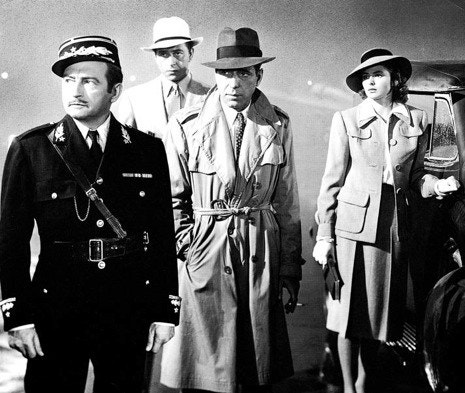
Rick and Louis

casablanca

That old film Casablanca was on last night. If ever a film was made at the right time this was it. Set in Casablanca Morocco in 1940 it is primarily a love story. When you watch it today, few, I think, have the background knowledge that even the most casual person would have had when the film premiered in November 1942. It was still dark days in America. Millions of families had sons and daughters in the armed services. Already the telegrams were arriving at front doors all over the country.

The Nazi’s had overrun France and Belgium in the summer of 1940. The continent of Europe, Eastern Europe and Much of Asia was in the hands of the Axis. The Wermacht was driving across north Africa towards Egypt. Pearl Harbor, Wake Island, The Philippines were gone. Shanghai, Hong Kong, the Dutch East Indies were in Japanese hands and they were driving South through the Solomon Islands toward Australia. Britain was stoically enduring the Blitz. Hope was in very short supply. Unlike today, no one knew the future.

This story of an American that risked his citizenship and his life to fight for the Republicans in the Spanish Civil war. A refugee in Paris right before the Nazi’s rolled. A woman whose husband had been imprisoned in the Theresienstadt concentration camp in Bohemia and was thought to be dead. Add a menagerie of expatriates, Sascha, the Russian bartender infatuated with Yvonne, a French refugee who had left Nazi-occupied Europe. Señor Ferrari the unctuous, unscrupulous man of all that is duplicitous. Captain Louis Renault the Prefect of police always looking out for the main chance though with a wink and a nod. Major Heinrich Strasser the SS commander, thoroughly Nazi, evil, cold and thoroughly deadly. 

In the final scene as Rick and Louis stroll off into the foggy darkness, the frenchman with his impish grin and gallic swagger, Rick, with his side to side stroll trailing the smoke from his ever present Gauloise, the credits role and you are left with the thought, where did they go?

Maybe This…..  

fff

The Jeep with the Free French cross of Lorraine on the hood rolled slowly up the Rue Buffon and gradually came to a stop.

“Don’t touch the brakes Sam, They screech like a cat with his tail in the door,” the officer in the passenger seat quietly spoke, “Don’t want to draw any attention from the Krauts.”

” Yessir Mister Rick, I hear you,” said the driver in his unique deep south accent, “I ain’t fixin’ to get shot just yet.”

The slim Captain in the uniform wearing the French blue and yellow shoulder patch of General Leclerc’s 2nd Division slid out of his seat and walked back to the armored personnel carrier. As he passed the second jeep in line he said to the soldier manning the .50 caliber machine gun mounted in the back seat, 

“Keep an eye on the Jardin de Plantes there,” the captain said as he pointed left. “Who knows what might be in there.”

 “Oui, mon Captain.”

“And corporal, remember there are two of our boys in there. don’t be too quick on the trigger” 

“Certainement.” The Caporal said, taking a long pull on his Sweet Caporal and then pinching it out and putting the butt in his pocket,

“Alors, I will not shoot the americain Shirlee, Ma raison d’être, n’est-ce pas?”

Captain Blaine smiled, “Je suis d’accord.”

The Captain approached the personnel carrier, stepping up on the running board to speak to the Major in the front.

“Louis, lets wait here, Sergeant Shannon and Corporal Fluerot are pushing through the gardens to try and snoop out any activity along the river. We should  be careful here, we might be the first unit to reach the Seine.”

I agree Ricky, “It’d be unfortunate to be shot now, we’ve come such a long way from Casablanca and Brazzaville, eh?” The trim little Major replied.

He slipped down from his seat, turning back to grab his carbine, he said,

“Lets walk up to the jardin de plantes vivaces, Shannon should be back soon.” He snapped of the safety on his M-1 and started for the gate.

The two officers walked along the side of the Galerie de Botanique towards the Allee de Justieu, turning left into the trees. Waiting for the Sargent, Major Renault reached into his blouse and offered a crushed pack of Gaulois to Captain Blaine.

“Thanks Louis,” he said, slipping the cigarette into the corner of his mouth and leaning down to the proffered match. Captain Blaine leaned back against a tree blowing smoke upward, he slumped slightly, plainly weary.

“You know Louis, we’re a long way from June 1940. Morocco, Algeria, Libya and the desert, chasing the krauts all the way. It makes those nights in Casablanca seem like a dream, doesn’t it?”

The little Major looked down, fingered his smoke, rolled it between his fingers and replied,

“D’accord Ricky, it does, I think of those nights often. Ils etaient de bons moments. Perhaps again some day.”

A slight rustling along the alee caused the men to slip behind the trees and bring their weapons up.  Sergeant Shirley Shannon appeared like a wraith from the nearby trees, the officers sighed with relief and stepped out to take his report.

“We saw nothing in the jardin or across the river Sir, Doesn’t mean they’re not there though. Caporal Fluerot is still back there keeping an eye out. What would you like to do?”

“What do you think Louis?”

“Lets roll up to the Boulevard de I’Hopital, from there we can see the Pont d’Austerlitz and get a good look across the Seine. We haven’t seen any Krauts yet and that worries me.” “

Shirley, he said, “Go collect the Caporal and meet us at Place Valhubert. Be careful and stay back in the trees, Eh? Watch for any movement in the windows across the river, could be snipers.”

“Yessir Major.”

Sergeant Shannon and  Corporal Fluerot disappeared into the trees, silent as wraiths the way experienced combat soldiers move. Sliding quietly on the balls of their feet as if feeling for danger under the earth. Shirley Shannon had grown up in the sweet little valley of Arroyo Grande, a farm boy, he was descended from the hollers of West Virginia, learning to hunt almost before he could talk. He could read the ground and all around it as if it were a classic book. Fourteen generations of backwoodsmen had cured the man like a good ham, lean and crusty, sweet too if you ever saw the inside. So tough on the outside, phlegmatic, almost wordless, he led his men by example, his only goal, to get them through to the end. Like many soldiers, war was the thing that brought out his selflessness and nobility.  Perhaps not apparent until you saw him tending to his flock on the field.  He was that rare thing, a veteran soldier, a killer, who taught his charges how to stay alive.

Move slowly, be quiet, don’t walk in front of doorways, shut up, Don’t smoke on patrol, take care of your weapons, watch the veterans, keep your eyes open and your head on a swivel, quiet does not mean the enemy is not there, always be prepared for a fight, the first shot is the most effective, kill the Krauts and get the hell home.

They all, those that had survived the two years, remembered how it was in Tunisia. Inexperienced but brave to a fault they learned their lessons the hard way. The German Africa Corps kicked the crap out of them. Vastly more experienced, the Wermacht taught them lessons that could only be learned on the ground. The cost in men was terrible, but slowly, but surely they learned how to pay off the debt those young men left in graves in Tunisia, Sicily and the Italian mountains had left them. Morals, ethics and pity had to be put away until some other time. 

Rick watched the trees, focused on nothing, wondering how it was that two young guys, one from Steubenville, Ohio and one from Arroyo Grande, California had managed to survive seven years of almost constant combat and still be standing.

“You know Louis, Shirley Shannon has been with me since we met on that cattle boat in 1938. Hit it off on the way to Spain to join the Republicans and fight Franco. Every day seems like some kind of miracle. Wonder how much luck is left in that tank, Eh?”

Louis took a deep drag on his Gaulois, “C’est La Guerre Ricky, C’est La Guerre.” he said through a cloud of smoke.

Returning to their vehicles Rick and Louis shook hands,

“Almost there, eh Ricky?

“Right Louis, lets move.”

Jumping into his seat, Captain Blaine said, “Low gear Sam, lets creep up to the end of the street and see if anybody notices.”

“Yessir boss,” The driver said.

Dropping the jeep into low gear and letting out the clutch, he slid the little truck up the Rue followed by the column spread out about thirty yards apart. Stopping just short of the tree line both officers climbed down, motioning the rest of their troops to get out of their vehicles.

“Lets move up,” the captain signaled.

He moved his arm  behind his back to let his soldiers know what he wanted. Then putting a finger to his lips for silence he slowly and carefully began moving forward. Spreading out, the column moved toward the Boulevard. The Port D’Austerlitz slowly came into sight. The advancing French patrol, though you could hardly call it French, there being few Frenchmen in it, was made up of Spanish civil war veterans who had fled Franco’s army in 1939, at the end of the Spanish Civil war. There was also a  sprinkling of American and British soldiers of fortune. Many of the  soldiers were from the western desert of Arabic Africa. They called themselves Maghrebis and were descendants of a mix of Roman Africans, Carthaginians, Berbers and the Moors who had once ruled all of Northern Africa and Spain. Some of them had been at war literally their entire lives. Captain Blaine and Major Renault knew this. Leading fighters such as these is why they had the most dangerous job of poking what they thought would be a German hornets nest. Sergeant Shannon said the Krauts were like chewing on hornets.

goumiers

Mahgrebi soldiers, WWII

It was no secret that General Dietrich von Choltitz had personal orders from Hitler to defend Paris to the last and then destroy the city. The Allied didn’t know that he commanded only about 20,000 troops and that most of these were poorly trained and  conscripted from territories overrun by the Wermacht early in the war. There were Poles, Romanians Serbs and Russian in the German army. They might not be fighting for the Fuehrer or Duetchland but they would fight to stay alive. As Captain Blaine will tell you, a bullet fired has no friends and you can be killed by the most unskilled and unmotivated of soldiers.

Following Sergeant Shannon, the Captain crept up to the corner of the building that housed the Museum d’histoire naturelle and lying prone behind some shrubs, slipped his  binoculars out of their case and slowly began to glass the buildings on the opposite side of the Seine. All the troops following spread out and went to ground, waiting. The Captain motioned the Major forward. Lying very still they spent 20 minutes carefully observing everything up and down the Quai Henri IV. The Major, Captain and Sergeant Shannon talked quietly among themselves, mapping out the order for crossing the Pont d’Austerlitz. Major Renault then retreated and called his other Sergeants and squad leaders forward and began to explain what they were to do.

“Sergeant Berthaud, send a runner back and tell the tank commanders to slowly bring up two of the M-4’s and stop when I signal, “comprenez vous?

Oui Majuer.”

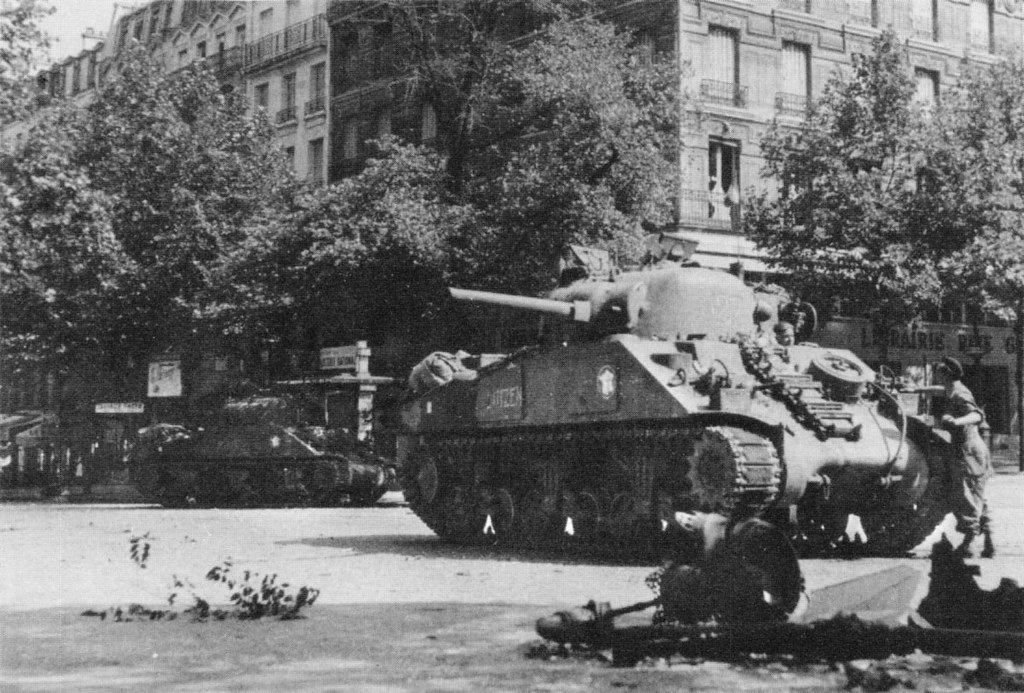
The runner turned and sprinted back along the line of vehicles until he come to the first two Shermans. He slipped around its rear and pulled out the telephone and called the tank commander who was buttoned up in the turret. The tanks soon moved out with the characteristic squeaking rasp of the bogie wheels on the tread dogs.  It moved up toward the head of the line. The Doggies inched out of her way. A Sherman was practically blind and smashed a soldier beyond recognition if he was in the way. Major Renault waved them on as they passed, noting the names painted on the sides, “Asesino” and “Guadalajara.” The dark eyed Spanish tank commanders saluted as they rumbled past. Major Renault noted the emblem of the Free French painted on the hull of each tank and the division patch for the 2nd armored, “Hell on Wheels” stitched on each commanders shoulder. He wondered if, in his lifetime he would ever again know men such as these. Some had been with him since he had driven into Brazzaville in 1940, he and the former saloon keeper Rick Blaine driving a stolen German staff car. He, the Vichy French Prefect of Police in Casablanca at the wheel. Both men fleeing murder charges after the killing of SS Hauptman Heinrich Strasser. A good killing he thought, no regrets there and after four years of killing, barely a footnote to anyone but himself and Ricky.
sherman

The tanks took up position on either side of the Rue Buffon, swiveling their 75mm main guns to cover the approaches to the Pont. Captain Blaine quickly formed two patrols of Magrebhi, explaining that they were to cross the bridge in a rush, one squad on each side. They would be covered by rifleman, the machine gunners and the tanks.

“Do it in a rush,” He said, “Don’t give any Krauts over there a minute to react.”

“Nem sayidi, dabit.” the Moroc sergeant replied, loosening his Koummya dagger in its sheath, “It is a good day sir, for slicing ‘Alemagne throats. He flashed a wicked smile that never reached his eyes.

“Jayid,” the Captain said with a nod, “Move out. Naql.”

The soldiers took up their positions on either side of the Pont d’Austerlitz and at the Captains hand signal they broke into a crouching run. As soon as they did, chips of stone erupted from the stonework of the bridge, followed almost instantly by the distinctive cracking sound of a Gewehr 41 rifle. Several riflemen instantly began pointing to an upper floor window in the Institut Medico building on the right of the bridge where the shots came from.

Captain Blaine ran to the “Asesino ” leapt up onto the sponson and pointed out the window to the commander who briefly spoke into his Mic,

“30 degrees right, Up 5, load HE, fire for effect.”

The tank turret ground around to the right, elevating its gun as it did.

“Fire,” he said and the tank leapt sideways with the explosion, sending up a cloud of dust from the blast wave. Its track slipping sideways on the pave with a characteristic metallic squeak. In a split second an eruption of brickwork, glass and wood on the second floor left the building looking like it had some of its teeth knocked out. The rifle went silent.

Captain Blaine signaled a squad of riflemen to clear the building. The squad of Magrehbi on the right entered a sidewall of the building which they knocked a hole in with a bazooka. No one ever went in a front door, better to shoot yourself than do that. They rolled two grenades inside and quickly followed the blast. A few minutes later they signaled from the second floor window, a smiling Tuareg soldier raised his right hand, giving the signal for all clear.”All clear.” A moment later two lumps of Feldgrau were thrown out the window. Both with their throats cut from ear to ear. No one paid the slightest attention, it had been a long war.

The remaining squad lined out to the left, moving in open formation clearing the buildings fronting the Quai Henri IV as they moved toward The Ile Saint Louis. Once enough of the buildings had been cleared and a perimeter set up, Major Renault ordered the rest of the men and vehicles to cross the Pont. Spaced 30 meters apart the half tracks, tanks, tank destroyers and trucks covered with soldiers rumbled across.

Major Renault called a meeting of officers and non-coms inside the lobby of the building at the corner by the Rue Vieille du Temple.

“Other than the sniper we’ve not seen any Germans in this area.” He said. “What do you think Ricky?”

Captain Blaine said that Caporal Fluerot and his radioman had said that they had heard shooting toward the Hotel Deville but it sounded like small arms only and that he had sent them back up the Quai see if they could find out what was happening. Just then Caporal Fluerot came running down the Quai shouting,

“Major, Major come quick. S il vous plait, you’re not going to believe this.”

Turning on his heel Major Renault followed by Captain Blaine followed the Caporal back down the Quai.

“Qu’Est-ce, que c-est,” the major shouted at the now running Caporal Fluerot.  Shouting over his shoulder, the Caporal said,

“Mon Dieu Majuer, c’est impossible.”

The officers followed the caporal down the Quai l’Hotel deville towards the corner of the Rue de Lobau where Sergeant Shannon was crouching and peering around the corner.

“Sirs. he said, you gotta see this,”

He stood and motioned the officers to step out to see what he was looking at.

“There is no danger, I think”

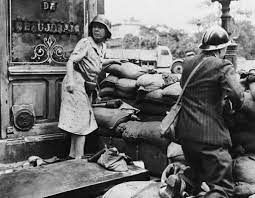
Major Renault and Captain Blaine stepped around the corner and looked in the direction the sergeant was pointing. Down the Rue Lobau’s wide avenue, perhaps 500 feet away at the intersection with the Rue de Rivoli they could see a barricade. Made of chairs, mattresses, boxes, overturned cars and carpets was a group of civilians.

“The barricades of Paris,” Majuer Renault laughed, “I love this city.” he said. “Lets take a stroll Ricky, looks like we’re home.”

They slung their weapons and spread out to make a smaller target and walked up the avenue. They passed two dead Germans both wearing the insignia of  the 325th Security Division. Shirley knelt down and rolled over the dead Feldwebel. 

“Christ Captain,  this kid can’t be more than fourteen,” Shannon said, “Those idiots don’t have enough sense to know when their licked, do they?

“No Shannon, they don’t. We’re going to have to kill them all before its over.” The Captain shook his head in disbelief at what he had just said. “What is the matter with those people?”

As they approached the makeshift wall of junk, the people standing behind it froze, obviously not sure who was approaching them. Making a mistake about which army someone was in could have fatal consequences. Weapons came up. The officers raised their hands and the Majuer said,

“Citoyens, nous sommes libres francais. The Free French Army. Nous apportons les salutations du président Roosevelt.”

The weapons stayed up. Rick glanced at Louis,

“They don’t seem friendly, what gives?”

“It’s been a long time since they’ve seen a friendly army, Ricky.”

They stopped. Just then, from a doorway on the right stepped a girl. She was very young, perhaps 18 or 19. She wore mens shoes with socks rolled down. A pair of black shorts, high waisted with a red and white checked blouse tucked in. She had dark brown hair which looked like it had been cut short with a knife. She topped that with a French Army Forage cap worn rakishly over her right ear. She had a German MP-40 submachine gun slung over her shoulder and pointed directly at Louis and Rick and they had no doubt she knew how to use it. Most astonishingly she wore bright red lipstick.

“Qui etes vous?” She said.

Jerking the MP_40’s barrel up as she spoke, “Dis-moi maintenant, Tell me now or I shoot. Parlez maintenant, speak now.”

simon

A slow grin spread across Majuer Louis Renault’s round face, his trim mustache twitching, his eyes smiling now,

“Mon Cheri, nous sommes La pour livrer Paris. We are here to liberate Paris, compliments of General Philippe François Marie Leclerc de Hauteclocque, commander of the Free French Forces.”

With that he gave a little bow and smiled again, obviously charmed by the girl.

“Merde” she spat, “We have liberated Paree ourselves with no help from anyone.”  

Majuer Renault reached up and pushed his Kepi back on his forehead, looked at Captain Blaine and said,

“Mon Dieu, Ricky, the Boche couldn’t crush French womanhood, certainment?.” “Mes compliment mon cherie, I see that I am corrected, charmant” and with that he removed his kepi with a flourish and bowed deeply.

The girl lowered her gun and broke into a smile that went right to her brown eyes.

“Allow me to introduce myself she said, “Madamoseille Simone Segouin, French Forces of the Interior, FFI.”

With that everyone pressed forward shaking hands, kissing cheeks and in many cases crying, tear streaming,

“We are free, Nous sommes libres, nous sommes libres.

It was suddenly a frenzy of thanksgiving. Simone grabbed Rick by the shoulders and planted her lips on his, leaving a smear of red lipstick, she threw back her head laughing like a little girl and then moved back in holding him as tight as she could.

girl tank

“Sergeant, Shannon, head back to the column and tell them to come up here to the Rue Lobau, it’s late in the day and this might be a good space to wait out the night before we push on in the morning. It’s a large space and we can set up a perimeter here.”

“Oui, Mon Capitaine, Shannon said and sprinted off.

The officers made arrangements for the soldiers and vehicles. Riflemen were sent into the upper stories of the Hotel deVille and the Mairie de Paris. The rolling artillery was positioned to guard the entrances to the Parvais and the Place Saint Gervais. Finally at 9:30 the officers met with the commanders of the Free French to share Baguettes, cheese and wine and plan for the movement into the center of Paris. Simone said, 

“Soon the leaders of the Forces in this sector will arrive here, there has been very hard fighting with the Les Cochons Boches for the past five days but they are finished now, you will see.”

Soon enough a battered Ford truck with FFI painted on the doors and the roof, creaked down the Rue Rivoli, belching black smoke, as it had obviously been converted to run on coal. One fender was crushed and black, likely from a run in with a German potato masher grenade. One side of the split windshield had a bullet hole right in the center. The beat up clunker had been liberated from the Germans or the French army or Henry Ford himself. Their were two men and a woman in the front seat and perhaps a half-dozen more men and women standing the bed, all armed with captured German weapons and even some French which must have been hidden away since 1940. The truck pulled to a stop in front of the barricade and the driver got out. The people in the back jumped down and then very tenderly pulled three bodies from the bed. They were carried into the Hotel deVille and laid carefully on the polished marble floors. The men dressed in all manner of clothes, three piece suits, one in a chefs apron, some of the women in their everyday dresses, their hair up, looked normal except for the older lady who had a German officers Luger pistol on a gun-belt slung low around her waist and another with a Karabiner 98K Mauser slung and what were apparently two Potato Masher grenades nested in her apron. “
paris woman

At the barricades.

Normal looking people,” Rick observed, “Looking not quite so normal,” he said with a wolfish smile. 

“Who were they, the dead?” someone asked.

“A communist from the Vercours, Henri Thierry and two from the City, the Jew, Cohon and the boy, 14, is Pierre Roban. Shot in the back in the Tuileries Jardin. Batards,” the driver spoke and spat on the pave.

The other man in the front and the woman climbed down from the truck, the man joined the officers  and the woman embraced Simone. Pulling away, Simone turned towards Rick and Louis and said, may I introduce my commander. The other woman removed her beret, shook out her blond hair and slowly turned to face the two men.

Simone said, “Majuer Renault, Capitain Blaine, puts-je presenter mon commandant, s’il vous plait, Madame Ilsa Lazlo.

Sam the captains driver gasped out loud, “Miss Ilsa.”  

“Hello Sam,” She said.

paris ilsa

Commander Ilsa Lazlo. Free French Forces of the Interior.
Standard

THE GREAT TURKEY RACE

swimmin hole

Aunt Mickey and Mom in the swimming’ hole.

My Aunt Mickey and my Uncle Ray had a little ranch in Watt’s Valley, not too far from  Tollhouse. Tollhouse is not a city or even really a town, in those days it was little more than a wide spot on the road to Shaver Lake. It marked the place where the tan and brown Sierra foothills changed to the stacked and twisted granite that make up the great backbone of California, the Sierra Nevada.

Their place was built on a sidehill above the little creek than ran through the property. The creek had a great advantage for the kids that lived and visited there. You see, it’s hotter’n the dickens in Watts valley in the summer. The weather slows things down some. Afternoons are for dozing on the porch and drinking lemonade, trying to stay in the shade because you might as well take aunt Mickeys Sad iron and rest it on your forehead as step out in the sunlight. The air grows heavy, taking a breath is a bit of work and the kids wait for Uncle Ray and my dad to get back from Humphrey’s Station with that 50 pound block of ice they use in the homemade swamp cooler in the living room. Works like this; a tin washtub for the ice which is then covered with an old burlap sack,  the cooling water on the sack is pushed around by an old electric fan. It sorta works, but really, it lets you think something is might be happening when it not. Such is the power of suggestion.

For us kids the best thing was Uncle Rays swimming’ hole. What could be better? Around ten o’clock mom and her sister would drift into the old kitchen. Not a modern kitchen with retro appliances made to look like old times, but the real deal. It had an old sink set in a wooden countertop just under the window that looked out on the corrals where the branding, notching, and nut cutting took place in the spring and fall. Back of that was a view up the hills covered with California Live Oaks, the occasional Hereford doing the same as us, resting under the shade of a tree. In the corner next to the dining room wall was the hulking cast iron stove where uncle Ray made breakfast most days. Bacon and eggs, fresh homemade biscuits from the oven served on plates stamped with ranch scenes, ropes,  brands and handsome white faced cattle. A jelly glass with milk fresh from the cow, a scattering of yellow cream on top, even the occasional captive fly. Put in front of each kid sitting around the kitchen table, some sitting in chairs, some on the bench under the row of windows looking over the road coming up to the house from the creek crossing, breakfast a comin’.

Aunt Mickey and my mother would gather up the fixings and make sandwiches for the trek to the swimmin’ hole. Pure white bread from the bag with the multicolored spots, mayonnaise from the jar kept in the cupboard standing out on the screened porch. Bright yellow mustard smeared on a piece of baloney and squished together with a firm hand then  folded into a waxed paper envelope and stacked in the bottom of an old wicker basket. Throw an apple or two in, some old tin cups and top it with a piece of red and white checkered oil cloth. By the time they were done they were surrounded by boys and maybe a girl, my cousin Karen, a tough little bird surrounded by some boys whom she took no lip from. The kids could hardly wait, they were literally dancing up and down with delight.

Busting out the back door, the only door we ever used, we headed down to the where the pasture gate crossed the road. The little guys would squeeze between the bars, a bigger boy would show off by opening the gate in a manly way. I’m almost grown it said. Down the road we would go the kids wanting to run ahead but held in check by the thought that the big black gobbler might be lurking in brush and trees along the left of the road. If he came at us there was no escape. The right side was a cutback you couldn’t climb, the left side was enemy territory and the only sure fire way to get by him was to be stealthy quiet. If he appeared the whole group would bolt, little legs carrying us a fast as they could go, helped by the downhill slope to the creek crossing. Aunt Mariel carried a kitchen broom for defense. Once we made the turn at the bottom we were safe, at least until the return trip.

Just before the creek a two track road veered off to the right and this we would follow through the pastures watched by phlegmatic cattle gently chewing their cuds. We knew to leave them be, no cowman ever runs cattle. Fat is currency in the cow business. It seemed forever before the little creek gently curved in front of  the cut bank that indicated where the swimming hole was. Down to the edge of the water, kids pulled off there Levi’s, tee shirts and jumped right in. No bathing suits. Modesty might indicate keeping your underwear on, thats what the moms did. They stripped down to their underwear and were mostly content to sit on the bank and watch their kids play.

We did what kid do, splashed water on each other, did a little dunking, big against little and pretended to swim. None of us could, you know. No need to worry much because the water wasn’t over 18 inches deep. Aunt Mickey and mom couldn’t swim either.

Those girls grew up in the oilfields. Oilfield brats didn’t get swimming lessons and they almost never lived near the beach or a river. In fact my mother was scared of the water and it took a whole lot of encouragement just to get her into a pond as shallow as this one. Temperatures in the nineties probably helped. Of course saying it was ninety would just have been a guess. Watts Valley in the summertime didn’t take a genius with a measuring instrument to tell you it was hot. Really hot.

With the youngest out of the water and napping in the shade it was time to take all that pink wrinkled skin home and get ready for dinner. The trip back was slower than the trip out kids completely worn out. As we neared the road up to the house, aunt Mickey walked a little ahead to spy out the pasture in front of the house, broom at the ready, to see if the big black Tom turkey was in sight. If he was hiding in the bushes we could be in trouble. If he was out in the pasture, same thing. He figured he was the boss and he wasn’t interested in having anyone trespassing on his territory. He would put his head down, spear you with his malevolent eye and charge like Ghengis Khan, blood in his eye, beak ready to draw the same. Flapping his wings he grew in size, seemingly moving like an express train as he boiled up the little hill. Kids, moms and aunts bolting for the gate, surrounded by shrieks like the secesh coming through the wheatfield. We, like the Yanks at Chancellorville, skedaddled as fast as we could. When we hit the gate, kids were squeezing through the bars like Cheez-It from the tube. Mom and aunt Mariel fumbled at the latch and at the last moment squeezed through. Turkey ran right up to the bars and stuck his head through, hissing, gobbling and jumping up and down, enough to strike terror into any kid. Just to show him who we were, we gave ’em the raspberries and skipped up to the house, triumphant.

About 7 o’clock we were all out on the front porch aunts and uncles, mom and dad sipping whiskey, smoking and telling stories, the kids quietly picking foxtail and clover burrs out of their socks, sipping lemonade and enjoying the cooler evening weather. Down in the pasture, uncle Ray had turned the sluice gate into the grass to keep the permanent pasture alive. Every few hours the gates had to be closed and the next one opened. He called out to my oldest cousin Bruce to “Get your fanny down there and move the watergate before dark.”  Bruce, being fourteen was reluctant to take on any job he could possibly get out of, grumbled his way down to the walk-through gate and ambled down across the pasture toward the creek not paying much attention to where he was. Whatever he was thinking about it wasn’t old Tom, that is until he heard the hiss of the charging turkey. Bruce yanked his head around toward the sidehill and saw the bird coming at him on the dead run. At fifteen you figure you’re almost grown and to show any sign of cowardice is the worst kind of self imposed sin. I’m sure he gave a moment of thought to standing his ground but self preservation won out and he bolted for the house as fast as his lanky frame could go, Mister Turk gaining at every step. Bruce didn’t bother with the gate, no time for that, no, he lifted off like a fighter plane and soared right over that four wire bob wire fence, clearing it by a foot. As he was airborne it occurred to him he’d just been humiliated by a bird in front of the whole family. Instead of stopping, he continued his flight right up onto the porch, flung open the screen door and raced inside emerging a moment later with his .22 to be greeted with gales of laughter by the big folks. Uncle Ray laughed so hard I swear he had whiskey coming out of his nose. Just a moments hesitation on his part was all it took for uncle Ray to say, “Jughead, put that damn rifle down, you’re not shooting that bird.” Bruce silently retreated back inside to nurse his ego and the little kids slyly smirked at each other to see their big cousin put in his place, not so much by uncle Ray but by a bird. In family lore the great turkey race has lived down the decades, each telling adding some little detail. Cousin Bruce became a legend with us little kids but perhaps not in a way he wanted to be.

Bruce got some measure of revenge though. Uncle Ray dispatched that Tom with an axe and we ate him up at Thanksgiving. I never have figured out what part was the best, the delicious terror at being chased, my cousins teenage humiliation or the taste of old Tom with all the fixings. Perhaps its all of them.


Standard

A Walk In The Yard.

dickie1961


I took a walk through the yard today. I had some time. I hadn’t attended the funeral mass but I wanted to be there when they buried my friend Dickie. As always it struck me how the history of a place is written in its tombstones. 

Our little town was once a cozy little place built mostly around farms and ranches, many dating back to the days of the Spanish and Mexican Rancheros who came to this place in the first part of the 19th century. We all knew their descendants, children of those descendants and even their children and as always in small towns they married each other and have produced scatterings of relationships that would be impossible to unravel if you hadn’t grown up here.  In the case of the Quaresma family, unraveling who is married to who, is a practical impossiblity.

The cemetery is a small one. It used to be pretty far out of town but today it is in the center of a bustling community where people passing on the nearby freeway hardly give it a second look. Built as a community project by the Odd Fellows Organization and deeded to the town long before it was ever incorporated, it stands today as a monument to local history. When you first see it, it has no particular grace except for the rubble stone wall that encloses two sides of the field. Built of a local golden-red stone by the WPA during the depression it is roughhewn but has a certain grace which is fitting for its purpose. The oldest section which dates to the late 19th century still has tombstones but the newer section has fallen prey to economy of budget which decrees flat markers so the lawn mowers can run in straight lines. 

It’s worth a walk. You can see many people you know. That is only in your memory of course, buts it’s real enough for me. 

I would see the old boys from my dad’s poker club, Ed Taylor, Oliver Talley, and Vard Loomis, They used to come out to our house on poker night and it was a pretty big deal. Mom had to disappear, she and Hazel or Gladys would get together and make a night of it. My brothers and I helped my dad move the kitchen table into the living room where he covered it with the green felt table cloth, the chip rack, highball glasses, some peanuts and other snacks. The players brought the liquor, dad supplied the mixers. Soon enough the cars would arrive, coming up the dirt road to our place, the men trooping in the back door, no one ever used the front door, ever. There was lots of laughter and jokes, the kind of goodwill men share, it was almost as if they hadn’t seen each other for months, though they probably did meet just yesterday at the packing shed or the truck dock or even just stopped in the middle of the road talking with the windows down. Soon enough the play began. These were serious poker players, intent. The room soon had a cloud of cigarette, pipe and cigar smoke, that was Oliver Talley and John Loomis with cigars, the thick smoke pressing down from the ceiling as the men squinted at their cards. They never played a game with wild cards, only games like Stud, mostly five card, seven being considered frivolous. Low ball, high ball or hi-low, games they had all played most of their lives. We kids would fall asleep, snuggled in our parents bed where we could listen or peek through the keyhole, slowly fading away, thinking we were privy to the secrets of men.

Over by the row of trees in section B are the stones for Patrick and Sarah Moore, who raised my grandmother Annie Gray Shannon, who was Mrs Moore’s niece. Sarah died in 1900 and is one of the oldest residents of the cemetery, Pat is next to her, gone in 1905. Cancer killed her when she was just 61. Both born in Ireland, They immigrated to the United State before the civil war. In fact they were citizens by fact of residence before the 1882 immigration law. Considered to be “first general immigration law” due to the fact that it created guidelines of exclusion through the creation of “a new category of inadmissible aliens.” I suppose there are many in this cemetery who may not have been admitted to the country today. All of the original Shannon’s came to the U S before there were laws that restricted entry to the country. About the only thing that could keep a person out were disease or a physical impairment that would not allow you to work. Luckily my ancestors must have been healthy. Considering the century we come in we were probably indentured servants. The first of our family was likely forcibly sent to America after the Battles of the Cromwellian Conquestof Ireland. This was the incredibly brutal crushing of the Irish Republics by the British under Oliver Cromwell. Over 70,000 Irish were transported to the new world as indentured slaves. Ireland entered a period of mass famine and Bubonic Plague. This constituted the first of the waves of dispossessed Irish to come to America. 

Section C is our place, My great grandfather John  Edward, My Grandparents Jack and Annie, Mom and dad and my uncle Jackie. Nearby my nephew David who died at just 26′

The old section of the cemetery is thick withe names of the Irish. There is John Corbit of Corbett Canyon, Patrick Donovan, Daniel Rice, who built the stone house on Myrtle St, William Ryan, once the owner of Arroyo Grande’s largest hotel. George Hendrix whose saloon still exists on Branch Street.

There is Fred Jones, over in section E, whose mother was a daughter of Francis Ziba Branch, the first American to settle here in 1837. Fred came to our school when he was 88 years old to tell us about the lynching of the Hemmi’s in 1886 when he was just fifteen. His father was a participant. His mother, Maria Magdalena Eduarda Branch Jones grew up here when the nearest neighbor was a half days horseback ride away.

The first pioneers, names like Harloe, Paulding, Phoenix, Records, Jones, Porter and Poole. The Whitely’s, Lierleys, Loomis’s, and the Ides.

There are veterans of wars from the War Between the States, Spanish American, WWI and WWII, Korea, Vietnam and the middle east.

My high school friends Don Petersen, just 20 and Pete Segundo  died in Vietnam, My sons friend Michaelangelo Mora, killed in Iraq: they’re here.

You will find Cyril Michael Augustus Phelan from a pioneer family and one of my fathers closest friends. Gus and his wife Kathryn Routzhan Phelan are surrounded by family members, Big Dan Phelan, his wife  Dorothy and son Danny.

Our old neighbor lies there too. Lester Sullivan and his wife Gladys Walker Sullivan. Not only was mrs Sullivan my fathers third grade teacher but she used to invite us little Shannon boys over to her kitchen for milk and cookies. 

There is Cramer Williams, whose grand children I went to school with, my lovely friend Mary, Jimy, and our ranching neighbor Pat.

The Talley’s, in Section M, Oliver, Hazel and Kenneth, Kenny, my first true friend, whose lament was that he was named Kenneth James not Kenneth George because he wanted to be called KG. His brother Donald is there too, who once smacked me across the face with a flyswatter for using his bicycle without permission. Don’s daughter Maryanne, who died much too young, is near. The days I spent in their house on McKinley Street with it’s bright yellow kitchen and the basement with it’s pool table are now a cherished memory. Hazel Talley was one of the most gracious women I ever knew and thats saying something. Women from a certain time had that about them.

The place knows tragedy too. My friend Greg Folkerts, 17, who died in a senseless roll over accident while joyriding with two others on the beach in Oceano. He was universally liked and in a unique tribute, the day of his funeral, which was a school day, high school students were officially forbidden to attend, they cut classes en mass to do so. Death amongst the young is a hammer blow which is never forgotten. It was my first real experience with personal tragedy. He was simply too good to die.

Scattered everywhere are the babies, the greatest tragedy of all. Some who never had a name.

My reason for todays walk is to talk to my friend Dickie. We shared so many things in our lives. We were schoolmates at the old Branch school in the 1950’s. We were neighbors too, he lived a short walk from our place, just walk to the back of ranch, cut across by Machado’s, pass the  Gregory’s, cross the old Harris bridge, head for town, then pass by “Squeaky” Jerry Jesse’s place, and there was Rudolph and Mary’s little house. It was as warm and as inviting as our own; filled with kids. Mary always had a snack for you, homemade, not store bought, the best kind you could ever eat. Made with love. 

When you grow up together, attend the same schools, share almost everyday, the same experience, you grow to know a person in ways that casual acquaintance can never equal. There is also something about being kids. I think because your world is so proscribed by perspective, that is, a very tight focus on the few things you do know about life, the bonding is that much more intense.  

Kids in our school came from a small number of families. There were only about sixty kids in all eight grades. Think about the dynamics of that. There were 13 kids from the same extended family, Silvas and Gulartes, brothers, sisters and cousins. We had 3 Cecchetti’s, all kinds of Coehlos, two Hubbles, some Terras, a handful of Hunts and us, the 3 Shannon boys. Throw in some Gregories, Jurnjiaks, Georgie Rios, a couple of Antonio’s; and don’t forget the other Silvas, Charlie, Lulu and Tina and you had a school. Everybody knew everybody, kids and parents. Our social life was the school. Plays, singing, Christmas, Halloween, we did them all.  

We got along. The families came from everywhere, Irish, Portuguese, Japanese, Filipino, Swiss, Mexican, some so intermixed they could say they had no ethnicity. One of the great experiences was you could see that everyone was the same. Here in the yard, it’s still that way.

As I look down at the place where Dickie lies now, I can remember all the little boys singing Davy Crockett, we little boys in our coonskin caps, sure that we would someday prowl the great backwoods with Davy and his pal Georgie Russell, looking for adventure.   The Robin Hood Club, that gang of little boys who would come a runnin’ to help each other when an older boy transgressed on their rights or territory. You would hear the call; “To the Rescue” at recess and watch the stampede of little guys coming to fight off an older, bigger boy who might be torturing one of the gang. Girls played baseball, boys jumped rope. Everything was pretty equal.

When you see someone you grew up with, he’s still that little boy even if he’s offering you a nip from the bottle of Crown Royal he has stashed in the back of Andy Geremia’s pickup, parked over by the BBQ pit. All grown up with wife and kids, thats my friend Dickie. He was an easy man to love. I liked to stop at his feed store just to shoot the breeze.

Now he’s here and he can’t see me anymore. I think, when I walk through here that it’s not so much people that lie here but broken hearts. Each stone, covered with broken hearts.

Goodbye old friend. I’ll see you.

Standard

WILSON


wilson


Once upon a time, a big grey Tabby lived at the center of a world that cannot be imagined today. He patrolled the universe of death that was northern France and Belgium. In the spring of 1916, in a sector of the Belgian front called “Wipers. he patrolled No-mans land each night, crossing from one side to the other, showing no favoritism to either the Boches or the Tommies who had been very, very busy slaughtering each other for the last two years.    

FOREWORD

If you ask someone what had happened, they might give you a year or use an event to place the story in a particular time. Build a box for the story to reside in. This makes it history. History is not stories, it is fact in the sense that it provides a seemingly solid road marker on which to build time.  Facts are used as if they are stories but it is a mistake to think the two are even remotely related.  A story belongs to the teller and only the teller. He can stretch, revise and change it anyway he chooses. Every time he tells it it will be different. Just because it is written on paper does not make it true. The only truth belongs to the teller, no one else.

CHAPTER 1

Let me tell you a story, a true story. Well, maybe mostly true; some of it anyway. You be the judge.

When I met Harold “Ruff” Schilling, he was an old, old man. Originally from down in Texas he said. Down on the Rio Grande near Redford. The Big Bend country, about as far from civilization as you could get in these United States in the early 20th century. His brown eyes were still clear though. He was whip thin in the lanky drawn out way that country people are and he spoke a little like Waylon Jennings  sounded in his early days, like he was gargling gravel back in his craw. A tall thin man, he must have been a sight to see when he was young, riding horseback along the Arroyo de Iglesias rootin’ steers outta  the scrub brush during the spring roundup. He said “He always had a hankering’ to git outta that country, too hot, too dry and too damn many Messicans.” At the time I was surprised by the implied racism but later I learned his mother came from Mexico and the population of Redford was almost entirely Mexican, in fact, he said that, “If you didn’t know which country you was from, you’d have a hard time tellin which a one you was in.”

He was living out his days at my in-laws rest home in California when I knew him. He would sit in his chair just to the left of the front door looking into the distance and seeing what no one else could, what no one else cared about. Any family he had left was down in Texas; he said “His son don’t give a damn for me, I been spectin’ him to come through that door for years but he ain’t done it yet, guess he never will.”

Staying there was a rough deal for a man that loved to talk. Like an old bull out to pasture, too old too breed and to tough to eat, he whiled away his days watching a little TV and waiting. We both knew for what. 

It turns out he was with the railroad most of his life. Forty years he worked for the Santa Fe and the Union Pacific, starting out on the track gangs after the Great War and staying with it until 1961 when he retired as an engineer. He loved to tell of his life and if you could make time to sit with him it was lesson after lesson on how things once were.

“Redford, he said, was onct called El Polvo and it sure was, dusty as hell and then some.” He claimed it was the only place he ever lived where you could taste it before you saw it. Harold told me the little town was called El Polvo for about forty years until they put up the post office and were told they couldn’t have a foreign name so decided to call it Red Ford after the Spanish name, Vado Rojo, a location nearby where the Rio Grande met the Arroyo de Iglesias. “It was an old river crossin’ but the damn guvmit was the same then as it is now, they jus made it one word ‘cause they din know no better.” he joked, rolling his eyes upward. 

Harold loved newspapers, said his only real education was reading them. “Went to school off and on for maybe three years but when I was about 13, the post office opened and we could get newspapers in the mail ‘stead of begging from the teamsters whose freight wagons brought what we needed down from the railhead up to Alpine.” 

“Now, Redford wasn’t much, had an old square and mebbe four stores, a couple cantina’s, a few old adobe houses and some palapa’s for peoples to git under when it was a sizzlin’ hot.” Jeez, I hated that he opined, “Cookin’ in the summer freezing’ your tail off in the winter. If you was lookin’ to get outta Redford, that might jes be enuff for you to makeup your mind.” He went on to say, “Ya know, Southwest Texas is rough, hardly any dirt, everything is rocks, the plants have thorns and stickers and they’s hardly any flat ground. It’s bluffs and cliffs and you might wonder what in the hell anybody in they right mind would live there. I reckon I wondered that ever day I lived down there.” He paused a while, then he said, “Made us real damn tough tho, even my sisters, they rode as good as the men and could do a hard days work like we could. My sister Dulce, she married a rancher up to Fort Davis, give him a couple boys and when he was killed by a horse, why she raised them boys up, sent ‘em to college and ran that big old ranch just as good as him. See, we was tough kids.” Harold said, “Texas makes you hard or it kills you.”

He told me his sister Rosa Encarnacion run off with a young drover from New Mexico and when he left her there in Magdalena, why she just went up to Santa Fe and worked in a bawdy house for a couple a years. In about 1918 she married a big cattleman. “You know, people weren’t so particular  back then as they is now about that sort of thing. They had a flock of kids, sent ‘em back east to school too, why one become a judge and one of the girls was a movie star after the second war. Families are interestin’ ain’t they? One thing though, there ain’t one of ‘em living in Redford.” Harold laughed a little, then said, “Sometime I kinda miss them simple days.”

“See, we lived in a one room “dobe house, older than the hills; in fact it was the hills, made out of them for a fact. Didn’t have no floor, had one door and three windows with no glass. It had three rooms, one in the center and another they had added later on. None of the “dobe was plastered and the oldest part was a meltin’ away. Ma kept the inside clean though, she used to git a bucket of water, take a mouthfull and then spray it on the dirt while sweepin,’ and that sucker was hard as a rock as clean an shiny as a lizards belly. My pap done made a table and we had four old store bought chairs, a couple held together with wire. Nights in the summer we’d haul ‘em outside under our palapa where ma hung the chilis and have our dinner. Ma could make almos’ anything outta cactus, Nopales, I loved that stuff and ma knew how to make it. She had a old wood stove she cooked on and that thing was a job all by itself. Had a reservoir on the side for boiling water and when I was little I musta made a thousand trips a year hauling’ water from the hand pump to the stove. It had three big ‘ol flat plates on the top for cook pots or makin’ tortillas and two holes in the front for bakin’ bread. No one was too happy with her in the summer, ‘dobe holds the heat real good and you’d be a bakin’ long with the bread. In the winter though we loved her cause she kept that little house nice and warm. Have to say she kept me busy when I was little though, haulin’ wood and water, could never seem to keep up.”

“Down there in south Texas we was a good as Mexican anyhow. We all lived together, worked together, married each other and could talk each others lingo. You could throw in some indian talk too. Guess you could say I could speak three languages, not many can do that anymore.”

He went on, “Eight of us lived in that old place, ma, pa and my five sisters They had me after the three older gals and then the twins when I was eight. They was no more comin’ causes pa told me ma cut him off after that. Mebbe thats why he drank a little too much. Or mebbe it was just the hard life. He ran our place and worked on the side for the big outfits to to keeps us all goin. I spect no one would live that kind of life today, but in a way we didn’t know no better. If you don’t have and your neighbors don’t have ,then you’s all the same, ain’t you? Nothin’ to compare your life too, so it don’t bother.” 

“So in 1914, I got this friend, name of Sloat Temple, he lived with us, you see? He was a tall drink of water, red hair and a kinda long nose, made his upper lip stick out a little and when you looked him in the face the shadow of it allus made it seem like he had no teeth. His left eye had a little tilt on the side, didn’t quite line up, made him tilt his head a bit. He was a good boy but just a trifle. He stayed with us ‘cause my ma was that way, takin’ in strays, didn’ matter what kind. “Ma, she’d see you a-comin’ an’ put her hands on her hips and give a little tilt to her head, mebbe give that little squint she give if she’d thought you’d been doin’ sumpin’ wrong, but knowin’ you was a good boy anyhow. It was a mothers look, a grin full of mirth and automatic forgiveness. She never cared too much what you’d been doin,’ she just loved who you was now. She just naturally took in Sloat an’ made him a part of the family.”

Ya see, his pa got hisself shot dead down in Mexico. He had got this job in the mines, some kinda engineer workin’ for old George Hearst at the Barbicora ranch in Chihuahua and whilst he was travelin’ from Ojinaga to Tierra Blanca, the train was stopped by revolutionary troops under General Pascual Orozco. All the gringo’s and federal troops were taken off and the Federal troops immediately lined up and shot dead. Funny thing I heard, is that they didn’t tie ‘em or nothin’, they just stood there like a bunch a sheep and let ‘em do it, funny that. The Americans were accused of aiding the Mexican government and placed under arrest. President Wilson had stopped the sale of weapons to the revolutionary armies after rich American businessmen complained that their property in Mexico was being seized without anyone payin’ ‘em for it. I heard old Pascual was angry because they needed money from the American banks. They was selling stolen cattle they rustled from the big haciendas up to Texas and New Mexico and then usin’ the money to buy rifles and such in the United States. Wilson cut ‘em off an’ believe me, they wasn’t happy. A vaquero we knew who was down there when it happened tol’ us how they done it. They put Sloat’s father and the others back on the train and took ‘em down to Piedras Blancas and locked ‘em in an old ‘dobe store for a couple days. Orozco telegraphed old Hearst and told ‘em he shoot ‘em if’n he didn’t fork over some money to git ‘em off. We heard that after a couple days, they took ‘em out, started pushing and shovin’ them aroun finally pushing them down on they knees an’ tying up they hands behind their backs. Pascual himself came out and looked them over and said old man Hearst wouldn’t pay no money to get them out so they was goin’ to be shot. Said, “Did they have any messages for they families and such?” The vaquero said that Sloat’s pa to old Pascual that he and George Hearst could go an fuck ‘em selfs. “Bastardo,” said Orozco, walked over to him, pulled his revolver, put it on Temple’s forehead an’ shot him dead right there. He motioned to a captain, who walked behind the other three men and shot them in the back of the head. Just left ‘em lying in the dust in front of the store, Dirt in their open eyes, the blood running into the groun,’ the Vaquero said. He said  “They stripped the bodies, took the watches and boots and anything else they could and rolled ‘em in a ditch. After a couple days they spread some lime on ‘em and buried right there.” 

“When the revolution down in Mexico started, lots of the local vaqueros left to join Pancho Villa and Pascual Orozco and our life just got tougher than a nut, cause we had to work even harder. My Pa was tryin’ to run his ranch with almost no help but me, Sloat and a couple little Mex boys. Pa had took us’n down cross the river and we’d snatch up a few hunnert head of cattle, run ‘em back cross the border,  then drove ‘em up to Alpine where we’d sell ‘em to the cattle buyers. No ways it’s legal, but what ya gonna do? Rustlin’ only counts in the US don’t it?” Harold put his head down a little, paused for a while, gimme a little smile and said, “Hell.”  Then he laughed til he shook. “Hell.”

“We seen them Dorados onct. Villa and his men were passing through headed to the railhead at Alpine to take delivery of rifles and artillery he’d bought from the American government. We was moving’ cows over west of Torneros Arroyo and they come up the road ridin’ from Ojinaga where the musta crossed the border. Reckon they come up from Chihuahua city. They was a ridin’ by fours, musta took up most of two miles. They coulda’ been five hunnert of em, believe you me. They was a rough a bunch of killers as I ever seed. They wore them big sombreros and the horses they rode were good lookin’ too, really good mounts, probably stole from the big hacendados down there in Mexico. They carried them carbinas .30-.30’s, a helluva rifle an easy for a horsemen to handle as they was short and light. Didn’ wear no uniforms neither, just whatever they fancied.Them big Mexican hats, each one carried at least a couple belts of catridges, ridin’ them big old Mex single rig saddles with the soup bowl horn and tapaderos. Villa come ridin’ up with his personal killer, Rodofo Fierro, called ‘im El Carcinero,  it’s said he’d shoot you down and not turn a hair. In those days, Villas horse, Siete Leguas was ‘bout as famous as he was and they was both right in front of us. He give us a look and showed us his teeth as he went by. “Muchacho, Que tal? he said. He give us a nod and a wave and galloped up to the head of the line. Jesus, them was some bad lookin’ hombres, made the hairs on your neck stand up too. We give  ‘em a lotta room. I was gonna see some nasty stuff later on, but I never seed any troops that scared me like those boys. Jesus, they was so hard they nearly made you piss your trousers, right there. To me they said, “nada me importa perder la vida,”  (I care nothing about losing my life,) and they meant it. Villa sent them in against barbed wire and machine guns at Agua Prieta in 1915 and they musta been right about that ‘cause they did die, nearly every damned one. Rode right into those guns goin’ hell for leather hollerin’ and a yippin. Didn’ do ‘em a bit of good though, slaughtered ‘em and damn near ended Villa right there.

“They was sumpin’ about ‘em though, you could tell they figured they was good, chin up and all, plenty a swagger. Them Dorados was Villas personal troops, follered him ever where. Seemed like an adventure to me though, Villa and his Dorados was running rings around the government troops down in Chihuahua and Durango. My grandfather said he was just a cheap pistolero and Pancho Villa wasn’t even his real name anyways.” He ‘tol me “Used to buy cows from the real Pancho, he stole ‘em from the big hacendados and I bought ‘em on the cheap. This guy Arango will come to a bad end mijo, you can bet on it.” Turned out in the end what mi Abuelo was sayin’ was Verdad.” Harold said, “Thats what they done too, shot Villa to pieces about 1923.” That whole revolution din’ amount to much in the end, Millions dead and things just kinda went back to the way they’d allus been.” Harold said, “Hard to figure sometimes, ain’t it. All that waste weren’t for shit in the end, corrupt bastards still runnin’ ever thing in the end. Bad as ever.”

“Did see him though, talked to me too.” Harold smiled at that, “Not many can say they seen Pancho Villa anymore, can they? Helluva thing though.”

”President Wilson sent United States troops down our way to Chase Villa back into Mexico after he shot up Columbus  New Mexico. When the army come in with Gen’l Pershing, they had these flyin’ machines up to Presidio and some cavalry at old Fort Polvo just down the road from us.” “Ma worked as a cook and the money was welcome ’cause there weren’t no jobs for any women cept’n whores in those days.” I started hangin’ around the soldiers when I had the time and they were tellin’ me things I never heard before and it was pretty excitin’ stuff for a young guy like me who’d never been anywhere before.” Harold said, “It really got me to thinking’ maybe I wanted to git outta Redford and see sumpin else, you know?” “Them Mexican sojers were a bangin’ away cross the boarder and them beans was a flying’ around all the time. Course our side was a shootin’ back ‘cept no one was gettin’ plugged but the occasional cow, but still, hit weren’t too healthy.”

“I guess I coulda gone down and joined up with Villa, plenty of white folks were doin’ that but I thought, Let them Messicans fight it out amongst theyselves. I weren’t Messican, even if my mother said she was, I expect she was more Mescalero anyway, since I think she come from that part of Texas.” Harold laughed.

“I thought about it for a long time, figurin’ what to do and where to go until I finally decided to light out for good. Me an Sloat figured we needed to dust trail outta there and see sumpin’, ya know? From the Sojers, I’d a heard about the big bust up in France and I reckoned I’d go over  there and see the Elephant.” Harold said he knew from newspapers that President Wilson wouldn’t have nuthin’ to do with the war and If’n we wanted to go I’d have to go on up to Canada to enlist.

Now Harold was born while his pa was in Cuba with the Rough Riders. His pa had taken a ball through his cheek in the fight at Kettle Hill. He was pretty proud of that. He’d said “howdy” to the Colonel when he was in the hospital tent and the Colonel replied “You boys did a capital job with the Spaniards, yes sir, it was a Bully fight. Just Bully.” Pap wore that scar like it was a badge of honor, he allus said, “Hit was the best thing I ever done and I’d do agin ifn the Colonel ast me.”

He had lived his whole life so far in Redford. It was brown and dusty, scattered with rocks like chicken scratch thrown on the ground. Brown like his mothers skin, brown like his fathers hands, brown like all the people who lived there. “Nuthin’ for me now, nuthin’ ever gonna be for me,” he said, “I’d jus die here and they’d bura me under the brown earth. Nobody’d even know I’d ever been. Couldn’t see any sense in staying.”

He continued,”You know, I’d never been more’n 20 miles from home and that just a wranglin’ steers for the Cibolo Ranch, old Milton Favers place. Me’n Sloat talked it over and jus decided to git outta there. We snuck our things outta the ‘dobe, put ‘em in our possible sacks , waited ’til pa was gone for a couple a days and lit out. What I done was to take my ma’s money outtn the Hills Brothers coffee tin where she hid it, figured I’d pay her back some how, and we lit out for the railroad stop at Marfa on the Southern Pacific short line.  Took a couple horse from pa, me n Sloat. Took the worst too, didn’ want to discomfort pa too much.  Sloat forked the old Dun mare  and I had that mossy hammer head gelding my pa stole down in Mexico, he weren’t pretty, and he weren’t worth a damn with a steer but he could put in some miles if ya gave him his head.

Made the ride in three days, Tied the horses at the depot, told the agent whose they was and would he try to send a message back to my folks where the horses was and caught the train east. I ain’t never been back.” 

He thought a bit, then said, “Life out there wasn’t no picnic, but it had its good, My Pa died in about ’34, life had wored him out. He worked so hard, ever damn day, each the same as ta other an’ he hardly ever talked, just said what he needed to say and the rest of the time kept pretty quiet. Ma lived until she was nearly ninety, a miracle I reckon ‘cause she lived such a hard life but she was strong like those Injun women are. She raised up her kids as best she could and we all turned out alright didn’t we? Without any change of expression, he said, ”All this time and I can still smell her.”

The old man sat very still for a while, remembering, I suppose, then without any change in expression, the  tears began rolling down his cheeks. He didn’t wipe them, just let them roll down until they fell on his shirt front. 

Standard

WILSON

wilson


Chapter 2

I think it was a Sunday and I had some things to attend to at the rest home. When I opened the door Harold’s chair was gone. Sadly this wasn’t uncommon, many of the residents were just treading water and waiting to die. If you don’t have any experience with them, you’d be surprised how many of the old folks are essentially abandoned by their families. The check comes in the mail each month like a ticket to linger. Seeing the missing chair, you can imagine that person has gone.  Harold, though was just taking the sun in the patio. He’d dragged his old mahogany chair out and placed in in a corner where he could keep track of the comings and goings and when he saw me, he waved me over and asked if I had a minute or two. I did.

It seems Harold and Sloat rode the SP to San Antone, then the Katy into the Cherokee strip. Thats where they ran out of money. He said, ” We managed to wrangle  jobs on the Chapman/Barnard Ranch north a Pawhuska. One thing we could do was work cattle, ever body in Redford learnt that soon as they was big enough to git on a horse. Workin’ cattle was a dyin’ art in 1915, the big ranches were all fenced and the big cattle drives were as gone as yesterday’s news. We’d left the horses  in Marfa, but carried our rigs. You weren’t much of a puncher if you didn’t have a saddle and bridle. The ranches supplied horses, each man had a string, not your girly horse type but rough stock, soon as jump on your skull as breath, so you’d better know your business. Bunkhouse we lived in was nicer’n our place in Redford so we figured we was on the jump all right. Hell, things was gettin’ better already.” Harold laughed when he said it to, “Things was lookin’ up, yessir.”

We worked for the stud duck, a tough young puncher, name of Ben Johnson, worked with him most of a year, both of us savin’ some money which weren’t too hard, seein’ there weren’t a hell of a lot to spend it on no ways. Pawhuska ain’t got much to do ‘sept git drunk and fight. I didn’t much like either,” Harold said. “We was figurin’ on movin’ on after spring roundup anyhow.

I got a picture in my mind of ol’ Ben too. He’d be sittin’ on top of his horse over by that big old cottonwood tree a takin’ the shade while he give us a lookin’ over. He liked to cross his legs over the saddle horn, relaxin’ like, while he rolls a cigaret, his white Stetson with the flat crown and “no droop” brim kinda pushed back off his forehead a bit and that yellow bandana he allies wore hangin’ down the front of his vest. Being boss-like, he didn’t usually wear leathers but tucked his trousers in the high mule ear boots with the bull-doggin heels. He was the perfect picture of a cow boss.

“Later on, old Ben, he become big boss of that ‘ol spread, a position he held for many years. He come a rough one too, a tough old cobb, I heerd he had some trouble with his kid too. Didn’ get along at all. The kid finally run off and become a wrangler for the movies. We’us good pards tho. Don’t know why he got so rough with his boy.” He said, laughing. “Course I don’t see mine neither so maybe I was no better.”

“They was some good old boys working the big ranches in them days and they was all kinds too.” Harold explained. He pointed at the television in the corner of the room with it’s covey of old birds watching the soap operas and gave me his opinion. “You watch that TV over there, and I gotta tell ya they is all wrong, wrong about ever thing. First of all, we wasn’t all white, they was mex, injun, niggers and even city boys come west from New York city.” Harold laughed, “Why, we didn’t carry no iron neither, too damned heavy and uncomfortable for a man in the saddle. Some carried ‘em in saddlebags, but what you goin’ to shoot anyhow, your foot? No big ‘ol buckles neither, matter of fact we mostly wore braces to hold up our trousers, belts cut into your belly if you rode all day and we did that. And them tight -assed levi’s they’re wearing, why a man cain’t  work in those damn things, no room for your business for one thing. Cain’t use pockets in trousers either. If you is in the saddle, cain’t put nothin’ in ‘em or git nuthin’ out, wore a vest for that. Cowpoke din’t have much, din’t need much. On the trail, just a soogan, a slicker, a extry pair of socks and your makings if’n you needed them. Them cows don’t much care what you look like. Wore just what you needed an nuthin’ else. Maybe the best thing a man owned was his rig and a fine pair of boots. Used to send out for ‘em, scratch a pattern of your foot and they’d send back a pair that fit like a glove. If you saved a little you could have some fancy stichin.’ I allus had to have me some roses on there, Texan ya know. Din’ wear ‘em for work neither, jes fer goin’ ta town. People writin’ them movies is bunch of damn fools,” he said, cowboyin’, was nuthin’ but a laborer on horseback, damned hard work.” 

Harold scratched his head, then opined, “Ya know Mike, we didn’ have much in them days, why just your saddle and bridle was about all you needed to git work. A good California saddle a handmade leather bridle, some hopples, not them grass rope kind, them hurt the horses pastern if they had to wear ‘em overlong, used platted ones when we could still find ‘em. Lots of boys used grass rope for ropin’ but I still used a mex style reata, learned to make ‘em from my grandpap. He rode down to south Texas after the war, he been with Wade Hampton’s Legion and then Fitzhugh Lee’s cavalry division right to the end, surrendered with the General at Appomattax Court House. Grant let ‘em keep they horses and my grandpa rode that ol’ horse all the way down to south Texas. Didn’t cotton goin’ back to South Carolina I guess.

With a twinkle in his eye, Harold said, “Them movie fellers makes a damn sight more money though, so go figure.” He went on to say, ”Seen that Tom Mix onct, wear fancy duds like that an no tellin’ what might happen to ya in the bunkhouse. Yore bunkies might take some exception to them slicker clothes, see, we was proud in the way young men are and thought that ours was the way it should be. Give no truck to some Hollywood actor fool, pretendin’ he was like us, no sir.” 

“I’d guess about a month after I went to work out there, ‘ol Ben hired on a puncher just a little older’n me name of William Perkins, Billy he said to call ‘im.” 

Harold described that boy as, “To tall by half, skinny as a bean pole and all the angles on his face was sharp enuff to cut yer hand ifn you was to poke him. Why he had so much red hair it was a caution. Couldn’t keep it combed, account of it was so thick. He wore a skimmer too, kinda looked like the one Harold Lloyd wore in them old movies.

Harold laughed, said “why he never stopped talkin’ neither, I knew more about him in five minute than I knew about my own mother. He said he run off from a place called Hell’s Kitchen. Seemed to me hit was a heck of a name for a place to live and Billy said it shore was. Said it was chock full of the poorest Irish in New York, probly Ireland too. Said his ma and pa come over from a place called Bally Robert Doagh in ’81. Come on a ship called State of Alabama, stuffed in so tight could hardly breath and they fed so bad hit was worse’n pig swill; they pert near starved. Said, if you was walkin’ to school, older boys would kick the stuffin’ outta ya, steal yer coat ifn’ ya had one, or maybe just for the hell of it. Families livin’ two or three to a tenement, no water, no bathroom, no heat. When pa could work, he’d be lucky to get home with his pay, the shills be draggin’ the men into the saloons so they could take your money for drink.. Them’s comin’ off the boats would work cheaper and you’d have no job. In New York the worst of all for keepin’ ya down were your own people. Those Irish bastards who run Tammany Hall or the Jews down on the lower east side, and the “Eyeties” too. Why I went down ta Hester street once to  see the Jews and they was kids sleepin’ in the alleys, no place to go. Turned out by their parents or the parents are dead.The bosses never give a damn for us, we hated ‘em, but what can you do? They was so poor in New York that they could hardly feed his brothers and sisters so he lit out when he was 14. Said he’d been readin’ them dime novels and thought cowboy’n was the life for him, so he give ‘er a try. He rode a side door Pullman to Billings and got on with a ranch in the Pryor mountains south of there where he learned his trade. He punched cows up to Montana and then tried California some while, I believe he said the Peach Tree outfit near King City. Then come east to the territories and, well, here he was.”

“Ben give him the bunk next to mine and soon enough we was pards,” Harold went on to say. “Now I never been much for talkin’ but ol Billy, why he talked enuff for half a dozen men, which you might think was bad, but remember, in those days there weren’t no radios or television and them nights out on the prairie could be mighty lonesome, so no one minded. Billy didn’t have no mean bones and he could tell a good one.” 

Harold shook his head, smiled a small smile and said, “Ya know, almost nobody could read and even if you could, weren’t much to read from, mebbe an old Leslie’s newspaper or the Police Gazette but soon enuff they was gone fer toilet paper. Ever one knew all those stories by heart cause them that could read, read ‘em aloud to the others, so a man who could string out a tale was as welcome as May.” 

“No matter who he rode with he kept ‘em laughin’, always happy that boy. Purt soon this ‘ol mex from down to Durango way, Zarate somp’n or other, never could keep them messican names straight, they was all named ass backwards by my reckonin,’ Double barreled names the was. Anyhow, he was allus laughin’ an took to callin’ i’m “Perky,” being so damned happy and all, and it stuck. Perky Perkins, ain’t that a hell of a thing?” 

“About them nicknames, most of the boys had ‘em. Hardly anyone used more’n one anyhow. First or last or some made up one was good enuff for us. We’us all young ya know. Cowboyin ain’t no life for an ‘ol man anyhow, too tough. Why there’s hardly a man ever forked a horse, don’t have a broken bone and sure as hell, ain’t no money innit. Better know your business too. A horse can kick like the devil and bite like an allygator. Stomp your boot til your toes are a mash. People now don’t appreciate how much better a car is. Cowboyin’ tho, best damn life there is.”

“That Zarate feller give me my name too. See we had this ‘ol dog name of Bobby, yep, ‘ol Bobby Dog, he was a character too. Damndest smartest dog I ever knew. He took a special likin’ to me right off and when he see me he’d start to barking and running in circles. First one way then ‘tother. Happened ever time. Don’t know why but he did. So ol’ Zarate, he commented to calling’ me Ruff, seein’ how the dog always barked after me. Just some ol’ thing like that and you had a name.

In the summer that dog live under the bunk house. He had some hollows he dug around the ranch buildings too, where he’d lie during the heat of the day, he’d move aroun’ from one to the other with the sun and in the winter he slept inside with us. Now Bobby had one particular habit, he liked to ride horseback. Yep, horseback. He’d a come runnin’ from wherever he was hidin’ and just leap up on the hindquarters of one of the horses he liked just as proud as if he was the King of England. I had this Morgan crossed with an injun pony name of “Wonder.” Boss said they found ‘im the winter of ’11, just a colt, bought froze to death. They took him in the barn and bottle fed ‘im and darned if he didn’ make it. It was a wonder, they said, thats how he got his name, Wonder.” We’d be up before dawn and I’d go down and catch up Wonder, saddle ‘im and lead him up to the hitch rail before breakfast. When I come out, there’d be Bobby Dog a sittin’ on Wonder’s croup, ready to go to work. Ruff, Wonder and Bobby Dog, what a team we was.”

About horses, Harold said, “Them ‘ol ponies was pretty tough too. They’s a mix of all kind of horse. Some Indian, mebbe mix with other breeds sometime, mebbe not. Them plains Indians knew horses and really bred ‘em up for runnin’ the prairie. Ours could work all day and live on jus’ grass, why they never saw a speck grain in all their days. The best knew cattle too, learned to think like ‘em. Some so good you could show off a little and take the bridle off and the horse could still cut out a steer. People think a horse ain’t too smart, but they’d be dead wrong. Real smart they was.”

Harold told me, “The old days of cowboyin’ were gone of course, most of the range was fenced in by then, the big cattle drive was done in the 70’s and won’t see anything like that ever again. We only lived outdoors during roundup in the spring and fall, tho that hadn’t changed much. Still sleepin’ on the ground and eatin’ chuck; beans, beef and ifn’ we were lucky, a pickle for a treat. The cook, we always called ‘im Sally was an ol’ broke down puncher by the name of Jimmy Blue but he knew his business around the wagon. He rustled up there squares a day off the back of that ‘ol wagon and keep us fed. I’ll tell you though, them cooks your mother-in-law hires for this home can’t hold a candle to ol” Sally, why he made sourdough biscuits, we called ‘em Dough Gods, they’d rise up two three inches high, they would, and you could dip ‘im in your beef steak an sop up the gravy. Harold paused a bit, then said, Somethings you never forget or lose a taste for.” 

“Now, ol’ Sally was a real joker, allus up to some kinda mischief.  We had to keep on our toes in the cow camp ‘cus you never knowed what he might do. That spring we was camped along the Salt Fork of the Arkansas river and riding the scrub and washes a rootin’ our any beef we could find. After winter they was scattered far and wide across this big pastures and we’d be up ‘fore dawn and out of camp near the whole day. A man could get real tired.” Harold continued with a laugh, “Seems Sally took a pack mule down near the river to scout up some deadfalll wood for the cookin’ fires and come upon one of the boys a lying right next to the water where it was nice and cool. He were havin’ a nice little nap, sombrero down over his eyes, boots off, his feet coolin’ in the water. So Sally figures he’d give ‘em a little surprise. He looked around under them big ol’ Bur Oaks a growin’ there and found hisself a broken branch about five feet long. He picked ‘er up and carried it down to the water and put ‘er in right by the cowboys feet. He let her go and she quick like floated down stream and jus’ before she touched a foot he hollered out, loud as he could; “Allygator.”  That cowboy felt that thing touch his foot and rose up of the groun’ like he had springs. Before you could Jack Robinson, he had forked his horse and was goin’ hell for leather across the prairie, no sombrero, no boots and a hollering’ like a she coyote at a full moon. Ol’ Sally fell in the river he was laughn’ so hard. Got hisself soakin’ wet, somepin he didn’t much like but he said it was worth it.” 

Harold was laughin’ himself, recallin’ scene, said, “From then on the ol’ boy was “Gator. I don’t to this day recall his real name, he was just Gator from then on.”

Harold went on, “ Part of the cowboy way in them days was your business, where you come from, what you did was private. You could call yourself any name you want. Most cowpokes went by the first name. Didn’t here many last. Nicknames all over the place like Gator, Perky, Sally and such, names you don’t hear much no more. Had a boy named Poinsett,  one of my bunnies was name Monroe Teeple, can’t say why but we called ‘em Dunk.’Nother boy name of Shade ‘cause he was a darn good poker player. See, we knew the game was jus’ temporary and sometime we’d all move on. Pretty hard goin’ ifn you wanted to cowboy for life. 

Harold explained, “Fall round-up of 1914 we rode with punchers from the Miller brothers who owned the 101 ranch over near Ponca City. Those Millers were interesting men. They ran the ranch, had a travelin’ wild west show and oil wells to boot.”

 Well, we was out ‘bout a month, we had to rustle up beeves spread all over those ranches, somewhere near 195,000. acres, thats put neer 300 square miles.”  See, all the outfits in a section of prairie joined up together, might could be fifty or a hunnert men in the big cow camp. Buncha chuck wagons, cooks and boys tendin’ the pony herds. It were a real operation, gettin’ all that work done. 

“So, while we was on roundup we got to knowed some new fellers from the 101. This old indian boy name a Got Dog Pollard from over to the Osage was one. He was as tough as a old skinned down bone, tall and so thin, when he turn sideway, couldn’t see ‘em at all. Had that back hair, shiny like a crows wing. Never showed much of a expression like Injun’s will do, spent most of his time just watchin’ like he got a secret he won’t tell. Mebbe hid did. Indians ways are way different then the white mans.

“Now my ma was injun and so was his, Pawnee says he, and he’d growned up out thar on the Cherokee Strip where it’s either too damn hot or too damn cold. Could read and write real good tho, ya see he went to that Carlisle Indian Industrial Boarding School in Pennsylvania. Got Dog said the motto of the school was “Kill the Indian, Save the Man” and they surely tried that. 

Harold  told me, “It was all about the couldn’ts and shouldn’ts The students were forbidden to speak their native languages, ever. They must always wear the uniform,  nothing to be worn that was of a personal nature. They took his moccasins and forced ‘im to wear tight shoes and tight clothes. Said he allies felt like he was in a sack. Cut his hair down to the skin too.  They tried to make us into white men, they even give ‘im a white man name, Tried to call me Gerald but he allus whispered his real name to himself so he wouldn’t forget.”

Harold told me that they brought little kids from the reservations in handcuffs. He said, “They just took ‘em away from they families, didn’t care what they thought. The idea was to stamp the Injun right outta them. They had a cemetery there where they buried the little ones who died of white man’s disease. Buried you in a white man hole too. Their little spirits got to wander forever now. Can’t never be at peace.

He told me Got Dog said, “White Man didn’t see us. Didn’t want to. We was quiet, we watched, we spoke quietly, we never tried to stand out, we wanted to be one with the earth.” Harold went on, “White man walked with noise, not quiet. He spoke like thunder speaks. He wanted to tear the Indian out of use, but he was wrong. We were strong. We disappeared where he couldn’t see us, he saw only what he wanted to see. You see, the white man is arrogant, he wants every thing for himself. If you won’t give it to him he just takes it.”

 Damned if he couldn’t do things on that prairie ya could hardly believe. He could see a beeve where no one else could and he showed me how hit was done. Ya see, ya never look right directly at a thing cause you cain’t see it, you look off to the side where your side vision will pick it up. He showed me how to suck a little rock to keep the thirst away and which berries and plants ya could eat to keep yor belly from growling’ up at ya.” He smiled at the memory and went on, “Got Dog was a helluva cowboy, I never seed a man could ride like that and I could fork a horse pretty good mysef. He said the Pawnee was so tough ‘cause they was allus fighting’ the Commanche and the Cheyenne to keep their territory. Said his band was the Skidi, which meant wolf. He kinda looked like one too, long nosed and them eyes never looked straight back at ya the way a wolf dog does. He walked real quiet too, hardly disturbed the air around ‘im. Turned out his pa was with the Rough Riders in Cuba, same as mine, planted the first flag on top of Kettle Hill. I guess his pa talked more’n mine about that fight ‘cause he said them black sojers of the 10th cavalry did the toughest fightin’ over on San Juan Heights but Colonel Roosevelt got all the credits. Ain’t  it always the same, black, red , brown does the work and white and rich gets the goods. I could see the Got Dog was just like me, poor, not well edjicated, no prospects ,but, just the same, tougher than nails.”

“We had one other hand out there that showed us a trick I never seed afore either. His name was Bill Pickett and he rode for the 101. He was an older fella, had kinda a dark and dusky complexion and wasn’t too tall. He had those squint eyes old timers get, a long nose and a big wide mouth which he shaded with a mustache. He coulda’ passed for maybe a cross between a chink and a white man, ‘cept a course he was blacker than the ace of spades.  But he could cowboy all right, he was, sure enuff a top hand. He had this trick he would do when he was a chasin’ a steer, he’d ride right alongside the head and then just lean on down, grab ‘em by the horns and a start a twistin’ they neck, then he’d bite ‘em on the lip and, why lickety-split they’d be throwed and ready for the iron. Hell of a thing to see. ‘Ol Bill called it bulldogging, said that was what them old bull dogs did was bite ‘em on the lip and hold on ’til they dropped. He could do all kinda fancy tricks on his hoss account a he used to ride for the Miller Brothers Wild West show.” He was home with us because the British confiscated all the stock and wagons in 1914 on account of the war and they all had came home.

“Ben Johnson and ‘Ol Bill chivvied us boys into Ponca City one night just after round-up was over, said they’d a big surprise for us on account of we was all a buncha’ hayseeds an didn’t know nothin bout nothin. Said they was gonna see we got our ashes hauled, git a little drunk too and then we’d see a real treat. You gotta remember Mike, I was mebbe sixteen or thereabouts and where I come from they was ‘nuthin but work, no town to speak of, jest some old ‘dobe’s scattered about, hit hardly qualifyied for a name. I was sure enuff plumb green, from the top to the bottom. Sloat, Perky and Shade weren’t no better off neither. Sounded good to us so we lit out with the two stud ducks figuring’ on havin’ a hell of a good time.”

“We was all damn fools,” Harold laughed, “ but we figured we’d see somethin’ new so we put on our best duds, that big ‘ol Stetson hat we kept for occasions, shined up our boots, tucked in our trousers and polished our spurs up. Cleaned all the mud off the jingle bobs and figured we was goin’ to be the delite of all the young gals we saw. Don’t know what we thought was goin’ to happen but we was sure a hopin.’ See, most people think workin’ the range is glamorous and romantic, ridin’ the purple sage and all but it hain’t. It’s dirty, mostly boring and generally you hurt all over. Buildin’ fence, digging out the tanks, haying and brandin’ is just hard work and its six days a week, not much pay and damn little excitement. So a little trip to town was something special.”

“They rode us in, in one of Mr Millers automobiles.  It was that old car they rode ol’ Geronimo on in 1905. It was a Loco mobile and it shore was a fittin’ name. It had been rode hard, carpet tore up from too many spurs, bumps and dents everywhere, only fit for cowboys on the lookout, if you know what I mean.” 

He continued, “Now that old injun couldn’t drive no how and it weren’t ever his car. He was prisoner at Fort Sill and they only trotted him out when when they wanted to show him off, like he was from a zoo. They give him a white man suit with a boiled shirt and put a top hat on his coconut and took his picture with some other old chiefs. Made ‘im look like an old fool. In his day he was a rough old cobb and he’d kill a white man for the fun of it but when they were ridin’ him in that damn car, he was jus’ a tired ol’ man waitin’ to die. Die he did too. Fell of his horse in ’09 and it kilt him. Them Chirachaua Apache lived in the mountains and did most of their work on foot so I guess he never learned to ride so good. Legend won’t save ya in the end.”

He continued, “That car didn’t have no top and bounce’d worse’n a spring wagon on a bad road. First one I ever rode in too. Purple it was, black on the fenders, tarnished brass everywhere else, we was riding’ high wide and handsome for certain.”

“Didn’t matter none to us though, we was headed to the big city and we was goin’ to whoop it up.”


Standard

THE ELEVENTH HOUR

By Michael Shannon

vet13

Private David Gray, US Army Co A 1st Battalion, 27th Infantry Regiment, “Wolfhounds.”. He served with the 8th Division in Vladivostok, Siberia, Russia. The AEF fought the Communist Russians until returning to the US in late 1919. David was my grandmother Shannon’s younger brother and was born and raised in Santa Maria California. The photo was taken in April, 1918 at Camp Fremont which was located in Palo Alto, Menlo Park, CA

One hundred and 13 years ago today the “War To End All wars” ended with the signing of an armistice between the antagonists. The war officially came to an end on the 11th hour of the 11th day of November, 1918. The significance of the time on the clock may be lost to todays average person but to the more classically educated diplomats of the time, the meaning was clear. The Eleventh Hour is a phrase meaning at the last moment, it is taken from a passage  in the King James Bible. The “Parable of the Workers in the Vineyard” is from the book of Matthew, chapters 20, verses 20 through 9.

“Time at the end, may be signified by the eleventh hour, and for the remainder of God’s elect, on that last day, time was far spent, it was almost gone, only a small portion of it remained, just an hour.”

On the seventh of November a German armistice delegation arrived at a railway junction in the Forest of Compiegne, Province of the Oise, northern France. The commander of the allied forces, French General Ferdinand Foch, met the German members for a very chilly interview and five days later the German government accepted the Allied terms. The armistice was signed at 5:15 on the morning of the 11th and went into effect at at eleven o’clock that morning. The six hour delay was to make sure all military units were properly notified. The Allied generals also wanted to send the German High Command the message that they meant business. Because of this, in those six hours there were 10,944 casualties of whom 2,738 were killed.

Sitting near each other in the St. Symphorien military cemetery, just south-east of Mons in Belgium, are the gravestones of the first and last British soldiers to be killed in the first world war. The proximity of the graves of Private John Parr, killed 17 days after Britain declared war, and Private George Ellison, who died 90 minutes before the armistice, is said to be a coincidence – a consequence of the fact that Mons was lost to the Germans at the opening of the war and regained by the allies at the very end.

Private John Parr, 1897-1914

Parr was born in 1898 in Chipping Barnet and grew up in North Finchley,  London. He took a job as a golf caddy upon leaving school and joined the army at the age of 14, five years younger than the legal age to fight at the time. The British both lowered and raised the age requirement as the war ate up their manhood. Battles were planned around the annual graduation dates of secondary and universities when fresh soldiers would be needed.

At the battle of the Somme in 1916 the allies sent 3 million men over the top. On the first day, July 1st, 1916, the British forces suffered 57,470 casualties, including 19,240 fatalities. They gained just three square miles of territory. Of the 120,000 Allied troops—including those from Australia, India, South Africa, New Zealand, Newfoundland and Canada—who launched the initial attack, nearly 20,000 were killed, most of them in the first 20 minutes, another 37,000 were wounded. Thirty-seven sets of British brothers lost their lives on the battle’s first day, and one man was killed every 4.4 seconds, making July 1, 1916, the bloodiest single day in the history of the British Army.

It was unbelievable,” wrote Australian soldier Edward Lynch. “We live in a world of Somme mud. We sleep in it, work in it, fight in it, wade in it and many of us die in it. We see it, feel it, eat it and curse it, but we can’t escape it, not even by dying.”


.Captain Wilfred Nevill sought to encourage the four platoons of his 8th East Surrey Battalion to continue moving forward by presenting each with a soccer ball and promising a prize to whichever was first to kick it into the German trenches. One platoon painted “The Great European Cup” and “East Surreys v. Bavarians” on its soccer ball. When the whistles blew at “zero hour,” the cheering East Surreys kicked their balls as they moved forward, They couldn’t escape the slaughter though, seven officers were killed, and the 21-year-old Nevill was shot through the head in the first minutes of the battle. Two of the soccer balls were recovered from the battlefield near his body.

37-year-old Raymond Asquith—son of sitting British Prime Minister Herbert Asquith—was killed after being shot in the chest while leading an attack. Leading the first half of 4 Company in an attack near Ginchy on 15 September 1916, he was shot in the chest but famously stopped and lit a cigarette to hide the seriousness of his injuries so that his men would continue the attack. He died whilst being carried back to British lines. This casual disregard for danger was once considered the highest mark of a British gentleman. What might have this man been? A fellow of Balliol college, Oxford, a member of the British Bar, considered to be one of the leading intellectuals of his time. Two other members of the British Parliament also lost their lives in the Battle of the Somme, and Harold Macmillan, who would serve as Britain’s prime minister from 1957 to 1963, was wounded twice while serving as an officer in the Grenadier Guards.

Lt. Raymond Asquith, 1878-1916

In late September 1916, Bavarian Army corporal Adolf Hitler was dispatched with his unit to the Battle of the Somme, which he described as “more like hell than war.” Just days after Hitler’s deployment, a British shell exploded outside the entrance of the dugout near Bapaume, France, in which the dispatch runner was sleeping. While several of his fellow soldiers were killed, Hitler was wounded in the left thigh and, in spite of his protests, sent to convalesce in a German hospital before returning to his old regiment in early 1917. Even Fate is unaware of what the future will bring.

Private George Ellison, of the Royal Irish Lancers, was killed at 9:30 am on 11 November 1918, shot in the chest by a sniper, dying instantly. He was on a bicycle patrol on the outskirts of Mons. It sounds silly, riding a bicycle, but there is no humor in death. He was from Leeds. The age stated on his gravestone is 40. He left a wife, Hannah and a son, James Cornelius just five years old. His only brother, Frederick, of the Royal Naval Reserve was lost at sea during the naval action at Jutland. 10,000 British and German sailors died in a sea battle between the two fleets lasting about five hours.

Private George Ellison, 1878-1918

The last Canadian, George Lawrence Price, 25, a captain in the 6th Canadian Infantry Brigade, was shot through the head at 10:57 am. He was the last British Empire soldier to die. He is also buried at the St Symphorien cemetery, about 50 feet from Parr and Ellison.

Captain John Lawrence Price, 1892-1918

Augustin-Joseph Victorin Trébuchon was the last French soldier killed during World War I. He was shot 15 minutes before the Armistice came into effect, at 10:45 am on 11 November 1918. The French Army, embarrassed to have sent men into battle after the armistice with the Germans had been signed, recorded the date of his death as earlier by one day. The French withdrew without recovering his body and his remains were never found. Trebuchon certainly knew the armistice had been signed since he was a messenger or runner who hand carried communications between headquarters and front line units. In this little inconsequential action at the absolute end of the war, 91 Frenchmen died. He fell near the front line with his message still in his hand. Maréchal Foch, commander of all French forces, believed the Germans were reluctant to sign and so ordered Général Philippe Pétain to press on across the Meuse and deliver the message that the allies meant business. A small thing when you do your fighting from a Chateau outside Paris. Général Petain went on to be the puppet head of the unoccupied French state after the fall of France in 1940. He took his orders from Berlin and is reviled in France today.

Pvt. Augustin Trebuchon, 163 infantrie, 1878-1918

The very last soldier to die was Henry Gunther. He had worked as a bookkeeper and clerk at the National Bank of Baltimore. A grandchild of German immigrants, he enlisted in Baltimore’s 313th regiment, 79th Division known as “Baltimores Own.” In his last living act, he charged alone with his bayonet at a German machine-gun post. He was shot dead at 10:59 am in Chaumont-devant-Damvillers near the Meuse river, in Lorraine. Despite attempts by the enemy soldiers to fire over his head to warn him off, Gunther continued his senseless charge. His death, horribly senseless, bookmarks Private John Parr’s and perfectly illustrates the futility felt by private soldier.

Sgt. John Gunther, 1895-1918

There were 11 thousand casualties on November eleventh, most of which knew the war would be over in a few hours. Such is the vanity of Generals, such is the utter helplessness of the private.

Nearly 800 thousand Commonwealth and American soldiers, sailors and airmen died on the western front. They rest in more than a thousand military and two thousand civil cemeteries.  More than three hundred thousand of them have no known graves, their remains were lost or destroyed and never found. They are commemorated on memorials to the missing along both sides of the battle line in France, Belgium,Germany, Russia; in Turkey, Iraq, and Africa. Those they commemorate were Regulars, Territorials, Volunteers and Draftees, aged from fourteen to sixty-eight and ranging from private soldier to lieutenant general. Most had done their duty.

North Gate Military Cemetery Baghdad, Iraq. Known but to God.

The sheer quantity of the loss numbs the mind. Over seventy-three thousand are commemorated at Thievpal, and almost fifty-five thousand on the Menin Gate. What called them to service or the manner of their death, they are united by the common humanity which we too share. Major John McRae, MD was a Canadian poet, physician, author, artist, soldier and a surgeon during the Second Battle of Ypres. A young Canadian artillery officer, Lieutenant Alexis Helmer, was killed on 2 May, 1915 in the gun positions near Ypres. Helmer, a 22-year-old from Ottawa, had been killed by an eight-inch German shell launched from the other side of the Yser Canal. He was blown to bits, and what could be found of him was collected and placed in the shape of a body on an army blanket.The burial had to wait until night to avoid giving the Germans a target. Remarkably, the last words entered into Helmer’s diary had been: “It has quieted a little and I shall try to get a good sleep.” As the brigade doctor, John McCrae was asked to conduct the burial service for Alexis because the regimental chaplain had been called away somewhere on duty that evening. It is believed that later that evening, after the burial, John began the draft for his now famous poem “In Flanders Fields”.

.…In Flanders fields the poppies grow
Between the crosses, row on row,
That mark our place; and in the sky
The larks, still bravely singing, fly
Scarce heard amid the guns below.


We are the Dead. Short days ago
We lived, felt dawn, saw sunset glow,
Loved and were loved, and now we lie
In Flanders fields.


Take up our quarrel with the foe:
To you from failing hands we throw
The torch; be yours to hold it high.
If ye break faith with us who die
We shall not sleep, though poppies grow
In Flanders fields.

The red poppies that McCrae referred to had been associated with conflict since the Napoleonic Wars, when a writer of that time first noted how the poppies grew over the graves of soldiers on the Waterloo battlefield. The damage done to the landscape in Flanders during the battles greatly increased the lime content in the surface soil, leaving the poppy as one of the few plants able to grow in the region.

In a testament to the ubiquity of war, the Napoleonic battlefield at Waterloo is just 31 miles from the memorials at Mons. Separated by one hundred and three years, the Poppy seed from 1815, generation after generation, grew in the fields of Flanders in 1918. They do the same today.

Inspired by “In Flanders Fields”, American professor Moina Michael resolved at the war’s conclusion in 1918 to wear a red poppy year-round to honor the soldiers who had died in the war. She distributed silk poppies to her peers and campaigned to have them adopted as an official symbol of remembrance by the American Legion.

This was a momentous time for her and it was the start of her journey to create a national emblem of Remembrance. She would devote her life’s work to this project. From this time and because of it she became known as “The Poppy Lady”.

Professor, Humanitarian, Moina Michael, 1869-1944

At it’s 1920 convention, the Legion supported Michael’s proposal and she was inspired to sell poppies in her native France to raise money for the war’s orphans. In 1921, the  Legion sent poppy sellers to London ahead of Armistice Day, attracting the attention of Field Marshal Sir Douglas Haig. A co-founder of The Royal British Legion, Haig supported and encouraged the sale. The practice quickly spread throughout the British Empire. The wearing of poppies in the days leading up to Veterans Day in America has long been the custom. Remembrance Day remains popular in many areas of the Commonwealth of Nations, particularly Great Britain, Canada and South Africa and in the days leading up to ANZAC Day in Australia and New Zealand. Poppies are also worn in Belgium and France.


When you wear your red poppy, pin it over your heart with the leaf positioned at eleven o’clock. My generation, whose own grandparents lived WWI, is likely the last to remember poppies sold on street corners in our small California town. It’s rare to see one anymore. The loss of historic memory, flesh and blood remembrance, becomes dry text in a book. Impossible to feel by a new generation.

All of the antagonists are now long gone, their memory faded, just old musty photographs or a bundle of letters tied up with a blue ribband and laying at the bottom of great-aunt Edith Green’s memory box. Those letters, the subject of another story are from her younger brother Edgar who never returned from the battles at Gallipoli, Turkey in 1915. He lies in the North Gate cemetery in Baghdad, Iraq, so very far from his home in Townsville, Australia. Like many families, his was destroyed by the war, he and his brother killed, two of his sisters, both nurses served in France, surviving bombs, artillery fire and machine gunning by German aircraft at Etaples. Etaples is believed to be the place where the first British victims of the Influenza epidemic were diagnosed in 1918. The Green sisters, Hilda and Edith left England forever in 1919. It was all too much to bear. They never returned.

Corporal Edgar Green, 15th Infantry, 1st AIF, 1893-1918, Lt. Percival Green, Royal Naval Reserve 1890-1917, Edith Green, Royal British Nursing Sister 1898-1988

For the citizens of Europe it was a universe of death. It brought on the destruction of empires. It destroyed Monarchies. All of Europe sacrificed an entire generation of men and women to the egos of emperors.

As we now are, so they once were: as they are now, so must we be. Let us remember them, each one, not with bravado, but with the respect that their sacrifice demands. That sacrifice included 40 million casualties which included 21 million dead. It was called “The War to End All Wars.” It wasn’t. The number of dead more than doubled in the second world war. It barely took a breath, just long enough to grow another generation of young men and women.

What is the matter with us? We have learned nothing. Nothing.

I knew a simple soldier boy
Who grinned at life in empty joy,
Slept soundly through the lonesome dark,
And whistled early with the lark.

In winter trenches, cowed and glum,
With crumps and lice and lack of rum,
He put a bullet through his brain.
No one spoke of him again.

You smug-faced crowds with kindling eye
Who cheer when soldier lads march by,
Sneak home and pray you’ll never know
The hell where youth and laughter go.
Siegfried Sassoon February 23, 1918.

NOTE; The majority of the reading and research for this story was from first hand accounts, diaries and letters of which there are a vast amount. Relying on accounts of those who are far removed from the time and subject is not something I would encourage. Below is a partial listing of available sources in your libraries. The various War Museums in Britian, France, Germany, Australia, Canada, Et Al contain a vast treasure trove of personal diaries and letters which are accessible.

Vera Mary Brittain was an English Voluntary Aid Detachment nurse, writer, feminist, socialist and pacifist. Her best-selling 1933 memoir Testament of Youth recounted her experiences during the First World War and the beginning of her journey towards pacifism. Born: December 29, 1893, Newcastle-under-Lyme, United Kingdom, Died: March 29, 1970, Wimbledon, London, United Kingdom. (Testament of Youth.)

Rupert Chawner Brooke was an English poet known for his idealistic war sonnets written during the First World War, especially The Soldier. He was also known for his boyish good looks, which were said to have prompted the Irish poet W. B. Yeats to describe him as “the handsomest young man in England”. Born: August 3, 1887, Rugby, England. Died; April 23, 1915, Tris BoukesBay, Greece

Robert von Ranke Graves was a British poet, historical novelist, critic, and classicist. His father was Alfred Perceval Graves, a celebrated Irish poet and figure in the Gaelic revival; they were both Celticists and students of Irish mythology. Graves produced more than 140 works in his lifetime. Born: July 24, 1895, Municipal Borough of Wimbledon, Died: December 7, 1985, Deià, Spain. (Goodbye to all that.)

Alfred Joyce Kilmer was an American writer and poet mainly remembered for a short poem titled “Trees”, which was published in the collection Trees and Other Poems in 1914. December 6, 1886, New Brunswick, NJ, Killed: July 30, 1918, Seringes-et-Nesles, 2nd battle of the Marne, France.

Erich Maria Remarque was a German novelist. His landmark novel Im Westen nichts Neues, (All Quiet on the Western Front.) about the German military experience of World War I, was an international best-seller which created a new literary genre, and was adapted into a film in 1930. Born: June 22, 1898, Osnabrück, Germany, Died: September 25, 1970, Locarno, Switzerland

Isaac Rosenberg was an English poet and artist. His Poems from the Trenches are recognized as some of the most outstanding poetry written during the First World War. Born: November 25, 1890, Bristol, United Kingdom Killed: April 1, 1918, Battle of the Somme, France

Wilfred Edward Salter Owen MC was an English poet and soldier. He was one of the leading poets of the First World War. Born: March 18, 1893, Oswestry, United Kingdom, Killed: November 4, 1918, Sambre-Oise Canal, Battle of the Somme, France

Alan Seeger was an American war poet who fought and died in World War I during the Battle of the Somme, serving in the French Foreign Legion. Seeger was the brother of Charles Seeger, a noted American pacifist and musicologist and the uncle of folk musician, Pete Seeger, Born: June 22, 1888, New York, NY, Killed: July 4, 1916, Belloy-en-Santerre, Battle of the Somme, France.

Siegfried Loraine Sassoon CBE MC was an English war poet, writer, and soldier. Decorated for bravery on the Western Front, he became one of the leading poets of the First World War. Born: September 8, 1886, Matfield, United Kingdom, Died: September 1, 1967, Heytesbury, United (Memoirs of a Fox Hunting Man)

Edgar Green was a British citizen, born in London, England in 1898. Living in Australia he volunteered in 1915. He served with the 2nd Australian Infantry in Egypt, Cyprus, Gallipoli and the prison camp the Yozghad POW camp, Afion Kara Hissar, Turkey, where he died of the Influenza epidemic just 30 days before the armistice. (Letters, postcards and journal in possesion of the author.)

*Photograph of the tombstone at the beginning of the article is of Private Edgar Green, #1705, 2nd battalion, 15th infantry Australian Infantry Force from Townsville, Queensland, Australia. He died on October 10th 1918 while in a prisoner of war camp in Yozghad, Central Turkey. He is buried in the North Gate Memorial Cemetery in Baghdad, Iraq. “Forever a little part of England.” Edgar was my wife’s great-uncle. The little box of letters actually exists, as do his letters and post cards from Gallipoli and Turkey.

Michael Shannon is a writer, teacher and World Citizen. He lives and writes in California.

Please hit the follow button if you enjoy these articles. Not all are published on the same website and to see them all you must follow. Thanks.

Standard

THE PLUG HAT

Coeds stylin’ their chapeaus at The University of California Berkeley in 1908. The hat was the thing to have.

plug hats


My grandfather had a plug hat. It was a silly looking thing, especially when he put it on his noggin. He didn’t mind though, he wasn’t the type of guy who fussed about his appearance or who cared much about what people thought of him. Something I learned about those particularities when I was a kid, was that because he didn’t care, no one else did either, in fact, people admired him for his lack of pretense.

People keep things for the darndest reasons. Like most people my grandparents had things stashed around their house that had meaning that only they understood. Some we know about, such as the little blue and white but very ordinary teacup and saucer my grandfather picked up in the ruins of the Red Front store before the building was consumed by the fires caused by the great San Francisco earthquake of 1906. It meant something to him, but unless you now the story behind it, and believe me, there were many, because it was one of the greatest events of his life, you would have passed it by if you saw it on a shelf at Goodwill.  My grandparents also kept a chaffing dish they had received for a wedding present. This, I never saw anywhere but the garage. It was covered copper on a stand but the one feature that kept it in the garage for nearly seventy years was the handle. The handle was made of a segment of deer horn. My grandmother though it was creepy, downright devilish and she wouldn’t allow it in the home, ever. I have no idea why she kept it all that time. Strangely enough, my brother still has it. It is as creepy looking as it ever was.

Now, as it turns out, there is a story behind the old plug hat. You see, it was the fancy of students who attended the University of California, Berkeley at the dawning of the twentieth century to wear them. Upperclassmen and women, of which my grandmother was one, wore the old beaten up hats as a fashion accessory, much as my father wore his beanie when he was a student at Cal in the 1930’s. They must have found them on trash heaps or second hand stores, useless to anyone but college students who delight in being contrarians. My grandmother and her friends would walk around campus, from the North Hall to the Bacon Library Hall, or gather at the Charter Oak, dressed in the style of 1908, wearing shirtwaists, high collars and long dresses over high button shoes. The stately look we imagine today as being their nature. It’s too easy to forget that they were twenty year old girls. Just as they are in college today, full of high spirits and dreams of a life yet to be lived.

Kids will always find a way to confound and confuse. In a day when women dressed in high collars and long skirts, where you could be sanctioned or expelled from Cal for showing too much shoe top under your skirt, they perched those crushed and worn hats atop there masses of carefully piled curls, looked the world straight in the eye and with a saucy grin, dared.

My grandmother Annie was 60 years old when I was born. She’d lived two thirds of an entire life and I was just beginning mine. She and my grandfather retired the dairy when I was nine. I had no curiosity about their life. Sitting on a treasure chest of experience both tragic and comic and never thinking of opening it. I have lived long enough now to see in some of the things we inherited from them, stories, though never told, that were somehow absorbed just by living in the soup of family life.

When I was young that old plug hat hung on the rack in the office where she did her accounts. The place where she counted the pennies and silver dollars people still paid their milk bills with. I suppose that the cash economy was dying then and only the stores that sold our milk paid by check. I spent much time sitting in the old bentwood chair she kept there, watching her count and roll the coins in their paper tubes, putting the money in the old green bag marked Bank of America, the color of the bag matching the baize cloth that covered the table where the family played serious games of poker after holiday dinners.

My grandad wore the hat during the Gay Nineties festival that we had in our little town to celebrate the end of the harvest season. Each year it would come down from its hook and be seen at various events. I saw him wear it during the skits, called “black outs,”  that were performed in the old Mission theatre on Branch Street and once I saw a photo taken when the Pacific Coast Railroad ran its last celebratory train trip through Arroyo Grande. Nearly the whole town turned out in 1938 to wish the old narrow gauge railroad, which had been such a large part of our community for more than a half century,  goodbye. People dressed in their best Gay Nineties style as people used to do for the old town celebrations. There they were in those old victorian costumes to wave the train  off on her last trip before they tore up the tracks for good. Right in the middle is my grandfather Jack, the top hat tipped at a jaunty angle, fake mustache awry, sitting at the wheel of an old 1920 Model T Ford, Cornelia Conrow at his side.

They still had that topper in 1968 when Jack served as the Grand Marshal of the Harvest Festival. There is an old newspaper photo of him with Mutt Anderson standing next to the old Model A Ford they used for the parade. He is dressed in a claw hammer coat and string tie, the old hat cocked at a jaunty angle, in what was likely its last hurrah.

That old hat, some 80 years old, battered, dented had lost its gleam but it must have had some real meaning for my grandparents, some vestige of the romance they shared such a long time ago. My grandparents were married for nearly seventy years and shared all the ups and downs that families endured during the great depression, two world wars and the daily life of farm and ranch families. They didn’t seem to me to be particularly sentimental people. There wasn’t much around the old place that might remind you of older times. A box of old bolts and nails kept in the calf shed for possible reuse had more cachet than an old photo.

They raised two sons, my dad and my uncle who were much like them. Unsentimental, they kept things until they were used up and then discarded them without looking back. When the old place was sold in the eighties, they discarded most everything in the house that my grandparents built including the old top hat. I guess whatever magic it once held for my grandparents had all run out.


Standard

MINOR SWING

Minor_swing

The heart of Saturday night; the entire town in attendance in the days before the future happened. As the varsity football team trotted off the field at halftime they were passed by the marching band, the high stepping big redhead pumping his baton, leading the group at double time, the sax players hacking with that unmistakable honk, backed up by the sweet sugary notes of cornets and trumpets, soaring over it all like syrup. Big Jim Maggini holding the bottom steady with his baritone Saxophone, Doyle Douglas matching him beat for beat on the bass drum. Twittering and fluttering over the top like a flock of giddy birds, the flutes. Oh Madeline, Madeline, Bruce Heir and Masaki working those ‘bones, wonderful, wonderful, pounding out James Brown’s “Night Train.” The entire crowd on it’s feet whistling and applauding in time to the insistent tempo of the drum section. The booming heavy base drum and the pick-up sticks of the snare drums rattling their dry bones in the cool night air.  Coda

Richie packed his Blacktop Fender Strat, slid the case into the baggage compartment and flew off to immortality. The eighth grade girls at Branch Elementary stood quietly in their poodle skirts; devastated, they cried for the boys they didn’t know. The music died.  Coda

Hillary wore a yellow dress. She put her wild auburn hair up; I wore my one dollar Silky shirt. I picked her up in my old blue Dodge Dart surf car and we drove to the valley where the Hawaiian Kings once lived. We sat on the grassy slope of the Honolulu bowl an waited for the show to start. The band who opened the show looked like nothing we had ever seen before, long, thick hanks of hair flying off in all the directions of the compass just like Medusa, they wore bright vibrant clothes on a stage hung with Jamaican flags. Potted palms littered the floor. They shuffled around on stage picking up their instruments, adjusting mics, plugging in. Finally they gathered, stood with their backs to the audience and turning, the lead suddenly counted out, one, two, three…and “Dread, Natty Dread now. (Natty Dread)” Instantly the entire audience was on their feet dancing and swaying. Bob Marley and the Wailers. What a night. It was perfect, Hillary was perfect. I’ve long forgotten who the headliners were but the Wailers I will never forget. Today, I was grocery shopping and I heard the same song, put to a thirty piece orchestra and played as Muzak over the PA system at Von’s Market. “Pick up on aisle 6.” Oh man, too sad.  Coda

Ernie slid onto the little bentwood cafe chair, sitting under the dark green awning of the Deux Magots, he turned to the hovering waiter and asked for espresso, it being too early for a man who took great pride in the ability to put away drink. Maybe a little later a gin and tonic with Angostura Bitters. As the day warmed, other dwellers of the Paris Demimond began to stroll the Boulevard Saint-Germain, Studiously ignoring the big man at the wrought iron table in the way that the French so perfectly do, a little lift of the chin, a turn of the shoulder an inward look. A brilliantly dressed man, still in a tailored tuxedo, boiled shirt with an Arrow color, a perfectly tied bow tie, the white carnation still fresh after a long night gave the slightest of nods to the man at the table and slid sinuously onto a chair and resting his chin on his manicured right hand, with a sly look and a twinkle in his large, liquid brown eyes, said, “Hemingway,

Birds do it, bees do it
Even educated fleas do it
Let’s do it, let’s fall in love”

Ernie smiled his wicked smile under the caterpillar mustache.  “Cole, he said.”  Coda

“And in the end, the love you take is equal to the love you make.”  Coda


Thank you: Stephan Grapelli, Jean “Django” Reinhardt, The 1962 Arroyo Grande Marching Band with drum major Robert Morefield, Ricardo Valenzuela, Robert Nesta Marley and the Wailers, Hillary Weireter, Ernest Miller Hemingway, Cole Albert Porter, and James Paul McCartney.


Standard

Doggie Stories

Michael Shannon

The Farmers Dogs.

EPSON MFP image

My mom and dad got a new pup when they moved from  Short Street, Arroyo Grande out to the ranch. They were living on acreage for the first time since they had married two year before. To celebrate they got themselves a little black and white pup. They named her Bitty because she was just a little bit of a thing. Dr. Case had told my mom she would never have children and the young couple needed a puppy to lavish all that care on. It was my mom mostly.

You see my dad had grown up and spent his whole life farming and ranching where dogs were treated like livestock. He and my uncle Jack had many pets I suppose, but not in the sense you know now. The cows had names and personalities just like the goat and “FLU” the pig. That didn’t mean there was any sentiment when ” Flu ” was cooked and served for Christmas dinner. The vet might be called out for livestock, they, after all, were the source of income but dogs and cats were simply left to get by on there own. Bit by a rabid skunk, the dog would die. A cat hurt in the hay bailer, same thing. There were always more, especially when you lived right next to the road. Someone would surely come along and dump their unwanted animals at the gate.

When I was a boy this still applied and we thought nothing of it. As kids we loved our dogs but they had to get by on there own. They had their jobs. Ground squirrels were their prey. At the ranch the cats worked too. If they were good mousers they got to live in the calf shed where the feed was stored or in the hay barn to keep the mouse population down. Fed just enough, they killed field mice by the thousands. Lest you think any of this is cruel, the cute little mousies nested in the hay and left their urine and waste all over it and the cattle refused to eat the contaminated food. The ground squirrels built towns in the pastures with hundreds of holes and created wastelands where the stock could not graze nor walk. Gophers in the row crops ate plant roots destroying the plants meant to feed families. Every square yard of a farmers land is meant to produce crops. It takes from 1.5 to 3 acres of pasture to support a cow depending on conditions, rainfall, cost of feed and other factors. You can see why acreage is closely guarded by the grower and his dogs.

Today, dogs are more likely to be taken to the Vet than a family member to the doctor but in those days they lived in a sort of benign neglect. When we went away for a few days, a precious thing for farm families for which vacations are essentially a mirage on the far horizon, Dad would go down to Loomis’ feed store, buy a fifty pound bag of dog food and just leave it open on the back porch and the dogs had smorgasbord just like Perry Boys All You Can Eat.” They did just fine.

In our family there is hardly a family photo without a dog somewhere in it. Over time some of them have become legends from the telling and retelling of things they did.

pat and bobby dog, 1935

Aunt Patsy and Bobby Dog. 1935, Family Photo.

Little Bitty grew up, of course and to a certain extant lost my mothers affection because the woman who would never be able to conceive, did. In fact she did it three times. In the forties nobody “fixed” a dog, male or female and Bitty was no exception. If you live on a ranch your neighbors live some distance away and the chances of interacting or even seeing other dogs is unlikely. Unless you have a female in heat and then male dogs come out of the woodwork. There are various ways to thwart these insane Lotharios, most of which consist of locking the bitch up. If you put here in the cab of a truck, the males will scratch the paint off the doors, If you try to sleep at night, the howling will keep you awake. Male dogs will kill each other over the chance to breed. They don’t get many opportunities in a life time. One time my dads solution was to lock Bitty in the second floor room of our tank house. At night the pack of neighbor dogs would circle the building like Sioux warriors attacking a wagon train, howling and barking while Bitty whined and cried in her prison tower. One night the pack killed Old Man Parrish’s Collie dog in their frenzy. Bitty, for her part, scratched and chewed at the wooden walls of her jail until one morning she made a hole big enough to crawl through and jumped, my dad said flew, through the air into a walnut tree and then to the ground and proceeded to run those male dogs on a wild goose chase. Three days later she came home, dirty, bedraggled but with a stupid grin on her face and  two months later produced one tiny little pup.

Paco was a volunteer dog. One of our field workers though Mister George’s kids needed a dog so the half grown pup joined the family. Paco was a funny looking guy of no particular breed, so much so that you could never figure out what combination of different types he might be. He was a kind of a leatherish brown color with medium length brown hair that stuck out in all directions. He was no house dog, I don’t recall him every being in the back porch, which is where dogs were allowed for feeding. Like our other dogs he slept wherever he liked. There was the seat on the Caterpillar tractor or perhaps the greatest luxury, a pickup with an open door. There were burlap sacks from the walnut orchard in the packing shed and in the warm months, plenty of weed patches to curl up on. Paco was no dilettante, he seemed never to be bothered by anything, he even slept out in the rain on occasion. I was always struck by his nobility. He was friendly enough but he never stooped to things like jumping on people or, God forbid, licking your hand or face. He didn’t bark much and barely took notice of strange people in cars. He had no sense of being a watchdog. Sometimes he would follow us out to the school bus or greet us with a wag when we came home from school but mostly he was content to just be by himself and observe his world. I was just a little kid when he arrived and was well into my teens when he lay down and died, quietly of course. He lived a long life and is remembered in the family with fondness.

Then there was Max. Max and Paco were contemporaries but couldn’t have been less alike. Max was a Fox Terrier, a smooth one, white with big tan spots. He was affectionate, intelligent, a playful dog and boy was he speedy. He could run a jackrabbit down if he could flush one into the open. The Jacks lived in our celery crops. Celery was perfect, it had tender leaves and grew in tightly packed rows where they could hide in the daytime. Remember what I said about our livelihood. Every stalk was precious and Jack rabbits could be a pest. Not only could Max outrun a Jack, he could do the thing most dogs can’t, he could turn with them. A Jack rabbit can usually escape a dog by turning on a dime which most dogs can’t do. Think of the big black SUV in the movies chasing down the guy in the little sports coupe. The coupe can turn on a dime and leave change but the SUV is a big lumbering machine thats only good on a straight road. Well, Maxie was a dirt bike to the Jack rabbits coupe.

His other job was gophers. Dad would put irrigation water down the gopher holes and when the gopher popped out, it was whack-a-mole for Max, a bite and a shake; job done. He was also our premier watchdog. Where Paco observed, Max acted. Though he weighed only about fifteen pounds and stood just an inch or two over a foot he had absolutely no fear. Turn into our driveway, really a ranch road about a quarter mile long, he’d be on you before you’d gone twenty yards. The whole distance to the house you’d be attacked by this little dog. The closer you come the more ferocious he became, attacking your front tires, snapping and biting at them with a frenzy that had to be seen to be believed. The piece de resistance, though, was as you drew near the house, he would begin jumping up and down as he ran, finally levitating even with the drivers window and barking and growling into the drivers face. People were flabbergasted. Windows were rolled up as fast as possible. This little dog was insane; people would or could not get out of their cars until somebody came out of the house to rescue them. If the whole family was in the house we’d run to the windows and watch Max put on his act and many a good laugh was had at the reactions of the people who came to visit.

Fred was my brothers dog, some sort of Beagleish type. Longer of leg than your typical beagle, he was black and white with a smattering of tan freckles on his white snout. He was a congenial dog and one of the family favorites. A good boy, he liked to follow dad wherever he went. He followed the trucks and tractors around the fields and made fast friends among the Mexicans and Filipino field workers. He was a taco lover of the first degree. He possessed a strange intelligence though, which he demonstrated occasionally.

One of our neighbors Lena Sevier raised chickens. The chickens, once known as Italians, were  originally imported from the central Italian city of Livorno in Tuscany. Livorno, in the American way was bastardized to leghorn, the name by which they are known today. You recognize them by their all white feathers. Lena’s birds were semi-wild as they lived and roosted outside and around the ranch building on her property. The chickens foraged under the Eucalyptus trees, the poison oak along the bluff and even crossed Branch Mill Road to look for grubs under Gladys Sullivan’s enormous old walnut tree. They had become wily creatures because they had to defend themselves against all kinds of predators, not the least of which were dogs. He evidently decided that a chicken dinner would be just the thing and made his way to the walnut tree. Having absolutely no experience in chicken snatching, he actually ran one down. Beginners luck I reckon. Thats not the end of the story though. He didn’t kill it but carried it home, a distance of about a half mile with the hen flapping and trying to peck him the whole way. By the time he got to the yard he was exhausted trying to hold to hen and dinner seemed to be a whole lot of hard work so he decided to bury it instead. Maybe he knew what happened to the last chicken stealing dog we had.

He went out to the back of the house near where dad parked the John Deere and set the bird down and began furiously digging a hole. The chicken immediately made a break for it and Fred had to leave the hole and run it down again. After this had played out several times, the hole was ready and he threw the chicken into it. He started nosing dirt into the hole but the uncooperative hen bolted, again making a break for freedom just like Steve McQueen on his motorcycle. Fred tried one more time but the result was the same. The writing on the wall was there for anyone to see, even a not very bright dog. He gave up and just laid down in the dirt with his head on his paws. Forget the chicken. It disappeared across the fields headed for home and Fred never bothered with Lena’s chickens again.

Clancy was a Chihuahua and he was my brother Cayce’s. He came from a line of dogs my uncle Jack had for keeping the hay barn mouse free. The little dogs were perfect for that job because of their size. When you hooked a bale and moved it just a little they would dart underneath and grab any mice that might be so unfortunate as to be there. The dogs were natural born killers. Clancy was named after the pugnacious symbol of Irishness, the fists up, bandy legged, always ready to fight Fenian devil so often portrayed in popular culture.

The Irish have taken that symbol to heart instead of moaning about an insult to their culture.  The Irish people fought everyone and when there were no invasions by the hated English they fought amongst themselves, “Every Irishman a King,” is the old saying and they meant it. Clancy was the pure embodiment of this even if he was a Mexican. He was ready to go at the drop of a hat, a mean little bugger if push came to shove. He loved only my brother, and women. Not human women but dog women. He tried to leave his legacy behind at every opportunity and when there was a dog in heat anywhere within the territory he would be there, duking it out with other much bigger dogs for the prize.

Finally my dad had had enough of him coming home beaten up, dirty, bedraggled and bloody. He vowed to start locking him up when there was any suspicion that sexual activities were on the horizon. Late one night he started acting up and clawing the back porch door to get out, moaning in his high pitched doggy voice, a sure sign that we were about to suffer another episode of sexual hi-jinks. Dad got up from his chair and said he was going to fix this so we could have some peace and grabbed the little dog and went out the back door to the grey, one ton flatbed truck he used for hauling vegetables, opened the drivers side door and threw him in and slammed the door behind him.

For a few hours peace prevailed. Quiet in the house, everyone eventually drifted off to bed. Now, every military mind knows that the best time for attack is in the very early morning when sleep is the deepest. As far away from awake as the mind can get, reaction time is slow in coming. Clancy must have somehow, in his little pea brain known this for at 3:30 AM he stood up on his hind legs, placed his front paws on the horn button  and let ‘er rip. Like an air raid siren the horn howled and howled and howled, waking everyone in the farmhouse and the labor camp barracks. More than a dozen people were startled from deep sleep by the bellow of the horn. Or maybe, the yowl from my dad as he crashed through the back door, slamming the screen so hard the handle broke, making for the truck, still in his pajamas and bare feet. He yanked the drivers side door open and Clancy shot out of the truck and disappeared into the night.

Two days later the little dog returned. He was in his usual state. Dad gave him the fish eye which Clancy returned.  Eventually they settled into a state of equilibrium, though Clancy was the obvious winner in the battle of wills. The best part of the story was the reaction of the Mexican Braceros who worked and lived with us, for each time they saw the little dog and my dad together they pointed at him laughed, saying “Mr George, el perro quiere conducir la camioneta,” while pantomiming turning a steering wheel and blowing the horn. Dad would laugh as hard as they did.

Gus or Gussie is pictured at the beginning of this story. He was a big rangy black and white indeterminate mix of flavors but my brother loved him just the same. He had the run of the neighborhood near their home up in Auburn and would run his route each day, visiting neighbors and enjoying the odd scratch and the treats offered. He collapsed last week and Jerry found out his big heart was surrounded by a cancerous tumor and he had to be put to sleep as there was nothing to be done. They were devastated and not just Jerry and Chris but the entire neighborhood. He was that kind of dog. 

My son Will and his girl Dina’s first order of business was to pick out a puppy when they decided to be together. His name was River. He was my granddog of course and got along famously with our girl Grace whenever he visited from Arizona. He like to dig holes for no reason whatsoever and was just the sort of runaround dog you can enjoy watching while sitting on the patio in Mesa. A busy beaver, a cuddly beaver who enjoyed a proper couch. My oldest boy Will, had to make the sad decision to put him to sleep today. He had some kind of immune deficiency that transfusions could not fix. 

Will and little River in better days.

A tough week in the Shannon family. There are people I cannot love, but Dogs ask nothing, don’t complain, don’t judge, don’t proselytize, and will give you their all. How can you not care for them?

Gracie at the beach.

Dogs are especially good for little children. They teach patience, loyalty and pure unadulterated love. When they die a little bit of us dies too. But, as this story , I hope illustrates, is there will be another come into your life. Don’t forget the one gone but cherish the one here and the one to be.

Michael Shannon is a writer who lives in Arroyo Grande California.

Standard