Dear Dona 12

Page 12

Closing the Ring

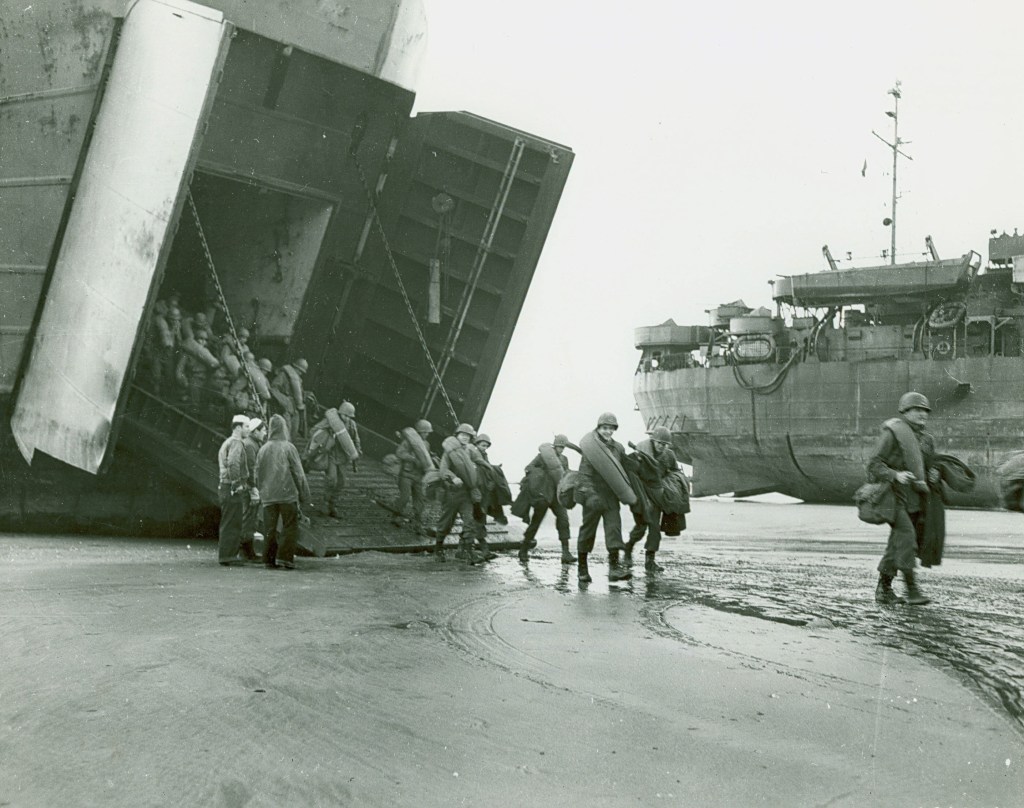
Landing Ship Tank was the official designation for the ship your dad traveled on to Luzon. The Navy thought that the name was adequate, they didn’t believe they deserved an official name such as those given to “Real” fighting ships. Sailors of course, being very young and with a patented sense of irreverence simply called them Large Slow Targets. Nearly forty were lost during the war so the swabs were right on the mark.

Disembarking from a large slow target, Lingayen Gulf Phillipines. US Navy Photo.

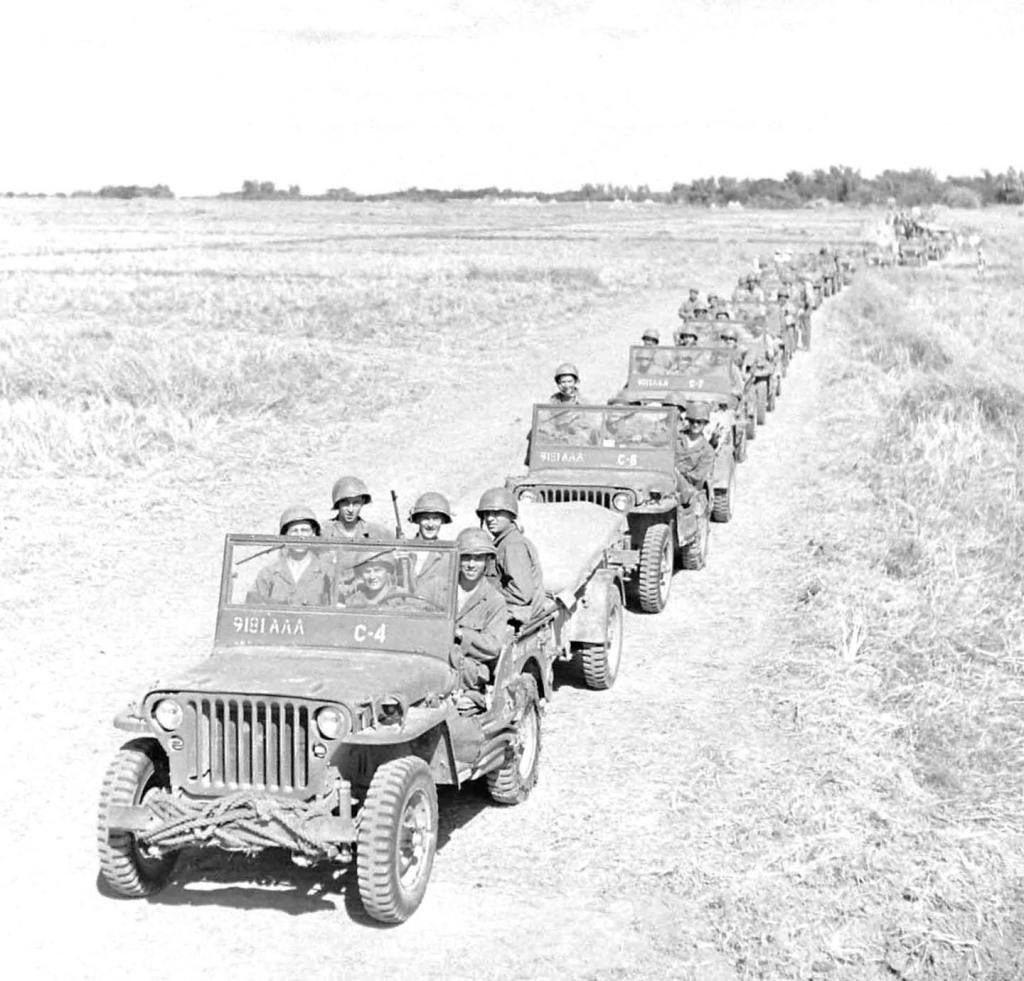
MacArthurs army charged down highway 55 towards the City of Manila. General Sasaki had chosen to leave only a few units along the 224 miles of the fertile Cagayan valley that runs down the center of Luzon. They convoys of American troops sped past Tarlac City, Angeles, San Fernando to Valenzuela on the outskirts of Manila proper. Though the allies had declared Manila an open city and had planned to bypass it. The Japanese were determined to defend it.

In the run down the valley, Some of the major guerrilla groups materialized out of the Corderillas and joined the regular tropps of the Eleventh and sixth corps. Groups led by Ramon Mafsaysay, future president of the Phillipine Republic, Russell Volckmann who was a West Point Graduate and had escaped into the mountains in December 1941 and led a guerrilla force of over 22,000 men*. Robert Lapham was a reserve Lieutenant in the 45th Regiment, Philippine Scouts and escaped into the jungle just before the fall of Bataan in 1942. Considered the most disciplined and successful of the guerrilla groups he moved into the Zimbales mountains where his 13,000 fighters fought with General Walter Kruegers sixth army.**

MacArthur ordered your dad’s team to Zimbales province where they were to be stationed in Olongapo City on Subic Bay. Subic was to be one of the prime the anchorages for the Navy as the Allies prepared for the invasion of Japan. By early 1945 the Navy operated over 6.700 ships of all types and Harbors like Subic and Manila Bay were essential to provisioning and maintenance.

Arriving at a large permanent base the team would have had the opportunity for the first time since landing on Luzon to strip off their filthy uniforms, shave and be relatively safe. For the first time in a long while the chances of being killed or wounded by artillery, Japanese bombers or snipers was behind them. For perhaps the first time your dad could stand up straight without fear of being killed. One MIS soldier said that when he moved into the Quonset hut he was to live in he was reminded that the slamming of the screen doors caused him to stand there and repeatedly open and close it because it reminded him of home so. He said it made him literally weak in the knees.

Hilo must have looked out at the country they were traveling and been reminded of his home in California. The land was gentle and planted in crops tended by families who lived on it. The feral and disturbingly inhospitable jungle, the Green Hell he and his friends had lived in for two years was replaced by a land more familiar to the farm boy from Arroyo Grande.

The island was such that a war of maneuver, where overwhelming numbers of troops and war machinery such as tanks an aircraft gave the allies a great advantage. American industry helped to turn the tide. I read of a German soldier captured in France asking his captors. “Where are your horses?” The Germans moved by horse drawn vehicles and had never dreamed of the American ability to produce. The Japanese Imperial army was equally amazed.

Highway South to Manila. War Department 1945.

The job of the MIS was to put together as much information as they could for the planners of the coming invasion of Japan proper. Captured documents, radio intercepts, military orders, maps and personal letters were to be collated in order to locate as precisely as possible every installation, road, railroad, landing strip In the islands. They even knew the home addresses of individual officers and enlisted men. It was a monumental task.

No longer suspect, Military Intelligence had long proved its worth. The battle of Midway, Guadalcanal, the island hoping campaign, MacArthurs drive up the southwest Pacific, The ambush of Admiral Yamamoto, Merrills Marauders, The mission in China supporting the armies of American General Stillwell and Chiang Kai-Chek, The battleship encounter in the Surigao Straits of the Phillipines along with the organization of the vast amounts of information obtained through all sources gave the allies an impressive view of the Japanes forces everywhere.

Housed in Quonset huts, hundreds of MIS translators worked around the clock preparing the information that would be need for what was planned as the largest invasion in history. The planning assumed multiple invasion beaches scattered around the Japanese homeland. In the coming invasion of Japan, the US navy planners favored the blockade and bombardment of Japan to instigate its collapse. General Douglas MacArthur and the army urged an early assault on Kyushu followed by an invasion of the main island of Honshu. Admiral Chester Nimitz agreed with MacArthur. The ensuing Operation Downfall envisaged two main assaults – Operation Olympic on Kyushu, planned for early November 1945 and Operation Coronet, the invasion of Honshu in March 1946. The casualty rate on Okinawa was to be 35% of all troops and with 767,000 men scheduled to participate in taking Kyushu, it was estimated that there would be 268,000 casualties. The Japanese High Command instigated a massive defensive plan, Ketsu Go (Operation Decisive) beginning with Kyushu that would eventually amount to almost 3 million men with the aim of breaking American morale with ferocious resistance. All men of any age, women and children were to be drilled for the effort. Thousands were issued sharpened stakes for use. The plan was for a resistance that would cause the ultimate collapse of the empire and the end of the Japanese nation. Resistance would be suicidal. Some estimates of American casualties ran as high as a million killed and wounded.

It’s impossible today to imagine what the military leaders and planners struggled with. Ordinary soldiers who were involved in the planning must have simply been sick at the thought. No one knew about the bomb. He wasn’t told about it until after President Roosevelt died on April 12th, 1945. From President Truman on down the inevitability of the holocaust in Japan for all countries must have been horrific. America was already exhausted. Too many dead boys to bear. Casualties in other allied countries were much higher than ours. In Great Britian there were literally nl boys left. Generals waited impatiently for 17 and 18 year old boys to graduate and be eligible for conscription. As in WWI these children were referred to as “The class of 1917” or “The class of 1944.” Back home in Arroyo Grande, class of 44′ boys included Gordon Bennett, John Loomis, Tommy Baxter and Don Gullickson who would all be in the Pacific by wars end. It must have seemed a universe of war with no ending. Most soldiers and sailors never made it home for a visit. From 1941 you father had spent over fourteen hundred days without seeing his family. There must have many nights lying on his cot in the steaming tropics unable to sleep thinking about his family, not knowing precisely where they were, how they were being treated; would he ever see them again. There was no answer to be had.

Exhaustion would have been written on the face of your father by the beginning of 1945. He had been overseas for over three long years. He hadn’t seen his family, surrounded by barbed wire and guard towers with machine guns pointed inward for going on five years. Corralled in the Southwest Arizona desert, winter and summer it must have been agony for Hirokini and Ito. Until 1943 theirs could not visit them. The fact that the boys had volunteered to serve the only country they knew meant little to military administrators.

The agony of mothers is compounded by the fact that though grandparents knew he was somewhere in the Pacific they never knew exactly where or what he was doing. Headlines in the Newspaper blared massive headlines praising the military for the carnage they caused and were exposed to. Casualty figures, though not typically released to the press didn’t stop the reporters on the wartime beat from happily publishing the butchers bill.

There is a scene in Saving Private Ryan where, in the distance a small farmhouse and barn somewhere in the wheat-fields of mid-America you see an automobile being driven along a dirt road. It’s a drab green color with a white star on its door. It’s rolling through a cloud of dust of its own making. A middle aged woman in the kitchen goes about her business, rinsing the lunch dishes, her hair styled in the rolls worn by mothers and grandmothers of the time. As she moves about dressed in a red print housedress and an apron exactly like your grandmother wore, she begins rinsing the dishes in the sink. A little movement in the distance catches her eye and she looks up to see the car as it turns up the road to the house. The woman, who you know immediately is the mother of the four Ryan boys because there is a small banner hung, almost without notice by the camera, on the kitchen wall. Framed in red with four blue stars on a white background indicating four children, boys, just boys in the service. Mrs Ryan looks up, sees the car, goes back to the dishes, with her head still down it registers. Why the car is here. She looks up again and grows absolutely still, She knows. The heart goes still, scarcely breathing, she sleepwalks to the screen door and stands, her slippered feet spread, very still as the car pulls up. She does not move. Everything in the scene is in suspended animation and when the doors open, first an officer in uniform from the front then her pastor from the back door, she loses control of her legs, staggers and then slowly, agonizingly collapses on the floor boards. It goes to the heart of every mother who sent a son off to war. It’s the finest scene Spielberg has ever made.

Mrs Margaret Ryan at the window, sees the car, in that instant she knows. Note the white picket fence reflected on the glass in a way that suggests white crosses. Superb imagery. Spielberg is a master artist. Screen capture. Amblin Entertainment, Mutual Film Company. 1998

The battle for Manila was to be the most destructive operation in the war outside of Stalingrad and the final apocalypse of Berlin. In the movie, “The Pianist”* the final scene is Adrian Brodie standing in the ruins of Warsaw, Poland. Though it’s a movie set, the scale of destruction is enormous, it borders on insanity, hopelessness and utter destruction. Such was Manila.

Your father had a ringside seat working at Subic Bay. MacArthur himself had a personal attachment to the city, he had lived there for many years. His son had been born in a Manila hospital and when he was serving in the Filipino Constabulary he was often quoted that it was his favorite city. An ancient city with wide avenues and scores of beautiful old buildings shaded by tens of thousands of trees, the dignified Narra with its gorgeous yellow flowers underlayed by the fallen blossoms carpeting the walks below, the unfurling Dapdap known as the Coral Tree with it’s diamond shaped, fiery red blossom, and the huge and ominous Balete, trees renowned for their expansive, sprawling roots and branches which are said to be home for sorcerers.

Gracing the ancient streets deep in the city, “Old Manila” refers to the historic walled city of Intramuros. Manila was known for its Spanish colonial architecture and historical landmarks like Fort Santiago and the San Agustin Church. Fort Santiago (Saint James, the patron Saint of Spain) was built between 1590 and 1593 by the first governor of the Spanish Phillipines and anchored the city center.

Your dad never saw it. By the time he left the Phillipines it was a graveyard of buildings, people and culture.

When the Japanese attacked the islands in 1941 MacArthur declared Manila an open city and withdrew his troops to save it from destruction. This was not to be the case in 1945 when your father was there. General Tomoyuki Yamashita, he commander of the army withdrew his forces from the city into the mountains of the northeast portion of the island leaving Yamashita decided not to declare Manila an open city as MacArthur had done but that Gen. Shizuo Yokoyama, destroy all bridges and other vital installations in the area and then evacuate his men from the city as soon as American troops arrived in force.

In spite of these orders, Rear Admiral Sanji Iwabuchi, commander of the Imperial Japanese Navy’s 31st Naval Special Base Force, was determined to fight a last-ditch battle in Manila. Iwabuchi repeatedly ignored orders to withdraw from the city. From the beginning of February 1945 until march, some of the most vicious street fighting of the war took place. Artillery and air strikes reduced the beautiful old city to a vast landscape of roofless shells. The Japanese forces resorted to a suicidal defense, refusing to surrender and murdering tens of thousands of Filipinos, men, women and children. Accounts from US soldiers tell of rape and systematic execution of the civilian populace. For the remainder of March 1945, American forces and Filipino guerrillas mopped up Japanese resistance throughout the city. With Intramuros secured on 4 March, Manila was officially liberated, although the city was almost completely destroyed and large areas had been demolished by American artillery fire. American forces suffered 1,010 dead and 5,565 wounded during the battle. At least 100,000 Filipino civilians had been killed, both deliberately by the Japanese in the various massacres, and from artillery and aerial bombardment by U.S. and Japanese forces. 16,665 Japanese military dead were counted within the Intramuros alone.

Afterwards, City of Manila, April 1945. War Department photo.

From Subic Bay where your father was, the sound of fighting would have heard. Flashes on the horizon coming from fires and exploding bombs would have illuminated the night sky. He heard the rolling thunder of the defenders being crushed. No one really knows the number of Japanese troops and civilian Filipinos died there. At the end the Imperial Army simply executed any Filipino they could find. They burned them with flame throwers, lined them up against walls and move them down like wheat stalks, they locked them in churches and burned them alive. Women were brutally raped and then shot. It was Hell on earth. It simply cannot be imagined except by those who lived through it and those, especially the soldiers, sailors and nurses to save their sanity simply locked it away. PTSD as it is known today is not a recent phenomenon but has been known by all veterans since Thermopylae and the Phalanx’s of Alexander and the Emperor Xerxes.

Dear Dona

Chapter 13

Coming Next

The Final Blow.

Cover Photo: The Fort Santiago Gate after the battle for Manila. War Dept. Photo.

*Brigadier Russell W. Volckmann was one of the founders of the Army’s Special Forces units after the war. His experience as a partisan commander was highly valuable in the formation of that elite force

**In 1947, Lapham returned to the Philippines for five months as a consultant to the U.S. on the subject of compensation to Filipinos who had served as guerrillas during the war. He recognized 79 squadrons of guerrillas under his command with a total of 809 officers and 13,382 men. His command suffered 813 recognized casualties. However, sorting out the deserving from the fraudulent was difficult. Of more than a million claims for compensation in all the Philippines, only 260,000 were approved. Lapham believed that most of his men were treated fairly, but was critical of U.S. policy toward the Philippines after the war. “If ever there was an ally of American whom we ought to have treated with generosity after the war, it was the Philippines.” He said the U.S. Congress was “niggardly” with the Philippines, providing less money for rebuilding than that spent in many other countries, putting conditions on Philippine independence that favored U.S. business and military interests, and backing corrupt Filipino politicians who protected American, rather than Filipino, interests.

***The nurse, LT. Sandy Davys from the film “They Were Expendable” by John Ford surrendered with the other 86 nurses on Bataan and spent the war years in the Los Banos and Santo Tomas internment camp in Manila. They all survived.

“The Angels of Bataan” War Department Photo. 1945

****”The Pianist,” the Oscar-winning film, is based on the real-life story of Władysław Szpilman, a Polish Jewish pianist who survived the Holocaust. Szpilman’s memoir, also titled “The Pianist,” details his extraordinary survival in Warsaw during World WarII.

Standard

The Taxman

Michael Shannon

The word ‘tariff’ owes its origin to the bustling Venetian trade with the Arab world during the 10th-15th centuries. The Arabic ‘arrafa’ meaning ‘notify’ led to the Italian ‘tariffa’ and through French it entered the English language.

Tariffs are fees U.S.-based companies pay the federal government when they import affected products into the United States. Since the money is collected by the government, it is considered a tax.

Still not clear? Lets take Willie Wonka for example. His factory needs Cocoa Beans to make chocolate. Cocoa refers to the seeds of the Theobroma cacao tree, which are the key ingredient in chocolate and chocolate products. The beans can be processed into various forms like cocoa powder, and butter. Commercial beans are grown in Central America, western South America, west Africa, India and Indonesia. None are produced in the USA.

So, Willie needs his beans. He will look to buy at the most advantageous rate he can find. Once the price is settled on he must pay the tariff on top of that. Lets say he pays $100 dollars a ton. To that he tacks on the tariff which we will suppose is 25%. The actual cost is now $125.00 dollars a ton. The tariff money is then remitted to the Federal Government. Willie pays the 25% then adds to his debit the cost of labor and incidentals to pay the tax, his accountants, bookkeepers, Fax machines and paper and all other incidentals included.

At the chocolate factory the arriving beans are processed, packaged and delivered to the retail outlets which actually sell to the consumer. This person is the “End user.”

If we assume that Willies net profit is say 10% on his candy bars he would lose 15% per bar. He will be bankrupt, no business can run such a large deficit and last very long. What can he do? Well, what he can do is simply raise the retail cost of his candy bar to cover the tariff which he has already paid to the taxman.

All things being equal, he is likely to raise his price more than 25% to cover ancillary costs above the tariff. (Tax) For purposes of clarity this means a $.50 candy bar will now cost as much as $.75 to 80 cents a bar to the end user. You.

Well what about the producer from Mexico you might say? There is no tax on him. His problem would be perhaps the reduction in the volume he is able to sell across the border of the US. But Americans like candy bars and Cocoa Butter so perhaps he will be OK. The idea here is to force the Mexican Cocoa Vato to lower his price.

So who is hurt? Not the treasury, they collect more tax money. It’s Willie, you and the foreign supplier. With across the board tariffs (Tax) which have been raised far higher, it means everything we import, the end user pays more, the tax. Do his wages go up to compensate? What do you think? You’re correct, he is poorer because the cost of goods he needs is higher. That new Ford 150? Forget that. The end user has less discretionary money to spend on a new vanity truck. The old one will have to serve. Ford is already importing parts from Canada, Japan, Europe and Mexico so there is a tax on each one which is added to the cost of the new truck. Slowing sales will push Ford stock down. Ford sales staff gets laid off. Mechanics get laid off, less gasoline is sold, fewer tires, probably a tariff on them too. See how it works?

Have tariffs (Tax) been around for a long time? Well over one thousand years. One of the tools used to attempt to balance trade, or the exchange of goods between countries they are a valuable tool when negotiated between the countries affected. Arbitrary imposition of tariffs (Tax) cause major disruptions in supply and the movement of goods and treasure around the world.

Imagine world trade as a vast spider web connecting countries all over the Earth. Even countries at war, another form of economics, will continue to trade. If you need an example of that, Standard Oil sold fuel oil to German submarines right up to Hitlers declaration of war on December 12, 1941. Casualties and destruction in Europe and Asia were not a consideration. Sales are sales. Henry Ford continued to build trucks for Hitler even after we went to war with Germany. He had the gall to sue the US government for the damage we did to his French and German factories by bombing them flat.

So, look around your house. See how many things you can find that are not made in the USA. TV, no, Those hip Chuck Taylor Converse tennies your kids wear? Sorry not made here. Your diamond ring? South Africa. The laptop you are reading this on, If it’s Apple is made in several countries, India, Vietnam and China. Add the medicinnes in your medicine cabinet, your furniture. Ikea anyone. Chemicals, precious gems, Aluminum, steel, magnesium, copper are what an airliner is made off, expect airfares to go up. Nothing will go untouched. Even companies who don’t import goods of any kind will raise their prices because thats good business.

Think about this. Even companies that manufacture nothing will raise their rates. If you buy a fancy schmancy BMW which is now going to cost 25% more than yesterday you can bet the your insurance company is going to raise your rates for a now higher priced car.

My favorite? Susan Collins, Senator from Maine stated that Maine blueberries are shipped across the border to Prince Edward island in Canada to be processed and when they come back their will be a tariff added to the sale price. That blueberry muffin at Starbucks? The beans in the coffee, the half and half, Canada. Forget it. No one is going to be untouched.

Economic policy is difficult to predict. It’s important to try but still its a cipher. There are many, many moving parts but there are some things I think you can be assured of. All these new tariffs, not negotiated but simply imposed by fiat are going to be a major problem for Willie and you. As always, economics are tied to your wallet. Buy one with a a zipper, your’re going to need it.

For a complete breakdown on the effects of predatory tariffs do some research into the Smoot-Hawley tariffs enacted in 1928/1929. That bill did not start the Great Depression but it contributed mightily to it.

Both JP Morgan bank and Henry Ford himself said they begged President Hoover no to sign the bill, Ford saying he nearly got down on his knees in the Oval Office. Hoover said that he must support the party and signed anyway. The US economy went right over a cliff. Ask your great-grandparents what that was like. How did we get out? Ask Adolph Hitler what that cost the world.

Michael Shannon is a former teacher of Economics and wrote one of the economic curriculums for high school used in California. He was also in the construction business for 27 years and knows that wood comes from Canada.

Standard

442nd RCT Erased.

Michael Shannon.

Members of the 442nd and 100th Infantry hold a captured Nazi flag in France, 1944. US Army photo

Something that should make you want to vomit. The United States Army has removed the page honoring the 442nd Regimental Combat Team from its webpage. If you don’t know who they were, they were the all Neisi Japanese Americans who fought in WWII. They were the most decorated small unit in the history of the Army. They, along with 100th infantry, a combat unit from the west coast, were American born boys who fought for their country even though their families were locked away in concentration camps at home. The excuse for removal? Trump and Hegseth’s insane attempt to stamp out diversity in the worlds most diverse country. By all definition they are evil.

My very good friends father, Isaac Akinaka was an army medic who fought in Italy and France. Local farmer Haruo Hiyashi was 442nd, the late Senator Daniel Inouye, whom I knew, lost his hand with the 442 in France.

These governmental fools are beneath contempt and should be treated so. If you are interested, attached a the link to the 442nd’s website. You can’t get it from the Army of the United States.

Standard

That’s So Gay.

Michael Shannon.

*That’s so gay,” in recent years has been used as an insult to mean “stupid”, “boring”, or “lame”.

Mrs Tibbets. Her name is on the nose of one of the most famous aircraft in the world. She was the mother of the pilot, the man who sat in the left hand seat. She was an Iowa girl.

She and her husband Paul had two children, a boy and a girl. Paul jr. and Anne. In WWII, Paul flew B-17’s in Europe and Africa and was for a time the personal pilot for General Eisenhower. He worked on the development of the B-29 and as an advisor to the Manhattan Project. Sent to the Pacific theater in 1945, his B-29, named for his mother who had just passed away in July carried the worlds first operational Atomic bomb called “Little Boy.” It went to Hiroshima, Japan.

After the 2nd bomb nicknamed “Fat Boy” was dropped by a plane named “BocksCar” the Japanese surrendered.

The B-29 aircraft was saved from demolition in the 1950’s and is displayed in the Smithsonian Museum’s Air and Space Museum in Fairfax, Virginia.

Whatever you feel about the Atomic bombs, the plane is an important part of the history of the United States and Japan.

Coronal Paul Tibbets and the crew of the Enola Gay in August 1945. UPI photo

This month, the Secretary of Defense former national Guard reserve major Paul Hegseth, who served as a Civil Affairs officer overseas in the middle east. As an officer on the national guards career track he was given the Bronze Star which is what officers get just for breathing.*

Secretary Hegseth, a true MAGA believer is intent on removing portions of the military which he finds distasteful. Mention of Tuskegee airmen, gone, their photos too. Their crime? Being black. The Womens Air Service Pilots, gone. Their crime? Being women and women of color. Women of color who faced a double burden of racism and sexism in joining the WASP. A few were accepted, but their numbers were small. Pilots Hazel Ying Lee and Maggie Gee, who were of Chinese descent; Verneda Rodriguez and Frances Dias, who were Latina; and Ola Mildred Rexroat, who was Oglala Sioux, all joined the WASP. Mildred Hemmons Carter whose husband flew P-51’s for the Tuskegee airman was rejected because she was Black even though she was already a highly experienced pilot. Even a United State Marine who won the Congressional Medal of Honor in the Pacific was erased. His crime? He was Portuguese-American. He gave his life on Okinawa. Harold Gonsalves was his name. Wrong color I guess.

The Enola Gay has been canceled too. A big silver plane, a machine, no brain, no heart, just a machine. Thinking individuals will be unsurprised to learn that the Enola Gay was not actually named after the sexual orientation. The plane was named after the mother of its pilot, Col. Paul Tibbets, Enola Gay Tibbets. The plane was not gay. Everyone knows that all planes are female just like ships. Thousands of photos and image descriptions including someone with the last name “Gay” have been flagged for deletion. The same thing has happened with a photo of members of the Army Corps of Engineers, his last name was Gay. There are still tens of thousands of photos, textbooks and other notices to go through before they are finished.

They’ll get Doris Miller too. Not only for the fact that he was black but had a womans name to boot. Doris’s heroic actions stirred the nation in 1941, but he was not formally identified or recognized for his role in saving lives at Pearl Harbor. No need to guess why.

Hegseth ordered the Pentagon to scrub any and all digital content that promotes diversity, including months that celebrate cultural awareness, from department and military branch websites and social media. No MLK day, no black history month and especially no Pride Week. The directive stated that all “information that promotes programs, concepts, or materials about critical race theory, gender ideology, and preferential treatment or quotas based upon sex, race or ethnicity, or other DEI-related matters with respect to promotion and selection reform, advisory boards, councils, and working groups” should be removed, with limited exceptions for content required by law.

Apparently Medals of Honor winners, women who gave their lives in service to their country or airplanes are protected by law.

PFC Harold Gonsalves, who received the Medal of Honor for his heroic actions during the Battle of Okinawa in 1945. A Portuguese American boy from Alameda, California. 4th Battalion,15th Marine Regiment.

Sounds like double speak which the military and Hegseth do well. Hegseth was a Fox host after all.

WTF, to coin a phrase. The United States is the most culturally diverse country on earth. That is our super-power. What is the matter with those people?

*A career officer must be able to wear proof of his service on his breast, hence superfluous awards. Likely it was awarded for a paper cut since the secretary was a publicist and journalist. Enlisted men must be shot or killed to get a Bronze star. Big difference.

Michael Shannon is a writer from California. He is a Vietnam veteran and has an eye for stupidity. which he tries to avoid like the plague.

Standard

This Country

Michael Shannon

I’e been thinking lately about who we are in this lovely country. We are kind. We think of others. We are free with our earnings in order to help the unfortunate. We ask for nothing in return.

We are marvelous creators. There are the engineers who have built this country with their inventions. There are the painters and printmakers who capture the spirit and the sublime looks we are fortunate to have. Our National Parks are the glory of this country, something no other can match. We have embraced immigrants from everywhere on earth. They have made us better.

One of the reasons that the American language is so diverse and adaptable is the fact that there are at least four hundred and thirty separate languages spoken in this country, which contributes to our distinct spoken word.

Our greatest single export is is our music. We’ve taken seeds from every culture and grown a rainbow of styles which have taken root and flourished all over the globe.

We are so unique in history. We sometimes have periods of time in which the small minded among us are ascendant but they are always undone by the meanness of their kind and so it will be this time too. Might is not right. We who are the meek will as is said, will inherit.

So turn on your radio and let the music play.

Endure.

Standard