The kine da Kine. Ea, the babe. She smaat too. From my friends they live down the street. You get this if you’re from Pearl city, Hawaii.
Category Archives: Uncategorized
Dear Dona 10
The End of a Hard Row.
By Michael Shannon
A hard row, something a farmer knows all too well.
As early as 1943, morale amongst the Japanese soldiers was very poor. The information compiled by the MIS translators wasn’t just about the killing of Admiral Yamamoto or Plan Z or the other logistical and strategic finds. US Army G-2 intelligence reported on the mindset of the ordinary Japanese soldier as seen through his own eyes in captured letters and journals.
One that can be easily manipulated politically. The difference for those being on the ground dealing with face to face combat or interrogation when captured left little to interpretation.
Many in the US believed the Japanese soldier was a fanatic, freely willing to give his life for the Emperor. The banzai charges. The kamikaze attacks. Individual soldiers throwing themselves under tanks with an explosive charge strapped onto their backs in a suicide attacks was the image the wartime press pushed. The truth of the matter is Japanese soldiers were farm boys, city boys, Just like our boys, they were drafted. Instead of dying in “banzai attacks”, these “fanatical” Japanese soldiers wanted to go home just like ours did. They couldn’t for fear of reprisal against their families by their own government. It must have been ironic to read of that treatment by the Nisei whose own families were behind barbed wire in concentration camps.

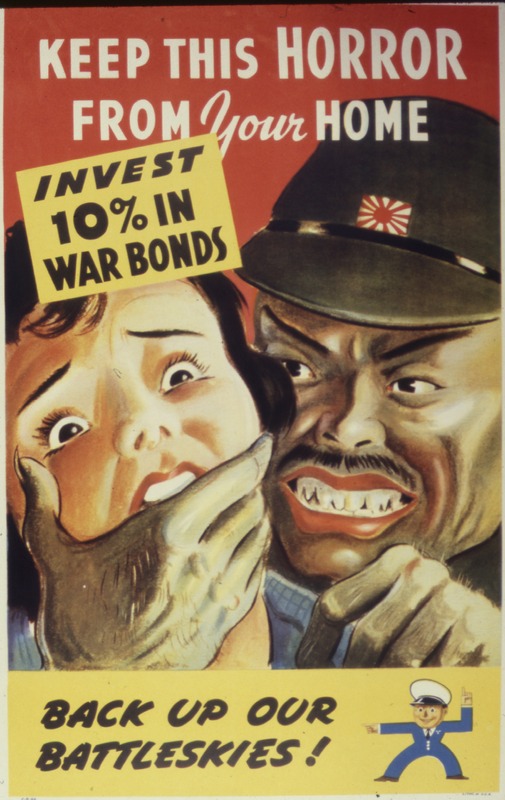
Neither side was immune from publishing the most scurrilous propaganda.
Being a buck private in the Japanese army made you a fanatic. In the American army you got the Congressional Medal of Honor. To a soldier of any army the end was the same. Media makes it seem that heroism is a choice but that is rarely so. Desperation or fatalism is much more likely.
General MacArthur told General Eichelberger, his chief of staff after the initial disastrous American showing by the 32nd division Buna-Gona, New Guinea, “I’m putting you in command at Buna. Relieve Harding. I am sending you in and I want you to remove any officer who won’t fight. Relieve regimental and battalion commanders; if necessary, put sergeants in charge of battalions and corporals in charge of companies, anyone who will fight, put ’em in.
MacArthur then strode down the breezy veranda again and turned back to Eichelberger . He said he had reports that American soldiers were throwing away their weapons and running from the enemy. Then he stopped short and spoke again, with emphasis. He wanted no misunderstandings about the assignment.
“Bob,” he said, “I want you to take Buna, or not come back alive.” Bob Eichelberger put on his three stars and walked into the front lines where the Japanese snipers could see him. Warned that he might be killed, he said, “I want my men to see a general in the line not in the rear. The word spread quickly through the Red Arrows troops and they turned the tide of the battle. That’s courage and the boys he commanded knew it when they saw it.
Eichelberger was recommended for the Congressional Medal of Honor, MacArthur disapproved it and awarded the Distinguished Service Cross to his staff officers at headquarters who saw no service. That was MacArthur at his political and selfish best. Eichelberger said nothing.
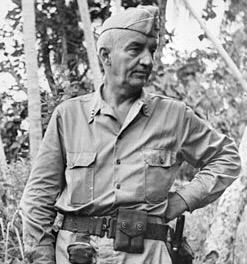
Major General Bob Eichlberger in New Guinea, 1943. US Photo
The MIS Nisei, as early as 1943 published a report detailing moral problems within the Imperial army. Culled from captured material, the official document spelled out problems within the Japanese officer corps. There were incidents of desertion, dereliction of duty, black market racketeering and hoarding rations for their own us. Enlisted men were homesick and felt helpless in the face of the war. Poorly led and often wasted in senseless attacks they were certainly as brave as American boys and throughout the Pacific campaign most American soldiers came to recognized this. Those Nisei who worked as cave flushers realized that the sense of hopelessness of soldiers hiding in caves during furious and savage battles were not always willing to die for the Emperor or their officers but could be talked into surrender by calm and kind words in their own language spoken by someone who knew their culture and in many cases who had been educated in their home prefecture.
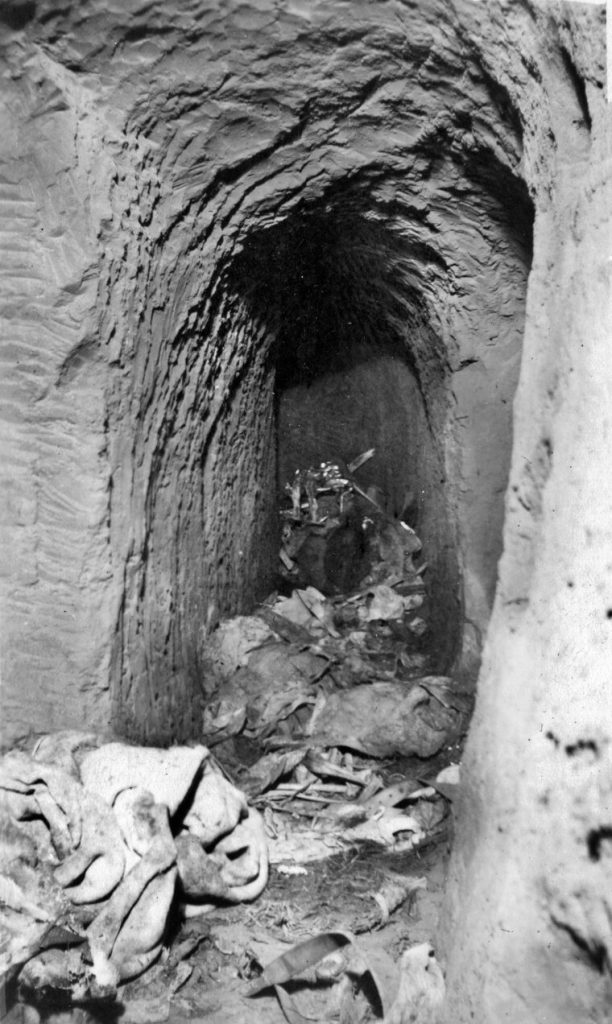
Abandoned cave. USMC photo
Many of the MIS boys were descendants of families who emigrated from the southwest portions of Japan which were primarily rural. They came as contract laborers to work in the pineapple and cane fields of Hawaii and the fishing and agricultural areas of California. Hiroshima, Kumamoto, Okayama and Yamaguchi was where the majority of emigrants came from. By coincidence many of the Japanese troops in the southwest Pacific came from the same areas. The Kibei, American citizens who had been educated in Japan might, by a good chance be familiar with the home areas of the captured. The offer of a cigarette and comforting words from someone who not only spoke your language but in your own dialect quickly overcame any reluctance to speak. In many documented case the MIS translators personally knew schools, relatives, teachers, family members and in more than one case interrogated brothers, cousins and uncles. There is an instance where a cave flusher on Okinawa encountered his older brother inside.
The interlocking cave defense pioneered on Peleliu which brutalized the Army and Marines was quickly adopted by other Japanese units and even though you might not expect to see it used on the large islands in the Phillipines, it was. Your dad was still on staff with the Eleventh Army on October 20th, 1944 when the Philippine island of Leyte was invaded, the first step in the conquest of the Philippines by American, Australian, Mexican* and Filipino guerrilla forces under the command of MacArthur. The U.S. fought Japanese Army forces led by General Tomoyuki Yamashita. The battle took place from 20 October to 31 December 1944 and launched the Philippines campaign of 1944–45, the goal of which was to recapture and liberate the entire Philippine Archipelago and to end almost three years of Japanese occupation.
The invasion was a surprise because the Japanese assumed the Americans would invade Luzon first so many troops had been withdrawn from Leyte and those left had been pulled back from the prepared beach defenses. Fortunately for our troops, the Japanese General had withdrawn his troops from shoreline defensive posts. Even though there had been up to four hours of bombardment by the USN of the shore defenses, many fortifications – including pillboxes – were untouched. General Kenney concluded there would have been a blood bath similar to Tarawa if the Japanese hadn’t withdrawn.
The advance was so rapid that that MacArthur made his walk onto the Leyte beach a “Hollywood-esque” event on the first day. He actually had several takes done of wading ashore being the media seeker he was but. Being on MacArthurs personal MIS staff, you father may have been there though I could find no evidence of that. Soldiers in the know laughed at MacArthurs self promotion remembering him as “Dugout Doug” from Bataan and Corregidor in 1942. A foot soldier has a quite different view of rear echelon soldiers no matter how important he thinks he is. Patton’s well known nickname “Old Blood and Guts,” was easily changed to. “Yeah, his guts, our blood” by the infantry soldiers of his third army in Europe. Like a politician, which he was, the entire landing was a production. He had Manuel Quezon, the president of the Phillipines, several Philippine Scouts of the Filipino army, his staff officers each in his crushed hat echoing their bosses famous hat with the tarnished “Scrambled Eggs” and all wet to the knees. No one though to wear combat boots though and their dress brown shoes indicates they didn’t expect to even get wet. MacArthur was furious at the cox’n of the Higgins boat he landed from and wanted him punished until he saw the photos and decided he looked sufficiently heroic. The Cox’n was spared.

“I Have Returned.” Carefully posed and including representatives of the Filipino Army, the Army Air Corps and various staff officers MacArthur wades in for the third take. Check out the bemused expression on the face of the soldier just to MacArthurs right, above the little Filipino Major.*
“People of the Philippines: I have returned. By the grace of Almighty God our forces stand again on Philippine soil—soil consecrated in the blood of our two peoples. We have come dedicated and committed to the task of destroying every vestige of enemy control over your daily lives, and of restoring upon a foundation of indestructible strength, the liberties of your people.” MacArthur.
The landing on Leyte looked good on newsreel, there were even a few gunshots in the distance but the landing was safe enough for the men from the rear. Distant gunshots were exhilarating and added a little flavor to the event. The rest of the entire Philippine campaign would be bitter, savage and cost the United States military dearly. The Phillipines were not secured until the end of the war in August 1945. The Allies totaled up 220,000+ wounded and dead before it was over. The Japanese Imperial Army lost over 430,000.
Luzon was mostly jungle fighting but Leyte with the nations capital city of Manila turned out to be some of the worst urban warfare of the entire war. The Japanese were in desperate straits. The army and air force could not be reliably reinforced because the surface navy now controlled the air and US submarines controlled the inland sea and had devastated the Japanese surface fleet, particularly supply ships that soldiers on the islands were nearly cut-off from Japan.
Because of the MIS translators the Americans brass knew this. They knew where the ammunition dumps were, food supplies, location of all Japanese headquarters and many troop movements. At sea, the Navy was informed of Japanese Naval plans and was able to prepare for what became “The Great Marianas Turkey Shoot” when Naval aviators decimated the air fleets of the Japanese Navy and Army in the Battle of the Philippine Sea, downing 65 planes and sinking one of Japan’s last carriers. Fighting on the defensive with no air support the isolated Japanese troops on the islands became more desperate and fatalistic.
No one knew of course but the war had less than a year to go but the nature of war in the Pacific saw the fighting get more and more desperate and dangerous. There was literally no hope for the Japanese and they knew it.
Lance Corporal Kiyoshi Koto was starving and wounded, but it is unlikely that he was troubled by his hunger or his pain as he reached the front on the day he had written his letter. Koto was killed in action about midnight on the same day, and his letter was never delivered. Instead, an American soldier pulled the letter from Koto’s uniform pocket and took it to his Nisei MIS intelligence section. The letter was translated into English while a few of Koto’s captured countrymen dug a grave for him somewhere on the site of the battle. The short paragraphs that Koto had hoped would give his family a sense of closure instead became a source of information and a curiosity for his American enemy.
Every Japanese sailor and soldier was familiar with the Song of the Warrior, an ancient ballad that captured the centuries of fighting culture that made surrender unthinkable for Kiyoshi Koto and his comrades.
If I go to sea, I shall return a corpse awash;
If duty calls me to the mountain, a verdant sword will be my pall;
Thus for the sake of the Emperor, I shall not die peacefully at home.
By December Lance Corporal Kiyoshi Koto wrote his last letter home. By that time, his unit’s command structure was decimated and the battle strength of his army and its supporting navy was nearly destroyed. As he wrote, the characters on the page of the letter, they were written with shaking hand because Kiyoshi had been wounded in the right arm by a shell during an attack five days earlier. He struggled to carry his rifle because of his injury, and he had not eaten because critical supplies had not reached the beach, let alone the front. Koto understood very well that he was a dead man.
Koto wrote, “Every day there is bombing by enemy airplanes, naval gunfire and artillery fire. No sign of friendly planes or of our navy appears. The transports haven’t come yet either. I have not eaten properly since the 24th of November; many days I have had nothing to eat at all. From tonight on indefinitely, again without expecting to return alive, I am going out resolutely to the front line. Even though I am holding my rifle with a right arm that doesn’t move easily, now is the time for me to dominate a military contest. I must serve as long as I can move at all.
“The Regimental Commander, Colonel Hiroyasu, 16th Infantry, died in battle. The battalion commanders are all either wounded or dead. My own company commander is dead. Two of the platoon commanders have been wounded; one of them entered the hospital for medical treatment and was with me there. In our company NCOs are acting as platoon commanders and privates as squad leaders. At present my company has come down to a total of only 30 men. Of the soldiers in my squad three were killed, four wounded, and at present four in good health are doing hard fighting. As I too am soon to leave for the front lines I should like to see their cheerful faces. The platoon leader, convalescing and almost up, says ‘Go to it Kiyoshi!’”
Koto includes greetings to members of his family and closes, “I am writing this as a farewell letter.”
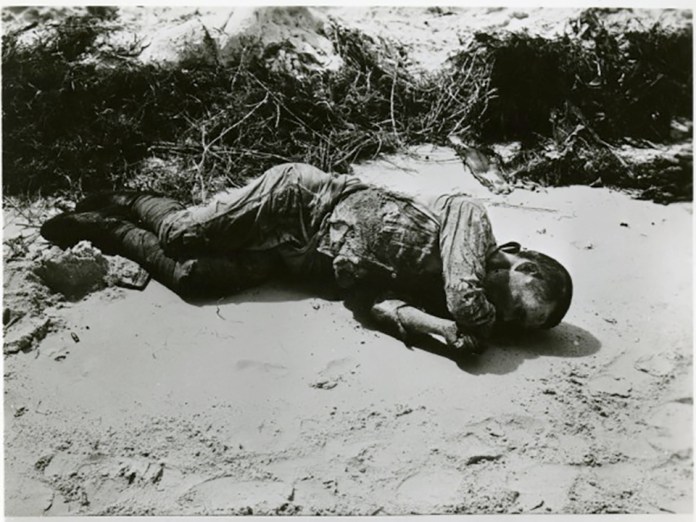
Saipan 1944. National WWII Museum. Gift of Akita Nakamura.
The answer, as the balance of the war proved prophetically true, was combat with no quarter. And the actions of soldiers letters offer a glimpse into the mind of Lance Corporal Kiyoshi Koto, who also refused to surrender when he found himself in a losing battle. He wrote his farewell letter home, and on the last day went forward to fight and die. He had no illusions about his future. Instead, his thoughts were with home and with his brothers in arms along with a final hope that he could save his family the pain of not knowing what had happened to him.
Dear Dona Page 11
Your fathers original group of four hundred translators that worked in Brisbane in 1943 had been broken up into smaller units and was now spread all over the Southwest Pacific. Many of them now shared the privations and dangers of combat and had taken to carrying rifles and wearing helmets. They operated just behind the lines and were subject to enemy gunfire, artillery and bombs.
Dear Dona 11 coming on February 1st.
* Mexico’s Escuadrón 201, The Aztec Eagles, equipped with Republic P-47D Thunderbolt fighter aircraft distinguished themselves in providing close air support to American ground units as well as long-range bombing strikes deep into Japanese held territory.
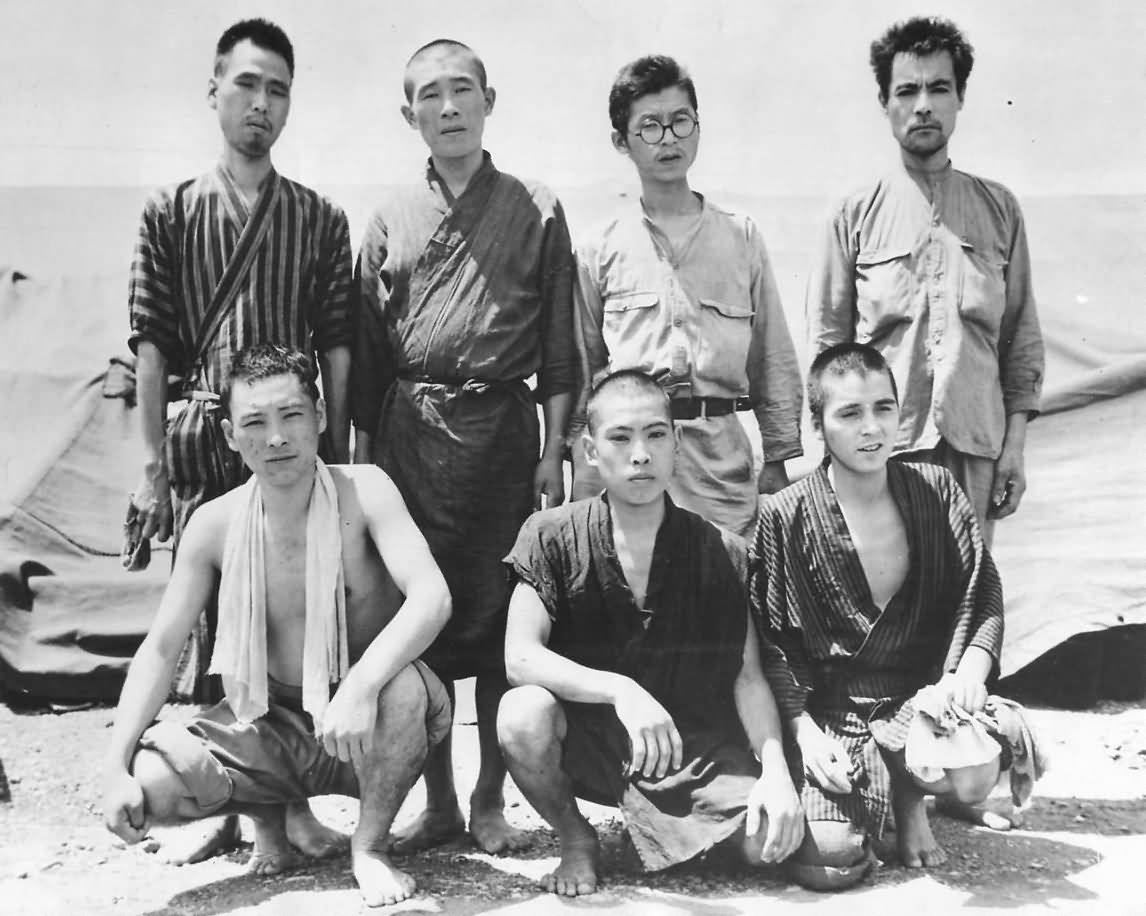
Cover Photo: Captured Japanese soldiers on Okinawa.
Michael Shannon is a writer from California and personally knew the protagonist in this story.

Dear Dona
Page 9
There is no toilet paper.
Michael Shannon
From the MIS Nisei: “They described how they were searching a Japanese soldier that had surrendered in the jungle of Moroti. They came across one of the American propaganda leaflets promising safe passage for those Japanese soldiers that surrendered. It was neatly folded in the soldier’s pocket.
Akune asked the Japanese soldier if he believed what the leaflet promised since the MIS Nisei wrote it. The Japanese soldier said no but that it made for good toilet paper. “There was no toilet paper in the jungle of Burma,” said the prisoner.” Americans laughed. They were issued 25 sheets a day, maybe, not often or never.

The leaflet written by MIS Nisei translators and air dropped over Japanese posissions, 1944
The army and the Marines continued to slowly work themselves toward the northern end of Papua New Guinea. After more than two years the organized large battles were over but the island was still overrun with small units of Japanese. There was more and more jungle fighting where small units of American and Australian troops constantly patrolled the dense jungles looking for stragglers and shattered elements of the Japanese. Sharp and very nasty fire fights occurred often.
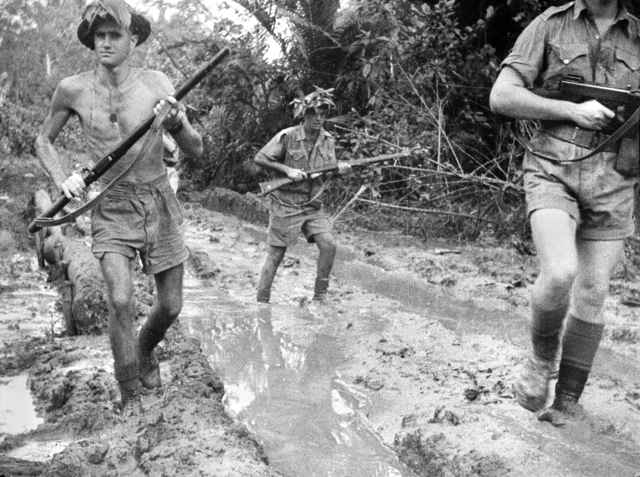
Australian Infantry of the 21st regiment, Papua New Guinea. Australia War Museum, 1943
The jungle itself was the enemy. It was as evil as any human enemy. It was dark and secretly evil, an enemy of all mankind. Its drenching, chilling, mud sucking presence came at the soldier with cold roiling mists, green mold and nearly ceaseless downpour. Tangled roots and vines tripped him, it poisoned a man with nasty stinging biting insects and malodorous bugs who flew and flitted about or dropped from dripping trees. The sop of mud into which his boots stepped and were sucked at by the jungle itself. It was a living breathing thing. You could awaken to find a dreaded Bushmaster Pit Viper coiled under your cot. Growing up to 10 feet long, a strike was almost certain to bring death. The Arizona national guard 158th regimental combat team which was requested by MacArthur because they were jungle trained adopted the snake as part of their regimental patch,

158th RCT Arizona National Guard “Bushmasters” on patrol, New Guinea. US Army photo. 1944
Nothing could stand against it. Letters were sodden and unreadable in a few days, Socks disintegrated in just a days, Cigarettes were sodden as soon as the cellophane was removed, your pocketknife blade rusted solid an your watch recorded it’s own death.
Food was garbage, made paste by the moisture which was everywhere in under canvas. A pencil swelled and burst, unable to write on sodden paper. Rifle barrels turned red from rust and had to be carried muzzle down to keep out the rain, a cellophane wrapper from a pack of cigarettes, parts of the waxed carton from K ration boxes or condom wrapped around the muzzle to little avail. Machine gun rounds stuck in their canvas belts. The jungle was an enemy so foul, stinking of mud and decay that the war was nearly forgotten in the search for a dry pair of trousers, socks or the prize wished for the most: a hot cup of coffee.

Brewing up a cup of Joe, Wewak, New Guinea, 1944.
Small units of translators were being sent into the field to do the interrogations of prisoners on the spot instead of relying on just the captured documents. They hoped to retrieve intelligence in real time. MacArthur was in the planning stages for the beginning of the move up the chains of islands between New Guinea and Japan itself.
Generals are as politically motivated as any politician,
they have to fight their way up the ranks and as the number of officers decreas, Major to Colonel, the pressure increase. There were three main components involving the Pacific theater. At the very top of that pyramid, General George Marshall the Army Chief of Staff and Admiral Ernest King of the navy were in a political fight for the means to prosecute a war on two fronts, the Pacific and the European theaters. The President, Churchill and Stalin had agreed that Europe would be the main focus of their efforts and the Japanese war would take a back seat. Admiral King, of course was not happy, as that meant the navy would receive fewer resources than the army whose main focus would be in Africa, the Mediterranean and western Europe. Initially this meant that the Navy and Marines would mount a holding action in the Pacific with the goal to halt Japanese expansion as the primary objective. This proved to be easier said than done.
The battles of the Coral Sea in May and Midway in June of 1942 showed that perhaps there was an opportunity to do more. The Japanese invasion of Port Moresby in Papua New Guinea was stopped. Admiral King began to press for more of everything to be sent west so the Navy and Marines could began the island hopping campaign which they are so famous for.
Politics immediately interfered. General MacArthur’s hasty retreat from the Phillipines left him with no army to command and no money to pay for it if he had one. The Joint Chiefs, FDR and his political advisors had to find something for America’s most famous and experienced military man to do. He wasn’t wanted by King, two colossal egos in charge has never worked. The solution was to park him in the far west Pacific where he couldn’t interfere with Admiral King’s navy and its goals.
MacArthur was not pleased. Stuck in Brisbane, Australia with few troops other than the Anzacs to command, not a situation that made the Australian and New Zealand military very happy, he had to beg FDR and Marshall for American units. The Navy, very grudgingly allotted a small naval command to serve under his command. He also had the use of the Australia’s small navy and on top of that commandeered whatever craft he could find including small sailing vessels once used for inter-island transport.
Politics meant that there would be two parallel efforts to fight the way to Japan. The Navy and Marines were to fight an increasingly brutal series of invasions. Guadalcanal, Tarawa, Peleliu, Saipan and Iwo Jima are all famous in American history and most important in the history of the Marine Corps. There is little difference between those battles than the uphill slaughter of the British at the Battle of Bunker Hill. Assaults directly into the face of an entrenched enemy such as Fredericksburg or Petersburg in the civil war had not changed. The Marines paid a horrible price in the Navy’s Pacific battles.
MacArthur on the other hand had a much, much larger land area to contend with. The island of New Guinea is the second largest on earth, just slightly larger than the state of California. As Californians we have some idea of how large that is. Sending limited numbers of troops and a small air force the length of the state would be dauntingly difficult. Instead MacArthur conceived of a plan to skip and hop across New Guinea. Using what he had, he planned on taking key areas where he could stage for the next leap and leaving the now isolated Japanese garrisons behind to wither and die.
Arriving in Port Moresby your father was ashore while the final battles in New Guinea were wrapping up. The army had trekked over 1,500 hundred miles, roughly the distance from Los Angeles to Dallas Texas. MacArthurs Eleventh Corps was pulled of the line to rest and refit and tp prepare for the initial phase of the return to the Phillipines. The Australians were left to finish the retaking of New Guinea which would take to the end of the war.
The eleventh Corps which included your dad’s unit was made up of the 23rd, 31st, 38th, 41st, 93rd (Colored) and the 503rd parachute infantry regiment was preparing to move on the Phillipines. They needed an airfield close enough to to Leyte island so the Army Air Corps could provide combat support and logistics. A small island named Morotai off the tip of Halmahera island in the Indonesian Archipelago was selected.

Landing on Red Beach, Morotai Island Dutch East Indies, September 15th, 1944
In the meantime the XI army got a little rest where they were resupplied with weapons and uniforms. The 93rd (Colored) built showers, laundries, mess halls and broke out the baseball equipment. The MIS boys were still hard a work but at least they had time to hang a coffee can from a wire, light a fire and brew up some coffee. In their tents at night, a soup can with some gasoline and a length of tent rope made a small stove for cooking up whatever they could scrounge from the mess boys. The natural alliance between the Nisei and the African Americans of the 93rd paid dividends for the MIS.

3rd Division (Colored) patrolling on Morotai. October, 1944
The MIS men had been stationed in Brisbane Australia for nearly two years but with the advances in the Solomons, Marshalls and New Guinea they began to be deployed in smaller groups to individual combat groups. The Navy, Marines, Army Air Corps, British, Dutch and ANZAC forces had seen their value and had asked for and received MIS Nisei support. This changed entirely the organization. Fourteen Japanese Americans were now serving in combat with Merrill’s Marauders in the China Burma theater. MIS boys had worked with the Marines in New Georgia, Saipan, Eniwetok and at the bloodbath at Peleliu where the Ist Mar. Div. and the Army’s 81st division engaged in a new kind of battle for which the were unprepared. For the first time they ran upon defensive caves which were to be the main feature of the amphibious campaign for the rest of the war. General “Chesty” Puller’s first Marine Division took casualties of nearly seventy percent and was put out of the war for nearly six months it was so badly devastated. Out of over twelve thousand Japanese on the island only a little over 300 were taken prisoner, mostly because of wounds.
The “Flusher” was born at Peleliu. These were volunteer MIS linguists who put down there rifles, took off their helmets and put their heads in or crawled inside fortified caves to attempt to talk the Japanese soldiers inside into surrender. Because the Nisei believed they would be killed if armed they tried to show the cave dwellers that were no to be afraid. They themselves must have been terrified. I find it difficult to comprehend the courage it took to do this.
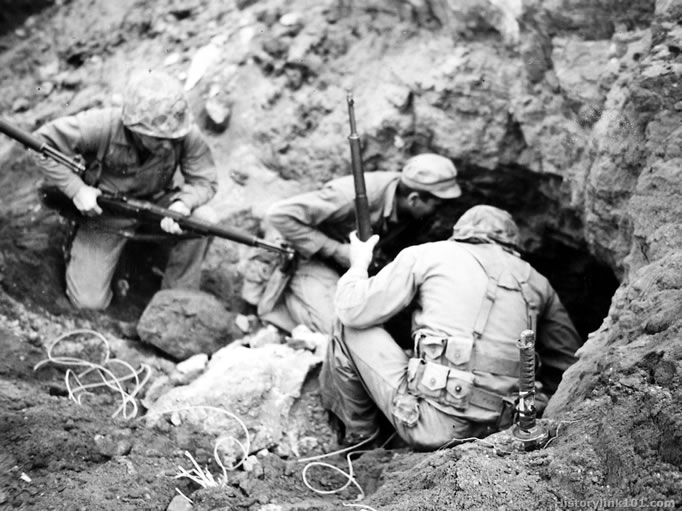
Nisei MIS Linguist coaxing Japanese soldiers out of a fortifies cave, 1944
In researching this letter I have not been a able to find any reference to the Nisei that performed this volunteer duty. I found no citations for bravery and no medals awarded. The MIS men were part of a secret organization within the military but still the lack of recognition is troubling. The only photos available that show MIS flushers at work were taken by other soldiers and not combat journalists who kept their unit’s diaries which chronicled daily action down to company sized units. In every sense the Nisei were combat soldiers. They were rifleman which is the name combat soldiers take for themselves as a point of pride. “Every Marine is a rifleman” in the Marine Corps no matter what his job.
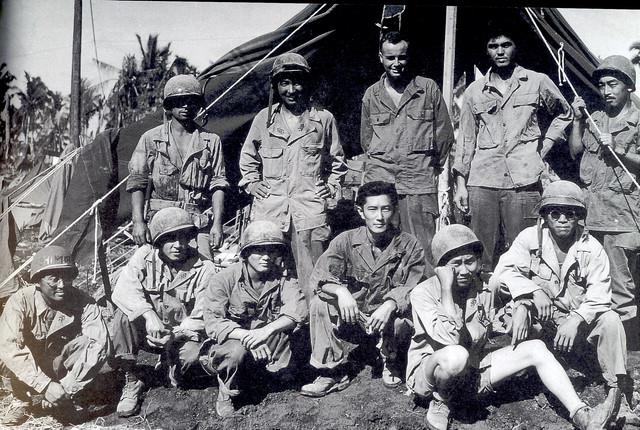
The 1306th MIS team, New Guinea, 1944. Note the white officer, no Nisei was yet in command of any group. US Army photo.
An important point to make here is that though the translators were formally attached to General MacArthurs command they were scattered amongst all combat units and were moved as needed. Rarely can you find a photo of a MIS man wearing a division patch. Your dad served with more than just the eleventh Army, he was with the 168th Infantry Regimental Combat Team, an element of the 32nd Division from Michigan and Wisconsin when they were transported by LST from Lae, New Guinea for the landing on Morotai Island. Morotai is part of the Indonesian archipelago which consists of over 18,000 separate islands. Roughly 2,300 miles from New Guinea it was 300 miles closer to the southern Philippines than Peleliu.
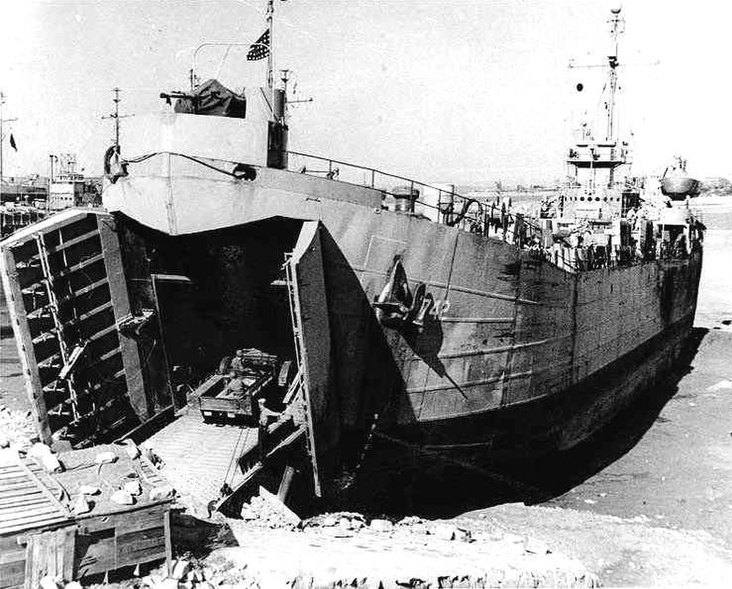
LST- 742 on the beach at Morotai, Dutch East Indies. Battered and bruised like all of her sisters she was one of the workhorses of the Pacific War. Unsung, no-name little ships hauled everything and went everywhere.
Not for the first time, your Dad traveled with his team on one of these ships. There were no accommodations for enlisted passengers so you rolled your blanket out on the steel deck and slept under a truck or up on the galleries that ran down the sides of the cargo hold. By this time Hilo wouldn’t have batted an eye at the lack of luxury.
Two islands were invaded on the same day, September 15th, 1944. Morotai in the Dutch East Indies and Peleliu in the Palau islands. Results could not have been more different. The Army and Marines on Peleliu suffered grievously. It was the deadliest invasion of the Pacific war where the Army’s 81st “Wildcat” Division and the 1st Marine division were ground down by two months of insane combat on an island five miles long and scarcely a mile wide.
Morotai by contrast was secured by troops from the 32nd “Red Arrows” Divison. Morotai was like most of the islands the men of the Southwest Pacific had become familiar with, it was mountainous and covered with rain forest. The first day of the invasion had one casualty, a soldier killed by a falling limb. The MIS processed the few prisoners captured and began studying their documents. As was their experience life would be wet and miserable until they left for the Invasion of the Southern Phillipines on Luzon in January 1945.


Officers Quarters and Enlisted Quarters. Southwest Pacific 1944.
From Thomas Tsubota, a translator with Merrill’s Marauder in Burma, 1944 He said, “They had just stumbled across ten Japanese soldiers in a small jungle clearing, he says. “Boom,” he said, in a split second they killed them all. He described how his commander, Colonel Beach, called him over to inspect a photo album taken off one of the now dead Japanese soldiers
They looked through the album. Tsubota told Col. Beach there was nothing of military importance in it but as they came upon the last page of the album, there was a picture of a mother and a daughter.
Tsubota said Colonel Beach’s eyes got red, filled with tears and he said, “Thank you, Tom.”
While crying, Tsubota ended the interview by saying this is why he isn’t enthusiastic about talking about the war. Too painful. He doesn’t want to think about that sad moment. Tsubota is 96 years old at the time of the interview.
Dear Dona
Page 10.
Luzon, Phillipines to Okinawa in the Ryukyus Island, part of the Japanese Homeland.
Coming on January 25th, 2025
Cover Photo: MIS Boys interrogating a captured Imperial Japanese army officer, Peleliu island, Palau Group, October 1944
Michael Shannon is from Arroyo Grande, California. He grew up with the children from the concentration camps. He knew the fathers.
Dear Dona.
Page 8
Doing Work, Staying Sane.
From Michael Shannon
Every soldier comes from somewhere. Sometimes to remain sane they need something, an object, a letter, a family photo, or one of his wife, children or sweetheart to remind him of home. In old stories knights, Jannisaries and legionnaires would carry a talisman to ward of evil or to remind the Gods to take care of them. Talismans have changed but the idea remains the same.
Historians have found letters from Roman soldiers to their friends and families that, if translated from the Latin to English sound remarkably like a letter written today. Alexander’s Macedonian Hoplites wrote home, so did the Persian boys who served under Xerxes and Darius of Persia. Letters form the backbone of history.*
Your dad must have done the same. Carried in his backpack or his ditty bag even in a breast pocket was a photo. Perhaps it was your grandparents or one of the family. Many soldiers carried pocket Bibles. Most likely, or so I would like to believe, he carried a photo that girl, Iso Kobara. Hopes and dreams reside there.
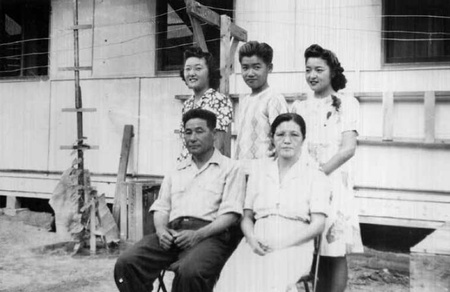
Shigechika and Kimi Kobara at Gila River with their children (left to right): Iso, Towru and Namiko. Photo courtesy of the Cal Poly Re/Collecting Project and the Fuchiwaki and Sanbonmatsu families.
With wartime restrictions, censorship in place no American serviceman could name the place he was nor where he might be going. Journals and diaries were forbidden and letters from home came from the family who knew there were certain things they could not say.
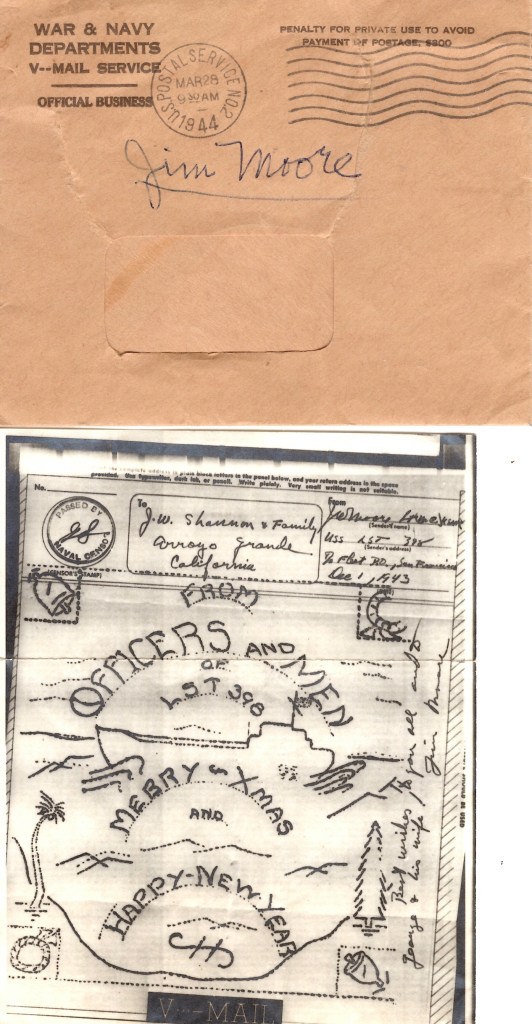
Jim Moore was my fathers friend and the son of Judge Webb Moore and his wife Edith, nee Fesler. They lived at the site of the McDonalds at Grand Ave and todays El Camino Real. The text on the side, “Best wishes to you all and to George and his (New) wife.” My mother was the new wife, the only wife actually. Other than the address Landing Ship Tank or LST there is little to tell you where he was when he wrote it. The only real clue is the palm tree which indicates somewhere in the Pacific. My family saved a number of these because they had friends serving all over the world. Over half the draft age young men from our town were in the service somewhere. My mother and grandmother were relentless in writing to them. Letters from home were a great prize.
Today we know that when this V-mail was written, his ship set sail from Kukum, Guadalcanal to resupply forces in Torokina, Bougainville. The convoy was under constant air attack and raised a barrage balloon to 2,000 ft. While unloading supplies, equipment and mail on a Bougainville beach. Japanese artillery hit the ship on the same day this photo was taken, killing an officer and five crew members.

Lt. Jim Moore’s 398. The workhorse of the fleet, hard used and constantly on the move. Jim served on her for three years without coming home. He took the train to Oakland on December 8th, 1941 with my father to enlist in the navy. After the war Jim became a surgeon in Ventura.
Your mother’s address would have been Gila River, Pima/Sacaton Arizona, Relocation camp, building 19-5 B, a hut they shared with two other families. His family would address mail to the APO, Army Post office San Francisco with just his name rank and serial number. Strict limits were put in place for obvious reasons. Old photos of the captured and dead invariably show them with pockets turned out and scattered papers and other objects lying nearby.
I took a while for the army to get over the suspicion that somehow the Nisei translators couldn’t be trusted, but by the time your dad got to New Guinea enough intelligence gathered by the MIS showed the great value they brought to the battlefield. Not only had battles been won but carful analysis of the information gathered gave the allies an almost complete picture of the Japanese Imperial armies disposition, tactical and strategic goals. They had gotten so good that the names of individual soldiers, not just officers, but the town and prefecture they lived in back home in Japan, their family members and their civilian occupations. Never in military history had planners had such a complete picture of their enemies.**

Captured diary of a Japanese soldier. National Archives. The map shows Malaysia, Burma, (Myanmar) both British controlled colonies. Thailand, Cambodia, and Vietnam were under the control of the French and called French Indochina. The Phillipines were and American Colony and the Dutch controlled Indonesia. All rich in resources such as rubber and oil they were the focus of the allies war effort in the Southwest Pacific area. Little mention of this area in textbooks but the effort to restore these countries to their European masters was very hard fought.
The following are entries from the personal diary of Hideki Oura.
June 29, 1943 : I wonder if they will come today. Last night it drizzled and there was a breeze, making me feel rather uncomfortable. When I awoke at 4 this morning, rain clouds filled the sky but there was still a breeze. The swell of the sea was higher than usual. However, the clouds seem to be breaking.
I have become used to combat, and I have no fear. In yesterday’s raid our air force suffered no losses, while nine enemy planes were confirmed as having been shot down and three others doubtful. Battle gains are positively in favor of our victory, and our belief in our invincibility is at last high.
Some doughnuts were brought to the officers’ room from the Field Defense HQ… They were awfully small ones, but I think each one of us had 20 or so. Whether they were actually tasty or not didn’t make much difference because of our craving for sweets. Each one was a treasure in itself. While eating the doughnuts, I lay down in the sand, and I pulled out the handbook my father had bought for me and which was now all in pieces from a bomb fragment. As I looked at the map of my homeland, which was dear to me, I thought I would like to go to a hot spring with my parents when I get home…
July 23: …Where have our air forces and battleships gone? Are we to lose? Why don’t they start operations? We are positively fighting to win, but we have no weapons. We stand with rifles and bayonets to meet the enemy’s aircraft, battleships, and medium artillery. To be told we must win is absolutely beyond reason… In the rear, they think that it is all for the benefit of our country. In short, as present conditions are, it is a defeat. However, a Japanese officer will always believe, until the very last, that there will be movements of our air and naval forces. There are signs that I am contracting malaria again.
This was Oura’s last entry. His fate is unknown, but it is unlikely he survived.
A diary with an illustration of the destruction after the fire bombing of Tokio
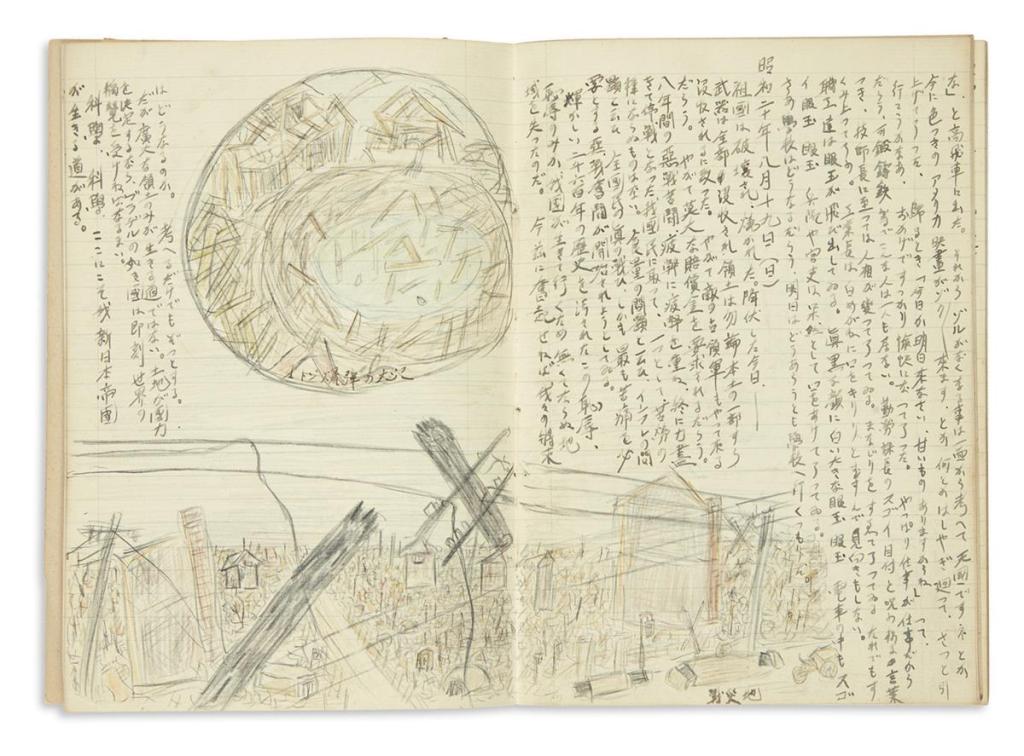
The first fire bombing of Tokyo on the 9th and 10th of March 1945 incinerated over 100,000 and made nearly a million people homeless. Every major city in Japan was to suffer the same fate. It didn’t sway the Emperors government at all.
Working in Port Moresby your dad would have handled letters and diaries daily. A vast amount of information had to be read, categorized and organized quickly because battlefield conditions are constantly in flux. Added to information coming down the Solomon and Marshall Islands, the Australian, Dutch, British, and from the US Army, there came intelligence from the coast watchers to which was now added labor needed to handle the documents coming from the Marines on Guadalcanal in the Solomons. The Navy and Marines would not enlist any Japanese. The remained segregated throughout the war but had seen the value the MIS boys brought to the fight and wanted to take full advantage of it. Because of this the MIS boys would soon be on the move.
At the ATIS clearance center in Brisbane, 400 hundred Nisei worked around the clock. Information from there was sifted thoroughly, categorized and quickly forwarded to Pacific headquarters at Pearl Harbor.
As well as the collected paperwork, your dad would have seen a steady stream of Papua New Guinea islanders, the famous Fuzzy Wuzzys. He would have had to really stretch his language skill because, though English was the language of the administrative population and the larger towns, in the bush it was Pidgin. Tok Pisin was the second language for the indigenous population. Pisin, or Tok Pisin is often referred to by English speakers as New Guinea Pidgin or simply Pidgin. It’s an English creole language spoken throughout Papua New Guinea and today is recognized as the official language of the country.
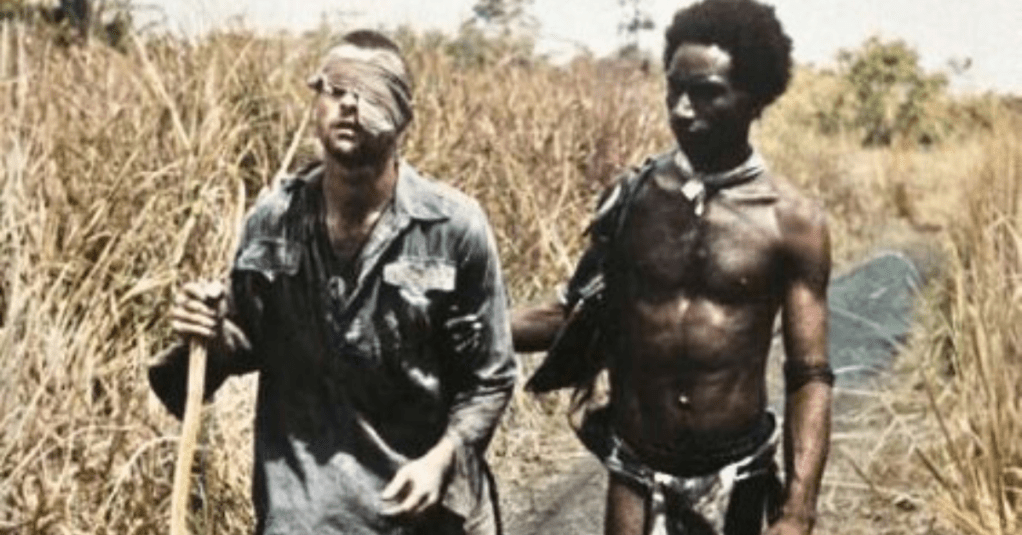
An Angel escorts a wound Australian of the 26th Regiment to the rear. Australian War Museum photo.
For example; if a Pidgin speaker came into the translators tent with some information on Japanese movements he might greet your dad with the greeting, “Gutpela long bungim yu.” or “Yu stap gut?” Wanam nem bilong yu? If Pisn wasn’t enough how about the Aussies? Australian and New Zealand slang is highly complex and something as simple as asking where the latrine is, “Wheres the Dunny mate?” can be laughingly confusing.
People today are likely to forget that much of the material the MIS handled was intensely personal. Japanese children grew up in those decades keeping journals in which they recorded their personal thoughts and feelings. Letters to Japan were mostly concerned with matters of family. American troops were much the same except that they were censored by their officers to root out any forbidden information which might help and enemy. The Japanese had no such system. A letter home by a Japanese soldier would have a return address, whereas US troops could not ever mention where they were.
Your grandparents hadn’t seen their son since he shipped out to Minnesota to attend school in October, 1942. He had not seen his family for almost two years. Letters were the only form of communication and it must have been agonizing to listen at mail call for his name to be called. Mail was irregular, frequently lost or arrived weeks and months late. The canvas bags of mail came by ship, were transferred to trucks or LST’s to be moved between stations and could come torn, opened by censors if they were from the concentration camps; even in some cases were and moldy after the long sea voyage. For the MIS especially terrible, literally every one your father knew, his entire family, neighbors, kids he went to High School with were locked behind barbed wire. Doing ones duty to his country came with a staggering personal cost.
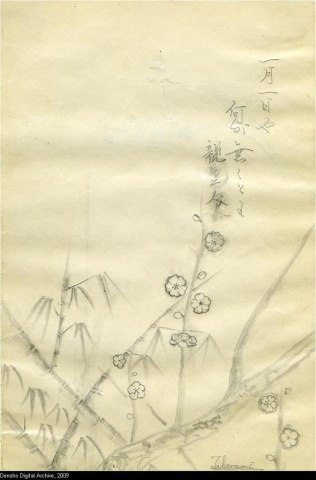
Japanese soldier’s diary page.
I must mention too that the documents that came in to the MIS where stripped from the dead for the most part. Soldiers were ordered to capture Japanese soldiers when they could but since that meant a risk to your own life, it was rarely done. A journal might be splattered with the blood of the soldier it belonged too. It may have been moldering at the bottom of a wet, fetid backpack for a week and stunk to high heaven. There is little doubt that the Japanese American boys felt something very personal about this. They read names just like their own. The Kibei especially, who had studied in Japan before the war and who knew the country well. Customs mentioned in the letters, places they had lived, schools they had attended and for a few as the war went on, the names of people they knew and in some rare cases Japanese soldiers from before the war and in at least one case a brother who was unable to get out of Japan, drafted and met his MIS brother on Okinawa.

As time has moved on and the old soldiers neared then end of their lives, secrets they never told anyone began to take on a new meaning. Sons and daughters who had asked the age old question, “What did you do in the war daddy?“ just might receive an answer. Many children only learned about their fathers military service when they opened that old green trunk in the attic or a small box at the bottom of the sock drawer with a handful of old unidentified medals and insignia or perhaps at the top your mothers closet, a small white cardboard box tied with a faded blue ribbon full of saved V-Mail letters from the far side of the world.
When my uncle Jackie was in his nineties, I asked that questions just like the others did and his answer? He thought about it a while before he answered, “Oh, you don’t want to know about that.” and that was that.
*Clint Eastwoods twin films “Flags of Our Fathers” and “Letters from Iwo Jima” received critical acclaim but “Letters” by far was the most watched because it opened a door into a shared experience to which the generations who have lived since WWII were unaware of. It had the effect of humanizing those Japanese boys on Iwo through their the personal experience written in letters home. Letters from Iwo Jima is not the most exciting or intense war film but it does something that I’ve never seen before in that it humanizes the Japanese. Yes, there are still quite strong cultural differences that the movie talks about but it also shows them as everyday people with their own worries and hopes.
**In researching for this letter I found numerous official photos taken by combat photographers of captured or surrendered Japanese Imperial soldiers being questioned, most without any mention of the MIS Nisei, such was the secrecy surrounding the program. The photos I’ve used in this story of Nisei are almost without exception non-official and taken by unofficial photographers. The only exception is the one with Colonel Merrill of the Marauders in Burma.
Dear Dona 9
Coming Jan 18th 2025: “Up the line to Morotai Island. Big changes for the MIS.”
Michael Shannon lives in Arroyo Grande, California. He writes so his children will know what kind of people they come from.
Be a lady they said.
Michael Shannon with La Furiosa.
“Be a lady they said. Wait, your skirt is too short. Button it up. Your pants are way too tight. Don’t show so much skin. Don’t show your thighs. Don’t show your breasts. Don’t show your tummy. Don’t show your cleavage. Don’t show your underwear. Don’t show your shoulders. Cover up. Leave something to the imagination. Dress modestly. Don’t be a tramp. Men cannot control themselves, they just can’t.
Be a lady. Men have needs you know. You look frumpy. Loosen yourself up. Show a little skin. Try and look sexy. Be hot. Whats the matter with you? Don’t be so provocative. You’re just asking for it. Wear black, it’s sexy. Wear heels, they make your legs look great. You’re too dressed up. You’re too dressed down. Don’t wear those sweatpants; they look like you’ve let yourself go.
Be a lady they said. Don’t be too fat and don’t be too thin. Don’t be too large. Don’t be too small. Eat up. Slim down. Stop eating so much. Don’t eat too fast. Order a salad and don’t eat carbs. Skip that dessert. You need to lose weight to fit into that dress. Go on a diet. Watch what you eat. Eat lots of celery. Chew gum but keep your mouth shut. Drink lots of water. You have to fit into those jeans. God, you look like a skeleton. Why don’t you just eat? You look emaciated. You look sick. Eat a burger. Men like women with some meat on their bones. And be small. Be light. Be little. Be petite. Be feminine. Be a size zero. Be a double zero. Be nothing. Be less than nothing.

Be a lady they said. Remove all your body hair. Shave those legs. Shave your armpits. Shave your bikini line. Shave your pubis, that’s cool. Wax your face. Wax your arms. Wax your eyebrows. Get rid of your mustache. Bleach this. Bleach that. Lighten your skin. Tan your skin. Eradicate your scars. Cover your stretch marks. Tighten your abs. Plump your lips. Inject Botox for your wrinkles. Lift your face. Tuck your tummy. Thin your thighs. Tone your calves. Perk up your boobs. But look natural. Be yourself. Be for real. Be confident. Wait, you’re trying too hard. You look overdone. Men don’t like girls who try too hard.
Be a lady they said. Wear makeup. Prime your face. Conceal your blemishes. Contour that nose. Highlight your cheekbones. Line your lids. Fill in your brows. Pluck your brows. Lengthen your lashes. Make them fakes. Color your lips. Powder, blush, bronze, highlight. Your hair is too short. Your hair is too long. Your ends are all split. Highlight your hair. Your roots are showing. Dye your hair. Not blue, that looks unnatural. You’re going grey. You look so old. Sad. Better to look young. Look youthful. Look ageless. Don’t get old. Women don’t get old, can’t be old. Old is ugly. Men don’t like ugly.
Be a lady they said. Save yourself for marriage. Be pure. Be virginal. Never talk about sex. Don’t flirt. Don’t be a skank. Don’t be a whore. Don’t be trash. Don’t sleep around. Don’t lose your dignity. Don’t have sex with too many men. Or any man. Don’t give yourself away. Men don’t like sluts. Don’t be a prude. Don’t be so up tight. Have a little fun girl. Smile more. Pleasure men. Be experienced. Be sexual. Be innocent. Be dirty. Be virginal. Be sexy. Be the cool girl. Don’t be like the other girls.
Be a Lady they said: Be a dame. Be a frail. Be a broad. Be a babe, a dish, a bimbo, a chick, a doll. Be a doxy, floozy, gal, girly, honey, a missy. Be a moll, skirt, sweet thang, or tootsie. Be sweetums, Honey-Bunny. You’re the Weather Girl, my girl Friday, The girlboss, fangirl, nerdygirl, baby girl.
Be a lady they said. Don’t talk too loud. Don’t talk too much. Don’t talk at all. Don’t take up space. Don’t sit like that. Don’t stand like that. Don’t be so intimidating. Don’t be smart, smarts not good. Don’t be intellectual. Why are you so miserable? Don’t be such a bitch. Don’t be so bossy. Don’t be assertive. Don’t overact. Don’t be so emotional. Don’t cry. Don’t yell. Don’t swear. Be passive. Be obedient. Endure the pain. Be pleasing. Never complain. Let him down easy. Boost his ego. Make him fall for you. Men want what they can’t have. Don’t give yourself away. Make him work for it. Men love the chase. Fold his clothes. Cook his dinner. Keep him happy. That’s a woman’s job. You’ll make a good wife some day. Take his last name. You hyphenated your name? Damn crazy feminist. Give him children. You don’t want children? You frigid? You will some day. You’ll change your mind.
Be a lady they said. Learn to cook. Learn to shop. Learn to clean. Vacuum, dust, wax, and scrub they said. Have dinner ready. Make what he likes. Clear the table. load the dishwasher. Whats his favorite drink? Keep it clean and neat. Impress the boss. Pump him up. Be a whore in the bed. Don’t ask too many questions they said.
Be a lady they said. Don’t swear, don’t be a battle-axe, Crone, Shrew, Floozie, Termagant, Trollop, Virago. No Feminazi, Radical chic, Don’t be a Nasty Woman. Be a “Good Miss.”
Be a lady they said. Don’t get yourself raped. Protect yourself. Don’t drink too much. Don’t walk alone. Don’t go out too late. Don’t dress like that. Don’t show too much. Don’t get drunk. Don’t leave your drink. Have a buddy. Walk where it’s well lit. Stay in the safe neighborhoods. Tell someone where you’re going. Bring pepper spray. Buy a rape whistle. Hold your keys like a weapon. Take a self-defense course. Check your trunk. Lock your doors. Don’t go out alone. Don’t make eye contact. Don’t bat your eyelashes. Don’t look easy. Don’t attract attention. Don’t work late. Don’t crack dirty jokes. Don’t smile at strangers. Don’t go out at night. Don’t trust anyone. Don’t say yes. Don’t say no.
Don’t be a Bitch. They said.
Men have needs you know. Just “be a lady,” they said.
Be Furious.
Michael Shannon with La Furiosa
Dear Dona,
Page 7
A Long Way From Arroyo Grande
Written By: Michael Shannon
When your dad was transferred up to Port Moresby with his team he was introduced to a place he never imagined while he grew up in Arroyo Grande.
He certainly read Tarzan of the apes when he was a kid and must have imagined the African jungle as it was described by Edgar Rice Burroughs. In the time honored way of writers, Burroughs himself never ventured any closer to Africa than Chicago. As kids, the places we know outside our own existence are described in a way that rarely has much relation to the real place where the story takes place. No less your fathers generation whose visual images wee formed by Life magazine or the jungle movies he saw at the Mission or Pismo theaters. It’s not much different today. Moviemakers are rarely too concerned with an actual location when they are creating a mythical place.
I’ve been to Papua New Guinea. I can testify as to its holding the title of one of the greatest hell holes on earth. When Hilo arrived in Port Moresby with MacArthurs headquarters the port itself was a tiny backwater of the colonial British empire. Papua New Guinea had a population of approximately 3,000 people, 2,000 natives and about 800 Europeans.

Port Moresby, Papua New Guinea, 1943
Port Moresby was a small British administrative center at the time, with only two track dirt roads connecting nearby coastal villages. The city was dry for eight months out of the year, from June to January, and locals had to depend on rainfall or transport water from other areas. For a place considered one of the wettest place on earth and because it was in the rain shadow of the Owen Stanley range it received only fifty inches of rain annually. It seems like a great deal if you grow up in Arroyo Grande where the average is about 19 but your dad would soon find out what real tropical rain is all about.
Imagine the introduction of nearly 18 thousand allied troops into the area. The general and some of his staff took over the British administrative buildings but almost everyone else lived in tents. There is no real way to experience the climate unless you go there. New Guinea is just about four hundred miles south of the equator and in the western regions the annual rainfall exceeds 125 inches a year. Think of that in feet. It’s raining there today and tomorrow and the next day and so on and so on. Plus its more 90 degrees and the humidity is roughly the same. Don’t worry though, it will cool off at night to about 85 or a little more. When the sun is out it can cook your skin in just a few minutes.

Port Moresby tent camp, 1943.
Flora and fauna? New Guinea has one of the most diverse ecologies on earth. It is home to every kind of biting, stinging and poisonous insect, even the wild dogs are dangerous. Think about birds, the Hooded Pitohui is extremely poisonous, and isn’t the only one. Some cockroaches can grow to six and seven inches long. There are nasty scorpions, stinging hornets, bees, caterpillars and moths, moths of all things. You want some relief? Go for a swim where in the ocean which is home to the deadly stonefish, killer sharks, Poisonous stingrays, remember the Crocodile Hunter? And snakes, sea snakes, very deadly and my personal favorite the “Two Step Snake,” if he bites you, you get two steps and you die.
The biggest killer in human history thrives in tropical climates and was responsible for more deaths in the Pacific than even the most horrific combat, especially for the Japanese Imperial army which was notoriously casual about the well being of it’s troops. Statistically somewhere around 95% of Japanese combat soldiers died of disease or starvation during the campaigns in Papua New Guinea.

Sidewall Tent Living, Port Moresby.
If all of that was not enough, living in a sidewall tent, sleeping on folding cots under mosquito netting you could also fall victim to Dengue fever commonly referred to as Breakbone Fever for which there was no vaccine until 1997. Add to this list Yellow Fever which killed tens of thousands during the building of the Panama Canal, Chagas, a parasite you get through the bite of the apply named “Assassin Bug.” Add Cholera which is transmitted through contaminated water and all kinds of parasites such as Hookworm, Roundworm, Whipworm and Tapeworm.
For Americans, disease was responsible for about 10% of deaths in the Pacific war but in the casualty column it was by far the biggest cause of loss. At any given time about 4% of US troops in the Pacific were unavailable for duty.
The MIS boys were ordered up by MacArthur in early 1943. He had around sixty who were loaded with their gear aboard the Australian navy’s transport HMAS Kanimba and sailed to Ferguson Harbor at Port Moresby. When they arrived there was almost no accommodations for them. Troops were billeted in camps scraped out of the brush. It would be months before Navy Seabees arrived and began building an airfield and erecting the ubiquitous Quonset huts so familiar to anyone who has ever lived in the Pacific islands.
Army service soldiers from the 93rd Division (Colored) worked around the clock unloading supply ships and building shelters, kitchens and other necessary support structures including showers and laundries.
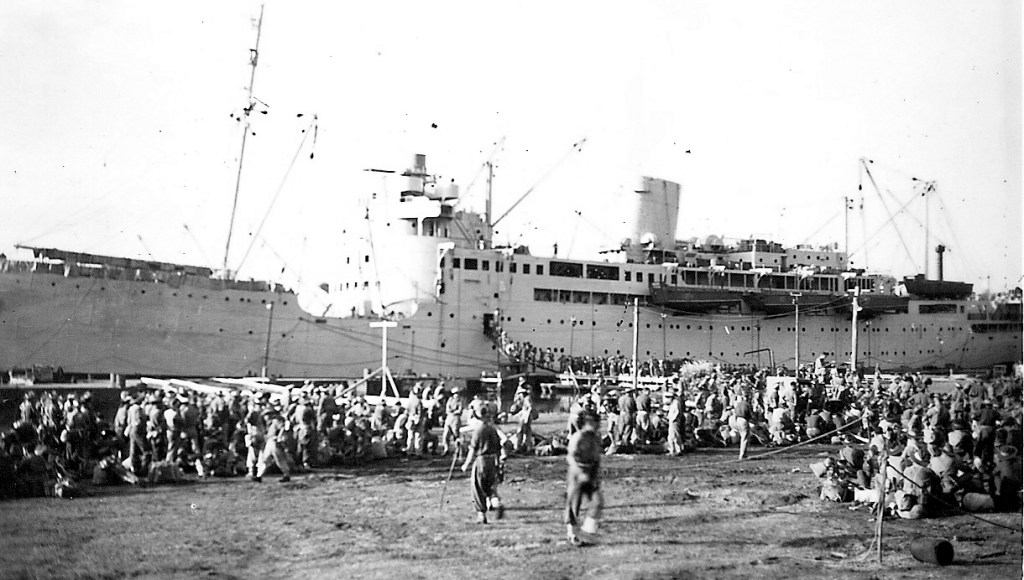
His Majesty’s Australian Ship Kanimba unloading at Port Moresby, 1943. Australian War Museum photo.
In one of the funny things regarding race, which was an ongoing issue, the white officers and troops had only cold water showers but the Black troops built themselves hot water showers. Your father said the Nisei showered with the African Americans. Apparently the white troops never figured this little act of defiance out. A small rebellion but a taste of a future army*
At Port Moresby, your father and the others on his ten man team moved into their tents and quickly began digging slit trenches. The Japanese sent bombers on a regular run down from Rabual to pound New Guinea. The sound of bombs rattling down from high above sent soldiers diving head first into their fox holes and trenches. When your dad first arrived the ground troops had not pushed the Japanese army far enough to stop the harassment. It would be their first experience of the shooting war but not the last.
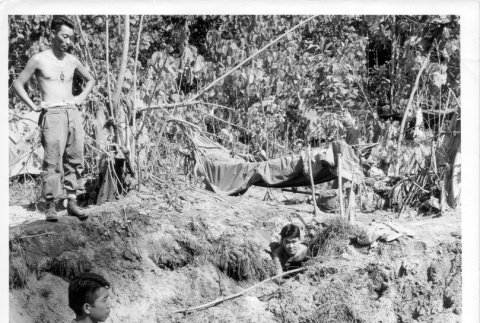
As a farm boy Hilo certainly knew about digging. Nikkei Archive photo.
The workload of the translators was very heavy. Because combat in New Guinea was unceasing as the allied troops slowly pushed the Japanese Northwest and out of the island, documents, letters and personal journals stripped from the vast number of dead** Japanese troops which by this time the allies understood to be of significant importance.
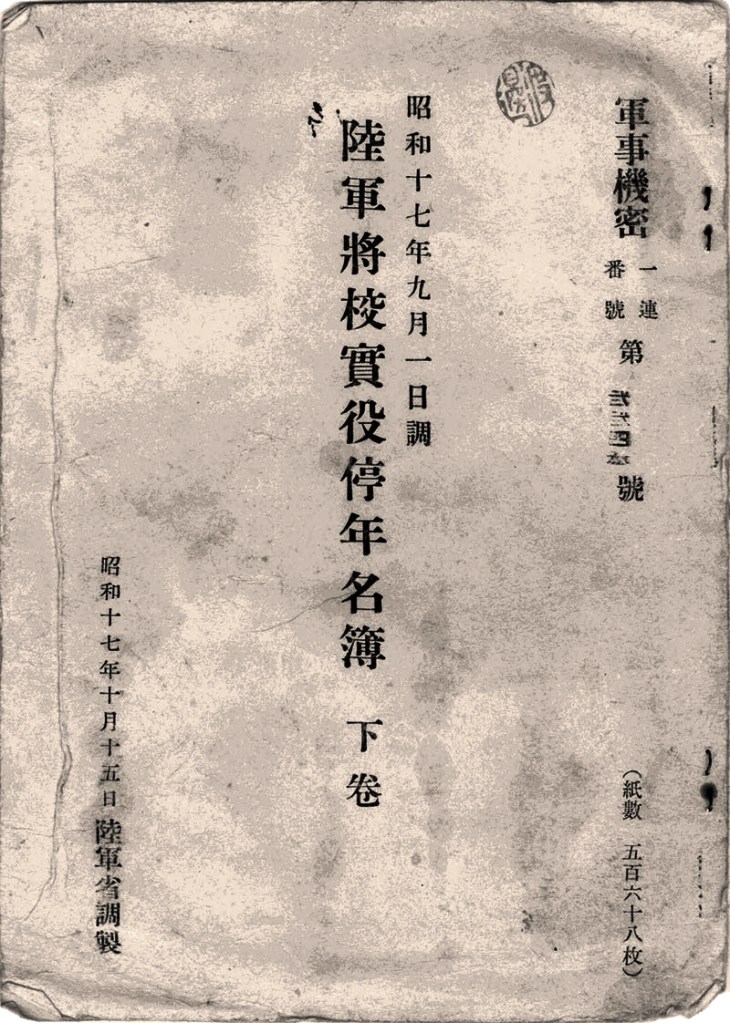
A Detail from the Japanese Imperial Navy’s Warship and Officer list. National Archives.
The battle of Midway in 1942 was partially won because of the MIS. Radio intercepts by the translators along with the breaking of the Japanese Naval code by the code breakers at Pearl set the stage for the ambush of the Japanese carrier force headed to Midway island in the northwest Hawaiian island chain and a good bit of sheer luck blunted the Japanese carrier navy which would never fully recover. It was the first nail in the coffin of Imperial Japans plans for the Greater Asia Co-Prosperity Sphere.
American commanders initially resisted using MIS nisei for their intended purpose, the gathering of information about the enemy. Thanks, however, to the persistence of a haole plantation doctor from Maui, Major James Burden, and the work of the nisei themselves, attitudes changed quickly. Major Burden took an MIS team to the South Pacific. They had to work hard for a chance to prove themselves. Nisei with the 23rd “Americal” Division in New Caledonia worked around the clock to translate a captured list of call signs and code names of all Imperial the Japanese Navy ships and air bases.
Major Burden and the nisei pushed to get closer to the action, and some wound up on Guadalcanal, where they made a big discovery: the joint operational plan for Japanese forces in the South Pacific.
Found floating in the Ocean it was brought ashore by New Caledonian natives and turned over to an Australian Coast watcher who arranged to get it to the 23rd’s headquarters. The Mis translators quickly discerned it’s contents and forwarded the documents to Army, Navy and Marine senior officers in Hawaii and Maryland. The hubris of the Japanese high command in not changing codes or plans meant that US forces in the Western Pacific were able to use the information to follow troop movements, fleet assignments for the rest of the war. Just this one thing validated the wisdom and the expense of the Army in forming the MIS teams.
There was more to come.
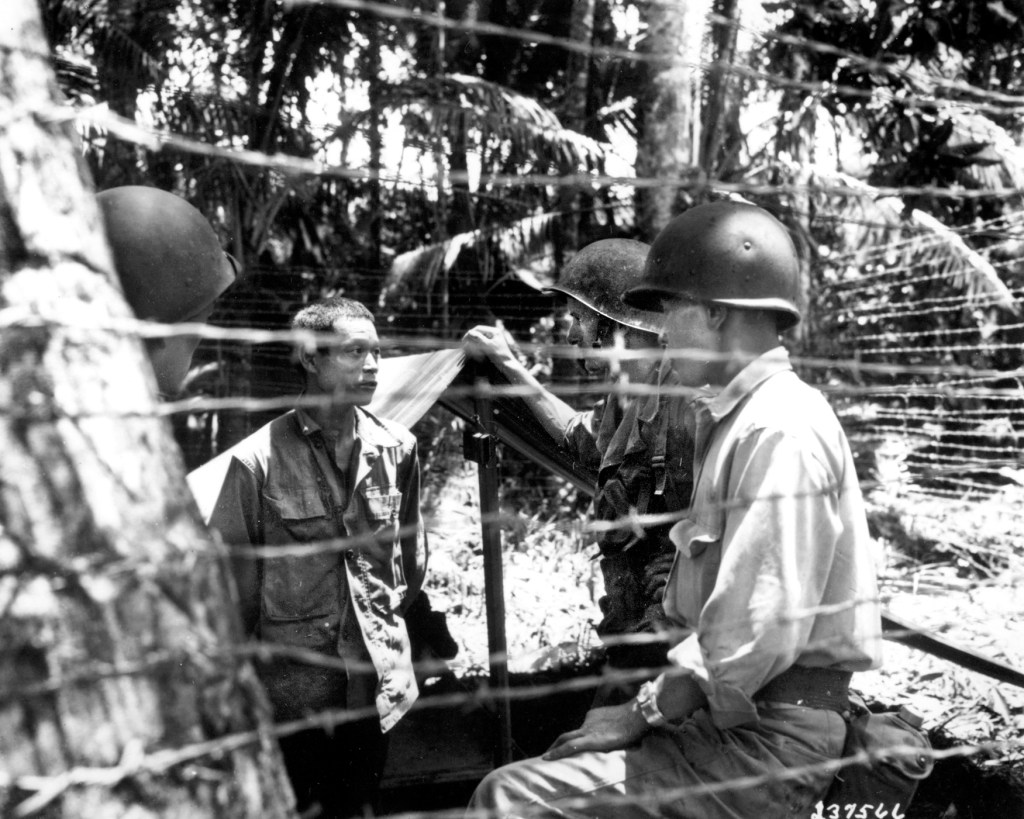
Above: SIMINI, New Guinea, January 2, 1943: From left, Major Hawkins, Phil Ishio and Arthur Ushiro Castle of the 32nd Infantry Division question a prisoner taken in the Buna campaign. Information from POW interrogations produced vital tactical information countless times. National Archives photo.
Next: Dear Dona, page 8. Moving up towards Japan. Maurutai, Luzon, Leyte, and Okinawa.
*Presiden Truman integrated the armed forces. On July 26, 1948, President Harry Truman signed Executive Order 9981, creating the President’s Committee on Equality of Treatment and Opportunity in the Armed Forces.
**The 23rd Infantry Division, more commonly known as the Americal Division, was formed in May, 1942 on the island of New Caledonia. In the immediate emergency following Pearl Harbor, the United States had hurriedly sent three individual regiments to defend New Caledonia against a feared Japanese attack. They were the 132nd Infantry Regiment, formerly part of the 33rd Infantry Division of the Illinois National Guard, the 164th Infantry Regiment from North Dakota, and the 182nd Infantry Regiment from Massachusetts. This division was formed as one of only two un-numbered divisions to serve in the Army during World War II. After World War II the Americal Division was officially re-designated as the 23rd Infantry Division, however, it is rarely referred to as such. The division’s name comes from a contraction of “American, New Caledonian Division”. The Americal Division was involved in ground combat in both World War II and Vietnam.
***From the Owen Stanley Mountains in New Guinea to Luzon, Philippines, the 32nd Division walked that long, winding and deadly combat road for 654 days of intense combat, more than any other American unit in World War 2. The Red Arrow was credited with many “firsts”. It was the first United States division to deploy as an entire unit overseas, initially to Papua New Guinea. The first of seven U.S. Army and U.S. Marine units to engage in offensive ground combat operations in 1942. The division was still fighting holdouts in New Guinea abd the Phillipines after the official Japanese surrender.
****The 93rd (Colored) was a combat trained division led by white officers. The “Blue Helmets” as they were known were almost never used in combat but reduced to labor battalions. The Division had shown in WWI in France that they were a fearsome outfit but in this war they were rarely given the chance and were reduced to no more than “Hired Hands.”
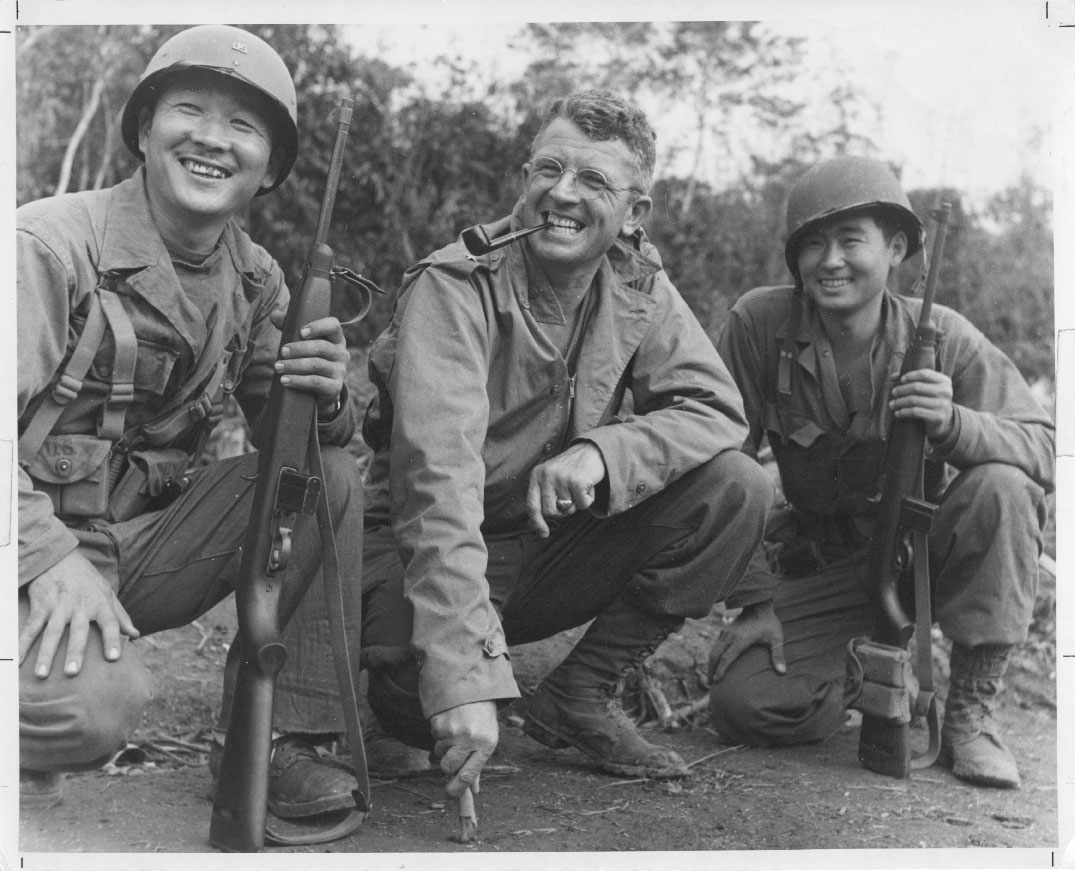
Cover Photo: General Frank Merrill posing with Japanese-American members of the Marauders. Fourteen Japanese-American service members with the Military Intelligence Service served as translators and codebreakers (Image courtesy of the National Archives and Records Administration)
Michael Shannon is a lifelong resident of California. He writes so his children will know where they come from.
Dear Dona,
Page 6
Author: Michael Shannon.
Auckland, New Zealand. 1943 population, 1.642 million people with a revolving population of soldiers and Marines. The New Zealand government was very concerned about the Japanese because without the Americans to defend the island they were in trouble. You see, the Anzacs were in Italy, the Mediterranean and North Africa, as well as Japan in south-east Asia and other parts of the Pacific. They weren’t home and the islands, just like Australia were desperate for the Americans to help defend them. Japanese submarines were patrolling the waters between New Zealand and Australia. In 1942 the United States navy had just barely stopped the planned invasion of Port Moresby in New Guinea. The reason was its close proximity to both Australia and Asia. The Japanese viewed Port Moresby as a key point to launch aerial attacks on the northern part of Australia. They could have closed the sea lanes from the U S to Australia and New Zealand. Troops fighting to defend New Guinea, the Anzacs, Dutch and MacArthur’s undertrained, rag tag 32nd division from Wisconsin and Michigan were slugging it out with Japanese in the fetid, rainy jungle of the southeast of New Guinea trying to push the Japanese back along the Kokoda trail and down the Owen Stanley range toward the coast. Soldiers on both sides had to literally crawl on their hands and knees because the slopes were so steep and slippery from the constant rain. There was no more brutal fighting in WWII. Nisei translators later found Japanese diaries which describe starving soldiers butchering and eating the Australian dead. The Japanese were literally starved out.
Soldiers were granted time away from the ship in Auckland. It was a chance for the Americans to sample a culture quite different than their own. For the Nisei who were well acquainted with ethnic hatred it brought to mind some curious observations. The Kiwis’ didn’t consider the translators outsiders. Neither did they dislike the black support troops from the ship and ones stationed at the army camps ashore. This was a big difference from the way white Americans treated their fellow citizens. On the voyage over, great care was taken to segregate troops of color from their fellow soldiers. Contrary to what is written in history books, violence towards minorities was common in our military.
On June 12, 1942, five transport ships carrying US Army troops arrived in Waitematā Harbour in Auckland. This marked the beginning of the “American invasion” of New Zealand, which lasted until mid-1944. The New Zealanders were quickly disabused of their inherent like of their fellow allies.
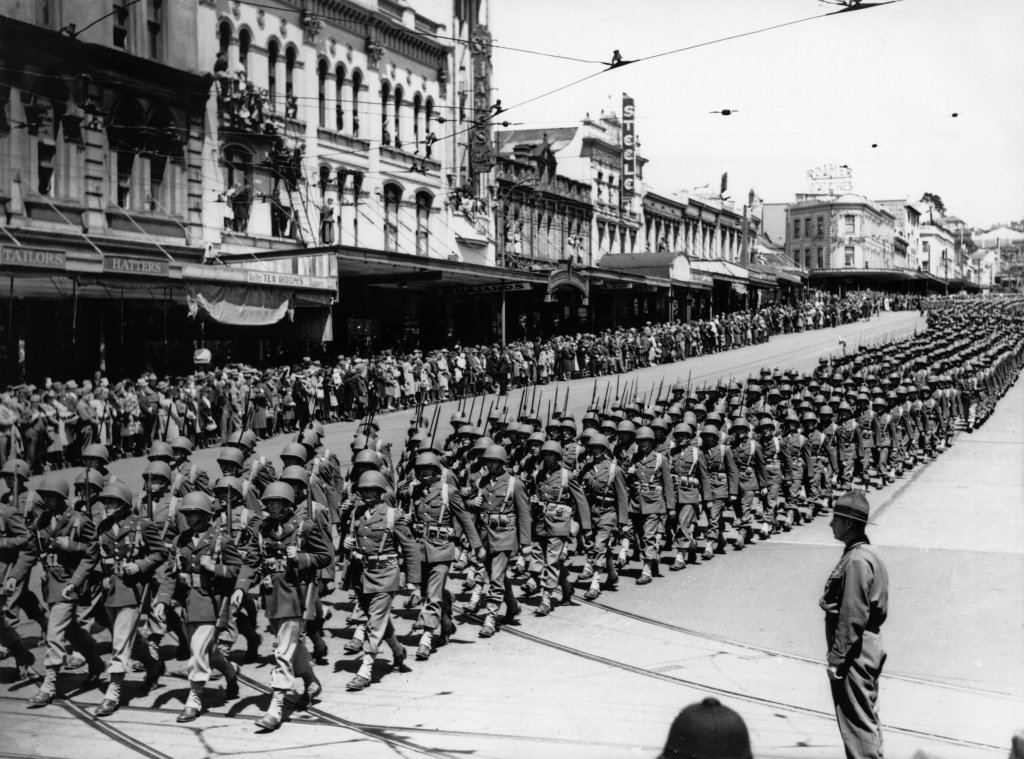
US troops march down Queen Street, Auckland, 1942. New Zealand Herald Archives photo.
Between 15,000 and 45,000 American servicemen were stationed in New Zealand, mostly in camps in or near Auckland and Wellington.There were cultural differences between the Americans and New Zealanders. New Zealand women found the US servicemen to be handsome and polite, and they had more money than New Zealand soldiers. They were better dressed than the local troops and being young and very far from the moral strictures of home had few reasons to show anyone respect. Women of all kinds were “fair” game, the way they saw it. This led to romantic entanglements between American troops and New Zealand women. “Overpaid, oversexed and over here” was the watchword for the New Zealanders. The locals saw it as an “American invasion”. Many New Zealand soldiers resented the idea of relationships between New Zealanders and American soldiers, leading to tense relations between the two parties.
Another source of tension was US servicemen’s attitudes towards the Māori. White soldiers from the 31st “Dixie Division” from the south were not “comfortable” with Māori soldiers. The government published a guide book for US servicemen, titled “Meet New Zealand” which reminded the Americans that “the Maori today occupy a position in society socially and politically equal to that of any pakeha or white New Zealander”. The Prime Minister’s office said that New Zealanders should “be friendly and sympathetic towards the colored American troops, but remember that they are not accustomed in their own country to close and intimate relationships with white people. Anyone finding themselves in the company of both white and black American troops was advised to “avoid unpleasantness”. Quite the understatement.
During this time, hotel bars closed at 6 pm and masses of drunk soldiers were then ejected into the streets. This was known colloquially as the ‘six o’clock swill’. Around 6 pm on the evening of 3 April 1943, fighting broke out between US servicemen and New Zealand soldiers and civilians outside the Allied Services Club. The brawls spread to the ANA (Army, Navy, and Air Force) Club in Willis Street and then to Cuba Street and continued nonstop for hours. Civilian and military police attempted to break up the fights, but only finally subsided as the US soldiers left town on trains back to their camps. 6×6 army trucks returned the passed out drunk and those damaged by the shore patrol and the MPS. Courts Marshalls were ordered then cancelled for lack of any evidence, another understatement.
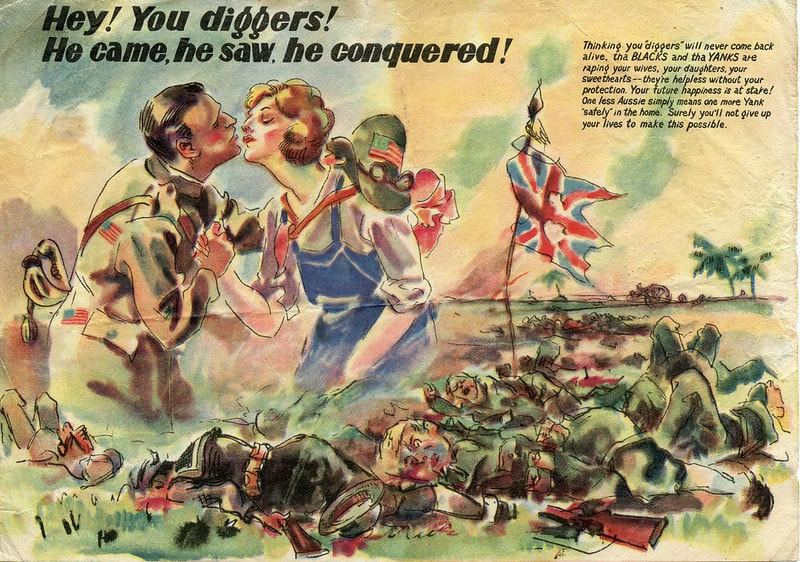
The Japanese also understood the value of propaganda. Japanese leaflet. 1943 US Army Archives
When your dad arrived with the other Nisei, the New Zealanders accepted them as equals but their own countrymen, far less so. Any thought by the translators that their service would reduce the racism of white troops was an unlikely dream. They had to be very careful.
A fight on 12 May 1945 in Cuba Street involved over 150 Māori and US servicemen. This fight was definitely racially motivated: Māori troops were angry at their treatment by the Americans, who tended to treat them the way they treated black Americans. Military reports stated that “Maoris from whom statements were taken allege they have been insulted by the Americans and have been told by Americans not to ride in the same tramcars, drink in the same bars, eat in the same cafes and that they should walk via back streets or step off the sidewalk when American soldiers approached. The Americans call them black curs an N*****s and have consistently insulted the Maori race. Imagine traveling halfway around the world only to find the same intolerance and hate as in your own home town. The only modifying thing was that the New Zealanders accepted both the Blacks and Japanese translators with no reservations. They were welcomed in New Zealand’s establishments and into their homes as well.
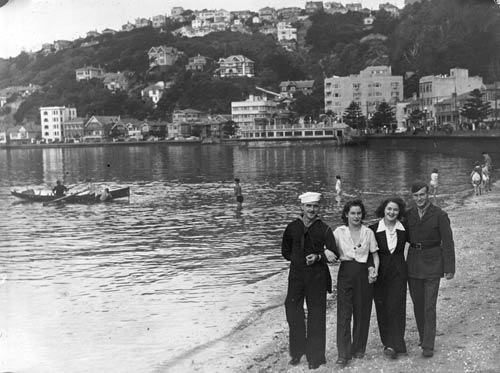
Because the MIS translators were considered so valuable, General MacArthur ordered them to be sent to Brisbane, Australia immediately. When they stepped off the ship in Brisbane, and were driven to army headquarters the first thing they were told was to avoid places where American soldiers hung around. Just like Auckland and Wellington, Brisbane had seen vicious riots on more than one occasionAmericans had worn out their welcome.
By late summer of 1943 the offending division had been moved to the front in New Guinea where they again failed to distinguish themselves in the vicious fighting on the Kokoda trail where the Imperial Japanese army had been pushed back over the Owen Stanley range of mountains by the Anzacs. At nearly 14,000 feet, the battles in the clouds as the news called it, the Aussies not only fought the Japanese but triple digit heat, little water, almost no food and what they did have had to be hauled up the nearly vertical mountains by the New Guinea natives who supported the Anzacs, the so called Fuzzy Wuzzy Angels. “Fuzzy Wuzzy Angels” was the name given by Australian soldiers to Papua New Guinean water carriers who, during World War II, were recruited or forced into service to bring supplies up to the front and carry injured Australian troops down the Kokoda trail during the Campaign. Over the four arduous months, the Fuzzy Wuzzys helped secure an Australian victory by forming a human supply chain along the Kokoda Track, moving food, ammunition up and wounded soldiers down from the front lines. 625 Australian soldiers were killed during the Kokoda Campaign, and over 1,600 wounded. Additionally, in excess of 4,000 soldiers became casualties due to illness. More than 150 Papuans died as members of the Papuan Infantry Battalion or as carriers of critical supplies and wounded along the Kokoda Trail.
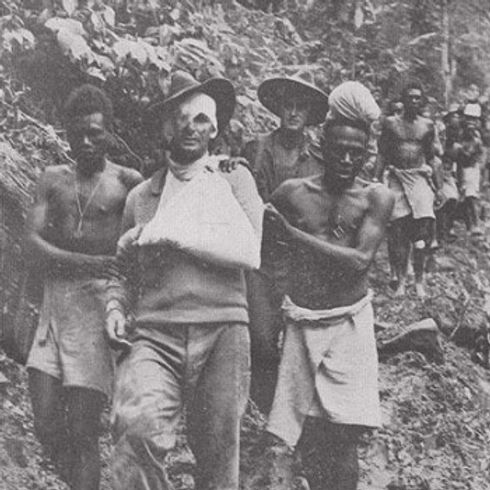
New Guinea auxiliaries helping an Australian soldier down from the Owen Stanley mountains. Australian War Museum photo.
the Australian and New Zealanders finally defeated what was to be Japan’s last attempt to invade Australia and cut the sea lanes from the United States. The battles now moved to the northern end of New Guinea. Port Moresby was secure and planning was underway for the next step up the island chain towards Japan itself.
MacArthur moved his headquarters from Brisbane to Port Moresby in New Guinea. Your dad and his other translators packed up and went with him. They were working seven days a week. Hundreds of thousands of diaries, letters home and military communications were being processed every week by the MIS translators. Rather, as you might imagine just a primarily local project, it had become necessary due to the volume of documents being found in caves, the bodies of dead Imperial troops and radio intercepts to establish a communication network that encompassed the men with MacArthur like your father and the cryptographers at Pearl Harbor, the language school at San Francisco’s Presidio and the school at Fort Snelling in Minnesota. A network was set up to handle the radio traffic between places and to provide air transport to move the thousands of crates of captured documents.
Leaving the comfortable billets in Brisbane, your father and his crew packed up and moved to the decidedly less cushy environs of Port Moresby, New Guinea. They would have to get used to the new arrangements. It would be a long time before they saw a solid roof over their heads or a decent shower. It would be canvas and cold water from here on out.

Tent 29. Camp Chelmer, Indoorooplily, Queensland, Australia. November 1943. Joe Iwataki photo
Dear Dona . Page 7 Coming December 27th.
 atthetable2015