HIGH-BALLIN’

Written by Michael Shannon

Working on the railroad all the live long day.

It was a bet between two railroad builders. Charles Crocker, one of the so called Big Four of the Central Pacific Railroad and Wily, rapacious Doctor Thomas Durant of the Union Pacific Railroad, wryly captioned “Uncle Pete” by the men who built it.

Charles Crocker was only 47 at the time of the great race, Thomas Durant was 49. Still young men.

As the roads closed in on the designated place where they were to meet at Promontory Point in Utah. In a fit of excess pride, Durant ordered his construction bosses, the Casement brothers, Dan and Jack to lay as much track in a day as they could.

Tough as nails and given to dressing like a Cossack, Jack Casement worked his men hard. The crews lived in 20 cars, including dormitories, kitchen, dining car and an arsenal car containing a thousand loaded rifles. They moved west accompanied by a mobile town that could be put up and torn down in a day. Called “Hell On Wheels” its only purpose was to supply the largely Irish workforce with all the requisite vices.

Track crews worked seven days a week, twelve to fourteen hours a day. They were paid a dollar for each days work. Much of the money went to the pockets of the thimblerigs, gamblers, bartenders and the ubiquitous “laundresses” that followed the road.

On the 24th the Union Pacific broke all records by laying six miles of track. Charles Crocker and his Chinese “pets” were invited to match that. The “Pets” was a derogatory term applied by other Central Pacific men to the Immigrant Chinese. Refugees from China during and after the Taeping revolution the Chinese had proven to be steady and hard working. Personal cleanliness and with a diet of vegetables and rice they were free of disease, did not drink and worked as steady as a metronome. By the time the Central Pacific hit Utah, they employed between ten thousand and fourteen thousand men, nine of every ten, Chinese.

Crocker beat it by a mile. Then the Union Pacific Casement brothers came back with seven and a half miles, working from three in the morning until almost midnight. But the Central Pacific was not to be beaten.

A $10,000.00 bet, $2,200,000.00 in todays currency, between two men with giant egos hanging in the balance, Crocker and his crews timed the final go so the other road wouldn’t have time to challenge whatever they did. Crocker and Durant epitomized the robber barons of the nineteenth century. Big risk, big reward.

After a day of careful planning, work began on the morning of April 29th, 1869. They were ready to go. A continuous line of five trains loaded with rails, spikes, fishplates, bolts and nuts were backed up to the end of track. Wagons loaded with water, hand tools and stacked high with ties were driven in and parked alongside the prepared roadbed. Thousands of men took their places and at exactly 7:00 o’clock a locomotive engineer carefully following the minute hand of his open pocket watch reached up and yanked the whistle cord sending up a piercing shriek of live steam and the great day was kicked off.

A train of sixteen cars loaded with iron rail and materials for two miles of track was pushed up to the front. Men climbed on top and threw off the fish plates and kegs of bolts and spikes. Others punched side stakes out of the right and left alternate cars. The rails were then rolled off and in eight minutes the sixteen ears were cleared with a noise like the bombardment of an army. The flat cars were then flipped off the track and the locomotive was then pulled back out of the way and another train of rails brought into position.

As soon as the material train was gone, small iron hand cars were put on the tracks. Each had a crew of six Chinese working under white bosses. Sixteen rails were loaded on each car, together with a keg of bolts, a keg of spikes, and a bundle of fish plates. Two horses with riders were attached to the car in tandem by a long rope. As soon as the car was loaded and the crew on top, the horses were off on the jump. One side of the roadway was kept clear for the horses racing ahead with the material cars. On a down-grade horses were detached and the car went flying along with one of the crew acting as a brakeman. The horses ran alongside and, when a level was reached, the nearest rider hooked on again. The first car out from the material dump only had to a short distance, while the last cars had to go perhaps two miles.

At the same time empty cars were returning on the single track, all of them at full speed. As a full car came closer, the crew on the empty car jumped off and lifted their car from the rails, while the loaded car went past without slacking speed. There was no halt in the continuous stream of materials to the front.

When the loaded car neared the rail-head, its gang stepped off and another gang jumped on with picks. They broke open the kegs and cut the fastenings on the fish plates. The keg of bolts was thrown to one side to men who filled their buckets and distributed the bolts. Other men distributed the fish plates. The spikes were poured out over the rails on the car and as the rails were pulled off the spikes dropped through the floorless car and distributed themselves.

At this point the picked crew of Irish rail handlers, working under Track Foreman H. H. Minkler and Gang Foreman George Coley, came into the picture. A single horse pulled the car up to rail-head, where it was blocked by a wooden-framed iron track gauge. Four men worked on each side of the track. Two men seized the forward end of the rail with their tongs while the two rear men slipped the rail to the side of the car so it rested on iron rollers. The two forward men trotted ahead the length of the rail, thirty feet, the rear men dropping the rail in place, where it was bolted and spiked by the track gang. The car was then pulled forward to the next track gauge and the procedure repeated.

The track went forward at the rate of almost a mile an hour. A correspondent for The Alta Califonian , a San Francisco newspaper, timed the track layers. He wrote: “I timed the movement twice and found the speed to be as follows: The first time 240 feet of rail was laid in one minute and twenty seconds; the second time 240 feet was laid in one minute and fifteen seconds. This is about as fast as a leisurely walk and as fast as the early ox teams used to travel over the plains.”

The rail handlers were only eight of several hundred men at the front, everyone of whom was an important cog in the smooth-working machinery. Ahead were three “pioneers,” the most advanced men, who, with shovel and by hand, butted the ties to a rope line measured from the track-center spikes set by the surveyors. About half the regulation number of ties were placed at first to insure having sufficient for the ten miles.

Just behind the rail layers came the spikers, bolters, and those who distributed the materials. The brawny Spike Men swung once to set the spike then one-two and she was done. A steady pace, three notes on the steel spike and on to the next one.Then came the gang that surfaced the track by raising the ends of the ties and shoveling enough ballast to hold them firm. Immediately following was a surveyor who sighted the line of the rails and, by motion of his hands, directed the track straighteners. Then the tampers, 400 strong, with shovels and tamping bars.

When a halt was called for the midday meal, six miles of track had been laid and the men were confident they would reach their goal. A number of Union Pacific officers had lunch with Stanford, Crocker, and others of the Central Pacific. They were ready to extend congratulations. “Victory” was the name given the spot where lunch was taken. The station is now called Rozel.

After lunch the work went on, but not so rapidly. The ascending grade on the west slope of Promontory Mountain was more difficult than the section covered during the morning and there were many curves. Considerable time was lost in bending rails, which was done by placing the rail on two blocks and forcing it into the desired curve by blows of heavy sledge hammers.

When the forward march was halted at 7 o’clock, ten miles and 56 feet of new track had been added to the Central Pacific. Jim Campbell, boarding boss and later superintendent of the division, jumped into a locomotive and ran it back over the new line at a clip of 40 miles an hour just to prove that the job had been well done.

If the roadway had been perfectly level and straight, these men could have laid fifteen miles of track. The task had involved bringing up and putting into position 25,800 ties, 3520 rails averaging 560 pounds each, 55,000 spikes, 14,080 bolts, and other material making a total of 4,462,000 pounds.

From the first “pioneer” to the last tamper, about two miles long, there was a line of men advancing a mile an hour; iron cars with their load of rails and humans dashed up and down the newly-laid track; foremen on horseback were galloping back and forth. Keeping pace with the track layers was the telegraph construction party. Alongside the moving force, teams were hauling tool and water wagons. Chinamen with pails dangling from poles balanced over their shoulders were moving among the men with water and tea.

Farther back, locomotives were waiting with their cars of materials. All five train loads were used on that day. When one section was completed, the next material train was moved up as far as possible on the new track and materials for another two miles unloaded. In the rear of all this was the boarding house train and quarters of officers, a long line of wood houses built on flat cars, looking like a small town stretched out. In the valley below, continuous trains of wagons and mounted work shops moved along in parallel lines. It could only be compared to the advance of an army, which it was.

The men who did it have vanished from history. Only the tracklayers whose names were listed on the time book of the foreman George Coley exist. Their names, civil war veterans from both armies, Immigrants and working men from the teeming ghettos of Five Points and Hells Kitchen and Baltimore’s Pigtown are listed. The all-Irish crew of Conley, Kennedy, McNamara, Daley, Kelleen, Joyce, Carton, Egan, Elliott, Thom and Sullivan. Coley also noted that each man was given four days pay.

Crockers pets the Chinese might have been but the Paddy’s got the plum jobs. No Chinaman ever hogged a locomotive and no Irishman hung from a basket to clear the Cape Horn turn above Auburn for blasting.

It was the greatest public works project ever built in our country. It also began a period in which the railroad took on and reshaped America and changed American thinking. The luxury passenger express hurtling past small town depots, the slow freight trains chugging through industrial zones, the commuter locals shuttling between suburban stations and urban terminals heralded the forces of modernization and touched millions with the romance of the rails. The allure of the railroad and the metropolitan corridor that evolved around it lasted until the ascendancy of the automobile, when the railroad suddenly vanished from national attention.

Durant never paid up. Just like the robber baron he was.

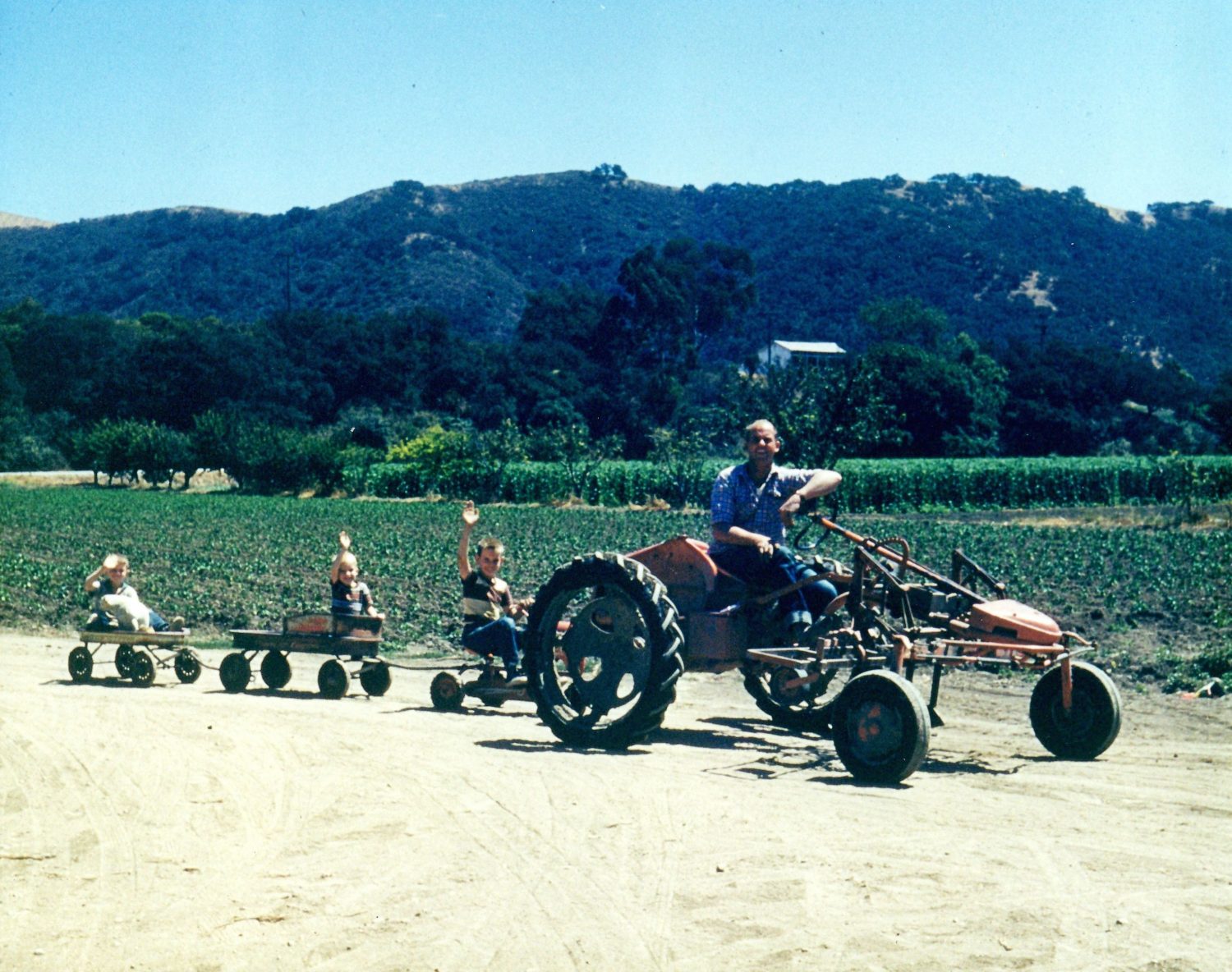
In the middle of the twentieth century I could lie in my bed on our farm in the upper Arroyo Grande valley, snuggled down under a layer of blankets, my breath vaporizing on these cold winter nights and hear the whistle of the trains as they approached the many grade crossings over the farms. I heard it like millions of boys and girls and just like them I dreamed of the places I might go someday when I grew up. That high register moan called to us.

The bass notes of the big brass steam whistle carried for mile up our valley. I came through the night with a promise. We all heard it clearly.

Daddy would open the passenger door of his pickup truck and his little boys would climb up. We did it for two reasons, we loved him, loved to be with him and always looked forward to any adventure he might take us on. Every trip in that old truck was an adventure when you were twelve.

He would pull off the road just to watch the trains go by. Parked next to the tracks in Oceano we would stand by the rails and wave to the engineers. We were lucky to see the Southern Pacific’s gorgeous Coast Daylight passenger train in its black, orange and gold livery, the silver drivers whipping around, the locomotive wheels a blur, rhythmic gouts of white smoke whipped to shreds by the speed of the train. Buy a ticket in Our Lady of Angels and step of in Saint Francisco, cities with beautiful sibilant, soft names that drifted across the ear. The last days of steam soon to be replaced by the humming diesel electric, mundane, humdrum and just work-a-day.

Wonderful but, oh, the freights. Mile long trains trudging along carrying our vegetables from here to there. Dad’s celery bound for New York’s markets, Oliver’s Bell Peppers bound for Canada and POVE’s lettuce to Chicago and Atlanta. The beauty of the freights wasn’t in the look, they carried all the cachet of the men working the freight depot, chambray shirts, overhauls, sturdy shoes, hard hands long past looking at the train logos and wondering.

This was for us. Rolling by, boxcars emblazoned with the names and nicknames of all the railroads criss crossing America. The Grand Trunk, The Nickel Plate, The Katy, The Rebel Route and our own Frisco. As we tried to count the cars we saw the Feather River Route, The Wabash, Northern Pacific’s Main Street, the Texas and New Orleans, Tennessee Central and the Lackawanna. The old Susie-Q, The Possum Trot, The Yelllow Dog, The Blue Streak, The Rock Island and the Kansa City Southern. The Zephyr, Grand Trunk, the big suitcase, The Milwaukee Road and the Slim Princess.

There were stories from my grandparents about our little narrow gauge Pacific Coast Railway which used to chug its leisurely way from Port Harford to Los Olivos down in Santa Barbara county. High-Ballin it was not. Thirty miles an hour was breezin’ for her.

Daughter of wealth and privilege, my grandmother would take the surrey down to the depot in Arroyo Grande with her friends and board for San Luis Obispo just to do a little shopping. During her high school days in Santa Maria she rode down on Monday and returned Friday evening. My grandfather to be, not born to wealth or privilege would pedal his bicycle over the dirt highway to meet her there. I don’t think we ever rode with my dad to the old dump on highway 227 without hearing that story.

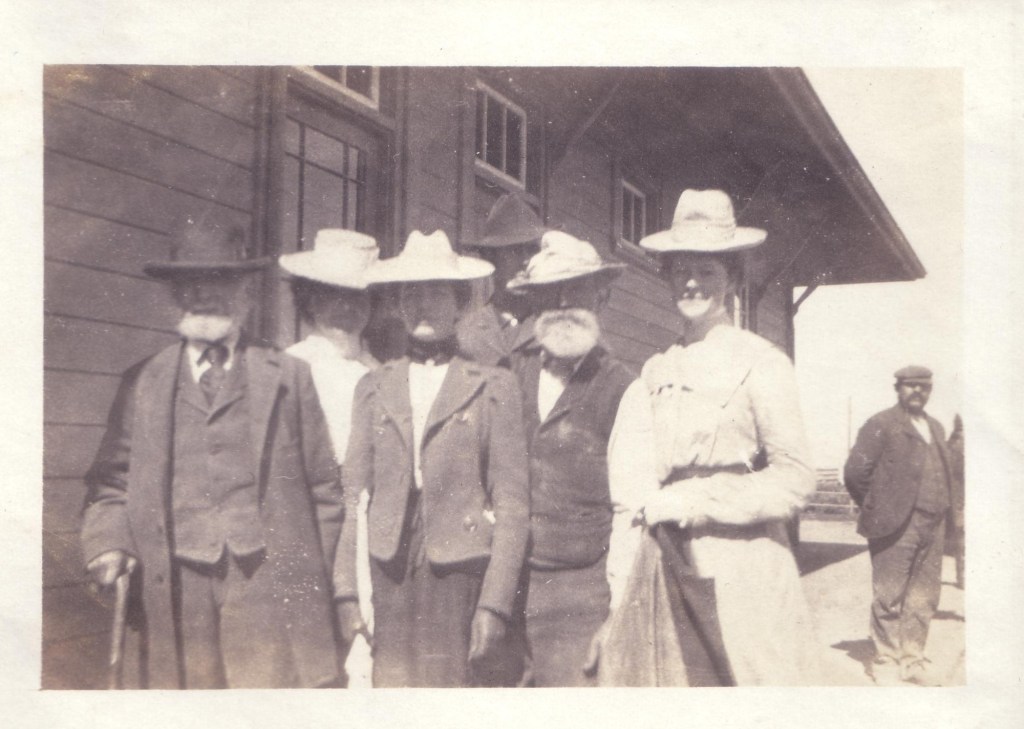
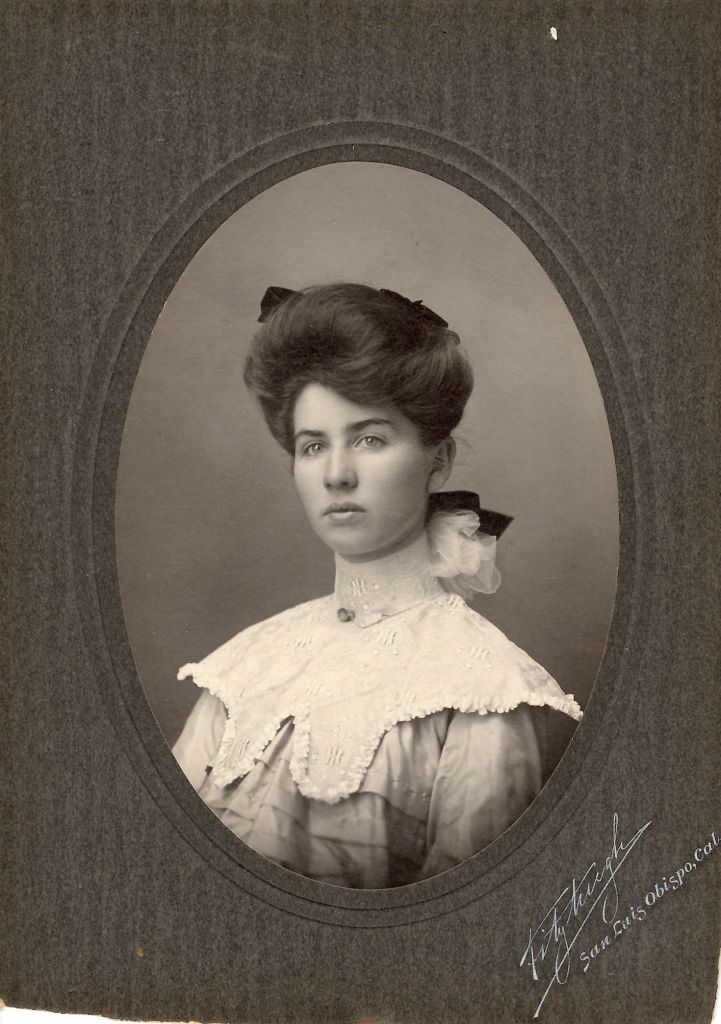
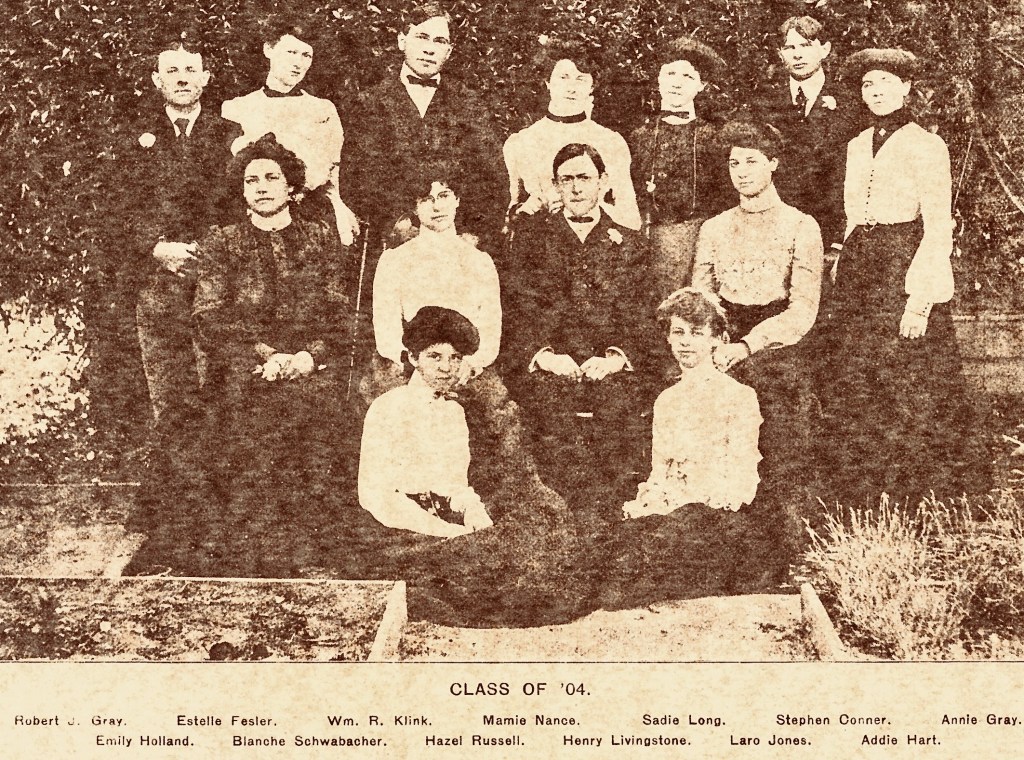
Annie Shannon, center, Oceano Depot, boarding for the University at Berkeley, September, 1904.

Our little narrow gauge served communities from Los Alamos down in Santa Barbara county and up to San Luis Obispo and west to the harbor at Port Harford. It hauled sugar beets, rock from the quarries, oil, cattle, farm products and the people who lived here. It was so in tune with life in the Cow Counties of western central California that my grandmother could walk down the hill from her house and the train would pull to a stop so she could get on for the ride to San Luis to go shopping. Just like a bus.

As kids we didn’t understand just what the PC meant to them at the turn of the century. Every type of freight needed in San Luis Obispo county came by sea. There were few exceptions. Steam and sailing ships docked and unloaded goods directly onto the train cars which fed businesses all over the county. Milk, butter, cream from the dairies, wheat, vegetables, and fruit were hauled down to the harbor and sped of to San Fransisco and Los Angeles. County baseball teams rode the train to the port and traveled overnight to play games in Los Angeles. Redwood from Cambria’s now long gone forest was shipped up north to build homes. Crude oil from the Kettleman Hills came by pipeline to Port Harford where it was loaded onto steam tankers headed for Richmond and Martinez in San Francisco’s east bay to be refined. The Pacific Coast was a literal lifeline for the isolated central coast until the coming of the Southern Pacific in 1904.

As the story goes, when the last of the tracks were pulled up in 1939 and shipped as scrap to Japan, the Imperial Japanese warlords would ship them right back in 1941, or so my dad said anyway.

No more boxcars. Instead, big fifty-three foot containers emblazoned with names like Costco (China), Maersk (Denmark), Evergreen (Taiwan), Hapag-LLoyd (Germany) and OOCL (Hong Kong). It’s different.

Not even the sound that generated the Hobo term “Rattler”, the clickety- clack of the trucks wheels rolling over the bolted joints on the tracks. The rhythm of the rails provided the inspiration for a thousand tunes that wrote the history of our country from the freedom trains rolling north from the Jim Crow south, headed up north to Kansas City and Chicago and all point in between or the fruit and grain pickers moving west for the apple harvest in Washington state or bean pickers in our own little town of Nipomo, California. Leadbelly, Woody Guthrie and his son Arlo, Bob Dylan and all those guitar pickin’ boys from Texas wrote it all down and put it to music. The rhythm of the rails.

Johnny Cash, Elvis Presley, The Doobie brothers, Gladys Knight and the Pips, Cat Stevens, Tom Waits; it’s as if you don’t have a train song in your play list you lack. For generations trains were part of the heartbeat of this country.

The rails, they’re all welded joints now and silent. No one writes about Amtrak.

Most of the old roads are gone. There are only four major railroads left now and only one slow freight graces our community with its presence today. It doesn’t even stop here anymore. The trucks killed it. There are no more of those esoteric names we loved as kids; all gone now and little kids look to something else to fire their imaginations

Cover Photo: New York Central and Hudson Valley RR, Locomotive 999, the first to pull a train at one hundred miles an hour. She did a mile in 32 seconds in 1883 for a recorded speed of 112.5 mph. Sporting 86 inch drivers her record stood for 21 years. She pulled the elite Empire Express on the Hudson River route for 16 years. She was retired in 1962 and now is of display at the Chicago Museum of Science and Industry.

Michael Shannon is a World Citizen, Surfer, Sailor, Teacher, Builder and Story Teller. He lives in Arroyo Grande, California, USA. He writes for his children.

E-Mail: Michaelshannonstable@Gmail.com

Standard

Mister Cuddle Wuddle.*

Written by Michael Shannon

Wishing cannot make something true of course but it can form a vivid picture in the mind. “Consider if you will….”

A long table set in a second story apartment in the sixth arrondissement of Paris, France. The walls are hung with paintings set so close together they create a mural of and by complete unknowns. The door to the apartment, before you turn the latch and open is plastered with strange drawings glued so close together that some are almost completely hidden by the newer.

The unheated apartment is full of life. Men and women bump and jostle. Everyone is talking, everyone is smoking. They flirt, they drink, argue and yet all are friends. The little Spaniard who made the drawings, the Beetle Browed American writer and war veteran glares at his fellows as is his wont, The poets Joyce and Eliot nodding and leaning into each other as they argued, passionate and critical. Having just arrived, arm in arm, the Cubist and the Impressionist made their hellos to the composer and his wife Linda Lee. Cole nodded in return, his fingers drumming a rhythm only he could hear. Sitting on the couch, the delicately handsome F. Scott held court with Ezra the poet, Sinclair, the ever self- revealing, Sherwood proud of his self-education, a tweedy bunch of writers discussing some esoteric tenet of their craft.

The hostess leaning back on her sofa, seemingly rooted, part of its form, solid, immutable, surveying the room. her birdlike companion, her lover, Alice with her hair so short, her soulful eyes hung above a noble, knife edged nose, hovered just behind. Gertrude glares at the portrait the little Spaniard had painted. It looked nothing like her, not a mirror image but, as the painter said,

“Never mind, in the end she will manage to look just like it.”

“The Autobiography of Alice B Toklas” and “The Alice B Toklas Cookbook,” bookends for an extraordinary life.

Years will pass, decades. The guests will scattered to the four winds. Their commonality will always be connected to that room. That so many gifted souls could be connected to one person….

“She was a golden brown presence, burned by the Tuscan sun and with a golden glint in her warm brown hair. She was dressed in a warm brown corduroy suit. She wore a large round coral brooch and when she talked, very little, or laughed, a good deal, I thought her voice came from this brooch. It was unlike anyone else’s voice—deep, full, velvety, like a great contralto’s, like two voices. Alice B. Toklas

Charlie Chaplin who knew her created a cinematic representation of her famous phrase, “a rose is a rose is a rose.” He gave her a nod in his 1952 film Limelight, in a scene where the protagonist says, “the meaning of anything is merely other words for the same thing. After all, a rose is a rose is a rose. That’s not bad. It should be quoted.”

Happy Birthday Gertrude Stein, thanks for everything, Mike.

*Mister Cuddle Wuddle was Alice B. Toklas’ pet name for Gertrude Stein.

Michael Shannon is a World Citizen, Surfer, Sailor, Teacher, Builder and Story Teller. He lives in Arroyo Grande, California, USA. He writes for his children.

E-Mail: Michaelshannonstable@Gmail.com

Standard

Uppity Women

Featured Photo: Abigail Adams, a clever woman.

Written by Michael Shannon

In days when people talked to each other by letter there was a small difference between letter writing men and women. Important men wrote for posterity, fully aware that their letters would be read by historians. Women wrote to communicate knowing that in most instances the missives would be relegated to the fireplace when they died.

Have you ever wondered why this should be of any importance? It’s important because most of our history was written by men. As Abigail Adams wrote to her continually absent husband, particularly when he was attending the continental congress, “Don’t forget the ladies.” She and many of the women married to or friends of the men who created our constitution were whip smart and concerned that the framers would do nothing for the rights of women. No surprise; they did not. They did nothing.

It’s often said that winners write history. That’s a fact. Most people have heard this often, most often used to describe some war or another. It’s not often used to describe who gets to write history but it applies.

James Thurber famously and I believe correctly said; “Women are wiser than men because they know less and understand more.”

John Adams should have listened to his wife. You can read her letters. She was very smart. She was also, as she spent most of her married life running a farm, buying and selling property and running a business while her husband was spending years abroad or in Philadelphia and much better educated in the things that men count. Unlike Thomas Jefferson she was never taught Greek and Latin. She could not read Homer and Virgil in the original, a not uncommon thing for wealthy educated men in the 18th century. James Madison was another educational savant. Madison and Jefferson are primarily responsible for the foundations of our country, such as they are. Keep in mind that “that all men are created equal, that they are endowed by their Creator with certain unalienable Rights, that among these are Life, Liberty and the pursuit of Happiness..” No mention of women’s Rights or Happiness. What they meant was that education and wealth conveyed those rights. The rest could go fish. Little of that has changed.

Consider this little bit of history. Wyoming passed the first woman’s suffrage law on December 10, 1869, and women voted for the first time in 1870. The word suffrage comes from the Latin word suffragium, meaning the right to vote. Every United States History course taught in our high schools includes this little snippet in their curriculum. I learned it, so did you. Why then it must be true. It’s in a book, a history book to boot. No problem.

Anti-vote cartoon, 1869

It’s not true, tidy, easy to teach and memorable, but not true. The truth is far more interesting; a great deal more than just messy and reflects poorly, or should I say badly, on men.

Likely overcome by the heady atmosphere following the vicious civil war that separated the colonies from Britain and perhaps influenced by their wives, the New Jersey legislature voted to extend voting rights to all citizens in 1776. They didn’t specify that they had to be men or women, just citizens of the state of New Jersey. In the first election under the new constitution women showed up at the polls and voted. To legally vote a woman had to own property, a rather narrow category seeing that only widows and single women could own land. A married wife had no such rights. She had no rights at all.

Nevertheless it was done. No on seemed to think anything of it. A few years later an attempt was made to codify the right under the United States Constitution. The word women was to be added but very stiff opposition made the point that such a change would be redundant because women were already voting, so there was no need. Think about how many times you have seen that argument used in politics,”We don’t need a law for that, every body already knows, so why change it.” A favorite smokescreen for Pols. It’s well polished from constant use.

Women had supported the revolution in every way they could, including combat. Thousands had read Mary Wollencrafts “Vindication of the Rights of Women.” The book along with Mercy “Warrens History of the American Revolution” brought with them torrents of controversy. Wollencraft’s personal history was used by anti-women’s rights groups to fend off reform. She had had the audacity to have a child out of wedlock and conceived a second before marrying the baby’s father. ( That baby, Mary Wollencraft grew up to marry Percy Bysshe Shelley and to write “Frankenstein” ) Being a founding mother would not save one from scurrilous attacks of the lowest type.

Since Wollencraft was a tramp, a mans label of course, nothing she wrote should be considered for serious thought. Ever heard that one before? Books like these were though to be dangerous because women with “Ideas” were difficult to control.

In 1790 the New Jersey legislature added “He or She” to the constitution since women had been voting the previous four years and they though it was important to codify the law. No reason to suppose that voting for women wasn’t to be forever enshrined in New Jersey.

Lets no forget it was New Jersey though. You should remember this state was the home of Tony Soprano and the Jersey Mob. None of them had been born yet but the natal home was already in a fine fettle.

Partisan politics grew increasingly bitter, elections got dirtier. Finally, many more women than were eligible voted in an Essex County election. Women had attempted to steal an election, the print press went wild, state legislators were tearing their hair out, or at least throwing their wigs across the statehouse floor. Women who had “Ideas” had rigged an election. Horrors! They must be suppressed.

Home or the street corner? A not so subtle reference to streetwalkers.

Is there any proof that they did? The answer is no. None has ever been found but in 1807 the conservative legislature used the excuse of fraud to limit the franchise to, and I quote, “…free, white, male citizens of this state, of the age of twenty-one years.” By this they “….guaranteed the safety, quiet, good order and dignity of the state.” In other words, “Stop the Distaff Steal.”

“Dignity of the State”, my goodness, in a state were politicians chewed plug tobacco and routinely spat on the carpet and drank corn whiskey at their desks. Fistfights, canings and whippings have been common in our congresses for decades. Witness Florida Republican Cory Mills who presented fellow U.S. House of Representatives members with an unusual gift to mark the start of the 118th Congress: a grenade and a letter inviting them to “get to work on behalf of their constituents.” Mills joined a long list of self-congratulatory idiots, “endowed by his creator with certain unalienable rights,” to leave no doubt as to his superiority to women and the public in general. Yea. PS: The grenades were defused which was nice of him.

Ever since then, after more than two centuries New Jersey has been widely known for it’s free and fair elections. Cue laugh track complete with guffaws.

Now back to Wyoming. The state voted in 1912 to give women the vote. Give being the operative word here, as if it was ever mens right to give something that by reason should have been available to all citizens; or “that all men are created equal, that they are endowed by their Creator with certain unalienable Rights, that among these are Life, Liberty and the pursuit of Happiness.”

Stories abound in the history of Wyoming, remember only men could vote at the time, of those mothers and daughters who made it clear where their men were to stand on the issue. Ranch wives turned the tide. Biscuits and gravy was the currency, or perhaps other things if you get my drift. Nights are cold in December cowboy.

In 1920, universal suffrage became federal law and my two grandmothers, aged thirty-five and thirty-two, voted for the first time. It was a big deal for them but in reality just a small step into the future.

I grew up on story’s about how neither one was smart enough to vote anyway. In one famous incident, my grandmother refused to vote for Thomas Dewey because he had a mustache and she didn’t like. It always seemed as good a reason as any to me. I know people who wouldn’t vote for Mrs Clinton because she didn’t divorce her husband. She did throw a cell phone at his head though. Perhaps if that had been common knowledge it might have made a difference for her.

A prominent news anchor recently referred to Mrs Biden as a “Jumped-up little nurse.” A woman commentator at that. A first class education at one of the worlds greatest universities surely taught her better, but, there is that massive paycheck tipping the scale.

One hundred-seventy plus years had passed since Abigail had asked her husband to, “Remember the Ladies,” and until 1964 a woman could be refused employment simply because she was a woman. Up until 1974 a woman could not buy a home on her own nor could she have a credit card under her own name. Women were not allowed to make contracts or wills, could not buy or sell property, had little or no control of their earnings in most situations, and were discouraged from acting politically, such as hold office, even though they could vote. Women’s rights were minimal. Girls could not play organized sports in secondary or post-secondary schools and even today women’s sports are funded at a much lower rate than that for men. They still suffer from what is known as the “Pink Tax,” the charging of more for women’s goods than mens. Add some scent, put it in a pink wrapper and the price of a bar of soap goes up.

Mrs Jones dressed as a man and so very frivolous and shallow. Sends a message, a very clear message.

When you study history you must choose your path each and every time you are presented with something new. Constantly evolving as information is uncovered and studied, it can be reliable and truthful or molded like silly putty in order to gain advantage.

Ask the women of New Jersey, it’s right there in their letters and journals. They had right on their side but it made no difference. They lost the vote.

Be a skeptic, look very closely, but don’t be a cynic. My dada famously said, “Don’t believe most of what you see and almost nothing which you read.” The road is very long but eventually something good might happen, but you must work at it.

In the fifties the young women who worked at a well known national magazine with the job title “researcher,” not only did the research but wrote the articles for the men who were not only paid much more but took the credit. They sued the publisher and won in a famous case known as the “Good Girls Revolt.”

Michael Shannon is a World Citizen, Surfer, Sailor, Teacher, Builder and Story Teller. He lives in Arroyo Grande, California, USA. He writes for his children.

E-Mail: Michaelshannonstable@Gmail.com

Standard

The Tea Cup

Annie Gray

Written by Michael Shannon

San Andreas fault
moved its fingers
through the ground
Earth divided
Plates collided
such an awful sound….
Nathaniel Merchant, from “San Andreas Fault, 1995

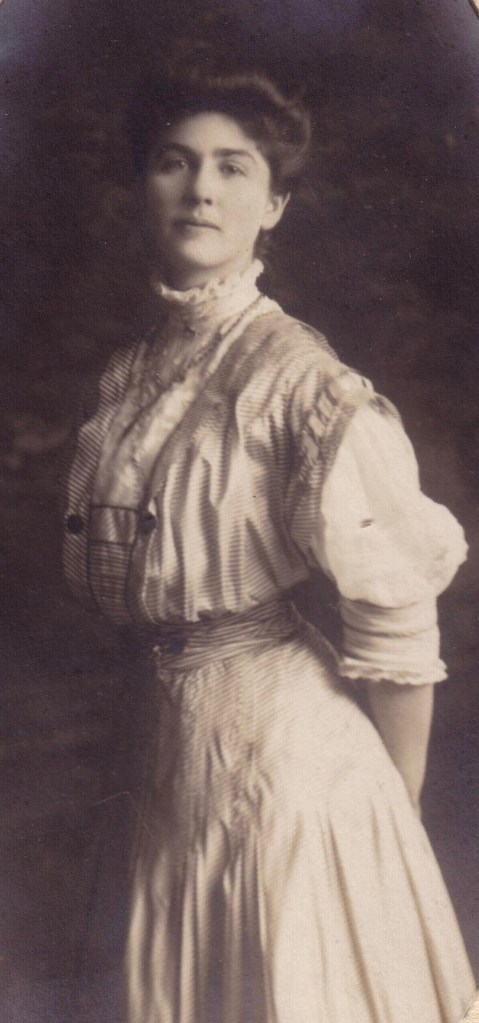
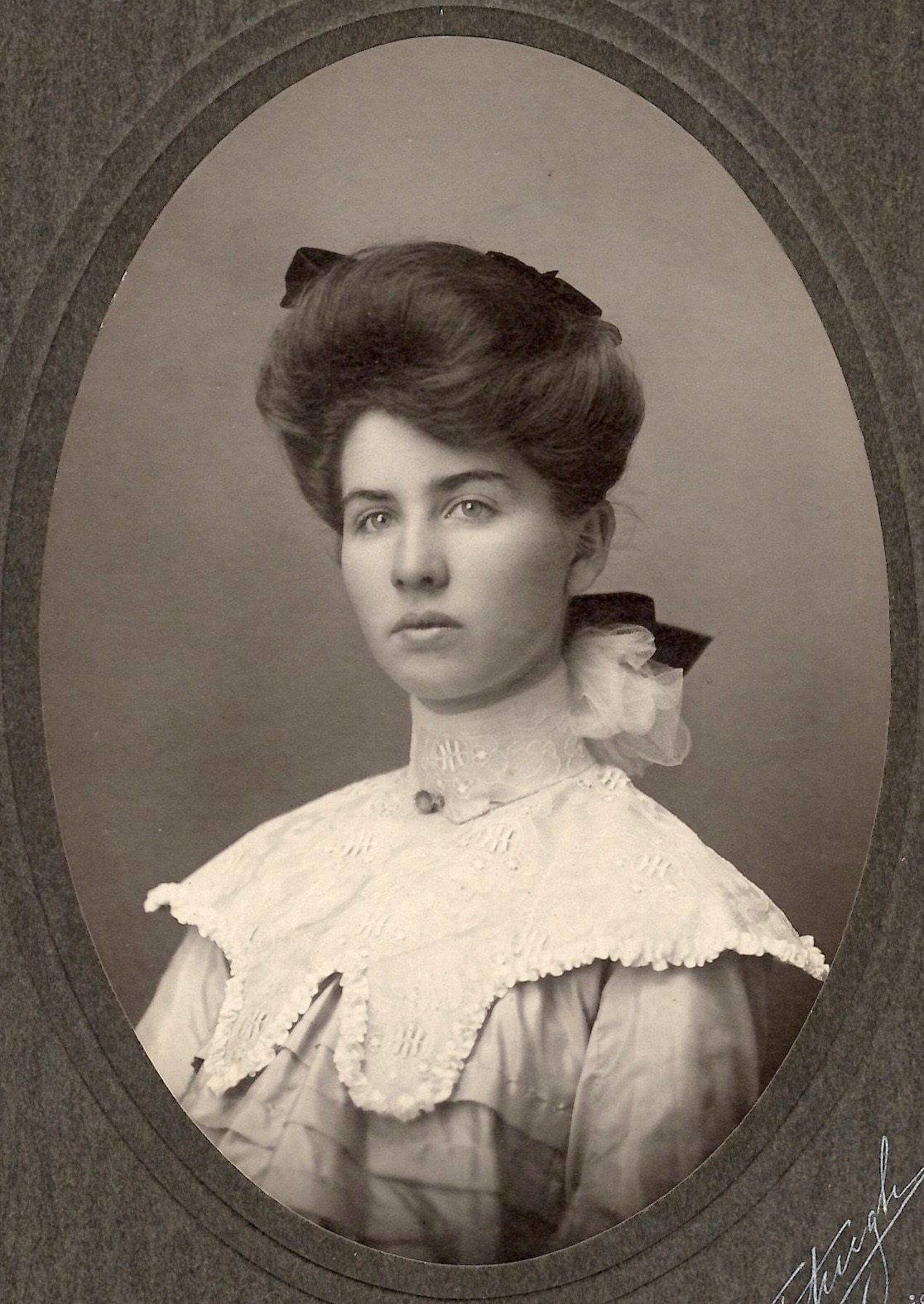
Annie “Nita” Gray, 21 yo. Family photo ©

Just across the bay in Berkeley Jack’s sweetheart Annie Gray was a student at the University of California. She was my grandmother to be. Annie lived as a boarder with the dentist, Dr. Arvan Meeks and his wife Minna in their home at 2610 Derby Street just a few blocks off campus. She was a sophomore.

Meeks Home, 1906 Shannon Family photo. ©

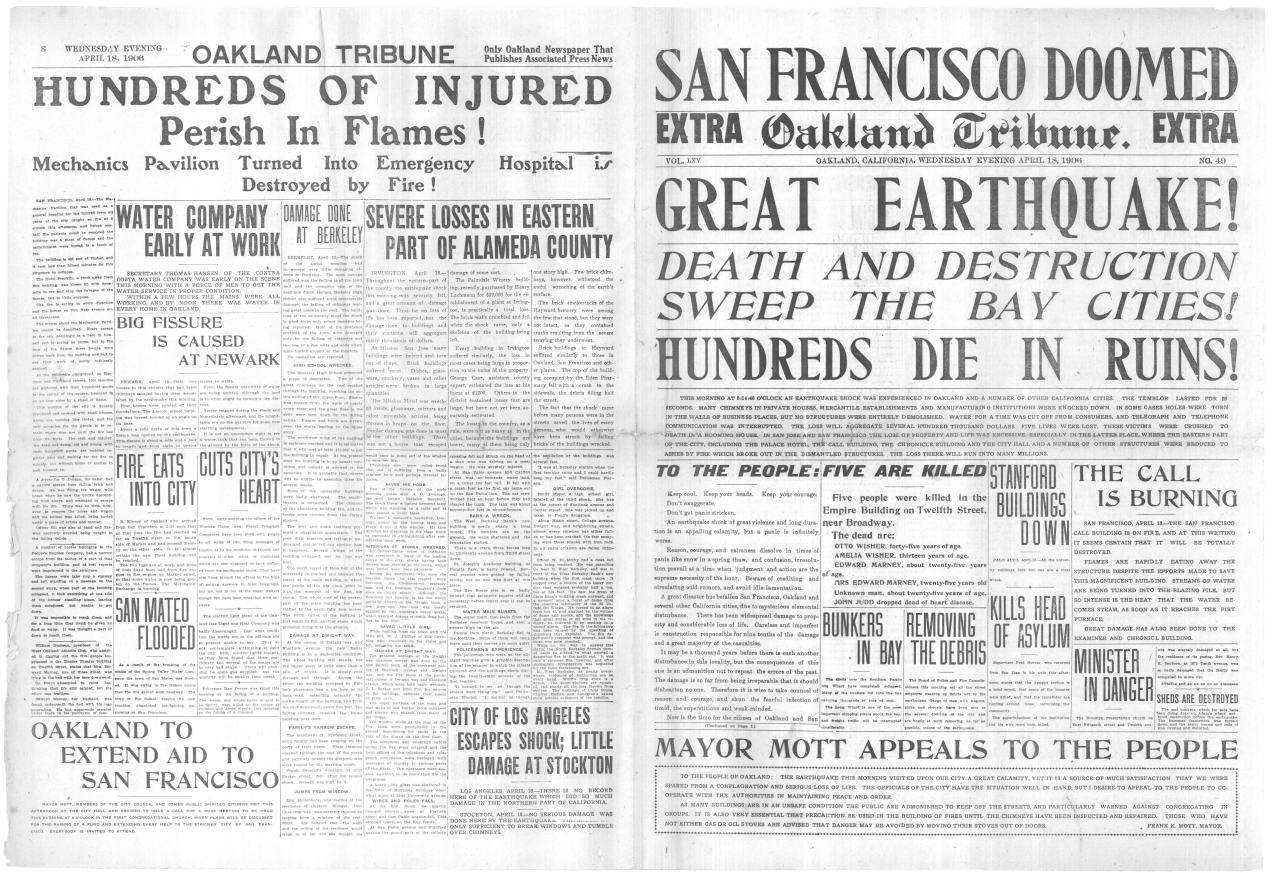
Annie, the Meeks family and the other two girls who lived there were awakened by the rumbling and moderate shaking which was quite unlike the feeling in San Francisco. The Meeks lost some china but otherwise the house they lived in was undamaged. Since the family was out of bed, they were quick to see that a broom and dustpan would clean up the mess so everyone went back to their rooms and dressed for the day. The cook made breakfast for the family and afterwards they decided what to do. Doctor Meeks was going to go downtown to check on his office, Minna was to stay home with the children and the girls were going to walk around Berkeley and do a little sightseeing. It seemed safe enough since there was little visible damage to the homes around them. Across the bay from San Francisco Annie and her friends took in the damage in downtown Oakland where, with its unreinforced brick buildings there was some brickwork in the streets and heaps of fallen terra cotta but other than the occasional broken window there wasn’t much to see.

In Berkeley, a 100-foot water tower fell unleashing a small flood, an explosion in a cooking oil factory threatened to spread fire throughout the industrial district and a large, deep crack opened up toward the west end of University Avenue stretching for several blocks. A workman picking up lumber at a West Berkeley wharf said he was nearly swept into the bay by a 4- to 5-foot wall of water that arrived about 10 minutes after the earthquake.

A split on the north end of East Street from the earthquake. East St. is now the Embarcadero. San Francisco, California: 1906. (Photo by Underwood Archives/Getty Images)

Around Berkeley, 5,000 chimneys suffered damage or turned to rubble, including that of geology professor Andrew C. Lawson, who had recently named the San Andreas fault. He took the name given to the valley in which it ran by the Spanish explorer Gaspar de Portola who passed through in 1774. Local wags joked that he had named it after himself though Portola mapped it and gave it it’s name on the feast day of Saint Andrew more than two hundred years before Lawson.

Lawson was to lead the geologic survey studying the earthquake from his office at the University. The results were the first comprehensive look at the fault and the geology associated with the movement of the earth. The quake gave birth to the serious study of why and how faults worked.


As the sun rose they looked across the bay and saw the rising smoke from fires scattered about the city. Smoke began to rise in billows from the parts of the city they knew were residential and small businesses areas. Dense columns rising from the Hayes Valley and the Mission district south of the Slot. Both these areas, they knew, were densely populated. The cheap and flimsy wooden homes and businesses were built of redwood and pine which was bone dry or full of pitch and was as flammable as tissue paper. Building codes were nonexistent in those parts of the city and if they had existed, a simple passing of money from one hand to another would solve any problem.

San Francisco in 1906 was, despite modern day revisionist history, as big and sooty, smoggy, brawling, vulgar and thoroughly corrupt as a city could be. In the south below Market and Mission, “South of the Slot,” as residents wryly called it with no particular charm intended was where the factories, manufacturing plants and Iron foundries belched gouts of reeking smoke into the air fueled by low-grade coal. Ships boilers were coal fired as were the locomotives of the Southern Pacific Railroads locomotive which sat in the marshalling yards twenty four hours a day adding to the yellow gray cloud that daily drifted across the lower part of the city. Built chock a block with each other, stores, houses, hotels and factories were a mishmash of wooden building, many of which had little water service and almost none, sewers. Few had any indoor plumbing.

Just to the south was Butchertown. In 1868 a group of butchers purchased eighty-one acres of submerged and waterlogged tidelands and a “Butchers’ Reservation” for slaughtering animals was built . Filled with marshes, creeks, and bayside mud flats, this area of southeastern San Francisco had remained largely undeveloped despite several attempts at residential housing. The city banished the slaughterhouses and the smells, sounds, and carnage that went with the process from anywhere near the city center. An abundant water supply and the area’s relative isolation must have appealed to the meat men: offal from butchering could be easily disposed of in the ebb and flow of bay tides or Islais’s creeks meandering channel. Related industries quickly followed: tanneries, fertilizer plants, wool pulleries, and tallow works joined the industrial community of the area. Workers came with the industries; the greatest number of neighborhood residents worked in the surrounding industrial plants of the area. Though some residential development had preceded the butchers’ move into the area, sustained development of land was a result of the jobs Butchertown created.

On warm spring days the miasma of odors from “South of the Slot” was enough to knock a man or woman down. On some days, Annie said, the San Francisco perfume could be smelled up on the campus of the University.


From miles away damage to the city it didn’t seem too bad though, they didn’t know yet that the San Francisco Fire Department, long considered one of the nations finest was in ruins.

The city’s fire chief Dennis Sullivan had been raging at the city fathers for years that the city was a tinderbox just waiting for a match to be struck. He had long argued that the city needed a saltwater firefighting system, after all, the seven square miles of the city was surrounded on three sides by the bay. He also wanted the freshwater cisterns which had been built decades before under the streets but had been long neglected, repaired. He was ignored.

Dennis T. Sullivan. SFFD museum

Just the year before, the National Board of Fire Underwriters had declared that, though in theory, the fire department could deliver 36 million of water a day it wouldn’t be sufficient to stop a major fire. Chief Sullivan again went to the city’s fathers but was again completely ignored.

Rich and complacent, the Mayor, and his fixer Abe Ruef, the Big Four of the Central Pacific Railroad, Claus Spreckels and the Silver Kings of Nevada were occupied with money making and from their mansions up on Nob Hill didn’t give a sniff.

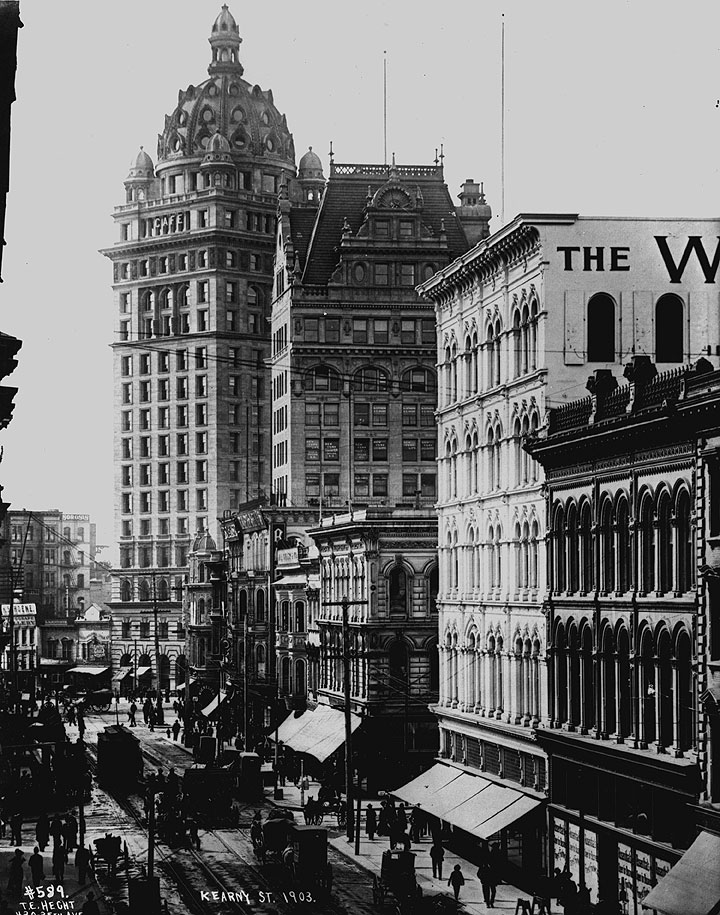
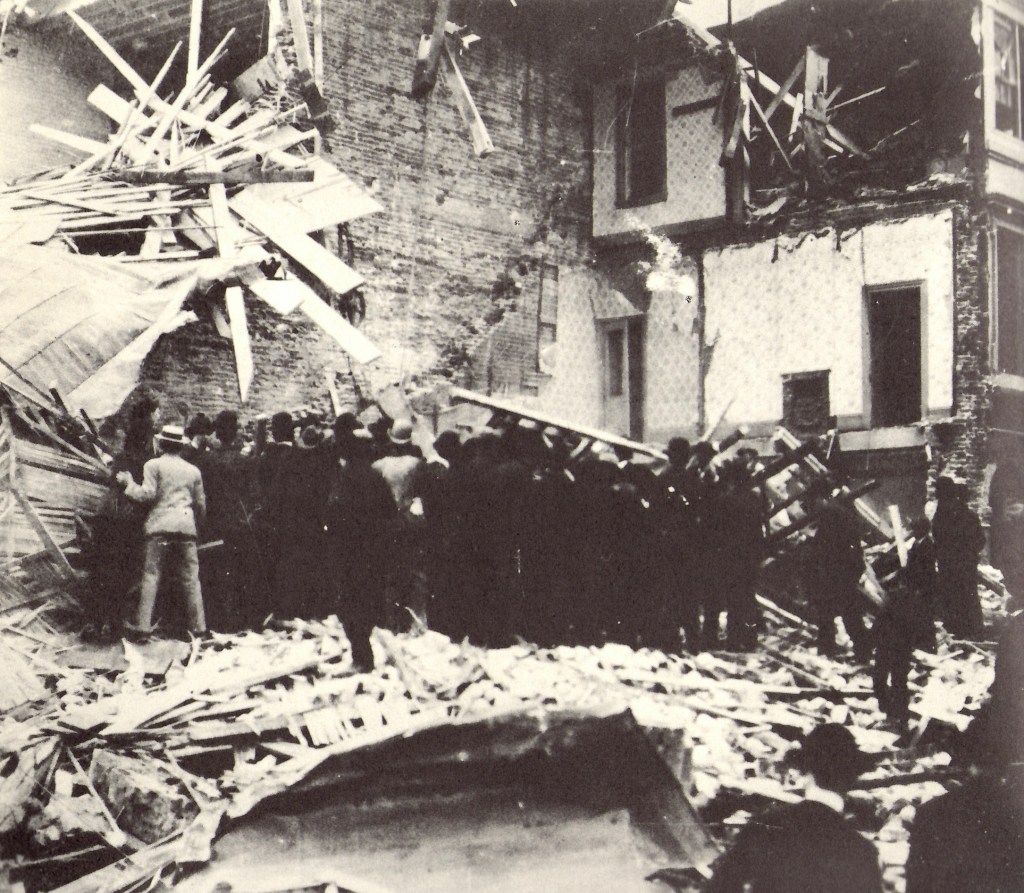
As the college girls watched the city from across the bay, Chief Sullivan’s worst fears were already beginning to come true, and for the Chief himself, tragically so. The Chief had jumped from his bed a the first sound. His official residence was Engine Company 2 on Bush between Grant and Kearney. The station was snug against the wall of the California Hotel. The Chief and his wife lived on the third floor and when the quake struck he ran for her door. Before he could get to her a bank of huge smokestacks from the hotel came down through the roof. Sullivan and his wife fell along with a mass of heavy brick and lumber all the way to the first floor. Mrs Sullivan suffered only minor injuries but the Chief, his chest crushed and skull fractured would die the next day, April 19th. When his department needed him most he was gone.

Annie and her roommates returned to Doctor Meeks home and were sitting in he parlor trying to figure out what they could do. Arvan Meeks had gone down to his office to check for damage and Minna was left alone with the girls and her eight year old son Charles.

The three young women thought to go up to campus and see if there was any damage to the school. Other than being awakened early there didn’t seem to be a thing unusual about what the day would bring. Annie and her friends assumed they would be attending classes as usual. They gathered their books and got ready to leave.

Bacon Library and South Hall, UC Berkeley. Family Postcard.

The girls, being just 20 were both thrilled and excited and wanted to go up to the campus to look around. They promised Minna they would do nothing remotely dangerous and left by the front door. Doctor Meeks having returned loaded them in his auto and headed down Derby to Shattuck Avenue.

From there they could take the streetcar up to Hearst Ave and then walk into the campus. Coincidentally the car crossed Dwight Way, the street on which my father would be born six years later. The Petrolia hotel on the corner had part of its frieze and all of its awnings littering the street. Entering the campus by crossing Bancroft they were surprised to see that except for a broken window in South Hall, the campus was otherwise untouched. In fact, classes had started as if nothing was amiss. Annie said that when they arrived on campus the only unusual activity was the mustering of the University Cadet Corps. Some were in formation already and others were running half dressed across campus to join their mates. A soldier boy passing by told them they were for the city and would be taking the ferry over to help keep order in San Francisco.

They asked why order was needed and he told them that the city was nearly destroyed. This was the first real news from San Francisco they had had. It immediately occurred to Annie that Jack might be in danger or even killed.

They decided to go to over to Stiles Hall which was the home of the YMCA where a large crowd of students had gathered on the steps to see what news they could get. While in conversation with others the doors opened and the announcement was made that the hall would be the headquarters for the Earthquake Relief Organization. It was said that volunteers would be needed for the anticipated flood of refugees from the City which were already stumbling off the cross bay ferries. They would need to be fed, clothed and given somewhere to stay. Annie and her roommates decided to see if they could be of use and went inside where tables had been set up so volunteers could be signed up for jobs. All three signed up for kitchen duty. They were going to head back to the Meek’s, change clothes and then return ready to go to work.

As they descended the steps they stopped to watch wagon loads of tents headed up campus to the football stadium. The second of Cal’s football stadiums, it was built in 1904 and could hold 20,000 fans. The tents, brought in from Mare Island by the Navy would be set up on the football field for the refugees who had nowhere else to go.

In Berkeley they were not aware of what was happening in the City for several hours. Time was spent looking around at the damage to the university and the city and beginning to make plans as to what to do. We assumed there was not too much damage across the bay as Berkeley was relatively untouched by any kind serious damage. We felt optimistic about our own damage and assumed it must be so in San Francisco until several hours later when we saw the beginning of the dense black cloud that would soon engulf the entire city. By noon we had learned by messenger that a large portion of the city was afire.” 

Washington Irving Stringham, Professor of Mathematics, UC Berkeley

At the Meek’s Annie tried telephoning the Craigs to check on Jack and the family but the operator told her their was no communication with the city by telephone or telegraph. All the lines across the city were dead and the main exchange building on New Montgomery Street, she thought, had been destroyed or heavily damaged. She said there was no connection across the bay at all.

By this time, though it was still mid-morning columns of smoke could be seen rising from the business district and east of Market street. Annie and her friends were all worried but knew there was nothing they could do but help those that would soon be arriving from the city. Jack will be all right she thought and I’ll worry about it when I have to. The three of them headed off to campus to go to work.

“We saw he first refugees arrived by ferry and a sorry looking lot they were. They only brought what they could carry and were dirty and bedraggled. Some were in serious shock, moaning and crying helpless with grief and fear. Their stories made me frightened for Jack. We knew little about what was happening in the city.” Annie Gray in a letter to her friend Hattie Tyler. May 15th, 1906

Annie Gray and Hattie Tyler. Shannon Family Trust (c)

In the early afternoon people began arriving on campus. Most had walked up from the ferry landings. Haggard, worn, most wearing whatever clothes they had had time to throw on they were covered in dust and smelled of destruction. Entire families of all stripes, wealthy and the poor carrying or dragging the little suitcases they had been allowed to carry aboard the ferries the were bewildered and lost. My grandma said it was the saddest thing. Yesterday was fine, today all was lost.

The refugees were given sandwiches and soup and then registered so they could be found somewhere to stay. The people of Berkeley and Oakland generously responded by setting up temporary camps, dispensing food, listing jobs, and even taking in the homeless. City officials had quickly taken measures to ensure public order and health as city and university officials were struggling to deal with thousands of disoriented, impoverished, and sometimes dangerous strangers, many separated from their loved ones. Berkeley with a population of twenty-six thousand was to grow its population by half in the coming weeks.

When Annie arrived home at the end of a very long an exhausting day Minna met her at the door with the familiar buff colored envelope containing a Western Union Telegram. Annie quickly seized it, praying it was from Jack. She torn open the envelope and pulled out the flimsy yellow paper printed with the companys logo and the senders address. She read from the tiny strips of paper printed with the message and then pasted to the form. It read….

23 WEST GUADALUPE RD SANTA MARIA CALIFORNIA= 18 April, 1906
ANNIE GRAY=
2610 DERBY ST BERKELEY CALIFORNIA=
ANNIE COME HOME= ENCLOSED 50 DOLLARS GOLD=
BOB.


The telegram was from her brother Bob Gray. She had been hoping it was from Jack. She wasn’t worried about Bob. He was safe at home with the family in Santa Maria.

She wouldn’t go home but she would keep the money.

To Be Continued….Jack’s story.

Michael Shannon is a World Citizen, Surfer, Sailor, Teacher, Builder and Story Teller. He lives in Arroyo Grande, California, USA. He writes for his children.

Contact: chinaplate@charter.net or Google atthetable2015.com

Standard

The Tea Cup

It is inevitability dismaying to all those who like to think that the earth and its inhabitants and all the events that occur upon it have any importance at all in the cosmic sense. From a great distance there was essentially nothing to see. But something did happen. The planet shrugged, oh so briefly like a horse rippling its skin to rid itself of a fly.  A blink of the eye and it would have been unnoticed. A brief ripple gone unseen on the blue green and white planet still bathed with lunar light at the tail end of the night. No more for the earth than a momentary shrug.

                                                                                      April,

      Laugh thy golden laughter;

Then, the moment after,

Weep thy golden tears!

                                                                                                                   Sir William Watson, “April” 1903


The Little tea Cup. It sat on the sideboard in my grandparents house for 75 years. To look at it you’d think, Annie, my grandmother, could have found something much grander to display on the cabinet. After all the hand crocheted Irish linen runner was a work of art and ancient. The emerald colored twin vases were embossed with real gold and the Seth Thomas clock was a thing of rare elegance. The little cup was of no special make, just a cheap knock-off you might pick up at a white elephant sale.

Like many things in life it held a personal story shared by my grandparents of an event both shocking and forever memorable as, perhaps the most consequential experience of their long lives.

Perhaps this was a secret thing. They never spoke of the cup and I can say I never gave it any thought until I was a grown man. My father told me the why and wherefore after my grandfather died.

You see, the tea cup was in fact a cheap thing of no particular value if you count its history in monetary terms but it was of immense value if you knew the story of how it came to be there.

Jack Shannon, 24. 1896 Ellis Street, San Francisco

EPSON MFP image

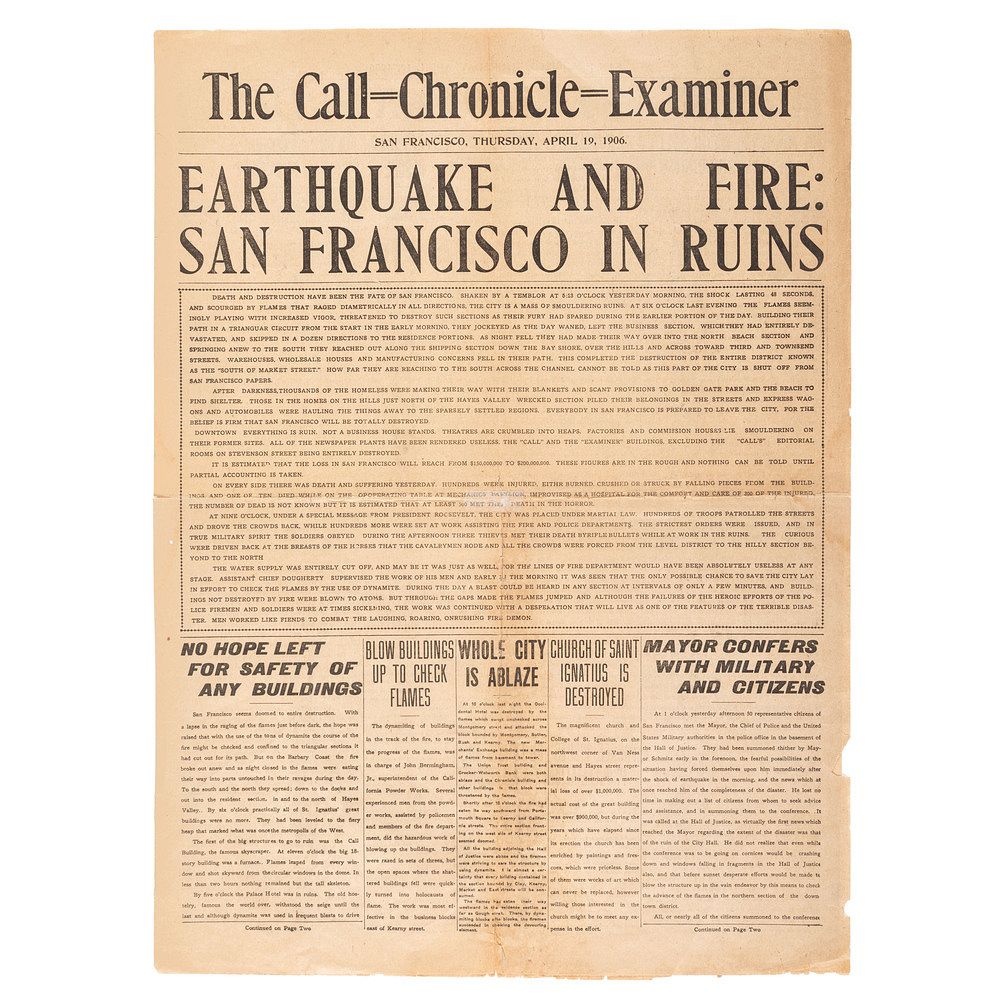
On a Wednesday morning, a work day for most but a school holiday for the kids, the Great San Andreas fault slipped its plates with a small ripple at 5:12 in the morning and then roughly 25 seconds later, shattered the north coast of California with the greatest earthquake in the states recorded history. One of the greatest ever recorded worldwide. In the year 1906 San Francisco became only the latest place on earth to suffer from a series of quakes and volcanos. A massive undersea quake off Ecuador in January; thousands killed. Sixteen days later St. Lucia in the Caribbean rocked violently; then five days later, the Caucasus mountains, the border between eastern Europe and Asia cracked open. Four weeks later Formosa, off the coast of China experienced an extremely destructive temblor. A very large loss of life and property devastated the island. Shortly after the volcano Vesuvius blasted rocks and boulders forty thousand feet into the air completely destroying several towns at its base. Scientists believe the eruption equaled or exceeded the eruption that destroyed Pompeii and Herculaneum.  After ten days of destruction Vesuvius quieted itself on the 16th of April. After three months of disturbances there was some small reason to believe that the earth had done its worst.

The vibrant and fast growing, young west coast city of San Francisco was waking to a new day, the pinkish eastern horizon behind Mount Diablo cast a faint glow over the sleeping city  The air was moist and chilly in the way that mornings are on the coast of northern part of California. Some early risers hurried off to work and the night dwellers of the Tenderloin and Barbary Coast were headed off to bed.


The earthquakes epicenter was very near San Francisco. Violent shocks punctuated the strong shaking which lasted some 45 to 60 seconds. The earthquake was felt from southern Oregon to south of Los Angeles and inland as far as central Nevada.  One important characteristic of the shaking intensity noted in Lawson’s (1908) report was the clear correlation of intensity with underlying geologic conditions. Areas situated in sediment-filled valleys sustained stronger shaking than nearby bedrock sites, and the strongest shaking occurred in areas where ground reclaimed from San Francisco Bay failed in part due to the filled areas of un-compacted soils liquefying, causing buildings to literally sink like ships in a storm.

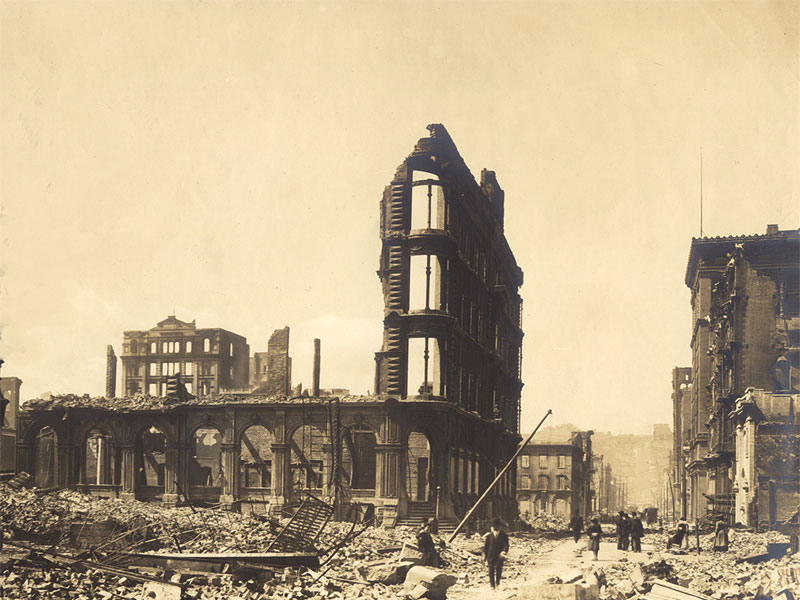
Downtown along Market street architectural details on the facades of its great business section rained down on the street below killing workmen just beginning their day. Crushed under heaps of broken terra-cotta stone and brick, dray horses and their drivers were smashed and died instantly, the blood of both men and horses trickling down the gutters. Frame buildings lurched off their foundations breaking water and gas lines beneath them, many flimsy wooden buildings in the poorer residential areas simply collapsed into  heaps of rubble, crushing and trapping the people inside.

The day before there had been a street fair. Jack was enjoying the last moments of sleep on that Wednesday morning. He was tired after being up late, celebrating, being Irish and all. Down on McCallister street they had had an orchestra playing and booths set up on the side of the street where punch and beer were to be had. The fun had gone on until the early hours of the morning. Jack said he had come in about 2am, dumped his suit on the floor and crawled into bed. Gerald woke up, sniffed the air and said, “Uncle Jack, you sure do stink.” Jack laughed and replied, “It’s just a little smoke and beer Jerry, it was a great party, now go back to sleep.”

My grandfather Jack lived on Ellis Street, west of Van Ness with his half brothers family in a two story victorian house at 1896. He had just woken, swung out from under his quilt and sat rubbing his eyes when a sound like a rapidly approaching train began to increase in intensity. The rumble became a roar. He stood when the first shaking occurred. He took a step and put his hand on the wall when suddenly the blast broke over the city like a an avalanche and the ground jerked like a cat shaking a rat. He stumbled and fell to his knees to the sound of Adelaine screaming down the hall. Crockery smashed down on the floor, sash weights were banging inside the walls like a drumroll and the boys, Frank and Geralds beds were sliding across the wooden floor, their metal wheels screeching  as they hit the wall.  The wooden house groaned under the strain, windows rattled in their frames and the doors opened and slammed closed with bangs. The crashing of crockery, screams of the terrified children pierced the clouds of dust rising from every corner of the old house. There was no need to speculate what was happening. Jack, against the violent shaking, tried to stand but could not. The rolling shudder seemed to last forever but in reality no more than sixty seconds before it suddenly stopped. Everyone rushed through the house, gathering in the parlor, shaken, pale and briefly undecided on what to do.                   From down the hall as Adelaine came running into the room holding six year old Mabel.  Everyone in the family quickly came to the conclusion that they needed to get out of the house. Would there be another, bigger than this one? Neighbors came flying from their rooms, out the doors, down the front steps and onto Ellis Street, joining hundreds of terrified other residents, most still in bedclothes; barefoot. Women had their hair down clutching robes against the cold trying to preserve a little modesty. In the cool and still dark morning, the crowds were silent as if waiting for the other shoe to drop. It didn’t. The great quake had lasted no more than 60 seconds by the clock, a lifetime measured by heartbeat.

  The Craigs house had windows broken, the front porched lurched like a drunken sailor man and hung askew, separated from the house but the house itself stayed on its foundation. Not all houses were so lucky. Houses built in the 18th century were not typically bolted down. A typical home might have baling wire embedded in concrete and then wrapped around the sill to hold the foundations in place but older home might not have concrete foundation at all but were simply built on redwood posts sunk into the soil beneath. In a fortunate co-incidence, the light unbraced walls of houses could flex and absorb some of the quakes energy which meant hundreds of homes in the residential sections.survived with little damage. Photos of the old painted ladies leaning on each other are common but it didn’t them take long afterwards to jack them back up onto their foundation to allow families to come home.

The Craig’s house suffered little damage, most of it cleaned up with a broom and dust pan. The only serious damage was to the gas stove which slid a short way across the floor, breaking the gas line. It seemed a small consequence, but it was repeated thousands of times across the city and along with the shattered water system, was to have a grave effect in the coming days.

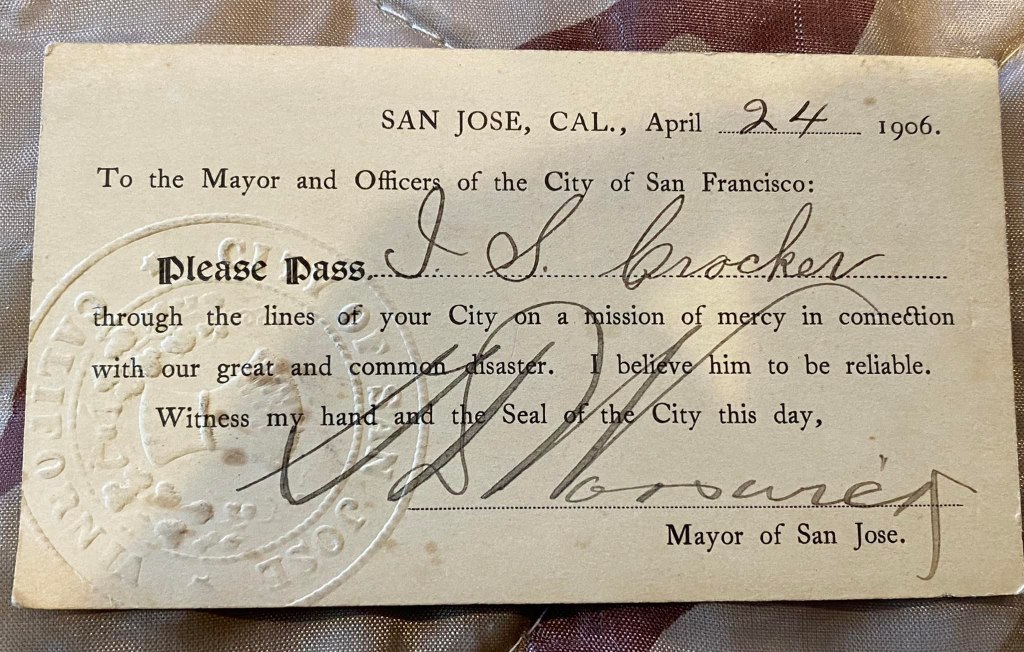
Jack worked for the phone company at the time but going to work seemed unnecessary in light of the massive destruction of the poles still swaying from the effects of the shaking. Lines were down everywhere. He helped his brother-in-law Bill Craig move his wife and kids out of the house and down to nearby Jefferson Street Park. The smell of gas filled the house with fumes and no sensible person would have stayed inside. They humped the old wood stove down into the street and away from the house, a sight that would be all too common in the following days as houses were much too dangerous to stay in.

San Francisco Earthquake Split

A split on the north end of East Street from the earthquake: 1906. Photo by Underwood Archives/Getty Images

Jack had left his family in the park and headed down Ellis Street headed toward Van Ness. He was a young man who had sought adventure all his lifetime and this seemed an opportunity. Whatever adventure there was, it lurked outside. By the time the family was settled in the park throngs of displaced, confused and frightened people were out on the streets. Jack willingly joined the crowds heading downtown. When he arrived at Van Ness he could look out over the city and see the huge dust cloud raised by the grinding earth and the collapsing buildings. With the Western Addition behind him the view to his right towards Bernal Heights and sweeping around to the South of the Slot, as the area below the Mission District used to be called. The Slot, being the cable car cut down Market Street that ran down towards the ferry building and the turntable where cars were turned around. He could see Union Square and the Tenderloin though the view of Cow Hollow and washerwoman’s cove was blocked by Pacific Heights where damaged building were plainly visible.

The city gave off an odd smell, a combination of escaping gas, unburned coal still smoldering in a thousand iron stoves and every kind of dust. Dust from broken brick and masonry, dust from the streets, dust from stables and thousands of houses shaken like rags. Dust rising into the sky, dislodged from every home and building by the shaking turning the early morning light a vague pinkish and dirty yellow.

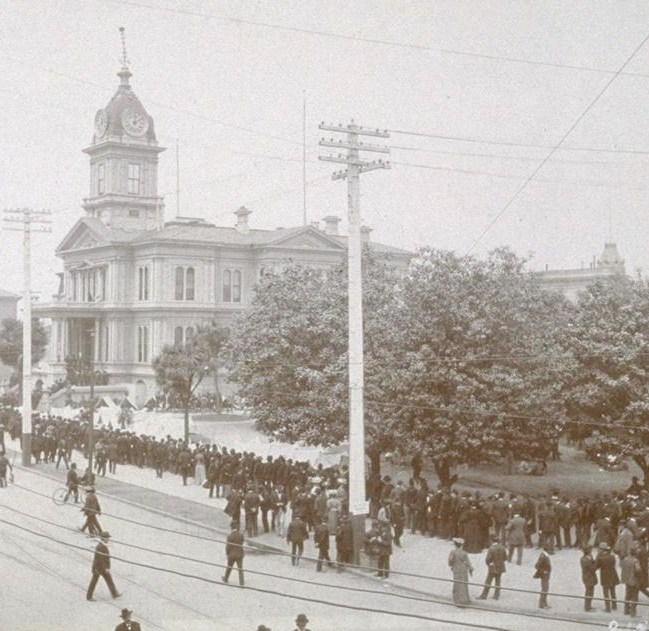
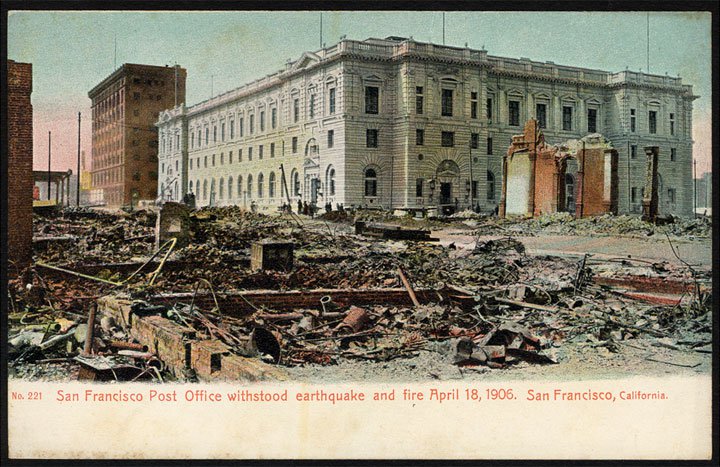
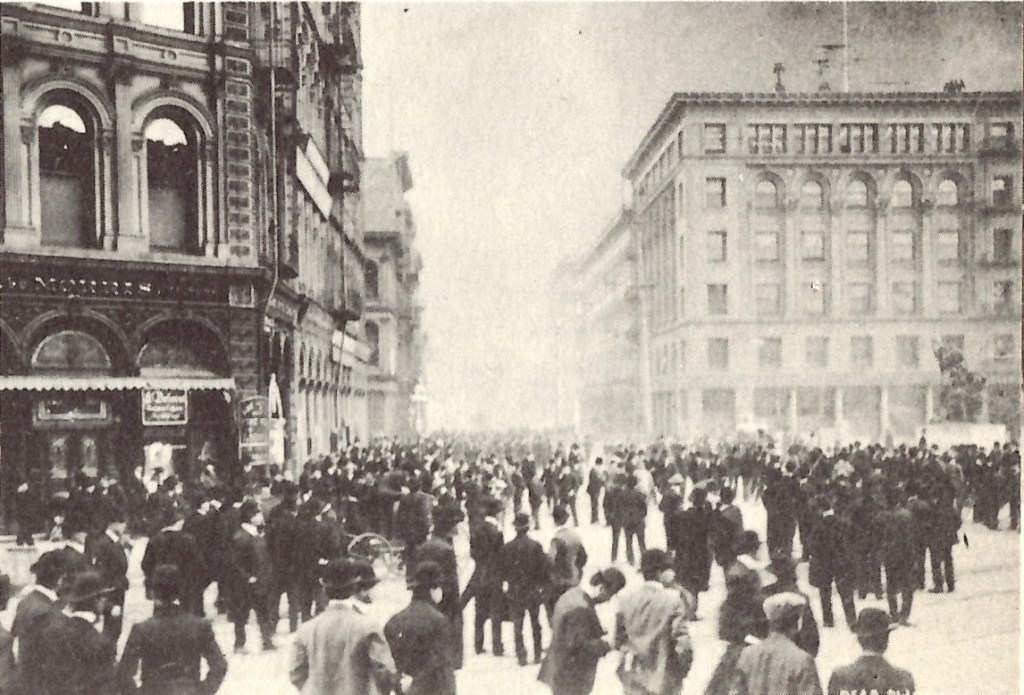
Turning onto Van Ness, it was a walk of just four blocks to the intersection of Larkin and McCallister where he got his first clear view of City Hall. There were broken windows aplenty and many front porches leaning like drunks against lamp poles. Near his house three older victorians leaned against each other in a temporary embrace but this, this, was beyond anything Jack could have imagined. The gaudy pile that was the new city hall, hailed as a monument to the glory of San Francisco by its boosters was completely ruined. Eight millions of dollars and twenty-six years of planning and work was completely destroyed in forty seconds. The steel columns holding the cupola which rose high above Market Street were nearly naked, it looked like a massive bird cage, the concrete and cladding stripped away, the steel tinged pale pink in the light of the rising sun.. At the ruined entrance he said he could see the blue clad arm and leg of a policeman, crushed as he made his way into the building in those early morning hours. On the very top of the tower the iron statue of the Goddess of Progress, twenty feet tall with its torch held aloft still wore its garlands of light and pointed toward heaven as if to mock the hand of man. The rest of the enormous building and everything in it was no more than a pile of rubble. When the fire reached it the next day, it would take four days to eat its way through the city’s paper records.

City Hall. Private Collection©

Jack was amazed at the damage. He was also not amazed. He said that the city of San Francisco had taken graft to a near perfect level, a thing that even ordinary citizens knew of and were secretly proud of. He said, having lived in New York, that Tammany Halls best efforts couldn’t match size of the money trough that Mayor Eugene “Handsome Gene” Schmitz and his fixer Abe Rueff’s cronies fed from. A fine city must have the best of all things in order to call itself so. If favoritism and graft existed they needed to be the best. City Hall epitomized this attitude.

My grandfather said that knowing about the robber barons and their minions who ran the city was one thing but seeing it was another. The massive columns that supported the facade had collapsed, one falling across Larkin Street and shearing the entire front off an apartment building. The Argyle Hotel on Larkin had its roof sagging under the weight of broken masonry flung from the Hall in the forty seconds it had taken to destroy over twenty years of construction and millions of dollars of public money. The broken columns lying in the street, he said, were full of sand, some with heavy oaken hogshead barrels inside instead of concrete. Considered by San Franciscans as the showpiece of the city it was a complete ruin, pointing its devastated finger directly at the grafters who built it. Jack said it was the worst damage of any large building in the city.

Ruined City Hall, Shannon Family Collection.

An hour later I was creeping past the shattered dome of the City Hall. Than it there was no better exhibit of the destructive force of the earthquake. Most of the stone had been shaken from the great dome, leaving standing the naked framework of steel. Market Street was piled high with the wreckage, and across the wreckage lay the overthrown pillars of the City Hall shattered into short crosswise sections.” Jack London

Fearing aftershocks, Jack kept to the center of the street. Broken brick, terra cotta decorations, glass, crushed delivery wagons hitched to dead horses were everywhere and getting worse. A milk delivery wagon was abandoned on the street, the horses gone and a steel telegraph pole lying across the crushed seat and broken wheels. Going down McCallister he met a policeman walking up from Market. When he asked about damage down there the man said it was much worse downtown but he thought the ferries were still running. Jack said policeman held a pistol in his hand and when asked why he said, “I’m shooting the poor horses that are hurt, there’s a lot.” My grandfather later told me thats not all they were shooting.

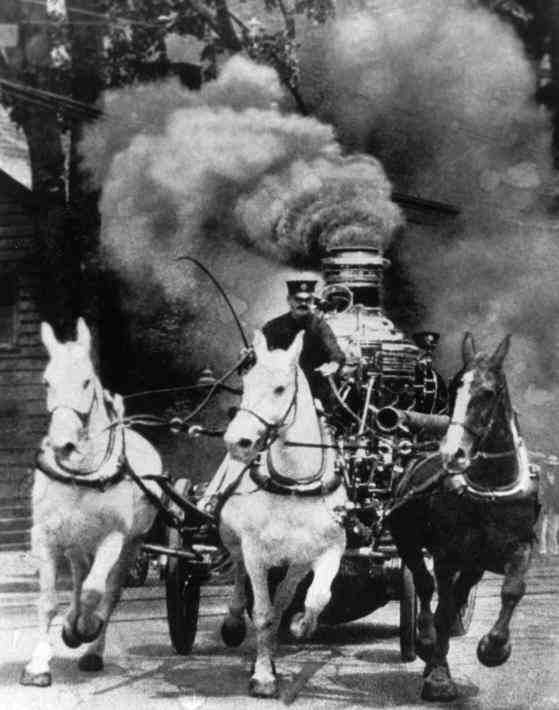
As he walked closer, behind him he heard the agonizing screech of the iron tires on the wheels of Engine 14’s steamer as it slid sideways around the debris littering McCallister, sparks were flying from the sliding rims on the wooden wheels and the three iron shod horses pulling the pumper at full speed. The firemen still only half dressed and hanging on to the grab bars for dear life as the the driver up on the high seat sawed on the reins, the brakeman kicking the brake bar, whipping the rig from side to side to avoid wrecking on the broken street. The big fire horses, knowing their job, loving their job, pulled her at breakneck speed. With flashing eyes and slobber flying from their mouths they headed down toward Hayes Valley where the first tendrils of fire were rising above the rooftops. Jack stood and watched as the steamer slewed around and went up Jones headed for what would be called the Ham and Eggs fire.

Rolling Out. Image: Collection of California Historical Society.

The wagon and engine companies didn’t need the alarm system to make a run for their rigs. In the old horse drawn days the firemen lived in the station houses with their horse. The equipment and horse stable were downstairs and the living quarters upstairs joined by the iconic brass fire pole. The third floor or attic space was used to store feed and grain for the horses.

Tumbling down the pole the men who staffed those companies had run the turn out drill so many times that they could have done their job blindfolded. The horse knew the drill too. By the time the first man hit the floor the horses would be stamping and banging the stalls, hooves clattering making a racket because they knew what their part was and they were ready to go. Over time the sturdy American bred Morgan horse was cross bred with the European Percheron for greater size and strength. Both horses were known for their even temperament. They were trained to remain calm around the rigging excitement and the action on the street while the men worked the fire.

The engines were parked behind and under the harnesses for the teams. The rigs hung from the ceiling on a wooden frame and were designed so the horse could simply stand in its assigned spot and the men could drop the pre-rigged harness over the back and hook up. Bridle and bit, collar and Hames snapped together, belly backer, traces, saddle, spider and hip drop would be quickly buckled, the engine pulled forward and tongue buckled on. The man holding the horse heads was being lifted off his feet and swung about trying to hold the horses so they wouldn’t bolt they were so eager to go. The driver and the brakemen would vault up to the seat, grab the ribbons and once the man at the head scooted aside, the doors opened, the engine would spring from the house with the firemen grabbing the bars and hanging on for dear life. Good crews could be out the door in a minute, sometimes less. That was the standard for companies in San Francisco.

The steam boiler and engine mounted on the wagon frame provided the power to operate the pump, which, when attached to a hydrant or cistern forced the water through the hose with tremendous pressure. The boilers fires were kept banked and tended by the boiler tender 24 hours a day. It took just a few minutes to get the fire going and build steam pressure in order to operate the pumps. In 1906, engine companies were at the peak of perfection and wouldn’t be topped for speed or efficiency until the development of the fire truck. San Francisco would burn but the fire companies did all they could under extreme circumstance to combat the massive fires to come.

All across the city, women who had gone back into their homes were preparing to cook breakfast without realizing that the chimneys and flues of the stoves were damaged. Brick chimneys had fallen, killing many people in their sleep. Falling across people still sleeping, the brick chimney’s weighed thousands of pounds and killed hundreds. The brick flues were the worst. As heat rose up them, dislodged brick and tar quickly caused many to catch fire. Flames probed through the broken brick, kindling the wooden frame buildings just like matches. Hundreds of fires started within minutes of the quake. Many were rapidly extinguished but in the largely wooden sections of the city the fires that would ultimately destroy San Francisco were already on the march.

Fallen Chimney, Image: Bancroft Library.

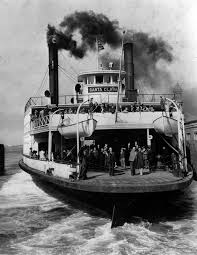
Dodging debris in the streets, Jack got down to Market and for the first time he could look all the way down to the ferry building faintly visible in the dust and smoke haze fourteen blocks away. He would walk down to the ferry and buy a ticket to Oakland and find Annie. He had no idea how much damage Oakland and Berkeley had suffered or how things were up on the University campus, but was going to find out. He began walking down Market Street. Far head he could see, down at the end of Market, the tower of the ferry building.

To be continued………Annies Story.

Standard

THE HISTORIAN

Written by Michael Shannon

A historian seeks the truth of it. He is neither blinded by the glare of opinion nor does he ever stop seeking a final answer which he knows in his heart is not or ever will be there. He must always dig deeper. His life is to live in worlds which no longer exist. His life is to parade before mankind the true blocks that built the world we live in.

My friend the historian has pawed through the dustbins of scrap, piecing together the puzzle of lives lived. Letter, journals, documents, film are all grist for the mill. A fabulist he is not.

He understands that there is never a final answer. There is always something to be discovered and his hope is the honour will be his. That is his calling.

Not long ago in a comment string on an article he posted, someone commented that what he said was interesting but not written by a “Real” historian. A “real” historian, which implied he was not.

I’ve been thinking about the comment and the not so subtle dig it implies so I though I’d explain what a real historian is.

You are. Did you keep your grandmothers Christmas cards? How about your mothers letters to her sister. Perhaps the journal your great uncle kept when he was stationed in Vladivostok during WWI. Do you still have the box with some black and white unidentified photos, the ones with the deckled edges and a coffee stain? Does it have an old crinkled embroidered handkerchief and at the bottom and a deed to the ranch made out in 1924. Do you still have your high school yearbook? How about a set of Compton’s Encyclopedia from 1930. All of that, my friend is history. Keepers of history long for those things. Mundane objects are the things history is made of.

True history which is known to all “real” historians is made up of the things that did not get thrown away. We know of the war between the kingdoms of Elam and Assyria because a record of the conflict was kept and survived nearly three thousand years buried in the sand of southwestern Iran. In Great Britain the site of the Roman fort at Vindolanda, a part of Hadrian’s Wall built to keep illegal Picts from what is now Scot Land from entering Roman Britain. These finds record military expenditures; daily bookkeeping which hasn’t changed in nearly 1,900 years which you would recognize if you ever served in the military, have been found. From it we learned that Roman soldiers wore underwear, something completely unknown until today. The documents are personal messages to and from members of the garrison of Vindolanda, their families, and their slaves. Highlights of the tablets include an invitation to a birthday party held in about 100 AD, which is perhaps the oldest surviving document written in Latin by a woman. It features her signature, the first known example of a woman signing her name, Claudia Severa. The commander’s wife was writing to Sulpicia Lepidina. How different is that than your grandmothers invitations. You can easily see it’s the same thing. That is its historic significance.

“Please come to my party Sulplicia.” AD 100. Collection of British Museum.

Those of us who watch movies or read novels must learn the difference between story telling and historical fact. Screen writers play fast and loose with history all the time. The old saying that “Facts should not get in the way of a good story” are absolutely true.

Consider some favorites. Old Braveheart, William Wallace never saw a kilt in his life. Thomas Rawlinson, an English ironmonger, who employed Highlanders to work his furnaces in Glengarry near Inverness invented the one you are familiar with in the early eighteenth century, around 1710. Finding the belted plaid wrap cumbersome, he conceived of the “little kilt” on the grounds of efficiency and practicality, as means of bringing the Highlanders “out of the heather and into the factory.” However, as Dorothy K. Burnham writes in Cut My Cote (1997), it is more likely that the transformation came about as the natural result of a change from the warp-weighted loom to the horizontal loom with its tighter weave. After the battle of Culloden (1745) which Jamie Frasier barely survived, wearing the “Wee Kiltee” was outlawed. Luckily moviegoers don’t care that Braveheart died horribly in 1305 over four centuries earlier.

William Wallace didn’t paint his face blue either. Where did the idea that the Picts painted themselves blue originate? Julius Caesar once noted that the Celts got blue pigment from the woad plant and that they used it to decorate their bodies. Pict was a name coined by the Romans to describe the Northern tribes who covered their bodies in blue woad to camouflage and perhaps to intimidate: Picti means painted people in Latin. It is likely that the Picts were the descended from the native peoples of Scotland such as the Caledones or Vacomagi who lived in modern-day northern and eastern Scotland about 1,800 years ago. Picts is merely a descriptive term. William Wallace and the Scots wore blue face paint in Braveheart, not because it was historically accurate, but because the filmmakers liked the idea of it. Braveheart certainly did not have sex with the English Queen out in the woods. Did Queen Eleanor have the habit of wondering around in the darkling woods of a night. Certainly she did not. If she wanted a child by Wallace she would have removed her Wimple which women wore to cover their hair lest the sight of it turn men into savage wanton beasts. She died fifteen years before Wallace’s revolt.

Eleanor, Queen of England. Tomb in Westminster Abbey, London

Henry the VIII’s second wife Ann Boleyn was executed, her head severed with the sword of a French executioner because she was an adultness. At least that is what we learned in “The Tudors.” Think about this, Henry the VIII was 6’2″ and weighted 210 pounds when he was in his twenties. The man who played him in the series is 5’9″ and 155 pounds. Quite a difference, yes? The simple truth is, Henry was a Tomcat, adultery was his hobby. Anne’s sister Mary was one of his mistresses, pimped out by her own father. Thomas Boleyn the Earl of Wiltshire and the 1st Earl of Ormond. These were nasty ruthless people. What Henry was, was fixated on having a male heir to the throne. The Tudors had overthrown the York family by killing King Richard the third who was the last of the Plantagenet dynasty that had conquered Britain in 1066. Henry felt a little shaky on the throne. English barons were a testy and power hungry lot and they could turn on the king in an instant. With the help of Bishop Cranmer, the head of the church, charges were trumped up and the lovely Anne bared her “Little Neck,” she actually said that to the executioner before the chop. She went to the block, dressed in a white shift, her hair shorn and her feet bare. Henry’s only concession was to allow the sword rather than the axe. Royalty was not to be beheaded by axe or an Englishman, hence the Frenchman. Likely we wouldn’t be at all interested in her story except that her daughter grew up to be the most famous British monarch of all. Elizabeth the first. The virgin Queen, though that too is in serious doubt. The virgin part I mean.

The archives kept in the British museum document Annes trial and her indictment but also contain the personal letters between the principles which show without a doubt that she was completely innocent of anything except, apparently, the capital crime of having a girl.

Anne Boleyn by Hans Holbein, from life.

Willian Shakespeare did not write his plays. That idea, which has persisted for decades was good enough to make more than one movie. We can start with the fact that his life in London is very well documented. There are the bills of lading for the material that he used to build the Globe theater. There is the building permit for the same. There are copies of the original documents themselves with his name on them The main argument, in the absence of such “proof” of authorship, skeptics have posed the question: How could a man of such humble origins and education come by such wealth of insight, wide-ranging understanding of complex legal and political matters and intimate knowledge of life in the English court? Shakespeare’s supporters emphasize the fact that the body of evidence that does exist points to Shakespeare, and no one else which are written in his own hand. This includes the printed copies of his plays and sonnets with his name on them, theater company records and comments by contemporaries like Ben Jonson, Samuel Boswell and John Webster, men of letters who actually knew him. Doubts about Shakespeare’s authorship and attempts to identify a more educated, worldly and high-born candidate reveal not only misguided snobbery but a striking disregard for one of the most outstanding qualities of the Bard’s extraordinary work—his imagination.

Who can doubt that an intelligent man, even one with limited education, not use historical works as background for whatever his bountiful imagination seeks to follow? Provable historic fact are the foundation of his plays, the same as it would be if he was writing today. Consider Samuel Clemens, one of Americas greatest writers. Fifth grade education in he backwater town of Hannibal, Missouri. Charles Dickens also left school at age twelve and I’ve seen no movement to discredit either.

In the end, the Puritans, yes those Puritans who figure in our American history tore down the Globe theater and banned all productions of any play including Will’s as being devilish and depraved. Puritans condemned the sexualization of the theatre and its associations with depravity and prostitution. Puritan authorities shut down English theaters in the 1640s and 1650s—Shakespeare’s Globe Theatre was demolished and copies of his plays were burned. That is an example of history is not made up.

The Puritans ruled England and early white America for a time. When you read your high school text book, there is no mention of the fact that they banned Christmas. Sometimes historical facts don’t fit the narrative do they? Inconvenient but provable historical fact. No Christmas for you. Maybe they had a point. Americans spent around 178 billion dollars on Christmas this year, nearly a thousand dollars per person.

When I was still teaching high school I heard from my mainly male students about their love of the Kurt Russell version of the Tombstone legend. They were adamant that the Earp legend was hands down true and accurate. They would accept no argument. What they knew was what the Earp and the screenwriters told them. Because Earps history is relatively recent, unfortunately it is also pretty well documented. Over two dozen films have featured Wyatt Earp, actually that would be Wyatt Barry Stapp Earp, a name that doesn’t easily fit on a theater marquee. Writers play fast and loose with “facts” all the time. What documented history knows and can prove is this; He was by turns a lawman, stage robber, horse thief, gambler, pimp, brothel keeper with his brothers, two of his wives were prostitutes and is definitively know to have killed two men, one a town marshal. At the shootout, eye witnesses state that he wore a Mackinaw coat not a long black overcoat ala Kurt Russell. He also didn’t carry a pistol in a gun-belt but in his pocket as was his custom. Perhaps the testimony of men who knew him in Tombstone sheds a light on his personal history. Roy Drachman would later write: “I don’t remember when Wyatt Earp began to be looked upon as some kind of hero. That was not his image around Arizona then, where many people knew and remembered him well. I never heard anything from those folks about any of the good or great deeds that he is supposed to have done. I think he just made them up for his biography which is nearly all lies anyway. He was a simply a survivor at a time when some of his close friends and relatives weren’t so lucky in avoiding a violent death.” Lastly, John Ringo had no education and did not speak Latin.

Consider, before you comment on my friends historical credentials, most people have only a single high school credit in US History, taught from a text compiled by a college professor and likely written by teaching assistants, cobbled together from many pieces and passed of as definitive “Truth.” 50% of U.S. adults are unable to read above an eighth grade level book with complete comprehension. 33% of U.S. high school graduates never read a book after high school. 80% of U.S. families have not purchased a book this year. (2020) Knowing this, it seems to me that folks should be very careful about who and why they offer up any criticism of “Real” historians.

Perhaps the best example there is, is that until recently everything you know about ancient Egypt came from Victorian Era amateur archeologists. All of them educated white men who had no background in the very long arc of Egyptian history. Not one asked an Egyptian. Until recently nearly all you knew about King Tut, Akhenaten and his wife Nefertiti, and the other pharoahs was written by these English gentlemen. Notwithstanding the beauty and the glory of that which was found in their tombs the real treasure were things like your grandmothers post card. Found in digs all over Egypt are payroll records for the pyramid builders, personal letters, diaries and business accounts. Those mundane objects are the real historical record.

Akhenaten and Nefertiti. Around 1335 BCE

Our friend the local historian knows where knowledge lies. He has written, studied and taught nearly his entire lifetime. He deserves credit for what he says. Do not take him lightly.

The phrase, “I only want to hear what I already know” was never uttered by any Historian.

History is a growing thing, it changes constantly as new things are discovered. As my sainted father was wont to say, “Don’t believe most of what you read and only half of what you see.” Look for it yourself, it’s the only way to know. History is thick, dense and tasty.

This particular historian, with his inquisitiveness and his joy in pure thought shine through, and they have captivated me. In a time when parts of our society, particularly political leaders are trying to freeze false historical narrative in amber, glorifying a time that never was, it’s more important than ever to get down on your knees and dig in the pig pen for that lost diamond.

Michael Shannon is a World Citizen, Surfer, Sailor, Teacher, Builder and Story Teller. He lives in Arroyo Grande, California, USA. He writes for his children.

E-Mail: Michaelshannonstable@Gmail.com

Standard

The Big Vomit.

Written by Michael Shannon

It was Elsie’s bus. Not the old pickup she and Evelyn Fernamburg drove to little Branch school. No, it was the second one, the yellow one the County Office of Education fobbed off on us after it was no longer needed by Atascadero. You don’t need a very big one when there are less than 60 kids in school and many walk or are delivered by their moms and dads.

Elsie parked the bus in her front yard which was just across the valley from the little school house. I guess she washed it now and then but mostly it looked like the farmers pickups, dusty in the spring and fall, muddy in the winter time. She drove the route which was just a circle around the upper valley, picking up the kids who walked down from Corralitos Canyon to the intersection with the road up to the Routzhans, Thompsons and the other old ranches in the foothills of the Santa Lucia. She’d head down to the Gulartes to pick up Judy and Dickie, back to Squeaky’s house then cross the old Harris bridge to grab the Gregory boys, Bruce and Jim, next; Billy Perry then the four corners, hang a right and head out to Newsom Springs to get Jimmy Genovini, the Hubbles and the Hunts. On the way back it was out Huasna road for Dennis Mineau, the Domingo’s, past Frank Branches old victorian house to the Coehlo’s, and Berguias. She turned her around in Al and Emma’s driveway, a pretty upscale word to describe a muddy dirty road filled with petrified ruts. The Coehlo boys, Al, David and Richard were the last to board on Huasna Road. A common thing for most of us, no asphalt anywhere. Maybe gravel if your dad had had a good year. On the way back a right turn up Alisos Canyon road, it had no name then, it was just the road to Jinks Machado’s ranch. We’d pick up the Silva kids then roll back to school.

Only the Gregorys and the Mineaus lived in houses you might consider modern. Nearly every other family lived in older wooden houses built around the turn of the twentieth century or earlier. The Branch houses, there were five existing at the time, were either Victorian or earlier adobes built before California was a state. Standards of wealth were different then, no family would have been considered rich and some were pretty poor. Descendants of the original Ranchero families owned vast tracts of land but had little money, the land poor as they were described. These were  some boys who wore the same clothes to school for days at a time and were lucky to have a single pair of shoes. Many came to school hungry and Mrs. Brown had to keep a close eye on the paste jars. I guess we were somewhere in the middle but those things are something we didn’t really notice as kids. Our shared experience was the school itself where we were all equal. No one was picked on because they didn’t have. It’s been a good life lesson for all of us.

Our bus driver, Elsie Cecchetti was a woman of many talents. She wheeled that little bus around twice a day and being a pragmatic farm wife did things like roll the bus to a stop in the middle of the road, hop out and pick up the odd head of Celery or Romain lettuce that had fallen off a farm truck on the way to market. She didn’t get paid much. The census listed her as a farm helper which meant in census speak, a wife. In 1950 her income was listed as zero. Supplemental vegetables were fine, just dust “em off and throw them in the pot.

elsie

Elsie in retirement mode.

The kids all liked her because she was so nice. No troubles on her bus because no student wanted to cause her any grief, besides she knew your parents well enough to call them by their first names.

In the second half of the twentieth century the state of California was just a hundred years old and different from eastern cities and towns where ethnic peoples tended to cluster. Out here immigrants came from everywhere. Our bus carried the children of families who had come from Ilocanos province, Phillipines, Argentina. Switzerland, The Azores Islands, Ireland, Wales, the Netherlands, Germany, Japan and even descendants of those soldados who had walked here with the padres who built the missions. We had one family who were of the first nations that predated everyone. Funny thing is, as kids we weren’t concerned with any of that. Our fathers were mostly farmers, our mother kept house and raised children and we accepted each other without complaint.

Elsie herself was the daughter of an immigrant, Jao Azevedo who was born in the Azores Islands in 1894 and came to America in 1910 as a sixteen year old who spoke no English and could neither read nor write. When she was born in 1922, he was living and farming on what has come to be called Cecchetti Road on the old Corral de Piedra Rancho.

Perhaps her most impressive and greatest moment came by way of Jeanette Coehlo. Kids passed around chicken pox, the mumps or the flu every winter. The bus could be a petri dish of bugs. One bright sunny morning we were passing the Perry’s house headed for Gregorys just opposite the old Harris place for which the bridge was named. The Harrises were grandparents to the three Hart kids who lived in town but were well known to us. Small town life there. Everyone knows everyone personally or by reputation. Anyway, since its less than a hundred yards from Perrys to Gregory we were moving slowly when Jeanette, sitting up front suddenly made a sound like “Urp,” did it again then heaved her entire, half digested breakfast all over the rubber floor and the opposite seat.

branch school 1961Jeanette (Shannon Family Collection)

Because it was a cool day all the windows were up, no draft you see and the other dozen or so kids seated around the bus were almost instantly confronted with a wave of nauseous, richly scented, miasmatic and, I swear, greenish cloud of a vapor guaranteed to trigger a sympathetic response from one and all. Like an wave it surged toward the back of the bus with a vengeance. The older boys, as is the custom, sitting in the “Cool” seats in the rear leaped for the windows, slammed them down and stuck their heads out as far as they could. We must have looked like an old circus wagon with all the animals sticking their heads out the side.

Ever the mother, Elsie just opened the door and drove on down to her friend Mary Gulartes house, turned onto the dirt road to the house and pulled to a stop.

“Every body Off, ” She ordered.

All the kids quickly walked down the aisle, shoes slipping in the slush,  some still dribbling vomit down their chins, some holding their noses as tight as they could, mouths tightly closed, they jumped down and quickly got away from the reeking little truck. Elsie calmly opened the back door and found the Gularte’s garden hose alongside the house and began sluicing sheets of water across the floor and spraying any seat that was dirty. Mary helped her with some old burlap sacks and they wiped her down. Mrs Gularte  then went to the back porch and into the kitchen where she loaded up a plate with homemade cookies. When she came back out the hose was being passed around as kids washed off their shoes and took a swallow or two of water to rinse away the bad taste.

Cookies were gobbled right down, Elsie shooed the kids back on the bus, said goodbye and thanks to Mary, whipped the little bus around, out the driveway and we continued back to pick up the Gregory’s and finished the route.

It was luck all around. The kids who missed the excitement considered themselves fortunate. The veterans felt superior. Just another day in a little rural school where things like this were taken pretty much in stride by all. Farm kids in the fifties had animals; horses, cattle, chickens, scads of dogs and cats so they tended to be not so finicky. We knew we were superior to the town kids. Always.

The writer, Michael Shannon is a veteran of that bus ride. Elsie was a fixture of his life growing up and like many folks misses her terribly. She was absolutely one of a kind.

Reprinted below is her Obituary.

Elsie M. Cecchetti
March 16, 1922 – March 11, 2021
Arroyo Grande, California – Elsie M. Cecchetti, 98 was a native of Arroyo Grande, CA and passed away on March 11, 2021; just 5 days shy of her 99th birthday. She was born on March 16, 1922, on the Carroll Ranch in Edna, to the late John (Jao) and Mary Azevedo. She was the oldest of four children and started out milking cows at the age of 5 until she was 15. She would deliver the milk in a wagon to the creamery in town.
Elsie worked at numerous dairies to buy her school clothes. When attending Arroyo Grande Schools, she only spoke Portuguese, but taught herself English. She graduated from Arroyo Grande High School when it was at the top of Crown Hill in 1943. In her early career she worked various jobs harvesting crops, was a plane spotter and switchboard operator during World War II.
Elsie worked on the Cecchetti Ranch picking beans, where she met the love of her life, George Cecchetti. George and Elsie were married in Arroyo Grande on September 15, 1945. They enjoyed dancing on Saturday nights at the Portuguese Hall, along with their love of Square Dancing together, and were members of the Hill Toppers, Dave’s Pairs ‘N’ Harmony and Mesa Twirlers clubs for many years. Their favorite vacation was camping at Bass Lake with their children, grandchildren, family and friends, especially during the 4th of July. They enjoyed fishing the creeks throughout the Sierra National Forest, Bass Lake loop with their kids and grandkids. They spent 47 wonderful years together.
In 1957, Elsie became a school bus driver although not driving a bus, but a 1957 yellow Ford pickup which included a canvas-covered camper shell and bench seats in the bed. She drove the pickup for 2 ½ years until the CHP said it couldn’t be used for a bus. So, Branch School bought a 22-seat bus, which she taught herself to drive.
In 1960 Branch School became part of Lucia Mar Unified School district and she began driving larger buses. She continued “driving a Crown” until retiring in 1993.
Elsie was honored to be the Grand Marshall for the Arroyo Grande Valley Harvest Festival in 2016. She was a longtime member of Luso-American Fraternal Federation (since 1946), I.D.E.S., Director of Arroyo Grande Hall Association, Cabrillo Civic Club, S.E.S., Historical Society, C.S.E.A., C.G.C., Farm Bureau Association, and a member of the St. Patrick’s Catholic Church. She was recognized as an Honorary member of both the Arroyo Grande FFA and Arroyo Grande Sportsman Club.
Elsie was a long-time coordinator for the Portuguese Celebrations. Not only did she organize, but you would also see her carrying the flags plus marching right alongside the queens and their courts.
You could say she WAS the Portuguese celebration!
Elsie loved tending to her garden, canning the fruits of her labor and raising her cows and chickens. She adored her dog Shiloh, who she called her companion. She loved her children, grandchildren, and great-grandchildren, along with numerous close friends whom she treated like family.
Elsie is survived by her four children: George (Tukie) and Linda, Marleen (Cecchetti) Freire, Melvin and Gayle, Judy Cecchetti; grandchildren, JR Cecchetti, Erica (Freire) and Chad Correia, Alisa Cecchetti; great-grandchildren, Bryce Hatfield, CJ Correia, and Jackson Correia.
She is also survived by sister Lena Hugger, sister-in-law Gerrie Quaresma and numerous nieces and nephews. She was preceded in death by her husband George Cecchetti, her parents John and Mary Azevedo and son-in-law Eddie Freire.
The family would like to extend their gratitude for her many caregivers who loved and cared for her these past few years.

Standard

Hands

I always sat with my back to the big picture window in the kitchen of our old farmhouse. Originally a pair of double hungs, they had been replaced with a large picture window by my dad and lester Haas when I was just a little guy. The window looked out on our farm and our neighbor Lester Sullivan’s fields. Behind that were the four corners where Huasna Road and Branch Mill Road cross. Back down Branch Mill you could see the little wooden bridge that crosses Tar Springs Creek, framed by the nearly vertical slope of the Newsom Ridge, the evergreen, chaparral and oak hills that defined our vision.

View from our window. Shannon Family ©

The view in the opposite direction was unremarkable. Our kitchen mirrored farmhouse kitchens as they were in the fifties, a table with chairs in the style of the time. The table had a grey formica top rimmed with chrome edging just like the side trim of a 1958 Buick Roadmaster. We had six chairs with curved chromium legs and frames, the seats and backs were covered with matching grey, industrial strength plastic as indestructible as modern science could make it. That table was the last gasp of a manufacturing style in which most things were made to last forever. Planned obsolescence was still just peeking over the horizon. A glance to the left revealed an International Harvester refrigerator made by the company that also built our tractors. It lasted the better part of thirty years. Next to it was a cabinet style Thermidor electric water heater and the electric range. To the right, a wooden cabinet with an old cast iron porcelain sink which, in a burst of pragmatism the original builder had just punched through the wall and drained into a bed of red geraniums.

Our old house was built long before electricity or indoor plumbing was common. My father believed, with some accuracy that it had been built by the Biddle family before the turn of the century when they owned that section of the old Santa Manuela Rancho. We knew as kids that we lived on a piece of land that had stories of Old California woven into its fabric, for the original adobe house built in 1837 was just up the hill from our place. The bear pit where Francis Branch and his Vaqueros trapped the Grizzly was literally a stones throw from my bedroom. The rich alluvial soil cleared of its monte, the tangled Sycamore and Oak trees thickly interwoven with willow and wild blackberry gradually cleared by farmers a century earlier would grow any crop. My family lived on the fertile land of the Arroyo Grande.

The most remarkable things to be seen at the table, for me at least, were my fathers hands. During my entire life in that house they were on display, holding a cup of coffee and a cigarette, writing in his farmers journal. making out checks for his workers or gesturing with them as he educated his children in the important things he believed we should know; the proper way to be.

They must have been when he himself was a boy, as smooth and unblemished as all children’s hands are. Not yet marked by a life of ceaseless toil on my grandparents dairy and on his own farm. Boys like my father and his brother who grew up in the first decades of the twentieth century who worked from the time they were able, doing farm chores helping my grandmother at home when nearly everything was done by hand. In the days when you made your own entertainment, they were employed in cutting, hammering or digging, making ideas from their imagination real. Children’s hands made the transformation to men’s hands slowly but relentlessly as needs must be.

Jackie and George Shannon 1923. Shannon Family ©

It’s difficult to imagine today what a farm boys life in the days before electricity and machines eased the burdens they had to carry. Nearly everything was done with hand labor, only horses helped and they themselves were a source of hard work, the feeding, harnessing and grooming were in themselves work. My grandparents worked from before dawn ’til after dark, my grandfather never taking a day off and my grandmother; only Sunday for church, the Cumberland Presbyterian church on the old Nipomo road now called Bridge street.

They switched from dry farming to dairy in 1923 because my grandfather had had it with beans which the demand for had plummeted after the war. Putting cattle on the land and selling milk simply switched from one tyranny to another. Cows never take a day off, ever. The entire family rose at 3:30 am and the boys were at the dairy barn by four. They brought in the big Holstein milk cows, herding them into the headstalls and spreading grain in the mangers while grandfather and the hired hands started the milking.

The girls at breakfast in 1926. Shannon Family ©

In 1923, my grandfather paid to have the Arroyo Grande Electric Company run lines out to the dairy barn in preparation for starting the new business. The brand new milking barn needed electricity for light and milking machines. The milk shed had to have it for the sterilizer, cream separator and Pasteurizing machine. He also built a chill box where milk was stored and cooled before delivery.

,The funny thing was he didn’t pay to have the “Juice” as my dad always called it, brought up to the house which was about two hundred yards further up the hill just across Shannon Creek. My grandmother Annie did get an electric water pump set down in the creek so water didn’t have to be carried up the hill by her boys in buckets anymore. All the time she lived in that house she never had electricity. I asked my dad what she thought of that and he said, “Oh, I guess they were just used to living that way.” I never had the chance to ask my grandmother what she thought about it but I suspect the answer might have been a little different. She likely agreed with an old woman interviewed about the progress of the Rural Electrification Administration’s line crews who strung wire across the hill country of Texas in the thirties who said, “I would go outside every night and watch the relentless progress of the power lines lines marching across from farm to ranch, each new lit house a continued string of pearls and I knew it would change my life in ways I couldn’t imagine.” I suspect my grandmother would have agreed.

The hardest job on the dairy for the two boys was the “stripping.” After the milking machines were disconnected from the cows teats they had to be “Stripped,” a job that had to be done by hand. Each cow would have a small amount of milk left in the teat and in order to prevent Mastitis infection it had to be squeezed out by hand. The udder was then washed with warm soapy water, rinsed and the cows sent back out to pasture. Dad started doing this job when he awas about twelve, four teats per cow, 15 to 18 cows per milking, twice a day everyday of the year. Thats more than a thousand a month, year after year until he left for college. He didn’t need to go to the gym. He had the most powerful hands I’ve ever known. He could squeeze mom’s pink bathroom scale and make it say “Uncle.” When the Silva boys, grown men actually, were in the kitchen, one or the other nearly every day, they would occasionally try to squeeze out a bigger number but they never did. Manuel had paws as large as a catchers mitts too, but dad told me that its all in the wrist and half a lifetime of stripping made him unbeatable. The very last time I tried to beat him he was 66 years old and I was 31 and I still couldn’t do it. Long live the king.

One of the serendipitous outcomes of their daily milking was the manure, milk and general grime that got on both boys trousers. The old family pictures of my dad and uncle show them wearing white corduroy pants which were the thing to wear for young men in the late twenties and early thirties. My grandfather nearly always wore white coveralls but his sons wore their school pants. Slaves to fashion, they worked hard to have the dirtiest pants, their corduroy bell bottoms with the 18” cuffs, when properly treated would get so dirty they could stand on their own in the corner while George and Jack slept. It gave my grandmother fits too, she fought them tooth and nail but the best she could do was to get them to wear a crisply ironed white shirt. The trousers are in almost all their school pictures along with the white shirt and always, as you can see, the only boys with a tie. That was a nod to my grandmothers upper crust sensibility.

White cords in various states of cool. Santa Maria Junior College 1931. Shannon Family ©

By the time I was old enough to begin noticing what you might call the little details, my father had spent an entire lifetime using his hands for work. They carried the marks of every blow and cut they had take in over sixty years of hard labor. There were scars where the harrow’s spikes drove into the back of his right hand. Two puckered reddish scars that looking like small dried Apricots, one at the base of the thumb and the other slightly below the base of his pinky finger the result of a redwood splinter driven through the palm while driving bean poles. His hands explained in clear detail while the Crescent wrench is known as a knuckle buster and the very worst and most constant the deep cracks and valleys caused by the daily immersion in irrigation water. During the cold months those cracks would ooze blood after a long day and yet, the work must be done regardless. My father never complained, ever. Neither did his friends. Some days there would be six or eight pairs of these hands on display during the morning coffee break. The only time hands were even mentioned is when those hurts were compared and then joked about. They would laugh about who was the dumbest for getting hurt. My mother suffered silently at the other end of the table  wishing my dad would use the cream she used to make her skin cool and smooth. He didn’t though. He simply got up in the morning and went out to work.

The day dad drove the splinter through his hand he walked into the kitchen with his hand wrapped in a blue bandana already soaked with blood, walked to the cupboard where he kept his bourbon, Old Grandad, filled a water glass to the brim and threw it down in one long gulp. He turned to where I sat at the table doing homework and said, “Take me to the doctor.” I did, though I’m sure he’d have done it himself if he could, his pickup was a stick shift and needed two hands. Doctor Cookson pulled the splinter completely through with a pair of pliers, gave him a squirt of antibiotics and a bandage. A stop at the drugstore for meds and home where he sat down in his easy chair and promptly went to sleep. The next day he got up at the usual time and went out to work. Farm boys learn about pain early and their toughness is their curse. How does one explain men like that?

Did all this come from a working mans life? Was it because, though a 1934 graduate of Cal Berkeley, the depression allowed few ways to escape? Or did he, as he once told me, just wanted to grow vegetables and farm. Farming is hard work but unlike many professions it renews itself with every harvest. It breeds optimists. Next year will be better if we can hang on.

My dad was nobodies fool and though he was never rich in possessions he got up each day in the dark and went to work, did the jobs that needed to be done, helped my mother and the rest of the family raise his three boys and never once complained. So, all the lessons we learned at that old table came not just from what our parents had to say, they also came from what we witnessed them doing and the ways they went about doing them.

Neither of my parents ever cried or complained. That was part of the lesson.

Standard

The Thing About Unca’ Jerry.

By A Brother.

Garrison Keillor used to tell stories about the bachelor farmers up in Minnesota. He did it in the News from Lake Wobegon segment of his radio show. I particularly liked that part because I’m familiar with the type. My uncles and for a time my brother Jerry filled the role in my family.

Gerald George “Jerry” Shannon. Family Photo©

Actually there were lots of uncles. No two were the same. There was uncle Ray, Ray Clarence Long was his entire name. He was a dyed in the wool gen-u-wine cowboy. Can’t have a better uncle than that. I mean, how many kids are blessed with one of those. He rode, roped, forked hay, milked cows, always a squirt for the kitties and the occasional nephew. Consider that once a chicken waddled into their old kitchen, hopped up on the table and laid and egg. My aunt Mariel calmly shooed the chicken out the door, returned, grabbed the egg and fried it up for my little cousin Lucinda’s breakfast. Business as usual.

There was my mothers brother, uncle Bob, Robert Harrison Hall who was one of two best tellers of jokes I’ve ever known. He had all kinds, dirty, cringeworthy and even a category for kids. He collected them like gems and I never heard him tell the same one twice. He could really spin a yarn.

My uncle John, John Madison Gray, was my grandmothers youngest brother. He had a blarge square head and a deep voice that rumbled like he was gargling rocks. He managed the family trust in the waning days of our families oil fortune. He wore a suit. An unusual thing in our family. He was a formal man.

Wiry, bandy legged uncle Bob, Robert James Gray played shortstop on the Santa Maria High School baseball team in 1904 and spent all of his life on the land. He ranched on the Cuyama river, lived in an adobe house built in the 1840’s on a small, flat piece of ground twenty two miles up the rivers canyon and every two weeks he’d load his wife Marian on a wagon and come down the riverbed to Santa Maria for provisions. They were newly married and just eighteen. He later ran cattle on the big ranch near Shandon. I remember it as a dusty place, most notable for its peacocks and always being too hot. He quit all that and moved to Oroville in the fifties and grew crab apples for the rest of his life.

Uncle Jackie, John Patrick Shannon was my fathers brother, my paternal uncle and the one I knew the best. He was a lifelong bachelor and dedicated his entire life to cattle. He had no wife. Cows were his family. He was a good uncle for my brothers and I though. He used to take us around in his pickup truck and hike with us up Buzzards rock or fishing at Davy Brown creek or Huffs Hole. A cattleman in our county knows all the other ranchers and we’d explore the Carissa plains or the road to Lockwood and the Peach Tree ranch. We even went up to Drury James old place to see the people who owned it then. Frank and Jesse hid out there for a while when on the run. Some historians say it ain’t so but as we say in the writing business print the legend. We’d always be sure to have a good time. He did most everything right but he was also the sort of clueless uncle who gave you socks or a box of cheap candy, bought on Christmas Eve, at 5:30 just before we’d show up and grandma Shannon’s house for presents. He might even eat a piece or two before he stuffed them in brown paper bag and put them under the tree. Not too much family sense but we loved him anyway.

The best uncle ever and I mean ever, is my brother, Jerry. He is still a boy at heart and was really great when my boys were little at giving them birthday and Christmas gifts. Perfect gifts. No socks. No shirts. The best teddy bears, the best toys. Very thoughtful things that boys need. Once he gave them knives. Not pocket knives but these great big ornate knives such as Saladin, the great Muslim Sultan of the middle east wore. The kind you slide into you silk sash, just so. That’s in case Richard the Lion-Heart rides up and you need to, maybe, poke him a little to get his attention. Little boys understand that kind of thing, living as they do in a world you can no longer inhabit. Most leave that dimension behind some where before teen time.

I’ve often wondered where that gene comes from. Probably from my mother. She had some kind of gift, call it empathy or whatever you like, but she knew kids, especially boys. She would take mine, one at a time, Christmas and birthday shopping and they were allowed to choose one gift which she never criticized. No matter how outrageous, noisy and such it might be she let them have it. She’d pick them up and they go off on an adventure, lunch with dessert, always dessert, that being the most important part. They’d hit all the toy stores spending the entire day hunting the perfect thing. The gift they chose for themselves was one thing but the time spent with grandma was the real gift. The evil cancer killed her when my boys were just twelve and nine and I often think how their lives might have been with her around for she was really best with teenagers. Their are many aging men around who still remember the special treatment they got from her. She worked in a Men and Boys store on the main street of our little town and dressed generations of kids for school, Boy Scouts, the Prom and weddings. She had just the right touch. Jerry got it from her.

The Nephews, Family Photo ©

My wife and sister in law were simply nonplussed. Looks were exchanged, serious looks, but it was too late. My mother sat in her rocker and smiled her secret smile; She understood.The boys were strutting proudly around my parents living room, 18″ engraved blades tucked in the waists of their pajamas ready for trouble. If Zorro the Fox had ridden up to the front door, he was a local boy you know, he’d have had two little men with blades ready to ride out against the evil Captain Monastario and his hapless sergeant, Demetrio Lopez Garcia.

Of course the blades were confiscated after the kids went to sleep, tucked away until safety was assured. What was most important was that both those, now grown men were bonded to Unca’ Jerry for as long as they shall live. Who can see into a little boys heart? Uncle Jerry can. What a gift. I love him for that.

Oh, and the next year at Christmas, he gave them great big flintlock pistols.

Merry Christmas, with Barbies. Family Photo©

Our boys are grown now; so instead Unca’ Jerry likes reading The Call of the Wild to his Dog child, Gus.

Michael Shannon is a writer and a brother from Arroyo Grande California.

Standard

THE BEANIE

Written by Michal Shannon

This image has an empty alt attribute; its file name is dad-smjc-1932.jpg

George Grey Shannon 1932. Family Photo

My dad was not a sentimental man. He didn’t cry at weddings or when listening to old songs that were part of his past. He left few personal keepsakes when he died. There were few things to give away after his death that meant anything to him. His real legacy was in his family and friends who were left behind. In all my life in this little town I never heard any man have anything to say about my dad that wasn’t a compliment.

Once to my everlasting shame I said to an acquaintance of my father, a man whom he didn’t particularly care for;  dad said that he was a chiseler and worse than that even, a “government man,” they; who were anathema to farmers in those days, that “I wondered how my father had worked so hard and had so little in life  to show for it.” There was a stunned silence and then Deril said, and with force too, “your father is the best man I have ever known and you should be proud to be his son.” I was nearly 30 years old and I was being schooled in a set of values quite beyond my experience. Someone once said to me, “Your dad is the kind of man who will wave to you whether you see him or not.” That is the kind of thing that mattered to my father, not possessions. His good name, his children and his wife mattered. His friends mattered. Things, not at all.

My brother Jerry, who was executor of my parents estate, gave to each my sons, Will and Colin, one of few keepsakes my father  treasured. Will, the oldest, who was in college at the time, received the little blue and gold beanie that dad had kept in his top dresser drawer for seventy years. It may seem an odd thing to keep, just a little blue and gold cap that lived quietly in a dresser drawer for a near lifetime. Snuggled in the back amongst the socks. Most of my life, dad had just the one drawer in the dresser, for his wants were few. Socks, underwear, a bandanna or two, Levi’s folded neatly to one side. Hanging in the little closet amongst my mother clothes, a couple of Pendelton work shirts, a minor indulgence on his part, besides they stood up to hard use. One suit, blue or brown as the times decreed and  a few personal treasures such as his old Scoutmasters shirt and hat. That’s it.

beanie

George Shannon ’34

My dad was one of the fortunate few boys from Arroyo Grande to attend a University during those terrible depression days. In a time when the deed to my grandparents ranch was put up for collateral at the bank each year in order raise the cash to grow the feed for the dairy cattle and other stock. To borrow for fall planting; the spring harvest and then redeem your property after the crops were in, done each and every year, in and endless cycle of indebtedness. It was a fact of farm life then. People could lose everything and frequently did. Luck had nothing to do with it either. My grandparents worked hard, scrimped and saved and some how managed to pull it off. As my dad often said, at the ultimate time in 1939, when the wolf was at the door they were saved by Hitler. By invading Poland he ended the depression; in an hour. Such is history.

After graduating from Arroyo Grande High School, dad enrolled at Santa Maria Junior College, which was so small that it’s classes were held in the old high school on south Broadway and west Morrison street. He attended class in the same classrooms as his mother, my grandmother Annie, who graduated from Santa Maria high in 1904 although she lived in Arroyo Grande with her aunt and uncle.

Arroyo Grande High School was closed at the time because some large land owners refused to pay the school tax and managed to finagle a majority on the school board. Once they had control, they promptly reduced teacher pay so low that no accredited teacher would work there. The stated excuse was that eight years of education was enough. The truth though, was that it was about money as things generally are.

Our little town had its own school just two blocks from her home. Arroyo was not  an accredited high school anyway and graduates were not eligible for  direct transfer to a UC if it had been open. She took the train down to Santa Maria on Monday and returned Friday afternoon, staying with her parents during the week at their ranch on West Guadalupe Road.

When Dad graduated High School in 1930, the country and farmers in particular were deep into the depression. Money was very tight and two years in Junior college would save some of the cost of university and give my grandparents some relief. When he was up at Cal, in 1932 and 1934, they paid his tuition and books. $37.00 tuition for a full time student and they and provided five dollars a month in spending money. He was on his own for the rest. He lived in a fraternity house, washed and cooked at a nearby firehouse where his uncle was chief and believe it or not, if he wanted to come down to Arroyo Grande during school vacations he hitched. He said if he was lucky he could make the trip in a day. He said sometimes no cars would pass for hours and that trucks were the best if you could catch one.

We still have copies of the “Mascot,” the Junior College bi-annual yearbook. Life at a junior college in the early thirties is illustrated in its pages.  If you live here you know the families who managed to send their kids to school there. George Oliver whose family ranched next to ours; Kathryn Routzhan who would marry Cyril “Gus” Phelan, Ralph Hanson, Leland Rice and Kenny Jones, all lifelong friends of my father.

Santa Maria Junior College Spring Graduates 1932. SMJC Mascot photo

The life of the kids who went there was like others of their time. As with every generation they were trendy. In the years after WW1 Life changed rapidly in America. My grandmother would wear late Victorian clothes to Cal, my dad wore corduroy trousers called “Bags” because they were. The way they dressed horrified my grandmother, a repetition of styles enjoyed by every generation. “Oh you kid!” meant frustrated parents, which was the whole point. 

By the late-1940s, beanies fell out of general popularity as a hat, in favor of cotton visored caps like the baseball cap. WWII veterans, returned from combat and getting a prized opportunity to study for a college degree weren’t much into the silliness of Beanies and wouldn’t wear them.

However, in the 1950s they made a brief return. they were worn by college freshmen and various fraternity initiates as a form of mild hazing. 

Popular people who are known for wearing beanies include Jughead from the Archie comic book series, Spanky from Our Gang and Goober Pyle who lived in Mayberry and worked at a gas station. The poor beanie had sunken from University level to grease monkey. It was the end.

My dad was a modest man and today it is almost impossible to imagine him wearing such a thing but that he did. He wore it to the Big Game with Stanford when the gridiron boys fought it out with the private school boys for possession of the Axe. The winner took possession for the next year when they would do it all again. They still do. We were told stories of the big pep rallies at Cal before the game when yell leaders would pump up the crown before venturing up to the California Memorial Stadium  in Strawberry Canyon or the ride on the train from San Francisco and down to Palo Alto. He told us about the card sections and how they worked as each school tried to outdo the other in whipping up the student section. We didn’t realize as kids what that meant to him. He was a college man and proud of it.

The Big “C”, The California Rooting Section ©

For many years when I was a youngster, he and my mother with their friends the Talleys would drive up to the city and book a great old San Francisco hotel for the annual Big Game. Fine dinners and seats in the alumni section for the three day event. They’d watch the Bears and the Indians, for that is what they were called in those days, battle it out on the field, always pulling for Cal over the hated private school boys. A year to brag or a year to mourn the loss of the Axe.

Why is it called the Stanford AXE? It made its first appearance on April 13, 1899 during a Stanford rally when yell leaders used it to decapitate a straw man dressed in blue and gold ribbons while chanting the Axe yell, which was based on The Frogs by Aristophanes (Brekekekèx-koàx-koáx): Give ’em the axe, the axe, the axe! The Cal rooters began to use the yell too. My dad would demonstrate when we were at my grandparents house during holiday season. He would chant with my grandmother Annie, a 1908 graduate of Cal

One of the best ways to teach your children is to demonstrate, over and over again the thing you wish to impart. The stories about his little beanie and the time, as a child pouring over the pages of the Blue and Gold yearbooks from 1908 and 1934 encouraged all three of his kids to go to college. It was also expected that we would root for California, and of course we so.
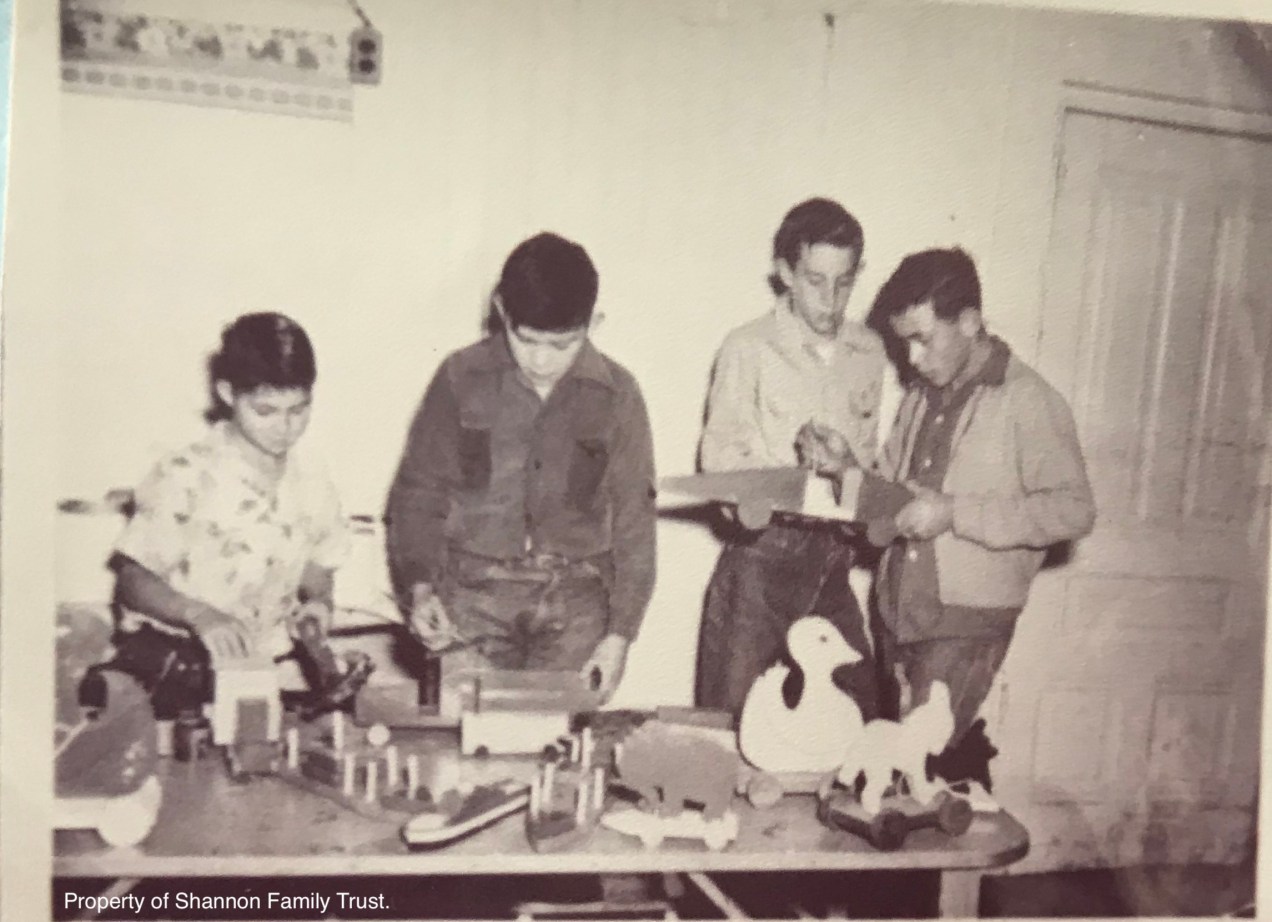
Dad and mom had some close friends, both university graduates, he from Stanford and she, California. He said he could never understand this. He always held her in suspicion as if she had committed a crime by marrying a Stanford man.

It is a wonder to me how members of my family hung onto talismans for a lifetime. Protection, luck and good fortune must have resided in the little things they kept. Did my father take his Beanie out of the drawer and dwell on its personal meaning? Did it have some nostalgic power? I don’t know but somehow I hope so.
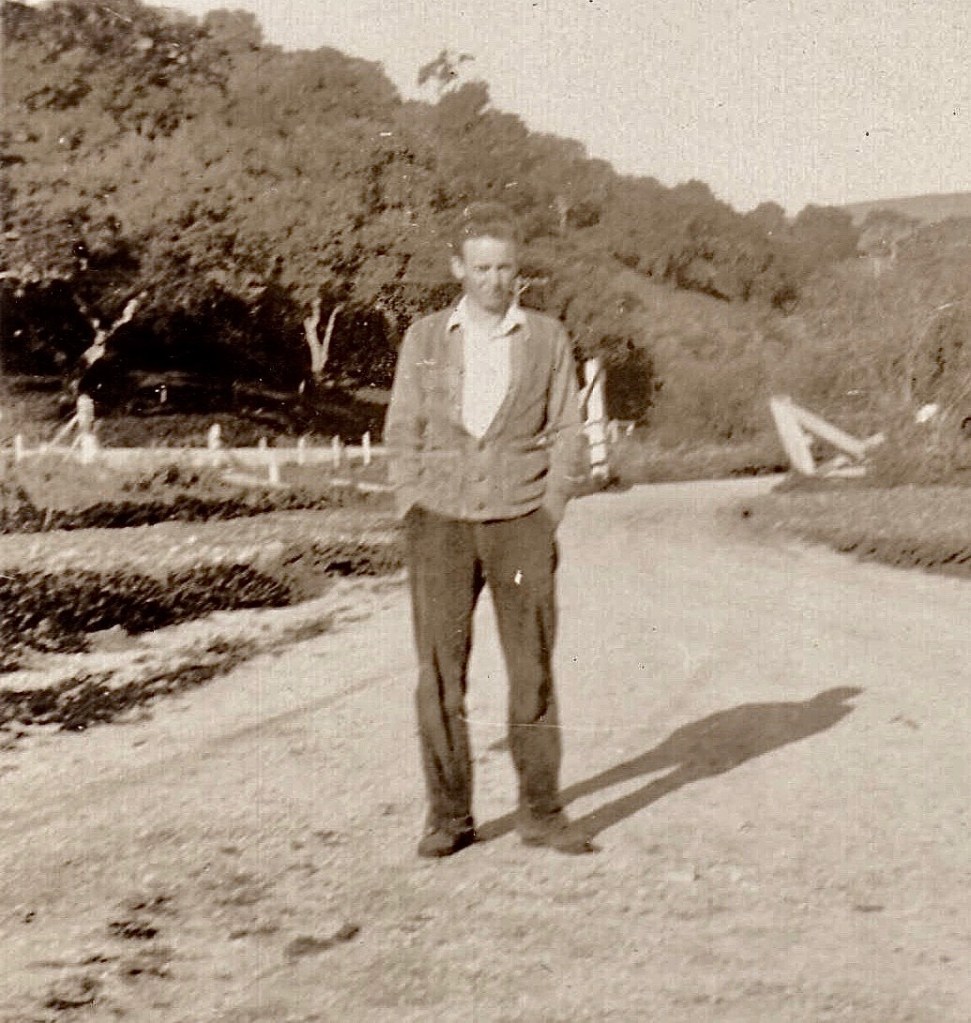
Michael Shannon is a surfer, teacher, builder and writer. He lives in Central California

Standard