How To Live Forever

Michael Shannon.

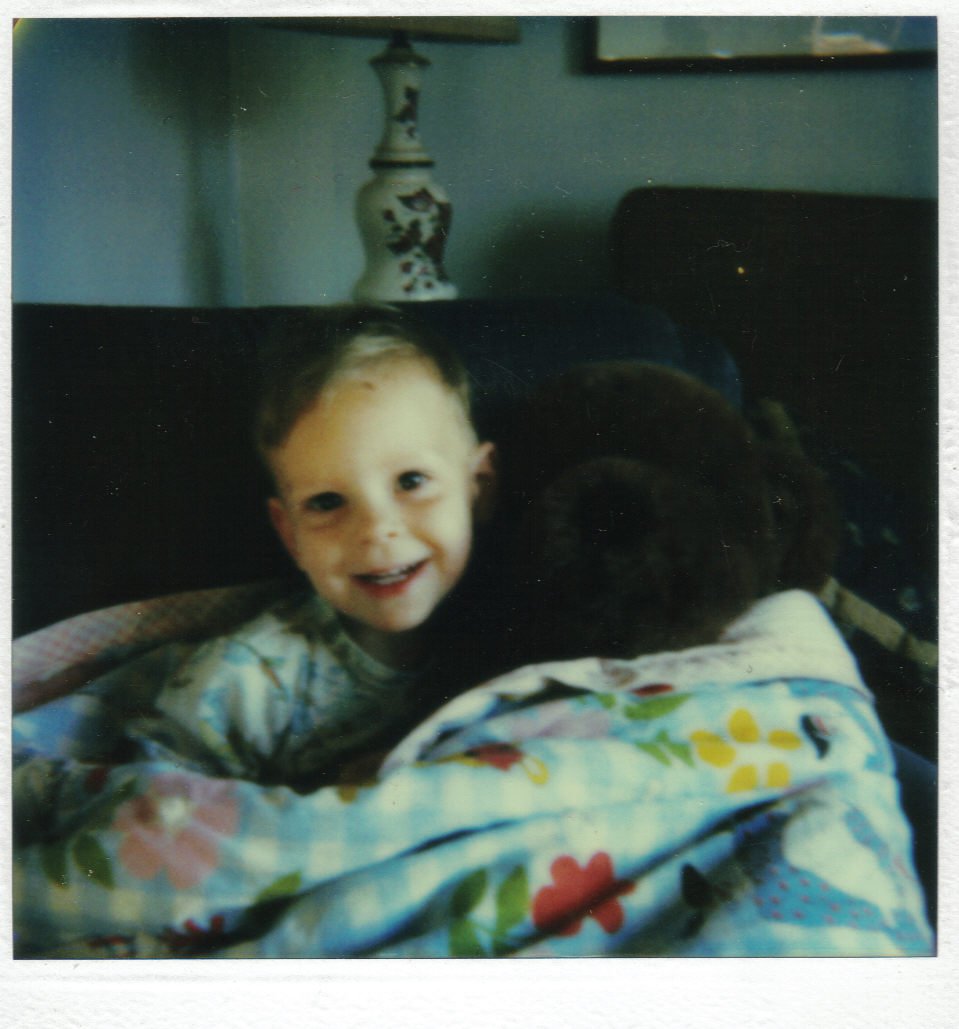
For a good start, be sure to be born on Easter Sunday. You might want to be the only child, a boy child at that, born that day. You should be born at Our Lady of Perpetual Help Hospital, better known as Sisters Hospital.

Staffed with The Poor Clares an austere Roman Catholic religious order of nuns, co-founded in 1212 by Saint Clare of Assisi and Saint Francis of Assisi. The order is dedicated to a contemplative life of prayer, and poverty. They were all good Irish girls. Many of them spent their entire working lives in Santa Maria and when they retired they returned to Ireland from whence they came.

They delivered the newborn to my mother with a blue bow tied in my blond locks. They told my mother it was an omen from God. It must have been because Dr. Case had given my parents some very bad news the year before, he said, “Barbara you will never be able to conceive.”

Born on Easter Sunday? Perhaps a subtle message to Harold Case. Who knows.

So thats a good start.

Now be sure your parents are from Farm and Ranch families. There are scads of reasons for this. The first is general health. To build a child’s immune system it’s important for them to drink from the irrigation ditch and the hose. In my case we drank from the kitchen faucet too, even when the water tank had dead Screech Owl chicks floating in it. The hard water in the valley had coated the inside of irrigation and all the other water pipe with a whitish hard scale that eventually caused the kitchen faucets to close up to the point where you could not stick a pencil in them. A soupcon of fertilizer in the irrigation pipe was good for kids too.

We learned that planting Roly-poly bugs does not grow snapdragons but that Nasturtiums are pretty tasty. We had oodles because they grew insanely lush over the septic pit behind the house. Leaves of three. let them be, we learned that the hard way and that Horse Nettles could be touched in the center of the leaf but not on the edge. We learned to remove our socks in the presence of foxtails and cockle burrs, that is if we happened to be wearing them and that there was only one kind of bad snake. If we saw one in the yard we just told mom, the woman whoo was terrified of spiders and she would come out and dispatch it with a shovel something she learned growing up in the oil fields. Mice in the house were pretty OK; Dad said they didn’t eat much anyway.

Kitties were tolerated for their mouser abilities but seldom coddled, dogs were loved beyond any reasonable amount. Dogs went everywhere we did, showing us the way.

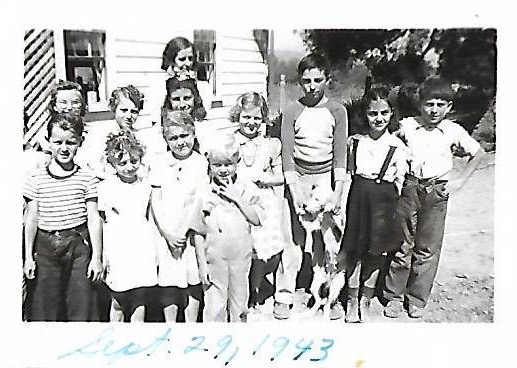
I learned to swim in the creek and the watering ponds on the cattle ranches. I could throw tomatoes, bell peppers and dirt clods with deadly accuracy. It was a mile walk through the fields and a dirt clod fight could and did last the whole way. My friend Kenny and I stalked Old Man Parrish’s apple orchards with our Red Ryders. Everything we did was a made up game of the imagination.

Every old building, corn crib, horse barn, tractor shed harbored an army of spiders. The dark places were home to Black Widows. There were Tarantulas living in holes in the ground, The Daddy Long Legs, so delicate and harmless, the Orb Weaver who weaves those delicate circular webs that can be so striking in the morning when dripping with the morning dew that are so striking that we used to duck under them so as not to harm them. Besides they were natural born fly killers. The nasty brown recluse which, if it bit you it was a sure trip to Doctor Cookson’s office.

When Warners came to dust the crops with clouds of sulphur and DDT filled the air. Not unpleasant odors went you sniffed it floating on the breeze. Sulphur was sprayed on Tomatoes and peas to fight mildew and DDT. It just killed everything but kids. We could imgine WWI watching those old Stearman biplanes zooming ten feet off the ground and then pulling nearly straight up after flying under Lester Sullivan’s power lines. He flew a Chandell and came right back the way he came and did it again. Dad said he was WWII fighter pilot and wishes he still was. He would call the kitchen phone to say when he was leaving Santa Maria so we knew when to rush out and get as close as possible to the crop he was dusting.

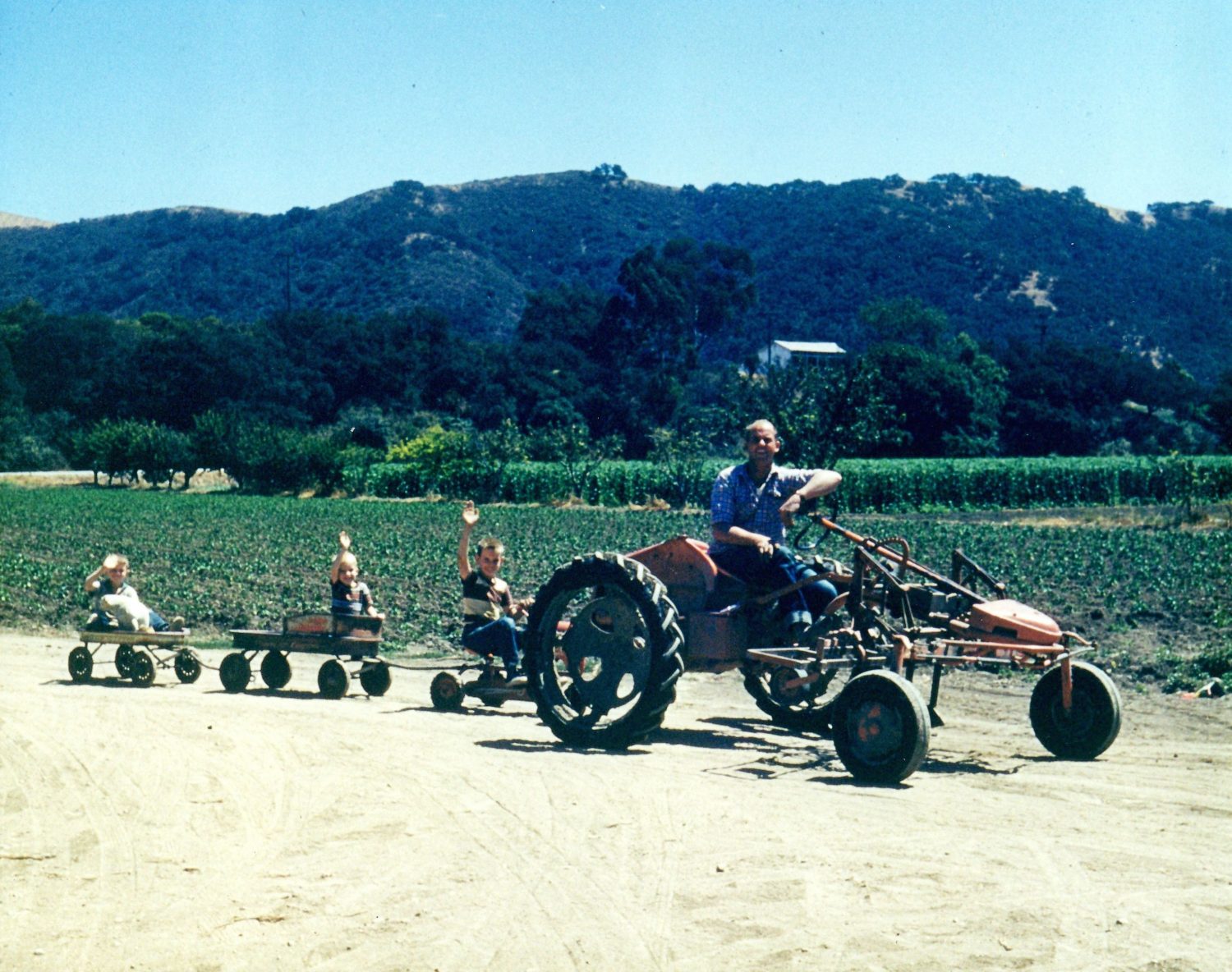
When we were big enough we stood on the cultivator bars of my dads tractors to hitch a ride into the fields. This wasn’t thought of as any great danger. Two of us would jump up and down on the bars to make the tractor buck a little which dad never seemed to mind much. Falling, losing your grip or footing and being dragged to death seemed a small price for some adventure.

We dug in the dirt, wallowed in the good rich mud of our adobe fields. Mom said the clogged pores in our skin prevented germs from entering. Being hosed of on the front lawn wasn’t such a bad thing in the summer.

The families ranches introduced us to livestock, “Bob” wire fences, the wonderful cow flop, cows must have the biggest bladders on earth. Have you ever seen a steer pee? My goodness! We knew what a salt block tasted like. The smell of new mown hay, used all the time in poetry but I think seldom experienced by most, the feel of the curly hair on a Hereford calf’s head and the rough feel of a cows tongue when she gives you a kiss.

My mother made sure we had a good clean shirt every day but Levi’s were worn until they were dirty and greasy enough to stand on their own. I mean, she had an old Westinghouse tub style washer with a wringer on the top which we were warned about but that hardly mattered and the occasional fingertip was squshed, carefully, so just to see how it felt. No one minded hanging out the wash because the clothsline was a great place to run through when the clothes were till wet. Had to be careful though, that was a switching offense. If you ran though and made good your escape mom soon pardoned you with a hug and a promise not to do it again.

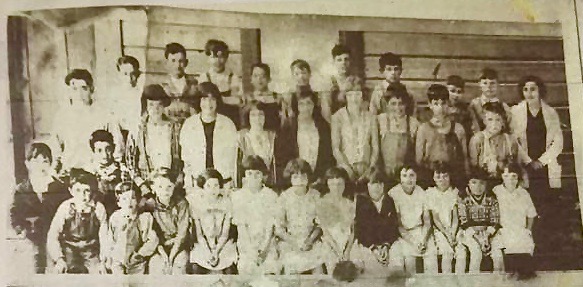
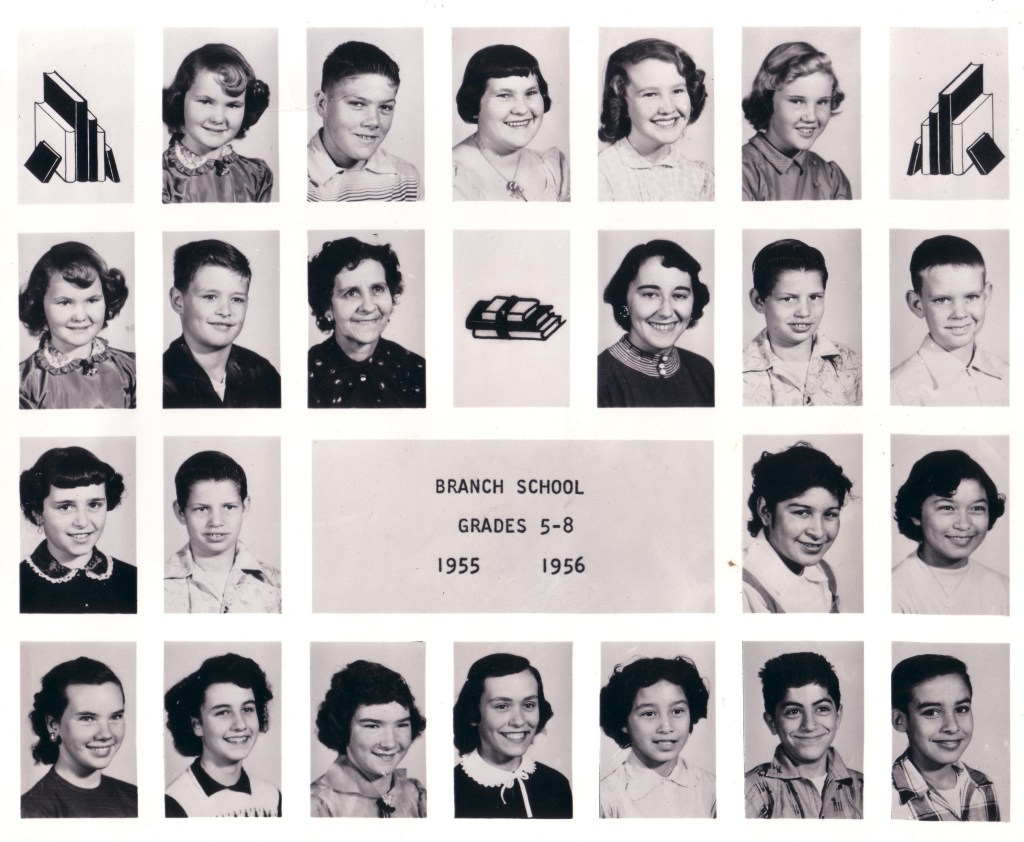
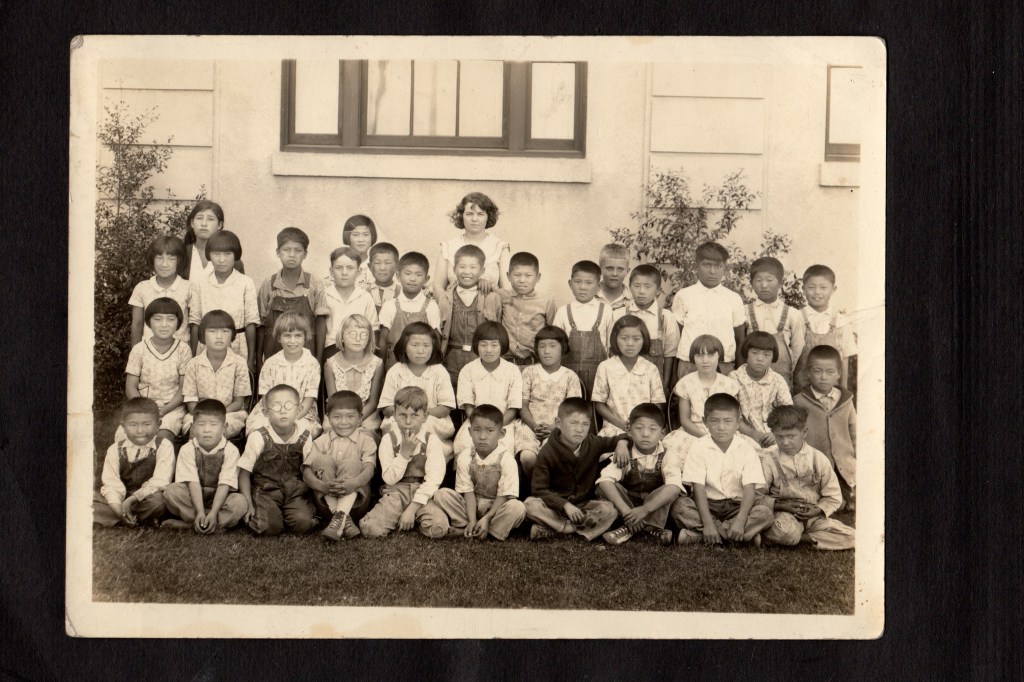
Kids did get sick though. We got infected from the other kids at Branch school. In the winter. Mrs Brown’s lower grade classroom could at times be fogged with microscopic beads of snotty goo and desk tops were glazed with phlegm from sticky fingers.

Mom and dad took disease very seriously. We had all the modern doctor mom tools, the humidifier that chuffed a fog of Vicks Vapo-Rub mist, A bottle of Iodine, Aspirin and band-Aids. She kept a handy rubber hot water bottle and if it was serious you might repose in their bed during the day and simply be cured by that treat and the smell of them as you slipped in and out of your fever dreams.

Our parents grew up in an age where the death of children was an omnipresent occurrence. When my father was born, one in five children died before their fifth birthday. Smallpox still wasn’t eradicated though the vaccine had been around for more than a century. My dad nearly died from Scarlett fever when he was seven. There was no cure. Children died from Whooping Cough, Measles, Influenza, Pneumonia, and infections from ordinary cuts and scrapes. A broken bone could become septic and a child would be lost. If you lived in the country there was little access to medical care, schools did not have nurses in attendance. The life of a child was precious but there were few ways to protect them. My own aunt was infected with polio when she was just nineteen. She survived but had a game leg for the rest of her life. Did I mention he was married with two small children and pregnant with a third when it happened.

Today we seem to have lost the institutional mamory of what pre-antibiotic medicine was like. My parents never did and neither have I.

No one asked me if I wanted to be stabbed by the nurse from the County Schools Office as we lined up at the schools gate and waited in line to go up the steps of the little school van and be stuck. Nope, any squawking would have been completely ignored. Parents knew the cost, nobody complained.

We learned from our parents that most things were not crying offenses. Dad never complained about anything, neither did my mother who if she sniped about her friends she didn’t do it around us. We lived in the kids world, all of us. Adventure was something homemade. You polished your imagination with no help from television because in the very beginning it wasn’t made for you. Reading was the drug of choice. We had all the Hardy Boys adventures, The Three Musketeers, Mark Twain, Jack London, Franklin W. Dixons Frank Merriwell’s adventures which in and of itself made us want to go to college. We knew little or nothing of war or politics. Those were of the adult world.

Looking back you can see that we were free to make our own adventures. We had little supervision. We knew the rules laid out for us but they were few. We were expected to have a good time, explore, learn to swim in the creek, fish for our dinner and follow the dogs wherever they went.

It was in many ways a simpler time for kids. You had time to learn and form yourself. To put on some the armor of self before you had to inevitably step over the threshold of young adulthood. It took me a long time to catch up with the town kids when I went to high school. I wasn’t prepared for smoking, fighting, sex or any of the other thing that can bring kids to grief.

A friend once told me that he found it admirable that I went my own way. Growing up on the farm had vaccinated me so to speak. Thoughtfulness was simply ground in you by experience. We were vaccinated by the tenet that you should “Look before you leap.”

Growing up on the land and understanding that the most wonderful thing was that my parents were alway there. My dad in our fields and mom in the kitchen. We were safe and secure in the knowledge that we were loved and cared for.

Cover Photo: My aunt Patsy at 17, she of the polio. My two brothers and myself. We were one, four and six. Shannon family photo

Michael Shannon is at heart, still a farm boy. He writes so his children will know where they come from.

Standard

The Twelve Hour Tour

Chapter 16

Michael Shannon

The Twelve Hour Tour was over. As the old saying goes don’t buy a Pig in a Poke sack. Except of course you’ll end up doing it anyway.

Bruce accepted the job as a superintendant of drilling and went to work on the Signal piers at Hydrocarbon Gulch. After they had cleared a platform to build a small and shaky derrick on the edge of the Pacific ocean the cable tool bit was dropped a few times which qualified as spudding in a well and the terms of the one year contract were fulfilled. They made it by the skin of their teeth.

Because Bruce was a whipstock expert he was busy at the Gulch. No derrick could be erected on the beach because of the tidal shifts so a pier was begun immediately in order to begin drilling out in the Santa Barbara channel. The oil pool was offshore and in order to reach it they would need to slant drill.

A pile driver building the piers for the validation well. The validation well, Appleford No. 1, October 1929.

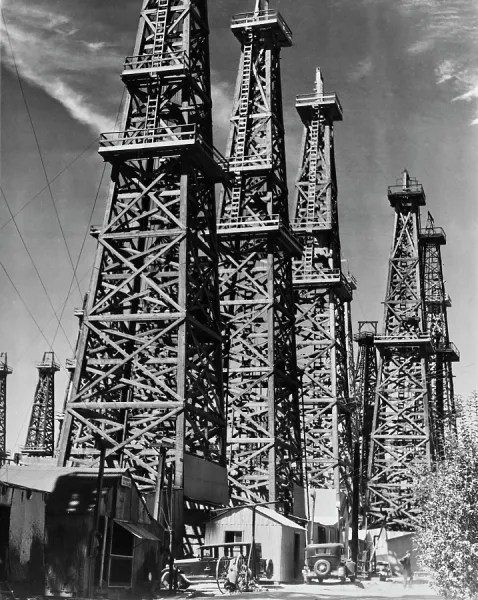
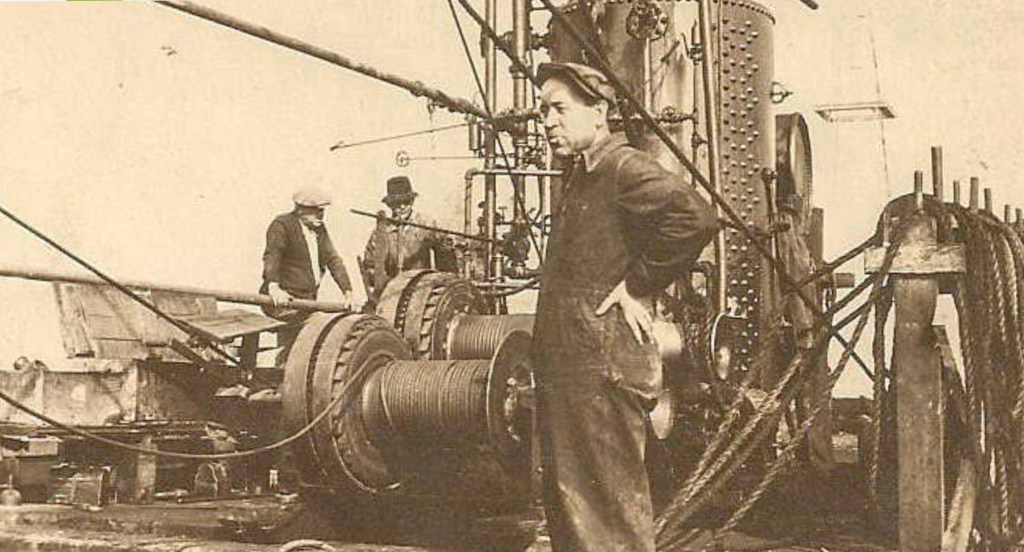
Bruce’s new position came with a raise and lots more responsibility. After nearly twelve years the twelve hour tour was a thing of the past. The twelve hour was now 24 hour and then some. Supervising more than one well could take a great deal of time. If his crews were lucky they had a shack or small shed where they could wrap themselves around boxes and equipment and sleep the sleep of exhaustion between tripping pipe. Pulling all the pipe in the casing, “Making a round trip” or simply “Making a trip” is the physical act of pulling the drill string out of the well-bore and then running it back in. This is done by physically breaking out or disconnecting the drill string when pulling out of the hole every other 2 or 3 joints of drill pipe at a time. The pipe pulled, called a stand is then racked vertically in the derrick. Up on a small platform near the top of the derrick called a “Monkey Board” is the The Derrick-man. the derrick-man walks the board to guide, stack, and secure drill pipe as it is lowered into or pulled from the bore hole.

Tripping pipe in the early 1930’s. The stack is behind the man on the right. Calisphere

A typical reason for tripping pipe is to replace a worn-out drill bit. Another common reason for tripping is to replace damaged drill pipe. It is important to get the pipe out of the well-bore quickly and safely before it can snap. My grandfather could place his gloved hand on the rotating pipe and tell you what was going on deep underground. In the thirties there was little in the way of scientific measurement. No electronics were yet available for measuring hole. The drillers still relied on taste, feel and smell to understand what was happening deep underground.

The drilling floor was a dangerous place to work, slippery with drilling mud, oil and water. Ninety feet above the floor hung all kinds of equipment that could fall and kill a man. Hands were crushed by heavy machinery, steam boilers could rupture and cook a man. Heavy chains could snap and take your legs off. No one wore a hard hat. They were not in common use yet. No self-respecting work man would were one anyway out of pure cussedness. Men were careful enough, within reason, but idiots were not tolerated and would be quickly run off lucky to just get a beating on the way. Avoiding death caused by an idiot is in itself likely to make a crew furious. It was every man for himself.

When Bruce left for work Eileen never knew when she would see him again. It could could be days. Raising the girls was mostly her job. House wifing was a different job in the thirties. There were no labor saving devices in the home. Few had a washing machines, only 8% of American homes had a refrigerator in 1930. If your house was electrified, about 90% were in urban areas, you had an opportunity to buy home appliances if you could afford it but if you lived out of town, if you lived on a farm or out in the country that dropped to roughly 10%. A woman lived little different than her grandmother had before the civil war. Things were still done by hand. Itinerant oil workers, because they moved so much weren’t likely to be moving with heavy appliances. It was by this time jusy normal life for grandma Hall. My mom talked about taking the rugs out to beat the dust out of them. She said she could really wrangle the floor sweeper around. She remembered that she was twelve when her mom retired the old Sad Iron. Mom also was the carwash, something she did until she married. Grandpa had a car which he liked to keep clean. Muddy roads meant a lot of washing. The car meant you could get to work and back and was an important as any other tool.

School was within walking distance. The old Benjamin Franklin grammar school had just been rebuilt and served the central section of Santa Barbara. Opened in 1899 it added to the legacy of education in Santa Barbara begun by the holding of formal classes in the home of Don Domingo Carrillo who had used local Chumash Indians labor to build his home in 1807. He built the house for his wife Concepción Pico Carrillo who established the school.*

Mom said she loved Santa Barbara and like every time they moved she hoped they would stay. Her reality was they were oil nomads. Grandpa went where the work was because he loved the work I guess. Thats thing not uncommon amongst those that work with their hands. Trapped by experience and the need to provide you’d better make the most of it. The rest of the family is along for the ride.

Barbara Hall. She carried that winsome look her entire life. Santa Barbara California 1931

Both my parents told me that when the were in the depression they didn’t really know it. No one called it that, It was just hard times and most people got by as best they could. They said ordinary people, which they were, took care of their money. Savings banks were a pretty new concept and most people didn’t use them anyway even if they had cash to spare. Because my dad was a farmer and dairyman they grew and made things people needed and saw as necessities. They were lucky in that way.

In the rest of the country one in four people were out of a job, over five thousand banks across the country closed forever taking peoples life saving with them, suicides increased by 30% and there were more than two million people homeless. Thirteen billion dollars of the American economy had absolutely evaporated in 1929 with the stock market crash. No one knew that the recovery would take a decade and with help from Adolf Hitler and the fascists governments of Europe.

Mom knew how to run a sewing machine and read patterns so she made her own clothes. So did her sister. Bob, her brother couldn’t sew but more than adequately filled the role of general all around pest which they both said he was pretty good at. They owned a car, which was a little bit of luxury but was necessary for Bruce to get to work. Mostly the kids walked to school, downtown or to shop. The Santa Barbara street railway had closed in 1929 killed off by car ownership but it wasn’t a large town, just 33 thousand in 1930 and especially for kids Shanks Mare got them around just fine. The most luxurious thing they owned was a radio. Radios were a new phenomenon that “Do you own a radio?” was a question on the 1930 census. The Hall’s said they did.

In addition to the music, news, and sports programming that present-day listeners are familiar with, radio during this period included scripted dramas, action-adventure series such as The Lone Ranger, science fiction shows such as Flash Gordon, soap operas, comedies, and live reads of movie scripts. Major film stars including Orson Welles got their start in radio Welles became a household name in the wake of the infamous panic sparked by his 1938 broadcast of The War of the Worlds. Both my parents said he didn’t really fool anybody.

Music filled many hours of programming, singers of all kinds, radio orchestras played popular music and symphonies. Popular 1930s radio shows included dramas and comedies like The Shadow, Little Orphan Annie, and Fibber McGee and Molly, variety and music shows like The Chase and Sanborn Hour and Kraft Music Hall, and children’s programs such as The Adventures of Superman. Radio was a booming entertainment medium during the decade.

Taking a break to listen.

The future of the Hall family wasn’t all that rosy though. Grandpa had a good job near the top of the earnings curve but life in oil was still tenuous. Crude oil price were through the floor. Some independant companies were dumping oil on the ground. It cost more to pump it than it was worth. New exploratory wells were at a standstill. If there is no hope of profit, don’t invest.

Signal had made up it’s mind that the only hope for the company now that their sales of gasoline to the big producers had been cut off was to plow ahead with the Elwood field hoping to strike enough crude to at least break even so that a hoped for upturn would still find the company afloat.

Like pirates fleeing the law, they pressed on, mortgaging what they owned, makeing frantic rounds of private investors and sending a steady stream of executives to what banks were still in business hoping to find at least a dribble of cash. They began selling their crude at a loss. It was an enormous bet on the company and Sam Mosher’s “Varsity Team” of engineers, superintendents and drillers to innovate, cut the fat and and walk the knife edge of safety to survive another day.

As fast as the piles for the piers at Hydrocarbon gulch were driven, derricks were thrown up, spudded in and the turntables began to whirl. Sometimes the drillers worked over parts of the pier that had almost no planking such was the rush. They wasted no time on guardrails. If you fell, it was in the water if you were lucky and you would simply be fished out. “Joining the Birds” was how they put it.”

From the small field in Maricopa, Chief Engineer R W Heath organized the teardown and loading of the refinery and processing plant which was moved by truck to Tecolote canyon where it was reassembled in just eighteen days. Eighteen, think of that, all moved by truck. There was no Hwy 166 in those days, it all came by 41 and down the Cuesta Grade in tired oil field trucks whose brakes were always suspect. That kind of job that could not be done today. Everyone who worked on the crew did whatever job was required. There was no specialization, if you could turn a wrench, you did. If sweat and grit could move tanks and towers it was done. In it’s early days Signal was like a team working to a common goal. A Varsity Team Sam Mosher liked to call it. Grandpa was one.

Signal had one toe over the line into bankruptcy. If they didn’t find a well which produced marketable quantities of crude they would be unable to meet their contracts and would be forced into receivership. Working overtime to keep the comany in business was the source of heart attacks. If the company failed no one had anywhere to turn. No jobs were available anywhere in oil. Mosher had nowhere to go except to work every day and trying to dream up a way out while sleeping.

Appleford number two did not bring in a heavy enough flow to be profitable. The head field engineer Walt Greenfield was sure that there was plenty of oil just a little farther offshore and said if he was able to whipstock a well he knew he could find it. Whipstocking used a heavy iron device shaped like a shoehorn that when lowered into the drill casing at about a hundred feet could guide the drill bit and its pipe in a lateral direction. They would be able to send the drill spinning out below the sea bed ahead of the pier into deeper water offshore. The problem for the front office is that the cost was thought prohibitive, as much as $35,000 instead of a typical $25,000 for a vertical hole. Management slammed the hammer down and said no, too expensive.

Bruce was a master of the Whipstock and drill bits were moving in all directions underground just like worms in the compost. Signal engineers believed that there was an ever larger pool just a little bit farther from shore. They believed that if they could just go a little bit farther out there was a fortune there for sure. They just had to find it.

The pile driver at work, Mahoney’s pier, 1930.

The family was pretty settled in those two years, Grandpa had steady work. The kids who were about to be teenagers and were happy in school, one of the few times where they stayed long enough make friends. Santa Barbara city was at it’s finest. Because of the generational wealth which was mostly depression proof stores stayed open, the streets were clean and safe. What was euphemistically called Riff Raff was quickly showed the way out of town.

Any minorities persevered in the face of direct and indirect discrimination. People who served in wealthy homes or worked the many fashionable hotels were allowed north to work but not to live.

The descendants of the original Spanish/Mexican and Barbareno Chumash were pushed down into the lower eastside south of Cabrillo street and east of State. Over the middle part of the twentieth century discrimination concentrated the non-white population into the area of temporary shacks, cheap houses** and a service area that held the laundries, shoe repair shops, blacksmiths and auto repair garages. In the depression there was a literal line at Cabrillo Street where people who dwelled in the lower east where most definitely not encouraged to cross.The Eastside neighborhood, was for the marginalized racial and ethnic minorities.

In an interesting twist the school my mother attended was fully integrated though it was outside those neighborhoods entirely.

Born at the end of the 19th century my grandparent’s had that sort of mild racist mindset common at the time. On a simple scale they felt that somehow they were better than the marginalized. In her old age, my grandmother occasionally referred to African Americans as “Coons” which set my teeth on edge. The thing about it was that she had no evil intent. She might have been just referring to the fact that African Americans were undereducated and had less opportunity or lived in poorer neighborhoods. It seemed to be just as if she was describing any object of note. It certainly goes to the complexity of experience. It would be decades before African Americans or Hispanics started showing up in the oilfields. In their married life that had lived in more than one “Sundowner” town.***

State street, Santa Barbara, California June 29th, 1925. Calisphere


In a fortunate piece of timing after the devastating earthquake of 1925 it was decided to rebuild the city in a quasi-California Mission Style. Helen Hunt Jackson’s novel Ramona written in the late nineteenth century had kindled and polished a romantic version of old California. Though the novel became popular and did, for some, shine a light on injustices toward Indigenous peoples, the fact remains that the novel, rather than initiating a movement of change, romanticized a tragic story where the ones who lost the most were those of Indigenous descent. The largest impact the novel had was in tourism—creating a road map of California that the characters traveled, thus making these locations popular and lucrative. The Rancho life has endured until today as a visible symbol of old California which never truly existed. The fantasy, the connection between the novel Ramona and Lummis’s Sunset Magazine is through tourism: the book became so popular it inspired a wave of travel in Southern California, which Sunset Magazine later helped promote and document. Focusing on the region’s “Old California” romantic image led to design requirements for rebuilding the downtown. Santa Barbara remade itself into a popular vision and because the country was postwar prosperous it became the best example of a Hollywood style fantasy of any California city.

Construction of the nearly destroyed Mission had been completed just two years before my mothers family moved there. The harbor was completed in 1929 and was family inaugurated the following year when my Aunt Mariel pushed my mother off the breakwater onto the boulders below and knocked out her front teeth. Never found they are still there as a sort of family talisman.

As a child I was fascinated that she could detach her bridge, take out her teeth which she scrubbed in the kitchen sink. I knew of no other mother who could do such a marvelous thing. Such are the connections that make a life I suppose.

Mission Santa Barbara 1925 after the quake.

The company could at least make payroll and service all it’s notes. Sam was busy looking around for more possibilities. He found some on Signal Hill.

The driller’s had no choice but to wait until things became absolutely desperate. Holding on by the skin of his teeth, Mosher operated a grand total of eighteen wells in the Los Angeles basin, the Midway-Sunset in the southern San Jaoquin and the Elwood field Mosher decided to slow exploration in Ellwood and buy more leases in and around Long Beach. So in late 1931 the Halls rolled up the carpets and trekked south.

Chapter 17 Next:. A year of ups and downs with a major surprise

NOTES

*Leopoldo Antonio Carrillo August 6, 1880 – September 10, 1961) was an American actor, vaudevillian, political cartoonist, and conservationist. He was notable for playing Pancho in the television series The Cisco Kid (1950–1956) and in several films. His signature line was “Cisco, lets went.” His character has since been memorialized and the catch phrase Lets Went” taken its place as a bit of California iconography. We will meet him again later in the story.

**My oldest son rented a studio apartment in an old house which had been divided into apartments in the old eastside neighborhood. This was when he was working in management at a beachside hotel in the early 2000s. Rent was nine hundred a months which was a very substantial sum for a bedroom that had a toilet in it. The house should have been condemned long ago but ghettos are not torn down in one night.

***A sundown town was an all-white community that intentionally excluded people of color, typically African Americans, using discriminatory laws, harassment, threats, or violence. The term comes from signs posted at town borders that warned non-white people to leave before sundown or face consequences. Many California oilfield towns had active KKK chapters until after WWII and later. My grandparents would have been familiar with the term and life in them.

Michael Shannon writes and lives in Arroyo Grande California. He tells these stories so his children will know where they came from.

Standard

The Lid

Michael Shannon

It’s inauguration day January 20th 1961. There is eight inches of new snow on the ground. It is freezing yet over a million people had gathered on the mall as witnesses. Two vastly important things happened on the marble steps of the Capitol building in Washington DC. Neither one was the swearing in of a new president. In a photograph of Supreme Court Justice Earl Warren reading the oath of office to the new chief executive who is not wearing a hat, his wife Jaqueline stands behind Warren absolutely rocking her Halston designed pillbox hat. The hew President John F. Kennedy was set to become the first US leader born in the 20th century, the first Catholic commander-in-chief and the first president whose inaugural speech was beamed across crackly television screens in color.

Everything that happened on January 20, 1961, was stage-managed to tell America that a new age was dawning. “Ask not what your country can do for you – ask what you can do for your country,” he implored a nation in need of reassurance and leadership at the height of the Cold War.

Perhaps the saddest thing about this day of hope was that it was the death knell of hats. Kennedy didn’t like hats and wouldn’t wear one unless he had to. He had great hair which is essential in the political game. Why cover it up?

In one fell swoop two centuries of hats were swept away. After 1961 there were still great hats to be seen but only on rare and special occasions. In the movies, at fashion shows and at the Kentucky Derby where they aped the far more famous and, dare I say more stylish British.

Audrey Hepburn, “My Fair Lady.”

We all know the iconic mega-feathered hats of the Edwardian era. The Edwardians were particularly enamored with plumage, but unlike their be-feathered predecessors, the Victorians and the Georgians, many a fine species of bird was taken to the brink of extinction by the incredible demand for ladies be-feathered hats.

Throughout history, hats have played a big role in indicating one’s status. For the Edwardians, they took this to a new level, and often added entire birds to their heads, and sometimes these birds were fantastical creations cobbled together from several varying bird parts!

Popular plumage for hats extended beyond ostrich, to include heron, peacock, egret, osprey, bird of paradise, pheasant…even vulture. The more “common” feathers for adornment were garden fowl, pigeon, turkey, goose, and rooster. These feathers were made into plumes, pompoms, aigrettes, wings, pads, bands, breasts, and quills, and not by marchandes, milliners, and craftsmen in quaint little shops, oh no, by massive factories employing thousands of women and children, and dealing in hundreds of thousands of feathers per day. In 1900, in North America, the millinery industry employed 83,000 people!

Camille Clifford American actress

Evelyn Nesbit, the Girl in the Velvet Swing. Lillian Russell the Jersey Lily. Lily Elsie in the Merry Widow

In a world of sweat stained baseball caps and shapeless, floppy hiking hats sold at every seaside gift shop and those faux cowboy hats made for the bar and ATV wrangling, only Jazz musicians have kept the banner of the chapeau flying. No one could rock a Pork Pie like Lester Young, the greatest tenor sax player who ever lived if I do say so myself.

L to R Thelonius Monk and Lester Williams “The Prez,” nicknamed by Billie Holiday herself.

Rockers too have had their iconic hats. Some such as Leon Russels “Mad Hatter” lid was so famous that just the sight of it identified the person. Tom Petty’s John Bull Topper and Stevie Ray Vaughns Texas style Plateau hat could be spotted a mile away. All three somehow lent a special air to the legendary musicians.

Cowboys are well known for their hats. Every area of the country seems to have a dedicated style today but in the beginning it was just something to cover the head. Bowlers, broken down military hats the cheap felt hats that came out of the civil war especially from the Confederates. Since big time ranching essentially started in Texas-New Mexico those boys set the style. They were dirt poor, likely almost no education but they could fork a horse and they showed off a certain style that somehow puts modern cowboys riding their ATV’s and wearing custom shirts with patches that make them look like they came out of nascar to shame.

Cowboys from the old original days. Black, Brown and white as it used to be. 1870 to 1900. PD

The women too wore hats, just like the men though with perhaps a little more style.

Clockwise from upper left: The Sweetheart of the rodeo, my great-grandmother Marianna Cayce, a Mexican Charraria from Jalisco, Mexico and one of the girls from the old Huasna rancho, California. Look up the Charrarias, they ride horse handling events and do it all sidesaddle. My grandmother was the first woman to ride astride in the Santa Barbara Fiest parade in 1925. She loved the scandal.
I have to say that some of the movie cowpokes sported great hats too though theirs were chosen by set dressers to match their features, like an artist might paint them but the good ones are worth remembering.

From upper left clockwise: Henry Fonda, Tom Selleck, Jeff Bridges with Hailey Stanfield and from the greatest western ever made, “Monte Walsh.” Lee Marvin.

Every good gangster must wear an iconic hat. Fedoras, snap brims, skimmers, newsboys, they wore ’em all doncha see? Before gangsters dressed in tracksuits and gold chains by the dozen, revealing their status as potential killers there was a day when the point was to look like an honest businessman. In suits and fedoras they strolled the Big Apple in neighborhoods such as “Hell’s Kitchen, “Alphabet City” and the Bowery. Gangsters of every stripe roamed the lower east side, Little Italy and The Five Points, The Tenderloin and Harlem. The Dead Rabbits, The Forty Thieves, The Whyos, The Purple Gang and Murder Inc. roamed their districts with evil intent. With a Snap Brim or Straw Boater, Chewing on a ‘seegar’ they dressed to the Nines to send a message.

“Lucky” Luciano and “Bugs Moran” Cold dead eyes.

Moviemakers have a fascination with gangsters. Their portrayal is designed to send shivers up and down the spines of viewers who will watch them and ogle their antics on the big screen in a state of vicarious joy.

The Godfather, Little Caesar, Public Enemy and Scarface.

The workingman typically sported a cap unlike the “Swells” and their Homburgs and hardboiled Derbys winding down through the financial district and sporting a rolled umbrella as a mark of their status. Known by various names in the western world, Flat Caps, Newsboys, Scally Cap and Baker Boy Cap they were once worn by tradesmen of every kind. Recently they have seen a modest rebirth with the hipster Scally Cap and the Baker Boy Paddy Cap from Ireland.

The Morning Telegraph was a New York City broadsheet newspaper owned by Moe Annenberg’s Cecelia Corporation. Bat Masterson frontier marshall was its sportswriter. It ceased publication in 1972. Newsboys photo circa 1897.

This a comparison of the Baker Boy Cap, the real on the left and the movie on the right. Henry Fowler real, Cillian Murphy not real.

Gang members frequently wore tailored clothing, which was not uncommon for gangs of the time. Bosses wore silk scarves and starched collars with metal tie buttons. Their distinctive dress was easily recognizable by city inhabitants, police, and rival gang members. The wives, girlfriends, and mistresses of the gang members were known for wearing lavish clothing. Pearls, silks, and colorful scarves were commonplace on their women. The gang in England, operated from the 1880s until the 1920s. The group consisted largely of young criminals from lower- to working-class backgrounds. They engaged in murder, robbery, violence, racketeering, illegal bookmaking, and control of gambling. Members wore signature outfits that typically included tailored jackets, lapelled overcoats, buttoned waistcoats, silk scarves, bell-bottom trousers, leather boots, and flat caps. The so-called Peaky Blinders, which contrary to what you might see on television did not have razor blades sewn into their caps because Gillette didn’t begin making the old single edge razor blade until 1908. They instead gained their name from the way they wore them with the cap tilted so that the peak covered one eye.

The real deal. Peaky Blinders criminal records about 1904. Birmingham, England.

The armed forces in America have little choice in what they wear. Officers and enlisted men have gone to great lengths to build in some individual style when they can. In WWII Army Air Corps officer pilots wore their field grade visor hats in the cockpit. Because they wore head phones to communicate the strap on the phones bent down the crown stiffener so that the normally flat top was “crushed” on the sides. The hat became so cool that all officers not just fliers sported them. Flyers looked down on these posers with a degree of disdain as they should.

The real deal. B-17 pilot Colonel Jimmy Stewart and Major Clark Gable, air gunner. Both flew multiple missions over Germany.

Enlisted sailors and soldiers, though they didn’t wear gold braid, nevertheless found ways to twist, fold and crimp their headgear too. If you have complained about those darn kids wearing their ball caps all crazy, have at look at your great-grandfathers style.

Tuskegee 332nd fighter group ground crew in Italy WWII. Bobby Hall stylin’ his Dixie, US Navy

In Great Britain they run the Epsom Derby, pronounced Darby, is run in June of each year. The Stakes, more commonly known as the Derby and sometimes referred to as the Epsom Derby, is a Group 1 flat horse race in England open to three-year-old colts and fillies. It’s a major event in on British sporting calendar. The queens and kings have been running their horses in this race since 1661 and annually since 1740. Like other elite horse races, the Epsom Derby has grown into a multiday festival, featuring musical acts and events in addition to the race itself. The Oaks is also run during the Derby festival, held on the Friday before the Saturday running of the Derby. Derby Day is more formal than most contemporary sporting events: Epsom Downs maintains a dress code for male spectators in certain sections of the stands, and women often attend the event wearing extravagant hats. Hats are literally the most important reason for showing up for some. Troops of photographers flit to and fro capturing images of important people and their hats.

Queen to be, The real Queen, a Duchess and an the American Queen.

We’ve all seen the distintive Cloche hat which was popular in the 20’s and 30’s I always thought the were strange looking things. aort of beanie-like, blah and bland. When I was looking for examples I ran across a colorized video of a Parisian woman sitting outside a bistro wearing one and it completely changed my perception. The color and movement explained it all.

Janet Gaynor, American actress traveling to New York on the Queen Mary in 1929 and a sophisticated Parisienne taking tea on the banks of the Seine in 1927. Some people can make anything look good.

I’m sad to see the end of the Pork Pie, the Topper, the Skimmer, the derby, the merry widow and the little straw bonnet worn by Natty Bumpo’s sweetheart Cora Munro in the Last of the Mohicans,

Misstress Cora Munro.

My brothers and I though, are making an attempt to jump start the fine old art of hat wearing. Maybe it will work.

Good luck to us I say.

Cover Photo: My grandmother Annie Gray Shannon and Hattie Tyler, 1900

Michael Shannon is a writer and sure to take some abuse from his brothers for this.

Standard

The Hired Girl

Michael Shannon

She was only ever referred to as the hired girl. She worked for my Great Uncle Patrick Moore and his wife Sarah. She wasn’t a live in for her parents had a home just down the hill from the Big House called Grand View, that huge confection of a house built in the 1889 by My grandmother’s maternal uncle, the very successful Irish immigrant who had risen from a sheep farmer in Guadalupe to become one of the richest and most influential men in what were still known as the “Cow Counties.”

Grandview 1896. Annie Gray Shannon is the little girl in white up on the balcony.

The Moores could never have imagined how their life would turn out. They immigrated to the United States in 1847 from Cavan town in county Cavan where Patrick’s family raised pigs. Moderately prosperous they lived in what is known as the Irish Lakes District because it contains 365 named lakes. County Cavan is also the source of the river Shannon. According to legend, the Shannon is named after Sionnan, who was the granddaughter of Manannán mac Lir, the god of the sea. She came to this spot to eat the forbidden fruit of the Tree of Knowledge, which was planted by the druids. As she began to eat it, the waters of the pool sprang up and overwhelmed her. She was drawn down into the pool and its water began to flow over the land, forming the River Shannon.

Patrick himself had no desire to spend his life slopping pigs in that good Irish mud so he prevailed upon his father Michael to buy him a ticket on an immigrant steamer. He arrived at Castle Gardens New York in April 1847 aboard the SS John Ravenal out of Liverpool, he was 15 and he intended to stay. Like most immigrants he already knew someone who could show him the ropes so to speak. Chain immigration has always been the way. Over the next decade he would return the favor and bring his father Michael and his three sisters, Mary, Bessie and Catherine to this country.

They moved across the country. He lived Sandusky Ohio and in 1860, moved to the Sacramento area of California. Somewhere along the way he learned to read and write and became a citizen.

Patrick Moore. Family photo

He and Sarah were married in 1871 but old census reports indicate they were living in the same house for a few years before that. Perhaps you can imagine the rest, or not. Everyones life has been self censored.

In 1877 they were living near Salinas during the great drought of the 1870’s. He ran horses, cattle and herds of sheep and his stock was in great distress because of little feed and almost no water. He wrote to his old friend Patrick Donovan who was an Arroyo Grande pioneer asking if he had feed to sell. Pat Donovan told him that he had leased lands in the Oso Flaco area and that Moore should drive his herds south. When Pat Moore asked what would be the cost Donovan said it would be nothing as they were friends and Patrick Moore was a friend in need. Pat Moore never forgot this act of kindness. “Every cent I now have ” he would often say, “I owe to the friendly act of my friend, Pat Donovan. He never took a cent in pay for the feed he gave my starving livestock.” Pat Moore spent the rest of his life paying that kindness forward.

The entire family relocated to Guadalupe in 1877 where he farmed and ranched. Like many Irish immigrants he began buying land, Something no Irishman could do in the home country. For some like Pat Moore it was an obsession.

By 1891 he owned vast tracts of land. Much of the old Santa Manuela Rancho, Parts of the Bolsa de Chamisal, bottom land in the Arroyo Grande valley, three stone quarries and had become an informal banker, lending money to others. Some of his land in the hills of Santa Barbara county and in the flats east of Santa Maria produced the first oil in the area.

Fortunate had graced his efforts and in 1890 he began building the great house known as Grandview. It overlooked the little town of Arroyo Grande and the valley for which it was named. Pat was active in politics and in 1892 was elected supervisor of the fifth district of San Luis Obispo county, the so-called “Bloody Fifth.” It’s reputation was well earned. Saloon brawls, the little town had many more than a dozen saloons and there were land disputes which occasioned cold blooded murder and a non-judicial lynching. The regular clearing out of undesirables such as vagrants and the pesky Celestials who lived in the Oceano area. People then were no better than we are now.

In 1893 a singular event in their lives changed their lives. My eight year old grandmother came to live with the Moores in the big house. From a prominent Santa Maria family, her mother was a niece of Sarah Moore. Annie Gray left her family to be raised by the Moores who were childless. They promised to provide her with a first class university education and deed her a ranch when the Moores passed on. It was another selfless act of kindness by two Irish immigrant families. My great-grandparents to loan a child and another family to cherish her.

The Moores had also taken in a pair of sisters who had been orphaned. The inscription on Elizabeth Tyler’s headstone reads: “Remember friends as you pass by. As you are now, once was I. As I am now so you must be. Prepare yourselves to follow me.” Mrs. Tyler and her husband died of Smallpox in 1875. She is said to have been the first person to be laid to rest in the burial grounds of the old Guadalupe Catholic cemetery. Her two girls, Mame and Hattie would grow up with my grandmother in the Moore house. Just down the hill in the little area of small farms owned by some of the most prominent citizens raised boys and girls of the same age. The big ranching families all had houses in town because they were so far from schools and shopping that they sometimes lived in their townhouses away from the ranches.

Up at the house in the days long before radio, television and the like, entertainment for kids was provided by parties and family get togethers which were a constant occurence. My grandmothers little autograph book which her guests signed contains the names of kids from families like the Phoenix kids, the Harloes, Dixons, Lierely, Jack Shannon, my future grandfather, the Rice girls, the Griebs, Conrows and many others. Children were more than welcome at Grandview anytime and for any reason.

The gift of an education was not reserved for just my grandmother but was settled on several young women who spent time in that house. Girls attended the San Jose Normal school, Santa Barbara College and Cal, all paid for by Pat Moore.

So, a big house full of kids and adults, hence the hired girl. Her name was Clara.*

Annie Gray, my grandmother and the hired girl Clara. Rear. Mary Maguire and the Tyler sisters. 1893. family photo

Clara was a lively redheaded Irish girl six years older than my grandmother when she came to live with the Moore’s. Her parents had come from Ireland in 1879 and settled in Arroyo Grande. They lived just down the hill from Grandview. Her father farmed a small tract of land in the lower valley. He had come south working for the Southern Pacific railroad.

Clara began working for the Moore’s when she was fourteen. A house nearly ten thousand square feet took some work to keep up. The house had hardwood floors covered with rugs and you can bet that guests and families did not remove their high button shoes to come inside. The streets of the town were still years from being paved and the road out to the house was corduroy which was just basically logs covered with dirt. The Moores might have had a big house and dressed well but they still had horses in the barn, pigs in the sty and dogs in the yard.

Visitors from out of town like San Luis Obispo or Guadalupe came by train which ran twice a day. Come for dinner you had to spend the night. Pat and Sarah loved guests in their home and weekends especially the house would be full.

Clara must have spent many hours pushing that brand new invention, the carpet sweeper** and scrubbing floors.Thankfully for her most of the laundry was sent out to the Chinese laundry in Oceano so at least she was relieved of that chore. Outside duties were delegated to the hired man Clarence Seamen who lived upstairs in the horse barn. The house was set on an entire section of ranch land and was a busy place.

My grandmother grew up in that big house, leaving for university at Berkeley in 1904. She married my grandfather Jack Shannon in 1908 and had two boys. The family ran their dairy on the promised ranch, and retired in 1954. My grandfather passed away in November of 1976 and my grandmother Annie in April 1977.

Readers of stories about my family will know that she was a right proper lady. She was a turn of the century girl raised by two wealthy families. She was a churchgoer of the first order and anything improper was neither said nor done…or ever mentioned.

Annie Gray 1906. University of California Berkeley. Yearbook photo.***

On a visit home in 1977 I went out to the ranch house where she still lived and found her, always a small women, much diminished in stature sitting on her pink rose patterned couch where she spent her last days. She was lost to me. She dwelt in some foggy place where I could never go and barely recognized who I was. Cold and wrapped in a house coat and a blanket across her knees she sat in a ray of sunlight and took my hand when I sat down with her. The little hand I had touched all my life, the hand that had stroked the blonde curls of her first grandchild that I was. Any conversation was mostly mine offering questions that were things long past that she might recall. She offered snippets of stories, of the family.

I found a small autograph book in a box stored on the shelf below the folded towels in the guest bathroom along with stacks of old photos. The cover, a polished wooden piece of lovely mahogany with the crest of Queen Liliokulani**** of the kingdom of Hawai’i and filled with a decade of sentiments by kids who attended birthday parties, graduations or just any occasion to get together in the big house. Many names familiar to me for we lived in a small town where for decades families never left. I went to school with children whose grandparents had signed her book.

She didn’t have much to say. “She played bridge with that girl, or that was her best friend, that was my sister Sadie, he was a nice boy,” things like that. In a beautiful copperplate script there was a note that said “Think of me long, think of me ever? Think of the fun we’ve had together.” Your Friend Clara J. Arroyo Grande February 3rd, 1899. It was my grandmothers thirteenth birthday.

When I asked who Clara was because I had never heard it before she replied, “Oh that was the hired girl, she got knocked up by the hired man.”

Well now! Here was a voice from long ago that sent the family stories tumbling. Neither my father nor uncle ever heard of Clara. My grandmother even mentioning the word sin out loud was a surprise. Not exactly a peccadillo, but something very serious. She said “Knocked Up.” Did people in 1900 even use vulgar phrases like that? Yes they did, in fact you might be surprised that people were not much different then, than now.

One sentence is all, just one. This is what I had. A mention by a very old woman, a single inscription in an autograph book and Clara’s name written on the back of an old, old photograph. “Knocked Up” she had to be sent away. She married a Mexican it was said, not entirely a full throated congratulation for the poor girl. Clara was just six years older than my grandmother and a friend, judging from the inscriptions she left in Annies autograph books. She got herself “Knocked Up” as the old saying goes and had to be sent away. “At least she had enough sense not to marry the hired hand who made the baby.” My grandmother whispered, “But she did marry a Mexican.” The hired hand? He was sent packing. When she talked of these things eighty long years had passed yet to her they were as real as yesterday. Isn’t that time travel? And indeed Clara never had another child which would lead one to believe the outcome of the pregnancy was not good. Perhaps at twenty she should have known better, but she was a “lively” girl.

I thought, sent away which I think implies not just home but away somewhere else. San Luis Obispo and Santa Maria had lively Red Light districts where there would likely have been midwives employed for that very reason. Or was she sent by train to San Francisco and how did the Moore’s know where to send her. Abortion? Miscarriage, no one alive today knows just that she never had children. Of course the verdict of the time wold have been that she was “Ruined.”

She did marry a “Mexican” though in California that didn’t really mean all that much since it was once a Mexican province and like it or not many Californians are descendants of Mexican people and proud of it as they should be.

Clara married just two years later and stayed married for 61 years to the same man. Her family stayed in the San Luis county area and her sister even has a local valley street named after her.

Clara seems to have had a good life and her secret has remained one for well over a century but it’s a story that delights the discoverer and covers much of the history of what we might call real people don’t you think?

A secret buried for 76 years and never to be revealed as if somehow my grandmother was shamed by it. We have learned that the human does not change. Words yes, the world around us yes, but us, not so much.

*Though Clara had no living children, her husbands family has descendants living nearby so family and married name shall remain private.

**Invented in 1876, the carpet sweeper reduced the workload on housekeepers. Rugs had to be taken out and beaten at regular intervals. It was the latest mechanical marvel and a boon the housekeepers everywhere.

***We still have that skirt packed away in a cedar lined trunk.

****Hawaii was still a kingdom at the time and how or why she came into possession of the little book is a mystery.

Michael Shannon is a writer and found his own family to be very fertile ground. He writes so his own children might know something of that family.

Standard

My Fathers Big Fish

by Michael Shannon.

The River of the Kings was my father’s place of choice. Fast running, deep, frigid and isolated and in a most remote part of the formidable Sierra Nevada. The Snowy Mountains* are part of the American Cordillera, an almost continuous chain of mountain ranges that forms the western “backbone” of the Americas. He and his brother began going there in the late 1920’s. Still in high school, my uncle just 18 and my dad 16, both from a little town in coastal California over 200 miles from the Kings River canyon.

Río de los Santos Reyes headwaters originate along the Sierra Crest in and around Kings Canyon National Park and form Kings Canyon, one of the deepest river gorges in North America. The river was named by Gabriel Moraga, the commander of a Spanish military expedition in 1806, but it was not until California became a U.S. state in 1850 that many Europeans arrived and settled along the Kings River, driving out the original inhabitants the Yokuts. The Middle Fork flows for only 37 miles through some of the Sierras most difficult-to-access backcountry, including Simpson Meadow and Tehipite Valley.

Tehipite Dome

Two hundred miles of mostly dirt roads which they had to navigate into the mountains in my grandfathers old 1918 Model T Ford. Arroyo Grande to Paso de Robles, east on hwy. 41 through the central valley to Lemoore, Hanford and Visalia turning at Woodlake and starting the climb through the foothills and up to Badger and Pinehurst to the road junction east of Dunlap then following the winding one lane dirt track up to Grants Grove, past Hume Station and then down to the turnout at Yucca Point.

The road was so narrow that on sharp turns there would be a hand painted wooden sign tacked to a tree cautioning the driver to “Sound Klaxon” on all the blind corners. If you heard another horn, the downhill driver had to back uphill until there was enough room to pass. Dad said the driver going uphill would have a great view straight downhill to the canyons below.

The Ford had been outfitted with everything a wilderness fisherman might need. Two sleeping bags, a couple canteens though in those days you could still drink from the river, no Giardia. Couple loaves of homemade bread baked by grandmother, jam and a jar of peanut butter, small can of lard for frying fish, salt and pepper, skillet and a knife to serve all the purposes a knife might. Only one problem. In a hurry to get away the sleeping bags were forgotten on the back porch. Neither of them noticed until they got to Grant Grove where they had to dig into the back to get a water bag to hang on the radiator.

This created a little bitty problem for the nights in September in the high sierra can be a wee bit cold or very hot, you never know. You want to count on both. The went in a talked to the man in the little store there but they didn’t sell sleeping bags or blankets. He did suggest they might talk to the owner of the pack station just up the road he might be able to help. Sure as shootin’ he could and did. See, he had a stack of horse blankets which he was willing to part with for say, five bucks each, used of course. Knowing the were in desperate straits the two boys agreed. They riffle through the pile trying to find the least objectionable. They all reeked of horse sweat, some were raggedy and many sported holes where they sat up on the horses’s withers. Picking out two they forked over a double sawbuck and carried the loot back to the care uttering what passed for polite boy’s curses the whole way. The old cowpoke reckoned it was a mighty good day.

The two boys wore long sleeved shirts because of the mosquitos and yellow jackets, one pair of trousers and believe it or not high top canvas sneakers with rubber soles. No hiking boots, too much to carry, but they did have a coil of rope in case they needed to cross in high water coming down from the south fork. In some years the water was still dangerously swift and deep even on Labor Day. The river bed was entirely rocks and scattered boulders. Fording the river was always and adventure. The current was swift and everything slippery and in the twenties there was nothing or no one to help you if you were hurt. The trail back up to yucca point was very steep and unimproved and the only way out was walking. It would have been a walk out for the uninjured and then seek help and the return trip with someone else and again the return by stretcher up a treacherous steep trail crossed by tree roots, half embedded stone, mud and all in the early September heat and don’t forget the deer fly trying to drink from your sweat and tears. You could soak your handkerchief in water from your canteen and tie it over your face above the eyes, it was the only way to keep them out. The view through the wet bandana was minimal so you’d better step carefully. The first rule was to be very careful.

At the bottom of the trail they tried fording the river but it was too swift and deep though it was barely more than knee deep. They figured if they could get the rope across the be able to ford. My dad was an excellent swimmer and body surfer. He’d spent a great deal of his youth swimming in the ocean and had the confidence to give it a try. He said he couldn’t really swim at the ford but determined that he could get across at the deep hole just upstream. The best thing was to swim the center where the current was a little slower so he stripped off all his clothes, tied the rope around his waist and waded in.

Left to Right, Jackie, Jack Shannon and George in 1928, Family Photo.

The water was cold, cold, cold, so cold that he could hardly breath. He was really glad to crawl out at the other side. The sand bar he came out on had three sycamore trees just a little set back form the shore so he walked to the trees and tied the rope around the closest one. His brother tied off the other on the opposite shore. Now they could use the rope to steady themselves as they crossed and recrossed to move their packs across.

After spending the night on the sand bar where the middle and south fork came together they cooked up a little breakfast then hit the trail. That is if you could call it a trail. Even today it is marked as unmaintained by the forest service and in those days it was nothing more than a narrow single wide path scratched out by miners during the gold rush.

The middle fork drops hundreds of feet per mile bounding and crashing around boulders where it forms eddys and small falls around the great deep pools. To get upstream the original trail blazers had cut a very steep trail up the side of the mountain ridges that formed the canyon. They had to climb this switchback trail for several hundred feet to get to a spot where the trail leveled out. It was just impossible to go upstream along the river below because the canyon walls ended where the river ran. The only way was to climb up to a little bench in the mountainside where they had cut the original trail. Unmaintained no wider than a couple feet you could look down a near vertical slope to the river below and straight up at your shoulder. Boulders clung to the slopes by some mysterious force for there wasn’t any visible means that kept them from flinging themselves headlong into the water below.

About two miles along they found a rusted, crumbling piece of one inch twisted steel cable. Puzzled by the find they at first couldn’t figure out why it should be in a place where it made no sense. Who dragged it up there and why? You couldn’t get much farther from anywhere than this place. Standing together they looked around but they couldn’t find any reason for it until they noticed, way across the river on the opposite cliff side the mouth of a small tunnel that could only be a mine entrance. They could see some rotted old timbers in the entrance and a few rusted tinned cans scattered about. The cable had to be the remnants of a pulley system that head been built to ferry supplies to the men who worked the mine and to haul whatever ore they found back across. How in the world did those old forty-niners get up there while prospecting and once they found some color how did they ever get the cable across? With only a small bench of mine tailings at the mouth of the tunnel they must have actually lived in the mine itself. Just visible down slope of the mine they could see a small rectangular iron bucket with a pulley still attached which explained how they got across.

Dad said they tried to imagine how a couple prospectors in the 1850’s hauled all the gear up there. Did they come by horseback and a packtrain? Did they walk in with a donkey? There is no forage nearby, little vegetation other than stunted trees clinging to the mountainside and where would the animals go when they were working the mine?

Those old prospectors explored every inch of the Sierra, getting into places where you would think no one could. There are abandoned mines all over the mountains. No one knows who found them or worked them and the only clue is a dark tunnel and scattered and broken old shovels, picks and empty cans of tomatoes.*

Finally at the end of a hot and dusty hike the train crossed a monumental rock slide where there was no walking but a semi-stumbling, one hand for yourself crossing to a sandbar along the river. The trail had caught up with the Kings where Lost Canyon creek came tumbling down from the nearly twelve thousand foot height of the Sentinel.

La Cuidadela, the Sentinel peak.

They told fish tails about the trips, how the fishing was fantastic. There were no planted trout up on the Kings, and there are none today. A man had to be full of tricks to land one of the veteran, wily Rainbow and Brown trout. Always fish going upstream, never let your shadow fall on the water, when the sun is high enough retire to the shade and take a nap because the fish cannot see whats on the surface and won’t rise. Don’t fish when it’s windy which it normally is in the afternoon. Find a deep hole which is partially shaded and bordered by an eddy which delivers insects right to the fish and delicately lay a dry fly on its edge. Make your pole dance the fly in an irregular pattern just as if it was real and you might be rewarded.

Dad even had a favorite place. High on a rock where the river was scrunched between a nest of huge boulders that had tumbled down the canyon walls you cold climb on top of the largest and flip your Grey Hackle right under and overhang formed by a split boulder where, he always believed, the King of Brown trout lived. Deep down in the dark cavern of still water he would only rise to feed under the most perfect of conditions.

Since their first trip in 1929, they returned again and again over the decades. They began to take me along when I was thirteen. What we carried was about the same, peanut butter, Webers bread, some butter and a small bag of flour and the cheapest frying pan possible because it didn’t weigh much. My uncle Jackie always took his old sleeping bag. I’m sure it was the first one he ever owned.*** No one in the family though that fancy gear like waders and basket creels were necessary. They considered that kind of stuff an affectation. The were there to fish and they knew the fish didn’t care. A bed of willow leaves in a flour sack worked well enough for the fish who would be dinner and your Levis had pockets anyway.

Lying on top of your bag at night, it was too hot to get inside, my dad and uncle talked quietly about nothing important and I listened. We watched the heavens for our American satellite Explorer I as it passed overhead. When finally it moved quickly across the sky and didn’t twinkle you could wonder at it all. In a time where space was all new to us, I felt safe in the knowledge that our country was the best place. I was thirteen then and all seemed possible. A boy and his father sleeping in the remote wilderness of the King’s River. No sound but the melodious chortling of the river and the owl.

*The Sierra Nevada.

**Tomato processing began in 1847, when Harrison Woodhull Crosby, the chief gardener at Lafayette College developed a crude method of canning tomatoes. Prior to 1890 all tomato canning was done by hand. It was said that you could follow the empty cans from Kansas to California.

***We still have it.

Michael Shannon writes of his family so his children will know from whom they came.

Standard