THE MOUSE KING

TWELVE HOUR TOUR

Chapter Eleven

THE MOUSE KING. Life in the Californias Oil Fields.

Written By Michael Shannon

The vast mouse army stirred in the grasses surrounding Tulare lake. A hurricane of life’s force filled the world of the southern San Joaquin.
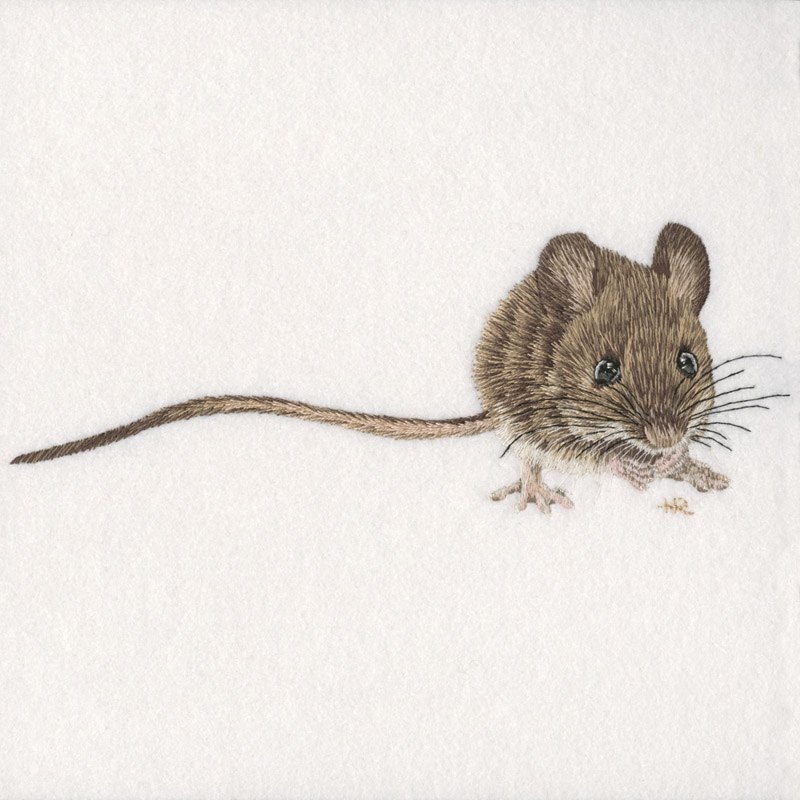
mice

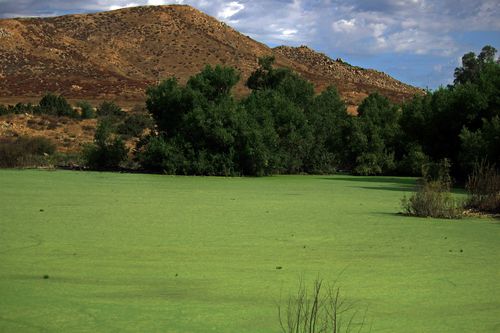
Tulare Lake, in the great San Joaquin valley of California was once the second largest freshwater lake in the United States west of Lake Superior. It was fed by the magnificent rivers, born in the great Sierra to the east that flowed west into great basin at the foot of the valley. In the spring the lake was fed with the waters of the Kings, Kaweah, Tule and Kern rivers. Before the Isabella dam on the Kern river was built in 1953 they ran freely into the depression at the foot of the valley. One of three major seasonal lakes, Tulare was a major stopping place for migrant wildlife moving north and south through the inter-coastal region of California. Buena Vista lake, to the northeast of Taft was planted in wheat and corn as the lake diminished in the spring of each year.

Located just to the southwest were the oilfield towns of Taft, Ford City, Maricopa, McKittrick, Fellows and Reward. At the eastern foot of the Elk Hills, they comprised the greatest producing oilfields on earth. Once upon a time in the mid 1920’s over 7000 wooden derricks covered the landscape from Sunset (Southeast of Maricopa), through the Midway Valley, the Elk Hills to McKittrick and Reward, a distance of approximately 21 miles in Southwest Kern County. It was indeed a veritable forest of derricks.  From the Monkey boards at the top of an oil derrick the White capped Sierra Nevada seemed to be within touching distance in those days before pollution and smog. To the south, the Tehachapi’s and rounding to the west, the Temblor range.  Three quarters of a circle, verdant green east, sere and barren to the west, they enfolded a sea of oil derricks seemingly without end in the early part of the century.

There were modern rotary and old fashioned cable tool rigs by the thousands and my grandfather Bruce Hall was there to work them. He began his drilling career working for Associated oil in Casmalia California in 1919. By 1926 he was a veteran oilman. He had moved his wife, two daughters and six year old son to Taft, following the job. Now working for Barnsdahl Oil Company, he had risen to be a driller. Rope Chokers is a derisive term used for cable tool drillers by rotary drillers in areas where the two forms of oil well drilling were in competition. Rotary drillers were called swivel necks by the cable tool drilling people. Grandpa Bruce was an expert cable tool man and ran those rigs into the fifties for Signal Oil.

The cable tool rigs were staffed by two two-man crews composed of a driller and tool dresser who worked alternating 12 hour tours (pronounced as tower in oilfield lingo). The driller ran the rig and was responsible for making hole. Tool dressers were driller’s helpers who performed various tasks to assist the driller. Bits were dressed (sharpened) by heating in a coal or gas fired forge at the rig. When a dull bit was brought to the proper temperature and was sufficiently malleable, both the driller and toolie used sledge hammers to reshape the cutting edge.

Drillers had to be multi-talented. If something on the rig broke (usually a wooden part), they were expected to fix it and not call the tool pusher (superintendent) in the middle of the night. Some drillers also performed fishing jobs for drilling tools lost in the hole. After sufficient service as a tool dresser, a good hand could be promoted to driller,  which was the highest paying job in the oil field.

Big oil companies operated all over California and since the time to drill a well varied from one to three months, employees were moved as needs required. My grandparents were married for forty two years and lived in seventy eight different houses. My dad used to say that they moved whenever grandma saw that she needed to clean house.
EPSON MFP image

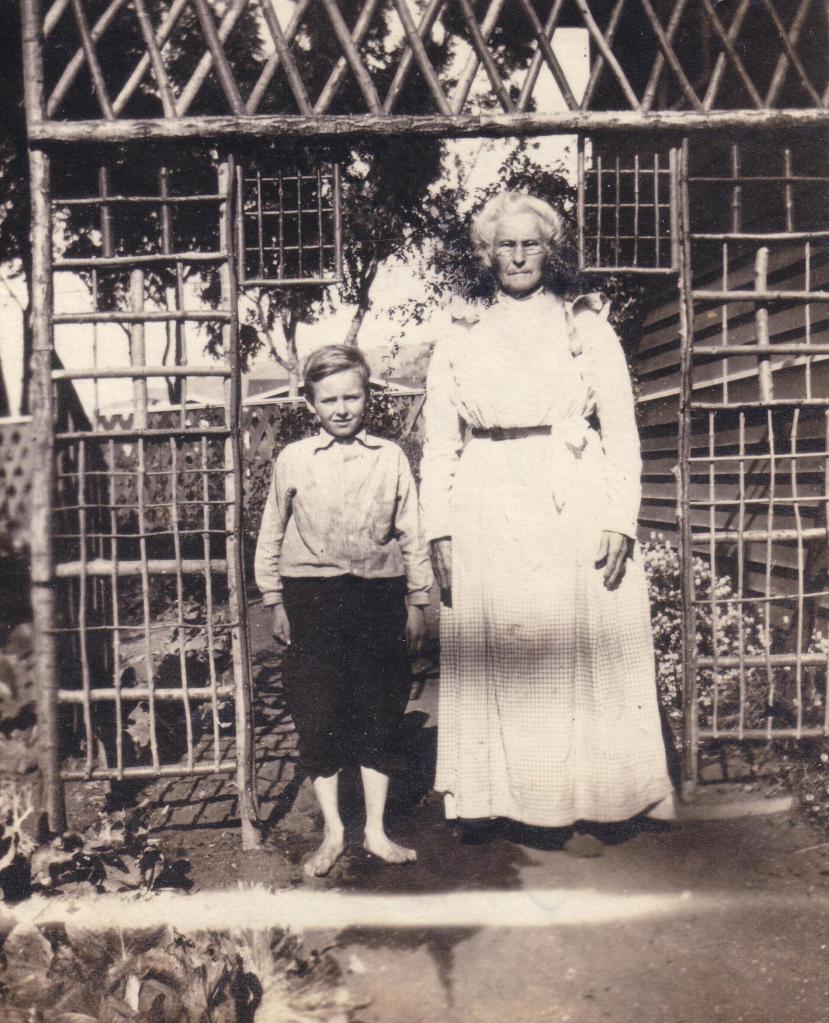
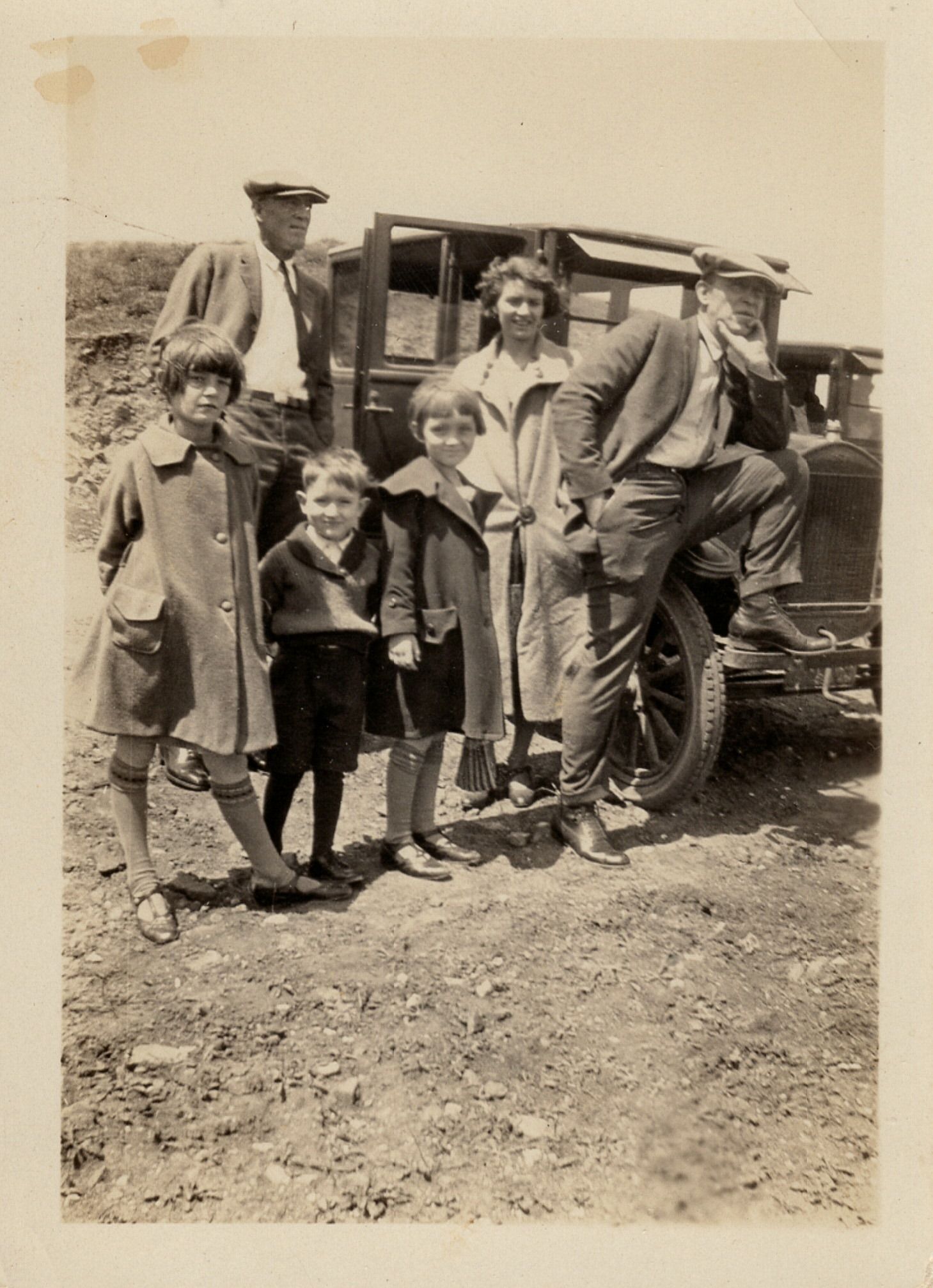
The Halls in 1927

In the fall of 1926 they moved to Taft. Grandpa Bruce immediately went to work, gone for up to 14 hours a day at the rig.  Eileen unpacked herself and the kids and made a home in the small rental house oil workers families lived in. Most were furnished with the bare necessities, a table and chairs, bed frames but not much else. The rest came with the family. You moved only what could be stuffed in or tied on the car, if you had a car, which many didn’t. You could travel by train, but you carried your luggage and that limited what you could take. There was no room for any thing else. The nature of the job didn’t allow for an accumulation of many goods, you could be moved to a new job in a matter of weeks. A moving van was not an option. People who worked the wells were well paid but the cost of housing and food was high too. Nobody was getting rich.

The houses themselves were at best temporary. Some were just Shebangs with a board floor, single wall construction to about four feet and a tent above that. Nothing was considered permanent in the oil patch. Others were of the well known “shotgun” type, arranged with the rooms on the sides and a central hall dividing them. It was said that with front and back doors open a shotgun could be fired down the middle, doing no damage.

Through the work and conditions of oil field work, oil field life and conditions tended to breed self reliance and close family ties. Oil field people, because of their often isolated camps and small towns, plus  the impermanence of their places of work formed close associations with others that frequently lasted a lifetime.

The image of the oil field worker does not carry the romantic image, of say, the cowboy and his horse. Roustabouts, the toolie, pushers, teamsters and drillers  laboring in the oil fields dirty, greasy and often dangerous conditions, required many of the same admirable characteristics of the cowboy. Work in the oil patch took nerve, physical strength, courage and toughness of mind and spirit. The wives and children needed the same qualities and they had it in spades.

Grandma and her children “made do” in those isolated communities. They knew hardship and learned to deal with the stressful conditions that came with the life. They enjoyed the simple pleasures they found and the ones they made. Grandma met the challenges of cramped housing, sickness and loneliness by having close family ties and developing lasting friendships.
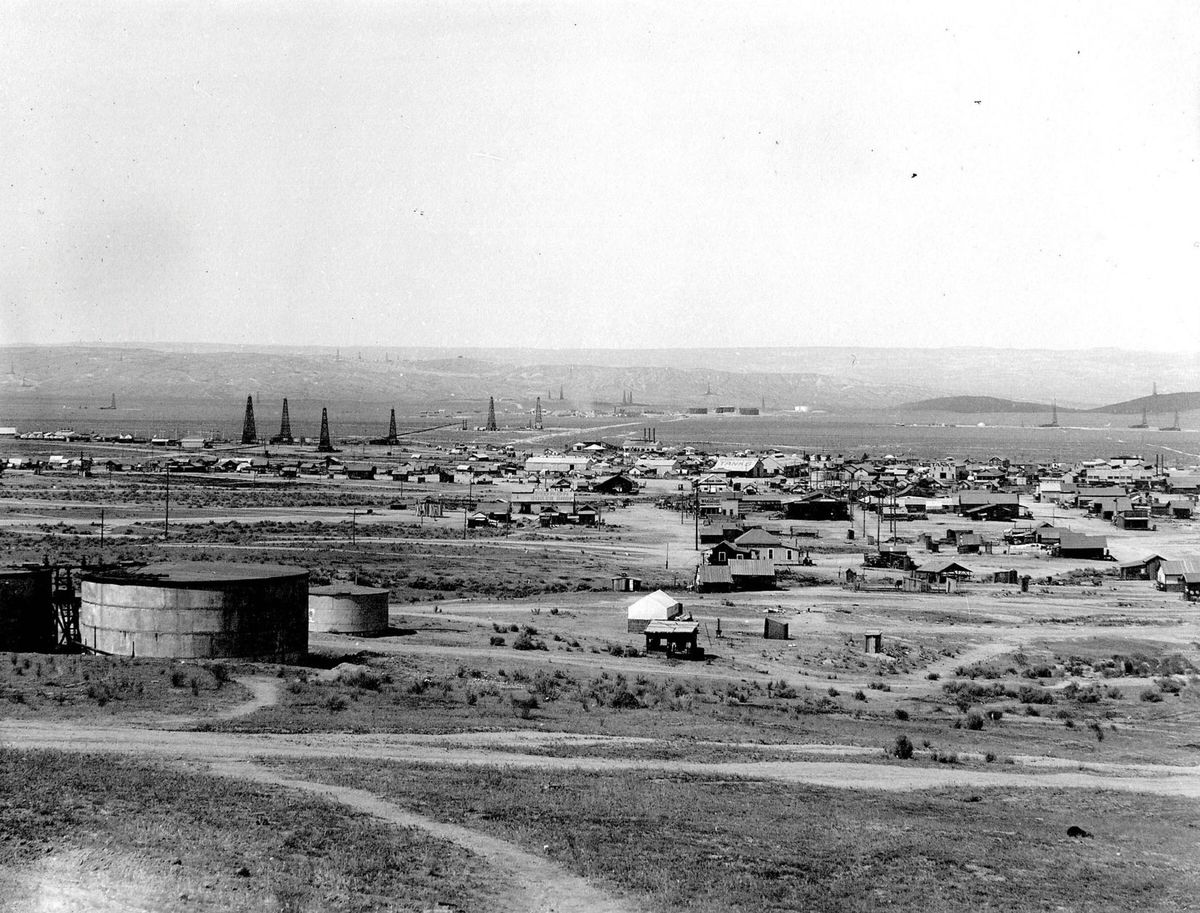
taft 1920Maricopa about 1920

Neighbors met in their homes for suppers, candy making, card playing and in the warm summer evenings in the San Joaquin, men pitched horseshoes, organized baseball games or played Croquet with the wives. My mom spoke of making and pulling taffy with her sister, playing endless games of checkers with her dad, and reading, always reading.

Today, it’s nearly impossible to imagine Grandma’s life. Even though they lived on the most productive oilfield on earth, the streets weren’t paved. Dusty in the sweltering summer heat, slippery mud in the rainy season. There was no municipal water in the midway- sunset field in the early twenties. It was hauled in on the Sunset RR Line in wooden tanks mounted  on flatcars. Water had to be carried home for cooking and washing. Two little girls and a six year old boy needed baths, clothes had to be washed by hand in a tub or sink using a washboard. Bruce’s work clothes would have been covered in oil and needed to be soaked in kerosene before washing. They were terrible chores. Until electric generating plants were built, lighting was by kerosene lantern, if you were fortunate you might have a kerosene ice box. Ironing was done, with an old Sad iron. Ironing was on the kitchen table as was practically every other household chore. The little houses were board and batt construction. Newsprint was folded and pressed between the vertical boards to help keep out the winter cold and the summer dust. Grandma hated board and batt houses with a passion, for the rest of her life. She once told me that “Those houses are only good for trash.”  At the time there wasn’t much trouble from trashy people in Taft. In the twenties they had a very active KKK which made sure of that.

In the summer of 1926, drought conditions lowered the water level of the nearby lake. The Miller and Lux cattle company used a diversion channel and a small earthen dam to further depress water level and then planted 11,000 acres barley and corn in the 30,000 acre dry, but extremely fertile lakebed.

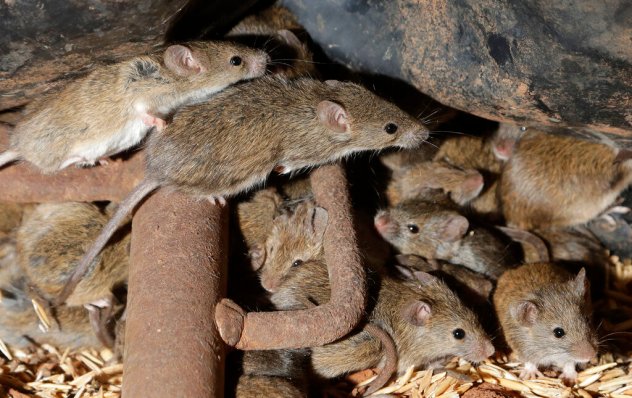
It likewise was a perfect breeding ground for the mouse. With natural enemies like the coyote, owl and hawk nearly eradicated by a new federal program that paid bounties for the killing of predators, the House Mouse ( Mus Musculus ) in the fields lived well and, with all that food, they flourished.  Did they ever. The gestation period for mice is 20 days. A single pair of mice can produce more than 16-thousand offspring in a year, so by the fall, millions of the little critters flourished at Buena Vista. Hundreds of millions.
Then, in November of 1926, it started to rain. And rain. And rain. And rain. The diversion channel and the little temporary dam failed and the water from the rivers poured into the dry lakebed.

It flooded the mice habitat. The Mouse King had a decision to make. He decided to head for the hills – the Honolulu Hills three miles to the west to be exact. They mice were wet – and very hungry. The hills had little forage, instead they had hundreds of wooden oil derricks. With all the traffic, what little grass was left after a dry fall had been flattened by truck traffic. The mice gnawed at the wooden derricks and found them wanting. They ate the fabric on truck seats, they the insulation from electric cables, the steering wheels; they ate the mens work clothes that were drying in the boiler sheds, Like a biblical plague they moved west towards Taft and Maricopa

By the tens of millions they overran the town, roads, railroad tracks; madly searching for food. The roads and RR tracks were smeared with mashed mice slime, cars went into ditches and the trains could not move. The locomotives had to use sand to get enough traction to pull the cars. The mouse horde was afraid of nothing. They came on.

Eileen and her brood prepared for battle. Every crack and seam in the house was stuffed with rags, stuffed in and as tight as she could make them. The wash tub was filled with kerosene, placed on the table and an island in the middle made with an overturned bucket so food could be protected. The bedsteads had their legs placed in buckets. They practiced swinging brooms like Babe Ruth as the horde moved relentlessly onward. Nearer and nearer they came, as inexorable as the incoming tide. The horde slowed briefly to eat a sheep in a pen on Gardner Hills Rd then entered Ford City and Taft on Dec 4th and the real battle began.

The odds were against grandma and her little army, about 20,000 for each one of them to be exact. 100,000 personal mice for your family. They came under the doors, through the windows; anyplace with a crack the size of your little fingernail. There was no escape. The grocery store, the markets, nowhere was safe. The battle went on everywhere.  The West side was literally overrun by mice, That year,  at Taft Union High School,  kids were taken out of gym classes and hauled on flatbed trucks to the Honolulu Hills northeast of Taft to dig ditches in which poison grain was strewn to attract the mice. And attract them it did,  thousands  piled down into the trenches and gobbled up the grain and died, after which the trenches were simply covered over. They chewed right through the wooden walls of storerooms to get at the food inside.

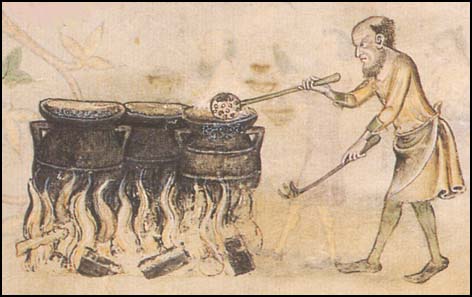
Ditches were plowed and filled with kerosene and waste oil; lit and the mice were fricasseed by the hundreds of thousands. Trainloads of poison were shipped from Los Angeles, spread and the mice weren’t slowed a bit. In the ditches there were five thousand  dead mice per foot. Little boys could get into the Taft movie theater for the price of fifteen mouse tails. Two more generations of mice were born while the invasion lasted and the numbers went up. They tried mechanical grain harvesters but the cutter blades became choked with fur, blood and flesh and looked like sausage mills. By new years 1927, the call finally went out to the Feds for help. Please.

The Bureau of Biological Survey was called in to help, and they sent their top infestation man, Stanley Piper. Piper calculated the mice population at well over 100 million. The number had grown despite the organized murder of millions of the little critters. Piper had a plan to decimate the infestation at the source, the old lake bed,  the incubator for the mouse army.

Stanley Piper set up his base camp on Pelican Island in the dry lake bed, and hired 215 men for the job. They were promptly dubbed the “Pied Piper” and the Mouse Marines. Big joke. On one acre of land they took a tally and the figures indicated the presence of 44 million mice. Tons of poison were ordered.

Piper was preparing to launch the campaign, when a kind of Biblical miracle occurred: birds suddenly arrived — every kind of airborne killer, owls, hawks, ravens, gulls and more. The old  lakebed became a giant mouse buffet.  Beset by man and his poison, by birds of prey and by a “contagious mouse disease that flared in the rodents ranks”, the mice war could be declared over. Heavy rains came that winter, the dike broke, and the once dry lake bed was once again a large lake. Another large rainstorm in mid-February 1927 drowned the remaining mice. It was suddenly over. Everything was back in balance, but for those who survived, never forgotten.

My mother thought it would never end, in fact, mouse killing had become almost normal. Finding a mouse in your school desk, put there by mean little boys didn’t happen, they were there already. Conley school was infested like every other building. Be sure and shake out your shoes in the morning, sleep with your head under the covers so they can’t eat your hair, don’t under any circumstances go barefoot. She once said that being in grandma’s army was why she had such a good tennis swing.

When I was a boy, we lived in an old farmhouse in the Arroyo Grande valley of California and , of course we had mice. They didn’t scare my mom though, she was an old hand, but a spider; well, that’s another story.

Michael Shannon is a World Citizen, Surfer, Sailor, Teacher, Builder and Story Teller. He lives in Arroyo Grande, California, USA. He writes for his children.

E-Mail: Michaelshannonstable@Gmail.com
 

Standard

LITTLE GREEN BOX

We used to visit my dad’s parents all the time. They lived on their ranch just a couple miles away from ours. We’d ride along with my dad in the pickup and while he sat in the kitchen drinking coffee with his parents his boys were free to roam around as we pleased. Farms and ranches were similar in those days, usually a collection of sheds and barns, built for utility, not beauty, most of indeterminant age and antecedent, painted or not, sharp corners or slowly collapsing in a the kind of grace some old structures seem to have. They were full of an accumulation of old farm machinery. The hay barn where the 1937 Diamond Rio flatbed truck lived between haying. She smelled of age and mice and was a wonderful place to play. I was to become very familiar with her when I turned 14 and was put to loading hay on sidehills where the truck would slowly slip, sideways, downhill as bales were bucked up onto her. The calf shed, filled with fragrant feed and grain, salt licks for the cattle which we tried, of course. A collection of old tools, staples,  square nails and spikes which which lay in hand made bins along with black widow spiders and blue belly lizards. If you walked up the dirt road to the upper pastures there was, first of all, the big gully with its rusted, abandoned trucks and cars which lay there decaying. Wooden wheel spokes rotted away, leather completely gone from the seats leaving springs where field mice made nests. Hop in and pretend your were on your way somewhere, anywhere you pleased. At the back of the ranch, the little canyon that was once the old stagecoach road but now served as the dump. There were mountains of barbed wire, folded in bow ties when the hay bales were spread for cow dinner, then discarded it in huge piles that had taken 50 years to build. Add to this generations of tinned cans, worn out and rusted to a sort of surreal brown beauty. A marvelous place to explore. At the very top, the old, dry reservoir which we used as a fort to hold off the hordes of Mongols, Indians and Hessians that continually charged the parapet. There was no corner of the ranch which was left unexplored.

When I was 9 my grandparents, Jack and Annie moved to their new home on the hill. It was the third home they had lived in during their nearly fifty years on the ranch. The first was a little house above the dairy, no water, no electricity, already old in 1918. My great grandfather built a home down below them,  along where the freeway is now. That was 1924, the same year he drowned taking his daily swim at the pier in Pismo Beach.  That house was to be Jack and Annie’s home when I was a little guy. It was nestled in a little nook below the dairy and close to the old Nipomo Road where is descends Shannon Hill towards Arroyo Grande. It is a modest little house, it still stands, by the way, variously painted red or white as farm houses used to be. It began life painted white in 1924, went without color during the depression and was red when I was a boy. Red being the go to color on farms because it is made of rust and oil and is, most importantly, cheap.

California was growing rapidly in the 1950’s and the Department of Transportation deemed it necessary to build a four lane highway through my grandparents property. It would replace the two lane, winding road that had served the coast for years with a modern and efficient mover of the new and powerful automobiles coming off the Detroit assembly lines postwar. The state bought 33 acres of the ranch including the little red house. The timing was perfect for my grandparents, who, in their late sixties were ready to retire from the dairy business. Up and above the new highway they built a brand new modern home. It was all-electric with built in appliances, insulated and easy to clean. It had a washer and a dryer and just to be safe, a clothesline in the back. They bought all new furniture, keeping just their birds eye maple bedroom set which they had purchased in 1908 when they married.

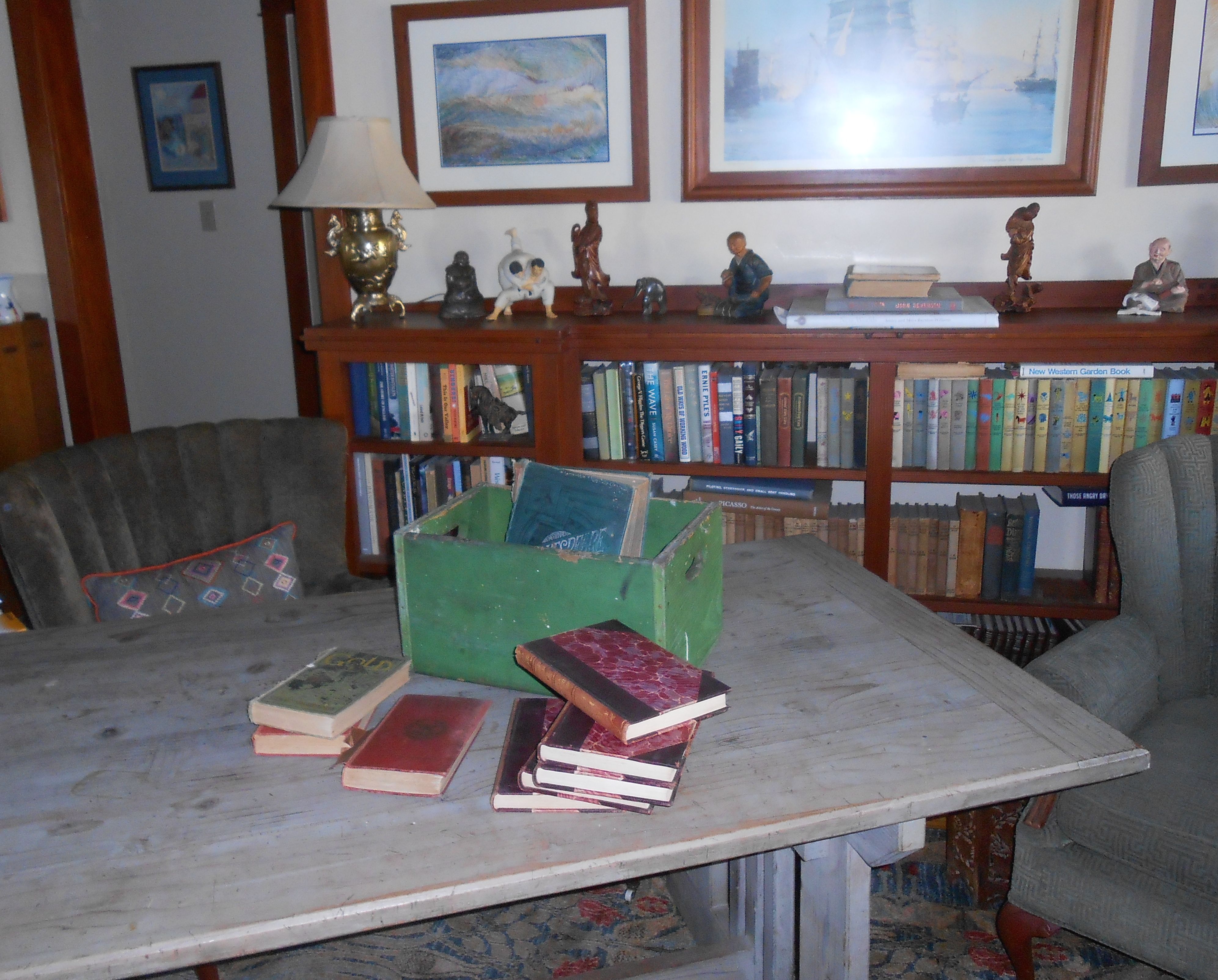
If you have ever moved you know that there is always a box or two of things which have no place in the new home but have enough value to hang on to. They end up in the attic, in the back of a closet or in the garage, stuffed back in a corner and forgotten. Such is the tale of the little green box, something I discovered while rooting around in their garage in 1955. In a corner, covered with gunny sacks and an old seed broadcaster was a wooden box, painted green and bound at the corners with metal traps nailed on for strength. To this day I have no idea of its original use, it has no labels or printing of any kind to identify it. You will note the use of the present tense here, for we still have it tucked in our garage, though its original contents have been removed, it is still in use.

In the little green box were keys. Not keys in the literal sense, by which I mean those that open, locks, but of another sort. Keys to the mind. Keys to the imagination, for it was a box of books, old books, printed long before I was born. Each had the dusty, musty smell of old and tired paper, too long put away and forgotten.

There was an 1898 collection of Shakespeare’s works, A complete collection of Stoddard’s lectures, an old ragged copy of Stewart Edward White’s “Gold,” “Frank Merriwell at Yale,” published in 1913; from 1918,”Tarzan and the Jewels of Opar,” and a very large, illustrated book called “The Boy Mechanic” which I later found out had been a gift to my father and his brother on Christmas day, 1920. The “Collected Essays of the Great Authors,” something way above the head of a ten year old boy reader, but nonetheless it flowed into the mind, fixed itself there, for life. That I understood little of what I read didn’t matter, I was snagged by the passion for print like an alcoholic is for the bottle. What I found was the common experience and solid worlds where judgement could be made and safely trod upon.  I was allowed to gaze upon distant things and places as if I knew them. Doors were opened.

I learned I didn’t need the surety of community, family and friends, but was free to explore. I was prepared to travel.

little green box

Because of these, I roomed in the same Dorm at Yale with Harry Rattleton and Frank, I climbed the cliffs and entered the forbidden valley of Opar with Lord Greystoke, and traveled to the far corners of the earth with John L. Stoddard. I crossed the Isthmus of Panama on the way to the Gold fields of California in ’48, stood in the mud of Agincourt and was thrilled by King Harry’s speech on Saint Crispian’s day. “Then will he strip his sleeve and show his scars, and say ‘These wounds I had on Crispian’s day.’  You may ride with Francisco Villa in Jack Reeds, “Insurgent Mexico,” first published in 1914.

Finding the box has allowed me to drift through time as a ghost through walls, seeing, hearing and imagining all that is put before me. The best gifts are those you do not seek.

Standard

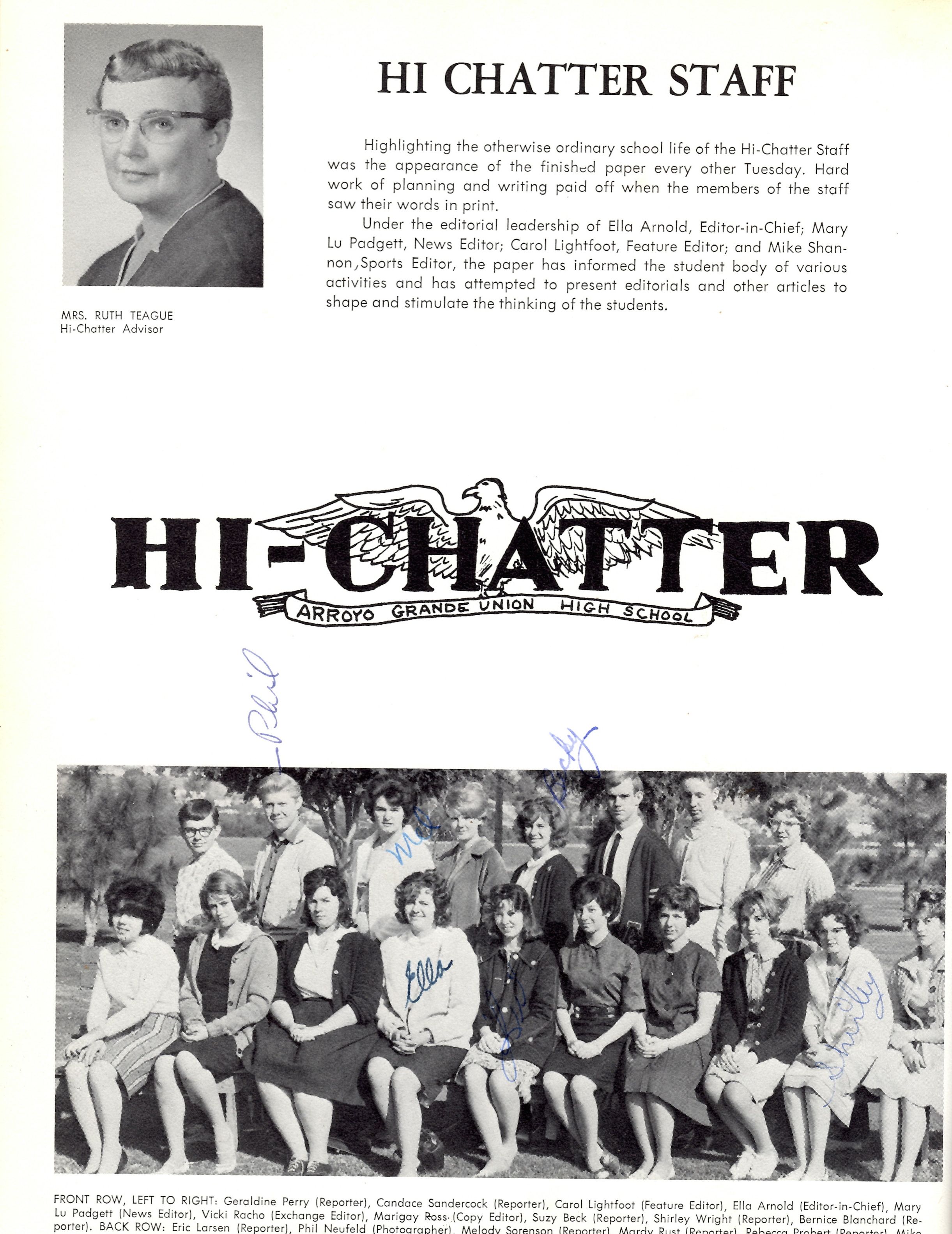
DEAR MRS TEAGUE

Writer, Michael Shannon. Arroyo Grande High School class of 1963

Thank you, wherever you are. I hope you are in a place where the very best of you go. You are certainly in my heart and my mind.

Ruth Teague was a teacher, specifically an English teacher at my high school, one of three that I had during the early 1960’s. The others were Mrs. Gladys Loomis, known as “happy bottom” in our house and Mrs. Francis, “Frankie” Campbell. “Happy bottom” was one of my dad’s little jokes as Vard and Gladys were among my parents closest friends. This was a happy circumstance for me because my mom could pull a string or two as I was chronically late with my writing. I would and did, jump from my fathers pickup and race to Mrs Loomis’s kitchen door, prop my missing report against it and race back, hoping to escape detection,  hoping to avoid any kind of embarrassment, if possible. Didn’t work though, as she would bring it up occasionally over the next fifty years. Always with a laugh though.

I had Mrs Teague three times, once for english and twice for Journalism. My most important memories of her was the journalism class. We published the school newspaper, known at the time as the Hi-Chatter. We  studied the art of communication through the written word. She taught all the usual stuff,of course, but thats not why I remember her. It was how she related to her students and particularly to me.

EPSON MFP image

As a high school kid I was just so so as an academic. A college prep guy who worked just hard enough to get by with B’s and C’s. As with most kids I was unable to see the my future  as an adult. Not uncommon, of course, but one of the most difficult things to relate to, young people who see the future as perhaps a dream of someday.  Mrs. Teague took the time to try and relate in a way I could understand, what life would be like after high school. It didn’t go exactly as planned. Ending up a high school teacher myself was not something I would have imagined.

In the 1960’s, high school was as stratified as igneous rock, very hard, divided into distinct layers and easily identified by its structure. Freshman, trying to maintain as low a profile as humanly possible, sophomores who might have their heads just above the surface of social order, juniors as the lady in waiting, and seniors, cocks of the walk. The students lived in this well ordered world but never quite gave credit to the teachers who made it so. Big man on campus Terry might by the king athlete, or Fred, the academic wonder but they had no vote. Teachers ruled. The teachers word was law and if you didn’t do what you were told you might have to go to the office to see the principle. That, was not to be contemplated with any degree of comfort.  Mr. Douglas Hitchen was the dean of boys my senior year and nothing, and I mean nothing got by him. If you saw him coming, have your pass ready or else. Don’t try to grow a mustache, it got you a trip to his office. Senior boys once packed the senior bathroom in a protest over some minor issue and Mr Hitchen just stuck his head in the door, said not a word and we immediately vacated the premises with just a whimper. Tough guys, we were.

Someone I knew chalked a bad word on Mr Wells Smiths green board and then quickly wiped it off, when the teacher walked in, saw the shadow of the four letters, and immediately knew who the culprit was and sent him away for punishment. Like I said, they were in charge. We didn’t have conversations about divers things with them. They were adults, we were not. Respect was the order of the day. Today, even if you saw him do it, you’d still need forensic evidence to prove it because the kid would just say you were lying and it would be his word against yours. Case closed.

Mrs Loomis once said to me as I contemplated an english essay, “Mr Shannon, the answers are NOT on the ceiling.” I wished they were, but I didn’t look at the ceiling again. “They are not on Miss Nelson’s knees either.” No more knees.

Their pictures in my yearbook make them look very severe, but they weren’t really. As with all great teachers they cared for their students, well, most of them anyway. I’m sure they recognized those kids with whom they were simpatico.

Those three women are the reason I can put words in the proper order, organize a thought and possibly put the comma where it belongs. Couldn’t teach me how to diagram though, that, thankfully, is a torture device that has disappeared from academics. Mrs Teague sat me down once and said that the reason I could get away with being lazy, was that I read so much that I instinctively knew what went where. She gave me two pieces of advice. The first was to make the writing personal. As a high school sportswriter and a stringer for the old Herald Recorder that wasn’t really my job, to be personal, I was just supposed to interview a player and report the scores. Pretty dull stuff. In the movie Bull Durham Crash Davis gives Ebby LaLoosh some helpful advice on how to talk to sportswriters. The advice, of course, is to only talk in cliches, something you can see on ESPN every day. Honestly, not very interesting stuff. She said, “Make a connection between the reader and the material.” I’m seventeen, I think, this might just be rocket science and I’m no scientist. She also said, “People read quietly, they don’t read aloud. You must provide them with the material to build a world in their heads.” This of course was the norm in 1963, though reading quietly, as a habit was only a couple of centuries old. She explained this by saying that in the past, the written word was, not surprisingly, meant to be read aloud, which is why readings from the King James bible sound so much better pronounced from the pulpit.

While I’m thinking this, she gives me the second bit, “Carry a notebook and use it.” I still do. Many, many notebooks. Some I have, some are lost. A museum of them, written on every available surface, loose leaf , ring, padded, perfect, spiral, comb, sewn, clasp, disc, and pressured. Written in pencil, pen, marker, sometimes a piece of writing stapled in, little drawings, cartoons or just a word. Lists of books to read or books read, even, in this modern day, discs and thumb drives; though they are not remotely as satisfying as words on paper. Incomprehensible they are to you, dear reader, but they follow me like the cloud of dust around Pig Pen.

Some entries were made for reasons I no longer remember. Some are just plain odd, such as the two small newspaper clipping from 1975 that describe the voyage of the Can Tiki. A sailing raft made of empty beer cans or “Tinnies” as the Aussies would say, which two blokes sailed from Darwin to Singapore. I might use it someday, maybe.

My english teachers stressed the importance of reading and research. Mrs Teague would say, “Put something personal in your articles. People want to know the personalities not just the score. Personality endures, score is gone tomorrow.”

Though I knew them all as an adult person; saw them occasionally over the next 40 years, it’s what they said in a few short hours in a high school classroom that still counts. I tried to remember that effect when I became a high school teacher myself. Just a little bit of personal interest in a young persons life can cast a long shadow.

30

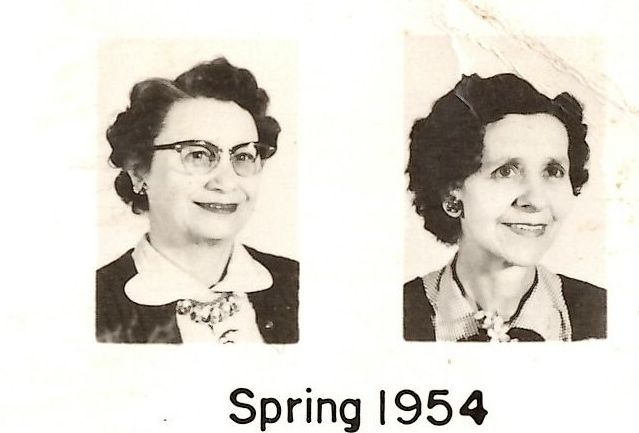
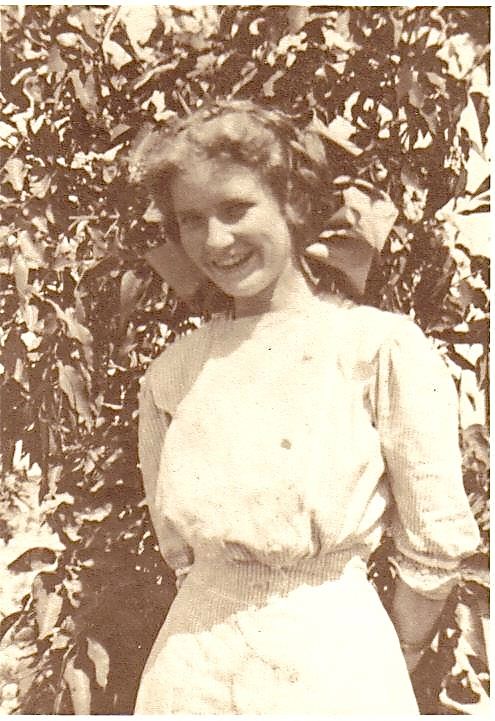
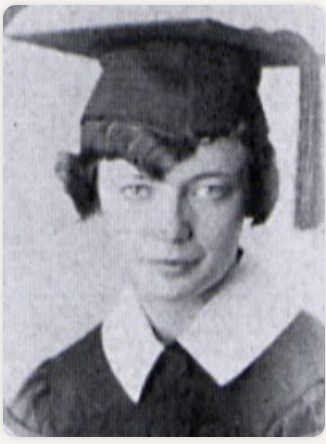
Cover Photo: Miss Ruth Williams (Teague), 1929 graduate of the Teachers College at San Jose, CA

Michael Shannon is a World Citizen, Surfer, Sailor, Teacher, Builder and Story Teller. He lives in Arroyo Grande, California, USA. He writes for his children.

E-Mail: Michaelshannonstable@Gmail.com


Standard

OLD SCHOOL.

Michael Shannon

EPSON MFP image

In the 1950’s when I was in elementary school, a child’s self-esteem was not a matter of concern. Shame was considered a spur to good behavior and accomplishment. If you flunked a test, you might be singled out, and the offending sheet of paper, splattered with red marks, was waved before the whole class as a warning to others, much the way in which ranchers hung the carcass of an offending coyote across a barbed wire fence as a warning to other coyotes.

Fear was also considered a useful tool. In those post WWII days, we were all raised by parents and a society in which was engrained the sort of discipline, not applied with a stick, but rather, the strictures one learned by the seemingly endless depression and the world wide war that followed it. Both events required strict rules that applied to almost all parts of our parent’s lives.

They had been tempered by the depression and had the scars to prove it. Many of them had grown up without enough to eat, with holes in their shoes, ragged shirts and trousers; radios, decent cars and a complete education cut short by the depression or the war. When it came, they were not soured by their experience, but rather still looked on their country as something to love, something special. They came out of this experience self reliant, not afraid of hard work and used to taking orders. They had a sense of worth and self confidence.

We were fortunate enough to be their children.

Teachers were inviolate. Their word was law, and never in my eight years at Branch, did I ever see a parent be other than polite and solicitous to a teacher. In those days, a teacher was not suspect at all, she took care of a child’s education, both academics and social. My parents considered themselves honored guests at school and under no circumstances would they take my word in a dispute. I wouldn’t have dared.  You see, there was no principle or administrator, just the teacher and she was the be all and end all for all things school.

At my school, a two-room wooden building,  far older than a half century when I went there, hard working parents provided the foundation for teachers in every sense of the word. The teachers taught and the parents supported them. Repair and maintenance of the old building was done by volunteer labor and she was kept in pretty good shape for an old girl. Better, in some cases than the homes kids came from.

Two teachers taught about 50 kids in all grades. Divided smack in the middle by a hallway, the two class rooms were entered by doors tucked in between coat hooks, trash cans and tall cabinets in which were tucked the essential tools of the teaching trade. Grade level books, spare erasers, boxes of chalk; for we still used slate black boards in those days, Rags, cleaning supplies and the detritus accumulated over eighty years of use.   Mrs Edith Brown taught first through fourth and Miss Elizabeth Holland, a spinster lady, taught fifth through eighth. Mrs Brown had just arrived a year or two before me; 1949, to be exact, after a long career teaching at the Arroyo Grande grade school on Orchard St. The home of kids we referred to as “Town Kids,” somehow sensed as inferior to us. They on the other hand referred to us as “Farmers,” Most certainly a perjorative term, usually accompanied by a sneer.

Miss Holland taught her entire career at Branch. Until almost her 35th year she taught alone. Only at the twilight of her career, was a second teacher assigned as enrollment increased school population; the beginning of the “Baby Boom,” and the closing of nearby Santa Manuela school made the classes too large for a single person.

Branch school had been moved from a previous location by the expedient of jacking it up, sliding peeled logs beneath it and hitching the entire contraption to a team of horses, then dragging it wherever you wanted it’s new home to be. In our case, a hollowed out side-hill near the old Branch Family cemetery on the original Santa Manuela Rancho in the upper Arroyo Grande.  Behind and to the right was open, oak studded pastureland, complete with the occasional Hereford. To the left, a scattering of homes, mostly small and fairly recent. Across Branch Mill road was the Ikeda brothers reservoir, a small fenced pond in which the gate was never locked. Tthe creek, was about a half mile down the hill. Across the creek lived the Cecchetti family. Gentle Elsie, big George and the legendary George “Tookie” junior. To the left, an expansive view of the lower valley, all the way to the dunes, fourteen miles away. The view explained, at least in part, why Don Francisco Branch located his home on a little hillock, less than a mile from the school. That building was long gone, having been built of adobe sometime around 1838, it had gently melted back into the earth from which it came. The site guarded by a pair of ancient pepper trees, whose seeds traveled across an ocean in a small bag carried by the Franciscan Fathers who found their way 2690 miles on foot to the site of the Mission, San Luis Obispo de Tolosa.

In the fifties we considered ourselves modern because we had a school bus. When I started school, it was a 1949 Chevrolet half-ton pickup, fitted with a brown canvas top, two wooden benches down the sides and a chain across the back where the tailgate used to be. You simply climbed up and over the bumper and perched where ever there was a seat. It had a roll down flap in the rear to protect kids from the rain. Why I don’t know, most kids had to walk from home to the bus stop no matter what the weather. Our house was about a quarter mile from the back door to the mail box where we were picked up. In the winter that driveway, if I can dignify it as such, was slimy with mud and puddles that reached little boys ankles.  I still recall the ritual of using a kitchen knife to scrape as much mud as you could from your shoes and then putting them in the oven to dry. The next morning, shoes were dry, but as stiff as an old hide and had to worked about in order to make them soft enough to wear. In case you missed the part about the kitchen knife, yes, they were the same ones we ate with. No one seemed the least concerned about that. Just a job that had to be done.

Our bus driver was Mrs Evelyn Fernamburg. She did duty as the bus driver, janitor, school board member and 4-H leader. You see, Branch was its own, independent school district. It was almost entirely a volunteer operation. The county school office  provided the budget and thats all you got. The budget came almost completely from property taxes and after the county skimmed off the lions share, schools received their allotments. School board members used  funds for improvements, teachers salaries, the bus and driver, and then did the rest of the jobs for free. They built the monkey bars, teeter totter and carousel on weekends. There was no lawn and the playing fields were simply scraped out of the hill sides. No child of the fifties will ever forget that, in order to save money on the continual painting of the old redwood siding, which was a big job, the board decided to cover it all with a brand new innovation, asbestos shingles. An off pink color, they solved the problem of repainting but, of course, they were asbestos. Didn’t seem to hurt anyone though and the school was well known for its “wonderful” color.

Behind the school were the restrooms. The term restrooms is applied loosely. Both boys and girls were in a small green shed, divided in the middle with the girls on the school side and the boys on the up hill end. Neither had a door, only a little privacy wall to prevent any immodest peeking. They both had a toilet with a wooden seat. In the fifties they had dispensed with old phone books and stacks of small squares cut from newspapers and used what my dad called window pane toilet paper, you can guess what that meant. Each room had something unique. The boys had a urinal or rather a trough for them to use. It was a galvanized thirty gallon water pressure tank cut in half lengthwise and bolted to the wall. A piece of half inch diameter pipe, drilled with a series of small holes and a gate valve at one end, completed this modern marvel. The girls had something even better; Bats. Boys, of course, knew all about bats and how the would lay their bat eggs in little girl’s hair. Mass screaming during recess would bring whichever teacher was closest, running to the bathroom with a handy broom to chase the bats away temporarily, at least. We boys took an unusual amount of pleasure in this.

One of the things that we didn’t realize until we were much older was, with only a few kids of any age, every activity from classroom study to recess and organized games required all ages, six to fourteen. All grades were together for every thing we did, be it a school play, softball or jump rope. Each game had its season, none marked on a calendar, but mysteriously appearing when the time was right. Suddenly, in the spring, marbles. The jump ropes, dormant in the old closet that served the athletic gear, brought out for the two weeks that jump rope was in vogue. In our school this was not just a sport for girls. There was no PE. Groups of kids just decided what to do on their own. There was almost no adult supervision, kids were expected to use their imaginations.  Older girls might stay in during lunch and listen to records they brought from home on the little portable record player that was kept in the closet. Oh, the wailing and crying in 1959 when the Big Bopper and Ritchie Valens were killed. Lulu, and the Judy’s were fit to be tied. A terrible tragedy when you are just 13.

I never heard a teacher or parent discuss curriculum. We were taught the basics of math, social studies, California history and we read, a lot. With perhaps 30 kids, Miss Holland supervised four grade levels all at the same time. When giving lessons to one grade level she left the others on their own. We helped each other. Books were kept for a long time not traded in for new ones every couple of years. I used a social studies book in 1956 that was used by William “Bill”  Quaresma in the 1930’s. I used a reader with the name Al Coehlo on the flyleaf. His son Al Jr was just a year behind me and used the same book as his father. History doesn’t change much, the teacher could fill in the blanks. Lest you think our teachers weren’t very good, The county schools superintendent told my father that Miss Holland was the finest teacher in the county in reply to a parent complaint. She had polio as a young woman and walked with a pronounced limp and used a crutch when she was tired. She was so very kind to all of us kids and I’ve thought through the years that those hundreds of kids she taught must have been her true family. My mom took me with her when she went to visit her on Pine St in Santa Maria a couple years after she retired and she seemed somehow diminished, as if the school was a part of her that was lost. She died in 1965, just 58 years old. In the picture at the head of this story, she is 47. She lived her whole life in that house on Pine St, she never married. We were her children.

All in all I was treated with kindness, which was often more than I deserved. My public school education has stood the test of time, which includes both the lessons my teachers instilled and the ones they never intended.

EPSON MFP image

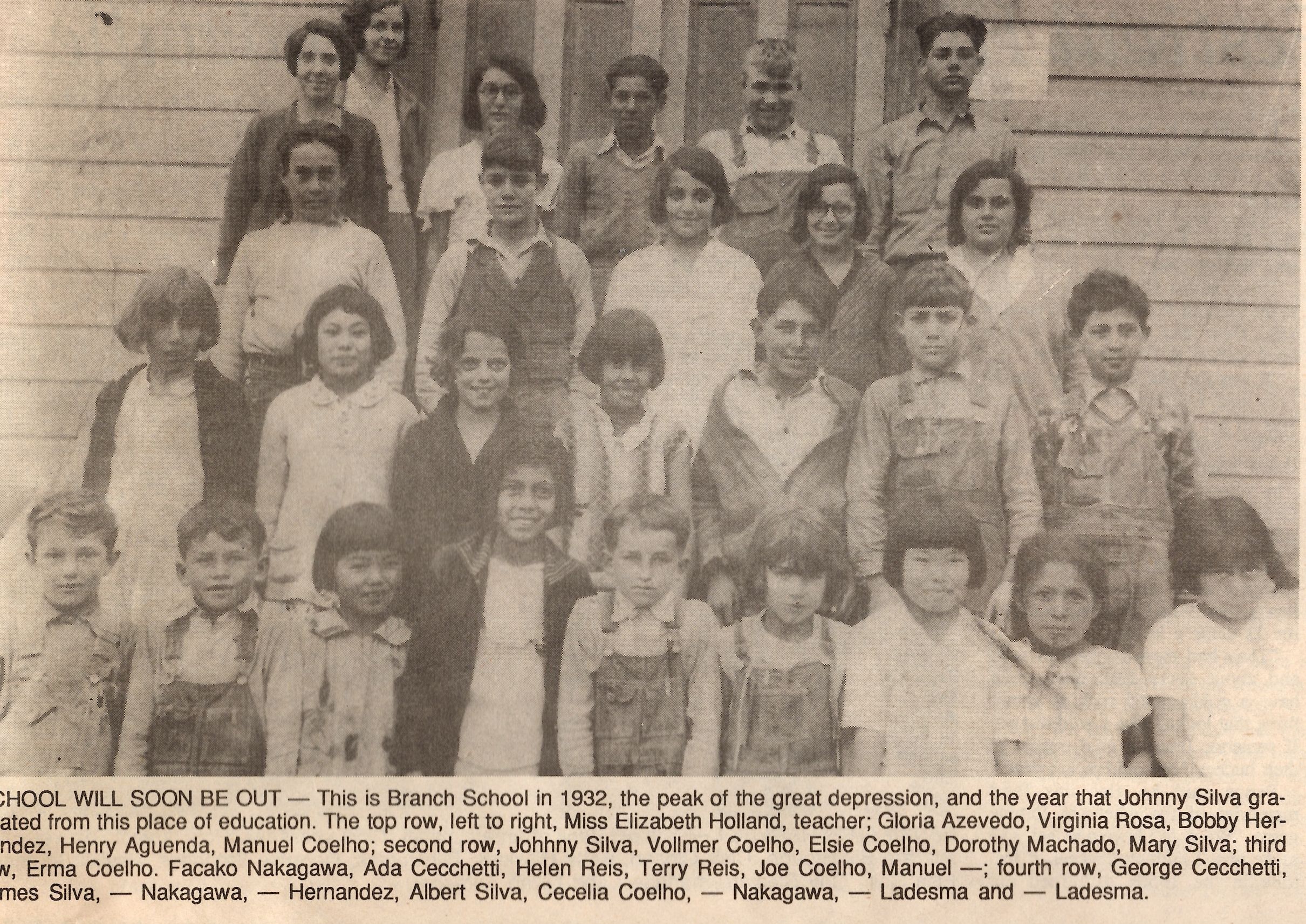
On the front steps of Branch School, 1932. I went to school with the children of many of the students pictured above. Most of these children are second generation immigrants whose families were working, renting or buying the rich farmlands of the Arroyo Grande. Mostly Portuguese from the Azores or South America whose families came to this country in the surge of immigration from the islands after the 1880’s. The Japanese families arrived about the same time, post 1880.

My own classes in the 1950’s weren’t unlike this one. We had some of the same surnames. We were Italian, Portuguese, Mexican, Irish, English, Filipino and Japanese. Quite a hodgepodge. My eighth grade class had four, the two Judys, Hubble and Gularte and the two Mikes, Murphy and Shannon.  Our teacher, the same Miss Holland.

credits: Cover photo, 1956, Back Row, l-R Dickie Gularte, Jerry Shannon, Irv “Tubby” Terra, Georgei “Tookie” Cecchetti. Front, Patsy Cavanillas, Doreen Massio and Irene Samaniago. The entire fourth grade class.

Michael Shannon is a former teacher himself and damn proud of it. I hope Miss Holland and Mrs Brown know I turned out OK.

Standard

FOR PHIL.

By Michael Shannon.

sunset draw

Being a surfer is like being in the Mafia, once you’re in you can never leave. In the 1960’s and 70’s it was the central pin around which my life revolved. I traveled to find waves, Mexico, Hawaii, Samoa, Fiji and up and down the coast of California and Mexico. Surfing populations were still small, particularly in the early days. With just a few thousand surfers along the entire Pacific coast. You rarely surfed in a crowd, and when you did; why, they were all your friends. We traveled in groups, exploring anywhere we thought we might find good waves.  Long distance travel wasn’t common just yet. What travel we did was in our cars, usually someone else’s cheap old junker that only a kid would have the nerve to drive. The front row of the parking lot at Pismo was populated with old woodies from the forties and fifties and a collection of mom and dads cast-offs. Younger surfers arrived at the beach in packs, delivered by Mrs Carnate’s station wagon or Beth Fossaceca’s Studebaker. Gary and David McDonald left their boards at dad’s optometry office on old highway one next to the A & W. Bootsie could walk out on the deck of his house to check the waves.  There were no rich kids. I don’t recall anyone thinking that way, we were all democratic, money gave you no status and neither did education or family connections. Really, only one thing counted, did you want to surf. Pecking order was established by skill. At the beginning, before Gidget, if you knew someone who had been in the water for more than a year or two, you knew an old timer.

I can’t remember when I didn’t want to be in the water. Mom would take us to the high school pool in the summer when we were young and I never wanted to leave, When we were older she took us to the beach where she would rent those inflatable mats for us to play on, you remember, yellow on one side blue on the other. Wade out as deep as you could and then ride the whitewater. What a thrill for a 12 year old. When I entered high school surf culture was just beginning. Jon Macom, Ralph Miller, Larry Hill, Sehon Powers and John Steele made up a group who had been surfing for a bit in 1961 when I started shortly after my 16th birthday. They were one of a very small group of kids who hung out at the beach and rode surfboards. For some reason I was desperate to try it so I bought a used Velzy surfboard for twenty five dollars from Sheriff Mansfield’s son, loaded it in my car, and with my friends Andy Harp and Mike Senuik, went to the beach after school, ran down a stairway known as the thousand steps. actually less than a hundred, truth be told, and paddled out into the coldest, windiest and absolutely miserable surf you could imagine. A blustery winter afternoon. We really didn’t know what we were doing, we didn’t surf an actual wave but we did get pushed around by the whitewater and even managed to stand up; briefly. So cold and miserable, wretched conditions, but I loved it and never looked back.

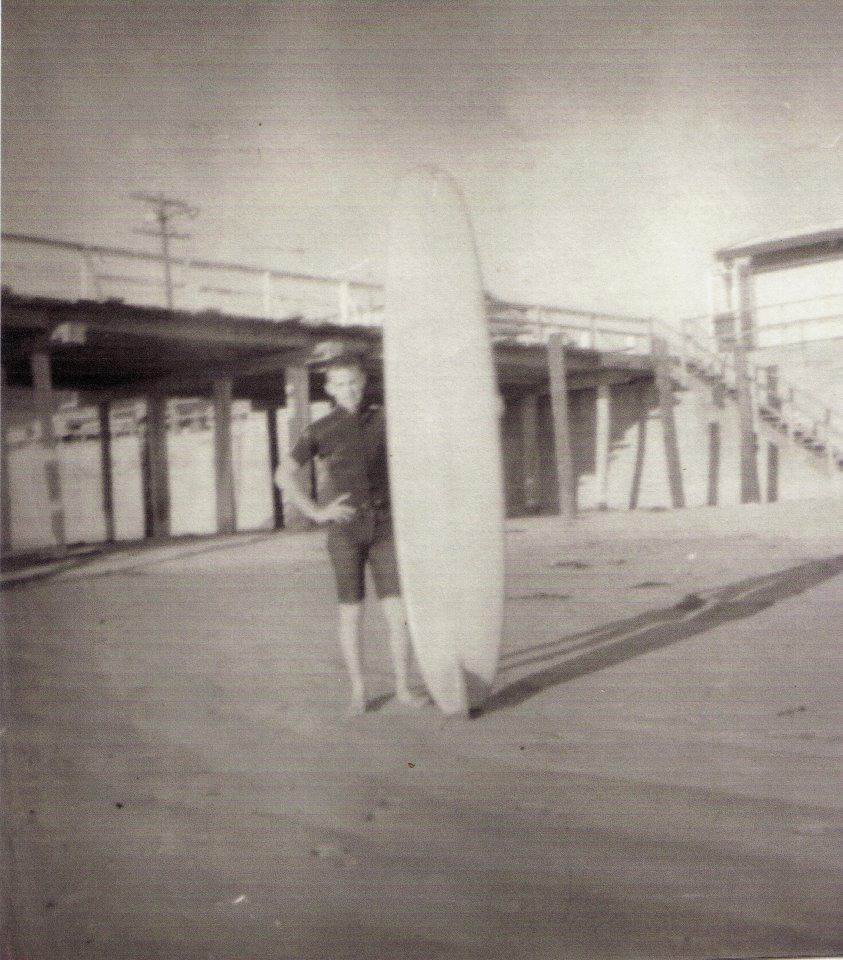
pismo 191961

Pismo Beach 1961

That sort of existential excitement fades with time and responsibility. The standard of wave type grows narrow with experience, which is kind of sad. Maybe it’s not big enough, glassy enough or the water is too cold in March so the veteran may go home. The other day though, I sat in the Addie Street parking lot and watched as an old orange Datsun, that had seen much better days wheel into the lot and before it could come to a stop, boys were piling out, hopping around on one foot trying to pull their wetsuits on, frantic to get in the water. It resembled a circus clown car act. Yanking surfboards of the roof they jumped the seawall and ran into the surf. It was freezing cold, onshore and the waves were small, but they were stoked to the gills. That__is__surfing. Fundamental, visceral, the best. If those kids ever stop feeling that way, they are done.

My timing was perfect. The following spring, 1962, the Beach Boys released their first record and the sport became a nationwide phenomenon.  If you surfed you were suddenly “Cool,” even if you weren’t. Funny. My high school was still full of guys with Ducktails and Flattops.

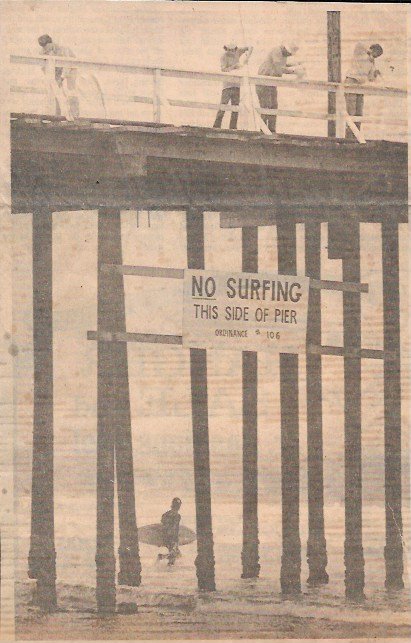
no surfing sign 1964

As with all  surf spots, there were the locals. Kids you saw on a daily basis, checking out the waves and deciding if it was good enough to surf now, or maybe later, was it better at Saint Andrews, maybe Oceano, if the tide was out; perhaps a run down to Refugio or El Capitan. As boys will do, we would spontaneously take off for some distant place without giving it a thought. Who has a little gas money? Anyone who did could go. Maybe for the day to “C” Street in Ventura where the dirt parking lot right at the edge of the water had  some old telephone poles to keep the your front wheels from running over the edge and into the water. Or maybe the Rincon, the best surf in California, where you had to park right on the edge of the freeway, opening the drivers side door carefully so it wouldn’t be removed by cars and trucks whipping by, staggering the car with their blast of air and flipping a surfboard or two over the guardrail to the rocks below. We lived on hope, Twinkies and chocolate milk.

Nobody locked their cars. I didn’t seem necessary, there was little to steal. Except towels, yes towels. John Steele was the master towel thief, the back of his woodie was the home of a smelly pile, taken from anyone who was reckless enough to leave theirs on the hood of the car or hung on the handrail to dry. Johnny’s car was saturated with the odor of slowly moldering, still wet terrycloth, warm with decay at the bottom, not unlike the nuclear pile at the lab in Los Alamos. You could have extracted Penicillin from it. Jealously guarded, towels helped to stave of the bone chilling cold before wetsuits. Seawater at Pismo dips into the high 40’s in the winter. Walking with Harry Hoover down to the water, frozen sand crackling under our feet, Knee paddling out to the lineup using only our fingertips, anything to stay out of the water as long as possible. So awfully cold. In the font seat, motor idling, those old heaters going full blast trying to warm feet and hands which were literally purple with cold. Going to the Seaview for a cup of coffee after, eat a donut from the plastic case on the counter. All better now, right? A small price to pay for a wave.

pb (4)

In 1964 I made my first trip to Hawai’i, going home to Kailua on O’ahu with a college friend and spending the summer at Waikiki Beach. Richard got a job at McWayne Marine, owned by the then state Senator Hiram Fong and I worked part time for Nathan Napoleon at the Halikulani Hotel beach services in Waikiki. The two of us tooled around in a 1959 bug eye Sprite, which, if loaded with Nathan’s son Nihi hiding in the trunk, would agonizingly  make its way up the grade to and from the Tavares house in Kailua town, which was on the opposite side of the mountains from Honolulu. The old Pali road was a two lane switchback then, unlike the bustling freeway of today.

The  Hawaia’n families who ran the beach services at the hotels there were very old fashioned, get your hair cut short every week by the Japanese girl barber in the basement of the Reef hotel or else. This was my introduction to the scissor cut, dressed with a straight razor, so unlike the old barbers in Arroyo Grande, Kelly and Buzz, who hacked away with electric trimmers, in Buzz’s case, I’ m sure he used the same ones to trim the bushes at his house on West Branch Street.

Mr Napoleon, always mister, never Nathan, was a big man and a former California Highway Patrolman who had returned to the islands to take over his fathers business. The families that worked the beach had done so for generations and do to this day. I became a friend to his son and was welcomed into their home and a life I had never seen  in Arroyo Grande. I never saw a potato on that table, only rice . This was something entirely new. My only real experience with rice was Uncle Ben’s, hardly the sine qua non of the rice world. This spelled, then, the end of my meat and potatoes world. There were hundreds of ways to prepare fish, fruits that were so good they make your mouth water and they grew everywhere, bananas, passion fruit, papaya and mango ripe for the picking on every street corner. There is a saying in Polynesia that they had to invent war so they would have something to do besides sit around and eat. They weren’t far wrong. At my house you could step out on the front porch and pick fresh Papaya for breakfast. In the rear, banana trees. I once lived in a house in Makiki that had three Mango trees. There was so much fruit we had to haul it away in 30 gallon trash cans. We could not eat them fast enough.


EPSON MFP image

Makiki, Oahu. 1967, The $100.00 Pepsi surf car.

On Waikiki, each day you put out the folding chairs, umbrellas, got the surfboards out of the lockers, put the paddle’s in the Koa wood outrigger canoes and helped pull the big Woody Brown sailing catamaran up on the sand to ready the day for the guests who would soon arrive. For me, the best part was an introduction to local culture and the people who made it so interesting. In the 60’s Hawaii was a segregated society. Whites ran the banks, big plantations, and shipping companies. The Japanese were state legislators, medium sized business and the labor unions. The Chinese were spread across most areas as they were the first immigrants to be brought to the islands in the 1840’s. The native Hawaiian’s worked labor jobs and were the police. Like many cities and states you could travel from one ethnic enclave to another where customs were as different as night and day. Growing up in Arroyo Grande in the fifties and sixties I never gave much thought to that kind of thing. Our little town was so small and the schools I attended so homogenous that it never occurred to me other kids where any different than me. I surfed with Filipino, Japanese, and Black kids every day at Pismo. On the islands it was Hawaiian, Filipino, Japanese, Peruvians, Aussies, Brazilians, and South Africans, all these distinct cultures to learn about.

Surfing itself had little time for ethnic or national division then, there just weren’t enough surfers to make any place too crowded. Besides, I have always been fascinated by people who were unlike me.

In 1968, when I moved to the islands permanently, I left all my old surfing buddies behind. Five years after high school they were married or in college, following a career and the surf life gradually left behind, in most cases, for good.

For many years I lived a life most of them could only imagine. I had a house near Haleiwa on the North Shore of O’ahu at that time the destination surf mecca for the entire surfing world. Home of Sunset Beach, Wiamea Bay, The Banzai pipeline and other equally near perfect wave sites. There were few fall, winter and spring day where perfect warm water waves could not be found. I was a AFL/CIO union carpenter, made a good living and had a reasonable amount of time off in the winter. It rains a lot, so lots of days off.

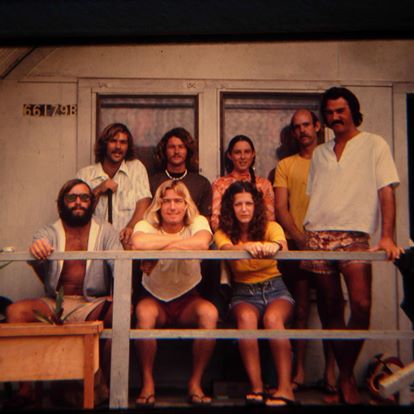
achiu lane

Leaving in the dark for work made it difficult to know what the surf was like. You could hear it from my house and the number of decibels or the amount of ground shake gave you some idea of its size but the work day had to pass before you really knew. A sight never to be forgotten is the view out the windshield as you top the high saddle just north of the little town of Wahiawa and look down on Haleiwa bay, seeing the surf conditions for the first time that day. Excitement or disappointment being your lot. If it looked good it was just four miles downhill to my house, grab your trunks and a surfboard or two, it was necessary to have more than one to suit the

66179B Achiu Lane, Haleiwa.

many conditions you could encounter on your drive along the coast. Turn left from Achiu Lane onto Kam highway then drive through Haleiwa, past the IGA store, Country Surfboards, Matsumoto store where they had good Hawaiian style shave ice and could make you a custom shirt or pair of trunks, cross the old bridge over Anahulu Stream and then along Kamehameha Highway past the old Army Air Corps airfield past Jocko’s, Chun’s reef and Laniakea up to and around Wiamea Bay, turn off on Ke Nui drive, a dirt road actually, then a quick stop at the public access by John Steele’s house to check out the Pipe, Backdoor, Off the Walls and Log Cabins, maybe another drive to Stefan Schweitzer’s place to check Pupukea and Gas Chambers, then to Rocky Point and finally the bay at Sunset. I surfed them all. Not bad for a boy from cold, foggy beach break Pismo Beach I thought.

I recall paddling around the lineup at Sunset or Pipe thinking about the friends I had who had dropped out of surfing and wishing I might surf with them again. We had some good times in the water as teenagers. The camaraderie of a shared delight. Surfing is not a team sport. My high school coaches looked down on surfing as something that losers did. Regimentation is for football or baseball. It allows for the shared experience, but none of the, ” Do this, do that” of team sports. As kids our entire social experience in the surf world was what we did together by choice.

johnsteele pupukea

John Steele, Pupukea.

Besides the surf conditions  which had the effect of neutralizing the social aspect of being in the water together, surfing in Hawaii requires that you paddle constantly to stay in the spot that you must take-off from. There are currents everywhere resulting from the vast amounts of water moving around the surf itself. The area where the best location for catching a wave is pretty small and the currents push you around so you must work to maintain your position. Constantly looking towards the beach and watching the relative positions of houses on the shore in order to “line up” the proper spot to be in. You must keep one eye on the other surfers around you in order to judge their skill level, their familiarity with the surf spot, and aggressiveness, plotting the pecking order so you can be in the perfect spot. If you can lay a psych job on someone, all the better.

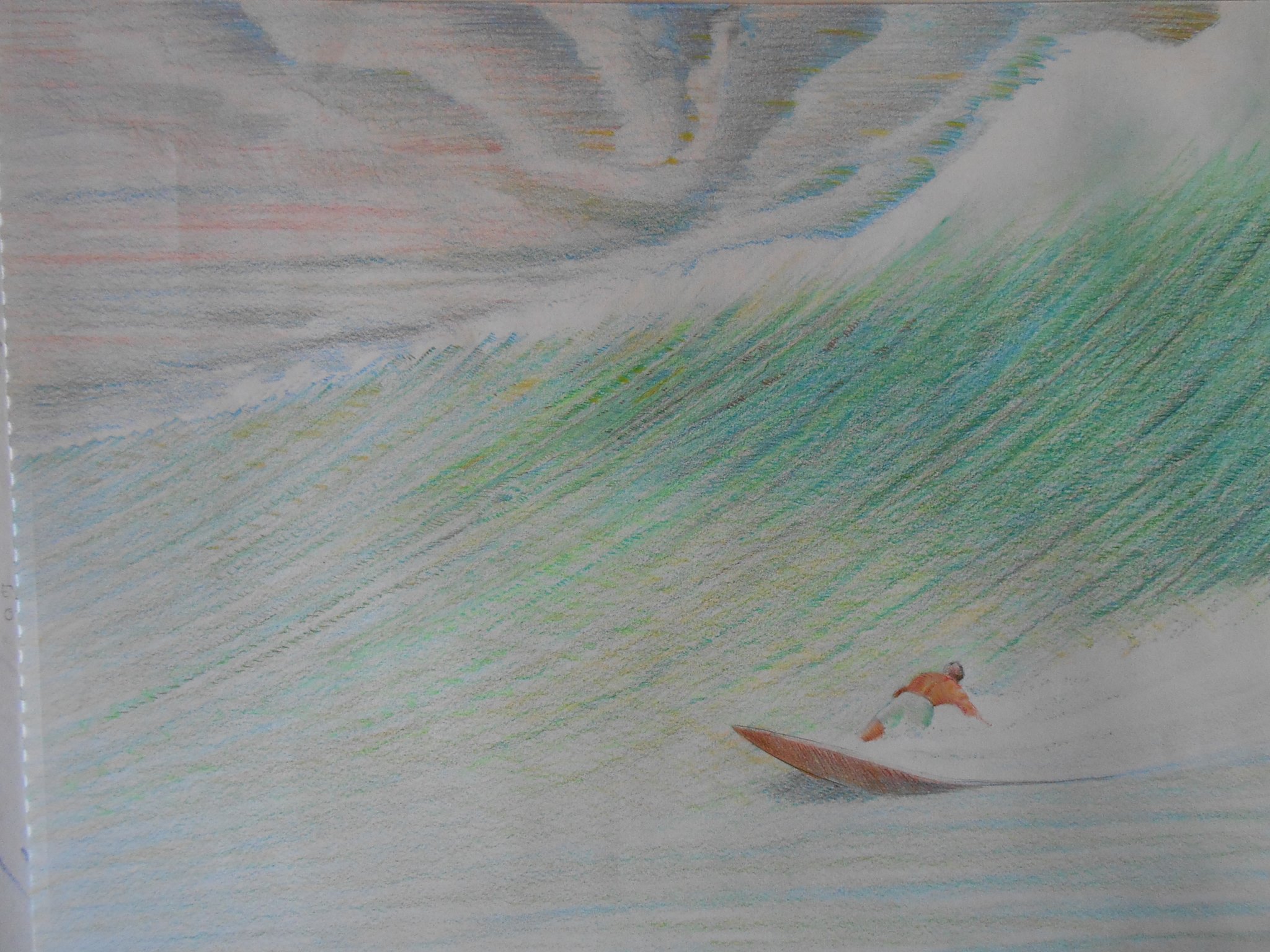
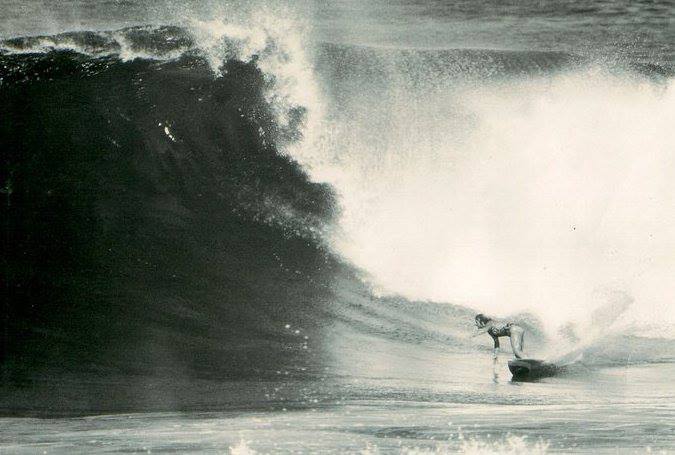
There is no thrill like being in the perfect spot for a takeoff at big Sunset, paddling hard, using all your skill to force your board to go fast enough to begin the free falling slide down the face of the massive wall of water. Once moving you can  hear the first sharp hiss of water against fiberglass as the board picks up speed and begins the run down the moving face of the water that can only be likened to a living thing. Sliding swiftly to the bottom and pulling a turn much like a fighter pilot does in a High G turn. Turning at the bottom, using the energy of the wave to fly up the face, and then the near weightlesness  as, near the top of the wave, you  snap the turn downward again. dropping to near vertical, heading down again, looking ahead, trying to gauge the exact moment to begin the run towards the end of the wave. There is no perceived sound, in the midst of all the movement and crashing of the wave behind you, you move in a bubble of silence. At Sunset, the last section of a good wave hooks back towards you as you approach and the timing needed to fly through the tunnel formed by thousands of tons of moving water arching up and over your head can only be learned by not making it out, smashed, tumbled and crushed by the self destruction every wave, ever, goes through. Adrenaline is addictive.

These swells are formed by winter storms in the Bering sea, three thousand miles northwest of Hawai’i. They are deep ridges of energy, each traveling as an underwater pulse, barely noticeable in the open ocean, just a ripple at the surface. An invisible wave, traveling over the north Pacific abyssal plain which averages over 14,000 feet deep. As this wave of energy approaches the Hawaiian Emperor Seamount, whose exposed mountainous tip form the Hawaiian Islands, the lower edge of the energy wave begins to drag along the shelving bottom of the sea forcing the excess energy to rise from the surface and form visible swells. What is unique about the North Shore of O’ahu is this shelving bottom rises very quickly, nearly four thousand feet in just a few miles. This forces the enormous amount of energy in a pressure wave straight up, as the drag on the bottom is so minimal that the wave can’t slow down but must rise. The water just offshore from the Banzai pipeline and Sunset beach is more than a thousand feet deep. These particular conditions are what creates such massive waves. The prevailing wind blows straight from the shore, perpendicular to the surf causing the wave to stand up longer making for nearly perfect surf conditions.

The term waterman wasn’t in common use in those days but we all certainly fit the bill. We dove the deep water off of south point on the big island. I could cast a throw net, a beautiful thing, hand made of the finest line used to catch reef fish in the early mornings and evenings when the sun was off the water. We sailed. We sailed the islands for no other reason than to see what was over the horizon. Polynesia invites you in. The ancient Hawaiians were a water culture and it always seemed strange to me that people who lived there worked in high rise buildings and wore suits to work.

sailors

You had to be a strong swimmer because in the 1960’s and 70’s no one wore a leg rope in large waves. A wipeout meant a swim to the beach to retrieve your board. The more chances you took, the more you swam and it wasn’t just the swim itself, no, you had to stay in the whitewater to get to the shore. Crashing in a wave can be rough enough but the act of getting to shore can be just as perilous. White water, or the broken wave itself can be many feet deep, a churning, spinning whirlpool where, as it goes over you, can pick you up and completely disorient you. It goes dark, the water over your head is suddenly not a foot deep, but ten or fifteen feet deep, increasing the pressure in your ears to painful levels. Your arms and legs are yanked and pulled away from your body, you can be not only held under for minutes but sometimes held against the coral bottom, unable to move because of the water pressure as it rolls over you. When you surface, if you’ve been down long enough the next wave is likely to be breaking right on top of you.  Luckily each wave that passes over, pushes you in towards the beach. A small section of a wave of these dimensions weighs hundreds or thousands tons and. its all moving adding to the dynamic. Add that the wave itself is rushing at 15 to 20 miles and hour toward shore and you, the surfer can be moving as fast as 30 mph. So, moving in at least three different directions at once you must know your business. The good part  is that the better you get the less likely you will have to experience the long swim in. The question has always been, are you strong enough, can you hold your breath long enough, can you swim, are you loose enough. As a friend was wont to say, “Don’t______Be______Afraid.”

On the other hand, the water is warm, low eighties in the winter during surf season. The offshore breeze is always balmy and fresh. Friends with a common interests are all around you. Nobody I ever knew talked like Jeff Spicoli or Ted Logan. That part of surfing is a commercial construct. Avoid it all costs.

Lest you think that it’s too dangerous don’t forget that women do it.There weren’t many women surfers in the late sixties and early seventies but they were about to break out in a big way.  My friend Sally Prange started surfing big Sunset in the seventies and went on to be one of the best women surfers in the world. I’ve always admired her for that. Not easy in the face of a male dominated sport filled with aggressive, ego driven men. Part of the social fabric of the north shore, she practically grew up in the water. You are surrounded by it. It would be hard to avoid.
sally sunsetSally Prange, Sunset Beach.

What I have learned is to become a citizen of the places you travel. Meet the local people, eat the local food, speak the language, immerse yourself in the culture and you will find that people everywhere have the same cares and needs. There are museums and libraries full of books on any place you might live. Nothing will seem strange if you do your homework. Eat Poi, the two fingered kind for me, Lomilomi Salmon, Swordfish Sashimi, pit cooked pork, pipi kaula, Portuguese sweetbread, malasala, and the semi-official state food, Spam. Spam, a million ways to cook it, one for each culture. I’ve lived with Egyptian Muslims, Samoan Catholics, Fijian Hindus, Japanese Buddhists, and Jehovah’s Witnesses and I’ve found that the basic tenants of each religion are faith and caring. We all got along just fine. It’s not necessary to make someone over into your own image.

My mom and dad at that kitchen table where I grew up never seemed to, nor want to understand what I did. It might have been the Lassiez Faire way we were raised. They seemed content to let us find our own way and didn’t plant many road blocks. Maybe that was all in my own mind, my dad wasn’t emotional, at least not visibly. There are only one or two times when I saw him shaken by an event. I don’t think my father ever asked me one question about surfing or traveling and I always felt he was disappointed in my choices. He always said that you “could live your life in San Luis County and never see all there is to see.” He once asked me, “what is it that you do over there?” But he wasn’t really interested in an answer. A determined child is difficult to sway. Remember the Norman Rockwell painting “Breaking Home Ties?” The boy, with his chin up looks to the future and the father, leaning, his elbows on his knees, looks the opposite direction, into the past. It’s my favorite Rockwell. It perfectly illustrates the severing of  home ties and the infinite promise of the young.

The prevailing wisdom then was that surfers had no ambition. They lived day to day, not caring about tomorrow. They let their hair grow, they didn’t wear shoes, they in dressed funny, clothes  from thrift stores for goodness sakes. Look at the cars they drove, junkers and hand me downs. The local paper even published an article with a list of words or phrases used by surfers. It explained each one in all seriousness. The problem was, they all came from Hollywood movies, made up by screenwriters and were almost never used by people I knew. It would have been embarrassing for us.

We were, and are, real people, just like you. We had jobs. My neighbors in Haleiwa were professionals, a nurse, a stockbroker, an eventual university professor. On one side a anti-war activist, on the other, a Vietnam veteran brought together by a common bond. Writers, photographers, surfboard builders; roofers, architects, international dealers in Persian rugs, airline stewards and engineers. The principle of Sunset Beach Elementary school surfed. I have a friend who is an internationally renowned marine geologist. We were all young and living in that wonderful place. Our bond was the water.

Sometimes living that life was almost too wonderful to believe and I wished I could share it with those whom I started out with in foggy, cold and flat Pismo Beach. Surfers would just pull up to the beach and sit, drinking it all in. The soft Hawaiian breeze, The sparkling sand with the keiki frolicking in the shore break where a tourist from Iowa might drown, the endless sky peppered with towering cumulonimbus clouds drifting down from the Koolaus, the brah’s, doing the same as you. Because of those, as I waited and watched  the approaching walls of water, pushing themselves high and higher as the rushed  towards me, I would say to myself, this one is for you Terry, you Andy, and for you Phil. All yours baby.

Clockwise from upper left: John Steele, Pupukea.  Mike Shannon, Sunset. Mike Shannon Sunset, Jock, Sunset, Vance Akinaka, Honolua. 

Thousands of surfers have explored every corner of any ocean or sea where there might be waves. We’ve trekked into the farthest reaches. It’s not a life anyone would forget. Yes, there are famous professional surfers and those that have made millions by advertising and exploiting the business but the world of surf is still and will always belong to the the not-famous who did it for the adventure. 

terry bailey tuitila

Terry Bailey, a Pismo Beach boy lost in the far reaches of the south Pacific. Tuitila, Western Samoa.

phil harwick

Dedicated to Phil Harwick, Lifelong friend, surfer all around good guy, Rest in Peace Brother. 

Read William Finnegan’s “Barbarian Days, a surfing life”  It’s a great book. Published by     Penguin Press, N.Y. 2015

…And Susan Casey’s “The Wave” Doubleday, N.Y. 2010

Michael Shannon is a writer and lifelong surfer. 

Standard

A BOY DREAMS OF PIRATES.


little pirates

Yaaaahr, we be pirates mate and we’uns be seekin’ treasure and a flagon of grog to wet our’n whistle. We’uns come off the brig Nancy’s Revenge, Cap’n Flint commanding’ Sor, and’r looking to spend our share of the loot from divers ships we’ve took on the Spanish Main.

Such are the dreams of boys. My grandfather, my uncle Jack and my dad told us stories of pirates gold and the places where it resided here in the Arroyo Grande. Stolen from Spanish Galleons on the run from Manila to Acapulco, the west coast port where it was to be shipped overland to Monterey, Mexico and on to Spain to fill King Phillips coffers. Gold pieces of eight, bars of silver and precious jewels by the handful, stashed in the caves of Mt. Picacho. Protected by the skeletons of the pirate rogues who buried it there. Dead men tell no tales mate. Beware the Black Spot.

When we were little boys, my uncle Jackie took us to this mysterious place on the southwest side of the distinctive hill known as Picacho. Clambering down the side of the hill, he led us to the dimly perceived opening of the pirate cave hidden below an overhang of ancient rock. A very small cave it was, you having to be just boy size in order to crawl back into it. Along the walls and ceiling were names of intrepid explorers who had visited it before us. Carved with jack knives were the names and dates of boys going back long before my father and grandfathers time, each one searching for the long lost treasure of Francis Drake and Hippolyte Bouchard, or perhaps the gold and silver deposited there when the padres were forced to abandon the missions in 1833. Delicious tales to enliven a little boys imagination. Tell me a story Daddy, like you said you would.

Raised on Frank Merriwell, Edgar Rice Burroughs and the Hardy Boys, it was no stretch to begin reading adult adventure novels, “The Captain from Castile,” and in the eighth grade discovering on my mothers bookshelf, a book borrowed from Gladys Loomis, “Beat to Quarters,” a Horatio Hornblower story. Then, Joseph Conrad and I was hooked on the sea.

As a lifelong surfer and seaman, I’ve learned many lessons about sea keeping, having been a merchant mariner and long distance sailor. Sad to say the experience has taught me that there never were any pirates hiding treasure along our California coast. Dreams of little boys are mostly dashed by the practicalities of life.

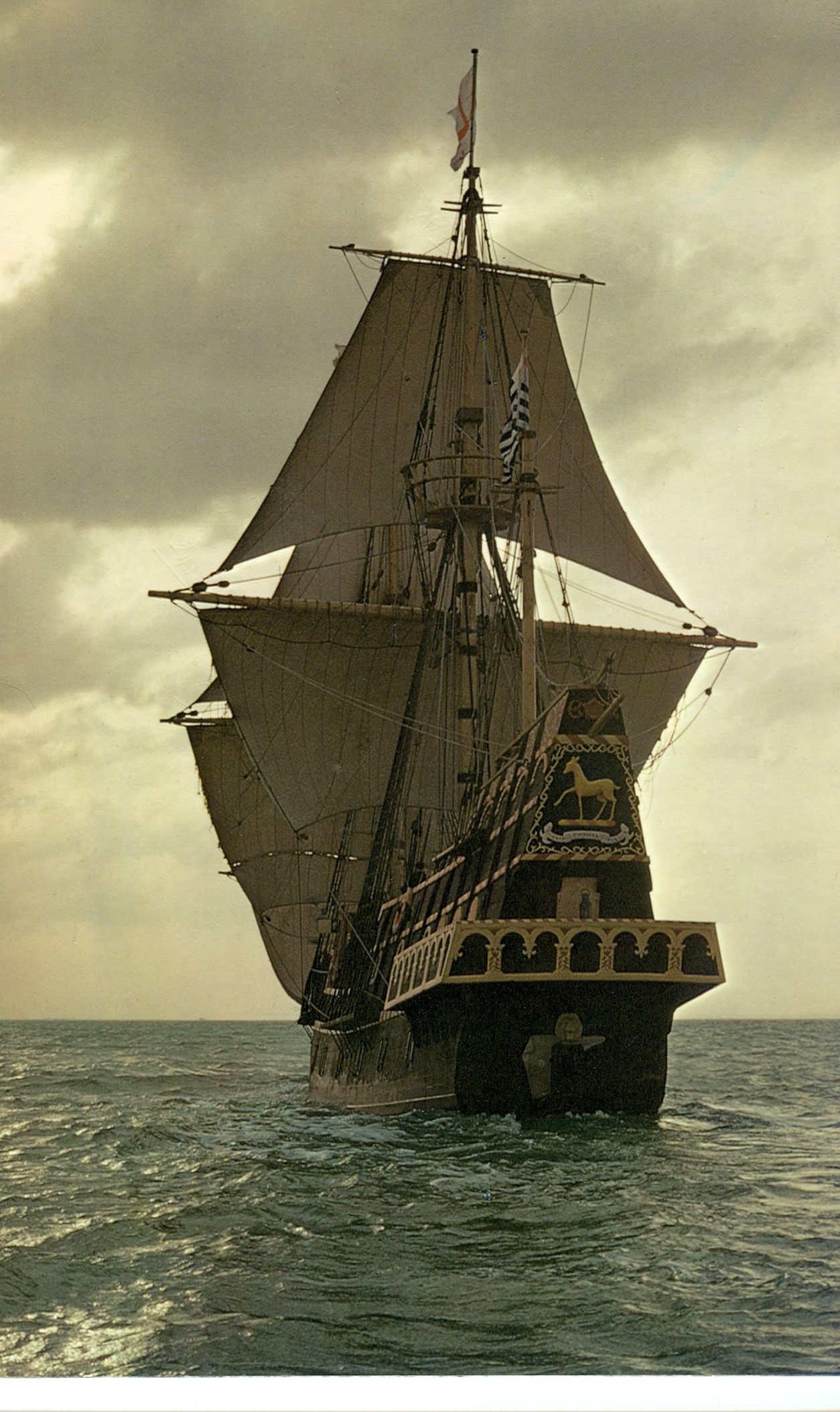
drake golden hinde

Golden Hinde, Length, 102′-Beam, 20′-Draught, 9′-Speed, 8 knots, Burden, 100 Ton.

Sir Francis Drake, El Dragon, sailed the coast of California in 1579 on his way around the world. Sad to say, his logbooks, accounts and maps were burned in a fire at Whitehall in 1698 so the exact sequence of events is mostly unknown. What is difficult to understand is how remote California was at the time. Mexico was still in the process of subjection by the Spanish, it only being 60 years since Cortes landed at Monterrey, Mexico. The destruction of Tenochitlan, the Aztec capitol three years later began the total destruction of the various indigenous tribal empires of central america. In Drake’s time, the spanish were in the midst of a bloody, protracted war with the Chichimeca people in Zacatecas and had not yet settled on the  northern Mexican, Baja or the California coast.

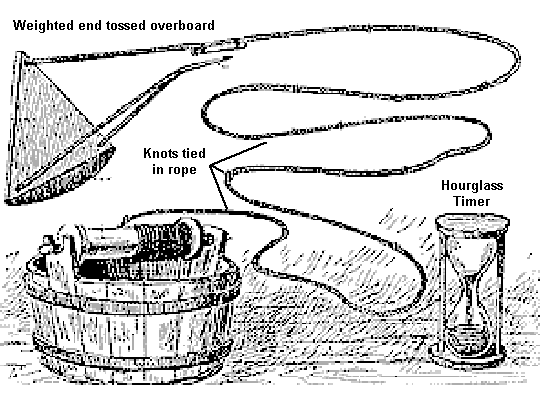
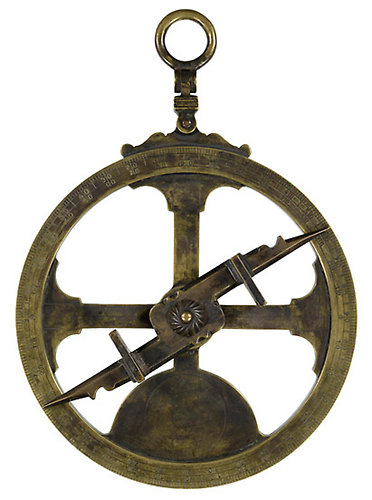
The state of navigation during the 16th century was such that accuracy of position was chancy at best. Most of the time mariners used a compass and a Log* to determine position. This was called Dead, for deduced reckoning, and with a knowledge of currents, or drift and, an Astrolabe,* position could be estimated with a certain degree of accuracy, particularly in measurement of latitude. Latitude was the measurement of position either north or south of the equator. Longitude, or the distance from a fixed point on earth was largely impossible to determine until the invention of extremely accurate chronometers (clocks) that would stand up to a sea voyage. These were not perfected until the late 17th century and weren’t common on ships until the 1820’s, two and one half centuries after Drakes voyage.

Here, where we live, any idea that Drake landed here is so unlikely that it bears no credence. The site at the old Cave landing could hardly be more dangerous to a ship of the type that he sailed. The Golden Hinde was a square rigged ship, which in his time, were largely unable to sail any closer to the wind direction than roughly 50 degrees. This means that if you sail into a north wind, the best they could do was  about 5 degrees off northeast or northwest. Easy to sail in, very difficult to get out.

compass-rose-02

COMPASS ROSE SHOWING DIRECTIONS IN DEGREES

The 22 mile distance from Point San Luis to Point Sal which comprises San Luis Bay is what is known as an “Open Roadstead,” meaning that there is little or no protection from the prevailing winds, no protected harbor, and has a sea bottom that won’t hold anchor in a storm or heavy sea. Each year, boats anchored in San Luis harbor go on the beach because they drag their anchors in heavy surf and it would have been much worse before the breakwater was built. The Masters Mate, who normally did the navigation in Drakes time would have been extremely reluctant to put in at a place such as Cave Landing. He could certainly sail in but would have been well aware of the difficulty in getting out. From the sea, the central coast is indistinguishable from most of the west coast. There are no outstanding geographical features to be seen from even a few miles out and with the nearly constant Northwest trade winds no sailor would likely come to shore here.

calif map

Map of California, circa 1590

As for Drake’s treasure, what would be the point of landing, and hiding it. It belonged to  Queen Elizabeth I and thats where it ended up. 80 pounds of gold, 20 tonnes of silver, 13 cases of silver coins and divers cases of pearls and gems, it paid off England’s national debt, and made Francis Drake and his crew rich beyond their wildest dreams.drake ship b1

Much the same as the Golden Hinde began its 7,000 mile journey west, across the Pacific to the Philippines, leaving California behind forever, we leave the dreams of our little boys in the secret places they belong. Or maybe not.

EPSON MFP image

EPSON MFP image


Even today, I can look out my studio window and see Picacho in the near distance and I still wonder, what if it was all true?


Footnotes:

Log: a piece of wood attached to a line knotted at uniform intervals. A sailor heaved the log from the stern of the ship and let the line pay out freely as the ship pulled away. When the sailor felt the first knot pass through his fingers, he shouted a signal to another sailor, who turned a one-minute glass. The first sailor counted aloud the number of knots that passed until the sand ran out. A timer of one minute (one-sixtieth of an hour), knots spaced one-sixtieth of a nautical mile apart, and simple arithmetic easily gave the speed of the ship in nautical miles per hour (“knots”).

chip-log

Astrolabe: By the Elizabethan era it consisted of a large brass ring fitted with an alidade or sighting rule. The user held the astrolabe by a loop at the top, turned the alidade so that he could sight the star along its length, and read the altitude off the scale engraved on the ring – difficult tasks to perform on the deck of a heaving ship. The consequences of imprecise measurement are serious (a latitude reading just one degree off produces an error in position of 60 nautical miles), so mariners often used the astrolabe in pairs, one to sight along the alidade, the other to steady the instrument and take readings. On shore, however, the astrolabe was easier to use and more accurate.

astrolabe


Standard

TOUGH WOMEN

By Michael Shannon

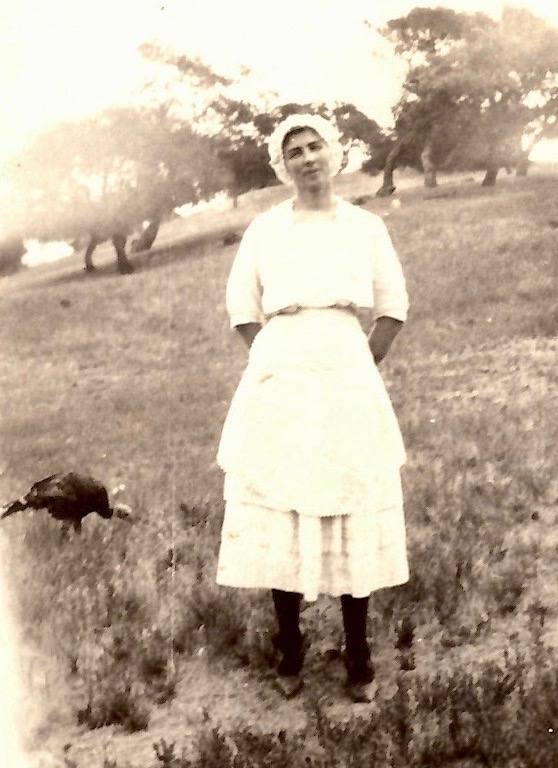
My grandmother Eileen gave birth to four children, only one in a hospital and even that was in the middle of an earthquake in 1933. She could pack up a house, take the kids out of school and be on the road to a new town in hours. She could take care of her kids, clean the house, make her husbands lunch and spend the day fighting a war to the finish against millions of ravenous mice. (Bakersfield 1926) She washed her husbands work clothes in kerosene; BARE HANDED! She never ever fought with her husband. She wore her hair down past her fanny, 100 brush strokes every night, wove it into a single braid, wrapped it around her head and got on with the day. They were so poor during the depression they lived with relatives. In Santa Barbara, Grandma went to the relief office for help but was told they would have to sell the car to qualify. Grandpa needed that car go to work so they muddled through. They lived in 78 houses in 44 years. Tough

My grandpa Bruce was an oilman and they moved with the work. It took one to three months to drill an average well and if the company needed you on another lease site, you had to go. My mother never attended any school for an entire year until she was 17 and was able to stay at Santa Barbara High School while grandpa drilled at the Rincon and Elwood leases in Santa Barbara County. She had to make a place for herself two or three times a year in new schools. She married young and was sorry for it. He beat her. She was a good girl though and got my dad on the second try. She raised three boys in an old farm house, where screech owls drowned in the water on the tank house and came through the pipes and into  the kitchen sink. We had one electric heater for the whole house and a single tub in the bath. She shared this with four of us men and yet could still go on a date with my dad and be so beautiful it made your heart hurt. She would say, “Kiss your mother goodbye and don’t smear the lipstick,” so we would kiss her on the cheek before she left. She once wrote in a letter to her mother that “she hoped George makes some money this year because I’m tired of hamburger.” She hated the hard Arroyo Grande valley water that turned our clothes yellow. It even turned the side of the house yellow when the sprinklers hit it. She worried about my dad getting hurt on the ranch but never told him so and when the awful cancer that took her life was killing her she kept her mouth shut and did her suffering in silence. Tough.

My aunt Mariel married a cowboy and they lived on a ranch in the Watts Valley near Tollhouse California. It was rough living by modern standing, Hot as hades in the summer, cold as a well diggers knee in the winter. An old wood stove heated the kitchen but in the back, well just add another blanket in the winter. In the summer a fifty pound block of ice covered with burlap and set in front of a fan did the job. They drank their milk unpastuerized, warm from the cow and their whiskey straight. Mixes dilute the liquor so they didn’t pour them that way. Those old houses couldn’t be kept clean. Dust leaked in everywhere. If you’ve ever lived in a house built in the nineteenth century you know what I mean. I never heard her complain, she loved her husband and her boys to pieces. She was a great person. Tough.

My aunt Pat married young too, right after high school and had four children pretty quickly. The marriage soured and in a few years she was left alone with four kids, no education and no place to go. She moved to Arroyo Grande, got a job in the newspaper business, brought up her children to be good citizens and made a new life for herself. An unmarried woman in the sixties had a hard road to hoe. She never made as much as a man in the same job and had to work twice as hard too. She persisted though. Tough

My grandmother Annie came from a rich family and never wanted for anything. She was a university graduate in a day when not many women did that. She had all the advantages. The families said to her, “Don’t do it,” but she married the boy anyway. They moved to a three hundred acre farm in 1918. They had to kick the chinaman out of the the house that was old even then. The house had three rooms a board floor and was a typical 18th century farmhouse of single wall construction.  She had a wood stove, no well, no electricity, two little boys and a husband that worked like the devil 7 days a week. No more finery for her. She hauled her wood, cooked the meals, sewed their clothes on a White treadle sewing machine. She could darn a stock, sew on a button and milk a cow. She put up with hogs, cattle, dogs, cats, squirrels, weasels and raccoons in cages but she couldn’t abide goats. They were for the “shanty” Irish. She never complained because, you see, she loved the boy. Tough

Great-grandma Shannon was Canadian by Ireland. She was a widow with four children living in upstate New York when she married my ex-con great-grandfather. He had just finished two years for robbing boxcars. He was a younger man and a bit of a hellion. His family had lived in America for two and a half centuries and done a bit of everything. They were inn-keeper in western Pennsylvania, read saloon there. The couple drifted west, farmed a little in Indiana and ended up running a boarding house in Reno where my grandfather was born. They arrived in Arroyo Grande, California in 1890 and bought a little farm where they raised chickens and grew apricots. Grandma Shannon had a bit of the heavy hand and my grandfather Jack bolted for freedom several times before he was 18. Each time the sheriff drug him back. Grandma Shannon fairly earned the sobriquet, “The meanest woman in the world,” but she was tough.

My other great-grandmother stepped aboard the States Liner SS State of Alabama on a fine Belfast morning with her brand new husband Samuel Gray, waved to her family who she would never see again and sailed for Ameriky. The newlyweds stepped ashore at Castle Gardens, Manhattan. traveled to Indiana where Sam worked as a farm laborer. Just a few years later they arrived in Oso Flaco, California in Santa Barbara County. For the next fifteen years she popped out a baby every eighteen months. All born at home, some with no dotor present. My grandmother Annie was the second. They worked hard, bought a small ranch in Graciosa just outside Orcutt and “lo and behold, there was oil in them thar hills.” They bought a bigger ranch in Santa Maria. She raised all those kids, my great aunts and uncles, brought them up to be decent people, every one. Jenny was a tough Cookie.

Clockwise from top left.  Catherine Craig Shannon, Annie Gray Shannon, Jenny Gray, Barbara Hall Shannon, Eileen Cayce Hall, Mariel Hall Long, and Patricia Hall Dilbeck 

1st row: From the left: Catherine Craig Shannon, Annie Gray Shannon, Jenny Gray.

2nd Row: Barbara Hall Shannon, Eileen Cayce Hall, Mariel Hall Long

Last Row: Patricia Hall

Cover photo: Annie Gray Shannon with a turkey on the ranch in 1920.

Michael Shannon is Californian, writer and citizen of the world. He write so his children will know who they are.

Standard

Annie in Age

She sits in her rocker. She looks for someone to come into the room. She waits. Hours pass and no one does. No one comes anymore. Her circle has shrunk to a dot. All are gone from her.

From her window she can see the place where she has lived nearly her entire life.

Standard

THE GREAT PEA WAR

By Michael Shannon

You would think the war over peas was about the Chinese peas my dad grew out on our farm. Not so. My mother heard Clarence Birdseye proclaim, “You must eat peas to be healthy” and she believed it with all her heart.

As in all wars, the beginnings are shrouded in mystery. what we kids always referred to as the “Olden Days” and which meant anything that had to do with our parents lives or maybe even what happened just an hour ago.

manuscript peas

Medieval Manuscript Illustration with Peas

She fed her boys strained peas when we were babies, that vile looking and tasteless, slimy  concoction spooned directly from a jar into our mouths like a mother bird feeding its chicks. Tiny babies are weak and helpless as we all know and we could have offered little resistance. Eat ’em or starve, it must have seemed easy to mom, her little boys growing healthy and strong before her eyes. Growing stronger yes; but smarter too, and in that fact lay the seeds of  her ultimate defeat.

I don’t remember how old I was when I first began to realize what was happening. I do recall the aftertaste being something like green latex paint with chalk dust added for flavor. Vile and disgusting doesn’t begin to describe it.

The origin of the pea is a mystery. The pea is a food plant so ancient that no one is sure, botanically or geographically, just where it came from. People have been eating peas for at least 10,000 years. Archaeologists have turned up the carbonized remains of pea feasts from Swiss lake dwellings and Neolithic farming villages in western Europe. According to Chinese legend, the pea was a find of the Emperor Shen Nung (the “Divine Farmer”), a helpful agricultural deity who also introduced the people to the hoe, the plow, the calendar, acupuncture, and tea. According to Norse legend, peas arrived as a punishment from the god Thor, who sent dragons toting peas to fill up the wells of recalcitrant worshippers. Later, once peas had caught on, Thor, when displeased, dispatched dwarves to plunder the pea fields. I think I’d have liked him.

In the medieval times, one of the staples of diet was dried pea soup, sometimes with resin added for flavor. Isn’t that a wonderful thought. Why just add some tree sap to make it sweeter. Perhaps that explains the fact the average Anglo Saxon of the time stood a scant five feet and weighed about 135 pounds. Forty was old, very old. Poor people could be so hungry they would waylay and murder travelers in order to have fresh meat. Imagine eating your neighbor because you couldn’t stand peas. When I was six, they might have had an ally. Fill a sock with dried peas and bonk ’em on the noggin.

medieval-food

Cooking the Pease porridge, 1156 Not happy

My mother was an oil field brat. She grew up during what was a constant state of financial depression. In 1915, my grandfather Bruce Hall went to work in the oilfields down in Casmalia. The pay was good for the time, about five dollars a day for an eight hour day. In the oil patch hours could be much longer and at about .67 cents an hour the pay was among the highest in the country but the work was itinerant, you might have to move at any time and oil companies in the heyday of discovery were going out of business almost as fast as they were created. Mom was born in 1918 and her life until 1943 when she married my dad, was spent on or near oil leases. The names of the places they lived are a litany of California’s oil history. Casmalia, Bakersfield, Taft, Coalinga, Maricopa, Summerland, Elwood, Signal Hill, Huntington Shores, Santa Barbara  and Arroyo Grande. The family staggered through the depression when mom was growing up and I’ll just bet you thats where she got her taste for peas. You could buy them by the 50 lb. bag. In the depression a sure indicator that the cost of living was increasing was the sudden demand for peas by the economically pinched who typically took refuge in that kind of food. In 1933, a hundredweight of dried peas cost $2.50 and baby, thats a lot of peas.

In 1928, the Gerber company held a contest to find a face to represent a baby food advertising campaign. Artist Dorothy Hope Smith entered her simple charcoal sketch of a tousle-haired, bright-eyed cherub of a baby. In her entry, Smith noted that she would finish the sketch if she won. Her drawing competed with elaborate oil paintings, but the judges fell in love with the baby face Smith drew, and when they chose it as the winner, they insisted that the simple illustration remain a sketch. The image of this happy, healthy baby was soon to become the face that launched a brand. My mother always said that I was a dead-ringer for that Gerber kid. She loved that.

Gerber--645x645

Add to this the fact that San Luis Obispo county during and after WWI grew peas, and I mean everywhere. A dry land crop that needed no more than winter rain for irrigation became the go to crop for the war in Europe where half-starved doughboys crouched in muddy dugouts choking down peas in lieu of real food.

County farmers grew wealthy. Semi-desert land that once was home to vast herds of Californio rancheros cattle now had pea vines criss crossing every available piece of ground. My family had been growing peas for two generations by the end of the war. The canceling of government contracts in 1918 slowed production but for some reason, non-discerning Americans continued to eat them by the ton.

mike and billie in madeline (1)

Me and mom out standing in the pea fields. 1947. Shannon Family Photo.

The photographs taken by Dorothea Lange of itinerant pickers in Nipomo during the depression show the depression at its worst. Did I mention they were there to pick the Dana’s family’s peas? They picked my grandfathers too. The crop was valuable enough that part of the foreman’s job was to make sure that the pickers didn’t steal them. I know thats true but I just cannot imagine even a starving, homeless Okie family wanting to eat them.

So my mom had a real affection for that drawing on the Gerbers jar but love might not been the word I would choose. When I was old enough to refuse food, peas had the honor of being the first and the worst. Mom was very clever though and so really determined, she marshaled her forces . She had cans of peas in the cupboard, dried peas in the cabinets and frozen peas in the refrigerator freezer. First she tried just boiling them and putting them on your plate, even adding a pat of butter to perhaps entice you to eat them. She and dad used the old strategy of telling you “You can’t leave the table until you’ve eaten everything on your plate.” The counter play’s for this are numerous. Self starvation means going to bed hungry, the old squish trick, mushing the food around in a vain attempt to make it look like you had eaten most of them which always works if your parents are blind, the drop, which is dropping a few peas at a time into your lap until dinner is over and the ever popular, hiding them in your napkin and asking to be excused to go to the bathroom and then dumping them down the toilet. My brother Jerry sat next to my little brother Cayce who would eat anything. He would slide his onto Cayce’s plate when no one was looking. No such luck for me, I sat next to my dad who loved my mother so much that he would have eaten anything my mother made. Anything, and I mean it too. She treasured him above diamonds for that. He deserved it.

Mom’s head on assault met with fierce resistance, her forces thrown back time and time again. So, as with any good general she tried a flanking attack. Understand, we were a farm family in which the menu was essentially an endless round of simple and comforting dishes. My mother was a good cook as most were in those times but she didn’t try gourmet foods or fancy dishes. I mean, come on, the French ate snails. My dad liked what he liked and that was it and we kids grew up thinking it was just fine with us.

One of our favorite dishes was creamed hamburger on home made biscuits of which my mother was the doyenne; par excellence as they say. My brother Jerry still eats, sixty years on, a homemade biscuit for breakfast almost every day. After months and years of frontal assaults she thought she would fool us by infiltrating a few peas into the the creamed hamburger in the hope we wouldn’t be able to detect this so subtle attack. The peas would be completely covered with her creamy milk and flour gravy which, she thought, even the most discerning boy would be unable to detect. No dice, there they were, winking her defiance beneath the sea of white camouflage. After that first less than successful subterfuge she became a dog with a bone in its teeth. Casserole with peas, creamed peas, carrots and peas, mushy peas, peas and cauliflower, green beans vegetable casserole with peas, creamed peas with bacon and; and wait for it, wait, horror of horrors scrambled eggs with peas, surely the poison gas attack of meals. But like the stubborn Irish boys we were, descendants of a people who have been fighting the hated english almost continuously since May, 1159, we still wouldn’t eat ’em.

How did she ever expect to win? Eight centuries of mostly futile resistance breeds a certain stubbornness, or as my British friend Claire Mason said,”Whats wrong with you Irish anyway, why won’t you quit?” A well known Irishman, George Bush, famously banned broccoli from Air Force One, explaining, “I do not like broccoli… And I haven’t liked it since I was a little kid and my mother made me eat it. And I’m President of the United States, and I’m not going to eat any more broccoli!” We felt the same way about peas.

Peace was never achieved, nor I suppose was it possible. A boys delight in putting one over on his parents is sublime. Actually, we were taught to think for ourselves at that table. It was a constant refrain, my dad would always tell us not to believe half of what we saw and believe little we read in the newspaper and  certainly nothing we saw on television. It’s turned out to be good advice.

Still don’t like peas and you can’t make me eat them; ever.

PS:    Drawn by Dorothy Hope Smith, the Gerber baby was introduced in 1928 and has become the internationally recognized face of the company. The model for the original sketch, is Ann Turner Cook,  a mystery novelist and english teacher. The symbol has one of the highest levels of loyalty in branding history. Mrs. Cook lives in Florida.

Michael Shannon is a writer from Arroyo Grande,California.

Standard

THE TYPHOID POND

Written by Michael Shannon

There is nothing more powerful than a little boy’s imagination.

Somewhere back of beyond, lies the Typhoid Pond. My brother Jerry, Kenny Talley and I discovered it in 1955 while on quest of the imagination.

pond scum tank

One hot July afternoon we headed up a canyon on the Donovan ranch. Once part of the old Rancho Santa Manuela it was still a cattle ranch in the 50’s. In July the hills and valleys were sere, the chapparal crackling and dusty, the pasturelands eaten down to stubble and the earth ankle deep in powder as light as talcum.

Preparing for a momentous journey, as always, called for careful preparation. High top Keds tennis shoes were a must and since tennis shoes were the shoe of choice for summer, the only choice because thats all we had.  Worn denim pants and white tee shirts rounded  out our farm boy sartorial elegance and since farm kids wore the same clothes every day but Sunday it wasn’t really much of a choice.

Most carefully chosen items were the single surplus WWII canteen we took and above all the choice of weapons. At the entrance to the nameless canyon was Oliver’s enormous stack of bean poles. In those days, the Blue Lake and Kentucky Wonder beans were trained on redwood or eucalyptus  poles, wired and strung with cotton twine. In season, a field with bean poles strung was a wonder to behold. A gigantic tapestry that shimmered with moisture in the early morning fog. A seemingly endless manmade spider web of bleached white string against the brilliant dark green of the vines reaching upward, embracing the twine in its fragile tendrils.

Choosing the proper pole was of the utmost importance for it must serve as a walking stick, rifle, spear, bow and sword. First of all it must be a broken one for we were boys still and incapable of swinging an eight foot bean pole. Usually there was a smaller pile of broken ones, haphazardly stacked with different lengths of both primary types. The redwood poles were the older more expensive ones, and mixed in, eucalyptus poles cut from the old trees on the mesa. The lighter redwood were easier to handle and drive, but you needed to have a pair of gloves to protect your hands for they were filthy with nasty splinters, sure to break-off under your skin, the splinters nearly impossible to remove, even with tweezers. You had to be patient and let them fester until you could squeeze them out. The squeeze was satisfying but the several days of irritation were not. It was a sort of no pain no gain situation. The eucalyptus on the other hand weren’t particularly straight, heavier and liable to break when pulling them out at the end of the growing season. My dad liked the geometry of the redwood. When strung they  made a satisfying tableau, a state of completeness more like a finished painting than a simple field. The crooked eucalyptus was wilder looking, not as finished and didn’t fit his view of how his fields should look. If you farmed, he was going to judge you by how straight your furrows were; crooked furrows and his estimation of your skill went down. A small conceit from a man hadn’t a self-serving bone in his body.

We invariably chose the Euc. They were heavier but easy on the skin and they had the heft to do the job.

So armed with the necessities, water, a weapon and most important, limitless imagination we set off up the valley, immediately jumping down into the dry wash that bisected the  canyon.  Walking along, we were sure to remind ourselves to be quiet and stealthy, occasionally lying against the walls of the wash and lifting our heads, lizard like, in order to see any danger approaching along the canyon floor. Sometimes crouching with our muskets raised, pans primed and locks cocked for the redcoats to march close enough for the first volley. The whites of their eyes clearly visible on the downslope of Breed’s Hill came The Royal Welch Fusiliers, the same regiment of the line that later produced two of the greatest poets of WWI, Sigfreid Sassoon and Robert Graves. We held off them until we ran out of ammunition and then fled around imaginations bend to safety.

patriots_at_breeds_hill_1775

The Patriots, Breeds Hill, June 17, 1775

In the distance we could see the Comanche chief Quanah Parker at the crest of a low hill.We were 3, they, 700. There was never a more splendidly barbaric sight. We were about to be in one of the last great fights of the indian wars. Hundreds of warriors, the flower of the fighting men of the southwestern Plains tribes, The greatest light cavalry the world has ever seen, mounted upon their finest ponies, armed with rifles and lances, and carrying heavy shields of thick buffalo hide, were coming on like the wind. Over all was splashed the rich colors of yellow, black, vermillion and ochre. Painted on the bodies of the men and  their running horses they told stories of courage and dreams. Scalps dangled from bridles, gorgeous war-bonnets fluttered their plumes, bright feathers dangled from the tails and manes of the horses, and the bronzed, half naked bodies of the riders glittered with ornaments of silver and brass. Behind this headlong charging host stretched the Plains, over whose horizon the rising sun was lifting.  The warriors seemed to emerge from this glowing background, tearing apart the mist in their headlong rush towards the old adobes. I had my friend Bat Masterson on the  left and the famous rifle shot William “Billy” Dixon on my right.  On the third day of the fight, Billy Dixon, already renowned as a crack shot, took aim with a “Big Fifty” Sharps  buffalo rifle  and cleanly dropped a warrior from atop his horse nearly a mile away. Discouraged by this amazing event the warriors melted away.

Chief Quanah Parker and Billy Dixon

As we crept away from the walls we looked to the left and saw at a distance the 7th riding towards their fate, equipment jingling, dirty blue shirts and dusty boots, an Irish trooper playing “I’ll take you home again Kathleen” on his mouth harp, perhaps it was Trooper James Patrick Boyle, just 23, a county Tyrone boy born in the green pastures of Ireland and destined to lay his bones on the Greasy Grass.  Farther up the draw, just seen at a distance, a wagon train bound for the California gold fields around Roaring Camp, perhaps to meet Bret Harte’s Thomas Luck.

Almost completely hidden in a small hole dug in the side of the gully was Sgt. Franklin “Frank”Rock and some of his men from Easy Company quietly watching for an appearance of any “Natsie scum.” We were glad of their company.

Suddenly from the right a ferocious roar. Ronin! Kenny shouts and we turn just in time to meet the charge of the purple hatted, knife wielding whirlwind. Each warrior seemingly armed with dozens of knives, each one more pointy than the next. Swirling like dervishes we meet them head on, our eucalyptus blades carving, their purple capped heads separated from their stalk-like shoulders bouncing across the prairie. In a few blinding, confusing moments they are vanquished, their mutilated bodies littering the ground around us. In triumph, exhausted by our labors we jump back down into the ditch, gasping, dusty and thirsty.purplethistle

California thistle, Circium Occidentale Californicum

Slowly cresting the head of the draw we spy a sight for sore eyes. In the near distance a cattle tank, a depression filled with rain water runoff, shallow in the summer, soon to be a mudflat but nevertheless inviting to tired, dirty explorers. Approaching along the mudflats, the surface a mosaic of earthen tiles each slightly cupped, covering the wet mud beneath, we removed our sneakers and socks and approached the edge of the pond the mud already beginning to squish between our toes, an experience, satisfying in the extreme to those with tired feet. Deciding that a swim was the answer we each stripped down to our shorts and began wading out into the water, brushing aside the green surface growth. The long tendrils of Spyrogyra* clutching at us as we pushed aside the moss and algae. Clearing enough of the surface growth to submerge we slowly sank. We croaked like frogs and splashed each other in a riot of noise, laughing and throwing slimy mud, we soon looked like mudmen crowned with green hairpieces. Finally, rinsing ourselves and pulling the moss out of our hair we waded back to where we left our clothes. Pulling socks on over muddy feet and slipping on our shirts and pants we began to retrace our steps.

tp

The Route to the Typhoid Pond on the far right

Suddenly, in the distance we could hear the big steam whistle blowing, we had to get to the steamboat landing in a hurry. We needed to get aboard her before she left the dock. She was headed down river from Cairo, bound for New Orleans, Sam Clemens the pilot standing by the Packets wheel way up on the Texas deck, splendid in his long frock coat and string tie, his arms akimbo, his hat cocked atop his head and a crooked cheroot gripped between his grinning teeth. He was a real river pilot, a prince of the river. We all wanted to be him.

on the river

“Yonder she comes”  Life on the Mississippi,  Mark Twain, 1883

We raced across the pasture pell mell until we spied the steamboat which looked suspiciously like my dads green chevy pickup. He leaned across and opened the door and we piled in, pushing and shoving, still excited by our adventures. Three boys covered in mud and dust, socks filthy with foxtails and cockleburrs, laughing with the sheer joy of being young. 

“What have you boys been up to, Dad said, you look like something the cat dragged in. Lets get you home and into the tub and you can tell me all about it.”

*My brother, by some cosmic connection was called Spyrogera or Spy in High School.

Michael Shannon is a World Citizen, Surfer, Sailor, Teacher, Builder and Story Teller. He lives in Arroyo Grande, California, USA. He writes for his children.

E-Mail: Michaelshannonstable@Gmail.com

Standard