So this is kind of an acknowledgment. There was something my father did in casual conversation that I found mystifying. He used to do this thing when talking to my mother or people he knew that were of his own generation and that thing was to refer to women by their maiden names.
He would say things to my mother, like,”I saw Georgie Hendrixs at Bennett’s grocery today and she said to say hello.” Thats all well and good, my mother understood who he meant but I didn’t. Now I knew only one Georgie and that was Georgie O’Conner. Bills’ wife. As I grew up and began to learn the ins and outs of social life in my hometown it finally occurred to me that the two Georgie’s were the same person.
One of these two women I knew well, she had a son my age, they lived on what once was Leedham Lane on the west side of town. The family still lives there, you know, the old house with the pair of big Fig trees in front. My dad knew that too. Then why did he call her Georgie Hendricks?
Georgia “Georgie” Hendrix, 17 Arroyo Grande HS yearbook 1943.
The mystery deepened when my mother always referred to her as Georgie O’Conner. Now it’s hard to be two people unless you are a criminal or a politician. Actors must count too, but here in the neighborhood it doesn’t happen. The mystery deepened.
When I was a teenager I asked him. We were at the table eating dinner and I said, Dad, why do you call your woman friends by the wrong name? It was always pretty hard to stump my father. I can count the times in my life when I did. I was probably around fourteen or so and he was forty seven, roughly. Dad was a college graduate and well read. He had a lifetime of experience in business so it was nearly impossible to confuse him which delighted me because like all the young I somehow thought we were equal in education and experience. I know better now.
He looked at me for a bit and you could practically see the marbles rolling around in his head as he tried to find an answer to my question. It was kind of a ridiculous question anyway, I mean what name he used was simply normal to him and I don’t think he had given it much thought one way or the other. Georgie had a name and it was Hendrix just like Marylee Baxter was Marylee Zeyen or Mrs Fuchiwaki was Iso Kobara. Make any sense to you? Me neither.
Rather than come up with a credible answer he gave me the usual, “You wouldn’t understand, or That’s just the way it is” or especially, “Those are their names.”
So there I was ignorant about something I heard my dad do all the time.
So here’s an example, when I was twelve or thirteen my parents took me to a party up on Sierra Drive. It was my father’s friend Cyril Phelan and his wife Kathryn’s home. It was a nervous experience because my mother had been sure to let me know that these people had daughters my age which made me a, twelve year old nervous wreck because it meant she had something sneaky in mind. The girls mother who I was meeting for the first time was called Kay, not Kathryn and my dad jokingly said something to her and called her Routzhan which made her laugh. Made no sense to me. Besides I was doing my best to avoid strange girls and was puzzling over this thing about the names. So, if you can follow, this Gus guy was really Cyril which seemed at the time a very unfamiliar and strange sort of name. He was married to Katherine or Kay whose last name was Phelan or was it Routzhan. See what I mean?
There was another woman there who was married to my dad’s poker playing buddy J. Vard, another strange name, who was apparently married to my mother’s friend “Happy Bottom” which I assumed was not her real name but…*
I guess it hadn’t yet occurred to me that adults did what we did in school. I had friends named Squeaky, Dumbo, big ears of course, and Woody. Tookie, his mom said he had just the cutest little Fanny when he was a babe. That one has stuck and it’s become practically his only name more than seventy years later.
All of course was explained by my mother. She told me my dad did it for several reasons. First of all many of the people he knew he had grown up with. The women who were once in school with him or he knew when they were just maids had married his friends or a stranger to our town and their married names were not the same as he remembered them and he just unconsciously recalled their maiden names and used them.
I guess these are things that make small towns special. Think of this. When I was sixteen I traded my job at Mattie’s restaurant for a better one at Baxter’s service station in Pismo Beach. It was owned by Walter Baxter and his sons. WA Baxter and sons Chevron where the bookeeper was “Granny” who had no other name that I knew of and her sons Bill and Tom. Take a breath and try and follow this. Tom Baxter’s wife was Mary Lee but her maiden name was Zeyen which is the name my dad used. Her father owned a clothing store on Branch street for eighty years and my mother worked there. Tom called my parents by their last names, Shannon and because when I went to work for him he apparently couldn’t remember my first name, though I have always believed that it was a compliment to my father, called me “George.” He called me George until the day he died.
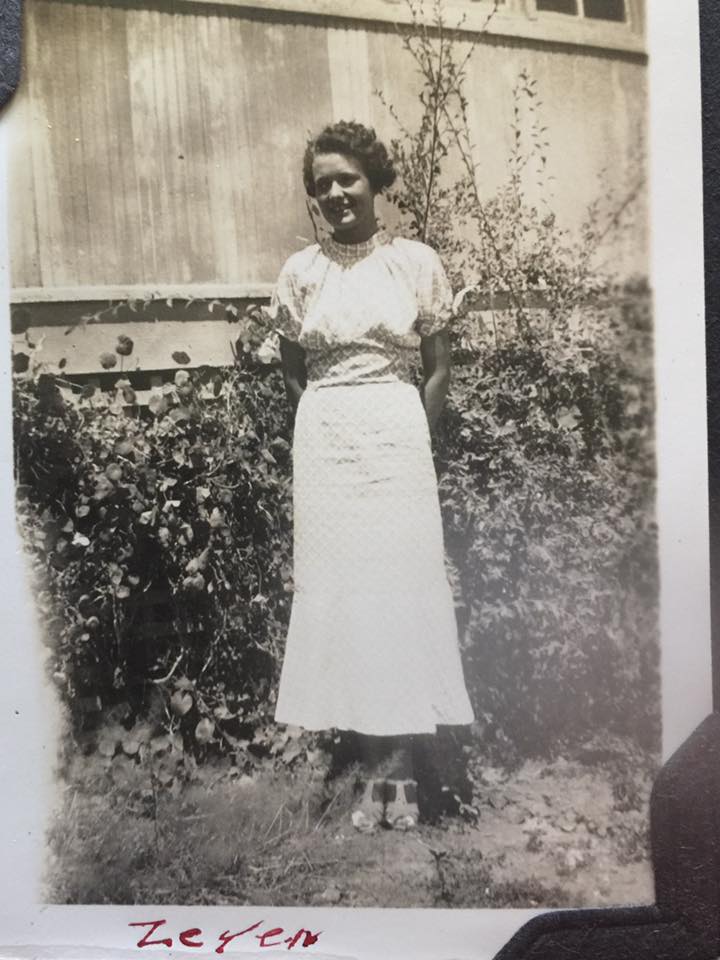
Marylee Zeyen Baxter, Arroyo Grande High School, 1944.
It finally occurred to me that he did it because he considered it a marker that divided his young life from his older. He also did it because he really could not remembered some of their married names. He did it from affection too.
Kathryn Routzhan and my father went all the way through school together, first grade through Junior College and would have attended Berkeley together until Gus came along. He knew her for nearly thirty years of the most impressionable time of their lives. Routzhan was the correct name for him.
Kathryn Routzhan, Santa Maria Junior College, 1931
Eventually after enough questions were asked some semblance of order was established, at least by me. Apparently these women existed in parallel universes, the before and after. I can understand it now. In memory people exist in block of time and we recognize that.
I suppose, in a bookend, the same thing has happened to me. At school reunions I see the women of today as the girl of yesterday. Just like my dad did. Thats the name I use, the real one.
Cover: Georgia “Georgie Hendrix and Agness “Billie” Records who you may have known as Georgie O’Conner and Billie Swigert..
My grandmother was born in 1885. Things were different then. The little Red house she was born in down in the Oso Flaco is long gone now like most old houses built in the days before electricity and indoor plumbing. She didn’t live there too long for her father was a fortunate man and found oil on his little ranch in Graciosa, todays Orcutt. he became an instant rich man and soon built himself a large modern home on west Guadalupe road. Though rich, he was still a farmer and he worked his land which stretched all the way back to the Santa Maria River. For an landless Irishman, which most were, the land held more importance than the oil.
When my grandma Annie was eight years old she came to Arroyo Grande to live with her aunt and uncle, Sarah and Patrick Moore. Patrick Moore had come to Guadalupe from Ireland and prospered in the sheep business. Though he had little education he was a cunning man and made himself a fortune with which he built a big house on the edge of little Arroyo Grande. He bought a big book of the collected works of William Shakespeare which he kept in the foyer of his house where all could see it as they entered. That was all the education he needed.
So, my grandmother grew in a life of privilege. Servants, beautiful clothes and the best of Arroyo Grande pioneer society. Her girlhood friends were, Phoenix, Harloe, Rice, Lierly, Porters, and the descendants of Don Francisco Branch. Families that sent their children to private schools in San Francisco and San Luis Obispo.
She was a child of the late Victorian Age and all it represented. A hundred years after the first American civil war or The Revolution as it’s now styled, fashionable society still looked to the European continent for guidance in societal affairs. We will dress this way, walk this way, speak this way and adopt the mores and shibboleths that decree customs, principles, or a belief that distinguish a particular class or group of people. The majority, under the influence of vague nineteenth-century shibboleths, understood that by associating oneself with these doctrines implied sophistication to the nth degree.
I never knew my grandmother as a girl though she certainly was one. She was 60 years old when I was born. She wore sensible low heeled shoes, cats eye glasses, plain print house dresses covered by an apron with the ubiquitous hankies in the pocket. If she wore any jewelry other than her slim wedding ring I don’t recall. She wasn’t overly solicitous of my attention but she was a calm presence rocking in her chair darning socks or knitting. It was the chair my grandfather bought her when she was first pregnant with my uncle Jackie in 1908, the year she graduated from California Berkeley. She would offer her hand with its delicate skin which had hardly ever seen the sun because in the forties women still wore gloves everywhere. A little cheek was offered for a boy’s kiss which was as soft as a down feather. She always smelled of White shoulders, powder not perfume for perfume was considered vulgar and only worn by “Soiled Doves or low class strumpets.
She played the piano in church, always wore a hat to go to town no matter how mundane or routine the purpose was and was unfailingly polite, no gossip that I ever heard. If there was it was confined to her bridge club, women who had sat at those old folding tables together for nearly fifty years and likely chewed, although the word chewed which she viewed as vulgar would never have passed any of their lips, they chewed on the same old conversations until they were polished to a soft sheen. Safe, familiar and soothing.
She was raised in a quite remarkable era which is almost unbelievable today. Things we take for granted were forbidden or lived under a series of shadow words that said one thing but implied another. Society had developed euphemisms to mask words and phrase which the well-educated and socially prominent practiced.
women were as energetic as they are today but har far fewer things to occupy their minds. A contemporary woman would hardly recognize my grandmothers life in 1900. She couldn’t own property under her own name, she couldn’t vote, there were few places she could go unaccompanied. She couldn’t initiate divorce nor was she protected from domestic abuse. She couldn’t wear trousers, smoke a cigarette, she couldn’t handle money even if she had some, that was her husbands job.
She a had an Irish servant girl, her name was Clara. Clara washed ironed, served dinner and kept house for the Moore’s. She is in one photo kept in the families collection. She was apparently a scandalous girl who’s secret my grandmother kept to herself for nearly her entire life. She let it slip in her mid-nineties when her memory of the present faded and the memories of the past sharpened.
When a girl reached puberty she was likely to be 16 or 17. Poor nutrition, increased physical stress from industrial work, and other poor living conditions during the Victorian era contributed to this delayed onset. Social standing at the turn of the century figured in the timing. Children went straight to adulthood as there was no concept of adolescent until roughly 1905 when the concept was published in a book. The word teenage was completely unknown. My grandmother graduated high school in 1904 and would have been constrained to act and dress as an adult. You can see in old photographs children dressed exactly like their parents.
As a young single woman which she was until graduation from college she wore her hair up. Nearly every woman did. She put her hair up as a young teen and it stayed up until she bobbed it in 1920. Wearing the hair down as an adult woman was a scandalous thing and indicated that you were of a lower class or a, horrors to even think about it, “Lady of the night.” A fallen woman in fact and if my grandmother and her friends saw you on the street in San Luis Obispo which by the way had a rich and teeming Red-Light district, they would turn away and point there noses skyward at the scandal of it. Hmph.
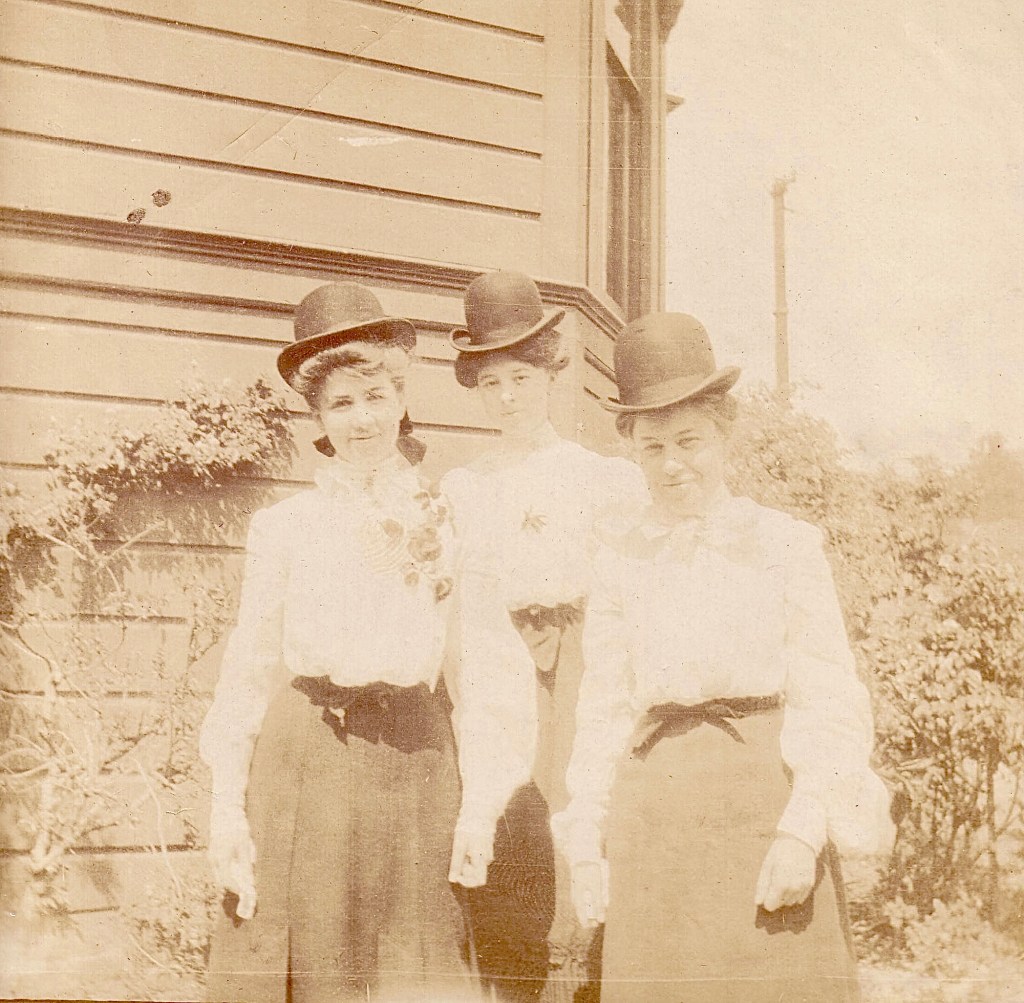
The girl in the rear, Margaret “Maggie” Phoenix. Our Margaret Harloe for which the school is named. Note the ubiquitous hankies.
This developmental stage was deeply shaped by Victorian social and moral codes, which emphasized female purity and restricted young people’s autonomy. Victorian culture strongly discouraged public discussion of sexuality and puberty. This lack of frankness contributed to a cultural “prudery” surrounding these topics. Some late-Victorian medical and social commentators viewed puberty with apprehension, seeing it as a time when girls were susceptible to disease or irrationality, swooning and the “vapors” more than likely brought on by too-tight corsets. There was a push for female health and physical activity for some, but this was often met with resistance from those who preferred to preserve traditional ideals of fragile femininity. Social mores were set by the extreme upper classes in order to distance themselves from the lower or even worse, the depraved gutter Irish.
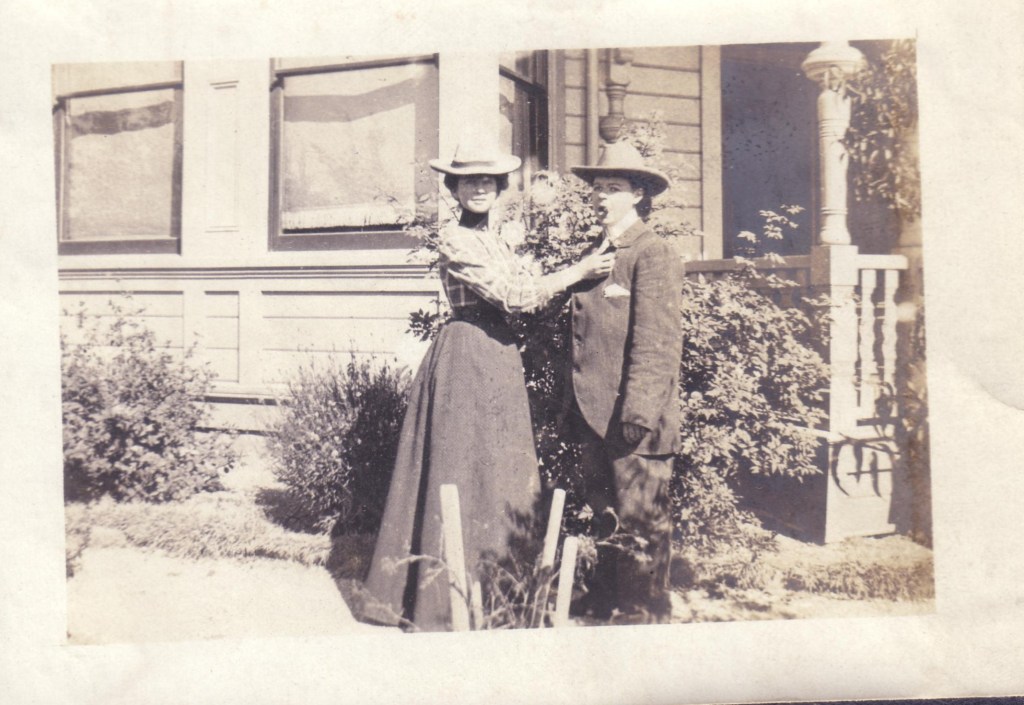
Grandma of course was just like the girls of today. They aped the manners and dress of their elders but they still found occasion for hi-jinks. Dressing up as their fathers was apparently a regular pastime. We have many photos of she and her friends posing for pictures taken with her new Kodak Brownie camera in front of her home. No lawn though as a front lawn wasn’t even a concept in 1903.
Annie Gray and Tootsie Lierley in 1903. Patrick Moore residence Arroyo Grande
You might notice that they both are both hatted. No self-respecting woman would ever be caught outside without a hat. Notice too that the skirts hem is touching the ground. It was thought that the sight of a shoe or God forbid, an ankle would drive men crazy. One of her classmates at Cal in 1907 was expelled for wearing her skirts short enough to expose he ankles. A length of fabric called a flounce was whip stitched to the hem of dresses with a small loop that could be grasped and delicately lifted just a little if she stepped over a curb or ascended the stairs. I could be removed for cleaning as often as needed since hems touched the ground and could get very dirty in a town which had no paved streets.
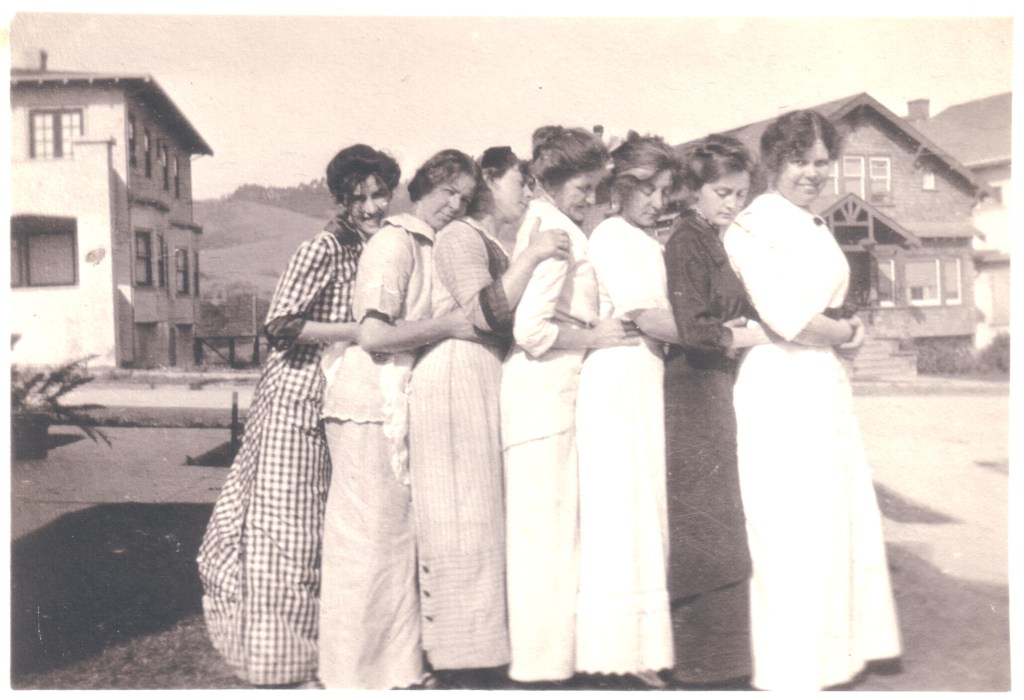
My grandmother is the girl in the checked dress on the left. 1907. University of California Berkeley campus.
When a woman was menstruating she was “Indisposed.” Women were such a fragile things that too much stimulation of any kind could cause her to swoon. Those darn corsets again. If a man referred to a woman’s leg as anything but a limb he might be cast out of polite society. A woman could not be touched in any fashion other than to take her arm if the road was too rough for walking. Sitting on a buggy seat, the heat from a woman’s limb was known to cause temporary blindness in men.
When she was in her nineties she still wouldn’t cross her ankles since that was considered suggestive. My grandfather didn’t cross his legs either, at least in the presence of women. You had to be careful because you were surrounded by vulgarity, it’s nasty fingers aching to clutch the unwary sophisticate.
Grandma frowned on anyone mentioning the number six, I think for obvious reasons. Animal horns were considered obscene, vulgar to the point of being devilish. Once I found a beautiful copper chaffing dish she had received as a wedding gift in 1908. That dish spent it’s entire life in the barn because the handle was a section of Elk horn which she wouldn’t touch. No goats either. My dad and uncle Jackie had to give their pet goat away, it had those devilish cloven hooves. The milk cows and bulls were also polled or dehorned, either for utility or because she wanted it that way.
She wore a silk chemise and pantaloons for underwear called, always, unmentionables. They were never seen by men. The pantaloons were basically a set of short leggings with no, dare I say, crotch. Probably shouldn’t. They wore so many layers of clothes that they simply could not undress quickly. A woman doing her business would have looked the same as a woman sitting in a chair. You see, this was because there were a couple things about feminine hygiene which were quite unknown at the time. Most homes had no toilet and many no running water. Finding and using the “Necessary” cold be very difficult when out and about. This was a woman’s dilemma. No business had a public toilet, Toilet comes from the French Toilette by the way. Toilet is French in origin and is derived from the word ‘toilette’, which translates as “dressing room”, rather than today’s meaning. This was another dodge around a seemingly vulgar term such as “The Jakes”, the outhouse, the Crapper* or the chamber pot. If I may, there was no toilet paper in a necessary unless the owner was well off . Paper for the toilet was invented by the Chinese in the fourth century BC. It took until 1857 until it first appeared in America and was sold in individual packs of five hundred and, of course quite expensive. Think of this, splinter free toilet paper first appeared in the 1930’s, multiply paper in 1942 and thanks to modern inventiveness, scented in 1964. Speaking of this would have been absolutely taboo in front of my grandmother. No lady could possibly utter the word toilet. She went to the bathroom where she did things that were secret from the world of men.
Remember that ancient Rome, Greece and Persia over three thousand or more years ago had running water, sewers and public baths and “Necessaries.” Arroyo Grande at the turn of the twentieth century did not, certainly did not.
This somewhat limited the distance a woman could go from her home. Timing was of the essence. She certainly could not just drop in to the Capitol Saloon on Branch street. She and her friends would have been forever shunned.
Saloons were places where Demon Rum lived. The men inside were considered vulgar beyond description. A woman who approached too closely would likely be subject to catcalls** and other unwanted comments.
I cannot imagine what she would think of our house when we had two rambunctious boys and one bathroom. On school days the door never closed and no one though anything about it. You all know what I mean. All that would have been incomprehensible to grandma.
As to engage in man woman stuff or Amorous Congress there was simply no word in her vocabulary that sufficed and it was never mentioned in any context, not even animals. She was a dairymen’s wife so she had to make her peace with sort of thing. She was seriously uncomfortable with both words and I’ve heard the act itself was only practiced twice, resulting in two children. Or so my father said, tongue in cheek, I hope.
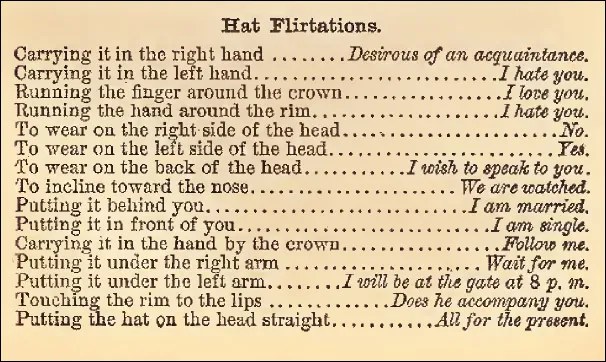
Girls and boys didn’t have to wonder what the rules of courtship were, you could buy a printed card.
So my grandmother, her name was Annie Shannon was a steady presence in my life growing up. She never raised her voice, she always dressed the same, she never ever went out without hat and gloves even if she was going to buy groceries. She taught her grandchildren not to masticate with their mouths open, keep our elbows off the table, not to speak unless spoken too and keep our opinions to ourselves. I’ve done poorly with the latter but I hope she will forgive me.
I loved her for who she was and I miss her.
Jack and Annie Shannon as I remember them. Arroyo Grande about 1950.
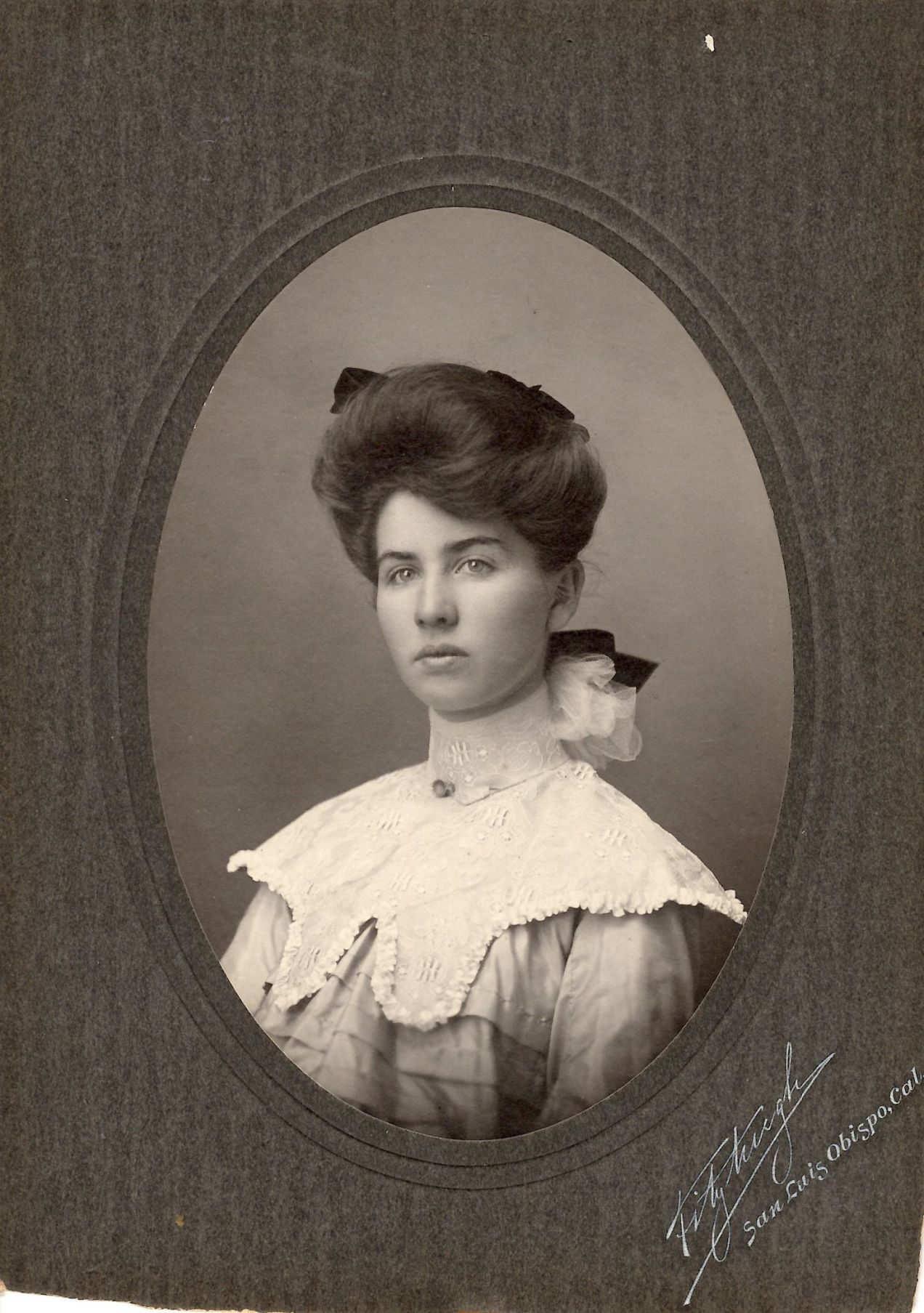
Cover Photo: Annie Gray formal portrait high school graduation 1904. Stoneheart Studios Santa Maria California.
*Thomas Crapper was an English plumber and businessman. He founded Thomas Crapper & Co in London, a plumbing equipment company. In 1861, Crapper patented his first invention – an improved ballcock mechanism. The device was used to regulate the flow of water in cisterns and is still used today in toilets across the world. I cannot not imagine my grandmothers reaction to the word ballcock, it may have killed heron the spot. Crapper’s notability with regard to toilets has often been overstated, mostly due to the publication in 1969 of a tongue-in-cheek biography by New Zealand satirist Wallace Reyburn.
**Catcalling is a form of street harassment, typically sexual in nature, where a man makes unwanted comments, gestures, or sounds toward a woman in public. It is not a compliment but a demeaning act that makes the target feel threatened, degraded, and unsafe. The motivations behind it can include asserting power, misogyny, or a desire to express sexual interest, but it is always a form of harassment that infringes on the target’s dignity and right to feel secure in public.
Michael Shannon, the author of this piece loved his grandmother. Both of them actually because they were characters in their own right.
“The God of Death has come.” Shouted by a Japanese Imperial Naval Marine* upon seeing Marines landings on Betio, forever enshrined in the notes taken in interviews by MIS translators during the battle for Tarawa.
The filth, the crawling over sharp coral, running crouched, hunched over with every muscle in the body nearly rigid with fear, the noise which never stopped, artillery, flamethrowers, grenades and the constant pop of gunfire. Battleship shells weighing a ton, Destroyers nearly run up on the beach duking it out with gun emplacements at point blank range. A miss is a miss but the M-1 round still can kill at 6,500 yards, over 3.5 miles. The Japanese Arisaka type 99 rifle could kill at 3,700 hundred yards. No place on the island could be safe for the soldier. The air is full of them. There was no place safe. No one could think or conceive of any other universe. The Battle of Okinawa (Operation Iceberg) was the final major land battle of World War II, lasting 82 days from April 1 to June 22, 1945. It was a brutal, large-scale engagement where U.S. and Allied forces fought Japanese troops on the island of Okinawa, the last step before a potential invasion of Japan. The battle was exceptionally bloody, resulting in massive casualties for both sides, including a significant loss of civilian life among the Okinawan people, and heavily influenced the U.S. decision to use atomic weapons on Japan.
Soldiers are so young. Is it impossible that they should be able to process the situation they are in? When they awaken at the bottom of their waterlogged foxholes after dreams of home they understood there was no escape.
Witness this Marine Ambulance driver’s letter home written about half way through the invasion. He would celebrate his 19th birthday on Okinawa.
Dear Folks. I know you have been worried about me but as you see I’m still very much O K. I’ve had a few close calls but that can be expected on this Rock. They say in the stateside news that this island is secure but, but they still have eight more miles to go so you can figure that out. We are three miles back from the front licking our wounds now and waiting for I don’t know what. Maybe we go back and maybe we don’t. I guess I’ve seen most of this island so far—enough anyway.
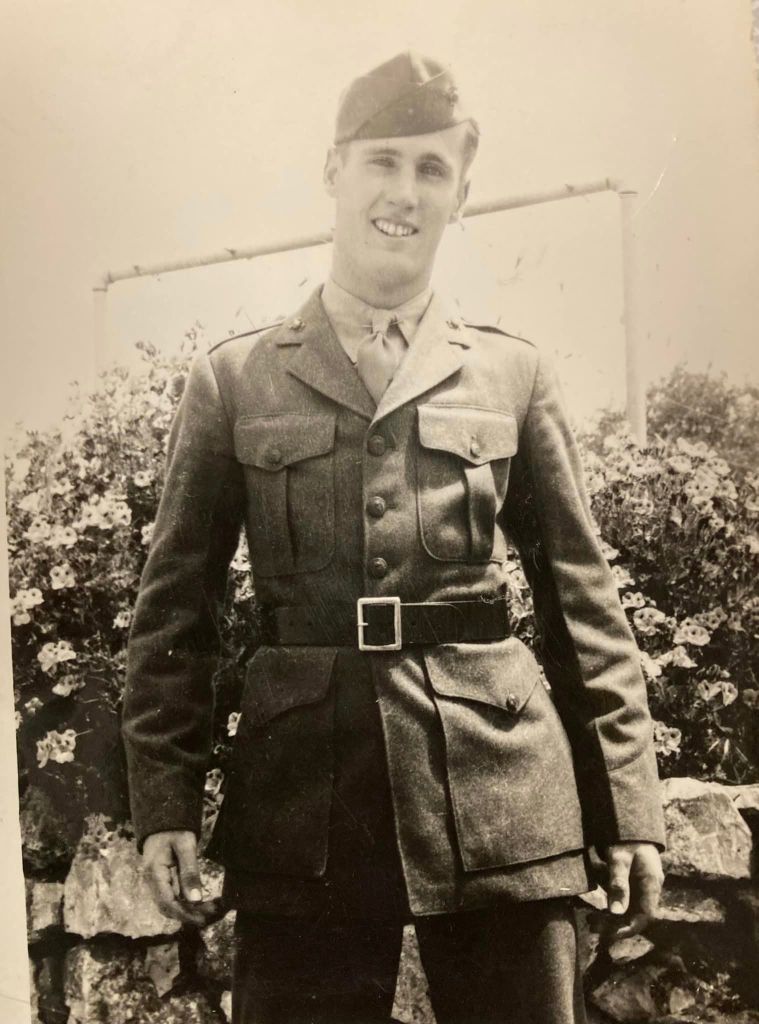
Private John Brewster Loomis USMC, Headquarters company, 1st Battalion, 1st Regiment, 1st Marine Division. MOS 245, Truck Operator. Just before shipping out to the Pacific, 1944.
Shuri Castle was a rich joint and Naha used to be quite a town. I am sitting in Jap truck now that we picked up in our travels. It is something like a ton and a half and something like a Chevrolet but right hand drive. I’m a little thinner but feel alright. (He entered the Marines at 5′ 11″ and 160 lbs.) Instead of “Golden Gate in ’48, it’s from Hell to Heaven in ’47. Old Snowball, a friend, is still alright as far as I know. We sure took a beating but took our objective.
Dad I’m sorry I couldn’t write on your birthday but Happy Fathers day and Fourth of July.
The weather is better now, cold at night. Last night was the first time I got to take off my shoes when I hit the sack. They brought us a little better chow for a while. Boy! Am I tired of C-Rations. My old ambulance is still running but it doesn’t look the same-no windshield. bumpers, paint, top or sides-justone seat and the stretcher racks.
I had my picture taken the other day by Division. I don’t know if it will get in the papers or not. I sure didn’t look like much that day.
Well, folks, I’ll write when I can and I hope from now on that will be very often. Much Love John.**
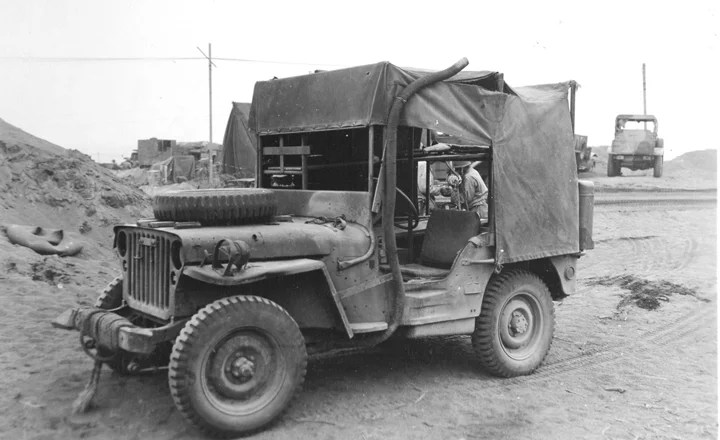
Modified by Holden an Australian body building company, this is the Jeep type ambulance John Loomis drove on Okinawa. The Marine Corps used this much more, go anywhere ambulance instead of the big GM trucks used in Europe. The rugged terrain and mud sloppy roads couldn’t be navigated by trucks and Sherman Tanks were sometimes used as tow trucks if they didn’t sink in the mud holes themselves. Almost everything was hand carried by exhausted Marines themselves.
As the battle for Okinawa came to a close, many of the Nisei translators were ordered off the island. The almost complete annihilation of the defenders meant there was little to do. In preparation for the invasion of Japan there was a mountain of captured documents to be gone through and they were needed back at headquarters.
The Lieutenant gathered the Nisei translators in a shell hole covered with a tent fly then read the names of those who would take one of the LCIs out to the attack transport (APA-139, the USS Broadwater) for transport back to Manila for further orders. Hilo and his team were leaving the island.
MacArthurs headquarters were now in the ruins of Manila. After unloading at Cavite Naval base in Manila bay, the MIS boys were trucked to the city and reported for duty.
Hilo and his team were issued new orders and upon pulling them open with a mixture of excitement and dread inherent in the action were delighted and almost giddy with the news that they were to report to Subic Bay for immediate transport to Naval base Long Beach, California to begin a 30 day leave. They were being sent home to rest before the invasion of Japan.
USS Broadwater APA-139 and USS Bellepheron ARL-31, a landing craft repair ship at anchor, San Francisco 1944
They were going to be transported by one on the Navy’s APAs or Attack Transports such as the USS Broadwater APA-139. The APAs*** were the real workhorses of the Navy. They were designed and built on Liberty and Victory ship hulls for the purpose of transporting men and supplies. With their boats they were able to house, feed and land an entire marine battalion of fifteen hundred men. Anchored just offshore, in harms way, they would swing out the landing craft, load the Marines and their equipment and then the Cox’ns would drive them into the landing beaches. When they had unloaded they would wait to receive the wounded and other men pulled off the line and return them to base. Equipped as emergency hospital ships they would offload casualties to the larger dedicated hospital ships waiting outside the arc of Japanese artillery fire and Kamikaze air strikes.
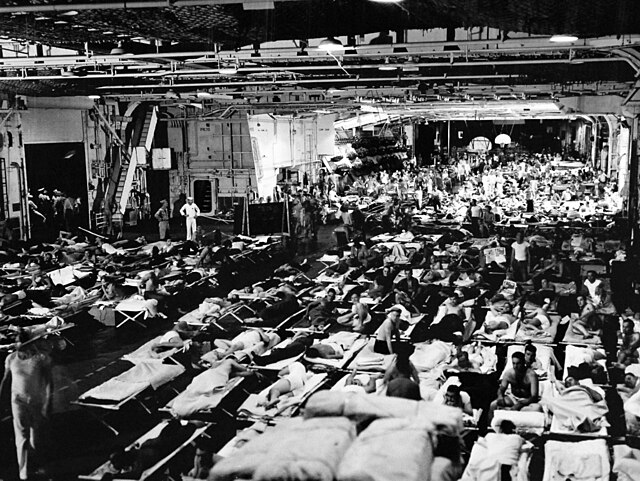
An Aircraft carriers hanger deck loaded with casualties from Okinawa, April 1945. War Department Photo.
The Navy operated over three hundred of these ship along with freighters of the Liberty and Victory types, over fifty oilers, and a myriad of specialty support ships. This allowed the Navy, Marines, and the US Army to operate efficiently more than 7,000 miles across the Pacific Ocean where there was little infrastructure to support operations. The logistics of the operations are literally mind boggling.
The APA’s were to serve a special purpose beginning in the waning weeks of July and August 1945. In the service any action needs have a name to identify it. Most, such as Okinawa which was dubbed “Iceberg” and the invasion of Guadalcanal “Operation Watchtower” general have no meaning other than to confuse the enemy but the name for the last major movement of men was oddly prescient. Operation “Magic Carpet” would return veterans of the Pacific home. By August the allies had just over 23 million troops and support service men in the western Pacific. The Aussies, New Zealanders, British, French, Dutch and the Mexican Air Force were all going home. Magic Carpet would be the largest mass transport of men and women ever attempted. Every ship type was going to be utilized for transport.
On July 25th Hilo Fuchiwaki and his team boarded an APA in Subic bay. The boys must have leaned over the ships rail and watched the sailors on the dock cast of their lines and felt the ship begin to vibrate as she backed into the stream and headed for home.
Dear Dona Page 15 is next.
Cover Photo: Holden Jeep ambulance. Missing one fender, other one dented. Shrapnel hole in hood, broken windshield. The exhaust pipe is extended to get it out of the mud. No paint and tow strap wrapped around the bumper. Hard used.
*Rikusentai, Imperial Japanese Naval Marine Infantry.
**The letter must have been written after the the capture of the Katchin peninsula by the 1st Marines. The battle for the island still had about ten weeks of combat left. He was, after a short rest to participate in some of the most brutal fighting ever seen in WWII. Private Loomis earned the Bronze Star for his actions on Okinawa.
***The book “Away All Boats” which was made into a movie of the same name based on the 1953 novel by Kenneth M. Dodson (1907–1999), who served on the USS Pierce (APA-50) in World War II and used his experiences there as a guide for his novel. It is considered a classic in naval literature.
Michael Shannon is a writer and lives in Arroyo Grande, California.




 atthetable2015