Dear Dona

Page 15

Michael Shannon

As the shipped nosed her way past Grande Island and the passing of Spanish Point off to Port she entered the Philippine sea where she picked up the two destroyers who were to be her escorts, the Quartermaster put her wheel over to Port and headed south. From the Philippine sea she swung southeast into the Sulu Sea. A 2 day run saw them turn east at the tip of Mindanao Island passing Zamboanga where the monkeys have no tails* then briefly south through the Celebes Sea until the could swing northeast for the open sea. The ship chugged along at 16 knots, her best speed while the escorts sailed in curlicues, on the hunt for submarines because even in June 1945 plenty of Japanese subs were still at sea hunting. Three days into the run to Guam where they were to pick up more casualties and returnees they passed within just a few miles of the spot at which the Japanese sub I-58 put two Long Lance Torpedos into a speeding cruiser which was not zigzaging but running on a plumb line. The Captain, James McVay was rushing to the Philippines to begin training his crew for the invasion of Japan. He was told there were no Japanese submarines in the area and his escorts had failed to appear so the cruiser was running alone.
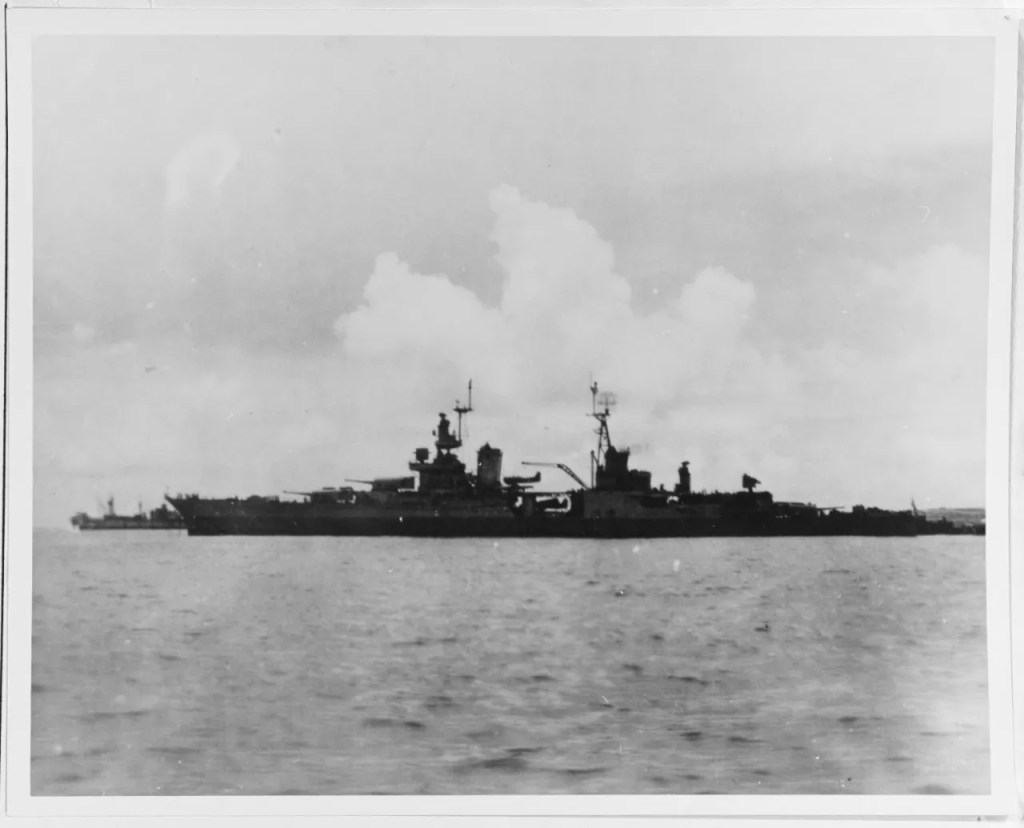
The “Indy” leaving Tinian after off-loading the first Atomic bomb. US Navy photo

USS Indianapolis CA-35, sank in just twelve minutes. Her bow was blown completely off and the second torpedo exploded in the after engine room and set of the main ammunition magazine. Of 1,195 crewmen aboard, about 300 went down with the ship. The after engine room crew boiled alive from escaping high pressure steam or were blown to bits by the explosion. Off duty sailors in the berthing spaces awoke to darkness and massive amounts of seawater which killed them in moments, their screams drowned in horror. The remaining 890 faced exposure, dehydration, saltwater poisoning, and shark attacks while stranded in the open ocean. With few lifeboats and almost no food or water they were eight hundred miles from land.

The Navy learned of the sinking four days later, when survivors were spotted by the crew of a PV-1 Ventura on routine patrol. U.S. Navy PBY flying boats landed in the rough seas to save those in the water. Only 316 survived. No U.S. warship sunk at sea had lost more sailors.**

Hilo and the rest of men aboard had no idea of the awful drama taking place just a few miles away. They wouldn’t know until the war was over either, for the cruiser had just delivered “Little Boy” to Tinian island the first of the atomic bombs which was dropped on Hiroshima City August 6th, 1945. The delivery was part of the biggest secret of WWII and the Indy was sailing under secret orders and radio silence. No SOS was sent from the ship.

The ship pulled in to Guams Apra harbor where she remained at anchor while more returnees and wounded were loaded. Fuel barges pulled alongside and began refilling her fuel bunkers for the long trip ahead. A repair ship floated at her side and lent the crew a hand in fixing or repairing anything on the list they could. Ships at sea are always broken. A welded ship nearly 442 feet long and rated for 10,000 tons of cargo, the Attack Transports suffered constant flexing and pounding while at sea caused all kinds of damage during operations. Though the Navy crew of 58 officers and 480 enlisted crew worked tirelessly to maintain the ship they could never entirely catch up.

Having traveled nearly two thousand miles, food to feed the crew and passengers was in short supply and barges coming out to the anchorage carried mounds of foodstuff which was winched aboard by the cranes on deck and stored away below. The quartermasters department was kept hopping seeing to the loading and storage of hopefully an ample supply for the rest of the voyage. Feeding and housing over 1,500 men and women returning to the states was a monumental job.

All this food was primarily stored in large, refrigerated and dry storage areas and consisted of both fresh and preserved goods. Cooking was done in massive galleys to produce thousands of meals daily for both the crew and the embarked troops. The logistical system was designed to provide as much variety as possible, though the quality and freshness of the food often depended on the length of the voyage and the availability of resupply.

A ship’s galleys were large-scale, industrial kitchens that operated almost continuously to feed the crew. Cooks, “lovingly” referred to a “Cookie” in the U.S. Navy, worked in 24 hour shifts, 8 hours per watch to ensure meals were available for personnel at all hours.

During long periods at sea, the menus would rely more heavily on frozen, canned, and dried ingredients as fresh supplies ran out. This was always a problem on tropical islands where fresh vegetables were seldom available.

The sailors and Marine would look at the twentieth plate of chipped beef on toast and mutter to themselves, “S**t on a Shingle” again? For veterans, any desire to eat it would be long gone by wars end.

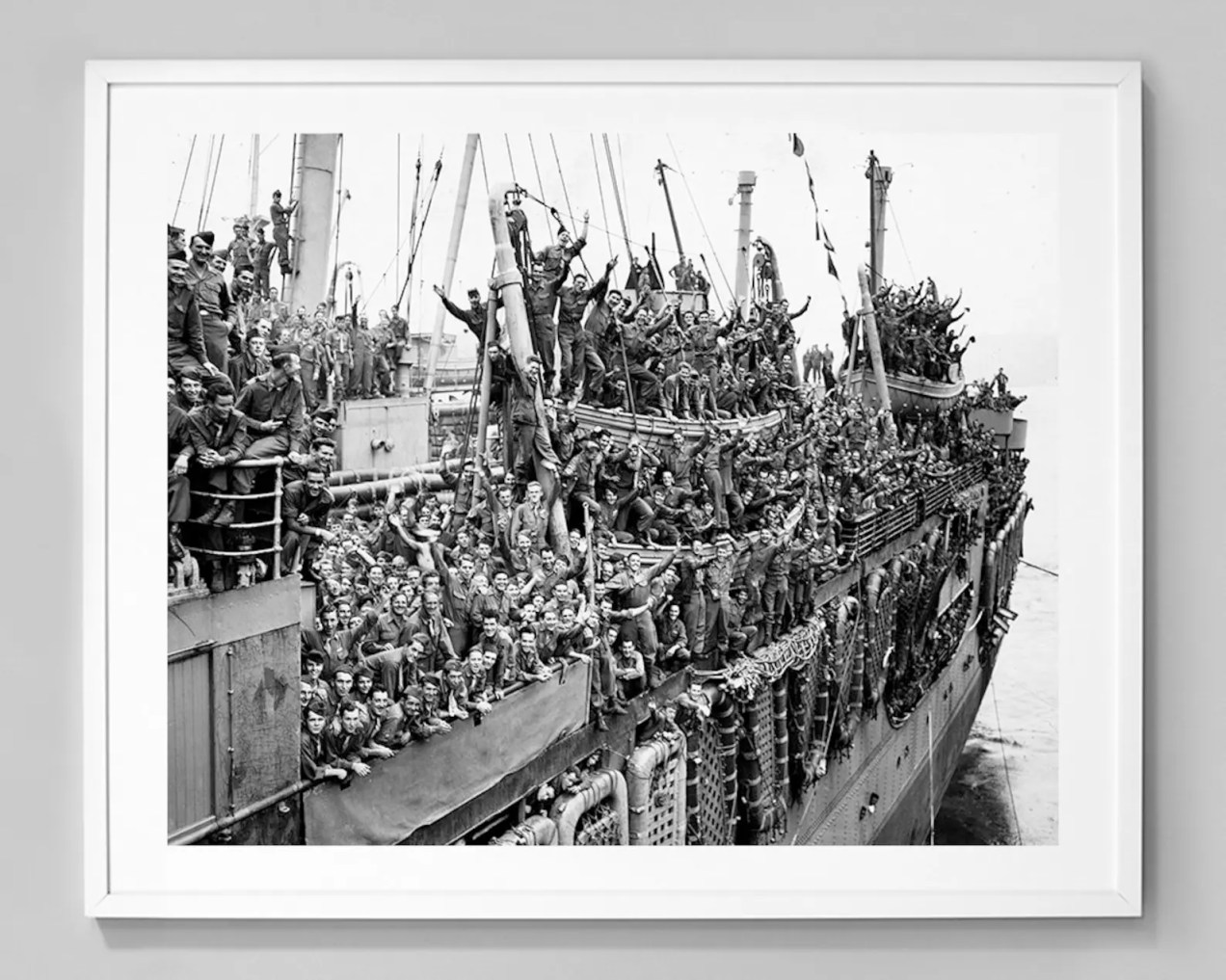
Leaving Guam for the west coast there were some things the troops and sailors could rely on. Chow was going to be monotonous. There would be much standing in line with more than two thousand to feed three times a day and by the time they arrived at the coast of California the mess crews would be like the walking dead, exhausted. For the galley crew these Magic Carpet voyages would be some of the hardest duty of the war for which they would receive scant praise. Perhaps a pat on the back from the Chief mess cook. There was little space for physical activity either, it was just too crowded and most of the passengers weren’t inclined to tolerate much spit and polish or discipline. How does the Shore Patrol or the Master at Arms keep them in line? You can guess. The Master at Arms who is the sheriff of the boat picks equally large and aggressive mates for his department and the officers generally turn a blind eye to the obvious bumps and bruises meted out in lieu of Captains Mast. Most Captains think that is a fair trade.

As always, things on A deck where the officers were housed was pretty plush, it was white table cloth, sterling silver and high quality food served by friendly Filipino stewards in white gloves. This increased the enlisted man’s mortal hatred of officers. While those below ate their monotonous meals the officers ate meals that were hardly less elegant than first class passengers had been served in more peaceful days. For supper it was dress whites or Suntans, shoes polished by the same stewards who served them and polite conversation. On some returning ships there were even army and Navy nurses to break the monotony and add to the hatred of the privileged. Most soldiers hadn’t seen an American woman in years and likely wouldn’t see those aboard their own ship.

What infantrymen know is that officers for the most part never share a foxhole with a Dogface. Few officers above Lieutenant ever get any closer to the fighting front than they can avoid. Those that did were revered but they were few. The thousands on the main deck or herded below seethed with bad will at the injustice of it. A famous phrase that came out of WWII concerned “old Blood and Guts” General Patton of whom his own troopers in the 3rd army were wont to say, “Yeah, his guts , our blood.” There are newsreels of him standing up in his staff car, ivory handled pistol on prominent display, speeding down the muddy roads of France, splattering mud on the tired an dirty troopers walking alongside and jauntily wave and pumping his fist in encouragement. Hardly a Doggie bothers to even look up. He slept in a French Chateau with Marlene Dietrich, they slept on the open ground under a dirty wool blanket. Hatred was putting it mildly. A pretty universal sentiment in the military wherever you went.

The last part of the voyage was over 6,000 miles, a quarter way around the globe. The attack transports had been hard used and most had never returned to Mare Island in the San Francisco bay for serious overhauls, they’d had to make do with bandaids and bailing wire. The boiler tubes were warped and caked with scale. Much engine room machinery was just capable of limping along at reduced speed. There were no places in the vast distances they were traveling where they could just pull over. The high speed destroyers racing around on patrol, duty they hated, it was monotonous and crews were frustrated by these voyages. They wanted to get ashore too. The navy was crewed by farm boys, mechanics, shoe salesmen and soda jerks, they were not or ever intended to be lifers. Their officers were reservists and would mostly go ashore once the war was over. Lifers were the men who manned the transport ships, civilian Merchant Mariners who had or would spend a life at sea. They shared the same dangers but the sea was their life.***

In the weeks at sea, Hilo and his mates were not afforded any special accommodations like the trip out in ’42. No more converted ocean liners for them, no private berthing, they were now veterans and their value to the army and marines were well understood. Though the MIS service was classified the people they worked with in the field knew what they did, they had seen them coaxing prisoners out of caves and half-destroyed pill boxes. They had crouched in foxholes with Marines and soldiers while the air buzzed with rifle and machine gun rounds. They had saved thousands of live across the Pacific. They had proven themselves.
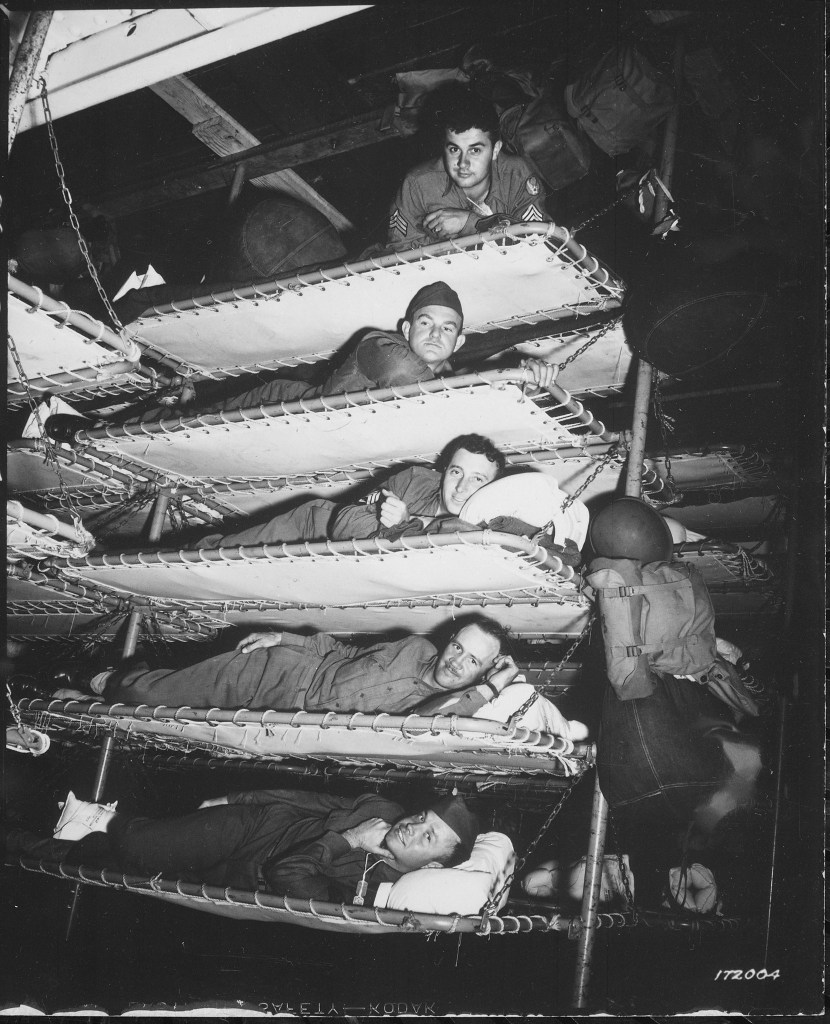
First Class accommodations. USN photo.

The most serious way to pass time at sea in a crowded ship was to sleep, play cards, roll “Dem Bones, or fight, of which there were plenty of takers. Books were rare though the ships had a small library and by the time they pulled into Long Beach Naval Base people were reading the instructions for operating machinery printed on the bulkheads. They read mattress tags, read and re-read letters from home until they literally fell apart, they read each others letters.

Without thinking the were putting away the memory of war and replacing it with the possibilities of the future.

Traveling the southern route in July and early August they were likely spared any serious bad weather but the monsoon in the southern hemisphere generated long swells which traveled north across the equator. smoothing out and lengthening in to long rollers that marched across the mid Pacific like ranks of soldiers. The Pacific or Mar Pacifico, the “Peaceful Sea” can be anything but. Named by Ferdinand Magellan as he crossed the southern hemisphere to his eventual fate in the Philippine islands. He passed day after day on a smooth almost oily ocean with most days, just a faint ripple of wind. The voyage from Patagonia to Guam took three and a half months. To quote Coleridge:****

Day after day, day after day,
We stuck, nor breath nor motion;
As idle as a painted ship
Upon a painted ocean.

Coming at right angles to the ships course they caused her to roll from Port to Starboard and back again. The motion caused some serious sea sickness. The old saying about seasickness is absolutely true. “At the first you think you’re going to die, by the second day you want to die.” By the time the ship reached the vicinity of the west coast near Point Conception on California’s western shore it drifted in a miasma of farts, the odor of unwashed bodies, their clothes and a skim of dried vomit coating her berthing spaces. No one had any desire to linger aboard.

Turning eastward into the Santa Barbara Channel the voyagers could, through the almost ever present fog clinging to Point Conception, poking into the Pacific like spear at the turning of California’s coastline from north-south to east-west, faint as a dream the sere brown and tan hills of home spattered by the greasy green chaparral, the hard dark green of coastal oaks and perhaps best of all the smell of home. Hardened soldiers and sailors were seen to cry.

Point Conception California. Hank Pitcher.

Hilo could not have been an exemption. He had been away for nearly four years. He could not have known exactly what to expect. He did know that the country he was returning to was an unknown place. His family was still in the concentration camp in the Sonoran desert of southwest Arizona, his Arroyo Grande friends scattered to the four winds. Where, exactly was home anymore?

Homecoming.

Page 16 of Dear Dona is next.

Cover Photo: returning troopship, Operation Magic Carpet, 1945

*”The Monkeys Have No Tails in Zamboanga” is the official regimental march of the 27th Infantry Regiment, as the “Wolfhound March”. The lyrics of this official version were written in 1907 in Cuba by G. Savoca, the regimental band leader (died 1912), after the regiment was formed in 1901 to serve in the Philippines. According to Harry McClintock, the tune was borrowed from an official march of the Philippine Constabulary Band, as played at the St. Louis Exposition in 1904. One version was collected as part of the Gordon “Inferno” Collection. As with many folk songs with military origins (such as “Mademoiselle from Armentières” from World War I), the song becomes a souvenir of the campaign for those who served. See below

**In the movie “Jaws,” Quint the shark hunter relates his experience as a survivor of the USS Indianapolis CA-35

***The Merchant Marine suffered the worst losses of World War II. During World War II, the U.S. Merchant Marine suffered high losses, with about 9,521 mariners perishing out of over 243,000 who served, representing a higher percentage casualty rate than any branch of the U.S. military. These losses occurred from enemy submarine, mine, and aircraft attacks, as well as the dangerous elements at sea, with 733 American merchant ships sunk and 609 mariners captured as prisoners of war. The US government ruled that they would receive no veterans benefits though their casualty rate was only slightly less than the Marines. In 1988 partial benefits were offered primarily for schooling but not on the scale of “Combat” veterans. Though sailors serving in wartime take an oath and are paid by the government they were not considered true servicemen. The author served in the Merchant Marine in the early 70’s and shipped with many veterans of WWII. Ask a man who was torpedoed twice in the Pacific if he considers himself a veteran.

****”The Rime of the Ancyent Marinere.” Samuel Taylor Coleridge. Written 1797–98

Oh, the monkeys have no tails in Zamboanga,
Oh, the monkeys have no tails,
They were bitten off by whales,
Oh, the monkeys have no tails in Zamboanga.

Chorus:
Oh, we won’t go back to Subic anymore,
Oh, we won’t go back to Subic
Where they mix our wine with tubig, (Water)

and on and on…

Michael Shannon is a Navy veteran and former Merchant Mariner. He lives in Arroyo Grande, California
Standard

Dear Dona

Chapter 13

The End And A New Beginning.

By Michael Shannon

Easter Sunday, April 1st, 1945, and where were you? I was resting in my mother’s arms in Sisters Hospital Santa Maria California. Staffed with sisters from the Poor Clares, a Irish enclosed order of the Holy Roman Catholic church. The sisters carried me to my mother from the nursery wrapped in a blue blanket and a small green ribbon tied in a bow in my sprig of blond hair, the only child born on that day. It’s been my luck.

Half a world away on the same date the tenth United States army made up of three Marine divisions and four army divisions started going ashore on the Japanese island of Okinawa. Supported by the Navy’s Fifth fleet made up of three separate task force units and the British, Australian Royal Canadians and New Zealanders. The combined forces numbered nearly 541,000 troops, 184,000 thousand of them combat infantry. The invasion was supported by a fleet consisting of 18 battleships, 27 cruisers, 177 destroyers/destroyer escorts, 39 aircraft carriers (11 fleet carriers, 6 light carriers and 22 escort carriers) and various support and troop transport ships.

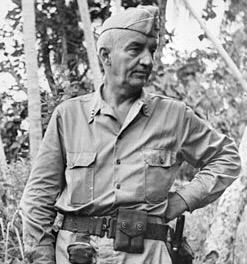
One of the great euphonius names of WWII commanded at Okinawa. Lt. General Simon Boliver Buckner jr. Named for his father he commanded the entire 10th Army. A graduate of Virginia Military Institute and the US Military Academy at West Point he had served in WWI and The Philippine Insurrection which I’m sure the Filipinos considered a war. His father Buckner sr. served in the Mexican war, the Civil war, was a Confederate General and Governor of Kentucky. General Buckner had iron clad credentials. Considered a soldiers General he was on the front lines with the 2nd Marine Division when he was warned by marines to remove his helmet with it’s three gold stars because they could see them a half mile away. He did. Moments later a small artillery shell hit near him and he was wounded by coral shards and died less than an hour later while being operated on in an aid station located in a shell hole.. He was one of four US Generals killed in WWII.

General Buckner was just one of the 200,000 deaths, including both military personnel and civilians. It was an orgy of killing and the newspapers back home listed casualties of such high numbers that the public which had become inured to the death toll was shocked into a stunned numbness. Marine casualties exceeded the total number of a single fully manned division. It was as if one of the three Marine divisions, the 1st, 2nd and 6th has been completely wiped off the face of the earth. The army suffered equally with over 19,000 dead and wounded. The Navy lost thirteen destroyers sunk by Kamikazes. Nearly sunk, the Essex class carrier USS Franklin, CV-13, the “Big Ben” lost 1,294 with 807 killed in the greatest single ships loss since the USS Arizona. Lest any one should think that support personnel were relatively safe 35,000 cooks, seabees, truck drivers, labor detachments, hospital corpsman and doctors were killed and wounded. The dead included two war correspondents.*

When the “Butchers Bill” was presented to the population of the United States and its government they were aghast. What was it going to cost to invade the Japanese homeland? You could scarcely drive down a street in the countries small towns without seeing small banners with gold and blue stars hanging in windows.

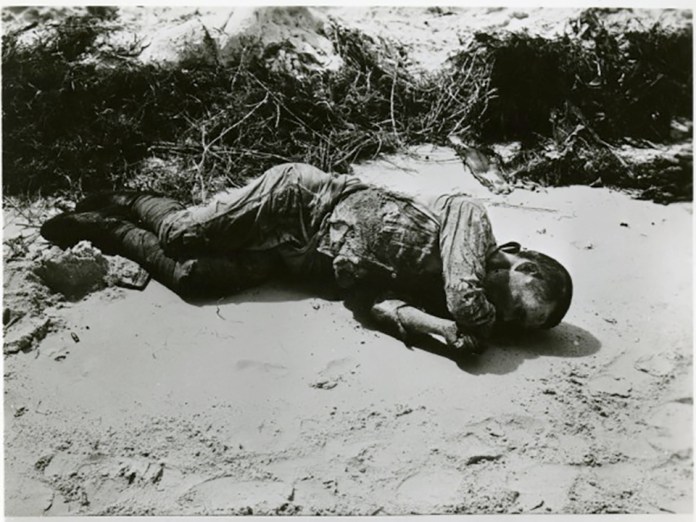
The Battle of Okinawa was a victory for the US but resulted in massive casualties on both sides. Japanese forces fought with the same fanaticism the Americans had witnessed in battles such as Iwo Jima and Peleliu. Rather than be taken prisoner, defenders often chose suicide. Okinawa was so close to home, most Japanese soldiers refused to surrender and fought to the death. Their fanaticism contributed to a dreadful toll. Some 110,000 Japanese and conscripted Okinawan defenders were killed in action. The battle created a humanitarian disaster for civilians as well. It is believed that the number of civilians casualties was greater than all battle casualties combined. Combatants on both sides, after three years of war were completely numb, bereft of any kind of humanity. Robert Leckie and Eugene Sledge both wrote books about their experiences and told the same story. Marines and soldiers automatically shot Imperial Japanese soldiers who were wounded, they also shot the dead to be sure they stayed that way. They told of the absolute necessity in a cold, pragmatic way, emotionless. No combat rifleman wanted an enemy soldier playing dead to suddenly come back to life and jump into their foxhole at night.

Later in Vietnam, a marine sergeant told Lieutenant Phillip Caputo. “Sir, before you leave here you’re going to learn that one of the most brutal things in the world is your average nineteen-year-old American boy. Phillip Caputo was Marine officer who served as a platoon leader in Vietnam. He was right. It is a quote that describes soldiers as far back in antiquity as you choose to go. It could have been said by a Hoplite in Alexander the Greats Macedonian/Greek army two and a half thousand years ago.

For the last time the Nisei boys boarded assault ships and sailed for the islands of the Ryukyu Group of which Okinawa was the largest island, 66 miles long and seven miles wide on average it was to be the last major battle of the Pacific war though no one knew it yet. It was also going to be the deadliest.

MIS camp, Okinawa, 1945. Signal Corps photo

The Japanese Imperial Army wasn’t nearly on it’s last legs. The Military leaders in Tokyo had determined that they would not engage in offensive battle but rather set up defense in depth and attempt to bleed the Americans dry. They well knew that after three years of increasingly brutal fighting the American public was losing heart. Printed in the nations newspapers casualty lists were enormous. Though newsmen tried to put a positive spin on war news, the Battle of the Bulge had just ended and cost the American army 81,000 casualties. People were war weary. We were running out of children to sacrifice. The High School class of 1944 was just finishing training and was headed for the front.

Mom’s cousin Don Polhemus, lost on the USS Spence during typhoon Cobra, her brother headed for the western Pacific on a destroyer. My dad’s best friend Sgt. Harry Chapek, killed in France, and his cousin Bill Marriott had just left New Guinea and was headed for Okinawa . Jim Moore, son of the judge and my grandparent’s closest friends LST was bombed in the Pacific.The war was everywhere in our little county. There were military posts in literally every town and all along the coast. People don’t think about it much anymore but there were P-38’s at Santa Maria, flying cadets at Hancock field, Coast artillery units above Pismo Beach, a Rec. Center in Grover City where my mother volunteered. There was a Coast Guard bases in Morro Bay and Avila beach. Amphibious landing were practiced along the Atascadero Beach. Camp San Luis Obispo was the largest infantry training base in the country turning out ten thousand soldiers with every cycle. Camp Roberts in north county on the Hearst ranch and just to the south Camp Cooke where Patton’s tank Divisions had trained on the dunes above Lompoc before North Africa.. Mom said military convoys clogged the old highway and would go through Arroyo Grande, rumbling people awake at all hours. The list carried in the old Arroyo Grande Herald Recorder titled “Our Boys in the Service” was filled with nearly four hundred names in August of 1943. They were the last names of kids I would go to school with. The bus drivers, librarians and teachers in our schools, the postman, truck drivers, housewives, doctors and pharmacists, all listed. Those that would never come home marked with a small black star. There were more than a few. All from a town with a population of less than five thousand people.

The troops were weary too. The American leadership put no real censorship on the news and the people at home and their families wrote of neighbor boys who were dead, wounded and captured. Every day, every thought grounded in the agony of a war that seemed to have no end.

Hilo and his team must have worked frantically to translate all the information coming in from the Army and Marines. The temptation is to think that all this emphasis on information was at this point useless. We al know the end of the story. Thats the problem with history. Though we can study events for their meaning there is one thing we cannot do and that is see the future. Hilo and his team hadn’t the least inkling of where it would end. The man at the center of the hurricane has no idea where the way out is. Even the big brass in the Phillipines, Pearl Harbor and Washington DC had no crystal ball. The only thing they could do was to press ahead.

Planning for the invasion of the Japanese islands was well under way. The war in Europe would soon be over, there was no doubt of that. Germany was finished. The only question was how much longer would the insane self destruction continue. Even the Dogface trudging along German roads, still dying daily knew it was over. They all wanted to live, Japan was waiting. They knew that is was different fighting the Japanese than the Germans. No one wanted to go. But they did. The first Army Air Corps units had already arrived from England. The Generals had no doubt that when the time came they would go. Bill Matousek, some day to be my family doctor, as a fresh replacement tank driver who arrived on the line just days before the battle of the Bulge knew it. My sister in laws father had fought all the way from Sicily to Anzio to southern France, he knew it too. Del Holloway, Orville Shultz, John Loomis*** Arch and Leo Harloe, your father too, they all knew what the next step was going to be. It’s all they talked about. It seemed to them that it would last for years. “Golden Gate in ’48” they said.

They knew nothing of the Manhattan Project and the bomb. During the fight for Okinawa, FDR died .On April 12th the day of his death the first order of business for the new President, Harry Truman was to be told about the bomb. It would be up to him to decide.

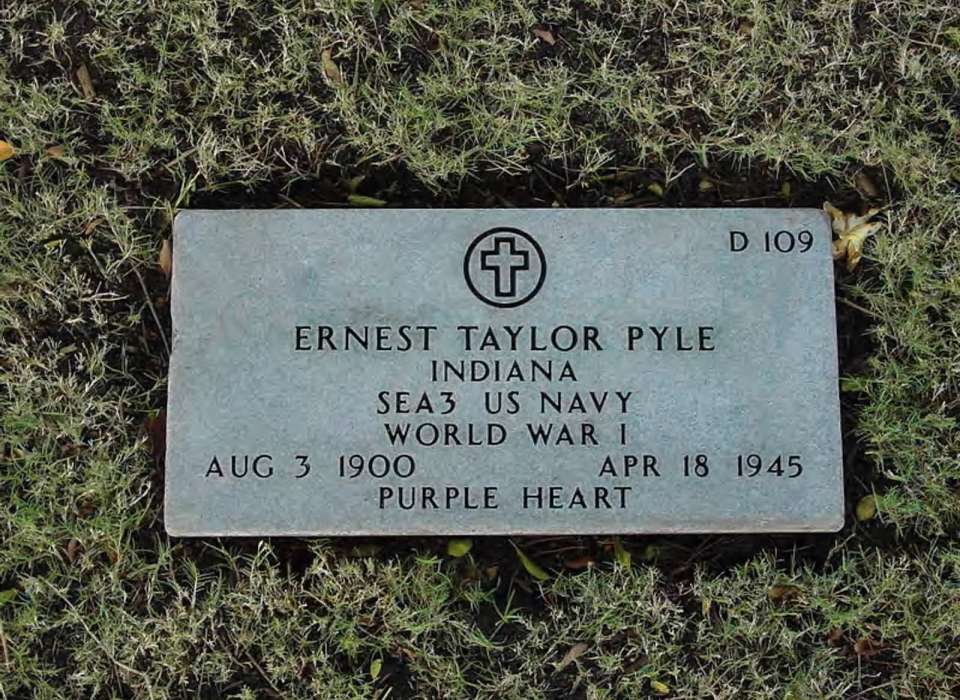
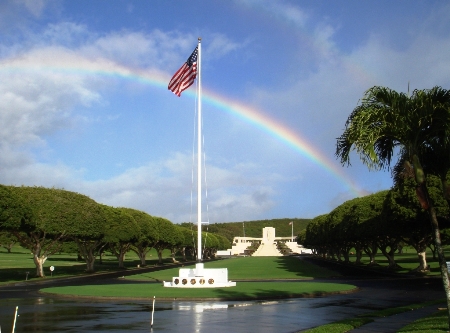
Ernest “Ernie” Pyle, the soldiers friend killed on Okinawa April 18, 1945 RIP National Cemetery of he Pacific, “Punchbowl” 2177 Puowaina Dr. Honolulu, Oahu, Hawai’i

They lie supine in their regimented rows where once they stood. They are the waste. The war dead. Those who know nothing pass them by on the road. Only as long as the markers, the holy grail of the left living, be visited by those who remember will they signify the personal cost. On memorial days and anniversaries families may gather at the stones to remember their children who all too often were in their teens or early twenties when they died. But during the rest of the year they are noticed only by the caretakers who mow between the stones.

The consequences, the blind, the amputees, the depressed, the suicidal, these insane, these jobless, these homeless, the side effects and delayed effects whose very existence keeps memories of the war alive when most citizens can’t wait to forget, or, remember in a circumscribed vision for the burial of the dead is a burial of memory. The National Cemeteries fulfill a desire to set it all aside. No one can say that they are not moving places but the arranged beauty does not evoke any memory of terrible battles.

Perfectly aligned marble does not resemble the memory of the men who lived them, but rather masks the heaps of the dead and wounded, They lay in piles, in fragments, limbs broken and contorted, Burned, muddy clothes shredded or ripped from bodies by the sheer velocity of the man made forces that took their lives. This, the veteran of combat knows and of which he will not speak. The impossible knowledge cannot be conveyed to the living, the wives and children and grandchildren. Thats the secret, the wilderness of slaughter and death, put away as if in a box to be gradually forgotten. It speaks to the resiliency of memory, the ability by some to bury the scars so deep they can never be found.**

Punchbowl

Next, Chapter 14. Home, it’s all changed.

*During the Battle of Okinawa in World War II, Ernie Pyle, a renowned American war correspondent, was killed by enemy fire. He was covering the battle for American newspapers and was known for his deeply humanizing accounts of soldiers’ experiences. Pyle won the Pulitzer Prize in 1944 for his newspaper accounts of the “dogface” infantry soldiers from a first-person perspective. He was killed by enemy fire on Ie jima (then known as Ie Shima) during the Battle of Okinawa. Another journalist, John Cashman, was killed in an aircraft crash on Okinawa on July 31, 1945,

**As far as I know I am the only living member of my family who recalls Corporal Edgar Green of the 2nd Australian Infantry whose grave is in the Baghdad North Gate military cemetery in Iraq. When I am gone so is Edgar, his incredible and brutal goes story with me. Markers are not for the dead but for the living.

***https://www.newspapers.com/article/the-arroyo-grande-valley-herald-recorder/179529347/ Follow this link to a letter home from a local Marine on Okinawa.

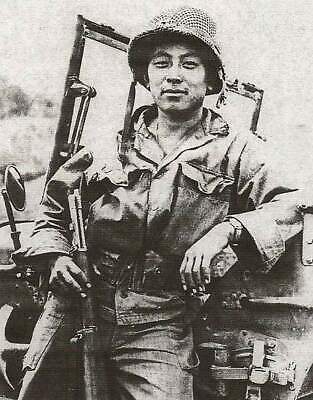
Cover Photo: Private Bob Hoichi Kubo United States Army MIS

Below is the link to “letters to Dona” page one.

https://wordpress.com/post/atthetable2015.com/1226

Michael Shannon writes so his children will know where they come from. He lives in Arroyo Grande California

Standard

Dear Dona 10

The End of a Hard Row.

By Michael Shannon

A hard row, something a farmer knows all too well.

As early as 1943, morale amongst the Japanese soldiers was very poor. The information compiled by the MIS translators wasn’t just about the killing of Admiral Yamamoto or Plan Z or the other logistical and strategic finds. US Army G-2 intelligence reported on the mindset of the ordinary Japanese soldier as seen through his own eyes in captured letters and journals.

One that can be easily manipulated politically. The difference for those being on the ground dealing with face to face combat or interrogation when captured left little to interpretation.

Many in the US believed the Japanese soldier was a fanatic, freely willing to give his life for the Emperor. The banzai charges. The kamikaze attacks. Individual soldiers throwing themselves under tanks with an explosive charge strapped onto their backs in a suicide attacks was the image the wartime press pushed. The truth of the matter is Japanese soldiers were farm boys, city boys, Just like our boys, they were drafted. Instead of dying in “banzai attacks”, these “fanatical” Japanese soldiers wanted to go home just like ours did. They couldn’t for fear of reprisal against their families by their own government. It must have been ironic to read of that treatment by the Nisei whose own families were behind barbed wire in concentration camps.

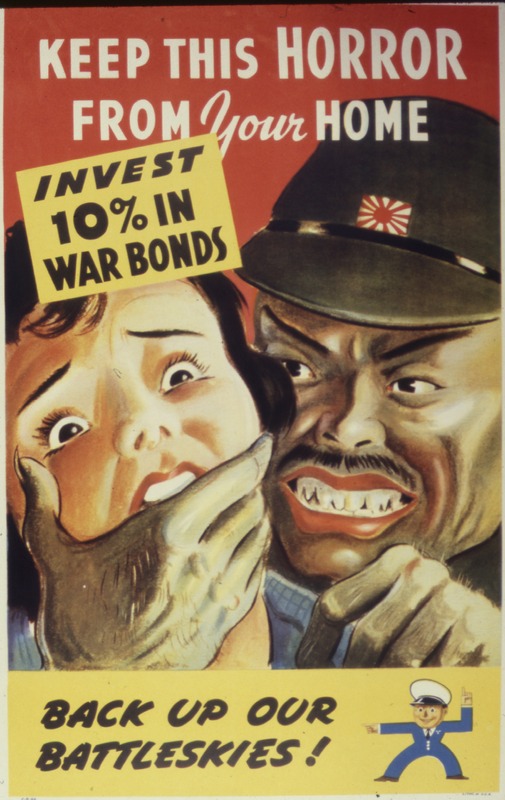
Neither side was immune from publishing the most scurrilous propaganda.

Being a buck private in the Japanese army made you a fanatic. In the American army you got the Congressional Medal of Honor. To a soldier of any army the end was the same. Media makes it seem that heroism is a choice but that is rarely so. Desperation or fatalism is much more likely.

General MacArthur told General Eichelberger, his chief of staff after the initial disastrous American showing by the 32nd division Buna-Gona, New Guinea, “I’m putting you in command at Buna. Relieve Harding. I am sending you in and I want you to remove any officer who won’t fight. Relieve regimental and battalion commanders; if necessary, put sergeants in charge of battalions and corporals in charge of companies, anyone who will fight, put ’em in.

MacArthur then strode down the breezy veranda again and turned back to Eichelberger . He said he had reports that American soldiers were throwing away their weapons and running from the enemy. Then he stopped short and spoke again, with emphasis. He wanted no misunderstandings about the assignment.

“Bob,” he said, “I want you to take Buna, or not come back alive.” Bob Eichelberger put on his three stars and walked into the front lines where the Japanese snipers could see him. Warned that he might be killed, he said, “I want my men to see a general in the line not in the rear. The word spread quickly through the Red Arrows troops and they turned the tide of the battle. That’s courage and the boys he commanded knew it when they saw it.

Eichelberger was recommended for the Congressional Medal of Honor, MacArthur disapproved it and awarded the Distinguished Service Cross to his staff officers at headquarters who saw no service. That was MacArthur at his political and selfish best. Eichelberger said nothing.

Major General Bob Eichlberger in New Guinea, 1943. US Photo

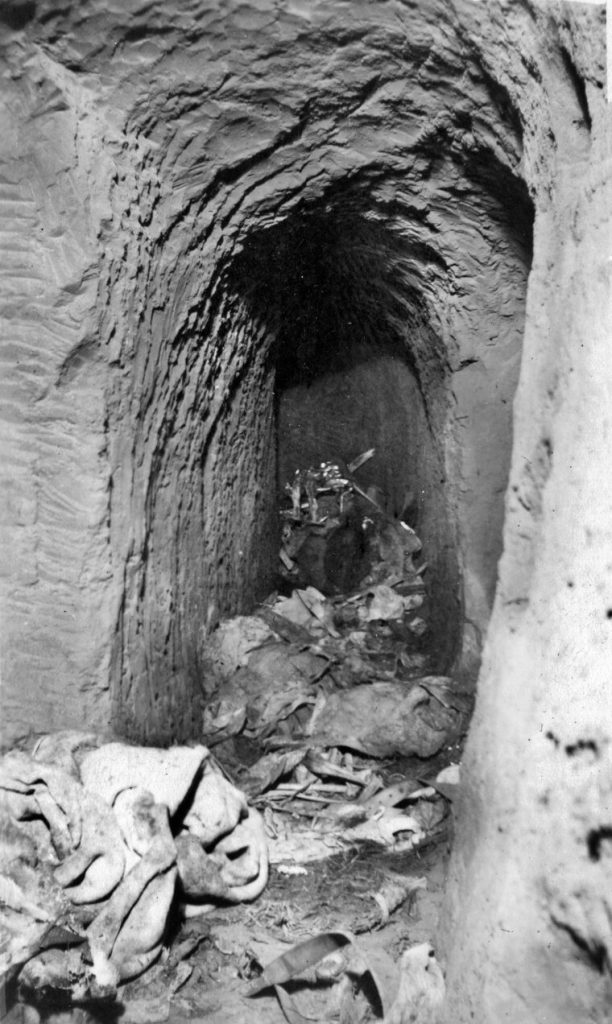
The MIS Nisei, as early as 1943 published a report detailing moral problems within the Imperial army. Culled from captured material, the official document spelled out problems within the Japanese officer corps. There were incidents of desertion, dereliction of duty, black market racketeering and hoarding rations for their own us. Enlisted men were homesick and felt helpless in the face of the war. Poorly led and often wasted in senseless attacks they were certainly as brave as American boys and throughout the Pacific campaign most American soldiers came to recognized this. Those Nisei who worked as cave flushers realized that the sense of hopelessness of soldiers hiding in caves during furious and savage battles were not always willing to die for the Emperor or their officers but could be talked into surrender by calm and kind words in their own language spoken by someone who knew their culture and in many cases who had been educated in their home prefecture.

Abandoned cave. USMC photo

Many of the MIS boys were descendants of families who emigrated from the southwest portions of Japan which were primarily rural. They came as contract laborers to work in the pineapple and cane fields of Hawaii and the fishing and agricultural areas of California. Hiroshima, Kumamoto, Okayama and Yamaguchi was where the majority of emigrants came from. By coincidence many of the Japanese troops in the southwest Pacific came from the same areas. The Kibei, American citizens who had been educated in Japan might, by a good chance be familiar with the home areas of the captured. The offer of a cigarette and comforting words from someone who not only spoke your language but in your own dialect quickly overcame any reluctance to speak. In many documented case the MIS translators personally knew schools, relatives, teachers, family members and in more than one case interrogated brothers, cousins and uncles. There is an instance where a cave flusher on Okinawa encountered his older brother inside.

The interlocking cave defense pioneered on Peleliu which brutalized the Army and Marines was quickly adopted by other Japanese units and even though you might not expect to see it used on the large islands in the Phillipines, it was. Your dad was still on staff with the Eleventh Army on October 20th, 1944 when the Philippine island of Leyte was invaded, the first step in the conquest of the Philippines by American, Australian, Mexican* and Filipino guerrilla forces under the command of MacArthur. The U.S. fought Japanese Army forces led by General Tomoyuki Yamashita. The battle took place from 20 October to 31 December 1944 and launched the Philippines campaign of 1944–45, the goal of which was to recapture and liberate the entire Philippine Archipelago and to end almost three years of Japanese occupation.

The invasion was a surprise because the Japanese assumed the Americans would invade Luzon first so many troops had been withdrawn from Leyte and those left had been pulled back from the prepared beach defenses. Fortunately for our troops, the Japanese General had withdrawn his troops from shoreline defensive posts. Even though there had been up to four hours of bombardment by the USN of the shore defenses, many fortifications – including pillboxes – were untouched. General Kenney concluded there would have been a blood bath similar to Tarawa if the Japanese hadn’t withdrawn.

The advance was so rapid that that MacArthur made his walk onto the Leyte beach a “Hollywood-esque” event on the first day. He actually had several takes done of wading ashore being the media seeker he was but. Being on MacArthurs personal MIS staff, you father may have been there though I could find no evidence of that. Soldiers in the know laughed at MacArthurs self promotion remembering him as “Dugout Doug” from Bataan and Corregidor in 1942. A foot soldier has a quite different view of rear echelon soldiers no matter how important he thinks he is. Patton’s well known nickname “Old Blood and Guts,” was easily changed to. “Yeah, his guts, our blood” by the infantry soldiers of his third army in Europe. Like a politician, which he was, the entire landing was a production. He had Manuel Quezon, the president of the Phillipines, several Philippine Scouts of the Filipino army, his staff officers each in his crushed hat echoing their bosses famous hat with the tarnished “Scrambled Eggs” and all wet to the knees. No one though to wear combat boots though and their dress brown shoes indicates they didn’t expect to even get wet. MacArthur was furious at the cox’n of the Higgins boat he landed from and wanted him punished until he saw the photos and decided he looked sufficiently heroic. The Cox’n was spared.

“I Have Returned.” Carefully posed and including representatives of the Filipino Army, the Army Air Corps and various staff officers MacArthur wades in for the third take. Check out the bemused expression on the face of the soldier just to MacArthurs right, above the little Filipino Major.*

“People of the Philippines: I have returned. By the grace of Almighty God our forces stand again on Philippine soil—soil consecrated in the blood of our two peoples. We have come dedicated and committed to the task of destroying every vestige of enemy control over your daily lives, and of restoring upon a foundation of indestructible strength, the liberties of your people.” MacArthur.

The landing on Leyte looked good on newsreel, there were even a few gunshots in the distance but the landing was safe enough for the men from the rear. Distant gunshots were exhilarating and added a little flavor to the event. The rest of the entire Philippine campaign would be bitter, savage and cost the United States military dearly. The Phillipines were not secured until the end of the war in August 1945. The Allies totaled up 220,000+ wounded and dead before it was over. The Japanese Imperial Army lost over 430,000.

Luzon was mostly jungle fighting but Leyte with the nations capital city of Manila turned out to be some of the worst urban warfare of the entire war. The Japanese were in desperate straits. The army and air force could not be reliably reinforced because the surface navy now controlled the air and US submarines controlled the inland sea and had devastated the Japanese surface fleet, particularly supply ships that soldiers on the islands were nearly cut-off from Japan.

Because of the MIS translators the Americans brass knew this. They knew where the ammunition dumps were, food supplies, location of all Japanese headquarters and many troop movements. At sea, the Navy was informed of Japanese Naval plans and was able to prepare for what became “The Great Marianas Turkey Shoot” when Naval aviators decimated the air fleets of the Japanese Navy and Army in the Battle of the Philippine Sea, downing 65 planes and sinking one of Japan’s last carriers. Fighting on the defensive with no air support the isolated Japanese troops on the islands became more desperate and fatalistic.

No one knew of course but the war had less than a year to go but the nature of war in the Pacific saw the fighting get more and more desperate and dangerous. There was literally no hope for the Japanese and they knew it.

Lance Corporal Kiyoshi Koto was starving and wounded, but it is unlikely that he was troubled by his hunger or his pain as he reached the front on the day he had written his letter. Koto was killed in action about midnight on the same day, and his letter was never delivered. Instead, an American soldier pulled the letter from Koto’s uniform pocket and took it to his Nisei MIS intelligence section. The letter was translated into English while a few of Koto’s captured countrymen dug a grave for him somewhere on the site of the battle. The short paragraphs that Koto had hoped would give his family a sense of closure instead became a source of information and a curiosity for his American enemy.

Every Japanese sailor and soldier was familiar with the Song of the Warrior, an ancient ballad that captured the centuries of fighting culture that made surrender unthinkable for Kiyoshi Koto and his comrades.

If I go to sea, I shall return a corpse awash;

If duty calls me to the mountain, a verdant sword will be my pall;

Thus for the sake of the Emperor, I shall not die peacefully at home.

By December Lance Corporal Kiyoshi Koto wrote his last letter home. By that time, his unit’s command structure was decimated and the battle strength of his army and its supporting navy was nearly destroyed. As he wrote, the characters on the page of the letter, they were written with shaking hand because Kiyoshi had been wounded in the right arm by a shell during an attack five days earlier. He struggled to carry his rifle because of his injury, and he had not eaten because critical supplies had not reached the beach, let alone the front. Koto understood very well that he was a dead man.

Koto wrote, “Every day there is bombing by enemy airplanes, naval gunfire and artillery fire. No sign of friendly planes or of our navy appears. The transports haven’t come yet either. I have not eaten properly since the 24th of November; many days I have had nothing to eat at all. From tonight on indefinitely, again without expecting to return alive, I am going out resolutely to the front line. Even though I am holding my rifle with a right arm that doesn’t move easily, now is the time for me to dominate a military contest. I must serve as long as I can move at all.

“The Regimental Commander, Colonel Hiroyasu, 16th Infantry, died in battle. The battalion commanders are all either wounded or dead. My own company commander is dead. Two of the platoon commanders have been wounded; one of them entered the hospital for medical treatment and was with me there. In our company NCOs are acting as platoon commanders and privates as squad leaders. At present my company has come down to a total of only 30 men. Of the soldiers in my squad three were killed, four wounded, and at present four in good health are doing hard fighting. As I too am soon to leave for the front lines I should like to see their cheerful faces. The platoon leader, convalescing and almost up, says ‘Go to it Kiyoshi!’”

Koto includes greetings to members of his family and closes, “I am writing this as a farewell letter.”

Saipan 1944. National WWII Museum. Gift of Akita Nakamura.

The answer, as the balance of the war proved prophetically true, was combat with no quarter. And the actions of soldiers letters offer a glimpse into the mind of Lance Corporal Kiyoshi Koto, who also refused to surrender when he found himself in a losing battle. He wrote his farewell letter home, and on the last day went forward to fight and die. He had no illusions about his future. Instead, his thoughts were with home and with his brothers in arms along with a final hope that he could save his family the pain of not knowing what had happened to him.

Dear Dona Page 11

Your fathers original group of four hundred translators that worked in Brisbane in 1943 had been broken up into smaller units and was now spread all over the Southwest Pacific. Many of them now shared the privations and dangers of combat and had taken to carrying rifles and wearing helmets. They operated just behind the lines and were subject to enemy gunfire, artillery and bombs.

Dear Dona 11 coming on February 1st.

* Mexico’s Escuadrón 201, The Aztec Eagles, equipped with Republic P-47D Thunderbolt fighter aircraft distinguished themselves in providing close air support to American ground units as well as long-range bombing strikes deep into Japanese held territory.

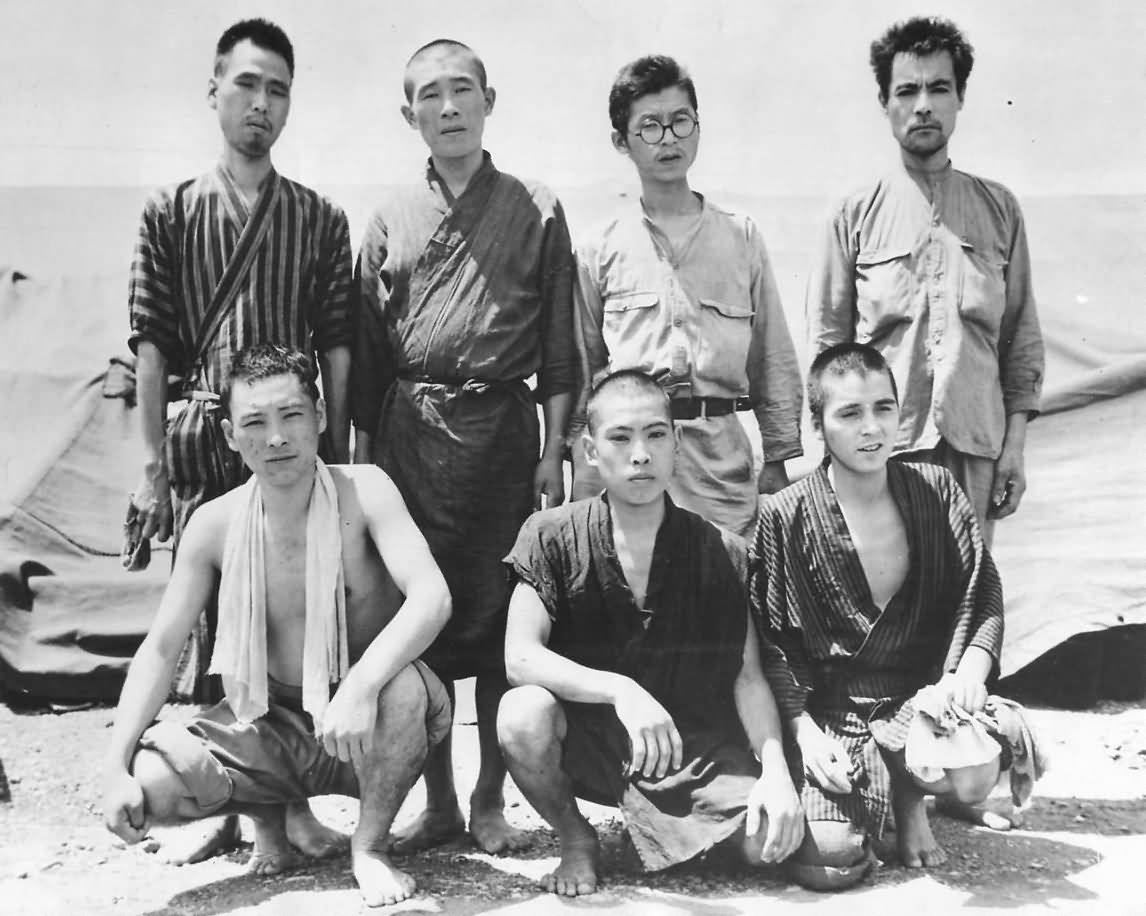
Cover Photo: Captured Japanese soldiers on Okinawa.

Michael Shannon is a writer from California and personally knew the protagonist in this story.

Standard

Dear Dona,

Page 6

Author: Michael Shannon.

Auckland, New Zealand. 1943 population, 1.642 million people with a revolving population of soldiers and Marines. The New Zealand government was very concerned about the Japanese because without the Americans to defend the island they were in trouble. You see, the Anzacs were in Italy, the Mediterranean and North Africa, as well as Japan in south-east Asia and other parts of the Pacific. They weren’t home and the islands, just like Australia were desperate for the Americans to help defend them. Japanese submarines were patrolling the waters between New Zealand and Australia. In 1942 the United States navy had just barely stopped the planned invasion of Port Moresby in New Guinea. The reason was its close proximity to both Australia and Asia. The Japanese viewed Port Moresby as a key point to launch aerial attacks on the northern part of Australia. They could have closed the sea lanes from the U S to Australia and New Zealand. Troops fighting to defend New Guinea, the Anzacs, Dutch and MacArthur’s undertrained, rag tag 32nd division from Wisconsin and Michigan were slugging it out with Japanese in the fetid, rainy jungle of the southeast of New Guinea trying to push the Japanese back along the Kokoda trail and down the Owen Stanley range toward the coast. Soldiers on both sides had to literally crawl on their hands and knees because the slopes were so steep and slippery from the constant rain. There was no more brutal fighting in WWII. Nisei translators later found Japanese diaries which describe starving soldiers butchering and eating the Australian dead. The Japanese were literally starved out.

Soldiers were granted time away from the ship in Auckland. It was a chance for the Americans to sample a culture quite different than their own. For the Nisei who were well acquainted with ethnic hatred it brought to mind some curious observations. The Kiwis’ didn’t consider the translators outsiders. Neither did they dislike the black support troops from the ship and ones stationed at the army camps ashore. This was a big difference from the way white Americans treated their fellow citizens. On the voyage over, great care was taken to segregate troops of color from their fellow soldiers. Contrary to what is written in history books, violence towards minorities was common in our military.

On June 12, 1942, five transport ships carrying US Army troops arrived in Waitematā Harbour in Auckland. This marked the beginning of the “American invasion” of New Zealand, which lasted until mid-1944. The New Zealanders were quickly disabused of their inherent like of their fellow allies.

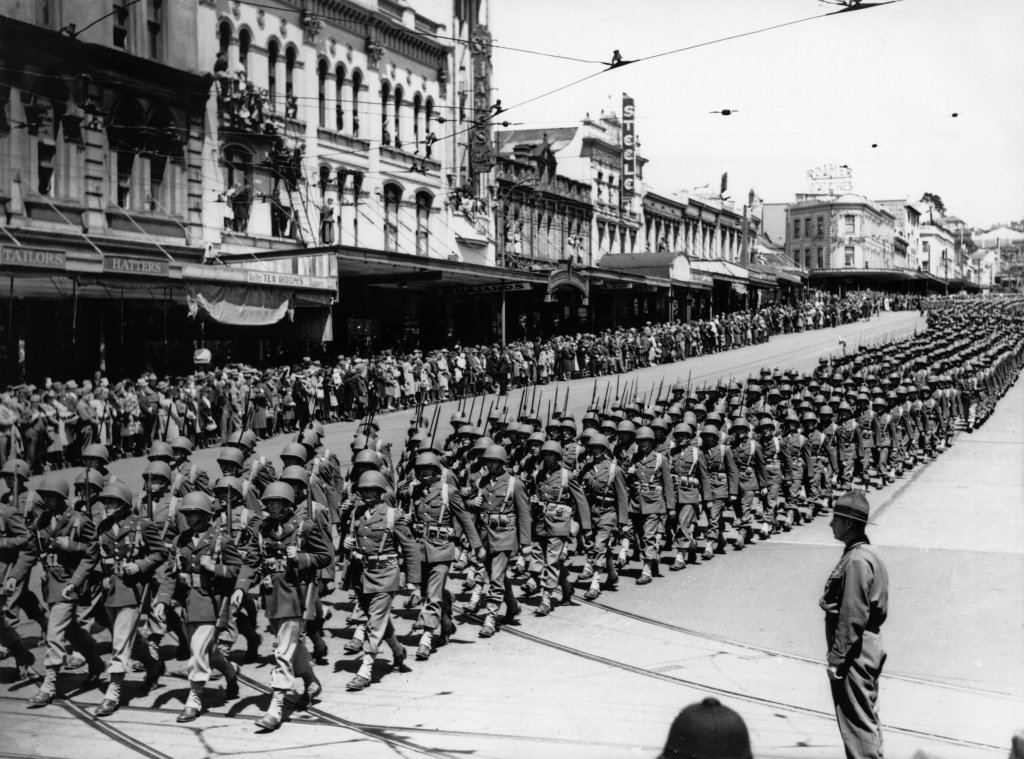
US troops march down Queen Street, Auckland, 1942. New Zealand Herald Archives photo.

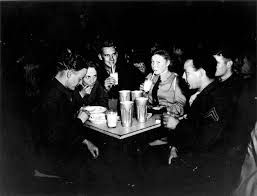
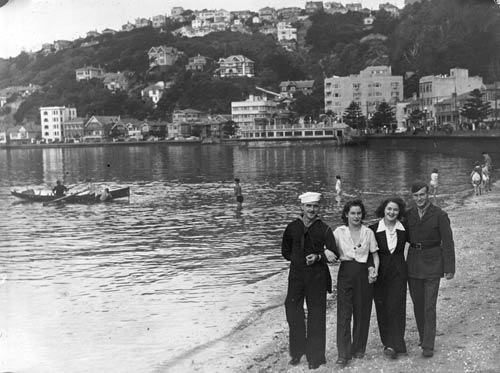
Between 15,000 and 45,000 American servicemen were stationed in New Zealand, mostly in camps in or near Auckland and Wellington.There were cultural differences between the Americans and New Zealanders. New Zealand women found the US servicemen to be handsome and polite, and they had more money than New Zealand soldiers. They were better dressed than the local troops and being young and very far from the moral strictures of home had few reasons to show anyone respect. Women of all kinds were “fair” game, the way they saw it. This led to romantic entanglements between American troops and New Zealand women. “Overpaid, oversexed and over here” was the watchword for the New Zealanders. The locals saw it as an “American invasion”. Many New Zealand soldiers resented the idea of relationships between New Zealanders and American soldiers, leading to tense relations between the two parties.

Another source of tension was US servicemen’s attitudes towards the Māori. White soldiers from the 31st “Dixie Division” from the south were not “comfortable” with Māori soldiers. The government published a guide book for US servicemen, titled “Meet New Zealand” which reminded the Americans that “the Maori today occupy a position in society socially and politically equal to that of any pakeha or white New Zealander”. The Prime Minister’s office said that New Zealanders should “be friendly and sympathetic towards the colored American troops, but remember that they are not accustomed in their own country to close and intimate relationships with white people. Anyone finding themselves in the company of both white and black American troops was advised to “avoid unpleasantness”. Quite the understatement.

During this time, hotel bars closed at 6 pm and masses of drunk soldiers were then ejected into the streets. This was known colloquially as the ‘six o’clock swill’. Around 6 pm on the evening of 3 April 1943, fighting broke out between US servicemen and New Zealand soldiers and civilians outside the Allied Services Club. The brawls spread to the ANA (Army, Navy, and Air Force) Club in Willis Street and then to Cuba Street and continued nonstop for hours. Civilian and military police attempted to break up the fights, but only finally subsided as the US soldiers left town on trains back to their camps. 6×6 army trucks returned the passed out drunk and those damaged by the shore patrol and the MPS. Courts Marshalls were ordered then cancelled for lack of any evidence, another understatement.

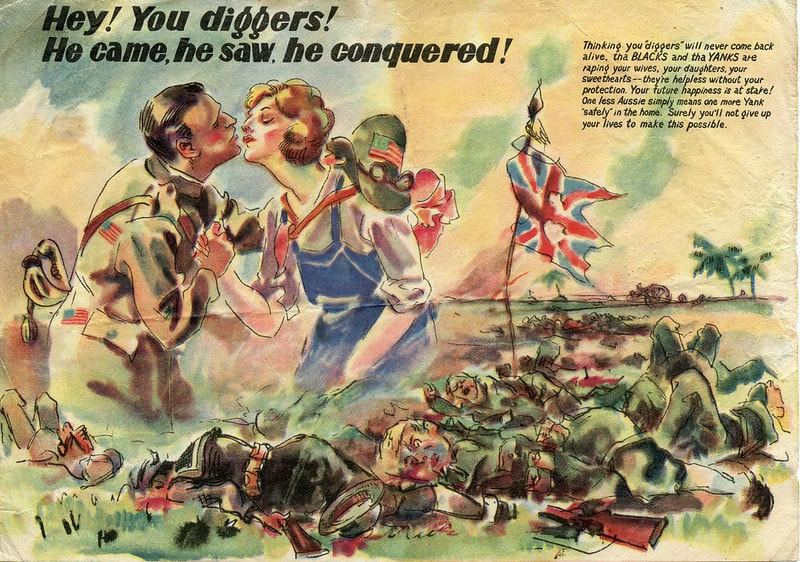
The Japanese also understood the value of propaganda. Japanese leaflet. 1943 US Army Archives

When your dad arrived with the other Nisei, the New Zealanders accepted them as equals but their own countrymen, far less so. Any thought by the translators that their service would reduce the racism of white troops was an unlikely dream. They had to be very careful.

A fight on 12 May 1945 in Cuba Street involved over 150 Māori and US servicemen. This fight was definitely racially motivated: Māori troops were angry at their treatment by the Americans, who tended to treat them the way they treated black Americans. Military reports stated that “Maoris from whom statements were taken allege they have been insulted by the Americans and have been told by Americans not to ride in the same tramcars, drink in the same bars, eat in the same cafes and that they should walk via back streets or step off the sidewalk when American soldiers approached. The Americans call them black curs an N*****s and have consistently insulted the Maori race. Imagine traveling halfway around the world only to find the same intolerance and hate as in your own home town. The only modifying thing was that the New Zealanders accepted both the Blacks and Japanese translators with no reservations. They were welcomed in New Zealand’s establishments and into their homes as well.

Because the MIS translators were considered so valuable, General MacArthur ordered them to be sent to Brisbane, Australia immediately. When they stepped off the ship in Brisbane, and were driven to army headquarters the first thing they were told was to avoid places where American soldiers hung around. Just like Auckland and Wellington, Brisbane had seen vicious riots on more than one occasionAmericans had worn out their welcome.

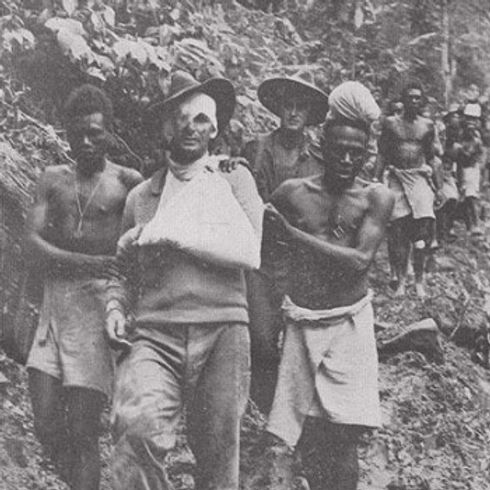
By late summer of 1943 the offending division had been moved to the front in New Guinea where they again failed to distinguish themselves in the vicious fighting on the Kokoda trail where the Imperial Japanese army had been pushed back over the Owen Stanley range of mountains by the Anzacs. At nearly 14,000 feet, the battles in the clouds as the news called it, the Aussies not only fought the Japanese but triple digit heat, little water, almost no food and what they did have had to be hauled up the nearly vertical mountains by the New Guinea natives who supported the Anzacs, the so called Fuzzy Wuzzy Angels. “Fuzzy Wuzzy Angels” was the name given by Australian soldiers to Papua New Guinean water carriers who, during World War II, were recruited or forced into service to bring supplies up to the front and carry injured Australian troops down the Kokoda trail during the Campaign. Over the four arduous months, the Fuzzy Wuzzys helped secure an Australian victory by forming a human supply chain along the Kokoda Track, moving food, ammunition up and wounded soldiers down from the front lines. 625 Australian soldiers were killed during the Kokoda Campaign, and over 1,600 wounded. Additionally, in excess of 4,000 soldiers became casualties due to illness. More than 150 Papuans died as members of the Papuan Infantry Battalion or as carriers of critical supplies and wounded along the Kokoda Trail.

New Guinea auxiliaries helping an Australian soldier down from the Owen Stanley mountains. Australian War Museum photo.

the Australian and New Zealanders finally defeated what was to be Japan’s last attempt to invade Australia and cut the sea lanes from the United States. The battles now moved to the northern end of New Guinea. Port Moresby was secure and planning was underway for the next step up the island chain towards Japan itself.

MacArthur moved his headquarters from Brisbane to Port Moresby in New Guinea. Your dad and his other translators packed up and went with him. They were working seven days a week. Hundreds of thousands of diaries, letters home and military communications were being processed every week by the MIS translators. Rather, as you might imagine just a primarily local project, it had become necessary due to the volume of documents being found in caves, the bodies of dead Imperial troops and radio intercepts to establish a communication network that encompassed the men with MacArthur like your father and the cryptographers at Pearl Harbor, the language school at San Francisco’s Presidio and the school at Fort Snelling in Minnesota. A network was set up to handle the radio traffic between places and to provide air transport to move the thousands of crates of captured documents.

Leaving the comfortable billets in Brisbane, your father and his crew packed up and moved to the decidedly less cushy environs of Port Moresby, New Guinea. They would have to get used to the new arrangements. It would be a long time before they saw a solid roof over their heads or a decent shower. It would be canvas and cold water from here on out.

Tent 29. Camp Chelmer, Indoorooplily, Queensland, Australia. November 1943. Joe Iwataki photo

Dear Dona . Page 7 Coming December 27th.

Standard

Dear Dona, 2

Written By Michael Shannon

Page Two

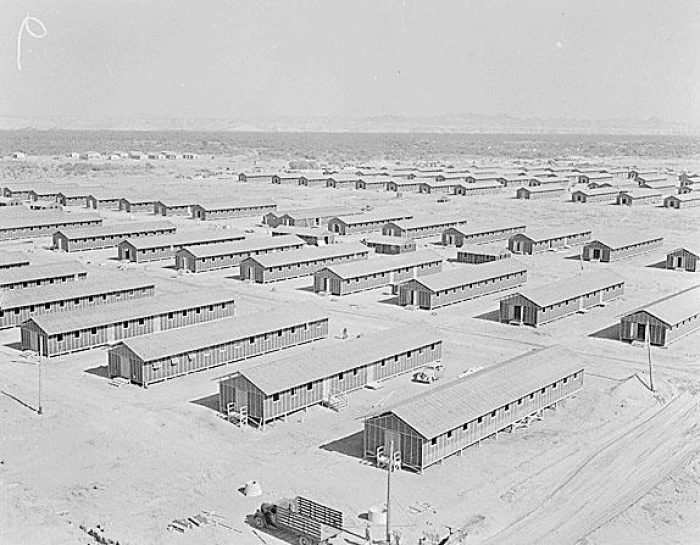
The living quarters of the Poston relocation camp, Poston, Arizona 1943. Pop: 18,000

Poston Camp

Endless rows of tar paper buildings housing six to eight families with no partitions, no toilets, no furniture and no running water. It was 88 degrees in April. They would not see temperatures under 100 degrees until Christmas. The camp was completely surrounded by nothing. No trees, no grass only desert scrub. On top of all that, it was not the worst of the all camps. I have a friend who remembers a little about life there. He was just a small boy from Guadalupe but he does remember the heat. Mothers tried soaking sheets and hanging them inside in the high summer. He said the little kids would run back and forth the length of the barracks purposely running through the wet and slightly cool sheets.

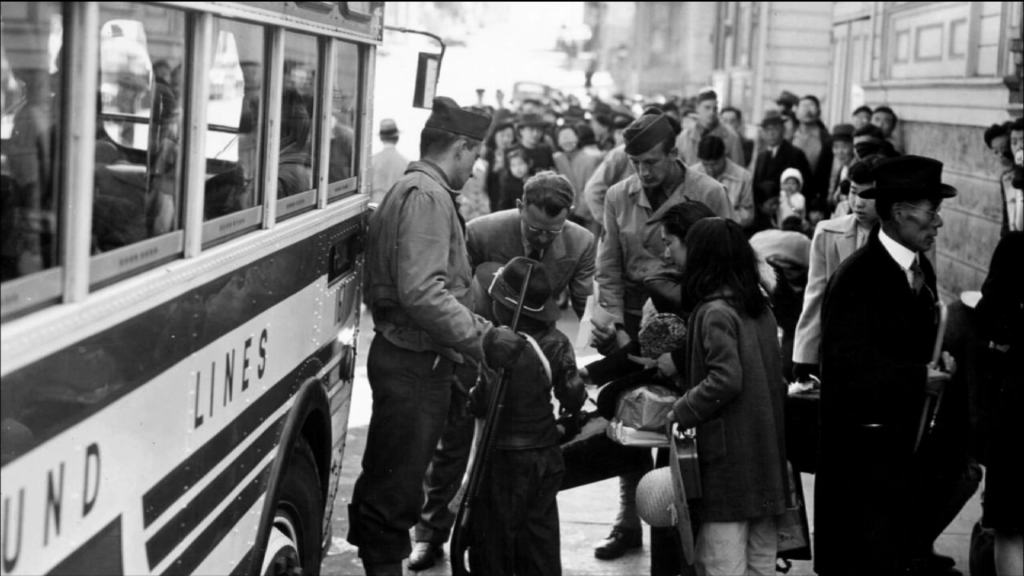
It’s pretty easy to form a picture of your great grandparents taking your dad to the old Greyhound bus depot at Mutt Anderson’s cafe, both wearing their best clothes as they did for important occasions. In 1941 they would have both been wearing hats, he in his Fedora and she with her go to church best, purse on her arm and those sensible heels women wore then. Mom holding a crushed linen hanky in her clenched hand. The family scene is always the same, father looking prideful and the mother just on the edge of tears but holding it all in so as not to embarrass. Hilo would have walked up the steps into the bus and found a seat, maybe at the window so he could look out and see mom and dad. All of them giving a subdued, shy wave as your grandparents hearts broke. Perhaps your mother was there too. My guess is she was.

Boarding the buses April, 1942

I well recall my own parents took me to the Greyhound in San Luis in 1966. My father proud, my mom doing her best to smile but visibly shaking. When the bus pulled out, I looked back to see her fall into my dads arms and bury her head in his shoulder. Just like your grandmother my mother had to go through the leave taking twice.

It is very different than sending a child in peacetime. Then they knew that the devil would take his due and this might be the last time the beloved boy would ever be home again. As always the future was grim and completely unknown.

George, Hisa and Yasbei Hirano with a picture of their son Hirano, Robert; Private; 442nd regimental combat team, 2nd Battalion Headquarters company; killed in action 26 June 1944 at Belvedere, France.

After enlistment your dad was sent basic training at Camp Roberts in San Miguel. He arrived there on the 29th of October and was assigned to Company B of the 82nd Training Battalion for 17 weeks of basic Infantry instruction. He was fortunate. By 1944 boot camp had been reduced to just eight weeks because of the expanding war and the urgent need for new soldiers. Basic is designed to teach you about the Army, it’s history, Its rules and how to operate as a group or groups of many different sizes. Your dad qualified as an expert marksman. He also passed courses in map reading, signals and hand grenade. He learned to fire the 80 mm mortar though he wasn’t assigned to a mortar platoon yet. Guys that weigh 125 pounds are too light to carry them so I’m sure he felt pretty fortunate. He stuck bayonets into canvas bags, fired the fifty caliber machine gun and could disassemble and reassemble his 1903 Springfield rifle with his eyes closed.

Just a week after Pearl Harbor he was headed for Fort Lewis Washington to join Company D, 162nd Infantry. The 162nd was a component of the 41st Division, Oregon National Guard which had been inducted into the regular army in late 1940. The beginning of WWII saw the various state National guards federalized for national defense. Strange as it may seem, the state you were from had little to do with where you were assigned during wartime. It was simply a matter of bodies needed.

While at Fort Washington which is near Tacoma he received further training as a mortar man. The military seems to have a perverse way of surprising you. He qualified as an assistant gunner in February and was re-assigned to the 138th infantry regiment of the Missouri National Guard. The Missourians had probably never met a Nisei since the 126,000 thousand plus Japanese in America were almost exclusively living in the far west, primarily California. One of the great things about the army is the mingling of kids that are from parts of the country where their upbringing and customs are so different. A sort of culture shock takes place at first until they learn that at heart they are not so different. I think you can say that your father like many kids, remember he was just 22, was getting a real education about the country he lived in that didn’t come from any textbook.

The 138th was ordered to Alaska that same month. Going with them would be Private Hiraoki Fuchiwaki, assistant gunner on a mortar crew. Right, a mortar crew for which he was deemed to light too carry. Thats the army for you.

Your dad’s commanding officer was Colonel Archie Roosevelt one of Theodore Roosevelt’s four sons who served in both WWI and WWII. Archie was the only one who survived. Quentin Roosevelt was the youngest son of President Theodore Roosevelt and Edith Roosevelt. Inspired by his father and siblings, he joined the United States Army Air Service where he became a pursuit pilot during World War I. He was killed in aerial combat over France on Bastille Day, 1918. Ted, the oldest died soon after the Normandy invasion. He was a Brigadier General and died of a heart attack while leading his troops. He was awarded the Congressional Medal of Honor for Bravery. Kermit died after serving in North Africa in action against the Afrika Corps and then fighting the Japanese in Alaska.

I mention the above because the sense of duty people felt was different then. Wealthy, educated and privileged kids stepped up. Sons of bankers (Clair Gibson, Army Air Corps), Judges, (Jim Moore, Navy Seabees) and the well-off who could have wangled a deferment but stepped up to the head of the line. (John Loomis, Marines) The list from Arroyo Grande is long and represented are kids from all walks of life. Grown-ups you knew in school who were your teachers, Del Holloway, Army, Cliff Boswell and Al Sperling, Air Corps, your neighbors, Gordon Dixon, Army, Ace Porter, Army, James Mankins, Army, all three Baxter boys, Don, Bill and Tommy, Navy, Maxine Bruce, Chuck Bells mother and Virginia Campodonico, from the Nipomo clan. Both were Army nurses who served overseas. Your father must have felt the same, that he owed it to his country to serve. He and your uncle were amongst hundreds of young men and women who volunteered from our county.

Many Nisei volunteered out of the camps, the ultimate irony, jailed and held under guard by a suspicious government they nevertheless took it upon themselves to serve a country who didn’t want them.

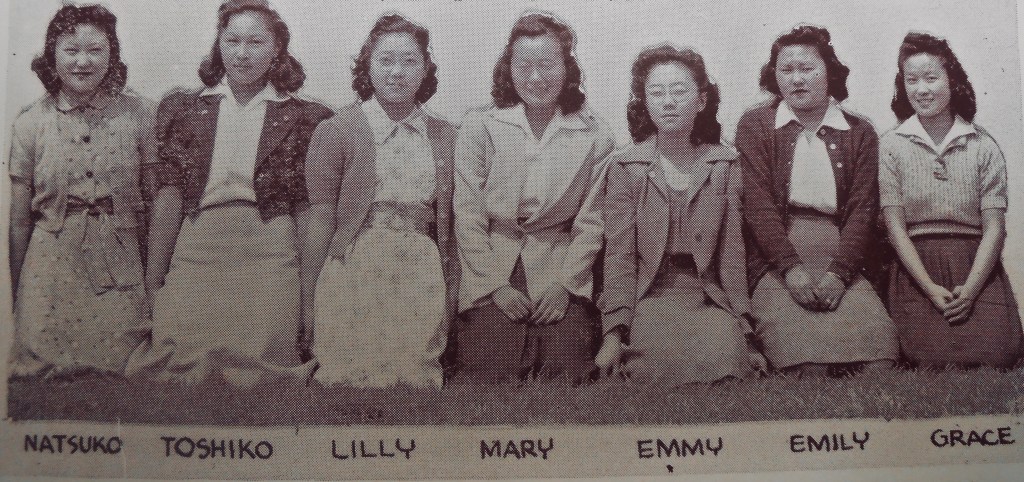
It wasn’t only the boys either. we wasted the girls and young children, five years stolen from young lives. High school girls with an entire life before them were ripped from school, loaded on buses and taken on the long drive to barbed wire compounds guarded with machine guns. Some would be held until 1948. A single drop of Japanese blood was all it took. Adopted kids went, mixed race kids too. Even white kids raised in Japanese homes. A young man whose mother was half Japanese was at Manzanar. He said because he was mostly white he was allowed to go to high school in Lone Pine where the other kids called him “The Jap.”

Arroyo Grande High School Graduates class of 1941. Courtesy AGHS

Sixteen or seventeen year old kids of any generation are ill equipped to understand the why of it. The transfer must have been stunning. The Nisei in Arroyo Grande High Schools class of 1941 represented a full 22 percent or more than one in five pupils. Every former student interviewed made a point of saying that there was no bias with the Japanese American kids and in fact they were fully integrated into school life.

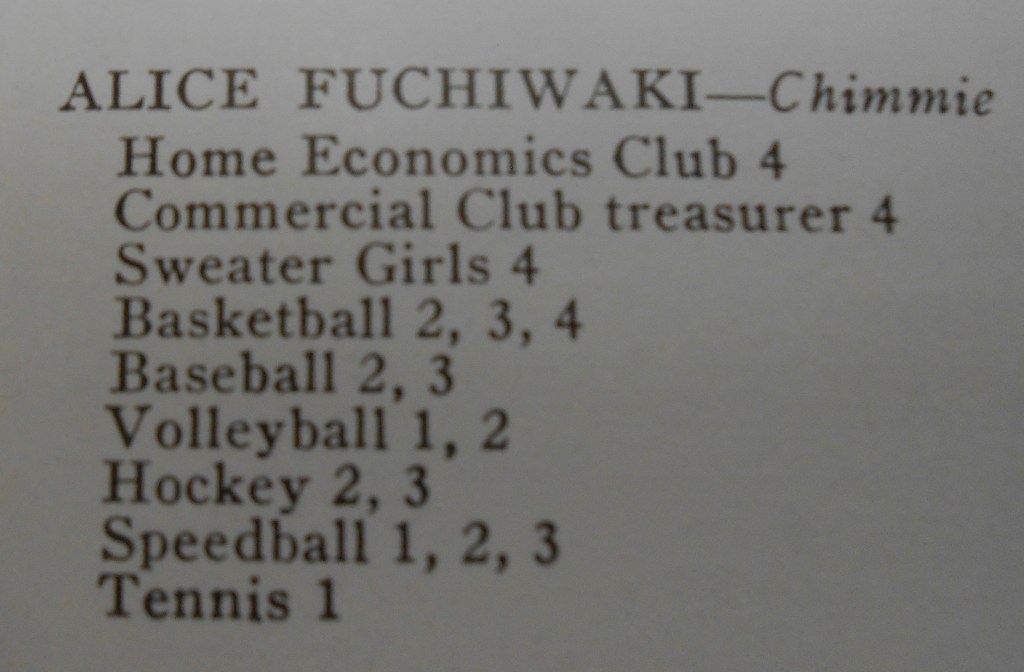
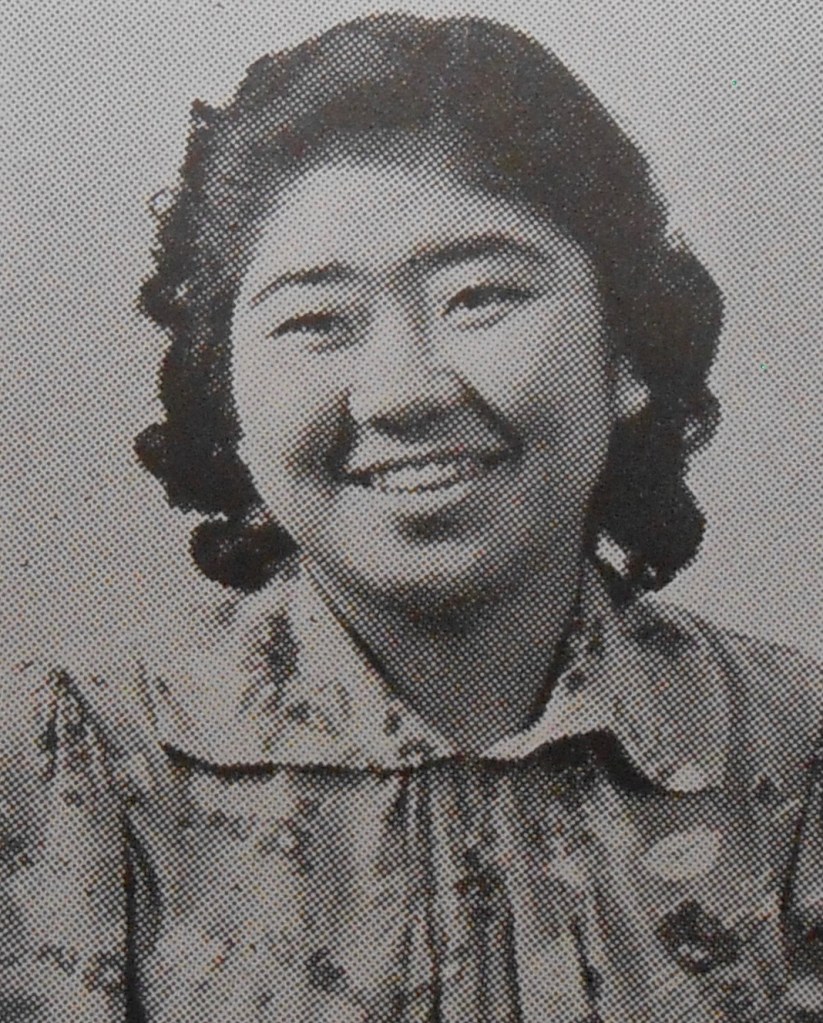
Chimiko Alice Fuchiwaki. Prisoner #882, Pima, Sacaton, Gila River camp. Arrived Sept 1, 1942, Departed May 3,1945. She was given an early release to go to Colorado for work. Chimmie never returned to Arroyo Grande. More than half of all the Nisei from Arroyo Grande never returned. The 1943 yearbook had no Nisei grads and almost no boys of any race. The war was in full swing in America.

Called to headquarters just before departure for Alaska your father was given a new set of orders. It was the cold finger of the federal governments Japanese re-location program. Even though neither your father or brother was in camp, they had both enlisted before the war, they are listed as internees in camp documents. There was no escape. When you were on laeave you could only go home, nowhere else. The reaction to the attack on Pearl Harbor was a disaster for the Japanese on the west coast. The war department had suspended enlistments from the Nisei and was pondering discharging all soldiers of Japanese decent. In the meantime they were withdrawn from their units and essentially parked at army bases in the middle of the country until it was decided what to do with them. Your dad was sent by train to Fort Bliss, Texas. He traveled along with other Nisei soldiers on trains with window shades drawn so as to not draw any attention to them. Fort Bliss was the perfect place. Located in West Texas just north of the Mexican border you can hide anything in its 1.12 million acres of scrub desert in El Paso County.

At the time Fort Bliss, was an old Cavalry base dating to post Civil War, it still had a barracks named for Robert E Lee. Don’t forget that Texas was part of the Confederacy. Run down after two decades of governmental neglect, it held a hodge podge of military from the “Old Ironsides” 1st cavalry division (Armored) to Nisei units waiting to be shipped to Mississippi for infantry training with the 442nd or up to Minnesota to the language schools. Afrika Corps POW’s were also interned there right next to Japanese Americans held in concentration camps. The Japanese were behind barbed wire, the Germans were not. Some irony there.

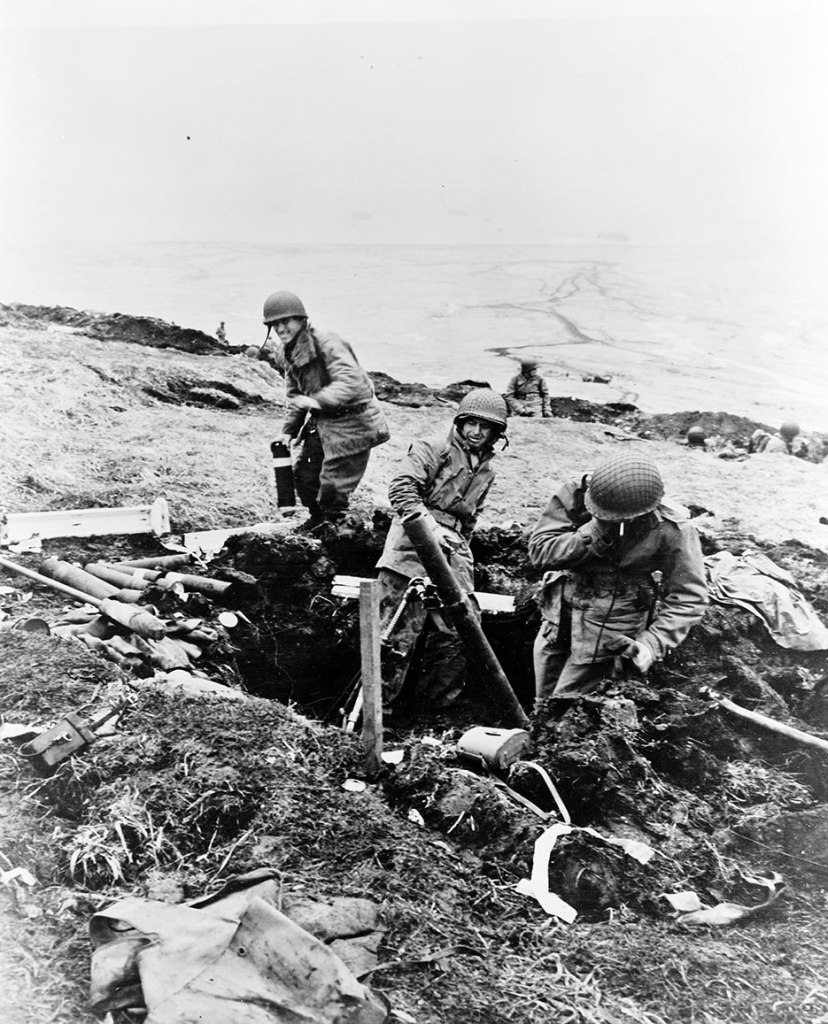
The 138th’s experience in Alaska was a disaster and your dad was extremely lucky to have missed it. Deployed to the island of Kiska in the brutal cold and perennial fog, the new and untried soldiers saw shadows everywhere. One dismal night of combat saw thirty soldiers killed and fifty wounded all by friendly fire. The Nisei soldiers were justifiably terrified of being shot by their own comrades. It was soon apparent that the Japanese had evacuated the island before the 138th had even arrived. Diaries and un-mailed letters left behind and read by MILS interpreters made it clear the Japanese soldiers hated the war and wanted to go home. So did the Americans. Operation Cottage was a dismal failure. General Simon Bolivar Buckner Jr. who was in charge of the Alaska campaign said, “The invasion of Kiska was a great big, juicy, expensive mistake.” General Buckner would cross paths with the Nisei and the MILS again in the far Pacific in 1945.

138th regiment, mortar crew, Kiska Island, Alaska. 1942 War Dept. photo

Assigned to random make work duties the Nisei soldiers had no idea what their fate would be. Back home their families were packing their one suitcase of belongings and preparing to be bussed out to holding centers where they would await their assignments to the infamous relocation camps where they were destined to spent the war. Your grandparents and your aunts were taken to Tulare where they were housed at the county fairgrounds, keeping house in dirty old horses stalls. Everything they had other than the one suitcase was left behind to be stolen or destroyed by vandals. Neither of their sons could do anything to help. It must have been agonizing. As soon as the half completed camps were ready, your grandparents and your aunts were taken by train to Poston, Arizona and then trucked to the Gila River concentration camps. They at least were able to see friends from Arroyo Grande, the Saruwataris, Kobaras, Hayashis, Ikedas, Fukuharas and the Nakayamas were all there. They would have to make a new life there. They could no longer dream of a future. They would have to bear what could not be born. ( Shikata Ga Nai )

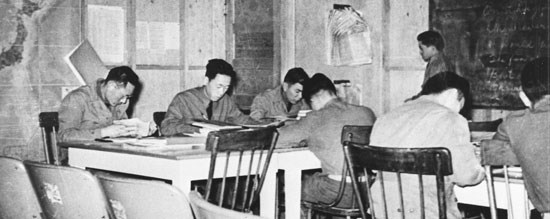
After eight months in Texas, he and the other Japanese boys were ordered to a barracks building where an officer with the Military Intelligence Service presented an opportunity to leave Fort Bliss. He said the army was looking for soldiers who had knowledge of the Japanese language. Could they speak it, or write it? Had they spent any time in Japan attending Japanese schools? The army had figured out that since they had no one who could speak or write Japanese they were going to be at a great disadvantage when they began their cross Pacific advance where the were sure to have captured Japanese soldiers and workers.

Those who could were encouraged to apply to the school and take a test which would qualify them for jobs as interpreters in the Army’s Intelligence Services.

Both your dad and uncle spoke, read and wrote Japanese. Your grandmother is listed as a Japanese speaker on her census forms so Japanese was spoken in the home. They both qualified as speakers and it’s very likely they attended the old Japanese school off Cherry Lane. They would have gone there after school to study reading and writing and the customs and history of Japan. How seriously its hard to say. In some of my interviews there was a lot of laughter about how serious they were. As one man said, “We hated it, we were American kids after all, not Japanese,” but we had to go.

For the Fuchiwaki boys it was to pay off. Ben was already at Presidio in San Francisco studying at the Military Language Institute while Hilo was in Texas being bored. Volunteering is simply not done in the military, at least not often. Soldiers know better. The thought is, if you volunteer for a duty you want, the army will make sure you never get it. But it was Texas, flat, dusty, desert Texas at that and if volunteering might get them a transfer and out of there, why not? The thinking was that at least it could turn out to be an important job.

All the candidates who volunteered were whisked off to an empty barracks building and spent two grueling days test taking. They were tested on the spoken word; They were tested on reading and writing and finally at the end, a sit down interview by a senior enlisted man from the language institute. White officers were present but not as interviewers because the Army only had a very few who had any fluency in Japanese at all. The interviewers were enlisted, non-officers because it was Army policy that no Japanese Americans could rise above the rank of Sergeant. At the time all Nisei units were commanded by white officers.

Your dad would have had no real idea of how he did on the tests. The military rarely gives a grade to the one taking any test. So, they waited….and waited, and waited some more. Some volunteers waited weeks before they were called in for final interviews. The waiting was just the military way. It was and is something that sailors, Marines and soldiers soon get used to. “Hurry up, and wait” has been the way since long before Alexander the Great. Never changed, never will.

As time passed, the Nisei soldiers began to see what their future might be. It had become common knowledge that because of manpower needs the War Department had decided not to discharge the Nisei but to incorporate them into new, all-Japanese units which would eventually be sent to the European theater and in particular Italy thus solving the issue of Japanese Americans fighting the Imperial Japanese.

The 100th Infantry was the initial unit which was made up of Nisei boys from Hawaii and the west coast who had been enlisted before Pearl Harbor. Later, the 100th would be integrated into the 442 Regimental Combat Team which did see terrible combat in the climb up the boot of Italy. The 442nd was to become the most decorated small unit, ever, in US Army history. Those kids felt they had something to prove and they laid down their lives by the thousands to do it. As happens in wartime, hard fighting units are “used up.” They are sent into combat again and again until they are ground down to nothing. Such it was with 442nd. A difficult objective and they were first in line. Their patriotism and the racist general who was their commander who was looking for promotion from his own superiors guaranteed that.

Your dad, if accepted in the language program might be spared combat for the time being, Nisei troops were already being sent for combat training. For one year, the men trained at Camp McCoy in Wisconsin and Camp Shelby in Mississippi. In May 1943, the 100th participated in training maneuvers in Louisiana. That August, the 100th deployed across the Atlantic to the Mediterranean where they took part in the Italian campaign. The men selected the motto “Remember Pearl Harbor,” to reflect their anger at the attack on their country. In Hawaiian slang they said, “Go For Broke.” They did just that too.

Hardly anyone here remembers that but when I lived in Hawaii just two decades after the war, those soldiers had used the GI Bill to go to college. They ran the unions and the banks. They were college professors and business owners. The Nisei had gone from the cane fields to the corporate office in one generation. “Go for Broke” they said and they did.

Dear Dona

Page Three

Hobson’s choice is a free choice in which only one thing is actually offered. The term is often used to describe an illusion that choices are available. That’s the military to a “T”

December 3rd, 1942.

At morning roll call, the Lieutenant called your father’s name. He was told to report to headquarters right after morning chow. Like any good soldier he asked what was up and like any good officer the Lieutenant wouldn’t tell him. So after breakfast he hustled over to the headquarters building and reported to the Top Kick, the first sergeant. Hilo would have entered the office, stood on the yellow footprints painted on the floor and announced himself. The sergeant merely looked up then rummaged on his desk until he found what he wanted, then said simply, “Your Orders.” “Where to Sarge?” “Camp Savage, you’d better pack your winter uniforms,” and he laughed……

Coming November 2nd

Link to Dear Dona page one: https://wordpress.com/post/atthetable2015.com/12268

The writer is a lifetime resident of Arroyo Grande California and writes so his children will know the place where they grew up.

Standard