By Michael Shannon.
There is a misconception about reading and education in early California. It is easy to think that our Rancheros were illiterate in Spanish andor English. The men and women who pioneered the Cow Counties were fixed on the idea that their children should be educated. Francis Branch, William Dana, Mariano Vallejo and Isaac Sparks set up schools in their homes for the children who lived on their vast Ranchos. Each of the many Mexican land grants had libraries of books imported from Mexico, Spain, The United States, England and other countries around the world. The impression that California was a backwards, howling wilderness could not be farther from the truth. Trade with China, the Phillipines and Russia was common. Francis Branch and his family ate off plates imported from China and drank from goblets that came from Mexico and Spain. Their boots and shoes came around the horn from New England. Contrary to Richard Henry Dana’s characterization of the Californios as a backward and a foolish people they were in fact wealthy, well read and sophisticated in the ways of the country they lived in. A cousin of Captain William Dana, Richard, a wealthy Harvard student taking a gap year for his health was, he felt, a superior being and felt no compunction about mocking and denigrating the people of California. His book, Two Years Before the Mast is an instructive look into California culture in the early 19th century but it must be viewed through the lens of the writer and his prejudices.
Other than the priests who managed the Missions and had libraries of religious tomes which no one other than the fathers would have been allowed to read, the first books introduced to San Luis and Santa Barbara counties would have come from the first pioneering families. For three quarters of a century all the libraries in the counties were either private or small collections of books maintained by the little towns themselves.
Until Andrew Carnegie. Andrew Carnegie, was, one of Americas most ruthless, loathed and hated tycoons of the late 19th century. Connecting him to the libraries that bear his name, my father explained that he built them because he was trying to beat the Devil. Spending part of his massive fortune on free public libraries, a novel and very liberal idea at the time might buy his way into heaven. Regardless, those libraries set the tone for a major change in public education.
Carnegie libraries were built along the coast of California in Lompoc, Santa Maria, San Luis Obispo, Paso Robles and Santa Barbara from 1905 until 1917. Our town, Arroyo Grande had a very small library tucked into a small and old wooden building on Branch Street. It was the towns first and was located right next to the space that would later house Dr. Pence’s office. It later moved, sometime in the Twenties to another small space on Mason Street roughly where Andy David’s law office was. It migrated to a utility building behind the Veterans of Foreign Wars Hall before WWII which is where it was when I was a kid.

Santa Maria Carnegie Free Library, 1909
I cannot remember the time when I didn’t have a library card. My mother started taking us to the little library behind the American Legion hall on Orchard street when I was just a little guy. It was the domain of Mrs Bernice Kitchell. She was the first librarian ever I knew. She was not too tall, slight in stature, almost too thin, wore spectacles and always had her hair up. She was very nice to little boys and guided us around the tiny rooms, for the library was, at that time, just a temporary building. Being a temporary building, it is, of course still there sixty five years later. At the time it was just a simple city library, not the kind you see today, but financed by the town. Mrs Kitchell was of course paid a pittance and in return she did every job required or not. She scrounged books from everywhere she could and it wasn’t unusual to find in a checked out book someones name written on the flyleaf. Most likely someone you or your parents knew. There was a muted mysteriousness to the place brought on by the smell of books, both the sharp fresh smell of a new book and the musty timeless smell of the old. The air was redolent of the mixture and combined with the pale, dusty air, a perfect setting for the child exploring for just the book to take him to a new place and the adventure there.
Thanks to Mrs Kitchell I’ve been everywhere, both on this world and all the others. I ran through the jungle with the Lost Boys, I’ve drifted down the mighty Mississippi with Huck and Nigger Jim, Followed Tarzan through the great, lost elephant graveyard on his quest for the jewels of Opar. I waited until I saw the whites of their eyes on Breed’s Hill, Studied with Frank Merriwell at Yale and crossed swords with Pedro De Vargas, the Captain from Castile.
Before I was out of grammar school I had read hundreds of books. I used to take books to school and read after my lessons in the little two room schoolhouse that my brothers and I went to. Both of my teachers, Mrs Brown and the sainted Miss Elizabeth Holland knew I was reading when I should have been doing something else because I would open my desk top and read a few lines while I pretended to be looking for something.
Mrs Edith Brown and Miss Elizabeth Holland at Branch Grade School

One of the things that worked to my advantage was that each of the teachers taught four complete grades mixed in each of the two classrooms. They taught each grade level for part of the day while the other students did assigned work or read from the school library. A student had time to explore their education without having each classroom minute orchestrated. This worked to my advantage because I could complete my school work and then go adventuring in a book. What has turned out to be the greatest reading lesson of all has been the ability to read in context. I was simply too lazy to go to the big Webster’s which weighed a full fifteen pounds and look up words I didn’t know, so I figured them out by the way they worked in sentences. I can say that this is the best thing I learned in school.
Not many of these little schools exist anymore. They were places where the teachers set the curriculum with a little help from the school board. Many of the school board members at Branch had gone to the school themselves. Other than a small stipend from the county schools office they were on their own as to school improvements, curriculum, books, playground equipment and anything else that was required. We had no band, and no organized sports program. Everything we did was dependent on the parents and teachers. Believe it or not, some of our text books were the same books used by students more than a generations before us. It seems strange today but those books covered social studies or history up to the 1930’s and the rest everybody knew because they had lived it. It was first hand knowledge.
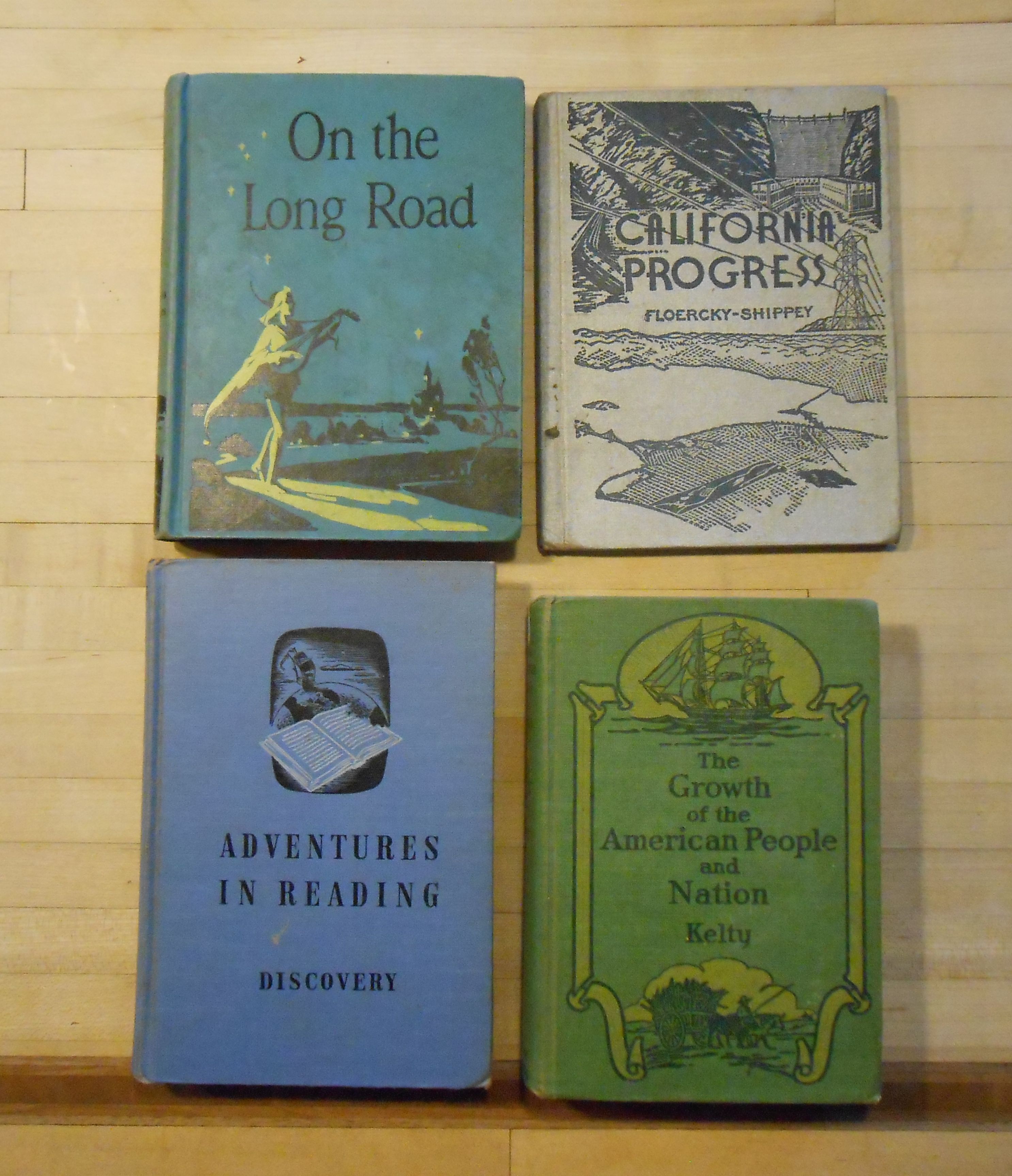
The photo above shows some texts from Branch. None is newer than 1936. The Growth of the American People has two names written on the flyleaf, Joe P. Roza and William Quaresma. Al Coehlo’s name is in the California Progress textbook. I knew these men as friends of my father and went to grammar school and high schol with Al’s children. These books were still in use in the fifties when I studied there.
I figured not long ago that I’ve read somewhere north of ten thousand books in my lifetime. Incubated in the Library and School, I have Mrs Kitchell, Katie Sullivan McNeil, Edith Brown and Elizabeth Holland to thank for starting me On the Long Road.
When I was in High School, it was Margaret Sullivan and Florence McNeil, members of some of the oldest Arroyo Grande families. Mrs. Don Rowe too, they were always there when you needed them. Decades later when I was a teaching High School the fabulous Kathy Womble prowled behind her desk at Nipomo High School always on the lookout for kids she could nurture. We also had the fabulous Feryl Furlin who was so helpful and organized she was scary.
Librarians care for books and they want you to care also. Nearly a million books are published in the United States each year. They are all written for you to read so you’d better hurry up.
Internet Memes are useless in building knowledge on any subject. Their only redeeming factor is that they may spark some little curiosity to know more. Go see your librarian and do it now.
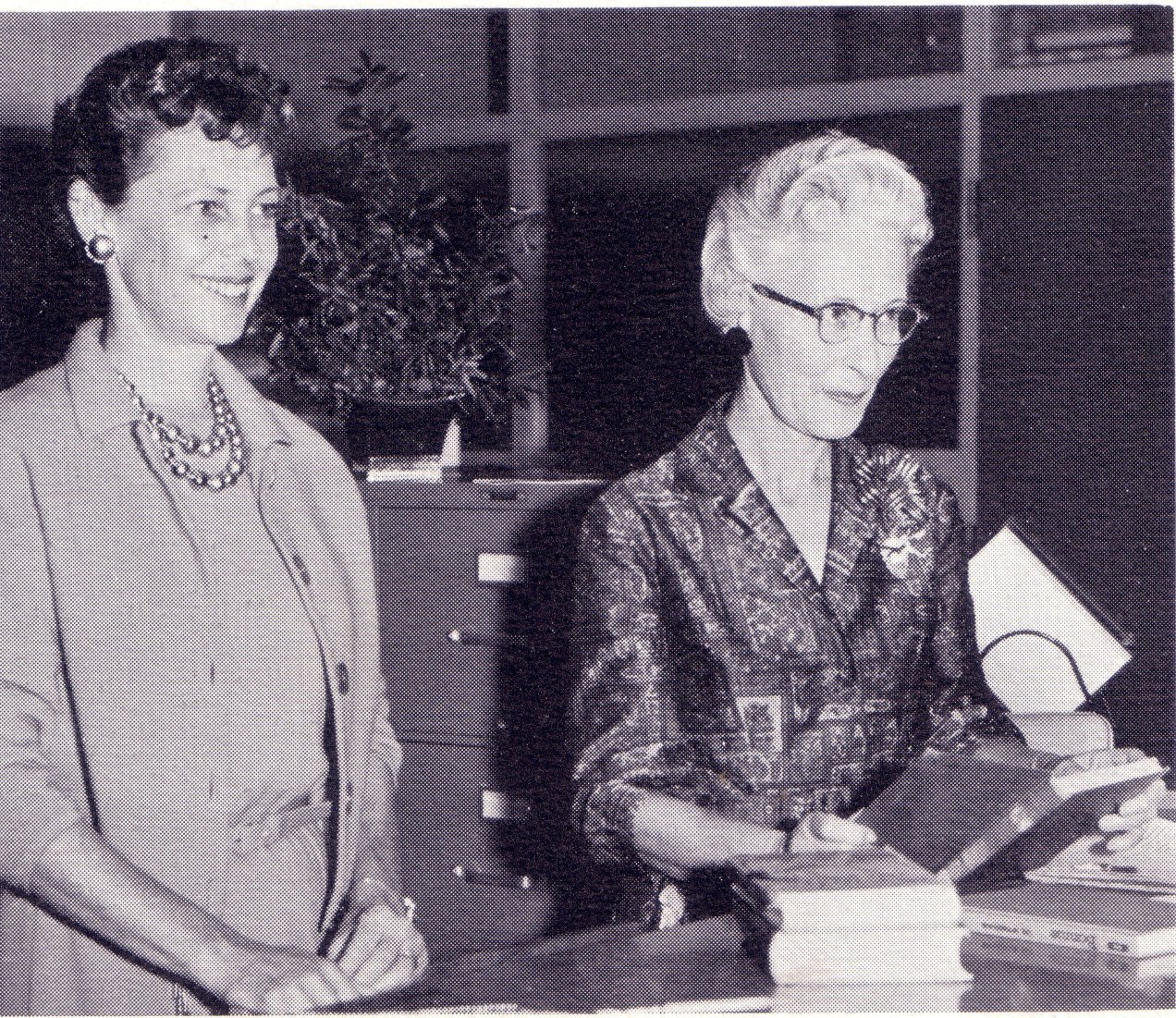
Cover Photo: Margaret Sheldon and Florence McNeil, Arroyo Grande High School Library 1962.
Michael Shannon lives in Arroyo Grande California. Reading has taken him around the world and into space both literally and figuratively. The number of library cards he has held from different places looks like a deck of cards.
Cards: Arroyo Grande Community Library, NTC San Diego, Balboa Naval Hospital San Diego, Naval Base Pearl Harbor, NSA RVN, Long Beach, San Diego, La Mesa, Hilo Hawaii, Honolulu, Haleiwa, Waikiki branch, San Luis Obispo Black Gold and San Luis County library system libraries and Shell Beach Community Library. Member of the Friends of the Library San Luis County.


![Intro1_AAD-2290[1]](https://atthetable2015.com/wp-content/uploads/2016/01/intro1_aad-22901.jpg)

 atthetable2015