Dear Dona

Page 14

The Last Battle

By Michael Shannon

“The God of Death has come.” Shouted by a Japanese Imperial Naval Marine* upon seeing Marines landings on Betio, forever enshrined in the notes taken in interviews by MIS translators during the battle for Tarawa.

The filth, the crawling over sharp coral, running crouched, hunched over with every muscle in the body nearly rigid with fear, the noise which never stopped, artillery, flamethrowers, grenades and the constant pop of gunfire. Battleship shells weighing a ton, Destroyers nearly run up on the beach duking it out with gun emplacements at point blank range. A miss is a miss but the M-1 round still can kill at 6,500 yards, over 3.5 miles. The Japanese Arisaka type 99 rifle could kill at 3,700 hundred yards. No place on the island could be safe for the soldier. The air is full of them. There was no place safe. No one could think or conceive of any other universe. The Battle of Okinawa (Operation Iceberg) was the final major land battle of World War II, lasting 82 days from April 1 to June 22, 1945. It was a brutal, large-scale engagement where U.S. and Allied forces fought Japanese troops on the island of Okinawa, the last step before a potential invasion of Japan. The battle was exceptionally bloody, resulting in massive casualties for both sides, including a significant loss of civilian life among the Okinawan people, and heavily influenced the U.S. decision to use atomic weapons on Japan.

Soldiers are so young. Is it impossible that they should be able to process the situation they are in? When they awaken at the bottom of their waterlogged foxholes after dreams of home they understood there was no escape.

Witness this Marine Ambulance driver’s letter home written about half way through the invasion. He would celebrate his 19th birthday on Okinawa.

Dear Folks. I know you have been worried about me but as you see I’m still very much O K. I’ve had a few close calls but that can be expected on this Rock. They say in the stateside news that this island is secure but, but they still have eight more miles to go so you can figure that out. We are three miles back from the front licking our wounds now and waiting for I don’t know what. Maybe we go back and maybe we don’t. I guess I’ve seen most of this island so far—enough anyway.
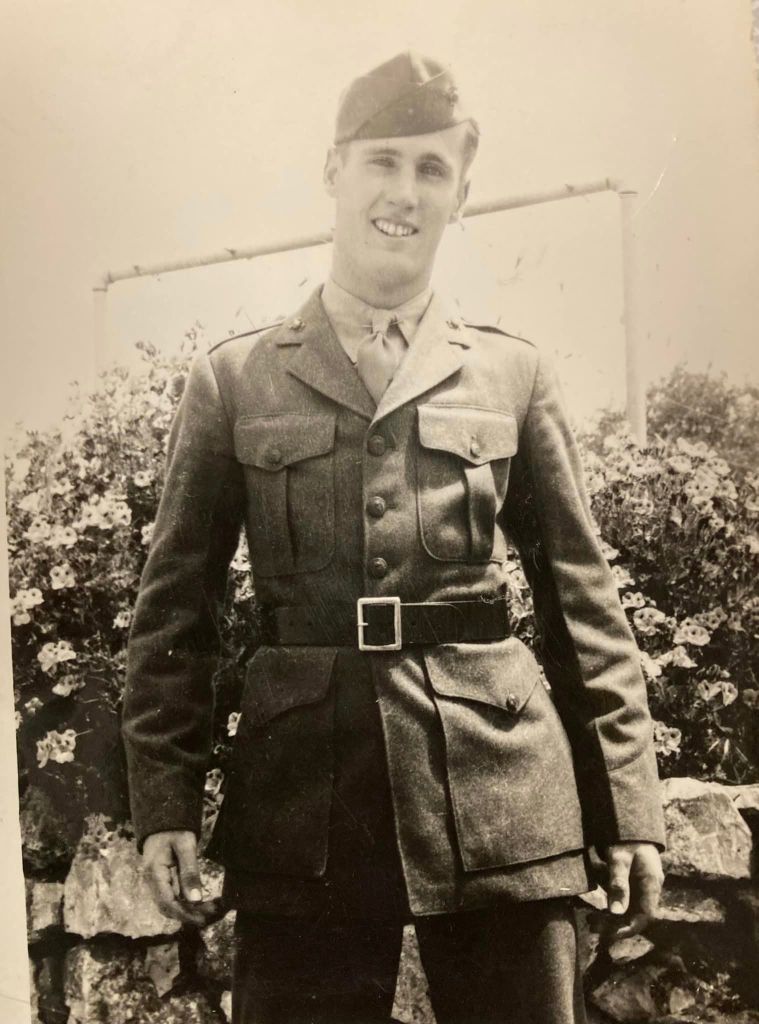
Private John Brewster Loomis USMC, Headquarters company, 1st Battalion, 1st Regiment, 1st Marine Division. MOS 245, Truck Operator. Just before shipping out to the Pacific, 1944.

Shuri Castle was a rich joint and Naha used to be quite a town. I am sitting in Jap truck now that we picked up in our travels. It is something like a ton and a half and something like a Chevrolet but right hand drive. I’m a little thinner but feel alright. (He entered the Marines at 5′ 11″ and 160 lbs.) Instead of “Golden Gate in ’48, it’s from Hell to Heaven in ’47. Old Snowball, a friend, is still alright as far as I know. We sure took a beating but took our objective.

Dad I’m sorry I couldn’t write on your birthday but Happy Fathers day and Fourth of July.

The weather is better now, cold at night. Last night was the first time I got to take off my shoes when I hit the sack. They brought us a little better chow for a while. Boy! Am I tired of C-Rations. My old ambulance is still running but it doesn’t look the same-no windshield. bumpers, paint, top or sides-just one seat and the stretcher racks.

I had my picture taken the other day by Division. I don’t know if it will get in the papers or not. I sure didn’t look like much that day.

Well, folks, I’ll write when I can and I hope from now on that will be very often. Much Love John.**

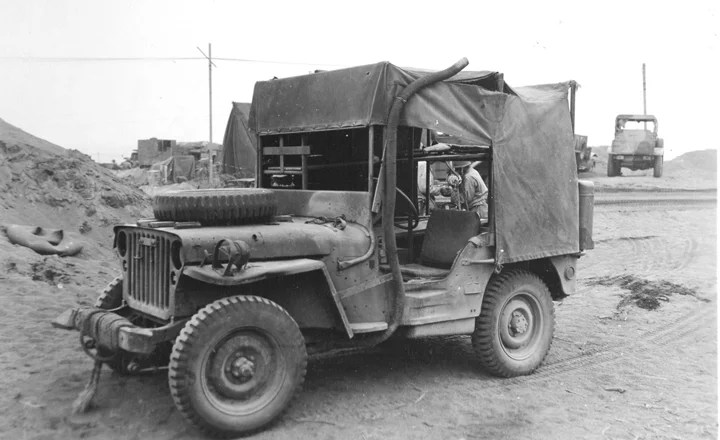
Modified by Holden an Australian body building company, this is the Jeep type ambulance John Loomis drove on Okinawa. The Marine Corps used this much more, go anywhere ambulance instead of the big GM trucks used in Europe. The rugged terrain and mud sloppy roads couldn’t be navigated by trucks and Sherman Tanks were sometimes used as tow trucks if they didn’t sink in the mud holes themselves. Almost everything was hand carried by exhausted Marines themselves.

As the battle for Okinawa came to a close, many of the Nisei translators were ordered off the island. The almost complete annihilation of the defenders meant there was little to do. In preparation for the invasion of Japan there was a mountain of captured documents to be gone through and they were needed back at headquarters.

The Lieutenant gathered the Nisei translators in a shell hole covered with a tent fly then read the names of those who would take one of the LCIs out to the attack transport (APA-139, the USS Broadwater) for transport back to Manila for further orders. Hilo and his team were leaving the island.

MacArthurs headquarters were now in the ruins of Manila. After unloading at Cavite Naval base in Manila bay, the MIS boys were trucked to the city and reported for duty.

Hilo and his team were issued new orders and upon pulling them open with a mixture of excitement and dread inherent in the action were delighted and almost giddy with the news that they were to report to Subic Bay for immediate transport to Naval base Long Beach, California to begin a 30 day leave. They were being sent home to rest before the invasion of Japan.

USS Broadwater APA-139 and USS Bellepheron ARL-31, a landing craft repair ship at anchor, San Francisco 1944

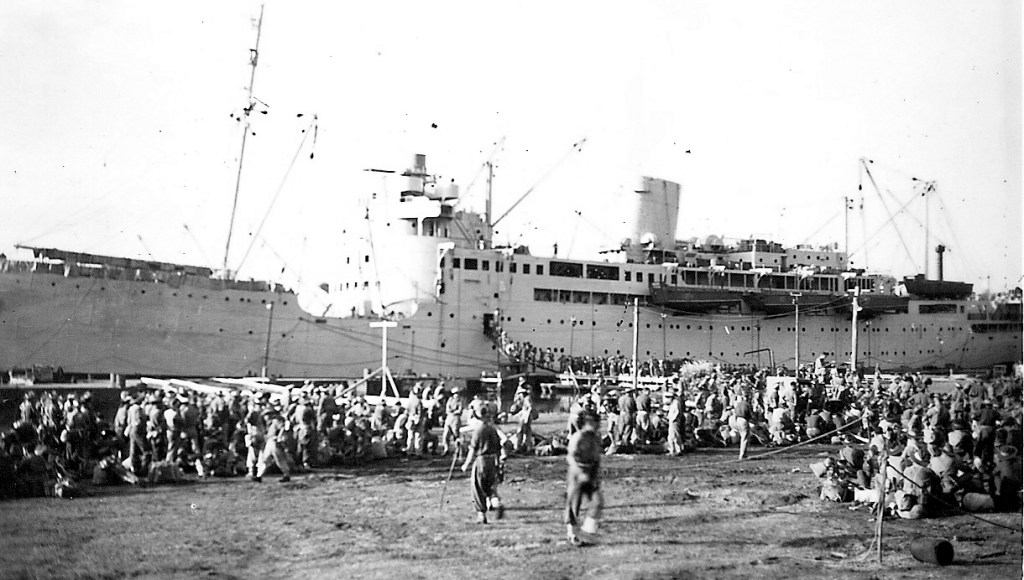
They were going to be transported by one on the Navy’s APAs or Attack Transports such as the USS Broadwater APA-139. The APAs*** were the real workhorses of the Navy. They were designed and built on Liberty and Victory ship hulls for the purpose of transporting men and supplies. With their boats they were able to house, feed and land an entire marine battalion of fifteen hundred men. Anchored just offshore, in harms way, they would swing out the landing craft, load the Marines and their equipment and then the Cox’ns would drive them into the landing beaches. When they had unloaded they would wait to receive the wounded and other men pulled off the line and return them to base. Equipped as emergency hospital ships they would offload casualties to the larger dedicated hospital ships waiting outside the arc of Japanese artillery fire and Kamikaze air strikes.
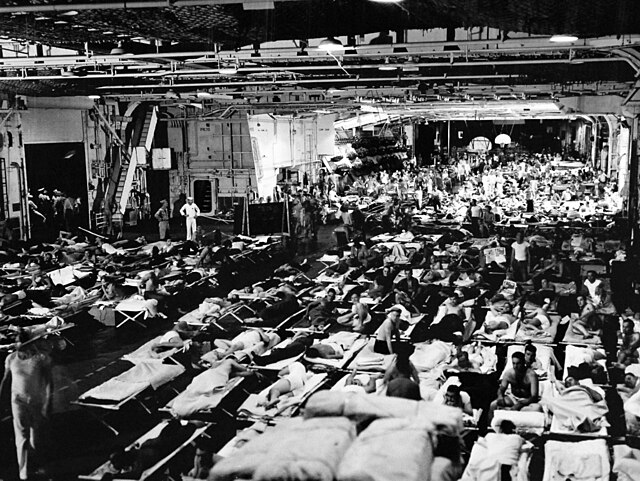
An Aircraft carriers hanger deck loaded with casualties from Okinawa, April 1945. War Department Photo.

The Navy operated over three hundred of these ship along with freighters of the Liberty and Victory types, over fifty oilers, and a myriad of specialty support ships. This allowed the Navy, Marines, and the US Army to operate efficiently more than 7,000 miles across the Pacific Ocean where there was little infrastructure to support operations. The logistics of the operations are literally mind boggling.

The APA’s were to serve a special purpose beginning in the waning weeks of July and August 1945. In the service any action needs have a name to identify it. Most, such as Okinawa which was dubbed “Iceberg” and the invasion of Guadalcanal “Operation Watchtower” general have no meaning other than to confuse the enemy but the name for the last major movement of men was oddly prescient. Operation “Magic Carpet” would return veterans of the Pacific home. By August the allies had just over 23 million troops and support service men in the western Pacific. The Aussies, New Zealanders, British, French, Dutch and the Mexican Air Force were all going home. Magic Carpet would be the largest mass transport of men and women ever attempted. Every ship type was going to be utilized for transport.

On July 25th Hilo Fuchiwaki and his team boarded an APA in Subic bay. The boys must have leaned over the ships rail and watched the sailors on the dock cast of their lines and felt the ship begin to vibrate as she backed into the stream and headed for home.

Dear Dona Page 15 is next.

Cover Photo: Holden Jeep ambulance. Missing one fender, other one dented. Shrapnel hole in hood, broken windshield. The exhaust pipe is extended to get it out of the mud. No paint and tow strap wrapped around the bumper. Hard used.

*Rikusentai, Imperial Japanese Naval Marine Infantry.

**The letter must have been written after the the capture of the Katchin peninsula by the 1st Marines. The battle for the island still had about ten weeks of combat left. He was, after a short rest to participate in some of the most brutal fighting ever seen in WWII. Private Loomis earned the Bronze Star for his actions on Okinawa.

***The book “Away All Boats” which was made into a movie of the same name based on the 1953 novel by Kenneth M. Dodson (1907–1999), who served on the USS Pierce (APA-50) in World War II and used his experiences there as a guide for his novel. It is considered a classic in naval literature.

Michael Shannon is a writer and lives in Arroyo Grande, California.
Standard

Dear Dona 11

Moving Up

Michael Shannon

Your fathers original group of four hundred translators that worked in Brisbane in 1943 had been broken up into small units and was now spread all over the Southwest Pacific. Many of them now shared the privations and dangers of combat and had taken to carrying rifles. They operated just behind and into the lines and were subject to enemy gunfire, artillery and bombs. War zones are dangerous places and even those that see no actual combat are subject to the whims of the monster.

After Morotai headquarters moved up to the island of Leyte and promptly discovered something entirely new. The translators as with all staff, headquarters and support troops rarely knew what was going on in the wider war. As they advanced in the Phillipines the war began to widen out. The days of jungle fighting were nearly over. Leyte with a population of just 900,00 most supporters of the Americans was divided by a mountain range with the southern portion of the island very lightly populated The flanking coastal plains allowed the use of tanks and other mobile units for the first time. Fighting was heavy but the Japanese were pushed up the island in a series of very sharp battles. The campaigns success allowed the planning for the invasion of the main island of Luzon to go forward in a hurry.

Since MacArthur had been ordered out, Corregidor had been surrendered, the Bataan death march had taken place and most combatant Americans had been locked up in concentration camps. MacArthurs Filipino Scouts had also surrendered but not all. Army Navy personnel and the Filipinos had disappeared into the hills of the Phillipines and for three years had been roving the country formed into Guerrilla groups. (1) Filipino ex-soldiers, American service members, Naval officers and Australian and Dutch soldiers had formed lethal bands of Guerrillas who preyed on Japanese troop movements and supply convoys. The Dutch and Australian stole or cobbled together radio sets with which they sent messages to Army headquarters in Australia. They reported on Japanese ship movements and disposition of army units.

MacArthurs command arranged to deliver better radios, generators to provide electricity to the Coast Watchers were constantly on the move. A message sent in the clear or in code could be tracked by Japanese rangefinders so they picked up and got out of Dodge immediately after sending. It was highly dangerous work but invaluable to the allies. Radio message were synced with MIS translations and throughout the three years before the return the command had a clear picture of almost everything the Japanese were up to.

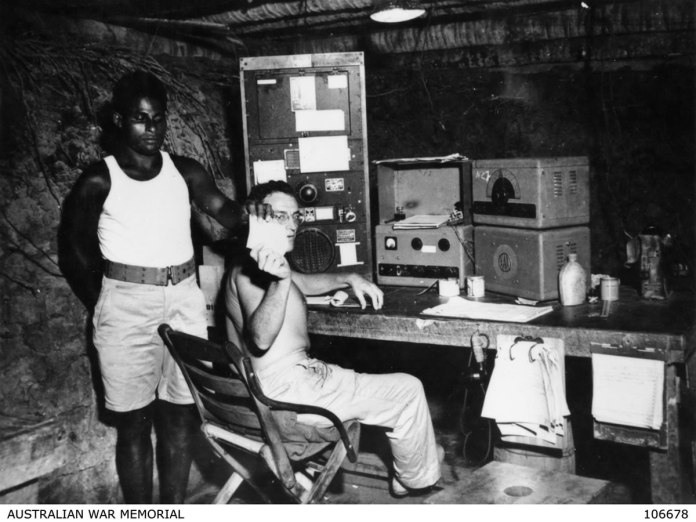
The base radio station dugout of the Coastwatchers Ken network in the Solomon Islands. Photo: Australian War Memorial.

During August and September 1942, 17 military coast watchers (Seven Post and Telegraph Department radio operators and 10 soldiers) and five civilians were captured as Japanese forces overran the Gilbert Islands. Imprisoned on Tarawa atoll, they were all beheaded following an American air raid on that island. The coast watchers and their teams, mainly native islanders were constantly on the move. They faced starvation, boredom and feared for their lives but none attempted to escape. Though mostly resident civilians who had worked for the rubber plantations and the petroleum companies they received nothing for their work. It wasn’t until late 1944 that that the Anzacs bestowed military officer rank on them so if killed their families would receive a pension.

Coastwatchers were also involved in organizing supplies for the Guerrilla bands. They received supplies and arms from American subs, Dumbos (2) and the famous Black Cat Catalina flying boats. They also rescued downed flyers and other military personnel who were downed or sunk along the island chains. These included the future US President, US Navy Lieutenant John F. Kennedy, whose PT 109 Patrol Torpedo boat was carved in two and destroyed by a Japanese warship in the Solomon Islands. After the sinking, Kennedy and his crew reached Kolombangara Island where they were found by Coastwatcher Sub-Lieutenant Reg Evans who organized their rescue.

In the Philippines they were to witness the roots of the local Resistance which represented the cultural and socio-economic diversity of the Philippine Islands. From socialist peasant farmers the Huks, middle school teachers, ROTC youths, to Moro (Philippine Muslim), the range of the men and women who participated in the struggle against the Japanese Imperial Army was seemingly inexhaustible.

Officers at headquarter were initially astounded when groups began showing up. slipping out of the jungles like wraiths, armed and dangerous.

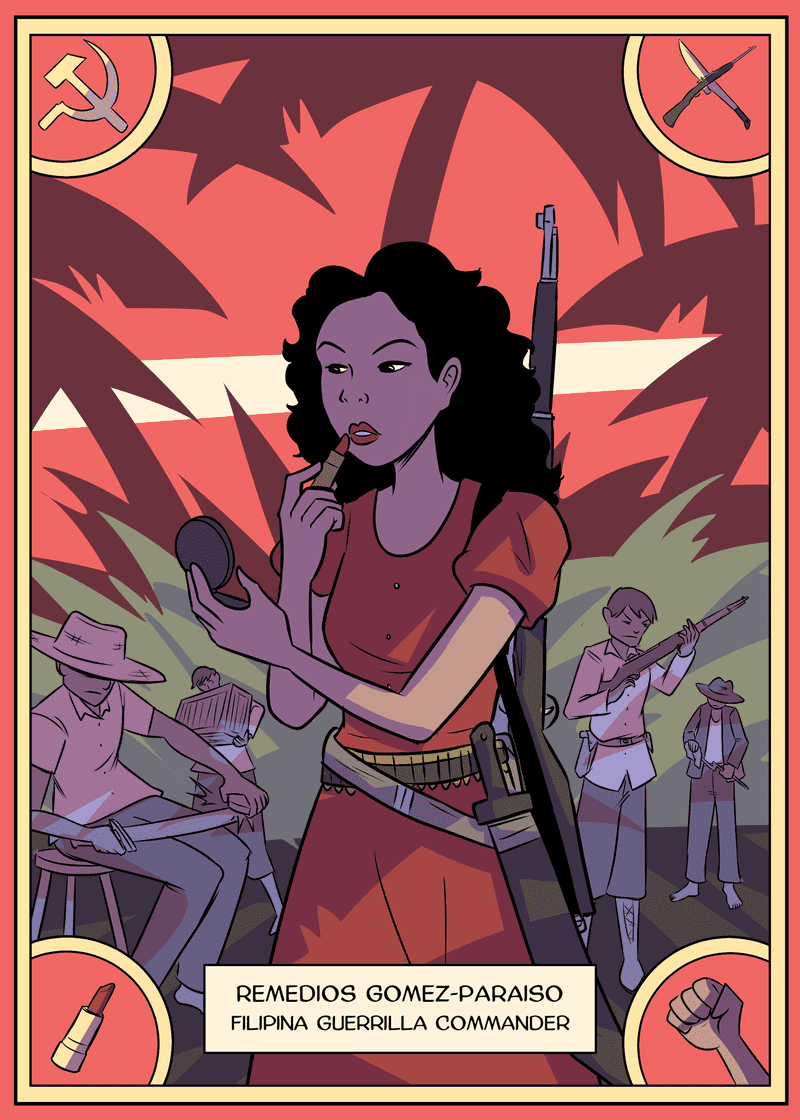
At least 260,000 strong, the guerrilla forces were ill-equipped and poorly armed. They depended on local civilians for food, shelter, and intelligence. Several units recruited women guerrillas. Some took up arms and served side by side with men, including journalist Yay Panlilio and Huk commander Remedios Gomez-Paraiso also know as “Kumander Liwayway.”

Remedios Gomez-Paraiso, Kumander Liwayway. Photographer unknown. 1945

Remedios Gomez-Paraiso was an officer in the Hukbalahap, a communist guerrilla army known for their daring attacks on Japanese forces. Born in Pampanga, Gomez-Paraiso joined the guerrillas after her father was killed by Japanese forces. Known for going into battle wearing her signature red lipstick, Gomez-Paraiso quickly rose in the ranks to become a commander of a squadron. At one point, she had two hundred men under her command. Perhaps best known for the “Battle of Kamansi” in which, despite being outnumbered, Gomez-Paraiso’s squadron forced Japanese forces to retreat. After the war, her Hukbalahap Guerrillas continued their revolution against the democratic Philippine government until 1948, when her husband was killed, and she was captured. She was released and went on to become a vocal advocate for the recognition of Filipina Guerrillas.

In a marriage of convenience the guerrillas, some who had been fighting the Americans invaders since 1898 when President McKinley annexed the islands against their wishes. In the southern Phillipines, the Muslin Moro had resisted the Spanish conquest since the since the end of the 15th century. This religious war only ended with the annexation by the US in 1898. The Muslim Moros then fought the United States and finally the Japanese. Resistance was baked into their DNA. Because they hated the Japanese more they saw the alliance as temporary but expedient. Filipino Guerrilla groups fought right up until the end of the war. (3)

A guerrila group on Leyte, Phillipines, 1944. National Archives photo.

On January 25th 1945 your dad and his MIS team walked aboard LST 922. They were bound from Leyte to the island of Luzon. Just nine days before 175,00 American troops supported by over 800 ships had gone ashore at Lingayen Gulf, ironically the same beaches employed by General Homma’s Japanese forces in December, 1941.

General MacArthur himself went ashore on S-Day. There were no histrionics this time. Luzon which he had abandoned in 1941 was not only his personal goal, but erasing the embarrassment which was compounded by secretly fleeing during the Phillipines during the dark of the night in a little PT boat, PT-32 commanded by LTJG John Bulkeley (4)

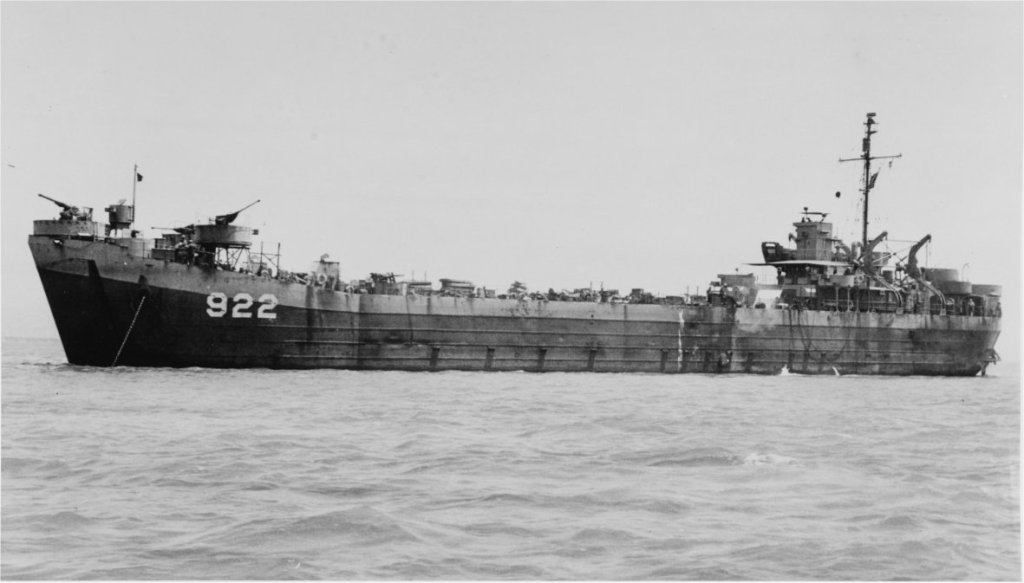
LST 922 at Morotai Island, Dutch East Indies, December 1944. USN Photo

Your dad’s MIS team hefted their barracks bags and walked up the ramp for yet another trip by an LST. Commanded by Lieutenant, Junior Grade Ronnie A Stallings who was a regular Navy officer. A special but not uncommon type in the WWII Navy, he was a Mustang. Mustangs as opposed the thoroughbred Naval Academy officers were generally outstanding enlisted men promoted up from the ranks. Born in Brooklyn New York in 1924, Stallings enlisted in April 1941 and went to sea as a 17 year old later that year. He was an ordinary seaman. Assigned to a Landing Craft Infantry 487 or LCI. LCI 487 was typical of this type of LCI. It was newly built and the crew was young and inexperienced. The skipper, Lt. Stewart F. Lovell was the “Old Man” on board. Born in Manchester, N. H. on May 26, 1907, he was 36 years old when he set sail on the 487. However, most of his crew was seventeen, eighteen and nineteen year olds. His young crew gave their Skipper the nick name “Baggy Pants” because he did not acquire a proper fitting uniform after losing a lot of weight while onboard. LCI’S were 158 feet long, just over half a football field and only 23 feet in the beam. With the bridge being high and the hold being empty she rolled like a “Drunken Sailor” to use a Navy term. There are other terms for unseaworthy ships but most are unprintable. A very strong stomach would be required and perhaps the skipper didn’t have one. The Executive Officer – Ensign James T. Clinton was nicknamed “Boy Scout” because he was pale, clean cut and did not drink or smoke. Ronnie Stallings was present during the landing in North Africa in 1942 and at D-Day, June 1944 where his little ship, derisively known as “Waterbugs” by disdainful Admirals disgorged over two hundred GI’s of K Company, 18th Regimental Combat Team of the 1st Infantry Divion onto Utah Beach. Unable to back off the beach, 487 was pounded by German artillery and temporarily abandoned. Stallings was taken back to a survivors camp in England located at Greenway House the estate of Agatha Christie. With only the clothes on his back he was given an overcoat and a bag with a broken tooth brush and a razor with no blades.

His next ship was the fleet oiler USS Salomonie. He caught up with her in Panama in July as she passed through the canal on the way to Milne Bay, New Guinea. By this time a Quartermaster or QM, he would stand watch as assistant to officers of the deck and the navigator; serve as helmsman and perform ship control, navigation and bridge watch duties. QMs procure, correct, use and stow navigational and oceanographic publications and oceanographic charts. Thats the official description. Navy slang is “Wheels” because the begin by steering ships which is no mean feat. (5)

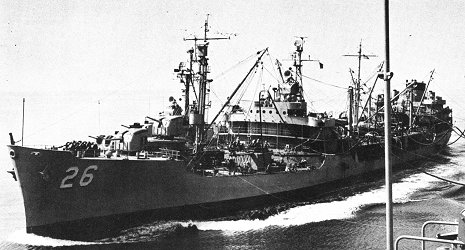
USS Salamonie Ao 26 and an LCI unloading at Utah red Beach Normandy, France June 5th, 1944.

Salamonie sailed for the Pacific Ocean via the Panama Canal on 8 July 1944 and reported for duty to Commander Service Force, US 7th Fleet, at Milne Bay, New Guinea, on 23 August. Salamonie joined the Leyte invasion force in Hollandia on 8 October 1944 and later supported both the Morotai and Mindoro strike forces. She spent the final months of the war supporting Allied operations in the Philippines after Ronnie Stallings transfer to the LST.

By the time Stallings arrived at Milne Bay he was a Chief, a rank achieved in just three years, a feat that could only be achieved in wartime. In peacetime it could take 20 years of duty, and he was just 22 years old. A 22 year old former enlisted swab made it to Chief Quartermaster. At Milne Bay he received a commission as a Lieutenant Junior Grade, and his own ship. No stateside classes, no practice, only his three years at sea as his training ground. As a newly commissioned officer he walked up the gangplank as the senior officer and Captain of his own ship Landing Ship Tank-922. He could never have imagined as a seventeen enlisted recruit that he would end up here.

Trailing their gear the team came aboard 922. Led by your father, the leader with the rank of TEC 4. Trudging into the ship were his crew, Jim Tanaka, Michael Miyatake, Henry Morisako, and Tabshi Uchigaki. Masai Uyeda, and Tsukasa Uyeda followed. Seven men, all headed for Eleventh Corps headquarters at Lingayen. General Eichelberger commanding. By this time they undoubtedly knew that the end was coming for the empire of Japan.

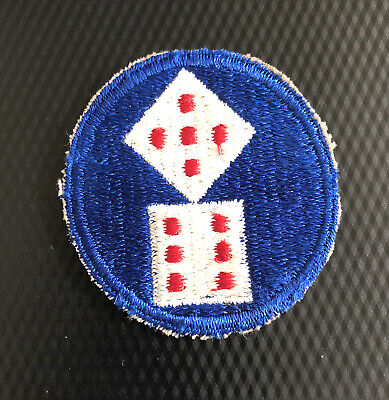
Eleventh Corps Badge, WWII

Dear Dona,

12th page next week Feb. 15th.

Closing the Ring*

1) Guerrilla from the Spanish Guerra. Guerrilla literally translates to “little war”. It’s a diminutive of the Spanish word guerra, which means “war”

(2) Dumbo refers to large aircraft such as the B-17 or B-24 heavy bombers which were modified to carry a large lifeboat that could be dropped to survivors at sea. They were largely replaced by the more versatile PBY Catalina which had a longer range and could land on water. The Catalina has been Largely ignored by most historians but was a major factor in air-sea rescue, insertion and extraction of personnel from Japanese held islands. The Catalinas also delivered supplies to Coastwatchers and guerrilla groups. The term Black Cats or Nightmare is the name given to the Naval and Army squadrons who flew these missions by night.

(3) The Moro people in the southern Phillipines have fought invaders from the fifteen hundreds right up to the present conflict with independent Philippine government. Nearly five hundred years of almost constant conflict has made them a formidable force.

(4) LTJG John Bulkeley is portrayed by Robert Montgomery in the 1945 film “They Were Expendable.” Directed by John Ford and co-starring John Wayne and the inestimable Donna Reed. In my opinion one of Ford’s best films. It impresses with its portrayal of the utter hopelessness of those last days before the surrender of the Phillipines to the Japanese. The dinner scene with the officers and the nurse, Donna Reed is utterly in tune with the times. By todays standards it is mawkish but it wasn’t made for now but during the war when people felt differently than they do today.

(5) The author served in the Merchant Marine. Steering a ship as long as two football fields and weighing nearly 30,000 tons is not for the faint of heart.

(6) Technician fourth grade (abbreviated T/4 or Tec 4) was a rank of the United States Army from 1942 to 1948. The rank was created to recognize enlisted soldiers with special technical skills, but who were not trained as combat leaders. Technician fourth grade. The T/4 insignia of a letter “T” below three chevrons.

*Apologies to Sir Winston Churchill.

Michael Shannon is a writer from California. He knew Mister Fuchiwaki personally.

Standard

Dear Dona.

Page 8

Doing Work, Staying Sane.

From Michael Shannon

Every soldier comes from somewhere. Sometimes to remain sane they need something, an object, a letter, a family photo, or one of his wife, children or sweetheart to remind him of home. In old stories knights, Jannisaries and legionnaires would carry a talisman to ward of evil or to remind the Gods to take care of them. Talismans have changed but the idea remains the same.

Historians have found letters from Roman soldiers to their friends and families that, if translated from the Latin to English sound remarkably like a letter written today. Alexander’s Macedonian Hoplites wrote home, so did the Persian boys who served under Xerxes and Darius of Persia. Letters form the backbone of history.*

Your dad must have done the same. Carried in his backpack or his ditty bag even in a breast pocket was a photo. Perhaps it was your grandparents or one of the family. Many soldiers carried pocket Bibles. Most likely, or so I would like to believe, he carried a photo that girl, Iso Kobara. Hopes and dreams reside there.

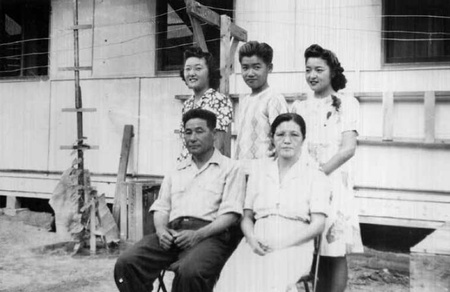
Shigechika and Kimi Kobara at Gila River with their children (left to right): Iso, Towru and Namiko. Photo courtesy of the Cal Poly Re/Collecting Project and the Fuchiwaki and Sanbonmatsu families.

With wartime restrictions, censorship in place no American serviceman could name the place he was nor where he might be going. Journals and diaries were forbidden and letters from home came from the family who knew there were certain things they could not say.

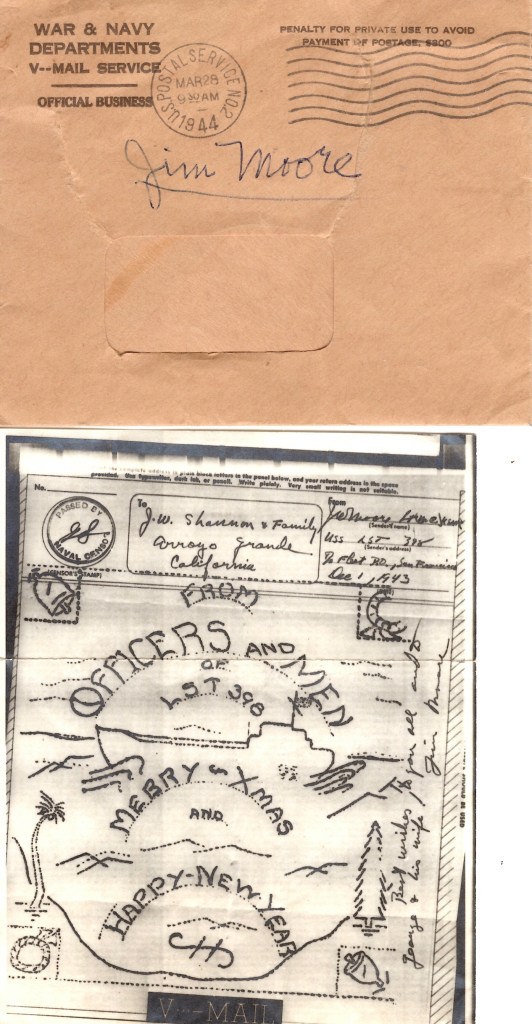
Jim Moore was my fathers friend and the son of Judge Webb Moore and his wife Edith, nee Fesler. They lived at the site of the McDonalds at Grand Ave and todays El Camino Real. The text on the side, “Best wishes to you all and to George and his (New) wife.” My mother was the new wife, the only wife actually. Other than the address Landing Ship Tank or LST there is little to tell you where he was when he wrote it. The only real clue is the palm tree which indicates somewhere in the Pacific. My family saved a number of these because they had friends serving all over the world. Over half the draft age young men from our town were in the service somewhere. My mother and grandmother were relentless in writing to them. Letters from home were a great prize.

Today we know that when this V-mail was written, his ship set sail from Kukum, Guadalcanal to resupply forces in Torokina, Bougainville. The convoy was under constant air attack and raised a barrage balloon to 2,000 ft. While unloading supplies, equipment and mail on a Bougainville beach. Japanese artillery hit the ship on the same day this photo was taken, killing an officer and five crew members.

Lt. Jim Moore’s 398. The workhorse of the fleet, hard used and constantly on the move. Jim served on her for three years without coming home. He took the train to Oakland on December 8th, 1941 with my father to enlist in the navy. After the war Jim became a surgeon in Ventura.

Your mother’s address would have been Gila River, Pima/Sacaton Arizona, Relocation camp, building 19-5 B, a hut they shared with two other families. His family would address mail to the APO, Army Post office San Francisco with just his name rank and serial number. Strict limits were put in place for obvious reasons. Old photos of the captured and dead invariably show them with pockets turned out and scattered papers and other objects lying nearby.

I took a while for the army to get over the suspicion that somehow the Nisei translators couldn’t be trusted, but by the time your dad got to New Guinea enough intelligence gathered by the MIS showed the great value they brought to the battlefield. Not only had battles been won but carful analysis of the information gathered gave the allies an almost complete picture of the Japanese Imperial armies disposition, tactical and strategic goals. They had gotten so good that the names of individual soldiers, not just officers, but the town and prefecture they lived in back home in Japan, their family members and their civilian occupations. Never in military history had planners had such a complete picture of their enemies.**

Captured diary of a Japanese soldier. National Archives. The map shows Malaysia, Burma, (Myanmar) both British controlled colonies. Thailand, Cambodia, and Vietnam were under the control of the French and called French Indochina. The Phillipines were and American Colony and the Dutch controlled Indonesia. All rich in resources such as rubber and oil they were the focus of the allies war effort in the Southwest Pacific area. Little mention of this area in textbooks but the effort to restore these countries to their European masters was very hard fought.

The following are entries from the personal diary of Hideki Oura.

June 29, 1943 : I wonder if they will come today. Last night it drizzled and there was a breeze, making me feel rather uncomfortable. When I awoke at 4 this morning, rain clouds filled the sky but there was still a breeze. The swell of the sea was higher than usual. However, the clouds seem to be breaking.

I have become used to combat, and I have no fear. In yesterday’s raid our air force suffered no losses, while nine enemy planes were confirmed as having been shot down and three others doubtful. Battle gains are positively in favor of our victory, and our belief in our invincibility is at last high.

Some doughnuts were brought to the officers’ room from the Field Defense HQ… They were awfully small ones, but I think each one of us had 20 or so. Whether they were actually tasty or not didn’t make much difference because of our craving for sweets. Each one was a treasure in itself. While eating the doughnuts, I lay down in the sand, and I pulled out the handbook my father had bought for me and which was now all in pieces from a bomb fragment. As I looked at the map of my homeland, which was dear to me, I thought I would like to go to a hot spring with my parents when I get home…

July 23:Where have our air forces and battleships gone? Are we to lose? Why don’t they start operations? We are positively fighting to win, but we have no weapons. We stand with rifles and bayonets to meet the enemy’s aircraft, battleships, and medium artillery. To be told we must win is absolutely beyond reason… In the rear, they think that it is all for the benefit of our country. In short, as present conditions are, it is a defeat. However, a Japanese officer will always believe, until the very last, that there will be movements of our air and naval forces. There are signs that I am contracting malaria again.

This was Oura’s last entry. His fate is unknown, but it is unlikely he survived.

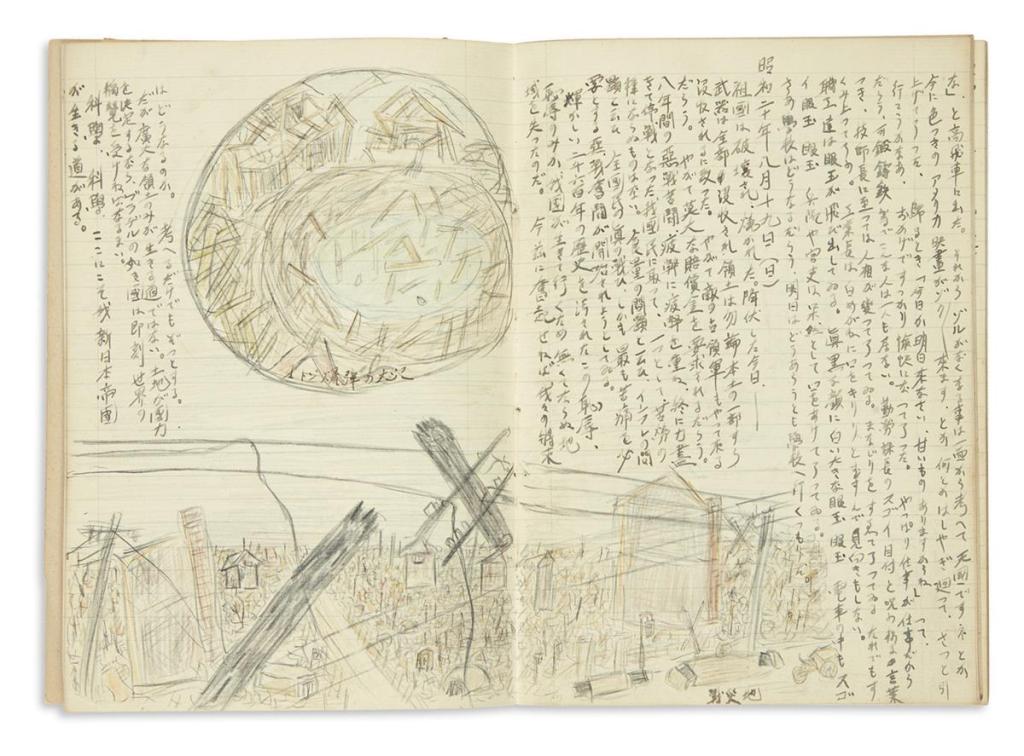
A diary with an illustration of the destruction after the fire bombing of Tokio

The first fire bombing of Tokyo on the 9th and 10th of March 1945 incinerated over 100,000 and made nearly a million people homeless. Every major city in Japan was to suffer the same fate. It didn’t sway the Emperors government at all.

Working in Port Moresby your dad would have handled letters and diaries daily. A vast amount of information had to be read, categorized and organized quickly because battlefield conditions are constantly in flux. Added to information coming down the Solomon and Marshall Islands, the Australian, Dutch, British, and from the US Army, there came intelligence from the coast watchers to which was now added labor needed to handle the documents coming from the Marines on Guadalcanal in the Solomons. The Navy and Marines would not enlist any Japanese. The remained segregated throughout the war but had seen the value the MIS boys brought to the fight and wanted to take full advantage of it. Because of this the MIS boys would soon be on the move.

At the ATIS clearance center in Brisbane, 400 hundred Nisei worked around the clock. Information from there was sifted thoroughly, categorized and quickly forwarded to Pacific headquarters at Pearl Harbor.

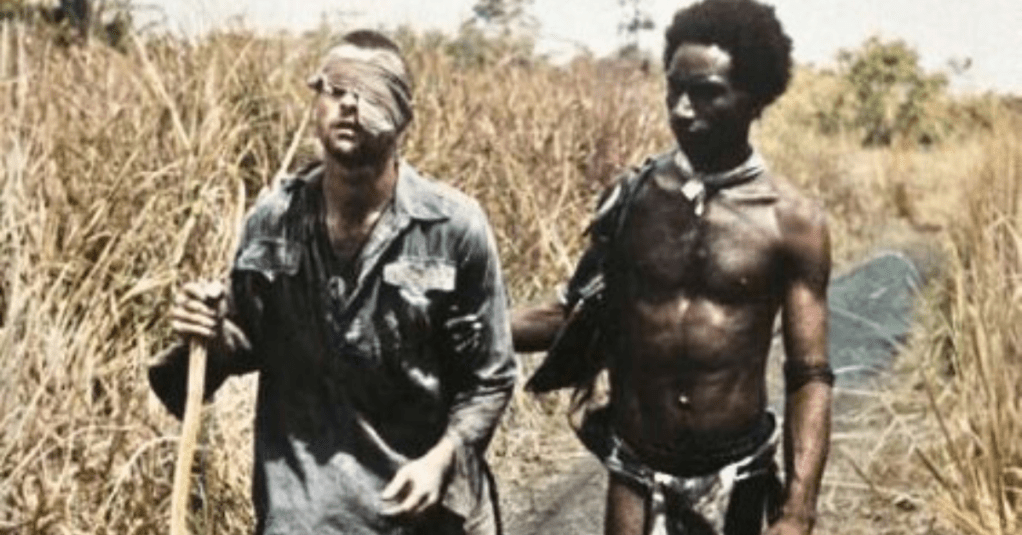
As well as the collected paperwork, your dad would have seen a steady stream of Papua New Guinea islanders, the famous Fuzzy Wuzzys. He would have had to really stretch his language skill because, though English was the language of the administrative population and the larger towns, in the bush it was Pidgin. Tok Pisin was the second language for the indigenous population. Pisin, or Tok Pisin is often referred to by English speakers as New Guinea Pidgin or simply Pidgin. It’s an English creole language spoken throughout Papua New Guinea and today is recognized as the official language of the country.

An Angel escorts a wound Australian of the 26th Regiment to the rear. Australian War Museum photo.

For example; if a Pidgin speaker came into the translators tent with some information on Japanese movements he might greet your dad with the greeting, “Gutpela long bungim yu.” or “Yu stap gut?” Wanam nem bilong yu? If Pisn wasn’t enough how about the Aussies? Australian and New Zealand slang is highly complex and something as simple as asking where the latrine is, “Wheres the Dunny mate?” can be laughingly confusing.

People today are likely to forget that much of the material the MIS handled was intensely personal. Japanese children grew up in those decades keeping journals in which they recorded their personal thoughts and feelings. Letters to Japan were mostly concerned with matters of family. American troops were much the same except that they were censored by their officers to root out any forbidden information which might help and enemy. The Japanese had no such system. A letter home by a Japanese soldier would have a return address, whereas US troops could not ever mention where they were.

Your grandparents hadn’t seen their son since he shipped out to Minnesota to attend school in October, 1942. He had not seen his family for almost two years. Letters were the only form of communication and it must have been agonizing to listen at mail call for his name to be called. Mail was irregular, frequently lost or arrived weeks and months late. The canvas bags of mail came by ship, were transferred to trucks or LST’s to be moved between stations and could come torn, opened by censors if they were from the concentration camps; even in some cases were and moldy after the long sea voyage. For the MIS especially terrible, literally every one your father knew, his entire family, neighbors, kids he went to High School with were locked behind barbed wire. Doing ones duty to his country came with a staggering personal cost.

Japanese soldier’s diary page.

I must mention too that the documents that came in to the MIS where stripped from the dead for the most part. Soldiers were ordered to capture Japanese soldiers when they could but since that meant a risk to your own life, it was rarely done. A journal might be splattered with the blood of the soldier it belonged too. It may have been moldering at the bottom of a wet, fetid backpack for a week and stunk to high heaven. There is little doubt that the Japanese American boys felt something very personal about this. They read names just like their own. The Kibei especially, who had studied in Japan before the war and who knew the country well. Customs mentioned in the letters, places they had lived, schools they had attended and for a few as the war went on, the names of people they knew and in some rare cases Japanese soldiers from before the war and in at least one case a brother who was unable to get out of Japan, drafted and met his MIS brother on Okinawa.

As time has moved on and the old soldiers neared then end of their lives, secrets they never told anyone began to take on a new meaning. Sons and daughters who had asked the age old question, “What did you do in the war daddy?“ just might receive an answer. Many children only learned about their fathers military service when they opened that old green trunk in the attic or a small box at the bottom of the sock drawer with a handful of old unidentified medals and insignia or perhaps at the top your mothers closet, a small white cardboard box tied with a faded blue ribbon full of saved V-Mail letters from the far side of the world.

When my uncle Jackie was in his nineties, I asked that questions just like the others did and his answer? He thought about it a while before he answered, “Oh, you don’t want to know about that.” and that was that.

*Clint Eastwoods twin films “Flags of Our Fathers” and “Letters from Iwo Jima” received critical acclaim but “Letters” by far was the most watched because it opened a door into a shared experience to which the generations who have lived since WWII were unaware of. It had the effect of humanizing those Japanese boys on Iwo through their the personal experience written in letters home. Letters from Iwo Jima is not the most exciting or intense war film but it does something that I’ve never seen before in that it humanizes the Japanese. Yes, there are still quite strong cultural differences that the movie talks about but it also shows them as everyday people with their own worries and hopes.

**In researching for this letter I found numerous official photos taken by combat photographers of captured or surrendered Japanese Imperial soldiers being questioned, most without any mention of the MIS Nisei, such was the secrecy surrounding the program. The photos I’ve used in this story of Nisei are almost without exception non-official and taken by unofficial photographers. The only exception is the one with Colonel Merrill of the Marauders in Burma.

Dear Dona 9

Coming Jan 18th 2025: “Up the line to Morotai Island. Big changes for the MIS.”

Michael Shannon lives in Arroyo Grande, California. He writes so his children will know what kind of people they come from.

Standard

Dear Dona,

Page 7

A Long Way From Arroyo Grande

Written By: Michael Shannon

When your dad was transferred up to Port Moresby with his team he was introduced to a place he never imagined while he grew up in Arroyo Grande.

He certainly read Tarzan of the apes when he was a kid and must have imagined the African jungle as it was described by Edgar Rice Burroughs. In the time honored way of writers, Burroughs himself never ventured any closer to Africa than Chicago. As kids, the places we know outside our own existence are described in a way that rarely has much relation to the real place where the story takes place. No less your fathers generation whose visual images wee formed by Life magazine or the jungle movies he saw at the Mission or Pismo theaters. It’s not much different today. Moviemakers are rarely too concerned with an actual location when they are creating a mythical place.


I’ve been to Papua New Guinea. I can testify as to its holding the title of one of the greatest hell holes on earth. When Hilo arrived in Port Moresby with MacArthurs headquarters the port itself was a tiny backwater of the colonial British empire. Papua New Guinea had a population of approximately 3,000 people, 2,000 natives and about 800 Europeans.

Port Moresby, Papua New Guinea, 1943

Port Moresby was a small British administrative center at the time, with only two track dirt roads connecting nearby coastal villages. The city was dry for eight months out of the year, from June to January, and locals had to depend on rainfall or transport water from other areas. For a place considered one of the wettest place on earth and because it was in the rain shadow of the Owen Stanley range it received only fifty inches of rain annually. It seems like a great deal if you grow up in Arroyo Grande where the average is about 19 but your dad would soon find out what real tropical rain is all about.


Imagine the introduction of nearly 18 thousand allied troops into the area. The general and some of his staff took over the British administrative buildings but almost everyone else lived in tents. There is no real way to experience the climate unless you go there. New Guinea is just about four hundred miles south of the equator and in the western regions the annual rainfall exceeds 125 inches a year. Think of that in feet. It’s raining there today and tomorrow and the next day and so on and so on. Plus its more 90 degrees and the humidity is roughly the same. Don’t worry though, it will cool off at night to about 85 or a little more. When the sun is out it can cook your skin in just a few minutes.

Port Moresby tent camp, 1943.

Flora and fauna? New Guinea has one of the most diverse ecologies on earth. It is home to every kind of biting, stinging and poisonous insect, even the wild dogs are dangerous. Think about birds, the Hooded Pitohui is extremely poisonous, and isn’t the only one. Some cockroaches can grow to six and seven inches long. There are nasty scorpions, stinging hornets, bees, caterpillars and moths, moths of all things. You want some relief? Go for a swim where in the ocean which is home to the deadly stonefish, killer sharks, Poisonous stingrays, remember the Crocodile Hunter? And snakes, sea snakes, very deadly and my personal favorite the “Two Step Snake,” if he bites you, you get two steps and you die.


The biggest killer in human history thrives in tropical climates and was responsible for more deaths in the Pacific than even the most horrific combat, especially for the Japanese Imperial army which was notoriously casual about the well being of it’s troops. Statistically somewhere around 95% of Japanese combat soldiers died of disease or starvation during the campaigns in Papua New Guinea.

Sidewall Tent Living, Port Moresby.

If all of that was not enough, living in a sidewall tent, sleeping on folding cots under mosquito netting you could also fall victim to Dengue fever commonly referred to as Breakbone Fever for which there was no vaccine until 1997. Add to this list Yellow Fever which killed tens of thousands during the building of the Panama Canal, Chagas, a parasite you get through the bite of the apply named “Assassin Bug.” Add Cholera which is transmitted through contaminated water and all kinds of parasites such as Hookworm, Roundworm, Whipworm and Tapeworm.


For Americans, disease was responsible for about 10% of deaths in the Pacific war but in the casualty column it was by far the biggest cause of loss. At any given time about 4% of US troops in the Pacific were unavailable for duty.

The MIS boys were ordered up by MacArthur in early 1943. He had around sixty who were loaded with their gear aboard the Australian navy’s transport HMAS Kanimba and sailed to Ferguson Harbor at Port Moresby. When they arrived there was almost no accommodations for them. Troops were billeted in camps scraped out of the brush. It would be months before Navy Seabees arrived and began building an airfield and erecting the ubiquitous Quonset huts so familiar to anyone who has ever lived in the Pacific islands.
Army service soldiers from the 93rd Division (Colored) worked around the clock unloading supply ships and building shelters, kitchens and other necessary support structures including showers and laundries.

His Majesty’s Australian Ship Kanimba unloading at Port Moresby, 1943. Australian War Museum photo.

In one of the funny things regarding race, which was an ongoing issue, the white officers and troops had only cold water showers but the Black troops built themselves hot water showers. Your father said the Nisei showered with the African Americans. Apparently the white troops never figured this little act of defiance out. A small rebellion but a taste of a future army*

At Port Moresby, your father and the others on his ten man team moved into their tents and quickly began digging slit trenches. The Japanese sent bombers on a regular run down from Rabual to pound New Guinea. The sound of bombs rattling down from high above sent soldiers diving head first into their fox holes and trenches. When your dad first arrived the ground troops had not pushed the Japanese army far enough to stop the harassment. It would be their first experience of the shooting war but not the last.

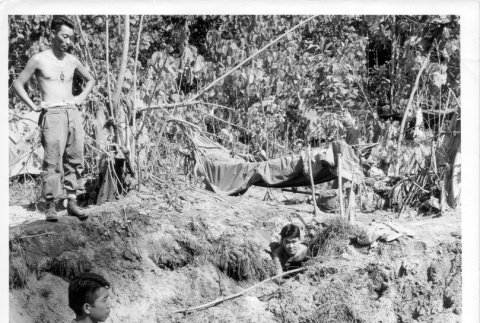
As a farm boy Hilo certainly knew about digging. Nikkei Archive photo.

The workload of the translators was very heavy. Because combat in New Guinea was unceasing as the allied troops slowly pushed the Japanese Northwest and out of the island, documents, letters and personal journals stripped from the vast number of dead** Japanese troops which by this time the allies understood to be of significant importance.

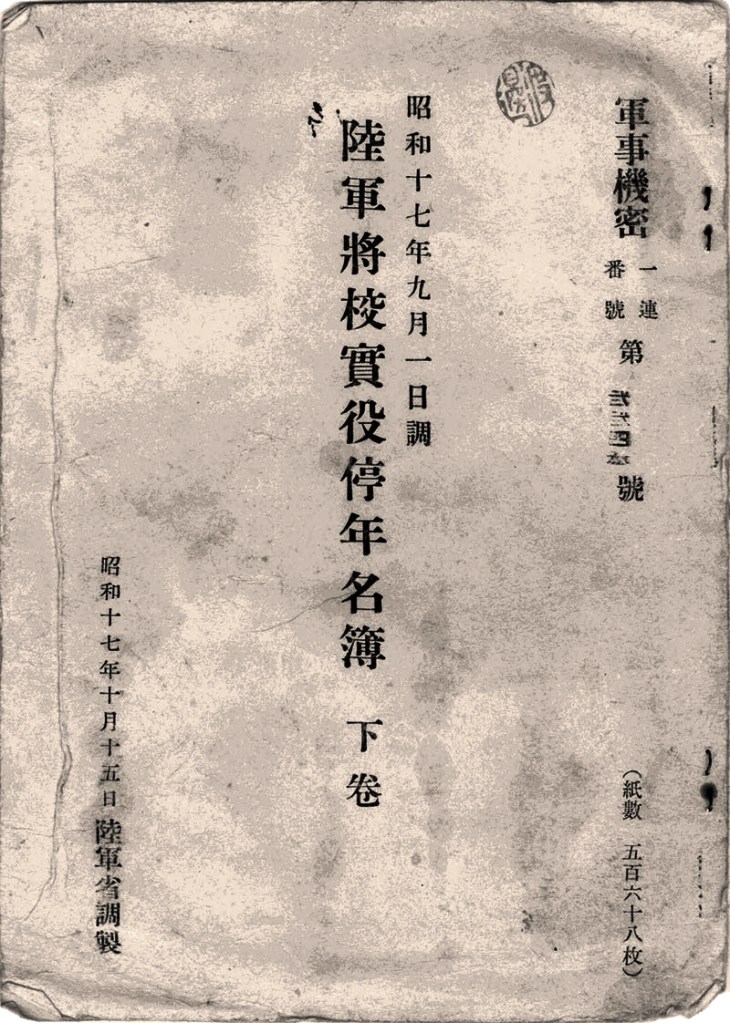
A Detail from the Japanese Imperial Navy’s Warship and Officer list. National Archives.

The battle of Midway in 1942 was partially won because of the MIS. Radio intercepts by the translators along with the breaking of the Japanese Naval code by the code breakers at Pearl set the stage for the ambush of the Japanese carrier force headed to Midway island in the northwest Hawaiian island chain and a good bit of sheer luck blunted the Japanese carrier navy which would never fully recover. It was the first nail in the coffin of Imperial Japans plans for the Greater Asia Co-Prosperity Sphere.

American commanders initially resisted using MIS nisei for their intended purpose, the gathering of information about the enemy. Thanks, however, to the persistence of a haole plantation doctor from Maui, Major James Burden, and the work of the nisei themselves, attitudes changed quickly. Major Burden took an MIS team to the South Pacific. They had to work hard for a chance to prove themselves. Nisei with the 23rd “Americal” Division in New Caledonia worked around the clock to translate a captured list of call signs and code names of all Imperial the Japanese Navy ships and air bases.

Major Burden and the nisei pushed to get closer to the action, and some wound up on Guadalcanal, where they made a big discovery: the joint operational plan for Japanese forces in the South Pacific.
Found floating in the Ocean it was brought ashore by New Caledonian natives and turned over to an Australian Coast watcher who arranged to get it to the 23rd’s headquarters. The Mis translators quickly discerned it’s contents and forwarded the documents to Army, Navy and Marine senior officers in Hawaii and Maryland. The hubris of the Japanese high command in not changing codes or plans meant that US forces in the Western Pacific were able to use the information to follow troop movements, fleet assignments for the rest of the war. Just this one thing validated the wisdom and the expense of the Army in forming the MIS teams.

There was more to come.

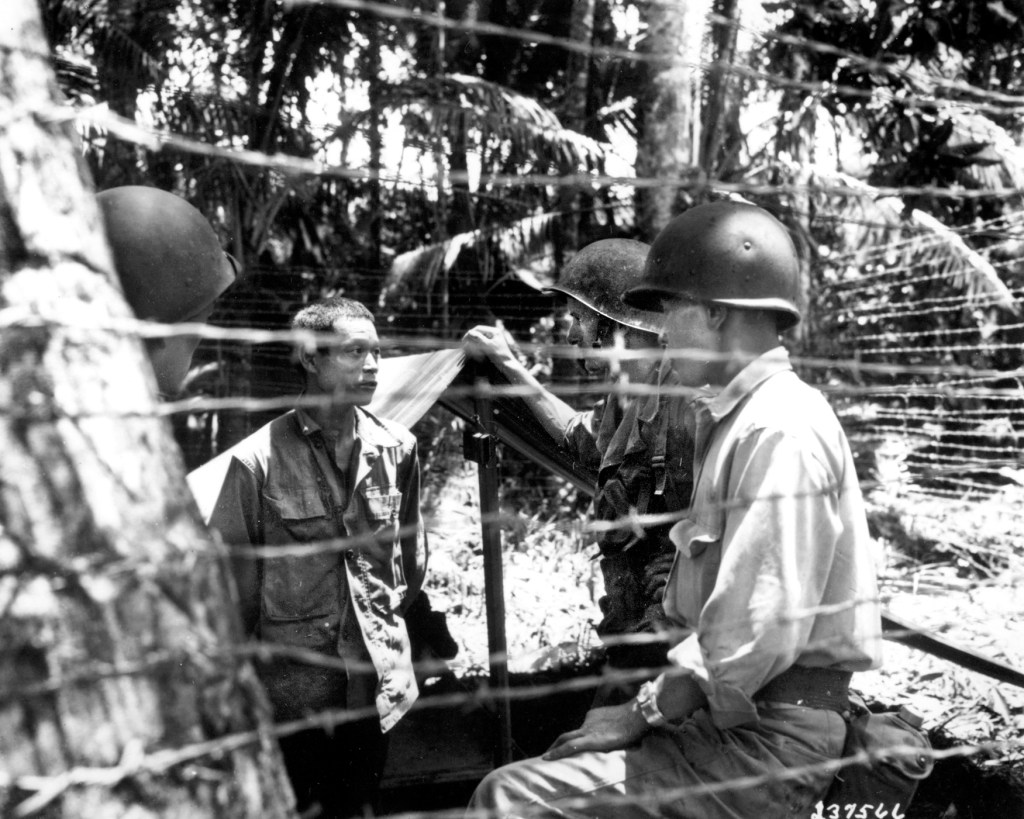
Above: SIMINI, New Guinea, January 2, 1943: From left, Major Hawkins, Phil Ishio and Arthur Ushiro Castle of the 32nd Infantry Division question a prisoner taken in the Buna campaign. Information from POW interrogations produced vital tactical information countless times. National Archives photo.

Next: Dear Dona, page 8. Moving up towards Japan. Maurutai, Luzon, Leyte, and Okinawa.

*Presiden Truman integrated the armed forces. On July 26, 1948, President Harry Truman signed Executive Order 9981, creating the President’s Committee on Equality of Treatment and Opportunity in the Armed Forces.

**The 23rd Infantry Division, more commonly known as the Americal Division, was formed in May, 1942 on the island of New Caledonia. In the immediate emergency following Pearl Harbor, the United States had hurriedly sent three individual regiments to defend New Caledonia against a feared Japanese attack. They were the 132nd Infantry Regiment, formerly part of the 33rd Infantry Division of the Illinois National Guard, the 164th Infantry Regiment from North Dakota, and the 182nd Infantry Regiment from Massachusetts. This division was formed as one of only two un-numbered divisions to serve in the Army during World War II. After World War II the Americal Division was officially re-designated as the 23rd Infantry Division, however, it is rarely referred to as such. The division’s name comes from a contraction of “American, New Caledonian Division”. The Americal Division was involved in ground combat in both World War II and Vietnam.

***From the Owen Stanley Mountains in New Guinea to Luzon, Philippines, the 32nd Division walked that long, winding and deadly combat road for 654 days of intense combat, more than any other American unit in World War 2. The Red Arrow was credited with many “firsts”. It was the first United States division to deploy as an entire unit overseas, initially to Papua New Guinea. The first of seven U.S. Army and U.S. Marine units to engage in offensive ground combat operations in 1942. The division was still fighting holdouts in New Guinea abd the Phillipines after the official Japanese surrender.

****The 93rd (Colored) was a combat trained division led by white officers. The “Blue Helmets” as they were known were almost never used in combat but reduced to labor battalions. The Division had shown in WWI in France that they were a fearsome outfit but in this war they were rarely given the chance and were reduced to no more than “Hired Hands.”

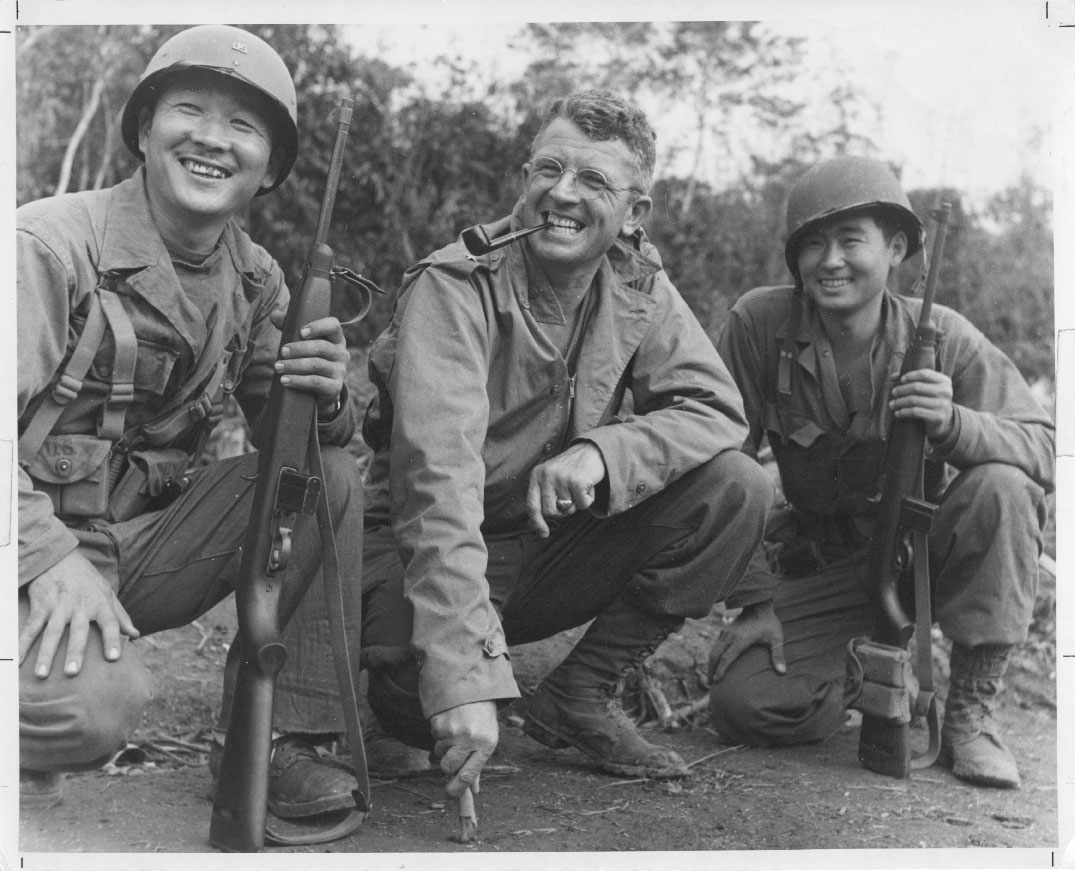
Cover Photo: General Frank Merrill posing with Japanese-American members of the Marauders. Fourteen Japanese-American service members with the Military Intelligence Service served as translators and codebreakers (Image courtesy of the National Archives and Records Administration)

Michael Shannon is a lifelong resident of California. He writes so his children will know where they come from.
Standard

Dear Dona,

Page 6

Author: Michael Shannon.

Auckland, New Zealand. 1943 population, 1.642 million people with a revolving population of soldiers and Marines. The New Zealand government was very concerned about the Japanese because without the Americans to defend the island they were in trouble. You see, the Anzacs were in Italy, the Mediterranean and North Africa, as well as Japan in south-east Asia and other parts of the Pacific. They weren’t home and the islands, just like Australia were desperate for the Americans to help defend them. Japanese submarines were patrolling the waters between New Zealand and Australia. In 1942 the United States navy had just barely stopped the planned invasion of Port Moresby in New Guinea. The reason was its close proximity to both Australia and Asia. The Japanese viewed Port Moresby as a key point to launch aerial attacks on the northern part of Australia. They could have closed the sea lanes from the U S to Australia and New Zealand. Troops fighting to defend New Guinea, the Anzacs, Dutch and MacArthur’s undertrained, rag tag 32nd division from Wisconsin and Michigan were slugging it out with Japanese in the fetid, rainy jungle of the southeast of New Guinea trying to push the Japanese back along the Kokoda trail and down the Owen Stanley range toward the coast. Soldiers on both sides had to literally crawl on their hands and knees because the slopes were so steep and slippery from the constant rain. There was no more brutal fighting in WWII. Nisei translators later found Japanese diaries which describe starving soldiers butchering and eating the Australian dead. The Japanese were literally starved out.

Soldiers were granted time away from the ship in Auckland. It was a chance for the Americans to sample a culture quite different than their own. For the Nisei who were well acquainted with ethnic hatred it brought to mind some curious observations. The Kiwis’ didn’t consider the translators outsiders. Neither did they dislike the black support troops from the ship and ones stationed at the army camps ashore. This was a big difference from the way white Americans treated their fellow citizens. On the voyage over, great care was taken to segregate troops of color from their fellow soldiers. Contrary to what is written in history books, violence towards minorities was common in our military.

On June 12, 1942, five transport ships carrying US Army troops arrived in Waitematā Harbour in Auckland. This marked the beginning of the “American invasion” of New Zealand, which lasted until mid-1944. The New Zealanders were quickly disabused of their inherent like of their fellow allies.

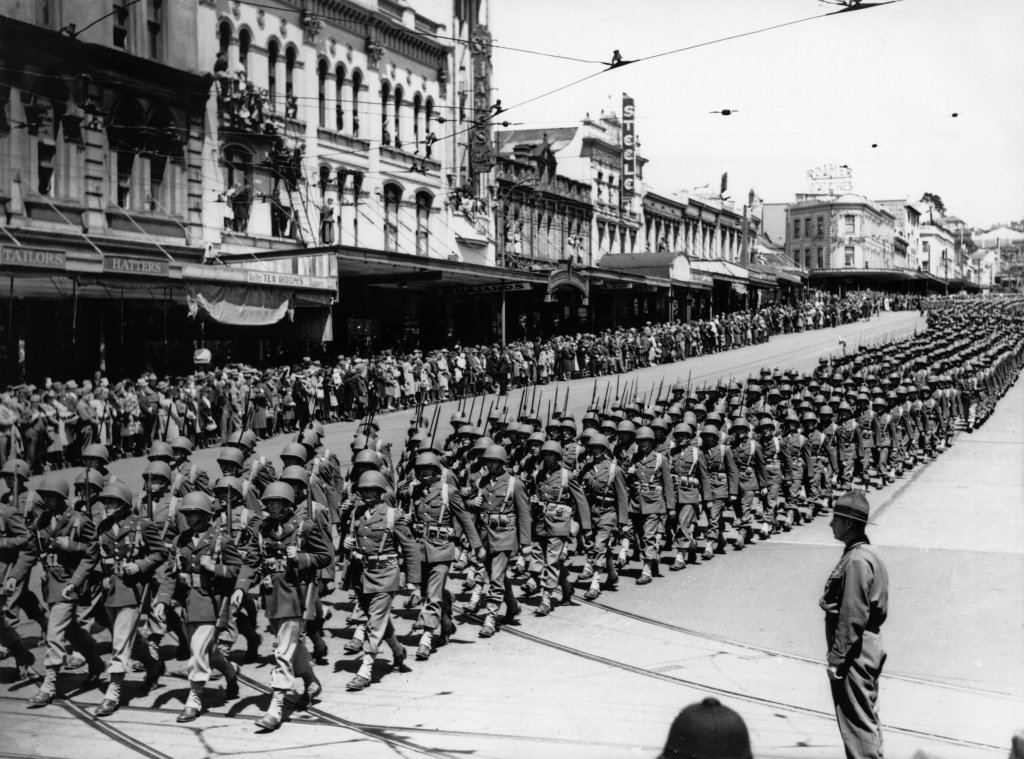
US troops march down Queen Street, Auckland, 1942. New Zealand Herald Archives photo.

Between 15,000 and 45,000 American servicemen were stationed in New Zealand, mostly in camps in or near Auckland and Wellington.There were cultural differences between the Americans and New Zealanders. New Zealand women found the US servicemen to be handsome and polite, and they had more money than New Zealand soldiers. They were better dressed than the local troops and being young and very far from the moral strictures of home had few reasons to show anyone respect. Women of all kinds were “fair” game, the way they saw it. This led to romantic entanglements between American troops and New Zealand women. “Overpaid, oversexed and over here” was the watchword for the New Zealanders. The locals saw it as an “American invasion”. Many New Zealand soldiers resented the idea of relationships between New Zealanders and American soldiers, leading to tense relations between the two parties.

Another source of tension was US servicemen’s attitudes towards the Māori. White soldiers from the 31st “Dixie Division” from the south were not “comfortable” with Māori soldiers. The government published a guide book for US servicemen, titled “Meet New Zealand” which reminded the Americans that “the Maori today occupy a position in society socially and politically equal to that of any pakeha or white New Zealander”. The Prime Minister’s office said that New Zealanders should “be friendly and sympathetic towards the colored American troops, but remember that they are not accustomed in their own country to close and intimate relationships with white people. Anyone finding themselves in the company of both white and black American troops was advised to “avoid unpleasantness”. Quite the understatement.

During this time, hotel bars closed at 6 pm and masses of drunk soldiers were then ejected into the streets. This was known colloquially as the ‘six o’clock swill’. Around 6 pm on the evening of 3 April 1943, fighting broke out between US servicemen and New Zealand soldiers and civilians outside the Allied Services Club. The brawls spread to the ANA (Army, Navy, and Air Force) Club in Willis Street and then to Cuba Street and continued nonstop for hours. Civilian and military police attempted to break up the fights, but only finally subsided as the US soldiers left town on trains back to their camps. 6×6 army trucks returned the passed out drunk and those damaged by the shore patrol and the MPS. Courts Marshalls were ordered then cancelled for lack of any evidence, another understatement.

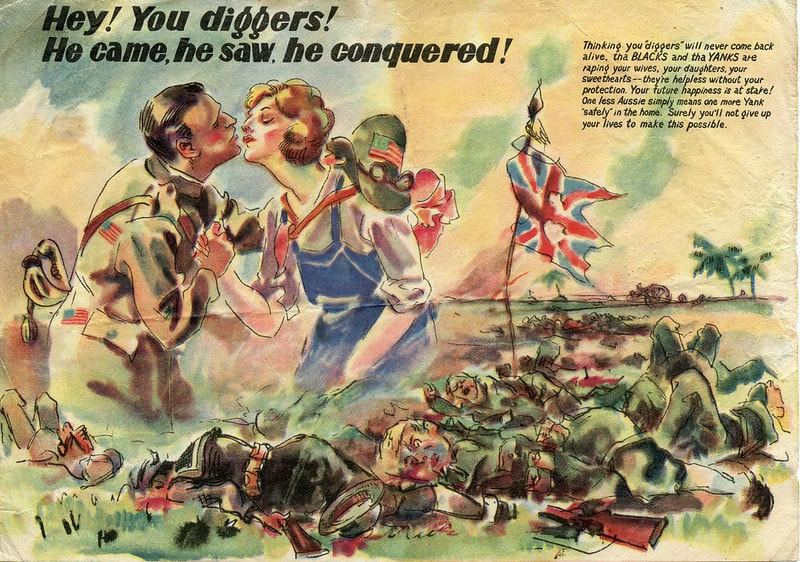
The Japanese also understood the value of propaganda. Japanese leaflet. 1943 US Army Archives

When your dad arrived with the other Nisei, the New Zealanders accepted them as equals but their own countrymen, far less so. Any thought by the translators that their service would reduce the racism of white troops was an unlikely dream. They had to be very careful.

A fight on 12 May 1945 in Cuba Street involved over 150 Māori and US servicemen. This fight was definitely racially motivated: Māori troops were angry at their treatment by the Americans, who tended to treat them the way they treated black Americans. Military reports stated that “Maoris from whom statements were taken allege they have been insulted by the Americans and have been told by Americans not to ride in the same tramcars, drink in the same bars, eat in the same cafes and that they should walk via back streets or step off the sidewalk when American soldiers approached. The Americans call them black curs an N*****s and have consistently insulted the Maori race. Imagine traveling halfway around the world only to find the same intolerance and hate as in your own home town. The only modifying thing was that the New Zealanders accepted both the Blacks and Japanese translators with no reservations. They were welcomed in New Zealand’s establishments and into their homes as well.

Because the MIS translators were considered so valuable, General MacArthur ordered them to be sent to Brisbane, Australia immediately. When they stepped off the ship in Brisbane, and were driven to army headquarters the first thing they were told was to avoid places where American soldiers hung around. Just like Auckland and Wellington, Brisbane had seen vicious riots on more than one occasionAmericans had worn out their welcome.

By late summer of 1943 the offending division had been moved to the front in New Guinea where they again failed to distinguish themselves in the vicious fighting on the Kokoda trail where the Imperial Japanese army had been pushed back over the Owen Stanley range of mountains by the Anzacs. At nearly 14,000 feet, the battles in the clouds as the news called it, the Aussies not only fought the Japanese but triple digit heat, little water, almost no food and what they did have had to be hauled up the nearly vertical mountains by the New Guinea natives who supported the Anzacs, the so called Fuzzy Wuzzy Angels. “Fuzzy Wuzzy Angels” was the name given by Australian soldiers to Papua New Guinean water carriers who, during World War II, were recruited or forced into service to bring supplies up to the front and carry injured Australian troops down the Kokoda trail during the Campaign. Over the four arduous months, the Fuzzy Wuzzys helped secure an Australian victory by forming a human supply chain along the Kokoda Track, moving food, ammunition up and wounded soldiers down from the front lines. 625 Australian soldiers were killed during the Kokoda Campaign, and over 1,600 wounded. Additionally, in excess of 4,000 soldiers became casualties due to illness. More than 150 Papuans died as members of the Papuan Infantry Battalion or as carriers of critical supplies and wounded along the Kokoda Trail.

New Guinea auxiliaries helping an Australian soldier down from the Owen Stanley mountains. Australian War Museum photo.

the Australian and New Zealanders finally defeated what was to be Japan’s last attempt to invade Australia and cut the sea lanes from the United States. The battles now moved to the northern end of New Guinea. Port Moresby was secure and planning was underway for the next step up the island chain towards Japan itself.

MacArthur moved his headquarters from Brisbane to Port Moresby in New Guinea. Your dad and his other translators packed up and went with him. They were working seven days a week. Hundreds of thousands of diaries, letters home and military communications were being processed every week by the MIS translators. Rather, as you might imagine just a primarily local project, it had become necessary due to the volume of documents being found in caves, the bodies of dead Imperial troops and radio intercepts to establish a communication network that encompassed the men with MacArthur like your father and the cryptographers at Pearl Harbor, the language school at San Francisco’s Presidio and the school at Fort Snelling in Minnesota. A network was set up to handle the radio traffic between places and to provide air transport to move the thousands of crates of captured documents.

Leaving the comfortable billets in Brisbane, your father and his crew packed up and moved to the decidedly less cushy environs of Port Moresby, New Guinea. They would have to get used to the new arrangements. It would be a long time before they saw a solid roof over their heads or a decent shower. It would be canvas and cold water from here on out.

Tent 29. Camp Chelmer, Indoorooplily, Queensland, Australia. November 1943. Joe Iwataki photo

Dear Dona . Page 7 Coming December 27th.

Standard

Dear Dona

Written by Michael Shannon

Page Four

Unlike the American military where mail was censored and journals and diaries forbidden the Japanese Imperial Army thought the differences in language would make ordinary Japanese as indecipherable as any code to an American reader. The head instructors at the MILS schoolalso knew that Japanese soldiers were brutalized by their superiors and would likely be resistant to the treatment the British were using on captured Afrika Corps German troops where violence and intimidation were routinely used to coerce confession and information. As many of the instructors had lived in Japan for extended periods of time they knew the Japanese were generally very kind and the spirit of co-operation was instilled in them from birth. The culture of Japan was bound to duty to the Emperor and higher authority, but they also believed that force would not be enough to get prisoners to break down. Instead the language program not only include reading a writing and the general makeup of the Japanese soldiers battlefield strategy and tactics but a heavy emphasis was put on Japanese society, geography and religious beliefs. The idea was to draw a picture of the individual soldier in an attempt to establish rapport with him. They planners knew that they would resist brutality because that was a soldiers daily life in the Imperial Army. Instead a cautionary approach was adopted where kindness and not only assurances of kind treatment but whenever possible knowing about the persons home. Differences in prefecture, religion, the social mores of a particular part of Japan helped build trust between the interrogator and the prisoner.

American government sponsored propaganda was designed to present the enemy as a monolithic structure, all Japanese being of the same mind. Depictions of the Japanese were as vile and hateful as the propagandists could make them. It was impressed upon the American public that they needed to be eradicated. This conveniently swept under the rug the fact that, just like the US they were a diverse people with many different beliefs. Led by a military dictatorship whose war aims were no less than domination of the entirety of east and Southeast Asia.

The two largest religions were Shintoism, the official state religion and Bhuddism which originally came from China and was characterized as a forign religion. Various western religions were also represented particularly the Methodists. In 1940, Christians in Japan united in a declaration of church unity after the Religious Organizations Law required all Protestant churches to merge into one.

Japan had religious freedom during World War II and there was separation of church and state. It was not a theocracy. It is correct to say that most religious people were pro-war at the time.

During the pre-1945 period, Japan moved into political totalitarianism, ultranationalism, and fascism culminating in Japan’s invasion of Chinese Manchuria in 1931. This was part of an overall global period of social upheavals and conflicts.

Regardless of the political reality the instructors knew that the average Imperial Japanese soldier would have far less interest in politics and much more allegiance to his family, friends and the local village life. All of these observations dictated a much more friendly and kind approach than the Germans were getting from the British. Establishing a connection between the Nisei interpreter and the prisoner was an important part of the curriculum at Camp Savage.

The very first class which started on June 1, 1942 was made up of 200 enlisted men, 193 Nisei and 7 Caucasians. The entire class, which had been moved from the Presidio was made up of soldiers who had already enlisted before the war and were considered regular army. Their studies had begun in San Francisco and it wasn’t until after order 9066 was signed in February of ’42 that they moved east.

There were three types of student classification. There were Caucasians who had studied abroad or attended universities where they studied Japanese The majority were Nisei, American born citizens who had varying degrees of language experience. Some had attended locally run Japanese schools which they attended after regular public school classes and came from homes where the Japanese was spoken. The third classification were the Kibei, A subset of Nisei who spent a significant part of their youth in Japan, usually for education, and then returned to the U.S. They ranged from students who had gone to elementary school, many from Japanese high schools and some University students. The Kibei were terrific asset to the MIS because of their familiarity with Japanese culture at all levels.

The terms the Japanese used to describe what generation they were from were introduced to Western American cultural language in the late thirties. Hilo’s immigrant parents were referred to as Issei or First Generation. The 2nd generation like Hilo and his brother were Nisei or 2nd generation. Sansei were their children, the ones I went through school with.

Families wealthy enough to send children to Japan were relatively uncommon. Kibei (帰米, literally “go home to America”) was a term often used in the 1930’s and 40s to describe Japanese Americans born in the United States who were studying in or had studied in Japan. Many Kibei got trapped in Japan when war broke out between Japan and the U.S. In a sense, they became stateless because they were Americans living in Japan, labeled as the “enemy” in both.

The Kibei were the foundation blocks of the school at Camp Savage. Because the service would need soldiers to read fluently, translate to careful english, have some background in Japanese cultural, both civilian and military classes were on educating each student in a curriculum that matched both his background, Nisei or Kibei, and the specialty he was being trained for. Graduates would operate in teams where each member had one of the key components they studied at Savage.

Savage was an apt description for both the curriculum and the school. Foremost in their minds must have been the consequences they likely faced if they failed. The military is essentially faceless. You have a serial number because thats how you are identified. Transfers aren’t exactly blind but primarily rely on number that are needed here or there. For the Nisei soldiers at camp Savage, that meant that failure meant transfer back to your original unit. In Summer of 1943, nearly all Nisei in the various units of the army were transferred to the 100th Infantry Regiment, a mostly Hawaiian unit made up from the Hawaii National Guard. Trained in Mississippi and Wisconsin they shipped out to Italy in September of 1943 and were immediately thrown into the battle for Salerno in southern Italy near Naples. They spent the next eight months in nearly constant combat in some of the most vicious fighting of WWII. Every Nisei at Savage knew of this and what the price of failure would be, immediate transfer to the 100th as a replacement. They weren’t cowards, far from it, but they also understood the reality.

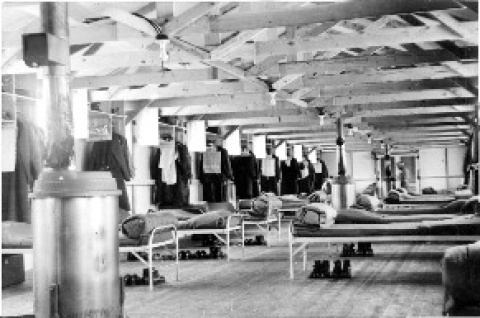
Your father lived in one of those tarpaper shacks for six months. I’m sure he had his turn rolling out of his cot at 4:30 am and priming the stove. He may have been lucky in the placement of his bunk, next to the little coal stove would have been as good as it got. Having a bunk on the end of the row would not be the best place to be in Minnesotas winter. Tarred paper is not among the greatest insulators. In fact it dwells pretty near the bottom. You can poke a pencil through it with no effort. Those shacks were drafty and pretty close to sleeping out of doors. In the morning they must have smelled. A confection of bad breath, farts, nearly dead hunks of coal giving off a noxious vapor and the clinging smell of cigarettes and uniforms they were not able to keep clean. Hanging just below the rafters a white cloud of condensed vapor from the mens breathing which would melt a drip as the room and the day heated. Soldiers had to do their own laundry, in tubs and basins outdoors with rough alkaline soap. Avoiding that chore would have been paramount.

Barracks at Camp Savage with stoves. US Army photo. 1943

Being young and soldiers they would have laughed at their predicament and blamed the army in no uncertain terms. Grousing soldiers have alway found the military to be the villain. SNAFU* was the word in WWII.

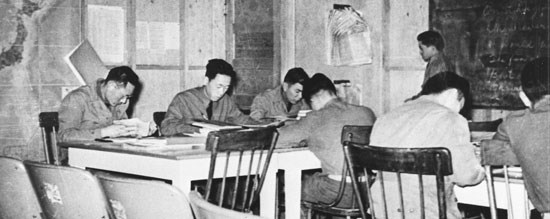
The classrooms were a better place to be. Semi-permanent buildings, well heated and clean would have been a relief. Luckily student were relieved of all the most basic duties that a soldier normally carried out. There was no drilling or inspections, no standing post in the middle of the night, all the little annoying things that the regular private has to put up with. The Army was desperate to prepare them for their combat jobs and made sure they had no more distractions than absolutely necessary.

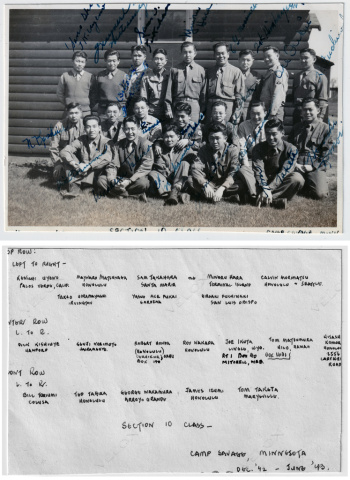
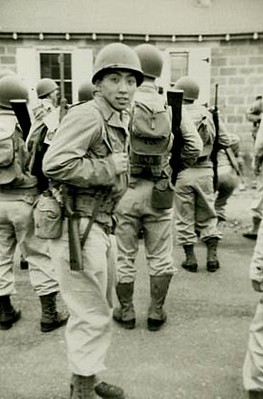
After six months in the classroom, class C-10 at Camp Savage walked out of the classroom for the last time and stood in front of one of the remaining log buildings and stood for a class picture. Everyone smiling and glad to be through the grinding curriculum.

1942 1943 Camp Savage MIS Niseis. Your fathers class.

Hilo received a promotion to Tech five, an enlisted rank slightly below Corporal.** Like the others, he walked back to his hutment to open his official orders. He would have opened the manila envelope with the printed label, Official, Department of the Army and like all soldiers held his breath while he slid the paperwork out. Along with his service record was a single page warning him that he was now a holder of a Top Secret Clearance and was liable under the Uniform Code of Military Justice and the Official Secrets Act not to share or divulge any information as to his assignment or duty station under penalty of law.

Every MIS soldier carried a Secret designation. Information on the school and its graduates, their purpose was to be a closely held secret. This designation was to be enforced for a period of fifty years after WWII. The Military was concerned about the fact that they had interpreters in the Pacific theater whose importance could not be overstated.

Hilo’s parents who were housed at the Gila River, Arizona concentration camp had been visited by the FBI. Every MIS graduate had been thoroughly vetted before they were ordered overseas. This must have been very confusing to Hirokuni and Ito who would have been interrogated by two agents who gave them no information at all about the reason. Hilo wasn’t even mentioned during the questioning. The were and would remain completely ignorant of the reason until the war was over.

The second sheet of paper stated his destination; future duty station and was clipped to a set of official orders and travel vouchers. He was to report to Army headquarters in Oakland where he would travel by available transport to the Southwest Pacific Theater of Operations immediately. There would be no leave as Nisei soldiers were not yet allowed to enter the restricted zone to see family.*** Censorship rules meant that he could not tell them his destination just that he was being ordered overseas.

MIS interpreter PFC Geo Hara leaving for the Pacific, 1943. Densho Archive photo

Hilo himself wouldn’t have known his actual destination. He wouldn’t find out until his ship passed Hawaii so sensitive was military command. Some of the instructors at Savage were returnees and would have shared general information but not too much. He could have likely guessed that it would have been the Western Theater of Operations under General MacArthur but where? He was left to wonder.

Page Five coming Saturday November 23rd.

Destination, Southwest Pacific theater of operations and the real war.

Notes on text:

*SNAFU, Situation Normal, All f****d Up.

**The Army forbid the Nisei commissioned rank until late in the war. All MIS personnel were enlisted or noncommissioned rank.

*** Restrictions on visitation were lifted for servicemen in late 1943.

Links to other chapters in the series.

Page one: https://wordpress.com/post/atthetable2015.com/12268

Page two: https://wordpress.com/post/atthetable2015.com/12861

Page three: https://wordpress.com/post/atthetable2015.com/12872

Michael Shannon is a writer living in the Central Coast of California. He went to school with many children, whose parents were survivors of the camps in his little farming community of Arroyo Grande, California..
Standard

Dear Dona

Page Three

Written by Michael Shannon

A Hobson’s choice is a free choice in which only one thing is actually offered. The term is often used to describe an illusion that choices are available. That’s the military to a “T”

December 3rd, 1942.

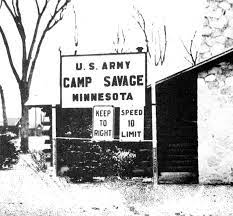
At morning roll call, the Lieutenant called your father’s name. He was told to report to headquarters right after morning chow. Like any good soldier he asked what was up and like any good officer the Lieutenant wouldn’t tell him. So after breakfast he hustled over to the headquarters building and reported to the Top Kick, the first sergeant. Hilo would have entered the office, stood on the yellow footprints painted on the floor and announced himself. The sergeant merely looked up then rummaged on his desk until he found what he wanted, then said simply, “Your Orders.” “Where to Sarge?” “Camp Savage, you’d better pack your winter uniforms,” and he laughed.

Camp Savage, Minnesota home of the Military Intelligence Service Language School. Camp Savage was a World War II Japanese language school located in Savage, Minnesota, and was the training ground for many Japanese Americans who served in the U.S. military. The buildings were originally built during the Great Depression to house Civilian Conservation Corps (CCC) workers. In the rush to build up American forces the CCC tarpaper huts were put into service for the Nisei students. Part of Fort Snelling near Minneapolis, Savage was the new home of the language school. Originally located at the Presidio in San Francisco it was moved to the center of the country for the “safety” of the Nisei students. Californias attorney general Earl Warren a supporter of Executive Order 9066 signed by President Roosevelt on February 19, 1942: this order authorized the forced removal of all persons deemed a threat to national security from the West Coast to “relocation centers” further inland – resulting in the incarceration of Japanese Americans. You will note that the order only mentions “persons,” and not Japanese Americans, though the only removals just happened to be in the west. Germans and Italians weren’t moved anywhere.

Fort Snelling/Savage had a long history controversial acts by the US Government. Snelling is a former military fortification on the bluffs overlooking the confluence of the Minnesota and Mississippi Rivers. The military site was initially named Fort Saint Anthony, but it was renamed Fort Snelling once its construction was completed in 1825.

Before the American Civil War, the U.S. Army supported slavery at the fort by allowing its soldiers to bring their personal slaves. These included African Americans Dred Scott and Harriet Robinson Scott, who lived at the fort in the 1830s. In the 1840s, the Scotts sued for their freedom, arguing that having lived in “free territory” made them free, leading to the landmark United States Supreme Court case Dred Scott v. Sandford. In this ruling, the U.S. Supreme Court ruled that enslaved people were not citizens of the United States and, therefore, could not expect any protection from the federal government or the courts. The opinion also stated that Congress had no authority to ban slavery from a Federal territory. United States Supreme Court Chief Justice Roger B. Taney ruled that African Americans were not and could not be citizens. Taney wrote that the Founders’ words in the Declaration of Independence, “all men were created equal,” were never intended to apply to enslaved blacks, they not being “Men” under the laws of the United States.The decision of Scott v. Sandford is considered by many legal scholars to be the worst ever rendered by the Supreme Court. The ruling was overturned by the 13th and 14th amendments to the Constitution, which abolished slavery and declared all persons born in the United States to be citizens of the United States.

The fort served as the primary center for U.S. government forces during the Dakota War of 1862. It also was the site of the concentration camp where eastern Dakota and Ojibway tribes awaited riverboat transport in their forced removal from Minnesota to the Missouri River and then to Crow Creek by the Great Sioux Reservation.

Hilo went down to the transportation office to find out how he would get up to Minnesota, it was nearly 1,400 miles away and when he checked the newspaper in the PX he found out that the high temperature that day was 21 degrees and the low was -1. Not the temperate central California weather where he was from nor even Fort Bliss where it was 68. He reckoned the crack about winter uniforms was good advice. Of course, being the army they weren’t going to issue him any either. He figured he would have to wait until Minnesota.

In ’42, getting from Texas to Minnesota wasn’t easy. The Army would waste no effort in flying a lowly private anywhere, going by car was impossible for those who had them and even if they could get rationed gasoline, that was impossible for an enlisted man. The Army sent soldiers by bus here and there but getting a chit to travel that way was forbidden to the Nisei. With the war in the Pacific the military considered it too dangerous for Japanese Americans travel alone or by private transport. He went by passenger train. Switching railroads and constantly being sidetracked by military trains which had priority, the 1,400 mile trip took six days. He had to sleep on the train car’s benches and jump off at the stations where the train stopped to buy something to eat. Even for a 23 year old in the prime of life it was an exhausting trip although considering what was to come, it was a walk in the park.

He and the other boys kept up on the war news by reading newspapers to pass the time. While they were enroute, the US Navy lost the heavy cruiser USS Northhampton in the Battle of Tassafaronga in the Solomon Islands, sunk by Japanese Imperial Naval torpedos. They read that the Afrika Corps was being pushed into a corner in Tunisia by the Allied armies and their surrender was expected, though that wouldn’t be soon. While traveling to Camp Shelby they read that the US Marines had turned over the mission in Guadalcanal to the US Army which immediately was involved in very heavy fighting in the interior of the island. American and Australian troops finally pushed the Japanese out of Buna, New Guinea. New Guinea was a place Hilo would soon enough become familiar with. Unbeknownst to the travelers, below the bleachers of Stagg Field at the University of Chicago, a team led by Enrico Fermi initiates the first nuclear chain reaction. A coded message, “The Italian navigator has landed in the new world” is sent to President Roosevelt. The result would, in the end, save the lives many Mils soldiers, but that would come much later, too late for many.

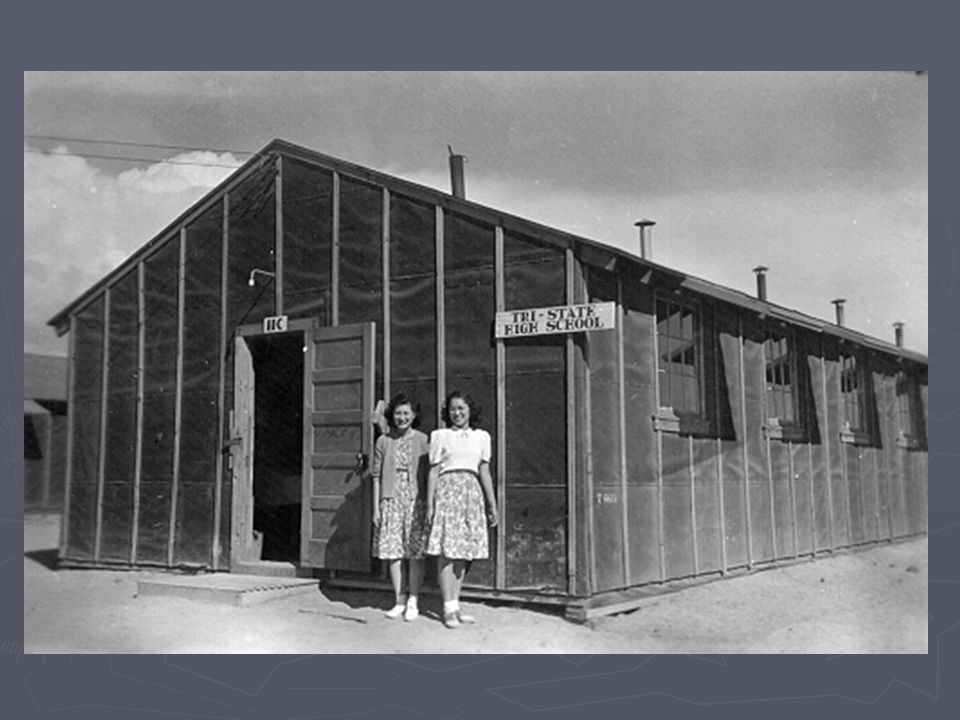
Following Japan’s attack on Pearl Harbor, anti-Japanese sentiment and political expediency pushed President Franklin D. Roosevelt to order the army to set up Japanese internment camps in seven western states, that included Japanese Americans who volunteered at the U.S. Military Intelligence Service Language School in San Francisco. The school and volunteers had to move from the so-called “exclusion zone.”

All the western states but Colorado and Minnesota refused to host the school except Minnesota Gov. Harold Stassen who offered 132 acres of land in Savage to host the school. In 1942, Camp Savage was established. An old CCC camp and host to the Boy Scouts, it was run down and primitive. What buildings were still standing were augmented with the building of the cheapest of the military’s building, the loathed and ubiquitous tarpaper shack, the miserable hutment.

Hilo stepped down from the camp bus which had picked up the volunteers at the railroad station. He tossed his barracks bag up onto his shoulder and followed a Corporal who had been sent to get the. When they got to the headquarters building he turned, looked them up and down and over a big grin said, “you’ll be sorry,” followed by a laughter. Names Kobayashi,” he said, “Larry.” “Get checked in and I’ll take you to your quarters.”

Most of the men experienced for the first time the bitterly cold winter of Minnesota. Nearly all the students were from the temperate zones of the west. Some of the men suffered frostbites and persistent colds. The only source of warmth was the pot-bellied coal burning stove found in the classrooms and in the barracks. The stoves in the classrooms were kept burning by the school staff but the ones in the barracks were the responsibility of the students. If you had been designated barracks leader you usually had to wake up early at 4:30 am. to stoke up the stoves so that the rest of the men could rise and shine in a warmish barracks.

Classmates at Camp Savage. The Military Intelligence Service Language School, 1943. Densho Archive

The purpose of the school was for the volunteers to teach the Japanese language to military personnel. This skill could then be used to interrogate prisoners of war, translate captured documents and aid in the American war effort. A total of 6,000 students graduated from the school before it was moved to Fort Snelling in 1944.

The ancient Chines General Sun Tzu and philospher revered as one of the greatest military strategists, advised in his treatise that intelligence, procured from the enemy is the way to victory. George Washington set up an extensive intelligence system and it really hit it’s stride in the Civil War. Of the two types of intelligence strategic or long term planning and Tactical which concerns the enemy’s strength and location and is used to make immediate decisions on the actual battlefield.

The short but extremely intensive course was designed to meet the demands for linguists from field commanders in the Pacific. The studies included the study or review of the Japanese language, order of battle of the Japanese military forces, prisoner of war interrogation, radio intercept and many other subjects that could be of value in the field. Just to illustrate how intense our course was the kanji (ideographs) instructor would make us memorize seventy five characters a day just to make sure we remembered fifty for the next day’s test. Many of us studied using flashlights under our blankets after lights out at 2200 hours. Saturday mornings were devoted to examinations. Many woke up early, about 0400 hours, went to the latrine, sat on the commodes and studied for the tests under the meager lighting. The competition was so keen in class that the class grade average was in the mid-nineties.

The study week, Mondays through Fridays, consisted of classes from 8 to 12, a brief lunch break, classes from 1 to 5, a break for supper and compulsory supervised study from 7 to 9. Examinations were conducted on Saturday mornings. The soldiers were free from Saturday afternoon until Monday morning. The majority would hurry to the Twin Cities for Chinese food and movies. On Sundays most attended church services in St. Paul, where many students were befriended by a Mrs. Florence Glessner, who graciously invited the Nisei kids to luncheons and parties. Mrs. Glessner was a Red Cross volunteer and after graduation and assignment to the Infantry Divisions on Bougainville, the MIS soldiers made a collection from the members of the language detachments and sent the donation to the Red Cross through Mrs. Glessner. She later sent us a clipping from a Minneapolis newspaper about the donation “from her boys”.

Minnesotans rarely saw any Japanese-Americans and for the most part had little or no racial bias. Unlike the west coast where business and individuals were stripping evacuees of their property, houses, fishing boats and anything they could get their hands on the people of Minneapolis were giving dances and dinners to the kids at school. Showing an appreciation for the Nisei soldiers who were serving their country. Many students at the MISLS were astounded by this. Captain Kai Rasmussen, the camp’s first commanding officer was quoted as saying, “Minnesota was the perfect place because not only did the state have room for the school, but Minnesotans had room in their hearts for the boys.”

Your dad arrived at Savage after your grandparents had already arrived at Poston. It was very hard for them to communicate by mail. Nisei soldiers could not safely write in Japanese and in many cases the parents could not write in English. Letter were very carefully written, in your dads case probably by your aunts, He must have been worried sick about them and they him. They may not have even known where he was. If he got leave at the end of his class he would not even have been able to visit because in 1942, no Nisei soldier would have been allowed in the exclusion zone. When the restriction was lifted in 1944, he had already left for the Pacific war zone.

Tri-State High School, Poston Camp. 1943. Densho Archive.

The photo above is a sad commentary, but the two young ladies are a lesson in the girls resilient nature. Though held against their will behind razor wire they still managed to dress in the current fashion of young women. They wear saddle shoes, bobby sox, full knee length skirts, peter pan collars and sweaters, they would not be out of place in any high school in the nation. My mother dressed just like this. She was the same age

It was a rough go for them because almost al the students were from the exclusion zone and many had no idea where their families were. Lieutenant Paul Rusch, one of the senior instructors had spent decades in Japan as a Methodist missionary and knew the culture better than any other instructor. He lent a sympathetic ear. Students said they ween’t angry with the Army but that they were, “Just against everything that was happening with their families. We’re being treated as second class citizens and we hate it.” Imagine what it be like to be forced from your schools and home and cast adrift in a forbidding and alien place where only the most rudimentary life is possible. It was like life on another planet.

A widowed mother with six children in a strawberry field near Fresno. Two of her sons served in Italy and France with the 442nd Regimental Combat Team. She spent the war with her other four children in the Manzanar concentration camp in the Owens Valley of California.
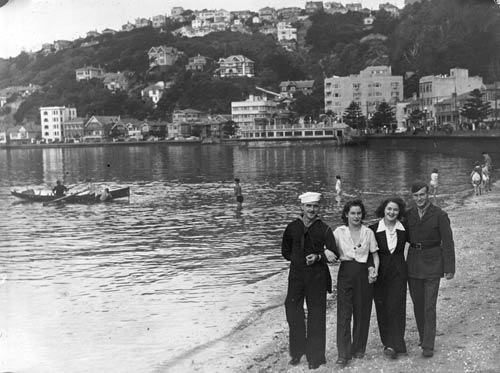
Dear Dona page four

Coming November 8th, 2024

Unlike the American military where mail was censored and journals and diaries forbidden the Japanese Imperial Army thought the differences in language would make ordinary Japanese as indecipherable as any code to an American reader. The head instructors also knew that Japanese soldiers were brutalized by their superiors and would likely be resistant to the treatment the British were using on captured Afrika Corps German troops where violence and intimidation were routinely used. As many of the instructors had lived in Japan for extended periods of time they knew the Japanese were generally very kind and the spirit of co-operation was instilled in them from birth. The culture of Japan was bound to duty to the Emperor and higher authority. They believed that force would not be enough to get prisoners to break down……

Links to other chapters in the series.

Page one: https://wordpress.com/post/atthetable2015.com/12268

Page two: https://wordpress.com/post/atthetable2015.com/12861

Michael Shannon is a writer living in the Central Coast of California. He went to school with many survivors of the camps in his little farming community.
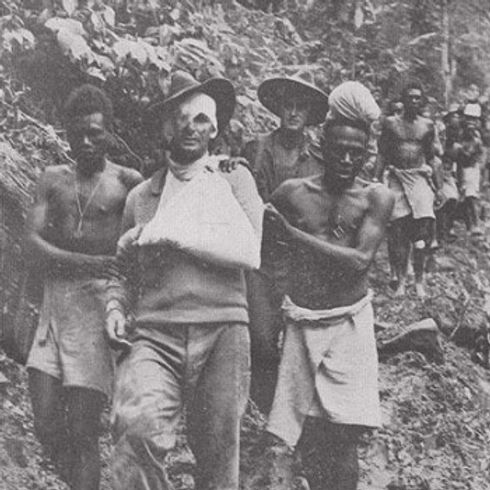
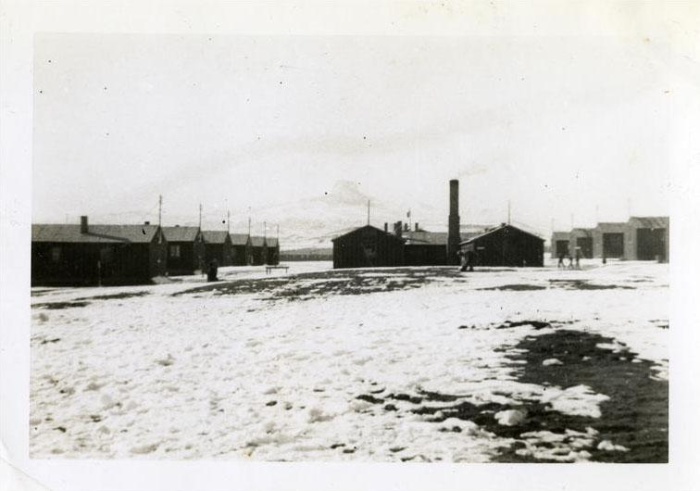
Standard