
Michael Shannon
In 1918 my grandparents, Jack and Annie Shannon came home. Home for both of them was southern San Luis County. This family event is the linchpin of our story.
When I was a boy we lived in the kitchen. Our little house, built at the turn of the century was the heart of the home. As were most homes built at the time it featured none of the devices we take for granted today. No insulation, no central heat, and no weatherstripping. Small houses were the norm before the war and ours, originally just three rooms had slowly been added to over time. To get to the back bedroom you had to pass through each of the other rooms. Porch, kitchen, living room, my parents bedroom, bathroom and finally, my room, a sunny room with large windows in which I imagined my future life as boys will do.
What my brothers and I learned at the kitchen table has shaped our lives. The Japanese philosopher Masonabu Fukuoka has said,”The simple hearth of the small farm is the true center of our universe.” This quote describes the experience of family all over the world, something we all have in common. I don’t know of any kids that I grew up with don’t share this experience and to this day I can see them as they were.

The photo above, taken in 1920 at my great-grandparents house on west Main St in Santa Maria shows my father and my uncle Jack with two friends. My father, George steers the trike on the right and my uncle Jack, his older brother by two years stands behind him. My grandparents lived with Annie’s parents for a time until they could move onto Annie’s ranch just south of Arroyo Grande.

The Samuel Gray home on Guadalupe Road in Santa Maria. Built by oil wells and many sheep. photo 1938.
We didn’t have a televison until I was eight. The most exciting thing was watching the test pattern because we somehow knew that hidden behind it were many earthly delights. We were partly right about that. There was only one available channel anyway and my parents didn’t see any need for one, the TV was for us mostly. They had the radio. They had been radio people all of their lives and it was the familiar thing. It had all the basic elements of TV anyway as television was really nothing more than radio with pictures. They read. We had Life, Look and the Readers Digest magazines scattered about. Part of my education were those old Reader’s Digests with their puzzles, riddles and a vast variety of stories. I found Bennett Cerf there and many of the great writets of the day. My grandmother belonged to the book of the month club as did many of my mothers friends so there was always a book around. We still have old Book of the Month editions with the names of friends on the flyleaf. Gladys Loomis’s heirs are probably still looking for them.
Most of my abiity to read comes from comic books. For a time we had a neighbor who rented Joaquin Machado’s house which was back by the creek near the old Evans place. The renter was a comic book distributor and each month one of his jobs was to collect all the back issues of comics not sold. Once a month my dad would come into the kitchen with a big bundle of comic books tied up with cotton string. It was a tiny Christmas. We devoured them and couldn’t wait for the next 30 days to pass. It seemed a tragedy when the man moved away.
Farm and ranch life in the forties and fifties was pretty isolated. Farm kids, for the most part spent their time either in small one or two room schoolhouses learning from books, in some case decades old taught by teachers who balanced the needs of up to four grades at one time. Kids were not separated by grade as they are today. All eight grades studied and played together. If you imagine schools today there are self-contained boxes for each grade level. We had all the kids in one box. Teachers ran curriculum and the parents were the school board members, janitors and school bus drivers. It was a family affair. A six year old had to handle a ground ball from a thirteen year old. It made little kids deal with older ages and those older ages learn to accept the little guys. Not a bad system.
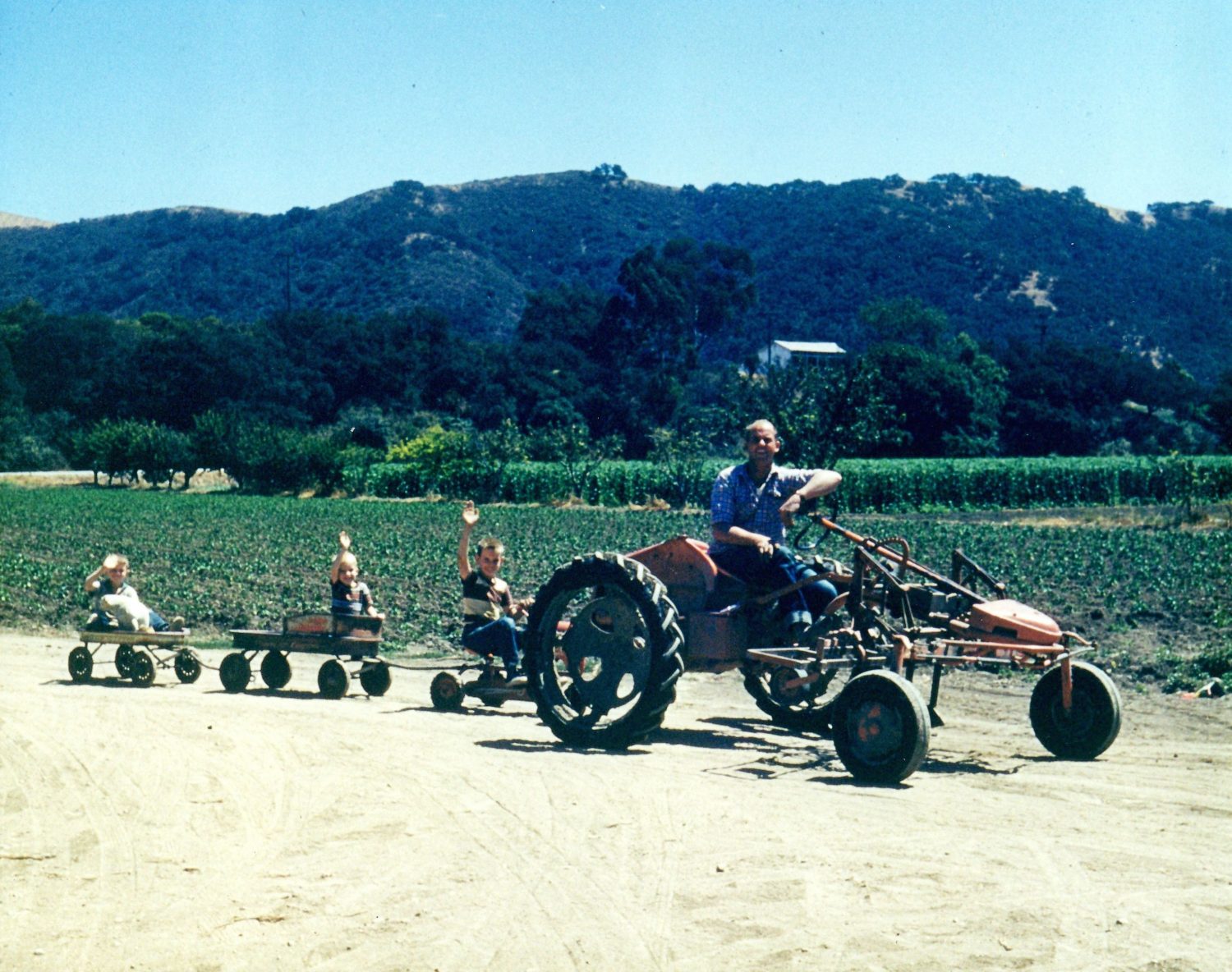
4-H was the only club activity which was OK as nearly every kid’s father was a farmer or worked for a farmer and it was assumed by kids that they would do what dad did. It was not an unusual thing to see see Mrs Fernamburg working in their walnut orchard or Elsie Cecchetti out feeding her calves. I can still see Helen Kawaguchi sitting up on the seat of the old red Farmall wheel tractor slowly trekking back and forth across their fields. She always wore a big straw hat favored by the Japanese ladies when they were in the fields.
Fields were a descriptive word much like a compass and used to indicate direction. There was “Down the fields” and “Up the field.” Mom might say daddy is down the field which told you he was far away from the house. He would tell you that the irrigation pipe to be moved was up the field meaning it was away from the house too. Everyone understood this. Other directions told you he was with the celery crew or the broccoli cutters. Markers were all around. There were the Walnut trees, Lester Sullivans barn or “Old Man Parrish’s” orchard. I crossed Branch Mill Road at the old Branch bear pit behind Ramon Branches adobe house when I went to visit Kenny Talley, my closest friend. The four corners was where we caught the school bus, which wasn’t a real bus but served the purpose of getting kids to school. It had retired “Shanks Mare” in 1949. Kids didn’t have to walk anymore. The school bell which had once rung to tell moms it was time to send the kids still rang but really just for tradition I suppose.

The old Kawaguchi home. in the 1890’s
Schools were the center of social life. They were the meeting halls, the place where Halloween was celebrated, Christmas plays performed and potlucks held for no particular reason other than to get together. Mom’s made the costumes, painted the decorations and formed the audience cheering us on as we walked in our circle in Mrs. Edith Browns lower grade classroom. We might get a prize, or should I saw mom might get a prize. My own mother was a master at costumes. I was a robot, my brother Jerry and I were a horse once. as the older brother I started of as the head but was reduced in rank when I passed a smidge of gas during a rehearsal in our living room. It was worth it though, winning a round in war between brothers always was. Still is.
The world was small. A schoolroom, the little town of Arroyo Grande, which, for kids meant The Western Auto and The Variety Store, thats were the toys were. Bennett’s Grocery where Muriel and Rusty were free with the candy jar, the clothing stores where my mother worked. Louise Ralphs where all the ladies wore perfume, still the best and most fragrant place I can remember, Zeyen’s clothing store where the Levis were stacked to the ceiling and permeated the building with their peculiar new clothes odor. Mom worked there and served two generations of kids.
During the Gay Nineties festival celebration my grandfather sang in a barbershop quartet with Gordon Bennet, and Bill O’Conner from the stage of the old Mission theater. The Rotarians entertained with jokes and skits. Thats them below in all their sartorial finery doing the Lord knows what.

Vaudeville Blackouts in the Mission Theater. Harvest Festival/Gay Nineties, 1950’s. Family photo
The moms entertained too. Being shy was not too bad when you knew everyone in the audience.

1965, Women were still know by their husbands name.
The world was small and lined with soft things that didn’t sting or hurt too much. A kiss, some spit or a daub of mud cured most things. Kids felt safe there. It would be gone soon enough, mores the pity.
The kitchens in our homes weave through the narrative of our lives and form the foundation of the stories of our lives.
Michael Shannon writes and would still prefer to live in the kitchen if he could.