EPILOGUE
Al Krauchunas and fifty or so men were able to get off the foundering ship. They clutched life rafts, floater nets, life jackets and whatever they could get their hands on. The wind blew them out of sight of the ship immediately and none saw the ship go down. The last they saw was the upturned, and rusty red hull, the screws still slowly revolving. Sailors caught on wave crests without a handhold were blown likes leaves, skittering across the water and out of sight. Some said they felt the shock of the Spence’s boilers exploding as she plunged to the bottom.
That same morning the Monaghan DD-354 a Farragut class destroyer and the Hull DD-350, another Farragut also foundered. Much of the first hand information we have comes from those who survived the three ships.
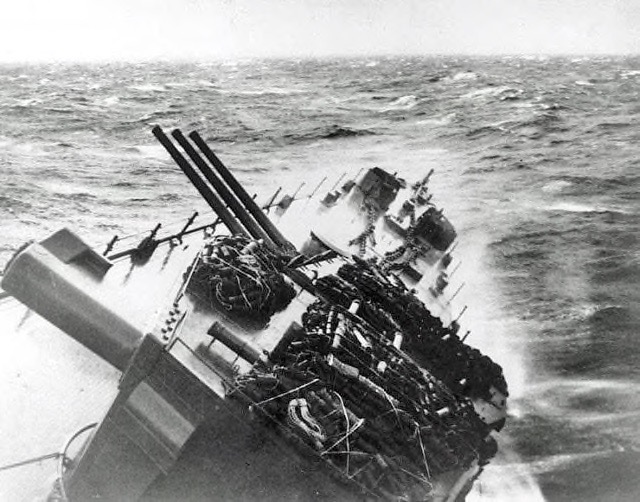
The rescue of the survivors of Hull and Spence by the little destroyer-escort Tabberer DE-418, which by chance stumbled upon a sailor struggling in the water at the very height of the storm and managed to pull him from the water. That was the first indication anyone had that the Spence was gone. They spent the next two days rescuing 55 men from the water. They did it in the teeth of a terrible storm, maneuvering the ship with a great deal of skill, ignoring orders to rejoin the fleet. She barely survived herself, being knocked down more than once by mountainous seas and screaming winds, once going over 72 degrees* on the inclinometer. Her Exec and one of her Bosun’s mates more than once dove into the raging water to rescue floundering men.
As the storm subsided in the late afternoon Halsey ordered the fleet to steam towards a new fueling point. The Admiral and his staff knew by this time they had ships not answering radio calls but turned away regardless, still intent on supporting McArthurs Landings on the 19th. Tabberer, having lost her mast in the storm, something that almost certainly helped her survive, the missing weight of the tophamper reducing her upper weight. She finally jury rigged an antenna and reported her position and the fact she was searching for the survivors of the foundered ships. She was ordered to stop and follow the fleet. Lcdr Plage simply disobeyed and kept up the search. The next day Halsey finally ordered two other destroyers to the area to assist and the last survivors were picked up. Some of the men picked up had drifted 75 miles from the wreck sites. There were undoubtedly others who were never found and died hoping.
Lt. Alfonso Krauchunas
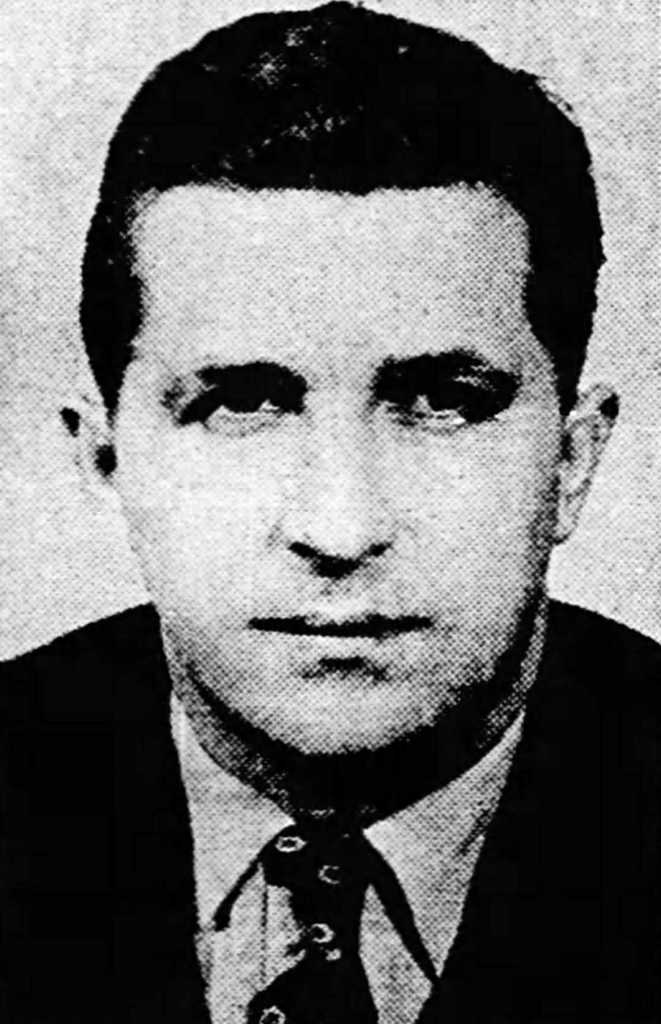
Lt. Alfonso Krauchunas, the only officer to survive the sinking, was pay master and supply officer, according to Torpedman 3rd class Albert Rosley jr. “I survived with him,” said Rosley, “he was a good one.” Al Krachunas was returned to the Pentagon, given a small office and personally wrote to the families of each man lost on the ship. Below is an excerpt from his personal account.
After being picked up 50 hours after the sinking, we were brought back to Ulithi and assembled on a transport after spending a week on a hospital ship. From the other 23 survivors, I was able to get a great deal of information as to who was seen in the water at any time. Those who were not seen could only have been in one place, below decks. It is hard to believe that anyone like Poley, Bean, Kleckley, and many others died as they did in their compartments, without any light and utter confusion and hysteria going on. All of this happened so suddenly that even the captain was not able to get off the bridge, or Carrigan, or the Exec, or any other officer. Almost none of the bridge crew survived.
Krauchunas died in 1994 at his home in Battle Creek, Michigan. He was 71.
The survivors
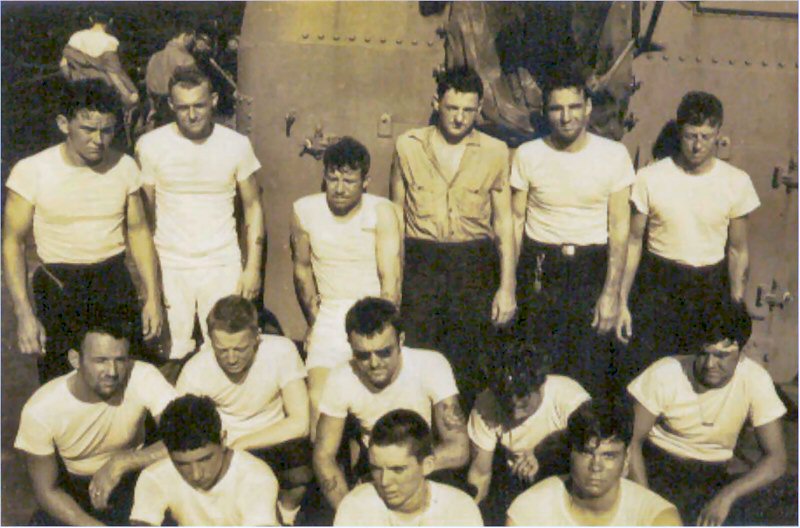
The survivors were shipped back to the states and given a 30 day leave. Most were returned to shipboard duty until the end of the war.
The Tabberer

The Tabberer returned to Pearl Harbor for repairs. By February 1945 she was back in the western Pacific screening task Force 38 during the invasion of Iwo Jima. She remained in service until 1960 when she was decommissioned and placed in the reserve fleet. In 1972 she was stricken from the Navy list and sold for scrap. The little ship was awarded the Presidential Unit Citation, presented by Admiral Nimitz for her actions on 18, 19 and 20th December 1944.
Captain Henry Plage
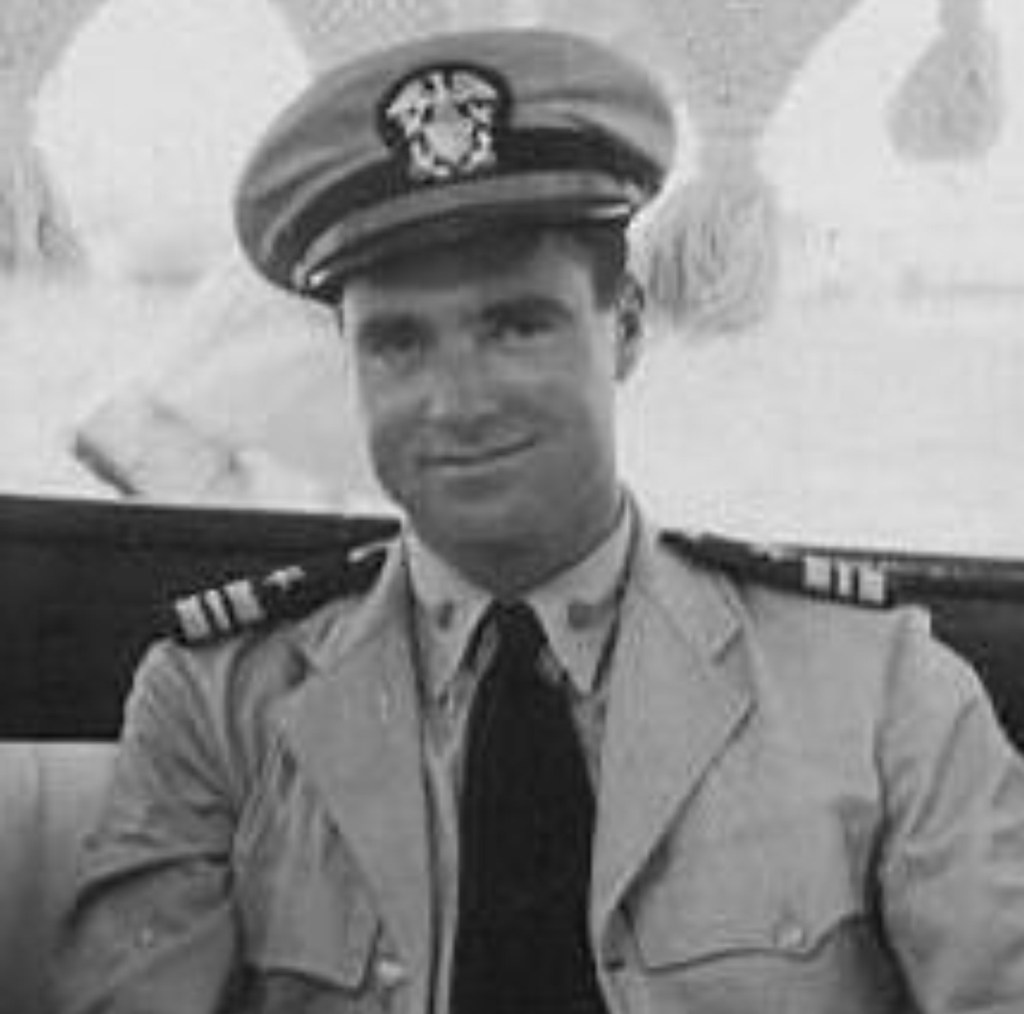
On December 29, Adm. Halsey visited the Tabberer and awarded Lt. Comdr. Plage the Legion of Merit for his “courageous leadership and excellent seamanship,” and commended the crew. Halsey who asked the skipper about his actions, was fully expecting that he would be an old salt but was told the Plage was a reserve and only on his second cruise. Henry Place left the Navy after the war and worked as a pharmaceutical distributor. He died in Ocala, Florida in 2003 at age 88.
Admiral Halsey

After the disaster of Typhoon Cobra a court of inquiry was held and Admiral Halsey was found to be at fault by the examining board. Admiral Nimitz, Commander in Chief in the Pacific and Admiral Ernest King CIC of all Naval forces overruled the board in the interest of the war effort, feeling that the prestige of the service and prosecution of the war held more importance than the courts outcome. Admiral Nimitz left a note on the court proceedings report, it merely said B.S. Admiral William Halsey Jr. died in 1959 at the age of 77. He is buried in Arlington National Cemetery. He is one of only four individuals ever to hold the rank oF fleet Admiral.
PS: He hated the name Bull.
The crew
Of all the crew of the Spence whose names were mentioned in this story only the brother-in-law of Muriel Owens, John Ladd, who was transferred off the ship in October of 1944 survived. The dead of the Spence are memorialized on a plaque mounted in the Military Cemetery in Manila, Philippines.
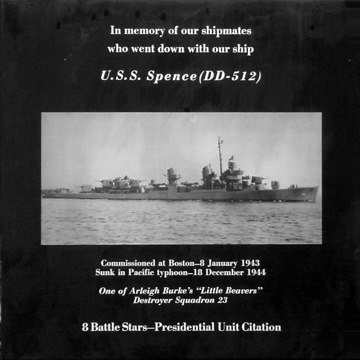
In addition to DesRon 23’s Presidential Unit Citation, Spence earned 8 battle stars. Her loss was widely mourned and for the 1983 “Little Beavers reunion,” when Bath Iron Works wanted to present a model to Adm. Burke and asked Desron-23 shipmates which ship it should be, Spence was the answer. The model is now at the Navy Museum.
The Spence was stricken from the Navy List on January 19th, 1945. Its remains and those of the crew lie five miles down roughly 800 miles east of the island of Luzon, the Philippines.
Notes
Long before I knew about my cousin Donald, I read the Caine Mutiny by Herman Wouk. Made into a movie starring Humphrey Bogart and Fred McMurray it chronicles the struggles of a destroyer in a terrific Pacific storm during WWII.
Herman Wouk was a Lieutenant in the US Naval Reserve and served on destroyer minesweepers throughout the War in the Pacific. He was present at the courts martial of one of the captains who lost his ship in Typhoon Cobra which was the seed for the book published in 1951 and the movie made in 1954.
A chance remark by my wonderful Aunt Pat Dilbeck led me to Donald Polhemus. She was appalled to learn the truth, the family having been told that he had been killed in combat and was a hero. As it turns out this is pretty standard military practice.
Thanks to the many shipmates of my cousin who survived and left a written and oral record for their help in researching this story.

- If you imagine an acute triangle as if it was a quarter of the clock face, 72 degrees is roughly a line drawn from the apex through two o’clock. This is the angle of the deck in a steep roll. For those who have never been to sea there is no way you can ever imagine the experience.
- The cost to the Navy was enormous. Three ships were lost and 27 ships badly damaged including the battleship Iowa. Many had to be taken out of service for repairs at Ulithi, Pearl or had to return to the west coast yards. 790 sailors died, the largest loss of life other than the 1st battle of Savo Island.
The stories that define events are those of individuals. History textbooks, must of necessity compress events into a quickly readable form. The readers defense to this is to ask questions of those who were there. Seek them out and do so.
During WWII, ships of the US Navy were named according to their type. There was no fixed and fast rule but aircraft carriers typically had the names of famous Navy ships of the past or battles. Names like Cowpens (CVL-25), Lexington (CV-2), Yorktown (CV-5) and Saratoga (CV-3) came from the Revolutionary war. Other carriers such as the Wasp (CV-7, Hornet (CV-8), and the Ranger (CV-4) were early ships of the first US Navy.
Battleships were named for state, Arizona and West Virginia are examples. Heavy cruisers were named for state capitols like the Baltimore (CA-68) and light cruisers for principle cities like USS Brooklyn (CL-40).
Submarines were named for fish like the USS Wahoo (SS-238) and oil tankers for rivers such as the USS Kaskaskia (AO-27) which had the name of that river in Illinois. The USS Markab (AD-21), a destroyer tender was named for the third brightest star in the constellation Pegasus.
By the end of the war the US Navy manned and operated over 6,000 ships, a monumental feat of organization.
The Secretary of the Navy named Destroyers and Destroyer Escorts in honor of distinguished leaders and heroes from each of the services. By 1942, the convention had been modified several times to read: “Deceased American Naval, Marine Corps and Coast Guard Officers and enlisted personnel who have rendered distinguished service to their country above and beyond the call of duty; former Secretaries and Assistant Secretaries of the Navy; members of Congress who have been closely identified with Naval affairs; and inventors.”
An example of this process was the naming of the USS Harmon (DE-678). Leonard Roy Harmon (January 21, 1917 – November 13, 1942) was an American sailor who died in action during World War II and was posthumously awarded the Navy Cross for his valor. He is the first African-American man to have a US warship named after him. He was a mess attendant on the USS San Francisco (CA-38) His citation reads in part; With persistent disregard for his own personal safety, Mess Attendant First Class Harmon rendered invaluable assistance in caring for the wounded and assisting them to a dressing station. In addition to displaying unusual loyalty in behalf of the injured Executive Officer, he deliberately exposed himself to hostile gunfire in order to protect a shipmate and, as a result of this courageous deed, was killed in action. His heroic spirit of self-sacrifice, maintained above and beyond the call of duty, was in keeping with the highest traditions of the United States Naval Service. He gallantly gave his life for his country.
USS Spence (DD-512) The ship was named for Robert T. Spence, superintendent of construction of USS Ontario (1813), and captain of USS Cyane (1815).
USS Aaron Ward (DD-483) Aaron Ward was sponsored by Miss Hilda Ward, the daughter of the late Admiral Ward. The ship was commissioned on 4 March 1942.
USS Charles Ausburne (DD-570), a Fletcher-class destroyer, was the second ship of the United States Navy to be named for Charles L. Ausburne, a sailor in World War I who was posthumously awarded the Navy Cross.
USS Abner Read (DD-526) was named after Lieutenant Commander Abner Read (1821 – 1863), who fought in the American Civil War. The Abner Read was sunk by a Kamikaze on 1 Nov, 1944 with the loss of 22 young men.
USS Balch (DD-363) was a Porter-class destroyer in the United States Navy. She is named for Admiral George Beall Balch.
USS Cassin Young (DD-793) is a Fletcher-class destroyer of the U.S. Navy named for Captain Cassin Young (1894–1942), who was awarded the Medal of Honor for his heroism at the Japanese attack on Pearl Harbor and killed in the Naval Battle of Guadalcanal in the fall of 1942.
USS Converse (DD-509), a Fletcher-class destroyer, was the second ship of the United States Navy to be named for George A. Converse (1844–1909).
USS Dyson (DD-572) was a Fletcher-class destroyer of the United States Navy. She was named for Rear Admiral Charles W. Dyson (1861–1930).
USS Foote (DD-511), a Fletcher-class destroyer, was the third ship of the United States Navy to be named for Rear Admiral Andrew Hull Foote (1806–1863), who served during the Civil War.
USS Isherwood (DD-520), a Fletcher-class destroyer, was the second ship of the United States Navy to be named for Rear Admiral Benjamin F. Isherwood (1822–1915).
USS J. Fred Talbott (DD-156), named for Joshua Frederick Cockey Talbott (1843–1918), Representative from Maryland Second District from 1879 to 1885, from 1893 to 1895 and again from 1903 to 1918, was a Wickes-class destroyer.
USS Johnston (DD-557) was a Fletcher-class destroyer built for the United States Navy during World War II. She was named after Lieutenant John V. Johnston, an officer of the US Navy during the American Civil War. Sunk in the battle of Samar 25 October, 1944
USS Kidd (DD-661), a Fletcher-class destroyer, was the first ship of the United States Navy to be named after Rear Admiral Isaac C. Kidd, who died on the bridge of his flagship USS Arizona during the 1941 Japanese attack on Pearl Harbor. Admiral Kidd was the first US flag officer to die during World War II and the first American admiral ever to be killed in action. A National Historic Landmark, she is now a museum ship, berthed on the Mississippi River in Baton Rouge, Louisiana, and is the only surviving US destroyer still in her World War II configuration.
USS La Vallette (DD-448) was a World War II-era Fletcher-class destroyer in the service of the United States Navy. She was the second Navy ship named after Rear Admiral Elie A. F. La Vallette.
USS Reuben James (DD-245) was a four-funnel Clemson-class destroyer made after World War I that was the first US Navy ship to be named for Boatswain’s Mate Reuben James (circa 1776–1838), who had distinguished himself fighting in the First Barbary War, and was the first to be sunk by hostile action in the European Theater of World War II. Woody Guthrie wrote a song about the death of this ship.
USS Runels (DE-793) Named for Donald Steven Runels who was born on 8 July 1904 at Santa Maria, California. He enlisted in the United States Navy on 19 March 1926; was appointed machinist on 14 September 1938; warranted machinist (to rank from 10 September 1938) on 25 November 1939; and commissioned Ensign on 23 June 1942. He was killed when his ship, the USS Northampton (CA-21) was torpedoed and sunk during the Battle of Tassafaronga on 30 November 1942. His family still lives and farms in Arroyo Grande, California. The author went to school with his nephew John.
USS Thatcher (DD-514), a Fletcher-class destroyer, was the second ship of the United States Navy to be named for Rear Admiral Henry K. Thatcher (1806–1880).
A final note. As Facebook becomes less relevant and inclusive the average readership of this blog has dropped by a great deal. Personal politics have caused it to be dropped from some pages as irrelevant or some other opinion of a particular administrator. If you are a confirmed reader beware that you could lose access if any particular FB is closed or restricted. Some pages are quite restrictive as to content and not all blog posts fit their rules. A post of any kind is not always sent to all pages. To guarantee access click on the follow button on this page and each post will be delivered directly to your E-Mail. The site can be found by typing the following into your search engine to find me. atthetable2015,com Any question to my E-Mail will be answered.
Thanks for your consideration, Michael Shannon
 atthetable2015
I was onboard the Newport in the early 1980s, she was a couple hundred feet longer than the Spence and almost twice as wide. But, she was flat bottomed, designed to beach herself and use an enormous bow ramp to disembark equipment and Marines. Which I was one of. This feature made her very susceptible to rocking, from side to side. Finding myself assigned to the ship’s radio room meant standing watch and often delivering messages to the bridge. Once in the North Atlantic I saw the inclinometer go over to 49*. I know how bad that was, I can’t imagine 75*. Again, thanks for sharing this, it has been fascinating.
LikeLike
Pingback: NAQT — atthetable2015 – battleoftheatlantic19391945
I was Navy and Merchant Marine and like you have walked on bulkheads.
LikeLike