
…Or Don’t Nock it ‘Til you know it.
Bu Michael Shannon.
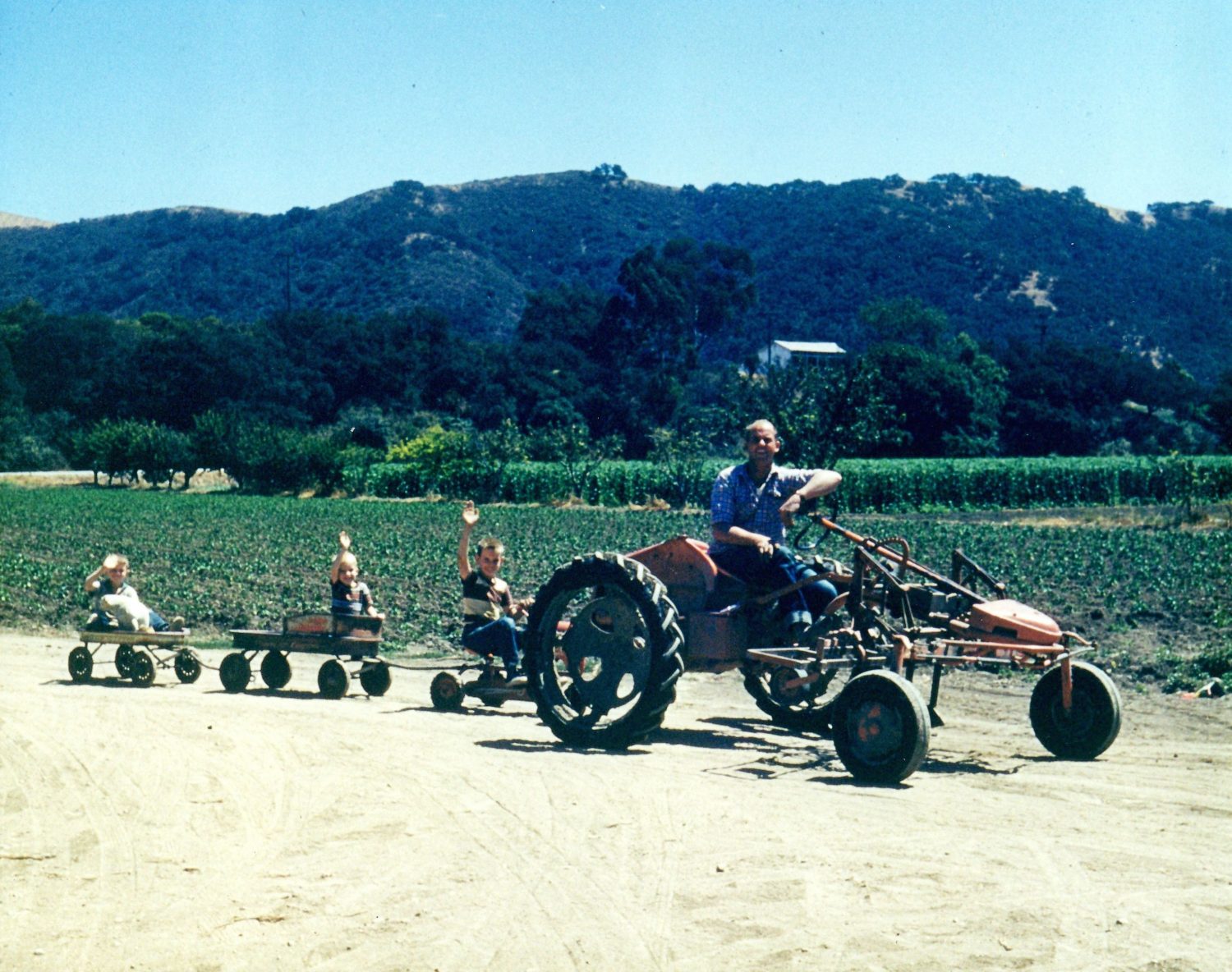
My family lived through the depression, the big one. For farm and ranch people that means from the federal governments cancellation of the WWI farm contracts until Adolf Hitler went into Poland. 1918 until 1939, just enough time to grow a new generation of boys. It was hard times, very hard times.
My dads side of the family, ranchers and dirt farmers who lived and worked in the central western part of California, the old Cow Counties, and my mothers side in the state’s oilfields. They grew up and lived right through it. Both required hard work, misery and close attention to just getting by. There are numerous family stories about their toughness.
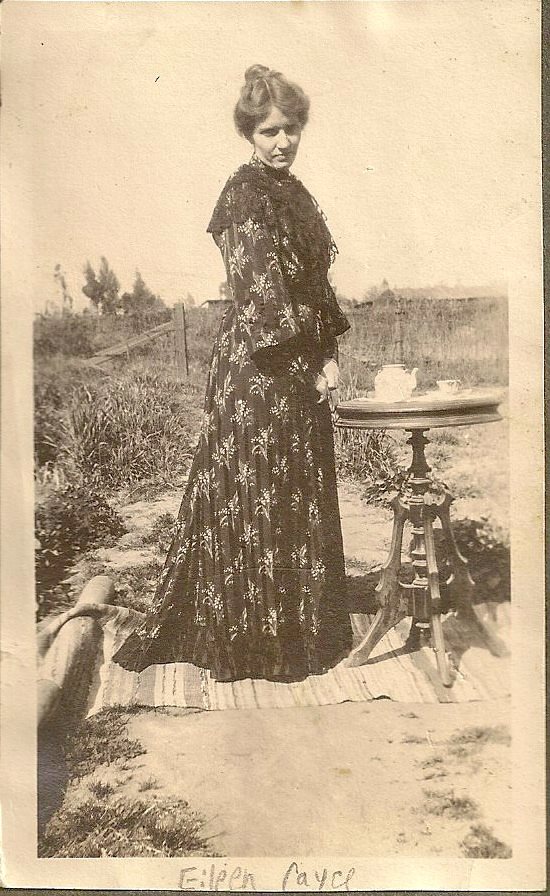
My grandmother made the trip from Bee Canyon east of Arroyo Grande to Madera on the seat of a buckboard in 1917 . She was eight months pregnant with my mother and had my aunt Mariel who was just a toddler along for the ride. They did it in the middle of the San Joaquin Valley summer. Half way there it got so hot that the family dog Brownie, went and sat under a shade tree in the lost Hills and refused to move. They left him and never looked back. The trip took 40 hours nonstop. To this day I don’t know how my grandmother did it. Dirt roads, ruts, pot holes, no shade, shaking and banging all the way. She walked with my grandfather Bruce up the Cuesta Grade because the horse couldn’t pull the loaded wagon with two people in it. Bruce carried Mariel. Eileen carried mom. There are all kinds of toughness.
Toughness. Money was tight. Frugality was the watchword. Nothing was wasted. Everyone in the family worked as soon as they could. Work they did for there was no safety net. No unemployment insurance, no Social Security, no medicare. Most every thing was cash and carry or barter. The Bank of Arroyo Grande was as tight fisted as Scrooge McDuck.
People took a great deal of pride in making their own way. It was the way of their lives and until the day they died they asked for nothing.
Growing up I don’t think I ever heard the name Franklin Roosevelt without some kind of expletive preceding it. The president who held office before Roosevelt, Herbert Hoover was unable to blunt the force of depression in any significant way but in the family this was not held against him, after all he was a good Republican which went a long ways in our house. But Roosevelt, oh my, he was considered evil incarnate though in fact what he really represented was the intrusion of the Federal Government into the lives of people who considered themselves self sufficient. There is that toughness again.
Rural folks simply believed that the government could not properly run anything. Farmers were by this time pretty tight with their money and hated to give it up to an entity they were sure was simply going to waste it on some fool project.

My dad used to grind his teeth whenever he saw a bridge or any other construction project that had WPA or CCC stamped on it. It wasn’t that he thought any of the young men in those organizations were bad but that the Federal Government was pouring his money down the drain.
Every time I cross one of those bridges, many of which still exist after ninety years I’m reminded criticisms are no always well founded.
Many were though. When the big hay barn burned on our dairy in 1923, the fire department from the nearby town of Arroyo Grande stopped at the city limits. From where they sat on the road side the got a splendid view of my grandfathers new barn going up in flames. They wouldn’t left a finger to help. The chief said they only worked fires within the city limits and there was “Nothing we can do about it.” My grandfather knew personally, every fireman in town. He played poker or Canasta with them, met with them at the IOOF and the Rotary Club and bent an elbow at Ryan’s saloon and by God, he never forgave them for the loss of the barn. Ever. He must have told that story dozens of times when I was a kid. He wanted to make sure my thoughts about Guv’mint were not pure. They are not.
When I was a kid we were used to state and national governments in our lives. Because of the times we lived in we had a different take. I’m not sending my Social Security check back and I’m glad to have Medicare and Veterans benefits but there is always the thought that they were right.
Here is an example of what they meant. My uncle Jackie was a cattleman. A charter member of the California Polled Herefords Association. Like most cattlemen he was pretty conservative. Remember that the root of conservative is conserve. Our ranch had, like most ranches, a shed where tools, feed and assorted junk was kept “In case I need it someday.” This of course was taken to ridiculous extremes. Ours was in what was called the calf shed. It was a little building with three small stalls where newborn calves who needed care could be kept and looked after. In one corner was a small room where tools, nuts and bolts, tractor parts and other assorted machinery was kept. If you needed a square headed bolt for a John Deere side delivery rake built in 1917, why we had it. We had wrenches for tractors long abandoned in the gully where old cars and trucks went to die. There were boxes of square headed nails not manufactured for over a hundred years. But if you needed one, we had it. A farmer or rancher could make the rounds of his friends and sooner or later someone would have what you needed for that old planter. You could age date the boxes they were kept in by the numbers of Black Widows living in them. Conserve, take care of yourself. No one else is going to do it.

I used to believe and I think is still true that every rancher and farmer in the county knew each other or were somehow related either by birth or marriage. Still pretty true. As I was the oldest boy, I used to ride around the county with my uncle while he was involved in buying or selling cattle. We would cruise out to Creston or up to the Cambria area to visit ranches and I listened while he and some cowman leaned on a fence and “chewed the fat.” We’d sit in the stands at the Templeton Stockyard Auction and I’d try and figure out who the bidders were. There was a sort of mystery to how they did that. I mean, the red and white cattle all looked the same and the ranchers did their actual bidding with what looked like telepathy. An eyebrow raised her and slight shift of a folded program or perhaps a hat brim touched with the index finger.
Templeton was where I first met Dick Nock. He was a friend of uncle Jack. This is the part where relationships come in. Though they were over twenty years apart in age, they both knew cattle. Dick was born and raised on the Phelan Ranch in Cambria, where his great-grandfather, Jeffrey Phelan, settled in 1858 after immigrating from Ireland. Our ranch was next door to another Phelan ranch in Arroyo Grande and my great uncle Patrick Moore, also an Irish immigrant was a friend to all the early Irish. I went to school with Phelan kids who are friends today. It’s was so, so small town.
Growing up, Dick worked on the Fiscalini Ranch, went to Santa Clara College and spent the rest of his life here. By the time he was a grown man he knew everyone in the county who mattered in the cattle business. For many years he wrote a column on the ranching business for the San Luis Telegram Tribune. Like most columns with a pretty restricted audience, I mean does the average person really care about salt blocks, feed supplements or the proper application of “Whiz” fly spray. Not likely but Dick had a sly sense of humor and would offer deadpan, tongue in cheek observations that would do Jerry Seinfeld proud.

In the 1970’s he wrote a column that was perhaps a perfect example of how the Guvmint works. Or doesn’t.
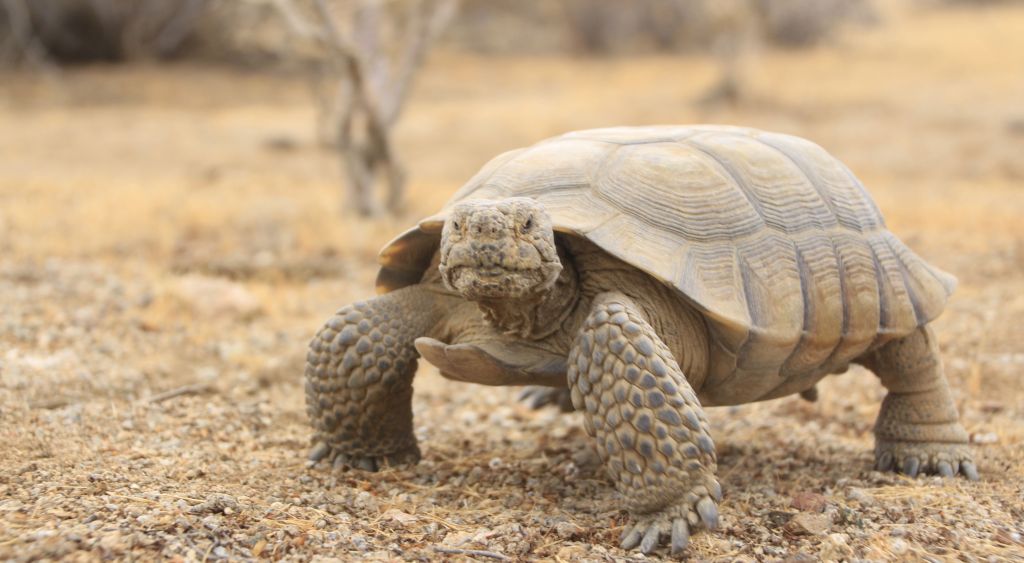
It seems Dick was traveling up the 395 highway on the way to Olancha, a tiny town up in the Owens Valley. It’s the kind of place where Gus’s Fresh Jerky is the premier attraction. It’s the back of lonesome is how it is. When Dick took this particular trip he was checking the fences along the highway where the Bureau of Land Management was putting chicken wire along the bottom of the cattle fences to keep the desert tortoise, pretty slow moving even at top speed, from being squashed crossing the highway. The idea was to keep the tortoise off the endangered species list, they being completely inoffensive and harming no one. A noble idea.
In the way of governments, thinking the issue through, trying to see all sides and what disaster might occur when messing with nature for what seemed a good idea…. Well, lets put it this way. The Australians in their wisdom imported rabbits for hunting. A case of incomplete thinking to say the least. Rabbits now infest the country, no natural predators you see. In Hawai’i, rats jumped ship in the early days and became a real problem, destroying vegetation, eating lizards and harboring diseases. The importation of the mongoose in order to eat the rats was the answer. Only one problem, rats are nocturnal and the mongoose is diurnal and never the twain shall meet, hence the almost complete destruction of every bird species in the Hawai’ian islands.*
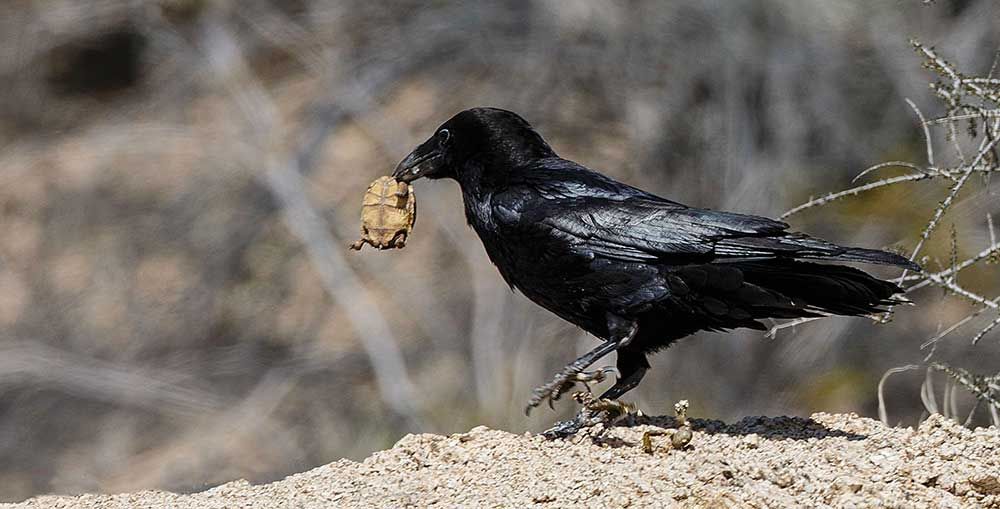
The good thing, saving the Desert Tortoise immediately triggered the Law of Unintended Consequences. The Ravens who live in the desert were denied the tortoise roadkill they took for granted and being very smart Ravens sought out a new source of sustenance, turtle eggs. You can see the dichotomy here. Tortoises are saved from cars on 395 but there are no tortoises because the Ravens have eaten all the eggs. In a perverse way it is the perfect solution, tortoises are squashed, eggs are eaten and all the Ravens starve to death. Problem solved. Except it wasn’t.
What to do? Schedule a conference of course. Bring in the experts put them around a table and let them have at it. After careful study and a great deal of field work it was determined that there were simply too many Ravens. 1500 Ravens were sentenced to death by the BLM. Environmentalists were of course enraged. The Ravens had simply been Ravens, doing what Ravens do. Threats of lawsuits, stakeholders meetings lasting months finally determined that only 56 of the most offensive Ravens would be executed. Furthermore these evil Ravens would be chosen based on observation of a minimum three Raven kills. Hmmm. As my uncle would say, “You’re a Daisy if you can and a Dumb Cluck if you can’t.” Yes, he actually said things like that, being a child of the 1920’s. Some things never left him.
Have you ever been to the lower reaches of the Owens Valley? It’s a vast area, nearly 700,000 acres in size. Only about 18,00 people live there, primarily along the north, south 395. Go east on highway 6 towards Duckwater, out behind the Humboldt-Toiyabe and the Pancake ranges of mountains and you enter ranch lands stuck in time like flies in the back door screen. There are vast ranching operations where cattleman and their families plan a trip to town as if it’s a vacation to a foreign country. The RO ranch herds cattle over more than 6 million acres of Nevada. The great Smoky Valley is so far out the word remote hardly describes it. It’s a place where the horse is still the king. For the most part the cowboy and the wildlife get along just fine.
From Winemucca in the north, eastern Califonia in the west and the Mojave desert and Death Valley as its southern neighbor the people can be counted with just a tally stick. There are more Ravens than souls. See the problem? There is no one out there to count tortoises. No one knows how many there are. Millions of dollars in state and federal funds have been spent in studying this issue since Dick Nock wrote the original in the late 70’s. As far as anyone knows there are still 56 Ravens on death row. It’s an interesting turn of events and unfortunately there is certainly much more to come, because in the end the Tortoises are still getting squashed, eggs eaten and the Ravens are fat and prospering. The Guvmint men all shook hands, satisfied the problem had been solved. Environmentalists broke out the champagne, another victory notched and if Ravens could smile, they certainly did. The ranchers just paid it no never mind.
Thanks to Dick Nock and my uncle Jack Shannon who was so delighted by the column that he cut it out of the paper and saved it in his top dresser drawer for forty years.
And that, my dear friends is why ranchers and farmers hate the Guvmint.
PS: Nothing has changed in the valley. Ravens still rule.
Richard Leo Nock September 3, 1931 – December 28, 2020 Dick Nock had a devoted family and a loyal community of friends, he remains the consummate cattleman (a fighting Irishman) with a never-ending enthusiasm for life.
*Four of the last species of tropical birds in Hawai’i were declared extinct in 2023.
Michael Shannon is from a family that lived on the land. He spent a lot of time picking hayseed from his hair.
 atthetable2015
Good job Mike. The only change is that Dick went to Santa Clara and not Poly.
LikeLike
Love your articles! Keep ’em coming!
LikeLike
Thank you Catherine. Dick was one of a kind. Sad to note that one FB site I publish on has bounced me because the story did not meet their standards.
LikeLike