By Michael Shannon
I know this to be true. Have you ever heard a truth, not shaded, parsed, paraphrased, but something that you know is clearly, purely, a truth? They’re rare, to be cherished and recalled time and again. Something heard which is clear and polished to brightness; something so clear as to be marveled at, precisely because they are so rare.
Lou Gehrig:
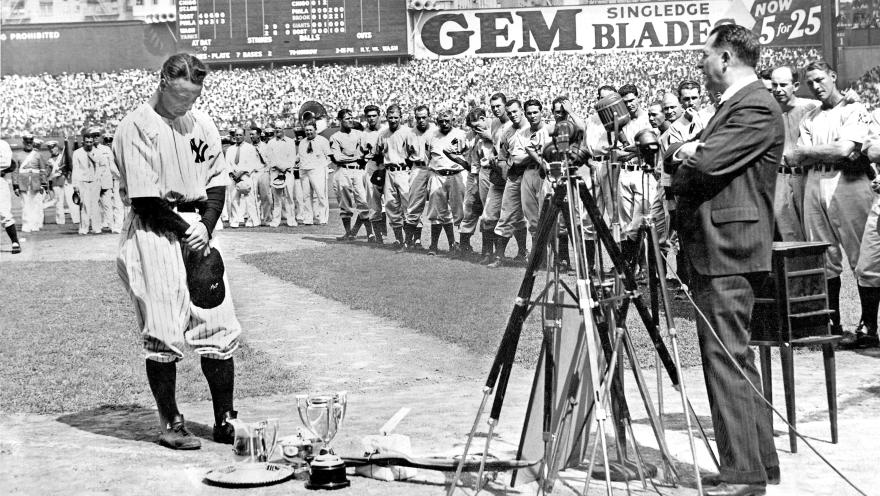
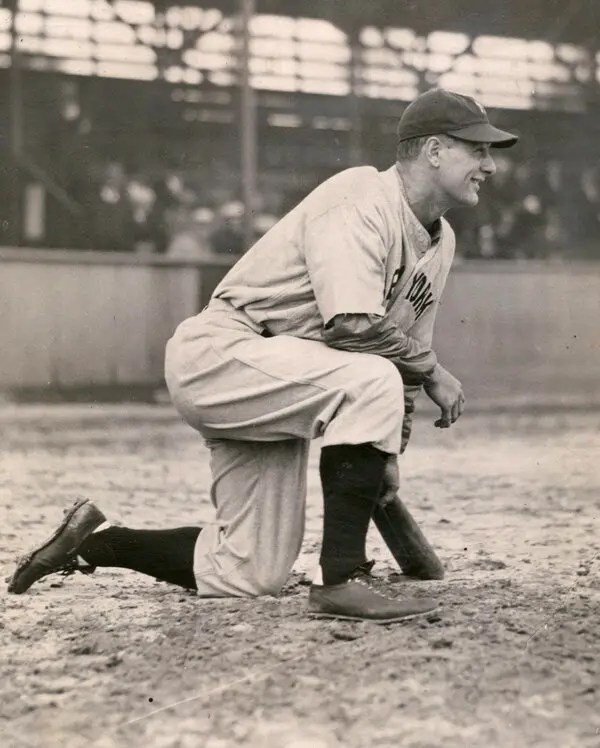
A tall man. Sloped shoulders, a baseball uniform of grey wool; pinstriped, his cap held before him as if in prayer, lifts his head and steps to the microphone planted on an impossibly green, manicured grass field, lowers his head and says softly, “Today, I consider myself the luckiest man on the face of the earth.” Despite his wonderful achievements as a Yankee first baseman, he will forever be remembered by the thing that killed him, “Lou Gehrigs Disease.” On June 2nd, 1941, Lou Gehrig died of ALS, still believing himself to be that lucky man. A truth.
The Brothers Van Gogh:
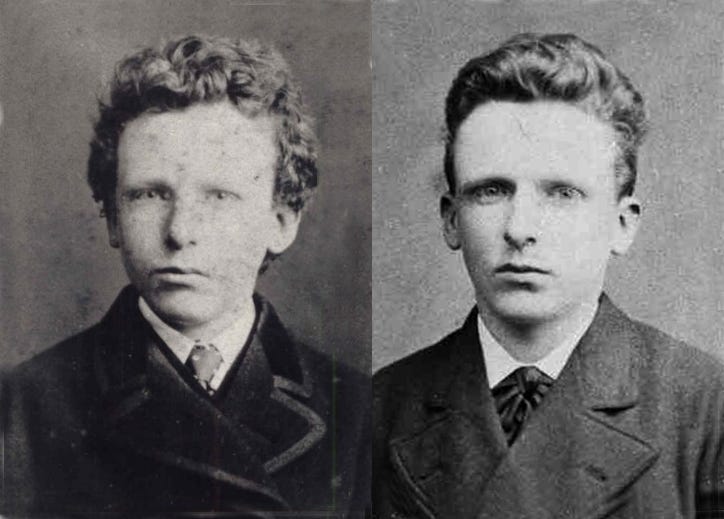
Theodorus loved his brother so much. They were, the two sides of the same coin. One successful, one not, one driven by ambition, one with none. Theo, self confident, the other without. Different worlds entirely but connected by brotherly love. One supported the other and was paid in useless paintings. Vincent wrote on the day he took his own life,
“Well, my work to me, I risk my life on it, and my reason has half foundered – all right – but you are not one of those dealers in men, as far as I know, and you can take sides, I find, truly acting with humanity, but what is the use?
Vincent Van Gogh had one human thing, a brother who loved him. A truth.
Captain Henry T. Waskow:“
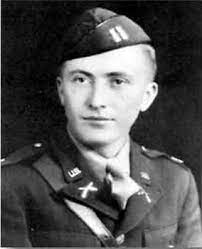
‘This one is Captain Waskow,’” one of them said quietly.
“Two men unleashed his body from the mule and lifted it off and laid it in the shadow beside the stone wall. Other men took the other bodies off. Finally, there were five lying end to end in a long row. You don’t cover up dead men in the combat zones. They just lie there in the shadows until someone comes after them.
“The unburdened mules moved off to their olive grove. The men in the road seemed reluctant to leave. They stood around, and gradually I could sense them moving, one by one, close to Captain Waskow’s body. Not so much to look, I think, as to say something in finality to him and to themselves. I stood close by and I could hear.”
“One soldier came and looked down, and he said out loud, ‘God…damn, it!’
“That’s all he said, and then he walked away.
“Another one came, and he said, ‘God damn it to hell anyway!’ He looked down for a few last moments and then turned and left.
“Another man came. I think he was an officer. It was hard to tell officers from men in the dim light, for everybody was bearded and grimy. The man looked down into the dead captain’s face and then spoke directly to him, as though he were alive, ‘I’m sorry, old man.’
“Then a soldier came and stood beside the officer and bent over, and he too spoke to his dead captain, not in a whisper but awfully tenderly, and he said, ‘I sure am sorry, sir.’
“Then the first man squatted down, and he reached down and took the captain’s hand, and he sat there for a full five minutes holding the dead hand in his own and looking intently into the dead face. And he never uttered a sound all the time he sat there.
“Finally he put the hand down. He reached over and gently straightened the points of the captain’s shirt collar, and then he sort of rearranged the tattered edges of the uniform around the wound, and then he got up and walked away down the road in the moonlight, all alone.”*
Written on the field at the Battle of San Pietro during the Italian campaign in December, 1943 by Ernie Pyle, war correspondent. A Truth.
Barbara Shannon:

“Life is but a breath,” the Good Book says, and that is surely true. In the end, if you count money, houses and land, then she was poor. But if you count wealth as the love and affection of your family and friends then she was rich beyond counting.
She loved her husband, she loved her sons, she loved her son’s wives as the daughters she never had, and her grandchildren were the crown she wore in her old age.
Suddenly one day, she was used up and worn out and just as suddenly gone from our lives. Mom was not born in this valley, but for over fifty years this is where she lived and moved and had her being and here is where she died.
It is not such a sad thing really, to contemplate her laid to rest in our green and peaceful cemetery in the midst of her friends, neighbors and family whom she loved and who loved her. It is not such a sad thing, perhaps, to think of her lying in the shadows of the everlasting hills of this green and golden valley that we love so well.
The first time dad went to see her in the hospital, she was in a coma and was terribly ravaged by that awful, awful disease. When he walked into the room and saw her he said,
“No Mike, thats not my wife. Barbara is beautiful. I don’t want to remember her like this. Please take me home son.”
Now dad lies beside her, as one day, her sons will too. A truth.
Ray and Mariel Long
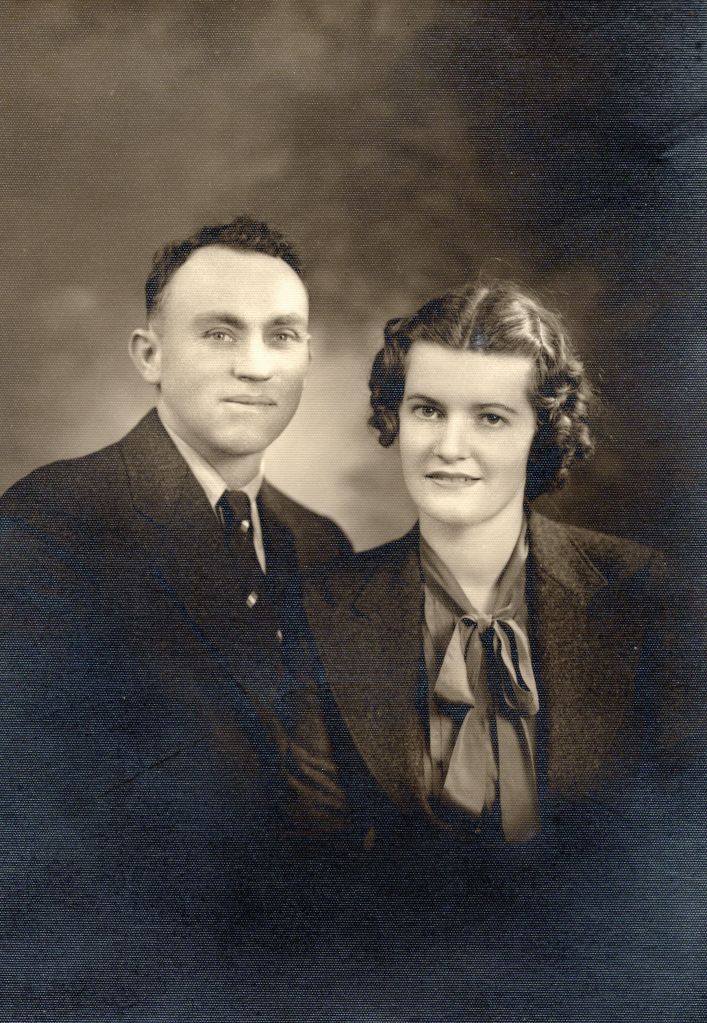
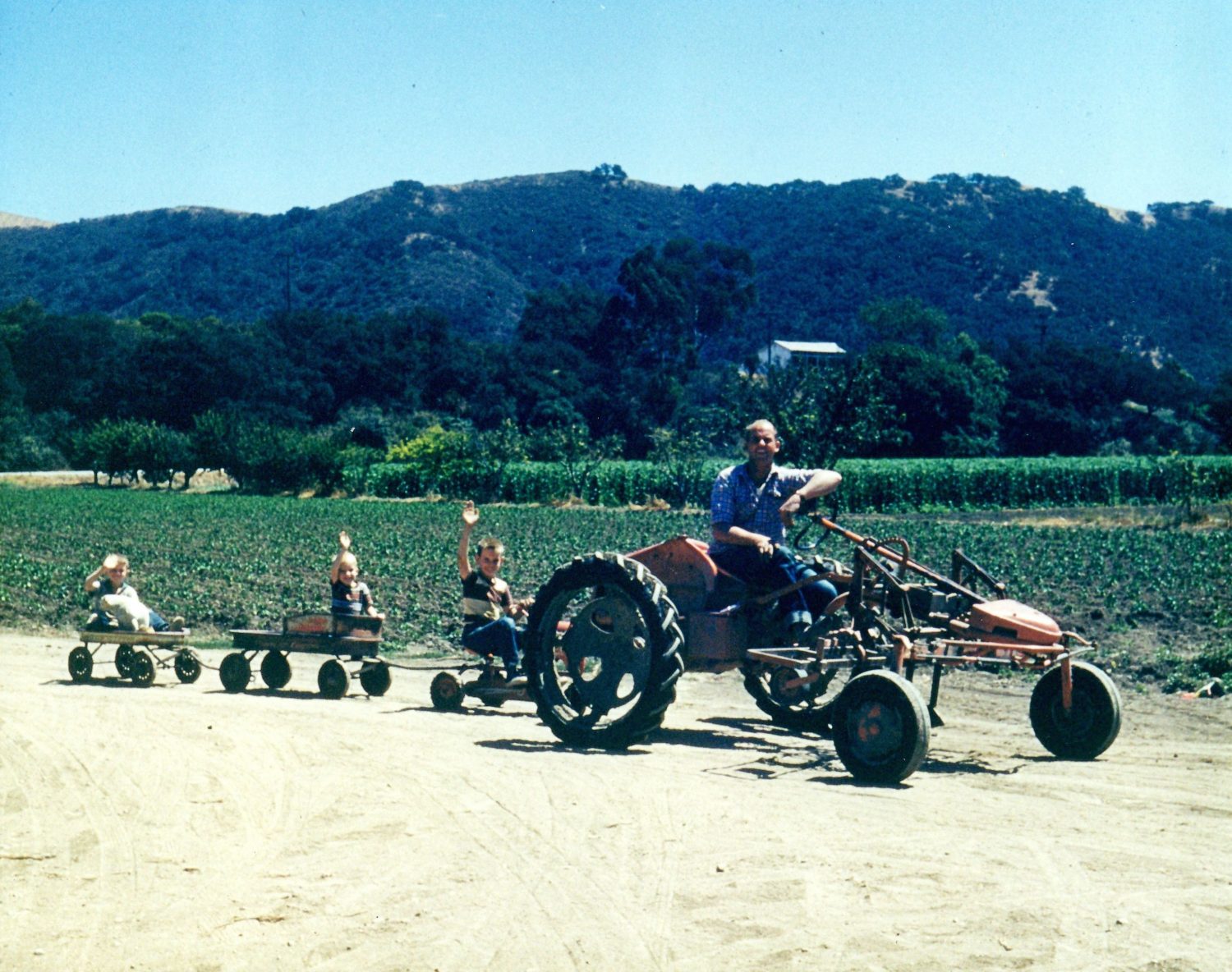
He was a cowman, she was an oilfield girl. They were two of the most naturally funny people I have ever known. They lived in an ancient ranch house in Watt’s Valley California. The house was so old it resembled an old drunk leaning on a lamp post. Only faith held it up.**
In the summers of the fifties it was overrun with their kids and heaps of cousins who came up to the ranch for the summer. There were horses, dogs, chickens, turkeys and cattle. There were kitties in the barn where the milking was done. In the early ‘morn they had little beards of milk, uncle Ray was partial to cats you know.
He saddled every kid with a nickname. He spared not one of us. There was Jughead, Festus, Shebang, Jeb and knothead. My mom was “Sis.” He meant nothin’ by it except to say he loved us and we knew it.
Mariel, our aunt Mickie was no kind of cook, her mother turned her nose up at the housewife life and her girls were on their own growing up. Uncle Ray rustled the big old iron stove in the corner of the kitchen. Dough God biscuits, tall and flaked, rashers of bacon and fresh eggs gathered that morning. The kids set at the long table with the oilcloth cover devoured his breakfasts washed down with fresh milk, pored from an old tin pitcher. That’s fresh milk straight from the cow, gobs of yellow cream floating on top with an occasional dead fly as a garnish. No one was afraid of fresh cream then, still warm from the cow, no.
It’s hotter than Hades up there come summer and each morning the kids would suit up and walk down in the pasture to the little dam where the water was about a foot deep. We would pretend twe could swim, occasionally rising out to lie on the grass pasture to dry off in the dappled sunlight poking through the willow leaves. We ate sandwiches made with wonder bread, mustard and baloney, store bought sugar cookies and dreamed of growing up to be cowboys.
Like uncle Ray.
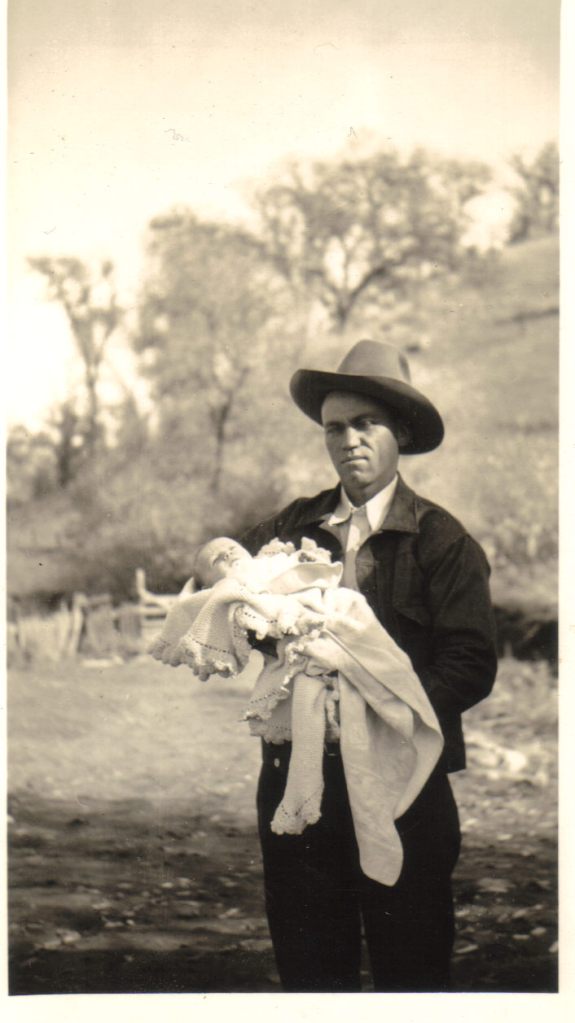
Ray Clarence Long with his firstborn, my cousin Bruce, better known as Jughead. Shannon Family photo.
He rode the Sierra his whole life long. Pushing cattle up to the high meadows in the spring, bringing them down in the fall. He worked the stockyards in the valley when times were lean; which was almost always. Dad said he knew every trail, crick, and cow camp from Mexico to Oregon and I never doubted it. There is a scene in the book Monte Walsh where the Stud Duck turns to his friend when they see a puncher ridin’ their way and says. “That’s Monte Walsh, nobody sits a horse like Monte Walsh.” He might as well have been talking about my uncle Ray.

Ray Long up on Charm, Watts Valley 1952. Shannon Family Photo.
He hand rolled his smokes with the one hand and drank his bourbon straight. He was honest as the day is long and the good God has surely made no one like him since. He rode horseback ’til the day he died.
A Truth.
*Ernie Pyle seldom wrote about generals, he wrote about the ordinary people he cared for, the dirty shirt dollar sixty a day Dogface who marched from Tunisia to Germany.
**Surprisingly, that old house still stands under the Sycamore trees some some seventy years gone.
Micheal Shannon is a World Citizen, Surfer, teacher and writer. He writes so his kids will know their story..
 atthetable2015
Looking forward to hearing a story or two round the campfire. To ride a horse till the day he died- that’s more scarce than a hen’s tooth.
LikeLike