Chapter Two
THE OLD SCHOOLS TAKE SIDES
By Michael Shannon
Introduction
People prefer to find order and beauty in the past. The heritage business is devoted to making sure they do. Textbooks are written which carefully polish the past until it shines.The silk ropes strung before the exhibit are meant to keep you out. The partition is to block your view. There is no place you can stand to see all the parts at once. Much of history is the shadow of somthing, blurred, which fails to to mark the place where an event, almost familiar, once was. Much history has runoff like water after a storm. It’s blown by the wind into nothing. Sometimes, from the tail of the eye an image appears. You have caught an instant of transparency, then the present draws the veil. This is a tiny drop of that local history, long, forgotten.
Arroyo Grande Herald: Sept. 10, 1898.
There are a number of citizens who are anxious on one ground or another that the educational facilities of the Arroyo Grande region should not have a high school….
So began the editorial laying out of the back and forth war between the factions who were at odds over the continuation of Arroyo Grande High School.
Arroyo Grande Herald: There will be a third stakes race Saturday at the Arroyo Grande Chataqua grounds between Jake See’s “Jennie T” and Will Heath’s “Perrine,” an eighth of a mile for a $ 50.00 purse. ($1,9750.00 )
In the very beginning Don Francisco Branch had sent for his sister, asking her to come out to California to take in hand the teaching of his children and those of his employees sometime before 1848. She made the trip from Scipio, New York to California by sail from New York to Panama, crossed the isthmus by mule and sailed north to California arriving in San Francisco in 1848. Escorted by a party of Rancheros returning to their ranches in the Cow Counties, she arrived safely after a trip of around 7,000 miles. She spent three to five months on the trip. She survived Bandidos, yellow fever, malaria, bad food, sea sickness and a great deal of discomfort. The trip cost between three and four hundred dollars. Getting to the west coast cost roughly $11,000.00 in todays dollars. Francis Branch could afford it. Most travelers were wealthy enough to pay their own way. This meant that most immigrants had some education and important skill in order to pay their own way. The poor stayed home.
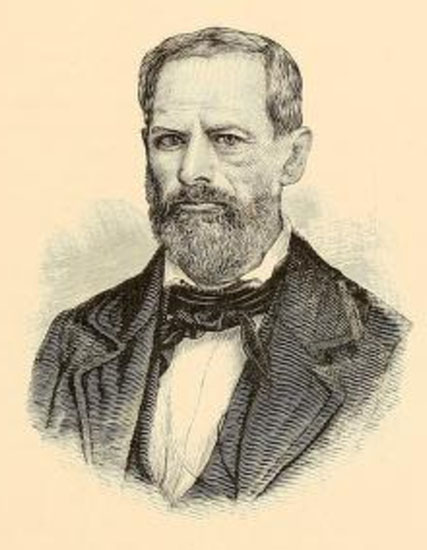
Don Francisco Ziba Branch, sailor, mountain man, trapper storekeeper and Ranchero. Litho Print from 1860’s.
Miss Branch taught in the Branch home of her brother for five years. She did not speak Spanish, though it was the universal language of California before the gold rush. She learned quickly enough. She taught basic reading, writing and arithmetic along with drawing and music. The children taught her Spanish and how to ride horseback in the Californio style where women rode astride like a man. Once her students were old enough they were sent up to San Francisco to be “Finished.”
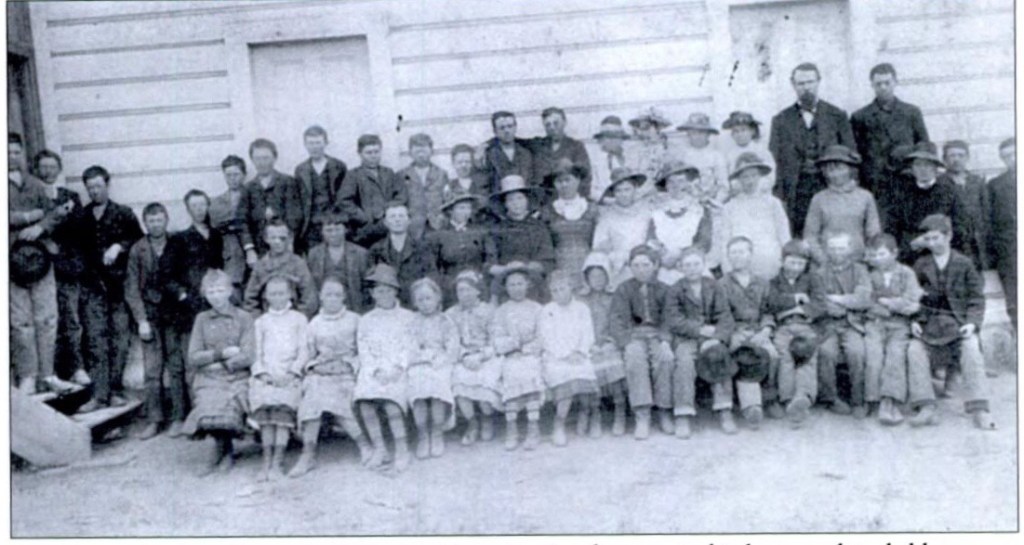
Arroyo Grande school, 1867. The first after the township was formed. SCHS photo
In 1867 Francisco Branch deeded a plot of land on todays Nevada street and a small wooden schoolhouse was built there. It was the first.
Arroyo Grande grew exponentially after the War Between the States. As always, wars create a world of widows and orphans. Add to this hundreds of thousands of veterans of the brutal fighting it is no wonder people felt the need to pick up and go. Go west it was and many came here.
Large landowners in California, the original Rancheros had little choice in finding a way to profit from their vast holdings. With statehood, organized government demanding taxes and the decline of trade with the east, the Ranchos were sold or were broken up, subdivided and along with active boosters who advertised nationwide, small farm took on a new importance. Many of the new residents were veterans. They brought their families with them and were familiar with schools in Ohio, Indiana and Illinois, where many came from, the wanted the same opportunities for children here.
Arroyo Grande Herald: The Philllips boys have shot a Condor in the upper Lopez. It measured over nine feet wingtip to wingtip.
The teachers were no longer adventurers or men and women who had some education that supplied the first decades of schooling in the Arroyo Grande valley but graduates of the Normal Schools. The California State Normal School was the first teaching college in state, founded on May 2, 1862. The school later evolved into San José State University in San Jose. The southern branch campus evolved into the University of California, Los Angeles.
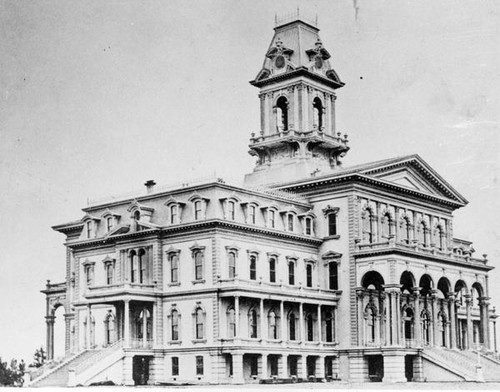
California State Normal School, San Jose. 1888. Calisphere photo archive
The San Jose school was created when the State of California took over a normal school that educated San Francisco teachers in association with that city’s high school system. This school was founded in 1857 and was generally known as either the San Francisco Normal School or Minns Evening Normal School.
San Luis Obispo Tribune: County hunters asked the Board of Supervisors to set a bounty on Blue Jays. The birds eat the eggs of quail and other game birds and reduce the populations. They have also been known to kill small children. The board will take this under advisement.
Normal schools were developed and built primarily to train elementary level teachers for the public schools. The term “normal school” is based on the French école normale, a sixteenth-century school with practice classrooms where model teaching practices were taught to teacher candidates.

San Jose State Normal School students about 1896. Calisphere
The Anna S. C. Blake Manual Training School, opened in 1889 was located in Santa Barbara, taught home economics and skills like sewing and cooking. Sloyd, a Scandinavian system of handicraft education, was also offered at the training school. Almost all of the original teachers in our town were graduates of one of these two schools. Margaret Phoenix Harloe, Hattie and Mamie Tyler, Molly O’Conner Moore, Gladys Walker Sullivan, and young women of the Rice, Poole, Conrad, Carpenter and Ide families.
Education was important to families with children. They wanted the best they could get but large landowners, businessmen and those with no children in the home were far less concerned about education and much more concerned with the taxes that supported the schools and that’s where the trouble started.
San Luis Obispo Tribune: The proposal to apply for a Carnegie Library in this place has met with stiff opposition from certain taxpayers. The application has been tabled until more study can be done. The opposing parties claim there is not the slightest reason to provide free books to the public. They state that it is a well know fact that excessive reading leads to sloth and indolence.
In 1893 when the high school was proposed a vote was held using the Australian voting system. It simply required that the voter write yes or no on a slip of paper and drop it in the box provided. There was no requirement that voters be registered only that they be personally known by the clerk accepting ballots. The system worked quite well as there were less than sixteen thousand people in the entire county. Arroyo Grande had a rough population of about 466. The demographic area covered the entire lower and upper Arroyo Grande valley. Oak Park, Los Berros, Cienega, and Oso Flaco, the Pismo and Nipomo votes were counted as well. A small population but they had pretensions.
The Arroyo Grande Herald: Saturday, June 3, 1893. “From the official returns of the election of May 27th, 1893 proposing the formation of a Union High School District a large aggregate of the votes tallied from the districts proposed a large percentage, 181 yea, 11 nay, the election is hereby carried. The nay votes came from the following districts; Arroyo Grande, three, Branch, two, Oak Park, four, West Los Berros, one and Los Berros one. All other districts were carried in a convincing fashion. We will have a high school.
In those Nay votes were the seeds of rebellion which began showing itself very quickly. Each of the smaller elementary schools would pay a portion of the tax needed to fund the high school as the California Supreme Court had ruled that taxing landowners to pay for high schools was illegal under the states constitution. It only took a few years for the big ranchers to figure out that if they could get the small elementary school districts to leave the union of schools which supported the high school, the school would fail for lack of funds. A number of them went to work. They weren’t shy with their opinions either. The newspapers of the south county reported on the doings on a regular basis. The Arroyo Grande Herald, owned by Stephen Clevenger who had arrived in Arroyo Grande from Missouri by way of Santa Cruz, promptly founded a wife, Edith Finney with whom he started his first paper there. He came down to Arroyo Grande, started a new paper for which he was owner, editor and publisher. Known as the Weekly Herald, Clevenger quickly demonstrated that he was without fear when it came to reporting the doings in the valley. He was definitely pro school and went after the men he called “Wreckers” with a vengeance.
Arroyo Grande Herald: Lodge no. 258, I. O. O. F. The Angel of death has invaded our mystic circle and removed from us our beloved brother, I. D. Miller. In his death our order has lost an active and useful member and the community a useful person. A.F. Parsons, Secretary.
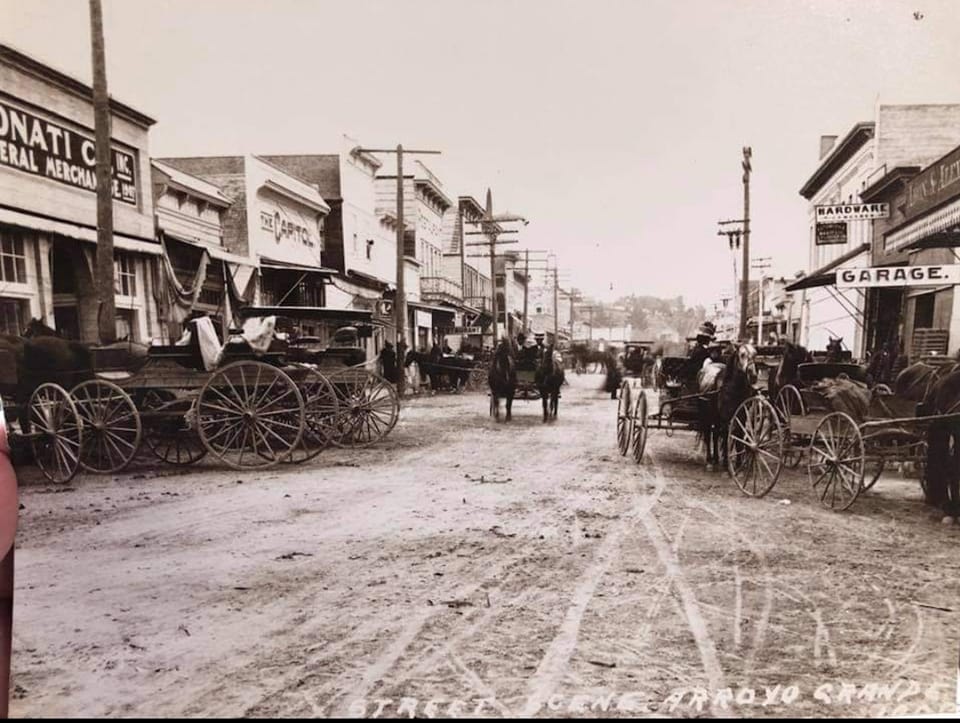
Saturday go to town, Branch Street, Arroyo Grande. Photo, California Historical Society. Town constable Henry Llewellyn was shot in the doorway of the Capitol Saloon, left, and died the next day in the Ryan Hotel. Ryan Hotel is the large building distant left. Peter “Pete” Olohan’s building is the tall building on the right. There are eight saloons in this photo. Saturday afternoon was shopping day for the rural ranchers and farmers. A time to stock up on necessities, get the local gossip and scheme and deal politically.
Self styled important men objected to the high school and met at Pete Olohan’s saloon on Branch Street to hack out a way to get the school closed. Sitting around a table on a Saturday afternoon while their wives did the weekly shopping, they pulled on cheap cigars and passed a bottle around and discussed strategies for closing the school and getting themselves out from under the burden of paying a tax they didn’t agree with. Daniel Donovan owner of substantial acreage in the west Los Berros section, Ed Newsom, Hotel owner and farmer from the Newsom Springs ranch on the old Santa Manuela Rancho, Bernard Miossi owner of Sycamore Springs and Willis Buck who was ranching on the Corral de Piedra and Oak Park area planned a campaign to relieve themselves of the property taxes that supported schools, particularly the new high school. Sitting with them was Judge Venable from San Luis Obispo who controlled the big Biddle Ranch in the northern end of the valley.Their scheme was to find a legal way to close down the high school district, and if no strictly legal way could be found, well….

The Newsom Sulfur Hot Springs Hotel, 1887. Calisphere photo
Arroyo Grande Herald: Charles S. Clark M.D. Professional calls attended to, day or night.*
The group chose young Willis Buck as their spokesman as he was studying law and being advised by Judge Venable and apparently had a big chip on his shoulder. It pretty evident that Stephen Clevenger of the Herald didn’t care for him as evidenced by this description which he published soon after the meeting at Olohan’s. “Little Wrecker Billy Buck” or “Little Baldy Billy Buck” were terms the paper used to get under his skin, both of which just made him angry. Clevenger kept it up.
The Wreckers put the first part of their scheme in motion soon after the September 4th, 1897 meeting at Olohan’s. The began to pressure the clerks of the board who held the elementary schools vote to terminate the Union with the high school, thus depriving the school of it’s main source of income, the districts elementary schools who paid into the high school operating fund. They also called upon County Superintendent Messer to schedule a special vote to elect a new High School board. No regular vote was scheduled but political pressure and the thought that the voters, all men of property of course, would support the school as they had done in 1893 when it was first approved, convinced Messer this election would end the same way. Women who were likely the most concerned for their children were still more than twenty years away from suffrage and were excluded.
The third leg of the plan was to pressure the voters of the old fifth supervisorial district to vote out the incumbent, Patrick Moore. He had announced for a third four year term and was known to be a supporter of all schools.
Patrick Moore was born in Cavan, Cavan, Ireland and had immigrated with nearly his entire family to the old Guadalupe Rancho in the Santa Maria area. A very successful rancher, farmer and… as he always listed on his census forms, Capitalist. He owned wide swaths of property in the Santa Maria and Arroyo Grande area. He had spent eight years as a supervisor in was was still known in the later nineties as the “Bloody fifth,” a sobriquet that was very well deserved. Hardly a week passed without a report of a murder, Saloon shooting, accidental death by gunshot, crushed by accident, dismemberment, fratricide and the killings of wives, children and husbands and neighbors. The newspapers from the Paso Robles Leader to the Arroyo Grande Herald faithfully listed the mayhem. If a person survived all the above, they still might be poisoned, killed by bad food or eating too many green Cherry’s. They could be shot in cold blood by the road agents and bandits which infested the still rural “Cow Counties.” For children, dying before five was also a distinct possibility. Horses routinely caused mayhem, kicking men to death, crushing and running away with their owners happened all the time. A spooked horse reared and then backed a buggy with its driver and her infant daughter over the side of the railroad bridge and miracle of miracle, no one was hurt unless it was the horses dignity. There is is only one recorded legal hanging in the county, all the rest, and there were many over the previous 45 years, had been impromptu. The latest, a lynching of a fifteen year old and his father from the Pacific Coast Railroad bridge in 1886 by “men unknown.” A curious part of that event is that the men were certainly not unknown and were in fact, some of the leading citizens of Arroyo Grande. An older man who spoke at my grammar school when I was 11, told us of his father being called out at night to assist in the lynching of the man and his son. He said the men doing the hanging were known to all, their names were an open secret. A state detective was ordered in to investigate the extra-legal murders but interviews with the towns citizens yielded no one iota of information on the identities of the men who did the deed. Mrs. Eldridge’s daughter Missouri was one of the children who witnessed the dangling bodies the next morning on the way to school.
The Arroyo Grande Herald: Many Children See Bodies. Missouri Eldridge, chattering gaily with her chum approached the bridge over which the children crossed each day to the schoolhouse. “Oh, Zoo! There the most terrible thing on the bridge.” Exclaimed one of the group of breathless girls rushing back to her. But Missouri was not to be plagued. “Don’t be silly.” she replied sedately. “You are only trying to fool me because this is April Fools Day.” Then, her eyes widened as she stared past the chalk white faces of the other girls for she saw they were not fooling, indeed. She saw, hanging from the bridge, the bodies of a man and a boy, hung during the night. She ran home to tell her mother.**
No legal measure was ever filed against them. My own great-grandfather was known to carry the Smith and Wesson 41 caliber pistol he had used as a Santa Clara County deputy sheriff in his front pocket on occasion. Very little law enforcement existed beyond the town constable. Nefarious deeds were seldom punished. Most citizens seemed to take a certain Ho Hum attitude about it all. What is common fare is barely noted, even today.

The offending bridge. Home to buggy accidents, impromptu lynchings and even an occasional train. Pacific Coast Railroad, photographer unknown.
The bridge was one of only two ways to cross Arroyo Grande creek. There were few houses on the east side an area that was still mostly small holdings and farms. The dirt paths and buggy crossing illustrate the fact that it was routinely used by pedestrians, wagons and the train. This bridge would be washed out in the floods of 1911.
Arroyo Grande Herald: September 8th, 1897: Yesterday at the Cienega just south of Arroyo Grande near supervisor Moore’s home a sad accident occurred . The ten year od son of Mr and Mrs Costa who live at the old stagecoach stop along the Nipomo road was playing with a loaded gun which accidentely discharged killing his infant brother. The parents of the children were away from the home at the time. The Coroners inquest was in accordance with the above facts.
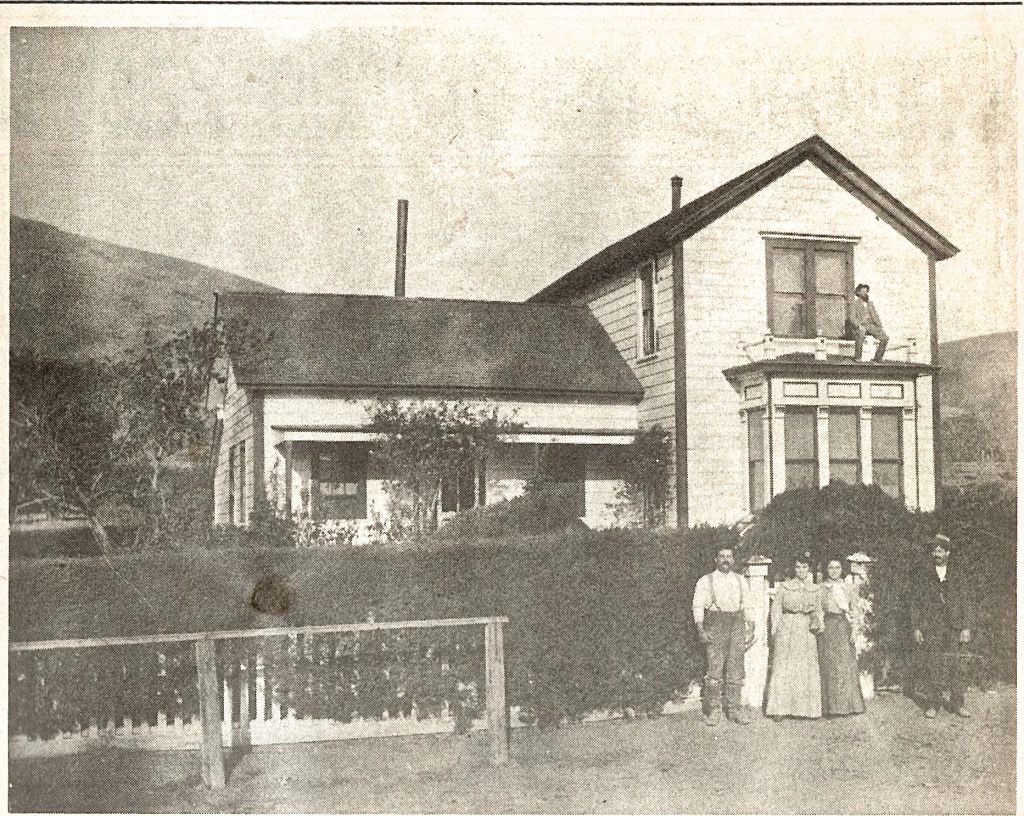
The Costa home, lower Bridge Street and Nipomo Road, late 1880’s. Arroyo Grande Herald Recorder, Costa Family Photo.
In 1898, the superintendent of county schools realized that he was up against real opposition to the Arroyo Grande high school. Screeching and whining had finally reached the point that anti-school “wreckers” were on the march and meant to throttle the high school once and for all. They were aiming for Supervisor Patrick Moore and citizens wondered where they would strike after that.
San Luis Obispo Tribune: Mrs Strobridge will have her yellow dog safely in her possession. City Marshall Cook confirmed her that his brother, City Marshall of Morgan Hill has found the dog and arrested the man who swiped him. The yellow dog will be brought back to this county and will be made to tell what he knows.
It was reported that Supervisor Moore would sit on the Dias at the courthouse in San Luis Obispo and with a sphinx-like expression and was rarely readable until he made his decision. He was also immune to bribery. As a supporter of education and a rich man, he was bulletproof when it came to lending support and his personal fortune to the school district. For many years and into the decade to come he consistently used his money to pay tuition for boys and girls who were off to school to become professionals. Numbers of young women including my grandmother were recipients of his largesse. No school was ever given his name but a local elementary school carries the name of a young woman who became a teacher thanks to Patrick and Sarah Moore’s generosity. Obviously in order to guarantee the success of their scheme, the Wreckers had to boot him out of office.

Annie Shannon nee Gray, The honorable Patrick Moore and Mary “Molly O” O’Connor schoolteacher. 1900. Shannon Family Photo.
The election of 1898 saw many scenes that would be entirely familiar today. The Wreckers put up a candidate named John Gilliam. Gilliam had been the supervisor for the Santa Margarita district but was tossed out after a single term. Moving from that district to Pismo Beach he declared himself a candidate for the fifth against the incumbent, the Honorable Patrick Moore the two time holder of the seat. There were three challengers initially but after some closed door meetings two of them “graciously” withdrew their names from consideration. The Herald reported this incident with more than a touch of snark, stating that “What promises were made is unknown but it is certain they were made and if Gilliam wins will be fulfilled.”
Arroyo Grande Herald: October 8th, 1898. Say! It was rather nice for Fowler and Eddy to step down and out and make way for Gilliam wasn’t it? Such exhibitions of “Good for the order” are so seldom met with.”
Pat Moore was a popular man in the fifth and was considered a fiscal conservative. In the way that politics works, his record as such was used against him. In the last quarter of ’98 he had voted to do away with the ground squirrel bounty of .01 cent for each tail turned in as a waste of good taxpayers money. He stated that 21, 687 tails was just a drop in the bucket compared to squirrels breeding far faster than they could be killed. This was used by the Wreckers as proof of his anti-farming bias. He was bad for farms and ranches. He had also voted against the purchase of all new walnut furniture for the Superior Courts office of Judge Venable, thus showing disrespect for the courts and law enforcement. He objected to the high rates set by the county for road sprinkling which no doubt cost him the vote of Martin Fly who sprinkled the dirt streets of Arroyo Grande including the road in front of Pat’s own house. He was in favor of the ban on the export of Pismo clams, Abalone, and Seals, the ordinance which he authored in 1892 which he said, “Will reduce their populations and show no advantage to our county.” He also was not in favor of the county building a road from Arroyo Grande to the Pozo district over the Santa Lucia mountain range which would only benefit the large ranches along it’s route, the cost to be paid by the counties taxpayers. All sensible but when has sensible ever entered political considerations.
Pat Moore, a Republican and staunch conservative always tended to be frugal with county monies. He didn’t believe taxpayers should be on the hook for the benefit of the wealthier citizens of the county. A perfect example was his almost always negative vote on propositions that the counties Roadmasters take over the many toll roads across the districts. The Cuesta Road was still a toll road and rather poorly maintained by it’s owners who petitioned the supervisors, asking that the county purchase it and relieved them of its maintenance because, they claimed, they couldn’t afford to do so themselves. “Nonsense, “He said, “they made a good profit from the most heavily traveled road in the county and did the least amount of work on it as they could get away with.” The completion of the Southern Pacific over the grade had cost them most of there freight traffic and they were desperate to unload it. They would certainly make a profit from any deal with the county. Supervisors were just as canny as politicians as they are today and ultimately bought the right of way which then operated as a financial loss to the county but grew the supervisors power base and individually cost them nothing, the burden being passed on to the taxpayer, most of whom would never even use the road. Spun properly this stamped Pat Moore as anti-progress and anti-business. It was to cost him his job.
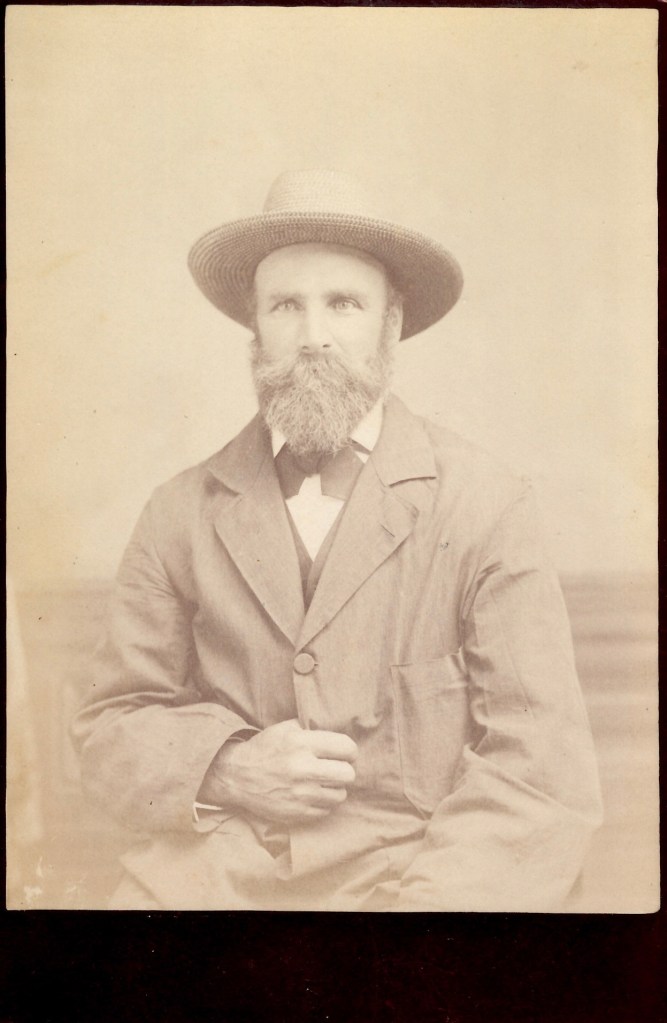
The Honorable Patrick Moore, 4th district supervisor, Official Photo. San Luis Obispo County, 3 terms, 1890-1898, 1902-1906. Shannon Family photo.
Even the Herald, a paper run by Pat’s friend Stephen Clevenger could not afford to turn away advertising from the opposition which bought ads like the one below.
Arroyo Grande Herald: “Say! Have you seen the recommendations of J W Gilliam in the press? They present him as a “Clean Man.” Why don’t Pete Olohan and some other good Christian men take Pat Moore down to the creek and give him a good bath so he won’t be handicapped in the supervisorial race”.
Stephen Clevenger and Pat Moore were friends and Moore, an astute politician did not force Clevenger to take sides but instead ran his attacks on Gilliam in the Paso Robles Leader, the Cayucos Oracle and San Luis Breeze. He was shrewd politician and wanted no one to know where he stood.
Arroyo Grande Herald: “Say! There is some very wild guessing which way the election will go in Arroyo Grande. The Republicans claim the town by 82 majority and the Fusionists ( Democrats and Peoples Party) by over a hundred. They both claim to have the figures to prove it.”
Pat Moore was a well known patron of William Ryans saloon on Branch Street which was considered by the “Fusionist” party to be the nest in which the Republican vipers lived. It was his defacto office and where he held court and did his so-called shady deals along with his cronies Ryan, Corbit, Meherin, Beckett and the Rice brothers.
Arroyo Grande Herald: Yesterday rifle pellets were seen chasing a patron of Ryans Saloon as he scampered up Tabernacle Hill. Constable Whiteley has secured a horse and is in hot pursuit.
When the ballots were returned to the county courthouse to be counted, it was found that many clerks had not signed and certified the vote count, so Judge Venable locked the boxes up in his courtroom while his clerks re-counted them. The judge ruled that only his court clerks could do the counting, He said the Democrats were notoriously corrupt and could not be trusted. So the Democratic officials were given the boot. Perhaps not surprisingly, the Republican candidate Jim Gilliam walked away with the election and Pat Moore went home.
the Screechers and Wreckers next used their power as wealthy and influential landowners to lobby the clerks of the individual elementary school boards to withdraw from the Union High School district. All twelve schools did vote on this as each clerk had the individual power to do so. All the schools other than the town school had few students, Black Lake School polled just 21 boys and girls, most not landowners or in many cases, even US citizens. Enrollment lists show large numbers of names that could only be recent immigrants and unable to vote or even to read and write in English. Voting to withdraw by the various clerks of the boards must have been comparatively easy. The advantage to the clerk of each school was that they no longer would have to apportion some of their budget to support the high school. Only Arroyo Grande, Branch and Santa Manuela schools elected to stay.
The newspaper, referring to the opposition as rattlesnakes published figures showing that Newsom Springs school had paid in just $28.07 to the High School fund but received nearly $400.00 dollars from the county in recompense. Clevenger took this to mean that the schools themselves were not the main issue but the cost of taxation on the big ranch owners who made up less than 30% of the taxable acreage was. This made it a purely personal and selfish issue. He kept his paper hammering at them.
Arroyo Grande Herald: May 28th, 1898: Miss Edith Jatta and Miss Edith Carpenter went down to Nipomo yesterday after school on a visit to the first Edith’s sister, Mrs E. C. Loomis. They return in the morning.***
Francis Branch who started the first school in the valley for his children and those of his workers was more than fifteen years in his grave and his ranches had been deeded to his children who, in many cases married them out of the Branch family or failed as ranchers and sold the property to speculators and developers who had little connection to the land and the people on it. For example, The big Biddle ranch, once Branche’s Rancho Arroyo Grande and large portions of the Santa Manuela rancho were controlled by Judge Venable, he of the Walnut office furniture. He who we will hear from again.
San Luis Obispo Tribune: Some person with a can of poison for dogs has made a great success of his nocturnal adventures yesterday and quite a number of canines of more or less value, have turned their toes to the daisies.
After the by election to choose new clerks for the Board of Control and against all expectations, the “Wreckers” controlled six of the eleven seats on the district board. Bernard Miossi of the Sycamore Springs Ranch represented the Pismo school, “Bald” Willy Buck sat for Oak Park, Frank Newsom son of D F Newsom and founder of Newsom Springs school whose father had originally supported education and built the school. Frank didn’t like the fact that school taxes bit him in the pocketbook, Daniel Donovan from the lower Los Berros school district, Judge Venable from Santa Manuela school and James Beckett, a real estate speculator property owner and board member from Branch school figured they had the winning hand and set about the “Wrecking.” It was a case of the voters apparently not believing what was in plain sight as they still so often do and voting the way their bosses told them to do or not voting at all.
Arroyo Grande Herald: Mrs Robert English is expected home tonight fro San Francisco where she has been this week selecting her spring millinery.
San Luis Obispo Tribune: September 18th: School Tax Levy Fixed Yesterday. During the afternoon proceddings of the Board of Supervisors Budget allowances were set for the coming 1900 school year.
The only incident if note before the board was the matter of making an estimate to maintain the high school and over this the conflict raged merrily for hours.
Willis B. Buck of Oak Park and Bernardo Miossi, the former the president and the latter, the secretary of the board of control appeared before the board of supervisors and argued that the board should adopt the estimate of $ 775.00 made by a majority of the board of control to maintain the high school for the new school year.
Mister Orville Pence appeared on behalf of the citizens committee of the Arroyo Grande high school and demanded that the estimate be raised to something more than the previous years budget of $ 1,700.00. He stated that any reduction of the budget would make it impossible to keep the school open.
Willis Buck argued that there was little need for the school and that it was a needless burden on the taxpayers. Questioned on what the students were to do he stated they could attend school at the old Mission school or the parents could hire tutors. He said that eight students had already made plans to attend San Luis Obispo high school. When asked if this might be a financial burden on the parents he said he believed those that could afford to send their young people to San Luis Obispo would do so and those that could not were not really in need of any higher education.
There was much spirited back and forth but in the end the board sustained the estimate of the board of control and fixed the lower rate accordingly. The board was split 50-50 and chairman Gilliam cast the deciding vote.
The opponents of the Arroyo Grande Union High School won out. With the chairman of the Board of Supervisors, Mister Gilliam, elected from the Arroyo Grande district in 1998, voting to break the tie, it was ordered that the budget for the high school be reduced as requested by the board of control. The ousting of Pat Moore from his supervisors seat had its intended result.
With the budget firmly in hand, the high school board promptly voted in a pay schedule for principal, vice-principal and teachers. The principal, A F Parsons, the former county surveyor was to have his salary reduced by sixty eight percent. An article in the Santa Maria Times put it succinctly;
Santa Maria Times: September 11, 1898: The “Oppositionists” concocted a plan by which the high school will be stopped. They have fixed the salaries for the coming academic year, 1899-1900, as follows: Principal, $40 per month, Assistant, $25; Janitor$1; Rent for the school building per month, $5, and incidental expenses for the term, $2.50. Last school year the Principal received $125.00. The two high school teachers were reduced to $1, and $2, dollars a week. As it is now impossible to secure teachers at those salaries the “Wreckers” have made their point. The school will be unable to open in the fall of 1900.
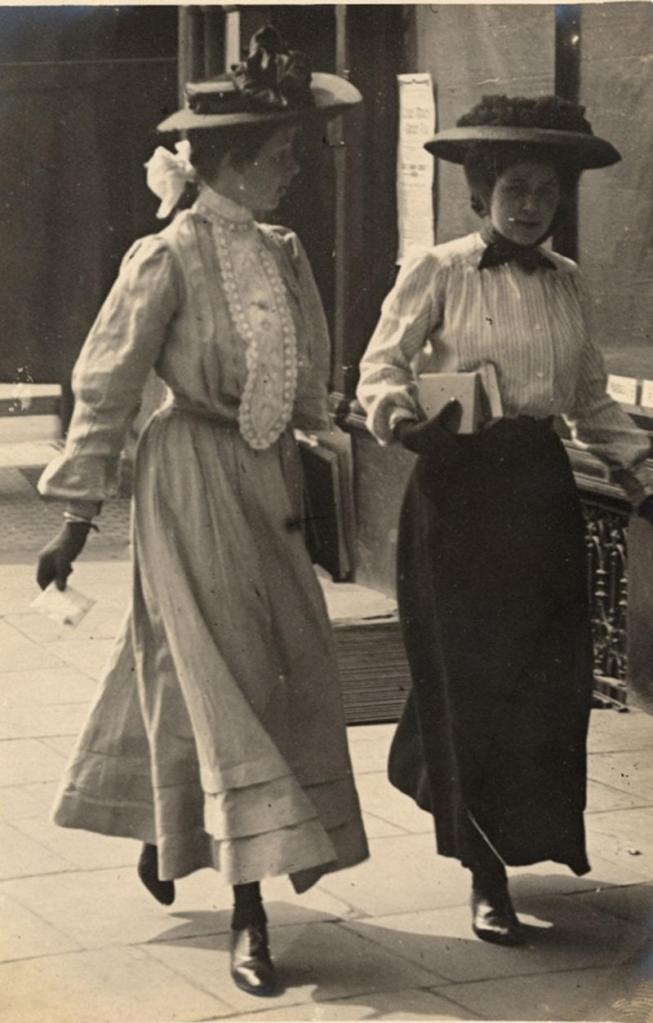
San Luis Obispo Breeze: Many of the young ladies from Arroyo Grande have been visiting lately. San Luis Obispo may be a little dilatory in the way of street improvements but when it comes to pretty girls she is way up in the head of the procession. go down the street on any sunny afternoon and you will see more beautiful women to the square inch than any town in California. Up on the train today visiting our fair city were the misses Tootsie Lierley, Maggie Phoenix, Annie Gray, and Aggie Donovan. They were accompanied by Miss Edith Fesler of Santa Maria. (Teenagers all, 13 and 14 years old)***
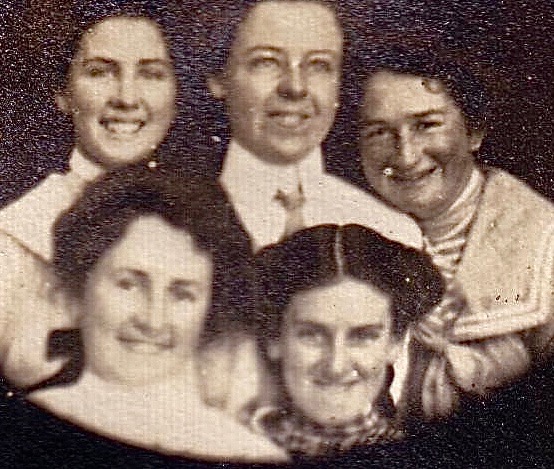
Note: The cover photo of the young girls, top row L-R Annie “Nita” Gray, Margaret “Mamie” Tyler and Agnes “Aggie” Donovan. Bottom L-R “Tootsie” Lierley and Margaret “Maggie” Phoenix. Annie Gray was the authors grandmother. “Mamie” Tyler would become a teacher and teach in Western Washington in a log cabin school. Maggie would Marry Archie Harloe and teach nearly her entire career in the Arroyo Grande School District. Margaret Harloe elementary school is named for her.
*Doctor Charles Clark was affectionately known as the baby Doctor. He buzzed around the valley delivering children by day and night including my own aunt Mariel who was born at her parents home in Bee Canyon up in the Verde district in 1916.
*Missouri Eldridge was the niece of Pete Olohan, who was very likely another participant in the hanging.
*I’ve often wondered who their chaperone was. They wouldn’t have been allowed to go without one in 1900.
*The Misses Jatta and Carpenter’s fathers were well known members of the lynch party.
Below is the link to Chapter one.
https://wordpress.com/post/atthetable2015.com/11202
Coming in the next post:
CHAPTER THREE
1899
Arroyo Grande Oracle: The Arroyo Grande High School class of ’99 will have no commencement this year. Arrangements were being made for the affair and undoubtedly it would have been a grand affair and would certainly have obliterated much of the ill feeling towards the school by our neighbors who dominate the school’s board of control. Certain comments by students and faculty in the Herald caused the ceremony to be declared off by Willis Buck, chairman of the Board of Control. If the students and teachers are not willing to work to build up the school they cannot blame those who are prejudiced for trying to wreck the institution and cause disbandment of the High School district….
 atthetable2015
Pingback: THE WAYBACK MACHINE | atthetable2015
You’re a great writer, and you certainly have a great knowledge of the earlier Central Coast News. You even had relatives who lived here during the earlier times, which makes it even more interesting.
LikeLike
Thanks Kathy.
LikeLike