Michael Shannon
Chapter 24,
Six Months in Billings.
They rolled the old Hog down the eastern palisades of the Rocky Mountains and down onto the high western prairies of central Montana, The ancestral home of the Lakota, Shoshone, Nez Perce, Blackfeet, Flathead, and Crow who had roamed horseback across the undulating prairies of Montana, Wyoming and the Dakotas for more than three centuries.
The difference was stark. The foothills of the Rockies, bathed in the late summer heat with Billings nestled in the fertile valley of the Yellowstone river and framed on three sides by scenic mountain ranges, Billings is a blend of plains and mountain geographies. The environment is rugged and wild just beyond the city with the spectacular Rimrock standing like stone fence on the north and east.
Fed by numerous tributaries, the Yellowstone River flows in a northeasterly direction through the Yellowstone valley. The valley measures from a few yards to twelve miles in width. Valley soils are deep, well-drained loams and silty clays. Sandstone cliffs, from 300 to 500 feet high, form a landmark border known as the “Rimrocks” to the north and east of the city. Above the Rimrocks, the land is primarily rolling hills with shallow to moderately deep soils of sandy and clay loams. South of Billings, the terrain is characterized by rolling steep hills with high, flat tablelands.
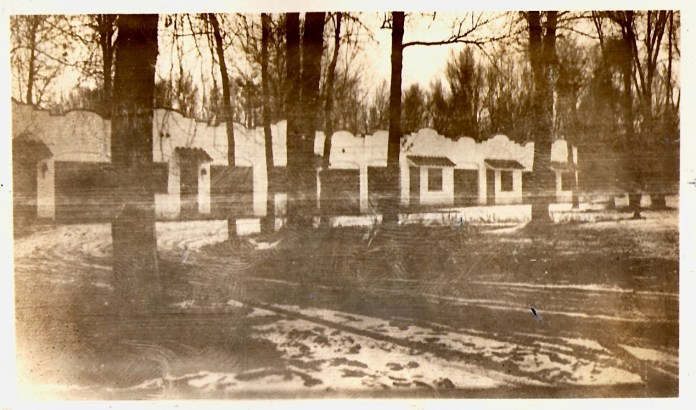
They’d left Arroyo Grande in September when it was still nice California weather but they weren’t prepared for the weather on the great plains. They hit a blizzard and Bruce and Eileen wee very concerned about wether they could get through. Bruce couldn’t see where the road was and so he had Bob walking ahead on the muddy snow covered road to guide the car. It was very cold. The Nash had only a little box heater under the dash board that ran on hot water from the radiator. Little Patsy sat on her mothers lap bundled in blankets trying to keep warm. They finally found an Auto Court and decided to wait it out. There is an old saying in Montana that if you don’t like the weather just wait a few minutes and it will change.
Bruce paid for the room and and sloshed his way to the door and used the key to open the door. Patsy was wearing a little dress and a pair of Maryjanes so Bob, who was already wet and muddy carried his sister in. Bruce had to help Eileen walk, the heels she always wore didn’t help much in the slush. They realized that the were completely Californian in their experience and that this might just be a completely new amd different way to live..
Eileen was born at a ranch in Anaheim. Her family were pioneers there and the Polhemus Ranch was partly on the site of todays Disneyland. Called the Miramonte, the ranch had wonderful views of the mountains to the east, a pretty rare sight today. Bruce grew up in Arroyo Grande so neither of them had any experience in the snow.
All the little room had for heat was a little electic hot plate so Eileen put on a pot and boiled water so the steam would send the temperature and humidity up. Bundled in their clothes and blankets they spent a miserable night huddled together on the bed, Mister Beans too.
As the old saying goes just wait a bit and sure as little green apples they awoke to clear skies and a warm breeze out of the east. It had been a freakish introduction to the vagaries of early Montana winter weather. Before instant communication, long distance travel in the west always had a hint of the disaster hanging about and they felt lucky that they had escaped from a blizzard that might easily have killed them.
It was nice when they finally rolled into Billings. After asking for directions they drove up 31st street to an apartment building on the tree lined and shaded street. Checking in with the landlady they rented an apartment in the otherwise vacant building. Eight rooms and they were the only residents which suited them just fine.*
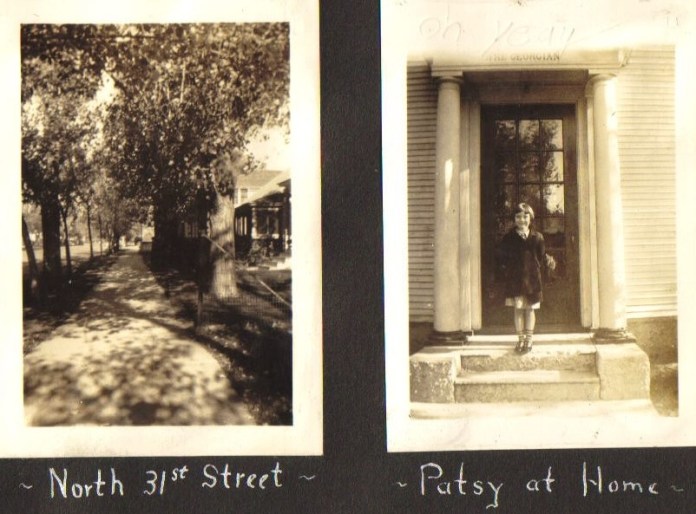
Patsy standing on the stoop still wearing her short skirt and Maryjanes. Late September 1938.
They had a day or two to settle in and get organized before Bruce had to go to work. The apartment had two little kitchen chairs and a round table which proudly showed the scars, scrapes and dents of a long useful life. They also inherited an old crippled three legged dresser with a sort of peg leg nailed to the side with a folded matchbook strategically positioned to keep it level most of the time. There was a stand alone wardrobe for clothes which stood alongside an old iron framed double bed painted white. The mattress had seen some hard use and would have to go which presented no problem for them. It was just part of the deal when you lived in temporary houses and they were used to that sort of thing. The rent was only eight dollars a month so at least it wasn’t going to break the bank.
Grandma brought a box of dishes and some cooking utensils with her and some folded sheets and blankets. A night or two on the floor presented no problem. Billings was a nice little town and with a little nosing around she would find what ever she needed.
My aunt who had just turned five had the run of the place because her mother thought it was perfectly safe with no other residents. People were a little more casual with their kids then and paid less attention to the occasional bumps, scrapes and bruises. Years of itinerant life had taught them the important thing was to teach children how to look out for themselves.
Billings had a population which hovered around 20,00 souls in 1938 and qualified as Montana’s 3rd largest city behind Butte and Great Falls. The town was slowly climbing out of the depression with the introduction of some light industry, particularly the new sugar beet factory and the local refinery.
One of the most brutal labor intensive crops grown at the time, sugar beets used a legion of itinerant laborers who did almost all of the planting, weeding and production by hand. The infamous “Cortito” or short handled hoe was prominent in the fields. Known by Mexican laborers as the “Brazo de Diablo,” or the devils arm, it was the only weeding tool in use at the time.** It would be forty years before it was phased out of existence.
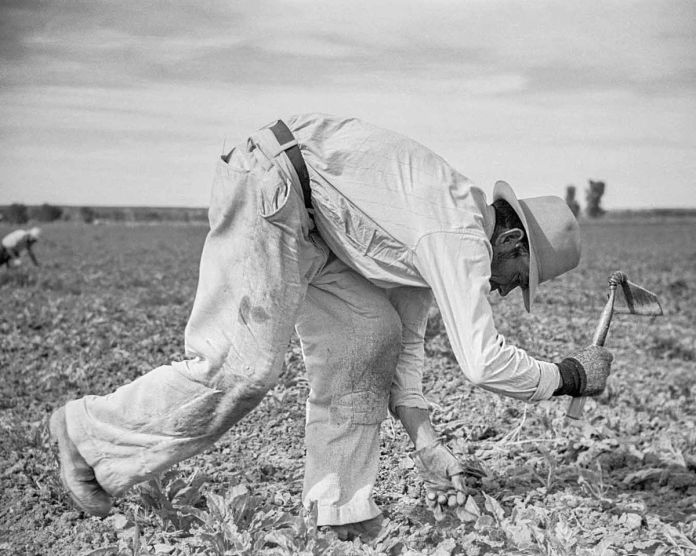
Thinning sugar beets in the Yellowstone valley, Treasure County Montana near Billings Montana 1939
There were around twenty refineries in Montana at the time though most people wouldn’t likely think of the state as a major oil producer. Yale Oil ran a refinery right outside Billings and received crude from the wells which had been drilled in the southeastern part of the state.
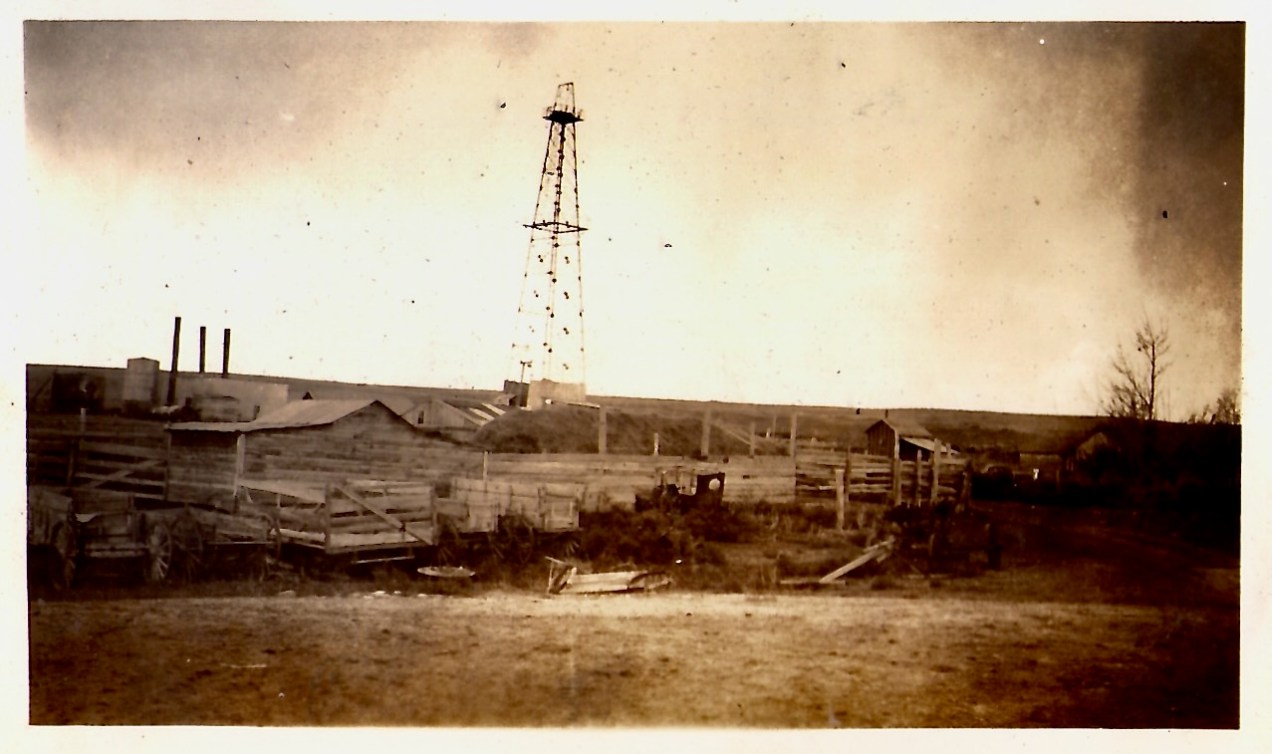
Signal landmen had contracted for some leases near the small town of Broadview which was about forty miles northwest of Billings and Bruce and his crew were sent to set up and drill a wildcat. The region is in the northern portion of the Crazy Horse Mountain Basin/Bull Mountain Basin region, which was surveyed for oil potential during that the thirties. Montana was well known for its light crude which was a high quality product and when refined made a very good quality gasoline. Cars in the late thirties were far more sophisticated than they had been twenty years before. V8 motors needed a higher grade of gasoline than the old four banger Model T’s. Signal was advertising its Purepull gasoline which had lead added and known as Tetrathyl which ran smoother in the new and modern engines.***
With a long history of drilling and production Signal geologists believed that a wildcat might be worth a try and Mosher agreed to sent my grandfather and his crew up to Montana to have a go on the chance that a new field could be brought in.
Walt and Ray would be flying in to Billings soon so setting up the household was going to be done in a hurry.
Chapter 25
How its done.
*North 31st street is still there. Built in 1910 a room can be rented for just 875 a month. Eight rooms, four baths, one with a tub. when the Halls lived there. It now has two apartments with full baths and is estimated to be around four hundred thousand if it was on the market. It’s walking distance to McKinley Elementary school where Patsy went to the first grade while they lived there. It’s one of the few old survivors left in downtown Billings.

**Kaz Ikeda who volunteered to go north to Idaho to work the beets in 1944, said, “Anything to get out of the concentration camp at Poston, Arizona,” Kaz told me it was the most brutal work he ever did and this from a farm boy who grew up in the fields of Arroyo Grande, California. He always said,”The joke was on me.”
***Ethyl gasoline, introduced in 1923, was a leaded fuel additive developed by General Motors and Standard Oil to eliminate engine knock and increase efficiency, using tetraethyl lead. Despite early cases of severe lead poisoning among workers, the product was marketed heavily as “Ethyl” to hide its lead content. It dominated the market for decades before being phased out starting in the 1970s due to extreme environmental and public health risks.
Michael Shannon comes from an oil field family. Bruce and Eileen Hall were his mothers parents.
 atthetable2015