“The God of Death has come.” Shouted by a Japanese Imperial Naval Marine* upon seeing Marines landings on Betio, forever enshrined in the notes taken in interviews by MIS translators during the battle for Tarawa.
The filth, the crawling over sharp coral, running crouched, hunched over with every muscle in the body nearly rigid with fear, the noise which never stopped, artillery, flamethrowers, grenades and the constant pop of gunfire. Battleship shells weighing a ton, Destroyers nearly run up on the beach duking it out with gun emplacements at point blank range. A miss is a miss but the M-1 round still can kill at 6,500 yards, over 3.5 miles. The Japanese Arisaka type 99 rifle could kill at 3,700 hundred yards. No place on the island could be safe for the soldier. The air is full of them. There was no place safe. No one could think or conceive of any other universe. The Battle of Okinawa (Operation Iceberg) was the final major land battle of World War II, lasting 82 days from April 1 to June 22, 1945. It was a brutal, large-scale engagement where U.S. and Allied forces fought Japanese troops on the island of Okinawa, the last step before a potential invasion of Japan. The battle was exceptionally bloody, resulting in massive casualties for both sides, including a significant loss of civilian life among the Okinawan people, and heavily influenced the U.S. decision to use atomic weapons on Japan.
Soldiers are so young. Is it impossible that they should be able to process the situation they are in? When they awaken at the bottom of their waterlogged foxholes after dreams of home they understood there was no escape.
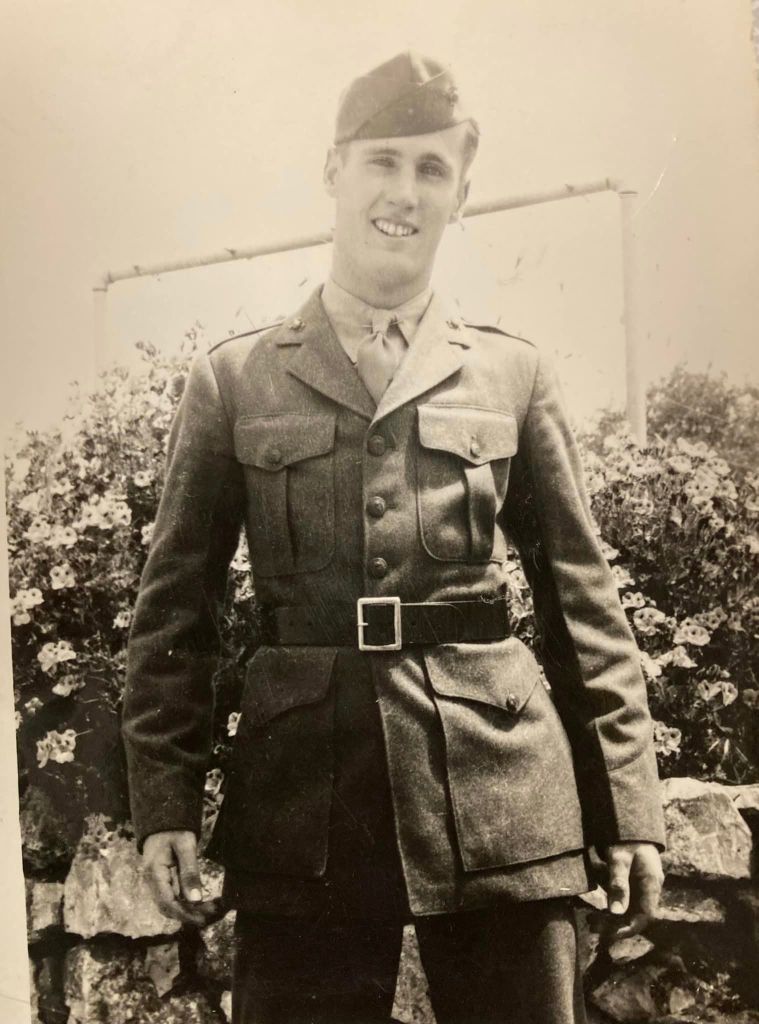
Witness this Marine Ambulance driver’s letter home written about half way through the invasion. He would celebrate his 19th birthday on Okinawa.
Dear Folks. I know you have been worried about me but as you see I’m still very much O K. I’ve had a few close calls but that can be expected on this Rock. They say in the stateside news that this island is secure but, but they still have eight more miles to go so you can figure that out. We are three miles back from the front licking our wounds now and waiting for I don’t know what. Maybe we go back and maybe we don’t. I guess I’ve seen most of this island so far—enough anyway.
Private John Brewster Loomis USMC, Headquarters company, 1st Battalion, 1st Regiment, 1st Marine Division. MOS 245, Truck Operator. Just before shipping out to the Pacific, 1944.
Shuri Castle was a rich joint and Naha used to be quite a town. I am sitting in Jap truck now that we picked up in our travels. It is something like a ton and a half and something like a Chevrolet but right hand drive. I’m a little thinner but feel alright. (He entered the Marines at 5′ 11″ and 160 lbs.) Instead of “Golden Gate in ’48, it’s from Hell to Heaven in ’47. Old Snowball, a friend, is still alright as far as I know. We sure took a beating but took our objective.
Dad I’m sorry I couldn’t write on your birthday but Happy Fathers day and Fourth of July.
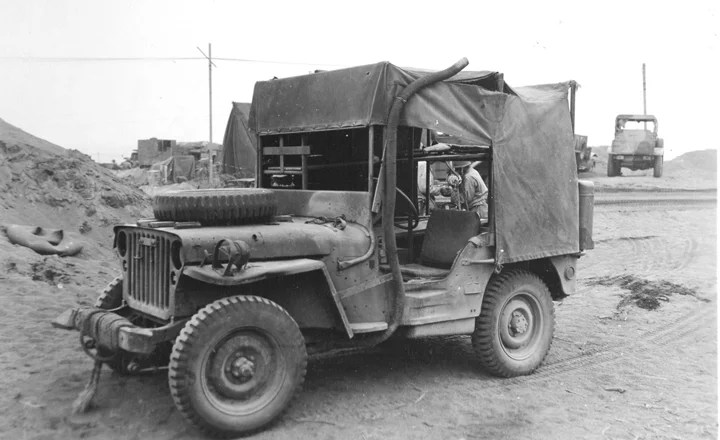
The weather is better now, cold at night. Last night was the first time I got to take off my shoes when I hit the sack. They brought us a little better chow for a while. Boy! Am I tired of C-Rations. My old ambulance is still running but it doesn’t look the same-no windshield. bumpers, paint, top or sides-justone seat and the stretcher racks.
I had my picture taken the other day by Division. I don’t know if it will get in the papers or not. I sure didn’t look like much that day.
Well, folks, I’ll write when I can and I hope from now on that will be very often. Much Love John.**
Modified by Holden an Australian body building company, this is the Jeep type ambulance John Loomis drove on Okinawa. The Marine Corps used this much more, go anywhere ambulance instead of the big GM trucks used in Europe. The rugged terrain and mud sloppy roads couldn’t be navigated by trucks and Sherman Tanks were sometimes used as tow trucks if they didn’t sink in the mud holes themselves. Almost everything was hand carried by exhausted Marines themselves.
As the battle for Okinawa came to a close, many of the Nisei translators were ordered off the island. The almost complete annihilation of the defenders meant there was little to do. In preparation for the invasion of Japan there was a mountain of captured documents to be gone through and they were needed back at headquarters.
The Lieutenant gathered the Nisei translators in a shell hole covered with a tent fly then read the names of those who would take one of the LCIs out to the attack transport (APA-139, the USS Broadwater) for transport back to Manila for further orders. Hilo and his team were leaving the island.
MacArthurs headquarters were now in the ruins of Manila. After unloading at Cavite Naval base in Manila bay, the MIS boys were trucked to the city and reported for duty.
Hilo and his team were issued new orders and upon pulling them open with a mixture of excitement and dread inherent in the action were delighted and almost giddy with the news that they were to report to Subic Bay for immediate transport to Naval base Long Beach, California to begin a 30 day leave. They were being sent home to rest before the invasion of Japan.
USS Broadwater APA-139 and USS Bellepheron ARL-31, a landing craft repair ship at anchor, San Francisco 1944
They were going to be transported by one on the Navy’s APAs or Attack Transports such as the USS Broadwater APA-139. The APAs*** were the real workhorses of the Navy. They were designed and built on Liberty and Victory ship hulls for the purpose of transporting men and supplies. With their boats they were able to house, feed and land an entire marine battalion of fifteen hundred men. Anchored just offshore, in harms way, they would swing out the landing craft, load the Marines and their equipment and then the Cox’ns would drive them into the landing beaches. When they had unloaded they would wait to receive the wounded and other men pulled off the line and return them to base. Equipped as emergency hospital ships they would offload casualties to the larger dedicated hospital ships waiting outside the arc of Japanese artillery fire and Kamikaze air strikes.
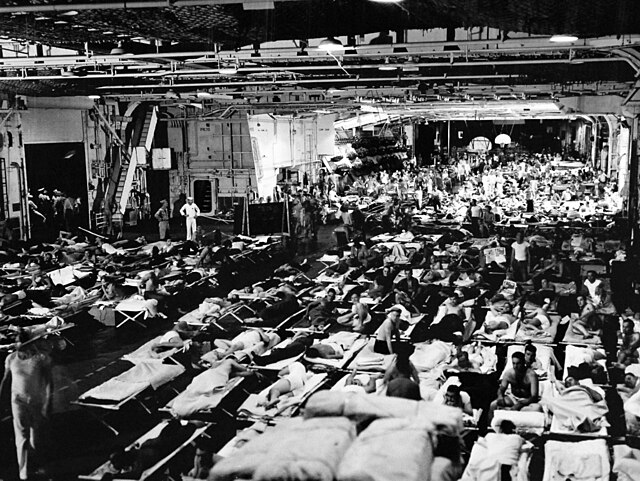
An Aircraft carriers hanger deck loaded with casualties from Okinawa, April 1945. War Department Photo.
The Navy operated over three hundred of these ship along with freighters of the Liberty and Victory types, over fifty oilers, and a myriad of specialty support ships. This allowed the Navy, Marines, and the US Army to operate efficiently more than 7,000 miles across the Pacific Ocean where there was little infrastructure to support operations. The logistics of the operations are literally mind boggling.
The APA’s were to serve a special purpose beginning in the waning weeks of July and August 1945. In the service any action needs have a name to identify it. Most, such as Okinawa which was dubbed “Iceberg” and the invasion of Guadalcanal “Operation Watchtower” general have no meaning other than to confuse the enemy but the name for the last major movement of men was oddly prescient. Operation “Magic Carpet” would return veterans of the Pacific home. By August the allies had just over 23 million troops and support service men in the western Pacific. The Aussies, New Zealanders, British, French, Dutch and the Mexican Air Force were all going home. Magic Carpet would be the largest mass transport of men and women ever attempted. Every ship type was going to be utilized for transport.
On July 25th Hilo Fuchiwaki and his team boarded an APA in Subic bay. The boys must have leaned over the ships rail and watched the sailors on the dock cast of their lines and felt the ship begin to vibrate as she backed into the stream and headed for home.
Dear Dona Page 15 is next.
Cover Photo: Holden Jeep ambulance. Missing one fender, other one dented. Shrapnel hole in hood, broken windshield. The exhaust pipe is extended to get it out of the mud. No paint and tow strap wrapped around the bumper. Hard used.
*Rikusentai, Imperial Japanese Naval Marine Infantry.
**The letter must have been written after the the capture of the Katchin peninsula by the 1st Marines. The battle for the island still had about ten weeks of combat left. He was, after a short rest to participate in some of the most brutal fighting ever seen in WWII. Private Loomis earned the Bronze Star for his actions on Okinawa.
***The book “Away All Boats” which was made into a movie of the same name based on the 1953 novel by Kenneth M. Dodson (1907–1999), who served on the USS Pierce (APA-50) in World War II and used his experiences there as a guide for his novel. It is considered a classic in naval literature.
Michael Shannon is a writer and lives in Arroyo Grande, California.
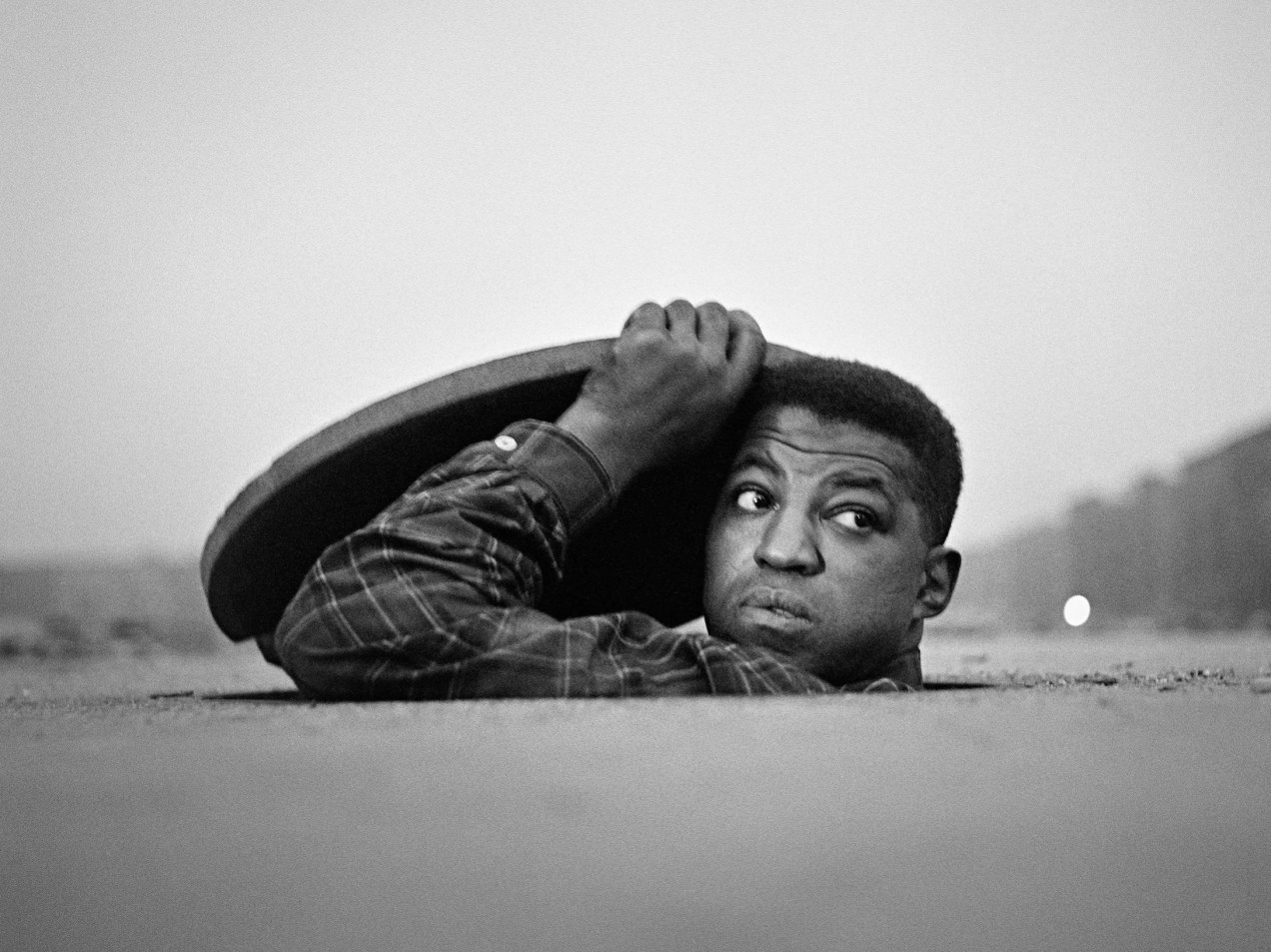
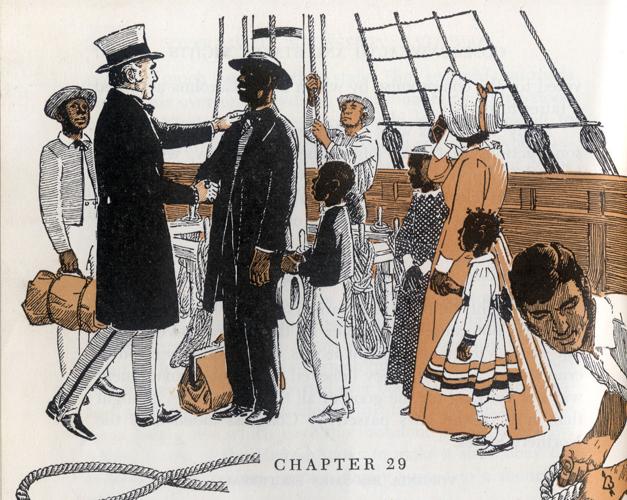
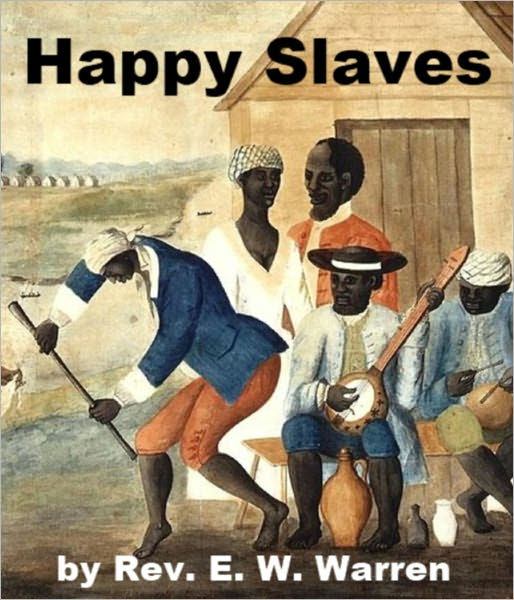
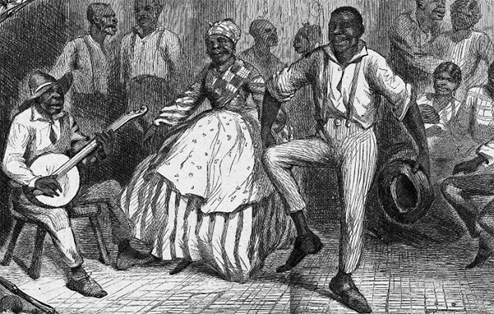
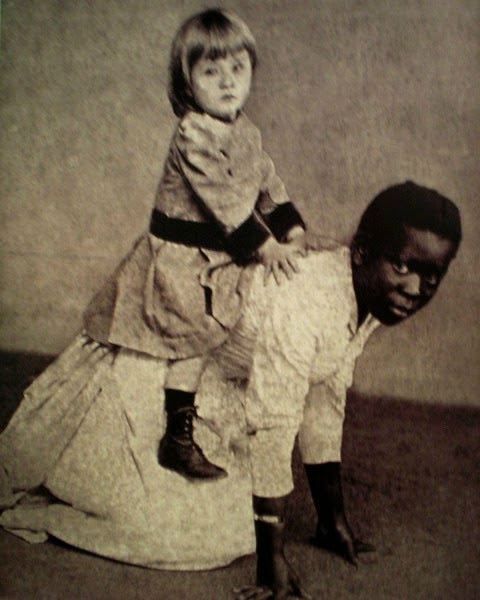
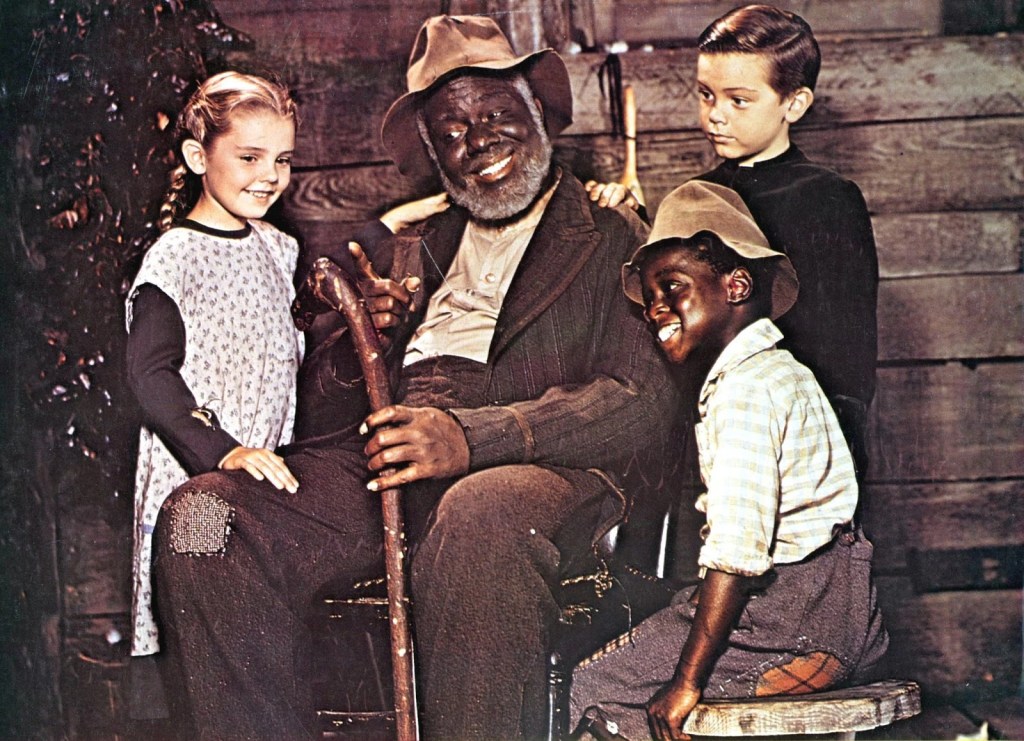
White House Smithsonian Committee study group has released the first photos of the new “Slavery Was Nice” exhibit. Replacing the old “Nasty Slavery was Harsh” display will be the colored people who are the most famous in history as identified by the president’s council. No one has ever seen an exhibit like this, it’s great and perfectly demonstrates the Presidents vision of America’s people and their exceptional history where no bad things ever really happened like the terrible libs say they did.
Welcome to America sir, I expect you and your family had a good trip from the Congo.
Livin’ de good life down the plantation.
Shuck n’ jive Saturday night.
Playin’ wit de white chilluns.
Uncle Remus tellin’ dem stories, Hydee hi, hydee hay.
Easter Sunday, April 1st, 1945, and where were you? I was resting in my mother’s arms in Sisters Hospital Santa Maria California. Staffed with sisters from the Poor Clares, a Irish enclosed order of the Holy Roman Catholic church. The sisters carried me to my mother from the nursery wrapped in a blue blanket and a small green ribbon tied in a bow in my sprig of blond hair, the only child born on that day. It’s been my luck.
Half a world away on the same date the tenth United States army made up of three Marine divisions and four army divisions started going ashore on the Japanese island of Okinawa. Supported by the Navy’s Fifth fleet made up of three separate task force units and the British, Australian Royal Canadians and New Zealanders. The combined forces numbered nearly 541,000 troops, 184,000 thousand of them combat infantry. The invasion was supported by a fleet consisting of 18 battleships, 27 cruisers, 177 destroyers/destroyer escorts, 39 aircraft carriers (11 fleet carriers, 6 light carriers and 22 escort carriers) and various support and troop transport ships.
One of the great euphonius names of WWII commanded at Okinawa. Lt. General Simon Boliver Buckner jr. Named for his father he commanded the entire 10th Army. A graduate of Virginia Military Institute and the US Military Academy at West Point he had served in WWI and The Philippine Insurrection which I’m sure the Filipinos considered a war. His father Buckner sr. served in the Mexican war, the Civil war, was a Confederate General and Governor of Kentucky. General Buckner had iron clad credentials. Considered a soldiers General he was on the front lines with the 2nd Marine Division when he was warned by marines to remove his helmet with it’s three gold stars because they could see them a half mile away. He did. Moments later a small artillery shell hit near him and he was wounded by coral shards and died less than an hour later while being operated on in an aid station located in a shell hole.. He was one of four US Generals killed in WWII.
General Buckner was just one of the 200,000 deaths, including both military personnel and civilians. It was an orgy of killing and the newspapers back home listed casualties of such high numbers that the public which had become inured to the death toll was shocked into a stunned numbness. Marine casualties exceeded the total number of a single fully manned division. It was as if one of the three Marine divisions, the 1st, 2nd and 6th has been completely wiped off the face of the earth. The army suffered equally with over 19,000 dead and wounded. The Navy lost thirteen destroyers sunk by Kamikazes. Nearly sunk, the Essex class carrier USS Franklin, CV-13, the “Big Ben” lost 1,294 with 807 killed in the greatest single ships loss since the USS Arizona. Lest any one should think that support personnel were relatively safe 35,000 cooks, seabees, truck drivers, labor detachments, hospital corpsman and doctors were killed and wounded. The dead included two war correspondents.*
When the “Butchers Bill” was presented to the population of the United States and its government they were aghast. What was it going to cost to invade the Japanese homeland? You could scarcely drive down a street in the countries small towns without seeing small banners with gold and blue stars hanging in windows.
The Battle of Okinawa was a victory for the US but resulted in massive casualties on both sides. Japanese forces fought with the same fanaticism the Americans had witnessed in battles such as Iwo Jima and Peleliu. Rather than be taken prisoner, defenders often chose suicide. Okinawa was so close to home, most Japanese soldiers refused to surrender and fought to the death. Their fanaticism contributed to a dreadful toll. Some 110,000 Japanese and conscripted Okinawan defenders were killed in action. The battle created a humanitarian disaster for civilians as well. It is believed that the number of civilians casualties was greater than all battle casualties combined. Combatants on both sides, after three years of war were completely numb, bereft of any kind of humanity. Robert Leckie and Eugene Sledge both wrote books about their experiences and told the same story. Marines and soldiers automatically shot Imperial Japanese soldiers who were wounded, they also shot the dead to be sure they stayed that way. They told of the absolute necessity in a cold, pragmatic way, emotionless. No combat rifleman wanted an enemy soldier playing dead to suddenly come back to life and jump into their foxhole at night.
Later in Vietnam, a marine sergeant told Lieutenant Phillip Caputo. “Sir, before you leave here you’re going to learn that one of the most brutal things in the world is your average nineteen-year-old American boy. Phillip Caputo was Marine officer who served as a platoon leader in Vietnam. He was right. It is a quote that describes soldiers as far back in antiquity as you choose to go. It could have been said by a Hoplite in Alexander the Greats Macedonian/Greek army two and a half thousand years ago.
For the last time the Nisei boys boarded assault ships and sailed for the islands of the Ryukyu Group of which Okinawa was the largest island, 66 miles long and seven miles wide on average it was to be the last major battle of the Pacific war though no one knew it yet. It was also going to be the deadliest.
MIS camp, Okinawa, 1945. Signal Corps photo
The Japanese Imperial Army wasn’t nearly on it’s last legs. The Military leaders in Tokyo had determined that they would not engage in offensive battle but rather set up defense in depth and attempt to bleed the Americans dry. They well knew that after three years of increasingly brutal fighting the American public was losing heart. Printed in the nations newspapers casualty lists were enormous. Though newsmen tried to put a positive spin on war news, the Battle of the Bulge had just ended and cost the American army 81,000 casualties. People were war weary. We were running out of children to sacrifice. The High School class of 1944 was just finishing training and was headed for the front.
Mom’s cousin Don Polhemus, lost on the USS Spence during typhoon Cobra, her brother headed for the western Pacific on a destroyer. My dad’s best friend Sgt. Harry Chapek, killed in France, and his cousin Bill Marriott had just left New Guinea and was headed for Okinawa . Jim Moore, son of the judge and my grandparent’s closest friends LST was bombed in the Pacific.The war was everywhere in our little county. There were military posts in literally every town and all along the coast. People don’t think about it much anymore but there were P-38’s at Santa Maria, flying cadets at Hancock field, Coast artillery units above Pismo Beach, a Rec. Center in Grover City where my mother volunteered. There was a Coast Guard bases in Morro Bay and Avila beach. Amphibious landing were practiced along the Atascadero Beach. Camp San Luis Obispo was the largest infantry training base in the country turning out ten thousand soldiers with every cycle. Camp Roberts in north county on the Hearst ranch and just to the south Camp Cooke where Patton’s tank Divisions had trained on the dunes above Lompoc before North Africa.. Mom said military convoys clogged the old highway and would go through Arroyo Grande, rumbling people awake at all hours. The list carried in the old Arroyo Grande Herald Recorder titled “Our Boys in the Service” was filled with nearly four hundred names in August of 1943. They were the last names of kids I would go to school with. The bus drivers, librarians and teachers in our schools, the postman, truck drivers, housewives, doctors and pharmacists, all listed. Those that would never come home marked with a small black star. There were more than a few. All from a town with a population of less than five thousand people.
The troops were weary too. The American leadership put no real censorship on the news and the people at home and their families wrote of neighbor boys who were dead, wounded and captured. Every day, every thought grounded in the agony of a war that seemed to have no end.
Hilo and his team must have worked frantically to translate all the information coming in from the Army and Marines. The temptation is to think that all this emphasis on information was at this point useless. We al know the end of the story. Thats the problem with history. Though we can study events for their meaning there is one thing we cannot do and that is see the future. Hilo and his team hadn’t the least inkling of where it would end. The man at the center of the hurricane has no idea where the way out is. Even the big brass in the Phillipines, Pearl Harbor and Washington DC had no crystal ball. The only thing they could do was to press ahead.
Planning for the invasion of the Japanese islands was well under way. The war in Europe would soon be over, there was no doubt of that. Germany was finished. The only question was how much longer would the insane self destruction continue. Even the Dogface trudging along German roads, still dying daily knew it was over. They all wanted to live, Japan was waiting. They knew that is was different fighting the Japanese than the Germans. No one wanted to go. But they did. The first Army Air Corps units had already arrived from England. The Generals had no doubt that when the time came they would go. Bill Matousek, some day to be my family doctor, as a fresh replacement tank driver who arrived on the line just days before the battle of the Bulge knew it. My sister in laws father had fought all the way from Sicily to Anzio to southern France, he knew it too. Del Holloway, Orville Shultz, John Loomis*** Arch and Leo Harloe, your father too, they all knew what the next step was going to be. It’s all they talked about. It seemed to them that it would last for years. “Golden Gate in ’48” they said.
They knew nothing of the Manhattan Project and the bomb. During the fight for Okinawa, FDR died .On April 12th the day of his death the first order of business for the new President, Harry Truman was to be told about the bomb. It would be up to him to decide.
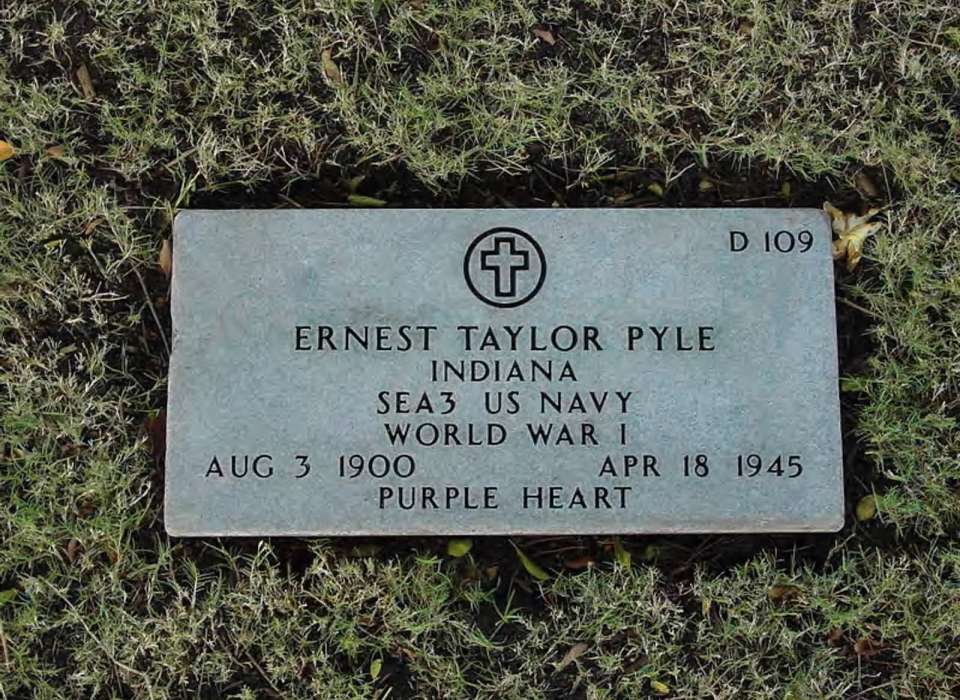
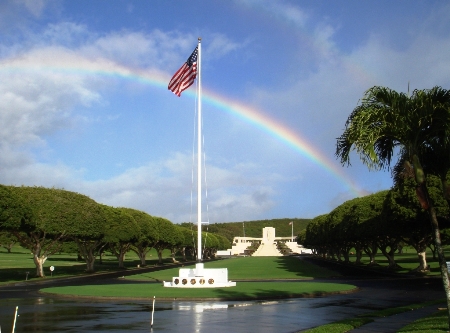
Ernest “Ernie” Pyle, the soldiers friend killed on Okinawa April 18, 1945 RIP National Cemetery of he Pacific, “Punchbowl” 2177 Puowaina Dr. Honolulu, Oahu, Hawai’i
They lie supine in their regimented rows where once they stood. They are the waste. The war dead. Those who know nothing pass them by on the road. Only as long as the markers, the holy grail of the left living, be visited by those who remember will they signify the personal cost. On memorial days and anniversaries families may gather at the stones to remember their children who all too often were in their teens or early twenties when they died. But during the rest of the year they are noticed only by the caretakers who mow between the stones.
The consequences, the blind, the amputees, the depressed, the suicidal, these insane, these jobless, these homeless, the side effects and delayed effects whose very existence keeps memories of the war alive when most citizens can’t wait to forget, or, remember in a circumscribed vision for the burial of the dead is a burial of memory. The National Cemeteries fulfill a desire to set it all aside. No one can say that they are not moving places but the arranged beauty does not evoke any memory of terrible battles.
Perfectly aligned marble does not resemble the memory of the men who lived them, but rather masks the heaps of the dead and wounded, They lay in piles, in fragments, limbs broken and contorted, Burned, muddy clothes shredded or ripped from bodies by the sheer velocity of the man made forces that took their lives. This, the veteran of combat knows and of which he will not speak. The impossible knowledge cannot be conveyed to the living, the wives and children and grandchildren. Thats the secret, the wilderness of slaughter and death, put away as if in a box to be gradually forgotten. It speaks to the resiliency of memory, the ability by some to bury the scars so deep they can never be found.**
Punchbowl
Next, Chapter 14. Home, it’s all changed.
*During the Battle of Okinawa in World War II, Ernie Pyle, a renowned American war correspondent, was killed by enemy fire. He was covering the battle for American newspapers and was known for his deeply humanizing accounts of soldiers’ experiences. Pyle won the Pulitzer Prize in 1944 for his newspaper accounts of the “dogface” infantry soldiers from a first-person perspective. He was killed by enemy fire on Ie jima (then known as Ie Shima) during the Battle of Okinawa. Another journalist, John Cashman, was killed in an aircraft crash on Okinawa on July 31, 1945,
**As far as I know I am the only living member of my family who recalls Corporal Edgar Green of the 2nd Australian Infantry whose grave is in the Baghdad North Gate military cemetery in Iraq. When I am gone so is Edgar, his incredible and brutal goes story with me. Markers are not for the dead but for the living.
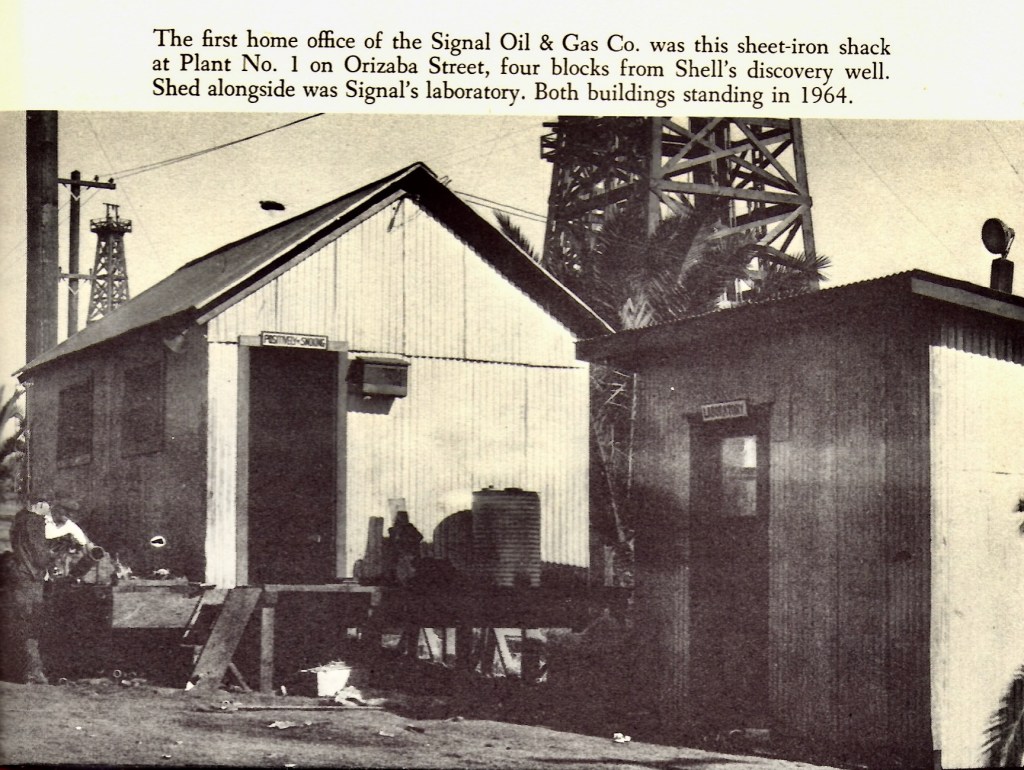
Grandpa called Grandma from the phone in the Signal office on Orizaba Street. He gave her good news. She especially liked the idea of going back to Santa Barbara. As was the custom with them she started getting all that the little family would be taking with them together. Clothes for the girls and Bob, toiletries and whatnots, just what could be packed in a suitcase. The kids carried their own. My mother was twelve and Mariel thirteen. Bob had just turned ten so whatever they could carry was what they took. Moms piano and a little furniture would have to be shipped later. Uncle Marion would drive them down by the same route they had gone up to Madera. Marion was counting on Bruce to put him on a crew so it seemed like a good bet.
Following the work was the name of the game then just as it is today. My mother said it was normal for kids who had never known any other way. They kids knew how to make new friends and were all sociable at that age. It would never change as they grew.
Grandma could shake and bake. Get ’em packed, sacked and on the road. Rent a house, bring the goods and move ’em in. Enroll in school, do it in jig time too.
733 East Islay St, Santa Barbara. The 1930, Home to the Hall’s, Zillow photo
She had the whole thing down to a science. Grandpa would come home from work or get a phone call telling him he had to be at another rig the next day or two and he would leave right away, Eileen and the kids would follow. The house shown above was their home after arriving from Madera in 1930.
Sam Mosher had a specific purpose in mind when he hired Bruce. Whipstocking. Although the Ellwood field was already operating he had bought some abandoned and unproved leases at the very edge of the Ellwood field.
Other companies geologists had determined there was no oil to be had. It was a big gamble for a small operator but the leases were cheap and his geologist thought that there were oil deposits if they went just a bit deeper. There was also a possibility that the so-called safe lease would be a total disaster. One thing about Sam Mosher, he was not risk averse.
Mosher who was born in Pasadena in in 1892, just three years younger than my grandfather. His father sent him to the University of California at Berkekly where he earned a BS in Agriculture. Right out of university he leased and began farming seventeen acres of Lemons and Avocados in Pico Rivera. In 1918 all of what is now western Los Angeles was farmland with a few small towns dotted about. It was a struggle and Sam worked sixty to seventy hours a week and then used his Ford tractor to plow and disc for other farmers near by. He always said afterward that he “Didn’t know a darn thing about oil wells or the business.
A single event changed all that. On June 23rd, 1921, a wildcat well on the lower slope of Signal Hill announced itself with a massive plume of crude oil. Coming in with a roar like the passing of a steam locomotive and the unbelievable shaking and rumbling of an earthquake, Alamitos no. 1 borned itself and set off the mad scramble for discovery on what became the richest field ever found.*
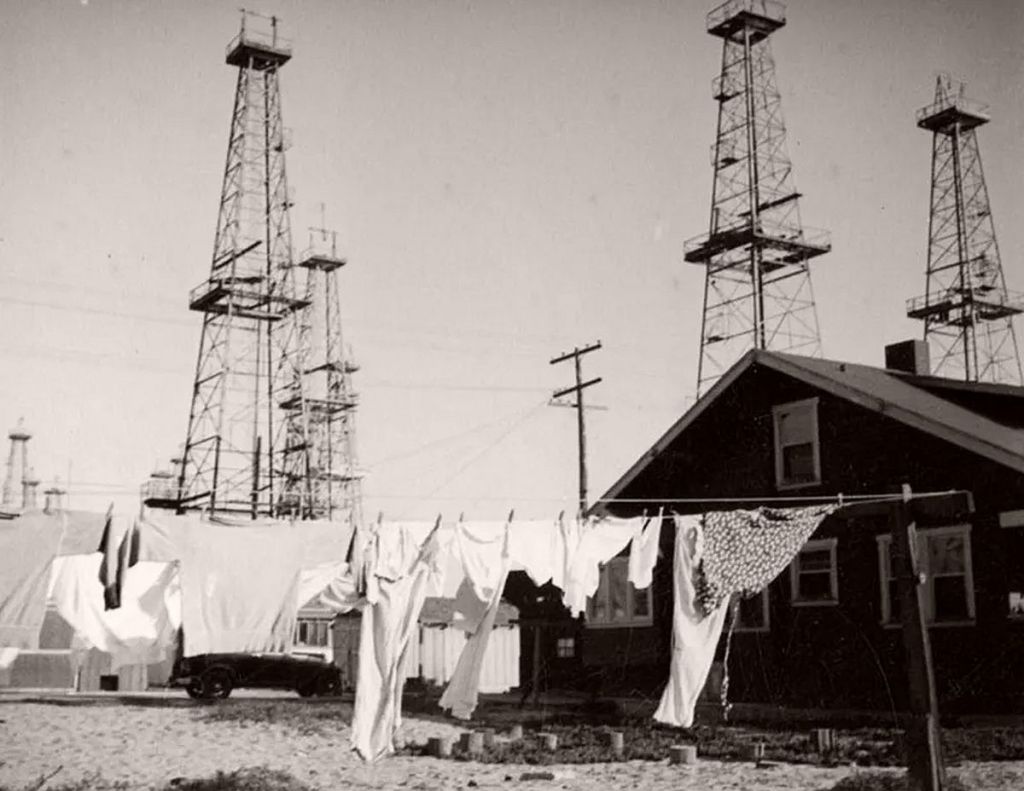
A drifting fog of micro dots of oil spread eastward on the back of the northwest ocean breeze, depositing crude on every surface. Clothesline’s, cars in the driveway and the houses themselves soon were coated with the sticky black residue of decomposed plant life from a tropical earth gone away millions of years ago.
Bumper to bumper lines of cars from Los Angeles came out to see the well. It was an event that would grow the city in ways none anticipated. The 25 miles to Signal Hill were dotted with small towns and orchards like Mosher’s in Pico Rivera. Looking up from his tractor’s seat, Sam Mosher couldn’t have helped thinking that the drudgery of farming could be traded for riches from the oil patch.
Alamitos number one set off a frenzy of drilling that within a few years saw wells in the Dominguez Hills, Torrance, Santa Fe Springs, Long Beach, Belmont shores, Seal Beach, The Bolsa Chica and Huntington Beach. Bruce would work them all.
The Halls were getting settled in Santa Barbara, kids enrolled in school and Bruce was back at work. Lucky for them too. Because of the depression unemployment was pushing 25%. There was no unemployment insurance or Federal minimum wage and hordes of desperate men and boys, women too, hopped the side door pullmans as they rattled back and forth across the country. Midwest farmers abandoned their farms because if you could find a bank to loan you “Crop Money” the crop itself would, more than likely not sell for enough to pay off the loan. More farms abandoned or foreclosed every week. Banks failed because there was no FDIC to guarantee money to keep them solvent. Factories cut wages to the bone, seeing it as the only way to turn a profit. In many cases it just didn’t work. More families took to the road than ever before in our history searching for work, just something to put food on the tables. The government of president Hoover blamed it on the workers. “They are Communists, Unionists, Fascists, they don’t want to work” he said. Sound familiar?
The Knight Riders, the Ku Klux Klan which had existed in the old Confederacy rose up from its deathbed and reappeared all across the county. Burning, looting and lynchings occurred for the first time in decades. Their target, Blacks, immigrants, Jews and unionists. The government did very little to stop it. The FBI focused it’s energies on these same people as Hoover acted as an enforcer for the wealthy entrenched establishment.
Business, finance, the law and government acted as if it was business as usual. unable or unwilling to do anything except support the status quo. Hoover, promising “A chicken in every pot” was one of the more callous election promises ever made in this country. He couldn’t produce the promise and wouldn’t seriously try. The callousness of the sitting government was focus on protecting those that had and not those that didn’t. It would cost him the Presidency in 1932.
The Oil Patch was no different, wages were sinking, drilling was slowing dramatically. With car sales plummeting no one needed the gasoline no matter how cheap. Every one in oil production understood this but at first they could not slow down. Pure greed, especially by the big companies like Standard, Sinclair, Richfield who could only survive by drilling held sway. When it got to the point where high production was unsustainable they cut costs to the point where the independents were forced to quit, putting thousands of roughnecks, toolies and supers on the road with laid the off factory workers, tractored out farmers and small business failures.
Everyone went from unbridled optimism, where no amount of oil seemed too much to the point where wells were simply pumping it into earthen pits waiting for a price hike and when they didn’t come, they walking away from their wells. In many cases no one bothered to even plug the casings leaving the well heads wide open.
An oil sump, Signal Hill, 1930. Long Beach Historical Society
The land owners who had leased their mineral rights to oil companies took it in the shorts too. Your little farm where you had some fruit trees an a few acres of vegetables were suddenly covered in waste oil, abandoned machinery, derricks and muddy roads everywhere. The trees were long dead, the house coated in oil mist and you never saw a dime from your share of production. You were abandoned too.
So, fortunate Bruce was. After twelve years traveling the state chasing crude you at least had a job with a small company which was hell bent on surviving by taking on the riskiest of projects on the chance that they might, could, or would pay off. Sam Mosher had given up the lease on his little seventeen acres of fruit trees in Pico Rivera so for him it was do or die.
With some Signal stock and promise of a piece of production for capital he didn’t have he bought a lease north of Elwood, near Goleta that had never been “Proved.” At what geologists thought was the end of the underground pool at Elwood, he bought from a local attorney in Santa Barbara who had leased some ranch land right at the foot of the tidal bluff just north of Tecolote canyon. The attorney had no luck and wasn’t able to find anyone who would even contract to drill there.
Though Geologists at the time had more than a century of practical experience in finding oil the devices used today where nonexistent in 1930. They looked for areas where surface indications showed the presence of undersea creatures. Fossils, like Trilobites on the surface especially on a hill or hills called Anticlines** sometimes indicated oil pools below. Ancient seabeds where plant life once flourished turned out to be where you could get rich drilling. The San Jaoquin Valley and the southern coastal regions of California had massive oil pools if you could find them.
We have a box of prehistoric sharks teeth that grandpa Bruce collected from the many leases he worked, mostly from the Elk Hills which runs along the valley’s westside. He would come home and thrill his children with tales of an ancient world where enormous sharks patrolled a sea which was now dry and dusty hills baking in the San Jaoquin valley’s brutal summer heat. My mother kept the teeth all of her life and the little box now resides in a drawer of the desk I’m writing this story on.
In the get rich quick culture of the oil business, landsmen would go out to areas where oil was discovered or about to be and for a fee or a promise of a percentage of production for a specified time the underground rights to said property were purchased. This meant that the oilman could drill on the property and if they found enough oil and it was worth producing, they would kick back to the actual owner of the land a specified percentage of sales. Leases on Signal Hill were sometimes negotiated by the square foot and even, in a few instances, by the square inch. How anyone could understand this complex and inherently crooked system is anyones guess. Of course that was a win for the oil men and their lawyers.
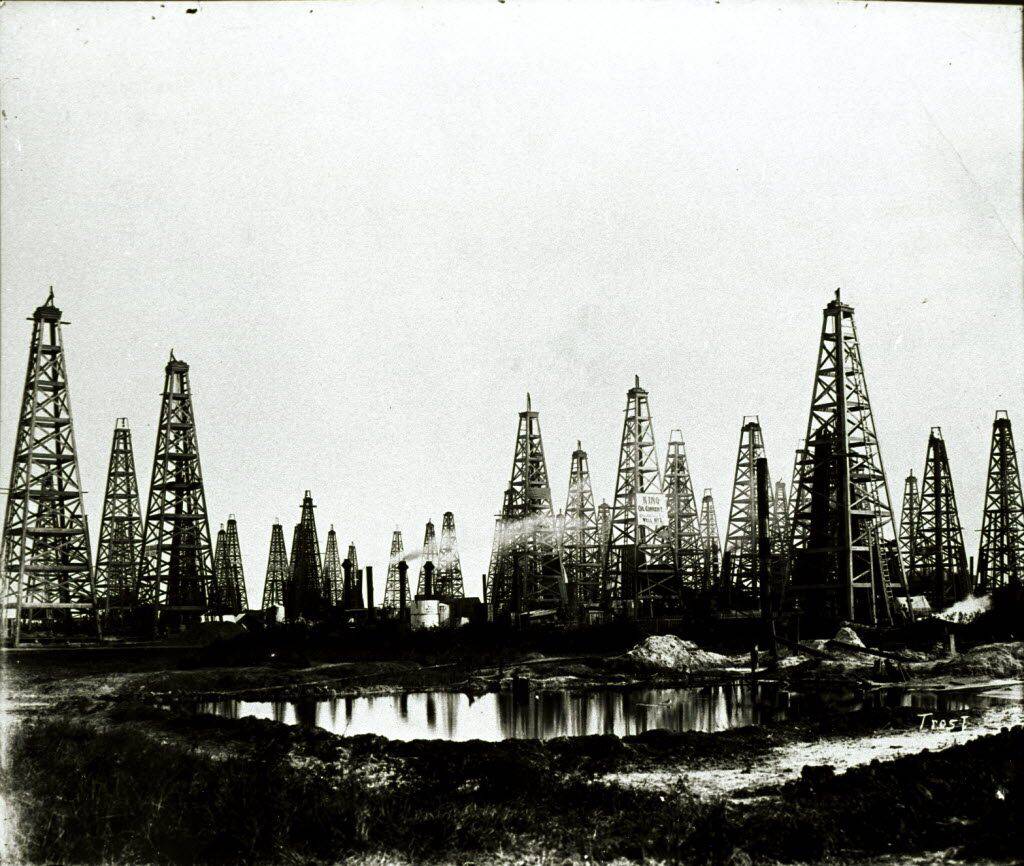
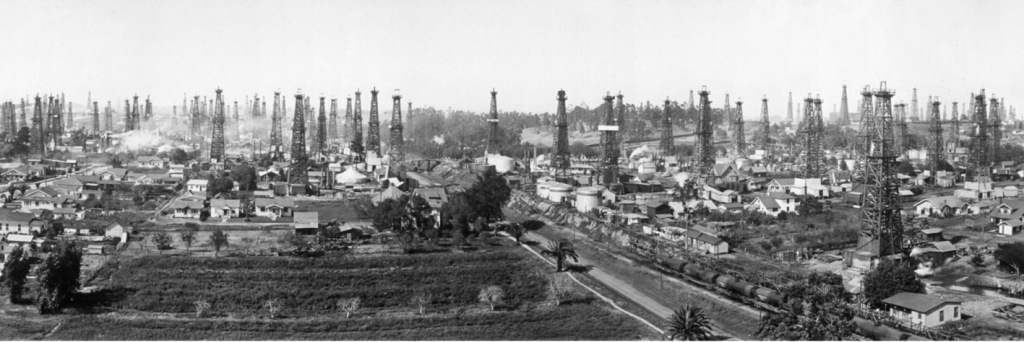
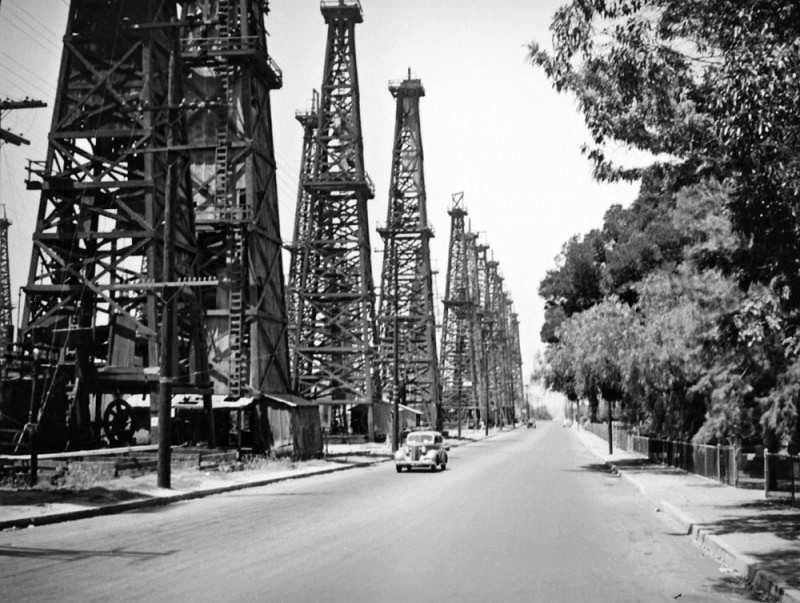
There were almost no rules. Oil companies with sharp lawyers and accountants ran roughshod over property owners all the time. Getting the right to drill without any up front money was the key for the Landsmen and many an owner ended up with his lot trashed, steeped in waste and marked with an abandoned wooden derrick as tall as 82′ feet looming over his house. An absolute frenzy occurred every time their was a big strike. On Signal hill and the west Los Angeles fields most of the leases were on standard house lots. Each lot might be a different wildcatter. Some derricks on the hill were so close together that their legs were intertwined. Drill stings became entangled hundreds of feet underground with one company drilling right through the pipe and casing of another. It was fertile ground for lawyers. Fertile ground for roughnecks too who went to war with their neighbors, fists, pipe, ball bats and six shooters were not uncommon and close to hand.
Signal Hill, east Willow street, California 1930. Calisphere.
Property owners were basically ignorant of the actual doings of companies. Fast talking lease buyers, shifty drillers and sharp lawyers could end up, through slight of hand, leaving the poor small farmer householder holding the bag. There was a property owner in Long Beach who told his friend at the barbershop that he was no fool, “That danged lease man offered me 10 points of the profits, but I ain’t nobody’s fool I’m holding out for a 20th.” He was getting more than one shave he just didn’t know it yet.
Mosher and his company signed the documents for the lease in Goleta but in so doing apparently no one read the docs very carefully. Under California the law at the time a leaseholder had 12 months to “prove” a lease by beginning drilling before time ran out. After signing the documents a sharp eyed engineer noted that all but 28 days of the year had gone by. Signal had just 28 days in which to prove the lease on a piece of property with no access, no road and at the foot of a steep bluff that ran down to the hight tide mark. To make matters worse they would have to seek permission to cross the tracks of the Southern Pacific RR tracks which meant red tape that could take a year or more. The Southern Pacific was once known as the Octopus and for good reason. There was no doubt on Orizaba street that they would do just that, squeeze as much out of Signal as they could.
It would seem to be a lost cause. Mosher sent his Varsity Team a he called it, the first gathering of the young experts he had hired at Signal to scout out ways to to spud in a well before the 28 days ran out. There was no road down to the beach just a brush choked gully. Maybe an access road could be bulldozed down it to get equipment in but there was no way to cross the RR tracks legally. No dozer, no road, no road, no steam shovel to cut down to the beach, checkmate. The property owner keeps the payment and Sam Mosher takes it in the shorts as the old saying goes.
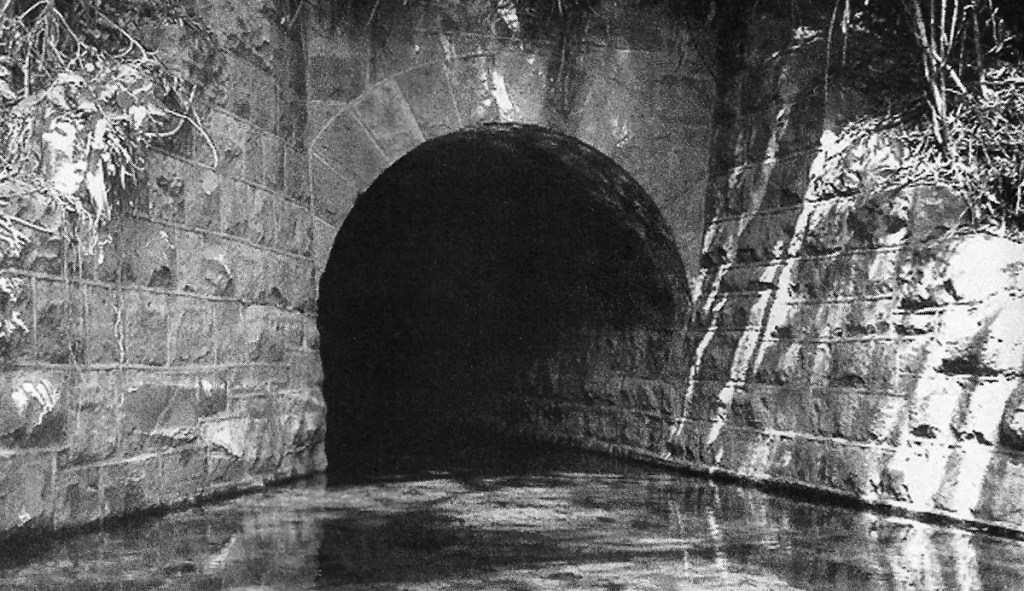
After a couple days of nosing around one of the engineers walking the track had to cross a gully alongside the tracks and found back in the brush, a stone culvert the SP had built in order to throw the track across the ravine which was active in the winter and couldn’t be blocked. He looked over, scrambled down the slope to the creek bottom, took out his measuring tape did a few calculations and then high tailed it back to Goleta and called Orizaba street and talked to Garth Young, Mosher’s young, chief engineer.
“Garth, I found a way in where we don’t have to get permission from the railroad. I figure our shovel will just fit with about five inches to spare, we can just drive her in.”
Sam Mosher and Garth Young. 1930. Signal Oil Company photos.
Young replied, “Well we can’t do that it’s still railroad property and we have to have permission.”
“Hell with the railroad Garth, let’s just do it and deal with them later. What are they going to do after its done, sue us?”
“Probably, but what the hell lets just go ahead. Our times running out and we need the well or it’s all lost anyway.”
“OK boss, we’ll roll the shovel up tonight and we’ll be down to the bluff before sunlight. Those railroad stiffs will never know.” Getting permission from the railroad to pass through this culvert would have also held them up, so Garth Young decided to do it without telling his boss, relieving Mosher of any personal responsibility.
Mosher had already gotten permission to pass through the Eagle Canyon Ranch from the owner, Louis Dreyfus, while his Engineer, Garth Young’s boys had discovered a passageway to the shore.
The Culvert on Eagle Canyon. Goleta Historical photo.
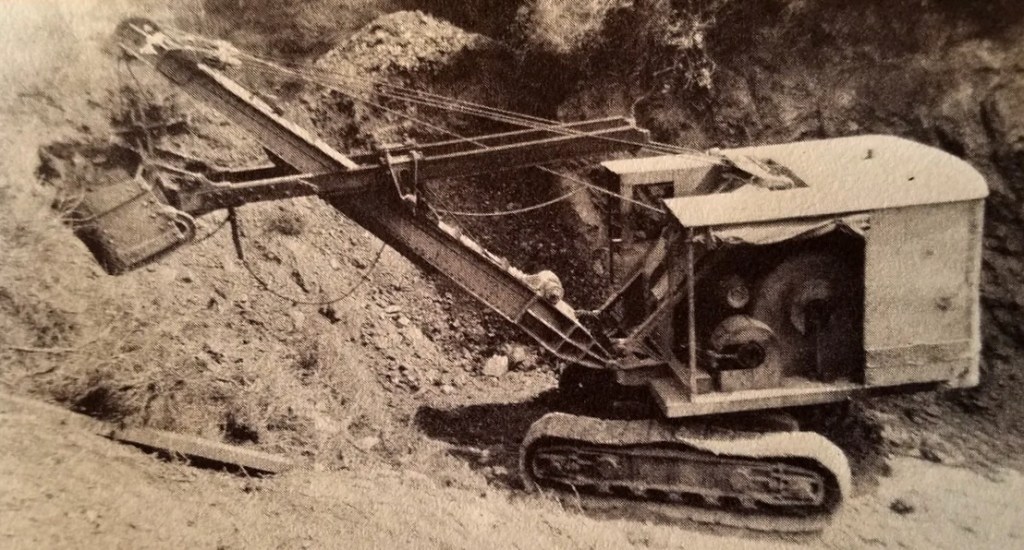
The heavy-duty self propelled power shovel made its way through the dry Eagle Canyon creek bed. As it approached the culvert, the operator lowered the boom to horizontal, the huge clamshell shovel blades mere inches off the ground. The prehistoric looking iron beast slowly crept through the dark stone tunnel, foot by foot, as Garth Young watched in suspense. Without a hitch, the giant piece of machinery clanking and squealing crawled carefully through the dark tunnel and emerged into the dark of midnight. Walking alongside with flashlights they maneuvered the iron monster down the dry creek bed and onto a shelf above the driftwood littered beach.
Taking the first bite of the bluff. 1929. Goleta Historical Society.
Time to go to work. Times running out. Young explained to the operator that he would have to wait for the tide to go out, then clear a way down the beach to the foot of the cliff below Hydrocarbon Gulch. He would quickly dig a foothold at the base of the cliff before the tide comes back up. If he didn’t his shovel would sink into the wet sand and the job would be over. The driver laughed at the crazy plan and said it would likely take him 10 days. He would drive back to the culvert every high tide and return on the next low. But Garth Young told him they didn’t have 10 days, it needed to be done, and done today. And if he didn’t succeed, they had insurance for the power shovel anyway. No problem there except they, had no insurance which was a bit of a necessary fabrication as Garth saw it. If they lost the shovel it was a moot point anyway….
*The Long Beach Oil Field is a large oil field underneath the cities of Long Beach and Signal Hill, California, in the United States. Discovered in 1921, the field was enormously productive in the 1920s, with hundreds of oil derricks covering Signal Hill and adjacent parts of Long Beach; largely due to the huge output of this field. The Los Angeles Basin produced one-fifth of the nation’s oil supply during the early 1920s. In 1923 alone the field produced over 68 million barrels of oil, and in barrels produced by surface area, the field was the world’s richest. During the early stages of the field’s development, unlike most oil fields, land was leased by the square inch instead of by the acre. The field is eighth-largest by cumulative production in California, and although now largely depleted, still officially retains around 5 million barrels of recoverable oil and has produced 963 million out of 3,600 million barrels of original oil in place. 294 wells remained in operation as of the beginning of 2008, and in 2008 the field reported production of over 1.5 million barrels of oil. The field is currently run entirely by small independent oil companies, with the largest operator in 2009 being Signal Hill Petroleum, Inc. Sam Mosher’s old company.
**An anticline is simply the opposite of a decline, meaning a geographic feature characterized by a geological fold in rock strata where the layers bend upwards, forming a convex shape, resembling an arch or an inverted “U”. It’s the opposite of a syncline, which is a downward fold. Anticlines often form due to compressional forces that cause rocks to bend and buckle rather than break. In oil fields the fold is created by the upward and immense pressure from the gas created by the decomposition of vegetation underground. It’s important to know that not every hill overlies and oil field hence the often used word “Lucky” applied to wildcatters.
Michael Shannon is a grandson of Bruce and Eileen Hall. The life of oilmen was a serious topic when he was growing up and listening to his mother’s stories about growing up in the oil patch. He writes so his children will know where they came from and who they are.
A Notice to the Reader.
For those of you who read this Blog on the Facebook platform I’d like to explain some changes that are affecting your ability to read and see them. Many FB sites have gone to AI to do the work of administering who gets seen and who doesn’t. This means that there is no actual human being deciding who gets published and who doesn’t. Programmers have designed algorithms to filter submissions to all kinds of platforms. What this means to me is that about a month ago quite suddenly a dozen or so FB sites that I published on suddenly began refusing my content, all of it.
I have been unable to find out why or actually speak to a real human person as to the cause. What this means to me is that though I reach over 50 countries through the WordPress platform I’m reaching only those that are on my friends list on Facebook. Readership has plunged from hundreds per post to around a dozen on a good day.
I believe that soon AI will rule FB entirely and the “Social” will no longer be attached to the Media.
I encourage you to go to https://atthetable2015.com/ and click the follow button. When an article is published you will receive a notice in your email which you can click to open and read.
For those who are curious, there is no profit for me in this. It’s free to you and I receive nothing other than your goodwill.
We had a small red shed on the ranch. It was the greatest place explore when I was a kid. It had cobwebs that had been spun a century earlier. There wer enough Black Widows to populate half San Luis County. My uncle Jackie said once that some of the spiders knew Captain Guillermo Dana who owned the old Nipomo Rancho. He was always saying stuff like that and you could never tell if it was true or just funny a uncle’s bushwa.
It had two doors, one at each end. They were Dutch doors which was a true novelty as I had never seen or heard of one before. The only Dutch I knew was the woman on the Old Dutch Cleaner can who looked vaguely sinister with her purposeful stride and big stick, obviously out to punish the unclean. I can’t recall ever seeing the top half closed except during swallow season. In true country style no one wasted any time doing useless things so each door was closed and opened perhaps once a year.
The small building served four purposes. The left side was divided into small stalls which were occasionally used to house calves that needed hand feeding or just a little extra care for a bit. For kids having a small red and white Hereford calf that you cold bottle feed, well there’s not many things that can top that. The little heifer being quite naturally friendly who would cuddle up to you or suck milk from your fingers is hard to beat. Usually one stall would be full of feed sacks, special meal, seed and always a few blocks of salt lick. Red, white and pink depending on their us. Did we lick them, you know the answer. Seeing that saving was considered a virtue, there was one stall with heaps of used and empty gunny sacks just in case. There were cotton feed sacks too, piled in a corner some, no doubt as old as the feed and grain business my grandfather, Al Spooner and David Donovan once owned.*
The sacks were home to the Kitties. Kitties is really the wrong thing to say. They were fierce predators an not interested in little boys. Their job was to keep the shed clear of mice. There are few things more attractive to a mouse than a shed packed with grain to eat. They were shy cats and not always visible, hunting was their job and during hunting hours were occupied wherever they could find a victim. No names for them, for decades the cats went by Cat, all of them. They never ate from a can or bag of cat food. They had to pull their own weight. Domesticated animals like dogs and cats were mostly for utility and not human companionship.
The little place was fragrant beyond belief and it changed it’s perfume like an elegant woman dressing for a dinner. The rich heady smell of grain, the pungent manure from the little calves and in the cold of winter it exuded a musty smell of old redwood lumber and always the rich, sweet sweet smell of Hay. Depending on the time of year wisps of dust motes drifted in the light from the doorway’s like a veil on a beautiful Spanish maiden painted by Velasquez.
The best thing though was the little corner where the tools were kept. All those drawers filled with haphazard piles of metal we assumed to be tools of one sort or another. Most carried a patina of rust, some just dusted with and some stuck together by lumps of it, glued together for no one knew how long. Wrenches of indeterminant use perhaps from some long gone piece of farm machinery, like tractors and old milk trucks, some predating the electrical motors used in the milking barn. Ball peen hammers, an old fashioned straight clawed hammer at least a century old and in the bins rusted clumps of fence staples, nails, some porcelain insulators left over from putting in the electric fence and bolts with square heads that hadn’t seen a use for 75 years.
Unique to me, a child born after the big war, many of the tools were curvilinear, embossed with the names of the manufacturer, some with molded decoration that wasn’t just for utility but for beauty. Designed by the last generation that saw pride in the craftsmanship involved in the pure design of a useful object.
The 1950’s spelled the end of the “fix it” age. Men who were our fathers had grown up in the Great Depression and as adults went to war, the most destructive war in history. Historians have said that the US defeated the Germans, not with superior tactics but with the fact that American boys could fix a tank and the Germans couldn’t. Baked into them was a certain self sufficient attitude that they could take care of themselves. They didn’t need help and like my father would rather die than ask for it. If something broke they fixed it. If something was needed they made it. They didn’t go to trade school they learned from others or simply invented what they needed. They didn’t need much, things could be repurposed. Nothing was thrown away, we had a gully with trucks, cars, tractors and farm machinery rusting in the sun where a part might be salvaged and put to a better use. If my uncle Jackie needed a stock trailer, he hauled a rear axle from the ditch, got out his tanks and welded up a frame. He dragged some used lumber from the scrap pile of odds and ends some of it dating back to some time before my great-grandfather’s day, got a handful of nails from the rusty nail bin and when he was done mixed a few shades of green paint together, brushed it on and he had a perfectly useful trailer. Rolling down the 101 on the wheels from an old Buick and a taillight taken from a Model T, With mismatched hub caps one reading Buick and one Chevrolet, It served him well for fifty years. It’s not used anymore, it sits in the old hay barn, it’s tires flat and the green paint faded but if you needed it a little air in the tires and it would be good to go.
It was all wonderfully “Make Do.”
One of the first “Essential” stores in our little town was the first hardware store. If you are a regular at one of the modern hardware stores today you might be surprised by what those old places stocked. Those old places officially died in Arroyo Grande on February 21st, 1958. The Chief wasn’t quite sure what happened but the old building built in the 1889 was a total loss. A nearly 75 year old building where the amount of Case oil. Kerosene, Lamp oil and desiccated cardboard boxes holding assorted glass fuses or leather drive belts, frayed at the edges and emitting a small cloud of dust whenever touched was simply waiting to immolate itself.
For those of us old enough to remember the dark, dusty stacks of shelve and boxes, greasy, oily wooden floors fronted by the long counter at the front, the varnish long turned to caked, flaked shreds of black chips resembling the dried mudflats of the lower valley where the adobe mud is completely tessellated in the dry late summer. The green enameled light shades hanging from the ceiling had a thick coat oily dust as they hung on the twisted copper “Rag Wire” so treasured by the rats who lived in the attics of old buildings. The tasty oil impregnated linen which passed for insulation just begged a rat to nibble on it exposing the wires which would short circuit and catch fire at a moments notice.
The fire, however she started left nothing but a heap of ashes, charcoal and twisted metal, It also ended the era of a type of store that doesn’t exist anymore except in small, isolated communities across the country.
Don Madsen was the last owner of the business which was started By Charles Kinney in ’85, thats 1885 by the way until it was passed on the Carmi Mosher in 1909. Carmi sold it to Harold Howard in 1919. Harold, a local boy having grown up with my grandfather kept the business going as Howard & McCabe until 1950 when he retired and sold it to Don whose son I went to school with. Small towns you know.
Don had worked in the hardware business since he was a high school student had returned from WWII where he served as an MP on occupation duty in Germany. He went right back to what he knew.
Occasionally my dad or uncle would need something in the way of bolts and nuts or hand tools that they couldn’t find in the tool maze of the calf shed and would be forced to actually buy something. Stores were the place for what you didn’t have. Take the broken piece to Don and lay it on the counter. He would pick it up, heft it to determine its weight then give it a serious look and say, “Yeah, we might have something like that. Let me go see.” He would disappear into the stacks of goods between the ceiling height wooden shelves and bins and begin his voyage of discovery. Assorted bangs and bumps would come from the back and finally he would return and lay a new one or close proximity on the counter. He didn’t have to say Eureka but there would be some head nodding and low noises as both customer and seller acknowledged that it was in fact “Just what I need.”
Dad would pull out his billfold, a term I have’t heard in decades and say, “How Much?”
“Six bits will do it George.”
Dad would put the billfold back in his right hand jeans pocket and then fish around in the one in front until had a small handfull of stuff, an old slotted screw with the slot turned out useless, but you never know, maybe hang on to it awhile just in case. In amongst the seeds, a piece of wrinkled Juicy Fruit gum and foxtails were some nickels, dimes and a few quarters, just enough.
Dad would ask about Clara and the boys and Don would return the favor.
Whatever that piece of hardware, it would someday, when it’s immediate usefulness was done, end up in the calf shed where it likely still resides.
After all that old hardware store was not a too distant kin to the calf sheds.
When she burned in ’58 it marked, in a real way the end of frugality nurtured by “Make Do” and the way we live now where everything has a date on which it will magically die.
Epilogue.
The though that planted the seed for this story was a trip to the local hardware store the other day. Big, bright and shiny, all the trim painted fire engine red and the first thing you see when the automatic doors open is a large open space with military straight rows of Barbecues. Stainless steel, black enamel, wood burning, pellet burning or gas or electric. Line up like they just graduated from boot camp they are surrounded by all the accouterments designed to make you a perfect cook. Tens of thousands of dollars worth.
There is a paint department where you can buy hundreds of different colors. Anything to suit your fancy. They have more cleaning supplies, mops, and brooms than you can conceive or could find at the grocery store. Every one is persistently helpful but no one knows much of anything about anything. But they wear a red vest to show that they might. Very official.
Unlike Don, they will look at your problem, scoff, and advise you to buy a new one, or a box of fifty when you need just the one. And believe me, the inferior new one that will never deserve a place in the calf shed.
Dad Shannon at the BBQ pit. Family Photo
For a kid that grew up with BBQ cooked over a pit which was just a handy hole behind the house and a grill made of heavy rods left over from some job they did and whose grandparents painted their dairy barn and silo pink because there wasn’t enough of either color available during WWII so they just mixed them up and it was good enough and a great lesson too.
“Make Do.” That was it.
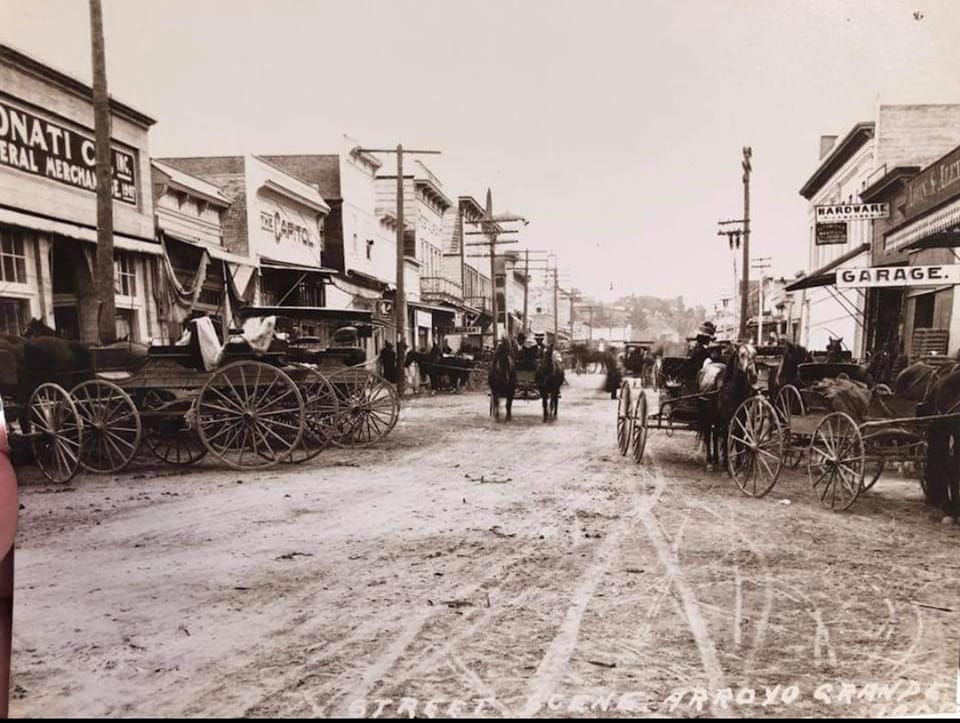
Cover Photo: The old hardware store on the right in 1906.
Note: The Madsen’s moved their store across the street to the old Donati building and prospered for many years but it was never the same.
Michael Shannon has been known to keep random pieces of lumber for fifty years, you know, just in case.
Bruce listened intently. With his left hand braced against the wall, head down and the receiver jammed aginst his right ear. He softly repeated, “Yes sir” several times. After a few minutes he said “Thank you Sam, I’ll be there as soon as I can.”
He hung up the phone, turned, took off his hat and held it as he put his hands on his hips and arched his back as he exhaled.
He looked at Eileen then Marion and said “That was Sam Mosher, I’m going back to work. I have to be in Long Beach as soon as I can. I’ll leave tonight I gotta go gas up the Ford. Eileen can you pack me a bag and something to eat?”
Bruce rattled down the Cahuenga pass into Los Angeles. He’d been on the road for a day and a half, slept in the back of the Ford last night and woke this morning sliding into the drivers set, setting the Magneto and advancing the spark, he kicked the starter button and turned her over. He figured with a quick stop for breakfast he’d roll down Alameda Street and into Long Beach just after sunup.
Rolling through Huntington Park then South Gate he drove into the fields and scattered houses of Compton and he could smell it. Drifting east on the morning breeze, the unmistakeable heady mixture of crude oil perfume. A strong, pungent, and a little bit sweet, the odor can be reminiscent of a mix of gasoline and tar, with a distinct earthy or petroleum scent. Some people find the smell unpleasant, but to an oilman It smelled like home.
Exhausted by the drive the odor washed over Bruce and caused his energy to start flowing. With his hopes soaring he drove down Alameda until he entered Long Beach. The City of Long Beach had a population pushing 150,000 and had doubled since the census of 1920. Once it was primarily a Beach resort for the retired and wealthy but the discovery of Alameda no.1 up on Signal Hill had changed the city drastically. Midwesterners flocked to the Hill to get rich. Leasemen, Drillers, Salesman, factories that built steam boilers and rolled pipe quickly surrounded Long Beach. Houses went up as fast as they could be built. The Navy was moving part of the fleet to the new Navy Yard on Terminal Island. During the booming twenties Long Beach became the home of sailors, oil field workers, workers in auto assembly plants, soap makers, a vast fishing fleet made up of Japanese immigrants and people coming to the edge of America looking for the main chance.
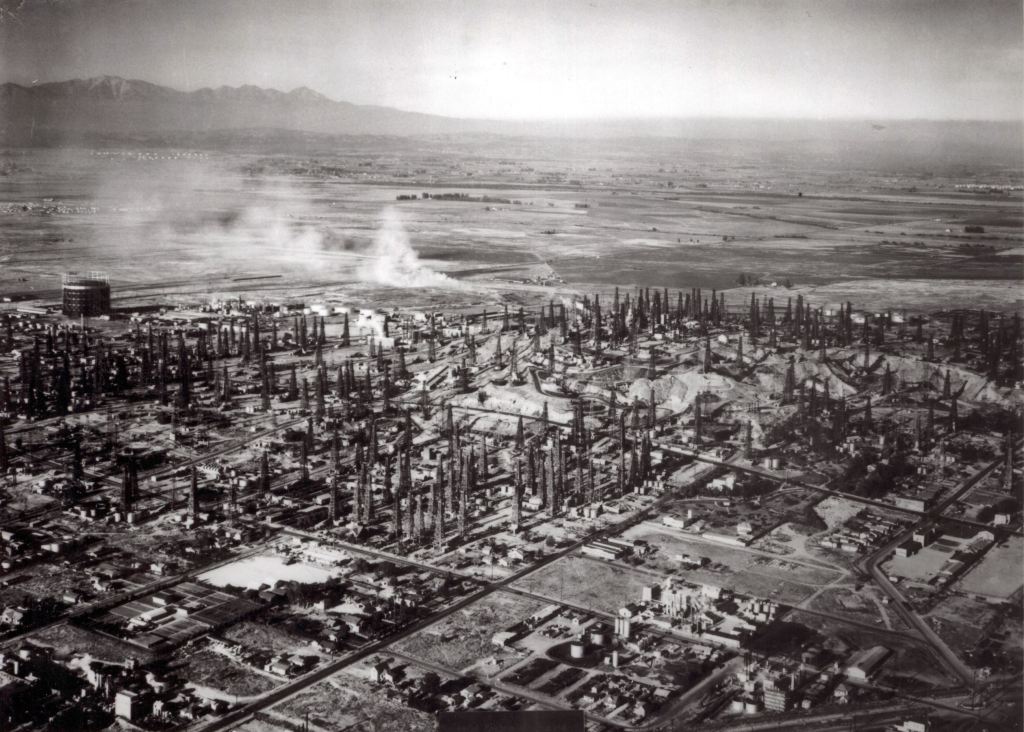
Signal Hill with The San Gabriel Mountains to the north. 1931 Calisphere photo.
Long Beach city was part of the Mexican land grant Ranchos Los Cerritos, the Little Hills and Rancho Los Alamitos. the Little Cottonwoods. It had been for two centuries dedicated to cattle raising. The small villages of the area were distinctly rural and grew slowly over time. Wildcat drillers began poking around in the 1890’s and when Edward Doheny brought in the first well in 1the Los Angeles field* in 1892 it was “Katie, bar the door.” The Los Angeles Oil Field made Edward Doheny one of the richest men on earth. “Richer than Rockefeller” as the song “Sunny Side of the Street” says from the old Fats Waller tune and it was true. Richer than Rockefeller.
Beginning in the late 15th century, Spanish explorers arrived in the New World and worked their way to the California coast by 1542. The colonization process included “civilizing” the native populations in California by establishing various missions. Soon afterward, a tiny pueblo called El Pueblo de Nuestra Señora la Reina de los Ángeles de Porciúncula would be founded and prosper with the aid of subjects from New Spain and Native American slave labor.
One Mestizo Spanish soldier, José Manuel Nieto, was granted a large plot of land by the Spanish King Carlos III, which he named Rancho Los Nietos. (The Grandchildren) It covered 300,000 acres of what are today the cities of Cerritos, Long Beach, Lakewood, Downey, Norwalk, Santa Fe Springs, part of Whittier, Huntington Beach, Buena Park and Garden Grove. It was the largest Spanish or Mexican land grant issued being nearly ten times the size if Catalina Island.
Soon prospectors started putting down hole everywhere. They found Oil in Santa Fe Springs and in a couple of decades were pumping in Beverly Hills, Torrance, Southgate Dominguez Hills and Seal Beach.
But Alamitos #1 was the biggie. She came in with a roar heard in downtown 24 miles away. Drilled on the at the northeast corner of Temple Avenue and Hill Street in Signal Hill. Spudded in on March 23, 1921, it flowed 590 barrels of oil a day when it was completed June 25, 1921, at a depth of 3,114 feet. The discovery well led to the development of one of the most productive oil fields in the world and helped to establish California as a major oil producing state.
Alamitos no. 1. Discovery Well, June 25th 1921. Signal Hill, Long Beach
Ten years later Bruce made the turn from Alameda onto Willow, passing the Sunnyyside* Cemetery and headed east towards the Signal Oil and Gas headquarters building. Building isn’t exactly the right word though. Years later Signal would move into a modern building on Beach Boulevard and later still build its’ own headquarters building on Wilshire and 7th in downtown Los Angeles. This headquarters was was no more than a tin shack in the middle of the field itself. It may be a slight exaggeration to call it that but Signal was just eight years old and had begun life as a refiner of natural gas and owned no wells of its own in the beginning.
In the run up to the great depression Sam Mosher’s nascent company was struggling mightily to raise money to stay in business. Consequently they were using bond sales, private money, partnering with large oil companies like Standard Oil of California and banks trying to stay afloat. Independent companies were failing on nearly a daily basis as the price of oil tumbled. The big companies were cancelling contracts to the independents in order to protect their own. Breaking bonafide contracts was illegal but they had the money and lawyers so the attitude was independents be damned. Crocker Bank pulled its loans and a loan agreement with Giannini’s Bank of America kept them afloat.
The company under Mosher’s leadership invested in oil leases in Texas, the Westside of the San Joaquin, Summerland and a few abandoned leases in Elwood near Goleta. The idea was to diversify their holdings into drilling in order to provide product for their little refinery.
As the Ford toiled up Signal Hill the couldn’t help but wonder what the job would be. It didn’t matter that much, whatever it was he needed it.
Bruce and the Ford were both tired, it had been and long lonely drive He wanted to show Mosher that he had extraordinary drive hence the immediate drive down to Long Beach. It was very important to demonstrate that he was always ready to go. He had met the man a few times but had mainly dealt with his drillers and superintendents when he was working the Goleta and Summerland fields.
He pulled into the yard which was filled with trucks, automobiles parked any whichaway. Climbing down from the car he stretched than walked quickly toward the headquarters building. He could see, hear and see welders pipefitters, draymen, ditch diggers, bricklayers concrete masons, electricians, carpenters and plumbers at work everywhere. They were coming and going, these skilled laborers moving between rigs, some working for just one company but most were day laborers or were moonlighting, paid cash money they represented the itinerant workers seen all over any oil fields. Bruce stepped over some drill pipe and paused turning to take in the hustle and bustle and chatter of the men around. The sound of boiler valves popping off extra pressure, steam whistles, the chug chug of diesel engines pulling the linked chains that spun the drill string, sucker rods in an endless rise and fall lifting the crude from near a mile underground. When the wind blew the massive wooden derricks bent to it, creaking and groaning with a dismal sound. An ordinary man would be cautious and afraid his ears ringing, eyes stung by the constant blend of exhausts, the sewer gas coming from the drill pipes with its semi-putrid odor all of it wafting about lighting on and tainting every surface. Grandpa once said you didn’t need any hair oil in the patch, it was provided for free. Always buy a black car and never wear a white shirt.
Headed for the steps he hopped over every kind of detritus, crushed cans, butts, random paper blowing about, there were gobs of crude oil everywhere and the wooden surfaces of the buildings and derricks were soaked with it. It was no place for a fastidious man. A very careful man but not one overly finicky.
Bruce climbed the steps stepped to the door and knocked on the door trim, there was no door, someone found a better use for it he guessed.
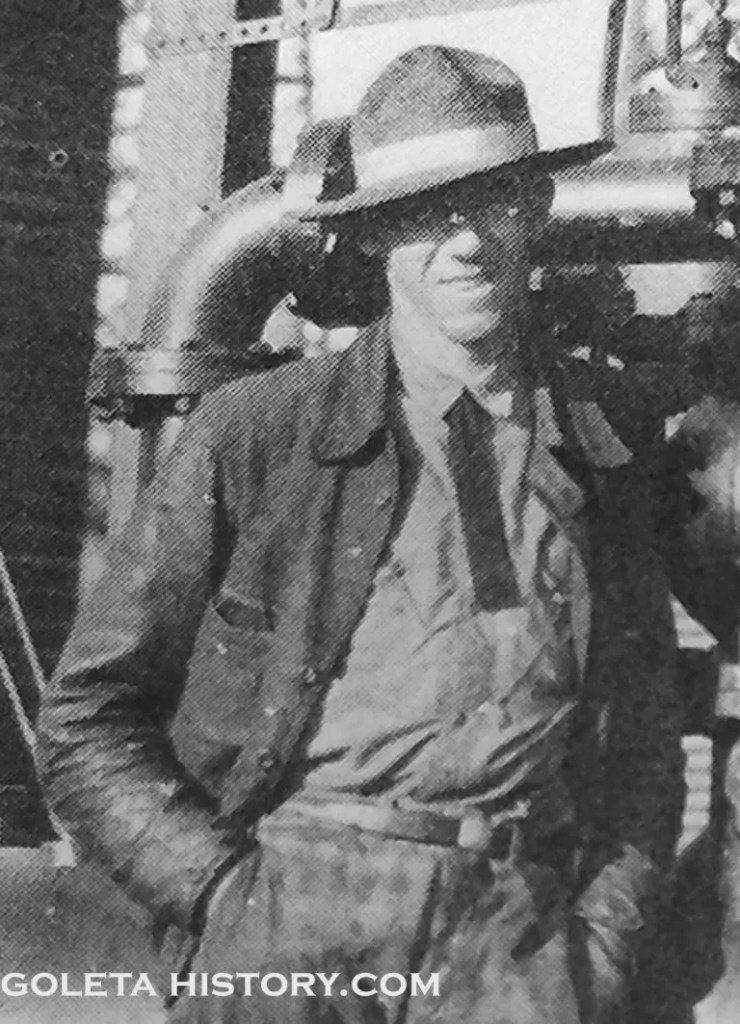
Inside at an old desk scarred by hard use, its edges burned by cigarette butts left too long, sat a man. Dressed in stained Khakis and hard used work boots. He wore a green long sleeved work shirt, cuffs buttoned against the dirt and grime, no man exposed any more of his body than was necessary on the job. Pants held up by braces, no man working in 1931 wore belts, too restrictive. He rose from behind the desk sliding back the bent wood chair that served as a seat with a rasping screech, he reached up with his right hand and pushed back his typically stained and dirty Fedora. The smile above his jowls flashed as he held out his hand and said “Hello Bruce, damned good to see you.” Grandpa smiled back and took the hand, “Good to see you too Bob.”
It was Robert M. Pyles, Signals drilling superintendant for Huntington Beach. He said, “Sit down Bruce.” Bruce pulled up the only other chair and sat. Bob pushed up his black heavy rimmed glasses, used his forearm to sweep the piles of paper on the desk to the side, reached down opened a drawer and pulled out a binder and laid it on the desk. “These are our reports for Elwood, I want you to take a look at them and tell me what you think.” Bruce slipped his reading glasses out of their case, put them on and slid his chair closer to the desk.
He pulled a crushed pack of Chesterfields from his left front pocket and offered one to Bob who declined. Picking a match from a box on the desk he scratched it with his thumb held it to the smoke. Fired up he leaned back blew the match out and closed his eyes for a moment to let the smoke from the phosphorus match head clear and then bent to the binder and began to read.
After an hour or so and some discussion the two men sat back in their chairs. Bob pulled open a desk drawer and snagged a fifth he kept there, blew the dust from two coffee cups and poured a couple fingers in each one. He took one and slid the other one to Bruce and said “So you’ll take the job?” Bruce grinned, nodded. They reached out and clinked the cups and threw it back. They stood up reached across the desk and shook again. Bob said, “You’d better call Eileen and tell her to pack up and get down to Santa Barbara.”
That is how the employment contract was signed. The old way.
Cover Photo: Willow Street and Sunnyside Cemetery in Long Beach 1930. Long Beach History photo
*The Los Angeles field is is still pumping. It runs from the east near Dodger Stadium into downtown at Alvarado Street.
**The Sunnyside Cemetery would not lease its ground for oil drilling for obvious reasons. It was completely surrounded by forests of wells. More on that later.
Michael Shannon is the spawn of drillers and ranchers. He write so his children know who they are.








 atthetable2015