He slept in the old rattling, wheezy school bus as it found it’s arthritic way. Most did. They hoped for just five more minutes, one more minute, please. The bus turned off the two lane road, bumped through the borrow ditch and rattled down the dirt road to the fields. The road baked as hard as steel, rutted, criss-crossed with the stampings of tractor wheels shook the old yellow bus with the fading tracery of San Luis County Schoolson its side. With a lurch the bus pulled up, the doors wheezed open and the driver said, “Get off.”
Down the aisle he shuffled with the others. The stale smell of yesterdays sweat hung about with evil odor of whiskey farts, bad breath and musty, not washed enough work clothes. He stepped down, he stretched cramped muscles, a thankless gift from the day before. Holding his pail with the tortillas, beans and rice rolled in tinfoil. he walked heavily to the wire bound basket in the pickup bed holding the hoes and flat files which were the tools of his trade.
Taking a deep breath of the sparkling air flavored with the last vestiges of the nights foggy dew, he headed down the row which seemed to stretch to infinity the ends still shrouded in the ground fog of early morning. He arrived at the spot where he’d quit the day before. Taking his water bottle off, a glass gallon jug with a length of binder twine tied around the neck in order to make it easier to carry, he stood tall, arching his back as he made a last futile attempt to disappear yesterdays pain. With an audible sigh he bent to the work.
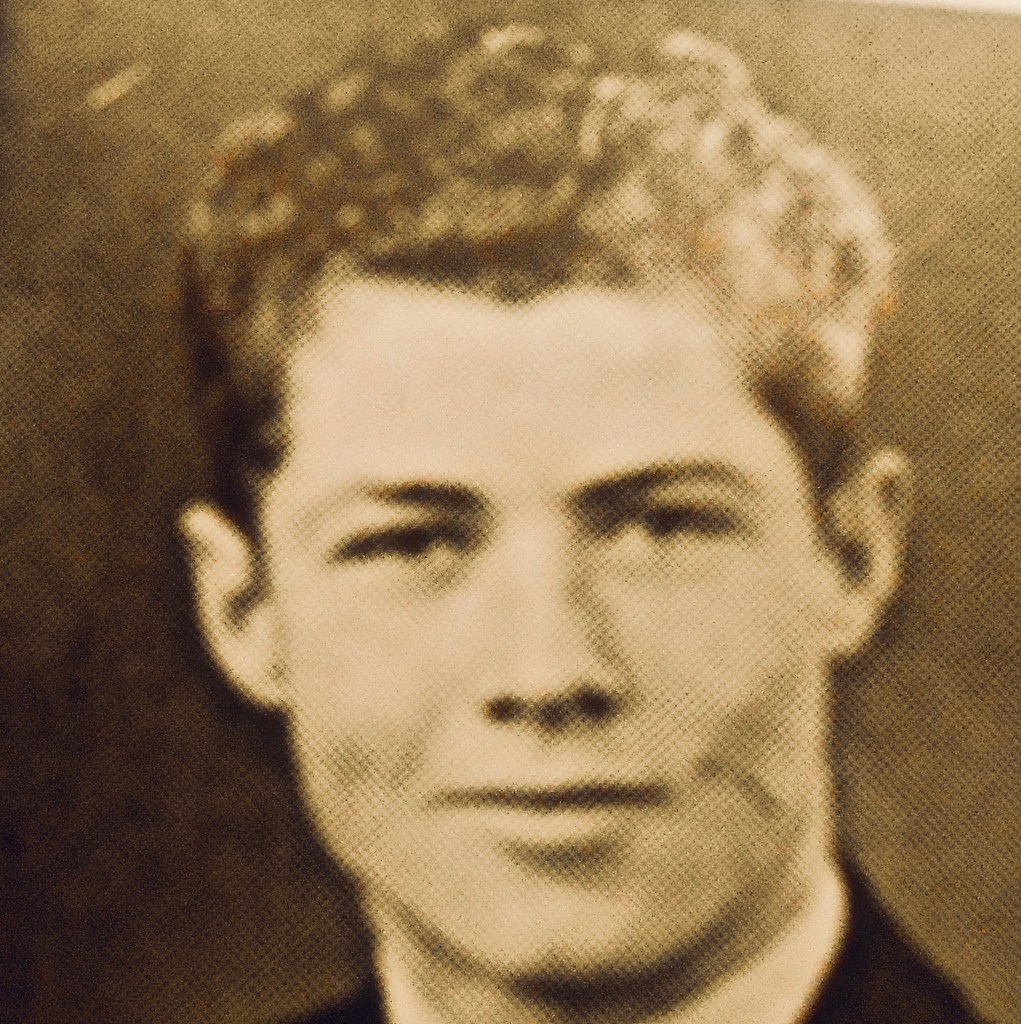
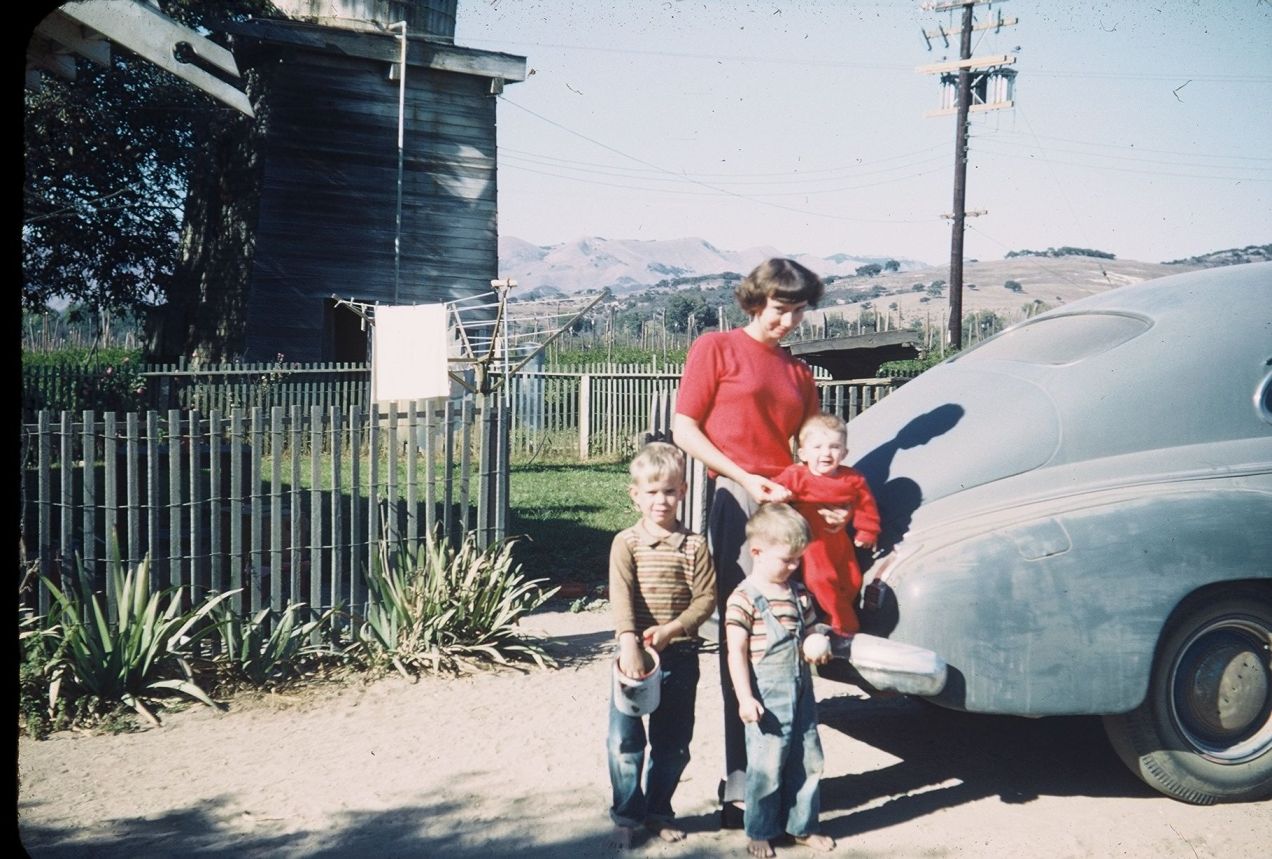
Simon Yanez, Bracero August 1959. Photo by my mother on our farm.
Scattered like the seeds they tend, across the fields as if flung there, their backs humped up, faces the color of the dirt. they are bent close to the ground as if part of it.
Hoeing, weeding and thinning the delicate tomato seedlings already exuding the distinctive faint odor of their kind. The width of the short hoe with its 16 inch handle determined the spacing of the plants which would be allowed grow to maturity. All others sacrificed, Tomatoes, Malva, thistle, purslane and mustard, tiny as a fingernail, chopped by the rhythmic rise and fall of the hoe. Mass murder.
Held halfway down the handle for balance the hoe slipped between the plants removing all unwanted growth. The Tomato seedling with its two jagged leaves was left alone. Again. Again. Again. Tens of thousands sacrificed to the scuffling blade.
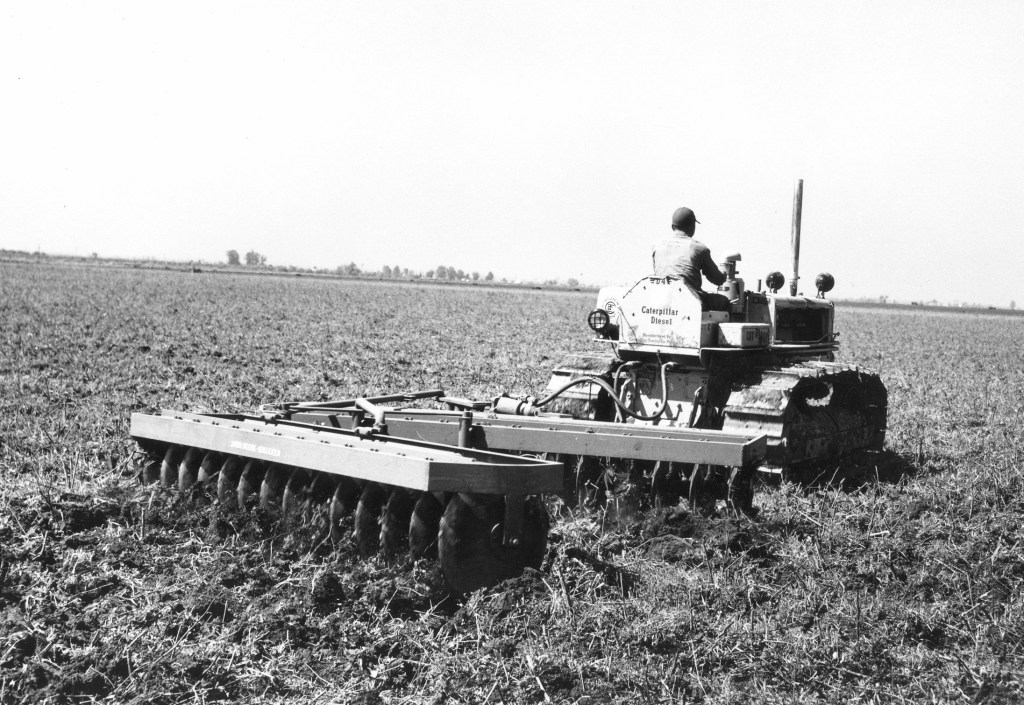
Photo ; Leonard Nagel, National Museum of Natural History 1956
Bent double at the waist, feet crossing again and again in the narrow furrow, he moved on. Already his back hurting. The pain began at the waist, spread down the backs of his thighs, the tendons behind the knees and up his spine to the shoulders and the back of the neck. Stay stooped, don’t straighten up it hurts less and the boss will see you if you do stand. There is a family to feed.
The heat rising, the sun seemingly stationary, the row endless and if you ever get to the end you must turn and face it again. Ten hours. All around the rhythmic pace of men, no talking, waste no energy. Can’t stop to smoke. When no one’s looking, a quick sip of tepid water. Sweat dripping from brow into the eyes. He straightened slowly, careful to ease the muscles lest he be crippled. He bent back over the row, trying to ease the pain of the hoe in his palm, turned red from the constant movement of the wood against skin. Back to it and all the while the ache, the ache; never ending.
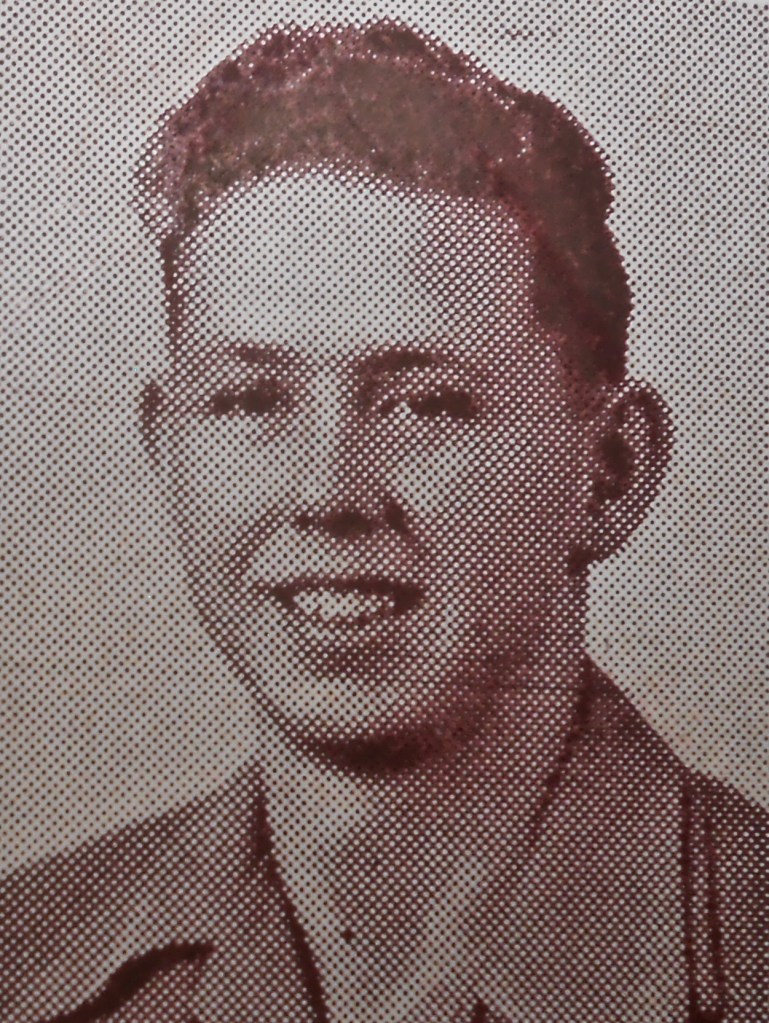
Almuerzo en el Campo. Photo Shannon 1950’s
Noon, an unbelievable half hour crouched in the shade of the bus. Almost asleep while eating. Eyes closed until wakened by the shuffle of other men, cursing, groaning, headed back. Bloated with lunch, gut heavy, aching, he bent over the row. Shuffling sideways, his legs crossing and uncrossing, the Cortito rising and falling, he labored on like a condemned man, he administered his own torture; held it in his own hand.
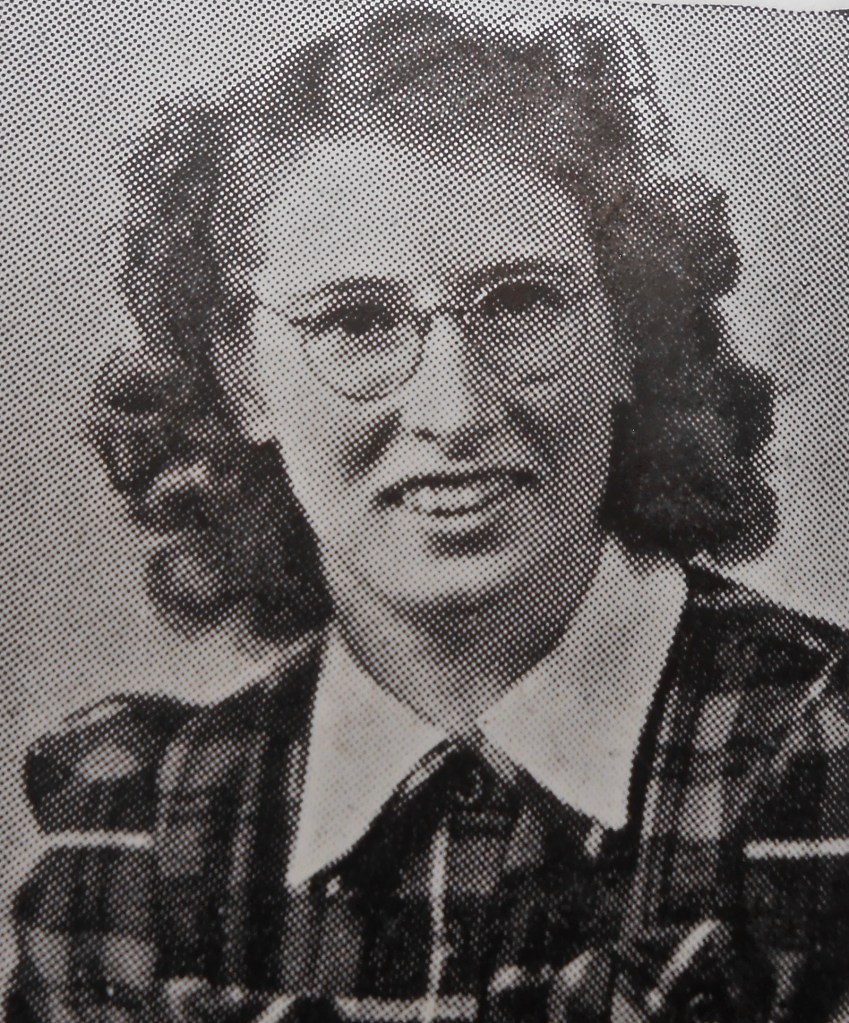
Usando el “Cortito,” ( El Azada) San Luis County, California. Family Photo
His vision narrowed until the only thing visible was the hoe and the tiny green plants. The mind going down a dark hole, focused only on the intolerable ache and the rhythm. Slide step, drop and pull, crossover step, drop and pull. He followed the bent men.
The sun slid achingly down the sky, the men moved on across the brown earth. He hardly thought, focused only on the pain and the chopping. Quitting time did not exist now, only an endless wilderness of sameness. Up and back, up and back.
At first he was hardly aware of a new movement, men jumping across rows and trotting to the bus. IHe realized with a start that it was quitting time. Slowly straighten, stretch the bunched up muscles in his back, finally standing upright he followed the others into the bus. Stepping over men prone, unable to take another moment of back bending, he found a seat.
He walked to the barracks leaning oddly backwards still trying to stretch the twisted, corded muscles in his back. Propped on his cot, feeling the new lumps of muscle in his aching spine he said to himself, “I will never go back.” But the pay was one dollar an hour and his family, in Chihuahua needed the money. An hour of work bought a meal, two, a day of food.
He was a long way from home, unable to see a return, he had no choice.
Epilogue
The Chumash, The Mestizos, the Chinese come to Gold Mountain, the Irish Navies cast loose by the southern rebellion, the Japanese, Filipinos, Azoreans, Germans, Italians, Norwegians and Swedes. The Russian Jews and the those fleeing Eastern Europes despots. Vietnamese fleeing Ho Chi Minh. Now, Haiti, South and Central America, Mexicans, Hondurans, the disposed of Oaxaca, Chiapas and the raging Cartel wars. Day laborers from Mississippi, Motel maids from Chicago, tractored out sharecroppers from Missouri, Arkansas and Oklahoma, they all come for the same reason.
America and California are built on expectations. You can start all over here. That’s why people come–to start all over and become somethng new. They put up with tenements, sweatshops and grinding stoop labor, not in resignation to tragedy but in the name of a future. Something better for my kids.
Don’t mistake the illegal Mexican immigrant who is, today, working the lettuce fields around Santa Maria, Salinas, Arroyo Grande and Oxnard with an intensity that you might mistake as resignation. It’s the reverse.
In one way or another every immigrant since the Ice Bridge has lived this same story. We are a country of Immigrants and should be proud of it. There is no other country on earth that has the same collective experience. Immigrants are truly the Glory of our Country. We need to be reminded of that often, especially now.
Maria y Jennifer San Salvador, 15 y 17 anos. Students at Oxnard HS. 2020. Oxnard California. Photo: Elizabeth Aguilera for CalMatters, 2020
Si Se Puede.
The hoe, ”El Cortito,” The Short one. One bracero called the hoe an “instrument of horror . . . designed by the devil.” Many growers believed short-handled hoes made workers more careful and kept crops from being damaged. The bosses also liked the short-handled hoe because they could tell at a glance whether the farm laborers were working or resting. After numerous and very contentious lawsuits the hoe was outlawed in California in 1972. The crops, workers and farmers are just fine without it.
Michael Shannon is a writer and died in he wool farm boy. He has an intimate acquaintance with the short hoe. He lives in California.
Jack was a clever man so as he packed up the rolling stock and his village, carefully placing each piece in one of the old milk crates stamped with the family’s label, Hillcrest Farms Dairy. As was his nature, being a man who does nothing half way he began to ruminate on how he could continue his railroading.
After running the dairy for thirty years my grandfather was retired. No more 4:30 am cow calls, no more bottling, no more deliveries, he had time on his hands for the first time in his life. At 70, his “ready to go” nature needed an outlet.
The old dairy barn was semi- abandoned, the milk cows were gone and to boot, there was the huge stack of clear heart redwood planking that was left from the collapse of the main silo many years before. An idea was germinated. Why not just move his trains up to the barn? It had electricity, overhead lights and an attached workshop where he could tinker as much as he wanted. What my grandmother thought of this we don’t know but she could hardly have failed to see that it would get him out of the house. After forty six years of marriage, outside was where she was used to him being. She offered no argument.
There is a thing about small towns that many don’t know or remember. Small numbers means that neighbors are, well, neighborly. The glue that holds them together is an unwritten law that precludes people who are acquaintances mind some of their own business. Much depends on that. The grocer and the butcher and their wives and children are people you know. The school teacher, the farmer, the hotelkeeper and the constable are all on a first name basis. You can apply the Mark Twain saying, “A lie travels right round the world while the truth is still getting its shoes on.” People are careful with gossip. It’s someone you know. Everyone needs something from someone else.
It’s not as if normal human behavior is somehow missing in small communities. There is a man who is the love child of two seemingly ordinary people, both married. The state representative is having an affair with the woman down the street. A woman on Nelson St was referred to as a “Sexaholic” by my mother. There is a dairyman who waters his milk and the county treasurer is about to go on trial for embezzling. There is racism, Whites, Japanese, Filipino, Portuguese, Mexican get along in public but there are things said in the privacy of kitchens that prove otherwise.The elders in my family surely knew of these things, yet kept those discussions inside the home and certainly never in front of children.
Going to a small rural school where all these people were represented never seemed to be an issue. Racism is taught. If you are not taught you’ll be happier.
Keeping the lid on the kettle was important to most folks since people not only knew other people but likely knew their antecedents too. When a man like Jack needed help he could get it. Personal relations was the glue that kept communities together.
L-R, George Burt, Jack Shannon, unidentified, George Shannon and Clem Lambert. Family Photo
In the dairy business you needed labor year round from boys and young men who were children of people they knew. When I was a young man I knew many adults who would invariably say, “I worked for your grandparents when I was a boy.” They were full of high praise for the way they were treated. The bus driver who drove me to high school was one. His name was Al Huebner and he had worked haying for my grandfather. There was Clem Lambert, a mechanic, George Burt, builder and Mayor, Deril Waiters, an electrician and builder, Addison Woods, another contractor and many others who had cut their teeth in the hay fields or the milking barn before the war. When you talked to them they would remark that what they got was worth repayment. Pass it forward to a new generation. I worked for some of them because of him. Jack and Annie had banked, if you will, a heap of good relations that they could now call on for his railroad.
A plan was made. The old cow barn would be the place where his trains ran. The girls were all gone so the barn was empty and just needed a little work to be ready. All the stanchions were torn out. A load of sheetrock was ordered from Leo Brisco’s lumber yard and they covered all the windows and walls to give the interior an nice clean, white surface. They then took all the redwood from the old silo and built a table that covered nearly the entire interior, leaving just a walkway around three sides. My mother came in with her paint brushes and painted a backdrop at the one end.
The Hiawatha and the Super Chief under the big sky. Family Photo.
Deril Waiters helped my grandfather lay out all the electrical wire needed for the switches, building lights and interior lights in the little town with it’s church, hardware store and tiny little homes. All of that was connected to a myriad of switches, toggles and the transformers which would run the trains. The men built chicken wire mountains and plastered them. They built hills, gullies and rivers too. My mother painted and painted. Grandfather built a round house. I thought it was funny because he used toilet paper rolls for the many chimneys on the roof, each one designed to collect the exhaust of the locomotive below. He built a turntable and even stuck a little enameled worker at one end to operate it when a locomotive needed to be run in or out.
Pacific Coast Railroad and Southern Pacific Roundhouses San Luis Obispo, California
We knew roundhouses. San Luis Obispo was a division point on the Southern Pacific and had a large one along with the shops needed to maintain all the rolling stock. He knew that things were rapidly changing and the big roundhouse would soon be gone so he took me one a road trip to see it. We also plowed through the weeds to see the ruins of the old Pacific Coast railroad yard down on lower Higuera Street. Long abandoned, the shops and warehouse were just the kind of things to tempt a little boy no matter his age.
Apparently this was a family thing because my dad took us on trips to see things that would soon be gone forever. We rode the last ferries across San Francisco Bay, we stood next to the huge Big Boy locomotives as they watered at the little station at Madeline up in Lassen county. My parents friends lived on a ranch there that belonged to Tommy and Billie Swigert. The RR stop was just up the ranch road. When you’re barely four feet tall those engines are monsters. In those days the engineer let kids walk right up to them and touch.
Southern Pacific’s Alco 4-8-8-4 “Big Boy” at Madeline, Lassen County, California. Barbara Shannon Photo.
We went down to Guadalupe to see the great train wreck. A diesel unit pulling freight passing through the Guadalupe yards clipped the rear of the tender on a cab forward 4-8-8–2 Southern Pacific cab forward locomotive and made a huge mess. My grandfather drove me down in his big green Cadillac Sedan Deville and we simply walked through the site. There was train debris everywhere. Trucks with their great steel wheels, journal boxes bleeding grease, Boxcars split by giant can openers, Barrels and crates strewn about, steel rails twisted, ties tore apart already pushed into piles by bulldozers. the Diesel unit’s cab crushed and on its side, the steam locomotive the same. Huge railroad cranes hooking up to the rolling stock in order to lift them free of the tracks. No one seemed to notice us, a grandfather and his little grandson wandering across a train wreck site. Maybe it was the suit he wore or the Caddie, he looked important so he must have been. Afterwards we went for ice cream.
The Southern Pacific Railroad sponsored train rides for many years. Cub Scouts, 4-H and many local school kids took the short ride up the Cuesta courtesy of the Railroad. My grammar school, Branch Elementary would, a few years later, take the last steam locomotive ride up over the Cuesta grade to Santa Margarita. A picnic at Cuesta Park afterwards and the ride home in our mothers cars. The last steamers were then retired and the Diesel-Electric took center stage. Parents and teachers told us about “The Last Thing.” but it doesn’t register when you are so young which in a way is a sad thing. We should have been able to savor the experience when it was happening. Perhaps my grandfather felt the same way. He was born a horse and buggy man when serious travel was by train. For him, those were all the past.
Work on the trains moved along. They built the table from the old silo’s redwood. Removable plywood skirts were added which could be removed in order to work underneath the table. 4 oz duck was glued to the table top just as it was for the mountains. paint was brushed on, trees and vegetation glued into place and fake water filled all the streams and rivers. Many of the houses, autos and trucks were simply bought at the dime store.
I don’t think my grandfather ever attacked anything as a casual endeavor. The family observation was that when he “Made hay, he made hay.” I grew up hearing this and I believed it then as I do now.
Dad would go out to help on Sundays, the farmers only day off, and give us reports at dinner. Occasionally my grandfather would drive out to our farm, pull his big car into the back yard gate and come into the house with a big box of donuts from Carlock’s bakery. He would be peppered with questions by his grandsons and was happy to give us detailed answers though how much of that sunk in I don’t know. It was exciting though. It was hard to imagine even with my little train set chugging round and round on our living room floor circling my mothers hand made braided rug.
After months of anticipation Dad took us out to see the completed project. He parked by the geraniums planted next to the big silo, painted a pink tone, a mix of barn red and white because as was the custom on our ranches nothing was ever wasted if anyone thought it might have some future use. At the top were the faded letters that spelled Hillcrest Farms which were once bright and clear but now after the wars rationing of paint, slipping away. Those years saw the gradual end of local dairies because the big Knudsen Dairy Company had moved into Santa Maria and started buying up the locals, in effect forcing them out. They would all be gone by the mid fifties, so why waste paint?
The great rolling door to the dairy barn was pulled back and we scampered up the steps, my dad lifting my little brother because his legs were still too short to do it on his own we entered the cool dark space. My grandfather flipped the old porcelain light switch which made a crisp snap and all the hanging lights came to life. And there it was. What a glorious sight for a little boy. I had, for my pleasure, the largest privately owned “O” gauge train set in the state of California.
There are those who still remember coming out to the ranch for the March of Dimes fundraisers in the fifties. Sponsored by the Rotary Club, my grandfather a member, the lines would literally stretch out the door with people and their kids. Over the years it was occasionally open to the public and was viewed by thousands of local kids. Much to their delight for those that remember it. Arroyo Grande was still awfully rural then and kids were pretty limited in possible experience.
Sad to say, my grandfather, by now pushing seventy five found it hard to maintain, old barns are not very clean and dust and chaff from the corrals deposited a layer of dust that had to be continually cleaned. Toy trains still used steel rails then and the cracks in the walls and around the doors allowed in enough moisture to continually coat the yards and yards of rail with a fine coast of rust which had to be ground off by hand using a block of pumice. Without good electrical contact the locomotives simply would not run. The hours I spent crawling around grinding away with my stone weren’t that much fun but there was no one else who could do it. The compensation was, of course, learning to operate several trains at once, switch boxcars in the yards and best of all spending a lot of time with my grandfather.
Dad would take me out in the morning after breakfast and drop me off at the barn where I did my track maintenance until noon. Jack would bundle me into the big Caddie and it would make its stately was along the highway frontage road and up the hill the house, where my grandmother would have a lunch laid out for us, baloney sandwiches with Mayo and the cold, cold milk she kept in the yellow Fiestaware jug she kept in the fridge. I felt very grown up when my grandfather offered me “A Cuppa Jo” which I accepted just as if I was all grown up. Boiled on the stove he and my grandfather would take theirs poured onto a saucer from the cup and mine would be liberally laced with sugar and milk. What a treat. Afterwards a little nap and then the return trip.
I’d earned my engineers license in the morning and we would spend some time at the bank of big black Bakelite transformers driving the New York Central’s Hiawatha and the Southern Pacific Daylight passenger trains around and around. We ran the little Yard Goats, making up freight trains, parking under the coal chute and moving locomotives in and out of the round houses. We could wind the key in the little church and the bells would call to service. In the corner was an old record player and grandpa would put on a record that played the sounds of passing trains and the heavy staccato exhaust of the big locomotive starting a train. He taught me how to synchronize the sound with the little trains on the layout. He said it had to be just right. There was no speeding or crashing of trains. Everything had to be just right. It was not apparent to me at the time but lessons were being learned about hard work, rewards and all things proper.
Years later when I returned to Arroyo Grande from my own adventures, both my grandparents had gone to heaven. I went out to the barn and opened the door and viewed the forlorn table, cleared of all the trains and track. Only the hole where the round house turntable once was, was left. The mural my mother painted on the back wall was a fresh as ever. Nothing, really, was left. It had all been sold years before, my grandfather just gotten too old and let it all go. All a memory now.
You can’t imagine how that felt to the grown man who cherished the little boy and his grandparents.
Jack Shannon lived to be 96 years old. A long and busy life. He was born in 1882 in frontier Reno, Nevada, and grew up in Arroyo Grande California. His life spanned from the horse to a man on the moon. Just marvelous don’t you think?
Hogger is a slang term for a locomotive engineer. Steam locomotives were referred to as “Hogs” in the early days of railroading.
My grandparents grew up when trains were the most modern form of transportation. When they were children growing up in Arroyo Grande, the steam train dominated the movement of people and goods throughout California’s Cow Counties. The big Railroad, the Southern Pacific hadn’t arrived yet, there was a promise it would but it took years for the local movers and shakers to pony up the bribes and free land that the Big Four demanded. No, the railroad here was the little narrow gauge Pacific Coast. Quite a bit smaller than the big train, it had served the area since 1868. It ran essentially from nowhere to nowhere. It huffed and puffed its little self-confident way to and fro making no apologies to anyone.
Arroyo Grande station and warehouse 1898. Historic Society.
My grandmother Annie rode it down to Santa Maria to go to High School. The high school in Arroyo Grande wasn’t accredited for those that were planning on going to Cal Berkeley. She and her friends hopped aboard, the train would actually pick you up in front of your house, to take trips up to San Luis Obispo to shop for the latest spring frocks and hats.
Nearly all the goods in the stores that marched along Branch street had to have their merchandise brought down from San Francisco by steam or sail and then shipped by rail to their destinations. The largest building in town was the PC warehouse on upper Branch Street.
Pacific Coast Railway Bridge Arroyo Grande, Ca, 1914. County Historical Society.
When my grandparent were kids the only bridges across Arroyo Grande creek were the railroad bridge and Newt Short’s swinging bridge which was only good for pedestrians. The RR bridge handled most of the walking public and all the wagons crossing the creek. It also served as an impromptu gallows at least once.
If you lived in town to train whistle and the rumble of the cars was a daily fact. My grandfather lived with the sound of that little train for almost fifty years. It’s no wonder it was planted in his thoughts.
Dad Shannon’s little house on the dairy. Family Photo
Christmas eve 1953 the family jumped in the green Buick sedan for the trip to my grandparents house where we always spent Christmas eve. It’s impossible to recall the excitment little kids feel when you are grown. Anticipation can cause you to almost wet your pants, your hair to stand on end and your head spin. The cars in those days had fabric upholstery which had a singular odor mixed with cigarette smoke and the ever present dirt and dust that farm families live with. Once in a while the car got washed but it was a fruitless exercise for my mother. Its pea soup color was always dusty in summer and muddy in winter. No matter how it looked it might as well been a golden chariot on Christmas eve with three little boys bouncing around on the seats in a collective fit of anticipation. Kids didn’t get many presents in those days. One special thing and the rest was basically utility. Shirts made by my mother probably, always socks from bachelor uncle Jack who didn’t have a clue. I got socks from him every Christmas for nearly fifty years. We really weren’t concerned about quantity. We had heard stories about Christmas past when my father got a pair of socks knitted by my aunt Sadie and a fresh Orange. He told me he was glad to get them too, especially the Orange, a pretty rare thing for those days. That was in 1920 when he was eight and he still operated on that principle in the fifties. Things were not particularly important to him. He felt that you should be grateful for what you got and say thank you because no matter what it was it was important to the one who gave it to you. The thing had no particular value, it was the love that counted.
When you know you will only receive one gift, why, it takes on a much greater importance. It was a good lesson.
We drove into town and then south on the old highway and turned off on El Campo Road where my grandparents lived on their ranch. The little red house with the white trim was down in a place I always thought of as the hole. The big bank of the highway and the old Nipomo road on the other side boxed it in and you entered downhill on the gravel driveway. Built n 1924 by my great-grandfather it was a simple board and batt sided, two bedroom with a door at each end. The backdoor led into a screen porch where grandmas pie safe stood, green with screen in the doors that looked like lace. Full of jelly jars with room for a cooling pie. There was a bench for changing shoes and some hooks screwed to the wall to hang jackets and hats on. In 1953 every man still wore one. Open the inside door and you were in the kitchen. Very simple it was. Next the dining kitchen table area and then through to the living room. Behind that was the front door enclosed in a little add on porch. This door was nearly useless because no one was ever likely to use it. Only itinerant drummers like the Fuller Brush man or his like. The custom in the country is to always use the back door. There is a familiarity and friendship involved in that like you might almost be a member of the family. Even the Knights of the Road knew this, they would come down the hill from the highway, tap on the door and stand with bowed head and hat in hand. They were not turned away. It was a vastly different time.
I only went in that front door a few times in my life, always on Christmas eve. My grandparents built a new home in 1954 up on the hill. A modern style home, yes, but we still used the back door except at Christmas .
Christmas 1949. Annie Shannon, my father and two of his boys just arrived at the old house. Family Photo.
1954, in what was our last Christmas in the old house in which the event that is the subject of this story occurred. We heaved the doors to the Buick open and ran to the door hoping to catch Santa in the act but as seemed to happen every year he had just left by the back door while we tumbled in the front. Mom and dad followed, arms full of presents, Cayce, my little brother, just three dragging mom by the hand squeaking in delight.
Grandma and grandpa met us at the door she in her print dress, sturdy shoes, old fashioned wire rim glasses and her apron, always with a hanky peeking from the pocket. She smelled sweetly of white shoulders and when you hugged her she would give you her very soft cheek to kiss. The formal and manly handshake from Big Jack as he uttered his, “The Blessed Boys,” with that big grin, his chest pushed out and his green suspenders like two vertical stripes holding his belly in. Uncle Jackie bringing up the rear, short, bald and bandy legged he sported a big grin, delighted to see his nephews. This ritual of greeting never changed as long as they lived, it didn’t matter if they had just seen you an hour earlier it was always the same.
In that last Christmas in the old house, the biggest most important thing for me was a brand new Lionel electric train. The little black engine pulling the cars and caboose in a stately manner around the Christmas tree. My grandfather got right down on the floor with me and we played with it until dinner was called. I could hardly step away. Eventually, full of turkey and homemade pie my brother Jerry and I fell asleep on the floor. Mom cuddled with little Cayce on the sofa until it was time to go home. The little train set stayed until dad could go back with the pickup to get it.
My dad visited his parents often. Sunday, which was a no work day would see him sitting at the green painted table with the checkered oilcloth cover, tacks along the edge to hold it in place. This was the kitchen of the old house where he had grown up. They would drink scalding hot coffee from the old enamel pot that sat in its habitual place on the stove. They’d be shooting the breeze, his parents and brother Jackie. They had nearly fifty years together so there was always something talk about.
After one of these visits, sometime after new years he came home and over lunch laughingly told us that after Christmas my grandfather had gone to Bello’s store in San Luis Obispo and bought himself a train set. My grandmother thought it was pretty silly for a grown man to do that. It was a silly little topic at her bridge club. Mrs. Brisco, Mrs Conrow and Mrs Jatta agreed and commented that it was just like Jack to do something like that. They said he was still just a boy at heart. They spoke the truth.
The little train lived in their living room for a bit but slowly began to grow. He added track, some trees and two small buildings. One was a church that looked similar to the one my grandmother attended. Perhaps this was an attempt to head of the inevitable grandmother “Stink eye” that was sure to come when the railroad would need to be moved for company.
By mid-January he made a trip north to buy more track, though he was already encroaching on the dining area. The next day grandma went to town to do her shopping and run some errands and when she came home he came out to help her unload the food she bought at Bennett’s grocery while she went in the house to take off her hat and gloves and put on her apron to ready supper. From outside Jack heard her raise her voice to the high heavens and quickly the sound of her voice saying, “Jack, you get in the house right this minute.”
He had finally reached her limit for what he had done with his new track was cut three holes in the walls so the train could pass through into the bedroom, make a left turn through another tunnel into the office and then turn again through the wall back from where it came. Enough was enough. She evicted him and his railroad.
Jack and Annie Shannon circa 1950. Shannon Family Photo.
Jach was a clever man so as he packed up the rolling stock and his village, carefully placing each piece in some of his old milk crates stamped with the family’s label, Hillcrest Farms Dairy. As was his nature, being a man who does nothing half way, he began to ruminate on how he could continue his railroading…….
Part two is coming on Saturday the 8th of June.
Michael Shannon is a born and raised Californian and still lives in God’s country.
A hilarious look at how kids spent their nights in the days before play dates, day camp, and structured activities, “Whacha Wanna Do?” This story captures a world gone by that will be a revelation to younger readers and an affectionate look back for those families who remember the old stories.
He was a twelve o’clock kid in a nine o’clock world. He was a teen aged boy at the last gasp of the nineteenth century. His name was Jack. He ran the dirt streets of Arroyo Grande with his boys, Ace Porter, Matt Swall, and Arch Beckett, whose flaming red hair could be seen from a mile off.
A little farm town, Arroyo Grande was named for the narrow valley that runs from the Santa Lucia mountains to the Pacific ocean. In the 1890’s there weren’t many of the things we consider necessities today. No sidewalks, street lights, or pavement. The horse was king. No automobile had yet to show itself up in the Cow Counties. There was a tiny Railroad, the Pacific Coast but it ended at both ends without really going anywhere. The stagecoach still made regular stops in front of Ryan’s Hotel on Branch Street. It was lights out at nine o’clock.
Whatever you wanted had to come by wagon, coastal steamer or sail ships which regularly docked at the wharf in Port Harford. By road it came from the South, over the San Marcos road at Slippery Rock or very carefully down the old toll road over La Cuesta from the north.
In those old days there was a lot of time to fill. Early to bed, early to rise, neither one particularly appealing to teen boys. As always the best deeds are done at night.
Jack was thirteen in 1895. He was on the cusp of manhood. His country was too. It was about to go from a century of rather slow progress to one moving at almost blinding speed. Eighteen ninety-five was quite a year to be alive in the world. It was a time in history when the era that was passing and the era beginning were locked together like the cogs in two wheels, ready to transfer the energy of one to the other. In England Queen Victoria was entering the final stretch of her 63 year reign. Oscar Wilde was at the start of his two year sentence for “gross indecency” in Reading Gaol. The first professional football game was played in Latrobe, Pennsylvania. In the fall, George B. Selden is granted the first U.S. patent for an automobile. Meanwhile, William Randolph Hearst, the young heir to his fathers silver-mining fortune whose father, a United States Senator had recently given him a small San Francisco newspaper to run, made the seemingly foolish move of buying a failing New York newspaper, the New York Morning Journal. It was the start of multimedia empire that would expand to over thirty papers and change the face of journalism.
This was the year that Guglielmo Marconi, a twenty one year old Italian and scientific hobbyist first succeeded in transmitting radio waves over a considerable distance. It would soon make possible wireless telegraph and eventually, broadcast radio and the internet. In Charlestown Massachusetts the first black man to earn a PhD graduated from Harvard. He was W. E. B. Du Bois. A Neurologist in Vienna woke from a strange dream about a patient and decided to develop a method of analysis of the interpretation of dreams including his own.
In that year, almost every segment of American life was on the brink of a disorienting transformation. Technology, Entertainment, Transportation, Education,Labor practices, Social and sexual behavior, Race relations and Parenting all entering a time of profound change. The way people spent time with one another and interacted with the world around them was about to be overrun by a series of dizzying events.
Few people in America could have been further removed from the social, technological and cultural change than the citizens of little Arroyo Grande, it’s population, less than four hundred people and isolated in a corner of California much as it had been for the six decades since its founding as a Mexican land grant in 1835.
Jack and his parents, John and Catherine had made the slide west from Reno Nevada where they operated the Toronto house restaurant and a boarding house called the Ohio House. Located near the river on Virginia Street is was a busy and popular place and why they sold out and moved west has been lost, although court records may indicate a certain reluctance to pay their bills.
John Edward Shannon, known in the family as Dad Shannon always listed himself on census forms as a Capitalist, a common term at the time for a promoter and investor. His mother Elizabeth, a widow with seven children ran a tavern in Lackawaxen, Pike County Pennsylvania. John himself worked as a brakeman on the New York Central railroad by the time he was twenty and then spent a year in Sing Sing prison for breaking into and stealing from the boxcars he was working atop. Capitalism at it’s finest, illegal, but what capitalist won’t take a risk.
He dealt in real estate and property and the move to Arroyo Grande included a home and property just east of town where they was in the fruit and egg business. The old house on the slopes of Carpenter Canyon still stands. Jack could simply walk down hill cross the usually dry Becketts Lake and be in town which was just a short diatnace away.
The old house on Printz Road.
Young Jack grew up there in comfortable surroundings, his mother Catherine was a women of some drive and means. Originally from Toronto, Canada and New York, She had owned the Craig house on the waterfront in Oakland and later a hotel in Berkeley. She was a widow when she met Dad Shannon in Reno, the site of her latest endeavor the, Toronto House restaurant and boarding house on Virginia Street, the future site of the famous Mapes Hotel. After the 1875 marriage, he bought the Ohio House, another boarding house so they weren’t poor. They ran the three businesses until 1890 when they sold out and moved to Arroyo Grande. She was 52 and they had decided to retire from their businesses. At 52 she should would have been elderly by the standards of the late nineteenth century.
Jack was the product of her second marriage. She had four other children who were grown and scattered arount the country in San Francisco, Berkeley and in New York. She married Jack’s father when she was already 40 years old and was 47 when he was born. A pretty advanced age to be having children in the eighteen eighties. An afterthought, the bonus child or the accident, we don’t know. The family story is that he wasn’t exactly considered a gift from above. With four grown children she had the experience of motherhood but perhaps not the tender desire if you will. She has come down in family lore as the “Meanest women in the world.” My dad could never explain exactly why as he was just a little boy when she passed away. He did say they were both pretty heavy handed with punishment. Jack was very well acquainted with his father’s razor strop.
Strops are unusual today but back in Jack’s day men used a straight razor to shave and after honing the edge on a wet stone a leather strop, usually made of heavy tanned cowhide with a hook or ring on one end and a leather handle on the other. The ring would be placed on a wall mounted hook and the strop pulled taut by the handle. The razor was then dragged back across the two foot long strop which removed any burrs on the edge of the sharpened razor’s blade putting on a very fine edge. The strop was also very useful in tanning a boys hide. Jack and his father were both very familiar with this use, one on each end. Jack never seemed to hold corporal punishment against his father. It’s difficult to complain against that which is richly deserved. Didn’t slow him down, just reinforced his desire to “Get Outta Dodge” as the old saying goes. In his teens Jack put a lot of thought and energy into running away from home though he was never really successful.
Growing up in Arroyo Grande it didn’t take Jack long to display his rambunctious spirit. Boys in the 80’s and 90’s lived a quite different world than we did just two generations later. The idea that children were essentially owned by their parents was still the norm. As a form of legal property, they had no real rights as we know them today. Parents could put them to work at almost any age and they did. Boys delivered newspapers, cleaned spittoons in the many saloons on Branch street. The yworked in the butcher shops, they delivered groceries from Bennett’s store. The mucked out the stalls at the Harloe stables and tended the forge at Miller’s blacksmith shop down on the creek. If you needed windows cleaned there was a boy. Because most boys, rarely if ever were required to go to school there was always one handy.
Kids were allowed to roam freely, a circumstance that still applied when I was young. There were no tresspassing signs as property owners knew which kids belonged to which family so someone almost always had an eye on you. Fishing or swimming in the creek, riding your bicycle to San Luis Obispo, going varmint hunting with your .22 or simply disappearing for hours at a time were common activities. A boys time was his own, at least when he had some.
My grandfather when I knew him was always quick with a joke and loved to tell stories about his young life. It wasn’t hard to see the rambunctious mischief maker in the man. He wasn’t afraid to be the butt of the story either which game him a certain verisimilitude which was charming for for us kids. He could laugh at himself.
If you asked Jack if he was ready he’d say. ” When I get up every morning.”
That “Always Ready” was for a time a bit of a problem. The term “Lets Go” never found a more willing participant. His running mate Ace Porter, he of the cheeky grin were best friends for life.They met as altar boys you know. They were the quintessential example of the scapegrace’s who got into the sacramental wine, switched Holy Water with water from the tap and tied knots in the bell rope.
Saint Patricks Catholic Church 1890. Photo: Marshalek Family
They were well known for their pranks by Father Michael Francis Lynch, the pastor of Saint Patrick’s Church. Father Lynch, bless his heart, must have been a good soul. Both of them had earned their reputations for being mischievous tricksters. It didn’t end in church either.
On All Hallows Eve, Jack climbed over the window sill after his parents had gone to bed and met his cohorts down to Miller’s blacksmith shop right along the creek. Just behind the Meherin store, it was right up against the willows which lined the Arroyo Grande creek. The willows, Sycamore trees and the huge stands of late season Poison Oak provided cover from the town constable Thomas “Tom” Whitely, who was prowling the little town looking for scapegraces up to no good.
Whitely would have know about scapegraces. He had been roundly criticized for doing nothing to stop the lynching of the two Hemmi men from the railroad bridge in 1886. One of the men was actually a fifteen year old boy. Newspapers around California were scathing in their criticism of Whitely and the uncivilized citizens of Arroyo Grande who did the deed. They being the town’s most prominent men. No one was ever named nor arrested for what amounted to pre-meditated murder. In a small town where there were many family ties and everyone knew everyones business, silence on the matter stated the consensus verdict.
Whitely was also called before the Grand Jury to explain why he had continuously failed to remit the entire amount of the fines he leveled and the bail collected to the county treasurer. He fought the case and lost. In 1900 the voting citizens of Arroyo Grande sent him packing in favor of Frank Swigert.
Hunting boys intent on mischief must have been a lark for him as it likely entailed no risk. In fact, people whose gates were lifted and hidden or outhouse pushed back just a few feet exposing the cess pit to the unwary man stumbling through the dark half asleep would be thankful for the constables diligence.
This didn’t deter Jack and his gang for on this night, they had bigger things in mind. A notable prank that would give early risers a start as they came up Branch Street to begin the day.
They quietly took a spring wagon parked behind F E Bennett’s store and pulled it up to the Union Hall. Using wrenches and screwdrivers purloined from their fathers sheds the quickly reduced the wagon to its constituent parts. Boosting Jack up to the roof, they began handing up the pieces, the box, seat, springs, dashboard and the wheels. Climbing up, they just as quickly reassembled the wagon astride the ridge of the roof. When the job was complete they shinnied down and headed for home.
The old Union Hall built by Judge Beder Wood, 1880’s. Historical Society.
The next morning Ma Shannon was surprised to see Jack headed out the door much earlier than usual. When she called out . “Where are you going? he answered over his shoulder, “Goin’ fishing.” Not likely, he was headed down to Branch street to meet his fellow outlaws in front of the Commercial Company building to spy out the reaction of folks to their handiwork. Across the street the Hall sported the Studebaker wagon proudly astride the center of the roof. They watched as the early morning crowd gathered. Boys on the way to school larked about laughing, nearly overcome by the audacity of the deed, Beder Wood, the owner of the building talked to the Constable and some other prominent citizens, growling about delinquent youth and how he’d like to take a wack at them. Maybe put them under, he being the towns undertaker. The little boys cast their eyes surreptitiously across the street at Jack and his friends. Knowing looks were exchanged. Someone fetched a ladder and the men began the task of reversing the nights work. Jack and his friends quietly disappeared and the little boy dashed of to school to report the big news.
As the old saying goes, “Success Breeds Success.” The boys went about their regular business while they plotted their next foray into the world of crime. They laid low over the Christmas holidays and the early spring of 1899 but with the coming of All Fools Day the put their next plan of action into play. That year it fell on a Friday which suited the gang perfectly.
They all snuck out of their houses and met behind the Cumberland Presbyterian Church on Bridge Street. There they spied out the vicinity making sure the Constable wasn’t anywhere around. The figured he was likely tossing back a beer at the Capitol Saloon anyway and wasn’t going to be any trouble. They dashed across Bridge Street to the big and imposing Grammar school directly opposite the church. They scouted the building to see if they could find a way inside. They found a conveniently unlatched window on the first floor and quickly boosted each other up, scooted and over the sill. Miss Young, whose room had the unlatched window, suspicious as that in was itself, fit with the plan to do no damage. Once inside they carried out the mischief they had been plotting for weeks.
Arroyo Grande School, Bridge Street, 1899.
They quickly ran up the stairs to the second floor where the upper grades and the high school held their classes. Mrs. Watson’s book shelves were emptied and all the books mixed up and piled at the head of the stairs. Her desk was moved to the opposite end of the room and the desks reversed. Mr.Huston’s room suffered the same fate. His books were piled on the top of the stove, his desk and the floor. The school organ which Mr. Huston played for school presentations was hefted and then slid out to the hallway and placed at the top of the stairs. The organ and the books made a wall blocking the upper stories.
The midnight vandals disappeared the same way they came leaving nary a clue to their identities. Nothing was discovered until the following Monday when the front door was unlocked by the custodian. Frank Parsons, the principal, galvanized every teacher as they came through the door in the clean-up effort. The sound of cast iron school desk legs scraping the floor, books quickly tossed onto shelves and the swish swish of brooms rang out through the building. Frank’s idea was to reverse the joke by having everything in order before students arrived. He figured the vandals would get no satisfaction if the students never found out what had happened.
He was mistaken. The children’s telegraph was operating at full throttle. After the bell they sat in their desks and sniggered when ever they thought the teachers weren’t looking or listening. The teachers knew of course because every one had elephant ears and eyes in the back of their heads. It might have passed unknown, the school wanted to keep the joke quiet but the kids couldn’t wait to get home and share. Because one of those student’s father just happened to publish the town paper the story was memorialized in print. Though Stephen Clevenger may have used a little tongue in check in writing about the great event, I mean how many notable events go on in a small farm town at the turn of the century?
Clevenger wrote, “It was probably funny for the boys engaged in the performance but trustees, teachers and scholars will require the funny part to be pointed out to them before they can see it.” Oh, I don’t think so.
Clevenger wrote, “The boys incurred the grave risk of entering the school building and tampering with its contents.” As a crime it didn’t amount to much and no one was ever brought to task for it by the law.
My grandfather said that punishment was a liberal laying on of the strop, again. Though there was no proof any of the boys was involved, Dad Shannon evidently though that an ounce of prevention is worth a pound of cure.
It never slowed any of them at all. I mean, whats the use of never taking a chance.
The Meanest Woman in the World, Catherine Brennan Shannon with my uncle Jackie, 1917. Berkeley, Califonia.
He figured he could solve the problem by running away. They caught him pretty quickly. After all the distance between towns in the cow counties is pretty large and what do you do with little or no money, so no stagecoach or railroad, it had to be shanks mare and that was slow going. He tried again though and then again. He finally made it when he turned eighteen because they couldn’t legally stop him. He didn’t fool around either. He headed straight across the country and ended up in New York City. His adventures made for many funny family stories.
The thing was, he never did anything half way. I never heard him say he regretted any of the things he did in life, successful or not. When I was in high school he showed once again who he was. After his eightieth birthday party our family was preparing to leave for home, standing on the front lawn making our goodbyes when someone of the kids had a question for him about his time in New York at the turn of the century. He had worked as an athletic trainer for the MacLevy company in Manhattan. He met many notable people there, Lillian Russell, the scandalous actress and singer who was known to cycle around Central Park on her golden bicycle given to her by her lover “Diamond Jim ” Brady. Grandpa said she was a corker.
He was a friend of Jimmy Swinnerton who practically invented newspaper comic strips and became a successful painter of southwest scenes in later life and best of all, the former heavyweight champion of the world, John L. Sullivan, something he talked about often. When my brothers and I visited with them in their home he would shake hands with you and say, “Shake the hand of the man who shook the hand of John L. Sullivan.” We all got a kick out of that but not as big as he did. Little rituals.
He explained what a gymnast was to my little brother Cayce and then did something that left dad, mother, uncle and grandmother gasping. He stepped out on the lawn and executed a perfect somersault to the delight of us kids. Grandma Annie gave him that look and scolded him for being silly, but she smiled a little smile too. Still that kid at eighty.
-30-
Michael Shannon is a writer and dedicated admirer of his grandfather and gymnasts everywhere.
Whatever happened to those names? Names my grandfather gave to his milk cows. My grandmother Annie’s friends from the bridge club she played with for over 50 years was his favorite source. The names carefully penciled onto the milking charts thumbtacked to the wooden walls of the old milking barn on the hill. Names etched into the living memories of the their descendants of this place. Names familiar to the kids that grew up in our valley in the first half of the century. Names etched into the fabric of the descendants that live here today.
How is it that they have vanished? Generations of names have disappeared as completely as a breath of wind. People we remember from our time as kids. The mothers and grandmothers of people that populated our community whose given names suddenly vanished. Minta, Mazie, Sadie, Birdie, Jessie, Muriel, Maude, Cornelia, Florence, Wilda, Bernice, Mamie and Maybelle, gone from the directory. Belva, Elsie, Blossom, Myrtle and Florita “Cushie”Harloe, who today, gives their children names like that? How about Frederick “Shorty” Fernamburg and the wonderfully rhythmic Morris Pruess who was married to Claudia. They owned the drugstore downtown. And Claude and Wilhelmina “Willy” Devereaux who owned the log cabin market. My grandfather didn’t give the cows those names because he though they were odd, they were perfectly normal at the time. He was a funny guy and he did it to amuse his Annie, my grandmother. Knowing him I’m sure he amused himself too. And the women, they took it as a compliment.
Hazel Miller, Stanford ’16, High School Teacher
Rebecca Denham married Hubert “Hu” Thatcher who was in the hardware business. Her second marriage was to James Mineau, also in the hardware business, fancy that.
Margherita “Nellie” Diffenbacher whose son was Carl “Buzz” Langenbeck, future town Barber who cut my hair when I was a little boy. They didn’t call him Buzz for nothing.
Muriel Loomis married Ralph “Rusty” Bennett, Storekeeper. She always gave me a piece of candy from one of the jars on the counter when I was little.
Lenora Clark, Cal ’18 She never married, She was high school teacher in Alameda, CA. Her father, the towns “Baby” Doctor delivered my aunt Mariel
Ronnie Swall, graduated from the San Jose Normal School, ’15 and began her teaching career on Maui, Territory of Hawaii in 1915.
Cora Bennett married Porter Clevenger whose father started and owned both the Santa Maria Times and the Arroyo Grande Herald newspaper.
Miss Lenora Clark, Cal Berkeley Yearbook. Class of 1918.
Michael Shannon lives and write from his hometown, Arroyo Grande California.
Just a regular Tuesday. The only two 8th grade girls in our little school. They were the Judy’s, one Gularte and one Hubble. Dressed in their skirts buoyed by crystal white petticoats, looking like upside down Chrysanthemums they huddled around the little portable 45 RPM record player in the corner of the classroom with their friends Jeanette, Cheryl and Nancy, they were playing and listening to a very popular song. The volume was low as Mrs Faye had asked them. They were crying, for the music that had died the night before in a scraped over cornfield in winter’s Idaho. A cheap little puddle jumper aircraft, 21 years old flown and by a 21 year old novice pilot had gone down killing all aboard. That old Beechcraft, worn out and dangerous to fly, especially with a low ceiling and swirling ground fog had slammed into the iron hard frozen ground, killing Richard Valenzuela of Pacoima, California, instantly. All the dreams of a poor barrio boy went with it.
Not one kid in that classroom could have imagined that the little tune, La Bamba would be immortalized by the tragedy of a seventeen year old boys death. But it was.
Valenzuela home movies. 1957
Don McLean, who wrote the greatest damn rock-and-roll tribute song of all time—the rhapsodic, rambling, profoundly metaphoric history of American rock from his self-proclaimed “Day the Music Died,” a concert about Buddy Holly, Richie Valens and the Big Bopper’s plane crash. MacLean is the ultimate rock-and-roll outsider. No Rock and Roll Hall of Fame, no mega-shows in Vegas, just the guy Bruce Springsteen said was his greatest musical influence. For what are musical lyrics but storytelling.
After all, it used to go without saying that rock-and-roll was the musical expression—the voice, if you will, of the American angry young men (and women) of the 1950s and ’60s—those same rebels without a cause that McLean describes as wearing “a coat they borrowed from James Dean.”
I look at it and marvel – what’s their dream going to be? My dream ended with a lot of sixties’ assassinations. It didn’t have to end. It didn’t get a chance to play out as it might have. Someone else’s dream put paid to it.
Music, iconic songs, capture a time in the way an academic historian never could. Ritchie’s little ballad lives forever, even if he didn’t.
Richard Stevens Valenzuela’s name rolls of the tongue particularly when pronounced with the Mexicans soft and sibilant hiss, the sound dripping of the tongue like silk sliding across velvet.
In 1955 the 110-block area on the north side of San Fernando Road was the dusty little town of Pacoima. It consisted of a smear of sagging, leaning shacks and outhouses framed by disintegrating fences and clutter of tin cans, old lumber, stripped automobiles, bottles, rusted water heaters and other garbage strung along the back alleys. In 1955 Pacoima had no curbs, cement sidewalks, or paved streets. Pacoima had dusty footpaths and rutted dirt roads that in seasonal rains become beds for angry streams. The 450 houses in Pacoima, with only 2,000 inhabitants, squatted in the clutches of blight and neglect. There, but not there.
First Nations people had lived in the flats below the San Bernardino mountains for thousands of years. The original name for the Native American village in this area was actually Pakoinga or Pakɨynga in Fernandeño, but since the “ng” sound did not exist in Spanish, the Spaniards mistook the sound as an “m” and recorded the name as Pacoima, as it is today. Natives subsistance farmed and ran sheep in the foothills and the little town began as a rancheria where Mission workers at the San Fernando mission lived after the missions were securlaized in 1826. For the next century and a half it had been home to the marginalized people who could live no where else.
The thing is, like many marginalized communities with strong ethnic ties there was a richness of culture running throughout those dusty muddy alleys. With little migration, families had forged ties with one another and created a patchwork of social order. Fiestas, Quinceaneras, saints days and weddings brought the extended families together. It was a small town where everyone knew each other. The watchful eyes of aunties and abuelas kept an eye on kids as the went about their kid business. At the time you had to get out of town to get in real trouble.
Richie’s mother Conception must have dandled his chubby little body on her knee, boosting him up and down, holding his little fingers as they listened to the music of the Pacoima Barrio. La Bamba came to him as an infant.
It came a long way. From the ancient sub-saharan kingdom of Kongo. Spanning central Africa below the Gulf of Guinea, the kingdom included some dependent kingdoms, such as Ndongo to the south. Trade with other African states was the main commercial activity in the centuries before the white invasions. Kongo was a wealthy and influential kingdom state based on its highly productive agriculture and the increasing exploitation of mineral wealth.
In 1482, Portuguese sailing ships commanded by Diogo Cão arrived off the coast of the Kongo. Cão landed an expedition which explored the extreme north-western coast of Ndongo in 1484. Other expeditions followed, and close relations were soon established between the King of Portugal and the Kingdom of Kongo. The Portuguese introduced firearms and many other technologies, as well as a new religion, Christianity; in return, the King of the Congo offered for sale, slaves, ivory, and minerals such as gold and silver. Slave trading was an ancient and accepted form of trade, predating written history and fully accepted as a way of doing business by both the Portuguese and the African nations of central Africa. The slaves themselves had no choice as to their fate.
Over the span of two centuries, Kongo was ruled by the Portuguese, Dutch, Brazil and then the Portuguese again. Each change of ownership was accompanied by savage warfare between the nations wishing to exploit the riches of Africa and the Africans themselves. Hundreds of thousands of prisoners were sold into slavery by all sides, the majority being shipped to the New World. Brazil at first, then to Dutch possessions all over the world. They were transported to the Caribbean and what was not yet the United States. The future United States was still made up of Spanish French and British colonies but in order to grow they were in need of vast numbers of laborers to exploit their new lands. It is estimated that beginning in 1619 more than ten million people from Africa were imported into north America and sold like property.
The slave trade was and horrible you must never make light of it, bound people to their owners for life to do whatever they pleased with a human being that was considered just property. Millions of African people died or were subjugated to the interests of the plantation owners in the western hemisphere, there is something entirely missed in the textbooks you read in school. To believe that they were somehow sub-human is to fly in the face of our common history. Slave uprisings were common and planters had every right to be terrified of them. A people who were subjected, denied the simple right to read and right, worship as they pleased, denied any memory of their African culture and in many cases forbidden the simple pleasure of song. This festered.
The descendants of generations of the MBamba people from Ndongo (Angola) who lived along the Bamba River and had been sold west to Brazil, Cuba, Jamaica and the other Caribbean islands were also sold into New Spain (Mexico) at Vera Cruz a century and a half before they reached the American colonies.
What they brought our modern culture they paid dearly for. We learn early on in school how Europe and Asia gave us important literature, science, and art. How their nations changed the course of history. But what about Africa? There are plenty of books that detail colonialism, corruption, famine, and war, but few that discuss the debt owed to African thinkers and innovators.
They MBamba didn’t come alone. There is nothing physical that you can hold in your hand, no baggage that came during those centuries of slavery. No slave Hell-Ship carried any luggage. Everything came in their heads. All the things that defined culture, speech, art, history and above all, music.
By the seventeenth century, the west African people had made it west to old Mexico. Hernán Cortés founded La Villa Rica de la Vera Cruz (“The Rich Town of the True Cross”) in 1519. As the chief seaport between colonial Mexico and Spain, Veracruz prospered as a port and became the most “Spanish” of Mexican cities. Because of its strategic location and direct overland connections to Puebla and Mexico City. it was attacked and captured many times by pirates. In the 16th century Francis Drake and other British pirates savagely attacked the city several times.
Just before dawn on May 18, 1683, pirates stormed the port city of Veracruz in the Viceroyalty of New Spain on the shores of the Gulf of Mexico, easily overwhelming its Spanish military defense. For two weeks, the buccaneers, led by the Dutch Captain Laurens de Graaf and several hundred French and English volunteers, wreaked havoc. They raped and looted, pillaged and murdered at will. The Pirates demanded steep ransoms for the release of their valuable hostages which included the governor of Vera Cruz.
But the ultimate crime is what they did in the end, They kidnapped almost the entire population of people of African descent, because slavery was rapidly expanding and the English and French colonies at this time and there was a a huge market for such captives. Human beings were worth more than gold and jewels.
Just before their departure on May 31, the pirates captured between 1,000 to 1,500 Veracruzanos and loaded them onto their fleet of 13 ships. Then they set sail for the pirate sanctuary of St. Domingue, todays Haiti. There, they sold their human cargo. The captives, people of African descent, many of whom had intermarried and intermixed with the Spanish and indigenous population, some already Veracruzanos in the second or third generation, were deemed mulatos, pardos, negros and morenos. Chattel slaves or not, the pirates loaded them up and sold them into slavery. New Orleans, Havana, Santo Domingo and Charleston South Carolina’s slave buyers were there with bags of coin. Slave markets in those places quickly sold them off. The seeds of Africa were scattered everywhere. The melting pot of musical style went with them spreading across the continent.
Soon after the slaves remaining in and around Vera Cruz organized a revolt called the Bombarria which, when put down scattered people even more. Each attack on Vera Cruz spread the slave population as they used the opportunity to run away, many headed north and west to live among Native Americans.
Again, without personal possessions they took only what they could remember. Their culture and their music. Especially the music which is always paramount in peoples who were illiterate. By the mid- nineteenth century this had become a mixture of Caribbean creole influences, Spanish Flamenco, Afro-American percussive and in the 19th century Celtic music from Brittany in France which was brought to Mexico by the French soldiers of the Emperor Maximillian.
Like a whirlpool pulling water down, mixing all these elements, hollers and chants from the cotton fields where enslaved people trudged, bent over, from dark to dark, native American drumming, the northern Mexican stomps and shakes, the Bombolear, danced at weddings and the percussive heel strikes of the Flamenco. Traditional La Bamba evolved along with Ragtime, Jass, (The original spelling,) and Rhythm and Blues. Throw in Gospel, Scots-Irish hill country music, Tex-Mex and Corridos, all of it played to a syncopated rhythm. Syncopation is the beat that still permeates much of the American music, a beat that comes from African slaves in the United States, Mexico, the Caribbean and central and south America. Syncopation is quite literally the rhythm of your heart.
“La Bamba” is believed to come specifically from that slave uprising in 1683. The song was traditionally performed at weddings, where attendees were encouraged to make up verses of their own. The traditional aspect of “La Bamba” lies in the tune, which remains almost the same through most versions. The name of the dance referenced within the song, which has no direct English translation, is presumably connected with the Spanish verb “bambolear”, meaning “to sway”, “to shake” or “to wobble”.
The music migrated to California. Some of the earliest histories of California have descriptions of fiestas, weddings and christening celebrations. Richard Henry Dana who wrote Two Years Before the Mast was a Harvard student from a wealthy shipping family who shipped as an ordinary seaman on a hide trading voyage to California and the west coast of America. His book paints a mainly unflattering picture of the people who lived here but in 1836 he and the crew of his Brig attended the wedding of Alfred Robinson, a gringo shipping agent and the daughter of Santa Barbara’s Principal citizen .The bride was the daughter of Jose Antonio de la Guerra y Noriega, one of the most prominent Californios in all of Alta California . Alfred Robinson and the beautiful Dona Anneta Ana Maria De La Guerra were wed in the old Santa Barbara Mission church.
Dana wrote: “The bride’s father’s house was the largest home in Santa Barbara, (It still stands) with a large court in front, upon which a tent was built, capable of containing several hundred people. As we drew near, we heard the accustomed sound of violins and guitars, and saw a great motion of the people within. Going in, we found nearly all the people of the town* – men, women, and children – collected and crowded together, barely leaving room for the dancers; for on these occasions no invitations are given, but everyone is expected to come, though there is always a private entertainment within the house for particular friends. The old women sat down in rows, clapping their hands to the music, and applauding the young ones. The music was lively, and among the tunes, we recognized several popular airs, which we, without doubt, would have taken from the Spanish Africans.”
A depiction of El Fandango a la Casa De la Guerra in 1836 is featured in one of the sprawling Santa Barbara scene paintings in the Santa Barbara County Courthouse.
Like all little children, Ritchie could dance before he could read or write. He was one of the fortunate few who knew what he was born to do. He was given a guitar when he was five years old and though left-handed, he taught himself to play with his right. He played completely by ear, copying the music he heard.
When he began playing at high school dances and parties he had a ready made audience impatiently waiting for the new music that always accompanies an emerging generation of young people. Their parents grew up on Glenn Miller and Artie Shaw or tunes from Tin Pan Alley. They went off the to war and dreamed the music while they waited to come home. Six Million men and women served in WWII, those that worked the defense plants, shipyards and aircraft factories got right down to business and produced the Baby Boomers. The Boomers, as they entered their teen years wanted little to do with their parents swing music, they wanted something to call their own. If it offended their parents that was all to the good. Elvis kicked down the door between “Race” music and the treacly harmonic clap-trap of street corner Philly and got their feet moving. Chuck Berry, Jerry Lee and Fats Domino came a running. Johnny B Goode, Bee Bop a Lula, there was suddenly a whole lotta shakin’ goin’ on Baby.
It wasn’t only music either. Clothing, food, social events were all busy rolling over. At the Pruess ReXall’s drugstore counter in our little town which had once catered to the high school crowd suddenly lost it’s appeal. Teens didn’t walk uptown to the fountain anymore. Now they had cars, they could go anywhere, and they did.
Bobby sox, loafers, ponytails tied up with ribbons gone with the snap of the fingers. Bobbie Chatterton had the last ponytail in my high school in 1958. Goodbye ankle length pencil skirts. So long the ducktail, the jelly roll and the spit curl. Hello the Pixie and lurking just over the horizon, Bouffant and the Flip.
The Lindy Hop, exit stage left. The Twist, enter right. Dance became free expression. “Bambolear”, “to sway”, “to shake” or “to wobble.” Just shake it up, Baby.**
Suddenly A&R men were trolling clubs, high school dances, intermission shows at movie theaters and Juke joints looking for new talent. Bob Keane the owner, engineer and janitor of a tiny home based record label, Del-Fi records got a tip. He showed up at a Saturday afternoon matinee show in a theater in San Fernando, California. He stood in the back as a band called the Silouehettes dragged their equipment on stage, tuned and with a cue from the stocky kid with a Telecaster guitar, launched into a driving, beat driven version of the old tune. Spinning to face the audience, Richard Valenzuela, a grin like a garden gate in a white picket fence, obligatory rock and roll spit curl dangling and dancing across his forehead, jelly rolled duck tailed hair brought the audience screaming to its feet, girls jumping and ponytails swaying, and boys stomping their feet. Keane was floored.
Within a week Richard Valenzuela was in Keane’s basement studio in Silverlake, making a demo and the next week his little band of high school friends were forgotten forever,
The Silouehettes were replaced by the already famous “Wrecking Crew” of studio master musicians. Hal Blaine on traps, Carole Kaye backing up on Rhythm guitar, Earl Palmer, bass and René Hall, guitarist and arranger. They cut four songs that day at Gold Star Studios, “Come On, Let’s Go” and three others, all originals, all credited to Valens. His second record. “Donna” Written about a real girlfriend Donna Ludwig, a classic last dance tune heard in every high school gym in the country for years. The “B” side, “La Bamba”. It sold over one million copies, and was awarded a gold disc when a million records was really a million.
It was the late 1950s when a 16-year-old boy took an old Mexican folk song and set it to a rock ‘n’ roll beat. “La Bamba” made rock ‘n’ roll history when it became the first Latin-based song to cross over to the pop and rock audience. That teen-ager, Ritchie Valens, was made famous. it was the first Spanish song to reach No. 1 on the American charts, and the only non-English song to be included in Rolling Stones “500 Greatest Songs of All Time,” at #354, surely far to low but that’s museum politics.
People all over the world, when they think of U.S. culture, and they’re like, ‘Yeah, “La Bamba.” Yes it is, but it’s not simply American but African, Caribbean, All-Americas rolled into one. That’s dope. This song has survived slavery, colonialism and you’re darn sure it’s going to survive anything that comes along, because it lives within us. I invite everybody to also make it yours.
And those Branch school girls? They are pushing, well I shouldn’t say what age but at high school reunions they can still shake it like they did in 1959.
The video above is a more traditional take on La Bamba. Note the old style instruments which have been in use for centuries. If you love this old song there are literally hundreds of version on YouTube and other sharing sites. Try Los Lobos at Watsonville High School or “Playing for Change, La Bamba”
If you need any proof for the appeal of this song put your three year old granddaughter down and play it for her. Bambolear!
*If you are California, especially from the Cow Counties, every Ranchero who settled here shortly after the wedding was there at the fiesta including Captain William Dana of the Nipomo Rancho and Don Francisco Branch of the Santa Manuela.
**La Bamba still works. In a 1988 at a concert in Argentina, “The Boss” brought 70,000 Argentinians to their feet before he finished the first three notes of the song. 70,000 people swaying, dancing and singing along. The old song still excites.
Michael Shannon is a writer, he lives in Arroyo Grande California with his family. This for his musical sons
If you came of age in the sixties, a kid like me, you knew this, Brian Wilson was a genius. He spoke to us. He came to your room and spoke to you personally. He wrote this song, surely one of the greatest pieces in our musical history. It still touches the heart.
At the very end, it says, “For the love of music.” This whole production is to show how artists from around the world and all different genres can connect to a single song. ‘God Only Knows’ is one of the greatest pieces in musical history,
I submit this for your consideration, to all, to all those you love and who love you in return.
In order of appearance: Martin James, Pharrell Williams, Emeli Sande, Elton John, Lorde, Chris Martin, Brian Wilson, Florence Welch, Kylie Minogue, Stevie Wonder, Eliza Carthy, Nicola Benedetti, Jools Holland, Brian May, Jake Bugg, Katie Derham, Lauren Laverne, Gareth Malone, Alison Balsom, One Direction, Zane Lowe, Jaz Dhami, Paloma Faith, Chrissie Hynde, Jamie Cullum, Baaba Maal, Danielle de Niese, Dave Grohl, Sam Smith.
Brian Wilsons family has petitioned to have him committed to hospice care.. Dementia has taken him and he can never return. This song is his gift and his legacy.
Michael Shannon is a writer, surfer, teacher and unabashedly sentimental.
1910. A great year in America. The year most often mentioned by those who wish would we could return. Nostalgic days when families came right from Norman Rockwell’s dreams. Can’t you feel it, smell it; why you can almost taste the beauty of the United States, untainted and in all its glory. Our time, when America was great.
Or maybe, not so much, not so much.
Stepping out of the buckboard into the middle of Branch Street where it crosses Bridge street, sticky adobe ankle deep mud or dusty dirt as the seasons dictate. No sidewalks, no electric streetlights, no lights of any kind when you are wending your way home of a night.
Just behind you on Branch street, the Capitol Saloon, a false fronted wooden bar where the town constable was gunned down in the doorway a couple of years ago. There is the old schoolhouse on Nevada Street where two hostlers from the Harloe stables perforated the walls with their six-shooters causing the kiddies to drop to the floor in panic. The citizens hurried to build a new school outside of pistol shot of the main street with its eleven saloons. Revolvers carried in coat pockets, stuck behind a belt, stuffed in the front pocket of the trousers surprisingly killed fewer people than rifle accidents.. Dying by gunshot was practically a weekly occurrence in San Luis County at the time. Children playing with their fathers guns, hunting accidents, accidental homicide, mistaken for a deer, all played their part in what was rather routine. No apparent hand wringing by the news of the day.
There is the old Loomis and Swall meat market with its skinned livestock hanging on hooks, each one slippery with fat and its resident colony of flies. Pheasant and Quail, feet lashed and hanging head down with glazed, dead eyes and lolling tongues. Take your pick madam, fresh a couple of days ago.
Mothers died during childbirth, their babies too. Death by Mumps, Measles, Scarlett Fever, Cholera, Typhoid, Diphtheria, Pneumonia, Diarrhea, Tuberculosis and Influenza. Lets not forget Sepsis; Blood Poisoning, which before antibiotics was almost always a death sentence. Men who worked with their hands were killed by simple cuts. Rusty hayforks, knives and other tools could kill. Mom at home could die from the lead in her house-paint, her babies too. Cast iron wood or coal fired stoves maimed and burned, kerosene lanterns set houses afire.
Bath time. Shannon Family Photo
I asked my dad what my grandmother must have thought about this, she having been brought up in privilege and after marrying my grandfather became a dairyman’s wife. Ranch life with few luxuries and lots of hard work for her delicate hands. He said, “Oh, she was used to it I think.” It seemed a strange thing to hear when I was sixteen but age has put me straight. Of course she was used to it the same as we are today when we look at our lives. At least if we are honest about that.
Your granny got down on her knees and scrubbed the oilcloth covered floors with carbolic (Caustic or Lye) soap and a bristle brush. Draperies were rare in working class homes because there was no easy way to clean them, no washing machine yet. Rugs were hauled outside and beaten with carpet beaters to remove dust and dirt. Floors were generally oak or fir, and varnished. This also and took constant maintenance. Granny brushed them with the same bristle brush she used for the oilcloth in the kitchen. No vacumn cleaner was the norm. Perhaps she had a newfangled carpet cleaner but in a small rural community, likely not. She washed clothes in a tub of hot water she boiled on the cast iron stove and hauled outside in buckets. The washboard and bristle brush were her main tools. Everyone had a clothesline. If she lived in town, she walked to do her shopping. Those that lived on Crown Hill had the a difficult path. It wasn’t paved of course and if you had children it was two trips a day to the grammar school, five days a week. She had to shepard the children and carry her baskets of groceries too. In the winter she slipped and skidded down hill and did the same on the return trip. For Mrs. Bennett, Mrs. Eldridge and Mrs. Paulding this was a daily chore. As always a home with a view comes at a cost.
Annie Gray and Mame Tyler off to town, 1901. Shannon Family Photo.
Country people traveled by horse. A horse was not a pet. Buckboards, Buggys, Surreys, and farm wagons served as primary transportation. People had to have a barn for the hay, grains and horse. They needed to maintain the leather harness and if they rode, saddles and bridles too. Horses could be cantankerous. A horse can kick you in any direction if you stand too close. They bite. A horse weighs around a half a ton and just leaning on you can break your bones. Falling from a bucking horse never seems to hurt anyone in the movies but in reality the ground is hard and it’s a long way down. A few horses were pets for the kids but in reality they were the same as any other piece of machinery, utilitarian and disposable when no longer useful.
Riding in the Huasna, mother and daughter. Riders unknown. Photographer unknown.
Farm work was all done with horse power. In 1900 around fifty million were at work each day. Not much short of the countries population seventy-six million. About half died every year. Horses, mules and oxen pulled plows up and down the fields. They pulled threshers, rakes, mowers and wagons. They pulled the big Haywain wagons too. Grading and roadwork was done by hand with only the Fresno Grader to lighten some of the load, horse pulled of course.
A blacksmith in Illinois invented the moldboard plow design still used today. It was a plow, basically unchanged for thousands of years but with an added moldboard of polished steel which didn’t stick to heavy soils. The blacksmith, John Deere produced one in 1837. By 1848 he was producing 700 per year. Without the polished moldboard and share, the heavy adobe soils of the Arroyo Grande would have been near impossible to turn. Deeres version of the plow was perhaps the greatest innovation in farming history. It had one small problem though, it still needed a large animal to pull it, which meant that farming on a industrial scale was still impossible in 1910.
Horse drawn threshing on the Shannon Ranch. Jack Shannon standing on the sewing board. 1918. Family Photo
At the turn of the century, stone fruit such as Peaches and apricots or apples and walnuts were the main crops here. Crops that needed little care such as bush beans, squash and pumpkins filled out fields. If a family wanted leaf vegetables, carrots and potatoes they had to have their own little plots. Like many crops that needed refrigeration, they were seasonal and took hard work to make them grow. Likely your greens came canned and you bought them at Frank Bennetts grocery.
Old horses were “knackered” (euthanized) and recycled into useful stuff; leather, bone objects, fertilizer, soap, tallow, lamp oil and, glue. Gelatin can be found in the hides, bone marrow, sinews, hooves, trotters and guts. It can be rendered into glue, known as “hide glue” or “sinew glue”. The horsehair was used as an ingredient in plaster and to stuff cushions or mattresses. People were less sympathetic about animals than today.
Chickens, hogs and cattle were slaughtered for food. Hunting was not a sport but a way to put food on the table. Little Timmy’s favorite hen was, sooner or later, going in the stewpot. As Timmy got a little older, killing the hen would be his job. My dad always said it toughened kids up. Dogs and cats needed to be useful. Unwanted kittens would be put in a sack and thrown in the creek. Thats not a made up story, I’ve seen my father do it. If cats don’t keep the mice away they aren’t useful. If a dog won’t hunt, well you can guess the rest. Dogs that trespassed on the heighbors property, killed chicken or other farm animals faced the death penalty. My dad took our dog and gave it to Lena Parrish because he came home with one of her chickens. She shot it. Nothing worse than a chicken killing dog he said.
Country people in Arroyo Grande didn’t keep little, precious, pampered dogs. No Corgis, Shitzus, Chihuahuas or anything smaller than a terrier. Terriers were good “Ratters” and therefore useful.
Mothers all nursed their children. Why? Cows milk was dangerous. Because of almost no regulation for the conditions of production, much milk was heavily contaminated in the late nineteenth and early twentieth centuries. The new science of bacteriology demonstrated this. In about 1900, American milk contained pus from the diseased udders of country cows. Particles of manure, dust from the cowshed, dirt from the railway wagon: all of these made milk a dangerous cocktail for those who drank it raw. Its nutrient mix also made it the ideal breeding ground for a wide variety of diseases.
The deadly list includes well-known afflictions such as anthrax, botulism, brucellosis, cholera, diphtheria, dysentery, enteritis, E. coli, gastroenteritis, giardiasis, hepatitis, listeria, paratyphoid, salmonella, scarlet fever, tuberculosis, typhoid, and many others less prominent. In the period under review there were hundreds of recorded milk-borne epidemics across the country. The middle class suffered disproportionately because of their higher milk consumption and because their babies were most likely to be artificially fed rather than breast fed.
The two foremost causes of milk-related deaths amongst infants were tuberculosis and diarrhea. Bovine tuberculosis has been underemphasized in the literature of medical history, for the understandable reason that its close relative, pulmonary tuberculosis, was such the major killer at all ages and a social problem that afflicted the Victorians and Edwardians. In addition to being an airborne disease that thrives in overcrowded housing, tuberculosis is also potentially a trans-species infection. Milk was the medium of transmission from diseased cattle to unwitting consumers that led to approximately 500,000 deaths amongst infants in the period 1850-1900, and up to 30 per cent of all deaths from tuberculosis before 1930. The hazard was only brought under control gradually as milk was increasingly pasteurized in the 1930s and 1940s. My father and grandfather were dairymen and knew who, exactly, you should not buy milk from. They were not afraid to say so, right out loud. They understood the risks people took by buying cheap unpasteurized milk from those farmers who were trying to make the extra buck.
Domestic contamination is also likely to have been a factor. Only a small minority of houses had satisfactory food storage areas before the First World War and it seems likely that the poor quality milk delivered to the doorstep deteriorated further before it was fed to babies. My grandmother got her first refrigerator in 1924. It’s not likely a coincidence that my father nearly died from Scarlet fever the year before. There was nothing a doctor could do but try and ease the suffering.
Tuberculosis or consumption was the biggest killer in 1900. Cramped living conditions, damp and what might be surprising to the reader, chewing tobacco. Two things were contributory factors, Most men chewed what was known as plug cut. Plug cut was a block of compressed tobacco which a man would cut slices from and “Chaw.” My dad and the other men in our family all chewed. He said it was primarily because hand rolled cigarettes wouldn’t stayed lit so farmers, ranchers and other men who used their hands for work chewed instead. Red Man was his choice. The nicotine rush was much stronger than pipes, cigars or cigarettes. A direct result of chewing was the production of copious amounts of saliva. Men were constantly spitting. In the dirt, the wooden sidewalk, spittoons if they were handy or just on the floors. Not a good idea to swallow. Floors of public buildings were sticky with it. The concept of airborne disease was not well understood at the time so in crowds the bacillus was able to easily transmit itself. Sneezing, coughing and spitting was the most common way to transmit the bacillus.
Some of our greatest literary figures afflicted with TB include John Keats, Percy Shelley, Elizabeth Barrett Browning, Robert Louis Stevenson, Henry David Thoreau, Emily and Charlotte Bronte, Anton Chekov, and F. Scott Fitzgerald. TB was called the “artist’s disease” and was linked with creativity and the bohemian life. Gunslinger and murderer Doc Holliday died of consumption. The composer Frederick Chopin, Edgar Allan Poe, and Sukanta Bhattacharya, the playwright Anton Chekhov, the novelists Franz Kafka, Katherine Mansfield, , Fyodor Dostoevsky, Thomas Mann, the actress Vivian Leigh, D. H. Lawrence, and George Orwell all died from it. Untold numbers of tenement dwellers, those that lived in slums and perhaps worst of all, children. Roughly a half million children under five died from TB in the last fifty years of the nineteenth century. In 1900, if you were attended by a doctor or not your chances were about fifty-fifty. Medicine had few tools with which to help. All in all, total life expectancy was about 49 years. There was little health education, not because people didn’t think it was important but not much was known about disease. There was also no public healthcare providers such as hospitals, few physicians, no community health centers, mental health organizations, laboratories, or nursing homes, which provide preventive, curative, and rehabilitative care. Public safety organizations such as police, fire and emergency medical services were rudimentary or nonexistent. Edward Paulding, Arroyo Grande’s first doctor eventually gave up his practice because he could not make a decent living. He was paid in kind, eggs, fruit, fresh killed game and even some money but it wasn’t enough to pay for his home and his family. His wife, a schoolteacher made more than he did. Teachers themselves made near poverty level wages, around two dollars a week.Teachers bought pens, ink, pencils and paper out of their own pockest the same as they do today. Being a country doctor cost more than it made.
Arroyo Grande’s Doctor Charles Clark, was the so-called “baby doctor,” in the town He delivered my aunt Mariel in 1917 at her parents home in the Verde district.
The discovery of penicillin in 1928 by Sir Alexander Fleming marked the beginning of the antibiotic revolution. Ernst Chain and Howard Florey purified the first penicillin, penicillin G, in 1942 but it did not became widely available outside the Allied military until 1945. This was the beginning of the antibiotic era. As children of the forties and fifties, my brothers and I might have been living on a different planet than our own parents when it came to medical care.
Home sweet home, Shannon Ranch 1918. L-R, Molly Moore, Annie, George, Jack and Jackie Shannon. Family Photo
So, at the turn of the century you lived in a house that was uninsulated though you might fold newsprint and stuff it in the cracks between boards but there were cracks everywhere and that was pretty much a useless exercise. The only heat was from a fireplace which was small, nothing like the ones we have today. By 1900 county newspapers were complaining about the scarcity of firewood. The once thickly oak forested hills were stripped clean. Old photos of towns in California around the turn of the century show the Sierra foothills almost completely bare save for the occasional lone pine. Wood cutting was a valued and lucrative trade. Not much coal in San Luis county so the boilers that powered machinery, locomotives and homes consumed wood nearly as fast as it could be cut.
Rural homes and many houses in town were lit by kerosene lamps. Untrimmed wicks caused them to smoke and coat the ceiling with greasy soot. There was a gasworks in Arroyo Grande and many houses had been fitted with gas fixtures. Gas provided better light than lanterns but could blow your house up or suffocate you if you weren’t careful. This was long before a scent was added to the invisible, odorless natural gas. A few homes had electricity but the theory behind it was a mystery to most and because of that it could be very dangerous. Unshielded wire and the complete lack of safety devices brought with it a certain amount of peril. Our house had five rooms, each one with a single outlet and one light fixture in the ceiling. That house I grew up in had rudimentary wiring known as Knob and Tube. A set of wires which were exposed in the attic and were a favorite of rats which liked to chew the insulation thereby executing themselves and occasionally burning a house to the ground as a by-product. My father, uncle and grandfather always referred to electricity as “Juice.” As in, “Put the juice to her son,” when they wanted the big exposed bayonet circuit breaker engaged. You know, like the one Gene Wilder used to animate Peter Boyle in the movie Frankenstein. It seemed like it only needed to be switched off and on during rain storms and in the dark of midnight. It was mounted in a wooden box on the side of our tank house where you had to hold the lid open with one hand and throw the switch with other, all while standing in the wet grass. It terrified me. Fuses, If we had none, well, we just used a penny. It was another of my fathers rites of passage though and I guess I passed or I wouldn’t be writing this.
In 1900 there were no airplanes. The Wrights would not fly until 1903. There was no Railroad that connected with the rest of California, that wouldn’t come until 1904. The first automobile to pass through town was a steam car and that was 1901. The town wasn’t actually a town as such. It didn’t incorporate until 1911 which meant there was no tax base to fund things like sidewalks, night lighting, paving streets or any other public improvements. The last lynching had taken place just fourteen years ago. Higher education, the high school was nearly nonexistent, only four girls graduated from high school that year which held its classes in a rented meeting hall. A mob of white men had just run the small community of Chinese out of town and burned their homes. With them went the only commercial laundry. The town constable bragged that he had recently purchased leg irons fitted with ball and chain to be used for any one he considered a vagrant.
There were no banks. If you wanted to borrow money it had to be obtained privately. There was little in the way of credit, most stores were cash and carry. The first bank was opened in 1901 in a saloon. In 1903 it was incorporated as the Bank of Arroyo Grande. You didn’t have to hide your cash anymore but bank deposits would not be insured for more than thirty years so you’d better hope they weren’t robbed.
Add to this no unemployment insurance, no social security, no Medicare or Medicaid, doctors treated you in their homes or yours. Newspapers advertised sarsaparilla as a cure all and people used it for cancer, rheumatoid arthritis, psoriasis, and many other conditions, but there is no scientific evidence to support any of these uses. In fact, it was banned in 1960 for being dangerous. Both my great-great uncle and aunt, Patrick Moore and his wife Sarah died from stomach cancer and it didn’t help them. Plus, as any western movie fan knows, drinking it in a saloon can get you shot by the local homicidal bully, Liberty Valance.
The good news? Since there were no radios, TV’s, or I-Phones meant that other forms of entertainment had to fill the time. People read much more, newspapers which were readily available, books, the town had a flourishing library, entertainments such as plays, live music, every town had an orchestra who would entertain at the drop of a hat. There were traveling public speakers and the ubiquitous Chautauqua. The Chautauqua brought entertainment and culture for the whole community, with speakers, teachers, musicians, showmen, preachers, and specialists of the day. U.S. President Theodore Roosevelt is often quoted as saying that Chautauqua is “the most American thing in America”. What he actually said was: “it is a source of positive strength and refreshment of mind and body to come to meet a typical American gathering like this—a gathering that is typically American in that it is typical of America at its best.”
The annual Chautauqua shows were held west of town next to the race track, horse racing being perhaps the most exciting sport of the time. Baseball was king though. There were dozens of amateur teams spread around the county. Grammar, high schools and Cal Poly played each other. Each little town had one or more teams. In one case, a Nipomo team was comprised of players, all from one family, the Dana’s.
The Nipomo Ball Team, Dana family, used by permission
Dad slept in his night dress and so did mother. Most fabric was wool. Men wore suits as a matter of course with a vest and tie. Bathing once a week meant if you tended to be lazy, your long johns, supposedly named for the boxing costume of prizefighter John L Sullivan, stayed on for a week. If the missus washed on Mondays, the long underwear would be grey when washday came around again. High laced shoes, a pocket watch and hat made up a man’s daily dress. A farm hand din’t wear special clothes to work, he simply took of his coat before grabbing his hoe. A man didn’t have, or need many clothes. He likely had only a dresser drawer or two and since homes were not likely to have hanging closets, he and the wife made do with a wardrobe in the corner of the bedroom.
Women wore nothing you would wear today. The fashionable silhouette continued to be dominated by the S-shape created by a new “health” corset. These corsets pushed the bust forward and the hips back in an attempt to avoid pressure on the abdomen. The shape emphasized a narrow waist and large “mono-bosom,” sometimes referred to as a Pigeon Breast. Tops were blousy and loose, the extra fabric helping to emphasize this top-heavy shape. Sleeves were equally dramatic. The effect was enhanced with petticoats that had full backs and smooth fronts. Modesty was emphasized with day dresses covering the body from the neck to the floor and long sleeves covering the arms. Skirts were bell-shaped and lace was a popular decoration. For those who couldn’t afford lace, Irish crochet was a good alternative. Rich fabrics were used with silk satin and chiffon two popular choices. Colors were light, but embellished with decoration. Women were beginning to work outside the home. These women needed something more practical to wear and this came in the form of the “tailor-made.” These suits were introduced in the late 1800s and both working and the wealthy wore them in the 1900s. The suits allowed women to change the bodice or the blouse while keeping the skirt, an economic way to stay fashionable. This type of dress would stay in favor until after WWI.
Modesty was the watchword. No part of a woman’s body was allowed exposed below the collar. An exposed ankle while crossing the street would supposedly drive men wild. One of my grandmothers friends was expelled from the University of Califonia for shortening her skirts and exposing just the smallest part of her ankle to view. Entire portions of the english language were verboten in polite company.
Fashionable young women of Arroyo Grande. Bottom, Clockwise: Tootsie Lierley, Mamie Tyler, Grace Whiteley, Cliffie Carpenter, Annie Gray and Maggie Phoenix. 1903, Shannon Family Photo.
The delicate female was guarded from all knowledge, and even from all suspicion or suggestion of evil. “To utter aloud in her presence the word shirt,” said my father, “was an open insult.” No man or woman would pronounce the word corset in front of ladies. The word “woman,” in those days, became a term of reproach, the uncouth female took its place. In the same way the legs of the fair became limbs and their breasts, bosoms. The word lady was substituted for wife. Stomach was transformed, by some unfathomable magic, into a euphemism denoting the whole region from the nipples to the pelvic arch. It was during this time that the newspapers invented such locutions as delicate condition, criminal operation, house of ill repute, disorderly-house, sporting-house, statutory offense, fallen woman and criminal assault. Servant girls ceased to be seduced, and began to be betrayed. That happened to my grandmother’s hired girl Clara who was betrayed by the hired hand. She was “sent away,” another euphemism for the obvious. Syphilis became transformed into blood-poison, specific blood-poison and secret disease, and it and gonorrhea into social diseases. Various French terms, enceinte and accouchement among them, were imported to conceal the fact that careless wives occasionally became pregnant and had lyings-in. In public, my grandmother and her friends never used the word limb or leg. The term organ was equally forbidden. No belly button was ever to be mentioned or seen. Grandmother was given a chaffing dish as a wedding present but it’s handle was deer horn. That was just too, too vulgar and it spent 75 years in a dusty corner of the garage.
The last look is at the kids. They don’t care. What once was is what still is. Same kids, same concerns and thank goodness for that because their dreams keep moving them forward. The clothes are different but they wore them with elan, panache and like today, cool. They want change, they want things to be better, they, unlike their parents don’t want or need the status quo.
When I was in high school, kids were trying to figure out how to overturn the dress code. My wife secretly rolled the waistband of her skirts to make them shorter after she left her parents house for school. My dad told me the girls at Arroyo Grande high school wore nothing but a shimmy under their summer dresses and you could see right through them. I could tell you who they were because they were the 1960’s mothers who supported the dress code. My mom rolled her stockings like Louise Brooks and God forbid, wore trousers in public. And smoked, horrors, what is the world coming too?
My grandmother and her friends could well be imagined as having the same conversation as the girls above.
Lying in the summer grass with a dog. What boy hasn’t done that. Talking about nothing of import, just shootin’ the breeze. The future is made from such as these. No matter the age, kids have not yet had imagination beaten out of them by “Practical Matters.” Be eternally thankful for that.
People would be the same of course. Same hopes, same dreams. Humanity has remained static for millennia. People deal with the problems in their lives like they always have. History repeats itself like turning a page. No one seems to learn much from it. The conversation, be it family, work, or politics doesn’t change, just the names. If you don’t study history you are doomed to repeat it, the man said. Study has changed little. People believe, it’s what makes them and few seem inclined to introspection. The original idea for this article was that, no, you really wouldn’t want to go back to 1900. There are few reasons to do so, but you can bet your bottom dollar that people would go. Human experience is as deep as the ocean but most of us live very near the top. For myself, I would go, but I’d also want to come back. It’s too bad you can’t have both.
Credits:
J. R. Williams was an American cartoonist, animator, and fine artist best known for his late 1980s/early 1990s work in alternative comics. Known for his manic, exaggerated cartooning style, Williams brought an underground comix edge to his work during this period. Born Thirty Years To Soon” and “Out Our Way” are mostly long forgotten today. The books these drawings come from was a Christmas gift to my father and mother in 1946. My uncle Bob who was a great teller of Jokes found it somewhere. He, my dad, Uncle Ray Long and my two grandfathers all lived it. Printed in 1936 it sat on a bookshelf in my parent house where I discovered it when I was about twelve. The many questions I asked about the drawings were my first research project. My parents and grandparents lived those days and loved to talk about them. They all said they’d lived hard lives in a way, but they’d do it again. They wouldn’t trade it for anything.
The title comes from a song by Mary Chapin Carpenter. “Twist and Shout,” a song about dreams contains the line, “When they play you a waltz from 1910. You’re gonna feel a little bit young again” is more than just words.
Michael Shannon is a lifelong Californian. Product of small town life with all its mysterious ins and outs. He lives in Arroyo Grande, California
Clara, Mrs E.L. Paulding, nee Edwards. Arroyo Grande Valley Historical Society photo.
Lets call her Clara for surely a woman of character deserves the use of the familiar. What she did she did without help from anyone other than herself.
She was born in the little town of Bath, Stueben County, New York in 1855. Bath is in the western part of New York state. It lies at the base of the Allegheny mountains and was about a half century old when she was born. Her father John Edwards was named for his distant relative Jonathan Edwards. A leading figure of the American Enlightenment. Edwards is widely regarded as one of America’s most important and original philosophical theologians. Perhaps this drove his decision to become a pastor and missionary in his own right.
Little Clara spent her early life on the move as missionaries were ordered to a new parishes as the church needed. In 1857 her father was ordered to take over the administration of the Wheelock Indian Academy in what was then Arkansas’ western territory, now Oklahoma. Wheelock was one of many schools formed by church organizations in an attempt to educate the native American peoples into subjugation and to make them “White Men.”
Wheelock served the Choctaw Nation. The Choctaw (in the Choctaw language, Chahta) are a Native American people originally based in the Southeastern Woodlands, in what is now Alabama and Mississippi. As part of Indian Removal Act of, despite not having waged war against the United States, the majority of Choctaw were forcibly relocated to Indian Territory from 1831 to 1833. President Andrew Jackson was primarily responsible for the removal and defied the Supreme Court who had ruled against the act to do anything about it. David Crockett, the legendary frontiersman and Tennessee congressman, opposed the Indian Removal Act, declaring that his decision would “not make me ashamed on the Day of Judgment.” The congressmen resigned his seat in protest and went to Texas. It didn’t do him any good but it no doubt did not shame him before Saint Peter when he arrived at The Gates on March 6th, 1836.
The Edwards family traveled to the Arkansas territory by taking ship in New York and sailing down to New Orleans where they went up the Mississippi by steamboat to Fort Smith. They then bought a Studebaker wagon painted dark green with red wheels and bumped and banged their way southwest to the Wheelock Mission..
Indian children at the Carlisle Indian School. National Archives Photo.
Western Arkansas was a wild place when the Edwards family arrived.
Thought he Civil War wouldn’t officially begin until April 1860, Pro and anti-slavery armed bands roamed the Arkansas, Missouri and Kansas territories preying on each other and the citizens who lived there. Political butchery was in full swing with the likes of Senator James Lane’s Jayhawkers whose bands of men were willing to fight, kill, and rob for a variety of motives that included defense against pro-slavery “Border Ruffians”, who favored abolition. The Jayhawkers were intent on driving pro-slavery settlers from their claims of land. John Brown and his sons plied there murderous trade under the banner of God himself. Brown’s weapon of choice was a sword which he used to numerous hack pro-slavery men to bits. In the name of God, he said.
From the state of Missouri, pro-slavery Bushwhackers and Border Ruffians tried to force slavery on Kansas by resorting to the same methods. Bands led by William Quantrill, Bloody Bill Anderson and Dave Pool raided into Kansas from Missouri and the Arkansas territory. They then retreated to the lawless territories to avoid capture. Political murder was in full swing.
Regardless of anyones personal politics it was a very dangerous place to live. A missionary and his family were not be immune from the violence.
Bushwackers Archie Clements 1, Dave Pool 2, and Bill Hendricks 3. about 1858. Kansas State Historical Society Photo.*
The Wheelock school was right in the middle of the burgeoning conflict that would become the civil war. At the outset of the war, the Union Army abandoned all of its forts in the Indian Territories and withdrew its troops to Kansas and Missouri, knowing that they would be needed to fight the Confederate Army. All civil government essentially collapsed, and irregular guerrillas ran unchecked throughout the Arkansas territory. All other non-Choctaw personnel also left including the five year old Clara and her parents. The school closed for the duration of the war.
Though not as visible as the war in the east the conflict in the borderlands was extremely vicious. Those bands of quasi-soldiers took no prisoners and devolved into nothing more than thieves and bandits, killing, robbing and defying what little law there was. The were a breeding ground for the scourge of outlaws that would plague the west for decades to come.
16 year old Jesse James, already a killer. He is wearing a Bushwacker shirt made by his mother. They were made with oversize pockets for ammunition and carrying three Colt six shooters. 1863. Kansas State Historical Society Photo.*
Five year old Clara’s father, Pastor John Edwards was wont to tell the “Ruffians” that his oath forbade him to take up arms for either side. He just wanted to be left alone. That was not to be.
A few weeks later a neighbor lady came running to the school and between gasps for air informed Mrs Edwards that a gang of armed Texans had vowed to hang all northern sympathizers and the Pastor Edwards, the dirty Yankee, was to be the first. Mrs Dukes told Clara’s mother Rose that they were already on the way. The Edwards had no doubt about Mrs. Duke’s news. Her husband ran to the barn to saddle a horse while Clara’s mother gathered some spare clothes and food to take. The Pastor shook his wife’s hand, it was 1860 after all when public affection between even married people was rare, hugged Clara, told her brother George he had to be the man of the house and to take care of his mother and sister, George was eight. He jumped into the saddle and headed north towards the Little River. Mrs Dukes had run several miles to warm the family and was exhauste so she was invited to supper before returning home. During the meal the sound of galloping horses was heard in the yard and the Texas Ruffians arrived in a cloud of dust demanding to know where the H**l was Yankee Edwards. Being an honest women she pointed north. The didn’t believe her, surely a woman would lie to save her husband, they figured he wouldn’t be able to ford the Red river to the south and head into Texas without drowning or being killed. After talking it over they figured she was lying about going north which presented them with a conundrum about which way to hunt Pastor Edwards. Surmising that he would be forced to return they decided to stay until he did. Dismounting they pushed came up on the porch, pushed past Mrs Edwards and into the house where they turned over every piece of furniture and looked anywhere a man could hide, but found nothing. Still certain that the Pastor would soon return, they surrounded the house and spent the night waiting. The murmur of their voices and the glow of their pipes terrified the women and children in the house. All the next day they waited but by evening it was certain the Pastor would not be returning. Grumbling and muttering amongst themselves they mounted up and rode away south telling Mrs Edwards that they better not find her husband or he would be done for.
Arroyo Grande Herald:Dear Mr. Clevenger, when up Lopez creek yesterday and I met Mr. Eubanks andGeorge Balaam. They were very comfortably camped and they invited me to a Coyote dinner. Talk about hard times when Coyote is the best meat we have. John Mahan
Families and friends helped Mrs Edwards pull the wagon from the barn and up to the house. She loaded it with what goods she thought she could keep. Rose arranged to give 35 head of cattle and six acres of land to the local storekeeper for two horses which the husband of her neighbor told her weren’t fit to pull a loaded wagon and if she tried she’d be stranded on the plains with no help anywhere. He said he would trade her the horses for two mules instead. Poor Rose had to kick in $ 35.00 dollars to boot.This was not an act of generosity and left her nearly destitute. She sold most of her furniture, kitchen utensils and any other thing she could lay her hands on because she would need money when she arrived at Fort Smith to meet John. The mules were far superior for the job than the horses would have been. The little Edwards family headed north, with Mr Libby, John’s helper driving the old Studebaker wagon, Rose Edwards on the drivers seat with Mr Libby and Clara and her brother George sitting atop the heap of bedding and furniture. In 1861 the Arkansas territory was wild and deserted. It was the beginning of the Great Plains which swept west to the Rockies, seemingly flat but cut by gullies and washes which made travel difficult, especially for a 35 year old mother of two. She had only Libby to help her. After a long days travel they unhitched the mules at night, saw to their feed, set up camp and fed themselves and the children. Mr Libby slept under the stars and Rose and the children inside the wagon. A woman traveling with her children, completely alone, was far too risky and as Mr Libby was a slave owner that they would likely be left alone by any Bushwackers they might meet. The remnants of the Edwards family drove by day and camped without a fire at night and slowly found their way northeast. Still early in the war and US troops still in the territory she thought that the Choctaw and Osage would leave them be. The outlaws and Bushwackers would likely leave Mr. Libby alone if they were stopped. They’d assume, because he owned slaves he was a southern sympathizer. Somehow they crossed the Little River, mules wagon and all and got to Lennox where they met John and continued on to Fort Smith where they had to give an oath of parole never to serve the north and were finally able to get a steamboat up river. They would never return to Wheelock.
Mister Libby did return and he and his family sat out the war without any harm coming to them. The Indian children were simply left to find their way home if they could.
In 1862, Clara was to make the trip to California with her parents. At seven, like most children of her age she was a walking talking bundle of energy and about to head off on another of her great adventures. The trip, by sailing ship from New York to San Francisco began in December of 1861, just nine months after the Secessionist fired on Fort Sumpter. It would take them down the east coast, around Florida and to New Orleans. The risk of winter storms and Confederate Raiders was high, but other than a shifting cargo which put the ship over on her beam ends for a time, a very dangerous thing which could have resulted in the ship capsizing and sinking but which the children on board made into a game by climbing to the high side and sliding down the decks for fun.
The little Edwards family took ship from New Orleans to Aspinall Panama to board the cross isthmus rail road. The Panama Railway was the first transcontinental railroad in the Americas and was built to provide a shorter and more secure path between the United States’ East and West Coasts. When completed in 1855, the line was designated as an “inter-oceanic” railroad crossing as it connected ports on the Atlantic and Pacific Oceans. The tropical rain forest terrain and outbreak of malaria and cholera, rendered its five-year construction, at a cost of $8,000,000, a considerable engineering challenge, and required more than seven thousand active workers drawn from “every quarter of the globe including from the United States, Europe, Colombia, China, the Caribbean islands, and also included hundreds of African slaves rented out by their owners. Many of these workers had come to Panama to seek their fortune and had arrived with little or no identification. Many died with no known next of kin, nor permanent address, nor even a known surname. The death toll ran upwards to as much as ten thousand men and women. Malaria, Yellow Fever, Typhus, the Black Vomit and Cholera scythed through the workers. Few records were kept of the dead because the laborers were considered disposable.
Aspinall, Panama. East to west, ocean to ocean on the Panama Railroad. 1860.
Arroyo Grande Herald:Charley Rice’s team was left in front of his City Meat Market shop while the driver went inside to collect some turkeys. There was a big fat hog in the wagon and he decided that he would givea big grunt, which he did. The horses thought they heard “Bear” and they made a wild leap and bolted. Geo. Thatcher tried to stop them and was rewarded with a kick to his leg which will likely cause him to limp for some time. George’s attempt caused the team to run up on the sidewalk where they were captured in front of Richards store. They haven’t stopped looking for that bear yet.
The Missionary Foundation paid the passage for the family as Pastor Edwards was being sent to his new posting in San Francisco. A ticket on the road was $ 25.00 dollars a considerable coast to travel just the 47 miles from Caribbean to Pacific. It was the most expensive railroad in the world.
It was said at the time that each tie on the road had cost a human life. It nearly cost seven year old Clara hers, as she quickly fell ill with Malaria. Once aboard the San Francisco bound ship in Panama City she took to her bunk and suffered bone breaking pains in her limbs and a raging fever. Her mother expected she would die and be buried at sea, but somehow she lived.
Clara was an adventurous from the get-go. She fell out of trees, slammed window sills on her hands, nearly drowned and was frequently sick. Malaria in Panama, Pneumonia in cold and wet San Francisco and when the family moved to Visalia she promptly contracted Valley Fever. In the 1870’s only three in five children lived past five years. Scarlet Fever, Cholera, Typhoid, Measles, Smallpox, Pneumonia, and Influenza along with the dangers of day to day living which brought rabid animals, blood poisoning, kicking horses and shooting accidents which nearly every family was familiar with. There was not much John and Rose could do to protect her, something common to all parents in the still wild west of the 1870’s. Visalia was still frontier, dusty, dirty, abundant saloons with rough characters everywhere and frequently heeled. With her friends, Clara ran free with little adult supervision. She was forming the character which was to lead her to Arroyo Grande where she was to lead the effort to save a school.
The Right Reverend John Edwards and his daughter Clara. Calisphere Photo. About 1868
Clara started school at ten in Visalia and proved to be a precocious student. With John Edwards connections to the University of California and Mills College he arranged for Clara to start her college education in 1871. Clara was off to Mills College at just fifteen. She, like most of her contemporaries was to study to be a teacher. Teaching was one of the few serious careers open to women at the time. Western movies would lead you to believe that any young woman could just walk into a school and teach but then as now it required a rigorous education at a Normal School or teachers school such as Mills. Three years of higher education led to strict testing system in order to earn a certificate. Curriculum was predicated on the fact that most students would not attend school past the eighth grade. Compared to today, classwork was more rigorous than than it is now. Most schools only went up to 8th grade. By necessity their education was much more difficult than even high schools today. Very few people went to college. In 1900 only around 4 percent of children even attended a high school. Less than one precent of those would attend college and just seventeen of a hundred actually graduated. Just over half of all children would attend any school whatsoever. They would be starting their adult lives much sooner. In order to graduate from 8th grade, students had to pass a final exam. Below is a snippet of a typical 8th grade test from 1899:
Orthography 1 1/2 hours
1.)What is meant by the following: Alphabet, Phonetic, Orthography, Etymology, Syllabication.
2.)What are elementary sounds? How classified?
3.)What are the following, and give examples of each: Trigraph, Subvocals, Diphthong, Cognate, Linguals?
4.)Give two uses of silent letters in spelling. Illustrate each.
5.)Define the following prefixes and use in connection with a word: Bi, Dis, Mis, Pre, Semi, Post, Non, Inter, Mono, Super
6.)Mark diacritically and divided into syllables the following, and name the sign that indicates the sound: Card, ball, mercy, sir, odd, cell, rise, blood, fare, last.
7.)Use the following correctly in sentences: Cite, site, sight, fane, fain, feign, vane, vein, raze, raise, rays.
8.)Write 10words frequently mispronounced and indicate pronunciation by use of diacritical marks and by syllabication
In 1883 Clara returned to California from Hawaii where she had been the private teacher and governess to the seven daughters of Alfred S. Hartwell the presiding justice of the kingdom of Hawai’i’s Supreme Court. She had traveled and worked independently without the supervision of an adult male which, for the time was quite unusual. Teachers of the female persuasion were forbidden to enter pool halls, saloons under any circumstances and were required to be escorted by an approved male when eating out or attending concerts or entertainments. They were typically enjoined to attend church each week and only certain churches were likely to be approved. They were to be in bed by ten o’clock and to exhibit the strictest morals as set down by the community. No smoking, sex, drinking, reading of “Racy” novels or unchaperoned courting were allowed. Marriage meant instant dismissal in most cases.
Arroyo Grande Oracle:Four slick and greasy tramps crawled out from under the PCRR depot this morning and proceeded to work Branch Street for grub. Constable Tom Whitely urged them to move on or become aquainted with the ball and chain…
In Hawai’i Clara showed an independent spirit to say the least. She rode horseback astride, She camped with other young people in Haleakala crater on Maui, completely unsupervised and she went where she wanted without asking anyones permission. She had an independent streak a mile wide. Returning to the mainland and needing a job, she went to see the California Superintendant of Schools who told her there was only one school available and that was in the little town of Arroyo Grande and if she took it she must start Monday next. In a split second she made the fateful decision to go. She said “yes.”
She made it on time. She sailed from the San Francisco Bay to Port Harford (Port San Luis/Avila Beach) and bought a ticket for one dollar on the Pacific Coast Railroad, one of the oldest in California. The rattler huffed and puffed it’s way to San Luis Obispo then over the hills south to Arroyo Grande. It clanked along at bare walking speed for it was no streamliner. It was built to haul goods, with passengers and their comfort simply an afterthought.
Clara Edwards Paulding on the wheel she rode from her home in Arroyo Grande to and from Branch Elementary School where she was teaching in 1898. She taught about sixty students grades 1 thru 8. She is 42 yo. Photographer unknown. CA.SP Photo.
Clara taught all over San Luis Obispo County. She listed the Court School in San Luis, Cholame and Shandon in north county, Santa Manuela and Branch in the upper valley and the old Arroyo Grande Grammar school on Nevada Street. When two Hostlers at the Ryan stables across the way perforated the school with their handguns, parents prompted the school to move down to Bridge Street. While at Branch, she heard a commotion outside during recess and stepped out the back door to see the kids surrounding a rattlesnake. One of the older boys said, “miss, you’d better shoot it,” and reached into his possibles sack and handed her an old Civil War revolver. She did too, shot the rattlesnake’s head clean off. If she wasn’t already respected, she certainly was now. Just another day at school. In 1898 it didn’t occur to anyone to question why a boy would take a revolver to school. It came in handy this day.
Branch Elementery School in 1886 when Clara taught there. It looks about the same today. San Luis Historical Society photo
She started the first town library and was a member of the WCTU which fought the saloonkeepers tooth and nail for years finally causing Arroyo Grande to “go dry” though none of the drinkers seemed to notice. She was a leading advocate for the high school which finally came to fruition in 1895. The “Wreckers” of Billy Buck and his cohorts had came up against Mrs Clara Dudley Edwards Paulding and they would be sorry.
*In the movie, Ride “With the Devil,” Pitt Mackeson played to great effect by Jonathan Rhys-Myers is modeled on Archie Clements a psychopathic killer responsible for numbers of cold blooded murders. Though the movie is fiction, it is a harrowing depiction of the border wars as they were known.
*James Woodson James did nothing in his short life that was of any value to humanity. He stole, he robbed, and was a casual murderer. The movies and books have made him something he was not. He was a killer of the first order.
Chapter Five
The Wreckers Get Their Comeuppance, coming next.
Michael Shannon is writer and a Branch Grammar School graduate. He writes so his children will know where they came from.