The Wayback Machine 5

By Michael Shannon

Chapter Five

Superintendent Messer says he will not call an election to disincorporate the AGHS district unless the courts compel him too. It is probable the opposition will resort to the courts to force his hand. Frank Newsom and Willis Buck were in town working up the matter yesterday at Olohan’s saloon. The state legislature has ruled that county supervisors cannot tax land owners to support schools which leaves our high schools, in particular, nearly penniless. County school offices do not have nearly enough money to fund all the high schools in the county and ” Little Bald Billy Buck” and his “Wreckers” know that. The legislature is stuffed with rich landowners and the law was no surprise to anyone.

Landowners in San Luis Obispo County are not all paying their school tax. Board of Control members “Lobbied” taxpayers, newspaper publishers and businesses aggressively. They argued that high school curriculum was full of “Fads and Frills.” “Any foreign language classes were ridiculous in an English speaking country and drama, music and art were a waste of time and taxpayers money,” they said. The idea that preparing “Working mens children” for higher education was preposterous. Summer school was a complete and unnecessary luxury .Those students who couldn’t keep up were only good for laboring and teaching them was a waste of money.

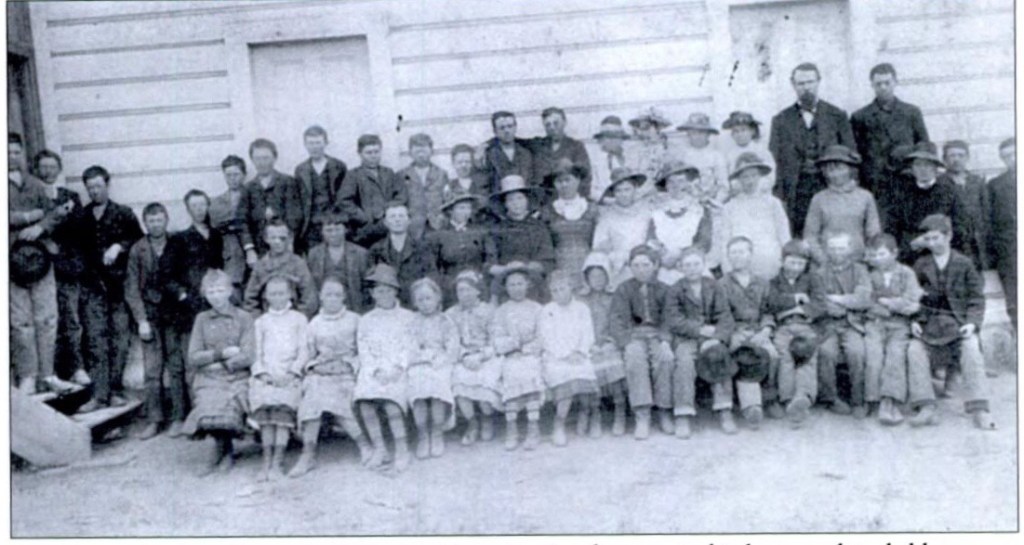
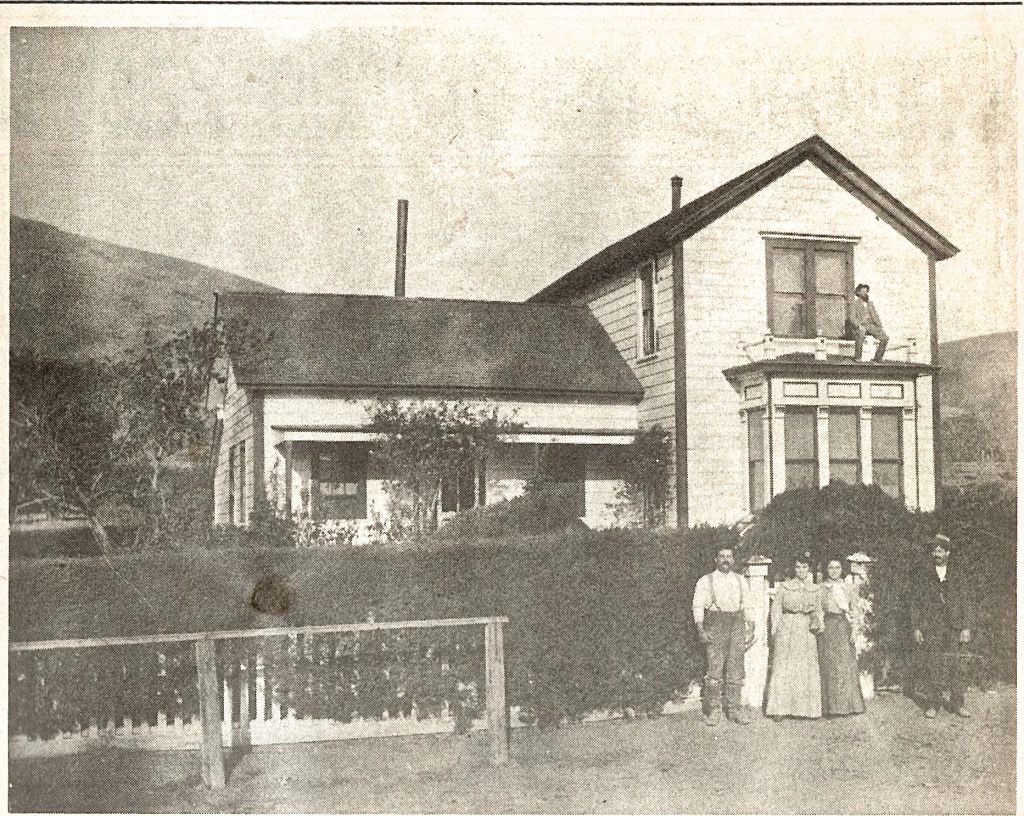
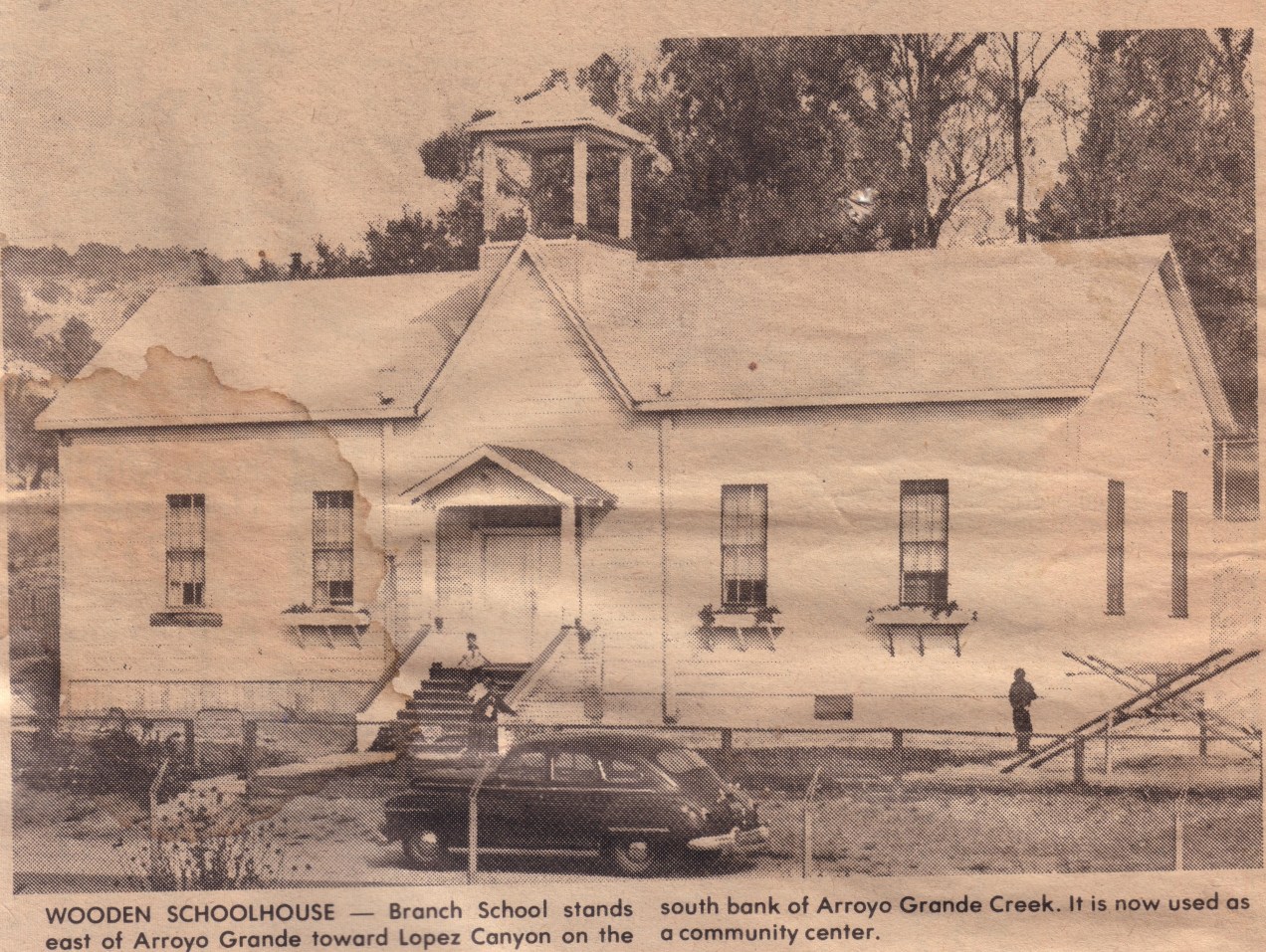
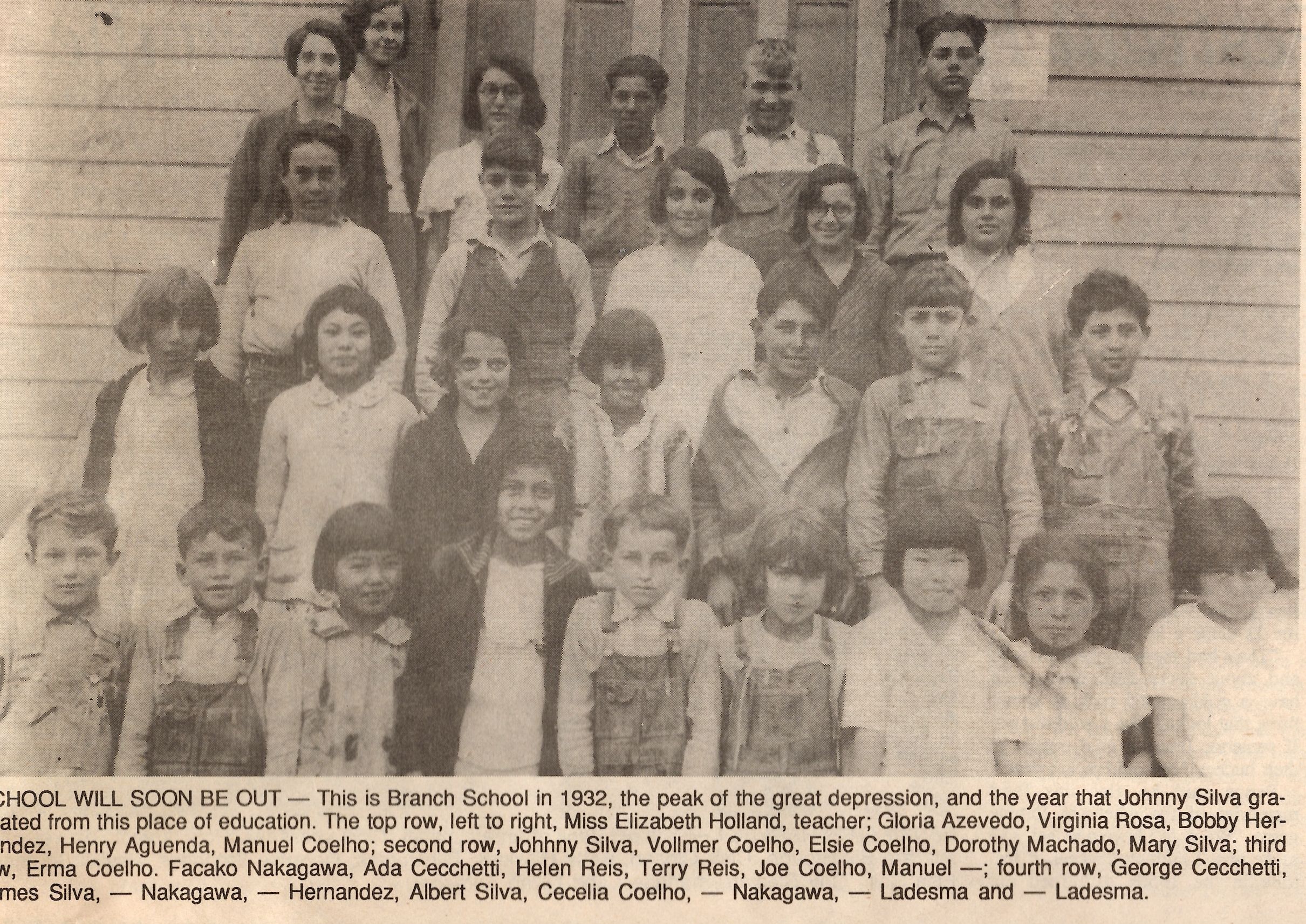
Figures from the 1890’s show that the vast majority of children, mostly boys, dropped out of school at 12 to 14 years and went directly to work as my grandfather did. Rural schools in San Luis County had large numbers of students who were immigrants or children of recent immigrants and spoke little or no English. Waves of Portuguese, Japanese, German and Swiss Italian came to California in the 1880’s and ’90’s. They came because of wars and famine in their home countries, a lack of education, grinding poverty and no opportunity to improve their lives. They understood that schools were the key. The Branch School photo shown below lists five Perry kids, one Fink and one Nagagawa. Every one of the 24 remaining kids bears a Portuguese name.
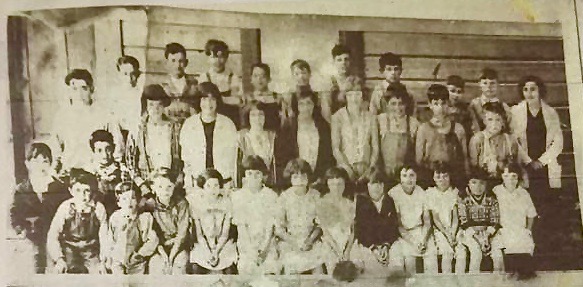
The “Wreckers” didn’t care about these kids. They were only good for labor. Bald Billy Buck, himself a law student at Hastings Law School at the University of California, and who had his tuition partially paid for by Judge Venable, was quoted as saying, “Education is no help to these people. It shouldn’t be put on the shoulders of the successful to pay for it.”

Buck was reducing the uneducated as unworthy. He was referencing the theory of the Helot. Helot was a term used by the Spartans to describe a class of people who were in a sense wage slaves, bound to the soil and assigned to individual property owners to till their holdings; their masters could neither free them nor sell them. The helots had a very limited rights, after paying to their masters a fixed proportion of the produce of the land they worked. In America we refer them to as “Share Croppers,” a state in which the person is only a hair above chattel slavery. After the Civil War ended, Share Cropping was introduced as a way to keep former slaves bound to the land and the plantation owner in business. By the 1890’s Share Cropping had become an institution in America and Willis Buck would have known very well the import of his words.

An article printed in the Oracle quoted Columbia University professor Nicholas Murray Butler as saying, “We need to replace teachers and local school boards opinions on curriculum with education policies set by “College-Educated Bureaucrats.” These administrative “Progressives” forged an alliance with business leaders who liked the idea of top down, expert management of schools. They deplored the idea of local control and wished to lower their taxes by cutting away classes they deemed “Useless and Wasteful.”*

The “Wreckers were certainly aware of a reform movement that advocated replacing women teachers with men. “Feminization” of teachers was a major misstep according to William Rainey Harper, president of the university of Chicago. When Chicago teachers complained, that their wages had been frozen for twenty years and they deserved a living wage, Harper replied that women in the teaching profession should be glad they made as much money as his maid, who worked harder than they did and deserved her money, inferring, of course, that female teachers did not.

Under the guise of “Reform,” business leaders stated that non-university-schooled teachers were not qualified to make autonomous decisions, write lesson plans or discipline children within their own classrooms.* Reform leaders thought that “Normal Schools” gave only the most rudimentary education to women teachers and that graduates were not, thus, fully qualified to manage their classrooms.

Local people may have had just a simple education but they could read. The back and forth agreements were a staple of the local papers. Other county papers watched and commented on the Board of Control’s doings too. Though big city papers didn’t write about local news, they were readily available. Daily papers from San Francisco were brought down by train from the city by the Southern Pacific railroad which had a depot in San Luis Obispo. You could read a paper from Chicago or New York just a day or two old. Newspapers were the only mass outlet for news and were thoroughly read. Readers would not have been unaware of educational doings in other cities. Thinking that people in 1899 were completely unaware of world events would be a mistake. Disincorporation of the high school was a community wide concern and it was clear that the moneyed interests, the big landowners and their crony’s meant to kill the school.

Supporters of the high school were counting on a recent law passed in Sacramento which gave women who were eligible the right to vote in school elections. Governor Gage promptly vetoed it. He apparently stands with the Republican school Wreckers here. Surely women voters, mothers and fathers of children, would have tipped the balance for the school in an honest election. The last one was not honest. People knew that the ballot boxes had been manipulated. The head of the election commission had a vested interest in seeing the school fail as he controlled a very large ranch in rural Arroyo Grande.As Stephen Clevenger said in the Herald, we know because everyone knows that the government can’t keep a secret for five seconds, something that holds true today
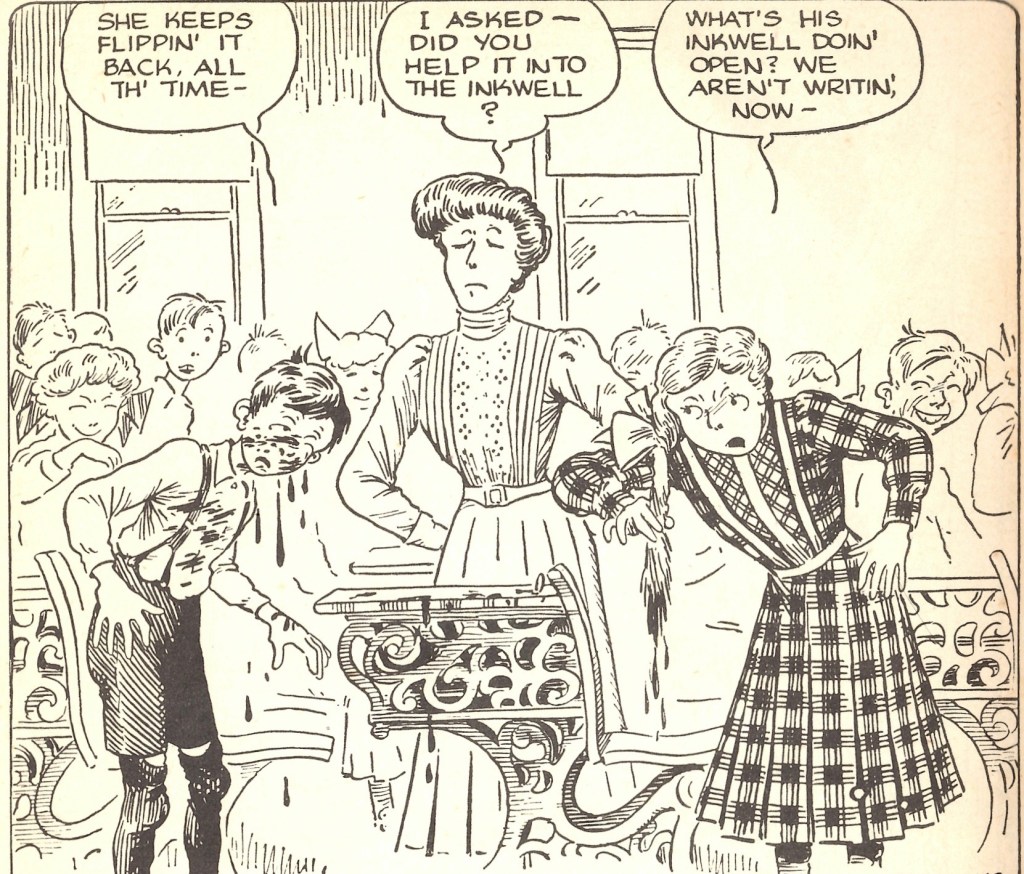
Born 100 Years too Soon. Illustration: J R Williams.

Arroyo Grande Herald: Miss Maud Grieb arrived in this place yesterday where she will spend the summer before retuning to Stanford.
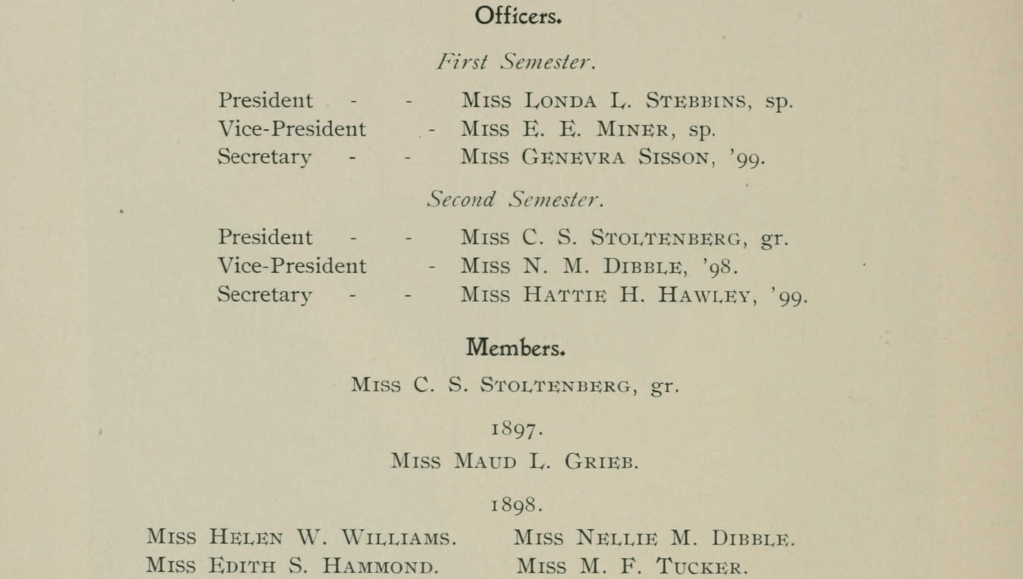
Maud Grieb. Saturday Night Club. Stanford University Yearbook..

The immediate need was for donations to make up the nearly one thousand dollar shortfall in the budget in order to keep the school open until spring 1901. The Wreckers who had a majority of one on the board of control had lowered Professor Parsons salary to $65.00 a year hoping he would resign. He didn’t, so they lowered it to $40.00 and he did. So did the two teachers. They next hired a notorious local drunk and ne’er-do-well named Stringfellow to be the principal and not one new teacher. The students began to skip school. Clara Paulding saw Cliffie Carpenter and Helen Grieb walking arm in arm past Miller’s Stable and blacksmiths shop and asked them why they weren’t in school. Cliffie replied, “He doesn’t teach us anything and the boys like Tom Meherin, Louis Phillips and Charley Phoenix* jump out of the windows and go smoke down by the creek. There is nothing for us to do.” Clara shook her finger at the girls and said, “If you don’t stay in school there will be no school. Take your knitting or a book to read but please stay in school and I will tell the boys’ fathers, who will strip a piece from their backside if they are caught again.” She was as good as her word. All three fathers were supporters of the school. Meherin and Phoenix were both large landowners and had already made substantial donations to the school fund as had the Phillips Brothers.

San Luis Obispo Tribune: About 9 o’clock last evening Marshall Cook arrested one of the denizens of Chinatown who operates a house of ill-fame. She was released on bond of $50.00 by Judge Egan.($1,500.00 today)

The fund to support the school was quickly raised and the class of 1901 was assured of graduation. What kind of education they got was up for debate as the new principal did not change his stripes one bit. Nevertheless the class would graduate in the spring.

Arroyo Grande Herald: 1898: Mister John Corbit a well-known citizen of this district is being mentioned in connection as a candidate for county Sheriff. He will make the strongest possible candidate that the party could put up.
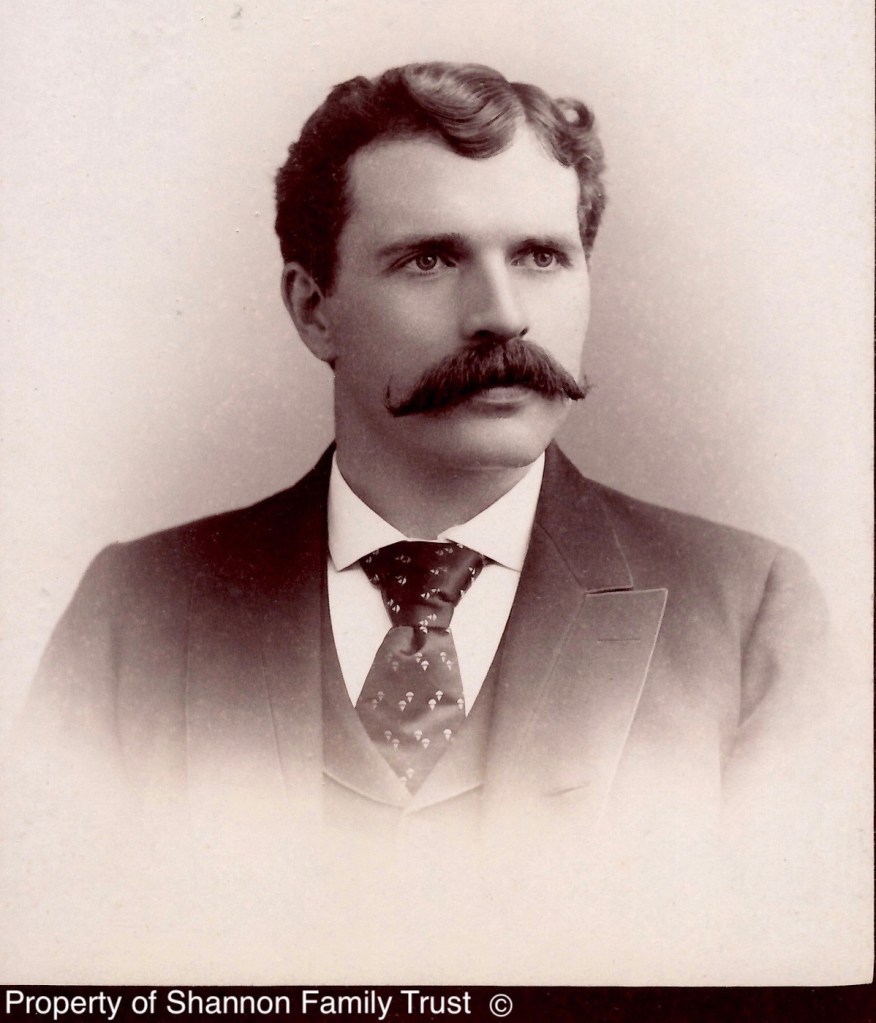
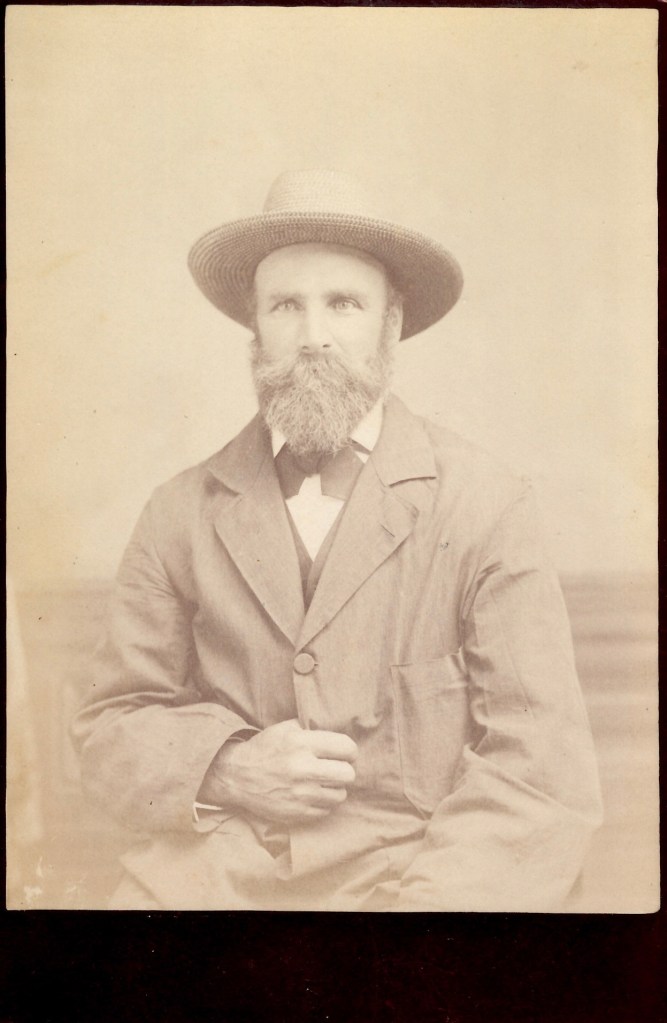
The Honorable John Corbit From County Cork Ireland. B. 1832, D. 1912. Photo from Pat Moores photo album. Shannon Family.

Arroyo Grande Herald: 24th June, 1899: At Oak Park, Mr and Mrs Willis Buck, born, a son.

Arroyo Grande Herald: 25th June, 1899: At Oak Park, Mr and Mrs Willis Buck, a son. Died.

The members of the save the school committee tasked with exploring the legal issues surrounding the closing of the school went to work. Three local businessmen, Thomas Hodges, Amos Henry and the publisher of the Herald, Stephen Clevenger began looking into any legal issues they thought might give them an opening into reversing the decisions of the Board of Control.

Amos Henry was a young father with a 5 year old son, Daniel. At 31 he was successful farmer and lived and farmed on what would become Mason Street. He and his wife Aurelia were both community mended. Amos went on to become county assessor and was active in many organizations such as the IOOF. He was cerainly concerned for the future education of his little boy.

Thomas Hodges was also a farmer and grew fruit trees on the Arroyo Grande road southwest of town off todays Halcyon Road. His farm was where the mobile home parks are today. He and his wife Sarah had six children. All educated in Arroyo Grande schools. Thomas’s daughter Rose taught at Los Berros school in the 1890’s. Well known was their son Virgil who Chronicled life around the turn of the century with his camera. Virgil who always listed himself as an artist, left us an incomparable record of photographs of our town and the people who lived here. Virgil was a 1897 graduate of the high school.

Virgil Hodges, left and friend on the Pismo Road. After the turn of the century. Virgil Hodges Photo.

Arroyo Grande Herald: It is high time the responsible citizens of the Arroyo Grande district arise and stamp into dust this whole hissing nest of vipers trying to dismantle education and bring anarchy to our school system.

After the citizens meeting at the Good Samaritan Hall, Mrs Paulding began going door to door, buttonholing anyone would would listen to her about the value of higher education. Carefully skipping around the manure dotting the dirt streets, pinching her flounce and lifting it to keep her hem out of the muck as she knocked on door after door. Some remained closed to her but most opened up and listened to what she had to say.

The flyer she carried was headed with the phrase, “The Plain Facts.” It went on to say that it had been requested that the flyer be circulated by the friends of the high school. In it they encouraged readers to take a look at the statements being made by the board of control; to wit:

1.That it is not possible to continue the high school because of the dissatisfaction of the people.

2. The majority of the board of control are opposed to the continuance of said school. (Six to five.)

3. As the high school district is so large as to make it impossible for students to travel to and from the school, property owners should not be taxed to pay for the school as no students would be wiling to travel that far to attend.

Mrs Paulding pointed out that there was no dissatisfaction by the public except on the part of the board of control whose six majority office holders were in fact large property owners who represented considerably less than a third of the district’s students but more than 60% of its land.

She also pointed out that 80% of all students who attended the school lived within four and a half miles of the school, a distance easily traveled by horse or wagon. The Patchett family farmed and ranched on land adjacent to Willis Buck. She stated they had no problem getting their children to school. In fact, the Fink children were students who traveled more than eight miles to school. She mentioned the Phoenix children and the Harloes who lived fifteen miles away on their ranches but who also maintained houses in town. Both families had homes off Bridge street which were within easy walking distance of the school. Ex-supervisor Moore and his wife Sarah also provided rooms for children during the week.

Clara said it was clear that there was a great deal of support for the school as evidenced by the funds the committee had raised to support it.

Mrs Paulding was quick to point out that the school had twenty-four students currently attending the school that came from these outlying district and that there were an equal number who would graduate from the eighth grade in May ready to enter the high school in the fall.*

She also said that without a high school diploma no student would be able to enter the state’s universities. There was already talk from the State Board of Education that the Arroyo Grande high school would lose its accreditation over the propose disenfranchisement fight.*

The opposition had also been saying that the grammar schools curriculum had been corrupted and that the Normal Schools had indicated that no graduate would be qualified to enter there. Clara was quite clear that this story being put about by the Wreckers was an outright lie and could easily be disproved.

Arroyo Grande: Died, Oliver Taylor, age 70

The three men working up a legal case against the board of control were ready to go to court. They had been working with the county District Attorney to draw up a bill of particulars stating the various crimes and misdemeanors of the Wreckers. A hearing would be held in the San Luis Obispo courthouse.

The Herald also posited that since nearly all of the grammar schools in the district had with withdrawn from the union high school, their seats on the board of control should be vacated as they no longer represented the school.

Arroyo Grande Oracle: An automobile passed through town yesterday on its way to Solano. It runs by steam.

Everything came to a head in September of 1899. The “Wreckers, by a single vote of the board of supervisors reduced the budget for Arroyo Grande’s high school to the point where it simply could no longer operate.

The Citizens Committee to Save the School quickly raised enough money through subscriptions to make up the budget shortfall and thus ensured that the school would remain open until June of 1900.

Up at the county courthouse Oliver Pence, the attorney representing the “Friends” was meeting with County District Attorney Arch Campbell who had won election the year before, defeating Fred Dorn who was no friend of the school. The Tribune wondered what kind of strategy they were cooking up behind closed doors. Willis Buck, who happened to be in San Luis was quoted as saying, “I will not show the white feather,* no threats from the committee will stop us from closing the high school. It is a burden to all taxpayers and must go.” Buck, Miossi, and Donovan are having a lively time of it said the Tribune.

Buck was soon to find out what they were up to. On Sept. 14 the district attorney issued a citation ordering W. B. Buck, et al, to appear in court on Wednesday the 20th to show cause why they should not be removed from office and judgement of $ 500.00* entered against each of the board members who had voted to reduce the budget and close the school.

Both parties appeared before Judge Unangst in superior court at 10 am. The “Wreckers’ immediately requested a continuance citing too little time to prepare their case. Judge Unangst granted the request and set a new hearing for the 22nd. That too was postponed for the same reason though Judge Unangst was not pleased with the continued delays by the “Obstructionists.” The opening of the trial was now set for Wednesday the 28th.

Outside the courthouse, Bernard Miossi, who represents the Pismo school district on the board of control of the high school said that the board would hold a meeting to formally close the school on Saturday. Daniel Donovan who is a member of the board from the two Los Berros schools agreed with Miossi that the school should not continue. They both said, “This will be an exciting meeting; the school, will, be closed however They can’t stop us, we have the majority.”

Except that it wasn’t. The citizens committee showed up at the Columbia Hall in force. They far outnumbered tose who wanted to close. It was a standing room turnout. Many fine speeches were given opposing the closing of the school. Mrs E. L. Paulding took the board to task stating that what they were doing was illegal and if they went ahead she would see them in jail for breaking their oath of office. At the end of the night the majority, the “Wreckers” voted to table the motion to close until after the superior court made its ruling. That trial was due to begin on Thursday the 28th and the majority said they were ready and would prevail.

Reported Expressly for the Tribune by P. A. H. Ararta in superior court the Hon. Edward P. Unangst, Judge, September 28th, 1899.

Plaintiff R. B, Musick* vs. Willis B. Buck et al. The defendants request for a trial by jury denied by Judge Unangst. The judge stating that he had had enough delays. The defendants then demanded that they be tried by separately. Denied again. Judge Unangst was visibly angry and threatened the defendants with contempt for their attempt to delay the proceedings. The defendants then asked for a continuance of five days on account of the absence of a material witness, viz: Mrs. A. C. S. Woods. Motion again denied. The following witnesses testified for the plaintiffs. D. Newsom, Albert Fowler, Mrs Clara Dudley Edwards Paulding, A. Slack, Geo. Balaam, Frank Swigert, Robert English, and A F Parsons.

David Newsom, was the son of Frank Newsom who built the first school at Newsom Springs but who was opposed to the high school. There must have been some interesting conversations around the kitchen table up in Newsom’s canyon.

Others testifying for the plaintiffs were Albert Fowler, the father of three young children was a farmer, Albert Slack an accountant, George Balaam, a Gensler (Goose breeder), Frank Swigart, a farmer, Robert English,* Arroyo Grande’s undertaker and A F Parsons, the county surveyor. They were all parents of children in school.

The missing witness, Adelaide Woods was the San Luis county superintendant of schools. She was the first woman elected to that position. She was a graduate of the state normal school in San Jose, the future San Jose State University and had taught a year at the Alma school, San Jose and two years in Eureka, Humboldt county. She taught at the Court school in San Luis before being elected to the job as superintendant. In fact, she was the first lady elected to any office in the history of the county. She was just 35 years old and had been elected in 1898 . She had been instrumental in collecting furnishings, books and other supplies for the Arroyo Grande Grammar school after it was destroyed by fire. It would be interesting to know what the “Wreckers” had in mind when they asked her to testify. It isn’t likely she would have been in favor of closing the high school. She had been elected and began serving the previous year and its easy to imagine her thought process. She had to uphold her office, an elected office to boot, and her primary job was supporting education. It’s difficult to imagine what the “Obstructionists” were thinking. It was extremely unlikely she would have anything to say to support the actual closing of a school. She made herself scarce.

When testimony was concluded, judge Unangst continued the trial to the next day, Friday the 29th for closing arguments. He said he was curious what the “Wreckers” might say in closing as they had produced no witnesses for their own defense.
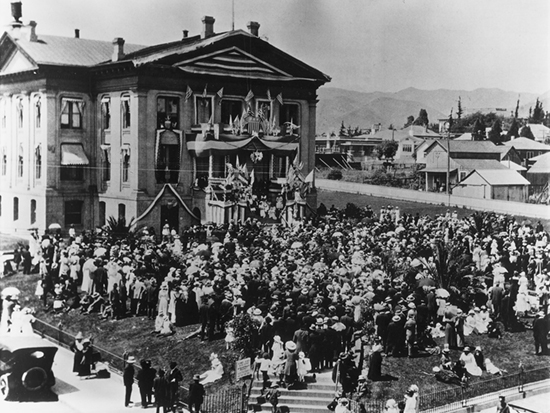
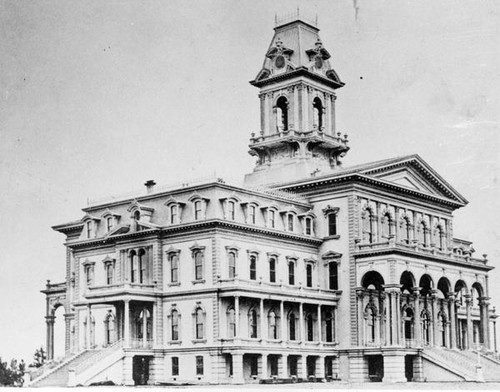
San Luis Obispo Superior Courthouse, Fourth of July, 1898.

Late on Friday morning Judge Unangst ordered that the case of Musick vs. W. B. Buck be called. The attorney for the plaintiffs, Oliver Pence rose and informed the judge that the parties had reached an agreement and moved that the action be dismissed without prejudice* , and without costs to either party. Judge Unangst took a long moment then asked the attorney for the “Wreckers” if they agreed. With the answer in the affirmative he dismissed the case.

Overnight a deal had been reached. When the remainder of the case was presented to Buck, he realized he was done. State law required that an elected board could not dissolve itself. Elected officials, sworn to duty could not, as part of that duty, vote to disband themselves. In effect, closing the school was a crime under state law as they were duty bound to continue education at the high school level. The schemers would be liable for fines and possible incarceration if found guilty. Willis B. Buck was forced to show the White Feather. The high school was saved.

San Luis Obispo Tribune: Popular school teacher Miss Mollie O’Conner and several of her friends were up from Arroyo Grande yesterday.

In Arroyo Grande an election was immediately held in which new trustees were elected. The three remaining grammar schools and the high school board voted that Frank Parsons be rehired as principle and Amos Henry was then voted in as president of the school board. The withdrawal of eight of the grammar schools in the south county now meant that the individual school would no longer use their budgets to help support the high school. They would also no longer receive revenues from the high school which would reduce their operating costs. The new high school board, according to Amos Slack, the district accountant, needed to establish a fee for out of district students to attend the school. On the recommendation of Mr. Slack a charge of $2.50* a month for each student was so ordered.

The withdrawn grammar schools almost immediately began to hear complaints from parents that wanted their children to attend high school. What once cost them nothing suddenly became a burden on their pocketbooks and they let the trustees of their schools know it. To use an old phrase used at the time, they had “Shot themselves in the foot” or, as the case may be, their collective feet.

Those that followed the lead of the “Wreckers” now suffered with them. Over the next few years all the grammar schools that had jumped ship came crawling back and rejoined the Union High School District.

The High School Citizens Committee: The citizens committee in defense of the high school feels it must commend Mr. Clevenger for his unstinting support of the school these last nine years. His defense in preserving the school and defeating the opposition cannot go unnoticed. The committee takes great pleasure in saying a word in behalf of his generous and unstinting work. There is nothing that lends general prosperity to the common welfare of a community like an active local paper, one that is in harmony with the town and its beneficent institutions. Without Mr Clevenger, the high school would have been closed some time past.


The Herald Recorder Building erected by Stephen Clevenger in 1897. Arroyo Grande Herald photo. 1963

Arroyo Grande Herald: The Herald says that the class of 1901 of the Arroyo Grande High School will hold its commencement exercises at the Columbia Hall next Friday evening, May 31st. Doctor Thos. Hoyer will be pleased to give the commencement address The members of the class consider themselves very fortunate in having a school from which to graduate. The four* young ladies of the class are Mary v. Keown, Lou F. Parsons, A Gelka Barcella and Lorena B. HaskinsThey will be tendered a reception by the other three classes at the Union Hall this evening at 7:00 O’clock.

The program is as follows:

Song, “The Bugler”, John “Jack” Shannon*

Recitation: The Hen with One Chicken by Miss Stella Sims.

Coon Song; Six Girls*

“The Kitchen Clock,” Duet, Hazel Miller, May Clevenger

Selection, Orchestra.

Recitation: The Little Runaway, Florence Lynam.

Song: The Boot Black*, Eight Boys.

The Class Colors are Green and Pink.

Master of ceremonies is Miss Belle Bowden. Assistant Principal

So the “Wreckers” slunk back into their caves like the snakes that they were and nothing more was heard from them. Willing to destroy an educational opportunity for the children of the Arroyo Grande Valley they received their comeuppance from a dedicated citizens group led an educated woman whose life had taught her that you must take no prisoners when it came to matters of principle.

Herald Recorder: The high school will be constructed on new lines. This ought not to be such a hard job with such workers as Mr. Newsom, Mr. Fowler and Mrs. Paulding at the helm. The high school district and the people will fall right in and carry them out. We must have no more “Dog in the manger practice.”

Arroyo Grande High School, built 1904

Arroyo Grande High School today numbers more than 2,000 students. It is a California Distinguished school and boasts a 96% graduation rate. All of this grown from a tiny school with no building of its own founded in 1895. Today, one of the districts middle schools is named for Clara Edwards Paulding’s daughter, Ruth who taught for over thirty years in the district. Ruth Paulding taught both my father and my uncle. My children both attended Paulding middle school. The Paulding family home is now a state park museum and is open to the public.

On a final note. History like all of life is a very flexible thing. The issues written about here are still with us today in perhaps a slightly different form but nonetheless they are still bones of contention. Educational issues are never truly finally fixed. This has been an extremely interesting story to write about. All I can say is that, be like Clara, do your homework, work hard at educating yourself about educational issues and don’t be afraid. History tends to treat women as subtext, but be assured that, just as today, they were a serious factor in 1901 Arroyo Grande.
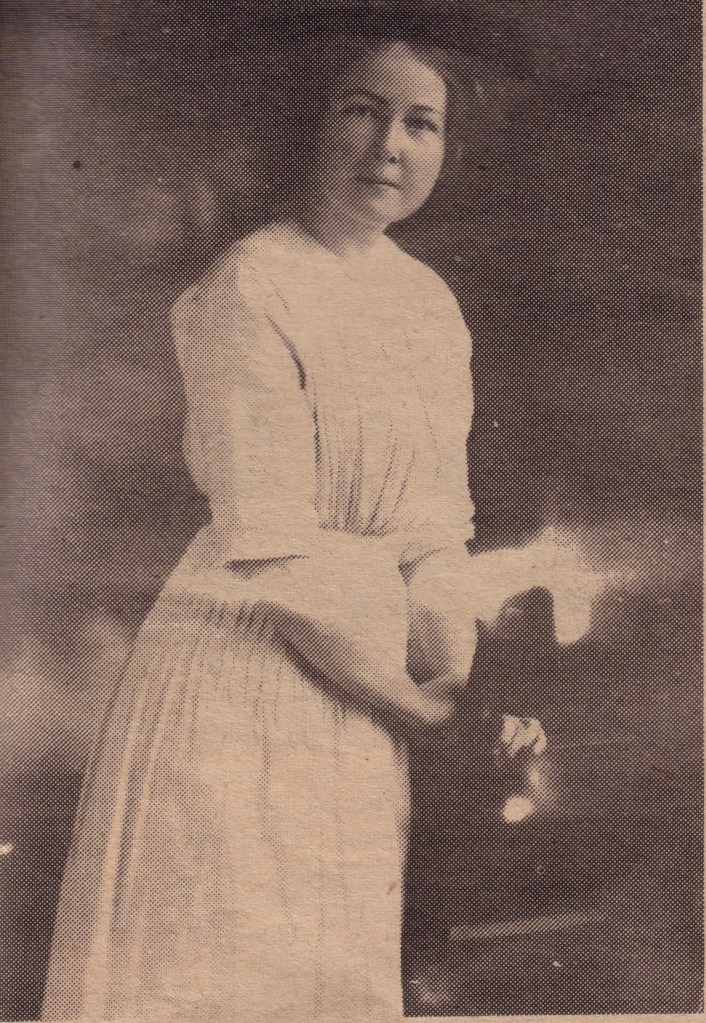
Miss Ruth Paulding.

Notes:

*The cover photo is of the new grammar school that replaced the one destroyed by fire. It was razed in 1931.

*Professor Nicholas Murray Butlers opinion that schools should be run by “College Educated Bureaucrats” is now the norm.

*Administrative bureaucrats posited that discipline should only be meted out by “Qualified Professionals.”

*Neither Tom Meherin, Charley Phoenix or Louis Phillips graduated with their class in 1901 though they were all from prominent and well off families and their fathers were supporters of the high school.

*The High School did lose its accreditation. My grandmother, Annie Gray graduated from the eighth grade in the spring of 1901 from Arroyo Grande grammar and would begin as a freshman that fall. Because she intended to enter the University of California she was forced to travel down to Santa Maria for high school where she graduated in 1904. She was a graduate of Cal, class of 1908.

*$500.00 in 1900 money is the equivalent of more than $18,000.00 today. It would have been a devastating fine.

*The white feather is a widely recognized symbol. It has, among other things, represented cowardice or conscientious pacifism; as in A. E. W. Mason’s 1902 book “The Four Feathers”. In Britain during the First World War, it was often given to males out of uniform by women to shame them publicly into signing up for the slaughterhouse in France. The true origins of the term are lost to history but Billy Buck certainly knew it was meant to show cowardice.

*R. Musick was a rancher in the upper Arroyo Grande and was the father of well known author and historian Madge Musick Ditmas who wrote a column on local history for the Herald for over thirty years . He is credited with being one of the county’s first grape growers.

*Robert English the town undertaker displayed my great-grandfather John Edward Shannon in his coffin behind the window of his parlor on Branch Street in 1924. I went to school with his grandson Jack, who is my life long friend.

*Communications marked as ‘without prejudice’ cannot be used by the other party as evidence in court. This means that parties can speak openly about the matters in dispute without the risk of the other party using that information against them later.

*The $2.50 a month is roughly equal to $90. 00 today. A serious levy for 1900.

*The four young ladies that graduated in 1901 were the remains of a freshman class of 18, including 6 boys.

*Coon song or “Turkey in the Straw” is a folk tune that been around in the United States for almost 200 years. With lyrics clearly intended to parody the speech of African-Americans in the rural South, it became a staple of minstrel shows and blackface acts into the twentieth century. It was a popular black-faced minstrel show song and one of the most popular sheet music covers for the song is dominated by an image of a caricatured black man. In sum, it appears that most credible sources date “Old Zip Coon” as the earlier song. “Turkey in the Straw” is adapted from it. The song illustrates the systemic and casual racism of the time. The civil war was part of the experience for many Arroyo Grandeans, many having fought in or migrated west from the border states. A large number of citizens had come out of Missouri after the war and brought prejudices with them.

*The Boot Black is another racially centered song. History shows that though it seems that no real changes have been made in our country’s conversation with race the opposite is true. The kind of overt racism presented in this music would not be tolerated today, at least in public.

*Prejudice against the Chinese was also extreme at the time. The Chinese Exclusion Act was approved on May 6, 1882. It was the first significant law restricting immigration into the United States. In the spring of 1882, the Chinese Exclusion Act was passed by Congress and signed by President Chester A. Arthur.Jan 17, 1882. Following the passing of the Chinese Exclusion Act, a period known as the “Driving Out” era was born. In this period, anti-Chinese Americans physically forced Chinese communities to flee to other areas.

*You will note that my grandfather Jack Shannon sang at the 1901 graduation ceremony though he never attended a single day of high school. He also played on the high school baseball team. Such was life in small town America at the turn of the twentieth century.

*And finally, Little Bald Willis Buck never went to law school. He lost and the judge never paid up. He died in Avila Beach, CA in 1933. In the ultimate irony, all of his three children went to high school.

*Patrick Moore ran for supervisor against Gilliam in 1902 and reclaimed his seat by a large margin.

*On a final note, the author went to school with the descendants of nearly all the families written about in this article. Patchett, Fink, Harloe, Phoenix, Donovan, Newsom, Fowler, Miossi, Jatta, Moore, Gray, English, Swigert and the others who still reside in our county.

Michael Shannon lives in Arroyo Grande and is a graduate of Arroyo Grande high school as were his father and uncle, 1928 and 1930. Both of his sons are AGHS grads also. He, his wife and his brother and sister-in-law all taught in the school district.

Link to Chapter one: https://wordpress.com/post/atthetable2015.com/11202

Link to chapter two: https://wordpress.com/post/atthetable2015.com/11890

Link to Chapter three: https://wordpress.com/post/atthetable2015.com/11815

Link to Chapter four: https://wordpress.com/view/atthetable2015.com
Standard

The Wayback Machine 2

Chapter Two

THE OLD SCHOOLS TAKE SIDES

By Michael Shannon

Introduction

People prefer to find order and beauty in the past. The heritage business is devoted to making sure they do. Textbooks are written which carefully polish the past until it shines.The silk ropes strung before the exhibit are meant to keep you out. The partition is to block your view. There is no place you can stand to see all the parts at once. Much of history is the shadow of somthing, blurred, which fails to to mark the place where an event, almost familiar, once was. Much history has runoff like water after a storm. It’s blown by the wind into nothing. Sometimes, from the tail of the eye an image appears. You have caught an instant of transparency, then the present draws the veil. This is a tiny drop of that local history, long, forgotten.

Arroyo Grande Herald: Sept. 10, 1898.

There are a number of citizens who are anxious on one ground or another that the educational facilities of the Arroyo Grande region should not have a high school….

So began the editorial laying out of the back and forth war between the factions who were at odds over the continuation of Arroyo Grande High School.

Arroyo Grande Herald: There will be a third stakes race Saturday at the Arroyo Grande Chataqua grounds between Jake See’s “Jennie T” and Will Heath’s “Perrine,” an eighth of a mile for a $ 50.00 purse. ($1,9750.00 )

In the very beginning Don Francisco Branch had sent for his sister, asking her to come out to California to take in hand the teaching of his children and those of his employees sometime before 1848. She made the trip from Scipio, New York to California by sail from New York to Panama, crossed the isthmus by mule and sailed north to California arriving in San Francisco in 1848. Escorted by a party of Rancheros returning to their ranches in the Cow Counties, she arrived safely after a trip of around 7,000 miles. She spent three to five months on the trip. She survived Bandidos, yellow fever, malaria, bad food, sea sickness and a great deal of discomfort. The trip cost between three and four hundred dollars. Getting to the west coast cost roughly $11,000.00 in todays dollars. Francis Branch could afford it. Most travelers were wealthy enough to pay their own way. This meant that most immigrants had some education and important skill in order to pay their own way. The poor stayed home.

Don Francisco Ziba Branch, sailor, mountain man, trapper storekeeper and Ranchero. Litho Print from 1860’s.

Miss Branch taught in the Branch home of her brother for five years. She did not speak Spanish, though it was the universal language of California before the gold rush. She learned quickly enough. She taught basic reading, writing and arithmetic along with drawing and music. The children taught her Spanish and how to ride horseback in the Californio style where women rode astride like a man. Once her students were old enough they were sent up to San Francisco to be “Finished.”

Arroyo Grande school, 1867. The first after the township was formed. SCHS photo

In 1867 Francisco Branch deeded a plot of land on todays Nevada street and a small wooden schoolhouse was built there. It was the first.

Arroyo Grande grew exponentially after the War Between the States. As always, wars create a world of widows and orphans. Add to this hundreds of thousands of veterans of the brutal fighting it is no wonder people felt the need to pick up and go. Go west it was and many came here.

Large landowners in California, the original Rancheros had little choice in finding a way to profit from their vast holdings. With statehood, organized government demanding taxes and the decline of trade with the east, the Ranchos were sold or were broken up, subdivided and along with active boosters who advertised nationwide, small farm took on a new importance. Many of the new residents were veterans. They brought their families with them and were familiar with schools in Ohio, Indiana and Illinois, where many came from, the wanted the same opportunities for children here.

Arroyo Grande Herald: The Philllips boys have shot a Condor in the upper Lopez. It measured over nine feet wingtip to wingtip.

The teachers were no longer adventurers or men and women who had some education that supplied the first decades of schooling in the Arroyo Grande valley but graduates of the Normal Schools. The California State Normal School was the first teaching college in state, founded on May 2, 1862. The school later evolved into San José State University in San Jose. The southern branch campus evolved into the University of California, Los Angeles.

California State Normal School, San Jose. 1888. Calisphere photo archive

The San Jose school was created when the State of California took over a normal school that educated San Francisco teachers in association with that city’s high school system. This school was founded in 1857 and was generally known as either the San Francisco Normal School or Minns Evening Normal School.

San Luis Obispo Tribune: County hunters asked the Board of Supervisors to set a bounty on Blue Jays. The birds eat the eggs of quail and other game birds and reduce the populations. They have also been known to kill small children. The board will take this under advisement.

Normal schools were developed and built primarily to train elementary level teachers for the public schools. The term “normal school” is based on the French école normale, a sixteenth-century school with practice classrooms where model teaching practices were taught to teacher candidates.

San Jose State Normal School students about 1896. Calisphere

The Anna S. C. Blake Manual Training School, opened in 1889 was located in Santa Barbara, taught home economics and skills like sewing and cooking. Sloyd, a Scandinavian system of handicraft education, was also offered at the training school. Almost all of the original teachers in our town were graduates of one of these two schools. Margaret Phoenix Harloe, Hattie and Mamie Tyler, Molly O’Conner Moore, Gladys Walker Sullivan, and young women of the Rice, Poole, Conrad, Carpenter and Ide families.

Education was important to families with children. They wanted the best they could get but large landowners, businessmen and those with no children in the home were far less concerned about education and much more concerned with the taxes that supported the schools and that’s where the trouble started.

San Luis Obispo Tribune: The proposal to apply for a Carnegie Library in this place has met with stiff opposition from certain taxpayers. The application has been tabled until more study can be done. The opposing parties claim there is not the slightest reason to provide free books to the public. They state that it is a well know fact that excessive reading leads to sloth and indolence.

In 1893 when the high school was proposed a vote was held using the Australian voting system. It simply required that the voter write yes or no on a slip of paper and drop it in the box provided. There was no requirement that voters be registered only that they be personally known by the clerk accepting ballots. The system worked quite well as there were less than sixteen thousand people in the entire county. Arroyo Grande had a rough population of about 466. The demographic area covered the entire lower and upper Arroyo Grande valley. Oak Park, Los Berros, Cienega, and Oso Flaco, the Pismo and Nipomo votes were counted as well. A small population but they had pretensions.

The Arroyo Grande Herald: Saturday, June 3, 1893. “From the official returns of the election of May 27th, 1893 proposing the formation of a Union High School District a large aggregate of the votes tallied from the districts proposed a large percentage, 181 yea, 11 nay, the election is hereby carried. The nay votes came from the following districts; Arroyo Grande, three, Branch, two, Oak Park, four, West Los Berros, one and Los Berros one. All other districts were carried in a convincing fashion. We will have a high school.

In those Nay votes were the seeds of rebellion which began showing itself very quickly. Each of the smaller elementary schools would pay a portion of the tax needed to fund the high school as the California Supreme Court had ruled that taxing landowners to pay for high schools was illegal under the states constitution. It only took a few years for the big ranchers to figure out that if they could get the small elementary school districts to leave the union of schools which supported the high school, the school would fail for lack of funds. A number of them went to work. They weren’t shy with their opinions either. The newspapers of the south county reported on the doings on a regular basis. The Arroyo Grande Herald, owned by Stephen Clevenger who had arrived in Arroyo Grande from Missouri by way of Santa Cruz, promptly founded a wife, Edith Finney with whom he started his first paper there. He came down to Arroyo Grande, started a new paper for which he was owner, editor and publisher. Known as the Weekly Herald, Clevenger quickly demonstrated that he was without fear when it came to reporting the doings in the valley. He was definitely pro school and went after the men he called “Wreckers” with a vengeance.

Arroyo Grande Herald: Lodge no. 258, I. O. O. F. The Angel of death has invaded our mystic circle and removed from us our beloved brother, I. D. Miller. In his death our order has lost an active and useful member and the community a useful person. A.F. Parsons, Secretary.

Saturday go to town, Branch Street, Arroyo Grande. Photo, California Historical Society. Town constable Henry Llewellyn was shot in the doorway of the Capitol Saloon, left, and died the next day in the Ryan Hotel. Ryan Hotel is the large building distant left. Peter “Pete” Olohan’s building is the tall building on the right. There are eight saloons in this photo. Saturday afternoon was shopping day for the rural ranchers and farmers. A time to stock up on necessities, get the local gossip and scheme and deal politically.

Self styled important men objected to the high school and met at Pete Olohan’s saloon on Branch Street to hack out a way to get the school closed. Sitting around a table on a Saturday afternoon while their wives did the weekly shopping, they pulled on cheap cigars and passed a bottle around and discussed strategies for closing the school and getting themselves out from under the burden of paying a tax they didn’t agree with. Daniel Donovan owner of substantial acreage in the west Los Berros section, Ed Newsom, Hotel owner and farmer from the Newsom Springs ranch on the old Santa Manuela Rancho, Bernard Miossi owner of Sycamore Springs and Willis Buck who was ranching on the Corral de Piedra and Oak Park area planned a campaign to relieve themselves of the property taxes that supported schools, particularly the new high school. Sitting with them was Judge Venable from San Luis Obispo who controlled the big Biddle Ranch in the northern end of the valley.Their scheme was to find a legal way to close down the high school district, and if no strictly legal way could be found, well….

The Newsom Sulfur Hot Springs Hotel, 1887. Calisphere photo

Arroyo Grande Herald: Charles S. Clark M.D. Professional calls attended to, day or night.*

The group chose young Willis Buck as their spokesman as he was studying law and being advised by Judge Venable and apparently had a big chip on his shoulder. It pretty evident that Stephen Clevenger of the Herald didn’t care for him as evidenced by this description which he published soon after the meeting at Olohan’s. “Little Wrecker Billy Buck” or “Little Baldy Billy Buck” were terms the paper used to get under his skin, both of which just made him angry. Clevenger kept it up.

The Wreckers put the first part of their scheme in motion soon after the September 4th, 1897 meeting at Olohan’s. The began to pressure the clerks of the board who held the elementary schools vote to terminate the Union with the high school, thus depriving the school of it’s main source of income, the districts elementary schools who paid into the high school operating fund. They also called upon County Superintendent Messer to schedule a special vote to elect a new High School board. No regular vote was scheduled but political pressure and the thought that the voters, all men of property of course, would support the school as they had done in 1893 when it was first approved, convinced Messer this election would end the same way. Women who were likely the most concerned for their children were still more than twenty years away from suffrage and were excluded.

The third leg of the plan was to pressure the voters of the old fifth supervisorial district to vote out the incumbent, Patrick Moore. He had announced for a third four year term and was known to be a supporter of all schools.

Patrick Moore was born in Cavan, Cavan, Ireland and had immigrated with nearly his entire family to the old Guadalupe Rancho in the Santa Maria area. A very successful rancher, farmer and… as he always listed on his census forms, Capitalist. He owned wide swaths of property in the Santa Maria and Arroyo Grande area. He had spent eight years as a supervisor in was was still known in the later nineties as the “Bloody fifth,” a sobriquet that was very well deserved. Hardly a week passed without a report of a murder, Saloon shooting, accidental death by gunshot, crushed by accident, dismemberment, fratricide and the killings of wives, children and husbands and neighbors. The newspapers from the Paso Robles Leader to the Arroyo Grande Herald faithfully listed the mayhem. If a person survived all the above, they still might be poisoned, killed by bad food or eating too many green Cherry’s. They could be shot in cold blood by the road agents and bandits which infested the still rural “Cow Counties.” For children, dying before five was also a distinct possibility. Horses routinely caused mayhem, kicking men to death, crushing and running away with their owners happened all the time. A spooked horse reared and then backed a buggy with its driver and her infant daughter over the side of the railroad bridge and miracle of miracle, no one was hurt unless it was the horses dignity. There is is only one recorded legal hanging in the county, all the rest, and there were many over the previous 45 years, had been impromptu. The latest, a lynching of a fifteen year old and his father from the Pacific Coast Railroad bridge in 1886 by “men unknown.” A curious part of that event is that the men were certainly not unknown and were in fact, some of the leading citizens of Arroyo Grande. An older man who spoke at my grammar school when I was 11, told us of his father being called out at night to assist in the lynching of the man and his son. He said the men doing the hanging were known to all, their names were an open secret. A state detective was ordered in to investigate the extra-legal murders but interviews with the towns citizens yielded no one iota of information on the identities of the men who did the deed. Mrs. Eldridge’s daughter Missouri was one of the children who witnessed the dangling bodies the next morning on the way to school.

The Arroyo Grande Herald: Many Children See Bodies. Missouri Eldridge, chattering gaily with her chum approached the bridge over which the children crossed each day to the schoolhouse. “Oh, Zoo! There the most terrible thing on the bridge.” Exclaimed one of the group of breathless girls rushing back to her. But Missouri was not to be plagued. “Don’t be silly.” she replied sedately. “You are only trying to fool me because this is April Fools Day.” Then, her eyes widened as she stared past the chalk white faces of the other girls for she saw they were not fooling, indeed. She saw, hanging from the bridge, the bodies of a man and a boy, hung during the night. She ran home to tell her mother.**

No legal measure was ever filed against them. My own great-grandfather was known to carry the Smith and Wesson 41 caliber pistol he had used as a Santa Clara County deputy sheriff in his front pocket on occasion. Very little law enforcement existed beyond the town constable. Nefarious deeds were seldom punished. Most citizens seemed to take a certain Ho Hum attitude about it all. What is common fare is barely noted, even today.

The offending bridge. Home to buggy accidents, impromptu lynchings and even an occasional train. Pacific Coast Railroad, photographer unknown.

The bridge was one of only two ways to cross Arroyo Grande creek. There were few houses on the east side an area that was still mostly small holdings and farms. The dirt paths and buggy crossing illustrate the fact that it was routinely used by pedestrians, wagons and the train. This bridge would be washed out in the floods of 1911.

Arroyo Grande Herald: September 8th, 1897: Yesterday at the Cienega just south of Arroyo Grande near supervisor Moore’s home a sad accident occurred . The ten year od son of Mr and Mrs Costa who live at the old stagecoach stop along the Nipomo road was playing with a loaded gun which accidentely discharged killing his infant brother. The parents of the children were away from the home at the time. The Coroners inquest was in accordance with the above facts.

The Costa home, lower Bridge Street and Nipomo Road, late 1880’s. Arroyo Grande Herald Recorder, Costa Family Photo.

In 1898, the superintendent of county schools realized that he was up against real opposition to the Arroyo Grande high school. Screeching and whining had finally reached the point that anti-school “wreckers” were on the march and meant to throttle the high school once and for all. They were aiming for Supervisor Patrick Moore and citizens wondered where they would strike after that.

San Luis Obispo Tribune: Mrs Strobridge will have her yellow dog safely in her possession. City Marshall Cook confirmed her that his brother, City Marshall of Morgan Hill has found the dog and arrested the man who swiped him. The yellow dog will be brought back to this county and will be made to tell what he knows.

It was reported that Supervisor Moore would sit on the Dias at the courthouse in San Luis Obispo and with a sphinx-like expression and was rarely readable until he made his decision. He was also immune to bribery. As a supporter of education and a rich man, he was bulletproof when it came to lending support and his personal fortune to the school district. For many years and into the decade to come he consistently used his money to pay tuition for boys and girls who were off to school to become professionals. Numbers of young women including my grandmother were recipients of his largesse. No school was ever given his name but a local elementary school carries the name of a young woman who became a teacher thanks to Patrick and Sarah Moore’s generosity. Obviously in order to guarantee the success of their scheme, the Wreckers had to boot him out of office.

Annie Shannon nee Gray, The honorable Patrick Moore and Mary “Molly O” O’Connor schoolteacher. 1900. Shannon Family Photo.

The election of 1898 saw many scenes that would be entirely familiar today. The Wreckers put up a candidate named John Gilliam. Gilliam had been the supervisor for the Santa Margarita district but was tossed out after a single term. Moving from that district to Pismo Beach he declared himself a candidate for the fifth against the incumbent, the Honorable Patrick Moore the two time holder of the seat. There were three challengers initially but after some closed door meetings two of them “graciously” withdrew their names from consideration. The Herald reported this incident with more than a touch of snark, stating that “What promises were made is unknown but it is certain they were made and if Gilliam wins will be fulfilled.”

Arroyo Grande Herald: October 8th, 1898. Say! It was rather nice for Fowler and Eddy to step down and out and make way for Gilliam wasn’t it? Such exhibitions of “Good for the order” are so seldom met with.”

Pat Moore was a popular man in the fifth and was considered a fiscal conservative. In the way that politics works, his record as such was used against him. In the last quarter of ’98 he had voted to do away with the ground squirrel bounty of .01 cent for each tail turned in as a waste of good taxpayers money. He stated that 21, 687 tails was just a drop in the bucket compared to squirrels breeding far faster than they could be killed. This was used by the Wreckers as proof of his anti-farming bias. He was bad for farms and ranches. He had also voted against the purchase of all new walnut furniture for the Superior Courts office of Judge Venable, thus showing disrespect for the courts and law enforcement. He objected to the high rates set by the county for road sprinkling which no doubt cost him the vote of Martin Fly who sprinkled the dirt streets of Arroyo Grande including the road in front of Pat’s own house. He was in favor of the ban on the export of Pismo clams, Abalone, and Seals, the ordinance which he authored in 1892 which he said, “Will reduce their populations and show no advantage to our county.” He also was not in favor of the county building a road from Arroyo Grande to the Pozo district over the Santa Lucia mountain range which would only benefit the large ranches along it’s route, the cost to be paid by the counties taxpayers. All sensible but when has sensible ever entered political considerations.

Pat Moore, a Republican and staunch conservative always tended to be frugal with county monies. He didn’t believe taxpayers should be on the hook for the benefit of the wealthier citizens of the county. A perfect example was his almost always negative vote on propositions that the counties Roadmasters take over the many toll roads across the districts. The Cuesta Road was still a toll road and rather poorly maintained by it’s owners who petitioned the supervisors, asking that the county purchase it and relieved them of its maintenance because, they claimed, they couldn’t afford to do so themselves. “Nonsense, “He said, “they made a good profit from the most heavily traveled road in the county and did the least amount of work on it as they could get away with.” The completion of the Southern Pacific over the grade had cost them most of there freight traffic and they were desperate to unload it. They would certainly make a profit from any deal with the county. Supervisors were just as canny as politicians as they are today and ultimately bought the right of way which then operated as a financial loss to the county but grew the supervisors power base and individually cost them nothing, the burden being passed on to the taxpayer, most of whom would never even use the road. Spun properly this stamped Pat Moore as anti-progress and anti-business. It was to cost him his job.

The Honorable Patrick Moore, 4th district supervisor, Official Photo. San Luis Obispo County, 3 terms, 1890-1898, 1902-1906. Shannon Family photo.

Even the Herald, a paper run by Pat’s friend Stephen Clevenger could not afford to turn away advertising from the opposition which bought ads like the one below.

Arroyo Grande Herald: “Say! Have you seen the recommendations of J W Gilliam in the press? They present him as a “Clean Man.” Why don’t Pete Olohan and some other good Christian men take Pat Moore down to the creek and give him a good bath so he won’t be handicapped in the supervisorial race”.

Stephen Clevenger and Pat Moore were friends and Moore, an astute politician did not force Clevenger to take sides but instead ran his attacks on Gilliam in the Paso Robles Leader, the Cayucos Oracle and San Luis Breeze. He was shrewd politician and wanted no one to know where he stood.

Arroyo Grande Herald: “Say! There is some very wild guessing which way the election will go in Arroyo Grande. The Republicans claim the town by 82 majority and the Fusionists ( Democrats and Peoples Party) by over a hundred. They both claim to have the figures to prove it.”

Pat Moore was a well known patron of William Ryans saloon on Branch Street which was considered by the “Fusionist” party to be the nest in which the Republican vipers lived. It was his defacto office and where he held court and did his so-called shady deals along with his cronies Ryan, Corbit, Meherin, Beckett and the Rice brothers.

Arroyo Grande Herald: Yesterday rifle pellets were seen chasing a patron of Ryans Saloon as he scampered up Tabernacle Hill. Constable Whiteley has secured a horse and is in hot pursuit.

When the ballots were returned to the county courthouse to be counted, it was found that many clerks had not signed and certified the vote count, so Judge Venable locked the boxes up in his courtroom while his clerks re-counted them. The judge ruled that only his court clerks could do the counting, He said the Democrats were notoriously corrupt and could not be trusted. So the Democratic officials were given the boot. Perhaps not surprisingly, the Republican candidate Jim Gilliam walked away with the election and Pat Moore went home.

the Screechers and Wreckers next used their power as wealthy and influential landowners to lobby the clerks of the individual elementary school boards to withdraw from the Union High School district. All twelve schools did vote on this as each clerk had the individual power to do so. All the schools other than the town school had few students, Black Lake School polled just 21 boys and girls, most not landowners or in many cases, even US citizens. Enrollment lists show large numbers of names that could only be recent immigrants and unable to vote or even to read and write in English. Voting to withdraw by the various clerks of the boards must have been comparatively easy. The advantage to the clerk of each school was that they no longer would have to apportion some of their budget to support the high school. Only Arroyo Grande, Branch and Santa Manuela schools elected to stay.

The newspaper, referring to the opposition as rattlesnakes published figures showing that Newsom Springs school had paid in just $28.07 to the High School fund but received nearly $400.00 dollars from the county in recompense. Clevenger took this to mean that the schools themselves were not the main issue but the cost of taxation on the big ranch owners who made up less than 30% of the taxable acreage was. This made it a purely personal and selfish issue. He kept his paper hammering at them.

Arroyo Grande Herald: May 28th, 1898: Miss Edith Jatta and Miss Edith Carpenter went down to Nipomo yesterday after school on a visit to the first Edith’s sister, Mrs E. C. Loomis. They return in the morning.***

Francis Branch who started the first school in the valley for his children and those of his workers was more than fifteen years in his grave and his ranches had been deeded to his children who, in many cases married them out of the Branch family or failed as ranchers and sold the property to speculators and developers who had little connection to the land and the people on it. For example, The big Biddle ranch, once Branche’s Rancho Arroyo Grande and large portions of the Santa Manuela rancho were controlled by Judge Venable, he of the Walnut office furniture. He who we will hear from again.

San Luis Obispo Tribune: Some person with a can of poison for dogs has made a great success of his nocturnal adventures yesterday and quite a number of canines of more or less value, have turned their toes to the daisies.

After the by election to choose new clerks for the Board of Control and against all expectations, the “Wreckers” controlled six of the eleven seats on the district board. Bernard Miossi of the Sycamore Springs Ranch represented the Pismo school, “Bald” Willy Buck sat for Oak Park, Frank Newsom son of D F Newsom and founder of Newsom Springs school whose father had originally supported education and built the school. Frank didn’t like the fact that school taxes bit him in the pocketbook, Daniel Donovan from the lower Los Berros school district, Judge Venable from Santa Manuela school and James Beckett, a real estate speculator property owner and board member from Branch school figured they had the winning hand and set about the “Wrecking.” It was a case of the voters apparently not believing what was in plain sight as they still so often do and voting the way their bosses told them to do or not voting at all.

Arroyo Grande Herald: Mrs Robert English is expected home tonight fro San Francisco where she has been this week selecting her spring millinery.

San Luis Obispo Tribune: September 18th: School Tax Levy Fixed Yesterday. During the afternoon proceddings of the Board of Supervisors Budget allowances were set for the coming 1900 school year.

The only incident if note before the board was the matter of making an estimate to maintain the high school and over this the conflict raged merrily for hours.

Willis B. Buck of Oak Park and Bernardo Miossi, the former the president and the latter, the secretary of the board of control appeared before the board of supervisors and argued that the board should adopt the estimate of $ 775.00 made by a majority of the board of control to maintain the high school for the new school year.

Mister Orville Pence appeared on behalf of the citizens committee of the Arroyo Grande high school and demanded that the estimate be raised to something more than the previous years budget of $ 1,700.00. He stated that any reduction of the budget would make it impossible to keep the school open.

Willis Buck argued that there was little need for the school and that it was a needless burden on the taxpayers. Questioned on what the students were to do he stated they could attend school at the old Mission school or the parents could hire tutors. He said that eight students had already made plans to attend San Luis Obispo high school. When asked if this might be a financial burden on the parents he said he believed those that could afford to send their young people to San Luis Obispo would do so and those that could not were not really in need of any higher education.

There was much spirited back and forth but in the end the board sustained the estimate of the board of control and fixed the lower rate accordingly. The board was split 50-50 and chairman Gilliam cast the deciding vote.

The opponents of the Arroyo Grande Union High School won out. With the chairman of the Board of Supervisors, Mister Gilliam, elected from the Arroyo Grande district in 1998, voting to break the tie, it was ordered that the budget for the high school be reduced as requested by the board of control. The ousting of Pat Moore from his supervisors seat had its intended result.

With the budget firmly in hand, the high school board promptly voted in a pay schedule for principal, vice-principal and teachers. The principal, A F Parsons, the former county surveyor was to have his salary reduced by sixty eight percent. An article in the Santa Maria Times put it succinctly;

Santa Maria Times: September 11, 1898: The “Oppositionists” concocted a plan by which the high school will be stopped. They have fixed the salaries for the coming academic year, 1899-1900, as follows: Principal, $40 per month, Assistant, $25; Janitor$1; Rent for the school building per month, $5, and incidental expenses for the term, $2.50. Last school year the Principal received $125.00. The two high school teachers were reduced to $1, and $2, dollars a week. As it is now impossible to secure teachers at those salaries the “Wreckers” have made their point. The school will be unable to open in the fall of 1900.

San Luis Obispo Breeze: Many of the young ladies from Arroyo Grande have been visiting lately. San Luis Obispo may be a little dilatory in the way of street improvements but when it comes to pretty girls she is way up in the head of the procession. go down the street on any sunny afternoon and you will see more beautiful women to the square inch than any town in California. Up on the train today visiting our fair city were the misses Tootsie Lierley, Maggie Phoenix, Annie Gray, and Aggie Donovan. They were accompanied by Miss Edith Fesler of Santa Maria. (Teenagers all, 13 and 14 years old)***

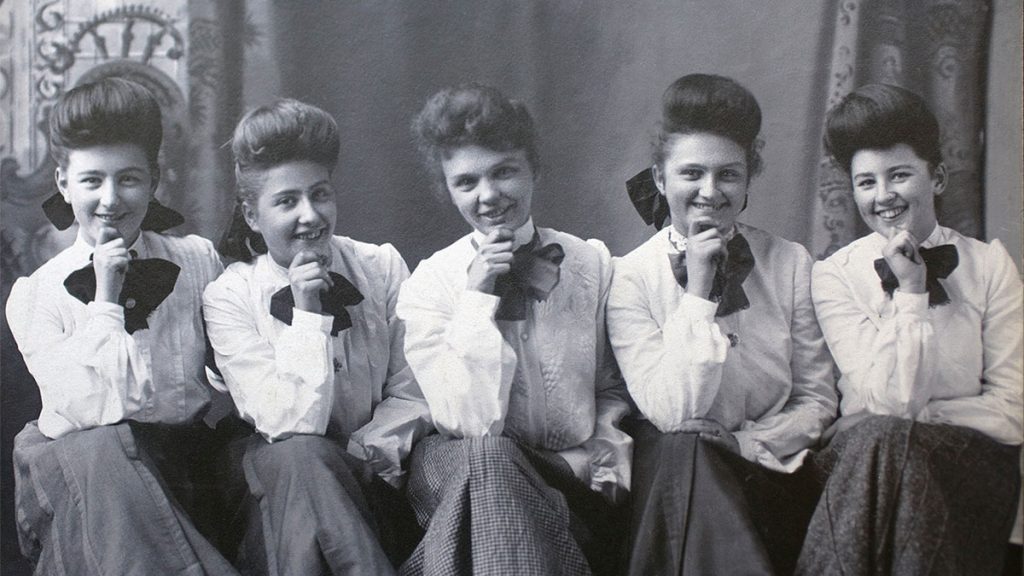
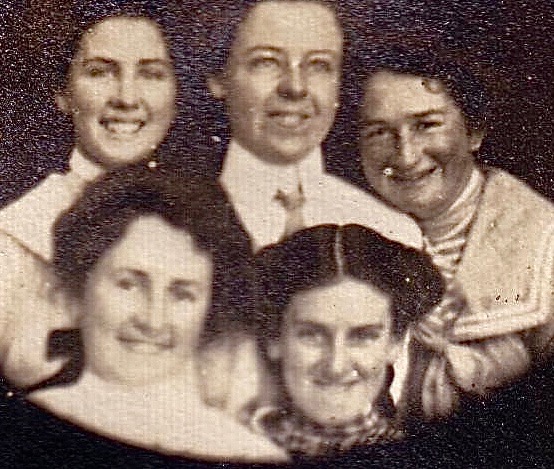
Note: The cover photo of the young girls, top row L-R Annie “Nita” Gray, Margaret “Mamie” Tyler and Agnes “Aggie” Donovan. Bottom L-R “Tootsie” Lierley and Margaret “Maggie” Phoenix. Annie Gray was the authors grandmother. “Mamie” Tyler would become a teacher and teach in Western Washington in a log cabin school. Maggie would Marry Archie Harloe and teach nearly her entire career in the Arroyo Grande School District. Margaret Harloe elementary school is named for her.

*Doctor Charles Clark was affectionately known as the baby Doctor. He buzzed around the valley delivering children by day and night including my own aunt Mariel who was born at her parents home in Bee Canyon up in the Verde district in 1916.

*Missouri Eldridge was the niece of Pete Olohan, who was very likely another participant in the hanging.

*I’ve often wondered who their chaperone was. They wouldn’t have been allowed to go without one in 1900.

*The Misses Jatta and Carpenter’s fathers were well known members of the lynch party.

Below is the link to Chapter one.

https://wordpress.com/post/atthetable2015.com/11202

Coming in the next post:

CHAPTER THREE

1899

Arroyo Grande Oracle: The Arroyo Grande High School class of ’99 will have no commencement this year. Arrangements were being made for the affair and undoubtedly it would have been a grand affair and would certainly have obliterated much of the ill feeling towards the school by our neighbors who dominate the school’s board of control. Certain comments by students and faculty in the Herald caused the ceremony to be declared off by Willis Buck, chairman of the Board of Control. If the students and teachers are not willing to work to build up the school they cannot blame those who are prejudiced for trying to wreck the institution and cause disbandment of the High School district….

Standard

The Big Vomit.

Written by Michael Shannon

It was Elsie’s bus. Not the old pickup she and Evelyn Fernamburg drove to little Branch school. No, it was the second one, the yellow one the County Office of Education fobbed off on us after it was no longer needed by Atascadero. You don’t need a very big one when there are less than 60 kids in school and many walk or are delivered by their moms and dads.

Elsie parked the bus in her front yard which was just across the valley from the little school house. I guess she washed it now and then but mostly it looked like the farmers pickups, dusty in the spring and fall, muddy in the winter time. She drove the route which was just a circle around the upper valley, picking up the kids who walked down from Corralitos Canyon to the intersection with the road up to the Routzhans, Thompsons and the other old ranches in the foothills of the Santa Lucia. She’d head down to the Gulartes to pick up Judy and Dickie, back to Squeaky’s house then cross the old Harris bridge to grab the Gregory boys, Bruce and Jim, next; Billy Perry then the four corners, hang a right and head out to Newsom Springs to get Jimmy Genovini, the Hubbles and the Hunts. On the way back it was out Huasna road for Dennis Mineau, the Domingo’s, past Frank Branches old victorian house to the Coehlo’s, and Berguias. She turned her around in Al and Emma’s driveway, a pretty upscale word to describe a muddy dirty road filled with petrified ruts. The Coehlo boys, Al, David and Richard were the last to board on Huasna Road. A common thing for most of us, no asphalt anywhere. Maybe gravel if your dad had had a good year. On the way back a right turn up Alisos Canyon road, it had no name then, it was just the road to Jinks Machado’s ranch. We’d pick up the Silva kids then roll back to school.

Only the Gregorys and the Mineaus lived in houses you might consider modern. Nearly every other family lived in older wooden houses built around the turn of the twentieth century or earlier. The Branch houses, there were five existing at the time, were either Victorian or earlier adobes built before California was a state. Standards of wealth were different then, no family would have been considered rich and some were pretty poor. Descendants of the original Ranchero families owned vast tracts of land but had little money, the land poor as they were described. These were  some boys who wore the same clothes to school for days at a time and were lucky to have a single pair of shoes. Many came to school hungry and Mrs. Brown had to keep a close eye on the paste jars. I guess we were somewhere in the middle but those things are something we didn’t really notice as kids. Our shared experience was the school itself where we were all equal. No one was picked on because they didn’t have. It’s been a good life lesson for all of us.

Our bus driver, Elsie Cecchetti was a woman of many talents. She wheeled that little bus around twice a day and being a pragmatic farm wife did things like roll the bus to a stop in the middle of the road, hop out and pick up the odd head of Celery or Romain lettuce that had fallen off a farm truck on the way to market. She didn’t get paid much. The census listed her as a farm helper which meant in census speak, a wife. In 1950 her income was listed as zero. Supplemental vegetables were fine, just dust “em off and throw them in the pot.

elsie

Elsie in retirement mode.

The kids all liked her because she was so nice. No troubles on her bus because no student wanted to cause her any grief, besides she knew your parents well enough to call them by their first names.

In the second half of the twentieth century the state of California was just a hundred years old and different from eastern cities and towns where ethnic peoples tended to cluster. Out here immigrants came from everywhere. Our bus carried the children of families who had come from Ilocanos province, Phillipines, Argentina. Switzerland, The Azores Islands, Ireland, Wales, the Netherlands, Germany, Japan and even descendants of those soldados who had walked here with the padres who built the missions. We had one family who were of the first nations that predated everyone. Funny thing is, as kids we weren’t concerned with any of that. Our fathers were mostly farmers, our mother kept house and raised children and we accepted each other without complaint.

Elsie herself was the daughter of an immigrant, Jao Azevedo who was born in the Azores Islands in 1894 and came to America in 1910 as a sixteen year old who spoke no English and could neither read nor write. When she was born in 1922, he was living and farming on what has come to be called Cecchetti Road on the old Corral de Piedra Rancho.

Perhaps her most impressive and greatest moment came by way of Jeanette Coehlo. Kids passed around chicken pox, the mumps or the flu every winter. The bus could be a petri dish of bugs. One bright sunny morning we were passing the Perry’s house headed for Gregorys just opposite the old Harris place for which the bridge was named. The Harrises were grandparents to the three Hart kids who lived in town but were well known to us. Small town life there. Everyone knows everyone personally or by reputation. Anyway, since its less than a hundred yards from Perrys to Gregory we were moving slowly when Jeanette, sitting up front suddenly made a sound like “Urp,” did it again then heaved her entire, half digested breakfast all over the rubber floor and the opposite seat.

branch school 1961Jeanette (Shannon Family Collection)
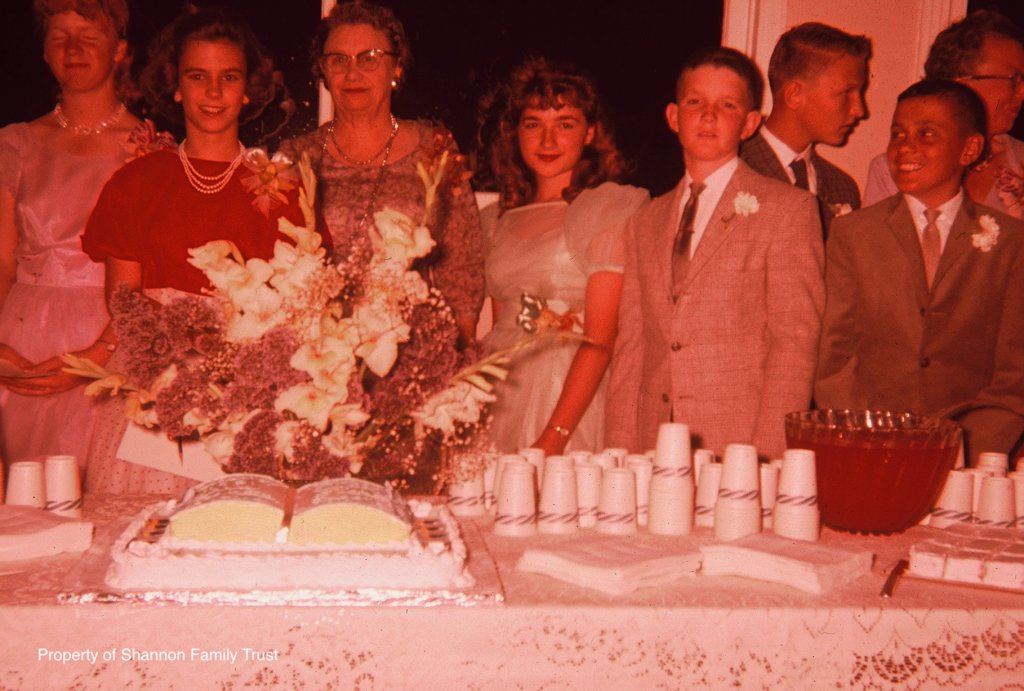
Because it was a cool day all the windows were up, no draft you see and the other dozen or so kids seated around the bus were almost instantly confronted with a wave of nauseous, richly scented, miasmatic and, I swear, greenish cloud of a vapor guaranteed to trigger a sympathetic response from one and all. Like an wave it surged toward the back of the bus with a vengeance. The older boys, as is the custom, sitting in the “Cool” seats in the rear leaped for the windows, slammed them down and stuck their heads out as far as they could. We must have looked like an old circus wagon with all the animals sticking their heads out the side.

Ever the mother, Elsie just opened the door and drove on down to her friend Mary Gulartes house, turned onto the dirt road to the house and pulled to a stop.

“Every body Off, ” She ordered.

All the kids quickly walked down the aisle, shoes slipping in the slush,  some still dribbling vomit down their chins, some holding their noses as tight as they could, mouths tightly closed, they jumped down and quickly got away from the reeking little truck. Elsie calmly opened the back door and found the Gularte’s garden hose alongside the house and began sluicing sheets of water across the floor and spraying any seat that was dirty. Mary helped her with some old burlap sacks and they wiped her down. Mrs Gularte  then went to the back porch and into the kitchen where she loaded up a plate with homemade cookies. When she came back out the hose was being passed around as kids washed off their shoes and took a swallow or two of water to rinse away the bad taste.

Cookies were gobbled right down, Elsie shooed the kids back on the bus, said goodbye and thanks to Mary, whipped the little bus around, out the driveway and we continued back to pick up the Gregory’s and finished the route.

It was luck all around. The kids who missed the excitement considered themselves fortunate. The veterans felt superior. Just another day in a little rural school where things like this were taken pretty much in stride by all. Farm kids in the fifties had animals; horses, cattle, chickens, scads of dogs and cats so they tended to be not so finicky. We knew we were superior to the town kids. Always.

The writer, Michael Shannon is a veteran of that bus ride. Elsie was a fixture of his life growing up and like many folks misses her terribly. She was absolutely one of a kind.

Reprinted below is her Obituary.

Elsie M. Cecchetti
March 16, 1922 – March 11, 2021
Arroyo Grande, California – Elsie M. Cecchetti, 98 was a native of Arroyo Grande, CA and passed away on March 11, 2021; just 5 days shy of her 99th birthday. She was born on March 16, 1922, on the Carroll Ranch in Edna, to the late John (Jao) and Mary Azevedo. She was the oldest of four children and started out milking cows at the age of 5 until she was 15. She would deliver the milk in a wagon to the creamery in town.
Elsie worked at numerous dairies to buy her school clothes. When attending Arroyo Grande Schools, she only spoke Portuguese, but taught herself English. She graduated from Arroyo Grande High School when it was at the top of Crown Hill in 1943. In her early career she worked various jobs harvesting crops, was a plane spotter and switchboard operator during World War II.
Elsie worked on the Cecchetti Ranch picking beans, where she met the love of her life, George Cecchetti. George and Elsie were married in Arroyo Grande on September 15, 1945. They enjoyed dancing on Saturday nights at the Portuguese Hall, along with their love of Square Dancing together, and were members of the Hill Toppers, Dave’s Pairs ‘N’ Harmony and Mesa Twirlers clubs for many years. Their favorite vacation was camping at Bass Lake with their children, grandchildren, family and friends, especially during the 4th of July. They enjoyed fishing the creeks throughout the Sierra National Forest, Bass Lake loop with their kids and grandkids. They spent 47 wonderful years together.
In 1957, Elsie became a school bus driver although not driving a bus, but a 1957 yellow Ford pickup which included a canvas-covered camper shell and bench seats in the bed. She drove the pickup for 2 ½ years until the CHP said it couldn’t be used for a bus. So, Branch School bought a 22-seat bus, which she taught herself to drive.
In 1960 Branch School became part of Lucia Mar Unified School district and she began driving larger buses. She continued “driving a Crown” until retiring in 1993.
Elsie was honored to be the Grand Marshall for the Arroyo Grande Valley Harvest Festival in 2016. She was a longtime member of Luso-American Fraternal Federation (since 1946), I.D.E.S., Director of Arroyo Grande Hall Association, Cabrillo Civic Club, S.E.S., Historical Society, C.S.E.A., C.G.C., Farm Bureau Association, and a member of the St. Patrick’s Catholic Church. She was recognized as an Honorary member of both the Arroyo Grande FFA and Arroyo Grande Sportsman Club.
Elsie was a long-time coordinator for the Portuguese Celebrations. Not only did she organize, but you would also see her carrying the flags plus marching right alongside the queens and their courts.
You could say she WAS the Portuguese celebration!
Elsie loved tending to her garden, canning the fruits of her labor and raising her cows and chickens. She adored her dog Shiloh, who she called her companion. She loved her children, grandchildren, and great-grandchildren, along with numerous close friends whom she treated like family.
Elsie is survived by her four children: George (Tukie) and Linda, Marleen (Cecchetti) Freire, Melvin and Gayle, Judy Cecchetti; grandchildren, JR Cecchetti, Erica (Freire) and Chad Correia, Alisa Cecchetti; great-grandchildren, Bryce Hatfield, CJ Correia, and Jackson Correia.
She is also survived by sister Lena Hugger, sister-in-law Gerrie Quaresma and numerous nieces and nephews. She was preceded in death by her husband George Cecchetti, her parents John and Mary Azevedo and son-in-law Eddie Freire.
The family would like to extend their gratitude for her many caregivers who loved and cared for her these past few years.

Standard

RECESS

Michael Shannon

Eight years of Grammar school and any memory of what I studied there is vague at best. What I do remember is Recess. Tiny rural schools in the 1950’s had the best Recess, bar none. Kids played. They played at things you might not believe but it’s all true, I swear by my tattoo.

Kids need to play and make use of their imaginations. Something we have perhaps lost with children carrying I-Phones everywhere. This is how we did it.

First of all, we played in the dirt. Once my dad and the other trustees planted a lawn in front of the school but it was a futile gesture. Hard adobe soil, no sprinkler systems because there was no hose bib in the front of the school and hundreds of acres of wild oats surrounding it guaranteed that by late spring it was just a memory. In the spring, mud, early summer dust, we sprinted out to recess, not wanting to waste a moment. Kids games revolved partly around soil conditions which was something we knew about, being mostly farm kids. When I was seven I could whip up a mud pie like nobodies business. That old adobe mud could be made in Frisbees, weaponized so to speak. Mom made sure our shirts were clean but those old black Levi’s we wore stayed on for days. Laundry was a lot of work for her. The old tub washing machine with its ringer was pretty slow and the dryer was 3/8 inch cotton rope strung between poles. When you were big enough you’d help her hang the wet laundry, sheets on the outside to hid the private stuff such as panties, slips and bras. Those bras of hers were wired for sound or at least highly engineered. They were so well made you could have used them to haul water from the well or use them as hampers to pick beans in. Our farm had a road that ran upwind of the clothesline and she had to take that into account too. We were clean but not too clean. My mother always said that a little dirt was good for you. Science has born that out.

A list of the games we played was long but in a funny way each had a life of its own. Each in it’s own season.

Marbles were played in the spring when the dirt was still slightly damp so a good ring could be scratched out. Not too soft but stiff enough so the marbles would roll. One boy would show up with a pocket full of glassies, cats eyes and steellies in early April and the next day it would be on. Boys and girls showed up ready to go to war. No playing for keeps was the teachers rule but out of sight they changed hands. Just as mysteriously as marble season appeared it was gone. There was no date on the calendar. It was as mysterious as the first flight of swallows showing up under the eaves of the old barn in our back yard.

Since the school never seemed to have more than one baseball, likely used for decades and an old basketball with all the pebbles worn off some ingenouity was required. There was no lack of old timey games, some from centuries lost in the mist that could be played. No one knew where the rules for Red Rover, Kick The Can, Mother May I, or Simon Says but everyone seemed to know how. The only game deemed too dangerous was Crack The Whip which was still played if the teachers were otherwise occupied. Second graders on the end could be spun like 45’s off the end on a good crack. The occasional skinned knee the result. Nobody cried. Parents would say thing like, “Well, don’t play then,” or “Just spit on it and rub it with mud, you’ll be fine.”

Rural baseball. US Archives

Most of our fathers and uncles; in fact almost every man we knew, some women too had served in WWII and the Old Colonel, who you could see driving around town, racing down Branch street in his old Plymouth at the breakneck speed of 10 mph had served in WWI. Naturally the boys, whose male relatives never, ever talked about the war, were a rabid and blood thirsty group. We were the Blue and Gray, Yanks and Huns, Nazi and Dogfaces, Rebels and Hessians, We rode with TR up Kettle Hill. We didn’t know that he actually walked up, but that wouldn’t have mattered anyway. Being farm boys we brought our own shovels to school and dug foxholes in the cut-bank uphill from the school where we staved off multiple attacks from the days chosen enemy, slaughtering them with the sticks found under the schools oak trees or pelting them with acorns. In a last ditch defense, Manny Silva leapt on Charlie Silvas back while he was coming up the hill and bit him. Victory was achieved for the Hillsiders.

When Mrs Fahey wasn’t looking we slid under the barbed wire fence around school and hightailed it up the hill and then down the other side to check out the old Branch Family grave site. Francus Ziba, his wife Manuela were buried there and just to the side, the graves of the Hemmi’s, father and son who were lynched by vigilantes, hung from the Pacific Coast Railroad bridge in 1886. Mrs Branch, in her kindness allowed them to be interred near the Branch Family when no other cemetery would . We knew a little about it because Fred Branch came to school on a history tour to talk about goings on in the old days and said he clearly remembered men coming to the Branch home, asking his father to come outside where they spoke in hushed voices before his father came back into the house to get his rifle before leaving with them. He was sure his father had had something to do with the hanging. An inquest was held afterward and ruled that persons unknown had done the deed though some members of the panel were likely present at the bridge. Secrets are hard to keep in small towns.

The Old Branch Family Cemetery today. Author photo.

The little place was not a spooky place, most kids knew about the original Ranchero and his family. Some of his descendants were my school mates.

When I was in the sixth grade Miss Holland retired. She had taught for decades at Branch and had taught kid who were now the grandparents of my classmates. The next year we had a new teacher, Miss Parker who I remember as young, blond and who smoked cigarettes behind the girls restroom during recess. That seemed daring, we had never seen a teacher smoke though you can be sure than in the fifties almost every adult we knew did. Somehow it was unexpected. It made her a person of some respect, we assumed this was never done. An adult who scoffed at rules had our respect.

Hours were spent carefully crafting snares from wild oat stalks. We stripped the leaves and carefully tied a loop on the thin end, securing it with a slip-knot. Ever so carefully we stalked the wily and elusive western fence lizard as he lay sunning himself on the rocks and old railroad tie fence posts around school. Captured “Blue Bellies” were never killed which might surprise some, kids being a rather bloodthirsty lot, but were left in girls coat pockets or carefully stashed in a teachers desk. Rural school teachers like Miss Parker were, of course, not the least bit frightened and simply took the lizards outside and freed them with a knowing smile, having been down that road many times. Courage was tested by letting the small reptile bite your little finger in a show of outstanding bravery which sent the little boys into to paroxysms of squeaks and admiring glances which we took as our due, being older, wiser and oh, so courageous.

Miss Parker did something else I’ve never forgotten. She read out loud to us. A chapter a day just before school let out. She read from Mark Twain’s Tom Sawyer. It was the greatest thing. I’m sure most kids hadn’t read the book either. She was an accomplished speaker and she took on the character voices too. I remember it was perhaps the greatest treat I had in grammar school. We couldn’t wait to get out on the Mississippi with Huckleberry and Jim to ride down the river on his raft to New Orleans.

Lucky for us the brothers Ikeda farmed the land across Branch Mill Road from the school and, wonder of wonders, they had a reservoir directly opposite. It was full of water and it didn’t take long to figure out that if we brought some loose boards from our dad’s scrap piles we could build a raft and go floating along the Old Mississip’ just like Huck and Jim. Since the gate to the pond was never locked we quickly used our recess time to start building and in just a few sessions we were floating about, spying out the downriver under our hand visors like true river rats. Mrs Brown and Mrs Fahey took no notice, they were used to feral boys on the loose.

Finally after a few days while driving by the school Kaz Ikeda noticed what was going on and our trip was ended. We had to clean up the pond and remove the raft but it was all done in the spirit of good fun. When one adventure ends another begins.

Walt Disney introduced us to Davy* Crockett when I was nine. Crockett, being such a fabulous creature, we naturally took his legend in hand and soon all the boys were sporting Coonskin hats and strutting around school shooting the eyes out of turkeys at a hundred yards. It was such an epidemic of gunplay that kids with their Mattel Fanner 50’s slung low around their hips that Mrs. Brown, the principle, as if you needed one in a school with less than sixty kids, decreed that we could only bring our guns to school one day a week. This would be known as “Gun Day.” On that day, a Wednesday if memory serves, the air was heavy with the smell of spent roll caps and the popping of pistols from behind every tree. The two acres of the school ground was the scene of vast carnage as the bodies lay where they fell, briefly of course. It was perfectly legal to pop up and shoot your adversary in the back. The hooks placed along the sides of the hallway between the two school rooms looked like an armory during class time, with the gun-belts hooked up and waiting for their owners to return.

Three Buckaroos, Family Photo, 1955

By the turn of the decade, the end of the fifties, the new “Modern” school was about to open and the last class to graduate from the old school, which had been in use since the 1880’s was looking forward to high school. The days of free recess where the kids were left to their own devices were coming to an end. The county schools office was growing in power and most of the old one and two room schoolhouses were closed. We had seen the end of Huasna, Santa Manuela, Newsom, Oak Park, Berros, Santa Fe, Freedom and Cienega schools and the rise of a much more rigorous education system. The Arroyo Grande Elementary school, though opened in 1932 was fifty years more modern than old Branch. The brand spanking new Margaret Harloe school with its modern buildings and structured activities didn’t allow for rafts, gun days or digging foxholes. Recess was now organized. Imaginations were stifled under the weight of adult theory about what is good for children. A sad day. Just for once why can’t we just open the gates and let them run free to discover on their own what is out there? No Toys-R-Us, no phones, no proper PE equipment no adults pointing fingers and giving orders. Just give them a shovel. As Pink Floyd so aptly said, “Teachers, leave those kids Alone.”

L-R: Christine Baker, Cheryl Jurniak, Mrs Edith Brown, Jeanette Coehlo, Jerry Shannon, Unidentified, Dickie Gularte, Mrs Fahey. Not pictured, George Cecchetti Junior. The last eighth grade class from the old school, 1961 Family photo
L-R: Michael Shannon, Judy Hubble, Judy Gularte and Michael Murphy, 1959, graduates Family photo

Cover Photo: 1960 Eighth Grade, Alcides Coehlo, Mrs Edith Brown, Johnny Silva, Nancy Wilcox, Steve Luster, Manny Silva and Mrs Fahey. The pond is to the right. Family Photo

*There is no record of Mister Crockett ever being referred to as Davy by either himself or any of his peers. That’s a Disney thing.

Michael Shannon is a proud graduate of the last two room school in our valley.

Standard

THE FIRST STEP

Written By: Michael Shannon

It’s been said that every journey begins with a single step. I believe that’s true. An idea; a thought that is nothing unless it’s put to use.

When my children were little I came across books written and illustrated by a man named Chris Van Allsburg. Mister Allsburg is world famous for his exquisite illustration techniques and clever story telling. Like many people who wrote, he never intended to be a writer, he studied sculpture in fact. Because of a little serendipity he became first an illustrator of books, one actually and then wrote and illustrated a book himself in 1981. It didn’t do badly though, it became a best seller and won the Caldecott Medal. The Randolph Caldecott Medal, shortened to just the Caldecott, annually recognizes the preceding year’s “most distinguished American picture book for children”. If you’re not familiar with his work I can explain to you in one word who he is. That word is Jumanji.

Allsburg is a terrific illustrator and children love his books though I believe since kids don’t actually buy books themselves that parents are transfixed by the beautifully crafted covers. His stories include the aforementioned “Jumanji” and “The Polar Express.” My personal favorites is the tale of the “Two Bad Ants.”

In any case this is just background. One of his lesser known books is The Mysteries of Harris Burdick. It’s a 1984 picture book and it consists of a series of images, supposedly created by Harris Burdick, a man who has mysteriously disappeared. Each image is accompanied by a title and some line of text, which encourage readers to create their own stories.

I’ve been captivated by that idea for some time so I’m going to give you a chance to exercise your own imagination by providing you with the first line of stories not yet written.. Have at it.

Martha Belle

Ben lowered his voice some and said to us, “You’ll see precisely what the Mattie Belle wishes you to see, and you’ll know just what she wants you to know.”

The Little Dog

Hopeful she is. She watches for the telltale signs, the putting on of shoes, the jingle of keys, any kind of stroll towards a door that leads outside. This is what my dog believes. This is her God.

Gone fer a Sojer

Ambrose Bierce was both a rifleman and officer in the 9th Indiana during the war between the states. He became one of the most respected writers in America, Stephen Crane and Hemingway considered him a great influence. He knew soldiering. At the age of 71, he died facedown in the dusty, dirty streets of Sierra Mojado, Coahuila Mexico. A shot to the back of the head. None knows his executioner save the Gods of the Mexican Revolution and Doroteo Arango, God rest his soul.

Surf Dog

January 27th, 1947: Tales of the South Pacific goes on sale

October, 1957: Gidget, the Little Girl with Big Ideas book is published.

April 10th 1959: The movie Gidget premieres.

August 21st, 1959: Hawai’i becomes the fiftieth state.

April 1st, 1960: First issue of Surfer magazine goes on sale.

March 25th, 1963: Beach Boys Surfing’ USA released.

My father sat back in his chair at our kitchen table and looked at me as I was about to go outside, jump in my little VW with the two surfboards tied to the roof racks and said, “You know Mike, you can’t just surf all your life.”

He wasn’t wrong about much when I was growing up but he was sure wrong about that.

Shirley Shannon

I climbed the stairs to the office. There were two mugs  outside my door. One was sitting on his heels, head down, arms between his legs holding a hand rolled cigarette, the other standing, watching me come up. He was whip thin. He had a crushed and stained fedora pushed back on his head and a dirty lock of dark hair curled above one eyebrow. A half smoked Camel clung to one corner of his mouth the smoke lazily curling up, causing him to squint. Both were dressed in workman’s clothes, stained and with the particular odor of crude oil. As I topped the landing, the one standing looked me over and said, “You Shannon?”

Doin’ Dixie

Marvelous Marv was my foreign friend. He came from another country; Virginia.

Iron Jive and the Hemorrhoid

So heres the plan, pay a bribe to the boss so he will lay you off, move to Hawaii to surf and while you’re there have your hemorrhoids removed. Simple. Solve a problem, enjoy a vacation in the surf and get paid. What could be more perfect? Whay could possibly go wrong.

Pub Sign

No great story ever started with someone eating a salad. Ever.

Edgar

What is a life? Is it a story that no one remembers? When enough time passes does one cease to be even a memory, to anyone? To whom? Is it some or just one, somewhere. Are you the caretaker of that life? I am that. Let me introduce Corporal Edgar Green lately of Townsville, Queensland Australia, 2nd Australian Infantry just stepped ashore on the Gallipoli peninsula. It is July 1915.

Hommes Et Colere

The dreadful price that a man pays for his belief in the American Myth.

The Whale Shark

In our house we have a chair. It’s cushy. It is covered with the hide of a Whale Shark. Dark, dark grey and sporting white spots over its entire surface. The back is broad enough for the prince of cats, Wendell to bide of a cool day.

Heart of Saturday Night

All the great mysteries, wrapped in a satin cloak decorated with the constellations , infinitely distant, yet close enough to touch. The Wolfman, distant, yet speaking to you from the radio in the dashboard. XERB 1090, 50,000 watts of pure Soul Power, beamed north from Rosarito, Mexico

The Plug Hat

My grandfather had a plug hat. It was a silly looking thing, especially when he put it on his noggin. He didn’t mind though, he wasn’t the type of guy who fussed about his appearance or who cared much about what people thought of him. Something I learned about those particularities when I was a kid, was that because he didn’t care, no one else did either, in fact, people admired him for his lack of pretense.

Minor Swing

Ernie slid onto the little bentwood cafe chair, sitting under the dark green awning of the Deux Magots, he turned to the hovering waiter and asked for espresso, it being too early for a man who took great pride in the ability to put away drink. Maybe a little later, a gin and tonic with Angostura Bitters. As the day warmed, other dwellers of the Paris Demimonde began to stroll the Boulevard Saint-Germain, Studiously ignoring the big man at the wrought iron table in the way that the French so perfectly do, a little lift of the chin, a turn of the shoulder an inward look. A brilliantly dressed man, still in a tailored tuxedo, boiled shirt with an Arrow color, a perfectly tied bow tie, the white carnation still fresh after a long night, gave the slightest of nods to the man at the table and slid sinuously onto a chair and resting his chin on his manicured right hand, with a sly look and a twinkle in his large, liquid brown eyes, said, “Hemingway,

Laura Beth

He sat awhile. He had a blank look in the eye. He scarcely moved. After a bit he licked the end of his pencil and he carefully wrote, “To the only girl who ever mattered” He looked at the writing. Then he nodded.

The Southern Cross

The sun popped up. It did, ..in fact,  POP up.   It was flattened like a sideways yellow wafer in the dawning, drawing its bottom free of the horizon with an almost audible jerk. In less than a minute dark became day, night had utterly vanished, the deck was alive with the light glancing from the gently riffling sea; a single ray, reflected from the binnacle, darted through the scuttle to light the face of the off-watch. The sun rose within his mind, his face broadened to a smile and he rolled out of his bunk.

The Golden Girl

She smiled. It was direct, clear, hopeful. I died on the spot.

The Princess Pat’s

They marched to the murmuring guns.. Dreaming of valor, flowers in their buttonholes; caps aslant, singing Tipperary, they moved up. On the way back, eyes blank, exhausted, bloody; now they knew the truth of it.

The Farmer

It was like chewing on wasps.

Drifting

The brush drifted across the canvas like a sigh, not touching really, it’s colors lying like a veil over the surface. He stepped back. A cock of the head, a squint of the eye, a nod so slight it couldn’t be seen. “Sublime” he breathed.

The Writer

The old fountain pen slithered across the paper leaving a convoluted trail of translucent green ink, the only color he would use. He wrote; “To the red country and part of the gray country of Oklahoma, the last rains came gently, and they did not cut the scarred earth.”

The Californio

Don Francisco Branch had sent for his sister, asking her to come out to California to take in hand the teaching of his children and those of his employees sometime before 48′. She made the trip from Scipio, New York to California by sail from New York to Panama, crossed the isthmus by mule and sailed north to California arriving in San Francisco in late 1848. Escorted by a party of Rancheros returning to their homes in the Cow Counties, she arrived safely after a trip of around 7,000 miles. She spent three months on the trip. She survived Bandidos, yellow fever, malaria, bad food, sea sickness and a great deal of discomfort. The trip cost between three and four hundred dollars. Getting to the west coast cost roughly $ 11,000.00 in todays dollars. Francis Branch could afford it. Most travelers to California were wealthy enough to pay their own way. This meant that most immigrants had some education and a skill in order to pay their own way. The poor stayed home.

Incident on Branch Street

On Wednesday last a Japanese man and a white woman were seen driving on Branch Street. Chief Fred Norton stopped the car and issued a warning to the occupants. The woman was advised to exit the car and not to ride in any auto with a Japanese man again. The driver was allowed to continue with a caution.

Martha from Texas

Arms akimbo, legs crossed, one slipper on the walk the other toe down, she shimmered in the light from the ocean, the beams drawing designs on her wide legged satin trousers as she leaned next to the door of her beer bar. With a wink and a saucy smirk, she said “Let me treat ya’ to a beer, pardner.”

Michael Shannon is a writer, reader and world citizen. He writes for his children so they will know where they came from.

Standard

Traveling by Train

Michael Shannon

When I was a boy I used to ride with my dad whenever he went somewhere. It was part of my education. My favorite place to go was the box company in Oceano. Oceano is a little town built along the Southern Pacific tracks at the west end of the little valley I grew up in. In the fifties it was the center of the farming industry. The vegetable packing sheds were there, the big ice plant, very important in the days when freight cars were stilled cooled by ice and best of all the box company. It was in a large warehouse located right next the main railroad line and the sidetracks where the little yard goat steam engine shuttled boxcars around as they were filled.

My dad would head into the office of the box company to talk about ordering any of the different types of boxes produce was packed and shipped in. In the early fifties most vegetables were packed right in the fields or in sheds we had on our farm. He needed different kinds of containers for different crops. Crates for Lettuce or Celery, Lug boxes for Tomatoes or Flats for Chinese Peas. Inside the warehouse there were two main areas, one where finished boxes were stored, nested together and stacked clear to the rafters, leaving only narrow passage ways between the different kinds just wide enough for a man to walk through. Down the center there was a wide alleyway for the forklifts that did the moving. Parked here and there were big clamping handcart dollies with jaws to grip the boxes loaded on them. A man would load the dolly and then step on a pedal at the back and the jaws would clamp the bottom box so the load could be moved without sliding the whole load off. We would go over and jump on the foot pedal but even with the two of us we couldn’t make them work. A great disappointment.

At the opposite end of the warehouse was the place where the boxes were assembled. Great stacks of pine. all precut were placed on tables and nailed together. When the man finished his box he placed it on the roller conveyor, gave it a big shove and it spun away on the rollers until someone working at the other end end picked it up, placed it with other boxes in it’s nest where it was then moved into the stacks.

Best of all was the smell of the place. Nearly every box was made of fresh cut pine and the smell of the place was sweet almost beyond imagining. You could, and we did, stand there and inhale the air and it seemed almost good enough to eat. The old heavy plank floors, worn smooth by decades of use were buttered with pitch and polished by the wheels of the forklifts which motored about moving tall stacks of boxes from the warehouse to waiting trucks ready to haul them out to farmers fields.

When dad came out of the office, order in hand he would holler for us and then have to chase us down in the labyrinth of crates. We always gave up in short order because we knew he had things to do and we wanted to be with him anyway.

Outside the box company there were steel rails to put pennies on, stray railroad spikes lying abandoned in the cinders along the rails and divers and unidentified things that stimulated the imagination of kids.

Sometimes the little yard goat steam engine would be scuttling about like a crab, moving loaded freight cars from one place to another, busy making up consists which would be shuffled into place on the big freights that stopped every day. Dad gave us pennies to place on the tracks to be squashed by the little engine as it passed by. You were sure to get a wave from the engineer because he had been a kid too. His dreams of becoming a railroad man had come true so he knew what it was like for little boys.

When the Southern Pacific first came it was the main transportation hub along the central coast of California where we lived. Typical in type, it had a line of warehouses on one side of the tracks and the sheds where produce was delivered from the fields to be washed, sorted and packed for shipment.The big packing sheds were all the same with an office at one end where the salesmen and secretaries worked and the boss sat at his desk with his feet up and thought great thoughts, or so it seemed to us. The processing floor had conveyors and bins everywhere. The men and women who worked there wore rubber boots and aprons, some carried knives for trimming vegetables, that seemed faintly dangerous but, of course we all wanted to carry them too. A goal for nearly all little boys is to go heavily armed.

The boxes all carried labels, colorful advertisements for the growers and shippers. Ed Taylor and Gus Phelan’s “Taylor Made” and “Phelan Fine,” Oceano Packing Companies “Oceano” label, Sal Reyes and Gabe DeLeon with its crossed Bolos reflective of their shared Philippine heritage and the Japanese growers POVE brand, Pismo Oceano Vegetable Exchange. The labels were stuck on the ends of the crates as they were loaded onto boxcars or semi-trucks headed for the Los Angeles or San Francisco markets. Some crops were shipped in used boxes with multiple labels plastered one over the other forming a virtual road map of the boxes travels.

Anchored at one end was the old depot building painted in the ubiquitous SP yellow and brown. In my grandparents day it was also a passenger depot. My grandmother and her family traveled to the bay area where her sister Sadie lived in Oakland and when she was matriculating at the University of California, the train was how she traveled back and forth to school. Someone the family knew always traveled with her, no lady traveled alone in those days.

My grandmother Annie Gray Shannon, center, leaving for Cal Berkeley in 1904. Her parents Samuel and Jenny Gray on the left and her uncle Patrick Moore and his wife Molly “O” Moore on the right. Family Photo.

Once in a while we would be down there when a fast freight rattler would pass through. We always tried to count cars but rarely ever did we make it before the cabooses passed us by with a wave from the brakeman perched up in the window of his cupola. One of the best things to do was to read the names on the boxcars. Each one represented a far off place in the imagination. “The Pine Tree Route” all the way from Maine, The Saint Louis-San Francisco, “The Frisco,” outlined in big white letters on a red shield. Not a popular name with hoity-toity San Franciscans but OK with us. The big Railroad states were all there, the Pennsy, Texas Southern, New York Central, Baltimore and Ohio, the Milwaukee Road, The Dixie Flyer, the Cotton Belt and The Katy. You might get glimpse of less well known roads, their boxcars still in use long after they folded like the Delta-Yazoo RR, nicknamed the old “Yellow Dog” and memorialized in songs from the Delta Blues to Bob Dylan. The proud white mountain goat emblazoned on cars from the Great Northern, the SP and the UP, and AT & SF, immortalized by songwriter Johnny Mercer in 1946 and first sung by Judy Garland in the movie “Harvey Girls.”* We once saw a blue freight car emblazoned with Susquehanna Railroad on one end and a female figure holding a railroad lantern who said, “Ship with Susie Q,” get it?

Very so often you could spot someone standing in the doorway of a “Side Door Pullman,” going from somewhere to someplace, a Bo, a Knight of the Road, seeing the country, didn’t cost a dime neither. Perhaps one of the last of the throngs of men, women and children who drifted around the country looking for work during the depression.

It was altogether a marvelous place for little boys to hang around. The depot has closed permanently , passenger trains dodn’t stop anymore but you could climb on the old freight wagon and peek inside through the dirty dirty windows and imagine the days when it was busy with people preparing to go somewhere much more exciting than the place we lived. You could almost see the conductor wave his red lantern to signal the engineer to open the throttle and hear the full throated cry “All Aboard for Salinas, San Jose and San Francisco, and all points East.” The sound of the locomotive beginning to move, the deep, throaty cough from the stack, the hiss of high pressure steam, the metallic grinding of the drive wheels slipping slightly as she gathered way and the crash and clank of the couplers as the slack was taken out. By standers would invariably stand and watch until the caboose faded completely into the distance and sigh, they were staying home. People my age are the last generation who witnessed train travel when it still carried the mail, nearly all the freight and most passengers. The rise of the trucks and the airplane would nearly doom railroads by the 1970’s. Today the depot is a museum, the sheds are closed and the freight trains pass us by without even slowing down.

*In case you feel like singing, just imagine Judy Garland singing this song as she waited tables in a Harvey House somewhere.

Judy Garland, The Harvey Girls MGM 1946.

Do ya hear that whistle down the line?
I figure that it’s engine number forty nine
She’s the only one that’ll sound that way
On the Atchison, Topeka And The Santa Fe
See the old smoke risin’ ’round the bend
I reckon that she knows she’s gonna meet a friend
Folks around these parts get the time of day
From The Atchison, Topeka And The Santa Fe, Here she comes
Whoo hoo hoo hoo hoo
Hey, Jim you’d better get the rig
Whoo hoo hoo hoo hoo
She’s got a list o’ passengers that’s pretty big And they’ll all want lifts to Brown’s Hotel
‘Cause lots o’ them been travelin’ for quite a spell
All the way from Philadelph-i-ay
On The Atchison, Topeka and the Santa FeAll aboard, all aboardHere she comes
Whoo hoo hoo hoo hoo
Hey, Jim you’d better get the rig
Whoo hoo hoo hoo hoo
She’s got a list o’ passengers that’s pretty big And they’ll all want lifts to Brown’s Hotel
‘Cause lots o’ them been travelin’ for quite a spell
All the way from Philadelph-i-ay.”

The Real Harvey Girls. National Archives photo.

If you didn’t live it, well, you should be sorry now. It’s all gone. The packing sheds, the Box Company, the Harvey House restaurants and their girls. Produce goes by truck now and somehow that doesn’t carry the same cachet.

You can still buy those old box labels, collectors items now, but without the scent of a fresh pine box, it’s just a piece of paper.

PS: You can still visit the old depot, now a museum. Ask for Linda Guiton and tell her I sent you.

Michael Shannon is a writer and world traveler. He lives in Coastal California.

Standard

The Handshake.

Michael Shannon

Those men. They always shook hands. I learned early in life that those handshakes were a form of communication. All kinds of subtleties, rituals observed by grown men that took a lot of growing up for me to understand.

manuel silva 1


Big Manuel had hands that were thick and muscular, criss-crossed with the scars that  illustrated his life and when he held your hand in his it felt as if they were covered by the bark of the oak trees that grew on the hills we grew up on. No man would have ever said “I love you” out loud, they did it by touch.

When we were little he just tousled your hair when he came in, perhaps put his hand on your shoulder. As you grew, he offered his hand. By the time you were a teen and as tall as he was, it was the whole shebang, the gravelly voice with a mild insult and a handshake that engulfed yours. The love he showed you, running like current from his heart to yours. God, how I loved that.

It’s how men of a certain time showed affection. The men and women in my family were subtle in that way and each had his own manner. It was a very small play, acted out between two people, seldom varying in its simplicity, which was its charm.

Garrison Keillor had his Minnesota bachelor farmers and we had our farmer uncles, some of our blood and some adopted in friendship.

My Grandmothers brothers, Uncles John, Bob, Tom and her brother in law Olin. There was my dad’s brother uncle Jack or Jackie as he was universally known. We had another uncle Bob on my mothers side and my uncle Ray who was an uncle by marriage.

So, bunches of them. Some we saw often, others, not so much. For many years when I was growing up, the entire Shannon and Gray families got together during the holidays.  Uncle John Gray, he of the pin-stripe suits and deep, deep growl of a voice, stood up very straight when he shook your hand. Aunt Eva, always perfectly coiffed, invariably dressed in a grey suit and smelling richly of powder would offer her soft hand, light as a butterfly. My grown cousin Iva Jean offered her little hand palm down, the fragile bones light as as a birds wing. She was a giggly girl, though she was in her forties. She was a simple woman, kind and loving. My uncle Bob Gray was short and wiry with a shiny bald head and he shook  with the vigor of a life long farmer. My dad’s brother uncle Jackie shook with his arm akimbo, his right elbow swung out and his hand diving down on yours like a hawk on a mouse, a firm economical grip. My grandmother Annie, she of the Lace Curtain Irish, used her left hand which you softly gripped from the side with your left, your fingers slipped across the index finger and next to her thumb, and always delivered with a soft kiss on her cheek. When she was dressed up she floated in a cloud of White Shoulders, even today the scent evokes memories of her. My grandfather, “Big Jack” Shannon shook hands with a hearty “My blessed boy.” He left no doubt he cared for you.

They had all been born in another century and formality was like wearing a suit of clothes. They all walked in the histories of their time. The view in our kitchen was more inward than outward. Not in the sense that they were unsophisticated, but rather in a way that valued honesty, formality and steady friendship as the anchors of their lives. Manuel, Johnny, Oliver and those other men who sat and drank coffee at our kitchen table, did not talk out of school. Personal opinions were never voiced in front of children, or, I think, in front of wives. Dad’s friends seem homogenous to me, not in the way they dressed or walked to our door, but in their opinions about what mattered the most to them.

They played by the rules they had established for themselves. The big boy rules. They were hard to define and were slightly different for each. No one wrote them down and they weren’t easy to know but you were expected to do what you said you you would do, no questions asked, no excuses given. It was agreed that you paid for your own mistakes. Your problem was yours to accept and deal with. They took the best from each other and ignored the rest. Favors agreed to were freely given. It seemed to me as a child that these were the rules under which the universe was governed. It was a brotherhood of sorts and lasted for life.

Of course, it was all kind of a con job. They knew secrets; they differed on things, but they found no reason to share the petty with us. They had all experienced horror, sadness and despair but nothing of those experiences was ever shared. We learned about casual cruelty in school. When you were undone by events, these steady, anchored men let you know that all could be well in the world. They felt no need to apologize for being who they were. They were the men of the Depression, the World War, born in a time of want, a need that could only be satisfied by hard work. They were used goods, polished until they gleamed like the handle of a good shovel.

You might say they were simple people from another era and different mindset. They worked hard, they rarely read. They talked of land, food and weather.  But is was more than that. My dad and his friends were steady people, they’d be quiet rather than lie, they were as good as their word and they were generous to a fault. You could count on them. They told you all you needed to know about them with just a touch of the hand.

When Big Manuel died, he wasn’t rich in possessions, he didn’t drive a fancy pickup and no one would have ever said he was a big shot. No, instead of that, he possessed the greatest thing a man can have, friends. Not just ordinary friends either, but men who, each believed with all their heart, that they were his best friend.

Status meant little to them. They valued the little things that made a life. When my father died and was buried, Manuel’s grandson came to the funeral and introduced himself to the family and said “My father was out of town and couldn’t attend, but he called me and said that I had to come and represent the family because he and my grandfather would have wanted to honor your family in that way.”

They are all gone now, but they left us a legacy, their children and their children’s children. Grown up now, they don’t hug, they still stick out their paw and shake your hand.


Michael Shannon is a farmers son and better for it. He writes so his children will who they are from. He lives in Arroyo Grande California.


Standard

OLD SCHOOL.

Michael Shannon

EPSON MFP image

In the 1950’s when I was in elementary school, a child’s self-esteem was not a matter of concern. Shame was considered a spur to good behavior and accomplishment. If you flunked a test, you might be singled out, and the offending sheet of paper, splattered with red marks, was waved before the whole class as a warning to others, much the way in which ranchers hung the carcass of an offending coyote across a barbed wire fence as a warning to other coyotes.

Fear was also considered a useful tool. In those post WWII days, we were all raised by parents and a society in which was engrained the sort of discipline, not applied with a stick, but rather, the strictures one learned by the seemingly endless depression and the world wide war that followed it. Both events required strict rules that applied to almost all parts of our parent’s lives.

They had been tempered by the depression and had the scars to prove it. Many of them had grown up without enough to eat, with holes in their shoes, ragged shirts and trousers; radios, decent cars and a complete education cut short by the depression or the war. When it came, they were not soured by their experience, but rather still looked on their country as something to love, something special. They came out of this experience self reliant, not afraid of hard work and used to taking orders. They had a sense of worth and self confidence.

We were fortunate enough to be their children.

Teachers were inviolate. Their word was law, and never in my eight years at Branch, did I ever see a parent be other than polite and solicitous to a teacher. In those days, a teacher was not suspect at all, she took care of a child’s education, both academics and social. My parents considered themselves honored guests at school and under no circumstances would they take my word in a dispute. I wouldn’t have dared.  You see, there was no principle or administrator, just the teacher and she was the be all and end all for all things school.

At my school, a two-room wooden building,  far older than a half century when I went there, hard working parents provided the foundation for teachers in every sense of the word. The teachers taught and the parents supported them. Repair and maintenance of the old building was done by volunteer labor and she was kept in pretty good shape for an old girl. Better, in some cases than the homes kids came from.

Two teachers taught about 50 kids in all grades. Divided smack in the middle by a hallway, the two class rooms were entered by doors tucked in between coat hooks, trash cans and tall cabinets in which were tucked the essential tools of the teaching trade. Grade level books, spare erasers, boxes of chalk; for we still used slate black boards in those days, Rags, cleaning supplies and the detritus accumulated over eighty years of use.   Mrs Edith Brown taught first through fourth and Miss Elizabeth Holland, a spinster lady, taught fifth through eighth. Mrs Brown had just arrived a year or two before me; 1949, to be exact, after a long career teaching at the Arroyo Grande grade school on Orchard St. The home of kids we referred to as “Town Kids,” somehow sensed as inferior to us. They on the other hand referred to us as “Farmers,” Most certainly a perjorative term, usually accompanied by a sneer.

Miss Holland taught her entire career at Branch. Until almost her 35th year she taught alone. Only at the twilight of her career, was a second teacher assigned as enrollment increased school population; the beginning of the “Baby Boom,” and the closing of nearby Santa Manuela school made the classes too large for a single person.

Branch school had been moved from a previous location by the expedient of jacking it up, sliding peeled logs beneath it and hitching the entire contraption to a team of horses, then dragging it wherever you wanted it’s new home to be. In our case, a hollowed out side-hill near the old Branch Family cemetery on the original Santa Manuela Rancho in the upper Arroyo Grande.  Behind and to the right was open, oak studded pastureland, complete with the occasional Hereford. To the left, a scattering of homes, mostly small and fairly recent. Across Branch Mill road was the Ikeda brothers reservoir, a small fenced pond in which the gate was never locked. Tthe creek, was about a half mile down the hill. Across the creek lived the Cecchetti family. Gentle Elsie, big George and the legendary George “Tookie” junior. To the left, an expansive view of the lower valley, all the way to the dunes, fourteen miles away. The view explained, at least in part, why Don Francisco Branch located his home on a little hillock, less than a mile from the school. That building was long gone, having been built of adobe sometime around 1838, it had gently melted back into the earth from which it came. The site guarded by a pair of ancient pepper trees, whose seeds traveled across an ocean in a small bag carried by the Franciscan Fathers who found their way 2690 miles on foot to the site of the Mission, San Luis Obispo de Tolosa.

In the fifties we considered ourselves modern because we had a school bus. When I started school, it was a 1949 Chevrolet half-ton pickup, fitted with a brown canvas top, two wooden benches down the sides and a chain across the back where the tailgate used to be. You simply climbed up and over the bumper and perched where ever there was a seat. It had a roll down flap in the rear to protect kids from the rain. Why I don’t know, most kids had to walk from home to the bus stop no matter what the weather. Our house was about a quarter mile from the back door to the mail box where we were picked up. In the winter that driveway, if I can dignify it as such, was slimy with mud and puddles that reached little boys ankles.  I still recall the ritual of using a kitchen knife to scrape as much mud as you could from your shoes and then putting them in the oven to dry. The next morning, shoes were dry, but as stiff as an old hide and had to worked about in order to make them soft enough to wear. In case you missed the part about the kitchen knife, yes, they were the same ones we ate with. No one seemed the least concerned about that. Just a job that had to be done.

Our bus driver was Mrs Evelyn Fernamburg. She did duty as the bus driver, janitor, school board member and 4-H leader. You see, Branch was its own, independent school district. It was almost entirely a volunteer operation. The county school office  provided the budget and thats all you got. The budget came almost completely from property taxes and after the county skimmed off the lions share, schools received their allotments. School board members used  funds for improvements, teachers salaries, the bus and driver, and then did the rest of the jobs for free. They built the monkey bars, teeter totter and carousel on weekends. There was no lawn and the playing fields were simply scraped out of the hill sides. No child of the fifties will ever forget that, in order to save money on the continual painting of the old redwood siding, which was a big job, the board decided to cover it all with a brand new innovation, asbestos shingles. An off pink color, they solved the problem of repainting but, of course, they were asbestos. Didn’t seem to hurt anyone though and the school was well known for its “wonderful” color.

Behind the school were the restrooms. The term restrooms is applied loosely. Both boys and girls were in a small green shed, divided in the middle with the girls on the school side and the boys on the up hill end. Neither had a door, only a little privacy wall to prevent any immodest peeking. They both had a toilet with a wooden seat. In the fifties they had dispensed with old phone books and stacks of small squares cut from newspapers and used what my dad called window pane toilet paper, you can guess what that meant. Each room had something unique. The boys had a urinal or rather a trough for them to use. It was a galvanized thirty gallon water pressure tank cut in half lengthwise and bolted to the wall. A piece of half inch diameter pipe, drilled with a series of small holes and a gate valve at one end, completed this modern marvel. The girls had something even better; Bats. Boys, of course, knew all about bats and how the would lay their bat eggs in little girl’s hair. Mass screaming during recess would bring whichever teacher was closest, running to the bathroom with a handy broom to chase the bats away temporarily, at least. We boys took an unusual amount of pleasure in this.

One of the things that we didn’t realize until we were much older was, with only a few kids of any age, every activity from classroom study to recess and organized games required all ages, six to fourteen. All grades were together for every thing we did, be it a school play, softball or jump rope. Each game had its season, none marked on a calendar, but mysteriously appearing when the time was right. Suddenly, in the spring, marbles. The jump ropes, dormant in the old closet that served the athletic gear, brought out for the two weeks that jump rope was in vogue. In our school this was not just a sport for girls. There was no PE. Groups of kids just decided what to do on their own. There was almost no adult supervision, kids were expected to use their imaginations.  Older girls might stay in during lunch and listen to records they brought from home on the little portable record player that was kept in the closet. Oh, the wailing and crying in 1959 when the Big Bopper and Ritchie Valens were killed. Lulu, and the Judy’s were fit to be tied. A terrible tragedy when you are just 13.

I never heard a teacher or parent discuss curriculum. We were taught the basics of math, social studies, California history and we read, a lot. With perhaps 30 kids, Miss Holland supervised four grade levels all at the same time. When giving lessons to one grade level she left the others on their own. We helped each other. Books were kept for a long time not traded in for new ones every couple of years. I used a social studies book in 1956 that was used by William “Bill”  Quaresma in the 1930’s. I used a reader with the name Al Coehlo on the flyleaf. His son Al Jr was just a year behind me and used the same book as his father. History doesn’t change much, the teacher could fill in the blanks. Lest you think our teachers weren’t very good, The county schools superintendent told my father that Miss Holland was the finest teacher in the county in reply to a parent complaint. She had polio as a young woman and walked with a pronounced limp and used a crutch when she was tired. She was so very kind to all of us kids and I’ve thought through the years that those hundreds of kids she taught must have been her true family. My mom took me with her when she went to visit her on Pine St in Santa Maria a couple years after she retired and she seemed somehow diminished, as if the school was a part of her that was lost. She died in 1965, just 58 years old. In the picture at the head of this story, she is 47. She lived her whole life in that house on Pine St, she never married. We were her children.

All in all I was treated with kindness, which was often more than I deserved. My public school education has stood the test of time, which includes both the lessons my teachers instilled and the ones they never intended.

EPSON MFP image

On the front steps of Branch School, 1932. I went to school with the children of many of the students pictured above. Most of these children are second generation immigrants whose families were working, renting or buying the rich farmlands of the Arroyo Grande. Mostly Portuguese from the Azores or South America whose families came to this country in the surge of immigration from the islands after the 1880’s. The Japanese families arrived about the same time, post 1880.

My own classes in the 1950’s weren’t unlike this one. We had some of the same surnames. We were Italian, Portuguese, Mexican, Irish, English, Filipino and Japanese. Quite a hodgepodge. My eighth grade class had four, the two Judys, Hubble and Gularte and the two Mikes, Murphy and Shannon.  Our teacher, the same Miss Holland.

credits: Cover photo, 1956, Back Row, l-R Dickie Gularte, Jerry Shannon, Irv “Tubby” Terra, Georgei “Tookie” Cecchetti. Front, Patsy Cavanillas, Doreen Massio and Irene Samaniago. The entire fourth grade class.

Michael Shannon is a former teacher himself and damn proud of it. I hope Miss Holland and Mrs Brown know I turned out OK.

Standard

THE GREAT PEA WAR

By Michael Shannon

You would think the war over peas was about the Chinese peas my dad grew out on our farm. Not so. My mother heard Clarence Birdseye proclaim, “You must eat peas to be healthy” and she believed it with all her heart.

As in all wars, the beginnings are shrouded in mystery. what we kids always referred to as the “Olden Days” and which meant anything that had to do with our parents lives or maybe even what happened just an hour ago.

manuscript peas

Medieval Manuscript Illustration with Peas

She fed her boys strained peas when we were babies, that vile looking and tasteless, slimy  concoction spooned directly from a jar into our mouths like a mother bird feeding its chicks. Tiny babies are weak and helpless as we all know and we could have offered little resistance. Eat ’em or starve, it must have seemed easy to mom, her little boys growing healthy and strong before her eyes. Growing stronger yes; but smarter too, and in that fact lay the seeds of  her ultimate defeat.

I don’t remember how old I was when I first began to realize what was happening. I do recall the aftertaste being something like green latex paint with chalk dust added for flavor. Vile and disgusting doesn’t begin to describe it.

The origin of the pea is a mystery. The pea is a food plant so ancient that no one is sure, botanically or geographically, just where it came from. People have been eating peas for at least 10,000 years. Archaeologists have turned up the carbonized remains of pea feasts from Swiss lake dwellings and Neolithic farming villages in western Europe. According to Chinese legend, the pea was a find of the Emperor Shen Nung (the “Divine Farmer”), a helpful agricultural deity who also introduced the people to the hoe, the plow, the calendar, acupuncture, and tea. According to Norse legend, peas arrived as a punishment from the god Thor, who sent dragons toting peas to fill up the wells of recalcitrant worshippers. Later, once peas had caught on, Thor, when displeased, dispatched dwarves to plunder the pea fields. I think I’d have liked him.

In the medieval times, one of the staples of diet was dried pea soup, sometimes with resin added for flavor. Isn’t that a wonderful thought. Why just add some tree sap to make it sweeter. Perhaps that explains the fact the average Anglo Saxon of the time stood a scant five feet and weighed about 135 pounds. Forty was old, very old. Poor people could be so hungry they would waylay and murder travelers in order to have fresh meat. Imagine eating your neighbor because you couldn’t stand peas. When I was six, they might have had an ally. Fill a sock with dried peas and bonk ’em on the noggin.

medieval-food

Cooking the Pease porridge, 1156 Not happy

My mother was an oil field brat. She grew up during what was a constant state of financial depression. In 1915, my grandfather Bruce Hall went to work in the oilfields down in Casmalia. The pay was good for the time, about five dollars a day for an eight hour day. In the oil patch hours could be much longer and at about .67 cents an hour the pay was among the highest in the country but the work was itinerant, you might have to move at any time and oil companies in the heyday of discovery were going out of business almost as fast as they were created. Mom was born in 1918 and her life until 1943 when she married my dad, was spent on or near oil leases. The names of the places they lived are a litany of California’s oil history. Casmalia, Bakersfield, Taft, Coalinga, Maricopa, Summerland, Elwood, Signal Hill, Huntington Shores, Santa Barbara  and Arroyo Grande. The family staggered through the depression when mom was growing up and I’ll just bet you thats where she got her taste for peas. You could buy them by the 50 lb. bag. In the depression a sure indicator that the cost of living was increasing was the sudden demand for peas by the economically pinched who typically took refuge in that kind of food. In 1933, a hundredweight of dried peas cost $2.50 and baby, thats a lot of peas.

In 1928, the Gerber company held a contest to find a face to represent a baby food advertising campaign. Artist Dorothy Hope Smith entered her simple charcoal sketch of a tousle-haired, bright-eyed cherub of a baby. In her entry, Smith noted that she would finish the sketch if she won. Her drawing competed with elaborate oil paintings, but the judges fell in love with the baby face Smith drew, and when they chose it as the winner, they insisted that the simple illustration remain a sketch. The image of this happy, healthy baby was soon to become the face that launched a brand. My mother always said that I was a dead-ringer for that Gerber kid. She loved that.

Gerber--645x645

Add to this the fact that San Luis Obispo county during and after WWI grew peas, and I mean everywhere. A dry land crop that needed no more than winter rain for irrigation became the go to crop for the war in Europe where half-starved doughboys crouched in muddy dugouts choking down peas in lieu of real food.

County farmers grew wealthy. Semi-desert land that once was home to vast herds of Californio rancheros cattle now had pea vines criss crossing every available piece of ground. My family had been growing peas for two generations by the end of the war. The canceling of government contracts in 1918 slowed production but for some reason, non-discerning Americans continued to eat them by the ton.

mike and billie in madeline (1)

Me and mom out standing in the pea fields. 1947. Shannon Family Photo.

The photographs taken by Dorothea Lange of itinerant pickers in Nipomo during the depression show the depression at its worst. Did I mention they were there to pick the Dana’s family’s peas? They picked my grandfathers too. The crop was valuable enough that part of the foreman’s job was to make sure that the pickers didn’t steal them. I know thats true but I just cannot imagine even a starving, homeless Okie family wanting to eat them.

So my mom had a real affection for that drawing on the Gerbers jar but love might not been the word I would choose. When I was old enough to refuse food, peas had the honor of being the first and the worst. Mom was very clever though and so really determined, she marshaled her forces . She had cans of peas in the cupboard, dried peas in the cabinets and frozen peas in the refrigerator freezer. First she tried just boiling them and putting them on your plate, even adding a pat of butter to perhaps entice you to eat them. She and dad used the old strategy of telling you “You can’t leave the table until you’ve eaten everything on your plate.” The counter play’s for this are numerous. Self starvation means going to bed hungry, the old squish trick, mushing the food around in a vain attempt to make it look like you had eaten most of them which always works if your parents are blind, the drop, which is dropping a few peas at a time into your lap until dinner is over and the ever popular, hiding them in your napkin and asking to be excused to go to the bathroom and then dumping them down the toilet. My brother Jerry sat next to my little brother Cayce who would eat anything. He would slide his onto Cayce’s plate when no one was looking. No such luck for me, I sat next to my dad who loved my mother so much that he would have eaten anything my mother made. Anything, and I mean it too. She treasured him above diamonds for that. He deserved it.

Mom’s head on assault met with fierce resistance, her forces thrown back time and time again. So, as with any good general she tried a flanking attack. Understand, we were a farm family in which the menu was essentially an endless round of simple and comforting dishes. My mother was a good cook as most were in those times but she didn’t try gourmet foods or fancy dishes. I mean, come on, the French ate snails. My dad liked what he liked and that was it and we kids grew up thinking it was just fine with us.

One of our favorite dishes was creamed hamburger on home made biscuits of which my mother was the doyenne; par excellence as they say. My brother Jerry still eats, sixty years on, a homemade biscuit for breakfast almost every day. After months and years of frontal assaults she thought she would fool us by infiltrating a few peas into the the creamed hamburger in the hope we wouldn’t be able to detect this so subtle attack. The peas would be completely covered with her creamy milk and flour gravy which, she thought, even the most discerning boy would be unable to detect. No dice, there they were, winking her defiance beneath the sea of white camouflage. After that first less than successful subterfuge she became a dog with a bone in its teeth. Casserole with peas, creamed peas, carrots and peas, mushy peas, peas and cauliflower, green beans vegetable casserole with peas, creamed peas with bacon and; and wait for it, wait, horror of horrors scrambled eggs with peas, surely the poison gas attack of meals. But like the stubborn Irish boys we were, descendants of a people who have been fighting the hated english almost continuously since May, 1159, we still wouldn’t eat ’em.

How did she ever expect to win? Eight centuries of mostly futile resistance breeds a certain stubbornness, or as my British friend Claire Mason said,”Whats wrong with you Irish anyway, why won’t you quit?” A well known Irishman, George Bush, famously banned broccoli from Air Force One, explaining, “I do not like broccoli… And I haven’t liked it since I was a little kid and my mother made me eat it. And I’m President of the United States, and I’m not going to eat any more broccoli!” We felt the same way about peas.

Peace was never achieved, nor I suppose was it possible. A boys delight in putting one over on his parents is sublime. Actually, we were taught to think for ourselves at that table. It was a constant refrain, my dad would always tell us not to believe half of what we saw and believe little we read in the newspaper and  certainly nothing we saw on television. It’s turned out to be good advice.

Still don’t like peas and you can’t make me eat them; ever.

PS:    Drawn by Dorothy Hope Smith, the Gerber baby was introduced in 1928 and has become the internationally recognized face of the company. The model for the original sketch, is Ann Turner Cook,  a mystery novelist and english teacher. The symbol has one of the highest levels of loyalty in branding history. Mrs. Cook lives in Florida.

Michael Shannon is a writer from Arroyo Grande,California.

Standard

Rainy Day

By Michael Shannon

Farmers are outdoor people. They live by the rhythms of season. So we learned from our father the importance of weather. My dad lived more outdoors than in. No matter the weather, he was up and out of the house at dawn. Be it the promise of a hot August day, an April morning dripping fog or a dark winter day of pouring rain.

On the wall of our kitchen dad always had a barometer. The thermometer was outside the back door.  We had no meter for the dew point but the humidity you could feel on your skin. In the early morning, observing the moisture on a plants leaves and even the smell of the air could be interpreted to predict the weather. The wind from the south meant rain, from the northwest meant it was clearing. The daily crop report on the radio could help a farmer see a little bit into the future. Calling the  brokers at the  San Francisco  wholesale vegetable market and asking about the bay area conditions was a help. At Mow Fung produce on Grant Avenue in Chinatown, they could just look out the window and give you a forecast. I know a farm family who called their cousins in Salinas for the same reason.

Farmers are all gamblers. They are the greatest of optimists. My dad bet the farm on the weather and the markets every day of his working life. An entire summers investment and work could be wiped in an early morning hour by frost or rising waters from the same creek that fed his crops.

When you are a kid every day holds the promise of some adventure. Rainy winter days were the most exciting, fraught with the possibility of perhaps, some disaster.

As little children we were eager listeners when family told stories of creeks flooding. The Arroyo Grande going over its banks, drowning crops under layers of mud carried down the creek from the High Mountain area above the Ranchita, Huff’s Hole and upper Lopez canyon. Joined by Tar Springs creek just below Gulartes, the careening water would swirl, twisting in upon itself while parts of broken trees submerged and resurfaced like wooden submarines. Through the narrows at the Harris bridge, close by the Machado’s and the Gregory’s, the sound carried to our home almost a mile away. A rumbling, low bass,  with a curious rhythmic pace, things being torn apart and slammed together with terrific violence.

geo flood

Ed Taylor, George Shannon and just behind, John Loomis and George Oliver

My father sitting in the semi-darkness, smoking and drinking coffee, worried over the rise  of the waters, a scene mirrored in other kitchens as farmers throughout our valley waited for  dawn to see the how high the creeks were. Bundled up in our coats and riding the front seat of the pickup, warm and snug against my dad, we rode the dawn patrol as he made the rounds of all the turnouts where the water could be seen. Cecchetti’s bridge crossing, The Harris bridge, under the spans at Mason and Bridge Streets and the crossing at the site of the Cienega school, hard by the old Oliver Taylor house. The photo above, taken in 1954, clearly shows the concern on my fathers face as he watches the flood waters just above the old highway 1 bridge. The water is just below the top of the dike and Ed Taylor’s ground is just on the opposite side of the creek. Ed is listening to John Loomis who is pointing just upstream where the flood is about go over the bank.

1914-ag-floodA

The Arroyo Grande, The morning after, 1914. Crown Hill in the background

Groups of worried farmers gathered at each turnout to assess the damage and speculate whether the water was rising or falling. This was no academic exercise. If the creek rose enough to top the banks, farm fields would flood. Crops could not recover, either drowned or covered with a slurry of mud, choking them to death. Any part of the valley which had heavy soil, such as the Dune Lakes area, could take months to dry making it impossible to farm at all.  To the farmers on the ground which made up the old La Cienega Rancho, flooding was a disaster of the first order. The ranch that was Spencer Record’s, the Taylor acreage, could be destroyed in a few minutes for once she was over her banks there was no stopping her. Witness the washout at Branch Street in 1914 created by the little creek out of Corbit Canyon. Imagine the effort it took to replace the ground in the days before powered machines. Every bit of the dirt was brought in by horse and wagon, one shovel full at a time.

EPSON MFP image

1914, looking down Branch Street, the old Herald building first on the right.

In those days, the flooding creek literally plowed it’s way downstream, rooting out the willows and sometimes entire Sycamore trees which scoured the undergrowth along the banks, cleaning the channel for its entire length. In the days before the dam was built this was an annual cycle that allowed a free flowing stream in the summer and fall where swimming and fishing in the farmers dams was an annual sport for boys and girls who ran free like semi-tamed animals, migrating up and down stream as they would. At our place it was the dam behind our farm, or George Cecchetti Senior’s just above the bridge where we would go after school. It is still today, a short downhill coast from the old Branch school to the creek. Town kids swam at the gauge below the old high school, just above the old railroad bridge. Most of us learned to swim this way.  And of course we weren’t by any means the first. Generations of Arroyo Grande kids once swam there. My grandfather Jack Shannon told stories of swimming in the slough at the foot of Printz Road. Arch Beckett’s lake it was called. My dad and uncle had a small hole on Shannon Creek near where they lived.

two huckies

Jack and George Shannon 1920, taking a dip in Shannon Creek.

My uncle Jackie on the left and my dad on the right, taken in the front yard of my great-grandfather’s house on the old Nipomo  road now known as El Campo, about to set out for a dip in 1920. You can just see the gravel drive at the left and the bushes along the little creek. Today this flows behind Arroyo Grande High School where it was re-routed when the Poole tract was built in the 1930’s. It could be just as well be my brother and I, 35 years later.

I can still remember Hazel Talley, in our kitchen talking to my mom about how frantic she was when her oldest son Donald, went down the creek with Bob Rowe, leaving from the Rowe’s house, putting in at the creek on the Waller’s farm and racing downstream to the ocean in an inner tube during a big flood year in 1959. The flooding creek was a meat grinder of logs, whole trees, old car bodies and whatever kind of junk had been thrown in it. Poor Hazel could just imagine what could have happened to her son, who of course, being a boy, thought only of the adventure.

flood 3

High water above the highway 1 bridge 1954

We have lost this annual cycle to the dam. Water no longer flows in the summer or winter. The creek is choked with willows and wild blackberry woven together in an impenetrable mat by poison oak vines. Children no longer play in their fathers little ponds and todays farmers needn’t agonize through the night wondering if their fields will be there in the morning. Safer, yes, but what has been lost to us is irreplaceable. Fish no longer swim upstream for little boys to catch and our fathers disasters can no longer be, there is a certain sadness here.

Few kids today can know the pleasure of cuddling with their mothers on the couch of a rainy day, before television and reading the Hardy Boys while she leafed through the pages of the Ladies Home Journal. Dad in the kitchen staring out the big picture window at the weather, something he did nearly every day of his life.

Michael Shannon lives in Arroyo Grande, California. He writes so his children will know who they came from.

Standard