The Twelve Hour Tour

Chapter 16

Michael Shannon

The Twelve Hour Tour was over. As the old saying goes don’t buy a Pig in a Poke sack. Except of course you’ll end up doing it anyway.

Bruce accepted the job as a superintendant of drilling and went to work on the Signal piers at Hydrocarbon Gulch. After they had cleared a platform to build a small and shaky derrick on the edge of the Pacific ocean the cable tool bit was dropped a few times which qualified as spudding in a well and the terms of the one year contract were fulfilled. They made it by the skin of their teeth.

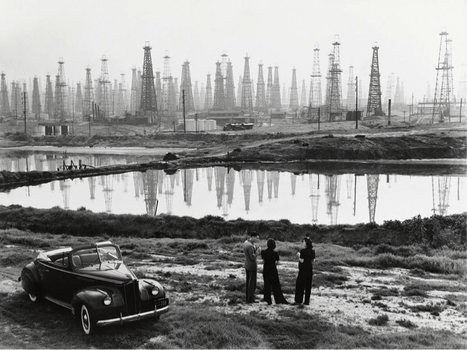
Because Bruce was a whipstock expert he was busy at the Gulch. No derrick could be erected on the beach because of the tidal shifts so a pier was begun immediately in order to begin drilling out in the Santa Barbara channel. The oil pool was offshore and in order to reach it they would need to slant drill.

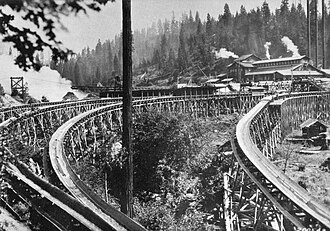
A pile driver building the piers for the validation well. The validation well, Appleford No. 1, October 1929.

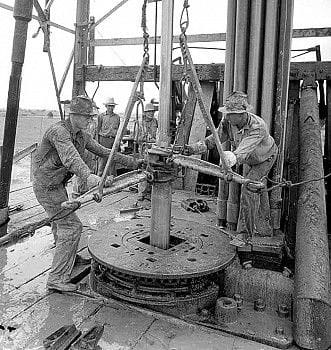
Bruce’s new position came with a raise and lots more responsibility. After nearly twelve years the twelve hour tour was a thing of the past. The twelve hour was now 24 hour and then some. Supervising more than one well could take a great deal of time. If his crews were lucky they had a shack or small shed where they could wrap themselves around boxes and equipment and sleep the sleep of exhaustion between tripping pipe. Pulling all the pipe in the casing, “Making a round trip” or simply “Making a trip” is the physical act of pulling the drill string out of the well-bore and then running it back in. This is done by physically breaking out or disconnecting the drill string when pulling out of the hole every other 2 or 3 joints of drill pipe at a time. The pipe pulled, called a stand is then racked vertically in the derrick. Up on a small platform near the top of the derrick called a “Monkey Board” is the The Derrick-man. the derrick-man walks the board to guide, stack, and secure drill pipe as it is lowered into or pulled from the bore hole.

Tripping pipe in the early 1930’s. The stack is behind the man on the right. Calisphere

A typical reason for tripping pipe is to replace a worn-out drill bit. Another common reason for tripping is to replace damaged drill pipe. It is important to get the pipe out of the well-bore quickly and safely before it can snap. My grandfather could place his gloved hand on the rotating pipe and tell you what was going on deep underground. In the thirties there was little in the way of scientific measurement. No electronics were yet available for measuring hole. The drillers still relied on taste, feel and smell to understand what was happening deep underground.

The drilling floor was a dangerous place to work, slippery with drilling mud, oil and water. Ninety feet above the floor hung all kinds of equipment that could fall and kill a man. Hands were crushed by heavy machinery, steam boilers could rupture and cook a man. Heavy chains could snap and take your legs off. No one wore a hard hat. They were not in common use yet. No self-respecting work man would were one anyway out of pure cussedness. Men were careful enough, within reason, but idiots were not tolerated and would be quickly run off lucky to just get a beating on the way. Avoiding death caused by an idiot is in itself likely to make a crew furious. It was every man for himself.

When Bruce left for work Eileen never knew when she would see him again. It could could be days. Raising the girls was mostly her job. House wifing was a different job in the thirties. There were no labor saving devices in the home. Few had a washing machines, only 8% of American homes had a refrigerator in 1930. If your house was electrified, about 90% were in urban areas, you had an opportunity to buy home appliances if you could afford it but if you lived out of town, if you lived on a farm or out in the country that dropped to roughly 10%. A woman lived little different than her grandmother had before the civil war. Things were still done by hand. Itinerant oil workers, because they moved so much weren’t likely to be moving with heavy appliances. It was by this time jusy normal life for grandma Hall. My mom talked about taking the rugs out to beat the dust out of them. She said she could really wrangle the floor sweeper around. She remembered that she was twelve when her mom retired the old Sad Iron. Mom also was the carwash, something she did until she married. Grandpa had a car which he liked to keep clean. Muddy roads meant a lot of washing. The car meant you could get to work and back and was an important as any other tool.

School was within walking distance. The old Benjamin Franklin grammar school had just been rebuilt and served the central section of Santa Barbara. Opened in 1899 it added to the legacy of education in Santa Barbara begun by the holding of formal classes in the home of Don Domingo Carrillo who had used local Chumash Indians labor to build his home in 1807. He built the house for his wife Concepción Pico Carrillo who established the school.*

Mom said she loved Santa Barbara and like every time they moved she hoped they would stay. Her reality was they were oil nomads. Grandpa went where the work was because he loved the work I guess. Thats thing not uncommon amongst those that work with their hands. Trapped by experience and the need to provide you’d better make the most of it. The rest of the family is along for the ride.

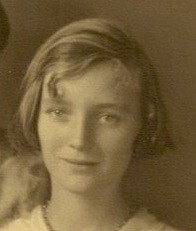
Barbara Hall. She carried that winsome look her entire life. Santa Barbara California 1931

Both my parents told me that when the were in the depression they didn’t really know it. No one called it that, It was just hard times and most people got by as best they could. They said ordinary people, which they were, took care of their money. Savings banks were a pretty new concept and most people didn’t use them anyway even if they had cash to spare. Because my dad was a farmer and dairyman they grew and made things people needed and saw as necessities. They were lucky in that way.

In the rest of the country one in four people were out of a job, over five thousand banks across the country closed forever taking peoples life saving with them, suicides increased by 30% and there were more than two million people homeless. Thirteen billion dollars of the American economy had absolutely evaporated in 1929 with the stock market crash. No one knew that the recovery would take a decade and with help from Adolf Hitler and the fascists governments of Europe.

Mom knew how to run a sewing machine and read patterns so she made her own clothes. So did her sister. Bob, her brother couldn’t sew but more than adequately filled the role of general all around pest which they both said he was pretty good at. They owned a car, which was a little bit of luxury but was necessary for Bruce to get to work. Mostly the kids walked to school, downtown or to shop. The Santa Barbara street railway had closed in 1929 killed off by car ownership but it wasn’t a large town, just 33 thousand in 1930 and especially for kids Shanks Mare got them around just fine. The most luxurious thing they owned was a radio. Radios were a new phenomenon that “Do you own a radio?” was a question on the 1930 census. The Hall’s said they did.

In addition to the music, news, and sports programming that present-day listeners are familiar with, radio during this period included scripted dramas, action-adventure series such as The Lone Ranger, science fiction shows such as Flash Gordon, soap operas, comedies, and live reads of movie scripts. Major film stars including Orson Welles got their start in radio Welles became a household name in the wake of the infamous panic sparked by his 1938 broadcast of The War of the Worlds. Both my parents said he didn’t really fool anybody.

Music filled many hours of programming, singers of all kinds, radio orchestras played popular music and symphonies. Popular 1930s radio shows included dramas and comedies like The Shadow, Little Orphan Annie, and Fibber McGee and Molly, variety and music shows like The Chase and Sanborn Hour and Kraft Music Hall, and children’s programs such as The Adventures of Superman. Radio was a booming entertainment medium during the decade.

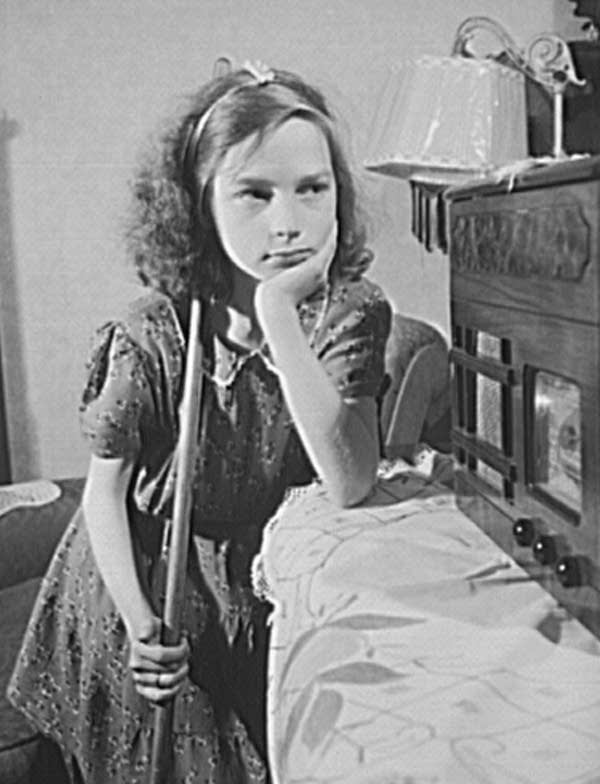
Taking a break to listen.

The future of the Hall family wasn’t all that rosy though. Grandpa had a good job near the top of the earnings curve but life in oil was still tenuous. Crude oil price were through the floor. Some independant companies were dumping oil on the ground. It cost more to pump it than it was worth. New exploratory wells were at a standstill. If there is no hope of profit, don’t invest.

Signal had made up it’s mind that the only hope for the company now that their sales of gasoline to the big producers had been cut off was to plow ahead with the Elwood field hoping to strike enough crude to at least break even so that a hoped for upturn would still find the company afloat.

Like pirates fleeing the law, they pressed on, mortgaging what they owned, makeing frantic rounds of private investors and sending a steady stream of executives to what banks were still in business hoping to find at least a dribble of cash. They began selling their crude at a loss. It was an enormous bet on the company and Sam Mosher’s “Varsity Team” of engineers, superintendents and drillers to innovate, cut the fat and and walk the knife edge of safety to survive another day.

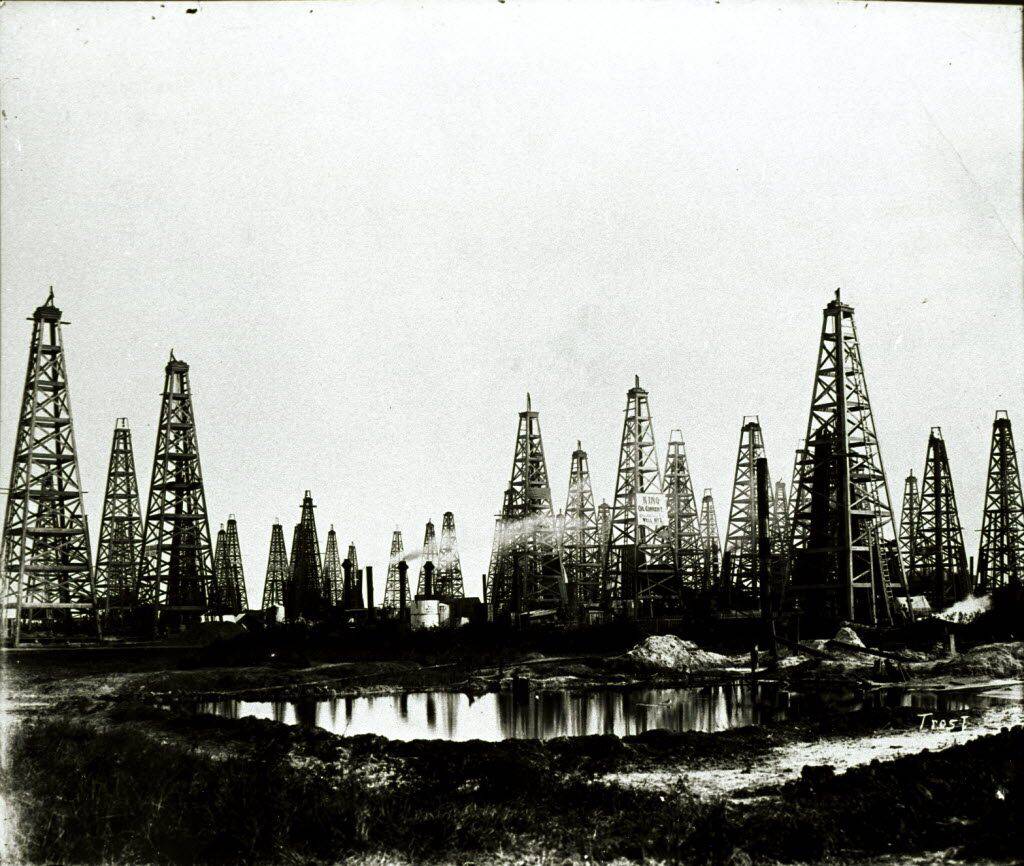
As fast as the piles for the piers at Hydrocarbon gulch were driven, derricks were thrown up, spudded in and the turntables began to whirl. Sometimes the drillers worked over parts of the pier that had almost no planking such was the rush. They wasted no time on guardrails. If you fell, it was in the water if you were lucky and you would simply be fished out. “Joining the Birds” was how they put it.”

From the small field in Maricopa, Chief Engineer R W Heath organized the teardown and loading of the refinery and processing plant which was moved by truck to Tecolote canyon where it was reassembled in just eighteen days. Eighteen, think of that, all moved by truck. There was no Hwy 166 in those days, it all came by 41 and down the Cuesta Grade in tired oil field trucks whose brakes were always suspect. That kind of job that could not be done today. Everyone who worked on the crew did whatever job was required. There was no specialization, if you could turn a wrench, you did. If sweat and grit could move tanks and towers it was done. In it’s early days Signal was like a team working to a common goal. A Varsity Team Sam Mosher liked to call it. Grandpa was one.

Signal had one toe over the line into bankruptcy. If they didn’t find a well which produced marketable quantities of crude they would be unable to meet their contracts and would be forced into receivership. Working overtime to keep the comany in business was the source of heart attacks. If the company failed no one had anywhere to turn. No jobs were available anywhere in oil. Mosher had nowhere to go except to work every day and trying to dream up a way out while sleeping.

Appleford number two did not bring in a heavy enough flow to be profitable. The head field engineer Walt Greenfield was sure that there was plenty of oil just a little farther offshore and said if he was able to whipstock a well he knew he could find it. Whipstocking used a heavy iron device shaped like a shoehorn that when lowered into the drill casing at about a hundred feet could guide the drill bit and its pipe in a lateral direction. They would be able to send the drill spinning out below the sea bed ahead of the pier into deeper water offshore. The problem for the front office is that the cost was thought prohibitive, as much as $35,000 instead of a typical $25,000 for a vertical hole. Management slammed the hammer down and said no, too expensive.

Bruce was a master of the Whipstock and drill bits were moving in all directions underground just like worms in the compost. Signal engineers believed that there was an ever larger pool just a little bit farther from shore. They believed that if they could just go a little bit farther out there was a fortune there for sure. They just had to find it.

The pile driver at work, Mahoney’s pier, 1930.

The family was pretty settled in those two years, Grandpa had steady work. The kids who were about to be teenagers and were happy in school, one of the few times where they stayed long enough make friends. Santa Barbara city was at it’s finest. Because of the generational wealth which was mostly depression proof stores stayed open, the streets were clean and safe. What was euphemistically called Riff Raff was quickly showed the way out of town.

Any minorities persevered in the face of direct and indirect discrimination. People who served in wealthy homes or worked the many fashionable hotels were allowed north to work but not to live.

The descendants of the original Spanish/Mexican and Barbareno Chumash were pushed down into the lower eastside south of Cabrillo street and east of State. Over the middle part of the twentieth century discrimination concentrated the non-white population into the area of temporary shacks, cheap houses** and a service area that held the laundries, shoe repair shops, blacksmiths and auto repair garages. In the depression there was a literal line at Cabrillo Street where people who dwelled in the lower east where most definitely not encouraged to cross.The Eastside neighborhood, was for the marginalized racial and ethnic minorities.

In an interesting twist the school my mother attended was fully integrated though it was outside those neighborhoods entirely.

Born at the end of the 19th century my grandparent’s had that sort of mild racist mindset common at the time. On a simple scale they felt that somehow they were better than the marginalized. In her old age, my grandmother occasionally referred to African Americans as “Coons” which set my teeth on edge. The thing about it was that she had no evil intent. She might have been just referring to the fact that African Americans were undereducated and had less opportunity or lived in poorer neighborhoods. It seemed to be just as if she was describing any object of note. It certainly goes to the complexity of experience. It would be decades before African Americans or Hispanics started showing up in the oilfields. In their married life that had lived in more than one “Sundowner” town.***

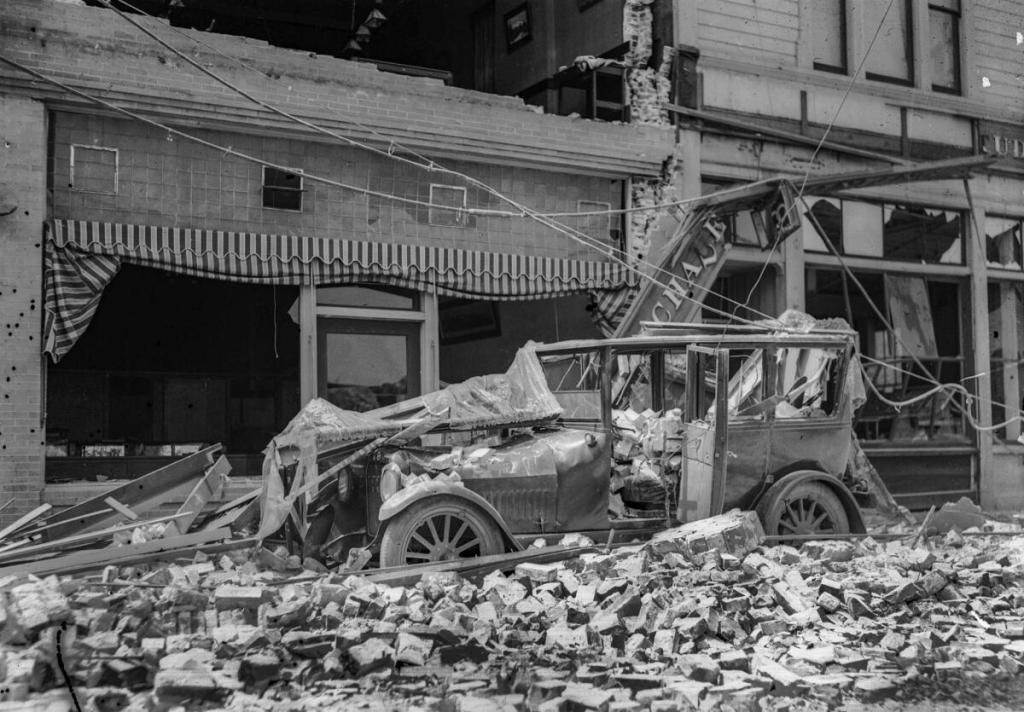
State street, Santa Barbara, California June 29th, 1925. Calisphere


In a fortunate piece of timing after the devastating earthquake of 1925 it was decided to rebuild the city in a quasi-California Mission Style. Helen Hunt Jackson’s novel Ramona written in the late nineteenth century had kindled and polished a romantic version of old California. Though the novel became popular and did, for some, shine a light on injustices toward Indigenous peoples, the fact remains that the novel, rather than initiating a movement of change, romanticized a tragic story where the ones who lost the most were those of Indigenous descent. The largest impact the novel had was in tourism—creating a road map of California that the characters traveled, thus making these locations popular and lucrative. The Rancho life has endured until today as a visible symbol of old California which never truly existed. The fantasy, the connection between the novel Ramona and Lummis’s Sunset Magazine is through tourism: the book became so popular it inspired a wave of travel in Southern California, which Sunset Magazine later helped promote and document. Focusing on the region’s “Old California” romantic image led to design requirements for rebuilding the downtown. Santa Barbara remade itself into a popular vision and because the country was postwar prosperous it became the best example of a Hollywood style fantasy of any California city.

Construction of the nearly destroyed Mission had been completed just two years before my mothers family moved there. The harbor was completed in 1929 and was family inaugurated the following year when my Aunt Mariel pushed my mother off the breakwater onto the boulders below and knocked out her front teeth. Never found they are still there as a sort of family talisman.

As a child I was fascinated that she could detach her bridge, take out her teeth which she scrubbed in the kitchen sink. I knew of no other mother who could do such a marvelous thing. Such are the connections that make a life I suppose.

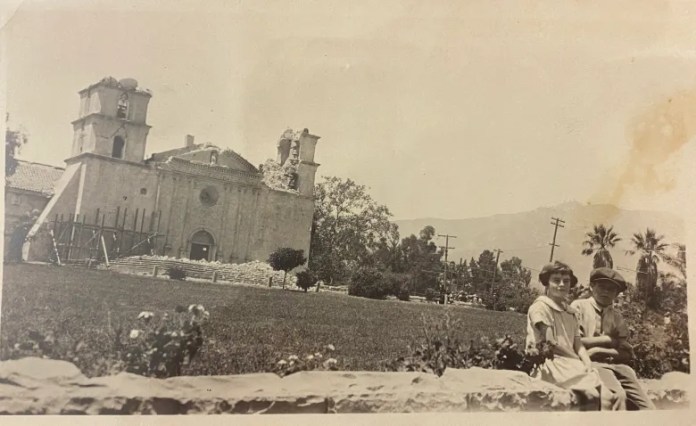
Mission Santa Barbara 1925 after the quake.

The company could at least make payroll and service all it’s notes. Sam was busy looking around for more possibilities. He found some on Signal Hill.

The driller’s had no choice but to wait until things became absolutely desperate. Holding on by the skin of his teeth, Mosher operated a grand total of eighteen wells in the Los Angeles basin, the Midway-Sunset in the southern San Jaoquin and the Elwood field Mosher decided to slow exploration in Ellwood and buy more leases in and around Long Beach. So in late 1931 the Halls rolled up the carpets and trekked south.

Chapter 17 Next:. A year of ups and downs with a major surprise

NOTES

*Leopoldo Antonio Carrillo August 6, 1880 – September 10, 1961) was an American actor, vaudevillian, political cartoonist, and conservationist. He was notable for playing Pancho in the television series The Cisco Kid (1950–1956) and in several films. His signature line was “Cisco, lets went.” His character has since been memorialized and the catch phrase Lets Went” taken its place as a bit of California iconography. We will meet him again later in the story.

**My oldest son rented a studio apartment in an old house which had been divided into apartments in the old eastside neighborhood. This was when he was working in management at a beachside hotel in the early 2000s. Rent was nine hundred a months which was a very substantial sum for a bedroom that had a toilet in it. The house should have been condemned long ago but ghettos are not torn down in one night.

***A sundown town was an all-white community that intentionally excluded people of color, typically African Americans, using discriminatory laws, harassment, threats, or violence. The term comes from signs posted at town borders that warned non-white people to leave before sundown or face consequences. Many California oilfield towns had active KKK chapters until after WWII and later. My grandparents would have been familiar with the term and life in them.

Michael Shannon writes and lives in Arroyo Grande California. He tells these stories so his children will know where they came from.

Standard

The Lid

Michael Shannon

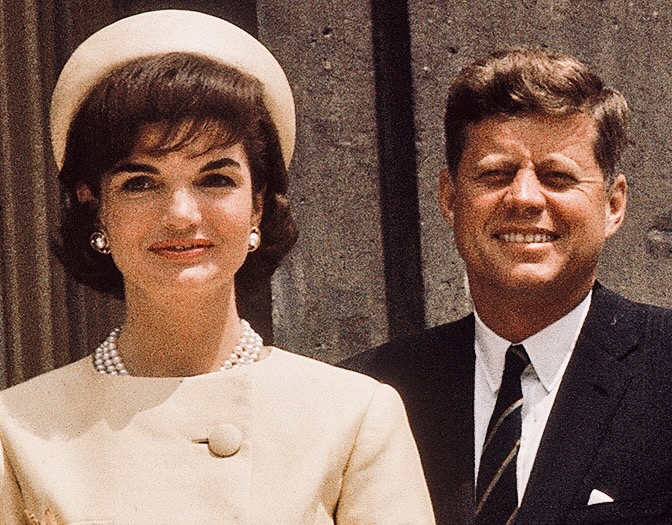
It’s inauguration day January 20th 1961. There is eight inches of new snow on the ground. It is freezing yet over a million people had gathered on the mall as witnesses. Two vastly important things happened on the marble steps of the Capitol building in Washington DC. Neither one was the swearing in of a new president. In a photograph of Supreme Court Justice Earl Warren reading the oath of office to the new chief executive who is not wearing a hat, his wife Jaqueline stands behind Warren absolutely rocking her Halston designed pillbox hat. The hew President John F. Kennedy was set to become the first US leader born in the 20th century, the first Catholic commander-in-chief and the first president whose inaugural speech was beamed across crackly television screens in color.

Everything that happened on January 20, 1961, was stage-managed to tell America that a new age was dawning. “Ask not what your country can do for you – ask what you can do for your country,” he implored a nation in need of reassurance and leadership at the height of the Cold War.

Perhaps the saddest thing about this day of hope was that it was the death knell of hats. Kennedy didn’t like hats and wouldn’t wear one unless he had to. He had great hair which is essential in the political game. Why cover it up?

In one fell swoop two centuries of hats were swept away. After 1961 there were still great hats to be seen but only on rare and special occasions. In the movies, at fashion shows and at the Kentucky Derby where they aped the far more famous and, dare I say more stylish British.

Audrey Hepburn, “My Fair Lady.”

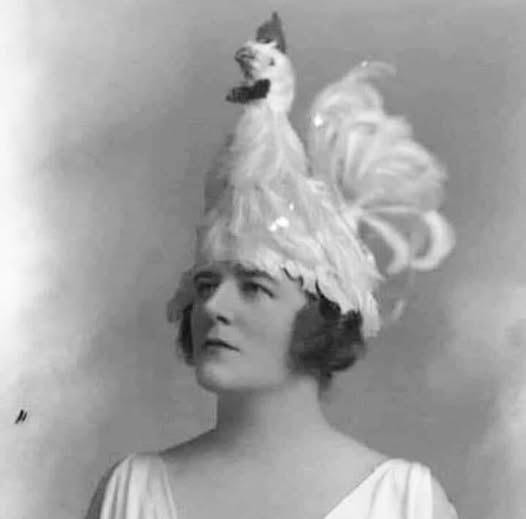
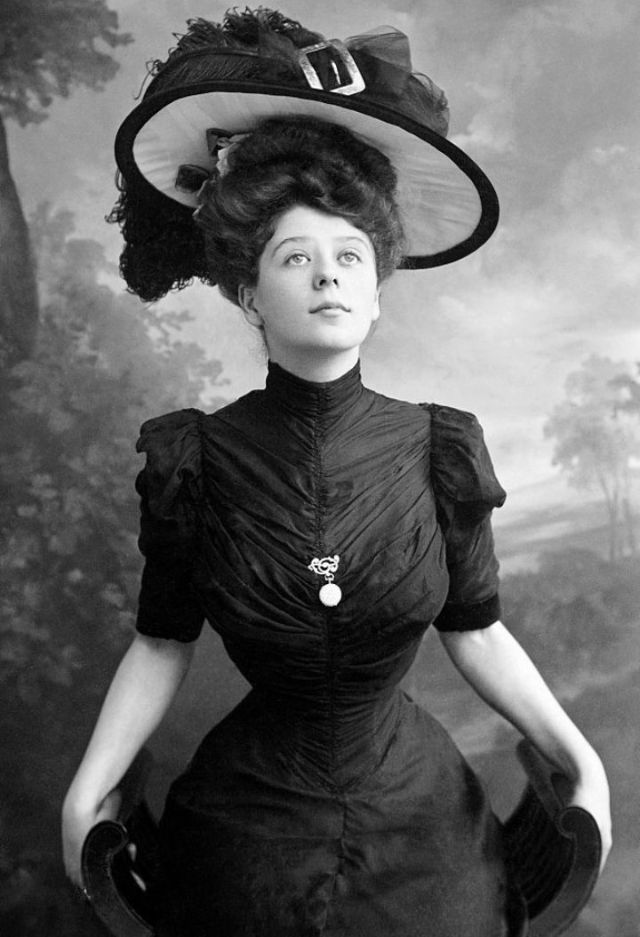
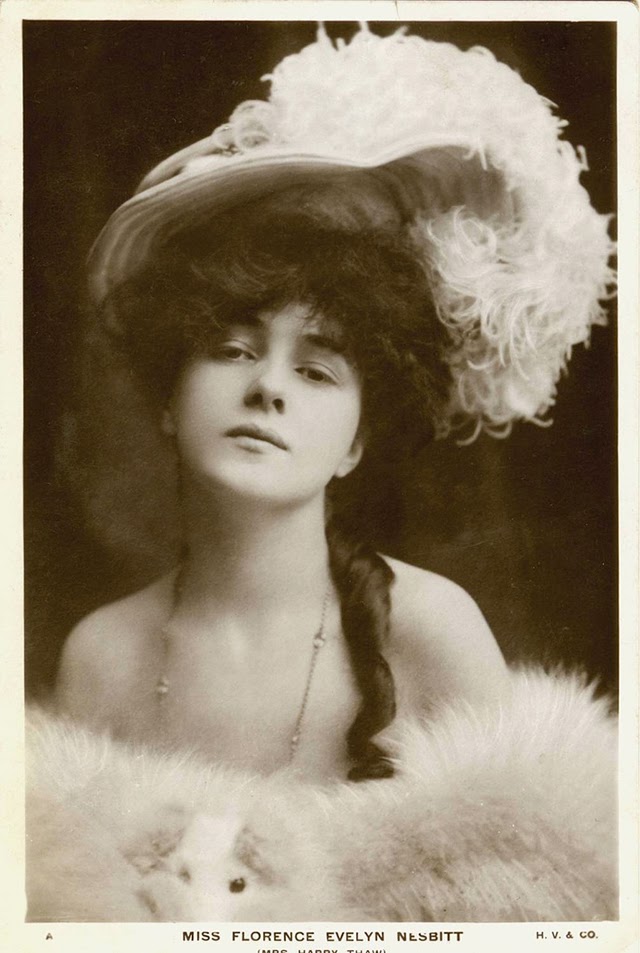
We all know the iconic mega-feathered hats of the Edwardian era. The Edwardians were particularly enamored with plumage, but unlike their be-feathered predecessors, the Victorians and the Georgians, many a fine species of bird was taken to the brink of extinction by the incredible demand for ladies be-feathered hats.

Throughout history, hats have played a big role in indicating one’s status. For the Edwardians, they took this to a new level, and often added entire birds to their heads, and sometimes these birds were fantastical creations cobbled together from several varying bird parts!

Popular plumage for hats extended beyond ostrich, to include heron, peacock, egret, osprey, bird of paradise, pheasant…even vulture. The more “common” feathers for adornment were garden fowl, pigeon, turkey, goose, and rooster. These feathers were made into plumes, pompoms, aigrettes, wings, pads, bands, breasts, and quills, and not by marchandes, milliners, and craftsmen in quaint little shops, oh no, by massive factories employing thousands of women and children, and dealing in hundreds of thousands of feathers per day. In 1900, in North America, the millinery industry employed 83,000 people!

Camille Clifford American actress

Evelyn Nesbit, the Girl in the Velvet Swing. Lillian Russell the Jersey Lily. Lily Elsie in the Merry Widow

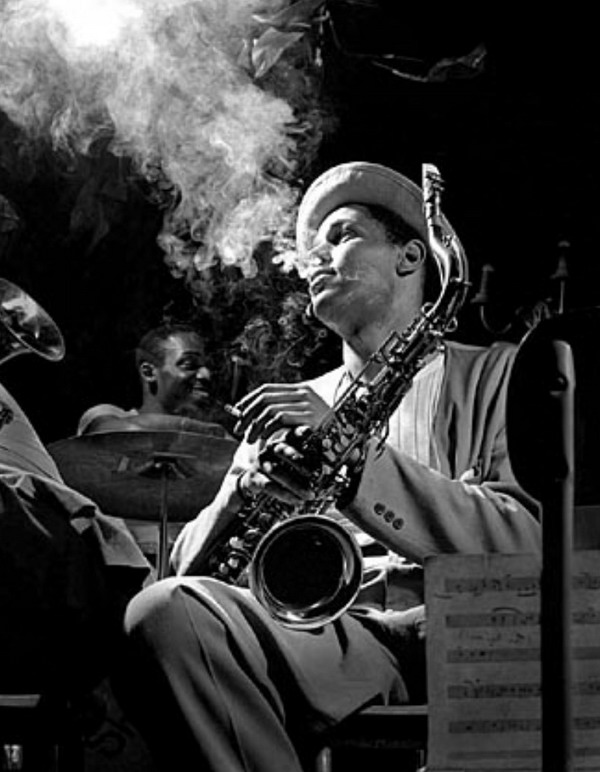
In a world of sweat stained baseball caps and shapeless, floppy hiking hats sold at every seaside gift shop and those faux cowboy hats made for the bar and ATV wrangling, only Jazz musicians have kept the banner of the chapeau flying. No one could rock a Pork Pie like Lester Young, the greatest tenor sax player who ever lived if I do say so myself.

L to R Thelonius Monk and Lester Williams “The Prez,” nicknamed by Billie Holiday herself.

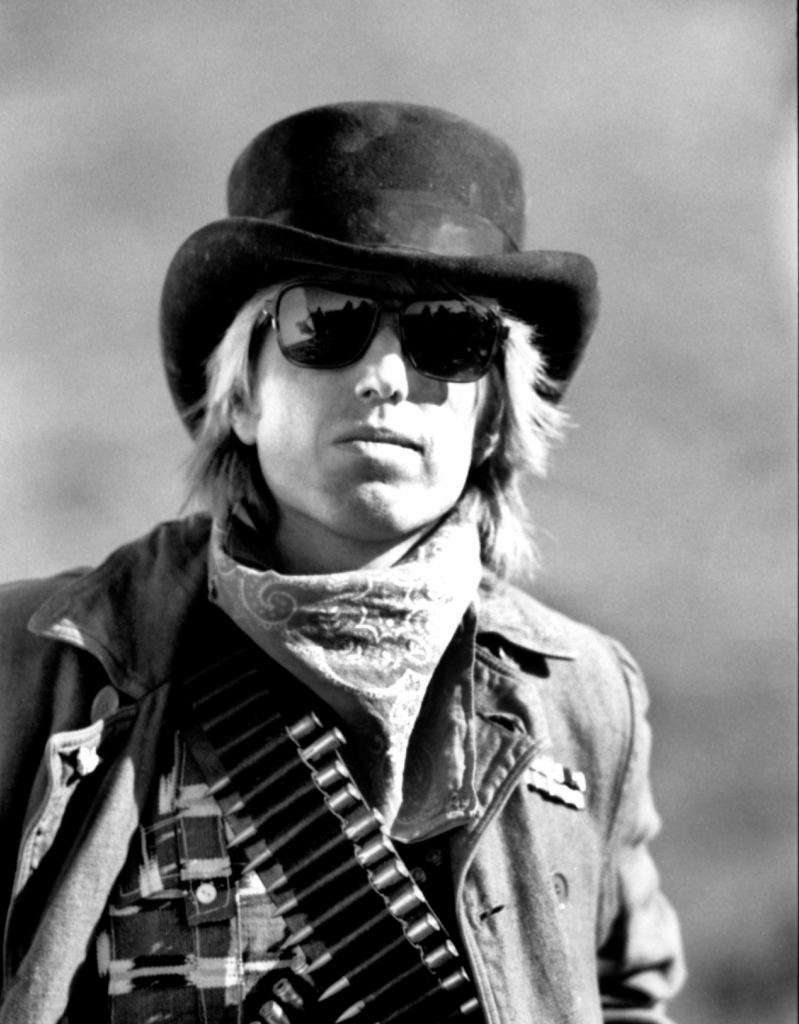
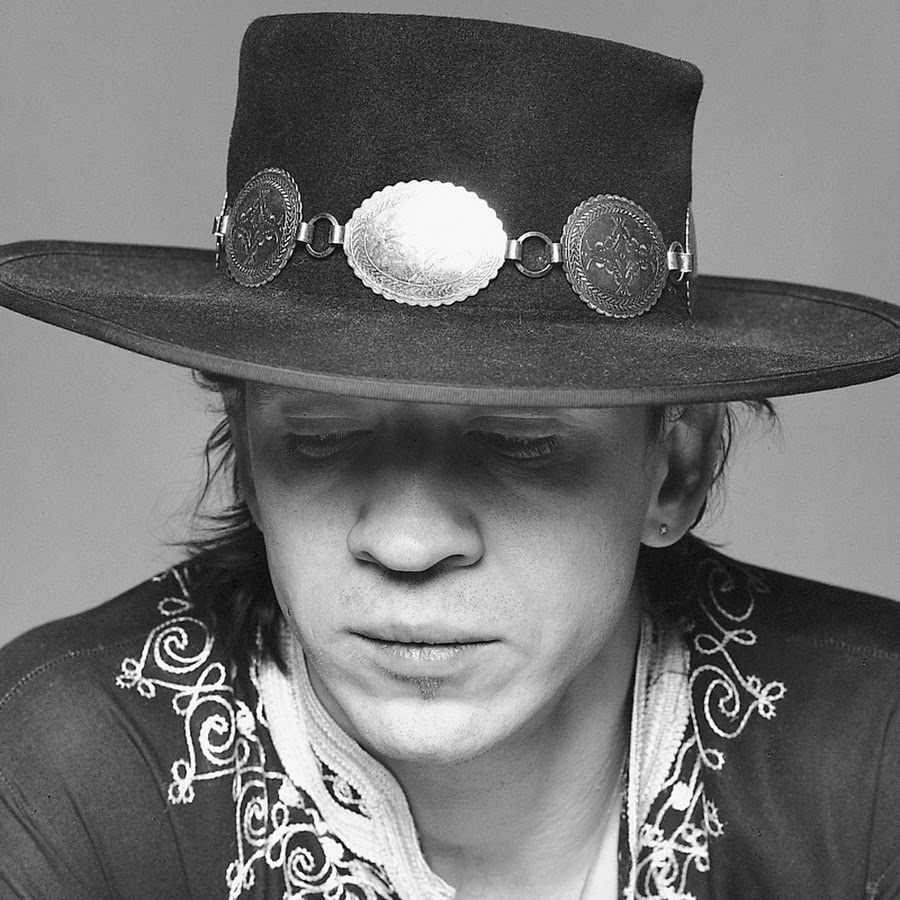
Rockers too have had their iconic hats. Some such as Leon Russels “Mad Hatter” lid was so famous that just the sight of it identified the person. Tom Petty’s John Bull Topper and Stevie Ray Vaughns Texas style Plateau hat could be spotted a mile away. All three somehow lent a special air to the legendary musicians.

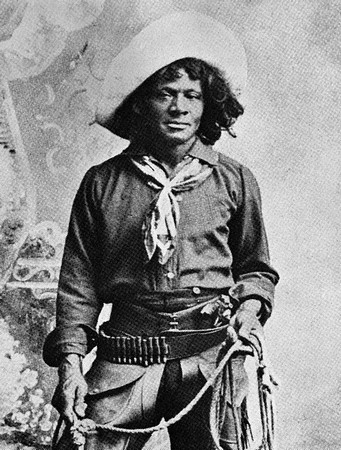
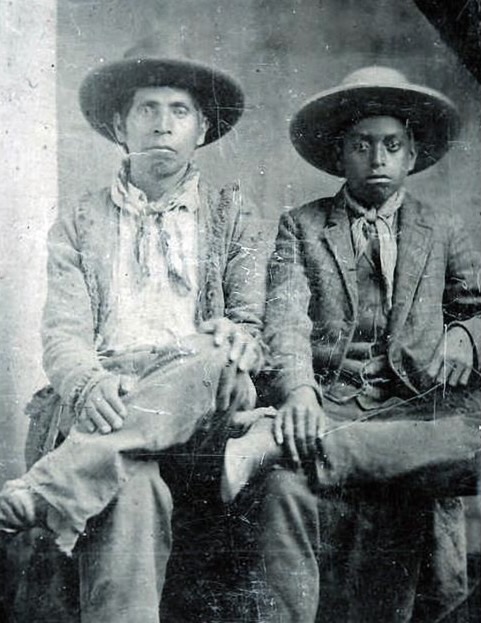
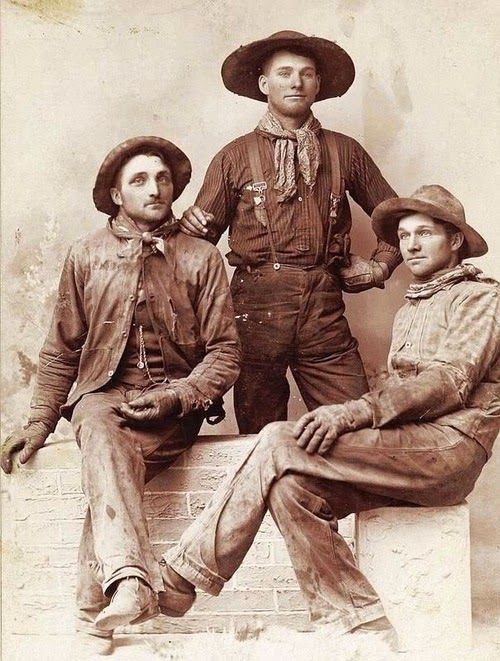
Cowboys are well known for their hats. Every area of the country seems to have a dedicated style today but in the beginning it was just something to cover the head. Bowlers, broken down military hats the cheap felt hats that came out of the civil war especially from the Confederates. Since big time ranching essentially started in Texas-New Mexico those boys set the style. They were dirt poor, likely almost no education but they could fork a horse and they showed off a certain style that somehow puts modern cowboys riding their ATV’s and wearing custom shirts with patches that make them look like they came out of nascar to shame.

Cowboys from the old original days. Black, Brown and white as it used to be. 1870 to 1900. PD

The women too wore hats, just like the men though with perhaps a little more style.

Clockwise from upper left: The Sweetheart of the rodeo, my great-grandmother Marianna Cayce, a Mexican Charraria from Jalisco, Mexico and one of the girls from the old Huasna rancho, California. Look up the Charrarias, they ride horse handling events and do it all sidesaddle. My grandmother was the first woman to ride astride in the Santa Barbara Fiest parade in 1925. She loved the scandal.

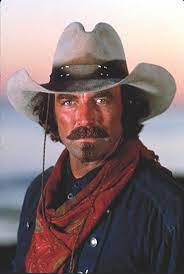
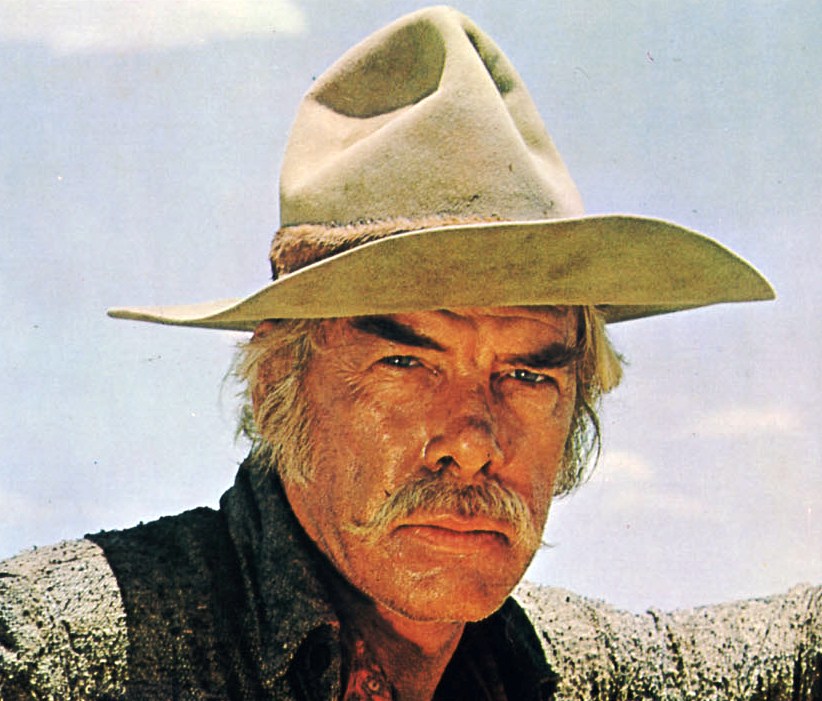
I have to say that some of the movie cowpokes sported great hats too though theirs were chosen by set dressers to match their features, like an artist might paint them but the good ones are worth remembering.

From upper left clockwise: Henry Fonda, Tom Selleck, Jeff Bridges with Hailey Stanfield and from the greatest western ever made, “Monte Walsh.” Lee Marvin.

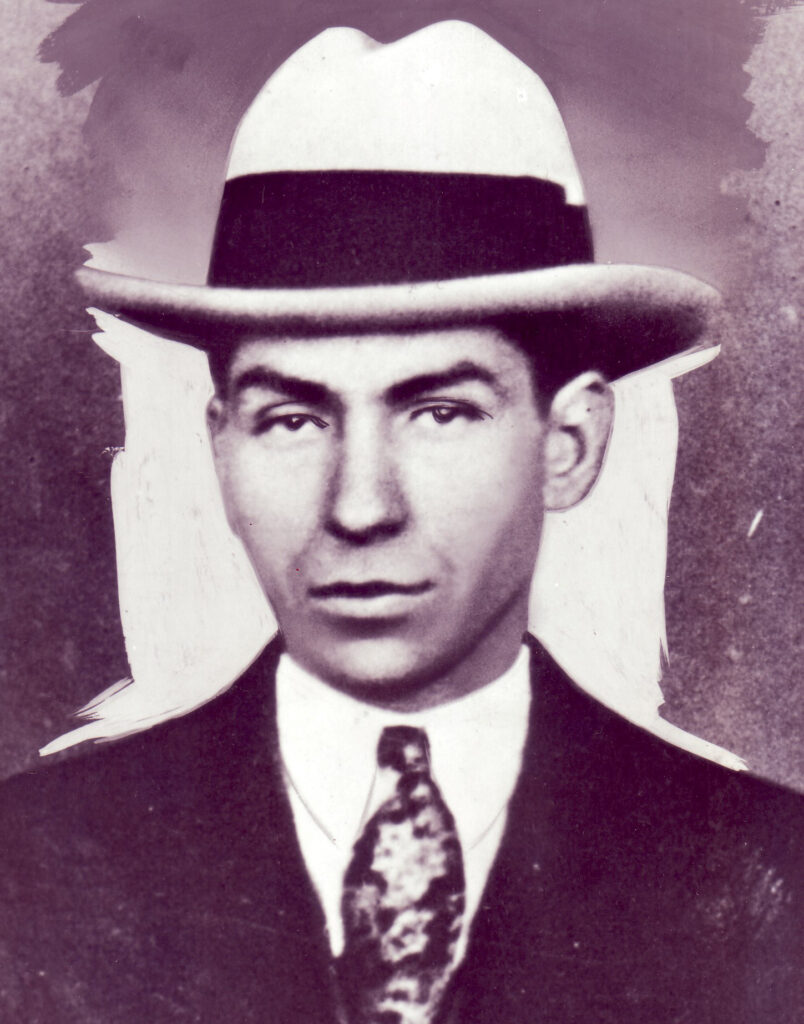
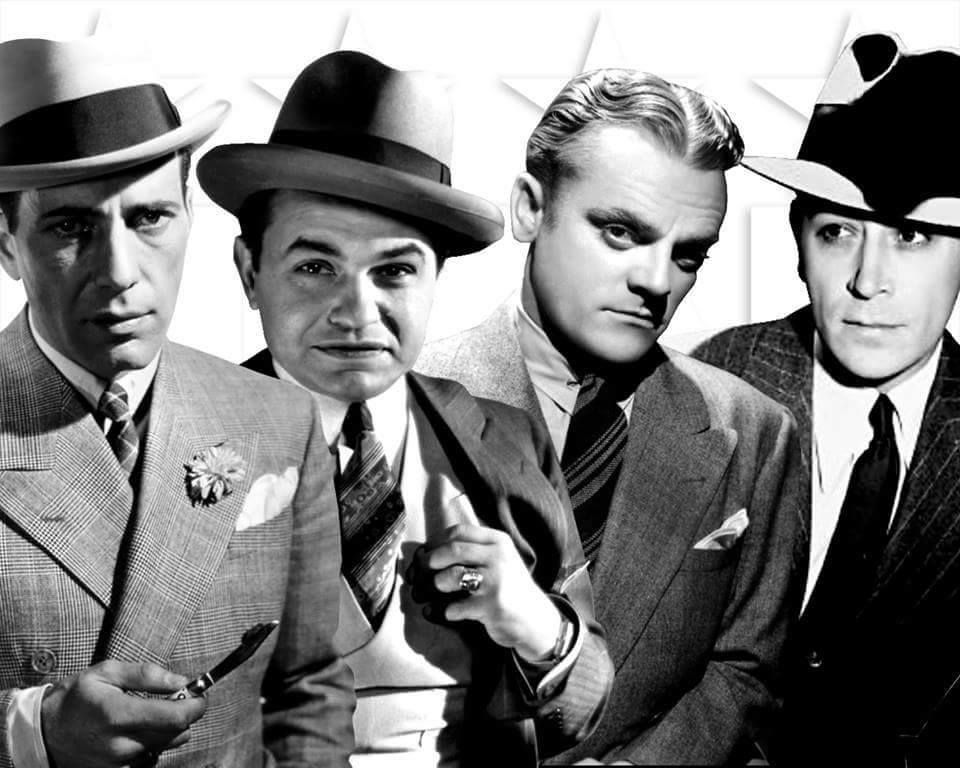
Every good gangster must wear an iconic hat. Fedoras, snap brims, skimmers, newsboys, they wore ’em all doncha see? Before gangsters dressed in tracksuits and gold chains by the dozen, revealing their status as potential killers there was a day when the point was to look like an honest businessman. In suits and fedoras they strolled the Big Apple in neighborhoods such as “Hell’s Kitchen, “Alphabet City” and the Bowery. Gangsters of every stripe roamed the lower east side, Little Italy and The Five Points, The Tenderloin and Harlem. The Dead Rabbits, The Forty Thieves, The Whyos, The Purple Gang and Murder Inc. roamed their districts with evil intent. With a Snap Brim or Straw Boater, Chewing on a ‘seegar’ they dressed to the Nines to send a message.

“Lucky” Luciano and “Bugs Moran” Cold dead eyes.

Moviemakers have a fascination with gangsters. Their portrayal is designed to send shivers up and down the spines of viewers who will watch them and ogle their antics on the big screen in a state of vicarious joy.

The Godfather, Little Caesar, Public Enemy and Scarface.

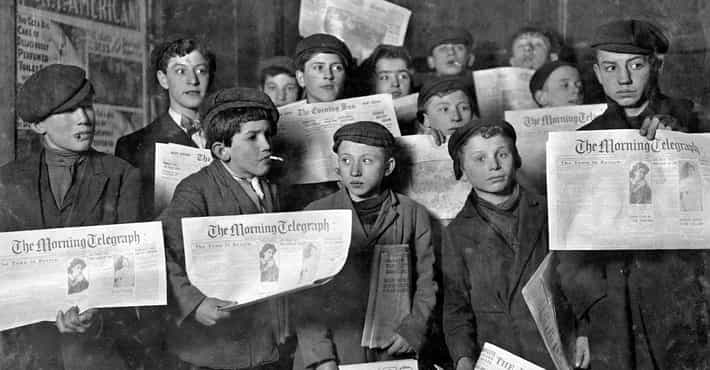
The workingman typically sported a cap unlike the “Swells” and their Homburgs and hardboiled Derbys winding down through the financial district and sporting a rolled umbrella as a mark of their status. Known by various names in the western world, Flat Caps, Newsboys, Scally Cap and Baker Boy Cap they were once worn by tradesmen of every kind. Recently they have seen a modest rebirth with the hipster Scally Cap and the Baker Boy Paddy Cap from Ireland.

The Morning Telegraph was a New York City broadsheet newspaper owned by Moe Annenberg’s Cecelia Corporation. Bat Masterson frontier marshall was its sportswriter. It ceased publication in 1972. Newsboys photo circa 1897.

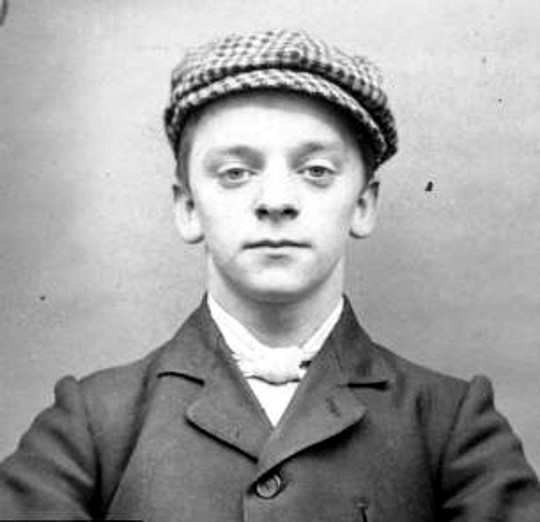
This a comparison of the Baker Boy Cap, the real on the left and the movie on the right. Henry Fowler real, Cillian Murphy not real.

Gang members frequently wore tailored clothing, which was not uncommon for gangs of the time. Bosses wore silk scarves and starched collars with metal tie buttons. Their distinctive dress was easily recognizable by city inhabitants, police, and rival gang members. The wives, girlfriends, and mistresses of the gang members were known for wearing lavish clothing. Pearls, silks, and colorful scarves were commonplace on their women. The gang in England, operated from the 1880s until the 1920s. The group consisted largely of young criminals from lower- to working-class backgrounds. They engaged in murder, robbery, violence, racketeering, illegal bookmaking, and control of gambling. Members wore signature outfits that typically included tailored jackets, lapelled overcoats, buttoned waistcoats, silk scarves, bell-bottom trousers, leather boots, and flat caps. The so-called Peaky Blinders, which contrary to what you might see on television did not have razor blades sewn into their caps because Gillette didn’t begin making the old single edge razor blade until 1908. They instead gained their name from the way they wore them with the cap tilted so that the peak covered one eye.

The real deal. Peaky Blinders criminal records about 1904. Birmingham, England.

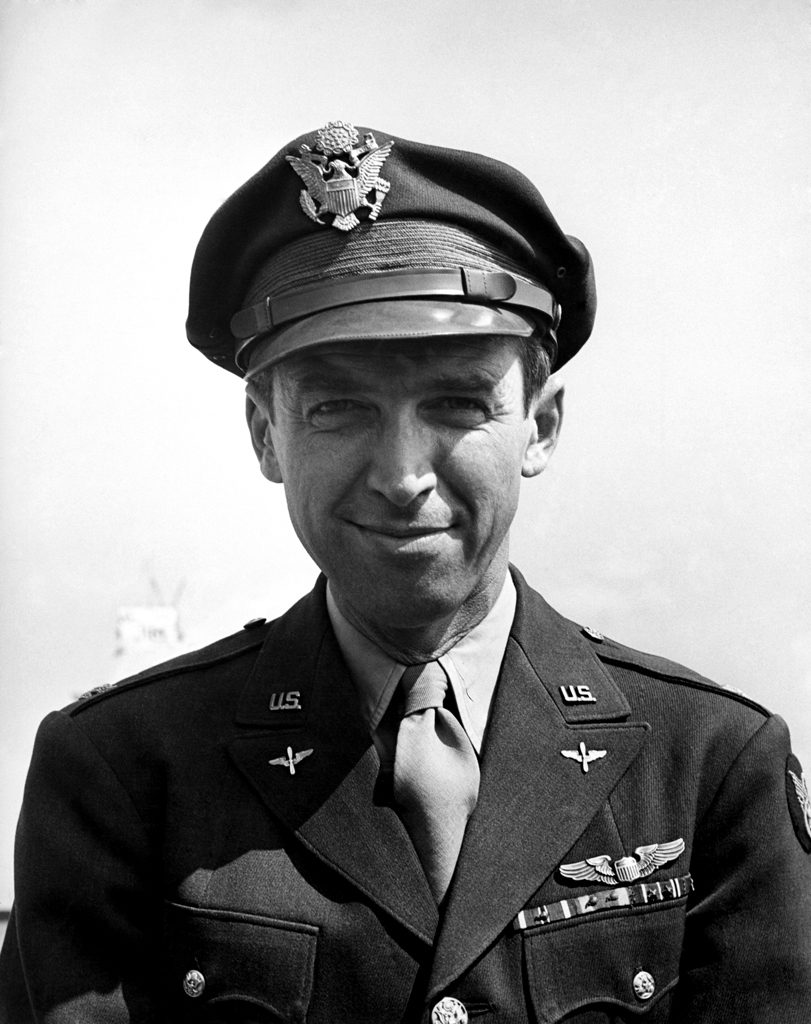
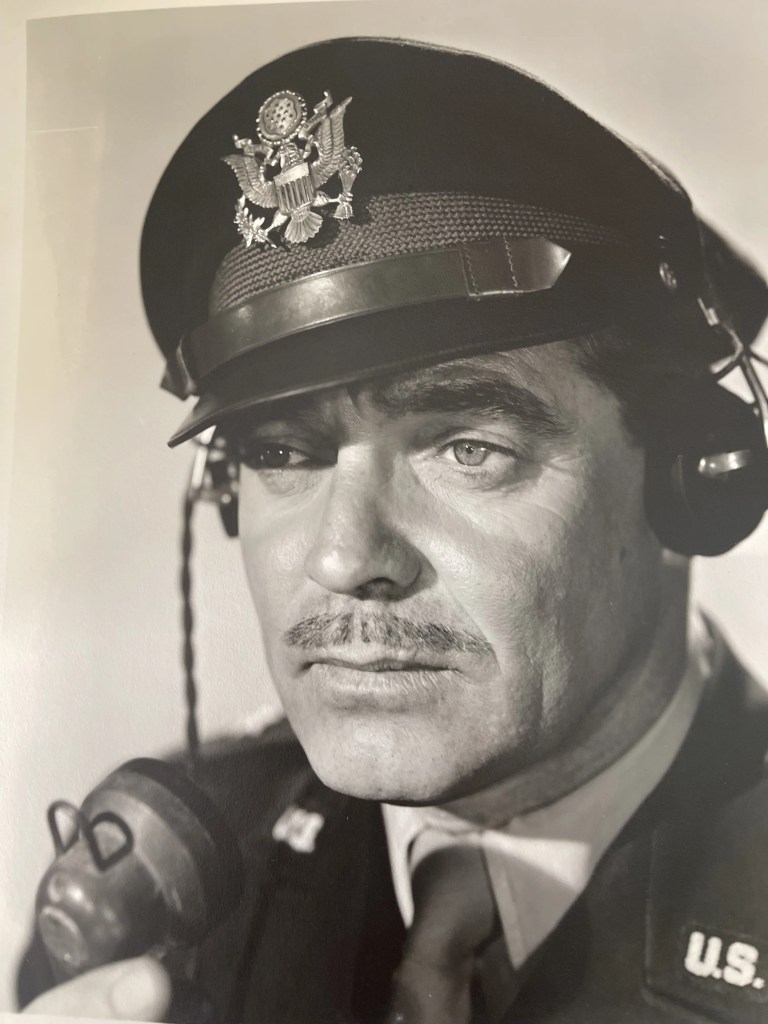
The armed forces in America have little choice in what they wear. Officers and enlisted men have gone to great lengths to build in some individual style when they can. In WWII Army Air Corps officer pilots wore their field grade visor hats in the cockpit. Because they wore head phones to communicate the strap on the phones bent down the crown stiffener so that the normally flat top was “crushed” on the sides. The hat became so cool that all officers not just fliers sported them. Flyers looked down on these posers with a degree of disdain as they should.

The real deal. B-17 pilot Colonel Jimmy Stewart and Major Clark Gable, air gunner. Both flew multiple missions over Germany.

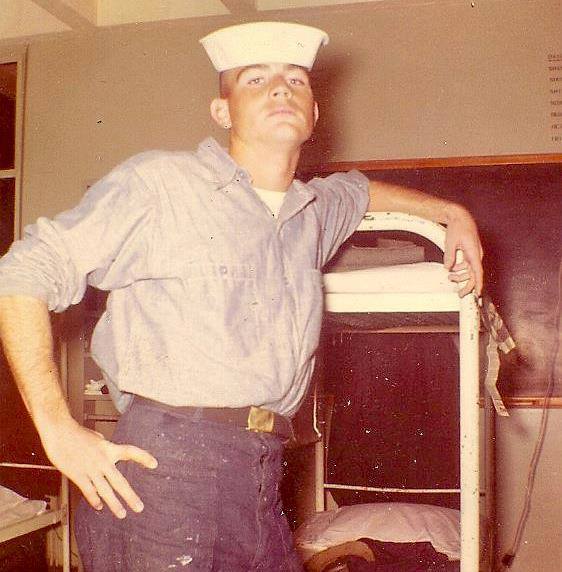
Enlisted sailors and soldiers, though they didn’t wear gold braid, nevertheless found ways to twist, fold and crimp their headgear too. If you have complained about those darn kids wearing their ball caps all crazy, have at look at your great-grandfathers style.

Tuskegee 332nd fighter group ground crew in Italy WWII. Bobby Hall stylin’ his Dixie, US Navy

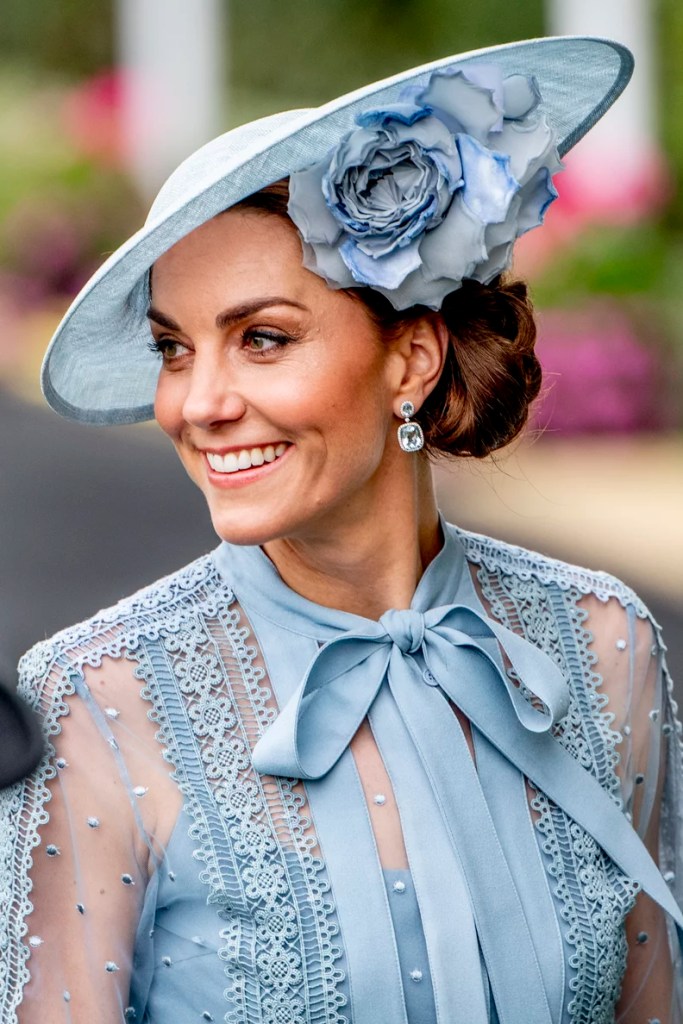
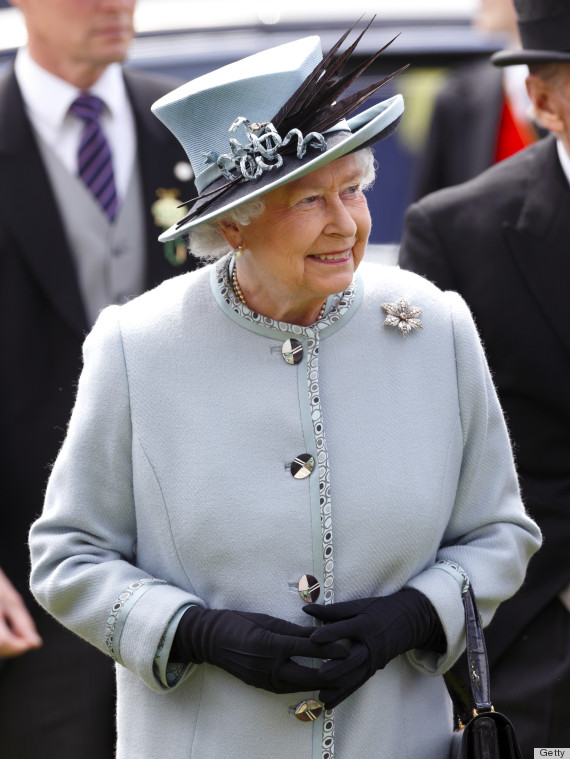
In Great Britain they run the Epsom Derby, pronounced Darby, is run in June of each year. The Stakes, more commonly known as the Derby and sometimes referred to as the Epsom Derby, is a Group 1 flat horse race in England open to three-year-old colts and fillies. It’s a major event in on British sporting calendar. The queens and kings have been running their horses in this race since 1661 and annually since 1740. Like other elite horse races, the Epsom Derby has grown into a multiday festival, featuring musical acts and events in addition to the race itself. The Oaks is also run during the Derby festival, held on the Friday before the Saturday running of the Derby. Derby Day is more formal than most contemporary sporting events: Epsom Downs maintains a dress code for male spectators in certain sections of the stands, and women often attend the event wearing extravagant hats. Hats are literally the most important reason for showing up for some. Troops of photographers flit to and fro capturing images of important people and their hats.

Queen to be, The real Queen, a Duchess and an the American Queen.

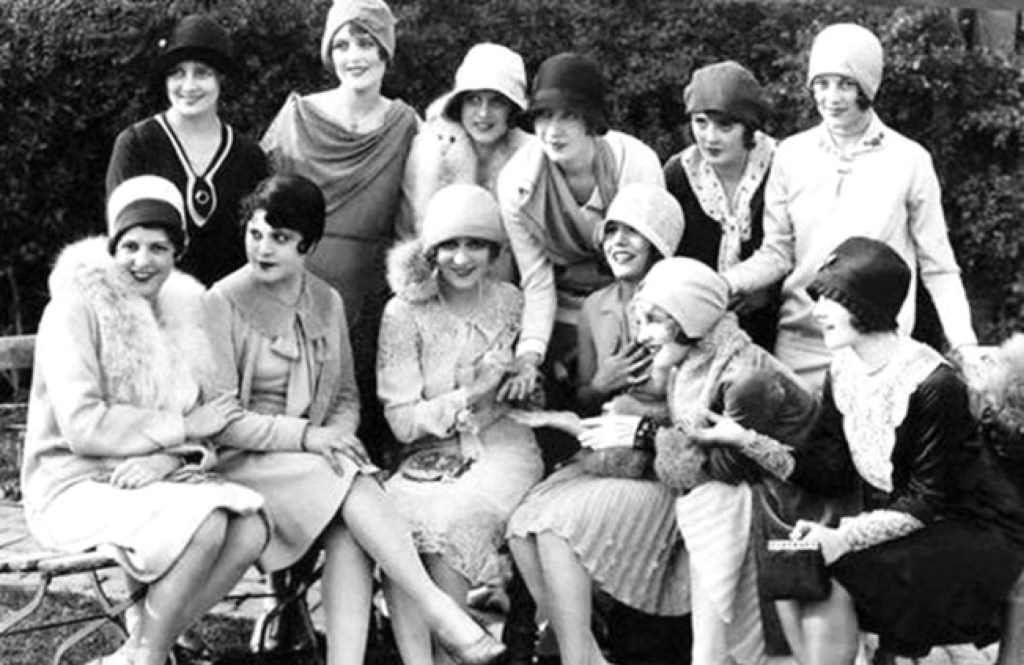
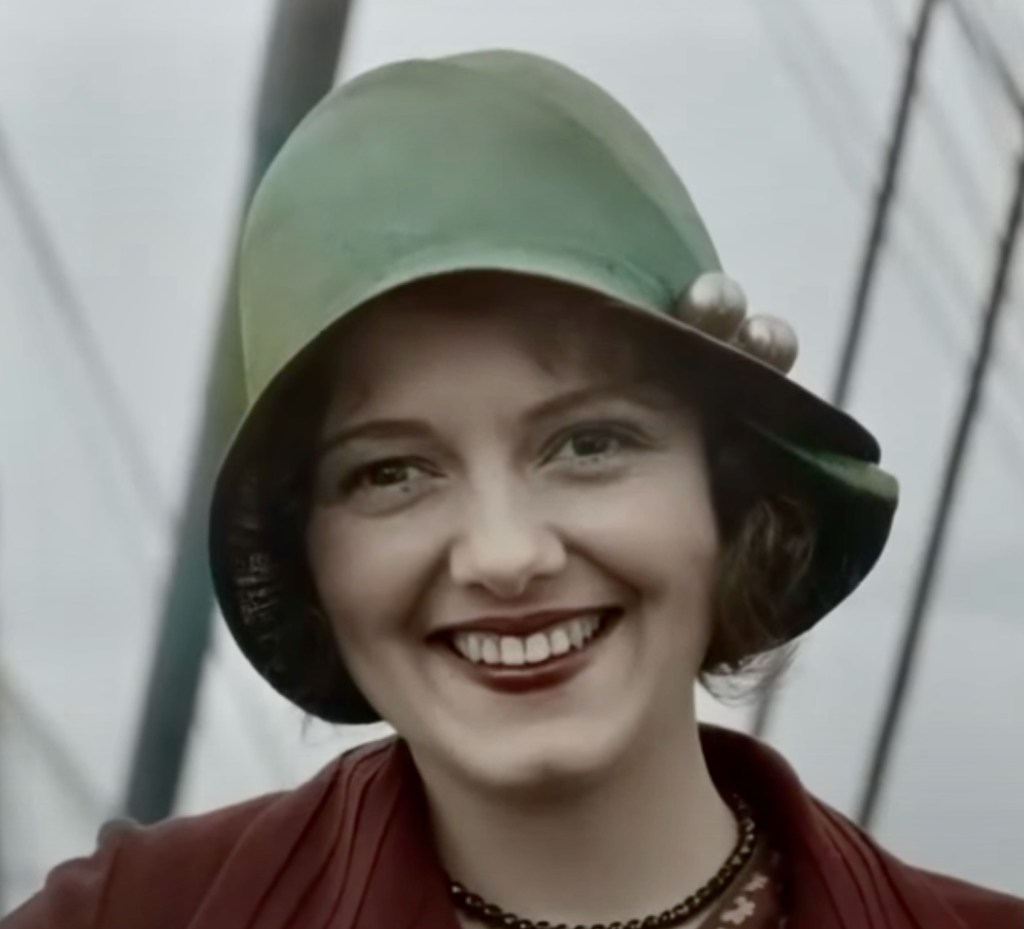
We’ve all seen the distintive Cloche hat which was popular in the 20’s and 30’s I always thought the were strange looking things. aort of beanie-like, blah and bland. When I was looking for examples I ran across a colorized video of a Parisian woman sitting outside a bistro wearing one and it completely changed my perception. The color and movement explained it all.

Janet Gaynor, American actress traveling to New York on the Queen Mary in 1929 and a sophisticated Parisienne taking tea on the banks of the Seine in 1927. Some people can make anything look good.

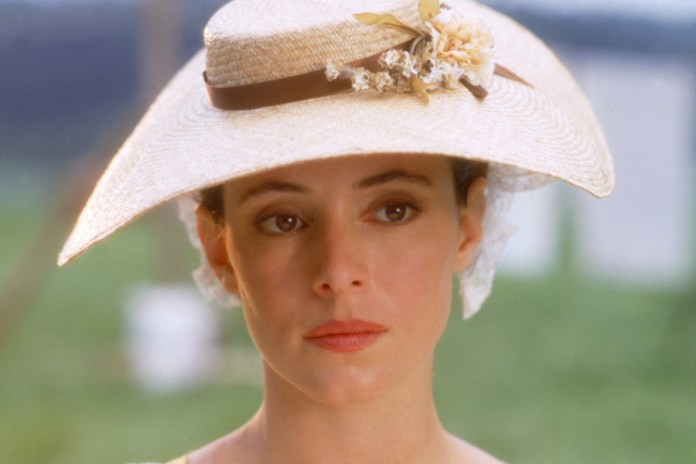
I’m sad to see the end of the Pork Pie, the Topper, the Skimmer, the derby, the merry widow and the little straw bonnet worn by Natty Bumpo’s sweetheart Cora Munro in the Last of the Mohicans,

Misstress Cora Munro.

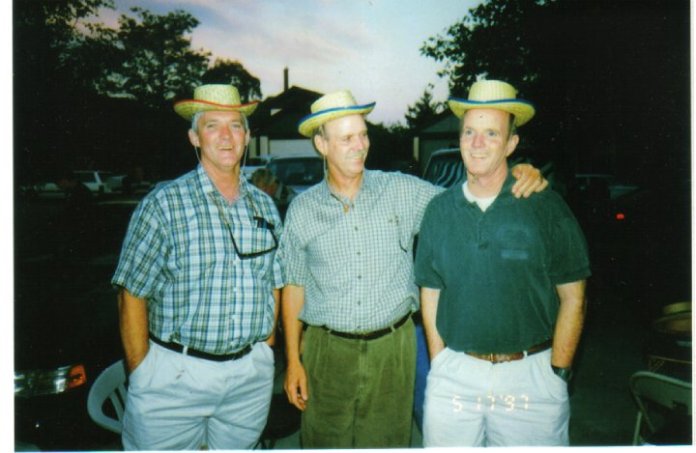
My brothers and I though, are making an attempt to jump start the fine old art of hat wearing. Maybe it will work.

Good luck to us I say.

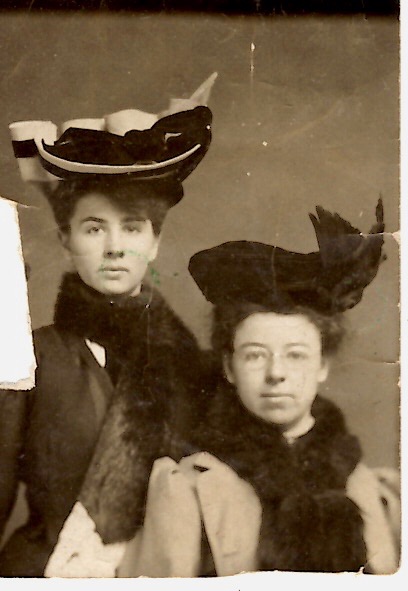
Cover Photo: My grandmother Annie Gray Shannon and Hattie Tyler, 1900

Michael Shannon is a writer and sure to take some abuse from his brothers for this.

Standard

Dear Dona

Page 14

The Last Battle

By Michael Shannon

“The God of Death has come.” Shouted by a Japanese Imperial Naval Marine* upon seeing Marines landings on Betio, forever enshrined in the notes taken in interviews by MIS translators during the battle for Tarawa.

The filth, the crawling over sharp coral, running crouched, hunched over with every muscle in the body nearly rigid with fear, the noise which never stopped, artillery, flamethrowers, grenades and the constant pop of gunfire. Battleship shells weighing a ton, Destroyers nearly run up on the beach duking it out with gun emplacements at point blank range. A miss is a miss but the M-1 round still can kill at 6,500 yards, over 3.5 miles. The Japanese Arisaka type 99 rifle could kill at 3,700 hundred yards. No place on the island could be safe for the soldier. The air is full of them. There was no place safe. No one could think or conceive of any other universe. The Battle of Okinawa (Operation Iceberg) was the final major land battle of World War II, lasting 82 days from April 1 to June 22, 1945. It was a brutal, large-scale engagement where U.S. and Allied forces fought Japanese troops on the island of Okinawa, the last step before a potential invasion of Japan. The battle was exceptionally bloody, resulting in massive casualties for both sides, including a significant loss of civilian life among the Okinawan people, and heavily influenced the U.S. decision to use atomic weapons on Japan.

Soldiers are so young. Is it impossible that they should be able to process the situation they are in? When they awaken at the bottom of their waterlogged foxholes after dreams of home they understood there was no escape.

Witness this Marine Ambulance driver’s letter home written about half way through the invasion. He would celebrate his 19th birthday on Okinawa.

Dear Folks. I know you have been worried about me but as you see I’m still very much O K. I’ve had a few close calls but that can be expected on this Rock. They say in the stateside news that this island is secure but, but they still have eight more miles to go so you can figure that out. We are three miles back from the front licking our wounds now and waiting for I don’t know what. Maybe we go back and maybe we don’t. I guess I’ve seen most of this island so far—enough anyway.

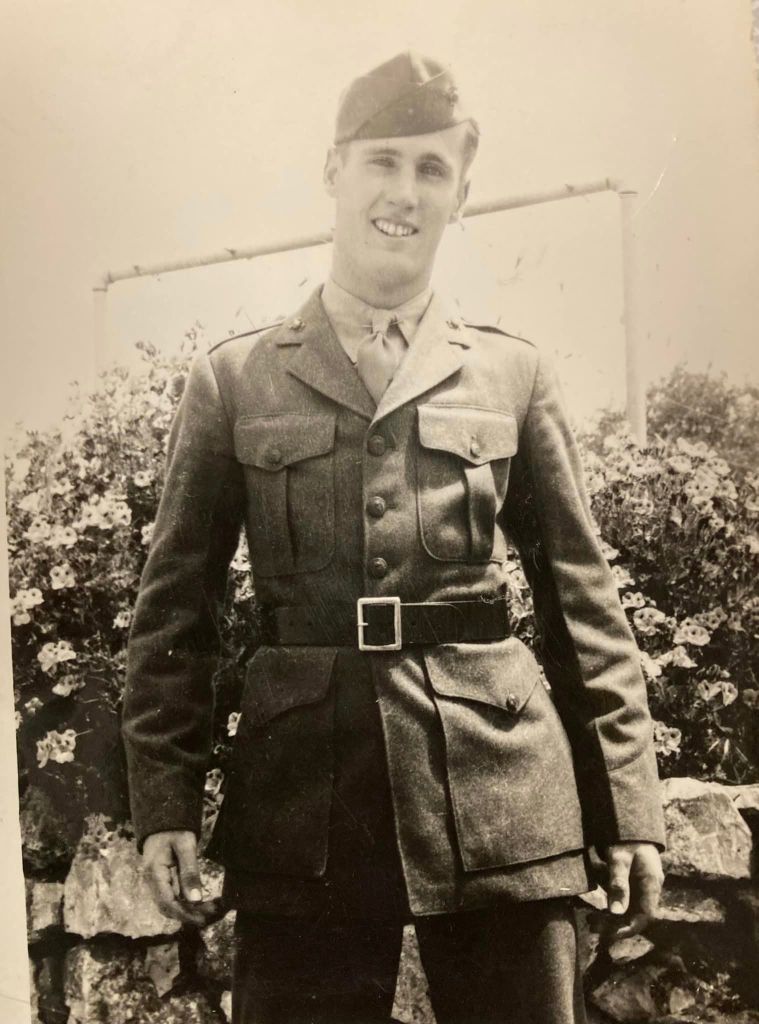
Private John Brewster Loomis USMC, Headquarters company, 1st Battalion, 1st Regiment, 1st Marine Division. MOS 245, Truck Operator. Just before shipping out to the Pacific, 1944.

Shuri Castle was a rich joint and Naha used to be quite a town. I am sitting in Jap truck now that we picked up in our travels. It is something like a ton and a half and something like a Chevrolet but right hand drive. I’m a little thinner but feel alright. (He entered the Marines at 5′ 11″ and 160 lbs.) Instead of “Golden Gate in ’48, it’s from Hell to Heaven in ’47. Old Snowball, a friend, is still alright as far as I know. We sure took a beating but took our objective.

Dad I’m sorry I couldn’t write on your birthday but Happy Fathers day and Fourth of July.

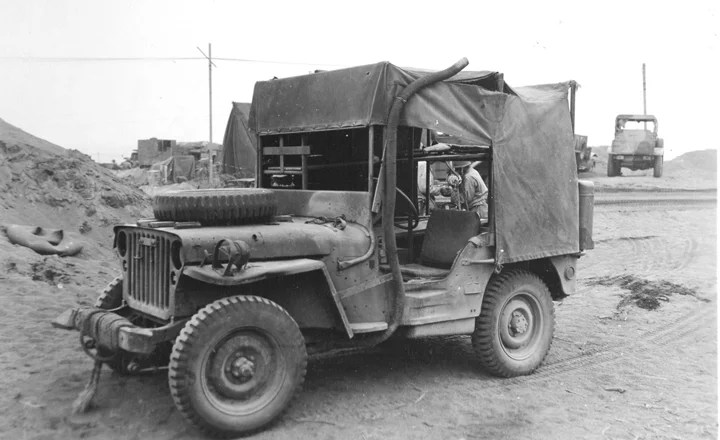
The weather is better now, cold at night. Last night was the first time I got to take off my shoes when I hit the sack. They brought us a little better chow for a while. Boy! Am I tired of C-Rations. My old ambulance is still running but it doesn’t look the same-no windshield. bumpers, paint, top or sides-just one seat and the stretcher racks.

I had my picture taken the other day by Division. I don’t know if it will get in the papers or not. I sure didn’t look like much that day.

Well, folks, I’ll write when I can and I hope from now on that will be very often. Much Love John.**

Modified by Holden an Australian body building company, this is the Jeep type ambulance John Loomis drove on Okinawa. The Marine Corps used this much more, go anywhere ambulance instead of the big GM trucks used in Europe. The rugged terrain and mud sloppy roads couldn’t be navigated by trucks and Sherman Tanks were sometimes used as tow trucks if they didn’t sink in the mud holes themselves. Almost everything was hand carried by exhausted Marines themselves.

As the battle for Okinawa came to a close, many of the Nisei translators were ordered off the island. The almost complete annihilation of the defenders meant there was little to do. In preparation for the invasion of Japan there was a mountain of captured documents to be gone through and they were needed back at headquarters.

The Lieutenant gathered the Nisei translators in a shell hole covered with a tent fly then read the names of those who would take one of the LCIs out to the attack transport (APA-139, the USS Broadwater) for transport back to Manila for further orders. Hilo and his team were leaving the island.

MacArthurs headquarters were now in the ruins of Manila. After unloading at Cavite Naval base in Manila bay, the MIS boys were trucked to the city and reported for duty.

Hilo and his team were issued new orders and upon pulling them open with a mixture of excitement and dread inherent in the action were delighted and almost giddy with the news that they were to report to Subic Bay for immediate transport to Naval base Long Beach, California to begin a 30 day leave. They were being sent home to rest before the invasion of Japan.

USS Broadwater APA-139 and USS Bellepheron ARL-31, a landing craft repair ship at anchor, San Francisco 1944

They were going to be transported by one on the Navy’s APAs or Attack Transports such as the USS Broadwater APA-139. The APAs*** were the real workhorses of the Navy. They were designed and built on Liberty and Victory ship hulls for the purpose of transporting men and supplies. With their boats they were able to house, feed and land an entire marine battalion of fifteen hundred men. Anchored just offshore, in harms way, they would swing out the landing craft, load the Marines and their equipment and then the Cox’ns would drive them into the landing beaches. When they had unloaded they would wait to receive the wounded and other men pulled off the line and return them to base. Equipped as emergency hospital ships they would offload casualties to the larger dedicated hospital ships waiting outside the arc of Japanese artillery fire and Kamikaze air strikes.

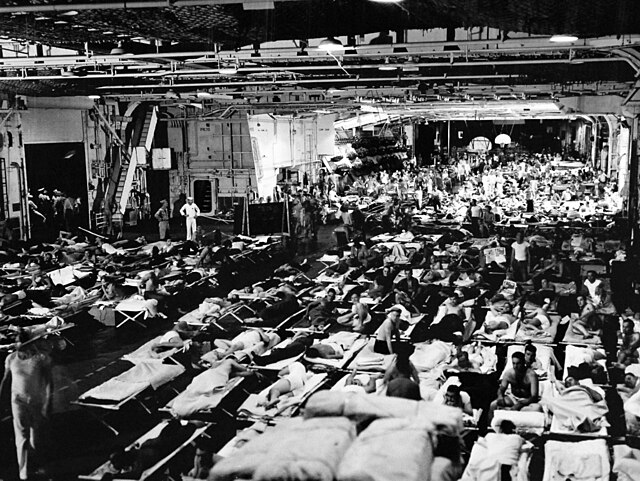
An Aircraft carriers hanger deck loaded with casualties from Okinawa, April 1945. War Department Photo.

The Navy operated over three hundred of these ship along with freighters of the Liberty and Victory types, over fifty oilers, and a myriad of specialty support ships. This allowed the Navy, Marines, and the US Army to operate efficiently more than 7,000 miles across the Pacific Ocean where there was little infrastructure to support operations. The logistics of the operations are literally mind boggling.

The APA’s were to serve a special purpose beginning in the waning weeks of July and August 1945. In the service any action needs have a name to identify it. Most, such as Okinawa which was dubbed “Iceberg” and the invasion of Guadalcanal “Operation Watchtower” general have no meaning other than to confuse the enemy but the name for the last major movement of men was oddly prescient. Operation “Magic Carpet” would return veterans of the Pacific home. By August the allies had just over 23 million troops and support service men in the western Pacific. The Aussies, New Zealanders, British, French, Dutch and the Mexican Air Force were all going home. Magic Carpet would be the largest mass transport of men and women ever attempted. Every ship type was going to be utilized for transport.

On July 25th Hilo Fuchiwaki and his team boarded an APA in Subic bay. The boys must have leaned over the ships rail and watched the sailors on the dock cast of their lines and felt the ship begin to vibrate as she backed into the stream and headed for home.

Dear Dona Page 15 is next.

Cover Photo: Holden Jeep ambulance. Missing one fender, other one dented. Shrapnel hole in hood, broken windshield. The exhaust pipe is extended to get it out of the mud. No paint and tow strap wrapped around the bumper. Hard used.

*Rikusentai, Imperial Japanese Naval Marine Infantry.

**The letter must have been written after the the capture of the Katchin peninsula by the 1st Marines. The battle for the island still had about ten weeks of combat left. He was, after a short rest to participate in some of the most brutal fighting ever seen in WWII. Private Loomis earned the Bronze Star for his actions on Okinawa.

***The book “Away All Boats” which was made into a movie of the same name based on the 1953 novel by Kenneth M. Dodson (1907–1999), who served on the USS Pierce (APA-50) in World War II and used his experiences there as a guide for his novel. It is considered a classic in naval literature.

Michael Shannon is a writer and lives in Arroyo Grande, California.

Standard

Dear Dona

Chapter 13

The End And A New Beginning.

By Michael Shannon

Easter Sunday, April 1st, 1945, and where were you? I was resting in my mother’s arms in Sisters Hospital Santa Maria California. Staffed with sisters from the Poor Clares, a Irish enclosed order of the Holy Roman Catholic church. The sisters carried me to my mother from the nursery wrapped in a blue blanket and a small green ribbon tied in a bow in my sprig of blond hair, the only child born on that day. It’s been my luck.

Half a world away on the same date the tenth United States army made up of three Marine divisions and four army divisions started going ashore on the Japanese island of Okinawa. Supported by the Navy’s Fifth fleet made up of three separate task force units and the British, Australian Royal Canadians and New Zealanders. The combined forces numbered nearly 541,000 troops, 184,000 thousand of them combat infantry. The invasion was supported by a fleet consisting of 18 battleships, 27 cruisers, 177 destroyers/destroyer escorts, 39 aircraft carriers (11 fleet carriers, 6 light carriers and 22 escort carriers) and various support and troop transport ships.

One of the great euphonius names of WWII commanded at Okinawa. Lt. General Simon Boliver Buckner jr. Named for his father he commanded the entire 10th Army. A graduate of Virginia Military Institute and the US Military Academy at West Point he had served in WWI and The Philippine Insurrection which I’m sure the Filipinos considered a war. His father Buckner sr. served in the Mexican war, the Civil war, was a Confederate General and Governor of Kentucky. General Buckner had iron clad credentials. Considered a soldiers General he was on the front lines with the 2nd Marine Division when he was warned by marines to remove his helmet with it’s three gold stars because they could see them a half mile away. He did. Moments later a small artillery shell hit near him and he was wounded by coral shards and died less than an hour later while being operated on in an aid station located in a shell hole.. He was one of four US Generals killed in WWII.

General Buckner was just one of the 200,000 deaths, including both military personnel and civilians. It was an orgy of killing and the newspapers back home listed casualties of such high numbers that the public which had become inured to the death toll was shocked into a stunned numbness. Marine casualties exceeded the total number of a single fully manned division. It was as if one of the three Marine divisions, the 1st, 2nd and 6th has been completely wiped off the face of the earth. The army suffered equally with over 19,000 dead and wounded. The Navy lost thirteen destroyers sunk by Kamikazes. Nearly sunk, the Essex class carrier USS Franklin, CV-13, the “Big Ben” lost 1,294 with 807 killed in the greatest single ships loss since the USS Arizona. Lest any one should think that support personnel were relatively safe 35,000 cooks, seabees, truck drivers, labor detachments, hospital corpsman and doctors were killed and wounded. The dead included two war correspondents.*

When the “Butchers Bill” was presented to the population of the United States and its government they were aghast. What was it going to cost to invade the Japanese homeland? You could scarcely drive down a street in the countries small towns without seeing small banners with gold and blue stars hanging in windows.

The Battle of Okinawa was a victory for the US but resulted in massive casualties on both sides. Japanese forces fought with the same fanaticism the Americans had witnessed in battles such as Iwo Jima and Peleliu. Rather than be taken prisoner, defenders often chose suicide. Okinawa was so close to home, most Japanese soldiers refused to surrender and fought to the death. Their fanaticism contributed to a dreadful toll. Some 110,000 Japanese and conscripted Okinawan defenders were killed in action. The battle created a humanitarian disaster for civilians as well. It is believed that the number of civilians casualties was greater than all battle casualties combined. Combatants on both sides, after three years of war were completely numb, bereft of any kind of humanity. Robert Leckie and Eugene Sledge both wrote books about their experiences and told the same story. Marines and soldiers automatically shot Imperial Japanese soldiers who were wounded, they also shot the dead to be sure they stayed that way. They told of the absolute necessity in a cold, pragmatic way, emotionless. No combat rifleman wanted an enemy soldier playing dead to suddenly come back to life and jump into their foxhole at night.

Later in Vietnam, a marine sergeant told Lieutenant Phillip Caputo. “Sir, before you leave here you’re going to learn that one of the most brutal things in the world is your average nineteen-year-old American boy. Phillip Caputo was Marine officer who served as a platoon leader in Vietnam. He was right. It is a quote that describes soldiers as far back in antiquity as you choose to go. It could have been said by a Hoplite in Alexander the Greats Macedonian/Greek army two and a half thousand years ago.

For the last time the Nisei boys boarded assault ships and sailed for the islands of the Ryukyu Group of which Okinawa was the largest island, 66 miles long and seven miles wide on average it was to be the last major battle of the Pacific war though no one knew it yet. It was also going to be the deadliest.

MIS camp, Okinawa, 1945. Signal Corps photo

The Japanese Imperial Army wasn’t nearly on it’s last legs. The Military leaders in Tokyo had determined that they would not engage in offensive battle but rather set up defense in depth and attempt to bleed the Americans dry. They well knew that after three years of increasingly brutal fighting the American public was losing heart. Printed in the nations newspapers casualty lists were enormous. Though newsmen tried to put a positive spin on war news, the Battle of the Bulge had just ended and cost the American army 81,000 casualties. People were war weary. We were running out of children to sacrifice. The High School class of 1944 was just finishing training and was headed for the front.

Mom’s cousin Don Polhemus, lost on the USS Spence during typhoon Cobra, her brother headed for the western Pacific on a destroyer. My dad’s best friend Sgt. Harry Chapek, killed in France, and his cousin Bill Marriott had just left New Guinea and was headed for Okinawa . Jim Moore, son of the judge and my grandparent’s closest friends LST was bombed in the Pacific.The war was everywhere in our little county. There were military posts in literally every town and all along the coast. People don’t think about it much anymore but there were P-38’s at Santa Maria, flying cadets at Hancock field, Coast artillery units above Pismo Beach, a Rec. Center in Grover City where my mother volunteered. There was a Coast Guard bases in Morro Bay and Avila beach. Amphibious landing were practiced along the Atascadero Beach. Camp San Luis Obispo was the largest infantry training base in the country turning out ten thousand soldiers with every cycle. Camp Roberts in north county on the Hearst ranch and just to the south Camp Cooke where Patton’s tank Divisions had trained on the dunes above Lompoc before North Africa.. Mom said military convoys clogged the old highway and would go through Arroyo Grande, rumbling people awake at all hours. The list carried in the old Arroyo Grande Herald Recorder titled “Our Boys in the Service” was filled with nearly four hundred names in August of 1943. They were the last names of kids I would go to school with. The bus drivers, librarians and teachers in our schools, the postman, truck drivers, housewives, doctors and pharmacists, all listed. Those that would never come home marked with a small black star. There were more than a few. All from a town with a population of less than five thousand people.

The troops were weary too. The American leadership put no real censorship on the news and the people at home and their families wrote of neighbor boys who were dead, wounded and captured. Every day, every thought grounded in the agony of a war that seemed to have no end.

Hilo and his team must have worked frantically to translate all the information coming in from the Army and Marines. The temptation is to think that all this emphasis on information was at this point useless. We al know the end of the story. Thats the problem with history. Though we can study events for their meaning there is one thing we cannot do and that is see the future. Hilo and his team hadn’t the least inkling of where it would end. The man at the center of the hurricane has no idea where the way out is. Even the big brass in the Phillipines, Pearl Harbor and Washington DC had no crystal ball. The only thing they could do was to press ahead.

Planning for the invasion of the Japanese islands was well under way. The war in Europe would soon be over, there was no doubt of that. Germany was finished. The only question was how much longer would the insane self destruction continue. Even the Dogface trudging along German roads, still dying daily knew it was over. They all wanted to live, Japan was waiting. They knew that is was different fighting the Japanese than the Germans. No one wanted to go. But they did. The first Army Air Corps units had already arrived from England. The Generals had no doubt that when the time came they would go. Bill Matousek, some day to be my family doctor, as a fresh replacement tank driver who arrived on the line just days before the battle of the Bulge knew it. My sister in laws father had fought all the way from Sicily to Anzio to southern France, he knew it too. Del Holloway, Orville Shultz, John Loomis*** Arch and Leo Harloe, your father too, they all knew what the next step was going to be. It’s all they talked about. It seemed to them that it would last for years. “Golden Gate in ’48” they said.

They knew nothing of the Manhattan Project and the bomb. During the fight for Okinawa, FDR died .On April 12th the day of his death the first order of business for the new President, Harry Truman was to be told about the bomb. It would be up to him to decide.

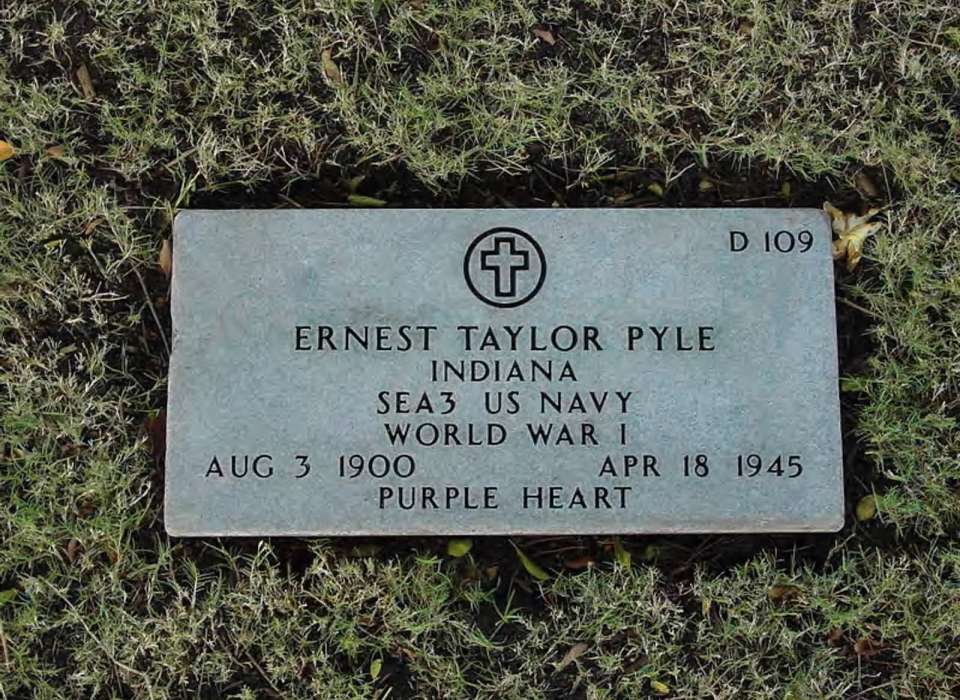
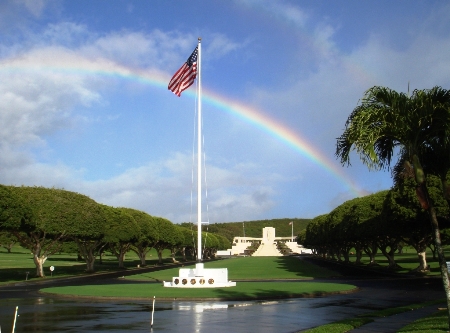
Ernest “Ernie” Pyle, the soldiers friend killed on Okinawa April 18, 1945 RIP National Cemetery of he Pacific, “Punchbowl” 2177 Puowaina Dr. Honolulu, Oahu, Hawai’i

They lie supine in their regimented rows where once they stood. They are the waste. The war dead. Those who know nothing pass them by on the road. Only as long as the markers, the holy grail of the left living, be visited by those who remember will they signify the personal cost. On memorial days and anniversaries families may gather at the stones to remember their children who all too often were in their teens or early twenties when they died. But during the rest of the year they are noticed only by the caretakers who mow between the stones.

The consequences, the blind, the amputees, the depressed, the suicidal, these insane, these jobless, these homeless, the side effects and delayed effects whose very existence keeps memories of the war alive when most citizens can’t wait to forget, or, remember in a circumscribed vision for the burial of the dead is a burial of memory. The National Cemeteries fulfill a desire to set it all aside. No one can say that they are not moving places but the arranged beauty does not evoke any memory of terrible battles.

Perfectly aligned marble does not resemble the memory of the men who lived them, but rather masks the heaps of the dead and wounded, They lay in piles, in fragments, limbs broken and contorted, Burned, muddy clothes shredded or ripped from bodies by the sheer velocity of the man made forces that took their lives. This, the veteran of combat knows and of which he will not speak. The impossible knowledge cannot be conveyed to the living, the wives and children and grandchildren. Thats the secret, the wilderness of slaughter and death, put away as if in a box to be gradually forgotten. It speaks to the resiliency of memory, the ability by some to bury the scars so deep they can never be found.**

Punchbowl

Next, Chapter 14. Home, it’s all changed.

*During the Battle of Okinawa in World War II, Ernie Pyle, a renowned American war correspondent, was killed by enemy fire. He was covering the battle for American newspapers and was known for his deeply humanizing accounts of soldiers’ experiences. Pyle won the Pulitzer Prize in 1944 for his newspaper accounts of the “dogface” infantry soldiers from a first-person perspective. He was killed by enemy fire on Ie jima (then known as Ie Shima) during the Battle of Okinawa. Another journalist, John Cashman, was killed in an aircraft crash on Okinawa on July 31, 1945,

**As far as I know I am the only living member of my family who recalls Corporal Edgar Green of the 2nd Australian Infantry whose grave is in the Baghdad North Gate military cemetery in Iraq. When I am gone so is Edgar, his incredible and brutal goes story with me. Markers are not for the dead but for the living.

***https://www.newspapers.com/article/the-arroyo-grande-valley-herald-recorder/179529347/ Follow this link to a letter home from a local Marine on Okinawa.

Cover Photo: Private Bob Hoichi Kubo United States Army MIS

Below is the link to “letters to Dona” page one.

https://wordpress.com/post/atthetable2015.com/1226

Michael Shannon writes so his children will know where they come from. He lives in Arroyo Grande California

Standard

The Twelve Hour Tour.

Chapter 15

The Desperados

By Michael Shannon

Grandpa called Grandma from the phone in the Signal office on Orizaba Street. He gave her good news. She especially liked the idea of going back to Santa Barbara. As was the custom with them she started getting all that the little family would be taking with them together. Clothes for the girls and Bob, toiletries and whatnots, just what could be packed in a suitcase. The kids carried their own. My mother was twelve and Mariel thirteen. Bob had just turned ten so whatever they could carry was what they took. Moms piano and a little furniture would have to be shipped later. Uncle Marion would drive them down by the same route they had gone up to Madera. Marion was counting on Bruce to put him on a crew so it seemed like a good bet.

Following the work was the name of the game then just as it is today. My mother said it was normal for kids who had never known any other way. They kids knew how to make new friends and were all sociable at that age. It would never change as they grew.

Grandma could shake and bake. Get ’em packed, sacked and on the road. Rent a house, bring the goods and move ’em in. Enroll in school, do it in jig time too.

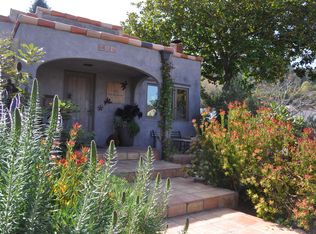
733 East Islay St, Santa Barbara. The 1930, Home to the Hall’s, Zillow photo

She had the whole thing down to a science. Grandpa would come home from work or get a phone call telling him he had to be at another rig the next day or two and he would leave right away, Eileen and the kids would follow. The house shown above was their home after arriving from Madera in 1930.

Sam Mosher had a specific purpose in mind when he hired Bruce. Whipstocking. Although the Ellwood field was already operating he had bought some abandoned and unproved leases at the very edge of the Ellwood field.

Other companies geologists had determined there was no oil to be had. It was a big gamble for a small operator but the leases were cheap and his geologist thought that there were oil deposits if they went just a bit deeper. There was also a possibility that the so-called safe lease would be a total disaster. One thing about Sam Mosher, he was not risk averse.

Mosher who was born in Pasadena in in 1892, just three years younger than my grandfather. His father sent him to the University of California at Berkekly where he earned a BS in Agriculture. Right out of university he leased and began farming seventeen acres of Lemons and Avocados in Pico Rivera. In 1918 all of what is now western Los Angeles was farmland with a few small towns dotted about. It was a struggle and Sam worked sixty to seventy hours a week and then used his Ford tractor to plow and disc for other farmers near by. He always said afterward that he “Didn’t know a darn thing about oil wells or the business.

A single event changed all that. On June 23rd, 1921, a wildcat well on the lower slope of Signal Hill announced itself with a massive plume of crude oil. Coming in with a roar like the passing of a steam locomotive and the unbelievable shaking and rumbling of an earthquake, Alamitos no. 1 borned itself and set off the mad scramble for discovery on what became the richest field ever found.*

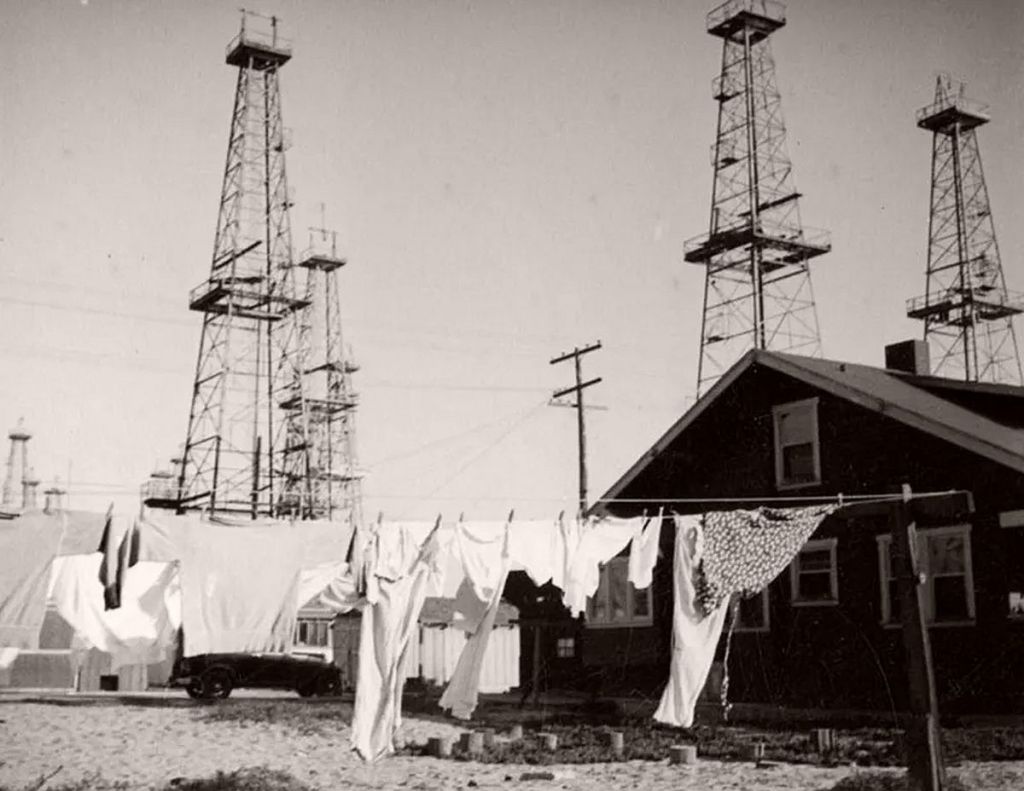
A drifting fog of micro dots of oil spread eastward on the back of the northwest ocean breeze, depositing crude on every surface. Clothesline’s, cars in the driveway and the houses themselves soon were coated with the sticky black residue of decomposed plant life from a tropical earth gone away millions of years ago.

Bumper to bumper lines of cars from Los Angeles came out to see the well. It was an event that would grow the city in ways none anticipated. The 25 miles to Signal Hill were dotted with small towns and orchards like Mosher’s in Pico Rivera. Looking up from his tractor’s seat, Sam Mosher couldn’t have helped thinking that the drudgery of farming could be traded for riches from the oil patch.

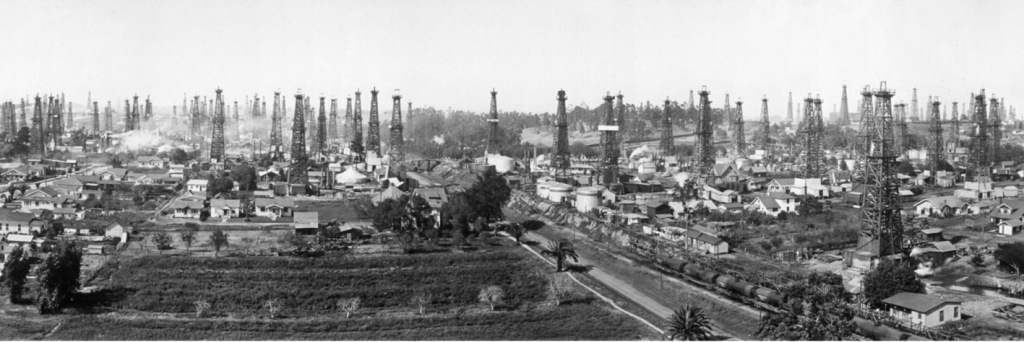
Alamitos number one set off a frenzy of drilling that within a few years saw wells in the Dominguez Hills, Torrance, Santa Fe Springs, Long Beach, Belmont shores, Seal Beach, The Bolsa Chica and Huntington Beach. Bruce would work them all.

The Halls were getting settled in Santa Barbara, kids enrolled in school and Bruce was back at work. Lucky for them too. Because of the depression unemployment was pushing 25%. There was no unemployment insurance or Federal minimum wage and hordes of desperate men and boys, women too, hopped the side door pullmans as they rattled back and forth across the country. Midwest farmers abandoned their farms because if you could find a bank to loan you “Crop Money” the crop itself would, more than likely not sell for enough to pay off the loan. More farms abandoned or foreclosed every week. Banks failed because there was no FDIC to guarantee money to keep them solvent. Factories cut wages to the bone, seeing it as the only way to turn a profit. In many cases it just didn’t work. More families took to the road than ever before in our history searching for work, just something to put food on the tables. The government of president Hoover blamed it on the workers. “They are Communists, Unionists, Fascists, they don’t want to work” he said. Sound familiar?

The Knight Riders, the Ku Klux Klan which had existed in the old Confederacy rose up from its deathbed and reappeared all across the county. Burning, looting and lynchings occurred for the first time in decades. Their target, Blacks, immigrants, Jews and unionists. The government did very little to stop it. The FBI focused it’s energies on these same people as Hoover acted as an enforcer for the wealthy entrenched establishment.

Business, finance, the law and government acted as if it was business as usual. unable or unwilling to do anything except support the status quo. Hoover, promising “A chicken in every pot” was one of the more callous election promises ever made in this country. He couldn’t produce the promise and wouldn’t seriously try. The callousness of the sitting government was focus on protecting those that had and not those that didn’t. It would cost him the Presidency in 1932.

The Oil Patch was no different, wages were sinking, drilling was slowing dramatically. With car sales plummeting no one needed the gasoline no matter how cheap. Every one in oil production understood this but at first they could not slow down. Pure greed, especially by the big companies like Standard, Sinclair, Richfield who could only survive by drilling held sway. When it got to the point where high production was unsustainable they cut costs to the point where the independents were forced to quit, putting thousands of roughnecks, toolies and supers on the road with laid the off factory workers, tractored out farmers and small business failures.

Everyone went from unbridled optimism, where no amount of oil seemed too much to the point where wells were simply pumping it into earthen pits waiting for a price hike and when they didn’t come, they walking away from their wells. In many cases no one bothered to even plug the casings leaving the well heads wide open.

An oil sump, Signal Hill, 1930. Long Beach Historical Society

The land owners who had leased their mineral rights to oil companies took it in the shorts too. Your little farm where you had some fruit trees an a few acres of vegetables were suddenly covered in waste oil, abandoned machinery, derricks and muddy roads everywhere. The trees were long dead, the house coated in oil mist and you never saw a dime from your share of production. You were abandoned too.

So, fortunate Bruce was. After twelve years traveling the state chasing crude you at least had a job with a small company which was hell bent on surviving by taking on the riskiest of projects on the chance that they might, could, or would pay off. Sam Mosher had given up the lease on his little seventeen acres of fruit trees in Pico Rivera so for him it was do or die.

With some Signal stock and promise of a piece of production for capital he didn’t have he bought a lease north of Elwood, near Goleta that had never been “Proved.” At what geologists thought was the end of the underground pool at Elwood, he bought from a local attorney in Santa Barbara who had leased some ranch land right at the foot of the tidal bluff just north of Tecolote canyon. The attorney had no luck and wasn’t able to find anyone who would even contract to drill there.

Though Geologists at the time had more than a century of practical experience in finding oil the devices used today where nonexistent in 1930. They looked for areas where surface indications showed the presence of undersea creatures. Fossils, like Trilobites on the surface especially on a hill or hills called Anticlines** sometimes indicated oil pools below. Ancient seabeds where plant life once flourished turned out to be where you could get rich drilling. The San Jaoquin Valley and the southern coastal regions of California had massive oil pools if you could find them.

We have a box of prehistoric sharks teeth that grandpa Bruce collected from the many leases he worked, mostly from the Elk Hills which runs along the valley’s westside. He would come home and thrill his children with tales of an ancient world where enormous sharks patrolled a sea which was now dry and dusty hills baking in the San Jaoquin valley’s brutal summer heat. My mother kept the teeth all of her life and the little box now resides in a drawer of the desk I’m writing this story on.

In the get rich quick culture of the oil business, landsmen would go out to areas where oil was discovered or about to be and for a fee or a promise of a percentage of production for a specified time the underground rights to said property were purchased. This meant that the oilman could drill on the property and if they found enough oil and it was worth producing, they would kick back to the actual owner of the land a specified percentage of sales. Leases on Signal Hill were sometimes negotiated by the square foot and even, in a few instances, by the square inch. How anyone could understand this complex and inherently crooked system is anyones guess. Of course that was a win for the oil men and their lawyers.

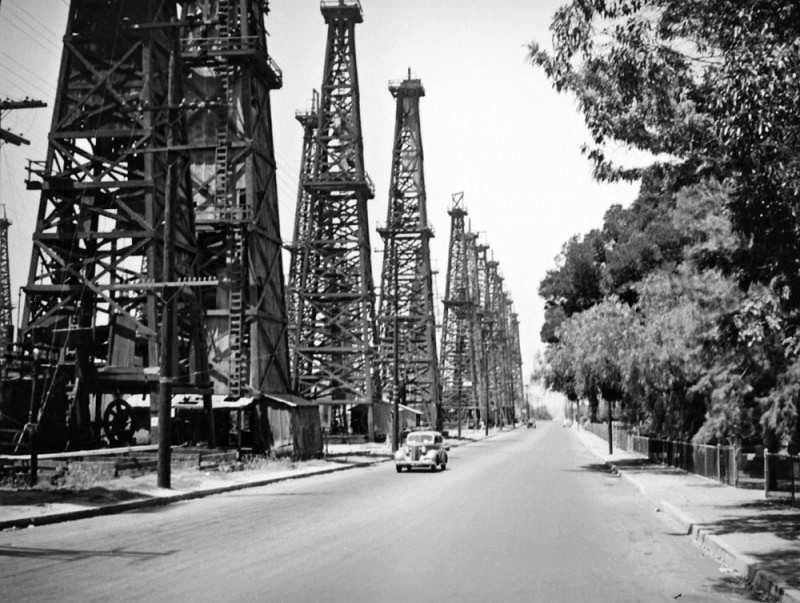
There were almost no rules. Oil companies with sharp lawyers and accountants ran roughshod over property owners all the time. Getting the right to drill without any up front money was the key for the Landsmen and many an owner ended up with his lot trashed, steeped in waste and marked with an abandoned wooden derrick as tall as 82′ feet looming over his house. An absolute frenzy occurred every time their was a big strike. On Signal hill and the west Los Angeles fields most of the leases were on standard house lots. Each lot might be a different wildcatter. Some derricks on the hill were so close together that their legs were intertwined. Drill stings became entangled hundreds of feet underground with one company drilling right through the pipe and casing of another. It was fertile ground for lawyers. Fertile ground for roughnecks too who went to war with their neighbors, fists, pipe, ball bats and six shooters were not uncommon and close to hand.

Signal Hill, east Willow street, California 1930. Calisphere.

Property owners were basically ignorant of the actual doings of companies. Fast talking lease buyers, shifty drillers and sharp lawyers could end up, through slight of hand, leaving the poor small farmer householder holding the bag. There was a property owner in Long Beach who told his friend at the barbershop that he was no fool, “That danged lease man offered me 10 points of the profits, but I ain’t nobody’s fool I’m holding out for a 20th.” He was getting more than one shave he just didn’t know it yet.

Mosher and his company signed the documents for the lease in Goleta but in so doing apparently no one read the docs very carefully. Under California the law at the time a leaseholder had 12 months to “prove” a lease by beginning drilling before time ran out. After signing the documents a sharp eyed engineer noted that all but 28 days of the year had gone by. Signal had just 28 days in which to prove the lease on a piece of property with no access, no road and at the foot of a steep bluff that ran down to the hight tide mark. To make matters worse they would have to seek permission to cross the tracks of the Southern Pacific RR tracks which meant red tape that could take a year or more. The Southern Pacific was once known as the Octopus and for good reason. There was no doubt on Orizaba street that they would do just that, squeeze as much out of Signal as they could.

It would seem to be a lost cause. Mosher sent his Varsity Team a he called it, the first gathering of the young experts he had hired at Signal to scout out ways to to spud in a well before the 28 days ran out. There was no road down to the beach just a brush choked gully. Maybe an access road could be bulldozed down it to get equipment in but there was no way to cross the RR tracks legally. No dozer, no road, no road, no steam shovel to cut down to the beach, checkmate. The property owner keeps the payment and Sam Mosher takes it in the shorts as the old saying goes.

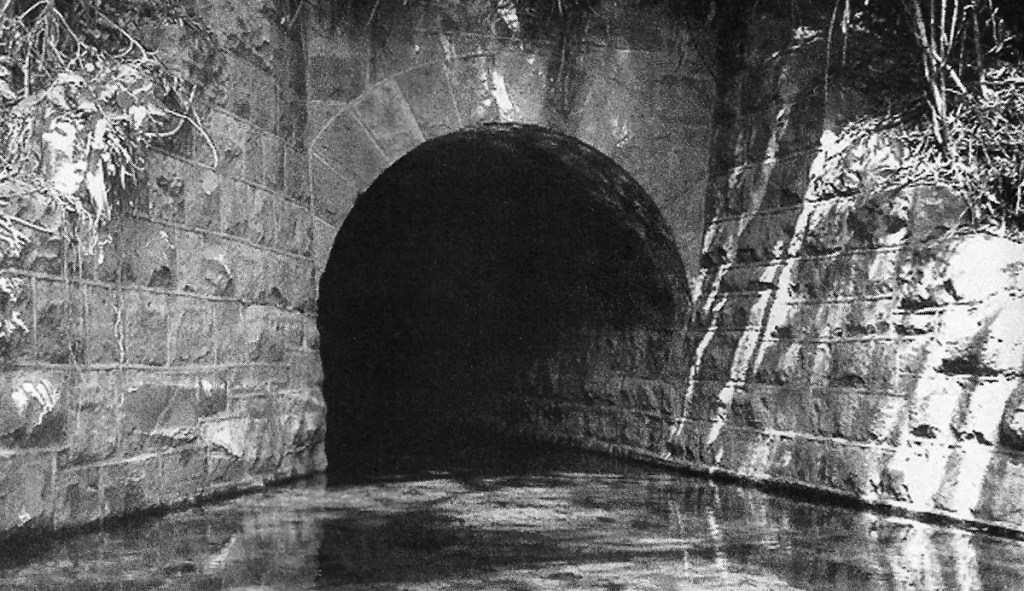
After a couple days of nosing around one of the engineers walking the track had to cross a gully alongside the tracks and found back in the brush, a stone culvert the SP had built in order to throw the track across the ravine which was active in the winter and couldn’t be blocked. He looked over, scrambled down the slope to the creek bottom, took out his measuring tape did a few calculations and then high tailed it back to Goleta and called Orizaba street and talked to Garth Young, Mosher’s young, chief engineer.

“Garth, I found a way in where we don’t have to get permission from the railroad. I figure our shovel will just fit with about five inches to spare, we can just drive her in.”

Sam Mosher and Garth Young. 1930. Signal Oil Company photos.

Young replied, “Well we can’t do that it’s still railroad property and we have to have permission.”

“Hell with the railroad Garth, let’s just do it and deal with them later. What are they going to do after its done, sue us?”

“Probably, but what the hell lets just go ahead. Our times running out and we need the well or it’s all lost anyway.”

“OK boss, we’ll roll the shovel up tonight and we’ll be down to the bluff before sunlight. Those railroad stiffs will never know.” Getting permission from the railroad to pass through this culvert would have also held them up, so Garth Young decided to do it without telling his boss, relieving Mosher of any personal responsibility.

Mosher had already gotten permission to pass through the Eagle Canyon Ranch from the owner, Louis Dreyfus, while his Engineer, Garth Young’s boys had discovered a passageway to the shore.

The Culvert on Eagle Canyon. Goleta Historical photo.

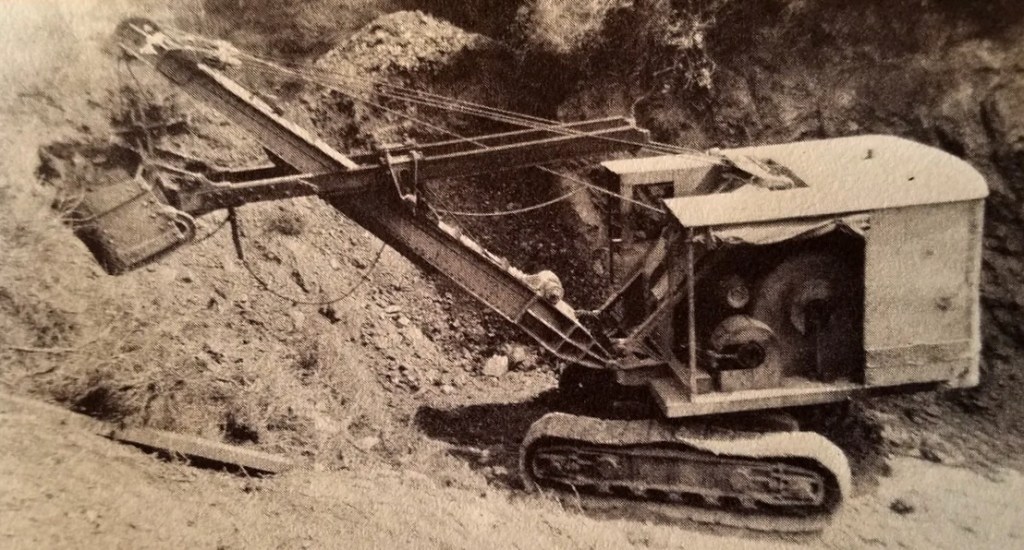
The heavy-duty self propelled power shovel made its way through the dry Eagle Canyon creek bed. As it approached the culvert, the operator lowered the boom to horizontal, the huge clamshell shovel blades mere inches off the ground. The prehistoric looking iron beast slowly crept through the dark stone tunnel, foot by foot, as Garth Young watched in suspense. Without a hitch, the giant piece of machinery clanking and squealing crawled carefully through the dark tunnel and emerged into the dark of midnight. Walking alongside with flashlights they maneuvered the iron monster down the dry creek bed and onto a shelf above the driftwood littered beach.

Taking the first bite of the bluff. 1929. Goleta Historical Society.

Time to go to work. Times running out. Young explained to the operator that he would have to wait for the tide to go out, then clear a way down the beach to the foot of the cliff below Hydrocarbon Gulch. He would quickly dig a foothold at the base of the cliff before the tide comes back up. If he didn’t his shovel would sink into the wet sand and the job would be over. The driver laughed at the crazy plan and said it would likely take him 10 days. He would drive back to the culvert every high tide and return on the next low. But Garth Young told him they didn’t have 10 days, it needed to be done, and done today. And if he didn’t succeed, they had insurance for the power shovel anyway. No problem there except they, had no insurance which was a bit of a necessary fabrication as Garth saw it. If they lost the shovel it was a moot point anyway….

*The Long Beach Oil Field is a large oil field underneath the cities of Long Beach and Signal Hill, California, in the United States. Discovered in 1921, the field was enormously productive in the 1920s, with hundreds of oil derricks covering Signal Hill and adjacent parts of Long Beach; largely due to the huge output of this field. The Los Angeles Basin produced one-fifth of the nation’s oil supply during the early 1920s. In 1923 alone the field produced over 68 million barrels of oil, and in barrels produced by surface area, the field was the world’s richest. During the early stages of the field’s development, unlike most oil fields, land was leased by the square inch instead of by the acre. The field is eighth-largest by cumulative production in California, and although now largely depleted, still officially retains around 5 million barrels of recoverable oil and has produced 963 million out of 3,600 million barrels of original oil in place. 294 wells remained in operation as of the beginning of 2008, and in 2008 the field reported production of over 1.5 million barrels of oil. The field is currently run entirely by small independent oil companies, with the largest operator in 2009 being Signal Hill Petroleum, Inc. Sam Mosher’s old company.

**An anticline is simply the opposite of a decline, meaning a geographic feature characterized by a geological fold in rock strata where the layers bend upwards, forming a convex shape, resembling an arch or an inverted “U”. It’s the opposite of a syncline, which is a downward fold. Anticlines often form due to compressional forces that cause rocks to bend and buckle rather than break. In oil fields the fold is created by the upward and immense pressure from the gas created by the decomposition of vegetation underground. It’s important to know that not every hill overlies and oil field hence the often used word “Lucky” applied to wildcatters.

Michael Shannon is a grandson of Bruce and Eileen Hall. The life of oilmen was a serious topic when he was growing up and listening to his mother’s stories about growing up in the oil patch. He writes so his children will know where they came from and who they are.
A Notice to the Reader.

For those of you who read this Blog on the Facebook platform I’d like to explain some changes that are affecting your ability to read and see them. Many FB sites have gone to AI to do the work of administering who gets seen and who doesn’t. This means that there is no actual human being deciding who gets published and who doesn’t. Programmers have designed algorithms to filter submissions to all kinds of platforms. What this means to me is that about a month ago quite suddenly a dozen or so FB sites that I published on suddenly began refusing my content, all of it.

I have been unable to find out why or actually speak to a real human person as to the cause. What this means to me is that though I reach over 50 countries through the WordPress platform I’m reaching only those that are on my friends list on Facebook. Readership has plunged from hundreds per post to around a dozen on a good day.

I believe that soon AI will rule FB entirely and the “Social” will no longer be attached to the Media.

I encourage you to go to https://atthetable2015.com/ and click the follow button. When an article is published you will receive a notice in your email which you can click to open and read.

For those who are curious, there is no profit for me in this. It’s free to you and I receive nothing other than your goodwill.

https://atthetable2015.com/

Standard

The Twelve Hour Tour

Chapter 14

Michael Shannon

Bruce listened intently. With his left hand braced against the wall, head down and the receiver jammed aginst his right ear. He softly repeated, “Yes sir” several times. After a few minutes he said “Thank you Sam, I’ll be there as soon as I can.”

He hung up the phone, turned, took off his hat and held it as he put his hands on his hips and arched his back as he exhaled.

He looked at Eileen then Marion and said “That was Sam Mosher, I’m going back to work. I have to be in Long Beach as soon as I can. I’ll leave tonight I gotta go gas up the Ford. Eileen can you pack me a bag and something to eat?”

Bruce rattled down the Cahuenga pass into Los Angeles. He’d been on the road for a day and a half, slept in the back of the Ford last night and woke this morning sliding into the drivers set, setting the Magneto and advancing the spark, he kicked the starter button and turned her over. He figured with a quick stop for breakfast he’d roll down Alameda Street and into Long Beach just after sunup.

Rolling through Huntington Park then South Gate he drove into the fields and scattered houses of Compton and he could smell it. Drifting east on the morning breeze, the unmistakeable heady mixture of crude oil perfume. A strong, pungent, and a little bit sweet, the odor can be reminiscent of a mix of gasoline and tar, with a distinct earthy or petroleum scent. Some people find the smell unpleasant, but to an oilman It smelled like home.

Exhausted by the drive the odor washed over Bruce and caused his energy to start flowing. With his hopes soaring he drove down Alameda until he entered Long Beach. The City of Long Beach had a population pushing 150,000 and had doubled since the census of 1920. Once it was primarily a Beach resort for the retired and wealthy but the discovery of Alameda no.1 up on Signal Hill had changed the city drastically. Midwesterners flocked to the Hill to get rich. Leasemen, Drillers, Salesman, factories that built steam boilers and rolled pipe quickly surrounded Long Beach. Houses went up as fast as they could be built. The Navy was moving part of the fleet to the new Navy Yard on Terminal Island. During the booming twenties Long Beach became the home of sailors, oil field workers, workers in auto assembly plants, soap makers, a vast fishing fleet made up of Japanese immigrants and people coming to the edge of America looking for the main chance.

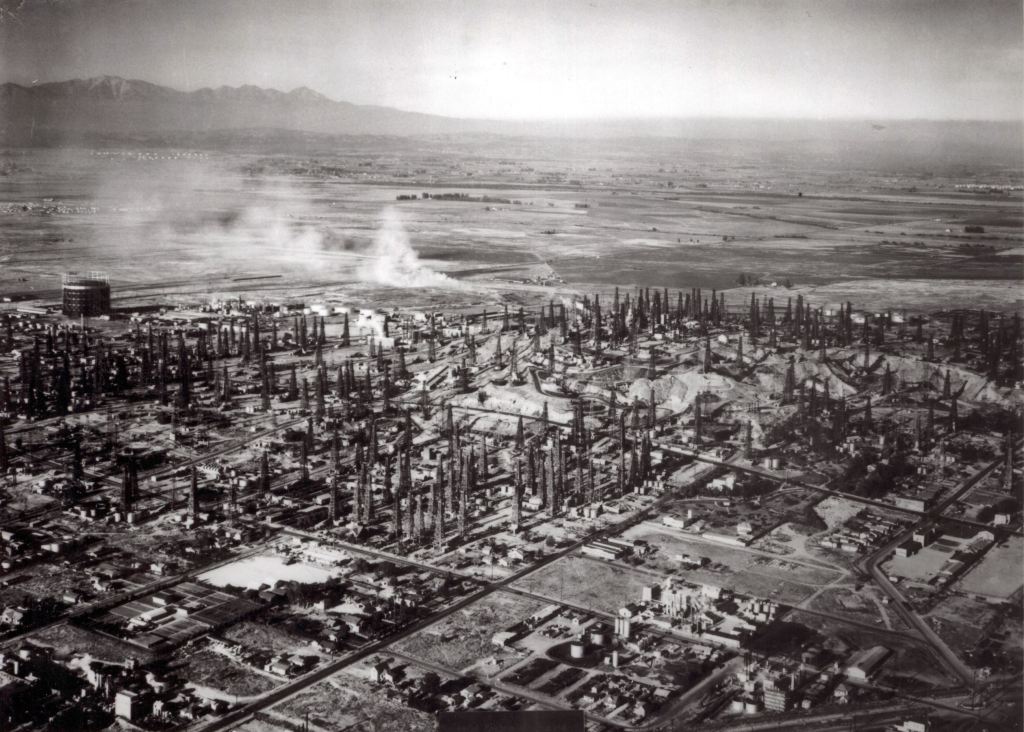
Signal Hill with The San Gabriel Mountains to the north. 1931 Calisphere photo.

Long Beach city was part of the Mexican land grant Ranchos Los Cerritos, the Little Hills and Rancho Los Alamitos. the Little Cottonwoods. It had been for two centuries dedicated to cattle raising. The small villages of the area were distinctly rural and grew slowly over time. Wildcat drillers began poking around in the 1890’s and when Edward Doheny brought in the first well in 1the Los Angeles field* in 1892 it was “Katie, bar the door.” The Los Angeles Oil Field made Edward Doheny one of the richest men on earth. “Richer than Rockefeller” as the song “Sunny Side of the Street” says from the old Fats Waller tune and it was true. Richer than Rockefeller.

Beginning in the late 15th century, Spanish explorers arrived in the New World and worked their way to the California coast by 1542. The colonization process included “civilizing” the native populations in California by establishing various missions. Soon afterward, a tiny pueblo called El Pueblo de Nuestra Señora la Reina de los Ángeles de Porciúncula would be founded and prosper with the aid of subjects from New Spain and Native American slave labor.

One Mestizo Spanish soldier, José Manuel Nieto, was granted a large plot of land by the Spanish King Carlos III, which he named Rancho Los Nietos. (The Grandchildren) It covered 300,000 acres of what are today the cities of Cerritos, Long Beach, Lakewood, Downey, Norwalk, Santa Fe Springs, part of Whittier, Huntington Beach, Buena Park and Garden Grove. It was the largest Spanish or Mexican land grant issued being nearly ten times the size if Catalina Island.

Soon prospectors started putting down hole everywhere. They found Oil in Santa Fe Springs and in a couple of decades were pumping in Beverly Hills, Torrance, Southgate Dominguez Hills and Seal Beach.

But Alamitos #1 was the biggie. She came in with a roar heard in downtown 24 miles away. Drilled on the at the northeast corner of Temple Avenue and Hill Street in Signal Hill. Spudded in on March 23, 1921, it flowed 590 barrels of oil a day when it was completed June 25, 1921, at a depth of 3,114 feet. The discovery well led to the development of one of the most productive oil fields in the world and helped to establish California as a major oil producing state.

Alamitos no. 1. Discovery Well, June 25th 1921. Signal Hill, Long Beach

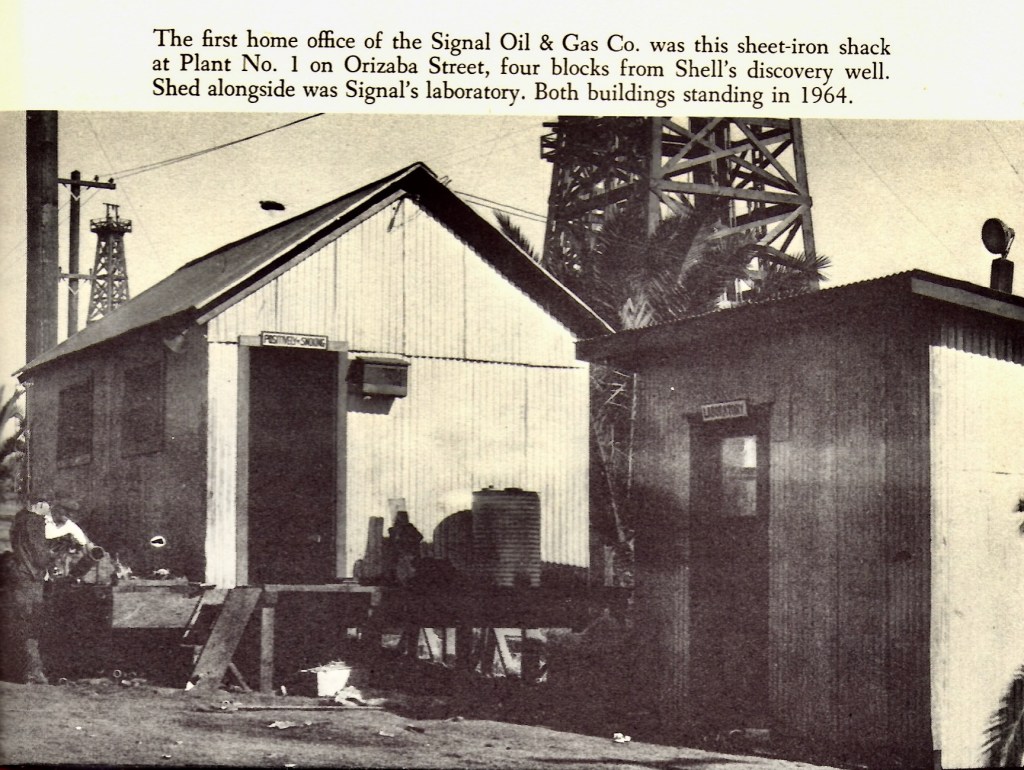
Ten years later Bruce made the turn from Alameda onto Willow, passing the Sunnyyside* Cemetery and headed east towards the Signal Oil and Gas headquarters building. Building isn’t exactly the right word though. Years later Signal would move into a modern building on Beach Boulevard and later still build its’ own headquarters building on Wilshire and 7th in downtown Los Angeles. This headquarters was was no more than a tin shack in the middle of the field itself. It may be a slight exaggeration to call it that but Signal was just eight years old and had begun life as a refiner of natural gas and owned no wells of its own in the beginning.

In the run up to the great depression Sam Mosher’s nascent company was struggling mightily to raise money to stay in business. Consequently they were using bond sales, private money, partnering with large oil companies like Standard Oil of California and banks trying to stay afloat. Independent companies were failing on nearly a daily basis as the price of oil tumbled. The big companies were cancelling contracts to the independents in order to protect their own. Breaking bonafide contracts was illegal but they had the money and lawyers so the attitude was independents be damned. Crocker Bank pulled its loans and a loan agreement with Giannini’s Bank of America kept them afloat.

The company under Mosher’s leadership invested in oil leases in Texas, the Westside of the San Joaquin, Summerland and a few abandoned leases in Elwood near Goleta. The idea was to diversify their holdings into drilling in order to provide product for their little refinery.

As the Ford toiled up Signal Hill the couldn’t help but wonder what the job would be. It didn’t matter that much, whatever it was he needed it.

Bruce and the Ford were both tired, it had been and long lonely drive He wanted to show Mosher that he had extraordinary drive hence the immediate drive down to Long Beach. It was very important to demonstrate that he was always ready to go. He had met the man a few times but had mainly dealt with his drillers and superintendents when he was working the Goleta and Summerland fields.

He pulled into the yard which was filled with trucks, automobiles parked any whichaway. Climbing down from the car he stretched than walked quickly toward the headquarters building. He could see, hear and see welders pipefitters, draymen, ditch diggers, bricklayers concrete masons, electricians, carpenters and plumbers at work everywhere. They were coming and going, these skilled laborers moving between rigs, some working for just one company but most were day laborers or were moonlighting, paid cash money they represented the itinerant workers seen all over any oil fields. Bruce stepped over some drill pipe and paused turning to take in the hustle and bustle and chatter of the men around. The sound of boiler valves popping off extra pressure, steam whistles, the chug chug of diesel engines pulling the linked chains that spun the drill string, sucker rods in an endless rise and fall lifting the crude from near a mile underground. When the wind blew the massive wooden derricks bent to it, creaking and groaning with a dismal sound. An ordinary man would be cautious and afraid his ears ringing, eyes stung by the constant blend of exhausts, the sewer gas coming from the drill pipes with its semi-putrid odor all of it wafting about lighting on and tainting every surface. Grandpa once said you didn’t need any hair oil in the patch, it was provided for free. Always buy a black car and never wear a white shirt.

Headed for the steps he hopped over every kind of detritus, crushed cans, butts, random paper blowing about, there were gobs of crude oil everywhere and the wooden surfaces of the buildings and derricks were soaked with it. It was no place for a fastidious man. A very careful man but not one overly finicky.

Bruce climbed the steps stepped to the door and knocked on the door trim, there was no door, someone found a better use for it he guessed.

Inside at an old desk scarred by hard use, its edges burned by cigarette butts left too long, sat a man. Dressed in stained Khakis and hard used work boots. He wore a green long sleeved work shirt, cuffs buttoned against the dirt and grime, no man exposed any more of his body than was necessary on the job. Pants held up by braces, no man working in 1931 wore belts, too restrictive. He rose from behind the desk sliding back the bent wood chair that served as a seat with a rasping screech, he reached up with his right hand and pushed back his typically stained and dirty Fedora. The smile above his jowls flashed as he held out his hand and said “Hello Bruce, damned good to see you.” Grandpa smiled back and took the hand, “Good to see you too Bob.”

It was Robert M. Pyles, Signals drilling superintendant for Huntington Beach. He said, “Sit down Bruce.” Bruce pulled up the only other chair and sat. Bob pushed up his black heavy rimmed glasses, used his forearm to sweep the piles of paper on the desk to the side, reached down opened a drawer and pulled out a binder and laid it on the desk. “These are our reports for Elwood, I want you to take a look at them and tell me what you think.” Bruce slipped his reading glasses out of their case, put them on and slid his chair closer to the desk.

He pulled a crushed pack of Chesterfields from his left front pocket and offered one to Bob who declined. Picking a match from a box on the desk he scratched it with his thumb held it to the smoke. Fired up he leaned back blew the match out and closed his eyes for a moment to let the smoke from the phosphorus match head clear and then bent to the binder and began to read.

After an hour or so and some discussion the two men sat back in their chairs. Bob pulled open a desk drawer and snagged a fifth he kept there, blew the dust from two coffee cups and poured a couple fingers in each one. He took one and slid the other one to Bruce and said “So you’ll take the job?” Bruce grinned, nodded. They reached out and clinked the cups and threw it back. They stood up reached across the desk and shook again. Bob said, “You’d better call Eileen and tell her to pack up and get down to Santa Barbara.”

That is how the employment contract was signed. The old way.

Cover Photo: Willow Street and Sunnyside Cemetery in Long Beach 1930. Long Beach History photo

*The Los Angeles field is is still pumping. It runs from the east near Dodger Stadium into downtown at Alvarado Street.

**The Sunnyside Cemetery would not lease its ground for oil drilling for obvious reasons. It was completely surrounded by forests of wells. More on that later.

Michael Shannon is the spawn of drillers and ranchers. He write so his children know who they are.

Standard

Twelve Hour Tour

Come the Little Giant.

Michael Shannon

Madera, California. Madera was founded in 1876 as a lumber town at the terminus of a flume built by the California Lumber Company. The town’s name, meaning “wood” in Spanish, reflected the timber industry that spurred its growth. But if you were looking for a job in the mills you could forget that. The Depression ultimately brought an end to the lumber era. A collapsing market for wood forced the Madera Sugar Pine Company to cut its last log in 1931, and the mountain sawmill closed shortly thereafter. The marvelous 63 mill long flume from the mountain mill to the planing mill in Madera went dry. By 1933, the company’s assets were liquidated, marking the end of nearly six decades of logging that had been the foundation of Madera’s economy.

When the timber industry died, agriculture emerged as Madera’s primary business. Farming had already begun in the late 19th century, with irrigation from the San Joaquin River boosting crop production. The 1930s marked a significant shift from sawmills to farms. Unemployed lumbermen and mill workers left for more likely places and were replaced by migrant farmworkers, including many Dust Bowl refugees, who found seasonal work the fields and orchards which now dominated the economy.

The big cattle ranches who grew their own feed were being squeezed out by the terrible drop in meat prices and consumption. There was so little cowboying to be done that they got off their horses and began working the stockyards and packing plants. Most of th the big ranchers failed and the land was sold or just abandoned for unpaid taxes.

Henry Miller a former San Francisco butcher began buying land in the central valley. Miller built up a thriving butcher business in San Francisco, later going into partnership with Charles Lux, a former competitor, in 1858. The Miller and Lux company expanded rapidly, shifting emphasis from meat products to cattle raising, and soon became the largest producer of cattle in California and one of the largest landowners in the United States, owning 1,400,000 acres directly and controlling nearly 22,000 square miles of cattle and farm land in California, Nevada, and Oregon. Madera was smack dab in the middle of the Miller and Lux holdings and Henry Miller was ruthless in controlling not only the land he owned by any adjacent properties. He also used bribery especially keeping tax assessors and town officials in line. Miller and Lux also became owners of the lakebed of the Buena Vista Lake. Miller played a major role in the development of much of the San Joaquin Valley during the late 19th century and early 20th century. His role in maintaining and managing his corporate farming empire illustrates the growing trend of industrial barons during the Gilded Age.

Bruce and Marion were aware of the terrors associated with industrial operations in the oil fields. Keep wages as low as possible provide nothing but temporary and work keep the unions a bay. Company loyalty only went one way, up. After more than ten years in the wells Bruce had thought that he would be protected by his superiors but with Barnsdall closing down it’s wells in Santa Barbara and literally sneaking out of town and back to Texas both men were left adrift. By the middle of 1930 there were a dozen or more men for every job. Having to retreat to Madera took them far away from the areas that were still operating.

Looking for work by telephone was frustrating. How many times did he spin the crank on the old wall phone and try to contact some one from the rumpled list of operators, contractors and owners taped to the wall in the farm house kitchen with pieces of yellowing Scotch Tape.

“Bruce, we might have something coming up in a couple months if the big boss can rustle up some financing so we can afford to drill, but I don’t know. Wyncha give me your number and I’ll call ya if sumpin breaks.”

They tried driving down the 130 miles to Bakersfield and the westside around Taft but that turned out be just a waste of gasoline.

So it was back to farming. They worked the ranch for grandpa Sam Hall and hired out for the various harvest seasons. Spending days climbing ladders to pick Apricots, working the Walnut orchards and the nut processing plants. There was a vast amount of cotton to hand pick too. They got by.

People had to eat no matter how poor they might be so agriculture stumbled ahead. My dad said that during the depressions farmers didn’t starve in California. My family in Arroyo Grande had a dairy, kept pigs, chickens and a goat. They grew their own feed and he said the old fashioned barter system kept them in vegetables which people traded for milk. They traded beef with the butcher Paul Wilkinson instead of cash. Milk was good for bread at the bakery and my grandmother’s little bag of coin which she got from her milk deliveries was enough for the Commercial Market. He said it was rough but everybody got by unlike people in the cities and industrial areas. He said people got used to having less, they didn’t travel as much and simply entertained themselves with local theaters and the goings on at schools and picnics put on by the lodges and clubs. He siad the the community was closer and better of for it.

Bruce, Eileen and the kids muddled on. Madera was a good place to live. There was swimming in the river with their cousin Don Williams though for some odd reason neither my mother or my aunt Mariel ever learned to swim but there were boys there and they were just getting to that age. There are few things better than lazying about a slow moving California River on a frying hot and dusty day. Slathered in baby lotion and olive oil, Mariel and mom would lie in the cool water slipping down from the high Sierra and bake.

And bake it was. The San Joaquin valley is a hot place in the summer. In old farmhouses built out on the flat ground west of the foothills of the Sierra Nevada where the land acts like a mirror radiating the heat like a flatiron. Kids who ran barefoot had to sprint from shade three to shade tree to keep from burning their feet. The old Hall ranch house was a single wall place, no such thing as insulation unless you counted the folded newspapers stuffed in the spaces between the vertical sugar pine boards that held it up. AC was not even a dream yet. At night they would open the sash windows to hopefully cool the inside a bit and in the morning close all the blinds to try and keep the night’s cooler air from escaping. “Close the door” was the call, trying to get the kids to close the door as they went in and out on their endless imaginary errands. Mom said they hauled the mattresses outside onto the porch to sleep at night if they could. Their sheets were soaked in water when it was unbearably hot. In July and August temperatures at the metal Coca Cola thermometer nailed to the wall out on the covered porch hit over 100 degrees every single day. It was cooler at night, somewhere in the seventies but that wasn’t til long after dark.

Bruce, Marion and grandpa Sam Hall would sit out on the covered porch as the air cooled, smoking drinking and talking about the days affairs and the state of the country and oil in particular. Passing a pint around the talked about the terrible bog the industry was mired in and not only the oil business but the entire western world. They wouldn’t have known it then but it would go down in history as the worst economic depression ever recorded. Breadlines and soup kitchens were already forming in California, there was even one on Yosemite Avenue in downtown Madera. Unemployed men, many from the the professions or fresh out of college were forced to live in “Hoovervilles,” gatherings of shacks, tents and cars while they desperately looked for work of any kind. Migrant workers and their families began swarming into the Milk and honey mirage that was California to escape the dust bowl and failing cities of the east. Highway 99 was seeing a massive caravan of the hopeful and desperate heading north and south looking for work. It was nothing less than a tidal wave of the unfortunate flooding the state and willing to take any kind of employment.

Banks and business firms were closing their doors. Runs on banks by people desperate to withdraw what money they had caused bank runs all over the country. Nine thousand bank failed. With no reserves a bank could not lend money or earn money. Farmers were defaulting on the annual loans, business firm too. Many banks instituted foreclosures against oil businesses, the fear this caused in the highly speculative business sent companies running for cover.

The smaller independent oil companies were the hardest hit. Hundreds in California simply disappeared, walking away and leaving wells half drilled or simply capped. The majors just quit drilling altogether. The price of gasoline hit .09 cents a gallon in 1930, less than the cost to bring in and put a well online. It would get worse.

For Bruce and uncle Marion it was hard to see a way out. Bruce Hall was just thirty five years old with a wife and three children and what seemed the bleakest of prospects. The burden must have been nearly impossible to bear, but bear it he must.

The phone rang. It was two longs and a short, the Hall distinctive ring. Thats the way it was on the old party lines. Aunt Grace got up from the table where she was peeling peaches for pie, wiped her hands on her apron and lifted the receiver and put it to her ear, “Hello,” she said. “Yes this is the Hall residence, Bruce Hall? Yes he lives here, can I ask who’s calling?”

“My name is O. P. Yowell, Bruce knows me as “Happy, Is he around, they gave me this number to call at the office.”

“Why yes he is here, he’s down in the orchard. I can send someone to fetch him if you can wait a few minutes.”

“That would be fine Mrs. Hall, I’ll hold.”

Aunt Grace looked over her shoulder for the nearest available kid and spotting Barbara playing solitaire she said “Barb, can you run down to the orchard and tell your father he has a call. Tell him it’s a man named Happy.” She winked at her niece, “a man named Happy, how about that.”
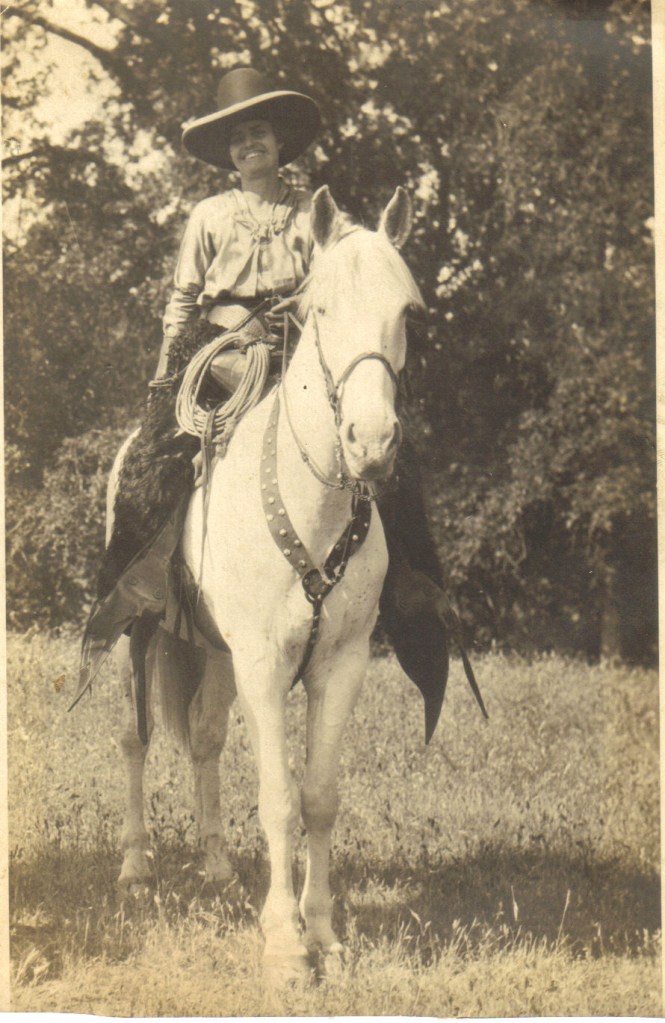
She turned back to the phone and asked what the call was about then said “O K, I understand. It will be just a minute”

Barbara, she yelled as she heard the screen door slam, “Tell your father it’s a man called Happy from Signal Oil, he says that Sam Mosher wants to talk to you.”

“And hurry honey, It’s important.

Michael Shannon is surfer, teacher and World Citizen. He writes so his children will know where they came from.

Standard

Whats’s in a Name.

By William E. Lye

The Secretary of defense has ordered the renaming of United States Naval ships as follows.

  1. The USNS Medgar Evers. The Evers will be recommissioned as the USNS Theophilus Eugene Connor (1897-1973) Eugene “Bull” Connor gained infamy during the spring of 1963 as the heavy-handed Birmingham police commissioner who turned power hoses and police dogs on the black demonstrators led by Martin Luther King, Jr. Bull Connor and Birmingham symbolized hard-line Southern racism. Connor’s actions received national and international media coverage, which dramatized the plight of black people in segregated areas, giving the civil rights movement much-needed attention. After viewing television reports of the fire-hose and police-dogs episode, President John Kennedy said, “The civil rights movement should thank God for Bull Connor. He helped as much as Abraham Lincoln.”
  2. USNS Thurgood Marshall. The Marshall will be renamed the USNS J. Robert Elliot. Elliott criticized his own party’s president, Harry S. Truman, and federal legislation to ban lynching and eliminate the poll tax, and he had opposed creation of a Fair Employment Practices Commission. Elliot criticized Democrats of southern states who opposed the civil rights act. In his 1952 Georgia House campaign, he expressed dissatisfaction with attempts to end the all-white primary: “I don’t want those pinks, radicals and black voters to outvote those who are trying to preserve our own segregation laws and our sacred Southern traditions.”
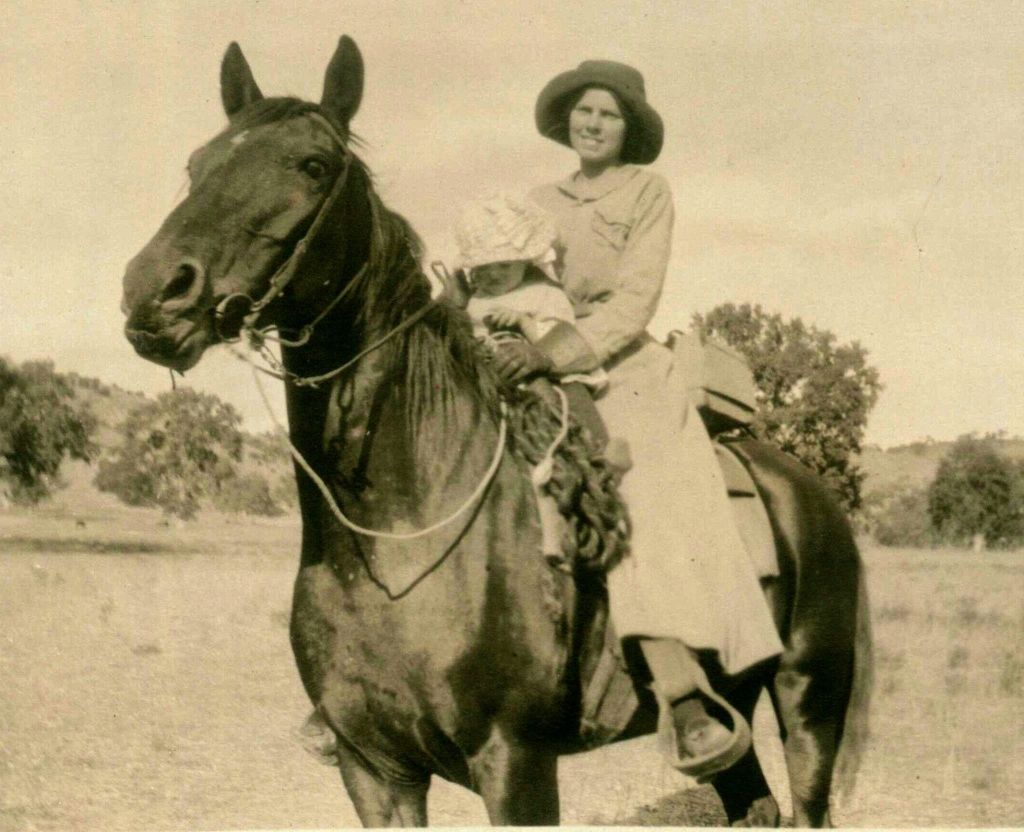
  3. USNS Harriet Tubman. She will be named the USNS Thomas McCreary. McCreary, a slave catcher from Cecil County, Maryland. Proclaimed a hero, he first drew public attention in the late 1840s for a career that peaked a few years after passage of the Fugitive Slave Act of 1850. Living and working as he did at the midpoint between Philadelphia, an important center for assisting fugitive slaves, and Baltimore, a major port in the slave trade, his story illustrates in raw detail the tensions that arose along the border between slavery and freedom just prior to the Civil War.
  4. USNS Ruth Bader Ginsberg. The proposed ship will have its name changed to the USNS Roger B. Taney. Taney, an American lawyer and politician who served as the fifth chief justice of the United States, holding that office from 1836 until his death in 1864. In the Dred-Scott decision, Taney’s court declared that all blacks — slaves as well as free — were not and could never become citizens of the United States. The court also declared the 1820 Missouri Compromise unconstitutional, thus permitting slavery in all of the country’s territories. The case before the court was that of Dred Scott v. Sanford
  5. Other proposed names to be deleted, Dolores Huerta, Cesar Chavez and Lucy Stone.
  6. The Congressman John Lewis class of ships one of which was the USNS Harvey Milk. The class to be renamed for James Oliver Eastland who was a segregationist Senator and led the Southern resistance against racial integration during the civil rights movement, often speaking of African Americans as “A degraded and inferior race”. Eastland has been called the “Voice of the White South” and the “Godfather of Mississippi Politics”. His famous quote on politics in answer to a reporters question was. “I run on two things, bridges and “n*****s, ahm for one and agin t’other.”

Chief Pentagon spokesman Sean Parnell said in a statement that Hegseth “is committed to ensuring that the names attached to all DOD installations and assets are reflective of the Commander-in-Chief’s priorities, our nation’s new history, and the warrior ethos.”

“Our military is the most powerful in the world – but this spiteful move does not strengthen our national security or the ‘warrior’ ethos. Instead, it is a surrender of a fundamental American value: to honor the legacy of those who worked to build a better country.”

Although the Navy has renamed ships for various reasons, name changes are an exceptionally rare occurrence, especially after the ships have entered service.

The Navy is made up of sailors from every state, political party, ethnicity, sex and religion. Navy men and women represent the diversity of all Americans and for the sea going contingent particularly treasure the traditions and affection for the ships they serve on.

You could have a long and serious discussion on the “Whys” of military bases and ships but politics intrudes for all kinds of nefarious reasons having to do with who votes for you the political office holder. Traitorous Confederate Generals get a name though they and their political class fostered a war that killed nearly eight hundred thousand American boys and men. The first black associate justice of the Supreme Court, a highly praised legal scholar, Thurgood Marshall is erased over what should be the motto of this country, the most diverse on earth since the Romans. DEI, Diversity, Equity and Inclusion which perfectly describes the goals this country has pursued since it’s very beginnings. This is someones personal fever dream of hate and divisiveness. Some times we stumble as a people and fall down but the idea that the pipsqueak in the Pentagon can erase, not just a paragraph in a history book but the lives of people who changed this country for the better because he thinks that his Moral Superiority derives from the color of his skin or his belief in a vengeful God.

The writers point is to demonstrate the utter absurdity of the administrations goal of canceling all of whom they don’t like. Remember the minority, in the end, rarely prevails.

The names of the propose ships are a fiction used to prove a point.

Willian E. Lye is a writer who cherishes the title of Iconoclast given to him by Janine Plassard one of the worlds greatest educators.

Standard

Twelve Hour Tour

Chapter thirteen

Elwood, his name was Elwood Cooper and he owned the large Elwood Ranch in what is now Goleta and the adjacent hills. His first name lingers in several local place names including the oil fields. There are Elwood Canyon, Elwood School, Elwood Station Road, and a Goleta neighborhood. He ran cattle. He was a horticulturist and was best known for importing millions of Ladybugs from China to California which wiped out the black fungus that was killing walnut trees and saving that industry. He also imported the first Blue Gum tree which he though might be a good source of lumber. There are still thousands of Eucalyptus planted in wind breaks all over Southern California. This turned out not to be a wise choice.

After the death of his wife in 1909 he sold out and lived the rest of his life at Santa Barbara’s Arlington hotel. The ranch was sold to the Doty family who kept the business until 1921 when it was foreclosed, auctioned off and was essentially dormant until 1927 when an exploratory oil well was drilled there by a company from Texas.
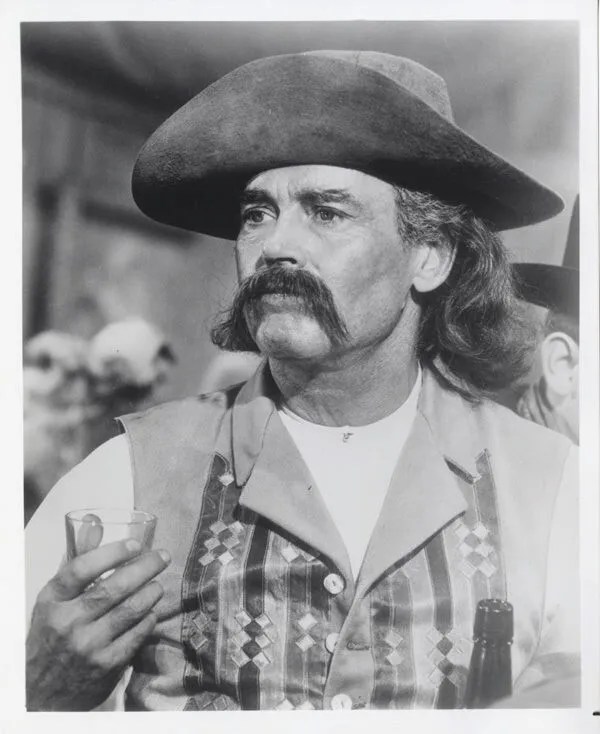
The first oil discovery in the area was in July 1928, by Barnsdall Oil and the Rio Grande Company, who drilled their Luton-Bell Well No. 1 to a depth of 3,208 feet into the Vaqueros Sandstone. After almost giving up they not only struck oil, but had a significant gusher, initially producing 1,316 barrels per day. This discovery touched off a period of oil leasing and wildcat well drilling on the Santa Barbara south coast, from Carpinteria to Gaviota. During this period, the Mesa Oil Field was discovered within the Santa Barbara city limits, about 12 miles east of the Elwood field. The Elwood Field contained approximately 106 million barrels of oil, almost all of which has now been removed. The field has been abandoned.

Elwood piers and wells. Elwood Field, Goleta, CA

Barnsdall moved Bruce up to Elwood in early 1929. Almost all the wells were being whipstocked trying to reach the oil sands covered by hundreds of feet of seawater in the Santa Barbara channel. His expertise was in high demand. The drill strings were boring diagonally down in to the field like the tentacles of a squid. The whipstocks themselves never saw the light of day, snuck in at night because no one wanted the competing oil company on the neighbor’s lease to know just what was going on.

The business was still the wild wild west. There was no government control on production. Small producers took no prisoners they just drilled and drilled. Since wells typically produced the greatest amount of oil when they were still new, the impetus was to never stop drilling. The big companies were no better. Over production was taking its toll at the gas pump but no one in the business cared. Neither did the Hoover government. The public liked the idea of .22 cent gasoline.

Times were still pretty flush during the postwar boom. Car companies were turning out automobiles as fast as they could and Ford, especially Ford with its emphasis on utility and low price was driving car production at a breakneck pace. In 1929 Henry Ford raised wages to $7.00 a day. The other auto makers promptly sued him citing unfair labor practices.

Wages in the oil fields were also high, seven to eight dollars a day. The length of a tour was now just 8 hours down from twelve. Things were better for Bruce and Eileen because he was able to spend a little more time at home though it also meant that the rigs now required two crews a day to make hole. As a tool pusher he was now required to supervise both crews not one.

It was rough work. Bruce wasn’t out of danger yet. In 1930, 67 oil workers were killed on the job. Blowouts, falling rigging, toppling derricks, explosions and fire were always a danger. There was rarely at time when there wasn’t something burning in the fields. Barnsdall, operating all over California sent them back to Oildale. a place where they lived for nearly a year. Bruce came home one day with the skin ripped from his fingertips to nearly his elbow peeled back. At the rig they had smeared some grease on the open wound, laid the skin back down and wrapped it in a dirty undershirt and sent him home. My grandmother opened it up, cleaned the dirt and stickers off, slathered it with Vaseline and wrapped in in a clean bandage which she cut from a sheet. He went back to work the same day. They were both tough people.

In 1929/30 they lived in Bakersfield in a house for the first time that was big enough for the whole family, Bruce Eileen and the three kids. It had enough bedrooms for each kid which was the first time that had happened. It was considered a luxury by the children because no one had to sleep on the couch or the screened porch. Wonder of wonder it had indoor plumbing. A faucet in the kitchen and a bathtub. No toilet though, you still had to use the “Backhouse” to do your business.

Robert Mariel and Barbara Hall, 1930. Hall Family photo

Bruce was getting a reputation for knowing what a well was doing. He could tell by smell and taste what was happening a thousand feet down. He could hear in the creaks and groans, what she was thinking. He had the drillers sense of where she was going. Kneeling on the platform you would have seen him sniffing at the casing head, taking a finger and tasting the liquid mud used to lubricate the drill string. How hot was the mud flooding up out of the well? What did it smell like, was that hint of rotten eggs? When traces of crude came up getting a little on the fingertips and touching it with the tongue to help predict its gravity, was in light and sweet or thicker, could it be chewed. There was even a difference when you wiped your hand on a rag, did it soak right in or stick to the surface. Was there gas coming up, how much pressure was pushing it? There were a thousand indicators, the well was telling you its story. It had to be read on the spot for there was little scientific measurement in the oil patch just yet.

He always said that the kind of things you see in a movie, wells blowing up or a gusher blowing vast amounts of oil skyward could and would get your fired. Crude was money and the big men in the office wouldn’t be happy if a well got out of control. If you’re senses told you what was coming next you were a valued worker and grandpa was that. He had eleven years on the job and the experience was paying off. There were just a few thousand men working the rigs and people as good as Bruce were worth their weight in gold, or oil as the case may be. Word gets around.

Everything was looking pretty rosy. All three kids doing well in school, Mariel would be in high school in a year, Barbara in seventh grade and Bobbie in fourth. The kids were old enough now that their constant moving about had taught them how to quickly make friends. How to spot the popular kids who were school leaders and elbow there way into the group. Their parents sat them down and counseled them on the best way to survive as the constant new kid. Moving two or three times a year from school to school strengthened their social skills. I remember my mother, Barbara, the second child could make a friend in about two seconds.

Something bad was lurking in the United States and the world though. On the surface was the gloss of good times shown brightly but they masked something sinister. By the end of the decade cracks would begin to show though no one seemed to understand the why or what of it just yet. Let the good times roll.

Life magazine cover. Art, John Held JR. November 1926

All during the twenties in the aftermath of the war the times were good, very good. Society had rapidly changed. The old song which opined that soldier boys who had seen gay Paree wouldn’t want to go back to the farm was true. Young people saw skirts go up, way up. Flappers wore silk stockings. They rolled them over a rubber band just below the knee slipped a flask of bootleg whiskey under their garters and shimmied like their sister Kate. Hair was bobbed. Silk undies, just a chemise and a pair of step-ins, let’s party like 1929.

Miss Bee Jackson 1925, The Charleston Girl. British Pathe photo. Youtube.

Henry Ford was turning out the Flivver by the millions, they cost just over two hundred dollars and the kids soon discovered that petting on the back seat was a delight. They wanted to go and party with Jay Gatsby on long Island. F Scott Fitzgerald helped open the door.

It Wouldn’t last.

Chapter 14, coming soon. Disaster.

Michael Shannon is a writer. These stories come from his mothers side of the family many of who spent more than sixty years in the oil patch.

Standard

Scribes.

…or how scribblers turn a joke, a phrase, a story.

When newspapers were the only mass communication in the country they reached nearly every home. My dad drove down to Kirk’s Liquor every morning after his men went to work and bought the LA Times and the Wall Street Journal. The big boys dominated and some said “Made” the news. The term Fake news is neither Fake nor new. Reading the papers at the kitchen table in our home was a part of my education. Guided by my fathers exhortation that most of what you read was suspect and how you might find a way to validate that was how I was instructed. He said, “Always remember that newspapers are always owned by an individual with an agenda.” He advised that you do your home work, read a conservative view then a liberal view and that the answer lies some where in the middle. Maybe.

About the only place you see a newsstand anymore is in the old asphalt jungle, New Yawk, New Yawk. Once the center of the news world, publishing as many as sixteen dailies and uncounted numbers of weeklies. Hearst built his temple of journalism to Saint Francis de Sales patron Saint of newspaper scribes and never looked back. He fought a circulation war in the late eighteen nineties with Joseph Pulitzer of the NY World while Alfred Ochs was busily, quietly making the NY Times the most trusted paper in the country.

Hearst and Pultitzer invented Yellow Journalism in the 1890’s, a term that is a sensationalized style of news reporting characterized by exaggeration, vivid illustrations, and a focus on sensational stories like scandal and crime, rather than factual accuracy. The term is believed to have originated from a comic strip character called the Yellow Kid written by Richard Outcault. The Kid is considered to be the seminal comic strip for those we know today. My grandfather Shannon who palled around with Outcault said he never refused a drink which was his way of saying he was a “Hale fellow well met.” Jack Shannon could spin a tale pretty well himself.

The rival newspapers of Hearst and Pulitzer competed for readership by printing sensational news stories pitched at the lowest common denominator, thus inaugurating the modern conception of journalism for a mass audience and gullible one too.

There were sporting papers for the Punters, guys like Nathan Detroit* who speculated on the ponies. Their were ethnics too. Papers in Yiddish, Polish, Italian and Rooshin for the reds to read. Lest the reader thinks newsmen are just hacks who couldn’t write books consider American writers like Bret Harte, Mark Twain, Jack London, Ambrose Bierce, Stephen Crane, and Damon Runyon. The original Rush Limbaugh, Westbrook Pegler had a Hearst column in which he preached hate and division and even Hearst eventually fired him. There were Walter Winchell, Dorothy Kilgallen, and Bob Considine too. Adolf Hitler, Benito Mussolini, and Winston Churchill, climactic figures of the twentieth century were contributors. Karl Marx, Einstein, Susan Sontag and the critic HL Mencken as well as James Baldwin wrote the news.

The greatest of sports writers, Ring Lardner, Red Smith, Frank Deford, George Will, Roger Angell and Dick Young dispensed real insight into popular culture cloaked in sporting news. Jim Murray of the los Angeles Times and E B White of Vanity Fair didn’t write the nuts and bolts of games but looked to the humanity contained in it.

The sports editor stuck is head out the office door, green eyeshade pulled down low, a chewed, five cent seegar clenched between his teeth. Swinging his head around he looked a human version of a snapping turtle. Hooking his index finger around the stump of rolled tobacco leaf he spotted Lardner. He sent a stream of tobacco juice in the general direction of the spittoon and bellowed, “Hey Lardner, gimme five hunert on dat busher from Balmer. (Baltimore) They call ‘Im Baby or Babe, sumpin’ like that. He licked the Yankees taday. Need it for the extra edition at five .”

BABE LICKS CUBBIES

BOSTON TWIRLER BLANKS CUBS, SOX IN SIX.

Beantown takes ’17 World Series.

For the scribbler in the newsroom, the idea…set the hook with an eye catching headline. Something to catch the eye of the Rubes. Something the newsboy could screech. Something simple, catchy, suck the penny right outta their vest pockets.

Newsboys with Morning Telegraph, New York City. 1899. The original Toughnuts.

Below are actual headlines which were carefully crafted to get attention from the buyer. Believe it or not there are archives and collections of the best and most amusing ever written.

OXYGEN KEY TO STAYING ALIVE.

CONFIRMED BY TOP SCIENTISTS

Breathing Found Necessary

Princess Kate all A-Titter

Princess and the Frog

Frog Photog, No Top Pix Draws Suit.

Princess Kate of Great Britain was filmed topless on a friends yacht. She sued a French tabloid and won.

I’M A CHEETAH

WOOD’S WIFE BONKS HUBBY WITH WEDGE

Tiger Woods, serial Tomcat Bogies out of his marriage. Lock up the waitresses!

CLOAK AND SHAG HER

CIA BOSS ADMITS AFFAIR

General David Petraeus resigns over the outing of his affair with his biographer. Headline, considered tasteless at the time would barely be news today.

‘Headless body in topless bar’ was voted as one of the greatest newspaper headlines of all time by New York magazine. It was written by the Post’s larger-than-life managing editor Vincent Musetto. Murder by Wife always gets the lead..

No More Mister Wiseguy

MOB RAT BLASTS YAPPER DON

Gabby Gotti Ruined the Mob says Gambino Capo

State Population to double by 2040

Babies to Blame

OFFICIALS CONCERNED, SAY NIX TO SEX

I was thinking about papers today after reading an essay by Steve Rushkin, a writer for Sports Illustrated. In it he quotes Bobby Knight once the basketball coach at Indiana University who famously said of writers, “Everybody learns to write by the second grade, most of us move on to better things.” Most of us stop calling ourselves Bobby and quit throwing chairs by then too, but I get his point.

Don’t take yourself too seriously, have some fun. Also remember that what we know of our history we know because SOMEONE WROTE IT DOWN. There’s that Bobby.

Cover Photo: Ring Lardner at work for the Sporting News. Considered one of America greatest satirists he was a contemporary of Ernest Hemingway, Virginia Woolf and F. Scott-Fitzgerald. In 1916, Lardner published his first successful book, “You Know Me Al,” an epistolary novel written in the form of letters by “Jack Keefe”, a bush-league baseball player, to a friend back home. The letters made much use of the fictional author’s idiosyncratic vernacular. Lardner is well worth the read.

Nathan Detroit: A fictional rogue and gambler from the Play “Guys and Dolls.” Guys and Dolls is a musical with music and lyrics by Frank Loesser and book by Jo Swerling and Abe Burrows. It is based on “The Idyll of Miss Sarah Brown” .

Michael Shannon lives in California and writes for the heck of it.

Standard