The long polished Mahogany table as seen through the little nook off the living room, an opening on the left where the swinging door to the kitchen stood propped open with a fold of newspaper and at the end of the room a window with its Venetian blinds open looked out to the side of Mrs Lake’s home stuccoed in beige and with a little imagination you could see a long stretch of featureless desert sand. Before the glass, sat four grown men.
I could watch them at a distance and have always wondered what it was of which they spoke. Hand on fist I would sit on the little brick hearth of my grandparents home in Lakewood and try to listen.
Gathered together around the every day tablecloth that would be changed for Thanksgiving dinner later that day sat my Grandfather Bruce Hall. A man who had labored nearly four decades in the oilfields of California. He was now the superintendant of drilling for the state of California. From oilfield roustabout to the top of the heap at Signal Oil and Gas. He wore his rumpled, baggy khakis and a white long sleeve shirt with the collar open and the sleeves rolled halfway. Spectacles over the lower half of the nose, his bald head encircled by a fringe of hair smelling of Wildroot. He seemed to me to be perpetually tired. He’d already had the first of the heart attacks that would in a couple of years kill him. A lifetime of filterless Chesterfields, one of which, smoldering he held with three fingers, idly scraping the ash from on the edge of the ashtray, a green baize bag filled with bird shot and a shallow brass bowl. He leaned forward on his elbows a half smile on his face.
My Dad sat next to him in his ever present flannel shirt and blue Levi’s his uniform of sorts the mark of a farmer. He was forty three. He sat in his customary pose, elbows braced on the table a half smoked cigarette in his right hand pinched behind his upper knuckles, I can’t remember ever seeing him sitting any other way. At his elbow a half filled bottle of bourbon being occasionally lifted with the comment, “Another drop?” No ice either, whiskey straight no frills, or as my dad told me, “Ice dilutes and pollutes the Bourbon. Bartender puts it in to short the pour.”
There was a glass at each mans hand, no fancy fat little crystal glasses, grandma had them but they mostly sat in the sideboard gathering dust. No, these man drank from kitchen glasses and in those days it was likely a jelly jar, not the canning Mason or Kerr but the old fashioned one that came from the Jewel Tea truck, full of, and always in that household, blackberry jelly, the kind that you had to pry the lid off with a church key. Practical men they were but at the same time would never drink straight from a bottle. Class of a sort.
Uncle Ray sat at grandpa’s other hand. His dark blue shirt with the mother of pearl buttons marked him as a cowman. In his late forties he was a little on the portly side, the shirt held in with a plain leather belt and a small not so fancy buckle. His old fashioned black levi’s turned up at the cuff a good four or five inches covered most of what were hand-tooled cowboy boots for thats what he was, a dyed in the wool, genuine cowman who could fork a horse as good as any. Better than most really for he was known through the Sierra Nevada as “Powerhouse” after, on a bet, put his horse Brownie over the side of the hill at the Kings river penstocks and rode her almost straight down as if it was nothing. A feat of horsemanship that gave him the name. If you ever get up there you’ll see what I mean.
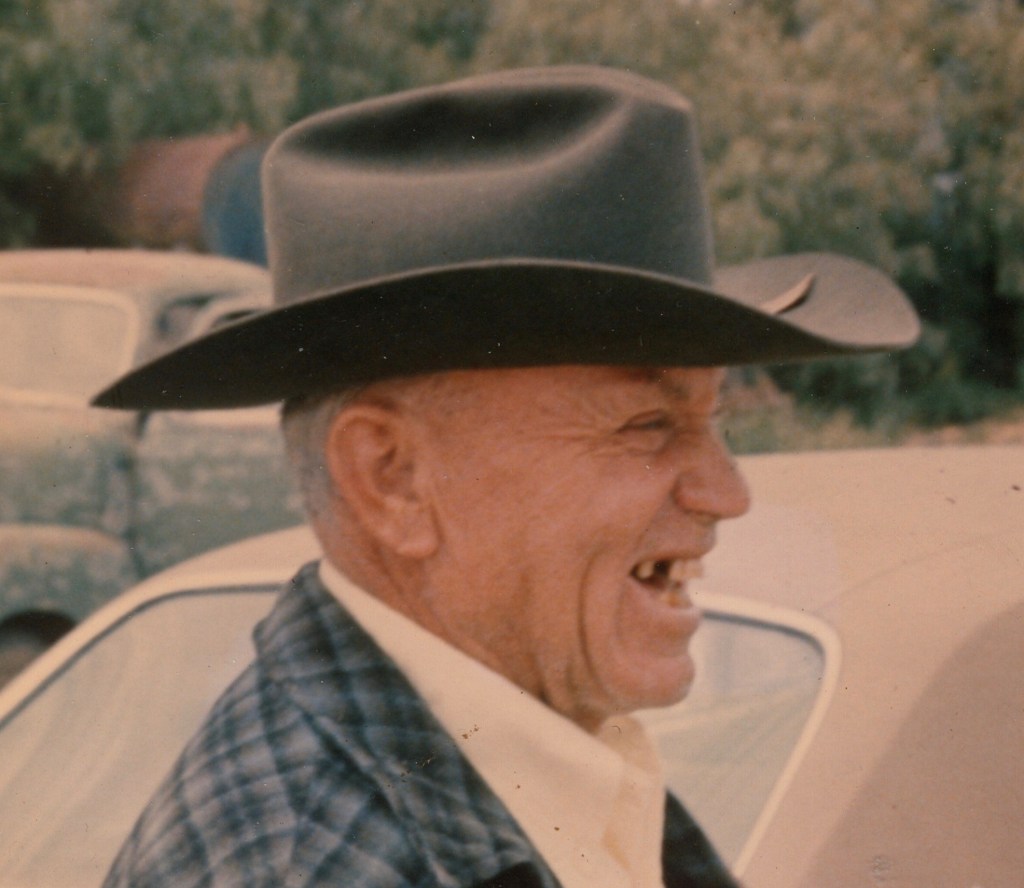
I remember him most for his laugh, a sort of lung deep basso cackle, really indescribable but still one of the greatest laughs I have ever heard. He didn’t hog it either it was as if it was just idling down in his throat ready to spring to the surface on any occasion.
Ray Long was such an original cowman, at that time already a vanishing breed that he had taken on the characteristics of the horses he rode. He was missing the molars on one side of his jaw and when he tipped his head back to laugh he looked just like a horse did. Horse laugh my dad called it.
The fourth that made up the quartet was my uncle Bob, Robert Preston Hall. At thirty five just a youngster. My mother’s youngest sibling, the only boy of that generation. He grew up with two older sisters and one younger who adored him. My aunt Patsy always said he was as caring as any parent.
He leaned back in his chair right arm hooked over the back with an elbow, his legs crossed at the knee. His white shirt collar unbuttoned had short sleeves, something I never saw the other three wear, ever. Cigerette pack in the pocket, he held one in is right hand. His jet black hair, slicked back shone in the light and sitting on his nose, old-fashioned steel rim, round spectacles. Topping it all off, he wore a thin mustache, the kind we used to call the “Boston Blackie.” He had an elegant long straight nose and a family trait inherited from grandpas’ family, Jug Handle ears. Mom said they were like airplane flaps and would slow you down when you came in for a landing.
Uncle Ray loved to tease and used the family ears as nicknames for one of his sons and me. Ears like that, guess they didn’t hurt Clark Gable none. He was an oil man too in his younger days. They had that in common.
They were different looking men really, no two looked alike but they had things in common. They could be absurdly funny and the well jest turned earned high praise in our family. The were men of the land all of them farmers and ranchers at heart with deep roots in the ground. Practical and pragmatic, they wasted no energy on frills. None of them liked to wear suits if they could avoid it and they did at all costs. The best you could get out of my dad was a sports coat and slacks.
They were all good with kids. I have friends I grew up with who still remember my dad handing out quarters at gatherings which meant something in those days. Uncle Ray made you feel like you were a grownup but wasn’t above squirting you with milk while milking either. Uncle Bob had the salesman gift and told me very first dirty joke though it barely made the grade as such.
The thing I most remember is they were grownups who stood for something. Kids were great but still kids. They shared very little about adult life. They did their best to keep all that at a distance to keep you safe. Your were a kid and they were adults, it was important that they kept it that way. They taught much more by example and were pretty content for their children to find their own way with as little guidance as possible.
Once my oldest cousin who was about fourteen and though pretty well of himself sauntered in and pulled out a chair and sat. He interjected some comment into the conversation and they all turned to look at him. No one answered. A moment or two passed as they sat silent until it occurred to him that maybe he wasn’t as old or important as he though and he soundlessly slithered out of the chair and beat a retreat.
They bookended an entire generation from one end to the other. They had seen two world wars, the greatest depression, the Korean War, the atomic bomb and each had weathered severe up and downs in the family.
That thanksgiving saw a dozen kids and five families shoehorned into that little house on Pepperwood Avenue in Long Beach, just about the last time we would all be together. Other than seeing them I really didn’t know what they talked about. I wish I had been older so I could really listen but I wasn’t.
Years have past and the questions were never asked. I had other interests and they were famously recalcitrant anyway in the way men of that generation could be. “Oh, you don’t want to know about that,” my uncle Jackie Shannon once said. I did but he just changed the subject. Every person you will ever know dies with secrets and stories you will never hear. It’s a shame.
Michael Shannon is a writer. He lives in Arroyo Grande, California.
Hogger is a slang term for a locomotive engineer. Steam locomotives were referred to as “Hogs” in the early days of railroading.
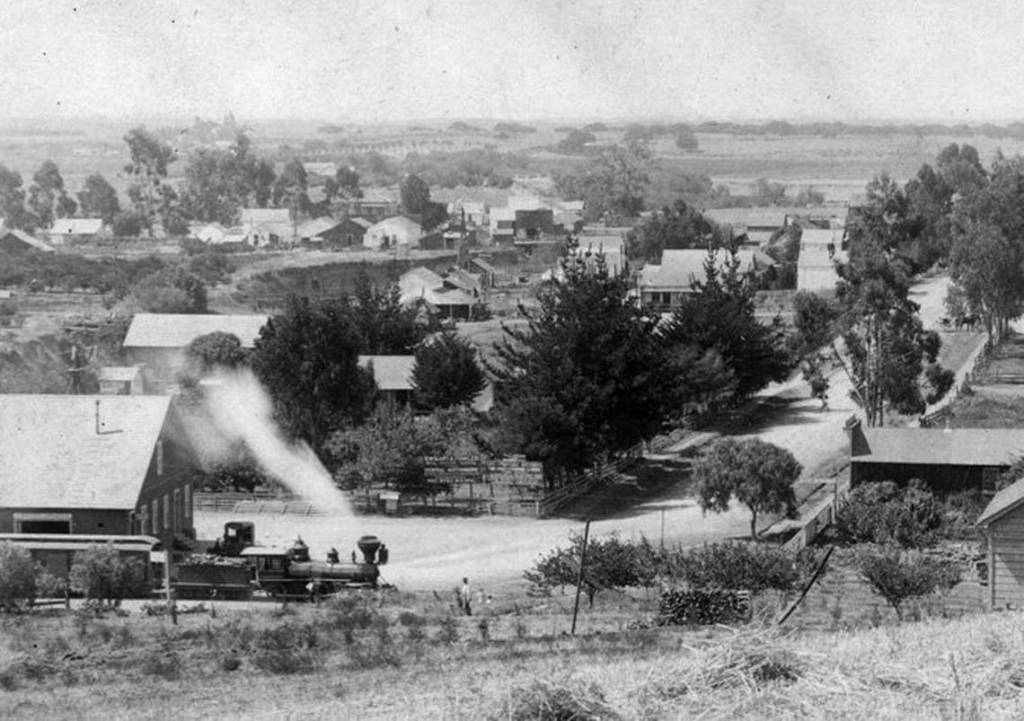
My grandparents grew up when trains were the most modern form of transportation. When they were children growing up in Arroyo Grande, the steam train dominated the movement of people and goods throughout California’s Cow Counties. The big Railroad, the Southern Pacific hadn’t arrived yet, there was a promise it would but it took years for the local movers and shakers to pony up the bribes and free land that the Big Four demanded. No, the railroad here was the little narrow gauge Pacific Coast. Quite a bit smaller than the big train, it had served the area since 1868. It ran essentially from nowhere to nowhere. It huffed and puffed its little self-confident way to and fro making no apologies to anyone.
Arroyo Grande station and warehouse 1898. Historic Society.
My grandmother Annie rode it down to Santa Maria to go to High School. The high school in Arroyo Grande wasn’t accredited for those that were planning on going to Cal Berkeley. She and her friends hopped aboard, the train would actually pick you up in front of your house, to take trips up to San Luis Obispo to shop for the latest spring frocks and hats.
Nearly all the goods in the stores that marched along Branch street had to have their merchandise brought down from San Francisco by steam or sail and then shipped by rail to their destinations. The largest building in town was the PC warehouse on upper Branch Street.
Pacific Coast Railway Bridge Arroyo Grande, Ca, 1914. County Historical Society.
When my grandparent were kids the only bridges across Arroyo Grande creek were the railroad bridge and Newt Short’s swinging bridge which was only good for pedestrians. The RR bridge handled most of the walking public and all the wagons crossing the creek. It also served as an impromptu gallows at least once.
If you lived in town to train whistle and the rumble of the cars was a daily fact. My grandfather lived with the sound of that little train for almost fifty years. It’s no wonder it was planted in his thoughts.
Dad Shannon’s little house on the dairy. Family Photo
Christmas eve 1953 the family jumped in the green Buick sedan for the trip to my grandparents house where we always spent Christmas eve. It’s impossible to recall the excitment little kids feel when you are grown. Anticipation can cause you to almost wet your pants, your hair to stand on end and your head spin. The cars in those days had fabric upholstery which had a singular odor mixed with cigarette smoke and the ever present dirt and dust that farm families live with. Once in a while the car got washed but it was a fruitless exercise for my mother. Its pea soup color was always dusty in summer and muddy in winter. No matter how it looked it might as well been a golden chariot on Christmas eve with three little boys bouncing around on the seats in a collective fit of anticipation. Kids didn’t get many presents in those days. One special thing and the rest was basically utility. Shirts made by my mother probably, always socks from bachelor uncle Jack who didn’t have a clue. I got socks from him every Christmas for nearly fifty years. We really weren’t concerned about quantity. We had heard stories about Christmas past when my father got a pair of socks knitted by my aunt Sadie and a fresh Orange. He told me he was glad to get them too, especially the Orange, a pretty rare thing for those days. That was in 1920 when he was eight and he still operated on that principle in the fifties. Things were not particularly important to him. He felt that you should be grateful for what you got and say thank you because no matter what it was it was important to the one who gave it to you. The thing had no particular value, it was the love that counted.
When you know you will only receive one gift, why, it takes on a much greater importance. It was a good lesson.
We drove into town and then south on the old highway and turned off on El Campo Road where my grandparents lived on their ranch. The little red house with the white trim was down in a place I always thought of as the hole. The big bank of the highway and the old Nipomo road on the other side boxed it in and you entered downhill on the gravel driveway. Built n 1924 by my great-grandfather it was a simple board and batt sided, two bedroom with a door at each end. The backdoor led into a screen porch where grandmas pie safe stood, green with screen in the doors that looked like lace. Full of jelly jars with room for a cooling pie. There was a bench for changing shoes and some hooks screwed to the wall to hang jackets and hats on. In 1953 every man still wore one. Open the inside door and you were in the kitchen. Very simple it was. Next the dining kitchen table area and then through to the living room. Behind that was the front door enclosed in a little add on porch. This door was nearly useless because no one was ever likely to use it. Only itinerant drummers like the Fuller Brush man or his like. The custom in the country is to always use the back door. There is a familiarity and friendship involved in that like you might almost be a member of the family. Even the Knights of the Road knew this, they would come down the hill from the highway, tap on the door and stand with bowed head and hat in hand. They were not turned away. It was a vastly different time.
I only went in that front door a few times in my life, always on Christmas eve. My grandparents built a new home in 1954 up on the hill. A modern style home, yes, but we still used the back door except at Christmas .
Christmas 1949. Annie Shannon, my father and two of his boys just arrived at the old house. Family Photo.
1954, in what was our last Christmas in the old house in which the event that is the subject of this story occurred. We heaved the doors to the Buick open and ran to the door hoping to catch Santa in the act but as seemed to happen every year he had just left by the back door while we tumbled in the front. Mom and dad followed, arms full of presents, Cayce, my little brother, just three dragging mom by the hand squeaking in delight.
Grandma and grandpa met us at the door she in her print dress, sturdy shoes, old fashioned wire rim glasses and her apron, always with a hanky peeking from the pocket. She smelled sweetly of white shoulders and when you hugged her she would give you her very soft cheek to kiss. The formal and manly handshake from Big Jack as he uttered his, “The Blessed Boys,” with that big grin, his chest pushed out and his green suspenders like two vertical stripes holding his belly in. Uncle Jackie bringing up the rear, short, bald and bandy legged he sported a big grin, delighted to see his nephews. This ritual of greeting never changed as long as they lived, it didn’t matter if they had just seen you an hour earlier it was always the same.
In that last Christmas in the old house, the biggest most important thing for me was a brand new Lionel electric train. The little black engine pulling the cars and caboose in a stately manner around the Christmas tree. My grandfather got right down on the floor with me and we played with it until dinner was called. I could hardly step away. Eventually, full of turkey and homemade pie my brother Jerry and I fell asleep on the floor. Mom cuddled with little Cayce on the sofa until it was time to go home. The little train set stayed until dad could go back with the pickup to get it.
My dad visited his parents often. Sunday, which was a no work day would see him sitting at the green painted table with the checkered oilcloth cover, tacks along the edge to hold it in place. This was the kitchen of the old house where he had grown up. They would drink scalding hot coffee from the old enamel pot that sat in its habitual place on the stove. They’d be shooting the breeze, his parents and brother Jackie. They had nearly fifty years together so there was always something talk about.
After one of these visits, sometime after new years he came home and over lunch laughingly told us that after Christmas my grandfather had gone to Bello’s store in San Luis Obispo and bought himself a train set. My grandmother thought it was pretty silly for a grown man to do that. It was a silly little topic at her bridge club. Mrs. Brisco, Mrs Conrow and Mrs Jatta agreed and commented that it was just like Jack to do something like that. They said he was still just a boy at heart. They spoke the truth.
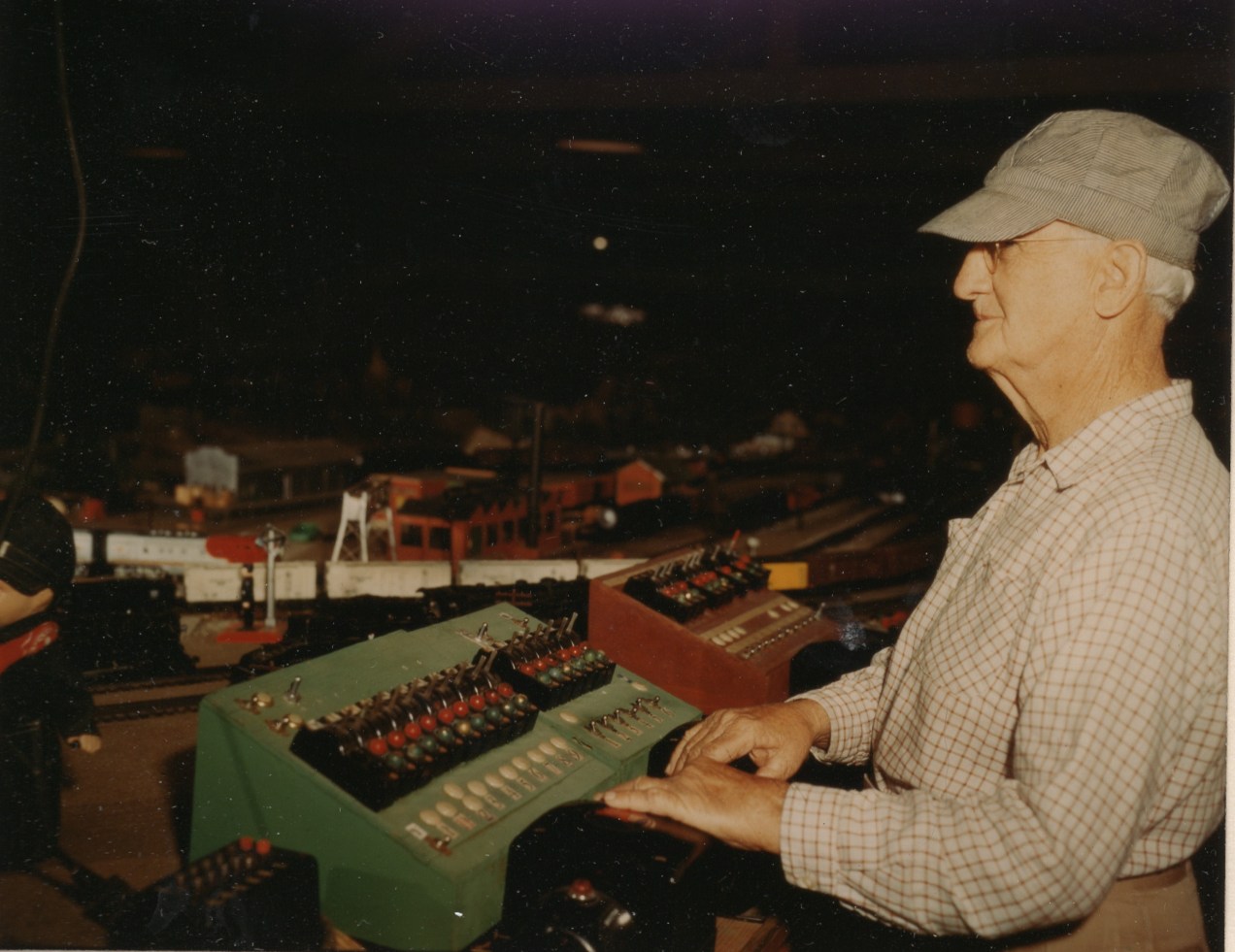
The little train lived in their living room for a bit but slowly began to grow. He added track, some trees and two small buildings. One was a church that looked similar to the one my grandmother attended. Perhaps this was an attempt to head of the inevitable grandmother “Stink eye” that was sure to come when the railroad would need to be moved for company.
By mid-January he made a trip north to buy more track, though he was already encroaching on the dining area. The next day grandma went to town to do her shopping and run some errands and when she came home he came out to help her unload the food she bought at Bennett’s grocery while she went in the house to take off her hat and gloves and put on her apron to ready supper. From outside Jack heard her raise her voice to the high heavens and quickly the sound of her voice saying, “Jack, you get in the house right this minute.”
He had finally reached her limit for what he had done with his new track was cut three holes in the walls so the train could pass through into the bedroom, make a left turn through another tunnel into the office and then turn again through the wall back from where it came. Enough was enough. She evicted him and his railroad.
Jack and Annie Shannon circa 1950. Shannon Family Photo.
Jach was a clever man so as he packed up the rolling stock and his village, carefully placing each piece in some of his old milk crates stamped with the family’s label, Hillcrest Farms Dairy. As was his nature, being a man who does nothing half way, he began to ruminate on how he could continue his railroading…….
Part two is coming on Saturday the 8th of June.
Michael Shannon is a born and raised Californian and still lives in God’s country.
A historian seeks the truth of it. He is neither blinded by the glare of opinion nor does he ever stop seeking a final answer which he knows in his heart is not or ever will be there. He must always dig deeper. His life is to live in worlds which no longer exist. His life is to parade before mankind the true blocks that built the world we live in.
My friend the historian has pawed through the dustbins of scrap, piecing together the puzzle of lives lived. Letter, journals, documents, film are all grist for the mill. A fabulist he is not.
He understands that there is never a final answer. There is always something to be discovered and his hope is the honour will be his. That is his calling.
Not long ago in a comment string on an article he posted, someone commented that what he said was interesting but not written by a “Real” historian. A “real” historian, which implied he was not.
I’ve been thinking about the comment and the not so subtle dig it implies so I though I’d explain what a real historian is.
You are. Did you keep your grandmothers Christmas cards? How about your mothers letters to her sister. Perhaps the journal your great uncle kept when he was stationed in Vladivostok during WWI. Do you still have the box with some black and white unidentified photos, the ones with the deckled edges and a coffee stain? Does it have an old crinkled embroidered handkerchief and at the bottom and a deed to the ranch made out in 1924. Do you still have your high school yearbook? How about a set of Compton’s Encyclopedia from 1930. All of that, my friend is history. Keepers of history long for those things. Mundane objects are the things history is made of.
True history which is known to all “real” historians is made up of the things that did not get thrown away. We know of the war between the kingdoms of Elam and Assyria because a record of the conflict was kept and survived nearly three thousand years buried in the sand of southwestern Iran. In Great Britain the site of the Roman fort at Vindolanda, a part of Hadrian’s Wall built to keep illegal Picts from what is now Scot Land from entering Roman Britain. Just like today its cost was enormous and it didn’t work.These finds record military expenditures; daily bookkeeping which hasn’t changed in nearly 1,900 years which you would recognize if you ever served in the military, have been found. From it we learned that Roman soldiers wore underwear, something completely unknown until today. The documents are personal messages to and from members of the garrison of Vindolanda, their families, and their slaves. Highlights of the tablets include an invitation to a birthday party held in about 100 AD, which is perhaps the oldest surviving document written in Latin by a woman. It features her signature, the first known example of a woman signing her name, Claudia Severa. The commander’s wife was writing to Sulpicia Lepidina. How different is that than your grandmothers invitations. You can easily see it’s the same thing. That is its historic significance.
“Please come to my party Sulplicia.” AD 100. Collection of British Museum.
Those of us who watch movies or read novels must learn the difference between story telling and historical fact. Screen writers play fast and loose with history all the time. The old saying that “Facts should not get in the way of a good story” are absolutely true Unless you are a historian.
Consider some favorites. Old Braveheart, William Wallace never saw a kilt in his life. Thomas Rawlinson, an English ironmonger, who employed Highlanders to work his furnaces in Glengarry near Inverness invented the one you are familiar with in the early eighteenth century, around 1710. Finding the belted plaid wrap cumbersome, he conceived of the “little kilt” on the grounds of efficiency and practicality, as means of bringing the Highlanders “out of the heather and into the factory.” However, as Dorothy K. Burnham writes in Cut My Cote (1997), it is more likely that the transformation came about as the natural result of a change from the warp-weighted loom to the horizontal loom with its tighter weave. After the battle of Culloden (1745) which Jamie Frasier barely survived, wearing the “Wee Kiltee,” it was outlawed By the British overlords. Luckily moviegoers don’t care that Braveheart died horribly in 1305 over four centuries earlier.
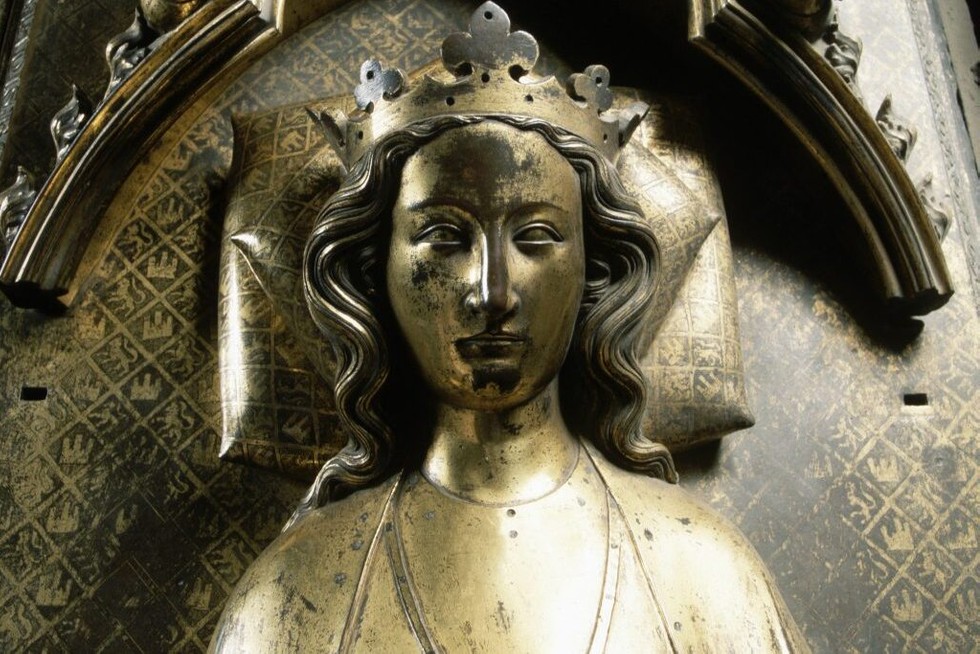
William Wallace didn’t paint his face blue either. Where did the idea that the Picts painted themselves blue originate? Julius Caesar once noted that the Celts got blue pigment from the woad plant and that they used it to decorate their bodies. Pict was a name coined by the Romans to describe the Northern tribes who covered their bodies in blue woad to camouflage and perhaps to intimidate: Picti means painted people in Latin. It is likely that the Picts were descended from the native peoples of Scotland such as the Caledones or Vacomagi who lived in modern-day northern and eastern Scotland about 1,800 years ago. Picts is merely a descriptive term. William Wallace and the Scots wore blue face paint in Braveheart, not because it was historically accurate, but because the filmmakers liked the idea of it. Braveheart certainly did not have sex with the English Queen out in the woods. Did Queen Eleanor have the habit of wondering around in the darkling woods of a night. Certainly she did not. If she wanted a child by Wallace she would have removed her Wimple which women wore to cover their hair lest the sight of it turn men into savage wanton beasts. She died fifteen years before Wallace’s revolt.
Eleanor, Queen of England. Tomb in Westminster Abbey, London
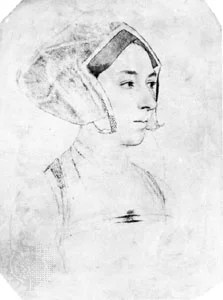
Henry the VIII’s second wife Ann Boleyn was executed, her head severed with the sword of a French executioner because she was an adultness. At least that is what we learned in “The Tudors.” Think about this, Henry the VIII was 6’2″ and weighted 210 pounds when he was in his twenties. The man who played him in the series is 5’9″ and 155 pounds. Quite a difference, yes? The simple truth is, Henry was a Tomcat, adultery was his hobby. Anne’s sister Mary was one of his mistresses, pimped out by her own father Thomas Boleyn the Earl of Wiltshire and the 1st Earl of Ormond. These were nasty ruthless people. What Henry was, was fixated on having a male heir to the throne. The Tudors had overthrown the York family by killing King Richard the third who was the last of the Plantagenet dynasty that had conquered Britain in 1066. Henry felt a little shaky on the throne. English barons were a testy and power hungry lot and they could turn on the king in an instant. With the help of Bishop Cranmer, the head of the church, charges were trumped up and the lovely Anne bared her “Little Neck,” she actually said that to the executioner before the chop. She went to the block, dressed in a white shift, her hair shorn and her feet bare. Henry’s only concession was to allow the sword rather than the axe. Royalty was not to be beheaded by axe or an Englishman, hence the Frenchman. Likely we wouldn’t be at all interested in her story except that her daughter grew up to be the most famous British monarch of all. Elizabeth the first. The virgin Queen, though that too is in serious doubt. The virgin part I mean.
The archives kept in the British museum document Annes trial and her indictment but also contain the personal letters between the principles which show without a doubt that she was completely innocent of anything except, apparently, the capital crime of having a girl baby.
Anne Boleyn by Hans Holbein, from life. The only known likeness from life. She does not look like Jessica Alba nor Natalie Dormer.
Willian Shakespeare did not write his plays. That idea, which has persisted for decades was good enough to make more than one movie. We can start with the fact that his life in London is very well documented. There are the bills of lading for the material that he used to build the Globe theater. There is the building permit for the same. There are copies of the original documents themselves with his name on them The main argument, in the absence of such “proof” of authorship, skeptics have posed the question: How could a man of such humble origins and education come by such wealth of insight, wide-ranging understanding of complex legal and political matters and intimate knowledge of life in the English court? Shakespeare’s supporters emphasize the fact that the body of evidence that does exist points to Shakespeare, and no one else which are written in his own hand. This includes the printed copies of his plays and sonnets with his name on them, theater company records and comments by contemporaries like Ben Jonson, Samuel Boswell and John Webster, men of letters who actually knew him. Doubts about Shakespeare’s authorship and attempts to identify a more educated, worldly and high-born candidate reveal not only misguided snobbery but a striking disregard for one of the most outstanding qualities of the Bard’s extraordinary work—his imagination.
Who can doubt that an intelligent man, even one with limited education, not use historical works as background for whatever his bountiful imagination seeks to follow? Provable historic fact are the foundation of his plays, the same as it would be if he was writing today. Consider Samuel Clemens, one of Americas greatest writers. Fifth grade education in he backwater town of Hannibal, Missouri. Charles Dickens also left school at age twelve and I’ve seen no movement to discredit either.
In the end, the Puritans, yes those Puritans who figure in our American history tore down the Globe theater and banned all productions of any play including Will’s as being devilish and depraved. Puritans condemned the sexualization of the theatre and its associations with depravity and prostitution. Puritan authorities shut down English theaters in the 1640s and 1650s—Shakespeare’s Globe Theatre was demolished and copies of his plays were burned. That is an example of history that is not made up.
The Puritans ruled England and early white America for a time. When you read your high school text book, there is no mention of the fact that they banned Christmas. Sometimes historical facts don’t fit the narrative do they? Inconvenient but provable historical fact. No Christmas for you. Maybe they had a point. Americans spent around 178 billion dollars on Christmas this year, nearly a thousand dollars per person.
The sainted “Boy General” George Armstrong Custer was in real life impotent because he spent a lot of time with prostitutes even after marriage. Gonnorea will do that to you. The Mercury used to treat it did his mental faculties little good. He demonstrated during the Civil War a sort of demented courage which the generals encouraged and rewarded him for with stars and high praise. He proved to be no tactician though and his skill was the same as any attack dog, he just went straight at the foe. After the war his career centered around the occasional Indian massacre, more cheating on his wife embezzling from the Army and in the end these skills or failings, call them what you will got him savagely killed which historians today say was his deserved fate. The whole story of the Greasy Grass fight was told ad infinitum by those same white men who ran the country. It apparently never occured for anyone to ask the winners who, when they were asked had quite different storys. He may have made it to the hill like the painting shows and in fact none of the warriors or warriorettes, yes the woman fought too even knew it was him. He was likely knocked off his horse by Buffalo Calf Road Woman and shot twice. Buffalo Calf Road Woman rode her horse into the Little Bighorn battlefield and struck Custer on the back of the head with a club. Custer, who was already injured with a shot to the chest, was knocked off his horse and died there. A bullet to the left temple did him in.
The gruesome details of the story from the elders say that following that encounter, another warrior woman speared him in the side with a saber in order to be a part of the slaying, and other women warriors took sewing utensils and stuck them in his ears. George Custer was an evil man in the eyes of the indigenous tribes.
Sticking him in the ears would prevent him from hearing them coming in the afterlife. Many warriors mutilated the Wasichu after the battle, but because Custer was labeled as an evil spirit, they left his body intact. White men said it was out of respect, Lakota and Cheyenne begged to differ.
There is some conjecture that the body may not have been him. Two days, stripped naked in the blazing sun meant that very few bodies were ever identified with certainty. History is murky that way.
The Crow scout Half Yellow Face told the colonel before they rode down upon the village,”You and I are going home today by a road we do not know.” He was correct.
When I was still teaching high school I heard from my mainly male students about their love of the Kurt Russell version of the Tombstone legend. They were adamant that the Earp legend was hands down true and accurate. They would accept no argument. What they knew was what the Earp and the screenwriters told them. Because Earps history is relatively recent, unfortunately it is also pretty well documented. Over two dozen films have featured Wyatt Earp, actually that would be Wyatt Barry Stapp Earp, a name that doesn’t easily fit on a theater marquee. Writers play fast and loose with “facts” all the time. What documented history knows and can prove is this; He was by turns a lawman, stage robber, horse thief, gambler, pimp, brothel keeper with his brothers, two of his wives were prostitutes and is definitively known to have killed two men, one a town marshal. At the shootout, eye witnesses state that he wore a Mackinaw coat not a long black overcoat ala Kurt Russell. He also didn’t carry a pistol in a gun-belt but in his pocket as was his custom. Perhaps the testimony of men who knew him in Tombstone sheds a light on his personal history. Roy Drachman would later write: “I don’t remember when Wyatt Earp began to be looked upon as some kind of hero. That was not his image around Arizona then, where many people knew and remembered him well. I never heard anything from those folks about any of the good or great deeds that he is supposed to have done. I think he just made them up for his biography which is nearly all lies anyway. He was a simply a survivor at a time when some of his close friends and relatives weren’t so lucky in avoiding a violent death.” Lastly, John Ringo had no education at all and did not speak Latin. Holliday didn’t either.
Likely not many men have noticed that few women are featured in the teacher’s history book. That’s something you might wonder about.
Consider, before you comment on my friends historic credentials, most people have only a single high school credit in US History, taught from a text compiled by a college professor and likely written by teaching assistants, cobbled together from many pieces and passed of as definitive “Truth.” 50% of U.S. adults are unable to read above an eighth grade level book with complete comprehension. 33% of U.S. high school graduates never read a book after high school. 80% of U.S. families have not purchased a book this year. (2025) The current chief executive does not. According to his family ever been a reader a fact which he demonstrates daily. Knowing this, it seems to me that folks should be very careful about who, what and why the so called facts they offer up in any criticism of “Real” historians.
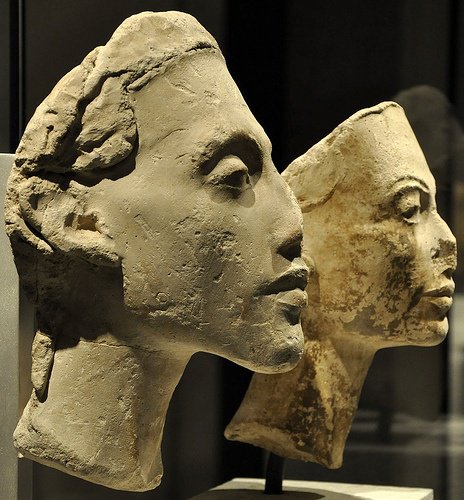
Perhaps the best example there is, is that until recently everything you know about ancient Egypt came from Victorian Era amateur archeologists. All of them educated white men who had no background in the very long arc of Egyptian history. Not one asked an Egyptian. Until recently nearly all you knew about King Tut, Akhenaten and his wife Nefertiti, and the other Pharaohs was written by these English gentlemen. What you know of the city stae of Troy was written by a German.Notwithstanding the beauty and the glory of that which was found in their tombs the real treasure were things like your grandmothers post card. Found in digs all over Egypt are payroll records for the pyramid builders, personal letters, diaries and business accounts. Those mundane objects are the real historical record.
Akhenaten and Nefertiti. Around 1335 BCE
Our friend the local historian knows where knowledge lies. He has written, studied and taught nearly his entire lifetime. He deserves credit for what he says. Do not take him lightly.
The phrase, “I only want to hear what I already know” was never uttered by any Historian.
History is a growing thing, it changes constantly as new things are discovered. As my sainted father was wont to say, “Don’t believe most of what you read and only half of what you see.” Look for it yourself, it’s the only way to know. History is thick, dense and very tasty. It explains a lot for those that seek it.
This particular historian, with his inquisitiveness and his joy in pure thought shine through, and they have captivated me. In a time when parts of our society, particularly political leaders are trying to freeze false historical narrative in amber, glorifying a time that never was, it’s more important than ever to get down on your knees and dig in the pig pen for that lost diamond.
Michael Shannon is a World Citizen, Surfer, Sailor, Teacher, Builder and Story Teller. He lives in Arroyo Grande, California, USA. He writes for his children.
In 1918 my grandparents, Jack and Annie Shannon came home. Home for both of them was southern San Luis County. This family event is the linchpin of our story.
When I was a boy we lived in the kitchen. Our little house, built at the turn of the century was the heart of the home. As were most homes built at the time it featured none of the devices we take for granted today. No insulation, no central heat, and no weatherstripping. Small houses were the norm before the war and ours, originally just three rooms had slowly been added to over time. To get to the back bedroom you had to pass through each of the other rooms. Porch, kitchen, living room, my parents bedroom, bathroom and finally, my room, a sunny room with large windows in which I imagined my future life as boys will do.
What my brothers and I learned at the kitchen table has shaped our lives. The Japanese philosopher Masonabu Fukuoka has said,”The simple hearth of the small farm is the true center of our universe.” This quote describes the experience of family all over the world, something we all have in common. I don’t know of any kids that I grew up with don’t share this experience and to this day I can see them as they were.
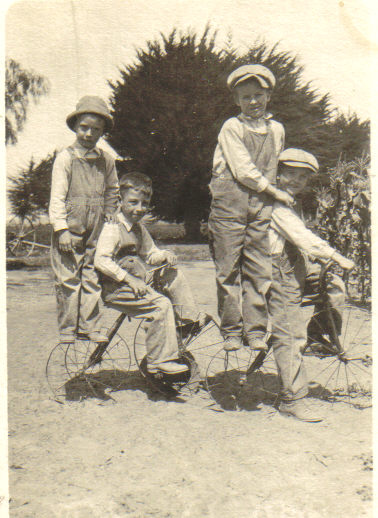
The photo above, taken in 1920 at my great-grandparents house on west Main St in Santa Maria shows my father and my uncle Jack with two friends. My father, George steers the trike on the right and my uncle Jack, his older brother by two years stands behind him. My grandparents lived with Annie’s parents for a time until they could move onto Annie’s ranch just south of Arroyo Grande.
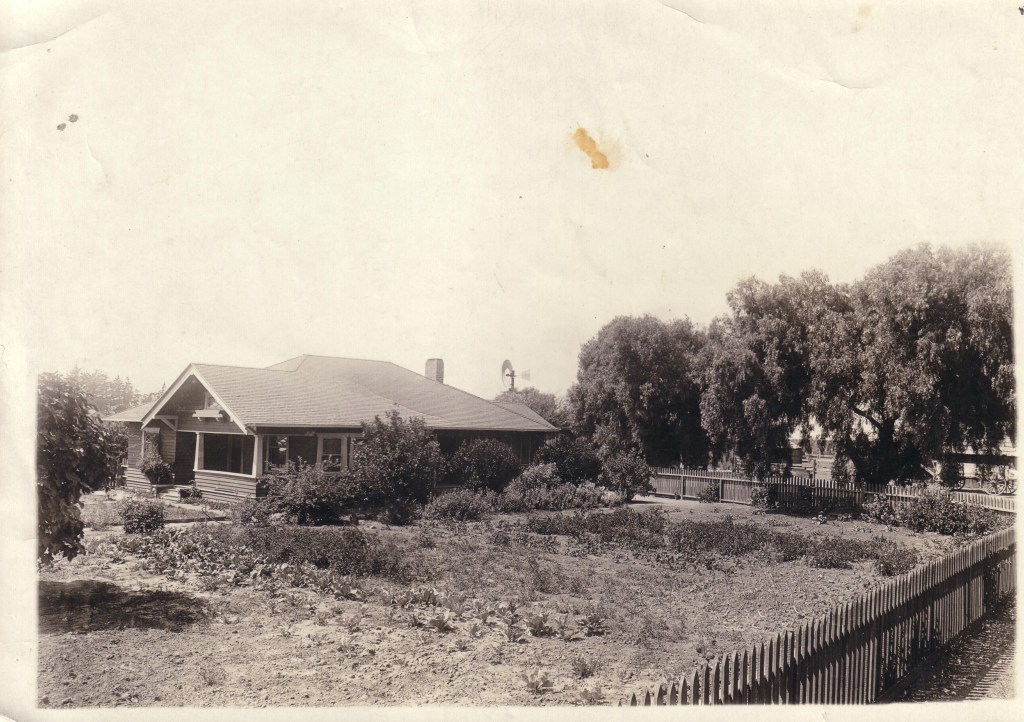
The Samuel Gray home on Guadalupe Road in Santa Maria. Built by oil wells and many sheep. photo 1938.
We didn’t have a televison until I was eight. The most exciting thing was watching the test pattern because we somehow knew that hidden behind it were many earthly delights. We were partly right about that. There was only one available channel anyway and my parents didn’t see any need for one, the TV was for us mostly. They had the radio. They had been radio people all of their lives and it was the familiar thing. It had all the basic elements of TV anyway as television was really nothing more than radio with pictures. They read. We had Life, Look and the Readers Digest magazines scattered about. Part of my education were those old Reader’s Digests with their puzzles, riddles and a vast variety of stories. I found Bennett Cerf there and many of the great writets of the day. My grandmother belonged to the book of the month club as did many of my mothers friends so there was always a book around. We still have old Book of the Month editions with the names of friends on the flyleaf. Gladys Loomis’s heirs are probably still looking for them.
Most of my abiity to read comes from comic books. For a time we had a neighbor who rented Joaquin Machado’s house which was back by the creek near the old Evans place. The renter was a comic book distributor and each month one of his jobs was to collect all the back issues of comics not sold. Once a month my dad would come into the kitchen with a big bundle of comic books tied up with cotton string. It was a tiny Christmas. We devoured them and couldn’t wait for the next 30 days to pass. It seemed a tragedy when the man moved away.
Farm and ranch life in the forties and fifties was pretty isolated. Farm kids, for the most part spent their time either in small one or two room schoolhouses learning from books, in some case decades old taught by teachers who balanced the needs of up to four grades at one time. Kids were not separated by grade as they are today. All eight grades studied and played together. If you imagine schools today there are self-contained boxes for each grade level. We had all the kids in one box. Teachers ran curriculum and the parents were the school board members, janitors and school bus drivers. It was a family affair. A six year old had to handle a ground ball from a thirteen year old. It made little kids deal with older ages and those older ages learn to accept the little guys. Not a bad system.
4-H was the only club activity which was OK as nearly every kid’s father was a farmer or worked for a farmer and it was assumed by kids that they would do what dad did. It was not an unusual thing to see see Mrs Fernamburg working in their walnut orchard or Elsie Cecchetti out feeding her calves. I can still see Helen Kawaguchi sitting up on the seat of the old red Farmall wheel tractor slowly trekking back and forth across their fields. She always wore a big straw hat favored by the Japanese ladies when they were in the fields.
Fields were a descriptive word much like a compass and used to indicate direction. There was “Down the fields” and “Up the field.” Mom might say daddy is down the field which told you he was far away from the house. He would tell you that the irrigation pipe to be moved was up the field meaning it was away from the house too. Everyone understood this. Other directions told you he was with the celery crew or the broccoli cutters. Markers were all around. There were the Walnut trees, Lester Sullivans barn or “Old Man Parrish’s” orchard. I crossed Branch Mill Road at the old Branch bear pit behind Ramon Branches adobe house when I went to visit Kenny Talley, my closest friend. The four corners was where we caught the school bus, which wasn’t a real bus but served the purpose of getting kids to school. It had retired “Shanks Mare” in 1949. Kids didn’t have to walk anymore. The school bell which had once rung to tell moms it was time to send the kids still rang but really just for tradition I suppose.
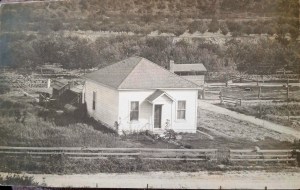
The old Kawaguchi home. in the 1890’s
Schools were the center of social life. They were the meeting halls, the place where Halloween was celebrated, Christmas plays performed and potlucks held for no particular reason other than to get together. Mom’s made the costumes, painted the decorations and formed the audience cheering us on as we walked in our circle in Mrs. Edith Browns lower grade classroom. We might get a prize, or should I saw mom might get a prize. My own mother was a master at costumes. I was a robot, my brother Jerry and I were a horse once. as the older brother I started of as the head but was reduced in rank when I passed a smidge of gas during a rehearsal in our living room. It was worth it though, winning a round in war between brothers always was. Still is.
The world was small. A schoolroom, the little town of Arroyo Grande, which, for kids meant The Western Auto and The Variety Store, thats were the toys were. Bennett’s Grocery where Muriel and Rusty were free with the candy jar, the clothing stores where my mother worked. Louise Ralphs where all the ladies wore perfume, still the best and most fragrant place I can remember, Zeyen’s clothing store where the Levis were stacked to the ceiling and permeated the building with their peculiar new clothes odor. Mom worked there and served two generations of kids.
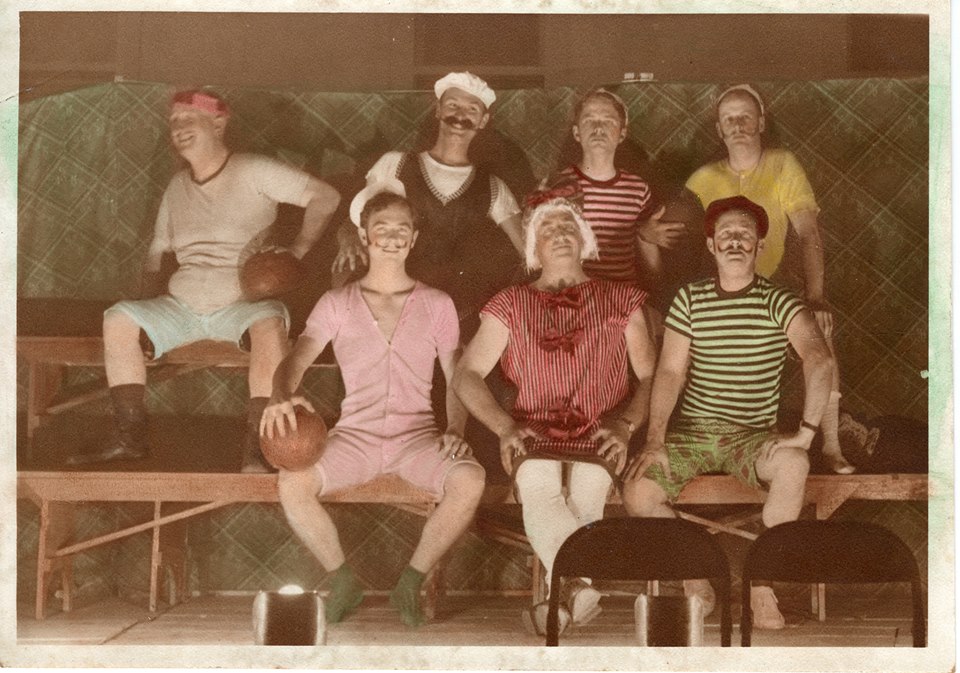
During the Gay Nineties festival celebration my grandfather sang in a barbershop quartet with Gordon Bennet, and Bill O’Conner from the stage of the old Mission theater. The Rotarians entertained with jokes and skits. Thats them below in all their sartorial finery doing the Lord knows what.
Vaudeville Blackouts in the Mission Theater. Harvest Festival/Gay Nineties, 1950’s. Family photo
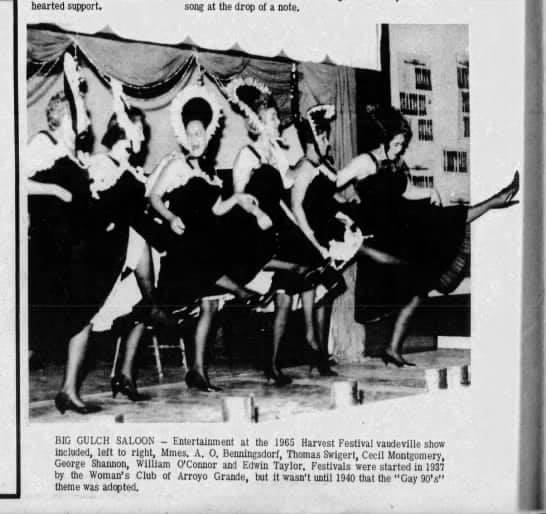
The moms entertained too. Being shy was not too bad when you knew everyone in the audience.
1965, Women were still know by their husbands name.
The world was small and lined with soft things that didn’t sting or hurt too much. A kiss, some spit or a daub of mud cured most things. Kids felt safe there. It would be gone soon enough, mores the pity.
The kitchens in our homes weave through the narrative of our lives and form the foundation of the stories of our lives.
Michael Shannon writes and would still prefer to live in the kitchen if he could.






 atthetable2015