Monthly Archives: September 2025

My Fathers Big Fish
by Michael Shannon.
The River of the Kings was my father’s place of choice. Fast running, deep, frigid and isolated and in a most remote part of the formidable Sierra Nevada. The Snowy Mountains* are part of the American Cordillera, an almost continuous chain of mountain ranges that forms the western “backbone” of the Americas. He and his brother began going there in the late 1920’s. Still in high school, my uncle just 18 and my dad 16, both from a little town in coastal California over 200 miles from the Kings River canyon.
Río de los Santos Reyes headwaters originate along the Sierra Crest in and around Kings Canyon National Park and form Kings Canyon, one of the deepest river gorges in North America. The river was named by Gabriel Moraga, the commander of a Spanish military expedition in 1806, but it was not until California became a U.S. state in 1850 that many Europeans arrived and settled along the Kings River, driving out the original inhabitants the Yokuts. The Middle Fork flows for only 37 miles through some of the Sierras most difficult-to-access backcountry, including Simpson Meadow and Tehipite Valley.
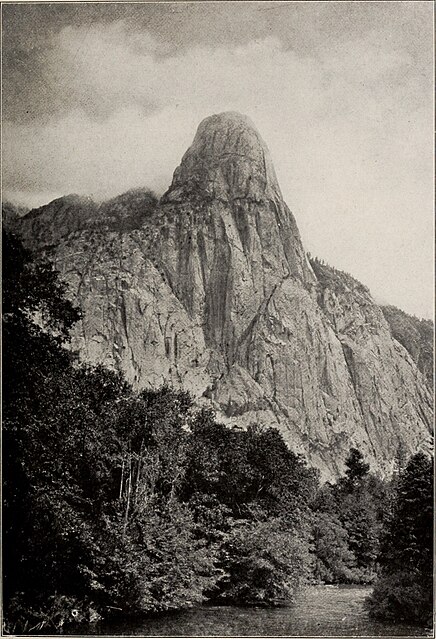
Tehipite Dome
Two hundred miles of mostly dirt roads which they had to navigate into the mountains in my grandfathers old 1918 Model T Ford. Arroyo Grande to Paso de Robles, east on hwy. 41 through the central valley to Lemoore, Hanford and Visalia turning at Woodlake and starting the climb through the foothills and up to Badger and Pinehurst to the road junction east of Dunlap then following the winding one lane dirt track up to Grants Grove, past Hume Station and then down to the turnout at Yucca Point.
The road was so narrow that on sharp turns there would be a hand painted wooden sign tacked to a tree cautioning the driver to “Sound Klaxon” on all the blind corners. If you heard another horn, the downhill driver had to back uphill until there was enough room to pass. Dad said the driver going uphill would have a great view straight downhill to the canyons below.
The Ford had been outfitted with everything a wilderness fisherman might need. Two sleeping bags, a couple canteens though in those days you could still drink from the river, no Giardia. Couple loaves of homemade bread baked by grandmother, jam and a jar of peanut butter, small can of lard for frying fish, salt and pepper, skillet and a knife to serve all the purposes a knife might. Only one problem. In a hurry to get away the sleeping bags were forgotten on the back porch. Neither of them noticed until they got to Grant Grove where they had to dig into the back to get a water bag to hang on the radiator.
This created a little bitty problem for the nights in September in the high sierra can be a wee bit cold or very hot, you never know. You want to count on both. The went in a talked to the man in the little store there but they didn’t sell sleeping bags or blankets. He did suggest they might talk to the owner of the pack station just up the road he might be able to help. Sure as shootin’ he could and did. See, he had a stack of horse blankets which he was willing to part with for say, five bucks each, used of course. Knowing the were in desperate straits the two boys agreed. They riffle through the pile trying to find the least objectionable. They all reeked of horse sweat, some were raggedy and many sported holes where they sat up on the horses’s withers. Picking out two they forked over a double sawbuck and carried the loot back to the care uttering what passed for polite boy’s curses the whole way. The old cowpoke reckoned it was a mighty good day.
The two boys wore long sleeved shirts because of the mosquitos and yellow jackets, one pair of trousers and believe it or not high top canvas sneakers with rubber soles. No hiking boots, too much to carry, but they did have a coil of rope in case they needed to cross in high water coming down from the south fork. In some years the water was still dangerously swift and deep even on Labor Day. The river bed was entirely rocks and scattered boulders. Fording the river was always and adventure. The current was swift and everything slippery and in the twenties there was nothing or no one to help you if you were hurt. The trail back up to yucca point was very steep and unimproved and the only way out was walking. It would have been a walk out for the uninjured and then seek help and the return trip with someone else and again the return by stretcher up a treacherous steep trail crossed by tree roots, half embedded stone, mud and all in the early September heat and don’t forget the deer fly trying to drink from your sweat and tears. You could soak your handkerchief in water from your canteen and tie it over your face above the eyes, it was the only way to keep them out. The view through the wet bandana was minimal so you’d better step carefully. The first rule was to be very careful.
At the bottom of the trail they tried fording the river but it was too swift and deep though it was barely more than knee deep. They figured if they could get the rope across the be able to ford. My dad was an excellent swimmer and body surfer. He’d spent a great deal of his youth swimming in the ocean and had the confidence to give it a try. He said he couldn’t really swim at the ford but determined that he could get across at the deep hole just upstream. The best thing was to swim the center where the current was a little slower so he stripped off all his clothes, tied the rope around his waist and waded in.
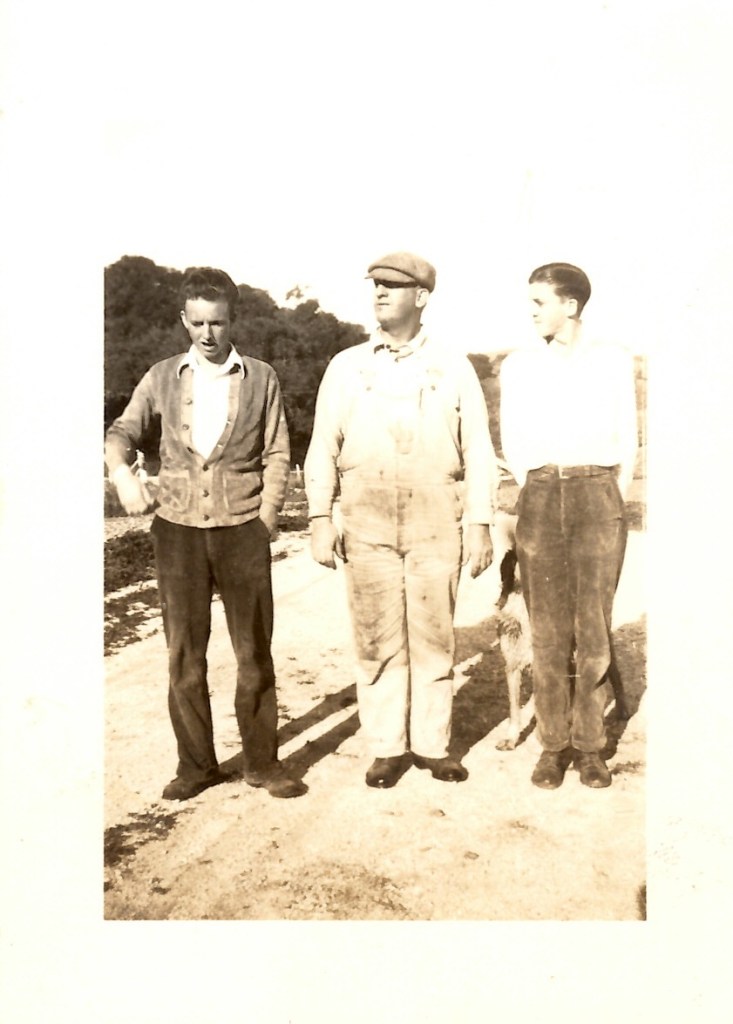
Left to Right, Jackie, Jack Shannon and George in 1928, Family Photo.
The water was cold, cold, cold, so cold that he could hardly breath. He was really glad to crawl out at the other side. The sand bar he came out on had three sycamore trees just a little set back form the shore so he walked to the trees and tied the rope around the closest one. His brother tied off the other on the opposite shore. Now they could use the rope to steady themselves as they crossed and recrossed to move their packs across.
After spending the night on the sand bar where the middle and south fork came together they cooked up a little breakfast then hit the trail. That is if you could call it a trail. Even today it is marked as unmaintained by the forest service and in those days it was nothing more than a narrow single wide path scratched out by miners during the gold rush.
The middle fork drops hundreds of feet per mile bounding and crashing around boulders where it forms eddys and small falls around the great deep pools. To get upstream the original trail blazers had cut a very steep trail up the side of the mountain ridges that formed the canyon. They had to climb this switchback trail for several hundred feet to get to a spot where the trail leveled out. It was just impossible to go upstream along the river below because the canyon walls ended where the river ran. The only way was to climb up to a little bench in the mountainside where they had cut the original trail. Unmaintained no wider than a couple feet you could look down a near vertical slope to the river below and straight up at your shoulder. Boulders clung to the slopes by some mysterious force for there wasn’t any visible means that kept them from flinging themselves headlong into the water below.
About two miles along they found a rusted, crumbling piece of one inch twisted steel cable. Puzzled by the find they at first couldn’t figure out why it should be in a place where it made no sense. Who dragged it up there and why? You couldn’t get much farther from anywhere than this place. Standing together they looked around but they couldn’t find any reason for it until they noticed, way across the river on the opposite cliff side the mouth of a small tunnel that could only be a mine entrance. They could see some rotted old timbers in the entrance and a few rusted tinned cans scattered about. The cable had to be the remnants of a pulley system that head been built to ferry supplies to the men who worked the mine and to haul whatever ore they found back across. How in the world did those old forty-niners get up there while prospecting and once they found some color how did they ever get the cable across? With only a small bench of mine tailings at the mouth of the tunnel they must have actually lived in the mine itself. Just visible down slope of the mine they could see a small rectangular iron bucket with a pulley still attached which explained how they got across.
Dad said they tried to imagine how a couple prospectors in the 1850’s hauled all the gear up there. Did they come by horseback and a packtrain? Did they walk in with a donkey? There is no forage nearby, little vegetation other than stunted trees clinging to the mountainside and where would the animals go when they were working the mine?
Those old prospectors explored every inch of the Sierra, getting into places where you would think no one could. There are abandoned mines all over the mountains. No one knows who found them or worked them and the only clue is a dark tunnel and scattered and broken old shovels, picks and empty cans of tomatoes.*
Finally at the end of a hot and dusty hike the train crossed a monumental rock slide where there was no walking but a semi-stumbling, one hand for yourself crossing to a sandbar along the river. The trail had caught up with the Kings where Lost Canyon creek came tumbling down from the nearly twelve thousand foot height of the Sentinel.
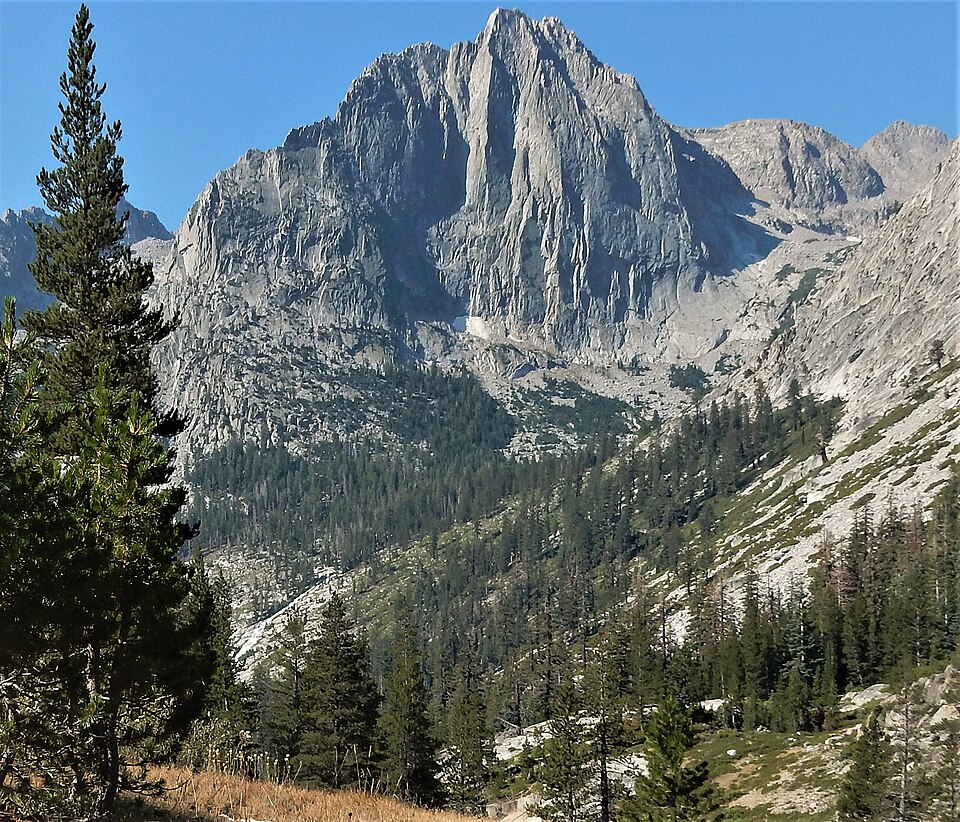
La Cuidadela, the Sentinel peak.
They told fish tails about the trips, how the fishing was fantastic. There were no planted trout up on the Kings, and there are none today. A man had to be full of tricks to land one of the veteran, wily Rainbow and Brown trout. Always fish going upstream, never let your shadow fall on the water, when the sun is high enough retire to the shade and take a nap because the fish cannot see whats on the surface and won’t rise. Don’t fish when it’s windy which it normally is in the afternoon. Find a deep hole which is partially shaded and bordered by an eddy which delivers insects right to the fish and delicately lay a dry fly on its edge. Make your pole dance the fly in an irregular pattern just as if it was real and you might be rewarded.
Dad even had a favorite place. High on a rock where the river was scrunched between a nest of huge boulders that had tumbled down the canyon walls you cold climb on top of the largest and flip your Grey Hackle right under and overhang formed by a split boulder where, he always believed, the King of Brown trout lived. Deep down in the dark cavern of still water he would only rise to feed under the most perfect of conditions.
Since their first trip in 1929, they returned again and again over the decades. They began to take me along when I was thirteen. What we carried was about the same, peanut butter, Webers bread, some butter and a small bag of flour and the cheapest frying pan possible because it didn’t weigh much. My uncle Jackie always took his old sleeping bag. I’m sure it was the first one he ever owned.*** No one in the family though that fancy gear like waders and basket creels were necessary. They considered that kind of stuff an affectation. The were there to fish and they knew the fish didn’t care. A bed of willow leaves in a flour sack worked well enough for the fish who would be dinner and your Levis had pockets anyway.
Lying on top of your bag at night, it was too hot to get inside, my dad and uncle talked quietly about nothing important and I listened. We watched the heavens for our American satellite Explorer I as it passed overhead. When finally it moved quickly across the sky and didn’t twinkle you could wonder at it all. In a time where space was all new to us, I felt safe in the knowledge that our country was the best place. I was thirteen then and all seemed possible. A boy and his father sleeping in the remote wilderness of the King’s River. No sound but the melodious chortling of the river and the owl.
*The Sierra Nevada.
**Tomato processing began in 1847, when Harrison Woodhull Crosby, the chief gardener at Lafayette College developed a crude method of canning tomatoes. Prior to 1890 all tomato canning was done by hand. It was said that you could follow the empty cans from Kansas to California.
***We still have it.
Michael Shannon writes of his family so his children will know from whom they came.
THE NECESSARY
My Goodness, What to Do?
By Michael Shannon
My grandmother was born in 1885. Things were different then. The little Red house she was born in down in the Oso Flaco is long gone now like most old houses built in the days before electricity and indoor plumbing. She didn’t live there too long for her father was a fortunate man and found oil on his little ranch in Graciosa, todays Orcutt. he became an instant rich man and soon built himself a large modern home on west Guadalupe road. Though rich, he was still a farmer and he worked his land which stretched all the way back to the Santa Maria River. For an landless Irishman, which most were, the land held more importance than the oil.
When my grandma Annie was eight years old she came to Arroyo Grande to live with her aunt and uncle, Sarah and Patrick Moore. Patrick Moore had come to Guadalupe from Ireland and prospered in the sheep business. Though he had little education he was a cunning man and made himself a fortune with which he built a big house on the edge of little Arroyo Grande. He bought a big book of the collected works of William Shakespeare which he kept in the foyer of his house where all could see it as they entered. That was all the education he needed.
So, my grandmother grew in a life of privilege. Servants, beautiful clothes and the best of Arroyo Grande pioneer society. Her girlhood friends were, Phoenix, Harloe, Rice, Lierly, Porters, and the descendants of Don Francisco Branch. Families that sent their children to private schools in San Francisco and San Luis Obispo.
She was a child of the late Victorian Age and all it represented. A hundred years after the first American civil war or The Revolution as it’s now styled, fashionable society still looked to the European continent for guidance in societal affairs. We will dress this way, walk this way, speak this way and adopt the mores and shibboleths that decree customs, principles, or a belief that distinguish a particular class or group of people. The majority, under the influence of vague nineteenth-century shibboleths, understood that by associating oneself with these doctrines implied sophistication to the nth degree.
I never knew my grandmother as a girl though she certainly was one. She was 60 years old when I was born. She wore sensible low heeled shoes, cats eye glasses, plain print house dresses covered by an apron with the ubiquitous hankies in the pocket. If she wore any jewelry other than her slim wedding ring I don’t recall. She wasn’t overly solicitous of my attention but she was a calm presence rocking in her chair darning socks or knitting. It was the chair my grandfather bought her when she was first pregnant with my uncle Jackie in 1908, the year she graduated from California Berkeley. She would offer her hand with its delicate skin which had hardly ever seen the sun because in the forties women still wore gloves everywhere. A little cheek was offered for a boy’s kiss which was as soft as a down feather. She always smelled of White shoulders, powder not perfume for perfume was considered vulgar and only worn by “Soiled Doves or low class strumpets.
She played the piano in church, always wore a hat to go to town no matter how mundane or routine the purpose was and was unfailingly polite, no gossip that I ever heard. If there was it was confined to her bridge club, women who had sat at those old folding tables together for nearly fifty years and likely chewed, although the word chewed which she viewed as vulgar would never have passed any of their lips, they chewed on the same old conversations until they were polished to a soft sheen. Safe, familiar and soothing.
She was raised in a quite remarkable era which is almost unbelievable today. Things we take for granted were forbidden or lived under a series of shadow words that said one thing but implied another. Society had developed euphemisms to mask words and phrase which the well-educated and socially prominent practiced.
women were as energetic as they are today but har far fewer things to occupy their minds. A contemporary woman would hardly recognize my grandmothers life in 1900. She couldn’t own property under her own name, she couldn’t vote, there were few places she could go unaccompanied. She couldn’t initiate divorce nor was she protected from domestic abuse. She couldn’t wear trousers, smoke a cigarette, she couldn’t handle money even if she had some, that was her husbands job.
She a had an Irish servant girl, her name was Clara. Clara washed ironed, served dinner and kept house for the Moore’s. She is in one photo kept in the families collection. She was apparently a scandalous girl who’s secret my grandmother kept to herself for nearly her entire life. She let it slip in her mid-nineties when her memory of the present faded and the memories of the past sharpened.
When a girl reached puberty she was likely to be 16 or 17. Poor nutrition, increased physical stress from industrial work, and other poor living conditions during the Victorian era contributed to this delayed onset. Social standing at the turn of the century figured in the timing. Children went straight to adulthood as there was no concept of adolescent until roughly 1905 when the concept was published in a book. The word teenage was completely unknown. My grandmother graduated high school in 1904 and would have been constrained to act and dress as an adult. You can see in old photographs children dressed exactly like their parents.
As a young single woman which she was until graduation from college she wore her hair up. Nearly every woman did. She put her hair up as a young teen and it stayed up until she bobbed it in 1920. Wearing the hair down as an adult woman was a scandalous thing and indicated that you were of a lower class or a, horrors to even think about it, “Lady of the night.” A fallen woman in fact and if my grandmother and her friends saw you on the street in San Luis Obispo which by the way had a rich and teeming Red-Light district, they would turn away and point there noses skyward at the scandal of it. Hmph.
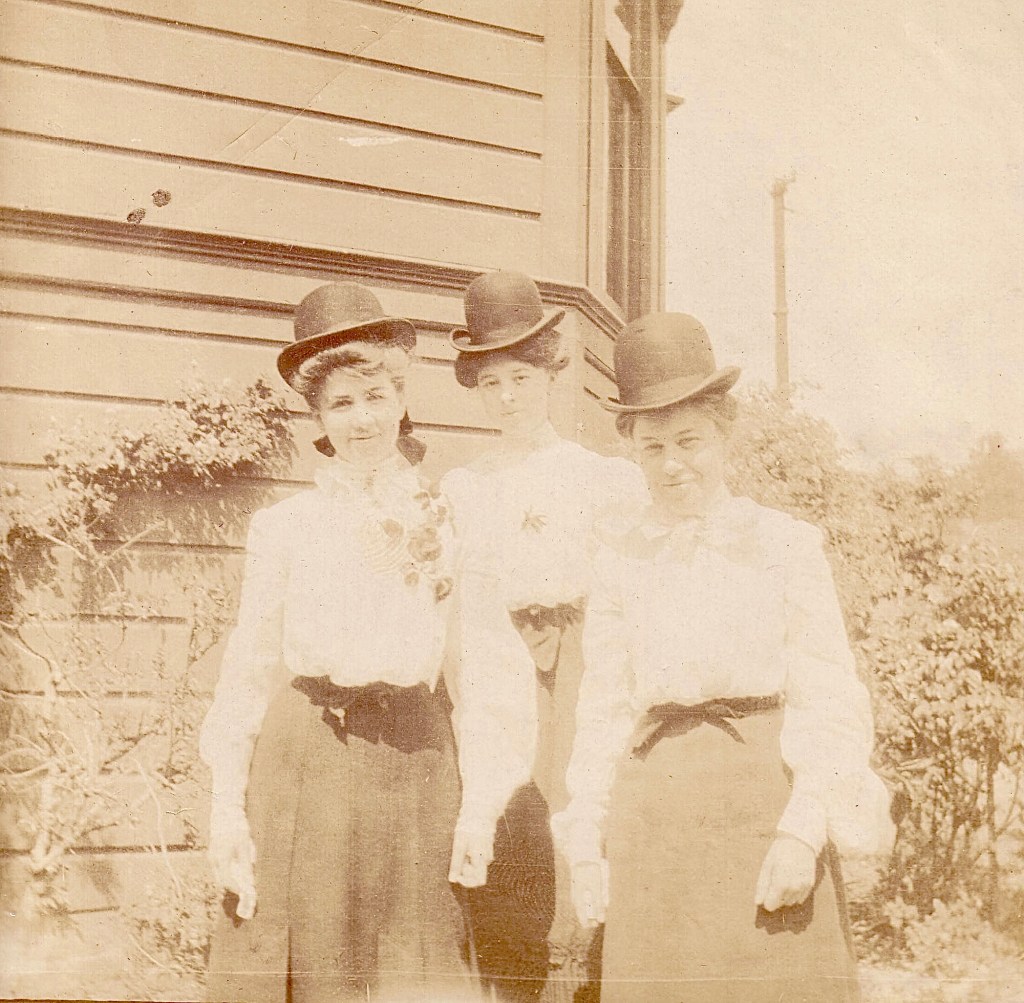
The girl in the rear, Margaret “Maggie” Phoenix. Our Margaret Harloe for which the school is named. Note the ubiquitous hankies.
This developmental stage was deeply shaped by Victorian social and moral codes, which emphasized female purity and restricted young people’s autonomy. Victorian culture strongly discouraged public discussion of sexuality and puberty. This lack of frankness contributed to a cultural “prudery” surrounding these topics. Some late-Victorian medical and social commentators viewed puberty with apprehension, seeing it as a time when girls were susceptible to disease or irrationality, swooning and the “vapors” more than likely brought on by too-tight corsets. There was a push for female health and physical activity for some, but this was often met with resistance from those who preferred to preserve traditional ideals of fragile femininity. Social mores were set by the extreme upper classes in order to distance themselves from the lower or even worse, the depraved gutter Irish.
Grandma of course was just like the girls of today. They aped the manners and dress of their elders but they still found occasion for hi-jinks. Dressing up as their fathers was apparently a regular pastime. We have many photos of she and her friends posing for pictures taken with her new Kodak Brownie camera in front of her home. No lawn though as a front lawn wasn’t even a concept in 1903.
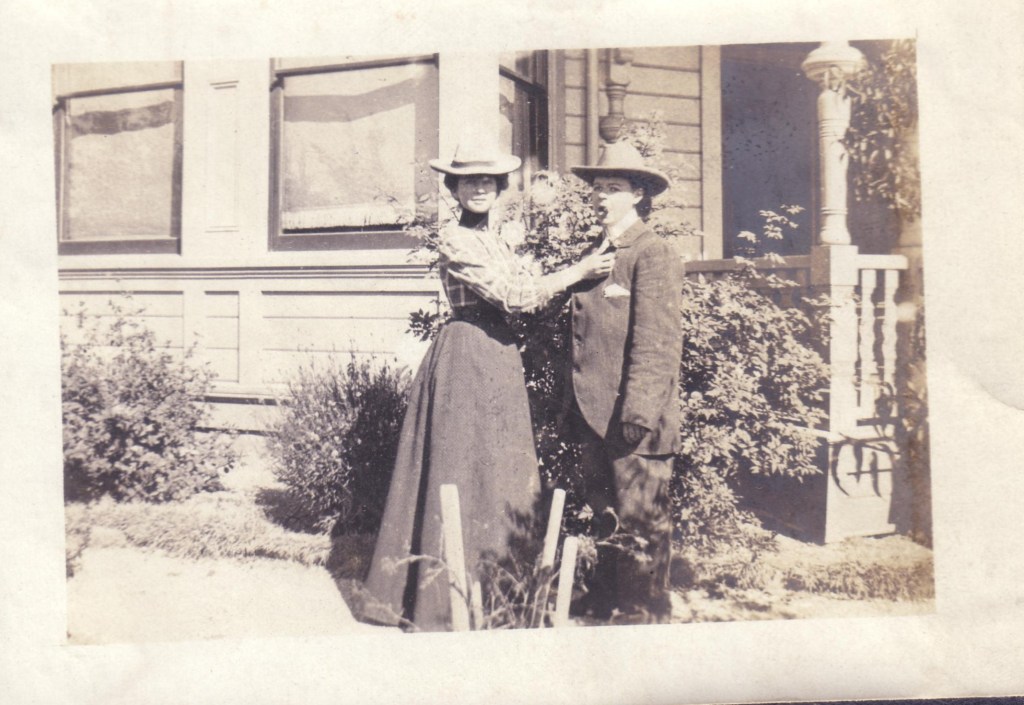
Annie Gray and Tootsie Lierley in 1903. Patrick Moore residence Arroyo Grande
You might notice that they both are both hatted. No self-respecting woman would ever be caught outside without a hat. Notice too that the skirts hem is touching the ground. It was thought that the sight of a shoe or God forbid, an ankle would drive men crazy. One of her classmates at Cal in 1907 was expelled for wearing her skirts short enough to expose he ankles. A length of fabric called a flounce was whip stitched to the hem of dresses with a small loop that could be grasped and delicately lifted just a little if she stepped over a curb or ascended the stairs. I could be removed for cleaning as often as needed since hems touched the ground and could get very dirty in a town which had no paved streets.
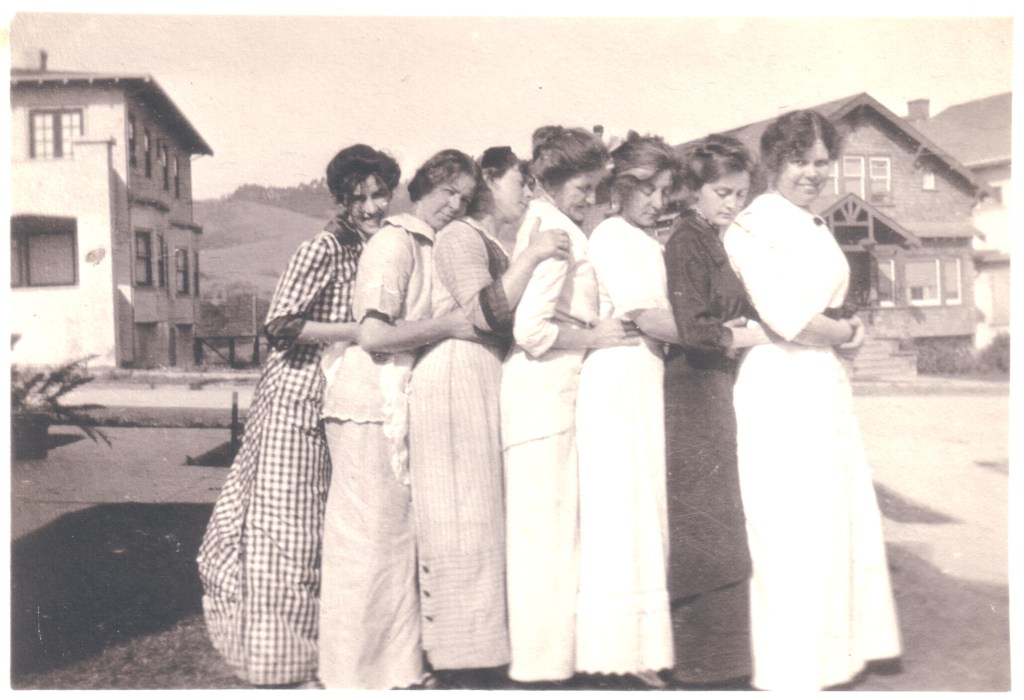
My grandmother is the girl in the checked dress on the left. 1907. University of California Berkeley campus.
When a woman was menstruating she was “Indisposed.” Women were such a fragile things that too much stimulation of any kind could cause her to swoon. Those darn corsets again. If a man referred to a woman’s leg as anything but a limb he might be cast out of polite society. A woman could not be touched in any fashion other than to take her arm if the road was too rough for walking. Sitting on a buggy seat, the heat from a woman’s limb was known to cause temporary blindness in men.
When she was in her nineties she still wouldn’t cross her ankles since that was considered suggestive. My grandfather didn’t cross his legs either, at least in the presence of women. You had to be careful because you were surrounded by vulgarity, it’s nasty fingers aching to clutch the unwary sophisticate.
Grandma frowned on anyone mentioning the number six, I think for obvious reasons. Animal horns were considered obscene, vulgar to the point of being devilish. Once I found a beautiful copper chaffing dish she had received as a wedding gift in 1908. That dish spent it’s entire life in the barn because the handle was a section of Elk horn which she wouldn’t touch. No goats either. My dad and uncle Jackie had to give their pet goat away, it had those devilish cloven hooves. The milk cows and bulls were also polled or dehorned, either for utility or because she wanted it that way.
She wore a silk chemise and pantaloons for underwear called, always, unmentionables. They were never seen by men. The pantaloons were basically a set of short leggings with no, dare I say, crotch. Probably shouldn’t. They wore so many layers of clothes that they simply could not undress quickly. A woman doing her business would have looked the same as a woman sitting in a chair. You see, this was because there were a couple things about feminine hygiene which were quite unknown at the time. Most homes had no toilet and many no running water. Finding and using the “Necessary” cold be very difficult when out and about. This was a woman’s dilemma. No business had a public toilet, Toilet comes from the French Toilette by the way. Toilet is French in origin and is derived from the word ‘toilette’, which translates as “dressing room”, rather than today’s meaning. This was another dodge around a seemingly vulgar term such as “The Jakes”, the outhouse, the Crapper* or the chamber pot. If I may, there was no toilet paper in a necessary unless the owner was well off . Paper for the toilet was invented by the Chinese in the fourth century BC. It took until 1857 until it first appeared in America and was sold in individual packs of five hundred and, of course quite expensive. Think of this, splinter free toilet paper first appeared in the 1930’s, multiply paper in 1942 and thanks to modern inventiveness, scented in 1964. Speaking of this would have been absolutely taboo in front of my grandmother. No lady could possibly utter the word toilet. She went to the bathroom where she did things that were secret from the world of men.
Remember that ancient Rome, Greece and Persia over three thousand or more years ago had running water, sewers and public baths and “Necessaries.” Arroyo Grande at the turn of the twentieth century did not, certainly did not.
This somewhat limited the distance a woman could go from her home. Timing was of the essence. She certainly could not just drop in to the Capitol Saloon on Branch street. She and her friends would have been forever shunned.
Saloons were places where Demon Rum lived. The men inside were considered vulgar beyond description. A woman who approached too closely would likely be subject to catcalls** and other unwanted comments.
I cannot imagine what she would think of our house when we had two rambunctious boys and one bathroom. On school days the door never closed and no one though anything about it. You all know what I mean. All that would have been incomprehensible to grandma.
As to engage in man woman stuff or Amorous Congress there was simply no word in her vocabulary that sufficed and it was never mentioned in any context, not even animals. She was a dairymen’s wife so she had to make her peace with sort of thing. She was seriously uncomfortable with both words and I’ve heard the act itself was only practiced twice, resulting in two children. Or so my father said, tongue in cheek, I hope.
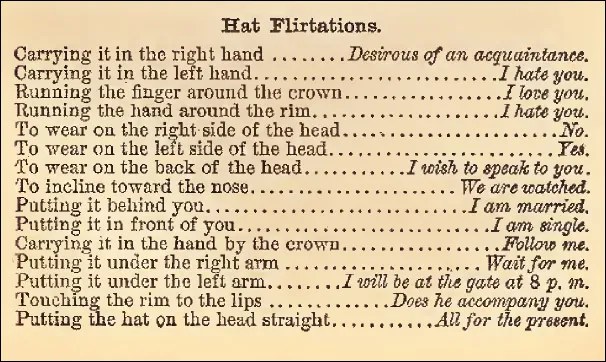
Girls and boys didn’t have to wonder what the rules of courtship were, you could buy a printed card.
So my grandmother, her name was Annie Shannon was a steady presence in my life growing up. She never raised her voice, she always dressed the same, she never ever went out without hat and gloves even if she was going to buy groceries. She taught her grandchildren not to masticate with their mouths open, keep our elbows off the table, not to speak unless spoken too and keep our opinions to ourselves. I’ve done poorly with the latter but I hope she will forgive me.
I loved her for who she was and I miss her.

Jack and Annie Shannon as I remember them. Arroyo Grande about 1950.
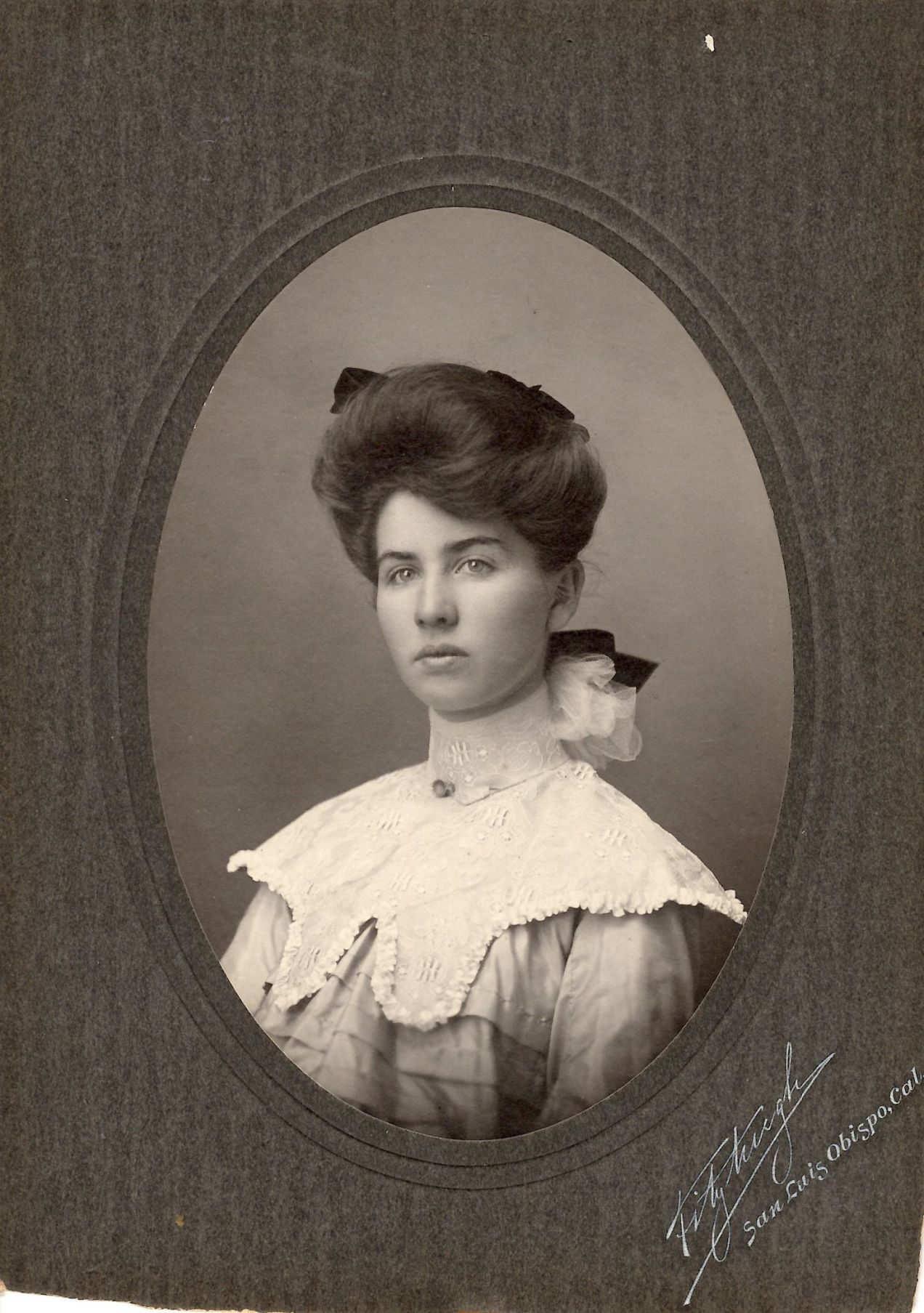
Cover Photo: Annie Gray formal portrait high school graduation 1904. Stoneheart Studios Santa Maria California.
*Thomas Crapper was an English plumber and businessman. He founded Thomas Crapper & Co in London, a plumbing equipment company. In 1861, Crapper patented his first invention – an improved ballcock mechanism. The device was used to regulate the flow of water in cisterns and is still used today in toilets across the world. I cannot not imagine my grandmothers reaction to the word ballcock, it may have killed heron the spot. Crapper’s notability with regard to toilets has often been overstated, mostly due to the publication in 1969 of a tongue-in-cheek biography by New Zealand satirist Wallace Reyburn.
**Catcalling is a form of street harassment, typically sexual in nature, where a man makes unwanted comments, gestures, or sounds toward a woman in public. It is not a compliment but a demeaning act that makes the target feel threatened, degraded, and unsafe. The motivations behind it can include asserting power, misogyny, or a desire to express sexual interest, but it is always a form of harassment that infringes on the target’s dignity and right to feel secure in public.
Michael Shannon, the author of this piece loved his grandmother. Both of them actually because they were characters in their own right.
Dear Dona
Page 15
Michael Shannon
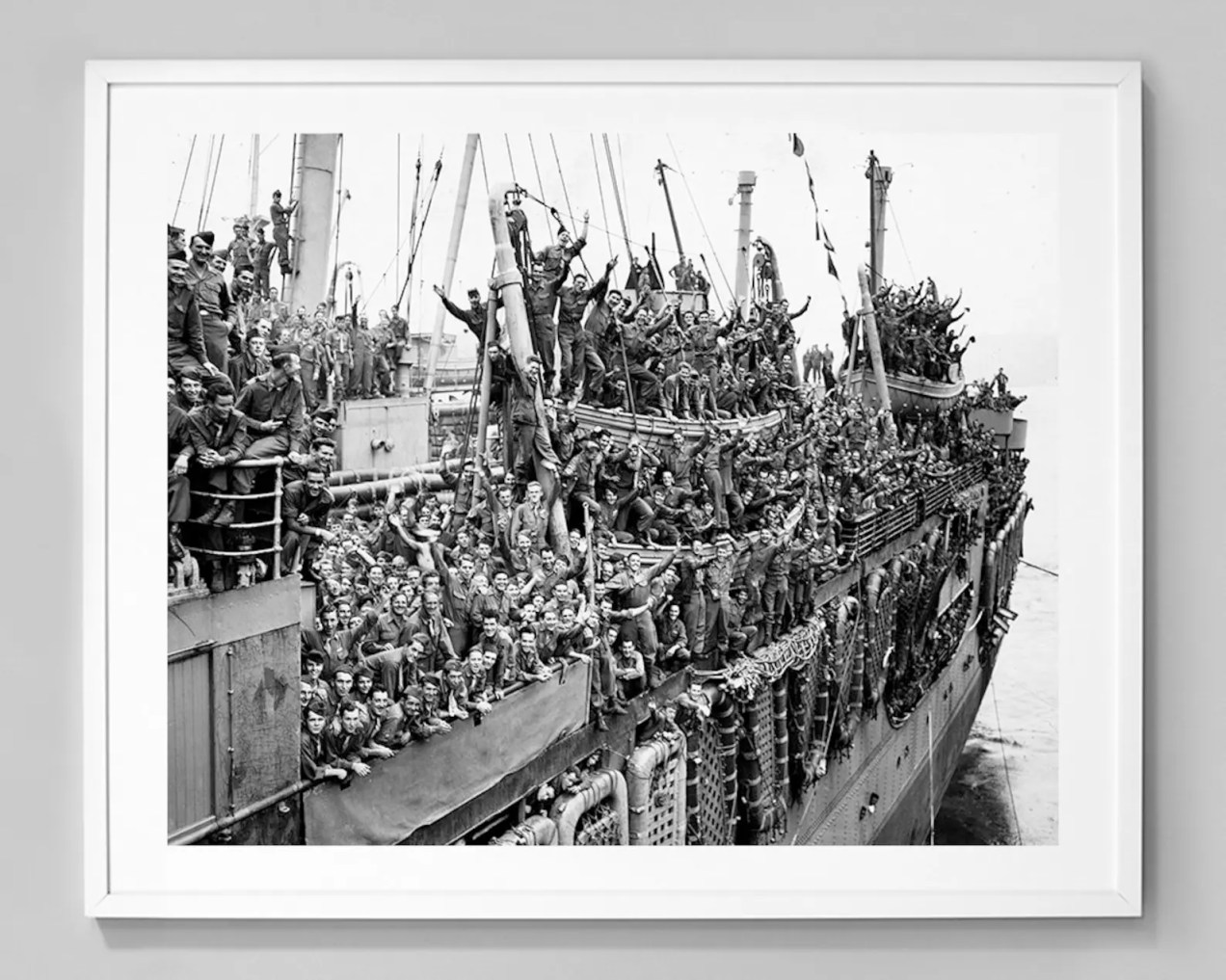
As the shipped nosed her way past Grande Island and the passing of Spanish Point off to Port she entered the Philippine sea where she picked up the two destroyers who were to be her escorts, the Quartermaster put her wheel over to Port and headed south. From the Philippine sea she swung southeast into the Sulu Sea. A 2 day run saw them turn east at the tip of Mindanao Island passing Zamboanga where the monkeys have no tails* then briefly south through the Celebes Sea until the could swing northeast for the open sea. The ship chugged along at 16 knots, her best speed while the escorts sailed in curlicues, on the hunt for submarines because even in June 1945 plenty of Japanese subs were still at sea hunting. Three days into the run to Guam where they were to pick up more casualties and returnees they passed within just a few miles of the spot at which the Japanese sub I-58 put two Long Lance Torpedos into a speeding cruiser which was not zigzaging but running on a plumb line. The Captain, James McVay was rushing to the Philippines to begin training his crew for the invasion of Japan. He was told there were no Japanese submarines in the area and his escorts had failed to appear so the cruiser was running alone.
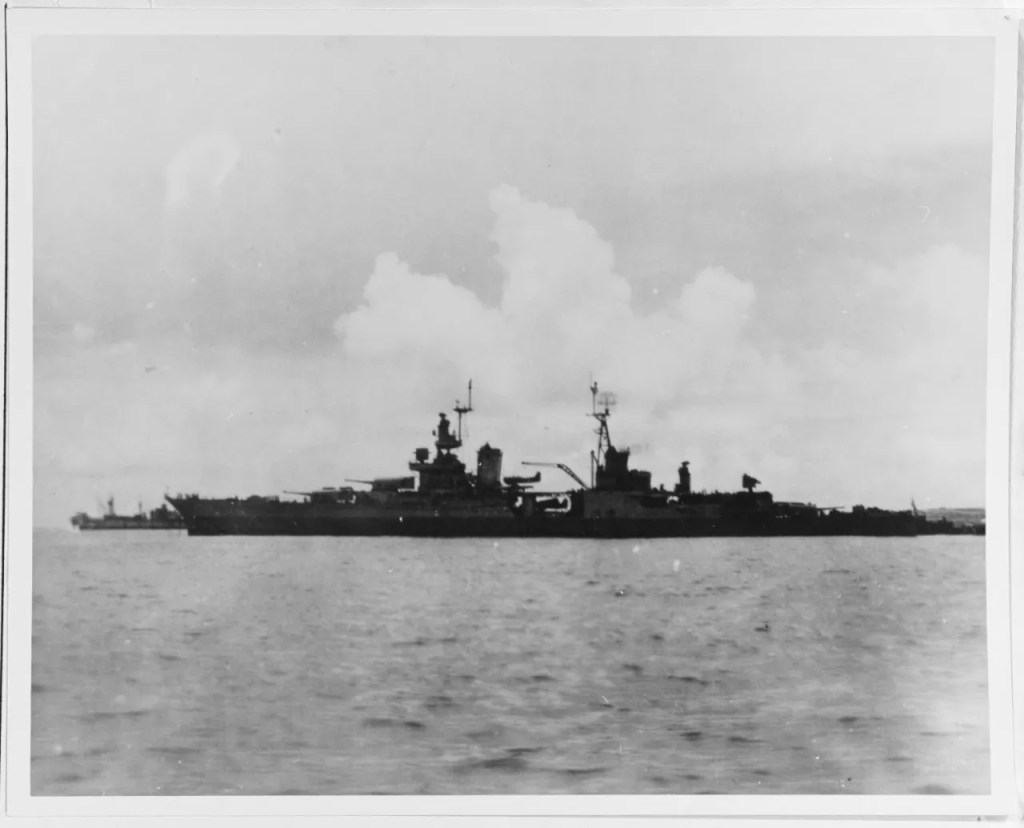
The “Indy” leaving Tinian after off-loading the first Atomic bomb. US Navy photo
USS Indianapolis CA-35, sank in just twelve minutes. Her bow was blown completely off and the second torpedo exploded in the after engine room and set of the main ammunition magazine. Of 1,195 crewmen aboard, about 300 went down with the ship. The after engine room crew boiled alive from escaping high pressure steam or were blown to bits by the explosion. Off duty sailors in the berthing spaces awoke to darkness and massive amounts of seawater which killed them in moments, their screams drowned in horror. The remaining 890 faced exposure, dehydration, saltwater poisoning, and shark attacks while stranded in the open ocean. With few lifeboats and almost no food or water they were eight hundred miles from land.
The Navy learned of the sinking four days later, when survivors were spotted by the crew of a PV-1 Ventura on routine patrol. U.S. Navy PBY flying boats landed in the rough seas to save those in the water. Only 316 survived. No U.S. warship sunk at sea had lost more sailors.**
Hilo and the rest of men aboard had no idea of the awful drama taking place just a few miles away. They wouldn’t know until the war was over either, for the cruiser had just delivered “Little Boy” to Tinian island the first of the atomic bombs which was dropped on Hiroshima City August 6th, 1945. The delivery was part of the biggest secret of WWII and the Indy was sailing under secret orders and radio silence. No SOS was sent from the ship.
The ship pulled in to Guams Apra harbor where she remained at anchor while more returnees and wounded were loaded. Fuel barges pulled alongside and began refilling her fuel bunkers for the long trip ahead. A repair ship floated at her side and lent the crew a hand in fixing or repairing anything on the list they could. Ships at sea are always broken. A welded ship nearly 442 feet long and rated for 10,000 tons of cargo, the Attack Transports suffered constant flexing and pounding while at sea caused all kinds of damage during operations. Though the Navy crew of 58 officers and 480 enlisted crew worked tirelessly to maintain the ship they could never entirely catch up.
Having traveled nearly two thousand miles, food to feed the crew and passengers was in short supply and barges coming out to the anchorage carried mounds of foodstuff which was winched aboard by the cranes on deck and stored away below. The quartermasters department was kept hopping seeing to the loading and storage of hopefully an ample supply for the rest of the voyage. Feeding and housing over 1,500 men and women returning to the states was a monumental job.
All this food was primarily stored in large, refrigerated and dry storage areas and consisted of both fresh and preserved goods. Cooking was done in massive galleys to produce thousands of meals daily for both the crew and the embarked troops. The logistical system was designed to provide as much variety as possible, though the quality and freshness of the food often depended on the length of the voyage and the availability of resupply.
A ship’s galleys were large-scale, industrial kitchens that operated almost continuously to feed the crew. Cooks, “lovingly” referred to a “Cookie” in the U.S. Navy, worked in 24 hour shifts, 8 hours per watch to ensure meals were available for personnel at all hours.
During long periods at sea, the menus would rely more heavily on frozen, canned, and dried ingredients as fresh supplies ran out. This was always a problem on tropical islands where fresh vegetables were seldom available.
The sailors and Marine would look at the twentieth plate of chipped beef on toast and mutter to themselves, “S**t on a Shingle” again? For veterans, any desire to eat it would be long gone by wars end.
Leaving Guam for the west coast there were some things the troops and sailors could rely on. Chow was going to be monotonous. There would be much standing in line with more than two thousand to feed three times a day and by the time they arrived at the coast of California the mess crews would be like the walking dead, exhausted. For the galley crew these Magic Carpet voyages would be some of the hardest duty of the war for which they would receive scant praise. Perhaps a pat on the back from the Chief mess cook. There was little space for physical activity either, it was just too crowded and most of the passengers weren’t inclined to tolerate much spit and polish or discipline. How does the Shore Patrol or the Master at Arms keep them in line? You can guess. The Master at Arms who is the sheriff of the boat picks equally large and aggressive mates for his department and the officers generally turn a blind eye to the obvious bumps and bruises meted out in lieu of Captains Mast. Most Captains think that is a fair trade.
As always, things on A deck where the officers were housed was pretty plush, it was white table cloth, sterling silver and high quality food served by friendly Filipino stewards in white gloves. This increased the enlisted man’s mortal hatred of officers. While those below ate their monotonous meals the officers ate meals that were hardly less elegant than first class passengers had been served in more peaceful days. For supper it was dress whites or Suntans, shoes polished by the same stewards who served them and polite conversation. On some returning ships there were even army and Navy nurses to break the monotony and add to the hatred of the privileged. Most soldiers hadn’t seen an American woman in years and likely wouldn’t see those aboard their own ship.
What infantrymen know is that officers for the most part never share a foxhole with a Dogface. Few officers above Lieutenant ever get any closer to the fighting front than they can avoid. Those that did were revered but they were few. The thousands on the main deck or herded below seethed with bad will at the injustice of it. A famous phrase that came out of WWII concerned “old Blood and Guts” General Patton of whom his own troopers in the 3rd army were wont to say, “Yeah, his guts , our blood.” There are newsreels of him standing up in his staff car, ivory handled pistol on prominent display, speeding down the muddy roads of France, splattering mud on the tired an dirty troopers walking alongside and jauntily wave and pumping his fist in encouragement. Hardly a Doggie bothers to even look up. He slept in a French Chateau with Marlene Dietrich, they slept on the open ground under a dirty wool blanket. Hatred was putting it mildly. A pretty universal sentiment in the military wherever you went.
The last part of the voyage was over 6,000 miles, a quarter way around the globe. The attack transports had been hard used and most had never returned to Mare Island in the San Francisco bay for serious overhauls, they’d had to make do with bandaids and bailing wire. The boiler tubes were warped and caked with scale. Much engine room machinery was just capable of limping along at reduced speed. There were no places in the vast distances they were traveling where they could just pull over. The high speed destroyers racing around on patrol, duty they hated, it was monotonous and crews were frustrated by these voyages. They wanted to get ashore too. The navy was crewed by farm boys, mechanics, shoe salesmen and soda jerks, they were not or ever intended to be lifers. Their officers were reservists and would mostly go ashore once the war was over. Lifers were the men who manned the transport ships, civilian Merchant Mariners who had or would spend a life at sea. They shared the same dangers but the sea was their life.***
In the weeks at sea, Hilo and his mates were not afforded any special accommodations like the trip out in ’42. No more converted ocean liners for them, no private berthing, they were now veterans and their value to the army and marines were well understood. Though the MIS service was classified the people they worked with in the field knew what they did, they had seen them coaxing prisoners out of caves and half-destroyed pill boxes. They had crouched in foxholes with Marines and soldiers while the air buzzed with rifle and machine gun rounds. They had saved thousands of live across the Pacific. They had proven themselves.
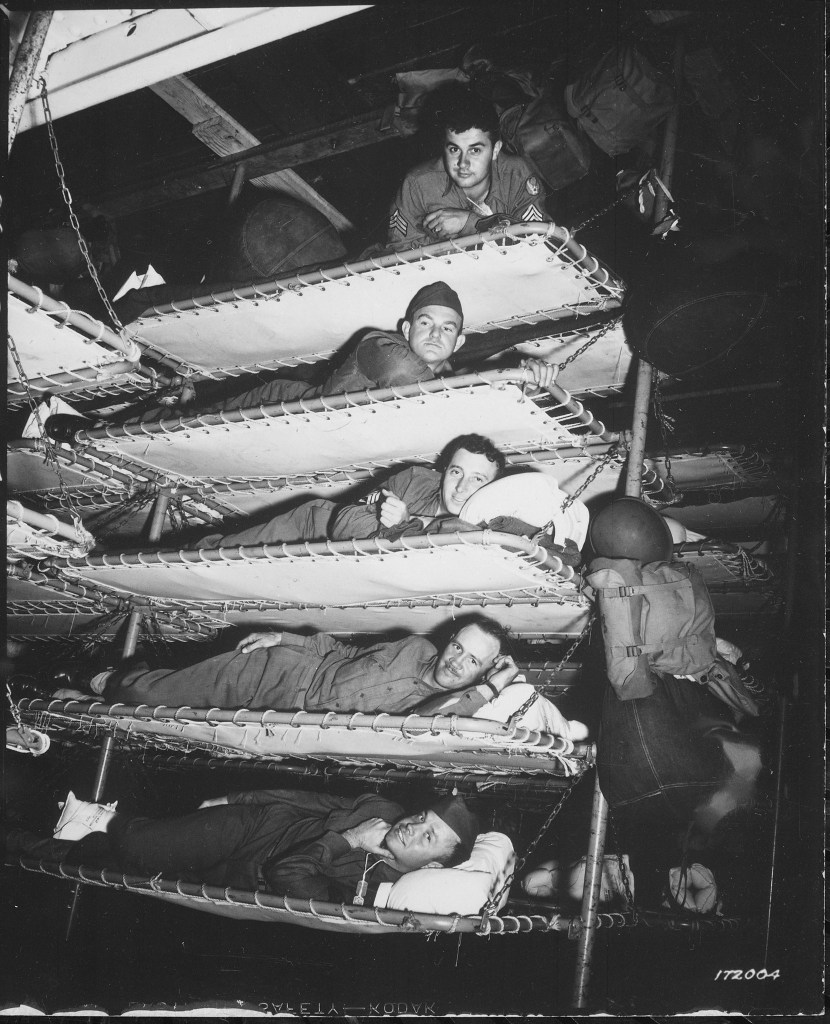
First Class accommodations. USN photo.
The most serious way to pass time at sea in a crowded ship was to sleep, play cards, roll “Dem Bones, or fight, of which there were plenty of takers. Books were rare though the ships had a small library and by the time they pulled into Long Beach Naval Base people were reading the instructions for operating machinery printed on the bulkheads. They read mattress tags, read and re-read letters from home until they literally fell apart, they read each others letters.
Without thinking the were putting away the memory of war and replacing it with the possibilities of the future.
Traveling the southern route in July and early August they were likely spared any serious bad weather but the monsoon in the southern hemisphere generated long swells which traveled north across the equator. smoothing out and lengthening in to long rollers that marched across the mid Pacific like ranks of soldiers. The Pacific or Mar Pacifico, the “Peaceful Sea” can be anything but. Named by Ferdinand Magellan as he crossed the southern hemisphere to his eventual fate in the Philippine islands. He passed day after day on a smooth almost oily ocean with most days, just a faint ripple of wind. The voyage from Patagonia to Guam took three and a half months. To quote Coleridge:****
Day after day, day after day,
We stuck, nor breath nor motion;
As idle as a painted ship
Upon a painted ocean.
Coming at right angles to the ships course they caused her to roll from Port to Starboard and back again. The motion caused some serious sea sickness. The old saying about seasickness is absolutely true. “At the first you think you’re going to die, by the second day you want to die.” By the time the ship reached the vicinity of the west coast near Point Conception on California’s western shore it drifted in a miasma of farts, the odor of unwashed bodies, their clothes and a skim of dried vomit coating her berthing spaces. No one had any desire to linger aboard.
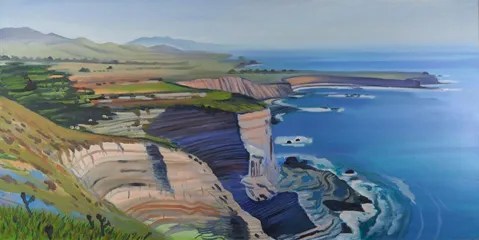
Turning eastward into the Santa Barbara Channel the voyagers could, through the almost ever present fog clinging to Point Conception, poking into the Pacific like spear at the turning of California’s coastline from north-south to east-west, faint as a dream the sere brown and tan hills of home spattered by the greasy green chaparral, the hard dark green of coastal oaks and perhaps best of all the smell of home. Hardened soldiers and sailors were seen to cry.
Point Conception California. Hank Pitcher.
Hilo could not have been an exemption. He had been away for nearly four years. He could not have known exactly what to expect. He did know that the country he was returning to was an unknown place. His family was still in the concentration camp in the Sonoran desert of southwest Arizona, his Arroyo Grande friends scattered to the four winds. Where, exactly was home anymore?
Homecoming.
Page 16 of Dear Dona is next.
Cover Photo: returning troopship, Operation Magic Carpet, 1945
*”The Monkeys Have No Tails in Zamboanga” is the official regimental march of the 27th Infantry Regiment, as the “Wolfhound March”. The lyrics of this official version were written in 1907 in Cuba by G. Savoca, the regimental band leader (died 1912), after the regiment was formed in 1901 to serve in the Philippines. According to Harry McClintock, the tune was borrowed from an official march of the Philippine Constabulary Band, as played at the St. Louis Exposition in 1904. One version was collected as part of the Gordon “Inferno” Collection. As with many folk songs with military origins (such as “Mademoiselle from Armentières” from World War I), the song becomes a souvenir of the campaign for those who served. See below
**In the movie “Jaws,” Quint the shark hunter relates his experience as a survivor of the USS Indianapolis CA-35
***The Merchant Marine suffered the worst losses of World War II. During World War II, the U.S. Merchant Marine suffered high losses, with about 9,521 mariners perishing out of over 243,000 who served, representing a higher percentage casualty rate than any branch of the U.S. military. These losses occurred from enemy submarine, mine, and aircraft attacks, as well as the dangerous elements at sea, with 733 American merchant ships sunk and 609 mariners captured as prisoners of war. The US government ruled that they would receive no veterans benefits though their casualty rate was only slightly less than the Marines. In 1988 partial benefits were offered primarily for schooling but not on the scale of “Combat” veterans. Though sailors serving in wartime take an oath and are paid by the government they were not considered true servicemen. The author served in the Merchant Marine in the early 70’s and shipped with many veterans of WWII. Ask a man who was torpedoed twice in the Pacific if he considers himself a veteran.
****”The Rime of the Ancyent Marinere.” Samuel Taylor Coleridge. Written 1797–98
Oh, the monkeys have no tails in Zamboanga,
Oh, the monkeys have no tails in Zamboanga,
Oh, the monkeys have no tails,
They were bitten off by whales,
Oh, the monkeys have no tails in Zamboanga.
Chorus:
Oh, we won’t go back to Subic anymore,
Oh, we won’t go back to Subic anymore,
Oh, we won’t go back to Subic
Where they mix our wine with tubig, (Water)
and on and on…
Michael Shannon is a Navy veteran and former Merchant Mariner. He lives in Arroyo Grande, California
 atthetable2015